HAL Id: hal-00303197
https://hal.archives-ouvertes.fr/hal-00303197
Submitted on 29 Nov 2007HAL is a multi-disciplinary open access
archive for the deposit and dissemination of sci-entific research documents, whether they are pub-lished or not. The documents may come from teaching and research institutions in France or abroad, or from public or private research centers.
L’archive ouverte pluridisciplinaire HAL, est destinée au dépôt et à la diffusion de documents scientifiques de niveau recherche, publiés ou non, émanant des établissements d’enseignement et de recherche français ou étrangers, des laboratoires publics ou privés.
Investigating the sources and atmospheric processing of
fine particles from Asia and the Northwestern United
States measured during INTEX B
R. E. Peltier, A. H. Hecobian, R. J. Weber, A. Stohl, E. L. Atlas, D. D.
Riemer, D. R. Blake, E. Apel, T. Campos, T. Karl
To cite this version:
R. E. Peltier, A. H. Hecobian, R. J. Weber, A. Stohl, E. L. Atlas, et al.. Investigating the sources and atmospheric processing of fine particles from Asia and the Northwestern United States measured during INTEX B. Atmospheric Chemistry and Physics Discussions, European Geosciences Union, 2007, 7 (6), pp.17429-17474. �hal-00303197�
ACPD
7, 17429–17474, 2007
Sources and processing of aerosol
from Asia and NW USA R. E. Peltier et al. Title Page Abstract Introduction Conclusions References Tables Figures ◭ ◮ ◭ ◮ Back Close
Full Screen / Esc
Printer-friendly Version Interactive Discussion
Atmos. Chem. Phys. Discuss., 7, 17429–17474, 2007 www.atmos-chem-phys-discuss.net/7/17429/2007/ © Author(s) 2007. This work is licensed
under a Creative Commons License.
Atmospheric Chemistry and Physics Discussions
Investigating the sources and
atmospheric processing of fine particles
from Asia and the Northwestern United
States measured during INTEX B
R. E. Peltier1,*, A. H. Hecobian1, R. J. Weber1, A. Stohl2, E. L. Atlas3, D. D. Riemer3, D. R. Blake4, E. Apel5, T. Campos5, and T. Karl5
1
Georgia Institute of Technology, School of Earth and Atmospheric Science, Atlanta, GA 30332-0340, USA
2
Norwegian Institute for Air Research, 2027 Kjeller, Norway
3
University of Miami, Rosenstiel School of Marine and Atmospheric Science, Miami, FL 33149-1098, USA
4
Department of Chemistry, University of California Irvine, Irvine, CA, 92697-2025, USA
5
National Center for Atmospheric Research, Atmospheric Chemistry Division, Boulder, CO 80307, USA
*
now at: Dept. of Environmental Medicine, NYU School of Medicine, Tuxedo, NY 10987, USA Received: 16 November 2007 – Accepted: 19 November 2007 – Published: 29 November 2007
Correspondence to: R. E. Peltier ([email protected])
ACPD
7, 17429–17474, 2007
Sources and processing of aerosol
from Asia and NW USA R. E. Peltier et al. Title Page Abstract Introduction Conclusions References Tables Figures ◭ ◮ ◭ ◮ Back Close
Full Screen / Esc
Printer-friendly Version Interactive Discussion
Abstract
During the National Aeronautics and Space Administration (NASA) Intercontinental Chemical Transport Experiment, Phase B (INTEX-B), in the spring of 2006, airborne measurements were made in the United States Pacific Northwest of the major inor-ganic ions and the water-soluble orinor-ganic carbon (WSOC) of submicron (PM1.0) aerosol.
5
An atmospheric trajectory (Hysplit) and a Lagrangian particle dispersion model (Flex-part) quantifying source contributions for carbon monoxide (CO) was used to segregate air masses into those of primarily Asian influence (>75% Asian CO) or North Ameri-can influence (>75% North AmeriAmeri-can CO). Of the measured compounds, fine particle mass mostly consisted of water-soluble organic carbon and sulfate, with highest
me-10
dian WSOC and sulfate concentrations in North American air masses. The fraction of WSOC to sulfate was significantly lower than one at altitudes above 3 km, opposite to what has been observed closer to Asia and in the northeastern United States, where organic components were at higher concentrations than sulfate in the free troposphere. The observations could be explained by loss of sulfate and organic aerosol due to
pre-15
cipitation scavenging, with reformation of mainly sulfate during advection from Asia to North America. WSOC sources were investigated by multivariate linear regression analyses of WSOC and volatile organic compounds (VOCs). In Asian air masses, of the WSOC variability that could be explained (49%), most were related to fossil fuel combustion VOCs, compared to North American air masses, where 75% of the WSOC
20
variability was explained through a nearly equal combination of fossil fuel combustion and biogenic VOCs. Distinct WSOC plumes encountered during the experiment were also studied. A plume observed near the California Central Valley at 0.6 km altitude was related to both fossil fuel combustion and biogenic VOCs. Another Central Valley plume observed over Nevada at 3 to 5 km, in a region of cloud detrainment, was mostly
25
related to biogenic VOCs.
ACPD
7, 17429–17474, 2007
Sources and processing of aerosol
from Asia and NW USA R. E. Peltier et al. Title Page Abstract Introduction Conclusions References Tables Figures ◭ ◮ ◭ ◮ Back Close
Full Screen / Esc
Printer-friendly Version Interactive Discussion
1 Introduction
Expanding arid regions and biomass burning in Asia, along with the rapid industrial-ization of China, has led to emissions from the Asian continent that are a significant global source of tropospheric aerosols (Streets, 2007; Streets et al., 2003; Streets and Waldhoff, 2000). Numerous studies have investigated the long range transport of
5
Asian mineral dust and pollution (Huebert et al., 2003, and references therein, Jaffe, 1999 #306; Jaffe et al., 2003, 2005; Bertschi and Jaffe, 2005), including extensive air-borne measurements made near the Asian coast during the ACE-Asia (Huebert et al., 2003) and TRACE-P (Jacob et al., 2003) research campaigns in the spring of 2001. Other studies have examined transported Asian aerosol as they approached the North
10
American continent (Park et al., 2003; de Gouw et al., 2004; Jaffe et al., 2005; Heald et al., 2005).
Airborne measurements during TRACE-P and ACE-ASIA of fine particle chemical composition identified both relatively pure plumes and mixed plumes of mineral dust, biomass burning, and anthropogenic emissions. Biomass burning plumes consisted
15
of fine particle ammonium, nitrate, water-soluble potassium, as well as organic car-bon and elemental carcar-bon (Ma et al., 2003). Anthropogenic plumes were comprised mainly of sulfate and nitrate, with associated ammonium (Lee et al., 2003), and car-bonaceous material that was mainly organic carbon (OC) (Huebert et al., 2004a; Maria et al., 2003). From soundings conducted off the coast of Asia, sulfate concentrations
20
on average dropped from ∼4 µg sm−3 near the surface to less than 1 µg sm−3 in the free troposphere. Elemental carbon (EC) had a similarly shaped profile (see Heald et al., 2005 and references therein). In contrast, OC concentrations ranged from on average ∼4 to 5 µgC sm−3 and were fairly uniform from the surface up to the upper measurement range of 6 to 7 km above sea level (asl). This resulted in mass ratios of
25
organic carbon to sulfate of near one below ∼2 km a.s.l., but ratios of 3 to 4 in the 3 to ∼6 km a.s.l. altitude range. Similar types of aerosol chemical components were ob-served in the anthropogenic-influenced Northeastern United States measured during
ACPD
7, 17429–17474, 2007
Sources and processing of aerosol
from Asia and NW USA R. E. Peltier et al. Title Page Abstract Introduction Conclusions References Tables Figures ◭ ◮ ◭ ◮ Back Close
Full Screen / Esc
Printer-friendly Version Interactive Discussion
ICARTT (Peltier et al., 2007a), and a similar altitude profile of organic carbon to sulfate was observed. These and other studies have demonstrated the importance of OC in the free troposphere.
Numerical simulations aimed at understanding the sources and atmospheric pro-cessing of sulfate and organic carbon in these two study domains demonstrated
limi-5
tations with current understandings of OC sources and processing (Heald et al., 2005; Heald et al., 2006). For the ACE-ASIA study, sulfate and EC were well predicted by GEOS-Chem, but OC was significantly under predicted, indicating unknown and unac-counted for OC sources (Heald et al., 2005). For the eastern United States ICARTT data, the OC mass (actually the mass of water-soluble OC) was predicted fairly well
10
by GEOS-Chem, but not the spatial distribution, suggesting a poor understanding of atmospheric processing.
A number of other recent studies have also demonstrated a general lack of under-standing of OC sources and processing in regions impacted by urban anthropogenic emissions (de Gouw et al., 2005; Johnson et al., 2006; Volkamer et al., 2006; de Gouw
15
et al., 2007). These studies indicated there is a significant yet unknown anthropogenic route for secondary organic aerosol production. OC is a substantial fraction of fine particle aerosol mass and a poor understanding of its sources and processing hinders development of strategies to improve air quality and assess its role in global climate. Understanding OC has been impeded by its chemical complexity, in part due to its
20
many sources, ranging from biogenic to anthropogenic emissions that produce both primary or secondary particles (Jacobson et al., 2000; Rogge et al., 1993; Seinfeld and Pankow, 2003; Turpin et al., 2000).
A subset of OC is the fraction that is water-soluble. So-called water-soluble organic carbon (WSOC) is of interest since it may have unique and important health effects
25
and indirect impacts on the planetary radiation balance. Studies focused on WSOC can also reduce the complexity of the carbonaceous aerosol and provide new insights. WSOC has two main sources; biomass burning and secondary organic aerosol for-mation (Huang and Yu, 2007; Huang et al., 2006; Weber et al., 2007; Sullivan et al.,
ACPD
7, 17429–17474, 2007
Sources and processing of aerosol
from Asia and NW USA R. E. Peltier et al. Title Page Abstract Introduction Conclusions References Tables Figures ◭ ◮ ◭ ◮ Back Close
Full Screen / Esc
Printer-friendly Version Interactive Discussion
2006) WSOC comprises typically 30–80% (gC/gC) of OC, with lowest ratios gener-ally recorded near sources with large primary emissions and highest ratios in aged air masses (Decesari et al., 2001; Jaffrezo et al., 2005; Zappoli et al., 1999).
In the spring of 2006, airborne measurements were made of the major inorganic ions and the water-soluble organic carbon (WSOC) of submicron (PM1.0) aerosol with the
5
goal to study the impact of transported Asian emissions on the Northwestern United States. This research was part of the National Aeronautical Space Administration (NASA) Intercontinental Chemical Transport Experiment, Phase B (INTEX-B). The Na-tional Center for Atmospheric Research (NCAR) C130 research aircraft participated in this study, and was based at Paine Field in Everett, Washington, (47.91◦N, −122.28◦).
10
The C130 conducted 10 research flights (plus two transit flights) that intercepted emis-sions mainly from Asia as they approached the North American continent. Research flights were conducted from 21 April 2006 to 15 May 2006. Altitude range of the air-craft extended from ∼0.1 km to ∼7.3 km a.s.l., with a nominal flight range of ∼1300 kilometers from base. Instruments deployed on the NSF C130 pertinent to this study
15
are discussed in the following section.
2 Methods
Fine particle bulk chemical composition was measured online from the C130 with two automated systems, each involving a Particle-Into-Liquid Sampler (PILS). The PILS quantitatively transfers ambient aerosol into a liquid stream that can then be analyzed
20
for specific aerosol chemical components. One PILS was coupled to two Metrohm® Ion Chromatographs (Model 761, Houston, TX), while the second was coupled to a Sievers Total Organic Carbon analyzer (GE Water Systems, Model 800T, Boulder, CO). The first instrument package is referred to as PILS-IC (ion chromatography), and the second as PILS-TOC (total organic carbon). Detailed descriptions of these instruments
25
have been published (Orsini et al., 2003; Peltier et al., 2007a; Weber et al., 2001) (Sullivan et al., 2006; Sullivan et al., 2004). Aerosol was sampled with a constant flow
ACPD
7, 17429–17474, 2007
Sources and processing of aerosol
from Asia and NW USA R. E. Peltier et al. Title Page Abstract Introduction Conclusions References Tables Figures ◭ ◮ ◭ ◮ Back Close
Full Screen / Esc
Printer-friendly Version Interactive Discussion
nominally isokinetic inlet, following the design of Clarke and coworkers (Huebert et al., 2004b), and was located on the underside of the aircraft roughly three quarters of the way aft in the free air stream. This inlet was shared with an Aerosol Mass Spectrometer that extracted a portion of flow upstream of the PILS from the centerline of the 1 inch OD sample transport tube. Aerosol was then passed through a non-rotating
multi-5
orifice impactor (Marple et al., 1991) that had a nominal particle cut size of 1.0 µm at 1 atmosphere. Sample temperature, relative humidity, and pressure were measured, and the sample then divided equally using a “Y” to each PILS operating at ∼15 L/min. 2.1 PILS-IC
The PILS-IC was operating using a 2.45 minute cation and 75 second anion
chro-10
matographic separation. For cation separation, a “Cation 1-2” resin column (Metrohm-Peak, Houston, TX) was used. Over a 90 s period, PILS effluent was pumped through a 150 µl sample loop for injection onto the column. Eluent with concentrations of 8.5 mM L-tartaric acid and 4.1 mM dipicolinic acid was used to isocratically separate cationic components: sodium, ammonium, calcium, potassium, and magnesium. For
15
this setup, cation limits of detection (LOD) for each species were 0.1 µg sm−3, with the exception of potassium ion with LOD 0.5 µg sm−3. A “Metrosep Dual 4–25” monolithic column (Metrohm-Peak, Houston, TX) was used for anion separation. Aerosol sample was continually collected over 60 s in a 90 µl sample loop and injected into the column. Eluent of 12.0 mM p-cyanophenol, pH adjusted (with 1.0N LiOH) to 7.80±0.05
isocrat-20
ically separate chloride, nitrate, and sulfate. With PILS liquid flow rates used for this anion setup, limits of detection were chloride 0.1 µg sm−3, nitrate 0.02 µg sm−3, and sulfate 0.02 µg sm−3.
The resulting time interval for one PM1.0 ion composition measurement was a 90-s integrated sample every 2.45 min for cations, and a 60-s integrated sample every 75 s
25
for anions. All concentrations have been converted to a standard temperature and pressure (273.15◦K, 1013.25 hPa).
A carbon monolith denuder and a set of etched glass honeycomb denuders coated 17434
ACPD
7, 17429–17474, 2007
Sources and processing of aerosol
from Asia and NW USA R. E. Peltier et al. Title Page Abstract Introduction Conclusions References Tables Figures ◭ ◮ ◭ ◮ Back Close
Full Screen / Esc
Printer-friendly Version Interactive Discussion
with citric acid and sodium carbonate were located immediately upstream of the PILS-IC to eliminate gas interferences. Before each flight, a valve diverted sampled aerosol through a HEPA filter for quantification of backgrounds. Sulfate was the only ionic compound measured with detectable background interference, which was generally constant at 0.015 µg l−1 (equivalent to ambient aerosol concentration of ∼10 ng sm−3).
5
The sulfate background was subtracted from the dataset.
The ion chromatographs were calibrated using known dilutions of NIST-traceable ion standards. Linear calibration curves forced through zero were established using five different standards of anions and cations that bracketed the expected range of con-centrations typically observed for the flow rates employed and the estimated ambient
10
aerosol concentration. Both cation and anion systems were calibrated using all five standards at the beginning and middle of the research mission. The anion column was also challenged with a single standard before most flights to verify peak retention time (which was very sensitive to eluent concentration and temperature), as well as peak area. At the end of the mission, the anion column calibration was re-verified;
unfortu-15
nately, the cation column failed during the last local flight and could not be calibrated. Sensitivity changed by less than ∼5% throughout the duration of the mission for the anion and cation systems, based on the series of calibrations.
2.2 PILS-TOC
A second PILS coupled to a Sievers Total Organic Carbon analyzer quantified
20
PM1.0 WSOC. The PILS was operated to produce a total sample liquid flow rate of 1.2 ml min−1. Following the removal of entrained gas bubbles in the liquid sample, this PILS effluent was aspirated by two glass syringe pumps working in alternating tandem to achieve continuous flow and pumped through a 0.5 µm PEEK filter. Liquid sample was re-equilibrated with cabin pressure by using an inline sample line “tee” with one
25
leg open to cabin air. Most of this sample (1.0 ml/min) was then drawn into the TOC analyzer via its internal peristaltic pump.
The TOC analyzer converts carbonaceous material to CO2 (carbon dioxide), and 17435
ACPD
7, 17429–17474, 2007
Sources and processing of aerosol
from Asia and NW USA R. E. Peltier et al. Title Page Abstract Introduction Conclusions References Tables Figures ◭ ◮ ◭ ◮ Back Close
Full Screen / Esc
Printer-friendly Version Interactive Discussion
measures the evolved CO2 by conductivity. Oxidation of organic compounds was achieved by acidifying the sample, and then applying a combination of chemical (am-monium persulfate, 15% w/w, flow rate = 1.5 µl min−1) and UV (ν=184 and 254 nm) oxidation. Tests show that no EC and no insoluble OC larger than ∼0.1 µm can be quantified with this TOC (Peltier et al., 2007b). The instrument was operated in “Turbo”
5
mode to provide a 3-s integrated measurement every 3 s. All concentrations have been converted to standard temperature and pressure (273.15◦K, 1013.25 hPa).
Immediately upstream of the PILS-TOC, the sample was passed through an acti-vated carbon parallel plate denuder (Eatough et al., 1999) to remove organic gases. During each flight, a computer-actuated valve was triggered every three hours to divert
10
sample flow through a Teflon filter for a dynamic blank measurement. In general, be-fore aircraft take off, and just after aircraft landing, the filter system was also manually triggered for blank measurements and to limit contamination associated with aircraft maneuvering while taxiing. A linear interpolation of consecutive blanks was calculated and subtracted from the online dataset to determine ambient WSOC concentrations.
15
Though the instrument is factory calibrated, additional calibrations using 4 different con-centrations of oxalic acid was conducted before and after the research mission. Near the middle of the mission, a single calibration standard was measured to verify analyzer sensitivity. In each case, analyzer sensitivity was within 5% of factory calibration.
To provide an assessment of instrument accuracy, measurements of identical
20
species made on the NSF C-130 and NASA DC-8 research aircraft were compared during periods of formation flying. A blind intercomparison from flight 12 (15 May 2006) showed that fine particle sulfate measured online with a mist chamber on the DC-8 was essentially identical to fine particle sulfate measured by the PILS-IC on the C130 (slope: 1.00, 1σ=0.03 µg sm−3, range 0.25 to 1.15 µg sm−3; n=40). The PILS-WSOC
25
was only operated on the C130 and thus could not be compared with a similar instru-ment on the DC-8.
ACPD
7, 17429–17474, 2007
Sources and processing of aerosol
from Asia and NW USA R. E. Peltier et al. Title Page Abstract Introduction Conclusions References Tables Figures ◭ ◮ ◭ ◮ Back Close
Full Screen / Esc
Printer-friendly Version Interactive Discussion
2.3 Other instrumentation
Additional instrumentation used in this work included a CO monitor using a modified UV resonance fluorescence instrument for 1Hz measurements of carbon monoxide (CO). The Trace Organic Gas Analyzer (TOGA) (Apel et al., 2003) was employed to measure a suite of 33 oxygenated volatile organic compounds that included: carbonyls,
alco-5
hols, and C2-C8 nonmethane hydrocarbons. TOGA is a fast gas chromatograph-mass spectroscopy (GC/MS) that provides a 45-s integrated measurement every ∼2.5 min. In addition, a variety of organic carbon compounds were detected by whole air sam-pling (WAS). These samples were subsequently analyzed by gas chromatography, mass spectrometry, flame ionization detection, or electron capture detection,
depend-10
ing on species measured. An onboard Proton Transfer Reaction-Mass Spectrometer (PTRMS) (de Gouw et al., 2003; Lindinger et al., 1998) quantified a variety of organic compounds, including hydroxyacetone and acetic acid. The sampling interval of this instrument was ∼33 s. Water vapor mixing ratio was measured at 1Hz by an onboard hygrometer. Physical measurements, such as altitude and latitude/longitude were
pro-15
vided by the C130 standard instrumentation package.
2.4 Identifying air mass sources
Various sources of measured anthropogenic species were identified with Flexpart, a Lagrangian particle dispersion model (Stohl et al., 1998; Stohl et al., 2005). Flexpart backward runs were conducted whenever the aircraft changed latitude or longitude by
20
0.18 degrees, or when the aircraft altitude changed by ∼8–15 hPa. In general, Flexpart runs were completed every ∼30–60 s for all research flights.
The Flexpart model provides estimates for the fraction of anthropogenic CO, SO2, and NO2from the following continents: Asia, North America, Australia, South America, and Europe. The calculations treated these substances as inert tracers, i.e., no
depo-25
sition processes or chemical conversions were accounted for. The results, thus, reflect the accumulated emissions that entered the air mass during the 20 days the model
ACPD
7, 17429–17474, 2007
Sources and processing of aerosol
from Asia and NW USA R. E. Peltier et al. Title Page Abstract Introduction Conclusions References Tables Figures ◭ ◮ ◭ ◮ Back Close
Full Screen / Esc
Printer-friendly Version Interactive Discussion
was run backward from the observation locations. The emissions were taken from the EDGAR 3.2 Fast Track 2000 global inventory (Olivier and Berdowski, 2001), except for North America where the emissions were based on the point, on-road, non-road and area sources from the U.S. EPA National Emissions Inventory, base year 1999 with updates for 2005, with spatial partitioning of area sources at 4 km resolution (Frost et
5
al., 2006).
In this analysis, when Asian CO (as determined by Flexpart) exceeded 75% of total Flexpart-predicted CO, the air mass was presumed to consist of mainly Asian emis-sions. When North American CO exceeded 75% of total CO, the air mass was consid-ered to be influenced mainly by North American sources. CO was chosen as a tracer
10
because of the three anthropogenic species Flexpart predicts (CO, NO2, SO2), CO is likely the most inert on the time scales of interest here, and hence best tracer to iden-tify long range transport. On average, CO from North America and Asia accounted for
>90% of total CO that was predicted by the model, indicating little influence from other continental sources. Of the 6078 Flexpart model runs analyzed, ∼48% (n=2931) were
15
delineated as influenced by Asian pollution, ∼12% (n=704) were mainly influenced by North American sources of CO, and the remaining ∼40% were not dominated by either source. For air masses identified as mainly influenced by Asia or North America, mea-sured CO mixing ratio during this mission was greater than 100ppbv in 93% and 97% of the observations, respectively. Thus, in cases that were identified using model results
20
as influenced by Asia or North America, most cases had significant enhancements above background levels of CO and were only minimally affected by low concentration (e.g., background) observations. In the following, Asian, North American, and all data are analyzed.
3 Results
25
During the experiment, each research flight had defined objectives that depended on a variety of factors, including meteorological conditions, satellite overpass schedules,
ACPD
7, 17429–17474, 2007
Sources and processing of aerosol
from Asia and NW USA R. E. Peltier et al. Title Page Abstract Introduction Conclusions References Tables Figures ◭ ◮ ◭ ◮ Back Close
Full Screen / Esc
Printer-friendly Version Interactive Discussion
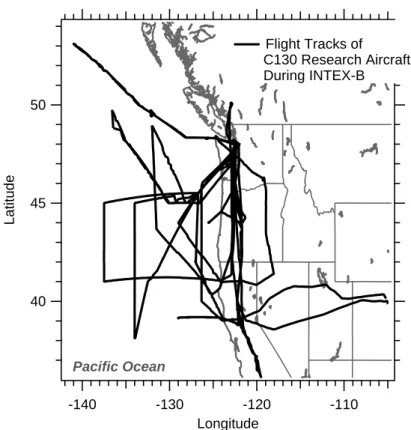
coordination with research flights of other aircraft involved in the INTEX campaign, and most importantly, model simulation predictions on the locations of Asian plumes. Fig-ure 1 shows the sampling region. Because most INTEX-B research flights focused on measurements within aged plumes from Asia, the data are not statistically representa-tive of local aerosol climatology; rather it represents measurements weighed by a focus
5
on aged Asian air masses. On several occasions, specific plumes that were identified to be mainly influenced by more local sources in North America were encountered. These are analyzed as a subset of the North American data set.
3.1 Aerosol composition by continental source
Measured concentrations were generally log-normally distributed and so
geomet-10
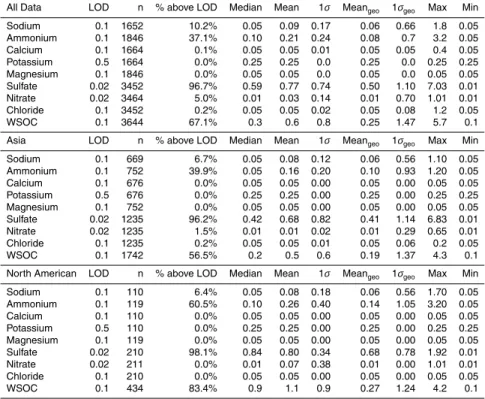
ric means and standard deviations are included in the analysis. Of measured components, PM1.0 mainly consisted of sulfate and then water-soluble organic car-bon, as summarized in Table 1. For all data, median sulfate concentration (±1σ) was 0.59±0.74 µg sm−3, and median WSOC was 0.3±0.8 µgC sm−3. Median am-monium concentration was at the detection limit, though mean concentration was
15
0.2±0.2 µg sm−3. Sodium ion was above the detection limit for just 10.2% of obser-vations, and nitrate ion was above the detection limit 5.0% of the time. Calcium and chloride ion were above the detection limit just 0.1% and 0.2%, respectively, and potas-sium and magnepotas-sium ions were not detected during the field campaign. The lack of sea-salt and mineral dust components is consistent with a PM1.0 measurement, since
20
these compounds are mostly observed in supermicron particle sizes (Fitzgerald, 1991). Contrasting air masses with mainly Asian CO sources to North American sources of CO shows that generally both sulfate and WSOC were higher in North American air masses. Median sulfate concentration was 0.84 µg sm−3in North American plumes and 0.42 µg sm−3 in Asian plumes, with substantially more variability in Asian sulfate
25
concentrations (range: LOD to 6.83 µg sm−3in Asian plumes; LOD to 1.92 µg sm−3 in North American plumes). This is consistent with large Asian point sources of SO2. It is noted, however, that our method of identifying North American emissions, based on
ACPD
7, 17429–17474, 2007
Sources and processing of aerosol
from Asia and NW USA R. E. Peltier et al. Title Page Abstract Introduction Conclusions References Tables Figures ◭ ◮ ◭ ◮ Back Close
Full Screen / Esc
Printer-friendly Version Interactive Discussion
CO, tends to focus on urban sources located near the west coast of the United States where there are relatively few SO2sources.
In contrast to sulfate, median WSOC was a factor of 4 times higher in North American air masses (Table 1) than Asian air masses. Highest concentrations of WSOC could be traced with Flexpart to air masses from the Central Valley of California, as well as
5
the immediate vicinity of Seattle. Not considering these plumes of highest WSOC con-centration, North American plumes still had generally much higher WSOC than Asian plumes (median WSOC without Central Valley or Seattle plumes was 0.5 µgC sm−3). California Central Valley plumes are analyzed further in Sect. 3.4. Plumes from Seat-tle are not investigated because interceptions were sporadic, recorded briefly during
10
take-off and landing when many instruments were not operational.
Ammonium ion concentration was a factor of two higher in North American air masses compared to Asian air masses. Lastly, mean nitrate (median values are be-low the LOD) ion concentration in North American plumes (0.07 µg sm−3) was 7 times higher than observed in Asian air masses (0.01 µg sm−3, Table 1), though nitrate was
15
only infrequently observed above LOD for Asia interceptions (1% of measurements were above LOD).
Most of the observations of sulfate and WSOC were representative of more regional conditions. This was especially true for the North American air masses. The ratio of mean to median concentration can provide some indication to the extent of large
20
anomalous plumes in the data set. Interceptions of unique plumes with concentrations significantly above the regional values would lead to mean/median ratios significantly larger than 1. Asian sulfate and WSOC had mean/median ratios of 1.6 and 2.5, re-spectively, whereas North American air masses had ratios of 0.95 (sulfate) and 1.2 (WSOC). In both Asian and North American air WSOC and sulfate were not correlated
25
(r2<0.03), suggesting different sources and atmospheric processing.
ACPD
7, 17429–17474, 2007
Sources and processing of aerosol
from Asia and NW USA R. E. Peltier et al. Title Page Abstract Introduction Conclusions References Tables Figures ◭ ◮ ◭ ◮ Back Close
Full Screen / Esc
Printer-friendly Version Interactive Discussion
3.2 Altitude profiles of WSOC and sulfate
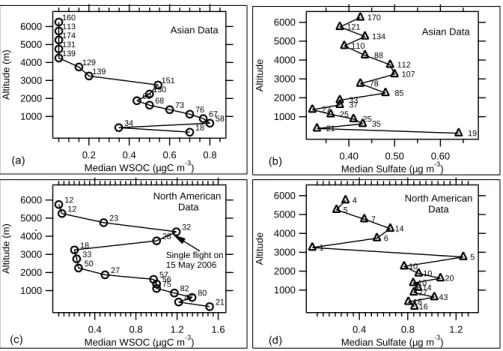
To provide a more detailed comparison on the distribution of aerosol composition, and for comparison with other studies, the median WSOC and sulfate altitude profiles are plotted for the Asian and North American air masses. Data were binned into 250 m intervals below 2500 m, and 500 m intervals above this altitude.
5
3.2.1 Asian WSOC and sulfate
As observed in other locations, Asian air mass WSOC concentrations were highest near the surface. The median WSOC below 3 km was ∼0.4–0.8 µgC sm−3, whereas above this altitude WSOC concentration rapidly decreased to below the limit of detec-tion (0.1 µgC sm−3). Measurements of OC on the Asian coast during ACE-ASIA were
10
very different. Huebert et al. (2004a) measured relatively constant OC concentration with altitude, while Maria et al. (2003) measured slightly decreasing concentrations with altitude. In both cases, the OC concentration at higher altitudes ranged from ∼2– 10 µgC sm−3, or approximately 10–20 times higher than WSOC observations at any altitude in our Asian air mass. A number of possibilities may explain the difference.
15
The organic carbon measured in our study may not have been highly soluble and so not detected as WSOC (OC was measured in ACE-ASIA). Emissions from Asia could have been substantially different for these two different study periods. The organic carbon aerosol may have been substantially diluted during transport, or the organic carbon was lost through, for example, precipitation scavenging.
20
It is unlikely that most of the OC remained insoluble since the air masses were well aged with transport times greater than ∼7 days. Aged air has ratios of oxygenated organic matter to total organic matter, and hence WSOC/OC, typically near 1.0 (Zhang et al., 2007). Asian emissions have, if anything, increased in the last few years, so dif-ferences in emission cannot likely account for the factor of 10 to 20 lower WSOC
mea-25
sured along the western United States coast. This is further supported by comparisons of CO, an approximately inert tracer for anthropogenic or biomass burning sources on
ACPD
7, 17429–17474, 2007
Sources and processing of aerosol
from Asia and NW USA R. E. Peltier et al. Title Page Abstract Introduction Conclusions References Tables Figures ◭ ◮ ◭ ◮ Back Close
Full Screen / Esc
Printer-friendly Version Interactive Discussion
the time scales considered here. CO recorded from the NASA P-3B aircraft (simi-lar operating altitude range as the NSF C130 of ACE-ASIA) during TRACE-P (held nominally concurrent with ACE-ASIA) had mean CO of 178.3 ppb (1σ=±89.3 ppbv), and median CO was 158.6 ppbv (range: 67–808 ppbv), whereas in this study, INTEX-B Asian air masses had mean CO of 130.7 ppbv (1σ=±23.9 ppbv), and median CO
5
was 133.1 ppbv (range: 72–316 ppbv). Assuming a springtime background concentra-tion of CO as 100 ppbv, and that emissions from Asia have not substantially changed since Trace-P, this very roughly suggests that pollutant concentrations decreased by a factor of 3 or less by dilution from transport across the Pacific (i.e., (mean TRACE-P CO minus background CO)/(mean INTEX-B CO minus background CO), or (178 ppb–
10
100 ppb)/(131 ppbv–100 ppbv)). Based on these arguments it seems reasonable that loss in transport is a major cause for the relatively low WSOC concentrations observed in Asian air masses during INTEX-B.
In contrast to WSOC, sulfate aerosol concentrations in the Asian plumes recorded near North America were relatively constant across the sampled altitude range.
Fig-15
ure 2 shows that at altitudes below 3 km, median sulfate concentration was typically 0.35–0.50 µg sm−3. At higher altitudes, median sulfate was 0.40–0.45 µg sm−3. These concentrations are substantially different than what was observed by Lee and cowork-ers (2003) near the Asian continent, where 8–10 µg sm−3of sulfate was recorded near the surface and a rapid decrease to ∼1–2 µg ssm−3 above 4 km. Although the vertical
20
profile is somewhat similar, again concentrations appear to be significantly lower after advection, likely due to dilution and loss.
3.3 North American WSOC and sulfate
A somewhat similar altitude profile for WSOC was observed when the data is re-stricted to plumes mainly of North American influence. Overall, WSOC
concentra-25
tion decreased with increasing altitude. Below 2 km, WSOC concentration was ∼1.0– 1.5 µgC sm−3 and was mainly due to local Seattle emissions observed during takeoff and landing approaches, as well as some incidental air traffic control transiting near
ACPD
7, 17429–17474, 2007
Sources and processing of aerosol
from Asia and NW USA R. E. Peltier et al. Title Page Abstract Introduction Conclusions References Tables Figures ◭ ◮ ◭ ◮ Back Close
Full Screen / Esc
Printer-friendly Version Interactive Discussion
Seattle. A distinct increase in WSOC concentration was observed between 3–5 km. These data were recorded on a single flight that occurred on 15 May 2006 near Nevada, USA and was due to air masses from the California Central Valley (this plume is dis-cussed more in Sect. 3.4). At altitudes above ∼5 km, WSOC concentration decreased to approximately 0.1 µgC sm−3. This is higher than similar altitude WSOC
concentra-5
tions in Asian air masses, which were below the LOD of 0.1 µgC sm−3, but similar to the WSOC concentrations of ∼0.3 µgC sm−3 at ∼5 to 6 km altitude reported by Peltier et al. (2007a) near the Northeastern United States.
For sulfate aerosol, North American air masses were characterized by fairly uniform concentrations below 3 km altitude (∼0.8–1.0 µg sm−3), and significantly lower
concen-10
trations above 3 km (∼0.4 µg sm−3). The free troposphere sulfate concentrations in North America air masses was similar to the free troposphere sulfate from Asian air masses, however, there are significantly fewer data available for an altitude profile of North American sulfate and thus less statistical significance.
3.4 WSOC sulfate ratio with altitude
15
As the two main components of fine particles in many regions, the ratio of OC or WSOC to sulfate can provide insight into differences in sources and processing. For example, in the Northeastern United States (NEAQS field campaign), the ratio of WSOC to sul-fate was observed to significantly increase with increasing altitude (Fig. 3) (Peltier et al., 2007a) suggesting that relative to sulfate, WSOC was either more efficiently lofted,
20
removed less efficiently, and/or produced in situ at faster rates at altitudes between 3 and 5 km. That study concentrated on urban regions of the northeast, as well as a re-gion densely populated with coal-fired power generation facilities located 500–900 km to the west of New York City. A similar dominance of organic aerosol at higher altitudes was also recorded within ∼1000 km from the coast of the Korean peninsula, Japan,
25
and the Asian continent during ACE-ASIA (Heald et al., 2005). These results are also plotted in Fig. 3.
NEAQS and ACE-ASIA sampled relatively fresh emissions. In contrast, the Asian 17443
ACPD
7, 17429–17474, 2007
Sources and processing of aerosol
from Asia and NW USA R. E. Peltier et al. Title Page Abstract Introduction Conclusions References Tables Figures ◭ ◮ ◭ ◮ Back Close
Full Screen / Esc
Printer-friendly Version Interactive Discussion
air masses recorded in this study along the northwestern U.S. coast had undergone long-range transport (6000–7000 km) and the altitude profile of WSOC/sulfate is much different. As shown in Fig. 3, the INTEX-B Asian WSOC/sulfate profile tends to de-crease with increasing altitude with a WSOC/sulfate ratio significantly below 1.0 in the free troposphere. On the other hand, INTEX-B North American observations were
sim-5
ilar in trend to the results from NEAQS and ACE-ASIA, with increasing WSOC/sulfate ratios above roughly 2 km a.s.l. (Fig. 3). However, free troposphere WSOC/sulfate ra-tios were not as high, possibly a result of Asian influence on the Northwestern United States aerosol climatology.
The differences in Asian air masses recorded in this study may be due to the effects
10
of transport from Asia on WSOC and sulfate. A number of studies have shown that under clear skies the time constant for secondary organic aerosol (SOA) formation in well defined urban plumes is on the order of ∼1 day (de Gouw et al., 2007; Sullivan et al., 2006), while the time constant for sulfate formation from SO2 is larger (Brock et al., 2007). Assuming the SOA and sulfate formation time constants described by
15
these studies were similar for Asian outflow, this mechanism, coupled with precipitation scavenging of aerosols followed by reformation of aerosol during advection from Asia may be responsible for the WSOC/sulfate ratio observed in Asian INTEX-B air masses. Eastern Asia and the north central Pacific Ocean regions were subjected to sig-nificant precipitation and cloud cover during the INTEX-B study period, according
20
to infrared satellite images of convective influence (http://bocachica.arc.nasa.gov/
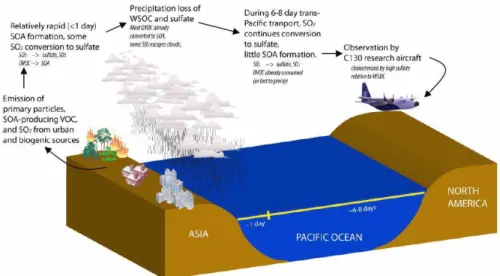
INTEX 2006/index.html). Figure 4 is a schematic representation of a possible expla-nation for observed differences between WSOC and sulfate at various locations that involves a combination of aerosol formation, loss, and replenishment. If most anthro-pogenic SOA (hence WSOC) is formed rapidly downwind of urban regions (de Gouw
25
et al., 2007; de Gouw et al., 2005; Sullivan et al., 2006), much of the WSOC could be lost by precipitation scavenging during advection to North America. Any primary WSOC from biomass burning and sulfate formed prior to precipitation would also be lost. However, aerosols can reform if the precursor gases penetrate the region of
ACPD
7, 17429–17474, 2007
Sources and processing of aerosol
from Asia and NW USA R. E. Peltier et al. Title Page Abstract Introduction Conclusions References Tables Figures ◭ ◮ ◭ ◮ Back Close
Full Screen / Esc
Printer-friendly Version Interactive Discussion
cipitation. Measurements show that because SO2 is not highly water-soluble, sulfate can be reformed down-wind of precipitating clouds (Brock et al., 2004; Weber et al., 2001). Our observation that WSOC concentration was much lower relative to sulfate in the Asian air masses measured near the northwestern United States suggests that there was little reformation of WSOC in comparison to sulfate. One would expect that
5
some VOCs may also penetrate the clouds, but if this line of reasoning is correct, they apparently do not lead to significant concentrations of SOA. The overall result is that Asian sulfur emissions may be more readily transported long distances than organic aerosols and their precursor VOCs, and hence sulfate will tend to dominate Asian an-thropogenic impacts in North America.
10
3.5 Investigating sources of WSOC
As the two main components of PM1.0in this study, the sources of sulfate and WSOC are of interest. Sulfate sources are well established and generally well predicted in model simulations (Nowak et al., 2006; Heald et al., 2005), whereas this is not the case for carbonaceous aerosols, especially organic carbon. For this reason, possible
15
sources for WSOC measured in this study are investigated further.
3.5.1 CO, water vapor, and WSOC
Our previous work focusing on SOA formation in urban plumes showed a strong cor-relation between WSOC and CO (Sullivan et al., 2006; Weber et al., 2007; de Gouw et al., 2007) indicating that WSOC and CO sources were strongly linked in some
man-20
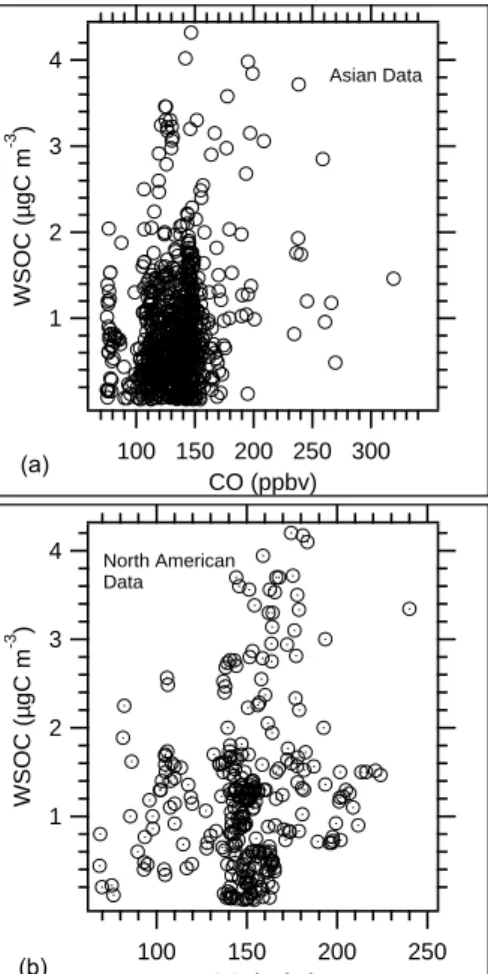
ner. Those studies involved airborne measurements in relatively fresh, well defined, urban plumes (aged <4 days). In contrast, the INTEX-B measurements were of well-aged Asian air masses that had undergone trans-Pacific transport (>7 days) and North American air masses mainly representative of regional conditions. WSOC and CO were not correlated (Fig. 5, r2=0.06 Asian, 0.08 North American) and WSOC could
25
not be linked to specific sources using this method. However, there were two no-17445
ACPD
7, 17429–17474, 2007
Sources and processing of aerosol
from Asia and NW USA R. E. Peltier et al. Title Page Abstract Introduction Conclusions References Tables Figures ◭ ◮ ◭ ◮ Back Close
Full Screen / Esc
Printer-friendly Version Interactive Discussion
table interceptions of plumes in the North America data set where enhancements in WSOC concentrations could be linked to a specific source region. On 3 May 2006, measurements were made in the vicinity of the California Central Valley and air trajec-tory analysis suggested Central Valley plumes of 1–2 days old. These plumes were intercepted at 21:50:30–22:05:00 UTC and again at 22:16:00–22:33:30 UTC at an
al-5
titude of 600 m a.s.l. On 15 May 2006, between 20:51 and 22:10 UTC, a region of enhanced WSOC concentration was intercepted over northern Nevada at an altitude of 3 to 5 km a.s.l. This plume can be seen in North American median WSOC pro-file of Fig. 2. Flexpart indicated plumes from the Central Valley that were 2–3 days old. Maps showing the locations of both plumes are given in Fig. 6. The low altitude
10
fresher plume was detected in a region of clear sky with broken cloud cover at altitudes of 6.4 km a.s.l., based on archived METARs from the Central Valley during the flight (available online at: http://vortex.plymouth.edu/sa parse-u.html). The second plume from the central valley was recorded down-wind of a heavily clouded region, based on both aircraft video and satellite data (cloud optical thickness based on MODIS aqua).
15
For each flight, WSOC and CO were moderately correlated (Fig. 6). The correlation coefficient between WSOC and CO during the flight near the Central Valley was 0.52 The Central Valley plume that was intercepted after transport to the northern Nevada region had a slightly higher correlation of r2=0.59. Univariate linear regression slopes of 50±1 and 52±9 µgC sm−3/ppmv, respectively, are somewhat higher than the range
20
of slopes reported for New York City (Sullivan et al., 2006) and Atlanta, United States, (Weber et al., 2007) urban plumes (30 to 40 µgC sm−3/ppmv).
Correlation between WSOC and water vapor in these plumes was also noteworthy (Fig. 6). Studies have shown that SOA formation may readily occur in aqueous so-lutions and may be enhanced by higher relative humidity (Altieri et al., 2006; Carlton
25
et al., 2006; Lim et al., 2005; Matsunaga et al., 2005). Both water vapor concentra-tion and relative humidity are moderately correlated with WSOC during the observaconcentra-tion above the Central Valley (water vapor r2=0.45, Fig. 6; RH r2=0.40, not shown), and better correlated in the observation over northern Nevada downwind of clouds (water
ACPD
7, 17429–17474, 2007
Sources and processing of aerosol
from Asia and NW USA R. E. Peltier et al. Title Page Abstract Introduction Conclusions References Tables Figures ◭ ◮ ◭ ◮ Back Close
Full Screen / Esc
Printer-friendly Version Interactive Discussion
vapor r2=0.74, RH r2=0.80). These plumes are further discussed in Sect. 3.4.3. In an attempt to discern contributions of anthropogenic and biogenic sources to the WSOC observed in the Asian and North American air masses, and the Central Valley plumes, a multivariate regression analysis is performed.
3.5.2 Multivariate regression to investigate WSOC sources
5
Measured VOCs, when compared with WSOC, may provide insights into specific WSOC sources. The previous analyses have focused on comparisons of WSOC with single variables (e.g. CO, water vapor, altitude, etc). In order to further identify WSOC sources, a multivariate linear regression model of WSOC and VOC data was con-structed. Principle component analysis (PCA) is often used to identify general sources
10
that have impacted ambient field studies that would not be apparent from a single cor-relation analysis (Quinn et al., 2006; Millet, 2006 #358; Millet et al., 2005, 2004; Kim and Hopke, 2007; Hopke et al., 2003, 1998; Shim et al., 2007; Wang et al., 2000). PCA is used to reduce a large number of variables into smaller and more meaning-ful sets of variables that account for most of the observed variability in the dataset.
15
Known sources for compounds can then be used in identifying the source for each principle component. This is particularly useful when a large number of variables are correlated. A disadvantage to this technique is that inferences from specific variables are limited because they have been grouped together with like variables. Multivariate linear regression directly relates a dependent variable to a specific set of independent
20
variables. In these techniques, variable coefficients can be compared to one another to provide some indication on the relative importance of each variable. However, a significant disadvantage to this technique is that the results are largely dependant on the variables that are chosen for the regression analysis. The multivariate regression model is described in Eq. (1), where β0is the intercept, and β1to βi are the regression
25
coefficients for independent variables x1to xi.
y = βo+ β1x1+ β2x2+ . . . βixi (1)
ACPD
7, 17429–17474, 2007
Sources and processing of aerosol
from Asia and NW USA R. E. Peltier et al. Title Page Abstract Introduction Conclusions References Tables Figures ◭ ◮ ◭ ◮ Back Close
Full Screen / Esc
Printer-friendly Version Interactive Discussion
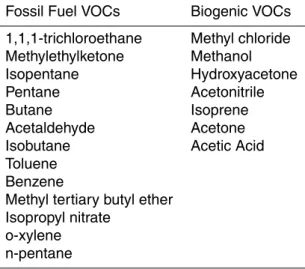
There were a number of VOC measurements made aboard the C130 research aircraft that can be used as tracers of fossil fuel combustion or biogenic (including biomass burning) emissions. Fossil fuel combustion VOCs chosen for this analysis were mainly alkanes and aromatics. Biogenic VOCs were mainly alcohols and organic acids, and also included acetonitrile, a gas tracer for biomass burning. The VOCs selected for
5
fitting with WSOC are summarized in Table 2. While none of the selected VOCs are perfectly unique tracers for fossil fuel combustion, biomass burning, or biogenic-non-biomass burning sources, compounds that have been shown to be emitted by mainly fossil fuel combustion or mainly biogenic sources were selected (Guenther et al., 1995; Heikes et al., 2002; Jacob et al., 2002; Jacob et al., 2005; Lewis et al., 2005; Singh et
10
al., 2004; Spaulding et al., 2003). For example, acetonitrile does have some small in-dustrial sources, and may be formed as a secondary compound, but the largest source of acetonitrile in the atmosphere is from biomass burning (de Gouw et al., 2003; Reiner et al., 2001).
Prior to regression analysis, the data were converted from a near lognormal to a
15
near normal distribution by calculating the natural log for each data point for all vari-ables. Subtracting the geometric mean concentration or mixing ratio from each mea-surement, and then dividing by the variable geometric standard deviation, standardized the dataset for each variable. This shifts the mean of the sample to 0 and standardizes the data variability (e.g. 1σ=±1, 2σ=±2, etc). The transformation eliminates potential
20
bias introduced into the model caused by the wide range of concentrations observed in the dataset, giving equal weight to all variables independent of magnitude. Model coefficients can then be compared to one another without consideration to original con-centration of the variables (Kim and Ferree, 1981). Our interest here is the source of VOCs with highest coefficients (e.g., fossil fuel, biogenic, biogenic from biomass
burn-25
ing).
Backward stepwise multivariate linear regression analysis was performed on the data to model WSOC concentration, where a variable was included when the t-statistic ex-ceeded 2 (i.e., significant at the 5% level). The variables were also checked for
ACPD
7, 17429–17474, 2007
Sources and processing of aerosol
from Asia and NW USA R. E. Peltier et al. Title Page Abstract Introduction Conclusions References Tables Figures ◭ ◮ ◭ ◮ Back Close
Full Screen / Esc
Printer-friendly Version Interactive Discussion
collinearity and if found, one variable was removed from the model to eliminate redun-dancy. The independent variables listed in Table 2 were used to analyze the dataset, and includes many VOCs that have atmospheric lifetimes greater than the expected transport time from Asia (∼5–8 days). Fossil fuel and biogenic VOC variables were combined in the regression model to predict WSOC variability. It should be noted that
5
this analysis does not predict whether specific VOCs form WSOC, rather it uses VOCs as tracers to describe conditions when WSOC can be observed.
As a result of using a linear multivariate regression analysis, it is not likely that the model will fully capture WSOC variability. The C130 research aircraft was equipped to measure just ∼60 different VOCs by several different analytical techniques. Since
10
WSOC formation involves highly complex and as of yet, largely unknown VOC chem-istry, there are undoubtedly a number of VOCs that play an important role in WSOC formation but were not included in the regression.
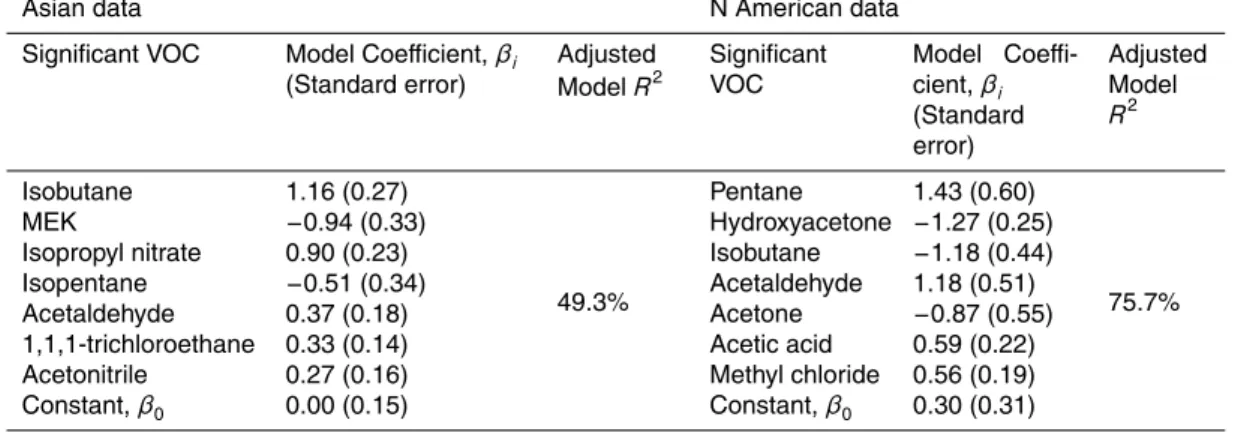
Table 3 summarizes the multivariate regression analysis for INTEX-B data that is mainly influenced by Asian emissions. The combined VOC sources of WSOC account
15
for 49.3% of the observed variability. Thus, a significant fraction of WSOC variability is unaccounted for in this analysis. Several factors that were not quantified could ex-plain the missing variability in the regression model. For example, variability in how WSOC aerosol was depleted during transport that differed from impacts on the VOCs. Similarly, VOCs may have been transformed in ways that do not lead to WSOC
for-20
mation, resulting in a change in VOC concentration but no change in WSOC. Also, since observed WSOC concentration in Asian air masses was frequently below the limit of detection, it is not surprising that this model does not capture all of the variabil-ity for well-aged (and traveled) air masses. Regression analysis of North American air masses yielded different results (Table 3). Overall, these covariates explain 75.7% of
25
the WSOC variability.
Comparing the standardized regression coefficients (Table 3) may provide some in-sight into generalized sources of WSOC. The absolute values of coefficients have been ranked from largest to smallest (Table 3). The absolute value is used since any process
ACPD
7, 17429–17474, 2007
Sources and processing of aerosol
from Asia and NW USA R. E. Peltier et al. Title Page Abstract Introduction Conclusions References Tables Figures ◭ ◮ ◭ ◮ Back Close
Full Screen / Esc
Printer-friendly Version Interactive Discussion
that leads to WSOC variability is of interest. For example, a negative coefficient could imply that the processes that produce WSOC is also in some way linked to loss of that VOC. A positive coefficient could result if the VOC and WSOC have similar sources. This points out a limitation with this method that introduces uncertainty with this analy-sis; some covariability of a VOC with WSOC may not be linked to WSOC formation in
5
any physical manner. For example, WSOC formed in high oxidizing environments can lead to more WSOC, but some VOCs not linked to WSOC in any way may also be lost, independent of the VOC source (biogenic or anthropogenic).
Fossil fuel combustion VOC tracers are most closely associated with WSOC concen-tration in Asian plumes (Table 3). Isobutane, methyl ethyl ketone (MEK), and isopropyl
10
nitrate coefficients are significantly larger than the remaining regression variables (it is noted, however, that all variables in this analysis are significant since each has been evaluated by student t-test). The remaining coefficients, including acetonitrile, a biomass burning tracer, contribute to variability in WSOC, but fossil fuel combustion VOCs explain most of the variability that could be accounted for in this model.
15
In contrast, North American WSOC is more closely associated with both biogenic and fossil fuel combustion VOCs. Pentane and hydroxyacetone are the largest contrib-utors to WSOC variability. Pentane is a VOC associated with fossil fuel combustion, and hydroxyacetone is a photo oxidation product of isoprene (Yu et al., 1995). Other signifi-cant fossil fuel combustion VOCs that contribute to WSOC variability include, isobutane
20
and acetaldehyde. Significant biogenic VOCs include acetone, acetic acid, and methyl chloride. These results suggest that both biogenic (but not biomass burning) and an-thropogenic sources contributed to WSOC variability in North American air masses. In the North American data set, acetonitrile contributed no significant influence, indicating a limited influence on WSOC by biomass burning.
25
The contrast between the regression results for Asian versus North American air masses is also consistent with expectations. Higher anthropogenic sources of WSOC relative to biogenic sources in Asian air masses versus northwestern United States air masses are expected given the proportions of anthropogenic and biogenic sources in
ACPD
7, 17429–17474, 2007
Sources and processing of aerosol
from Asia and NW USA R. E. Peltier et al. Title Page Abstract Introduction Conclusions References Tables Figures ◭ ◮ ◭ ◮ Back Close
Full Screen / Esc
Printer-friendly Version Interactive Discussion
the two regions. Asian emissions from more northern regions (e.g., China) advected westward are heavily influenced by large population centers, whereas the northwestern United States is not highly populated but is heavily forested.
3.5.3 Regression analysis on WSOC central valley plumes
The regression was performed in the same manner for the two California Central Valley
5
plumes encountered during INTEX-B. The first Central Valley plume (low altitude mea-surements made near the valley) was characterized by elevated VOCs and WSOC (2– 4 µgC sm−3). Due to data availability limitations, hydroxyacetone and acetic acid (both biogenic VOCs) are not included in the analysis. There are, however, a number of other VOCs included in the regression analysis (Table 2) that can be used to identify biogenic
10
sources. Thus, we may not be able to directly compare these results with the Asian and North American air mass regressions. Methylethylketone (MEK), methanol, and pentane are statistically significant VOCs that were identified in the regression model predicting WSOC variability (Table 4). Methylethylketone and pentane are associated with fossil fuel combustion. In contrast, methanol sources are predominately biogenic,
15
though there is evidence of small sources related to fossil fuel combustion (Jacob et al., 2005) (methanol from fossil fuel combustion accounts for ∼1–2% of global methanol loading). Comparing coefficients (again, using the absolute value), biogenic sources are similar (0.97±0.13) to fossil fuel combustion sources (Σβ=1.74±0.46 by RMS) for
WSOC variability, suggesting that in the Central Valley, WSOC is related to both fossil
20
fuel combustion and biogenic sources of VOCs. This model accounts for ∼98.2% of the variability of WSOC (Table 4).
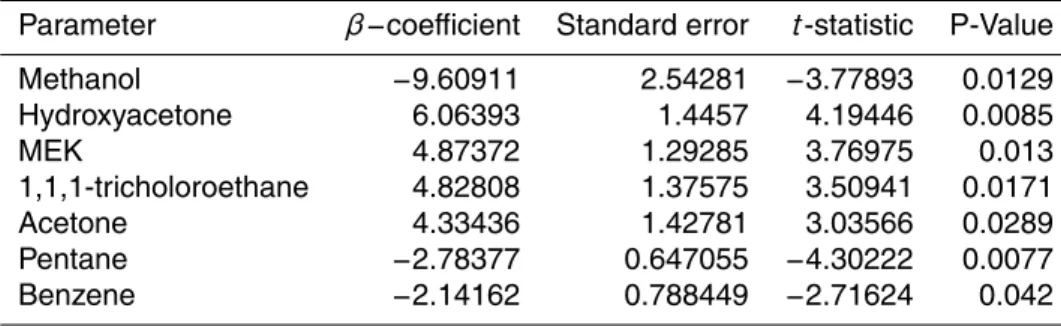
The second Central Valley plume intercepted over northern Nevada in a region di-rectly downwind of extensive clouds was characterized by elevated WSOC concen-trations (1–2 µgC sm−3), elevated oxygenated VOCs (e.g. methanol, acetic acid,
ace-25
tone), and CO, and relatively low anthropogenic VOCs (e.g. benzene). For this plume, a number of statistically significant VOCs were observed in the multiple regression model of WSOC variability. Methanol and hydroxyacetone – both biogenic VOC
ACPD
7, 17429–17474, 2007
Sources and processing of aerosol
from Asia and NW USA R. E. Peltier et al. Title Page Abstract Introduction Conclusions References Tables Figures ◭ ◮ ◭ ◮ Back Close
Full Screen / Esc
Printer-friendly Version Interactive Discussion
ers – comprise the largest coefficients of all parameters tested (Table 2). MEK and 1,1,1-tricholorethane, which are associated with fossil fuel combustion, and acetone (a biogenic tracer) have similar β-coefficients (Table 5), and are somewhat less impor-tant. Lastly, pentane and benzene, two VOCs associated with fossil fuel combustion, are also significant determinants of WSOC variability, though their β-coefficients are
5
considerably smaller that the other VOCs (Table 5). The model accounts for 92.6% of the variability of WSOC during this plume. By summing the significant VOCs by their
β-coefficient, biogenic sources appear to be most related to WSOC variability, though fossil fuel combustion VOC tracers also appear to be involved.
Despite having similar source regions (i.e., roughly same region of Central Valley, as
10
indicated by Flexpart), WSOC for each plume appears to have a different association with VOCs. Based on visual and satellite evidence of clouds in the vicinity during the Nevada flight segment, higher correlations with water vapor (Fig. 6), and differences in altitudes at which the two Central Valley plumes were detected, the Nevada plume is more likely to have been recently influenced by cloud processing. This may account
15
for some of the differences in multiple regression results.
In the cloud-outflow region, the overall analysis result is suggestive of WSOC (i.e., SOA) formation by heterogeneous processes involving liquid water and biogenic VOCs, as has been proposed in a number of other studies (Hastings et al., 2005; Bal-tensperger et al., 2005; Hartz et al., 2005; Lim et al., 2005; Pun et al., 1999, 2002;
20
Varutbangkul et al., 2006; Na et al., 2006; Tsigaridis and Kanakidou, 2003). This type of mechanism may, at least in part, explain the generally higher WSOC/sulfate ratios (e.g., Fig. 3) observed in free tropospheric continental air masses in this and other stud-ies (Peltier et al., 2007a), and may explain poor model prediction of free tropospheric organic aerosol mass and spatial distributions (Heald et al., 2005, 2006).
25
ACPD
7, 17429–17474, 2007
Sources and processing of aerosol
from Asia and NW USA R. E. Peltier et al. Title Page Abstract Introduction Conclusions References Tables Figures ◭ ◮ ◭ ◮ Back Close
Full Screen / Esc
Printer-friendly Version Interactive Discussion
4 Conclusions
Airborne measurements in spring 2006 of fine particle (PM1.0) bulk chemical compo-sition were made from the surface to ∼7 km attitude over Western United States and Canada, and the Eastern Pacific Ocean. The online measurements included ionic species chloride, nitrate, sulfate, sodium, ammonium, potassium, calcium and
magne-5
sium, and the water-soluble organic carbon (WSOC) fraction of the organic aerosol. Data were analyzed separately according to continental source by using the Flexpart dispersion model to identify continents of influence based on CO sources. A particular emphasis on WSOC sources is discussed.
Submicron aerosol mass was dominated by water soluble organic carbon and
10
sulfate, with additional contribution to mass by ammonium, nitrate and sodium ions. WSOC concentration was highest in North American air masses (median = 0.9 µgC sm−3), and lower in Asian outflow (median = 0.2 µgC sm−3). Overall, sulfate aerosol had similar concentrations for Asian and North American observations.
WSOC concentration was highest at lowest altitude ranges in both North American
15
and Asian air masses, though several enhancements in particular altitude ranges were observed. WSOC was also compared to sulfate concentration, and analyzed across altitude. Contrary to previous findings near Asia and near the Northeastern United States, the ratio of WSOC-to-sulfate in aged Asian air masses tended to decrease with altitude. We propose this was likely caused by precipitation loss of aerosol prior to
20
observation, followed by preferential replenishment of sulfate aerosol as the air mass was transported across the Pacific. Since observations were generally not of fresh, urban emissions, WSOC and CO were poorly correlated. However, in two distinct WSOC plumes observed during this experiment, WSOC and CO were well correlated (r2=0.5 to 0.6). A similar finding was observed when comparing WSOC with water
25
vapor mixing ratio.
Both Asian and North American plumes were investigated by multivariate regression analysis using a number of tracer VOCs that were representative of fossil fuel
ACPD
7, 17429–17474, 2007
Sources and processing of aerosol
from Asia and NW USA R. E. Peltier et al. Title Page Abstract Introduction Conclusions References Tables Figures ◭ ◮ ◭ ◮ Back Close
Full Screen / Esc
Printer-friendly Version Interactive Discussion
bustion or biogenic emissions (including biomass burning). In Asian air masses, VOCs that are mainly from fossil fuel combustion sources were most closely related to WSOC variability. Biogenic VOCs did not substantially contribute to the observed variability of WSOC in Asian air masses. However, the regression model has significant variability that can not be explained by the measured VOCs, and this is likely related to the long
5
transport time and possible meteorological transformations affecting Asian aerosols. In contrast, a multivariate regression of North American aerosols shows that WSOC variability is driven by a combination of fossil fuel combustion and biogenic VOCs. This regression model explained a greater amount of WSOC variability (∼75%).
North American air masses were further refined to include only Central Valley outflow
10
by comparing a relatively fresh plume (aged 1–2 days) with a somewhat aged (2– 3 days) plume that appeared to be recently advected through clouds. In the case of the relatively fresh plume, by multivariate regression analysis, both biogenic and fossil fuel combustion VOCs were nearly equally responsible for WSOC variability. In contrast, biogenic VOCs appear to have a significantly stronger association with WSOC
15
variability in a plume with stronger evidence for cloud processing. This may also have resulted in a somewhat higher ∆WSOC/∆CO regression slope for cloud-processed air masses (∼50 µgC sm−3/ppmv), than what has been observed in other urban plumes (30 to 40 µgC sm−3/ppmv). Cloud processing of biogenic VOCs may be an important mechanism for free tropospheric WSOC (SOA) formation, explaining enhanced WSOC
20
concentrations above ∼2 km altitude in this and other studies.
Acknowledgements. The authors acknowledge the invaluable assistance of the C130 aircraft support team from National Center for Atmospheric Research, and from NASA Earth Science Support Office. This work was funded by NASA under contract NNG06GA68G.
References
25
Altieri, K. E., Carlton, A. G., Lim, H. J., Turpin, B. J., and Seitzinger, S. P.: Evidence for oligomer formation in clouds: Reactions of isoprene oxidation products, Environ. Sci. Technol., 40,
ACPD
7, 17429–17474, 2007
Sources and processing of aerosol
from Asia and NW USA R. E. Peltier et al. Title Page Abstract Introduction Conclusions References Tables Figures ◭ ◮ ◭ ◮ Back Close
Full Screen / Esc
Printer-friendly Version Interactive Discussion
4956–4960, 2006.
Apel, E. C., Hills, A. J., Lueb, R., Zindel, S., Eisele, S., and Riemer, D. D.: A fast-gc/ms system to measure c2to c4carbonyls and methanol aboard aircraft, J. Geophys. Res., 108, 15–11, doi:10.1029/2002JD003199, 2003.
Baltensperger, U., Kalberer, M., Dommen, J., Paulsen, D., Alfarra, M. R., Coe, H., Fisseha,
5
R., Gascho, A., Gysel, M., Nyeki, S., Sax, M., Steinbacher, M., Prevot, A. S. H., Sjogren, S., Weingartner, E., and Zenobi, R.: Secondary organic aerosols from anthropogenic and biogenic precursors, Faraday Discuss., 130, 265–278, 2005.
Bertschi, I. T. and Jaffe, D. A.: Long-range transport of ozone, carbon monoxide, and aerosols to the ne pacific troposphere during the summer of 2003: Observations of smoke plumes
10
from asian boreal fires, J. Geophys. Res.-Atmos., 110, D05303, doi:10.1029/2004JD005135, 2005.
Brock, C. A., Hudson, P. K., Lovejoy, E. R., Sullivan, A., Nowak, J. B., Huey, L. G., Cooper, O. R., Cziczo, D. J., de Gouw, J., Fehsenfeld, F. C., Holloway, J. S., Hubler, G., Lafleur, B. G., Murphy, D. M., Neuman, J. A., Nicks, D. K., Orsini, D. A., Parrish, D. D., Ryerson,
15
T. B., Tanner, D. J., Warneke, C., Weber, R. J., and Wilson, J. C.: Particle characteristics following cloud-modified transport from asia to north america, J. Geophys. Res., 109, 1–18, doi:10.1029/2003JD004198, 2004.
Brock, C. A., Sullivan, A. P., Peltier, R. E., Weber, R. J., Wollny, A., de Gouw, J. A., Middlebrook, A. M., Atlas, E. L., Stohl, A., Trainer, M. K., Cooper, O. R., Fehsenfeld, F. C., Frost, G. J.,
20
Holloway, J. S., H ¨ubler, G., Neuman, J. A., Ryerson, T. B., Warneke, C., and Wilson, J. C.: Sources of particulate matter in the northeastern united states: 2. Evolution of chemical and microphysical properties, J. Geophys. Res., accepted, 2007.
Carlton, A. G., Turpin, B. J., Lim, H. J., Altieri, K. E., and Seitzinger, S.: Link between isoprene and secondary organic aerosol (soa): Pyruvic acid oxidation yields low volatility organic acids
25
in clouds, Geophys. Res. Lett., 33, L06822, doi:10.1029/2005GL025374., 2006.
de Gouw, J., Warneke, C., Karl, T., Eerdekens, G., van der Veen, C., and Fall, R.: Sensitivity and specificity of atmospheric trace gas detection by proton-transfer-reaction mass spectrometry, Int. J. Mass Spectrom., 223, 365–382, 2003.
de Gouw, J. A., Cooper, O. R., Warneke, C., Hudson, P. K., Fehsenfeld, F. C., Holloway, J.
30
S., Hubler, G., Nicks, D. K., Jr., Nowak, J. B., Parrish, D. D., Ryerson, T. B., Atlas, E. L., Donnelly, S. G., Schauffler, S. M., Stroud, V., Johnson, K., Carmichael, G. R., and Streets, D. G.: Chemical composition of air masses transported from asia to the U.S. West coast during