HAL Id: insu-01706563
https://hal-insu.archives-ouvertes.fr/insu-01706563
Submitted on 12 Feb 2018
HAL is a multi-disciplinary open access archive for the deposit and dissemination of sci-entific research documents, whether they are pub-lished or not. The documents may come from teaching and research institutions in France or abroad, or from public or private research centers.
L’archive ouverte pluridisciplinaire HAL, est destinée au dépôt et à la diffusion de documents scientifiques de niveau recherche, publiés ou non, émanant des établissements d’enseignement et de recherche français ou étrangers, des laboratoires publics ou privés.
Suspended particulate matter determines physical
speciation of Fe, Mn, and trace metals in surface waters
of Loire watershed
Mohamed Baalousha, Serge Stoll, Mikael Motelica-Heino, Nathalie Guigues,
Gilles Braibant, Frederic Huneau, Philippe Le Coustumer
To cite this version:
Mohamed Baalousha, Serge Stoll, Mikael Motelica-Heino, Nathalie Guigues, Gilles Braibant, et al.. Suspended particulate matter determines physical speciation of Fe, Mn, and trace metals in surface waters of Loire watershed. Environmental Science and Pollution Research, Springer Verlag, 2019, 26 (6), pp.5251-5266. �10.1007/s11356-018-1416-5�. �insu-01706563�
Suspended particulate matter determines physical speciation of Fe,
Mn and trace metals in surface waters of Loire watershed
Mohamed Baalousha
1*, Serge Stoll
2, Mikaël Motelica-Heino
3, Nathalie
Guigues
4, Gilles Braibant
5,
Frédéric Huneau
6,7and Philippe Le Coustumer
8,9,10**1 Center for Environmental Nanoscience and Risk, Arnold School of Public Health, University of South Carolina, Columbia, SC, USA, 29201
2 Université de Genève, Faculté des Sciences, Institut Forel, Uni Vogt, 66 Bd Carl Vogt, 1211 Genève 4, Switzerland
3 ISTO, UMR 7327 CNRS-Université d’Orléans, France 4 LNE, 1 rue Gaston Boissier, 75015 Paris, France 5 BRGM, 3 av. Claude Guillemin, 45071 Orléans, France
6 Université de Corse Pascal Paoli, Faculté des Sciences et Techniques, Campus Grimaldi, BP 52, F-20250 Corte, FRANCE
7 CNRS UMR 6134 SPE, Laboratoire d'Hydrogéologie Campus Grimaldi, BP 52, F-20250 Corte, FRANCE 8 CNRS- Université de Pau et des Pays de l’Adour, UMR5254 IPREM/, Technopôle Hélioparc, 2 av Pdt P. Angot 64053 Pau cédex09, France
9 Université Bordeaux Montaigne EA 4592 Géoressources & Environnement, ENSEGID, 1 allée F. Daguin, 33607 Pessac, France
10 Université de Bordeaux, UF Sciences de la Terre & de l'Environnement B.18, Allée Geoffroy Saint Hilaire 33615 Pessac Cedex, France CEDEX
Corresponding author: *[email protected]
Manuscript Click here to download Manuscript
Baalousha-Loire_Fe-Mn2018-final.doc
Click here to view linked References
1 2 3 4 5 6 7 8 9 10 11 12 13 14 15 16 17 18 19 20 21 22 23 24 25 26 27 28 29 30 31 32 33 34 35 36 37 38 39 40 41 42 43 44 45 46 47 48 49 50 51 52 53 54 55 56 57 58 59 60 61
Abstract
This study investigates the spatiotemporal variability of major and trace elements, dissolved organic carbon (DOC), total dissolved solids (TDS), and suspended particulate matter (SPM) in surface waters of several hydrosystems of the Loire River watershed in France. In particular, this study aims to delineate the impact of the abovementioned water physicochemical parameters on natural iron and manganese physical speciation (homoaggregation/heteroaggregation) among fine colloidal and dissolved (< 10 nm), colloidal (10 nm -450 nm) and particulate (> 450 nm) phases in Loire River watershed. Results show that the chemistry of the Loire River watershed is controlled by two end members: magmatic and metamorphic petrographic context on the upper part of the watershed; and sedimentary rocks for the middle and low part of the Loire. The percentage of particulate Fe and Mn increased downstream concurrent with the increase in SPM and major cations concentration, whereas the percentage of colloidal Fe and Mn decreased downstream. Transmission electron microscopy analyses of the colloidal and particulate fractions (from the non-filtered water sample) revealed that heteroaggregation of Fe and Mn rich natural nanoparticles and natural organic matter to the particulate phase is the dominant mechanism. The heteroaggregation controls the partitioning of Fe and Mn in the different fractions, potentially due to the increase in the ionic strength, and divalent cations concentration downstream, and SPM concentration. These findings imply that SPM concentration plays an important role in controlling the fate and behavior of Fe and Mn in various sized fractions.
Keywords
Natural iron and manganese, suspended particle matter, natural nanoparticles, colloids, physical speciation, hetero-aggregation, surface waters, Loire River watershed
1 2 3 4 5 6 7 8 9 10 11 12 13 14 15 16 17 18 19 20 21 22 23 24 25 26 27 28 29 30 31 32 33 34 35 36 37 38 39 40 41 42 43 44 45 46 47 48 49 50 51 52 53 54 55 56 57 58 59 60 61
1. Introduction
Rock weathering determines the geochemical parameters (e.g. ionic strength, major elements, minor elements, suspended particulate matter, etc.) of continental surface waters. These parameters control the geochemical cycle of elements at the Earth surface. Rock weathering releases dissolved elements, colloids and particles to rivers and finally discharges them into oceans (Garrels and MacKenzie 1971; Alloway 1990).
The forms in which a metal ion exist (speciation) determine its geochemical and biological cycling in the environment (Benson et al 2013). The importance of organic and inorganic colloids in the dissolved fraction (< 0.45 m, including natural nanoparticles <0.1
m) and suspended particulate matter (SPM > 0.45 m) in trace metals bioavailability, toxicity, fate and transport is largely recognized (Horowitz et al 1987; Jaïry et al 1999; Vignati and Dominik 2003). The partitioning of a metal among truly dissolved, colloidal and particulate matter is an important process in aquatic systems, particularly with respect to metal transport and their retention in sediments (Gaboury and Tim 1999; Ciszewski and Grygar 2016). It is now widely accepted that dissolved organic matter (DOM), colloids and SPM concentrations such as Al, Fe and Mn oxyhydroxides are key parameters that may control the speciation of trace metals in the environment (Luoma, and Bryan 1981; Lion et al 1982; Tessier et al 1985; Gagnon et al 2009). However, the mechanisms controlling particulate matter interaction with these elements are still poorly understood. Sorption of dissolved Fe and Mn on SPM and heteroaggregation of nanoscale and colloidal Fe and Mn phases with SPM may result in the removal of Fe and Mn from the dissolved and colloidal fractions to the particulate phase. Organic matter (fulvic - humic acids, exopolymers, polysaccharides etc.) can both promote or reduce the heteroaggregation rates depending on water physicochemical properties i.e., presence of divalent cations, ionic strength, etc. (Lossli et al 2015; Oriekhova and Stoll 2015)
Fe and Mn oxy-hydroxides are effective scavengers for trace metals (Honeyman and Santschi 1988; Brown et al 1999; Tessier et al 1996; Fuller and Harvey 2000; Lyven et al, 2003). Several field studies in aquatic environments demonstrated that trace metal partitioning was dominated by Fe and Mn oxides (Galan et al 2003; Wen et al 1997), especially that of Pb (Bird 2003; Baalousha et al 2006). Moreover, experimental and modeling studies illustrated the preponderant role of Fe and Mn oxides in trace metal sorption (Johnson 1986; Trivedi and Ave 2000; Dong et al 2003). Iron occurs to a large extent as colloidal hydrous iron oxides in rivers (Kinniburgh et al 1976; Mill 1980; Hong and Kester 1985). Hydrous iron oxides can be in the order of 0.001 µm when they initially form in stream waters. However, such small particles rapidly aggregate, forming continuous size range from 0.001 µm to greater than 1 µm (Stumm and Morgan 1996; Palomino and Stoll 2013). In some freshwater systems, ‘dissolved’, i.e. filterable iron is present as organically stabilized iron oxide colloids. Adsorption of iron oxy-hydroxides and organic carbon onto clay minerals is well documented, and is dependent on the pH of the water (Boyle et al 1977; Cameron and Liss 1984; Thurman 1985; Stumm and Morgan 1996). However, mechanisms controlling the interaction between iron oxides, organic carbon and particulate matter are still poorly understood. The properties of mineral constituents at the solution interface are usually modified by surface coatings (especially by organic matter and/or Fe oxy-hydroxides). These coatings might have a crucial 1 2 3 4 5 6 7 8 9 10 11 12 13 14 15 16 17 18 19 20 21 22 23 24 25 26 27 28 29 30 31 32 33 34 35 36 37 38 39 40 41 42 43 44 45 46 47 48 49 50 51 52 53 54 55 56 57 58 59 60 61
influence on colloids and particles diffusion, flocculation, aggregation as well as their interaction with trace elements and microfauna (Ledin et al 1995; Pedro et al 2011; Hartland et al 2013).
This study aims to (i) investigate the partitioning of natural Fe and Mn among the colloidal and particulate phases in the Loire River watershed, and (ii) identify the mechanism controlling Fe, Mn and trace metal distribution among the different fractions.
2. Materials and methods
2.1. Study area: geological and hydrological context
The Loire River, from its source in the Massif Central to the Atlantic Ocean, is 1010 km long (Fig. 1) and has a total basin area of 117 800 km². The Loire River basin is composed of three geological units. Firstly, the upper Loire includes the Allanche, Alagnon, Allier and Loire Rivers from their source in the Massif Central to Nevers. The bedrock composition of the upper Loire comprises older plutonic rocks (granite, gneiss, and mica schist dated from 500 to 300 My); and a large volcanic area that represents 46% of the total basin surface (Clozier et al 1976, 1983; Delance et al 1988). Secondly, the middle Loire includes the Cher, the Indre, and the Vienne tributaries from Nevers to the main confluence. In the middle Loire, the sedimentary series of Paris Basin consists primarily of carbonate deposits, dated from 200 to 6 My (BRGM 1996). Thirdly, the lower Loire includes the main river confluence up to the estuary, and does not concern this study. Generally, the Loire River watershed is characterized by two contrasted hydrological periods with an annual recurrence (Grosbois et al 2000), which is typical of temperate west European watersheds. These periods are seasonally marked with: (a) a low flow during warm months in summer from May to October, and (b) a high flow in winter and spring, generally from October to April.
The Loire River is one of the main European riverine inputs (26. 109 m3.yr-1) of water
to the Atlantic Ocean. The solid load ranges from 106 t yr-1 (Figueres et al 1985) to 4.3 106 t yr-1 (Négrel et al 1997), with the SPM representing 3% of the total suspended sediment load for rivers draining Western Europe based on the weighted average of the Seine, Oder, Vistula, Rhine, and Garonne Rivers (Milliman and Meade 1983).
Previous geochemical investigations on the Loire River were focused on studying the temporal variations of dissolved and suspended loads with regard to natural and anthropogenic inputs in the middle part of the Loire River watershed near Orleans and Tours on the Loire River (Négrel et Grosbois 1999; Négrel et al 2000; Grosbois et al 2000 and 2001). However, the present study focuses on the upper and middle Loire catchment area from Massif Central to Chatillon. This study area has been chosen because the Loire River and its tributaries drain contrasted geological areas characterized by magmatic and metamorphic bedrock on one side and sedimentary bedrock on the other side. Furthermore, rivers overrun variable anthropogenic sources of major and trace elements such as former mining area, industrial cities, waste water treatment plants, and agricultural areas. Such context leads to deliver and concentrate anthropic contaminants into the Loire River and its contributories (Dhivert et al 2013). 1 2 3 4 5 6 7 8 9 10 11 12 13 14 15 16 17 18 19 20 21 22 23 24 25 26 27 28 29 30 31 32 33 34 35 36 37 38 39 40 41 42 43 44 45 46 47 48 49 50 51 52 53 54 55 56 57 58 59 60 61
2.2. Sampling Collection and Preparation
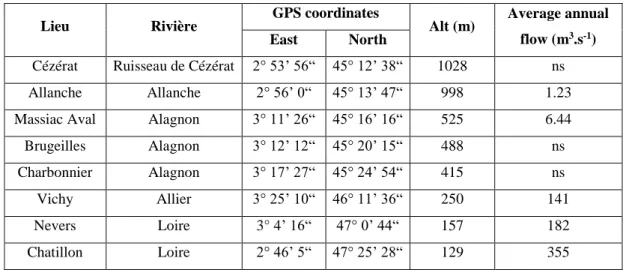
Eight samples were collected during three sampling campaign (Septt-2003, April-2004 and Septt-2004) at selected sites on the Loire River itself and its upper tributaries (Fig. 1, Table 1 and Table 2). They represent the contribution of 34% of the total Loire River basin, corresponding to a drainage area of 40.103 km2. This zone is composed of 76% magmatic and metamorphic rocks and 24% sedimentary formations (Grosbois et al 2000 and2001). Firstly, a small stream (Cézerat) draining peat bogs was sampled in the vicinity of Allanche (Fig. 1). Secondly, the Allanche stream was sampled at Allanche village. The Allanche watershed located in the center-west of the Massif Central covers 160 Km2, its maximum altitude is 1400 m, and the River is 29 Km long from headwaters to the outlet. The Allanche watershed bedrocks comprise volcanic rocks (basalts) overlain by a variable thickness of derived soils (De Goër De Herve and Tempier 1988). Thirdly, the Alagnon River was sampled correspondingly at Massiac, Brugeilles, and Charbonnier. The Massiac mineral district was intensively mined for Sb, As, and Pb, during the 19th and early 20th centuries (De Goër De Herve and Tempier, 1988). The fourth sampling area included three sampling points on the Allier and Loire Rivers, which were sampled downstream big cities such as Vichy on the Allier; and Nevers and Chatillon on the Loire River. In the Allier River, the main formations are gravels and sand from granites and basalts originated from the Massif Central. The carbonates from the Limagne d’Allier zone can also be another potential source of material (Kroonenberg et al 1988). Finally, the Loire River was sampled at Chatillon, roughly 12 km downstream of the Belleville nuclear Power Station.
The three sampling campaigns represent two contrasted hydrological situations. The campaigns of Septt-2003 and Septt-2004 represent low water discharge conditions. The campaign of April 2004 represents high water discharge conditions. Average annual discharge show high contrast between the different rivers as reported in Table 2. The smallest river flow discharge was 1.23 m3.s-1 and the largest river discharge was 355 m3.s-1. Near the city of
Chatillon, large variations in water discharge were observed between summer low flow conditions (around 50 m3 s-1) and winter high flow conditions > 1000 m3 s-1 (Négrel et al 2000).
Samples were collected from rivers near the middle of the stream; either using a 25 L plastic bucket (polyethylene, MANUTAN, France) at low flow rate or a pump at high flow rate. The collected waters were immediately refrigerated between 2 – 10 °C before analysis
Water samples were filtered on site and within two hours of sampling, through 0.45 µm (Teflon filters, Durapore, Millipore, USA) and 0.01 µm filters (Cellulose Nitrate, Millipore, USA) with nitrogen pressure. This filtration process enables the differentiation between three operationally defined size fractions i.e. colloidal fraction C1 (10-450 nm), fine colloids and truly dissolved fraction C2 (< 10 nm) and a particulate fraction P (> 450 nm). Nitrogen pressure was monitored during filtration process and filters were immediately replaced in case of pressure increase to avoid filter clogging and thus reduction in filter pore size. To prevent cross-contamination, the system was cleaned before each filtration by flushing 100-200 ml of MilliQ water (Millipore, USA) and the first 50 ml of the sample filtrate was systematically discarded.
Filtered solutions for major cations (< 450 nm, 50 ml) and trace element analyses (< 450 nm and < 10 nm, 50 mL each) were acidified (pH < 2) with ultrapure HNO3 and stored in
1 2 3 4 5 6 7 8 9 10 11 12 13 14 15 16 17 18 19 20 21 22 23 24 25 26 27 28 29 30 31 32 33 34 35 36 37 38 39 40 41 42 43 44 45 46 47 48 49 50 51 52 53 54 55 56 57 58 59 60 61
polyethylene bottles (ELVETEC, France). All bottles were previously washed in the laboratory with ultra-pure 10% HNO3, followed by MilliQ water and stored in MilliQ water
until use. Samples for dissolved organic carbon (DOC) analyses were collected in 20 ml glass bottles (ELVETEC, France), previously washed in the laboratory using a detergent (TFD4, Franklab, France) and then heated at 500 °C for 2 hours to remove any trace of organic carbon. Blanks were performed to control the level of pollution induced by sampling, conditioning, filtration and storage. Organic carbon blanks of filtrate never exceeded 0.2 mg l
-1. Concentrations of major elements in blanks were in the range 0.05 to 0.1 mg l-1, and
concentrations of Fe and Mn were in the range of 0.1-0.2 µg l-1 respectively. All samples were stored in dark cold conditions between at 4 °C until analysis.
2.3. Physicochemical water parameters and alkalinity
Physicochemical parameters such as temperature, pH, conductivity, and dissolved oxygen were measured in-situ or on-site when it was not possible to perform in-situ measurement because of inaccessibility to water stream. The pH was measured using a Mettler Toledo MP 120 pH meter. Calibration was carried out every day using 4.0 and 7.0 buffers. The accuracy of pH measurements was 0.05 pH units at pH 7.0. The temperature was measured using a Platinum probe integrated with the pH electrode. The accuracy of temperature measurements was 0.5°C. The conductivity was measured using a Jenway 4200 conductimeter. The calibration of the conductimetric cell was carried out at the laboratory at 25°C, using a KCl 0.01M solution. A correction factor of 2% was used to estimate river water conductivity at 25°C. The accuracy of the conductivity measurements was 1%. The dissolved oxygen was measured using a Jenway 9200 oxymeter. The calibration of the dissolved oxygen probe was carried out in saturated atmosphere with water (100 %) before each measurement. The accuracy of dissolved oxygen measurements was 5 %. Alkalinity in the dissolved fraction was also determined on-site by a means of potentiometric titration with HCl 0.1 M to pH = 4 and using the Gran method to estimate the equivalent concentration.
2.4. Chemical Analysis
Chemical analysis was performed in the laboratory using different techniques as follows. Aqueous silica concentrations were determined by colorimetry with an uncertainty of 5% using a Diode array spectrophotometer (HP 8452A). Major anion (Cl, SO4, and NO3), and
cations (Ca, Mg, Na, and K) concentrations were measured by ion chromatography (Dionex 4500) with an uncertainty of 5% RSD. Trace elements (Fe, Mn, Ni, Cu, As, Rb, Sr, Sb, Ba, Pb, U) were measured without pre-concentration by ICP-MS (PQ3, VG). The detection limits for the different trace elements are in the range 0.05-0.1 µg/l and uncertainty associated was 10 % RSD. Dissolved Organic Carbon (DOC) was analyzed using a Carbon Total Analyzer (Shimadzu TOC 5000) with an uncertainty of 10% RSD. Suspended Particulate Matter (SPM) was determined by weighing 0.45 µm filters. The uncertainty of this method was 5%. The Total Dissolved Salts (TDS) was calculated using the formula : TDS =[Ca]+[Mg]+[Na]+[K]+[Cl]+[HCO3]+[SO4]+[SiO2].
1 2 3 4 5 6 7 8 9 10 11 12 13 14 15 16 17 18 19 20 21 22 23 24 25 26 27 28 29 30 31 32 33 34 35 36 37 38 39 40 41 42 43 44 45 46 47 48 49 50 51 52 53 54 55 56 57 58 59 60 61
2.5. Colloids and particulate matter analysis
TEM analyses of selected water samples were performed using a Philips CM20 equipped with an X-EDS detector from the EDAX Company. Samples for TEM-X-EDS analyses were prepared directly from the non-filtered sample (all range of size is covered) by depositing a droplet of sample onto a TEM grid covered by a holey carbon film (Electron Microscopy Sciences, PA, USA) for 30 minutes to allow water evaporation; followed by intensive washing with deionized water to remove excess salts and this prevent salt crystallization. The TEM/X-EDS parameters are the following. For main modes such as Contrasted Bright Field (CBF) and Latttice Fringes (LF), 200KeV accelerating voltage and emission 1 upon a scale of 6 to minimize the degradation under the electron flux, a C2 aperture of 200 µm diameter, objective diaphragm of 50 µm. For X-EDS analysis, nanoprobe is used with a C2 aperture of 60 µm, parallel electron beam to generate a size probe between 100 and 200 µm of diameter, a collecting time of 120s with a dead time between 15 and 20% to allow the optimal signal detection. The X-EDS data are semi-qualitative only due to the lack of internal calibration to fix the user k factor.
3. Results and discussion
3.1. Hydrogeological context
Conductivity, SPM, TDS, Si, major cations (K+, Na+, Ca2+, Mg2+), major anions (HCO3-, Cl-, SO42-), and trace elements (Sr, Ba, Rb, Sb, As, Ni, Cu, Pb, Fe, and Mn) follow
the same geochemical behavior during two contrasted flow conditions. They present lower concentrations under high flow conditions (April-2004), which may be related to the dilution effect. This behavior was observed for the Loire River at Orleans in other studies (Grosbois et al 2000 and 2001), the Seine River (Roy et al 1999), and for the Humber River in the United Kingdom (Neal et al 1997; Jarvie et al 1997). These authors suggest that all these elements are derived from rivers’ bedrock weathering or point sources. They also found that, most major ions exhibit dilution effect with flow increase (as observed in the Humber River), with higher concentrations at low flow compared with high flow conditions. They related this behavior to the predominance of point sources (effluent) and/or by weathering which are the main sources of major ions. Only NO3− concentrations show higher values during high flow conditions than
during low flow conditions. This indicates the likely influence of agricultural runoff (fertilizers application). The increased river flow in Apr-04 indicates larger runoff, and therefore, a greater leaching from the soil (Meybeck 1986). A similar behavior of NO3− in the
Humber River has been observed by Jarvie et al (1997), which was attributed to diffuse sources, possibly derived from agricultural runoff.
3.2. Physicochemical parameters
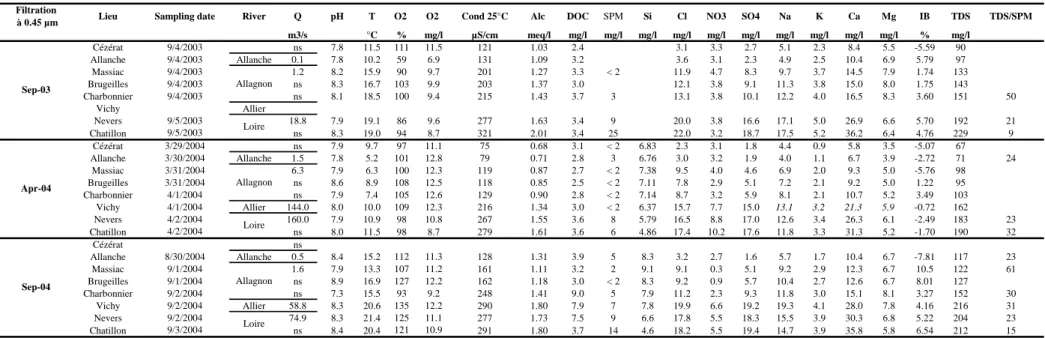
Physicochemical parameters (pH, O2, T, Conductivity, and Alkalinity) are reported in
Table 2. The pH varied in a narrow range around (7.8-8.4) for all samples except for Brugeilles (8.9 in Septt-2004). These pH values are representative of the Loire River watershed and in agreement with the range measured in previous studies on the Loire River at Orleans. Dissolved O2 concentrations were around the saturation level, which is well known
1 2 3 4 5 6 7 8 9 10 11 12 13 14 15 16 17 18 19 20 21 22 23 24 25 26 27 28 29 30 31 32 33 34 35 36 37 38 39 40 41 42 43 44 45 46 47 48 49 50 51 52 53 54 55 56 57 58 59 60 61
for surface water samples (Grosbois et al 2000 and 2001). Temperature increased generally from Cézerat to Chatillon, i.e. from higher to lower altitude (1028-129 m). River temperature is lower in April, roughly by 7-11°C, reflecting the colder temperature during the beginning of the spring season in France. Conductivity and alkalinity increased from upstream to downstream, which may be related to lithological variations: the Allanche and Alagnon Rivers drain magmatic and metamorphic rocks, while the Allier and Loire Rivers drain sedimentary formations.
3.3. SPM, TDS, and DOC
SPM has very low concentrations (Table 2) in the Allanche, and Alagnon Rivers (ca. < 5 mg l-1), while SPM has higher concentrations in the range of 8-9 mg l-1 in the Allier at
Nevers and 6-25 mg l-1 in the Loire River at Chatillon. Total dissolved salts (TDS) concentrations increase from upstream to downstream with a sudden increase from Charbonier to Vichy (i.e. the transfer from magmatic and metamorphic bedrock to the sedimentary bedrock). TDS concentrations (Table 2) in the upstream part at Vichy to Chatillon (183-229 mg l-1) are of the same order of TDS concentrations observed in other
rivers in France, such as: 174 mg l-1 for the upstream of the Garonne River (Probst and Bazerbachi 1986; Audry et al 2004), 460 mg l-1 for the Seine River (Roy 1996; Roy et al 1999), and 600 mg l-1 for the Rhine River (Meybeck and Ragu 1996). The higher TDS and SPM values in samples collected from the Allier and the Loire Rivers relative to those collected from the Allanche and Alagnon Rivers are presumably related to lithology variations: the Allanche and Alagnon Rivers drain magmatic and metamorphic, while the Allier and Loire River drain sedimentary bedrocks. One of the major characteristics of the Loire River watershed is that, the TDS dominates the SPM with TDS/SPM ratio in the range 9-61. This ratio shows no correlation to lithological variations in the Loire River watershed (Table 2).
Dissolved organic carbon (DOC) concentrations (Table 2) vary in a restraint range of 2.4-3.4 and 2.5-3.6 mg l-1 in Septt-03 and April-04, respectively. However, in Sept-04 DOC concentrations vary in the range of 3.0-3.7 mg l-1 for Allanche, Massiac, Brugeilles, and Chatillon on one hand and 4.9-9.0 mg l-1 for Charbonnier, Vichy, and Nevers on the other hand. DOC concentrations are not affected by lithology and they are comparable to average world river concentrations 4-6 mg l-1 (Berner and Berner 1996). The exceptional increase in
DOC concentration at Charbonnier, Vichy, and Nevers in Septt-04 is presumably attributed to the higher biological production at these sites, where abundant algae were observed during sample collection.
3.4. Major cations and anions
The order of abundance of the major cations is Ca2+>Na+>Mg2+>K+ (Table 2). This behavior is in agreement with the results obtained by Groisbois et al (2000) over two years study (1994-1996). Na, K, and Mg concentrations (Table 2) increase from Cézerat to Vichy, and then, they show a stable tendency from Vichy to Chatillon. However, Ca concentrations show slight increase from Cézerat to Charbonnier, followed by a higher increase from Vichy to Chatillon. The comparison between the major cations (Mg vs. Ca vs. Na + K) (Fig. 2) suggest that, the major cations (Na, K, Ca, Mg) are rather equally represented in the samples 1 2 3 4 5 6 7 8 9 10 11 12 13 14 15 16 17 18 19 20 21 22 23 24 25 26 27 28 29 30 31 32 33 34 35 36 37 38 39 40 41 42 43 44 45 46 47 48 49 50 51 52 53 54 55 56 57 58 59 60 61
collected in the Allanche and Alagnon Rivers with a slight decrease in Mg and Ca proportions in favor of Na+K. Additionally, an increase in Ca proportion can be observed in the Allier and Loire Rivers. The behavior of major cations suggests that, the chemistry of the Allanche, Alagnon, Allier, and Loire Rivers is mainly controlled by two end members: magmatic and metamorphic on one hand (Allanche and Alagnon Rivers) and carbonates on the other hand (Allier, and Loire River).
Chloride, nitrate, and sulfate concentrations (Table 2) concentrations increase toward downstream; that is their concentration increase from Cézerat to Chatillon. Anions (Cl-, NO3-,
and SO42-) concentrations in the Allier and Loire Rivers located in the sedimentary basin
(15.7-22 mg l-1 for Cl, 3.2-10.2 mg l-1 for NO3, and 15.0-19.4 mg l-1 for SO4) are two folds
higher than their concentrations in the Allanche and Alagnon Rivers located in the Massif Central (2.3-13.1 mg l-1 for Cl, 0.3-4.7 mg l-1 for NO3, and 1.6-10.1 mg l-1 for SO4). Négrel
and Roy (1998) showed that Cl-, NO3-, and SO42- concentrations in rainwater in the Massif
Central area (at Clermond-Ferrand city) are 0.7 mg l-1, 1.6 mg l-1, and 2.2 mg l-1,respectively. Moreover, it has been shown that, Cl-, NO3-, and SO42- concentrations in rainwater over the
sedimentary basin area (at Tours city in the Senonian-Turonian chalk formations) are respectively 3.7 mg l-1, 0.9 mg l-1, and 1.5 mg l-1 (Grosbois et al 2000). Consequently, in addition to the atmospheric (rain) background of Cl-, NO3-, and SO42- concentrations; they
have anthropogenic sources such as agricultural activities, animals breeding, domestic and industrial waste water effluents to these rivers (Meybeck 1986; Dojlido and Best 1996). Chloride and sodium concentrations in the Allier, and Loire River are comparable to those measured in the Seine River at Paris, France (21.3, and 10.6 mg l-1 respectively); however, NO3- concentrations are much higher in the Seine River than in the Allier and Loire River
(21.7 mg l-1). Other authors (Négrel and Roy 1998) related these high concentrations of Cl-, Na+, and NO3- to anthropogenic pollution from fertilizers application.
The comparison between the major anions (HCO3- vs. Cl- vs. SO42-+NO3-) (Fig. 3)
suggests that, bicarbonate is the dominating anion in all samples (Grosbois et al 2001). A decrease in the bicarbonate proportion can be observed from the Allanche River down to the Loire River as well as an increase in sulfate and nitrate relative proportions, illustrating the agricultural influence on the chemical composition of the Loire River watershed. Thus, even if bedrock weathering is an important mechanism and may be the dominant in the Loire River watershed chemistry, the anthropogenic inputs must not be neglected.
Dissolved silica (Table 2) is predominantly derived from weathering reactions within the soil - rocks and groundwater areas. Dissolved silica concentrations (Table 2) vary in a restraint range of (6.76-7.38), and (7.9-9.1) mg l-1 respectively in April-04, and Sept-04 from Cézerat to Charbonnier (analysis were not performed for samples of Sept-03). The constant dissolved silica concentrations in the Alanche and Alagnon Rivers reflect the dissolution of Si from magmatic and metamorphic rocks within this zone. Dissolved Si decrease from Vichy to Chatillon, can be related to lithology variations (sedimentary bedrock in the Allier and Loire Rivers).
3.5. Trace elements
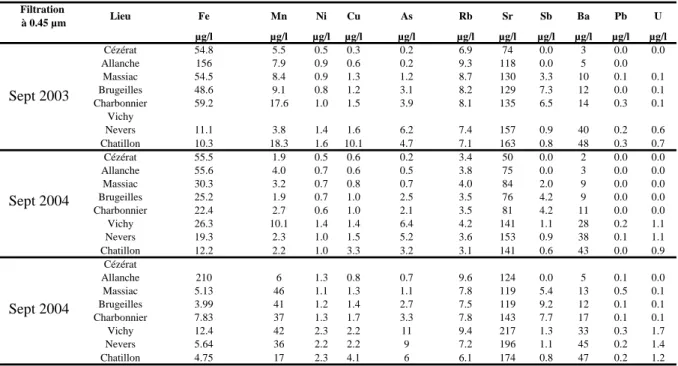
Trace element concentrations (Table 3) show significant variations between the different samples. Dissolved Sr concentrations increase slightly from Cézerat to Chatillon. 1 2 3 4 5 6 7 8 9 10 11 12 13 14 15 16 17 18 19 20 21 22 23 24 25 26 27 28 29 30 31 32 33 34 35 36 37 38 39 40 41 42 43 44 45 46 47 48 49 50 51 52 53 54 55 56 57 58 59 60 61
Barium concentrations increase slightly from Cézerat to Charbonnier, shows a 2 to 3 folds increase from Charbonnier to Vichy, and then continue to increase till Chatillon. Uranium concentrations are very low in the Allanche and Alagnon Rivers, but show higher values in the Allier and Loire Rivers. On the contrary to Sr, Ba, and U, rubidium concentrations show a constant concentration in the Allanche, and Alagnon Rivers and a slight decrease in the Allier, and the Loire Rivers (i.e. from Vichy to Chatillon).
Strontium, Barium, Uranium, and Rubidium are mainly derived from natural sources i.e. rock weathering (Palmer and Edmond 1993; Petelet et al 1998; Négrel et al 2000). The Allier, and the Loire Rivers are enriched in Sr, Ba, and U (Table 3) presumably from the drainage of sedimentary formations, which are richer in Sr, Ba, and U than the magmatic and metamorphic rocks. Uranium in rivers is frequently associated with carbonate dissolution (Palmer and Edmond 1993). Rubidium is also a good indicator of the lithology drained by rivers with Rb richer in magmatic and metamorphic rocks than in sedimentary formations (Négrel et al 2000; Petelet et al 1998). This fact, in addition to dilution effects, explains the decrease of Rb concentration in the Allier and the Loire Rivers downstream from Nevers, as they drain mainly sedimentary bedrock.
Antimony concentrations (Table 3) are negligible at Cézerat and Allanche sites (Allanche River), but Sb concentrations show significant values (2.0-9.2 µg l-1) between Massiac and Charbonnier (Alagnon River). Antimony is also present at very low concentrations (< 1.3 µg l-1) at Vichy, Never, and Chatillon (Allier, and Loire Rivers). The enrichment of Sb in the Alagnon River is presumably related to the antimony mining activity in the Brioude/Massiac district, in which the global production approached 40.000 tons of Sb during the activity period between1830 to 1930 (Vialaron 1993; BRGM 1996). The Sb concentrations decrease in the Allier, and Loire Rivers from Vichy to Chatillon due to dilution effects.
Arsenic (Table 3) shows very low concentrations in the Allanche River (< 0.7 µg l-1); a
slight increase up to 3.9 µg l-1 in the Alagnon River; and high concentrations in the Allier and
Loire Rivers (3.2-10.7 µg l-1). Nickel (Table 3) shows relatively constant values in the Allanche and Alagnon Rivers and higher values (1.5-2 folds) in the Allier and Loire Rivers. Copper shows very low concentrations (< 2.2 µg l-1) during the three sampling campaigns in all samples except at Chatillon (3.3-10.1 µg l-1), which corresponds to an increase of 2-6 fold. Finally, Lead (Table 3) does not show any clear trend because of its very low concentrations, which are close to the detection limit. Trace elements in the Allier and Loire Rivers (Table 3) show higher concentrations relative to rivers world average with 0.62 µg l-1 As, 0.80 µg l-1 Ni, 0.08 µg l-1 Pb, 1.48 µg l-1 Cu, 0.37 µg l-1 U (Gaillardet et al 2005)).
The low concentrations As, Ni, and Pb in the Alagnon River (Table 3) may be present as secondary mining products associated to the main mining element (Sb). The enrichment of As, Ni, and Pb in the Allier and Loire Rivers (after big cities) reflect the contribution of anthropogenic sources. However, identification of particular sources is not possible here as there is a wide selection of potential inputs. For example, metal processing and plating, textile industry, printing and drying, paper industry, chemical manufacture, and electronics (McNeely et al 1979). It is also possible that a part of As, Ni, and Pb concentration enrichment may be derived from non-industrial sources such as geology and land-use. For instance, Pb concentrations may reflect anthropogenic influences of agricultural signature due 1 2 3 4 5 6 7 8 9 10 11 12 13 14 15 16 17 18 19 20 21 22 23 24 25 26 27 28 29 30 31 32 33 34 35 36 37 38 39 40 41 42 43 44 45 46 47 48 49 50 51 52 53 54 55 56 57 58 59 60 61
to the use of fertilizers, automotive exhaust, mining activities, and industrial activities (Roy and Négrel 2001). Further, Otero et al (2005) have demonstrated that fertilizers contain trace elements such as Ba, Sr, As, and U. The enrichment of Cu at Chatillon is presumably related to the discharge from the cooling circuits of the nuclear power station at Belleville (12 km upstream from Chatillon).
Dissolved Fe (Table 3) shows high concentration at Allanche site and then decreases till Chatillon (Table 3). Iron is naturally present in river water, and has higher concentrations in magmatic and metamorphic rocks included into the predominant minerals such as amphiboles, biotite, olivine, and iron oxides (magnetite Fe3O4). Total dissolved manganese
concentrations (Table 3) vary in the range (3.8-18.3), (1.9-10.1), and (6-46) µg l-1 respectively in Sept-03, April-04, and Sept-04. Mn is not very abundant in terrestrial crust and frequently occurs as minor element in magmatic and metamorphic rocks.
3.6. Physical speciation of Natural Fe and Mn species
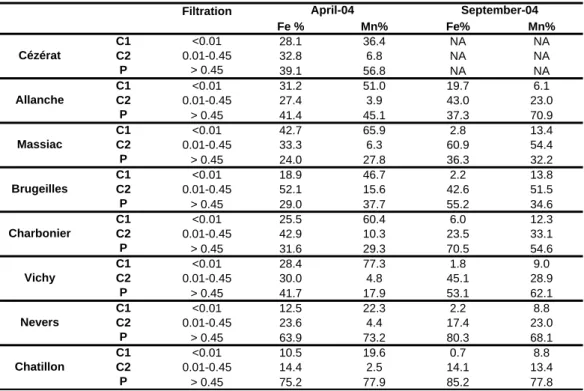
Fe and Mn were distributed among three size fractions for all samples, namely fine colloidal and dissolved (C1 <10 nm), colloidal (C2: 10-450 nm) and particulate (P>450 nm). Fe and Mn are concentrated in C1 and C2 fractions in samples collected upstream (Table 4)
i.e. from Alagnon and Allanche rivers with magmatic and metamorphic bedrocks; however,
they are concentrated in the P fraction (Table 4) in samples collected downstream i.e. from the Allier and the Loire Rivers with sedimentary bedrocks.
The variations in DOC and pH are not correlated to lithology variations. However, SPM and major cations (Ca2+, Mg2+, Na+ and K+) concentrations are correlated to lithology variations i.e. they have higher concentrations in rivers draining sedimentary bedrocks (Allier and Loire) than in rivers draining magmatic and metamorphic bedrocks (Allanche and Alagnon). Thereby, SPM and major cations (Ca2+, Mg2+, Na+ and K+) ) concentrations might explain such variations in Fe and Mn partitioning. They might affect the physical speciation of Fe and Mn through one of following mechanisms: (i) the homoaggregation of colloidal Fe and Mn oxides to form larger particles due to the increase of water conductivity and cations concentration, and/or (ii) the hetero-aggregation of colloidal Fe and Mn oxyhydroxides with SPM. The transfer of colloidal Fe and Mn matter into SPM via hetero-aggregation was observed by the authors in the Adour estuary (Point, 2006) and Gironde estuary (Masson et al 2011). These studies presented visual evidences by TEM on the flocculation/aggregation process of organic matter with increasing water salinity in the estuary. In regard to the second mechanism, the importance of SPM concentration in controlling the speciation of trace elements in the aquatic environment is discussed. Whereas some authors suggested that high SPM concentrations results in low dissolved metal concentrations (Ran et al 2000; Gueguen and Dominik 2003), others did not find any correlation between dissolved metal and SPM concentrations (Wen et al 1997; Gaboury and Tim 1999). To determine the mechanism responsible for the transfer of dissolved and colloidal Fe and Mn to the particulate phase, TEM coupled to X-EDS has been used to investigate SPM composition.
From TEM analysis of colloids and particles, different contrast can be discerned: large gray particles and smaller dark particles (Fig.4 - 7). The contrast differences in TEM can be related either to the variation in sample thickness or chemical composition. To determine if 1 2 3 4 5 6 7 8 9 10 11 12 13 14 15 16 17 18 19 20 21 22 23 24 25 26 27 28 29 30 31 32 33 34 35 36 37 38 39 40 41 42 43 44 45 46 47 48 49 50 51 52 53 54 55 56 57 58 59 60 61
contrast variations is related to the variation in particles thickness or chemical composition, X-EDS analysis were performed by focusing a spot size of few nanometer independently on the gray and on the darker particles. X-EDS suggest that the gray particles consist primarily aluminosilicates, carbonates and sulfates; while the dark smaller particles are mainly iron manganese oxy-hydroxides species. Thus, in these TEM micrography, the contrast variation can be attributed to differences in particles chemical composition. TEM micrographics (Fig.4-7) show no homo-aggregation (Stoll et al 2014) of colloidal Fe and Mn oxy-hydroxides to form large aggregates in the particulate range as shown for the Adour estuary. However, TEM micrographs and X-EDS analyses (Fig.4-7) show the heteroaggregation of small contrasted colloidal particles (Fe) with the surface of the large grey particles (aluminosilicates, carbonates and sulfates). Fig.4 (Cezerat) and Fig.5 (Massiac) show the heteroaggregation of colloidal Fe with aluminosilicates particle. Fig.6 (Vichy) and Fig.7 (Chatillon) show the heteroaggregation of colloidal Fe with aluminosilicates and carbonates particles.
To further elucidate the role of SPM on the partitioning of Fe and Mn in the different phases, the relative concentration (%) in each fraction was plotted as a function of SPM concentration (Fig.8). Note that, some samples have a limited SPM concentration. As a consequence, data analysis (Fig.8) was performed on samples having SPM concentration exceeding the detection limit (> 2 mg.l-1). Figure 8 reveals that the dissolved and colloidal fractions (C1 and C2) of Fe and Mn decrease with increasing SPM concentration, while particulate fractions Fe and Mn increase with increasing SPM concentration.
4. Conclusions
Physicochemical parameters, SPM, TDS, and concentrations of major and trace elements in the dissolved fraction (< 0.45 µm) were determined for samples collected from eight sites representing contrasted geological variations along the Loire River watershed at three sampling campaigns representing contrasted hydrological variations. Significant spatial (source) and temporal (climate and discharge) differences are observed for most parameters. The spatial variations of major and trace elements allow the determination of two end members representing lithological variations: magmatic and metamorphic lithology on one hand, and sedimentary lithology on the other hand. Allanche and Alagnon Rivers are controlled by the magmatic and metamorphic endmember with low Ca, Mg, Sr, Ba contents, low conductivity and alkalinity values. The Allier and Loire Rivers are controlled by the sedimentary end member with high Ca, Mg, Sr, Ba, U concentrations, high values of conductivity and alkalinity. Temporal variation (climate and discharge) are represented by lower concentrations of major and trace elements under high flow conditions (April-04) than under high flow conditions (Septtember-03, 04) due to dilution effects.
Increased SPM concentration due to geological variations is an important factor that may control the physical speciation and transfer of dissolved, natural nanoparticles and colloidal forms of Fe and Mn into the particulate phase via heteroaggregation of nanoparticle and colloidal forms of Fe and Mn with SPM. Therefore, this study provides direct evidences on the role of SPM in the geochemistry of Fe and Mn which may have important implications for some trace elements behavior in the Loire River watershed and other aquatic systems; in particular those trace metals with high affinity to Fe and Mn oxy-hydroxydes. For trace metals having affinity with Fe and Mn solid phases, the evolution of the SPM concentration is one 1 2 3 4 5 6 7 8 9 10 11 12 13 14 15 16 17 18 19 20 21 22 23 24 25 26 27 28 29 30 31 32 33 34 35 36 37 38 39 40 41 42 43 44 45 46 47 48 49 50 51 52 53 54 55 56 57 58 59 60 61
factor controlling their fractionation into the different compartments (dissolved, colloidal and particulate). In this study, SPM concentrations (>3-4 mg/L), induces higher concentration of Fe and Mn into particular fraction. At low SPM concentration (< 3-4mg/L) the major fraction of Fe and Mn are localized into dissolved and/or colloidal fractions. Thus, in SPM rich surface waters, heteroaggregation mechanism implies that Fe and Mn occur in the particulate phases preferentially; putting into evidence the importance of the size speciation mechanism which can affect natural nanoparticles behavior.
The outcome of this study can also underpin the ongoing studies and research on environmental fate and behavior of emergent pollutants such as engineered nanoparticles (ENPs). Based on the results of this study, we postulate that in streams characterized by low SPM and low ionic strengths, ENPs are likely to occur as individual particles, whereas in streams with high ionic strength and SPM, ENPs are likely to heteroaggregate with SPM and only a small fraction of ENPs may occur as individual particles.
Acknowledgment
s
Thanks to:
BRGM who supported (financial, technically) this research and we address special salutations at A-M. Fouillac who helpd us by a financial support dedicated to sampling campaign and laboratory analysis.
1 2 3 4 5 6 7 8 9 10 11 12 13 14 15 16 17 18 19 20 21 22 23 24 25 26 27 28 29 30 31 32 33 34 35 36 37 38 39 40 41 42 43 44 45 46 47 48 49 50 51 52 53 54 55 56 57 58 59 60 61
References
Alloway BJ (1990) The origin of heavy metals in soils. In: Heavy metals in soils. Wiley, New York, pp. 29-39.
Audry S, Schafer J, Blanc G, Bossy C, Lavaux G (2004) Anthropogenic components of heavy metal (Cd, Zn, Cu, Pb) budgets in the Lot-Garonne fluvial system (France). Appl. Geochem., 19 (5), 769-786. doi:10.1016/j.csr.2011.03.006
Baalousha M, Motelica-Heino M, Baborowski M, Hofmeister C, Le Coustumer P (2006) Size Based Speciation of Natural Colloidal Particles by Flow Field Flow Fractionation-Inductively Coupled Plasma-Mass Spectroscopy- Transmission Electron Microscopy/X-Energy Dispersive Spectroscopy: Colloids-Trace Element Interaction. Environ. Sci. Technol., 40, 2156-2162. doi: 10.1021/es051498d
Benson NU, Anake WU, Olanrewaju IO (2013) Analytical Relevance of Trace Metal Speciation in Environmental and Biophysicochemical Systems, American J. of AnalyticChemistry, 4, 633-641. doi: 10.4236/ajac.2013
Berner EK and Berner R.A (1996) Global environment. Water, air and geochemical cycles. Prenrice-Hall, Englewood Cliffs.
Bird D (2003) Characterization of Anthropogenic and Natural Sources of Acid Rock Drainage at the Cinnamon Gulch Abandoned Mine Land Inventory Site, Summit County, Colorado. Environ. Geol., 33, 919-932. ISSN 0943-0105
Boyle EA, Edmond JM, Sholkovitz ER (1977) The Mechanism of Iron Removal in Estuaries. Geochim. Cosmochim. Acta., 41, 1313-1324. doi: 10.1016/0016-7037(77)90109-0.
BRGM (1996) Geological Map of France, 1: 1,000,000 scale.
Brown GE, Foster AL, Ostergren JD (1999) Mineral Surfaces and Bioavailability of Heavy Metals: A Molecular-Scale Perspective. Proc. Natl. Acad. Sci. USA , 96, 3388-3395. doi: 10.1073/pnas.96.7.3388
Cameron AJ, Liss PS (1984) The Stabilization of Dissolved Iron in Freshwaters. Wat. Res. 18, 179-185. doi: 10.1016/0043-1354(84)90067-8
Ciszewski D, Grygar TM (2016) A Review of Flood-Related Storage and Remobilization of Heavy Metal Pollutants in River Systems, Water Air Soil Pollut. 227-239. doi: 10.1007/s11270-016-2934-8
Clozier L, Turland M, Belkessa M (1976) Gelogical Map of France at 1:50,000 scale, Dornes sheet. Explanatory Notes [51]
1 2 3 4 5 6 7 8 9 10 11 12 13 14 15 16 17 18 19 20 21 22 23 24 25 26 27 28 29 30 31 32 33 34 35 36 37 38 39 40 41 42 43 44 45 46 47 48 49 50 51 52 53 54 55 56 57 58 59 60 61
Clozier L, Debrand-Passard S, Delance JH, Desprez N, Lorenz C, Lorenz J (1983) Geological Map of France at 1:50,000 scale, Sancoins sheet. Explanatory Notes. [37] De Goër De Herve A and Tempier P (1988) Carte géologique à l'échelle du 1/50000, Saint-Flour sheet. Ann.Scien.de l'Univ.de Clermont-Ferrand BRGM, 92.
Delance JH, Lablanche G, Clozier L, Debrand-Passard S, Gros Y, Cornet J, Martins C, Vaurtrelle C, Garnier M (1988) Geological Map of France at 1:50,000 scale, Nevers sheet. Explanatory Notes. [55]
Dhivert E, Grosbois C, Desmet M, Curie F, Moatar F, Meybeck M, Bourrat X (2013) The metallic contamination of the Loire River Basin (France): Spatial and temporal evolution with a multi-scale approach. EGU General Assembly 2013, 7-12 April, 2013 in Vienna, Austria, id. EGU2013-10677
Dojilido JR, Best GA (1996) Chemistry of water and pollution. J. Hydrol., 180, 1-4. Dong D, Derry LA, Lion LW, (2003) Pb Scavenging from a Freshwater Lake by Mn Oxides in Heterogeneous Surface Coating Materials. Wat. Res. 37, 1662-1666. doi: 10.1016/S0043-1354(02)00556-0
Figueres G, Martin JM, Meybeck M, Seyler P, (1985) A comparative study of mercury contamination in the Tagus estuary (Portugal) and major French estuaries (Gironde, Loire, Rhone). Estuar. Coast. Shelf. Sci., 20 (2), 183-203. doi: 10.1016/0272-7714(85)90037-X
Fuller CC, Harvey JW (2000) Reactive Uptake of Trace Metals in the Hyporheic Zone of a Mining-Contaminated Stream, Pinal Creek, Arizona. Environ. Sci. Technol. 34, 1150-1155. doi: 10.1021/es990714d
Gaboury B, Tim FR (1999) The influence of size distribution on the particle
concentration effect and trace metal partitioning in rivers. Geochimica et Cosmochimica Acta, 63 (1), 113–127. doi: 10.1016/S0016-7037(98)00276-2Gagnon C, Turcotte P, Vigneault B (2009) Comparative study of the fate and mobility of metals discharged in mining and urban effluents using sequential extractions on suspended solids,
Environmental Geochemistry and Health , 31:657. doi: 10.1007/s10653-008-9223-4 Gaillardet J, Viers J, Dupré B (2005) Trace elements in river waters. Treat. Geochem., 5, 1-48. doi: 10.1016/B0-08-043751-6/05165-3
Galan E, Gomez-Ariza JL, Gonzalez I, Fernandez-Caliani JC, Morales E, Giraldez I (2003) Heavy Metal Partitioning in River Sediments Severely Polluted by Acid Mine Drainage in the Iberian Pyrite Belt. Appl. Geochem. 18, 409-421. doi: 10.1007/s11270-008-9905-7 1 2 3 4 5 6 7 8 9 10 11 12 13 14 15 16 17 18 19 20 21 22 23 24 25 26 27 28 29 30 31 32 33 34 35 36 37 38 39 40 41 42 43 44 45 46 47 48 49 50 51 52 53 54 55 56 57 58 59 60 61
Garrels RM, Mackenzie FT (1971) Evolution of sedimentary rocks. Norton, New York. doi: 10.4319/lo.1972.17.1.0165
Grosbois C, Negrel P, Fouillac C, Grimaud D (2000) Dissolved load of the Loire River: chemical and isotopic characterization. Chem. Geol., 170, 179-201. doi: 10.1016/S0009-2541(99)00247-8
Grosbois C, Négrel P, Grimaud D, Fouillac C, (2001) An Overview of Dissolved and Suspended Matter Fluxes in the Loire River Basin: Natural and Anthropogenic Inputs . Aquat. Geochem., 7 (2), 81-105. doi:10.1023/A:1017518831860
Guéguen C, Dominik J (2003) Partitioning of trace metals between particulate, colloidal and truly dissolved fractions in a polluted river: the Upper Vistula River (Poland). Applied Geochemistry, 18, 3, 457–470. doi: 10.1016/S0883-2927(02)00090-2
Hartland A, Lead J R, Slaveykova,V L, O’Carrol D, Valsami-Jones E (2013) The Environmental Significance of Natural Nanoparticles. Nature Education Knowledge, 2013, 4, 8, 7-14.
Honeyman B D, Santschi PH( 1988) Metals in Aquatic Systems: Predicting Their Scavenging Residence Times From Laboratory Data Remains a Challenge. Environ. Sci. Technol.22, 862. doi: 10.1021/es00173a002
Hong H, Kester DR (1985) Chemical forms of iron in Connecticut Rivers estuary. Estuarine, Coastal and Shelf Science 21, 449-459. doi: 10.1016/0272-7714(85)90049-6 Horowitz AJ, Elrick KA (1987) The Relation of Stream Sediment Surface Area, Grain Size and Composition to Trace Element Chemistry. Applied Geochemistry , 2, 437-451. doi: 10.1016/0883-2927(87)90027-8
Hudson-Edwards KA, Macklin MG, Curits CD, Vaughan DJ, (1996) Processes of formation and distribution of Pb, Zn, Cd, and Cu bearing minerals in Tyne Tyne Basin, NE England: implications for metal-contaminated river systems. Environ. Sci. Technol., 30, 72-80. doi: 10.1021/es9500724
Jaïry A, Garban B, Blanchard M, Chesterikoff A (1999). Speciation of Organic Carbon, Cu and Mn in the River Marne (France): the Role of Colloids. Hydrol. Process. 13, 223-237. doi: 10.1002/(SICI)1099-1085(19990215)13:2.
Jarvie HP, Neal C, Leach DV, Ryland GP, House WA, Robson AJ (1997) Major ion concentrations and the inorganic carbon chemistry of the Humber Rivers. Sci. Tot. Environ., 194-195, 285-302. doiI: 10.1016/S0048-9697(96)05371-5
Johnson CA,(1986) The Regulation of Trace Element Concentrations in River and Estuarine Waters Contaminated With Acid Mine Drainage: The Adsorption of Cu and 1 2 3 4 5 6 7 8 9 10 11 12 13 14 15 16 17 18 19 20 21 22 23 24 25 26 27 28 29 30 31 32 33 34 35 36 37 38 39 40 41 42 43 44 45 46 47 48 49 50 51 52 53 54 55 56 57 58 59 60 61
Zn on Amorphous Fe Oxyhydroxides. Geochim. Cosmochim. Acta. 50, 2433-2438. doi: 10.1016/0016-7037(86)90026-8
Jones KC, (1991) Contaminant trends in soils and crops. Environ. Pollut., 69 (4), 311-325. doiI: 10.1016/0269-7491(91)90119-H
Kinniburgh D G, Jackson M L, Syers JK (1976) Adsorption of Alkaline Earth, Transition, and Heavy Metal Cations by Hydrous Oxide Gels of Iron and Aluminum. Soil Sc. Soc. of America J., 40, 5, 796 -799. doi:10.2136/sssaj1976.03615995004000050047x
Kroonenberg SB, Moura ML, Jonker ATJ (1988) Geochemistry of the sands of the Allier River terraces, France. Geol. Mijnbouw., 67, 75-89.
McNeely RN, Neimanis VP, Dwyer L (2005) Water quality source book, A guide to water quality parameters. Environment Canada, Ottawa, Ont.
Labille J, Slomberg D, Sani-Kaast N, Praetorius A, Ollivier P, Radakovitch O, Brant J, Scheringer M, Bottero JY (2014) Assessing the heteroaggregation of manufactured nanoparticles with geogenic colloids in surface water, EGU General Assembly 2014, 27 April - 2 May 2014, Vienna, Austria, id.5400
Ledin A, Karlsson S, Düker A, Allard B (1995) Characterization of the Submicrometer Phase in Surface Waters. The Analyst 120, 603-608. doi: 10.1039/AN9952000603 Lion LW, Altmann RS, Leckie JO (1982) Trace-Metal Adsorption Characteristics of Estuarine Particulate Matter: Evaluation of Contributions of Fe/Mn Oxide and Organic Surface Coatings. Environ. Sci. Technol. , 16, 660-666. doi: 10.1021/es00104a007 Loosli F Vitorazi L, · Berret JF and Stoll S (2015) Towards a better understanding on agglomeration mechanisms and thermodynamic properties of TiO2 nanoparticles interacting with natural organic matter, Water Research 80, 139-148. doi: 10.1016/j.watres.2015.05.009
Luoma SN, Bryan GW (1981) A Statistical Assessment of the Form of Trace Metals in Oxidized Estuarine Sediments Employing Chemical Extractants. Sci. Tot. Environ. 17, 165-196. doi: 10.1016/0048-9697(81)90182-0
Lyven B, Hassellov M, Turner DR, Haraldsson C, Andersson K (2003) Competition Between Iron- and Carbon-Based Colloidal Carriers for Trace Metals in a Freshwater Assessed Using Flow Field-Flow Fractionation Coupled to ICMS MS. Geochim. Cosmochim. Acta. 67, 3791-3802. doi: 10.1016/S0016-7037(03)00087-5,
Masson M, Blanc G, Schäfer J, Parlanti E, Le Coustumer P (2011) Copper addition by organic matter degradation in the freshwater reaches of a turbid estuary, STOTEN 409(8):1539-1549. doi: 10.1016/j.scitotenv.2011.01.022. 1 2 3 4 5 6 7 8 9 10 11 12 13 14 15 16 17 18 19 20 21 22 23 24 25 26 27 28 29 30 31 32 33 34 35 36 37 38 39 40 41 42 43 44 45 46 47 48 49 50 51 52 53 54 55 56 57 58 59 60 61
Meybeck M (1986). Composition chimique des ruisseaux non pollués en France. Sci. Geol. Bull., 39 (1), 3-77.
Meybeck M, Ragu A (1996) Rivers discharge to the oceans: an assessment of suspended solids, major ions and nutrients. United Nation Environmental Programme. Report Mill AJB (1980) Colloidal and Macromolecular Forms of Iron in Natural Waters. I: A Review. Environ. Technol. Lett. 1980, 1, 97-108. doi: 10.1080/095593338009383955 Milliman LD, Meade RH (1983) World-wide delivery of river sediment to the oceans. J. Geol., 91, 1-21. doi: 10.1016/S0016-7037(03)00087-5
Neal C, Smith CJ, Jeffery HA, Jarvie HP, Robson AJ (1996) Trace element concentrations in the major rivers entering the Humber estuary, NE England. J. Hydrol., 182 (1-4), 37-64. doi: 10.1016/0022-1694(95)02940-0
Neal C, Robson AJ, Jeffery HA, Harrow ML, Neal M, Smith CJ, Jarvie HP (1997) Trace element inter-relationships for the Humber Rivers: inferences for hydrological and chemical controls. Sci. Tot. Environ., 194-195, 321-343. doi: 10.1016/S0048-9697(96)05373-9
Négrel P, Fouillac C, Branch M, (1997) Occurrence of mineral water springs in the stream channel of the Allier River (Massif Central, France): chemical and Sr isotope constraints . J. Hydrol., 203 (1-3), 143-153. doi:10.1016/S0022-1694(97)00094-2 Négrel P, Roy S (1998) Chemistry of rainwater in the Massif Central (France): a strontium isotope and major element study. Appl. Geochem., 13 (8), 941-952. doi: 10.1016/S0883-2927(98)00029-8
Négrel P, Grosbois C (1999) Changes in chemical and 87Sr/86Sr signature distribution patterns of suspended matter and bed sediments in the upper Loire River basin (France). Chem. Geol., 156 (1-4), 231-249. doi: 10.1016/S0009-2541(98)00182-X
Négrel P, Grosbois C, Klopmann W (2000) The labile fraction of suspended matter in the Loire River (France): multi-element chemistry and isotopic (Rb-Sr and C-O) systematics. Chem. Geol., 166 (3-4), 271-285. doi: 10.1016/S0009-2541(99)00225-9 Oriekhova O and Stoll S (2015) Effects of pH and fulvic acids concentration on the stability of fulvic acids - cerium (IV) oxide nanoparticle complexes. Chemosphere 144, 131-137. doi: 10.1016/j.chemosphere.2015.08.057
Otero N, Vitoria L, Soler A, Canals A (2005) Fertiliser characterisation: Major, trace and rare earth elements. Appl. Geochem., 20, 8, 1473-1488. doi: 10.1016/j.apgeochem.2005.04.002
Palmer MR, Edmond JM (1993) Uranium in river water. Geochim. Cosmochim. Acta., 57 (20), 4947-4955. doi: 10.1016/0016-7037(93)90131-F 1 2 3 4 5 6 7 8 9 10 11 12 13 14 15 16 17 18 19 20 21 22 23 24 25 26 27 28 29 30 31 32 33 34 35 36 37 38 39 40 41 42 43 44 45 46 47 48 49 50 51 52 53 54 55 56 57 58 59 60 61
Palomino D, Stoll S (2013) Fulvic acids concentration and pH influence on the stability of hematite nanoparticles in aquatic systems. J Nanoparticles Research 15, 1428-1436. doi: 10.1007/s11051-013-1428-5
Pedro M, Le Boudec A, Davranche M, Dia A, Henin O (2011) How Does Organic Matter Constrain the Nature, Size and Availabity of Fe nanoparticles for Biological Reduction ?, J. of Colloid and Interface Sc., 359, 75-85. doi: 10.1016/j.jcis.2011.03.067 Petelet E, Luck LM, Othman D, Negrel P, Aquilina L (1998) Geochemistry and water dynamics of a medium-sized watershed: the Hérault, southern France, I. Organisation of the different water reservoirs as constrained by Sr isotopes, major, and trace elements. Chem. Geol., 150 (1), 63-83. doi: 10.1016/S0009-2541(98)00053-9
Point D (2004) Speciation and Biogeochemistry of trace metals in the Adour estuary. Ph. D. Thesis, University of Pau
Probst JL, Bazerbachi A (1986) Solute and particulate transports by the upstream part of the Garonne River. Sci. Geol. Bull., 39 (1), 79-98.
Ran Y, Fu JM, Sheng GY, Beckett R, Hart BT (2000) Fractionation and composition of colloidal and suspended particulate materials in rivers. Chemosphere, 41, 1–2, 33–43. doi: 10.1016/S0045-6535(99)00387-2
Roy S (1996) Utilisation des isotopes du Pb et du Sr comme traceurs des apports anthropiques et naturels dans les précipitations et les rivières du bassin de Paris. PhD Thesis, Université de Paris 7
Roy S, Gaillardet J, Allegre CJ (1999) Geochemistry of dissolved and suspended loads of the Seine River, France: anthropogenic impact, carbonate and silicate weathering. Geochim. Cosmochim. Acta., 63 (9), 1277-1292. doi: 10.1016/S0016-7037(99)00099-X Roy S, Négrel P (2001) A Pb isotope and trace element study of rainwater from the Massif Central (France). Sci. Tot. Environ., 277 (1-3), 225-239. doi: 10.1016/S0048-9697(00)00883-4
Stone M, Droppo IG (1996) Distribution of lead, copper and zinc in size-fractionated river bed sediment in two agricultural catchments of southern Ontario, Canada. Environ. Pollut., 93 (3), 353-362. doi:10.1016/S0269-7491(96)00038-3
Stumm W, Morgan JJ (1996) Aquatic Chemistry; Wiley Interscience: New York
Tercier-Waeber ML, Stoll S,Slaveykova V (2012) Trace metal behavior in surface waters: emphasis on dynamic speciation, sorption processes and bioavailability. Archives des Sciences, 65, 119-142, http://archive-ouverte.unige.ch/unige:27739
1 2 3 4 5 6 7 8 9 10 11 12 13 14 15 16 17 18 19 20 21 22 23 24 25 26 27 28 29 30 31 32 33 34 35 36 37 38 39 40 41 42 43 44 45 46 47 48 49 50 51 52 53 54 55 56 57 58 59 60 61
Tessier A, Rapin F, Carignan R (1985) Trace Metals in Oxic Lake Sediments: Possible Adsorption Onto Iron Oxyhydroxides. Geochim. Cosmochim. Acta. 49, 183-194. doi: 10.1016/0016-7037(85)90203-0
Tessier A, Fortin D, Belzile N, De Vitre RR, Leppard GG (1996) Metal Sorption to Diagenetic Iron and Manganese Oxyhydroxides and Associated Organic Matter: Narrowing the Gap between Field and Laboratory Measurements. Geochim. Cosmochim. Acta 60, 387-404. doiI: 10.1016/0016-7037(95)00413-0
Thurman EM (1985) Organic Geochemistry of Natural Waters; Martinus Nijhoff/Dr. W. Junk Publishers: Boston, USA. doi: 10.1007/978-94-009-5095-5
Trivedi P, Ave L (2000) Modeling Cd and Zn Sorption to Hydrous Metal Oxides. Environ. Sci. Technol. 34, 2215-2223. doi: 10.1021/es991110c
Vialaron, C., 1993. L'antimoine dans le département de Haute-Loire. (Ed) Vialaron, pp. 32.
Vignati D, Dominik J (2003) The Role of Coarse Colloids As a Carrier Phase for Trace Metals in Riverine Systems. Aquat. Sci. 65, 129-142. doi: 10.1007/s00027-003-0640-2 Wen LS, Santschi PH, Gill G A, Paternostro CL, Lehman R D (1997) Colloidal and Particulate Silver in River and Estuarine Waters of Texas, Environ. Sci. Technol., 31 (3), 723–731. doi:10.1021/es9603057
List of Tables
Table 1: Sampling sites, rivers, sampling time, GPS coordinates and altitude
Table 2: General parameters and major elements concentrations in the dissolved fraction (< 0.45 µm) of the three sampling campaign..
Table 3: Trace element concentrations (µg/L) in the dissolved fraction (< 0.45 µm) of the three sampling campaign..
Table 4: Sampling sites, rivers, sampling time, GPS coordinates and altitude
Table 5: General parameters and major elements concentrations (mg/L) in the filtered fraction (< 0.45 µm) of the three sampling campaign.
Table 6: Trace element concentrations (µg/L) in the filtered fraction (< 0.45 µm) of the three sampling campaign..
1 2 3 4 5 6 7 8 9 10 11 12 13 14 15 16 17 18 19 20 21 22 23 24 25 26 27 28 29 30 31 32 33 34 35 36 37 38 39 40 41 42 43 44 45 46 47 48 49 50 51 52 53 54 55 56 57 58 59 60 61
Table 7: Partition of Fe and Mn in colloidal and filtered fraction C1 (< 0.01 µm) and colloidal C2 (0.01-0.45 µm) and a particulate fraction (P> 0.45 µm). NA: not analyzed
List of Figures
Figure 1: Geological map of the Loire basin, and location of the sampling points Figure 2: Samples chemical composition: cationic relative proportion
Figure 3: Samples chemical composition: anionic relative proportion
Figure 4: (A) Bright field micrograph of an aluminosilicate colloidal particle (lower contrast) and adsorbed iron (higher contrast) (Cezerat), (B) X-EDS analysis on the lower contrasted particle and (C) X-EDS analysis on the higher contrasted particle. Figure 5: (A) Bright field micrograph of an aluminosilicate colloidal particle (lower contrast) and adsorbed iron (higher contrast) (Massiac), (B) X-EDS analysis on the lower contrasted particle and (C) X-EDS analysis on the higher contrasted particle Figure 6: (A) Bright field micrograph of an association of different particles (Vichy) and (B, C and D) X-EDS analysis on each of these particles particle
Figure 7: (A) Bright field micrograph of an association of particles (Chatillon) weathered (black arrow) and metallic oxides (dash line) and (B) X-EDS analysis on the whole image.
Figure 8: Variation of (a) Fe and (b) Mn concentrations in colloidal and dissolved fraction (C1 <0.01 µm, circles) and colloidal (C2 0.01-0.45 µm, X) and a particulate fraction (>0.45 µm, triangles) in function of particulate matter concentration
1 2 3 4 5 6 7 8 9 10 11 12 13 14 15 16 17 18 19 20 21 22 23 24 25 26 27 28 29 30 31 32 33 34 35 36 37 38 39 40 41 42 43 44 45 46 47 48 49 50 51 52 53 54 55 56 57 58 59 60 61
Fig.1: Geological map of the Loire basin and location of the sampling points (black point) Figure
0 0.2 0.4 0.6 0.8 1 Ca 1 0.8 0.6 0.4 0.2 0 M g 1 0.8 0.6 0.4 0.2 0 Na + K Peat bog Cézallier streams Alagnon Allier Loire 0 0.2 0.4 0.6 0.8 1 Ca 1 0.8 0.6 0.4 0.2 0 M g 1 0.8 0.6 0.4 0.2 0 Na + K
Fig.1: Samples chemical composition, cationic relative proportions
0 0.2 0.4 0.6 0.8 1 Cl 1 0.8 0.6 0.4 0.2 0 S O 4 + N O 3 1 0.8 0.6 0.4 0.2 0 HC O3 Peat bog Cézallier streams Alagnon Allier Loire 0 0.2 0.4 0.6 0.8 1 Cl 1 0.8 0.6 0.4 0.2 0 S O 4 + N O 3 1 0.8 0.6 0.4 0.2 0 HC O3
Fig.4: (A) Bright field micrograph of an aluminosilicate colloidal particle (lower contrast) and adsorbed iron (higher contrast) (Cezerat), (B) X-EDS analysis on the lower contrasted particle
Fig.5: (A) Bright field micrograph of an aluminosilicate colloidal particle (lower contrast) and adsorbed iron (higher contrast) (Massiac), (B) X-EDS analysis on the lower contrasted
Fig.6: (A) Bright field micrograph of an association of different particles (Vichy) and (B, C and D) X-EDS analysis on each of these particles particle
Fig.7: (A) Bright field micrograph of an association of particles (Chatillon) weathered (white dash line) and metallic oxides (white arrow) and (B) X-EDS analysis on the whole image.
Fig.8: Variation of (A) Fe/FeT and (B) Mn/MnT concentrations (%, typical error is less than
10%) in dissolved fraction (C1, <0.01 µm, ● & red line), colloidal (0.01<C2<-0.45 µm, x & black line) and particulate fraction (>0.45 µm, ▲& blue line) in function of total particulate
matter concentration. 0 10 20 30 40 50 60 70 80 90 0 2 4 6 8 10 12 14 16 PM concentration (mg/l) Mn/MnT (%) B 0 10 20 30 40 50 60 70 80 90 0 2 4 6 8 10 12 14 16 PM concentration (mg/l) Fe/FeT (%) A
Table 1: Sampling sites, rivers, sampling time, GPS coordinates and altitude
Lieu Rivière
GPS coordinates
Alt (m) Average annual flow (m3.s-1)
East North
Cézérat Ruisseau de Cézérat 2° 53’ 56“ 45° 12’ 38“ 1028 ns Allanche Allanche 2° 56’ 0“ 45° 13’ 47“ 998 1.23 Massiac Aval Alagnon 3° 11’ 26“ 45° 16’ 16“ 525 6.44 Brugeilles Alagnon 3° 12’ 12“ 45° 20’ 15“ 488 ns Charbonnier Alagnon 3° 17’ 27“ 45° 24’ 54“ 415 ns Vichy Allier 3° 25’ 10“ 46° 11’ 36“ 250 141 Nevers Loire 3° 4’ 16“ 47° 0’ 44“ 157 182 Chatillon Loire 2° 46’ 5“ 47° 25’ 28“ 129 355
Average annual flow is obtained from the French hydrology bank. ns, no control station in the French hydrology bank