Architectures for photon-mediated quantum
information processing
by
Mihir Pant
B.Eng., Nanyang Technological University (2011)
S.M., Massachusetts Institute of Technology (2015)
Hu T11INS UTE F._T L&NLOGY.
MAR 262013
LIBRARIES
ARCHIVES
Submitted to the Department of Electrical Engineering and Computer
Science
in partial fulfillment of the requirements for the degree of
Doctor of Philosophy
at the
MASSACHUSETTS INSTITUTE OF TECHNOLOGY
February 2018
@
Massachusetts Institute of Technology 2018. All rights reserved.
Auho..Signature
redacted.
...
A u th o r ..
- --
-...---
-- -- ---
--Department of Electrical Engineering and Computer Science
January 31, 2018
Cetiid
y..Signature
redacted
Certified by
...
...
Dirk R. Englund
Associate Professor of Electricalvgineering and Computer Science
Thesis Supervisor
Accepted by ...
redacted
J( lie A. Kolodziejski
Professor of Electrical Engineering and Computer Science
Chair, Department Committee on Graduate Students
Architectures for photon-mediated quantum information
processing
by
Mihir Pant
Submitted to the Department of Electrical Engineering and Computer Science on January 31, 2018, in partial fulfillment of the
requirements for the degree of Doctor of Philosophy
Abstract
In this thesis, I present architectures for quantum information processing where pho-tons are used as the quantum bit (qubit) or for mediating entanglement between other qubits. The emphasis of this research is to simplify the basic building blocks required in such processors. The all-photonic repeater and computing architectures do not re-quire material nonlinearities, and their resource rere-quirements are reduced by several orders of magnitude. The photon-mediated atomic memory architecture is designed to work with faulty memories and experimentally demonstrated values of coherence time and photonic coupling efficiency. In the quantum network architecture, the only operation at every node is probabilistic Bell measurement.
Thesis Supervisor: Dirk R. Englund
Acknowledgments
I would like to thank Dirk Englund for being an amazing supervisor. I am extremely grateful for the academic freedom that I had while working in his group. My inter-ests during the last four years have changed significantly, but Dirk has always been supportive. At the same time, he always had the time to guide me, and kept my the-oretical work relevant to experimentalists. One conversation in particular will always stay with me. At the end of a conference, he came to me and said "Let's figure out what the requirements for making a useful quantum system are. Let's just get the numbers, regardless of how challenging they may be". As I was to find out (see Chap-ter 2), the requirements are indeed very daunting, but going through that calculation actually helped us find a path forward (covered in later chapters).
Saikat Guha had a major impact on my PhD. Saikat's guidance allowed me to grow as a theorist while being in an experimental group, and almost all my papers have involved collaborations with him. I have seen myself mature as a scientist and become more careful about stating my ideas precisely during my time with him. My numerous conversations with him exposed me to ideas ranging from percolation theory, information theory to classical error correcting codes. His breadth of work which spans across classical and quantum domains has been a major inspiration for me, and something I hope to emulate in the future.
I would also like to thank my two other thesis committee members, Jeff Shapiro and Terry Rudolph. Jeff Shapiro's course on quantum optical communication was very important to me, and I will continue to refer to his notes in my future research. I also loved his questions at conferences which were extremely effective at getting to the heart of the matter. My initial acquaintance with Terry was from his papers which have been central to linear optical quantum computing. During the last two years, I was able to talk to him through the MIT-Imperial College London Seed Fund program, which inspired a lot of the work in this thesis and shaped my view of quantum computing in general.
PhD, and also did two summer internships there under Saikat Guha and Mohammad Soltani. In addition, I had the opportunity to interact with a number of scientists including Hari Krovi, Prithwish Basu, Zachary Dutton, Boulat Bash, Jonathan Habif, Kin Chung Fong and the rest of the quantum information processing group.
There are a number of people at MIT that I was able to collaborate with including Hyeongrak Choi, Jacques Carolan, Mikkel Heuck, Nicholas Harris, Darius Bunandar, Christopher Panuski, Greg Steinbrecher, Jacob Mower, Catherine Lee, Ryan Hamerly and Mihika Prabhu. Furthermore, my labmates at the Quantum Photonics lab have been important to me during my PhD.
I had the privilege of working with Don Towsley from UMass Amherst and his
student Arman Mohseni Kabir on problems in percolation theory. It was also great to work with Liang Jiang and Sreraman Muralidharan from Yale on repeater problems. From Yale, I also enjoyed Leandros Tassiulas' insights on network theory.
My work has also been influenced by conversations with Mercedes Gimeno-Segovia,
Pete Shadbolt, Naomi Nickerson, Mihai Vidrighin, Mark Thompson, Jeremy O'Brien, Josh Silverstone, Karl Berggren, Faraz Najafi, Ananthram Swami, Paul Yu, Stefano Pirandola, Koji Azuma, Hoi-Kwong Lo, Zheshen Zhang, Murphy Niu, Franco Wong, Ben Dixon, Scott Aaronson, Alex Arkhipov, Gian Guerreschi, Aram Harrow, Saeed Mehraban, Joshua Combes, Barry Sanders, and Ish Dhand.
I immensely enjoyed the courses that I took at MIT. I have already mentioned
Jeff Shapiro's course on quantum optical communication but there are two more professors I would like to thank in particular. I loved Peter Hagelstein's course on applied quantum and statistical physics because of the window it provided into his thought process, and his fresh perspective on a subject that I had studied before. I am extremely glad that I took Michael Sipser's course on the theory of computation. In addition to providing me an excellent introduction to new areas, he was patient enough to answer the many questions that I had for him, even after the course was over.
I really enjoyed my semester as a teaching assistant for 6.011: Signals, Systems
Hagelstein for this extremely enriching experience. My role as a teacher improved my ability to explain research ideas. I would also like to thank the two other TAs from the class: Nalini Singh and Allan Sadun.
I would also like to thank my friends here (there are so many that if I start naming them, I fear to miss out on someone!) who have been my family away from home in my journey. I'm grateful to have a family that has always lent me unconditional support and has been a patient sounding board for all my professional and personal aspirations.
I would like to thank the funding agencies involved in my PhD. I was funded
by the Air Force Research Laboratory (AFRL/RITA), Grant No. FA8750-14-2-0120,
DARPA project Scalable Engineering of Quantum Optical Information Processing Architectures (SEQUOIA), US Army contract number W31P4Q-15-C-0045, the Air
Force Office of Scientific Research MURI (FA9550-14-1-0052), Army Research
Labora-tory (ARL) Center for Distributed Quantum Information (CDQI), and Office of Naval Research program Communications and Networking with Quantum Operationally-Secure Technology for Maritime Deployment (CONQUEST), awarded under prime contract number N00014-16-C-2069.
It's hard to recall every person that played an important role in the last four years of your life, particularly at a time of such major changes. I apologize to anyone I may have forgotten to mention here.
Contents
1 Introduction
1.1 Quantum computing . . . . 1.2 Photonic quantum computing . . . .
1.3 Quantum communication . . . .
1.4 T hesis outline . . . . 2 Resource costs for all-optical quantum repeaters
2.1 Introduction . . . . 2.2 Prelim inaries . . . . 2.3 Quantum repeaters based on mode multiplexing and entangle
sw apping . . . . 2.3.1 Counterfactual error correction . . . . 2.3.2 Repeater architecture . . . . 2.3.3 Constructing the clusters at the major nodes . . . . 2.3.4 Measuring the clusters and connecting the chain . . . . . 2.3.5 Re-ordering measurements in the cluster-creation process 2.3.6 Rate calculations . . . . 2.3.7 D iscussion . . . . 2.4 One-way repeater scheme based on logical Bell measurements. . 2.4.1 One-way quantum repeaters . . . . 2.4.2 Quantum parity code and logical Bell measurement . . . 2.4.3 K ey rate . . . . 2.4.4 Creation of quantum parity encoded Bell pairs . . . .
ment 40 . . . 43 . . . 44 . . . 49 . . . 56 . . . 57 . . . 59 . . . 64 . . . 69 . . . 69 70 . . . 71 . . . 73 29 29 31 34 36 37 37 38
2.5 Conclusions and open problems . . . . 78
3 Percolation thresholds for linear optic quantum computing 81 3.1 Introduction . . . . 81
3.2 M ain results . . . . 85
3.3 Revisiting ballistic cluster-state LOQC with a new approach . . . . . 88
3.3.1 Graph states and linear optical fusion . . . . 89
3.3.2 Fusing microclusters on a regular lattice . . . . 89
3.3.3 General picture for ballistic LOQC . . . . 94
3.4 Fundamental thresholds . . . . 96
3.4.1 Achievable thresholds . . . . 96
3.4.2 Intuitive converse . . . . 103
3.4.3 Formal proof of Converse . . . . 105
3.4.4 Photon loss . . . . 109
3.5 Conclusions and open problems . . . . 113
4 Percolation based architecture for cluster state quantum computa-tion using photon-mediated entanglement between atomic memories 115 4.1 Introduction . . . . 115
4.2 Creating photonic entanglement . . . . 118
4.2.1 Probabilistic Bell Measurement for broker qubit entanglement 119 4.2.2 Entanglement swapping procedure . . . . 122
4.2.3 Details on the timing of entangling operation . . . . 123
4.2.4 Collection efficiency and entanglement success probability . . . 124
4.3 Percolation threshold . . . . 126
4.4 Lower bound on the minimum time required . . . . 128
4.5 Faulty sites . . . . 129
4.6 Transparent node architecture . . . . 130
5 Routing entanglement in the quantum Internet 133
5.1 Background . . . .. . . . . 138
5.2 Entanglement routing protocols . . . . 140
5.2.1 Problem statement and notation . . . . 140
5.2.2 Multipath routing of a single entanglement flow . . . . 142
5.2.3 Multipath rate advantage . . . . 149
5.2.4 Distance metric for the local routing rule using L' norm and recursion . . . . 154
5.2.5 Simultaneous entanglement flows . . . . 155
5.3 Conclusions and open problems . . . . 159
6 Devices 161 6.1 Introduction . . . . 161
6.2 Single photon sources . . . . 161
6.2.1 Temporally and frequency multiplexed single photon source us-ing quantum feedback control for scalable photonic quantum technologies . . . . 162
6.2.2 Integrated source of spectrally filtered correlated photons for large-scale quantum photonic systems . . . . 163 6.3 A cavity-enabled technique for optical, quantum limited photodetection 164
List of Figures
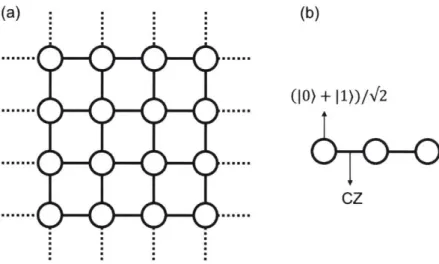
1-1 (a) A cluster state. The circles represent qubits in the state (10)
+
11))/v2 and edges represent controlled Z gates. Any quantum al-gorithm can be implemented with adaptive measurements on such a square lattice i.e. such a square lattice is a resource for universal quan-tum computation. (b) A three-qubit GHZ state. . . . . 33 1-2 Any circuit model quantum computation (left) can be mapped to
adap-tive measurements on a square grid cluster state (right). M., M, repre-sent measurement in the X and Z bases respectively. Mi - M5 are mea-surements in bases that depend on the intended single qubit rotation and previous measurement results. The thick blue arrows represents information flow. For more details, see Ref. [11. . . . . 33
2-1 Attaching a {3, 2, 2} tree to a node of a photonic cluster. . . . . 45 2-2 (a) and (b) show schematics of one elementary link, and a chain of them
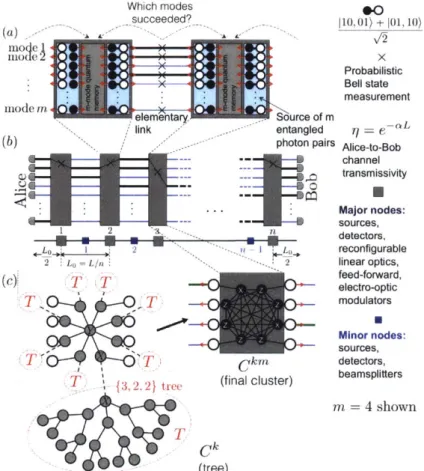
connecting Alice and Bob, respectively, for a repeater architecture that employs quantum memories, Bell pair sources, probabilistic BSMs, and multiplexing over m orthogonal qubit modes (parallel channels). (c) depicts the construction of a photonic cluster state that can subsume the roles of the quantum memory and the Bell pair sources, thereby resulting in a quantum repeater architecture based solely on 'flying' qubits. The outer (white) photonic qubits are transmitted on the fiber channels, and the inner (black) qubits are held locally in a (lossy) waveguide at the repeater node. See text for a detailed description. . 47
2-3 The tree cluster Ck (and the final cluster Ckm after the X and Y mea-surements), shown in Fig. 2-2, are created by a sequence of probabilistic linear-optic fusion-II operations, starting from 3-photon
maximally-entangled (GHZ) states. . . . . 50
2-4 (a) naive multiplexing scheme. A dashed rectangle represents a cluster that has some probability of having been been created after a proba-bilistic fusion step (red circle) or at the output of creating GHZ states using linear optics starting from six single photons (labeled 'GHZ Fac-tory'). A solid rectangle represents a cluster state that is successfully created with high probability by choosing a successful outcome (blue square) out of several identical copies attempted (dashed boxes). (b) the improved multiplexing scheme. A box surrounding clusters of the same type represents a bank of clusters and any operation applied to
the bank is applied to all the clusters in it. . . . . 52
2-5 The probability that all n = 250 major nodes are simultaneously
suc-cessful in creating clusters of size k = 7 fusion steps (i.e., 2
+k
+2 = 130photon clusters), using the naive and the improved multiplexing schemes. 55
2-6 Explanation of why single qubit measurements can be applied before
fusion operations. (a) X and Y basis measurements can be moved be-fore conditional Z operators. (b) Z operators bebe-fore Z basis measure-ments can be removed. (c) Hadamard gates followed by measurement in the X, Y or Z basis are equivalent to direct measurements in a dif-ferent Pauli basis. (d) Single qubit measurements on the final cluster
2-7 The key rate (in bits per mode) Sn(L) achieved by an n-node repeater chain shown as a function of range L, for n = 1, 10, 24, 56, 133, and 314 (magenta dotted plots). Our analytical lower bound to the rate-distance envelope SLB(L) (black solid plot) is indistinguishable for the numerically-obtained rate-distance envelope, which are very close to one another. For all the rate-distance plots, we choose m = 4 parallel
channels and b = {7, 3} error-protection trees (which translates to k = 8 clusters). The PLOB bound is shown for comparison (blue
dashed plot). . . . . 63
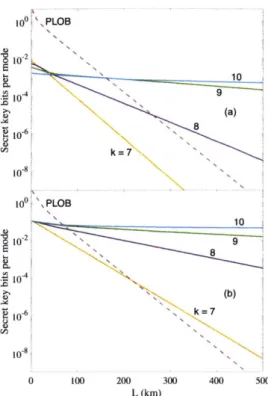
2-8 Scaling of the bits per mode as a function of distance L for different numbers of fusion steps k for the (a) naive scheme and (b) with the improvements of this chapter. The PLOB bound is the pink dashed line.
Q
= 2k + 2 is the total number of photons in the cluster at eachrepeater station . . . . 67
2-9 Schematic of the one-way repeater scheme . . . . 69
2-10 The key rate (in bits per mode) S achieved by an n-node repeater chain using the (p, q) = (12, 4) QPC shown as a function of range L, for n = 50, 100, 300, 500 and 700. The envelope (optimizing over n) is shown in black. The PLOB bound is shown for comparison (blue
dashed plot). . . . . 72
2-11 The key rate (in bits per mode) achieved for different sizes of the QPC, optimizing over n at every point. The PLOB bound is shown for comparison (blue dashed plot). . . . . 73
2-12 The probability that all n = 300 major nodes are simultaneously suc-cessful in creating encoded Bell pairs in quantum parity code of size
3-1 Ballistic photonic cluster state generation for quantum computing. A steady stream of entangled microclusters of size n-photons or less (n = 3 shown) is incident on a linear-optical interferometer (i.e., a
multimode unitary transformation U), which produces an entangled cluster of photons at its output. If a percolation condition is met, the output can be renormalized into a fully-connected logical cluster in a topology universal for cluster-model quantum computing. . . . . 82
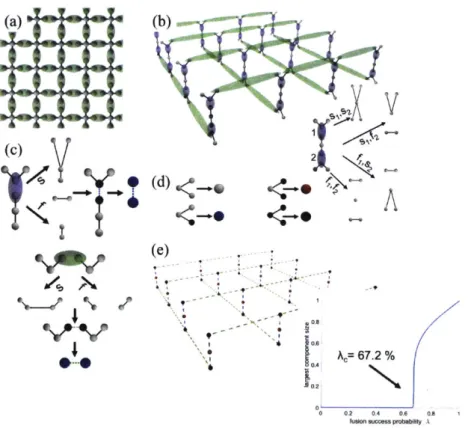
3-2 Different strategies and logical interpretations of piecing together a 2D square lattice by fusing microclusters: (a) 5-photon microclusters at each lattice node with fusion attempts on each lattice bond; (b) vertical arrangements of three 3-photon microclusters and 2 fusions create a 5-photon cluster if both fusions succeed; (c) interpreting fusion as coloring the measured nodes black and drawing a new bond between them if fusion succeeds, the linear optical circuits corresponding to the blue and green ellipses are shown in Fig. 2 and 3 of [4] respectively; (d) mapping microclusters to nodes in a logical graph and coloring them based on how many photons in the microcluster are left unmeasured; (e) pure bond percolation on the logical graph of colored nodes. . . . 88
3-3 Site-bond percolation critical boundaries shown for the (a) 2D square and (b) 3D diamond lattices. The magenta curves correspond to a modified site-bond percolation problem described in the text where even if a site is not occupied, neighboring bonds can still be pairwise connected if occupied. . . . . 89
3-4 A 3D (10,3)-b lattice modified with additional nodes at the centers of each vertical bond. Pure bond percolation on this logical lattice corresponds to assembling the 3D diamond lattice using 3-photon mi-croclusters discussed in [4]. Percolation threshold was evaluated by the Newman-Ziff method on a lattice with ~ 106 bonds. . . . . 93
3-5 (a) 4-node microclusters laid out on nodes of a square lattice. A ran-dom a = 0.3 fraction of microclusters are put in star configuration the central photon of which will not be measured in any fusion operation. All other photons are measured in fusion attempts. (b) A random in-stance after the fusion attempts, assuming that each fusion succeeds with probability A = 0.6. The measured photons are colored black. The unmeasured photons (colored white) in the giant component of the percolated lattice form the backbone random graph that is renor-malized into a fully connected 2D topology for universal cluster-state quantum computing. . . . . 95
3-6 A modified 2D brickwork lattice used as logical graph with node col-ors as shown yields A, ~ 0.746, which settles an open question in [5] on whether it is possible to attain ballistic LOQC with 3-photon microclusters with a fully 2D architecture and A, < 0.78125, which is achievable with unentangled ancilla photons. Percolation threshold was evaluated by the Newman-Ziff method on a lattice with ~ 106 bonds. 97
3-7 Schematic of the 4D extension of the (10,3)-b lattice, which when used as the logical graph with node colors as shown yields A, ~ 0.611. Percolation threshold was evaluated by the Newman-Ziff method on a lattice with ~ 107 bonds. The inner plots with x and y axes represent projections of the lattice on the (x, y) plane at the z and w values shown on the outer axes. . . . . 99
3-8 Schematic of the oo-D extension of the (10,3)-b lattice, which when used as logical graph with node colors as shown yields A, ~~ 0.5898. Percolation threshold was evaluated analytically. . . . . 100
3-9 Schematic of the lattice construction used to approach the A= 1/(n
3-10 (a) An example of a series of two-node fusions on n = 4 sized micro-clusters. (b) Mapping of the microclusters to nodes in a logical graph. Logical nodes with one, two, three, and four measured physical nodes are colored as Blue, Red, Green, and Black, respectively. . . . . 103
3-11 (a) A loss-dependent lower bound AcLB) on the critical fusion proba-bility A, as a function of the input microcluster size n for different values of qO; (b) a loss-dependent lower bound (LB) on the critical loss parameter IO as a function of n for different values of fusion success probability A. . . . . 111
4-1 Cluster state generation by percolation. (a),(b) Transition in the size of the largest connected component (LCC) with increasing bond prob-ability. Spheres and lines represent nodes and bonds respectively, and the red spheres represent the LCC. When the bond probability (p) goes above the percolation threshold (pc), the size of the LCC suddenly in-creases and the cluster changes from being classically simulable to a resource for universal quantum computation. (c) Expanded view of (a). (d) Physical implementation of nodes and bonds with NV centers in diamond. (1) Probabilistic Bell measurement (Barret-Kok protocol) is attempted on two nearest-neighbor broker qubits (electronic spins, blue spheres). g Conditioned on one photon detection events, the two broker qubits are entangled onto a Bell state.
@
Hyperfine interaction between electronic spins and nuclear spins (client qubits, "N) mediates controlled-Z gates.@
X-basis measurement of electronic spins projects nuclear spins into an entangled state heralded by the measurement re-sults (entanglement swapping) . . . . 1174-3 Physical implementation of the proposed architecture. A unit cell con-sists of an atomic memory, a 1 x 4 switch, waveguides and 4 single-photon detectors. Single-single-photons emitted from the atomic memory are coupled to the waveguide and directed to the switch. The switch chooses one of the nearest-neighbor nodes to be entangled with, and single-photons are interfered using a 50/50 beam-splitter. Single-photon detectors detect interfered photon projecting electronic spins onto an entangled state. . . . . 127
4-4 Size of the largest connected component vs time for (a) different values of po, the probability of successful Bell measurement in one attempt and (b) different underlying lattice geometries. A square lattice is used
in (a) and po = 0.02 % is used for (b) . . . . 128
4-5 The minimum time required to obtain a percolated lattice with sub-unity site-yield. po = 0.02%. The inset shows the bonds that can be attempted in a square lattice if the sites marked with crosses are inactive129
4-6 (a) A more general architecture with switches replaced by MZI arrays can allow for long-range entanglement as shown here (b) fLCC as a function of time for different values of c. po = 0.02% is used here. . . 130
5-1 Examples of fusing small entangled clusters into larger ones using pro-jective quantum measurements (green ovals) at nodes of a quantum network. Red circles represent qubits and black lines represent entan-glement. (a) Two-qubit measurement (Bell state projection) used to connect two entangled links into a longer entangled link; (b) a three-qubit measurement (a GHZ state projection) fuses three clusters (two 2-qubit entangled links and one 3-qubit linear cluster) into one 4-qubit entangled cluster; (c) two adjacent nodes in a network performing a three-qubit GHZ measurement and a two-qubit Bell state measure-ment simultaneously. The measured qubits are lost, whereas the final entangled state of the unmeasured qubits upon successful completion of both measurements is the same regardless of the order or the simul-taneity of the measurements. A quantum measurement at a node may succeed only with a probability, which is a function of the class of op-tical devices employed to realize the measurement (e.g., linear optics, single photon sources, and single photon detectors) and losses in de-vices. This figure does not show "failure outcomes", i.e., the resulting entangled state if one or both measurements fail. . . . . 134
5-2 Schematic of a general quantum repeater network. The large (green) circles represent 'trusted' nodes, which are connected via a classical network. The blue circles denote repeater stations, and the red circles inside them represent quantum memories. The dashed lines connect-ing the red circles are independent lossy optical (fiber) channels. In principle, all nodes in the network could be equipped with quantum repeaters (i.e., no trusted nodes), in which case depending upon the need, a node can be a consumer of shared entanglement, or act a router to conduit entanglement flows between other nodes. . . . . 135
5-3 Schematic of a square-grid topology. The blue circles represent repeater stations and the red circles represent quantum memories. Every cycle (time slot) of the protocol consists of two phases. (a) In the first (exter-nal) phase, entanglement is attempted between neighboring repeaters along all edges, each of which succeed with probability p (dashed lines). (b) In the second (internal) phase, entanglement swaps are attempted within each repeater node based on the successes and failures of the neighboring links in the first phase-with the objective of creating an unbroken end-to-end connection between Alice and Bob. Each of these internal connections succeed with probability q. Memories can hold qubits for one time slot . . . . . 140
5-4 Entanglement generation rate as a function of the Alice-Bob separa-tion along X and Y (on a square grid) as a funcsepara-tion of (p, q); (a) Rg(p, q) is the rate attained by a global-knowledge-based protocol we propose where each node, in each time step, knows whether any link in the entire network succeeded or failed to establish entanglement. For the case of q = 1, Rg is distance independent when p is greater than the bond percolation threshold (0.5 for the square lattice) and decays exponentially if it is below the threshold. (b) R(UB) (0.6) is the distance-independent Pirandola rate upper bound for p = 0.6, achieving which requires perfect quantum processing at repeater nodes. Rg(0.6, 1) is also distance independent, and within a factor 3.6 of R(UB)(0.6). With q < 1, e.g., Rg(0.6, 0.9), the rate decays exponentially with distance. R(UB) is an upper bound on the rate attainable with global-knowledge by any protocol. (c) Ri.c is attained by a protocol we propose where each node, in each time step, only needs to know the link state of neighboring edges. The rate-distance scaling exponent of Rj0c is clearly worse than Rg, but is significantly superior to that of a linear repeater chain along the shortest path, Rln, demonstrating multi-path routing advantage even with local link-state knowledge. (d) Contour plot of the entanglement generation rate with the local rule when p = 0.6 and q = 0.9. Although the Alice to Bob distance along the network links is
X + Y, there is a noticeable enhancement in the rate along the X = Y direction because of more Alice-Bob paths of similar length. . . . . . 145
5-5 The entanglement swap rule used at the repeater u in the dotted box in the case of local link-state knowledge. v and w are the repeaters closest to Alice and Bob, respectively, with a direct edge to u. (a) If two or three links are up, the memories linked to v and w undergo an entanglement swap. (b) If four links are up, the remaining two memories also undergo an entanglement swap. . . . . 147
5-6 f(p, q)/pq quantifies the improvement in the scaling of Ri.c(p, q) with respect to Rli1(p, q) with respect to the Alice-Bob Manhattan distance,
n. f(p, q)/pq increases as p is reduced in [1, pc] but changing q has a
negligible effect. . . . . 149
5-7 Network used to prove the lower bound on entanglement generation rate with our local routing rule which shows that scaling of the rate with Alice-Bob Manhattan (L) distance for our rule is better than the scaling of the rate along a linear repeater chain along the shortest path between Alice-Bob. . . . . 150
5-8 Entanglement generation rates with different distance metrics. RL1 and
RL2 are evaluated using the L' and L2
norms respectively. The distance metric for Ri, (iteration 1) is calculated using RLi, and Ri2 (iteration
2) is calculated using Rij. Ri2 and RL1 are nearly indistinguishable as
they almost coincide. . . . . 154 5-9 (a) Multi-flow routing for two Alice-Bob pairs that lie along the sides
of a 6 x 6 square, embedded in a 100 x 100 grid; (b) rate region (RI, R2) with different rules at repeater nodes, each employing local link-state knowledge, for p = q = 0.9. (c) Multi flow routing when the Alice-Bob paths cross (d) multiflow rate region for two local-knowledge rules. . . 156
5-10 A heat map plotting Pusage, the probability that a given repeater node is involved in a successful creation of a shared ebit generated between Alice and Bob, separated by 6 hops in an underlying square grid topol-ogy, when our local rule is employed. We assume p = 0.9 and q = 0.9. 157
6-1 Storage-and release design. Solid lines are optical waveguides, while dashed lines represent electrical control signals. PNRD: photon number resolving detector. The inset illustrates the power spectrum coupled out of the signal filter in its closed configuration and the spectrum arriving at the idler detector. . . . . 163
6-2 (a) Schematic layout of the photonic integrated circuit composed of a high-Q thermally tunable ring for efficient pair generation by sponta-neous four-wave mixing, followed by a DBR for pump rejection and the add-drop ring-resonator filters for the demultiplexing of signal and idler photons. Convenient optical coupling to a single-mode polarization-maintaining fiber array is achieved via focusing grating couplers sep-arated by a 127pm pitch. (b) Schematic transmission spectrum of the first ring around the pump wavelength wp. When one of the ring resonances is tuned to the laser at wp, signal and idler photons are produced in correlated pairs at neighboring resonance wavelengths W, and wi, respectively. (Pairs are also generated at wavelengths spaced by multiple free spectral ranges.) (c) Schematic transmission spectrum of the DBR with the stop band overlapping with the pump wavelength wp. (d) Add-drop filter spectrum tuned to route idler photons to the drop port. (e) First experimental setup: single-chip pump rejection. The add-drop rings are both tuned on resonance with the pump. Light is collected from the common throughport. (f) Second experimental setup: Correlated photon pairs generated in chip A are sent via a fiber to chip B where further pump rejection and signal or idler demulti-plexing are performed before spectral characterization or coincidence measurements with off-chip SNSPDs. . . . . 165
6-3 Optical micrograph of the source (one of four on the chip in an area of 2.4 by 1.36mm2
). Two grating couplers are not shown. (1) Grating couplers used to couple (collect) light to (from) the system are shown on the right. The input light is split by (2) a 2:1 multimode inter-ferometer for optical alignment. Pump light is then routed via (3) a 500-by-220-nm ridge waveguide to (4) the pair-generation ring. The pump is removed with (5) the DBR, which is divided into two sections
1(6) Fabry-Perot resonances due to the division can be controlled with the thermo-optic phase shifter [61]. The multiplexed signal and idler photon combs are then split off for spectral monitoring at (7) the direc-tional coupler before demultiplexing and/or further filtering with the
(8) signal and (9) idler add-drop rings. (10) The
p-doped/intrinsic/n-doped germanium photodiodes were not used during the experiment; however, they could be used to monitor the add-drop ring alignment. 166 6-4 a) Schematic of the coupled cavity detector. Similar to a Q-switched
laser, cavity A1 is in a high-Q state due to destructive interference
between its output decay channel and light returning from cavity A2. Injecting a signal photon into A2 disrupts this interference condition, creating a low-Q configuration which quickly flushes out (b) the energy stored in the composite system. c) A possible experimental implemen-tation of the coupled cavity configuration using a photonic crystal. Here A1 is the tunnel cavity, and A2 is the signal cavity. . . . . 167
List of Tables
2.1 Assumed values for device performance parameters. The source detec-tor efficiency product rg/d is sufficient for the purposes of the calcu-lations in this chapter, and need not be specified separately. Recall that Pff = e-#cch, Pff(fib) e-Tfcf, and Po = 7,ldPc/(2 - lITld). For computational ease, we choose Tf such that Pff = Pff(fib). The device parameters are aggressive but may be achievable in the near future given rapid advances in integrated photonics. . . . . 64 2.2 For k = 7,8,9, and 10, at L = 300 km range, mnaive and mnew are the
optimal values of m for the naive and new schemes respectively. bnaive
and bnew are the optimal values of b for the naive and new schemes respectively. Nnaive is the corresponding number of parallel fiber links needed between successive repeater nodes in the naive scheme. For the new scheme, the number of parallel links is 2
mnew. . . . . . . . 66
2.3 Number of photon sources Ns required at each repeater to create QPC (p, q) states across 300 repeaters with 90% probability. Nq is the num-ber of qubits in the QPC Bell pair. Alternatively NGHz 3-photon GHZ states can be used. The loss rate of each GHZ source is the same as obtained from linear optics using sources of the same efficiency as
ta-b le 2 .1. . . . . 77
4.1 Performance metrics for different collection schemes . . . . 120 4.2 ZPL Collection efficiencies of different schemes . . . . 126
Chapter 1
Introduction
Quantum mechanical effects are prevalent in computers today. Quantum effects like tunneling and discretization of energy levels form the basis of solid state physics used in transistors. However, even though the internal dynamics of these computers is dictated by quantum mechanical effects, their operation can be described classically i.e., a mechanical system can simulate a transistor based computer with a number of components proportional to the number of transistors. Hence, conventional computers are still classical computers.
However, recent experiments have shown that it is possible to isolate quantum mechanical systems from the environment sufficiently well so that superposition and entanglement play a major role. Unlike classical computers, these systems cannot be efficiently described with a system of any components following the laws of classical mechanics. This forms the basis of quantum information processors which can be used to accomplish computing and communication tasks beyond the capabilities of classical systems.
1.1
Quantum computing
Quantum computers use superposition and entanglement to perform several
computa-tional tasks, including prime factorization
17],
optimization [8,
9],
database search [10],
classical computers. In some of these examples, quantum computers with resources (both space and time) scaling polynomially in the size of the problem can solve prob-lems that have no polynomially scaling algorithm on a classical computer. Hence, in addition to practical motivations to building quantum computers, a quantum com-puter would provide strong evidence against the extended Church-Turing Thesis.
A quantum computer is composed of quantum bits or qubits. Since a quantum bit represents a quantum state, it is often written in the Dirac notation as I0)L for a qubit in the zero state and as 1)L for a qubit in the one state. However, since a quantum bit can be in a superposition of zero and one, a single qubit in general can be in the state cO I1)4 + c1 1) with Ico1
2
+
Ic112
= 1. Furthermore, a system of n entangled qubits can be in the state ZiEBCi )L where B, is the set of all n bit binary numbers andZiEB,, |c,12 = 1. Hence, tracking the evolution of a general system of n qubits requires
tracking the evolution of 2" coefficients (ci) which is inefficient in general. However, this does not automatically mean that an n qubit quantum computer allows us to obtain the results of 2' computations; measurement of an n qubit system collapses the state and only gives n bits of information. Quantum algorithms maneuver the state in such a way that the measurement result contains information about a large number of coefficients, and calculating the measurement outcome would require a large amount of classical computation.
There have been proposals of analog computing in systems ranging from mechani-cal gears [13] to soap bubbles for solving NP-complete problems (see [14] for a review). However, the maximum problem size in these systems is limited by errors; in all the analog computing proposals to date, the output becomes noisier as the size of the system increases. As a result, these systems do not present a path to obtaining better
scaling as compared to conventional computers. Quantum computers on the other
hand are not analog computers. Quantum error correction codes and fault tolerant architectures have been developed which can suppress errors for any system size with an overhead that is poly-logarithmic in the system size. There has been a recent theoretical proposal for fault-tolerant quantum computing architecture with constant overhead [15], although there are some problems which need to be solved including
efficient decoders, raising the threshold and minimizing long range gates.
While these theoretical results show that it is possible to build a quantum com-puter that far exceeds the capabilities of any classical comcom-puter in principle, practical issues have prevented the experimental demonstration of such a system. Firstly, fault-tolerant quantum computation requires the error in every component to be below a certain finite threshold. Secondly, even if the error correction overhead is poly-logarithmic in the size of the problem, the actual number of physical qubits re-quired per logical qubit is large when operating near the error correction threshold (the overhead diverges at the threshold). Finally, even though a quantum computer scales better than a classical computer, reaching a problem size where this scaling ad-vantage shows is challenging because of the incredible maturity of CMOS fabrication used in classical computers. A recent paper investigating the resource requirements for building an error-corrected quantum computer with ion-traps powerful enough to solve problems that are beyond current capabilities, using currently proposed
archi-tectures, found that the quantum computer would have the size of a football field
116].
Building so many components while maintaining an error rate below threshold is a daunting engineering challenge and it is quite likely that architectural improvements will be required to bring this down.
1.2
Photonic quantum computing
Photonic quantum computing computing uses photons to encode qubits. In dual-rail
encoding, one photon in two spatial modes encodes a single qubit. i.e. 110) I0)L and
101)
I
1). The subscript L signifies the qubit state. The modes could be temporal, spatial, polarization or any other degree of freedom. In this thesis, the modes of the dual rail qubit will be assumed to be spatial modes in different waveguides unless specified otherwise.Single qubit rotations in this encoding can be implemented with a single tunable beamsplitter. Large tunable arrays of such beamsplitters have been demonstrated with high visibility [17, 18, 19]. Furthermore, optical coupling between two spatially
separated waveguides is negligible, and as a result, the qubit decoherence rate is smaller than in other qubit systems [201. Photonic qubits are prone to errors due to photon loss. However, since photon loss takes a dual-rail qubit outside the qubit encoding, photon loss, even on a single qubit without error correction, is a detectable error. As a result, error correction thresholds for photon loss are as high as 50 % which is much higher than thresholds for errors that keep the qubit in the code space.
One major issue with photonic qubits is the difficulty in implementing two qubit gates. Direct implementation of a two qubit gate requires an extremely large material nonlinearity [21, 22, 231. Even with such large nonlinearities, the causal, noninstan-taneous response of the nonlinearity [24, 251 and unwanted spectral entanglement caused by the nonlinearity [261 lowers the gate fidelity. There has been work on over-coming such effects [27], but the fidelity only approaches one in a large system of coupled nonlinearities.
An alternative is to use effective nonlinearities induced by photon measurement [28, 291. Cluster state quantum computing [1] is a popular quantum computing paradigm which uses such measurement induced nonlinearities. A cluster state is an entangled state that can be depicted as a graph in which each node represents a qubit in the state (0)L4+ 1)L)/V'2 and edges represent controlled-Z gates (see Fig. 1-1(a)). A sem-inal paper by Raussendorf et al. [11 showed how any gate in circuit model quantum computing can be mapped to adaptive measurements on a square grid cluster state as shown in Fig. 1-2. In other words, a series of adaptive measurements on a square grid cluster state can implement any quantum algorithm. Note that other lattice topolo-gies which can be renormalized to a square lattice can also be used to implement any quantum algorithm (see chapter 3 for more details). Cluster state quantum comput-ing involves classical computcomput-ing between measurements, and this makes cluster state quantum computing more efficient than gate-based quantum computing in some ways. As an example, Shor's Algorithm can be implemented using a cluster state of constant depth in the size of the problem 130]. Furthermore, there are well-developed schemes for fault-tolerant quantum computing with cluster states [31, 32, 33].
(a) :b)
(10) + |1))/2
Cz
Figure 1-1: (a) A cluster state. The circles represent qubits in the state (10)
+|
1))/ v'and edges represent controlled Z gates. Any quantum algorithm can be implemented with adaptive measurements on such a square lattice i.e. such a square lattice is a resource for universal quantum computation. (b) A three-qubit GHZ state.
SWire :CNOl
----M M M M M
}
.... M M M M M M M
.---Mr M M M M M M M
.---Single qubit rotation_
----M N M M M ,
---Adaptive measurement Information Flow
Figure 1-2: Any circuit model quantum computation (left) can be mapped to adaptive measurements on a square grid cluster state (right). M., Mz represent measurement in the X and Z bases respectively. Mi - M5 are measurements in bases that depend
on the intended single qubit rotation and previous measurement results. The thick blue arrows represents information flow. For more details, see Ref. [1].
gates to creating the entangled cluster state and adaptive measurement on this state. Starting from single photons, the cluster creation process can start with the creation of 3-qubit Greenberger-Horne-Zeilinger (GHZ) states [34] which are equivalent to the three qubit cluster state in Fig. 1-1(b), up to single qubit rotations. Since single qubit operations with linear optics are relatively easy, we often compare states in terms of equivalence up to single qubit rotations. 3-qubit GHZ states can be created from six single photons using a probabilistic but heralded linear optic circuit with a success probability of 1/32 [2]. Subsequently, small cluster state can be merged together to form a larger cluster state using Type-I and Type-II fusion gates proposed in Ref. [3], both of which succeed with probability 50%. Subsequent work has shown how the success probability of Type-II fusion can be increased by injecting additional ancilla states into the circuit [35, 36, 37]. Because of this enhancement in the success probability, and the natural loss tolerance of Type-II fusion, we use only Type-IL fusion to merge cluster states in this thesis. We defer further discussion of 3-qubit
GHZ creation and fusion gates to Chapter 2.
The entangling operations used to create cluster states with linear optics are probabilistic. We will use two methods to create cluster states with probabilistic gates: multiplexed generation of cluster states, which will be explored in Chapter 2, and percolation based creation which will be explored in Chapters 3 and 4.
1.3
Quantum communication
Given the widespread use of light as an information carrier in modern communica-tion systems, photons have an advantage over other systems as carriers of quantum
information.
Quantum communication can accomplish a number of tasks including the gen-eration of shared secrets whose security relies only on the laws of physics (better known as quantum key distribution or QKD) [38, 391, distributed quantum comput-ing [40], improved senscomput-ing 141, 421, blind quantum computing (quantum computing on encrypted data) [43], and secure private-bid auctions [441.
Since a Bell pair shared between two parties can provide one bit of quantum communication using teleportation, we quantify the quantum communication rate with the entanglement generation rate.
For any direct-transmission protocol over the pure-loss optical channel of trans-missivity q, assuming unlimited authenticated two-way public classical communica-tion, it was recently shown that the entanglement generation rate cannot exceed
log2(1/(1 - i)) bits per mode [451, which is ~ 1.44TI for r, < 1. We will refer to this
as the Pirandola-Laurenza-Ottaviani-Banchi (PLOB) upper bound. For a pure-loss channel, the PLOB bound improves over the Takeoka-Guha-Wilde (TGW) bound
[461
by a factor of 2 in the il
<
1 regime. The TGW bound is an upper bound on the secret-key agreement capacity with unlimited two-way classical communicationP2 (M), applicable to a general quantum channel M. For the pure-loss channel Ar, the
PLOB bound coincides with the best-known achievable rate [47], thus establishing P2(Nq) = log2(1/(1 - 7)) bits per mode. The ebits/s rate is obtained by multiplying
the bits/mode rate by the spatio-temporal-polarization bandwidth (modes/s), which is governed by the channel geometry, and the transmitter and detector bandwidth. Since loss increases exponentially with distance L in optical fiber (i.e., I = eaL), for
T7 < 1, the entanglement generation rate in single-hop quantum communication must decay exponentially with the range L.
One of the big applications of quantum communication is quantum key distri-bution (QKD) which enables two distant authenticated parties Alice and Bob, con-nected via a quantum (e.g., optical) channel, to generate information-theoretically secure shared secret bits. No knowledge of the channel conditions (noise model, or any channel estimate) is required a priori to ensure security. However, the shared secret is generated at a rate commensurate with the worst-case adversary physically consistent with the channel conditions actually presented to Alice and Bob. The rea-son is that all the perceived channel imperfections (anything that causes the channel map to deviate from a noiseless identity transformation) is attributed to the actions of the most powerful adversary allowed by physics-even though some (or all) of that deviation of the channel from an identity map may actually stem from non-adversarial
sources, such as losses due to free-space diffraction, fiber loss, detection inefficiency, thermal noise from blackbody at the operating temperature and wavelength, and detector noise. An important consequence of this assumption is that all the signal power transmitted by Alice that is not collected by Bob is made available coherently to the eavesdropper, Eve. This model for Eve is the intuition behind why the secret key rate for a direct-transmission based QKD protocol must decrease linearly with 77,
the Alice-Bob power transmissivity, in the r < 1 regime [46, 45].
Quantum repeaters are devices that, when inserted along the length of the optical channel, can help generate shared secret at a rate that surpasses the PLOB bound [451,
even when the repeaters themselves are not trusted.
1.4
Thesis outline
Chapter 2 presents schemes for an optical repeaters, several improvements to all-optical repeater schemes and calculates the resource requirements for building useful all-optical quantum repeaters using multiplexed creation of cluster states, accounting for losses in detectors, sources and waveguides in the system. Our calculations show that relatively small cluster states can act as useful quantum repeaters. However, the multiplexed creation of cluster states is very inefficient. In chapter 3, we study a more efficient path towards cluster state creation with non-deterministic gates using perco-lation theory. We present a mapping from the success probability of linear optic fusion operations to the bond percolation threshold of a logical graph, which allows us to find lattices with properties desirable for linear optic quantum computing. Chapter 4 uses the percolation based creation of cluster states in an architecture for quantum computing with atomic memories, that is tailored to nitrogen vacancy centers in di-amond. In Chapter 5, we present the design of a quantum network architecture that only requires entanglement swaps at the repeater nodes, but provides several advan-tages over a linear repeater chain. Finally, Chapter 6 presents both experimental and theoretical work on devices for photonic quantum information processing that I was involved in.
Chapter 2
Resource costs for all-optical
quantum repeaters
2.1
Introduction
Quantum repeaters, proposed in Ref. [48], are devices which when inserted along the length of the optical channel, can help generate shared secret at a rate that surpasses
the PLOB bound [45]. Quantum repeaters need not be trusted or physically secured
to ensure the security of the keys generated. If n quantum repeaters are inserted
along the length of a channel of transmissivity 7 connecting the communicating
par-ties Alice and Bob, and if there are absolutely no physical constraints placed on the repeater nodes (i.e., the repeaters are assumed to be lossless, error-corrected, general purpose quantum computers), then the maximum key rate achievable by Alice and
Bob is given by
- log2(1 - 77min)bits/mode, where
7min = ( min(1, T12, . .. , jn+1) (withT1 = 1 ... -n+1) is the transmissivity of the lossiest link between successive repeater
nodes
149]
(see [501 for a different upper bound based on squashed entanglement [461).Given n repeater nodes, their optimal placement is to lay them equally spaced in
transmissivity, in which case, the maximum rate is - log2(1 - 71/(n+1)) bits/mode.
As n -+ oc, the rate is unbounded. However, assuming repeaters to be lossless
error-corrected quantum computers is not practical. A more practically relevant question to ask is if the repeater nodes have finite resources with lossy and imperfect
compo-nents (where 'resources' may be different physical entities depending upon the type of quantum repeater and the protocol employed), then what rate can Alice and Bob achieve, and what would it take to build repeater nodes to significantly outperform
Rdirect(7) = -log 2(1 - 71) bits/mode. This is the topic addressed in this chapter, for repeaters that are built solely using photonic components-single-photon sources, detectors, electro-optic feedforward, but no matter-based quantum memories. As we will see later, given physical constraints on a repeater node, placing more repeaters
(higher n) between Alice and Bob may not always improve the rate, i.e., depending upon the total distance L (or equivalently, the transmissivity 7) between Alice and Bob, and given the physical device constraints in a repeater node, there may be an optimal number n*(ii) of nodes, which achieves the highest end-to-end rate.
In this chapter, we study two different all-optical repeater protocols: a protocol based on mode multiplexing and entanglement swapping, and a one-way protocol based on logical Bell measurements. We found several improvements for both proto-cols to reduce resource requirements. We consider losses in sources, waveguides and detectors in every step of the protocol, including the creation of the resource states for our protocol. However, we do not consider 'multi-photon' errors that may stem from multi-photon emissions from the source, detector dark clicks, or errors due to mode mismatch in the sources. We should note however that the error correction schemes analyzed here also provide some protection against depolarizing noise [51, 521, a vari-ant of which arises when one assumes multi-photon errors, and errors stemming from imperfect mode matching within the passive linear optical circuits at the repeater nodes.
2.2
Preliminaries
We work with dual-rail photonic qubits, where the logical IO)L and I1)L are encoded by a single photon in one of two orthogonal (spatial) modes. We use the term qubit mode to refer to a set of 2 channels used to transmit a dual-rail qubit between repeater
A photonic cluster state (or, graph state), on a graph G(V, E) with vertices in set V and edges in set E, can be constructed by preparing each of the IVI qubits (one
stationed at each vertex) in the state (I0)L + I1)L)/V'f, and applying JEl controlled-phase operations (a two-qubit unitary gate that applies a Pauli Z gate to the second qubit if the first qubit is in the 1)L state and applies an identity otherwise) on each pair of vertices that share an edge [1]. An ideal loss-less photonic cluster state on graph G is a pure state, ML)G. A lossy cluster state on G is obtained when all the photonic qubits of VO)G are transmitted through independent pure-loss beamsplitters each of transmissivity q. We call 1 - 17 the loss rate of such a lossy cluster state.
Clearly, the loss rate of I)OG itself is 0.
Arbitrary photonic cluster states can be prepared-with non-unity probability-using ideal single photons, passive linear optics (i.e., beamsplitters and phase shifters) and single photon detectors [3]. As examples, in the absence of losses, a two-photon maximally entangled (Bell) state can be prepared with success probability 3/16 [531, whereas a three-photon maximally entangled (GHZ) state can be prepared with suc-cess probability 1/32 [2J. Browne and Rudolph introduced linear-optic Type I and Type II two-qubit fusion gates, which if successful (with probability 1/2), can fuse two cluster fragments into one, according to specific rules [3]. These fusion gates, in conjunction with Bell states and GHZ states, can be used to construct arbitrary cluster states. The success probability of the fusion gates can be improved to 3/4 if additional (ancilla) single photons are available to be injected on-demand into an otherwise-passive linear optical circuit, and if the detectors have up to two-photon number resolution [36]. We will assume such boosted fusion gates in our all-optical repeater construction described in this chapter.
We will model a lossy single photon source of efficiency r, as one that emits, on demand, the mixed state q, 1) (1+ (1 -I) |0) (01. We will use 17d for the efficiency of all detectors in the system. We will consider that the cluster is created on a photonic chip to allow for easier scalability after which the photons are coupled, with efficiency
Pc, to fiber with loss coefficient a and speed of light cf. Pff e0cch will denote the survival probability of a photon on-chip during one feed-forward step, where 3 is the
loss coefficient, ch is the speed of light and r, is the feed-forward time, all on-chip. We will also use PO PGHZPc where PGHZ =s7d/(2 - rsd) [2] is the survival rate of the photons that are input into a linear-optic circuit to produce 3-photon maximally-entangled GHZ states. The final measurement step requires feed-forward in fiber. The survival probability, Pff(fib), during feed-forward time in fiber, Tf, is Pff(fib) = eTf. The values for device performance assumed for the plots that appear later in the chapter, are summarized in Table 2.1.
2.3
Quantum repeaters based on mode multiplexing
and entanglement swapping
In this section, we will focus on a class of quantum repeaters that rely solely on probabilistic BSMs, quantum memories, and multiplexing, i.e., the ability to 'switch' qubits across (spatial, spectral, or temporal) modes. The essence of such a repeater protocol was developed by Sinclair et al. [54], which employed spectral multiplexing in multimode quantum memories across m parallel spectral channels, and entanglement swapping using linear optics and single photon detectors (the success probability of which can at most be 50%). Guha et al. analyzed the secret key rates achievable by the above protocol, with a fixed m (memory size) and found that even when photon loss is the only source of noise, the achievable key rate is of the form D77s, where D, and s < 1 are constants that are functions of various losses in the system (viz., detection efficiencies, coupling losses, memory loading and readout efficiencies, and BSM failure probability) [551. Since the exponent of q, i.e., s < 1, the key rate beats the PLOB bound (which scales as: ocq for 77