HAL Id: hal-01207363
https://hal-centralesupelec.archives-ouvertes.fr/hal-01207363
Submitted on 30 Sep 2015HAL is a multi-disciplinary open access archive for the deposit and dissemination of sci-entific research documents, whether they are pub-lished or not. The documents may come from teaching and research institutions in France or abroad, or from public or private research centers.
L’archive ouverte pluridisciplinaire HAL, est destinée au dépôt et à la diffusion de documents scientifiques de niveau recherche, publiés ou non, émanant des établissements d’enseignement et de recherche français ou étrangers, des laboratoires publics ou privés.
Sparse grid nested sampling for model selection in
eddy-current testing
Caifang Cai, Marc Lambert, Sandor Bilicz
To cite this version:
Caifang Cai, Marc Lambert, Sandor Bilicz. Sparse grid nested sampling for model selection in eddy-current testing. 20th International Workshop on Electromagnetic Nondestructive Evaluation (ENDE’2015)„ Sep 2015, Sendai, Japan. OS1-4 (2 p.). �hal-01207363�
SPARSE GRID NESTED SAMPLING FOR MODEL SELECTION IN
EDDY-CURRENT TESTING
Caifang CAI1, Marc LAMBERT2 and Sándor BILICZ3
1 L2S UMR8606, CentraleSupélec-CNRS-Univ. Paris Sud, 3 rue Joliot-Curie, 91192 Gif / Yvette, France 2 GeePs UMR8507, CNRS-CentraleSupélec-Univ. Paris Sud-UPMC, 11 rue Joliot-Curie,
91192 Gif-sur-Yvette, France
3 Department of Broadband Infocommunications and Electromagnetic Theory, Budapest University of
Technology and Economics, Egry J. u. 18, 1111 Budapest, Hungary
Model selection is a common problem that one can run into in non-destructive evaluations. As described in an example of eddy-current testing illustrated in Fig. 1, the measurements from two closed cracks can be very similar to those from a single crack. In this example, to determine the crack number from available measurements can be seen as a model selection problem.
Figure 1. Model selection between a single-crack model and a two-crack model In the Bayesian framework, selection between two models of interest, ℳ and ℳ , can be performed based on the Bayesian factor calculated as follows
(ℳ , ℳ ) = p( |ℳ ) p( |ℳ ) = p( | , ℳ ) p( | , ℳ ) = ( | , ℳ ) ( |ℳ ) p( | , ℳ ) ( |ℳ ) (1) where , are the unknown parameters in ℳ and ℳ , denotes the measurements. The numerator and the denominator in Eq. (1) are respectively the model evidences for ℳ and ℳ . They are also the marginal likelihoods subject to the prior distributions. Without any further information, uniform distributions can be used as the prior models. Among the methods dedicated to model evidence estimation, Nested Sampling (NS) [1, 2, 3] is one of the most efficient one. Compared to traditional Monte-Carlo methods, it offers a good compromise between the computational cost and the ability to manage complicated objective functions. In the present work, we use an accelerated NS method. The acceleration benefits from the existing points in the database and narrows down the parameter search space at the initialisation.
One of the major difficulties in Bayesian model selection is the computational complexity in approximating the model evidences. The complexity is mainly due to the fact that thousands of forward evaluations are often required in approximating the marginal likelihood. Recent works [4, 5] have shown that the computational cost in forward model evaluation can be considerably reduced by using a data-fitting surrogate model. In this surrogate model, a database containing pairs of { , } are trained off-line by using a method of moments [6] and the forward model can be replaced by a simple interpolation. However, for models with many unknown parameters, both the off-line database training and the on-line interpolation will be impossible because of the ''curse of dimensionality''.
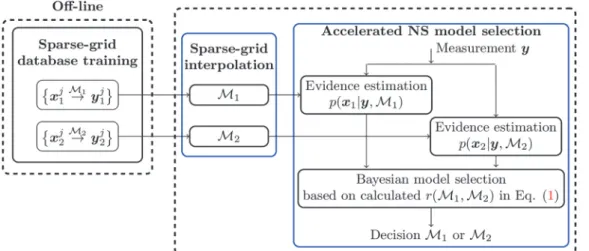
Sparse grids have shown great potential in dealing with the ''curse of dimensionality'' problem [7]. Here, we introduce sparse grids into the surrogate-model-based NS algorithm. How this method works for a two model selection problem is sketched in Fig. 2. The method can be extended easily to multiple model selections.
Figure 2. Sketch of the Bayesian model selection method based on sparse grid nested sampling
Simulation tests based on the same example shown in Fig. 1 have been conducted to test the performance of our algorithm. In this example, a non-ferromagnetic plate is affected by surface cracks. With a time-harmonic excitation, a surface scan of impedance variations can be measured and used for model selection between a single-crack model (2 unknown parameters) and a two-crack model (6 unknown parameters). By varying the distance between the two cracks in the simulation, we show that this Bayesian model selection method has very high selection ability. At a typical signal-to-noise ratio of 20 dB, it is still able to distinguish the correct model even when = 0.01 mm. Further details and more examples will be discussed in the full paper.
References
[1] J. Skilling. Nested sampling for general Bayesian computation. Bayesian Anal., 1(4):833–680, 2006.
[2] F. Feroz, M. P. Hobson, and M. Bridges. MultiNest: an efficient and robust Bayesian inference tool for cosmology and particle physics. Mon Not R Astron Soc, 398(4):1601–1614, 2009.
[3] F. Feroz, M. P. Hobson, E. Cameron, and A. N. Pettitt. Importance nested sampling and the multinest algorithm. arXiv:1306.2144v2 [astro-ph.IM], 28 pages 2014.
[4] R. Douvenot, M. Lambert, and D. Lesselier. Adaptive metamodels for crack Characterization in eddy-current testing. IEEE Trans Magn, 47(4):746–55, 2011. [5] S. Bilicz, Sz. Gyimóthy M. Lambert, and J. Pávó. Solution of inverse problems in
nondestructive testing by a kriging-based surrogate model. IEEE Trans Magnetics, 48(2):495–498, 2012.
[6] J. Pávó and D. Lesselier. Calculation of eddy current testing probe signal with global approximation. IEEE Trans Magn, 42(4):1419–22, 2006.
[7] S. Bilicz, Sparse grid surrogate models for electromagnetic problems with many parameters, 20th COMPUMAG, 2015 (accepted for presentation).
Acknowledgements
The authors would like to thank D. Lesselier for providing advices during the preparation of this abstract and the French National Research Agency (ANR) for providing financial support for this research work in the framework of ByPASS project.