Folia Linguistica 48/1 (2014), 169–223. doi 10.1515/flin.2014.006
issn 0165–4004, e-issn 1614–7308 © Mouton de Gruyter – Societas Linguistica Europaea
Manuela Schönenberger
University of Geneva
The object of this study is to test Meisel’s (2009) hypothesis that there is a sensi-tive phase in language acquisition that ends around age 4. Early L2 acquisition may therefore already show differences from L1 acquisition. To test this hypoth-esis, determiner production in the naturalistic speech of four successive bilingual Turkish–German children recorded during free-play situations was compared to that of monolingual German children discussed in the literature. The successive bilinguals had an age of onset of German between 3 and 4 years and were studied over a period of 20 months. Determiner production was examined because Turk-ish, as opposed to German, does not have an article system. Determiner omission and incorrect article use were considered. A clear difference emerged in miner omission, but not in article misuse. After some initial variability in deter-miner production, deterdeter-miner omission by the monolingual children was found to gradually fall below 10 per cent, while a plateau effect could be observed in the bilingual children. There was no clear evidence for article misuse in either the L1 or the child L2 data. Our findings about determiner omission suggest that early L2 acquisition differs from L1 acquisition. It is unclear, however, whether the child L2 learners will persist in omitting determiners from obligatory contexts, since data collection was ended while the children were still in the process of acquiring German.
Keywords: article misuse, child L2 acquisition, determiner omission, German,
plateau effect, sensitive phase
1 I am grateful to two anonymous reviewers for their very detailed and constructive
1. Introduction
This article discusses determiner production in the longitudinal data from four successive bilingual children whose first language (L1) is Turkish, and who were first regularly exposed to German upon entry to kindergarten between the ages of 3 and 4. The data cover a period of roughly 20 months. This study is of particular interest because, in contrast to German, Turkish does not have an overt article system. Various studies of adult learners of a second language (L2) with articles have found that determiner omission and incorrect article use are quite common and persistent among learners who speak an L1 without articles. In the present study, the L2 learners are children, not adults, with an early age of onset for the L2.
The question of whether their determiner production already shows essential differences from that by monolingual children is of primary inter-est, since it raises the more general question whether there exists a crit-ical period in language acquisition. In biology, for instance, it has been shown that certain behaviours typical of a given species are subject to a critical period, which means that in order for the behaviour to be success-fully acquired, members of that species must be exposed to the relevant stimuli during a critical time interval. Whether language acquisition in humans is also subject to a critical period has been widely discussed since such a period was first proposed by Lenneberg (1967). For the propon-ents of the Critical Period Hypothesis, it is important to discover whether different domains of grammar are subject to different critical periods and to establish at what age acquisition of a given domain becomes difficult or impossible to acquire in a native-like manner. Meisel (2011: 205) notes that “notions like ‘critical period’ and ‘sensitive phase’ do not imply abrupt changes. Rather, we may assume that, after a relatively short onset, each phase is characterized by an optimal period, followed by a gradual offset”. Research on successive bilingual children may illuminate these questions. It has already been pointed out that the phonological system is one of the linguistic domains that is particularly important to acquire at a young age. Hyltenstam & Abrahamsson (2003) suggest that a child must be exposed to the phonological system of a second language as early as age 1 in order to obtain native competence. As Meisel (2011) observes, little is known about the morphosyntactic development of children who are first exposed to a second language during their second or third year. It is therefore unclear whether successive acquisition with such an early age of onset still qualifies
as bilingual first-language acquisition. Meisel maintains that the optimal time interval for the acquisition of syntax and morphology seems to end before age 6, and may even be as early as age 4 (see also Schwartz 2004, Meisel 2009). Acquisition of a second language between ages 4 and 7 is referred to as “child L2 acquisition”, which may share properties with both child L1 and adult L2 acquisition. Language acquisition in children with an early age of onset is more likely to resemble L1 acquisition, and in children with a later age of onset it is more likely to resemble adult L2 acquisition. If determiner production by the Turkish–German children with an age of onset between 3 and 4 years is different from that by monolingual children, this difference would provide further evidence for an early sensitive phase. In order to discover similarities and differences between L1 and early L2 acquisition, the L2 German data from the four successive bilingual Turkish–German children are compared to the longitudinal data from five monolingual German children studied by Eisenbeiss (2000, 2002). Eisenbeiss showed that after some variability in article omission in the early stages of acquisition, it drops to below 10 per cent around age 3. Furthermore, she showed that article omission is particularly high with attributive adjectives and in Prepositional Phrases (PPs). These contexts have also been recognized as being problematic for article production in L2 acquisition. Eisenbeiss did not find any evidence of article misuse in the monolingual German children, that is, the use of a definite article in an indefinite context or an indefinite article in a definite context. In my L2 German data, article misuse by the Turkish–German children is low as well (only a few attestations). While their omission of determiners with PPs is very high, their omission of determiners with attributive adjectives is not. But in stark contrast to the monolingual children, their rate of article omission does not steadily decrease, but stabilizes at around 20 per cent, and remains there for at least 12 months, at which stage data collection was ended. By then, the children had been exposed to German for 30 months. This finding suggests that child L2 acquisition commencing between the ages of 3 and 4 may already differ from L1 acquisition, which tends to sup-port Meisel’s hypothesis that there is a sensitive phase ending around age 4. The article is organized as follows. Section 2 describes determiners in Turkish and article-based languages like German, and highlights article use in German. Section 3 provides a short overview of determiner produc-tion in German L1 and L2 acquisiproduc-tion. Secproduc-tion 4 discusses the data from the successive bilingual Turkish–German children and compares them to
the child L1 German data from Eisenbeiss (2000, 2002). The focus is on determiner omission, and in particular, whether there is a steady decrease in determiner omission with time in the child L2 data. Article misuse is briefly considered here as well. Section 5 summarizes the main findings and conclusions.
2. Determiners in German, English and Turkish
The class of determiners in German and English comprises demonstra-tives (diese Katze/this cat), possessives (mein Hund/my dog), quantifiers (alle Esel/all donkeys), numerals (zwei Enten/two ducks) and articles (eine
Maus/a mouse). Of particular interest in the present study are articles,
which form a subclass of determiners. I will therefore summarize article use in German and English (Section 2.1) as well as consider Turkish, which has determiners but no overt article system (Section 2.2).
2.1. Definite and indefinite articles in German and English
English has an article system comprising a definite article (the) and an indefinite article (a). The definite article marks the singular (the cat) and the plural (the cats), whereas the indefinite article is used only in the sin-gular (a cat). There is no indefinite article in the plural; instead, the null article is used (cats).2 The same is true of German, but the German article system is morphologically more complex than the English system: it shows case (e.g. der Katzen ‘the.gen.pl cats’ vs. den Katzen ‘the.dat.pl cats’), number (der Esel ‘the.nom.m.sg donkey’ vs. die Esel ‘the.nom.pl donkeys’) and gender distinctions (der Esel ‘the.nom.m donkey’, die Katze ‘the.nom.f cat’, das Schwein ‘the.nom.n pig’). The German article system has many syncretic forms, which make it non-transparent; for example, the form die can denote ‘the.nom.f’, ‘the.acc.f’, ‘the.nom.pl’ or ‘the.acc.pl’. The differ-ent forms of the definite article and of the indefinite article in German are 2 Chierchia (1998) analyses nouns without a determiner (e.g. Katzen/cats), so-called bare
nouns, as NPs. Sarko (2009), on the other hand, argues that languages that have a definite article but no indefinite article, as for example Syrian Arabic, project a DP in both definite and indefinite contexts, but that in indefinite contexts D is not phonologically realized. Longobardi (1994) maintains that all languages, independent of whether or not they have articles, project a DP. In this article, I assume Sarko’s hypothesis.
listed in Tables 1a and 1b. The different forms in Tables 1a and 1b would be expressed by one form in English: the and a, respectively.
Just like other determiners in English and German, definite articles and unreduced indefinite articles in German, as in (1a), are independent prosodic words that can occur on their own. In spoken German, however, indefinite articles are often reduced as in (1b); when reduced, they are clit-ics, that is, words that cannot occur on their own but must attach to either the preceding or following word, just like both definite and indefinite art-icles in English (see Selkirk 1996). Further, in spoken and standard written German, the definite article may combine with certain monosyllabic prep-ositions into one form, as in (2a), where an ‘at’ and dem ‘the.dat.m’ form
am. In spoken, but not standard written German, additional concatenated
forms are possible, as in (2b).
(1) a. Ich habe eine Kuh/ einen Esel gesehen. I have a.acc.f cow a.acc.m donkey seen ‘I’ve seen a cow/a donkey.’
b. Ich hab ne Kuh/n Esel gesehn.
(2) a. Am Bahnhof kannst Du noch einkaufen.
at.the.dat.m station can.2sg you still shop ‘At the train station you can still go shopping.’
Table 1a. The paradigm of the definite article in German
Masculine
(singular) Feminine (singular) Neuter (singular) Plural
Nominative (nom) der die das die
Genitive (gen) des der des der
Dative (dat) dem der dem den
Accusative (acc) den die das die
Table 1b. The paradigm of the indefinite article in German
Masculine
(singular) Feminine (singular) Neuter (singular) Plural
Nominative (nom) ein eine ein ∅
Genitive (gen) eines einer eines ∅
Dative (dat) einem einer einem ∅
b. Du kannst diesen Krug auf’n Tisch stellen.
you can.2sg this.acc.m jar on.the.acc.m/a.acc.m table put ‘You can put this jar on the/on a table.’
German articles are thus more complex than English articles, not only from a morphological but also from a prosodic point of view. However, our main concern will be the presence or absence of articles (and more generally, determiners), and whether they are used appropriately. Note that throughout this article the term “determiner” is used to refer to any mem-ber of the class of determiners, that is, demonstratives, possessives, quanti-fiers, numerals and articles, while the term “articles” is used to refer to the subset of determiners that are articles.
Singular common nouns in German and English do not usually occur on their own, but are accompanied by an article (*Katze/*cat vs. eine
Katze/a cat) or another pre-modifying determiner (diese Katze/this cat, meine Katze/my cat, welche Katze/which cat, (nur) eine Katze/(only) one cat). Articles, and more generally, determiners, are usually obligatory with
count nouns in the singular:
(3) a. Sean hat *Katze/ eine Katze gefunden. Sean has cat a cat found b. ‘Sean has found *cat/a cat.’
In languages like German and English, definiteness is grammaticalized in the article system. As Hawkins (1978) maintains, definiteness depends on whether a unique referent can be identified in the discourse. There are vari-ous ways in which uniqueness of a referent can be established. Some typ-ical examples are provided in (4).
(4) a. Anaphorically (via previous mention)
Ann hat eine Katze gefunden. Die Katze muss
Ann has a.acc.f cat found the.nom.f cat must
sich verlaufen haben.
self lost have
‘Ann has found a cat. The cat must have gotten lost.’ b. Via immediate situational context
Kannst du die Türe schliessen?
can.2sg you the.acc.f door close ‘Can you close the door?’
c. Via association
Sean hat am Samstag geheiratet. Die Braut war
Sean has on.the.dat.m Saturday married the.nom.f bride was
ziemlich verärgert, weil er wie immer zu spät kam.
quite upset because he as always too late came
‘ Sean got married on Saturday. The bride was quite upset because he arrived late as usual.’
d. Via encyclopaedic knowledge
Der Mond ist soeben aufgegangen.
the.nom.m moon is just risen ‘The moon has just risen.’
In (4a), the definite article is used anaphorically following a previous intro-duction of a new referent in the discourse. However, a speaker can use a definite DP without introducing the antecedent if the hearer can identify the referent via situational context (4b), via association (4c), or via world knowledge (4d). If the referent is not identifiable by the hearer (5a), or by the speaker and the hearer (5b), the indefinite article is used.
(5) a. Gestern hab ich eine Jeans gekauft. Leider ist sie zu eng.
yesterday have I a.acc.f jeans bought unfortunately is she too tight ‘I bought a pair of jeans yesterday. Unfortunately they are too tight.’ b. Ich kauf noch eine Melone heute.
I buy still a.acc.f melon today ‘I’ll buy a melon today.’
German and English behave similarly not only in their use of the defin-ite and indefindefin-ite articles with singular count nouns, but also with respect to mass nouns, which do not require an article, as shown in (6). In other contexts, article use may be different: for example, in English an indefinite article is generally used with predicative DPs referring to a profession (7a), while in German an indefinite article is used only if the predicative nom-inal is modified (see (7b′) vs. (7a′):
(6) a. Gromit liebt Reis. b. Gromit loves rice. (7) a. Wallace is a teacher.
a′. Wallace ist Lehrer.
b′. Wallace ist ein guter Lehrer.
Wallace is a.nom.m good.nom.m teacher ‘Wallace is a good teacher.’
German and English also have a plural definite article. In English, the plural definite article is homophonous with that in the singular, as shown in (8a) and (8b). In German, there is also only one definite article in the plural, which can show different case markings, but does not show dif-ferent gender markings (see Table 1a). The plural article can be homoph-onous with the feminine article in the singular, as shown in (8c). (Note that demonstratives in English have a distinct plural form: these/those vs. this/
that, while in German the form of the demonstrative in the plural again
often coincides with that of the feminine demonstrative in the singular: e.g. diese ‘this.nom/acc.f.sg’ or ‘these.nom/acc.pl’.) Neither German nor English has a plural indefinite article, as shown in (9).
(8) a. Hayley likes to stare at the moon.
b. Hayley’s mother likes to observe the motions of the moons sur-rounding Jupiter.
c. Hayley geniesst die wärmenden Strahlen der Sonne.
Hayley enjoys the.acc.pl warming.pl rays the.gen.f sun ‘Hayley’s enjoying the warming rays of the sun.’
d. Hayleys Mutter liebt es, die Bewegung der Monde,
Hayley.gen mother likes it the.acc.f motion the.gen.pl moons
die Jupiter umkreisen, zu beobachten.
that.nom.pl Jupiter surround to observe
‘ Hayley’s mother likes to observe the motion of the moons that surround Jupiter.’
(9) a. Alice liebt Uhren. b. Alice likes watches.
In both German and English, no article is used with generics in the plural, but an article is required in the singular:
(10) a. Katzen sind Raubtiere. b. Cats are predators.
c. Die Katze ist ein intelligentes Tier.
the.nom.f cat is an.nom.n intelligent.nom.n animal d. The cat is an intelligent animal.
In summary, the definite and indefinite articles are generally used in the same contexts in the two languages, and definiteness is grammaticalized in the article system.
2.2. Turkish
Unlike German and English, Turkish does not have an overt article system. So, instead of the definite article, it can use determiners to mark a nominal as being definite, for instance, the demonstratives bu ‘this’ and su ‘that’. In general, however, a nominal is interpreted as definite if it is not explicitly marked as being indefinite. Bare nominals in sentence-initial position are generally interpreted as definite, since this position is typically reserved for topics.
(11) Çocuk güldü. child laugh
‘The child laughed.’ (from Öztürk 2005, cited in Snape & Kupisch 2010: 530)
The numeral bir ‘one’ can indicate indefiniteness and is regarded as article-like when it is unstressed (Kornfilt 1997), but in contrast to indefinite art-icles in English and German it is said to be optional (see Parodi, Schwartz & Clahsen 2004: 675). In (12a), for instance, the object nominal is preceded by bir and is interpreted as indefinite; in (12b), the object nominal is pre-ceded by bir and carries an accusative suffix, which marks the nominal as being specific (see Von Heusinger & Kornfilt 2005) and indefinite. The nominal with accusative morphology but without bir in (13) is interpreted as being specific and definite.
(12) a. Ali bir kitap okudu. Ali a book read ‘Ali read a book.’ b. Ali bir kitab-ı okudu.
Ali a book-acc read
‘ Ali read a certain book.’ (from Öztürk 2005, cited in Snape & Kupisch 2010: 530)
(13) Ali kitab-ı okudu. Ali book-acc read
‘Ali read the book.’ (Snape & Kupisch 2010: 530)
Turkish-speaking learners of a language with articles like German or English are expected to have difficulties in acquiring articles but not other determiners, such as demonstratives, since these also exist in Turkish. The similarity of unstressed bir to an indefinite article might make the
acqui-sition of the indefinite article easier than the acquiacqui-sition of the definite article, for which there is no counterpart in Turkish. But if bir is optional, optionality might be transferred to indefinite nominals, or to nominals in general, in the L2. A word of caution is in order here: when a determiner is missing in a language that has articles, it cannot be determined with certainty whether or not the omitted element is an article. Moreover, it is often not possible to compare the proportion of omission across studies because some normalize to the total of omitted + overt determiners that are articles, and others to the total of omitted + overt determiners of any type.3 It has been shown that adult Turkish learners of German tend to leave out determiners in the L2 (see Parodi, Schwartz & Clahsen 2004), as do adult Turkish learners of English (see White 2003, Goad & White 2007). My study of determiner use by young Turkish children acquiring German as an L2 can show whether this is also a problem for very young learners.
3. Determiner production in monolingual and bilingual speakers
of German
The object of our study is to discover how closely determiner production by child L2 learners resembles that by child L1 learners and whether it already shows signs of adult L2 acquisition. As a backdrop, general trends in the production of determiners in monolingual and simultaneous bilingual L1 acquisition (Section 3.1) as well as in child and adult L2 acquisition are described (Section 3.2). Determiner omission may affect many different contexts, but two have been identified as particularly vulnerable to deter-miner omission, those of modified nouns and of PPs (Section 3.3). Besides determiner omission, article misuse has also been shown to occur in child L1 and L2 acquisition (Section 3.4).
3 Percentages of omission in different cases can be directly compared only when they use
the same normalization. Consider the following hypothetical example. Assume a speech sample from an L2 learner of German with 100 contexts in which a native speaker of Ger-man would use a determiner, but the L2 learner omits the determiner in 30 of these, and produces an overt determiner in the remaining 70, using an article in 50 of these 70 cases. Normalization to the total of omitted + overt determiners that are articles, as in (i), gener-ally results in a higher percentage of omission than normalization to the total of omitted + overt determiners of any type, as in (ii).
(i) omission = (30/(30+50)) × 100 = 37.5% (ii) omission = (30/(30+70)) × 100 = 30%
3.1. Determiner production in German L1 acquisition and
simultaneous bilingual acquisition
Important research on determiner acquisition in German L1 was carried out by Eisenbeiss (2000, 2002), who studied determiner production by seven monolingual German children. The study involved longitudinal data from spontaneous production by five of these children. The spontaneous production data from two of the five – Leonie and Svenja – were supple-mented with experimental data. The relevant information concerning the children is summarized in Table 2.4
Table 2. Overview of monolingual German children
Child Age range MLU No. of datasets D-contexts
Annelie 2;4–2;9 2.0–3.1 6 393
Hannah 2;0–2;7 1.2–2.9 8 267
Leonie 1;11–2;11 1.6–2.9 15 1181
Mathias 2;3–3;6 1.3–3.5 18 519
Svenja 2;9–3;3 3.3–4.1 15 1019
Note: based on Eisenbeiss (2000).
Eisenbeiss observes that the early datasets generally contain many formu-laic utterances with article-like determiners and what she labels “fixed D+N units”. Formulaic utterances are defined and exemplified in (14), below; “fixed D+N units”, such as der Papa ‘the daddy’, consist of a determiner and a noun frequently occurring together in the input, and are produced by the child without any variation, suggesting that the determiner is part of an unanalysed chunk. At the same time, there are few examples with determiners that freely combine with a noun. Eisenbeiss counts article-like determiners in formulaic utterances and in fixed D+N units as instantia-tions of overt determiners, which boosts the proportion of overt determin-ers and at the same time diminishes the proportion of omitted determindetermin-ers. She notes that a change from unanalysed to analysed forms in a child’s grammar can be seen first as a decrease in overt determiner production before the production increases again, resulting in a U-shaped develop-4 Throughout this article, the age of the child is denoted [y;m], where ‘y’ stands for ‘years’,
‘m’ for ‘months’; ‘MLU’ stands for ‘Mean Length of Utterance’ (measured in words not mor-phemes); and ‘D-contexts’ covers all the contexts in which an adult would use a determiner, but in which the child either did or did not use a determiner.
mental curve. In terms of determiner omission, this change would be seen first in an increase in determiner omission before it decreases again. (14) Formulaic utterances (adapted from Eisenbeiss 2000: 40)
a. Only the noun following the determiner in question shows lexical variation: e.g. wo’s de+Hund ‘where’s the+dog’, wo’s de+Haus ‘where’s the+house’.
b. The invariant part of the utterance, as in wo’s de ‘where’s the’, occurs at least three times in one dataset, always combined with a noun, and in more than one dataset.5
After some initial variation, the proportion of determiner omission gradu-ally decreases in the data from Annelie, Hannah and Leonie. In the early datasets, these children produce few examples with determiners that freely combine with a noun, but many with determiners in formulaic utterances and in fixed D+N units. Figure 1a summarizes determiner omission in Leonie’s data, whose overall development is representative for two other children (Annelie and Hannah).6 In contrast, Svenja rarely leaves out deter-miners (see Figure 1b), but her MLU is higher than that of the other three girls. Unlike the other three girls, Svenja does not produce any formulaic utterances. The data from these four children show that determiner omis-sion falls below 10 per cent before age 3 (see also Penner & Weissenborn 1996). This is less clear in Mathias’s case (see Figure 1c): Mathias does not produce any formulaic utterances with article-like determiners or fixed D+N units, which may explain why determiner omission in the first ten datasets (9–18) is so high. In the remaining datasets – except for dataset 23 – the omission rate drops to 20 per cent or lower.
Kupisch et al. (2008), in contrast to Eisenbeiss, looked at the correlation between a child’s MLU and omission, and they analysed omitted determin-ers specifically as articles rather than as general determindetermin-ers. They exam-ined longitudinal data from four monolingual children acquiring different Germanic languages (English, German, Norwegian, Swedish) and observe that once a child’s MLU is 3 or above the child omits articles in less than 20 per cent of cases. Since these authors assume that the omitted element in 5 One reviewer observes that the number of formulaic utterances may be underestimated,
since according to Eisenbeiss an utterance only counts as formulaic if it occurs at least three times in a child’s dataset. This may be true, but because I used the same analysis criteria, both analyses would be affected in the same way.
6 Note that in the figures presented in this article the numbers on the x-axis always label the
their child data is always an article, in their calculation of the percentage of omission they normalized to the total of omitted determiners + overt determiners that are articles (see also footnote 3).
The comparison of determiner production from children acquiring a Germanic language with those acquiring a Romance language has revealed
100 80 60 40 20 0 % 1 2 3 4 5 6 7 8 9 10 11 12 13 14 15 100 80 60 40 20 0 % 1 2 3 4 5 6 7 8 9 10 11 12 13 14 15 100 80 60 40 20 0 % 9 10 11 12 13 14 15 16 17 18 19 21 22 23 24 25 26 27
Figure 1a. Determiner omission in the data from Leonie
(1;11–2;11, MLU 1.6–2.9) (based on Eisenbeiss 2000)
Figure 1c. Determiner omission in the data from Mathias
(2;3–3;6, MLU 1.3–3.5) (based on Eisenbeiss 2000)
Figure 1b. Determiner omission in the data from Svenja
that Romance learners start using articles earlier and drop them less often (Chierchia, Guasti & Gualmini 1999, Lleó & Demuth 1999, Lleó 2001, Guasti et al. 2004). These differential onsets may explain the cross-linguis-tic influence found in some studies of bilingual acquisition, whereby the acquisition of one of the languages of a bilingual child is “accelerated” or “delayed”. Kupisch (2007) found that bilingual children acquiring Italian and German from birth are faster at acquiring articles in German than monolingual German children, pointing to a potential beneficial effect of Italian on German. On the other hand, a study by Hulk (2004) showed that in a Dutch–French bilingual child, the acquisition of articles in French is slower than that of monolingual French children. Since the Turkish– German children of my study had been acquiring Turkish for three years before regular exposure to German, their article acquisition in L2 German may be delayed due to the influence of L1 Turkish, a language without an article system.
3.2. Determiner production in L2 German
Earlier research on determiner production in L2 German has shown that article omission by child and adult learners can be quite high. Pfaff (1992) for instance, has studied the development of two Turkish children, who started to attend kindergarten at a very early age, at 1;2 and 0;6 respectively; the data were collected over a period of more than two years (ages 1;8–4;3 and 2;11–5;3). It was found that the two Turkish children persist in omitting articles in L2 German, in contrast to a German-speaking child visiting the same bilingual kindergarten in Berlin, which is attended by a very large proportion of children whose home language is not German (about 90% of the children speak Turkish at home). Even in the last recordings, both chil-dren more often omit an article than produce one (see Pfaff 1992: Tables 2 and 3). Quite different conclusions were reached in an experimental study on child L2 English by Zdorenko & Paradis (2008), who show that art-icle omission by child learners of English who speak an L1 without artart-icles begins to disappear after only 16 months of exposure to English. On aver-age article omission was 8.3 per cent, ranging from 1.3 to 20.5 per cent per child (see 2008: appendix 2).
With regard to adult L2 learners of German, a study by Parodi, Schwartz & Clahsen (2004) revealed that native speakers of an L1 without articles (Korean, Turkish) are more likely to omit determiners than native speakers
of an L1 with articles (Italian, Spanish). Determiner omission in the cross-sectional data from the 18 Korean speakers, aged 29–60, with exposure to German ranging from 9 months to 18 years, is very high, generally above 40 per cent. One of the three Turkish speakers, Kadir, aged 47, who had had only limited exposure to German for nine years, omitted determiners in 58 of 100 examples (58%). The other two Turkish speakers, Ilhami and Ayse, are also described as having had little contact with the German-speaking community during their participation in the study. Neither had had inten-sive language instruction in German, but they both participated “in a voca-tional training program for immigrants, which included a three-month language course” (Parodi, Schwartz & Clahsen 2004: 681). Both Ilhami and Ayse omitted determiners much less often than Kadir. Table 3 summarizes the data from these two learners (ME = months of exposure to German), whose production of determiners is surprisingly good. In fact, it is almost as good as that by some of the Romance learners of German.7
When comparing the child and adult L2 German data, it is surprising that the Turkish children omitted determiners more often than the older learners (Ayse and Illhami), although the children had been exposed to German much earlier and for a longer period of time than the two older learners. Note that the two studies normalize to different things, so the values cannot be directly compared (see footnote 3). Further, while the Turkish children in Pfaff’s (1992) study attended a bilingual kindergarten 7 Some learners never achieve full mastery of article use and persist in omitting articles.
Particularly clear evidence of this comes from a study by White (2003), who investigated article use in an endstate L2 learner of English with L1 Turkish (see also Lardiere 2004 for an endstate learner of English with L1 Chinese).
Table 3. Determiner omission by L2 learners of German
with L1 Turkish
L2 learnera Dataset Determiner omission
Ayse (17) 1 (ME16) 27% (29/107) 2 (ME22) 22% (12/54) 3 (ME28) 9% (3/32) Ilhami (16) 1 (ME10) 16% (18/116) 2 (ME18) 15% (12/79) 3 (ME29) 14% (18/132) Source: Parodi, Schwartz & Clahsen (2004).
with a high proportion of Turkish-speaking children, the successive bilin-gual Turkish–German children of my study attended a monolinbilin-gual kin-dergarten and clearly had more extensive exposure to German.
3.3. Sensitive contexts for determiner omission
Two contexts have been recognized as showing particularly frequent deter-miner omission in L1 and L2 acquisition studies: those of attributive adjec-tives/modified nouns and of PPs. They are considered in turn.
3.3.1. Attributive adjectives and modified nouns
According to Eisenbeiss (2000, 2002), the early stages of L1 acquisition of German are characterized by a high proportion of formulaic utterances and fixed D+N units. She suggests that in formulaic utterances the slot for N cannot be filled by an adjective + noun combination, nor can fixed D+N units allow for the insertion of an adjective (2000: 40). Examining utter-ances with attributive adjectives, she showed that, in the early stages of L1 acquisition, attributive adjectives and determiners are in complementary distribution – there were 46 such examples (2000: 46) – and there were no examples in which a determiner and an adjective occurred in the same DP. Four of the five children in her study produced many examples with an adjective (A), or an adjective followed by a noun (A+N), before they pro-duced the first example with a determiner and an adjective (and a noun) (D+A(+N)), that is, where a determiner and adjective are not in comple-mentary distribution. Note that the sequence D+A (e.g. das Gelbe ‘the yel-low (one)’) is grammatical in German. The fifth child, Svenja, produced four examples of D+A in the first dataset (age 2;9, MLU 3.3), but when recording started she was older and had a higher MLU than the other children. As mentioned in the discussion of determiner production in German L1 acquisition (Section 3.1), a steady decrease in determiner omission can be observed, as the children grow older. One of the contexts Eisenbeiss excluded from the general analysis is that of modified nouns (see Section 4.3.1) But also in this context, a clear developmental trend towards fewer omissions is visible, as exemplified by Leonie’s data in Figure 2. Note that the y-axis here denotes the number of utterances, not percentages.
With regard to adult L2 learners of L1s without articles, it has been shown by Trenkic (2009) that they tend to omit articles more often with
nouns that are modified by an adjective (e.g. black cat) than with nouns that are not modified (e.g. cat). She advances a processing account as an explanation: in her analysis, demonstratives, numerals, etc., are regarded as a “closed-class subset of the category adjective” in languages that do not have articles; that is, L2 learners whose L1 does not have articles are assumed to treat them as adjectives because of their similarity to demon-stratives and numerals. While articles are obligatory in the L2, adjectives are not. Articles may therefore be used inconsistently by L2 learners who misanalyse them as adjectives, that is, who assign them the following meanings:
(15) the: adj.def (that can be identified)
a: adj.indef (that cannot be identified) (Trenkic 2009: 125)
With increased proficiency and more exposure to the L2, article production generally improves. However, even when L2 learners start to produce art-icles quite reliably with unmodified nouns, article production with modi-fied nouns remains variable. Trenkic suggests that this may be attributed to modified nouns requiring more processing resources than unmodified nouns due to the extra element of meaning.
3.3.2. PPs
Determiner omission can be very high in PPs, as shown by Eisenbeiss (2000) for German children (L1), by Ferrari & Matteini (2009) for an Italian child (L1) and by Gutzmann & Turgay (2011) for child L2 learners of German. Several proposals have been advanced to account for this high
80 60 40 20 0 1 2 3 4 5 6 7 8 9 10 11 12 13 14 15 N
Overt determiner Missing determiner
Figure 2. Leonie’s realization of determiners in utterances with
omission rate. Ferrari & Matteini (2009) suggest that articles in PPs may be problematic either because two functional elements (P and D) are adjacent or because D undergoes head-adjunction to P in PPs with syncretic forms, as in nella foresta ‘in the forest’, where the article la has been incorpor-ated into the preposition in resulting in nella. Neither of these suggestions seems to be entirely satisfactory. In Italian past-tense forms, the affixation of two adjacent functional morphemes – tense and agreement – to the ver-bal stem does not pose a particular problem for Italian children, so why would the production of the adjacent functional words P and D be prob-lematic? Admittedly, tense and agreement morphemes are affixes – that is, bound morphemes – while determiners and prepositions are free mor-phemes. Still, Ferrari & Matteini point out that the monolingual Italian child (Sabrina) in their study does not usually leave out the article if the preposition and the article do not concatenate, as in a uno ballo ‘at a ball’ or per la mamma ‘for the mother’, which implies that the adjacency of two functional elements per se is not problematic. Forms like nella may indeed be difficult to acquire if such forms are not stored in the mental lexicon as single units, but as separate units (in and la), and the learner has to com-bine these two functional words into nella in a given utterance. Erroneous forms like inla would provide positive evidence that these forms are actu-ally combined on-line rather than memorized. Ferrari & Matteini (2009) do not mention whether there are any such forms in Sabrina’s data. German, too, has concatenated forms, for example, zu ‘to’ and dem ‘the. dat.m/n’ form zum. In a similar vein, Tracy (1984) suggests that articles are more likely to be omitted in concatenated forms in German and attributes this to their reduced prosodic weight. In the concatenated form zum, the article is realized as a clitic on the preceding preposition. However, articles can be realized as clitics in other syntactic contexts as well (see example (1b)), and these are not said to be particularly prone to article omission. Gutzmann & Turgay (2011), who present an experimental study targeting case assignment in PPs by monolingual German children and successive bilingual Turkish–German children with an AO of German between 3 and 4 years, argue that PPs pose a challenge in language acquisition because of their complex morpho-syntactic properties. Besides P and D, PPs are assumed to contain further functional categories such as PlaceP and PathP, which underlie the distinction between locative and directional PPs and are overtly realized in English prepositions like into. Although such complex prepositions do not exist in German, German PPs are also assumed to
con-tain at least three functional categories. As well as prepositions that always assign the same case, German has so-called Wechselpräpositionen, that is, prepositions that can assign either accusative or dative case, depending on whether the PP expresses direction or location:
(16) a. Sophie reist in die Provence.
Sophie travels in the.acc.f Provence ‘Sophie will travel to Provence.’ b. Sophie reist in der Provence.
Sophie travels in the.dat.f Provence
‘Sophie is travelling in Provence.’ (from Gutzmann & Turgay 2011) The presence of several functional projections inside PPs and the interplay between case and meaning with Wechselpräpositionen may indeed make the acquisition of PPs in German difficult. An additional problem may arise for Turkish learners of German, in that German PPs can be expressed by case-marked nouns in Turkish. For example, a dative-marked noun is associated with a directional relationship and a locative-marked noun with a locative relationship:
(17) a. ev-e house-dat
‘to the house’ b. ev-de house-loc
‘in/at/on/by the house’ (from Gutzmann & Turgay 2011)
Thus, German PPs in which both a preposition and a determiner need to be realized may be particularly challenging for Turkish learners of German, since such PPs can often be expressed by case-marked nouns in Turkish. Let us now briefly consider determiner omission in PPs. Determiner omission in the German L1 data from Eisenbeiss (2000) is summarized in Table 4, but where I have further subdivided the data into “early” and “late”. In the early datasets from Annelie, Hannah and Mathias, determiner omis-sion in PPs is high, but then it steadily decreases or vanishes completely. It remains relatively high in the PPs produced by Leonie and Svenja even after determiner omission becomes rare in other contexts: Leonie omit-ted the determiner in 8 of 20 (40%) PPs in the final dataset (see Eisenbeiss 2000: Table 2.12), and Svenja did so in 7 of 19 (37%) PPs in the second-to-last dataset (see Eisenbeiss 2000: Table 2.14). In child L1 Italian, determiner
omission is also common in PPs. Ferrari & Matteini show that the mono-lingual child Sabrina (age 1;11–2;6, MLU 2.1–2.9) omits determiners in PPs much more often than in any other context: 49% (42/85) in PPs vs. 21% (120/576) in other syntactic contexts (see Ferrari & Matteini 2009: Table 5). Sabrina is similar to Leonie in terms of age and MLU.
Gutzmann & Turgay (2011) found that first- (G1) to fourth-grade (G4) schoolchildren rarely produced PPs from which the preposition and the determiner are missing; they also rarely produced examples in which the preposition is missing but the determiner is present. (These two types of examples are also not very common in Sabrina’s data.) The production of target-like PPs with both a preposition and a determiner is very high in the monolingual children’s data, with only a very slight increase between G1 to G4 (93.2%–96%), while there is a noticeable increase in the successive bilingual children’s data between G1 to G4 (64.6%–87.7%). These experi-mental data show that monolingual German schoolchildren rarely omit determiners in PPs and that determiner omission in this context becomes less pronounced as successive bilingual schoolchildren grow older.
3.4. Article misuse in child L1 and L2 German
Eisenbeiss (2000: 45) notes that there is no evidence in her data that the monolingual German children use articles incorrectly, but states that “it is hard to detect errors with respect to definiteness in spontaneous speech.” In my experience with video-recorded data, an examination of the linguis-tic and situational context can generally provide enough information as to whether an overt definite or indefinite article is appropriate in a given utterance.
Incorrect use of articles is, however, attested in Ose & Schulz’s (2010) experimental data from monolingual German children and successive bilingual children with an AO of German between 3 and 4 years and whose L1 is Turkish, Russian, or Italian. The design of their experiment is based
Table 4. Determiner omission in PPs in child L1 German
Annelie Hannah Leonie Mathias Svenja
Average 49% (20/41) 50% (8/16) 40% (32/81) 40% (20/50) 18% (26/147) Early 64% (18/28) 100% (8/8) 81% (13/16) 100% (11/11) 22% (13/60) Late 15% (2/13) 0% (0/8) 29% (19/65) 23% (9/39) 15% (13/87) Note: based on Eisenbeiss (2000).
on “question after story” from de Villiers & Roeper (1996). Two experi-mental items are reproduced in (18) and (19):
(18) Hans will Fische fangen. ‘Hans wants to catch fish.’ Question: Was braucht er? ‘What does he need?’ Expected answer: Eine Angel.
‘A fishing rod.’
(19) Eine Katze und eine Maus haben Hunger. Ein Tier isst Käse. ‘A cat and a mouse are hungy. An animal eats/is eating cheese.’ Question: Wer isst Käse?
‘Who eats/is eating cheese?’ Expected answer: Die Maus.
‘The mouse.’
The results from Ose & Schulz’s study are summarized in Tables 5a and 5b. Although the monolingual children produced incorrect articles in both definite and indefinite contexts, their main error was article omission in the two contexts (see Table 5a). The bilingual children, who – except for one child – were all speakers of an L1 without articles (Turkish or Russian), omitted articles to the same extent in both definite and indefinite contexts, but used an indefinite article in a definite context much more often than a definite article in an indefinite context (see Table 5b).8
The finding that the monolingual children omitted articles more often than the bilingual children, who mostly speak L1s without articles, is very
8 Article misuse in child L2 German looks different from article misuse in child L2 English,
where the most common error consists in using a definite article in an indefinite context, an error that is referred to as the-overuse (Zdorenko & Paradis 2008). Article misuse in these experimental data on L1 German looks different from article misuse in L1 English, where the-overuse is found (see e.g. Maratsos 1974, Warden 1976, Schaeffer & Matthewson 2005, Wexler 2011).
Table 5a. Monolingual children, n=20, ages 4;0–6;4
Context Correct article Incorrect article Omission
Definite 136 (50%) 51 (19%) 83 (31%) Indefinite 146 (53%) 44 (16%) 85 (31%) Note: based on Ose & Schulz (2010).
surprising. This may have been an artifact of the test design. A potential problem of their question-after-story design is that all answers are of the same type, which may have encouraged children to respond routinely to the same pattern, possibly resulting in one-word answers. It would be interesting to know whether a child who answers Angel ‘fishing rod’ in (18) would also produce Er braucht Angel ‘He needs fishing rod’, i.e. leave out the article if the nominal were embedded in a larger utterance.
4. The present study
The data discussed in the present study were obtained during a long-term project to study similarities and differences between early L2 and L1 acqui-sition (Section 4.1).9 Determiner production by these children is interest-ing, because it looks quite different from L1 acquisition. There is no gradual decrease in determiner omission in the child L2 German data, irrespective of whether all data are studied (Section 4.2) or only those considered in the L1 study (Section 4.3). The bilingual children often leave out determiners in PPs but not in modified nouns (Section 4.4). In contrast to the mono-lingual children, the bimono-lingual children seem to persist in omitting deter-miners, as shown by a plateau effect in their data (Section 4.5). But just like the monolingual children, the successive bilingual children rarely misuse articles (Section 4.6).
9 The project titled “Specific language impairment and early second-language acquisition:
Differentiating deviations in morphosyntactic acquisition” was one of several projects on multilingualism at the Collaborative Research Center (Sonderforschungsbereich 538) of the University of Hamburg. This project was funded by a grant to Monika Rothweiler by the German Research Foundation (Deutsche Forschungsgemeinschaft, DFG) from 2002 to 2011.
Table 5b. Bilingual children, n=12, ages 4;2–6;1, AO 2;11–4;0,
ME10–37
Context Correct article Incorrect article Omission
Definite 36 (28%) 70 (54%) 24 (18%) Indefinite 99 (67%) 22 (15%) 26 (18%) Note: based on Ose & Schulz (2010).
4.1. The aim of the project on early child L2 German
The long-term project examined successive bilingual children with L1 Turkish and L2 German, with an age of onset earlier than age 4, and addressed the possible existence of a sensitive phase ending around age 4, as suggested by Meisel (2011). This issue is addressed by examining the similar-ities and differences between L2 and L1 acquisition. The findings obtained in earlier studies show that, with respect to morphosyntax, the successive bilingual children perform similarly to monolingual German children (see, for instance, Rothweiler 2006 and Kroffke & Rothweiler 2006 for subject-verb agreement and subject-verb placement in matrix clauses; Schönenberger, Rothweiler & Sterner 2012 and Schönenberger, Sterner & Rothweiler 2013 for case; Clahsen et al., to appear) and Sterner 2013 for participial forms). The present study continues this investigation of the relationship between early L2 and L1 acquisition, by focussing on determiner produc-tion, which not only involves morphosyntactic knowledge but also semantic and pragmatic knowledge. I intend to test the following three hypotheses: Hypothesis I: early L2 acquisition is like L1 acquisition; Hypothesis II: early L2 acquisition is like adult L2 acquisition; Hypothesis III: early L2 acquisi-tion shares properties of both child L1 and adult L2 acquisiacquisi-tion. In particu-lar, if early L2 acquisition closely resembles L1 acquisition, it is expected that:
(i) there is a clear developmental trend in determiner production: with increased time of exposure to German, the overt production of deter-miners increases and determiner omission decreases;
(ii) formulaic utterances and fixed D+N units increase the number of overt determiners, and lie behind the complementary distribution between attributive adjectives and determiners;
(iii) determiner omission is particularly high in PPs;
(iv) there is either no article misuse, or if there is, both types of error are found: definite articles in indefinite contexts and indefinite articles in definite contexts.
If, however, early L2 acquisition is like L2 acquisition, it is expected that: (i) there is no clear developmental trend in determiner production; (ii) determiner production is less reliable with nouns modified by
adjec-tives than with non-modified nouns;
(iv) article misuse occurs, and the error of using an indefinite article in a definite context is much more frequent than that of using a definite article in an indefinite context.
4.2. Overview of the successive bilingual children and their
deter-miner production
All the children participating in the project were from Turkish-speaking families in Germany. The language spoken at home was Turkish, and none of the children had older siblings who might have introduced German at home. Although the children presumably had had some exposure to German, regular exposure to German only started when they began to attend kindergarten, which is taken to be their Age of Onset (AO) for German. The children generally attended the kindergarten for at least four hours a day, and all the teachers were native speakers of German. Considerable amounts of data were collected from more than twenty chil-dren who were video-recorded while interacting on a one-to-one basis with a German-speaking experimenter. The period of time during which a child was observed ranged from 12 to 42 months, with from a fortnight to several months between recordings. Each recording is about 45 min-utes long and consists mainly of spontaneous speech data from free-play situations. Some data were obtained from short experiments, in which, for instance, nouns in the plural, locative prepositions, or accusative case forms were elicited.
To study determiner production in L2 German, I examined spontaneous production data from four of the successive bilingual Turkish–German children, two boys (Faruk and Fikret) and two girls (Eser and Gül). Earlier data are available from Faruk and Gül, but these are not considered here. Data collection from Faruk ended at ME24 and from the other children around ME30. Table 6 lists the age of onset (AO) for each child, the time (in months of exposure, MEs) covered by the recordings, the age range and the range in mean length of utterance in words (MLU). D-contexts com-prise all utterances in which a determiner is required, including one-word utterances, as in (20).
(20) a. Adult: Was ist denn das? ‘What’s this?’
b. Child: Angel. (Faruk, ME8) ‘fishing rod’ b′. Target: eine Angel
‘a fishing rod’
Figures 3a–3d show, for each of the children, the proportion of overt deter-miners, subdivided into articles and other deterdeter-miners, and the proportion of missing determiners (omissions) in obligatory contexts. The numbers
Table 6. Overview of successive bilingual children
Child AO ME range Age range MLU No. of datasets D-contexts
Eser 3;0 9–30.5 3;09–5;06 3.4–4.3 10 743 Faruk 2;9 6–24 3;05–4;09 2.5–4.2 8 790 Fikret 4;2 8–29.5 4;11–6;08 2.1–3.4 9 373 Gül 3;0 8–30.5 3;08–5;06 1.6–3.6 10 584 100 80 60 40 20 0 % 1 2 3 4 5 6 7 8 9 10
Article Other determiner Omission
Figure 3a. Proportion of overt vs. omitted determiners in
Eser’s data (ME9–30.5) 100 80 60 40 20 0 % 1 2 3 4 5 6 7 8
Article Other determiner Omission
Figure 3b. Proportion of overt vs. omitted determiners in
on the x-axis refer to the different datasets (see Tables 1a and 1b in the appendix for details).
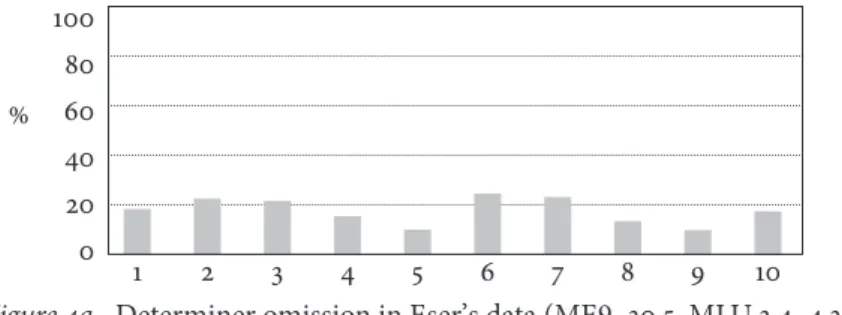
As can be seen from these figures, on the whole the children realize overt determiners more often as articles than as other determiners in German, and this in spite of the children’s L1 not having an article sys-tem. Determiner omission remains quite constant in Eser’s and Faruk’s data. There is slighly more variation in determiner omission in Fikret’s data. Gül’s data look different: after considerable omission in the earli-est dataset, there is a gradual decrease before omission increases again in the last dataset. Thus, at first sight, there is no clear gradual decrease in determiner omission in any of these four children’s data. In the following subsections, I shall try to show that there is indeed no steady decrease in determiner omission in the L2 data as opposed to the L1 data, even when the same analysis criteria are applied to both sets of data (Section 4.3) and
100 80 60 40 20 0 % 1 2 3 4 5 6 7 8 9
Article Other determiner Omission
Figure 3c. Proportion of overt vs. omitted determiners in
Fikret’s data (ME8–29.5) 100 80 60 40 20 0 % 1 2 3 4 5 6 7 8 9 10
Article Other determiner Omission
Figure 3d. Proportion of overt vs. omitted determiners in Gül’s
the two contexts that are particularly vulnerable to article omission – those of modified Ns and of PPs – are considered on their own (Section 4.4).
4.3. Comparing determiner omission in German child L1 and
L2 acquisition
4.3.1. Applying the same analysis criteria
In comparing determiner omission in the German L2 data from the four Turkish–German children and the German L1 data, I applied the same analysis criteria as Eisenbeiss (2000: 50). The following types of utterances were excluded from the overall counts:10
(21) a. one-word utterances (see example (20b)) b. onomatopoeic nouns: e.g. bumm
c. NPs/DPs with attributive adjectives: e.g. die/viele grosse Hühner ‘the/ many big chickens’, welche kleinen ‘which small (ones)’
d. NPs with Determiner-Quantifier combinations: e.g. meine vielen
Hühner ‘my many chickens’, diese drei ‘these three’
Excluding these types of utterances has an effect on the overall picture of determiner omission in the child L2 German data, summarized in Figures 4a–4d. In particular, the percentages of determiner omission are smaller than in Figures 3a–3d, which is largely due to the exclusion of one-word utterances. Based on Figures 4a–4d, the following observations can be made:
(i) Gül’s data look quite different from the other children’s data;
(ii) determiner omission is quite low even in the early datasets from Eser, Faruk and Fikret;
(iii) no clear developmental trend is visible in the data from Eser, Faruk and Fikret;
10 There is another context that is excluded, but which does not occur in my data: NPs
with proper names, which can be combined with an article in certain varieties of German. By separately examining the occurrence of expletive articles with proper names (e.g. die Hannah ‘the Hannah’), Eisenbeiss is able to show that expletive article use does not precede “substantive” article use (e.g. das Haus ‘the house’). The bilingual children of my study are growing up in Hamburg, where a variety of German is spoken in which proper names cannot be combined with expletive articles. The question of whether or not expletive article use precedes substantive article use therefore does not arise.
100 80 60 40 20 0 % 1 2 3 4 5 6 7 8 100 80 60 40 20 0 % 1 2 3 4 5 6 7 8 9 10 100 80 60 40 20 0 % 1 2 3 4 5 6 7 8 9 100 80 60 40 20 0 % 1 2 3 4 5 6 7 8 9 10
Figure 4a. Determiner omission in Eser’s data (ME9–30.5, MLU 3.4–4.3)
Figure 4d. Determiner omission in Gül’s data (ME8–30.5, MLU 1.6–3.6) Figure 4c. Determiner omission in Fikret’s data (ME8–29.5, MLU 2.1–3.4)
While three of the five monolingual German children produced formulaic utterances, there was only one L2 German child (Faruk) who did so: there were 15 such utterances in his data, with 11 in dataset 2 (ME8). It would seem, then, that formulaic utterances do not play a major role in the suc-cessive bilingual children’s data. There is also no clear evidence that these children use fixed D+N units that they heard in the input and then repro-duced as unanalysed chunks. Nouns already occur with different deter-miners (ein/mein Bruder ‘a/my brother’; mei(n)/dei(n) Ko(p)f ‘my/your head’) rather than one invariant determiner in their early datasets. These sequences are likely to be produced by the child on the fly by combining a noun with a determiner, rather than by the child reproducing a “mem-orized” D+N unit. Moreover, in some combinations of D+N the deter-miner shows the wrong gender (die Krokodil ‘the.f crocodile’ instead of das
Krokodil ‘the.n crocodile’; die Junge ‘the.f boy’ instead of der Junge ‘the.m
boy’) and sometimes the determiner shows variable gender with the same noun (der/die/das Maus ‘the.m/the.f/the.n mouse’) (see Ruberg 2013 for the acquisition of gender in German by children with different L1s). These ungrammatical D+N sequences are unlikely to occur in a child’s input and therefore unlikely to be stored as fixed units in the child’s lexicon; they are much more likely to have been construed by the child online. The absence of formulaic utterances and fixed D+N units may explain why there is lit-tle variation in determiner omission in the early datasets of these chil-dren, as opposed to the monolingual child Leonie (see Figure 1a), whose overall development is representative for two other children (Annelie and Hannah) as well. Recall that these three children did produce formulaic utterances and fixed D+N units, in particular in their early datasets. 4.3.2. Article omission and MLU
Our data also allow us to examine the relationship between article omis-sion and Mean Length of Utterance (MLU). In order to do so, I examined the context of omission: in the vast majority of cases, it looked like an art-icle had been omitted.
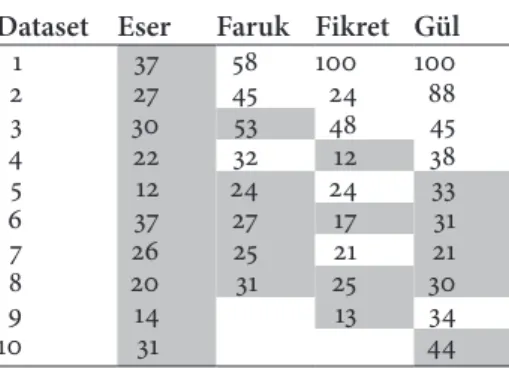
It has been pointed out by Kupisch et al. (2008) that article omission in monolingual children acquiring English, German, Swedish or Norwegian drops below 20 per cent once a child’s MLU measured in words is 3 or above. To see whether this observation also holds for the four successive bilingual Turkish–German children, consider Table 7, which lists article
omission rates (in %) in all the datasets from the successive bilingual chil-dren; shaded cells mark MLUs equal to or above 3.
As can be seen, in most of the datasets from the four successive bilin-gual children with an MLU of 3 or above, article omission is above rather than below 20 per cent. This is clearly visible in the data from Eser, whose MLU is above 3 in all datasets, but only in two of ten datasets is article omission below 20 per cent (datasets 5 and 9). Article omission is above 20 per cent in all the relevant datasets from Faruk and Gül, but it is below 20 per cent in 3 of the 4 relevant datasets from Fikret. The data from Gül and Fikret should be interpreted with caution, since their MLU still fluc-tuates once it has reached 3. A strict interpretation of the MLU criterion could be that it is only when a child’s MLU is consistently above 3 that his/ her article omission falls below 20 per cent.
To summarize, a clear developmental trend is visible in the data from the monolingual German children: after some initial vacillation in determiner production – possibly due to the large number of formulaic utterances and fixed D+N units in early datasets – determiner production increases and determiner omission decreases as the children grow older. A similar trend is not visible in the data from the successive bilingual children. A possible exception may be Gül’s data, which do show a downward trend in deter-miner omission; however, the increase in deterdeter-miner omission in her final dataset (at ME30.5) is incompatible with that (see Section 4.5 for a possible explanation). Further, in contrast to the monolingual children’s data (see Kupisch et al. 2008), the bilingual’s children’s data do not show a clear cor-relation between an MLU ≥ 3 and an article omission rate below 20 per cent.
Table 7. Article omission (in %) in the
datasets from the four bilingual children
Dataset Eser Faruk Fikret Gül
1 37 58 100 100 2 27 45 24 88 3 30 53 48 45 4 22 32 12 38 5 12 24 24 33 6 37 27 17 31 7 26 25 21 21 8 20 31 25 30 9 14 13 34 10 31 44
4.4. Sensitive contexts for D omission
In this section, I discuss how often the successive bilingual children leave out determiners with attributive adjectives/modified nouns and with PPs, something the monolingual children do frequently. Moreover, I also try to look for any developmental trend since the monolingual children show a clear trend towards fewer omissions.
4.4.1. Attributive adjectives and modified nouns
Attributive adjectives and determiners are in complementary distribution in the early datasets from four of the five monolingual German children, but in later datasets there is a steady decrease in determiner omission in this context (i.e. determiners increasingly appear in the context of attribu-tive adjecattribu-tive + noun). Eisenbeiss links the absence of attribuattribu-tive adjecattribu-tives with determiners in her early L1 data to the high proportion of article-like determiners in unanalysed chunks, which do not allow for the insertion of an adjective. Except for Faruk, none of the successive bilingual children produced such unanalysed chunks. If there is any evidence for complemen-tary distribution, it is therefore expected to arise in Faruk’s data. An exam-ination of the relevant data from Eser, Faruk and Gül reveals that there is no evidence that attributive adjectives and determiners are in complementary distribution: there are two examples of D+A and seven of D+A+N in Eser’s first dataset (ME9), one example of D+A in Faruk’s first dataset (ME6) and seven examples of D+A+N in Gül’s third dataset (ME14), which is the first dataset in which utterances with attributive adjectives appear. In Fikret’s data, however, attributive adjectives and determiners seem to be in com-plementary distribution. Before the first examples with D+A(+N) appear in dataset 4 (ME15), Fikret produced four examples of A and one example of A+N in the earlier datasets.
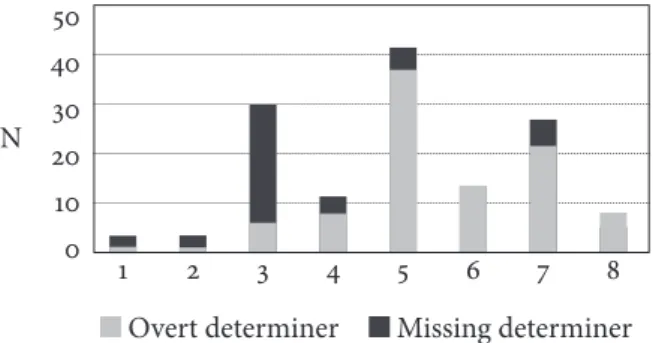
I will now turn to the question whether any developmental trend towards less article omission with attributive adjectives can be observed in the child L2 data. Consider first Faruk’s determiner production in utter-ances with attributive adjectives, summarized in Figure 5 (once again, the y-axis denotes the number of utterances not percentages).
Datasets 1 and 2 from Faruk contain very few relevant examples, but the remaining datasets contain enough examples to test for statistical signifi-cance (using the χ2-test). The difference in determiner omission between
dataset 3 and each of the datasets 4 to 8 is highly significant (p < 0.01); the difference in determiner omission between datasets 4 and 6 is also signifi-cant (p < 0.05). A clear development can thus be observed in Faruk’s use of determiners in the context of attributive adjectives. Note that this develop-ment only becomes visible when utterances with attributive adjectives are considered separately; it does not show up in Figure 3b, as it considers all D-contexts. Second, while the datasets from Eser, Gül and Fikret often contain too few examples to use χ2-tests (see Table 8), these children, on the whole, also omit determiners in this context more often in the early than in the late datasets.
Figure 5. Faruk’s realization of determiners in utterances with attributive
adjectives 50 40 30 20 10 0 N 1 2 3 4 5 6 7 8
Overt determiner Missing determiner
Table 8. Omitted determiners in utterances with
attributive adjectives
Dataset Eser Gül Fikret
1 44% (7/16) – 100% (1/1) 2 20% (8/40) – 100% (3/3) 3 75% (3/4) 46% (6/13) 100% (1/1) 4 11% (1/9) 50% (1/2) 12% (1/8) 5 9% (1/11) 33% (1/3) 0% (0/3) 6 0% (0/3) 15% (3/20) 22% (2/9) 7 0% (0/2) 27% (4/15) 17% (1/6) 8 12% (1/8) 100% (5/5) 50% (2/4) 9 9% (2/23) 25% (1/4) 14% (1/7) 10 0% (0/2) 20% (1/5) n.a. Total 19% (23/118) 25% (17/67) 29% (12/42)
According to Trenkic (2009), we would expect determiner omission
in D+A+N sequences to be higher than in D+N sequences because the former involve a higher processing load. A comparison between the chil-dren’s utterances with D+A (e.g. das Gelbe ‘the yellow’) vs. D+A+N (e.g.
das kleine Haus ‘the small house’) reveals that determiner omission is lower
in the former (see Tables 2a and 2b in the appendix), but this difference is quite small.
To summarize, determiner omission is not particularly high in the suc-cessive bilingual children’s utterances with attributive adjectives; it is gen-erally higher, though, in the early than in the late datasets. While four of the monolingual children showed complementary distribution between attributive adjectives and determiners, only one of the successive bilingual children did (Fikret). Eisenbeiss correlates this complementary distribu-tion in her L1 data with the occurrence of formulaic utterances and fixed D+N units. Fikret, however, does not produce any such utterances, which seems to go against Eisenbeiss’s assumption. Finally, on Trenkic’s process-ing account, determiner omission is predicted to be higher with nouns that are modified by adjectives than with nouns that are not modified. There was no evidence in the child L2 data supporting this hypothesis, but the number of relevant utterances may have been too small.
4.4.2. PPs
In Section 3.3.2 we saw that determiner omission in the German L1 data is particularly high in PPs, but that a clear developmental trend towards less determiner omission in this context was observed in three of the five monolingual children.
As in the L1 data discussed by Eisenbeiss, determiner omission is very high in the PPs produced by the successive bilingual children; the relevant data are summarized in Table 9 (see also Schönenberger, Sterner & Ruberg 2011 for article omission in PPs by successive bilingual children with dif-ferent L1s). In this table, the PPs are classified as follows: N (both P and D are missing), PN (P is overt, but D is missing), DP (P is missing, but D is overt) and PP (both P and D are overt); the fraction of the total number of PPs is given in parentheses. The DP and PP categories are further subcat-egorized for the type of determiner: article or other determiner; in these PP data, the number in parentheses is the number of preposition+article sequences that were realized as concatenated forms. Although the children
often left out determiners in PPs, they also produced many examples with determiners, and these are often articles. In PPs with a determiner, there are only few examples in which the preposition is missing (labelled ‘DP’ in the table). In PPs without a determiner, Eser, Faruk and Fikret rarely omit-ted the preposition (labelled ‘N’ in the table).11 Gül, on the other hand, pro-duced several examples in which both the preposition and the determiner are missing, as did Sabrina, the Italian child studied by Ferrari & Matteini (2009).
I will now examine these data in detail, focussing on Eser, who produced the most PPs (131). Of the total of 131 examples, Eser omitted the deter-miner in 60 cases (45.8%), and in six of these, she also omitted the prepos-ition, as in (22a). She also omitted the preposition in 7 of 71 examples with a determiner, as in (22b). The remaining 64 examples with a determiner are target-like, in that they contain a preposition and a determiner, as in (23); they also include examples in which the preposition and the article have been concatenated, as in (24).
(22) a. (Eser, dataset 8, ME21)
Dann kann ich doch allein hier Kinnegarten gehen.
then can I doch alone here kindergarten go
‘Then I can go to the kindergarten here by myself, can’t I?’
Correct: Dann kann ich doch allein hier in den Kindergarten.
then can I doch alone here in the.acc.m kindergarten 11 These two types of examples were very rare in the data from the monolingual German
and successive bilingual Turkish–German schoolchildren in Gutzmann & Turgay’s study.
Table 9. Distribution of PPs by context in child L2 German
Eser Faruk Fikret Gül
N (–P and –D) 6 (4.6%) 8 (6.8%) 3 (5.1%) 11 (21.6%) PN (+P and –D) 54 (41.2%) 35 (29.7%) 22 (37.3%) 9 (17.6%) DP (–P and +D) D=Article D=other D-word 7 (5.3%) 3 4 1 (0.8%) 1 (1.7%) 1 3 (5.9%) 2 1 PP (+P and +D) D=Article D=other D-word 64 (48.9%) 40 (10) 24 74 (62.7%) 48 (12) 26 33 (55.9%) 23 (2) 10 28 (54.9%) 16 (1) 12 Total PPs 131 118 59 51