https://doi.org/10.4224/23000501
READ THESE TERMS AND CONDITIONS CAREFULLY BEFORE USING THIS WEBSITE.
https://nrc-publications.canada.ca/eng/copyright
Vous avez des questions? Nous pouvons vous aider. Pour communiquer directement avec un auteur, consultez la première page de la revue dans laquelle son article a été publié afin de trouver ses coordonnées. Si vous n’arrivez pas à les repérer, communiquez avec nous à [email protected].
Questions? Contact the NRC Publications Archive team at
[email protected]. If you wish to email the authors directly, please see the first page of the publication for their contact information.
NRC Publications Archive
Archives des publications du CNRC
For the publisher’s version, please access the DOI link below./ Pour consulter la version de l’éditeur, utilisez le lien DOI ci-dessous.
Access and use of this website and the material on it are subject to the Terms and Conditions set forth at
An elastomeric membrane system for parking decks
Mailvaganam, N. P.
https://publications-cnrc.canada.ca/fra/droits
L’accès à ce site Web et l’utilisation de son contenu sont assujettis aux conditions présentées dans le site LISEZ CES CONDITIONS ATTENTIVEMENT AVANT D’UTILISER CE SITE WEB.
NRC Publications Record / Notice d'Archives des publications de CNRC:
https://nrc-publications.canada.ca/eng/view/object/?id=662ee889-15a9-4f8b-be25-0a84a3aca8a4 https://publications-cnrc.canada.ca/fra/voir/objet/?id=662ee889-15a9-4f8b-be25-0a84a3aca8a4An Elastomeric Membrane System for Parking Decks
by N.P. Mailvaganam
N.P. Mailvaganam is a senior research officer in the Materials Laboratory of the Institute for Research in Construction.
Originally published in "RAIC Update" 16(1), June-July 1992, p. 7
The fundamental condition which is common to almost every disintegrated concrete is that it is porous in the sense that it is absorptive or permeable to water. Prevent the penetration of water into the concrete and at once it becomes a building material highly resistant to all ordinary destructive agents. R.B. Young - Past President, ACI, 1931
When you see a concrete parking deck that shows signs of such damage as scaling,
delamination and spalling, chances are that you are looking at a concrete parking deck onto which no waterproofing system had been installed. Or where, if it had been installed, it may not have been done properly. Scaling and spalling of concrete, symptoms either of its poor quality or of the severity of the environmental conditions to which it was subjected, are relatively superficial damages that result from water penetration. But if water and dissolved deicing salts penetrate to the level of the reinforcing steel in the concrete deck, the steel corrodes and the structural integrity of the concrete parking deck is compromised. Therefore you should know about waterproofing systems, so that you can specify at the design stage the installation of a waterproofing membrane system on a new or existing parking deck.
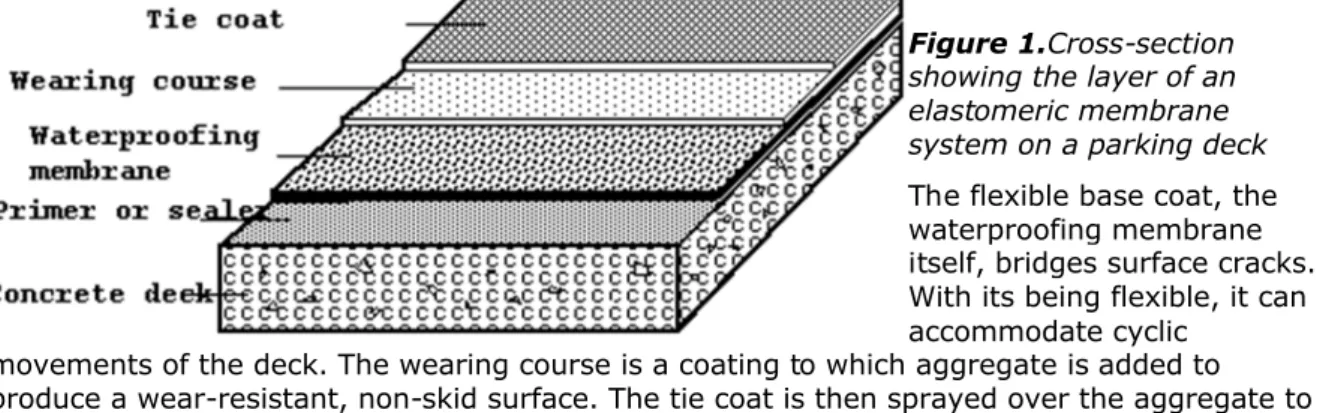
This article deals with one type of waterproofing membrane system, specifically the elastomeric adhesive membrane, which is usually applied to the concrete as a liquid. Once the liquid has been allowed to cure chemically, it provides a positive seal for the concrete surface, stopping leakage and water infiltration into the concrete: it seals existing hairline cracks and, without delamination or rupture, even stretches over those that may form later because of movement. One speaks here of a membrane system because the functions of several components or layers, consisting of one or more polymers, act in concert to make the concrete impenetrable by water. A basic membrane system usually includes a primer, a flexible base coat, a wearing course, and a tie coat (see Figure 1). Each layer, once it has dried to a film, is about 1 to 2 mm thick. The primer is used to seal the surface of the concrete and promote adhesion of the waterproofing membrane to the concrete. Although priming of the surface is not necessary with systems that happen to be self-priming or with the material that is applied by spraying, it is generally considered good practice because it prevents pinholing and blistering of the membrane.
Figure 1.Cross-section showing the layer of an elastomeric membrane system on a parking deck The flexible base coat, the waterproofing membrane itself, bridges surface cracks. With its being flexible, it can accommodate cyclic
movements of the deck. The wearing course is a coating to which aggregate is added to produce a wear-resistant, non-skid surface. The tie coat is then sprayed over the aggregate to bond it. Once properly installed, such a membrane system provides a seamless, durable, non-slip barrier not only to water and the salts dissolved in it, but also most common acids, fuels, oils, solvents, and cleaning compounds encountered in the parking garage environment. How well the membrane system performs and for how long depends on both the quality of the
membrane system and the quality of its installation, including appropriate substrate preparation.
Responsibility of the Architect
As an architect, you may be responsible for having the concrete surface prepared for the proper installation of a membrane system. Each cold-applied liquid elastomeric membrane system consists of different ingredients which influence the specific preparatory requirements for the concrete surface. Generally, the aim is to have a surface that is free of oil-based contaminants, moisture, cracks wider than 0.5 mm, and dust to ensure the adhesion and integrity of the membrane system - at least at this point. The preparations for an existing deck differ from those of a new deck in the rehabilitation that may be necessary.
Preparations for Existing Structures
Before considering any patching and waterproofing of an existing structure, its deterioration should be adequately investigated to determine the causes, extent, and severity. Of particular concern is the chloride content of the concrete, especially near the reinforcing bars. If it is less than 0.025 percent, the threshold value, and there is no delamination, then the deck can be waterproofed after the surface has been suitably patched and levelled. But if the chloride content is above the threshold value and there is evidence of delamination, the deck requires more extensive repair first. The repair begins with sandblasting the entire surface of the concrete so that all the cracked and spalled areas are revealed. Depending on the extent of the damage, in some areas the concrete may need to be removed and then replaced, preferably with an epoxy mortar. Once this repair work has been completed, the application of a
waterproofing membrane on an existing structure does not differ from that of a new structure.
Preparations for New Structures
In the construction of new parking structures, decisions must be made early in the design process whether a membrane system is to be installed, and if so, then what type. These decisions, in turn, influence decisions about the use of crack-control systems and the implementation of height and weight restrictions.
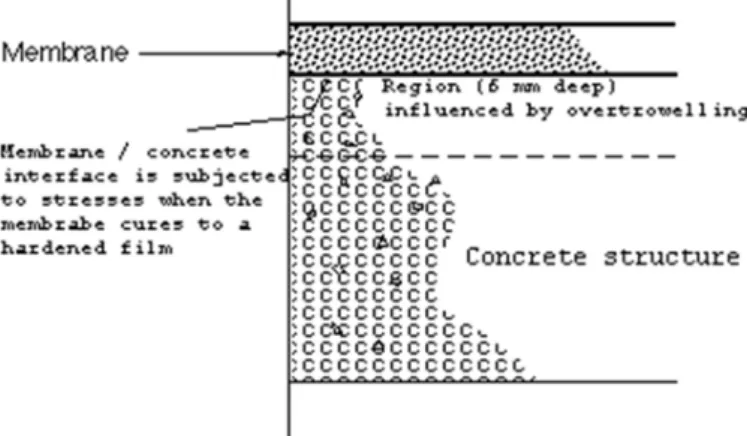
New concrete should be water-cured. The desired finish is usually a light texturing obtained by finishing the concrete with a wooden bull float followed by light trowelling. It should have a minimum compressive strength of 27.6 MPa (4,000 psi). Such minimum strength is required to prevent delamination. An applied membrane system exerts various stresses tending to pull the top layer of the concrete up (see Figure 2). If the concrete layer does not have the strength to resist these stresses, it will, in fact, be pulled off, thus causing delamination. That is why only light trowelling is recommended; the top layer of the concrete can be weakened by
overworking it during finishing.
Figure 2.Elements of a coating system for concrete
Factors Affecting Membrane
Performance
Even with the concrete surface meticulously prepared, concerns may still arise because of the material used or the conditions of its application. The membrane may detach itself from the concrete surface through blistering and delamination, or pinholes may form and thus compromise its integrity.
If the membrane system is applied during very hot ambient temperatures, the air in the small spaces between the concrete particles increases in volume and forms blisters. Because the film is thin, these blisters are easily pierced. Other factors can give rise to the formation of pinholes and blisters, among them the moisture content of the concrete, the application of too thick a layer, and the use of highly viscous material. Moisture in the concrete may change into a vapour which then condenses at the concrete-membrane interface before the coating has cured and thus interfere with its proper adhesion to the concrete. This is more likely to occur when the temperature of the concrete is higher than that of the air. The problems with applying too thick a layer and the use of highly viscous material can also be temperature-dependent. For example, when a membrane system is installed during very cold weather, the liquid becomes too viscous to form a continuous film over the concrete substrate. This can occur because the viscosity of a liquid usually increases with decreasing temperatures.
Although pinholing and blistering are characteristic of liquid-applied membranes, the practice of applying the material in two layers - with one layer being the primer - prevents the formation of pinholes almost totally. Also, if all the membrane manufacturer's specifications regarding concrete surface, suitable application-temperature range, and method of application are followed, the design properties of the elastomeric membrane system can be realized.
Selection and Evaluation
The selection and evaluation of a good elastomeric membrane system are difficult not only because there are so many products on the market but also because the performance even among materials of the same generic type varies. The selection can only be based on material properties and field experience. A good elastomeric membrane system has the following properties:
impermeability to water under all expected conditions;
good adhesion under normal, humid, or any other conditions to which the concrete parking deck may be subjected;
resistance to tearing at cracks resulting from stresses produced by temperature and traffic; resistance to the effects of aging and exposure to freeze-thaw cycles, salt spray, and various
chemicals encountered in the parking deck environment; and
ease of application so that the design properties of the membrane system can be realized. However, evaluation is difficult due to the lack of both information about previous use and standards or specifications. For that matter, manufacturers cannot even agree on the criteria by which performance should be judged.
Nevertheless, if the concrete surface has been conscientiously prepared for the installation of an elastomeric membrane system and the materials were carefully selected, the concrete parking deck will probably show little tendency toward scaling, spalling, or delamination for a long time. After all, it has been effectively waterproofed and a measure of prevention has been instituted.
Bibliography
1. Mailvaganam, N.P., ed. Repair and Protection of Concrete Structures. CRC Press, Boca Raton, 1992.
2. Mailvaganam, N.P., M. Lacasse, R. Paroli, and P. Collins, Evaluation of elastomeric membrane systems used in parking garage protection. Client Report for Public Works Canada, Ontario Ministry of Housing, and Canadian Institute of Public Real Estate Companies. Institute for Research in Construction, National Research Council of Canada, pp. 51-58, 1990.