Publisher’s version / Version de l'éditeur:
Corrosion, 54, March 3, pp. 241-245, 1998-03-01
READ THESE TERMS AND CONDITIONS CAREFULLY BEFORE USING THIS WEBSITE. https://nrc-publications.canada.ca/eng/copyright
Vous avez des questions? Nous pouvons vous aider. Pour communiquer directement avec un auteur, consultez la première page de la revue dans laquelle son article a été publié afin de trouver ses coordonnées. Si vous n’arrivez pas à les repérer, communiquez avec nous à [email protected].
Questions? Contact the NRC Publications Archive team at
[email protected]. If you wish to email the authors directly, please see the first page of the publication for their contact information.
NRC Publications Archive
Archives des publications du CNRC
This publication could be one of several versions: author’s original, accepted manuscript or the publisher’s version. / La version de cette publication peut être l’une des suivantes : la version prépublication de l’auteur, la version acceptée du manuscrit ou la version de l’éditeur.
Access and use of this website and the material on it are subject to the Terms and Conditions set forth at
Laboratory study on sacrificial anodes for reinforced concrete
Brousseau, R. J.; Baldock, B.
https://publications-cnrc.canada.ca/fra/droits
L’accès à ce site Web et l’utilisation de son contenu sont assujettis aux conditions présentées dans le site LISEZ CES CONDITIONS ATTENTIVEMENT AVANT D’UTILISER CE SITE WEB.
NRC Publications Record / Notice d'Archives des publications de CNRC:
https://nrc-publications.canada.ca/eng/view/object/?id=e40d74e1-34ac-4561-ac51-c9be346f566f
https://publications-cnrc.canada.ca/fra/voir/objet/?id=e40d74e1-34ac-4561-ac51-c9be346f566f
http://www.nrc-cnrc.gc.ca/irc
La bora t ory st udy on sa c rific ia l a node s for re inforc e d c onc re t e
N R C C - 4 3 6 0 6
B r o u s s e a u , R . J . ; B a l d o c k , B .
M a r c h 1 9 9 8
A version of this document is published in / Une version de ce document se trouve dans:
Corrosion, 54, (3), March, pp. 241-245, March 01, 1998
The material in this document is covered by the provisions of the Copyright Act, by Canadian laws, policies, regulations and international agreements. Such provisions serve to identify the information source and, in specific instances, to prohibit reproduction of materials without written permission. For more information visit http://laws.justice.gc.ca/en/showtdm/cs/C-42
Les renseignements dans ce document sont protégés par la Loi sur le droit d'auteur, par les lois, les politiques et les règlements du Canada et des accords internationaux. Ces dispositions permettent d'identifier la source de l'information et, dans certains cas, d'interdire la copie de documents sans permission écrite. Pour obtenir de plus amples renseignements : http://lois.justice.gc.ca/fr/showtdm/cs/C-42
Oカセ」」M
.y0630
CORROSiON ENGINEERING SECTION
Laboratory Study
of Sacrificial Anodes for Reinforced Concrete
R, Brousseau and B. Baldock"ABSTRACT
Theoutput of sacrificial current by two metallized coatings
wasmonitored under well-defined conditions. Experimen.ts
wer-e conducted at two relative humidities (RH). The peifor·
rnance ojazinc-alumin.umaHoy (78:22)was equalorsllght!y
supenorto that oj pure zln.c·coatedan.odes.However, there wasa.steady decline in.currentdensityOlltputwith ttme.
which was attributedto oxidationproducts formingatthe
sacrificial anode/concrete trtteifa.ce.
KEY WORDS: aluminum.anodes. coatfngs,current denSity, relative humidity. reiriforced concrete, zinc
INTRODUCTION
Steel reinforcement corrosion is a costly problem that has led to premature deterioration of a large number of concrete bridges and parking stxuctures, Cathodic protection {CPt is be1n.g used lncreasingly to reduce corrosion of steel reinforcement. Galvanic CP has stimulated considerable interest in the civil engineer-ing community because of its simplicity, The
protective current flow in a galvanic system is in-ducedbythe electromotive force (EMF) that arises between the steel and the sacrificial anode metal. No speclal wiring. rectifiers. eleCtrical short clearing between the anode and steel, rectifiers, and mainte-nance or corrosion monitoring are reqUired.
Thermally sprayed zinc is being used increas-ingly as an anode for CP of steel-reinforcedconcrete
Submitted Cor publicationfセ「ョNj。イケ 1997: InTevtsed Conn. June
1991.
• National Research CouncU of Canada. Bldg. M·20. Montreal Road, Ottawa, Ontario. KIA ORB. Canada.
stnIctures. Zinc coatings have been implemented successfully as an impressed current anode in California. Oregon,I and Ontario. The Florida
DepartmentofTransportation is startingto use metallized zincasa sacrificial anodeon itsmaline structures.2•4Recently, a more reactive metallized coating made of an。ャオュャョオュMコQョ」セゥョ、ゥオュ alloy has been developed.IS-6Although this newalloyshows superior electrochemical performance, its stiffness and brittle mechanical properties make poor·quality wiresthat canbe difficulttometallize.
The scope of the present work was to examine how metallized zinc coatings perform as sacrificial anodes in well·ctefined environments (e.g., at50°C and 50%or90%relative humidity(RI-Ij). The
perfor-mance of a zinc-aluminum alloy (78:221 was investigated for comparison tothat of purezinc.
EXPERIMENTAL
Effectiveness of the galvanic protection was tested on reinforced concrete samples made With type
10normalPortlandcement. admiXedwith 1%
sodium chlOride{NaCl)bymass ofcementand made withawatertocement ratio of 0.5. Additional samples were madewith a 0.43%キ。エ・イセエッᄋ」・ュ・ョエ
ratio for some of the bond-strength tests of the met-alliZed coatings. Most samples were fabricatedwitha single level of two steel reinforcing bars {Figure ll. The different configurations represented concrete covers of 20 mm, 50 mm, and 125 mm (0.79 in.,
1.97in., and 4.92in.)between thesteel reinforce-ment and the arc-sprayed coatings. All samples were manufactured in triplicates for a total of 36 samples.
CORROSION ENGINEERING SECTION
FIGURE 1.Schematic of the metalliz&d samples used to monitor rhEJ galvanic current flow.
Agraphite pseudo-reference electrode was pouredin all samples. This reference electrode was used tomeasure electrochemical potential shifts that occurred durtng the Tセィ depolarization surveys fol-lowingintenuptlon of thegalvanic current flow.
Thetopsurface ofeach concrete samplewas
grit·blastedWithno. 40 s1lica sand and air driedfora
fewdaysafter being curedfor 28 days at 100% RH.
The grit-blasting was sufficient to roughen the
sur-,face without exposing the aggregateinthe concrete.
Anydust or loose particles on the surface wereイ・セ
moved by bloWing With compressed air after
ァイゥエセ「ャ。ウエエョァN The surface of the concrete wasーイ・セ
heated to 50"'C immediately prior to arc spraying to
ensure an
adequate bond was obtained between the metallized anode and the concrete substrate. Preheating the surface of the concrete was performed sinceitwas found to maximize the adhesion of arc-sprayed zinc on concreteinprevious studies.7The temperature of
50"Cwas chosen because it would increase bond strength while remaining field practical. The samples then were arc-sprayed with zinc. or with a zlnc-aluminum alloy (78:22) using an automated applica-tlon system. All arc sprayings were performed with
620 kPa air pressure, 26 V. 300 A. and at a spray
distance of 15 em (5.90 In.), All thermal spraying was performed with wires 3 mm (0.118 in.) in diam-eter. Thicknessof the applied coatings was 0.4mm
(0.016 in.). Initialbond-strength measurements wereperfonned on a few samples using a pneumatic adhesion tester.
Oncemetallized, thereinforced concrete samples wereplacedinone of two environments: a 500/0 or 90%±50/0 RH at atemperature of 50"'C ± 2CC. The
samples were connected to a data acquisition system
sothat automatedcurrentand depolarization measurementscould be performed. Currentュ・。セ
surements were obtainedbymeasuring thevoltage dropacross a RセョZ precision shunt resistorthat was installed in series between the coating and the steel rebars. Surface area of the metallized anode on each sampleswas236cm2(36.59In.2
).
RESULTS
Initialbond-strength data of the metallized coat· ings are presented in Tables 1 and 2. Measurements were performed on concrete samples With two pre· heating temperatures andtwowater"to-cement ratios. lnitlal adhesion of the zinc-aluminum alloy
7
Rebaro
Graphne re1erence codo
I £ I Metalllted surface (23,625mm') TABLE 1Bond Strengths of Arc-Sprayed Zinc on Concrete
Concrete Water-ta-Cement RatIo 0.43 0,50
Preheating surface temperature Bond-strength averages (kPa) Standard deviations (kPa) Number of pull tests
50"C 1,313 212 31 12QOC 2,636 274 28
socc
1,515 400 32 120CC 2,359 465 29 TABLE 2Bond Strengths of Arc-Sprayed Zlnc·Aluminium (78:22) on Concrete Concrete Water-to·Cement Ratio 0.43 0.50
Preheatingsurface temperature Bond·strength averages (kPa) Standard deviations (kPa) Number of pUll tests
120°C 3,084 327 12 50CC 1,120 286 15 120°C 2,640 494 13 242
CORROSION ENGINEERING SECTION
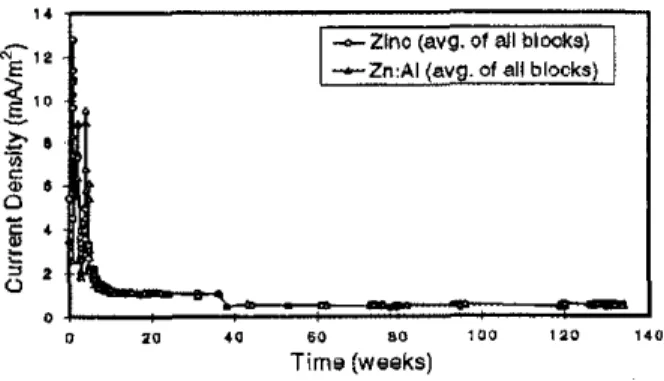
FIGURE 2. Galvanic current density time profile for metallized
samples stored Ina50% RHchamber.
Time (weeks)
FIGURE 3. GalvanIc current density time profile lor metaJJfzed samples stared Ina90% RH chamber.
'"
,
..
'"
..
,
1
_ Zino (avg. of all blocks) I -Zn:AI (ava. of all blocks)
60 80 100 Time (weeks)
..
2"
"'E
121"
セ
c•
"
0ij
•
::: セ 2 <.l 0,
•
average depolarization recorded after4 h. 24 h, and 72 h of interntptionof thegalvaniC current generated bythetwometallized coatings.Thisdataindicated
4 h was insufficient to measureallthe cathodic
polarization provided tothe rebars by themetallized coatinganodes. In practice, thesurface area of the
reJ.nforcingsteel andof themetallizedconcrete surface has a ratio of ..1: 1. except in beams and columns. In this experiment. the surface area ratio of steelto anode was 1.4: L
EMFbetween the metallized coatingsandrebars was measured onallsamples before the wiring to the dataacquisition system was completed.AverageEMF values were highestfor thezinc·alumlnum alloy (78:22), as listed inTable 4.Afterthe metallized an-odesandsteel reInforcing bars were wired together electrically. theッー・ョセ」ャイ」オゥエ potentialvalueswere recordedbetweenthe anode and steel after 4 h of depolarization. Althoughthiswas not a tnle EMF, it suggested that theコQョ」セ。ャオュゥョオュ (78:22) alloy could
produce a higher drivingvoltage.
In an earller study. it was found that wetting the surface of the metallized coatingswouldenhance the
galvaniccurrent output.2Sagues and Powers briefly
applied a damppaper towel to the metallized coating
"m---;:::::;::=::::;:::::;::::::=:-i
セ 11 __ Zinc (avg.Ol aU blocks)
... __ Zn:Ar (avg. 01 aU blocks)
1"
f
o
III NACE Standard RP0290-90, ·StandardRecommendedPracticefor Cathodtc Protection of Relnforclng Sleelln Atmospherically
セクーッウ・、 Concrete Structures.· NACE Book of Standards. voL 1
{Houston. TIC: NACE, 1990J.
(78:22)wasgenerally equal. if not slightly superior.
to that of pure。イ」セウーイ。ケ・、 zinc. No final
bond-strength measurements were taken since the
samples remain under investigation. However. no
apparent deterioration was observed.
The current density values of the tripl1cate samples was averaged and analyzed. Unfortunately, the magnitude of the observed current densities did
not correlate with the three different concrete covers
used to manufacture the samples. The significant
scatter in the data(± 50%) coupled with a limited
number of samples (trtplfcatesl madeitimpOSSible to observe the expected reductioningalvanic current
denSitywith thicker concrete covers. Therefore, the
current density values of all samples sprayedwith
the same metal coatings were averaged. Results for
the 50% and 90%samples are presented in Figures2
and 3, respectively, Initially, therewas an・クーッョ・ョセ tial declinein the galvanic current densityat both RH, whichappearedtostabilizetoward the end of the
experimental program.Thesamples stored at90% RHgenerally had current densities twoto three times higherthan thoseat50% RH. The,current delivered
bythe zinc·alumlnum alloywas simHar tothat deliV-eredbythe pure zinc at both RH.
Depolarization shifts were measured on the samples to detennineifthe criteria developed by
NACElntemattonal would be met.rLlThiscIiteria
stipulatesthat adequate CP is achieved ifthe
poten-tial of thesteel. after current interruption, shiftsbya
minimum of 100 mV within 4 h ofcurrent
interrup-tion. Longer depolarization periods canbe used for this criterja.
Thepotential values of thesteelreinforcement
and themetallized anode wererecorded versus a
graphite pseudo-reference electrodethat was embed-ded pemlanentlyineachconcrete sample. The averageddepolarization shifts that wererecorded
severaltimesdUringtheexperimental programare
presented in Figures4 and 5forthe two RH. Asnoted. the potential shiftofthesteel
rein-forcement shouldhaveexceeded 100 mV after the
currentwas interrupted for4 h. The QPPセュv criteria
was achievedafter 134weeksfor the zinc-aluminum
(78:22) alloysamples at90% RH, Forpurezinc, the
criteria wasmetonlyfor theinitial 80 weeks, al-though both the zinc and thezinc-aluminum(78:22)
alloy provided sirollar galvaniccurrentdensities. All
metallizedsamples maintained at a 50%RH pro-duced shifts in the40-mVto50-mVrange after 134 weeks of monitoring.
Depolarization tests usually were measured over
a 4-hperiod. However. occasionally longer、・ーッャ。イセ ization periods were measured. Table 3Hatsthe
CORROSION-Vol. 54, No.3
243
-CORROSION ENGINEERING SECTION
'"
,---,
Time (weeks)
FIGURE 5. Average depolarization shifts measured on samples stored in 90% RH.
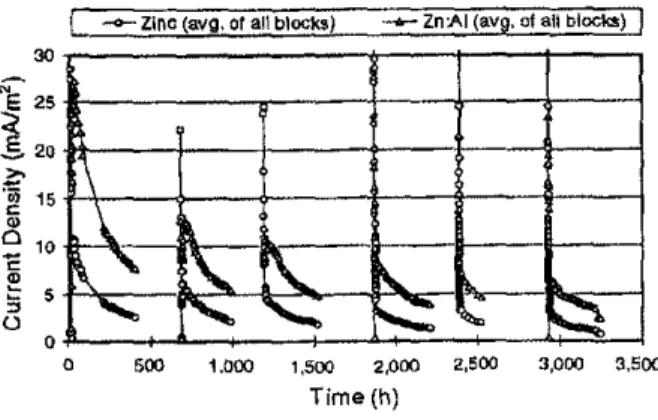
increase being highest for theコェョ」セ。Qオュャョオュ alloy (78:22), as shown in Figure 6.
Significantdrying ofthe concrete samplesッ」セ
curred. at50% RH. Since theEMFremained relativeh constant,a decrease in flow of galvaniccurrentwas' notsurpriSingas concrete drying increased. The system. however. was not passivated.Testshave shown that if the metallized samples were wetted with water, cUlTent flow would be increased.ThiS.
and the observation that higher galvaniC currents were recorded in the samples maintained at 90% RH implied that metallized coating anodes would be mosl active where concrete resistivity was lower or where there was weathering such as rain, snow. and seawa-ter splashing. Fortunately,this also occurs in most areas susceptible to greater reinforcing steel corro-sion. Galvanic CPwithmetallized coatings. therefore,
canbe descrtbed as self regulating.
Concrete drying alone could not explain all of the decreaseinthe flow ofgalvaniccurrent. This was obvious from the」オイイ・ョエセカウMエゥュ・ curves recorded at
90% RH.where continuous concrete drying was オョセ
likely to explaln the slow but consistent decrease of
galvaniccurrent.Anotherposs1ble cause for such a decrease was the formation of zinc oXidation prod-ucts attheanode/concrete interface. These products hindered further electrolytic current flow through the pores of the concrete normally fLlledwithsolution,
Contrary to what was expected. the experimental data did not show that a lower cover thickness of t.he concrete resulted in a higher galvanlc current.
Alloy-ingzincwith22% AI increased the EMF that drove the flow of galVaniccurrentfrom the anode to the rebars. However, the increase of galvaniC current with this alloy was limited. and a more electronegaセ
Uve coating should be developed for drier concrete or for structures With higher steel density, Another。ャセ
ternative would be to develop a solution that could be sprayed on the metallized zinc to enhanceits ー・イゥッイセ
mance as a sacrifiCial anode for reinforced concrete.
DiSCUSSION
'"
120'0'
'"
"
'0 '0..
1 __ Zn (avg. 01 aU blocks) . 1- Zn:AJ f8Vg. of all blO¢l<sI
.0
"
20,
,.,
_ 200>
g
セ
,.,
<J) c 0'"
セ Nセ セ "0"
0-,
,
Time (weeks)FIGURE 4. Average depolarization shifts measured on samples stof8d in 50% RH.
and observed a strong current Increase.!O After the paper towels were removed,ittook"'" 48 h for the
galvanic current generated by metallized zinc to de-crease back to base levels. To verify the ments of surface wettJng in activating metallized zinc coatings. the blocks usually maintained in a 50% RH were immersed periodically for 7 days in deionized water.
Aspredicted, wetting the samples increased the cur-rent output of the sacrificial coatings. W1th the
TABLE 3
(Extended Depolarization Oats Obtained
After41Weeks and 80 Weeks on the Samples Maintained at 50% RH
Sample
4·h 24.h
Depolarization (mV) Depolarization (mV)
41 WeekS 80 Weeks 41 Weeks 80 Weeks
72·h Depolarization (mV) 41 Weeks 80 Weeks
244
Zinc 20 mm Zn:A120 rnm Zinc 50 mm Zn:A150 mm Zinc 125 mm Zn:A1125 mm 60,3 41 66,3 68 93.3 78 50,0 43 75.3 72 84,0 77 54.0 30 72,7 46 79,3 64.7 46 77.0 73 83.7 71 44.3 27 62.7 44 69.3 76 53.0 50 69.7 72 73.3 73 CORROSION-MARCH 1998CORROSiON ENGINEERING SECTION
CONCLUSIONS
(AlMeasurements Iaken at 32 weeks and 79 weeks were taken after
only 4 h of depolarization.
TABLE 4
Open-Circuit Potential Difference
I
--- Zinc (avg, of all blocks) __ Zn:A1 (avg, 01 all blOCk:!;)
I
\
\.
セLl\..
,
1'0..
"
セMNNNNNN[
....;::
...
セ
o o 500 1,000 1,500 2,000 2,500 3,000 セLUPP Time (h)FIGURE 6.Current density change during rapetitlve wetting of the samplesstored at 50% RH. 168 387 209 370 213
4n
303 384 353 451 352 397 50% 50% 90% 90% Open-Circuit Potential RH Difference (mV)lAlCondition Initial 32 Weeks 79 Weeks Metals Coupled 2n-Fe Zn:AI (7B:22) -Fe Zn-Fe Zn:AI-Fe {7a:22)
.) Suffident galvanic CP to prevent corrosion of the reinforcing steel should be provided by the metallized anodes for at least a 2-y period in humid envirOn-ments or where there Is occasional surlace wetting of the metallized coatings.
<.
Potential depolarization shifts are higheriflonger depolarization periods are used. Compared to a metallized coating anode made of pure zinc, the zinc- aluminum alloy (78:22) had similar bond strengths, a higherEMF,andsimilar galvanic cur-rent output and cathodic polarization levels to the reinforcing steel.ACKNOWLEDGMENTS
The authors acknowledge financial support of J. SpriestersbachッヲgイエャQッセw・イォ・ and assistance in
providing the zinc-aJuminuffi wires. The authors also the assistance of B. Arsenault and S. Dallaire of the National Research Council of Canada with arc-spraying of the samples.
REFERENCES
1. B.S, Covino, S.J. Bullard, G.R. Holcomb, S.D. Cramer, G.E. Mean!. C,B. Cryer. 'Factors Affecting the Bonding of Arc, Sprayed Zinc tocッョ」イ・エ・Lセ SSpe'95, Balancing Economlc!ii and Compliance for MaintaIning Protective Coatlnga (Dallae, TX: SSPC. 1995). p, 115·128.
2. A.A. Saguee. RoO. powers. 'U>w-C05l Sprayed Zinc Galvanic AnodeforControlof Corrosl<Jn ofReinforcing SteelIn Marine
Bridge Substructu:res,'FInalReport, Str'doteglcHighway Re-."Iearch Program.ContractNo. SHRP-68-ID024.
3. R.J.Kessler.RG.Powers. I.R. Usa,セuー、。エ・ on Sacrlflcial Anode Cathodic Protection on Steel-Rt:1nforced ConcreteStruc·
tures in Seawater: CORROSlONj95, paper no. 516 (Houston,
IX: NACE, 1995).
4, A.A, Sagues. R.O. powers,セsーイ。ケ・、Nziiャ」 Sacrificial Anode for Reinforced Concrete In Marine SeIVice,' CORROSION/95, paper no. 515 (Houston. TX: NACE, 1995).
5. M.Funahashl.S.F.VaUy,W.T. Young,セp・イヲッイュ。ョ」・ ofNewly Developed Sprayed Anode CathodIc P'rotectlonsケウエ・ュNセ COR· ROSIQN/97, paper no. 254 (llouston.1"X: NACE. 1997). 6. M. Funahashl. 5.1". Daily.セn・キ Sacrifictal Anode for Cathodic
Protection of Reinforced Concrete SlrL\dures,·· Amertcan Society ofelvl} Englneen Annual Conf.. Washington, DC, November 1996 (New York. NY: ASeE. 1996).
1. R. Brousseau. M. Amott, B. Baldock, MP 34. } (l994): p, 40.
A Special Offer for New Subscribers
For more than 50 years,
CORROSIONhas
presented the most up-to-date research by
leading authors from around the world.
But don't take our word for it.
Try
the
journal for yourself with absolutely no
obligation.
CoffRosioEN
Subscrtbe now and get three free
is-sues of the world's leading journal devoted
exclusively to the science of corrosion
pre-vention and control. If you decide not to
continue after examining the three free
is-sues, just cancel your subscrtption and get
a full refund. To get your three free issues.
call
or write:
NACE Membership Services
1440 South Creek Drive, Houston, TX, 77084-4906 Phone: 28J1228-6223 or fax: 281/228-6329