Characterizing and Recognizing Spoken
Corrections in Human-Computer Dialog
by
Gina-Anne Levow
B.A./B.A.S, University of Pennsylvania (1989)
S.M., Massachusetts Institute of Technology (1993)
Submitted to the Department of Electrical Engineering and Computer
Science
in partial fulfillment of the requirements for the degree of
Doctor of Philosophy
at the
MASSACHUSETTS INSTITUTE OF TECHNOLOGY
September 1998
@ Massachusetts Institute of Technology 1998
All rights reserved
Signature of Author ...
Department of Electrical Engineering and Computer Science
September 4, 1998
C ertified by...
-
...
Certified by...
-Robert C. Berwick
Professor of Computer Science and Engineering and Computational
Linguistics
Accepted by...
..
MASSACHUSETTS INSTITUTE
Arthur C. Smith
OFTECHNOLOGY
4hairman, EECS Committee on Graduate Students
NOV 1 6 1998
LIBRARIES
Characterizing and Recognizing Spoken Corrections in
Human-Computer Dialog
by
Gina-Anne Levow
Revised version of a thesis submitted to the
Department of Electrical Engineering and Computer Science on September 4, 1998, in partial fulfillment of the
requirements for the degree of Doctor of Philosophy
Abstract
Miscommunication in human-computer spoken language systems is unavoidable. Recog-nition failures on the part of the system necessitate frequent correction attempts by the user. Unfortunately and counterintuitively, users' attempts to speak more clearly in the face of recognition errors actually lead to decreased recognition accuracy. The difficulty of correcting these errors, in turn, leads to user frustration and poor assess-ments of system quality.
Most current approaches to identifying corrections rely on detecting violations of task or belief models that are ineffective where such constraints are weak and recognition results inaccurate or unavailable. In contrast, the approach pursued in this thesis, in contrast, uses the acoustic contrasts between original inputs and repeat corrections to identify corrections in a more content- and context-independent fashion. This thesis quantifies and builds upon the observation that suprasegmental fea-tures, such as duration, pause, and pitch, play a crucial role in distinguishing correc-tions from other forms of input to spoken language systems. These features can also be used to identify spoken corrections and explain reductions in recognition accuracy for these utterances. By providing a detailed characterization of acoustic-prosodic changes in corrections relative to original inputs in a voice-only system, this thesis contributes to natural language processing and spoken language understanding. We present a treatment of systematic acoustic variability in speech recognizer input as a source of new information, to interpret the speaker's corrective intent, rather than simply as noise or user error. We demonstrate the application of a machine-learning technique, decision trees, for identifying spoken corrections and achieve accuracy rates close to human levels of performance for corrections of misrecognition errors, using acoustic-prosodic information. This process is simple and local and depends neither on perfect transcription of the recognition string nor complex reasoning based on the full conversation. We further extend the conventional analysis of speaking styles beyond a 'read' versus 'conversational' contrast to extreme clear speech, describing divergence from phonological and durational models for words in this style.
Thesis Supervisor: Robert C. Berwick
Acknowledgements
Although my name appears on this thesis, I could never have completed it without the support and assistance of many others, too numerous to name here. I will, how-ever, take a few lines to thank those whom I owe special debts: To Nicole Yankelovich and the Sun Microsystems Labs Speech Group for the use and transcription of the data from the SpeechActs field trial. To Sharon Oviatt and the Center for Human-Computer Communication for focusing my efforts on spoken corrections and providing the structure and tools for the acoustic analyses in this work. To my thesis super-visor, Robert Berwick, for encouragement, guidance, and the freedom to pursue this area of research. To the members of my thesis committee, Justine Cassell and Paul Viola, for insightful feedback and a commitment to high standards of research. To Eric Grimson for invaluable aid traversing the academic and administrative pitfalls of Area II. To my fellow students and lab members for a uniquely MIT combination of unflinching criticism, unstinting support, and wide-ranging discussion: Robbin Chap-man, Carl de Marcken, Charles Isbell, Tina Kapur, Marina Meila, Latanya Sweeney, Holly Yanco, Charles Yang, Liana Lorigo, and many, many others. To my family, for their love, support, and absolute conviction that this could be done. And, last and most important, to Jim, for everything.
Contents
1 Introduction 6 1.1 Challenges ... ... . ... . ... 7 1.2 System Design ... . ... ... 9 1.3 Preview ... . ... . ... 10 1.4 Outline ... ... ... 13 2 Related Work 15 2.1 Inferring Discourse Relations from Speech . ... 152.1.1 Inferring Discourse Structure from Speech . ... 15
2.1.2 Inferring Specific Discourse Functions from Speech ... 17
2.2 Self-repairs ... ... 19
2.2.1 Recognizing Self-Repairs with Text and Acoustic Information 19 2.2.2 Recognizing Self-Repairs with Acoustic Information Alone . . 19
2.3 Corrections ... ... ... ... 20
2.3.1 Speaking Styles ... ... . 21
3 Data Collection: System, Subjects, and Overall Analysis 22 3.1 SpeechActs Description ... ... 22
3.2 Data Collection and Coding ... .... 23
3.3 Longitudinal Change, OOV errors, and novice-expert contrasts . . . . 25
3.4 Vocabulary Changes ... ... 25
3.4.1 Error and OOV Rates ... 26
3.4.2 Vocabulary Size and Rate of New Word Introduction .... . 33
3.4.3 Vocabulary Overlap ... ... 36
3.5 Pair Data Selection ... ... 38
4 Acoustic Analysis 40 4.1 Duration ... . . ... ... 40
4.1.1 Total Utterance Duration . ... . 41
4.1.2 Total Speech Duration . ... ... 41
4.2 Pause ... .. ... 41
4.3 Fundamental Frequency ... ... 49
4.3.1 Scalar Pitch Measures . ... ... 51
4.3.2 Pitch Contour Measures . ... .. 51
4.4 Amplitude ... ... 53
4.5 Discussion ... ... ... 56
4.5.1 Duration and Pause: Conversational-to-(Hyper)Clear Speech . 56 4.5.2 Pitch: Accent, Contour, and Contrast ... 57
5 Decision Tree Classification
5.1 Decision Trees: Motivation ... 5.2 Classifier Features . ... 5.2.1 Duration-related Features . ... 5.2.2 Pause Features ... 5.2.3 Pitch Measures ... 5.2.4 Amplitude Measures ... 5.2.5 Feature Summary . ...
5.3 Classifier Experiments & Results . . . .. 5.3.1 General Methodology . ...
5.3.2 Recognizing Corrections: All Types . .
5.3.3 Recognizing Corrections: Misrecognitions 5.3.4 Recognizing Original-Repeat Pairs . . . 5.4 Discussion . . ...
6 Implications for Speech Recognizer Design
6.1 Motivation . . . ... 6.2 Duration-related Changes ...
6.2.1 Phonetic and Phonological Changes . . . 6.2.2 Durational Modeling ...
6.3 Summary . . . ...
7 Conclusions and Future Work
7.1 Pairwise Identification of Corrections ... 7.2 Future Work: Building a System
7.2.1 Introduction . ... 7.2.2 Recognition: Practical Issues ...
7.2.3 Recovery: Improving Recognition . .
7.2.4 Repair Interaction Strategies ...
7.2.5 Correction Detection and Error Recovery
A C4.5
A.1 Specifying the algorithm . . . . A.1.1 Case 2: T with no instances. A.1.2 Finding a splitting point A.1.3 Measuring Homogeneity A.2 Pruning ...
A.3 Trees to Rules . ... A.4 Issues in recognizing corrections
B Statistical Tests B.1 Analysis of Variance . . . .. B.2 T-test . ... 60 . . . . . 60 . . . . . 61 . . . . . 62 . . . . . 63 . . . . . 64 . . . . . 64 . . . . . 65 . . . . . 65 . . . . . 66 . . . . . 66 . . . . . 70 . . . . . 70 . . . . . 72 Only. 74 74 75 75 76 84 96 .. . . . 97 .. . . . 97 .. . . . 97 ... . . . . . . . 97 .. . . . 98 .. . . . 99 .. . . . 99 101 .. . . . . 101 .. . . . . . 102
Chapter 1
Introduction
Recognition errors are an unavoidable problem for today's recognition- based inter-faces. While isolated word speech recognition error rates can be as low as 5%, a recognizer working on continuous, conversational speech input often reaches
25% error for recognition of full utterances, due to the increased complexity of this task. These frequent recognition errors naturally necessitate frequent corrections. The severity of these problems can be demonstrated by a simple example of an error "spiral", a sequence of repeated recognition errors on the part of the system and repeated attempts to enter the same input on the part of the user, as shown below. USER: Give me the price for AT&T.
SYSTEM: Hewlett-Packard is at 83 3/8, up 2 3/8 since yesterday. USER: Give me the price for AT&T.
SYSTEM: Data General is at 63 1/4, up 1/3. USER: Give me the price for AT&T.
SYSTEM: Hewlett-Packard is at 83 3/8, up 2 3/8.
USER: Give me the price for American Telephone and Telegraph. SYSTEM: Excuse me?
These sequences are all too common in speech recognition systems and are natu-rally a source of great frustration to users. Each of the user inputs that follows a recog-nition error attempting the original misrecognized input is considered a correction. Understanding how corrections differ from other inputs and how these differences can be used to recognize such acts will form the focus of this thesis.
It has been observed [Shriberg et al., 1992], [Rudnicky and Hauptmann, 1990] that recognizer error rates are higher for corrections than for other input. This phenomenon suggests two important possibilities: first, that this observed increase in recognition errors results from characteristics of correction utterances which differ from other inputs and the recognizer's model of expected input, and secondly, that these changes in speaking style in correction utterances contribute to the frustrating phenomenon of error spirals, such as the one shown above.
Another important reason to more carefully examine error corrections comes from user assessments of system quality. In a recent study [Sukkar et al., 1996] researchers asked users to evaluate the quality of several spoken language systems. The study
revealed that, even for recognition system with low error rates, users gave very unsat-isfactory reviews of systems where it was more difficult to recover from errors when they did arise. These issues of decreased recognition accuracy, contribution of error spirals, and impact on system usability strongly argue on practical grounds that we focus our attention on a more thorough understanding of corrections of recognition errors in spoken language systems.
In addition to these very practical arguments, it is also important to better un-derstand the process of corrections in order to identify not only the lexical content of the user's input, but also the intent with which the input was made. In other words, we would like to understand the real meaning of the utterance, at the level of the speech act the user performed. Understanding that an utterance represents a correction of previous input, rather than new input has direct ramifications on the actions that should be performed by the system. Consider the following scenario as an example. The system has just received an input that it interprets as "Delete mes-sage two." The user then attempts a correction, saying "Delete mesmes-sage EIGHT." An appropriate response to this input as a new input would simply be to delete the eighth message. However, an appropriate response to this input when interpreted as a correction would be to delete the eighth message and, in additzon, reverse or offer to reverse the deletion of message number two, in accord with the user's corrective intent. Thus, identifying the corrective intent of an utterance can have an important impact on the choice of appropriate system action in response to that utterance.
1.1
Challenges
Unfortunately, identifying an utterance in human-computer dialog as a correction is far from simple. With a full accurate transcription of both user input and system response as shown in the initial error spiral in this chapter the user's repeated at-tempts at correcting the system are painfully obvious. However, the problem of error spirals arises form the simple fact that the system often does not have an accurate transcription of user input. Specifically, the system either misrecognizes the user's input, giving an erroneous transcription as seen in the first three responses in the error spiral, or rejects the input outright, failing to obtain any adequate result from the recognizer as occurs in the last step shown in the spiral. Thus the system does not have any guarantee of the ability to compare successive user inputs accurately; if it did, the need for correction would not have arisen in the first place. Many strategies for detecting self-repairs, where the user corrects their own utterance in mid-stream use lexical similarity between the original section of the input and the corrected com-ponent to detect the repair action, as we will discuss in more detail in the chapter on related work. Leaving aside for the moment the difficulty of obtaining a text transcription in the full speech recognition environment, the simple act of repeating a command to a spoken language system does not necessarily imply an attempted correction. An examination of 7752 user utterances in SpeechActs, a spoken language system, revealed that approximately 500 distinct phrases constituted almost 6700 of the observed utterances. In other words, a mere 500 phrases accounted for 80% of
the inputs to the system. Approximately, 1000 text strings occurred only once. Many utterances do appear many times, without necessarily involving any corrective intent. For example, many commands in these systems involve navigation through lists of in-formation available to the user. It is not unusual for a user to simply navigate through the list by repeatedly entering the command "next" or "next message". (One sub-ject, in particular, often completed entire session with the system by simply logging in , saying "next message" or "skip it" through all the messages, and hanging up.) However, by far the most common strategy employed by users in making a correction was the simple repetition of the same lexical content as the original input attempt.
If similarity of lexical content is not sufficient to identify spoken corrections, per-haps there are specific lexical cues to the discourse function of these utterances. A number of cue words or phrases are known to signal different discourse functions such as topic shift, acknowledgment, or explanation. [Reichman, 1985], [Hirschberg and Litman, 1993]. There are even cue phrases which are associated with corrections, such as a sentence-initial "no" or "I meant". However, ironically, these cues were found only rarely in transcripts of user interactions with a spoken language system. Only seven utterances of over 7700 contained such cues; a similar number of profani-ties were encountered. Clearly, one can not rely upon the presence of lexical cues to signal corrections in human-computer dialog.
The preceding discussion shows that lexical information alone is not sufficient to identify an utterance as a correction, nor would lexical usage effectively explain the greater frequency of recognition errors observed on correction utterances. Clearly, however, there is something distinctive about correction utterances that allows human listeners to identify corrections, even in isolation, at almost 80% accuracy. This identification argues that, not lexical, but suprasegmental features often signal the corrective intent of an utterance.
The use of suprasegmental variation, such as changes in duration, pause, or pitch, to distinguish corrections from other utterances would explain, not only how people could identify corrections even in isolation, but also the dual problems of the diffi-culty of recognizing correction in a common speech recognizer context as well as the lower recognition accuracy observed on correction utterances. First, features such as fundamental frequency (pitch) and amplitude (loudness) that are, at least anecdo-tally, associated with spoken corrections to computers and experimentally linked with corrections to speakers in other populations, such as the hard-of-hearing or children, are generally stripped off or normalized away in most current speech recognition sys-tems. Since this information is removed, it would be inaccessible for the purposes of identifying corrections. Other common suprasegmental features, such as change in duration or pause, would, in fact, present direct difficulties for speech recogniz-ers. This difficulty arises because speech recognition relies upon a match between the recognizer model and the observed input in durations, since an explicit penalty is imposed on recognition hypotheses in which phoneme durations exceed expected model durations.
This thesis quantifies and builds upon this observation that suprasegmental fea-tures, such as duration, pause, and pitch, play a crucial role in distinguishing correc-tions from other forms of input to spoken language systems and that the features can,
Reply
User -Language Understanding Manager Program Program t
Acousti Acoustic
" Acousc Correction
Analysis Classifier Correction Repair
Figure 1-1: Architecture of System with Correction Classifier
in addition, be used to identify spoken corrections and explain reductions in recogni-tion accuracy. By providing a detailed characterizarecogni-tion of acoustic-prosodic changes in correction utterances relative to original inputs in human-computer dialog with a proto-type fully voice-in/voice-out spoken language system, this thesis contributes to natural language processing and spoken language understanding. We present a treat-ment of systematic acoustic variability in speech recognizer input as a source of new information, to interpret the speaker's corrective intent, rather than simply as noise to be normalized or a bad habit that the user should mend. We demonstrate the ap-plication of a machine-learning technique, decision trees, and achieve accuracy rates close to human levels of performance for corrections of misrecognition errors, using acoustic-prosodic information to identify spoken corrections. This process is simple and local and depends neither on perfect transcription of the recognition string or complex reasoning based on the full conversation. We further extend the conventional analysis of speaking styles beyond a read versus conversational contrast to extreme hyper-clear speech, describing divergence from phonological and durational models for words in hyper-clear speech.
1.2
System Design
The classifier would be incorporated into a standard spoken language system archi-tecture as depicted above. (Figure 1-1) First, all user utterances would be passed, in parallel, to both the base speech recognizer and a speech act (in this case, correc-tion) classifier module. The first component of this classifier module performs simple acoustic analysis: utterance start and end checkpointing for duration analysis, pause detection, pitch and amplitude tracking, and speaking rate computation. These mea-sures are then fed into the correction classifier itself. The classifier will identify the utterance as corrective or not based on these measures. If a recognition result be-comes available from the speech recognizer (SR) unit, the classifier can incorporate that information as well. If the utterance is classified as non-corrective, the recog-nition result is passed, as usual, through the remainder of the system unimpeded. However, if the utterance is classified as a correction, two steps follow. First, this information is sent back to the SR module to invoke any acoustic adaptation rules for correction recognition and the utterance is reanalyzed. Second, a message is passed to
the discourse manager signaling that a correction has been detected. This discourse manager will then intervene in the processing of the utterance.
There are a number of forms this intervention could take. First the previous recognition string, stored in the discourse history stack, is marked as incorrect. If
available, the current and previous recognition results are lexically compared and single points of substitution are identified. If a single field differs, the system can prompt the user to explicitly enter that field, confirm it, or shift entry styles and ask the user to spell the item or select it from a list, for instance. The system can, even without testing for specific mismatch, present an explicit help message to the user, indicating recognition trouble or simply shift to a more directive interactive style, improving on the simple method, employed in many systems, of using longer prompts after repeated rejections.
We can follow this process through to see how it could alleviate the problems encountered in our example error spiral. After the system misrecognizes the first attempt to get the price for AT&T, the user attempts a correction. The acoustic analysis identifies an increase in utterance duration and pause duration. The classifier recognizes this change as signaling a correction. It marks the recognition of 'Hewlett-Packard' in the first input as an error and adjusts the context to remove reference to 'H-P' as the current company. It then performs a lexical comparison of the original and correction recognition results, identifying the company field as suspect. The system then shifts to directive mode, asking the user for the name of the company to check. The user would then enter 'AT&T'. The system could then prompt for explicit confirmation. Detecting the corrective intent of the user thus can defuse error spirals before the user becomes frustrated.
1.3
Preview
This thesis analyzes correction utterances in comparison to basic original inputs to develop a more precise characterization of the acoustic- prosodic differences between these two classes of utterances. This characterization in turn informs the design of a classifier to distinguish utterances of these two classes and finally can suggest modifications of speech recognizer design to improve recognition accuracy in the face of correction-related speech adaptations.
We begin with a discussion of related research. While little work has directly focussed on corrections, other work in discourse and dialog understanding can inform the analysis of corrections. Corrections can be viewed as performing a specific function in a discourse, as initiating a correction subdialog or performing a corrective speech act. Thus we look at research into the acoustic correlates of discourse structure and of different types of discourse relations. Here research indicates that utterance duration and pitch range expand when a new subdialog is initiated and that in some cases specific pitch contours may be associated with specific discourse relations. Corrections can also be viewed as a kind of "repair" of a failure of the "other" participant in the dialog. In this view, we examine work on other dialog repairs, specifically self-repairs, where the speaker corrects themselves, looking at lexical and acoustic cues to
repairs. Here we find that repetition and silence within the utterance and increases in duration, pitch, and amplitude can identify the location of a self-repair. Finally, we look at two purely descriptive analyses of spoken correction, in systems with only textual feedback, where increases in utterance duration and pause length characterize corrections.
We then set the stage for a more detailed analysis of corrections by describing the spoken language system, SpeechActs, through which we collect the data for these experiments. The system is a voice-only interface and thus relies exclusively on acous-tic cues, differing from other platforms where corrections have been studied. We find that users interacting with the system encounter an overall recognition error rate of 25%, over more than 60 hours of recorded interactions. These errors are divided between two-thirds rejection errors, complete recognition failures, and one-third
mzs-recognition errors, where a mzs-recognition result is found but contains some mistakes.
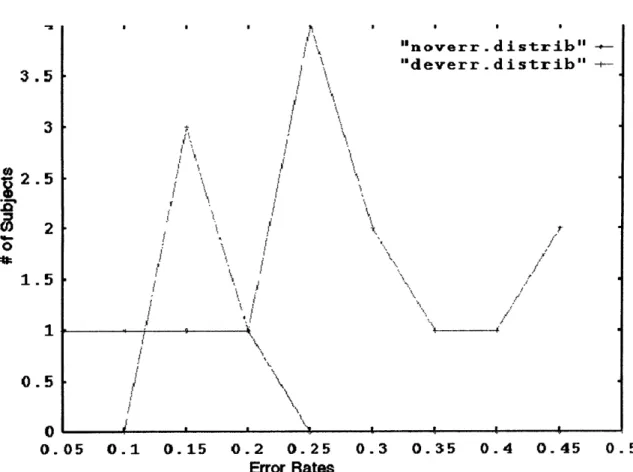
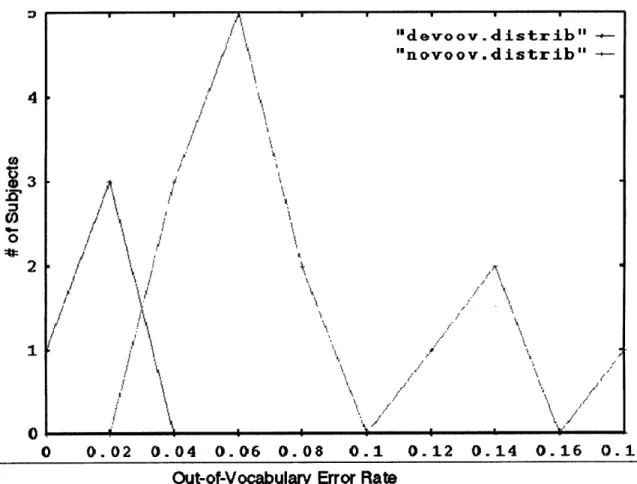
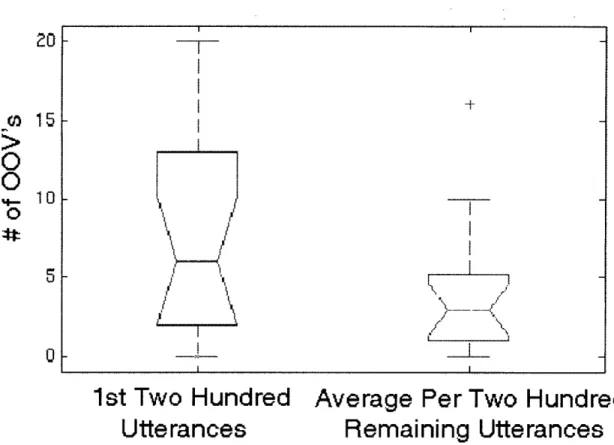
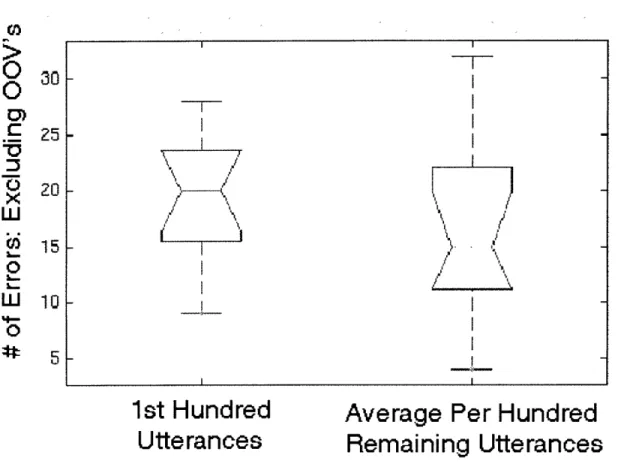
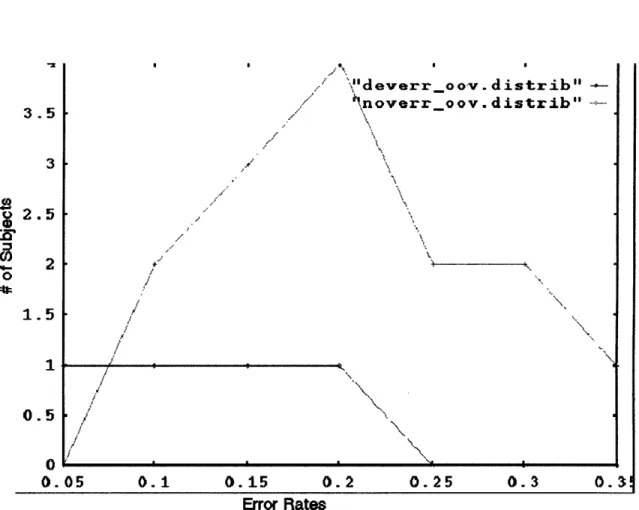
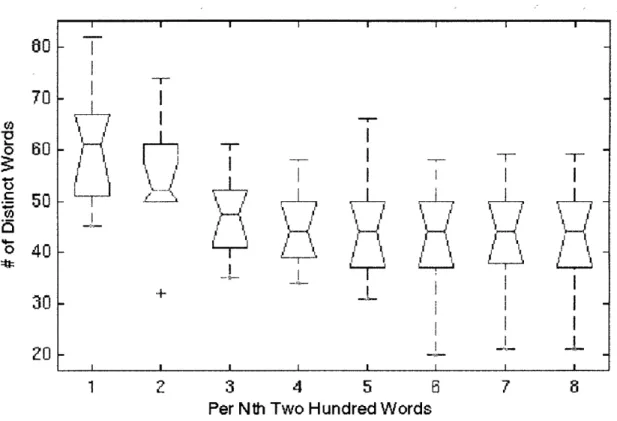
We explore the source of these errors in greater depth, beginning with a comparison of error rates for novice and expert users. We find that novices improve their er-ror rates over time, largely by learning the vocabulary and constructions understood by the system. However, even without these vocabulary related errors, novice users still encounter more errors than experts. The almost complete elimination of out-of-vocabulary utterances from novices' interactions can be tied to a decrease in their working vocabularies over time, to a set of words in which the user has high confi-dence. We also find that although each user converges on a small working vocabulary, there is still large variation in vocabulary between users. The presence, however, of persistent errors, an average of almost 20% for even more experienced novice users, illustrates the importance of properly handling errors and corrections.
Now we move on to the specific acoustic analysis of original inputs in contrast to repeat corrections. We use a data set consisting of approximately 300 lexically matched original-repeat utterance pairs. The "original" represents the user's first attempt at a given command, and the repeat correction corresponds to the first retry after the spoken recognition error. We analyze these utterances across a range of acoustic prosodic measures.
Broad Class Specific Measures Duration Total utterance duration, speech duration Pause Total and Average Pause duration Proportion of Silence Amplitude Average and Maximum Loudness Pitch Maximum, Minimum, Range Internal contour slope, final contour
We find significant differences between original inputs and repeat corrections for measures of all types except amplitude. There are significant increases in all duration and pause measures. Pitch minima are lower and final contours are more frequently falling, for corrections in contrast to original inputs. Finally, for corrections of mis-recognition errors only, utterance-internal contours are more variable, having steeper rises and larger cumulative slopes.
These contrasts demonstrate a large difference between original inputs and repeat corrections and suggest a set of features to be used in classifying utterances as originals or corrections. We design decision tree classifiers to perform this task, exploiting their ability to ignore irrelevant attributes and to produce readily intelligible and interpretable classifiers. We develop a set of 38 features for this classifier incorporating the measures found to be significant in the acoustic analysis, such as duration, pause, and pitch. These measures are used in both absolute and normalized forms, since the absolute values are highly variable. For instance, duration ranges from 210 to 5130 milliseconds, depending mostly of lexical content rather than original/correction status. We take as our basic unit of analysis a single user utterance, defined as the region between the system's prompt tone for user input and the system's next response, with preceding and trailing silences clipped. We emphasize identifying isolated individual utterances as original or corrective, but also examine the possibility of improving classification by comparing pairs of utterances for contrasts characteristic of corrections. We build classifiers that achieve between 65-77% accuracy, relative to a 50% baseline, depending on the type of correction being classified and the amount of information, full text transcription versus purely acoustic speaking rate measures. We find absolute and normalized duration to be the most important measures, producing the first split in all trees. For all correction types, other important features are pause duration and proportion of silence in the utterance. For corrections of misrecognition errors only, pitch contour and pitch minimum play an important secondary role. When compared to a 79.4% accuracy rate for human subjects on a similar task, the accuracy rates for classifiers fare well.
Finally, we consider the ramifications of the large differences between original in-puts and repeat corrections for the design of adaptive speech recognizers. First we observe that there are a number of phonological contrasts between originals and cor-rections. These shifts are largely a natural effect of the increased duration and pause lengths in correction utterances. The majority of these changes involve a shift to a clearer, more careful speaking style in corrections, and away from a more conversa-tional, casual style in original inputs. The contrasts include shifts from reduced vowels and consonants, such as 'schwa' or flapped 't', to unreduced, citation forms, such as a full vowel 'oo' in 'to' or a released, aspirated 't'. In addition we observed shifts to what can be called a "hyper-clear" style, characterized by insertion of a vowel or syllable, in correction utterances, as in shifting from 'goodbye' to 'good-ba-aye'. All of these changes constitute a shift away from the model of pronunciation derived from a base lexicon with standard co-articulation modeling. When we look at durational contrasts with a basic speech recognizer, rather than original inputs, the contrasts are even more clear. We find that a basic durational model, derived from TIMIT ut-terances [Chung, 1997], provides a good fit for words in non-final position in original inputs, with an almost normal distribution centered slightly above the TIMIT mean. Words in final position, though, begin to diverge from the model, being 0.5 standard deviations longer than predicted. However, corrections present a very poor match with this model, but in a systematic fashion. Durations of both final and non-final words become longer, moving the distributions 0.25 to 0.5 standard deviations further from the mean. We can thus see that a speech recognizer would need to take into
account these discourse and sentence-level information sources in order to adapt to recognizing corrections, particularly in those utterance- final words where correction and phrase-final lengthening effects combine.
In conclusion, we discuss specific ways to incorporate this understanding of du-rational change in corrections to build a more context- adaptive speech recognizer, either by incorporating phonological change rules conditioned on the corrective sta-tus of the utterance, or by modifying the durational model or scoring penalty for corrections. We also discuss the application of a similar decision tree method to isolate the corrected word(s) in the correction of misrecognition errors. Finally, we explore the possibility of using the original-repeat pair adjacency information to build a pair-based, rather than isolated correction recognizer.
1.4
Outline
The remainder of the thesis will follow the outline below. We will begin in Chapter 2 with an examination of related research. We will demonstrate how this thesis draws upon work in the use of intonation to identify discourse structure and discourse function. We will also look at research into recognizing the presence and position of self-repairs, another form of correction where the user corrects him/herself rather than the system. We will describe the use of both lexical and acoustic-prosodic information to solve this problem. Finally, we will discuss the small body of work explicitly involved corrections in human-computer dialog.
Chapter 3 will present a detailed description of SpeechActs, the prototype spoken language system used to collect the human-computer dialog data on which this thesis is based. We will describe typical interactions with the system and the subject popu-lation. We will then take a high-level look at error rates and error types encounter by users and examine in more depth the differences between novice and expert users in terms of error rates, use of out-of-vocabulary utterances, and vocabulary size and rate of acquisition. We will explain the selection of the original input-repeat correction pair data used extensively in acoustic analysis and classification experiments that form the core of the thesis.
Chapter 4 provides a detailed characterization of the acoustic-prosodic changes in correction utterances relative to original inputs in human-computer dialog. We exam-ine four classes of acoustic-prosodic measures: duration, pause, pitch, and amplitude. We explain the significant differences between original inputs and repeat corrections for three of these classes: duration, pause, and pitch, and identify important contrasts between corrections of rejection errors and corrections of misrecognition errors. Fi-nally, we relate these contrasts to a continuum in speaking style from conversational to clear.
Chapter 5 demonstrates the use of the acoustic features analyzed in the previous chapter in the development of a machine-learning based classifier to distinguish be-tween corrections and other inputs. We begin by explaining the choice of decision trees as the classifier mechanism, for reasons for intelligibility and robustness to ir-relevant attributes. We then describe in detail the feature set used to construct the
decision tree classifiers. We present results for decision tree classifiers on different correction types and using different types of lexical and contextual information.
Chapter 6 explains how the contrasts between original inputs and repeat correc-tions reflect a shift away from the models expected to support the speech recognizer. We demonstrate phonological contrasts between repeat utterances and both conver-sational and clear speech models of pronunciation. We also highlight the contrasts between the observed durations of correction utterances and durations predicted by a typical speech recognizer model, providing suggestions for modifications to a speech
recognizer that would make it more effective in the face of correction-related adapta-tions.
Chapter 7 summarizes the results from the thesis and presents several paths for future work. We discuss accommodations in the speech recognizer to improve recog-nition of corrections. We describe the application of acoustic features related to corrections to the identification of the word or segment being corrected and present some preliminary results in this area.
Chapter 2
Related Work
Fully operational spoken language systems are a very recent development. Conse-quently, there has been relatively little experimental analysis of users' interactions with such systems, much less analysis of detailed correction interactions in such sys-tems. We draw on related work in three main areas to provide direction and com-parison for this work on characterizing and recognizing spoken corrections. First we consider work done in the broader area of understanding the structure of extended narrative or dialog sequences, usually referred to as discourse. Understanding the structure of discourse involves both identifying shifts in topic and relationships be-tween topics and utterances within topics. Such relationships include correction, acknowledgement, and clarification, for instance. We will focus of identifying these structures in spoken interactions, emphasizing work on using prosodic cues, such as duration, loudness, and pitch. Second, we discuss the body of work most closely linked to corrections, that of automatic recognition of self-repairs. Self-repairs arise when a speaker interrupts themself to correct all or part of the current utterance; the later part of the utterance corrects an earlier portion. Corrections, as studied in this thesis, arise when the speaker's current utterance is intended to correct a perceived misunderstanding, misrecognition, or recognition failure of the part of the other con-versant, and thus form a natural parallel to self-repairs. Finally we will examine the small body of work that has directly studied spoken corrections, highlighting the different environments and tasks in which the data was collected.
2.1
Inferring Discourse Relations from Speech
2.1.1
Inferring Discourse Structure from Speech
In written text, narrative or written dialogue, good style decrees that paragraph structure should reflect discourse and topic structure. Generally the beginning of a paragraph coincides with the beginning of a discourse segment, and a paragraph end marks the conclusion of a discourse segment, such as a topic or subtopic. However, spoken narrative and dialogue lack even these basic cues to discourse structure. We will look at two sets of features that have been shown to be correlated with dis-course segment structure, specifically determining the location of disdis-course segment boundaries.
The first group of markers of discourse structure are purely prosodic measures, measures of pitch, duration, or loudness rather than based on the lexical content of the utterance. Monologues in which a speaker gives directions from one location to another, called direction-giving tasks, have been used extensively in several studies of discourse structure. Such discourses are chosen because giving directios usually involves an overall goal with clear beginning and end, as well as clearly defined sub-goals; this clear structure contrasts with the more muddled structure of a conversation between friends, for example. In one such study, [Davis and Hirschberg, 1988] ex-amined direction-giving and found that pitch range was closely related to position in a discourse segment. Specifically, these researchers found that utterances initiating discourse segments had expanded pitch range, relative to utterances within the seg-ment. These segment-internal utterances exhibited relatively compressed pitch range. These contrasts were then incorporated in a text-to-speech system, that demonstrated that expanded or contracted pitch range could lead subjects to different interpreta-tions of the sequence of direcinterpreta-tions based on whether or not they perceived that a new segment had begun. A group of more systematic studies of intonation related to discourse structure were performed on a group of direction-giving monologues re-ferred to as the Boston Directions Corpus. Studies of these monologues as reported in [Nakatani et al., 1995] again noted an expansion in pitch range associated with segment beginnings and compression of pitch range within segments.
Finally in a single "dialogue" question-answer system study of user utterances in the ATIS (Air Travel Information System) corpus, a standard spoken language systems testbed, [Swerts and Ostendorf, 1995] explored the features of topic initiating utterances. This testbed is interesting in that, although it is a query system, user input is in spoken English, while output was presented in textual and tabular form. In addition to demonstrating the use of expanded pitch range in segment-initial position utterances in this new domain and new interaction style, [Swerts and Ostendorf, 1995] observed that there was an accompanying increase in utterance duration in segment-initial position.
These results have particular bearing on understanding the discourse role of cor-rections in spoken dialogue. Some researchers [Swerts and Ostendorf, 1995] have suggested that corrections are, in fact a form of segment-initial utterance. Specif-ically, by performing a correction the user is initiating a correction subdialogue or clarification subdialogue. This analysis would then argue that corrections should share many acoustic features with other discourse segment initial utterances. We will return to this question after our own analyses of corrections in the SpeechActs data examined in this thesis.
Acoustic and Textual Cues
In addition to the completely text-independent cues to discourse segment structure discussed above, a common textual feature identified as signaling discourse structure is the use of cue words or cue phrases. Cue words are words that perform a discourse function, possibly in addition to their innate semantic meaning. Common examples of cue phrases are "now", "OK", "first", etc. "Now" obviously means "at this time", but when used in its discourse cue sense as in "Now, what are we going to do about this correction problem?", it signals a shift in topic, that the following utterance
belongs to a different segment from the preceding statements. Likewise, "OK" can be used to signal a transition between two discourse segments. However, the problem of determining whether a potential cue word is being used in its cue sense or in its basic meaning remains, even when one has successfully recognized the presence of one the words in an utterance. [Hirschberg and Litman, 1993] analyzed occurrences of common cue words in both their cue and literal uses. They determined that the cue use of a word could often be identified based on simple acoustic measures. Specifically, the presence of an L* accent (a low pitch accent on a stressed syllable) on the possible cue word and a possible following silence signaled the discourse use of the word. Thus, in addition to general utterance acoustic characteristics, discourse segment structure can be determined based on the presence of certain word classes, cue phrases, with a specific intonation contour, raising the question of whether similar cues are available for identifying spoken corrections.
2.1.2
Inferring Specific Discourse Functions from Speech
Thus far, we have considered simply determining the beginnings and endings of dis-course segments from speech features. Now we turn to inferring specific disdis-course relations. While the structural significance of corrections is somewhat unclear as to whether or not they should be considered to be segment-initial utterances, their func-tional, corrective, significance is both clear and of crucial importance. Clearly, some cue phrases, such as we discussed above, can carry specific discourse functions. "First" begins a narrative or list, "next" can continue a narrative sequence, and "however"' can introduce a contrastive view. The use of specific phrases to identify given dis-course relations has been studied extensively in text-based disdis-course analysis, such as Rhetorical Structure Theory (RST) by [Mann and Thompson, 1986] and augmented transition network discourse theories such as those by [Reichman, 1985]. However, as with paragraph segmentation, these cues are useful when available, but unfortunately are much less common in casual question-answer or direction-giving spoken interac-tions common in speech understanding domains, than in more formal written styles. For instance, in the SpeechActs data, only seven of the several hundred correction utterances contains a lexical cue such as "No" or "I meant." The question posed is thus how to identify a specific discourse function of a spoken utterance in the absence of explicit cue phrases.
The research of [Taylor, 1995], [Taylor et al., 1996a], and the University of Ed-inburgh has explored this problem. This research uses the HCRC Map Task Corpus, a collections of interactions between pairs of speakers of whom one is designated the leader and the other the follower. Their task is, given two slightly different maps, for the leader to direct the follower to draw a map path on his or her own map which accurately reflects the one on the leader's map. This task was intended to elicit a lot of negotiation, conversation, and discussion of appropriate reference terms for objects on the maps. They define a set of game-theoretic discourse relations such as inform, query-yn, reply-yn, query-wh, reply-wh, clarify, etc. Each utterance is labeled with one of the functions.
rise-fall-continuation model [Taylor, 1995]. This analysis assigns a pair of numbers to each non-flat segment of the contour. The numbers correspond to the parameters for the parabolic shape which best fits each portion of the pitch contour. The series of contour values and the discourse relation label are used to trained a neural network to classify new utterance contours as one of the available relation classes.
This relation information is then incorporated into the recognition process in the following fashion. The incoming utterance is passed to the neural network classifier and is assigned a game move label. The recognition hypotheses are now restricted to those that can fulfill that game move. This shift of recognition focus based on recognized discourse relation improves overall recognition accuracy.
Now, none of the game moves directly corresponds to our notion of corrections. This mismatch is actually not surprising since explicit corrections of misrecognitions are much less frequent in human-human dialogue such as that captured in the Map Task data, than in human-computer interaction. In addition, [Taylor et al., 1996b] observe that not all relations have clearly associated contours. Although there is no specific game move associated the phenomenon, there are many instances in the Map Task Corpus where one speaker acts to correct a misinterpretation on the part of the other conversant. It is likely that this type of correction would have many similarities to corrections of misrecognition errors in human-computer interaction. For instance, one would expect to observe contrastive use of pitch accent or insertion of a preceding silence associated with the word or phrase being corrected. The question of whether they take on the full array of clear speech characteristics, such as durational increase, requires further analysis, since many of the situations in which clear speech charac-teristics come to the fore involve interactions with conversants with some perceived deficit, as with young children, the hard-of-hearing, or computers; this is not the case for these human-human interactions. However, this research has strong connections to that reported in this thesis, by demonstrating that discourse relations can be iden-tified through acoustic- prosodic information, and providing a data set for comparison of corrections in human-human and human-computer interaction.
Another segment of the ATIS-based discourse study of [Swerts and Ostendorf, 1995] directly addressed the issue of corrections. The researchers examined a set of correction utterances in the air travel information domain. They observed three sets of statistically significant contrasts between original requests and corrections. These contrasts were in the following measures: increased utterance duration (including changes in lexical content of the correction), decreased tempo or speaking rate, and a decreased interval of silence between the current and preceding utterance. The most effective detector was the number of content words in common between the current and immediately preceding user utterance. Some utterances showed insertion of a pitch accent, stress, within an intermediate phrase or on a function word, such as 'the' or 'a', that would ordinarily not receive such accent. However, none of these pitch accent measures or overall utterance pitch maximum or pitch range measures reached significance. This absence of pitch contrasts was unexpected on the analysis of corrections as fulfilling a segment-initial discourse role.
2.2
Self-repairs
While relatively little research has been done on recognizing corrections of errors made by other conversational participants, a substantial amount of research has looked at recognizing self-repairs. Self-repairs are corrections within a single utterance, such as false starts, disfluencies, and the like. Consider the following utterance, "When does the plane for Austin leave on Mon - Tuesday?" This utterance contains a self-repair where the speaker changed the data of departure from Monday to Tuesday, after uttering the first syllable of the incorrect date. The goal of recognizing a self-repair is to pass to the natural language understanding module a string which corresponds to the corrected form of the utterance with all trace of the corrected, erroneous segment removed. In the literature, the corrected segment is referred to as the reparandum, and the new segment is called the repair. To accomplish this main task, it is necessary to identify the two regions constituting the reparandum and the repair. A variety of approaches to this problem have been proposed, and as in discourse segmentation and function inference, they can be divided into two groups based on whether or not the techniques rely on textual information.
2.2.1
Recognizing Self-Repairs with Text and Acoustic
In-formation
Approaches reported by [Heeman and Allen, 1994] and [Nakatani and Hirschberg, 1994] make use of lexical and acoustic features to identify the locus of self-repairs in utterances. The lexical component of these methods involves finding matched se-quences in the reparandum and repair, as in "Take the oranges to Albany - to Erie" where the word to starts both reparandum and repair. The presence of filled pauses, e.g. "umm" and "uh", and unfilled pauses is also found to be a useful cue to the initiation of a self-repair. The most important measures for these approaches were the presence of word fragments. When this measure was excluded measures of pres-ence and length of pause proved to be the best signals to the prespres-ence of self-repairs. A lexical match within a three word window to the right and position within the utterance were also useful. [Nakatani and Hirschberg, 1994] found, in addition, that there were significant increases in both pitch and amplitude between the last stressed syllable of the reparandum and the first stressed syllable of the repair. This decrease in amplitude and cliticization or deaccenting of the word preceding the interrupt-ing correction segment played a role in some classification in the Classification and Regression Tree (CART) used to find the boundary between reparandum and repair.
2.2.2
Recognizing Self-Repairs with Acoustic Information Alone
While they recognize that the best results for identifying self-repairs are achieved when textual information is used, [Shriberg et al., 1997] describe an approach that uses only acoustic cues. They argue for this approach based on the fact that in the context of speech recognition an accurate text transcription of the full utterance is not necessarily available, particularly in the cases of utterances involving self-repairs
where the presence of disfluencies can lead to misrecognitions. Their approach con-siders each inter-word position to be a possible start of a self-repair. They then use information about the duration, pitch, amplitude, and pauses in preceding and following words to determine which positions are most likely to be associated with self-repairs. The most important features for identifying self-repairs or disfluencies were duration, distance from pause, and for certain disfluency classes, pitch, which played a more significant role than amplitude, as measured by signal-to-noise ratio (SNR), or gender.
These studies of self-repairs show that a form of correction, where one corrects oneself mid-utterance, can be recognized best based on repeated phrases within an utterance, but can still be identified with some success based on acoustic features such as duration and amplitude. These approaches suggest several acoustic measures to be used in identifying corrections of errors made by either conversant. However, corrections are likely to prove more difficult to recognize both because repetition of words between utterances, even in the absence of correction, is more likely than within utterances and because this direct comparison of original and correction may not be possible.
2.3
Corrections
Recent research by [Oviatt et al., 1996] has focussed on characterizing the phonetic, acoustic, and prosodic changes that take place in spoken corrections. The data in [Oviatt et al., 1996]'s study was collected in a simulation study where randomly generated errors were presented to a subject who was using a speech interface to a form-based interface where recognized input and recognition failures were signaled visually on a WACOM graphical template. Thus there was a voice-in/tabular-visual-output system. While [Oviatt et al., 1996] do not make any attempt to automatically recognize these spoken corrections, they carefully analyze and characterize the spoken corrections collected in the experiments. First they identify a cluster of phonetic changes between otherwise lexically identical original inputs and repeat corrections. These changes, such as shifts from flapped to released t's reflect a change from a more conversational to a more clear and precise speaking style in 10% of correction utterances. They also found significant increases in total utterance duration, speech duration, number and length of pauses, and decrease s in pitch minimum among male speakers. However, no changes in amplitude were observed. These increases in utterance and pause duration fit into the same contrast of a shift from a more conversational to a more careful, clear speech style between original and correction as the phonological changes above.
The research in this thesis is a natural and more computational extension of the work by [Oviatt et al., 1996] in which the author participated. The prior work pro-vided the insight of casting corrections as instances of hyperarticulation, that can be characterized by a specific set of acoustic adaptations. That research also developed an analysis methodology for comparing different utterance classes, in this case original and repeat, systematically for a variety of acoustic-prosodic measures. Many similar
measures, along with extensions to speaking rate and refinements, such as per-subject normalization, play a primary role in the analysis in this thesis. Discussions of the best ways to exploit the contrasts between corrective and non-corrective utterances led to the decision to use them to build a correction classifier and adapt automatic speech recognition.
2.3.1
Speaking Styles
Since the above work on corrections has raised the issue of treating corrections as shifts from one speaking style to another, let us consider briefly the work of [Osten-dorf et al., 1996] in a summer workshop held at Johns Hopkins University in 1996. This workshop focussed on improving speech recognition rates by incorporating a speaking mode variable into the speech recognition model. This mode variable was intended to capture some of the systematic contrasts in phonological features that accompany differences between read and conversational speech. These differences are often blamed for the relatively poor accuracy rates on recognition of casual conver-sational speech as found in the Switchboard or "call-home" corpora, where people were recorded making free-form telephone calls to their family and friends, reaching about 40% word error rate, versus the 5-10% word error rates achieved on read Wall Street Journal text. For the read versus conversational contrast the designers built a decision tree classifier that could discriminate between these classes at an error rate of 27-34%. The classification was based most heavily on durational and speaking rate measures. In addition, presence of a pause of length greater than 50 milliseconds and loudness measures, in terms of signal-to-noise ratio (SNR), also played a role. Pitch measures did not provide any significant information to the classification process. They also found that they could significantly improve accuracy on the more diffi-cult conversational corpus data by collecting a set of common phonological changes and using these to modify the recognition model for words in utterances classed as conversational by the decision tree or other method.
This work has some clear parallels with that discussed in this thesis, in that it tries to use acoustic measures and classifiers to recognize certain speaking styles and seeks to understand the impact of the speaking style on the recognition process. However, we will see that the work in this thesis looks at identifying a specific set of features that identify an important discourse role, marking corrections, which has proven difficult even with perfect transcriptions and has proved opaque in the absence of this lexical information. In addition, at a finer granularity, we find different features to play a role in signaling corrections from those involved in the read-conversational speaking style contrasts. We seek to relate these contrasts to those for other discourse functions in the hope of better understanding the role of corrections in discourse structure as a whole.
Chapter 3
Data Collection: System, Subjects,
and Overall Analysis
The data used in the experiments and analyses throughout this thesis was drawn from recordings of user interactions with the Sun Microsystems SpeechActs system during a limited field trial. This chapter will provide an introduction to the SpeechActs system itself, a general description of the data obtained in the field trial, a discussion of the identification, coding, and analysis of errors encountered by system users, and a description of the criteria by which the utterance pairs used in the acoustic analysis and recognition experiments were selected.
3.1
SpeechActs Description
SpeechActs is a prototype spoken language system designed by Sun Microsystems Laboratories Speech group (1993-1995), where the author spent two summers as a student intern. SpeechActs provides a voice-only interface to a variety of common desktop and information feed services. Specifically, it included e-mail reading and sending, access to one's own and other browsable calendars, weather information, stock quotes, time zone and currency conversions, and a notification system. An example interaction is shown below:
SpeechActs: User: SpeechActs: User: SpeechActs: User: SpeechActs:
You have 14 new messages and 47 old messages. The first new message is from Eric Baatz regarding "'report completed." Let me hear it.
"The first draft is ready for your comments. Eric."
Reply and include the current message. Preparing message to Eric Baatz. Begin recording after the tone.
When finished, pause several seconds. Eric, I'll get those to you
this afternoon.
User: Send.
SpeechActs: Message sent. What now? User: Next message.
SpeechActs: New message two from Stuart Adams, subject "Can we meet at 3:00 today?"
User: Switch to calendar... 1
Two significant features distinguish SpeechActs from other spoken language sys-tems. First, since it was designed primarily for use over the telephone to provide ubiquitous access, it is a voice-only system. With the exception of password entry and escape sequences which use DTMF input, all user input is spoken, and all out-put is through synthesized speech; there are no visual displays for feedback. Speech recognition is performed by BBN's Hark speaker-independent continuous speech rec-ognizer, and synthesis is performed by Centigram's TruVoice text-to-speech system. Locally developed natural language processing and interpretation engines feed the speech recognition results to the appropriate speech application interfaces for each backend system. The restriction to a single, audio modality requires that the user give all necessary information to the system through speech, and allows our analysis to focus exclusively on those speech cues of lexical, phonetic, and acoustic-prosodic form which the spoken modality provides.
Secondly, SpeechActs was designed to provide a "conversational" interface. A conversational interface can best be understood by what it is not. It is not a fixed command language, it is not a form-based input structure, and it does not have rigid vocabulary or syntax. Instead, a conversational interfaces hopes to provide both ease of use for novice users and efficiency for more experienced users by allowing them to use language which comes naturally for each individual. In addition, it is easy to combine commands or criteria for requests into a single command for more confident and experienced users (e.g. read the third urgent message) or to simply step through the information with a sequence of simple commands for novice users (e.g. "Go to urgent messages" ," Next" ," Next" ," Next"). All new users are provided with a wallet-sized information card with examples of common commands for each application, but, as we will demonstrate later in this chapter, users each rapidly develop their own distinct style and vocabulary.
3.2
Data Collection and Coding
Now that we have provided a general overview of the SpeechActs system, let us turn to a more detailed description of the data collection process. As discussed above, SpeechActs was deployed for a limited field trial over an analog telephone connec-tion, so that it could be accessed from home, office, hotel, or even a busy, noisy airport terminal. All interactions were recorded automatically during the course of the conversation. All speech, both user input and system synthesized responses were
digitized and stored at 8kHz sampling rate in 8-bit mu-law encoding on a single chan-nel, compatible with native system hardware and the limitations of analog telephone lines. In addition to the stored audio, speech recognizer results, natural language analysis results, and the text of all system responses was recorded and time stamped. Next, all user utterances were textually transcribed by a paid transcriber. Each transcription of user input was paired with the speech recognizer output for that
utterance. Each of these pairs was assigned one of four accuracy codes: * Correct: Recognition and Action Correct
User Said: Read message one System Heard: Read message one
* Error minor: Recognition not verbatim; action correct User Said: Go to the next message
System Heard: Go to UH next message
* Misrecognition: Recognition not verbatim; action incorrect User Said: Next
System Heard: Fax
* Rejection: No recognition; no action User Said: Read message one System Heard: nothing
The use of the "Correct" code should be evident. The "error minor" code assign-ments generally resulted from a misrecognition of a non-content word (e.g. wrong tense of an auxiliary verb, incorrect article, insertion of "um" or "uh") for which the robust parsing of the natural language component could compensate. The "misrecog-nition" and "rejection"' codes were assigned in those cases where a user could identify a failure in the interaction. Utterances coded either as Misrecognition or Rejection could also receive an additional tag, OOV. This tag indicates that either words not in the recognizer's vocabulary or constructions not in the systems's grammar were used in the utterances. For simplicity, however, we refer to all these cases as OOV. Two examples appear below:
* Unknown Word: Rejection
User Said: Abracadabracadabra System Heard: nothing
* Unknown Construction:Misrecognition User Said: Go to message five eight six System Heard: Go to message fifty six