HAL Id: tel-02120762
https://tel.archives-ouvertes.fr/tel-02120762
Submitted on 13 May 2019HAL is a multi-disciplinary open access
archive for the deposit and dissemination of sci-entific research documents, whether they are pub-lished or not. The documents may come from teaching and research institutions in France or
L’archive ouverte pluridisciplinaire HAL, est destinée au dépôt et à la diffusion de documents scientifiques de niveau recherche, publiés ou non, émanant des établissements d’enseignement et de recherche français ou étrangers, des laboratoires
Topological phenomena in quantum gases
Jérôme Beugnon
To cite this version:
Jérôme Beugnon. Topological phenomena in quantum gases. Quantum Physics [quant-ph]. Sorbonne Université, 2018. �tel-02120762�
Habilitation `a diriger des recherches de Sorbonne Universit´e pr´epar´ee par J´erˆome BEUGNON
Gaz quantiques et topologie
Topological phenomena in quantum gases
Soutenue le 11 Octobre 2018 devant le jury compos´e de :
M. Rudolf GRIMM . . . Rapporteur M. David GU ´ERY-ODELIN . . . Rapporteur Mme Laurence PRUVOST . . . Rapporteur Mme Leticia CUGLIANDOLO . . . Examinatrice (Pr´esidente du jury) M. Pascal SZRIFTGISER . . . Examinateur M. Peter van der STRATEN . . . Examinateur
Contents
Introduction 3
1 Two-dimensional Bose gases 8
1.1 Introduction . . . 8
1.2 Basic features of 2D Bose gases . . . 9
1.2.1 The 2D Bose gas at zero temperature . . . 9
1.2.2 Equation of state . . . 9
1.2.3 Coherence properties of the 2D Bose gas . . . 10
1.3 Experimental realization of 2D Bose gases . . . 10
1.3.1 Confinement to 2D . . . 10
1.3.2 In-plane confinement . . . 11
1.4 Probing superfluidity and coherence of the 2D Bose gas . . . 11
1.4.1 Superfluid behavior of the 2D Bose gas . . . 11
1.4.2 Emergence of coherence in a 2D Bose gas . . . 12
1.4.3 Formation of topological defects in a quenched-cooled 2D Bose gas . . . 13
1.4.4 Propagation of sound in a 2D Bose gas . . . 15
1.5 Superfluid currents in a ring geometry . . . 16
1.5.1 Creation, detection and investigation of superfluid currents . . . 16
1.5.2 Stochastic formation of superfluid currents . . . 17
1.6 Additional works . . . 20
1.6.1 A proposal to create bosonic fractional Hall states . . . 20
1.6.2 Light scattering in an atomic layer . . . 20
1.7 Conclusion . . . 21
2 Towards 2D uniform Bose mixtures 22 2.1 Demixing dynamics . . . 22 2.1.1 Demixing principle . . . 22 2.1.2 Bulk demixing . . . 23 2.1.3 Demixing at an interface . . . 24 2.1.4 Possible extensions . . . 24 2.2 Impurity dynamics . . . 25 2.2.1 Bose polaron . . . 25
2.2.2 Quantum Brownian motion . . . 26
2.3 Other projects . . . 27
3 Ytterbium quantum gases in optical lattices 29 3.1 Introduction . . . 29
3.2 A new experiment . . . 30
3.2.1 Bose-Einstein condensation of174Yb . . . 30
3.3 Probing quantum gases on an optical transition . . . 31
3.3.1 Introduction . . . 31
3.3.2 Doppler spectroscopy . . . 32
3.3.3 Spectroscopy of a Mott-Insulator . . . 33
3.3.4 Spectroscopy in a magic dipole trap . . . 34
3.4 Towards topological phases in optical lattices . . . 35
3.4.1 Motivation . . . 35
3.4.2 State of the art . . . 36
3.4.3 Description of our protocol to induce artificial magnetism . . . 37
3.4.4 Expected results . . . 39
3.5 Topological properties of 1D quasicrystals. . . 41
3.6 Conclusion . . . 41
Conclusion 42
Introduction
In this manuscript, I describe my research activities on ultracold Bose gases since I joined the Bose-Einstein condensate team of Laboratoire Kastler Brossel (LKB) in 2008. Prior to this work I have been a postdoctoral fellow at Laboratoire Aim´e Cotton where I studied resonant interactions between Rydberg atomic pairs in an atomic beam. A description of the main results we obtained can be found in Ref. [1]. At LKB, I first started to work on the metastable helium project with Mich`ele Leduc for two years and then I initiated with Fabrice Gerbier the ongoing artificial magnetism in optical lattices project with ytterbium atoms in 2009. More recently, since 2011, I am also involved in the two-dimensional Bose gas project together with Jean Dalibard and Sylvain Nascimbene. This project first started on the existing setup at Ecole Normale Sup´erieure and is now continuing on a new setup at Coll`ege de France where all our team and experiments are installed since 2014.
Quantum physics in the 21st century
The development of quantum physics within the last 100 years has opened a very broad field of research including now, for instance, chemistry, solid-state physics, particle and nuclear physics, atomic and molecular physics, astrophysics and cosmology... Quantum physics is a the heart of a large part of the worldwide basic research activities and provides huge challenges (i) on the theory side because of the exponentially increasing size of the Hilbert space with the system size and the important role of correlations (entanglement) between different parts of this space; (ii) on the experimental side because of the difficulty to handle systems well-preserved from decoherence while maintaining a high degree of control.
More recently, quantum physics and quantum materials have been put to the forefront as good can-didates to overcome some global challenges that our world will have to face in this century [2, 3] and which maybe require groundbreaking advances. Among others quantum computers are expected to solve efficiently problems relevant for instance for artificial intelligence or more generally for optimization pro-tocols. Quantum simulators may offer suitable tools to understand and develop new phases of matter, like high-temperature superconductors thus enabling a better management of energy. On the same topic, quantum materials, like solar cells could provide more efficient and durable light harvesting techniques. Safe exchanges through communication channels may also benefit from the intake of quantum cryptog-raphy and communications.
Most of the technical progresses in these directions are expected to come from condensed-matter physics and photonics, which are the best candidates for practical implementations. However, funda-mental research of well-controlled and tunable systems is also crucial and the field of ultracold quantum gases provides such systems where a deep understanding and an extreme versatility are possible.
Ultracold quantum gases
Whereas Fermi gases of electrons are extensively studied in condensed-matter physics since the early days of quantum physics, Bose gases are less common. The paradigmatic example of liquid helium, first observed in 1908, has for a long time been the only playground to study Bose systems. An impressive amount of results on this system have been reported like the observation of superfluidity (1911), quantum
vortices or the normal to superfluid Berezinskii-Kosterlitz-Thouless (BKT) transition in two-dimensional systems [4]. Bose-Einstein condensation plays a crucial role for this system but strong interactions between particles hinder the pure effect of quantum statistics.
The realization of Bose-Einstein condensation in dilute atomic gases in 1995 has renewed the interest on Bose gases because of the possibility to study weakly interacting systems and make quantitative com-parison with models [5, 6]. The demonstration of superfluidity and quantized vortices quickly followed [7, 8, 9]. The dynamics of trapped Bose-Einstein condensates (BECs) have been accurately investigated and demonstrated the validity of the Bogoliubov microscopic description [10]. Gaseous BECs have been followed in 2001 by ultracold Fermi gases [11], which provide a fruitful alternative to condensed-matter systems.
Thanks to the fast development of laser technologies, we are now able to manipulate ultracold quan-tum gases in optical dipole traps with a great versatility. First, one can change the dimension of the system by strongly confining atoms along one or two directions of space to create two-dimensional and one-dimensional gases [12]. Thanks to beam shaping techniques it is also possible to draw arbitrary po-tentials on the atomic clouds [13, 14, 15, 16, 17, 18, 19]. Finally, by making two beams interfere, one can create periodic potentials, the so-called optical lattices, in which particles are trapped in great analogy with electrons in solid-state devices [20]. In addition to the flexibility for the confinement, interactions between particles can be controlled thanks to Feshbach resonances [21]. Last, the interaction with the environment can be almost fully cancelled leading to the realization of well-defined closed systems or, alternatively, this interaction can be tailored at will to study the dynamics of quantum open systems [22].
Topological phenomena in quantum gases
Topology is playing an increasing role in physics. Besides the mathematical elegance of the topological understanding of some physical phenomena, the great importance of topology in physics usually stems from the robustness of topological properties for instance to defects or geometrical deformations. The topological robustness is expected to be crucial for the emergence of quantum devices like for instance, Majorana fermions for quantum computing [23] or topological lasers [24, 25, 26].
Topology is well-known in the study of superfluids. For instance, vortices are topological defects which are characterized by an integer winding of the phase of the wavefunction around the vortex core. Topology is also at the heart of the Berezinskii-Kosterlitz-Thouless (BKT) phase transition to a superfluid state in 2D [27]. It is a topological phase transition, very different from continuous phase transitions, where the transition is associated to a change in the topology of the system. In addition, a large variety of topological defects exists in spinor superfluids [28]. We will explore topological features in superfluids in the two first chapter of this manuscript.
The most celebrated example of interplay between topology and physics is undoubtedly the descrip-tion of Quantum Hall Effect (QHE) in two-dimensional electron gases [29]. In this case, the quantizadescrip-tion of transverse conductivity is associated to a topological number (the Chern number) which characterizes the topology of the band structure. To explore similar physics with ultracold atoms one needs to simu-late orbital magnetism i.e. the effect of a magnetic field on the motion of charged particles. This goal has motivated an intense theoretical activity to propose protocols to implement this artificial magnetism using for instance rotation of the cloud [30], light-induced potentials [31], time-modulation of optical lattices or light-induced complex tunnelling [32]. Very recently, topological band structures have been realized in some pioneering experiments [32]. In our team, we aim at applying the protocol described in [33, 34] and I will describe our work in the direction of the quantum Hall effect with bosons in the last chapter of this thesis.
Present and future of ultracold quantum gases
A great challenge for the future in the quantum gases field is to use all these degrees of freedom to investigate the physics of many-body systems in non-trivial configurations where the role of interactions, topology and the interplay between both (like in the Fractional Quantum Hall Effect) can be controlled to realize rich and yet unexplored phases of matter. These investigations will be developed in parallel with theory progress to benchmark the ability to get reliable results and to prove that ultracold quantum gases can be used as robust quantum simulators. Whereas all the aforementioned interesting features of quantum gases have been demonstrated in several groups, merging many of them efficiently on a single experimental apparatus is getting increasingly difficult and requires state-of-the-art technologies and highly-trained teams. Many of the targeted breakthroughs may also be limited in the near future by the too high temperatures/entropy commonly achieved in experiments (on the range of tens of nK) which are comparable to energy gaps of the studied many-body phases. Here again laser-shaping of optical traps has been used to make significant progress in this direction allowing the observation of antiferromagnetic interactions in spin chains [35].
In the above description, I have selected only a few topics of the field which are lying in the context of this manuscript but ultracold quantum gases are also well adapted for many other subjects like local-ization in disordered potentials [36, 37], molecular physics [38], metrology [39] or quantum information processing.
Main results of this work
In this framework, we aim at contributing to the field with experimental studies on ultracold Bose gases. One project is dedicated to two-dimensional rubidium Bose gases in box-like potentials. The other focuses on the study of artificial magnetism with ytterbium atoms confined in optical lattices and manip-ulated on an optical clock transition. These two projects correspond to two different experimental setups and teams but they clearly have strong connections.
Two-dimensional Bose gases Most of our work on the two-dimensional Bose gas concerns the dynam-ical behaviour of the system and the probing of superfluidity and coherence properties using (mostly) re-cently developed uniform box-trapped gases. We have first initiated the realization of box-like potentials on the existing 2D setup and we have developed a fully new apparatus dedicated to this topic. Thanks to these apparatus we have demonstrated the superfluid character of the gas and studied the propagation of second sound which is also related to the gas superfluid fraction. In addition, we have characterized how coherence is restored after quenching the system to an out-of-equilibrium situation and measured the statistical distribution of the topological defects formed after different kinds of quenches in several geometries.
High-resolution optical spectroscopy of Bose gases We have built a new experimental apparatus to manipulate quantum gases of ytterbium atoms. This two-electron atom has specific properties compared to standard alkali like the presence of an ultranarrow clock transition which is at the heart of our activities and of the protocol that we plan to implement to create artificial magnetism. In this manuscript, I will describe the development of this apparatus and some studies that we have recently realized combining an ultranarrow laser and quantum gases. In these experiments we have probed ytterbium bulk BECs and few-particle systems confined in an optical lattice. These experiments allowed us to fully understand and characterize the rich dynamics of optically-coupled quantum systems.
Outline
The manuscript is organized as follows. I describe in chapter 1 recent results that we have obtained on two-dimensional Bose gases whereas chapter 2 describes the associated research plans. The first achievements on our ytterbium project, mainly about optical spectroscopy of many-body phases with high resolution optical spectroscopy are described in chapter 3 along with our research plans on this setup about artificial magnetism in optical lattices. The manuscript terminates with an overall conclusion.
CHAPTER 1
Two-dimensional Bose gases
1.1
Introduction
The study of quantum gases of bosons in two dimensions is motivated by several reasons. One of the most interesting feature of two-dimensional Bose gases is the existence of a topological phase transition from the high temperature normal phase to a low temperature superfluid state. This phase transition is of BKT (Berezinskii-Kosterlitz-Thouless) type. It is a topological phase transition and its initial description is the subject of the Physics Nobel Prize in 2016 [27]. It has been observed with an ultracold gas in our team in 2006 [40] and studied in several other teams [41, 42, 43, 44].
This specific phase transition is not a symmetry breaking phase transition (as Bose-Einstein con-densation for instance) and it features several original properties relevant to describe weakly interacting bosonic gases. Among this properties we wish to emphasize the following ones [45]:
– The low temperature phase is superfluid. The superfluid fraction exhibits a jump at the critical temperature from zero in the normal phase to a finite value in the superfluid phase. This behaviour was observed with liquid helium films [46].
– The low temperature phase, even if superfluid, does not present true long-range order, in agreement with Hohenberg-Mermin-Wagner theorem [47, 48]. In this phase the gas exhibits quasi-long range order corresponding to an algebraic decay of the first-order correlation function. In the normal phase, close to the critical point, quasi-long range order disappears and an exponential decay of the correlation function is predicted.
– The topological character of this phase transition can be understood from a microscopic point of view. The transition from the superfluid phase to the normal phase corresponds to the unbinding of vortex pairs into single vortices. Some signatures of this behaviour have been observed in Ref. [49].
Besides these fundamental properties of the 2D Bose gas, 2D systems also offers clear advantages from an experimental perspective. The main probing technique of quantum gases is absorption imaging. Using single atomic layers allows an efficient characterization of the clouds, possibly with a high optical resolution and without being limited by the depth of focus of the system. High optical resolution can also be used to tailor optical potentials with a good spatial resolution. We have exploited this feature in our team to create custom-shaped flat-bottom potentials using spatial light modulators.
Finally, physics in 2 dimensions of space is particularly suitable to investigate topological phases of matter, as exemplified by quantum Hall physics in 2D electron gases [50].
Most of the results described in this chapter have been reported in several theses realized by students that I have co-supervised [51, 52, 53, 54]. Three other PhD students are currently doing their PhD in our team (R. Saint-Jalm, E. Le Cerf and B. Bakkali). This work also involved several postdoctoral fellows: C. Weitenberg, T. Bienaim´e, M. Aidelsburger, P.M. Castilho. This project is conducted in collaboration with S. Nascimbene and J. Dalibard.
1.2
Basic features of 2D Bose gases
In this section we review a few properties of the 2D Bose gas that are of interest for the following of this chapter. Much more comprehensive descriptions can be found in [45, 55].
1.2.1 The 2D Bose gas at zero temperature
In 3D, weakly interacting Bose gases at zero temperature can be well described by the mean-field Gross-Pitaevskii equation. This equation is non-linear because of the presence of interactions between particles which are described by a coupling constant g= 4πa~2/m, where a is the s-wave scattering length.
In the following, we will consider a gas to be two-dimensional if the characteristic thermal and interaction energies are smaller than the typical confinement energy along the direction perpendicular to the plane. However, in the regime explored here the typical thickness of the cloud (hundreds of nm) is much larger than the s-wave scattering length (5.3 nm) and collisions in the gas are three-dimensional. In this regime, for low enough temperatures and for a strong harmonic confinement along z, one can show that the wavefunction ψ(r, t) of a uniform gas is given by an effective 2D Gross-Pitaevskii equation [45]
i~∂ψ∂t =−~ 2 2m∇ 2ψ + ~2 m˜g|ψ| 2ψ. (1.1)
Interactions are then described by the dimensionless parameter ˜g = √8πa/lz, where lz = p~/(mωz) is
the harmonic oscillator length along the strongly confining z direction. In our experiment we typically explore the regime where ˜g ≈ 0.1 − 0.2 is small (weakly-interacting regime). Larger values of the interaction parameter have been explored for atoms with an available Feshbach resonance [56] or for molecules in Fermi systems [57, 58].
Starting from this effective 2D situation, it is possible to investigate Bogoliubov excitations in the system [59, 45] in a way similar to what is done in 3D, even if phase fluctuations at T , 0 could destroy the order parameter at large distances. We obtain the “usual” Bogoliubov spectrum for excitations at wavevector k. E(k)= s ~2k2 2m ~2k2 2m + ~2 m˜gn2D ! , (1.2)
where n2Dis the surface density of the cloud. For k ξ−1=
√
˜gn2D, these excitations are phonons with
a Bogoliubov speed of sound cB = p~2˜gn2D/m2, which is typically a few mm/s in our experiments.
1.2.2 Equation of state
In a weakly interacting 2D Bose gas described by a classical field theory, there is a specific scale invari-ance. It can be shown that the thermodynamic properties can then be expressed only as a function of the dimensionless combination µ/kBT and does not depends on µ and T separately. This scale invariance
could be understood from the absence of dimension of the interaction parameter ˜g, contrary to the 3D case [55].
This scale invariance means that a relatively simple equation of state of the gas can be found. For instance, the knowledge of D = f (µ/kBT), where D = n2Dλ2T with λT = h/
√
2πmkBT the thermal
wavelength, is an equation of state of the system containing the full thermodynamical properties of the gas. This equation of state has been computed with classical field Monte-Carlo simulations in [60] and
confirmed with quantum Monte-Carlo methods [61]. Measurements of the equation of state in Bose gases have been reported in Refs. [56, 62, 63, 64] and measurements in 2D Fermi gases in Refs. [65, 66] and show a good agreement with these predictions.
1.2.3 Coherence properties of the 2D Bose gas
Phase fluctuations and coherence can be characterized by the first order correlation function
g1(r)= h ˆΨ†(r) ˆΨ(0)i, (1.3)
where ˆΨ is the annihilation operator. Depending on the degeneracy of the cloud this function shows very different behaviours [45].
– At high temperature and for an ideal gas, where the gas can be described with Boltzmann statistics, g1has a Gaussian shape with a characteristic decay length given by the thermal wavelength λT.
– At lower temperature and for an ideal gas, but above the critical point, the correlation function decays exponentially, g1(r) ∝ e−r/`, at large distances compared to λT. The decay length is given
by ` = λTeD/2/
√
4π. The decay length grows exponentially with D and can thus become very large1.
– Below the critical temperature and for an interacting gas, the long-distance behaviour of the corre-lation length is dominated by the low-energy phonon modes and is given by g1(r) ∝ r−1/Ds, where
Dsis the superfluid fraction phase-space density. This (slow2) algebraic decay is the signature of
quasi-long range order in this system.
1.3
Experimental realization of 2D Bose gases
1.3.1 Confinement to 2D
The usual approach to realize a 2D Bose gas is to strongly confine a 3D cold atomic cloud along one direction. In our experiments, we usually explore thermal energies and interaction energies on the order of kBT, Eint ≈ 100 nK. The confinement frequency should thus be on the order of a few kHz to ensure
two-dimensionality.
Several techniques are available to realize a 2D Bose gas. A common approach is to use an optical trap to engineer a fast spatial variation of the potential. To obtain a single 2D gas, one can create a single potential minimum [42, 67]. In these cases the confinement is often limited because of the relatively large size of the beam waists (few µm). Another approach is to create an optical lattice by interfering two laser beams [68, 43]. Then, one has to find a trade-off between using a short lattice spacing that enables to reach high confinement energies and using a large lattice spacing, which makes single-plane loading easier. In our team we have first been working with a single repulsive optical potential that was shaped into a Hermite-Gauss mode (with a dark line at its center) [67]. More recently we have designed and implemented an optical accordion lattice trap for which the angle between the interfering beams can be tuned dynamically from a large spacing configuration favouring the loading of atoms around a single node of the lattice to a short lattice spacing favouring a strong confinement. This work is described in [69] and in Fig. 1.1. Finally, another possibility is to use a radio-frequency dressed magnetic potential [70].
1Taking into account interactions one can show that ` diverges at the critical point, as expected generally for a phase transition, but this divergence is exponential rather than a power-law, as for the case of a second order phase transition.
Figure 1.1: Left: Sketch of the experimental setup. A vertical optical lattice is created thanks to the low-angle interference between two laser beams. A single node of this lattice is loaded with a cold atomic gas. The angle between the two beams can be tuned dynamically to adjust the lattice spacing. Two microscope objectives are place below (for imaging) and above the cloud (for tailoring the in-plane potential). The in-plane potential profile is obtained by direct imaging of the chip of a spatial light modulator. Right: Examples of absorption pictures of atomic clouds. Box, ring-shaped or more complex potentials can be realized and possibly dynamically modified.
1.3.2 In-plane confinement
The strong confinement along the vertical direction is usually created by a laser with a large waist and is always chosen repulsive in our team. It thus has almost no influence on the in-plane trapping potential. Practically, the decrease of the strength of the confinement away for the center of the trap because of the finite extension of the laser beam leads to an anti-confining potential which is of about a few (imaginary) Hz with our parameters [52].
The shaping of the in-plane trapping potential is flexible. Around 2012, on the ENS setup, we used a harmonic confinement created by a rotating magnetic quadrupole trap (TOP configuration). Then, we started to investigate box potentials at ENS (2013-2015). At Coll`ege de France (2016-now), we still use box potentials but with a much better optical resolution to design the potential (around 1 µm) and with a large flexibility thanks to the use of spatial modulators (see Fig. 1.1). We currently use two digital micro mirror (DMD) devices which allow us to change at will the shape of the trapping potential both between each experimental sequence and during a given sequence by playing movies on the DMD.
Our approach to produce two-dimensional custom-shaped atomic clouds is now used in several other teams studying Bose gases [18, 71] and Fermi gases [72].
1.4
Probing superfluidity and coherence of the 2D Bose gas
1.4.1 Superfluid behavior of the 2D Bose gas
This study is published in Ref. [73] and the full text of the article is reproduced in the appendix.
As discussed in the previous section, the weakly interacting 2D Bose gas is superfluid below the BKT critical temperature. The superfluid density and its jump at the critical point have been measured in liquid helium films [46]. Superfluidity can be defined in several ways but the most intuitive picture is that it allows a dissipation-less motion of the fluid around a defect for low enough relative velocity between the fluid and the defect. In Ref. [73] we have probed this criterion for superfluidity in a 2D Bose
Stirring velocity [mm/s] Local reduced chemical potential Tempe rature [nK] Critical velocity [mm/s]
Figure 1.2: Left: Sketch of the experiment. A 2D cloud of atoms harmonically trapped is stirred by a repulsive laser beam along circular trajectories. Center: Increase of temperature as a function of the stirring velocity. For
velocities below 1 mm/s, no dissipation is observed as expected for a superfluid system. Right: Evolution of the
critical velocity as a function of the local reduced chemical potential (µloc(r)/kBT ) which depends on the cloud
temperature, density and the stirring radius. A sudden jump is observed around 0.22. For lower values, the stirring radius is such that the defect moves in the thermal region. For higher values, the defect moves in the superfluid inner core of the cloud. (From Ref. [73])
gas by moving a defect created by a repulsive laser beam and measuring the subsequent heating of the cloud. This method had been used previously in 3D Bose gases [74], in Fermi gases [75, 76] and also in dipolar gases [77] to probe their superfluid behavior in a similar way.
In this work, we used a harmonically trapped Bose-Einstein condensate and stirred it with a repulsive laser beam moving along a circular trajectory around the trap center (see Fig. 1.2). We observed that the behavior of the system strongly depends on the radius of the stirrer trajectory. When stirring the inner part of the cloud we observed a critical velocity below which no dissipation occurred. For larger radii we observed no evidence of a critical velocity. We explained this behavior, within a local density approximation picture, by noting that the local degeneracy of the cloud decreases when going away from the center of the trap. The inner region of the cloud is thus superfluid whereas the outer region is in a normal state. The measured critical radius at which the dissipation-less behavior disappears is close to the expectation from local density approximation but we observed that it was systematically higher. This shift could be explained by the finite extension of the stirring laser spot and the fact that the stirring beam should be fully in the superfluid region to avoid dissipation. A detailed numerical modelling of our experiment was recently reported in Ref. [78] confirming our experimental findings. Interestingly, these simulations also revealed two important features. (i) The mechanism underlying the dissipation is the formation of vortex-antivortex pairs, which were not detectable with our experimental setup. (ii) The shift in the determination of the critical radius for stirring can also be explained by the absence of thermalization between the superfluid inner core and the thermal outer cloud. As we were determining the temperature of the cloud from a fit of the thermal wings, this led to a systematic shift in the determination of the amount of dissipation. A recent experimental study in a similar settings of scissor modes, whose presence is linked to the superfluid behavior of the gas, led to similar observations [79].
1.4.2 Emergence of coherence in a 2D Bose gas This study is published in Ref. [16].
In standard textbooks introducing Bose-Einstein condensation it is usually assumed, whatever is the dimension of the system, that the cloud is essentially isotropic. However, if one considers the cooling of very anisotropic clouds, like pancake-shaped or cigar-shaped systems, the usual criterion for 3D
Bose-Figure 1.3: Left: Momentum distribution determined after time-of-flight expansion. From left to right the degener-acy of the cloud is increased and the emergence of in-plane coherence appears as the formation of a narrow peak
in the momentum distribution. Right: Critical phase-space density Dcfor the emergence of in-plane coherence.
For strong vertical confinement (lowζ) coherence appears for Dcaround 4. For moderate vertical confinement
(higherζ) the critical phase space density increases linearly as expected for a transverse condensation scenario.
(From Ref. [16])
Einstein condensation is not sufficient to fully describe the cooling process. Such a discussion was first introduced in Ref. [80] under the name “two-step” or “transverse” condensation phenomenon. Transverse condensation from a 3D elongated harmonically-trapped cloud to 1D system was experimentally studied in Refs. [81, 82].
The main picture of transverse condensation is that for a trap which is anisotropic enough, Bose-Einstein condensation will develop in two steps when cooling the system. First, the system condenses along the strongly confining direction(s) and, second, full coherence in the weakly confining direction(s) is obtained. In Ref. [16], we have studied the emergence of coherence in a cloud strongly confined in the vertical direction with an approximate harmonic potential (with pulsation ωz) and confined in plane
by a box potential. The in-plane coherence was determined by measuring the momentum distribution of the cloud. It is crucial to realize this study with uniform in-plane confinement to be able to discuss the emergence of long-range coherence without suffering from an inhomogeneous density distribution that could wash out the effects we wish to study.
More quantitatively, we parametrized the problem with the quantity ζ = kBT/(~ωz). If ζ . 1, only
the ground state along z is populated and the results for a 2D system apply. A richer situation appears for ζ 1. In that case, the threshold for transverse Bose-Einstein condensation in the case of an ideal gas, i.e., the macroscopic accumulation of atoms in the motional ground state along the z direction, is reached when the phase-space density of the cloud reaches D = π62ζ. This value could be much higher than the critical phase-space density for the BKT transition for a perfectly 2D system of interacting particles (∼ 8 in our settings) (see Fig. 1.3). We have shown in Ref. [16] that in this case, at the threshold for transverse condensation, the cloud exhibits an in-plane coherence characterized by a decay length on the order of the vertical harmonic oscillator length `z= p~/(mωz) and rapidly increases for lower temperature. It means
that in this scenario coherence appears first because of statistics and not because of the BKT mechanism. This value of the coherence length, which increases rapidly for lower temperatures (typically 500 nm in our work) should be compared to (i) the size of the box (∼ 20 µm) and (ii) to the thermal wavelength (λT ≈ 400 nm). At the transverse condensation threshold we thus observe the onset of in-plane coherence
because the correlation length gets larger than the thermal wavelength but this coherence is not extended to the full size of the cloud.
1.4.3 Formation of topological defects in a quenched-cooled 2D Bose gas This study is published in Ref. [16].
Figure 1.4: Kibble-Zurek mechanism in a bulk 2D Bose gas. Left: Two examples of pictures of atomic clouds after quench cooling and relaxation. After a short time-of-flight we observe the presence of vortices. Right: Evolution
of the number of vortices Nvas a function of the cooling speed. (From [16])
Quantum gases offer unique perspectives for exploring out-of-equilibrium physics. The understand-ing of such physics is an extremely vast issue which is still in its infancy. One possible approach to out-of-equilibrium dynamics and more specifically relaxation is based on the Kibble-Zurek mechanism (KZM). This mechanism, first developed in the context of cosmology by Kibble [83] and then applied to second order phase transitions in condensed matter, describes the non-adiabatic crossing of a phase transition and the subsequent formation of topological defects [84].
Consider Bose-Einstein condensation and, starting from the normal phase, a rapid cooling of the system through this phase transition. As the thermalization time diverges around the transition, different parts of the system which are spatially separated will not be able to communicate with each other for a fast enough cooling ramp. Consequently, these different parts will condense independently, each of them with a given value of the phase for the macroscopic wavefunction describing each parts of the cloud. Around the transition point the system is thus frozen in a set of domains with independent phases. The typical size of each domain is given by the cooling speed of the system. This situation corresponds to a strongly out-of-equilibrium configuration that will relax slowly to a state where phase variations are smoothened. However, depending on the phase arrangement of the different domains, a bulk system could relax in a state with topological defects, like point-like vortices in a superfluid.
Kibble-Zurek mechanism has been probed in a large range of systems (see Ref. [85] for a recent review) from atomic physics to solid-state systems. In cold atomic systems, the formation of soliton-like defects when quenching an elongated and harmonically-trapped Bose gas was observed in Ref. [86]. The system being inhomogeneous it allows one to investigate the so-called inhomogeneous-KZM, which shows specific features [87]. KZM has also been studied experimentally for a uniform 3D Bose gas [17, 88], in which the scaling of the correlation length with the cooling time has been measured and critical exponents determined.
In Ref. [16], we described experiments where we performed such a quench cooling on a 2D Bose gas. We observed the formation of vortices, whose density increases for faster cooling ramps (see Fig. 1.4). Indeed, for a faster ramp, more domains are formed and it is then more likely to generate several vortices in the system. A key feature of KZM is the prediction of scaling laws for the evolution of the density of vortices as a function of the cooling speed and the fact that the power-law exponent of this scaling is directly linked to a combination of critical exponents describing the properties of the phase transition, namely the correlation length critical exponent, and the thermalization time critical exponent. In our work, we extract a value for this combination of critical exponents which is compatible with the one ex-pected for Bose-Einstein condensation but this comparison should be taken with care. First, as discussed
Figure 1.5: Measurement of the speed of sound in a 2D uniform Bose gas. (a) We excite a sound wave by creating a density perturbation in a rectangular box potential. (b) A density perturbation propagates along the y axis
as shown from the time evolution of the x-integrated density profile. Speed of sound is determined for different
degeneracies of the gas. Below Tcour measurements are in good agreement with the hydrodynamic prediction
(solid line). We also observe sound propagation above Tcthat we attribute to a collisionless sound mode.
in the previous section, during the quench the system evolves from a 3D normal gas to a 2D superfluid and the phase transition we are crossing is more transverse condensation rather than 3D Bose-Einstein condensation. Second, an accurate determination of critical exponents relies on a good understanding of the evolution of the vortices during the relaxation period. Indeed, even if topologically protected, the vortices could move, interact with each other and possibly annihilate, or reach the boundary of the sample and disappear. If this dynamics depends on the quench rate it could alter the investigated scaling law. We will see below that the ring geometry is more robust against this kind of limitations.
1.4.4 Propagation of sound in a 2D Bose gas This study is published in Ref. [89].
The equation of state of the weakly interacting two-dimensional Bose gas is well-known both exper-imentally and theoretically [60, 64] and can now be used as a tool to determine experexper-imentally the cloud thermodynamical properties [72, 89]. A challenge for the quantum gas community is still to measure the superfluid fraction of a 2D Bose gas. It has already been measured in liquid helium films but suitable tools are missing for quantum gases. Note that in 3D weakly interacting BECs, superfluid and condensed fraction are almost equal and the measurement of the condensed fraction is routinely realized. An inter-esting tool to probe quantum fluid is the measurement of the speed of sound. Indeed, in liquid helium two main sound modes are possible, first and second sounds, because of the interplay of the normal and superfluid components as described by the two-fluid model [90].
In a recent theoretical work, propagation of sound in a 2D Bose gas was considered within the hydrodynamic two-fluid model and it predicted the existence of two sound modes as in liquid helium [91, 92]. In a weakly interacting system, the second sound corresponds mainly to a motion of the superfluid part and thus give information about the superfluid fraction. Interestingly, in the limit of very weakly interacting system the speed of second sound squared is directly proportional to the superfluid density [92]. The measurement of speed of second sound thus provides a very interesting way, even if not fully direct in general, to determine the superfluid fraction. To illustrate this link between the superfluid fraction and the speed of second sound, it has been shown in Ref. [91] that the jump of the superfluid transition at the critical point leads to a similar jump of the speed of second sound.
waves) with a density perturbation to determine the speed of sound in a range of temperature starting as close as we can from zero to above the critical point (see Fig. 1.5). Our measurements are in good agreement with the prediction of Ref. [91] below the critical temperature. However, above the critical point, we still observed propagation of a density perturbation in contrast to the prediction. This ob-servation could be attributed to a collisionless sound mode [93, 94]. In addition to the speed of sound measurements we also studied the damping of the sound waves. We found a fast variation of damping with temperature compatible with Landau damping prediction [95]. Indeed, Landau damping describes the decay of phonon modes because of collisions with thermal excitations whose population depends obviously on the temperature of the cloud.
Related measurements have been performed previously in 3D Bose gases [96, 97] and Fermi gases [98, 99] but second sound in a 2D quantum fluid had never been observed previously.
1.5
Superfluid currents in a ring geometry
1.5.1 Creation, detection and investigation of superfluid currents
The ability to create custom-shaped potentials on a 2D cloud allows us to explore a wide range of ge-ometries. The ring configuration is of particular interest thanks to its non-trivial topology (which is not simply connected). Because the phase of the wavefunction φ of the cloud must be single-valued then the circulationΓcof the velocity field v= m~∇φ of the quantum gas should follow the quantization condition
Γc =
I
v.dl = qh
m, (1.4)
where q ∈ Z. This quantization of the circulation of the velocity field is associated with the existence of quantized superfluid currents along the ring of charge q. The sign of q corresponds to the direction of the rotation of the current and |q| to the amplitude of the current. Equivalently these superfluid currents correspond to vortices whose center coincides with the center of the ring (where no atoms are present).
These superfluid currents are topologically protected because of the quantization condition (1.4). They can only decay by loosing a quantum of circulation. These topological protection has been for instance evidenced in Ref. [100] where we observed that the lifetime of 2D superfluid currents can reach several tens of seconds and is longer than the atomic lifetime. The influence of temperature on the lifetime of superfluid currents is discussed in Ref. [101].
Several experiments studying superfluid currents have been realized. Superfluid currents can be generated deterministically thanks to angular momentum transfer from a pair of Raman beams (in a Laguerre-Gauss mode) [102, 103], and charges up to q = 10 have been realized [104]. Another way to create superfluid currents in a deterministic way consists in rotating a barrier along the ring. Indeed, below a critical velocity the motion of the barrier is dissipation-less because of the superfluid nature of the system but, above this critical velocity phase slips, and hence superfluid currents can be created [105, 106]. In our team, we focused on stochastic generation of superfluid currents and we discuss this point below.
The detection of the presence of a superfluid current in a ring is not straightforward because there is no signature of this current on the density distribution. One should thus rely on a measurement of the velocity field, or the phase distribution along the ring. A signature of the superfluid current on the velocity field can be observed in a time-of-flight experiment. When no circulation is present, the initial region with no atoms at the center of the ring gets filled because of the hydrodynamic expansion of the atomic cloud. However, for an initial cloud with non-zero circulation, a hole is visible in the momentum
distribution and its size allows one to determine the amplitude (but not the sign) of the superfluid current [102, 107]. An interferometric method using two internal states have also been developed in Ref. [104] to determine the amplitude superfluid currents. In our team [15, 100], and also simultaneously at NIST [108], we have developed an interferometric method based on matter-wave interference to detect both the sign and the amplitude of the superfluid current. In addition to the ring we want to characterize, we use another cloud, either disk- or ring-shaped, where no circulation is present. After expansion the two clouds interfere and the shape of the interference pattern allows us to determine if there was no circulation in the ring (concentric rings interference pattern) or a given circulation (spiral pattern whose number of arms give the superfluid current amplitude and whose orientation gives the orientation of the current). Finally, another method, based on the measurement of the frequency shift created through Doppler effect has been implemented in [109].
The possibility to move one or several optical barriers (or weak link) in a ring trap makes this system suitable for realizing atomtronics devices, which are the analog of electric devices but using atomic systems. In this context, hysteresis behavior have been demonstrated [110], the relationship between the relative phase between the two sides of the weak-link and the current going through the link have been studied [108, 111]. Atomic rings with two moving barriers have also been realized and have pioneered the study of atomic SQUIDs [112, 113]. Finally, all the results discussed above involves only a single spin component of the system, but rich physics can also be explored with spin mixtures in a ring geometry [114].
1.5.2 Stochastic formation of superfluid currents
Superfluid currents in a ring geometry are topologically protected and hence usually long-lived. Still, they are metastable states and the ground state of the system is a superfluid at rest. The ring geometry is interesting to study out-of-equilibrium dynamics because, starting from an out-of-equilibrium condition, the system could relax either to the ground state or to these metastable states (hosting a superfluid current) that can be easily measured in a experiment. In our team we have investigated two such situations. In one set of experiments we have created independent (and identical) “patches” of atoms along the ring, each of them with an independent phase and we have studied the stochastic formation of superfluid currents when merging them [100]. In another set of experiments we have quenched the atomic ring from a normal state to a superfluid state and observed the formation of superfluid currents [15] in agreement with Kibble-Zurek mechanism predictions. We detail below these two experiments.
Merging atomic patches in a ring geometry
This study is published in Ref. [100] and the full text of the article is reproduced in the appendix. In this work we have created a strongly out-of-equilibrium situation by merging a set of independent clouds arranged in a ring geometry. Each cloud initially has an independent (and stochastic) phase. When merging the clouds we create boundaries with possibly large phase mismatch that are thus associated with a high kinetic energy. The system then must relax to a configuration with a smoother phase profile which could be either the ground state of the system with no circulation or a metastable state with a given circulation. We have shown in our study that we can predict the statistics of the formation of superfluid currents after merging (see Fig. 1.6). This statistics is in agreement with the widely-used “geodesic rule” which gives a simple way to predict the winding around a loop. It is based on the idea that, for energetic reasons, the system will choose the shortest path between two phases.
With our typical optical resolution of about 1 µm and given the maximal achievable ring radius of about 20 µm we have been able to create configurations ranging from 1 to 12 independent clouds and
Figure 1.6: Merging dynamics in box potentials. Top: Merging protocol in a ring geometry and in a two-segment geometry. In both cases, an auxiliary cloud acts as a phase reference for detection. Bottom left: Example of measurements of the phase profile of the outer ring thanks to matter-wave interferences. The orientation and the number of arms of the spiral pattern gives a measurement of the winding number of the superfluid current. Bottom
right: Evolution of the width of the distribution of winding numberνrmswith the number of segments of the initial
ring. The solid line is the geodesic rule prediction. (From [100])
mostly confirm the geodesic rule prediction. We observed the formation of superfluid currents with the interferometric detection method discussed above which allows us to find both the amplitude and the sign of the superfluid currents. All these measurements were done for a “long” waiting time after merging (0.5 s) to focus only on the formation of supercurrents and not on the more complex short-term dynamics. In addition, we have explored shorter-term dynamics to unveil the microscopic mechanism at the ori-gin of the smoothening of the phase profile. We observed that the typical time scale for this smoothening is on the order of 100 ms. With our experimental parameters this time corresponds to the time necessary for a perturbation propagating at the speed of sound to make a rotation along the ring. We have been able to monitor the propagation of such phase defects thanks to a complementary experiment. We created a segment of atoms cut in two identical pieces and measured the phase profile of the cloud after merging the two pieces. We observed the time evolution of the phase defect, that can be considered as a gray soliton. This evolution mostly consists in a propagation towards the ends of the segment and a decay of the number of defects on the same time scale as in the ring geometry. We attribute this decay to the fact that the formed gray solitons are unstable in our 2D geometry because of the onset of the so-called “snake instability” [115]. This instability leads to the decay of the soliton into point-like vortices.
A related experiment have been realized with a lattice of Josephson junctions arranged in a ring geometry [116]. In this work the authors used a set of 214 junctions which extend our work, with a very different settings, to large values of the number of patches. They observed, as expected, a normal distribution of values for the circulation but they did not find a quantitative agreement with the geodesic rule.
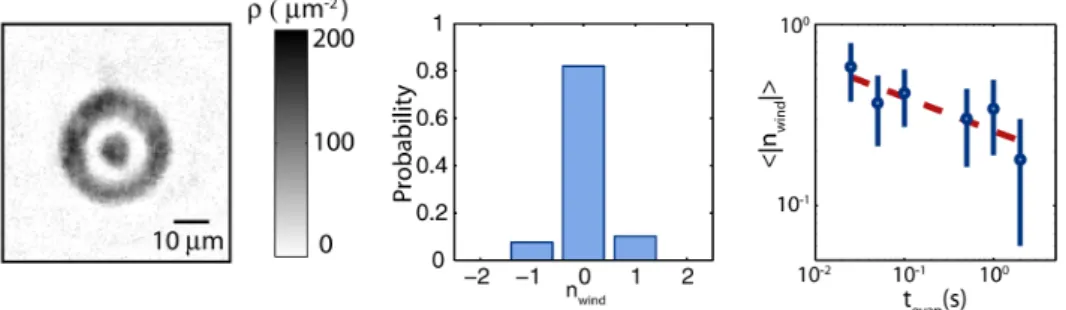
Figure 1.7: Kibble-Zurek mechanism in a ring geometry. Left: Initial clouds. The inner disk-shaped is the phase reference for matter-wave interferences. Center: Example of probability distribution of the different winding
numbers for a cooling time of 2 s. Right: Evolution of the mean absolute winding number h|nwind|i with cooling
time along with a power-law fit. (From [15])
Formation of topological defects in a quenched-cooled atomic ring
This study is published in Ref. [15] and the full text of the article is reproduced in the appendix.
As discussed in section 1.4.3, the fast crossing of the critical point when cooling a system through the Bose-Einstein phase transition leads to the formation of domains in the atomic cloud, each of them having an independent and stochastic phase. The relaxation dynamics of this patchwork could lead to the formation of topological defects like point-like vortices in a 2D cloud. In an atomic ring a very similar situation occurs and superfluid currents can be formed [84, 15].
The ring geometry has been put forward by Zurek in Ref. [84] in its gedankenexperiment to apply Kibble’s original idea, discussed in the context of cosmology, to solid-state physics and more specifically to liquid helium. This experiment in a ring geometry has never been realized with liquid helium and has only been developed in ring-shaped arrays of Josephson junctions [117]. Our experiment is thus the first investigation of KZM in a superfluid ring. The ring geometry has a major advantage on the bulk configuration. For a narrow enough ring, the typical size of the domains is larger than the width of the ring and the problem becomes one-dimensional. In addition, the formed superfluid currents are much more robust than point-like vortices that can evolve and interact during the quench itself and during the relaxation period. The ring geometry thus offers a better framework for a detailed study of KZM.
A detailed analysis of KZM allows one to extract critical exponents. The determination of criti-cal exponents relies on the model which describes how the different phase domains merge together. In Ref. [84], Zurek determines the link between the number of domains and the distribution of superfluid currents using a 1D random-walk approach for the phase. Assuming that there is a large number of domains Ndwhich are formed he predicts that the width of the distribution of winding number of the
su-perfluid currents will scale as √Nd. The work described in the previous section 1.5.2 is thus of particular
importance because it provides and experimental verification of this √Nd scaling. More importantly, it
generalizes this scaling to small values of Nd, for which the scaling is not obvious and which corresponds
more to our typical experimental situation when investigating quench cooling.
In Ref. [15] we measured the distribution of superfluid currents after quench cooling the gas at dif-ferent speeds. We observed an increase of the width of this distribution for increasing cooling rate (see Fig. 1.7). From these measurements we deduced an estimate of a combination of critical exponents com-patible with the one expected for Bose-Einstein condensation. However, this comparison should be taken with care. Indeed, as discussed above, during the cooling process the system evolves from a 3D normal fluid to a 2D superfluid state and the exact nature of the phase transition we are crossing is not so obvious
to determine.
1.6
Additional works
In addition to the results presented here which focus on the thermodynamical properties of the 2D Bose gas, I have also been working on other themes, related to what have been described above and that I briefly mention in the following.
1.6.1 A proposal to create bosonic fractional Hall states This study is published in Ref. [118].
Quantum gases are good candidates for exploring quantum-many body systems. An inspiring ex-ample is the physics of 2D electron gases submitted to a transverse magnetic field. This system is very rich because of the interplay between the topological band structure experienced by electrons and the presence of interactions which lead to the formation of fractional quantum Hall states whose properties are extremely rich. As we have seen, creating 2D atomic gases is now easily achieved but the orbital effect of a magnetic field is much harder to achieve (see Chapter 4 for a more detailed discussion).
In Ref. [118], we proposed a way to realize fractional quantum Hall states in a small bosonic clouds. The main idea is to use laser beams to transfer angular momentum to the cloud and thus mimic the orbital effect of a magnetic field. We showed that we can adiabatically prepare, for instance, a Laughlin state with a few particles. This method is limited to few particles because of the high value of orbital momentum that should be transferred. However, with current experimental techniques it has now become possible to control the trapping and imaging of a few particles and this protocol could be implemented with typical state-of-the-art methods.
1.6.2 Light scattering in an atomic layer These studies are published in Ref. [119, 120].
Our experimental setup is well designed to explore the physics of quantum fluids in two dimensions. Interestingly, it is also an original platform to explore basic features of light-matter interactions. Indeed, our atomic cloud can be considered as an ensemble of randomly-positioned scatterers. Atomic scat-terers are particularly interesting because they do not allow non-radiative decays which lead to optical absorption like in most solid-state materials. This absorption has been identified as the main limitation for the observation of Anderson localization with light [121]. Moreover, with our typical parameters we are able to explore a regime where the distance between the scatterers becomes smaller than the opti-cal wavelength. In this situation the atomic response becomes collective and leads to a rich many-body problem.
In Ref. [119], we studied the transmission of near-resonant light through a uniform slab of atoms. We observed the presence of a blue shift (on the order of the natural linewidth) of the resonance line. This blue shift has never been observed before and is a striking signature of the collective effects in light scattering. It is for instance opposite to the “textbook” Lorentz-Lorenz red shift which is predicted by classical electrodynamics. Indeed, this mean-field approach does not apply well to a set of fixed scatterers. In addition to this shift, we also observed a large decrease of the optical depth of the cloud and an important broadening of the resonance line.
In Ref. [120], we kept a similar atomic configuration but we locally illuminated the cloud with a laser beam and monitored the in-plane propagation of this optical excitation by monitoring the atomic
fluorescence. We characterized this propagation by a characteristic length and measured it as a function of density of the atomic cloud and detuning of the illumination with respect to the atomic resonance. The most striking feature of our study is the observation of a guiding or anti-guiding effect when changing the detuning from red-detuned to blue-detuned. We attribute this effect to the presence of a transverse gradient of index of refraction whose sign depends accordingly on detuning.
1.7
Conclusion
We have described in this chapter important features of 2D Bose gases and their experimental study. Thanks to the development of several tools, for instance the realization of box-like potentials, we have been able to deepen our understanding of these systems and more generally of the quantum behavior of many-body systems. We have explored different situations including equilibrium properties (coher-ence), dynamical behavior (superfluidity, sound propagation), and strongly out-of-equilibrium situations (quench cooling, merging of independent clouds). We have also seen that our platform offers an interest-ing perspectives in the study of light-matter interaction in dense and disordered media. We will describe in the next chapter new projects that could be explored with our current system and with the development of new tools.
CHAPTER 2
Towards 2D uniform Bose mixtures
The studies detailed in the previous chapter focus on 2D Bose gases confined in box-like potentials in a single spin component. A main direction for future experiments is to investigate mixtures of two spin components while still taking advantage of our flexibility in tailoring the shape of 2D uniform Bose gases. In this chapter I describe research plans relevant to this situation. Most of the proposed studies deal with the dynamical behavior of the system probing relaxation dynamics from an initial out-of-equilibrium situation.
When dealing with a mixture it is first important to consider its miscibility. The behavior of the mixtures depends on the relative values of the interspecies interaction parameter g↑↓and of intraspecies
ones g↑↑and g↓↓, where we have labelled ↑ and ↓ the two spin states. Within87Rb ground state manifold
both miscible and immiscible mixtures can be prepared. In the first section of this chapter I will focus on the demixing dynamics that appears when one overlaps two immiscible spin components and present experiments that we plan to realize on this topic. The second section will focus on strongly polarized mixtures and the investigation of impurity physics. In our case the impurity will be made of an atom, say in the spin state ↑, that interacts with the bath realized by the quantum gas of atoms in spin state ↓. We will describe how we can specifically address this problem with our system and extend the discussion to the study of a quantum Brownian motion model. Finally, we will also briefly review other interesting perspectives related to our current activities.
2.1
Demixing dynamics
2.1.1 Demixing principle
Demixing dynamics occur when two immiscible fluids are brought together and is a common situation in classical hydrodynamics. For quantum fluids, the situation is very similar and, starting with an out-of-equilibrium mixture of two immiscible fluids, one can observe phase separation between the two components.
The basic features of this demixing dynamics can be well understood by modelling the system by two coupled Gross-Pitaevskii equations describing the two components of the fluid,
i~∂ψ∂t↑ = −~ 2 2m∇ 2ψ ↑+ g↑↑n↑ψ↑+ g↑↓n↓ψ↑ i~∂ψ∂t↓ = −~ 2 2m∇ 2ψ ↓+ g↓↓n↓ψ↓+ g↑↓n↑ψ↓, (2.1)
where n↑ = |ψ↑|2 and n↓ = |ψ↓|2 are the densities in | ↑i and | ↓i. A simple estimate of energy
min-imization neglecting kinetic energy shows that the miscible or immiscible character is determined by comparing g↑↓to
√
g↑↑g↓↓. Indeed, for g↑↓ <
√
g↑↑g↓↓, it costs less energy to mix the two spin
In the immiscible case, the equilibrium state at zero temperature corresponds to a full separation of the two components with the creation of two domains. However, situations with more complex interfaces between the two components are energetically close to this ground state and, in the experimental range of temperature, we do not expect to observe full separation but rather a more complex phase separated (and random) situation.
The relaxation dynamics for an initially overlapping mixture is particularly interesting at short times where the emergence of reproducible patterns is expected through a modulational instability [123]. In this situation, some eigen energies of the problem are complex and the modes are unstable. The mode with the largest imaginary part is expected to grow preferentially. The length scale of this mode is typically given by the spin healing length ξs = ξ(g/∆g)1/2, where ξ is the healing length of the gas
(ξ = ~/√mgn). We have introduced g and ∆g in a simplify modelling of the system: g ≡ g↑↑ = g↓↓
and∆g = |g↑↓− g| g and we considered equal densities of atoms of the same mass. For∆g g
the length scale ξsbecomes large (several microns) and can be easily detected experimentally. The time
scale for the emergence of the unstable mode is typically τ = ξs/c, where c is the speed of sound in
the gas. Demixing dynamics have already been observed in several experiments involving different spin components of the same atomic species [124, 125, 126, 127, 128, 129, 130, 131, 132, 133, 134, 135] or different atomic species [136, 137, 138, 139].
The87Rb ground state manifold consists in 3 states in the F= 1 level and 5 states in the F = 2 level. With the usual methods used in our field we can typically create any binary mixtures of the 8 states. These states have different magnetic moments but as we operate in a fully optical trap we are not limited to magnetically trapped states. All the relevant scattering lengths for87Rb atoms are very close to each other, a↑↓ ≈ a↑↑ ≈ a↓↓ ≈ 100 a0, where a0is the Bohr radius and gi j = 4πa~2/m. All mixtures are thus
rather close to the miscibility/immiscibility transition and miscible and immiscible pairs are available for87Rb. For demixing experiments discussed in the following we plan to use the |F = 1, m = 0i to |F = 2, m = 0i transition which has the technical advantage to be insensitive to linear Zeeman effect. For this mixture, following the values given in [140], we have g↑↓/
√
g↑↑g↓↓ = 1.014 and it is indeed an
immiscible mixture.
2.1.2 Bulk demixing
In a first series of experiments, we will study bulk demixing dynamics. Starting from a degenerate cloud in |F = 1, m = 0i we will apply a short coherent microwave pulse to create a superposition with state |F = 2, m = 0i. In this case, the microwave field is homogeneous over the size of the cloud and the mixture will extend all over the cloud. We will then monitor the relaxation dynamics by measuring the time evolution of the in-situ density distribution of both spin components.
The main feature of this project compared to previous experiments is our control on the trap geometry. Experiments realized so far were limited to bulk 3D systems or elongated systems along one dimension with the presence of a longitudinal harmonic trap which influenced the dynamics of the spin domains. We will be able to realize similar experiments but without this external harmonic confinement. More importantly, we will also extend the study to 2D uniform systems and will observe the formation of 2D spin domains and their relaxation dynamics. In particular, we will investigate the role of the (hard-wall) boundary conditions on the pattern formation. We will also study the phase evolution of the two-component mixture [131].
Finally, we emphasize that this dynamical formation of patterns is strongly related to the formation of matter wave solitons in attractive single-component BECs [141, 142]. For g↑↓ < g↑↑, g↓↓, one can
a fixed total density) [143, 144, 134].
2.1.3 Demixing at an interface
We also propose to go beyond the bulk situation and investigate the dynamics of the interface between two spin domains. First, we will study the time evolution of the interface when the two components are at rest and in different geometries (see Fig. 2.1). The initial states are expected to be stable at zero temperature but we will investigate the time dynamics of the interface as a function of the temperature of the sample. As the characteristic energy scale of the interface is very low, this technique could be a sensitive probe at very low temperatures where usual methods fail. Second, when a relative flow is imposed between the two components, hydrodynamical instabilities are predicted. A flow perpendicu-lar to the interface is expected to give rise to a Rayleigh-Taylor instability [145, 146] and the growth of mushroom-like pattern is expected. A tangential flow will lead to a Kelvin-Helmholtz instability [147, 148] and the formation of a saw-tooth shaped interface at short time that will decay through the emission of point-like vortices. We also expect capillary instabilities for narrow tubes of one component immersed in the second component [149]. Finally, for a bubble of atoms moving in the other component, the formation of vortices above a critical velocity has been studied in Ref. [150]. This will open the perspective to study superfluid dynamics in a way reminiscent to the study of superfluidity we performed with a stirring laser in [73] replacing the obstacle by (impurity) moving atoms. It deserves to be revisited with smaller obstacles to avoid excitations due to the finite size of the stirring beam which prevent direct observation of the Landau critical velocity. A related study was reported in Ref. [151] but it focused on the scattered atoms and not on the precise dynamics of the impurities.
The investigation of this wealth of dynamical effects in two-component BECs requires a suitable tool-box to create bubbles of impurities with a controlled spatial shape and with a tunable initial velocity. We will realize spatially-resolved spin transfer thanks to two-photon Raman transitions to couple the two spin states and use our good spatial resolution to select the region in the cloud where spin transfer will be realized. To have full control over the shape of this region we will reflect the Raman beams of an additional DMD whose pattern will be imaged on the cloud. The relative momentum between the two components will be imparted by the Raman beams. This momentum transfer ranges from zero, for copropagating Raman beams, to in-plane velocities on the order of the speed of sound for beams crossing at an angle and with taking into account the geometrical constrains in our setup. Interestingly, we can easily extend this study to miscible mixtures or to situations with only a momentum transfer without changing the internal state.
It is important to keep in mind that the previous discussion focuses implicitly on “ideal” binary mixtures with no relaxation. This picture could be modified by spin-changing collisions that for instance will convert a pair of atoms in |F = 2, m = 0i to a pair of atoms in |F = 2, m = ±1i as investigated for instance in the seminal experiments reported in Refs. [152, 153, 154, 155]. Hyperfine relaxation can also occur and the |F = 2, mi states are expected to decay into F = 1 state. This causes losses owing to the large hyperfine energy splitting.
2.1.4 Possible extensions
Feshbach resonances For the spin components we aim at investigating first (|F = 1, m = 0i – |F = 2, m = 0i), the interaction parameters are fixed. It would be interesting to tune these parameters for a more complete investigation of demixing dynamics. The intraspecies interaction parameters cannot be changed easily for87Rb; however an interspecies Feshbach resonance exists for the |F = 1, m = −1i– |F= 2, m = 1i mixture [156] and has been characterized in Ref. [132].
Figure 2.1: Principle of a demixing experiment. We create an interface between two spin domains and then monitor the formation of patterns at this interface that are expected to appear through a dynamical instabilities. With our apparatus we will be able to realize custom-shaped interfaces like linear (left) or circular (right) ones.
Rabi-coupled two-component BECs Another interesting degree of freedom is to couple the two com-ponents (continuously). This allows to tune the miscibility of the system and to cross dynamically the miscible-immiscible phase transition [157, 158].
Topological defects in binary mixtures Superfluid systems host topological defects like point-like vortices or superfluid currents in ring geometries as discussed in the previous chapter. Multi-component superfluids host a much richer variety of topological defects as systematically investigated in Ref. [28] (see also [159] for a simplified discussion). Example of such defects are coreless vortices like skyrmions, which have been observed in spinor condensates [160, 161, 162]. Half-quantized vortices have also been observed [163, 164] and it has been recently proposed that their dynamics could simulate quark confinement [165, 166].
2.2
Impurity dynamics
2.2.1 Bose polaron
The concept of polaron has been first introduced by Landau and Pekar in condensed-matter physics to describe the motion of an electron in the bath of atoms constituting the solid [167]. The central idea is to introduce a quasiparticle state, the polaron, which describes the dynamics of the electron as a free particle with, among others features, a renormalized mass. The main interest of this situation is to deal with a rich many-problem for which theory can be pushed quite far (see [168] for a review of the Bose polaron case). In the context of quantum information, the study of the dynamics of the impurity in the bath can also be considered as the decoherence of a quantum system because of the interaction with a environment.
This concept has been adapted to the study of impurity dynamics in quantum gases experiments which propose ideal platforms to investigate this problem. The case of fermionic impurities in a Fermi bath is introduced in [169] and experiments are reported for instance in Refs. [170, 171, 172]. Decoher-ence of fermionic impurities in a Bose gas have also been studied in [173].
The Bose polaron problem is often modelled in a simple approach by the so-called Fr¨ohlich Hamilto-nian (see [168] for a discussion on the associated approximations) which captures many features of this problem: H= p 2 2m+ ~ Z d3kωk ˆa † kˆak+ Z d3k Vkeikr(ˆa † −k+ ˆak). (2.2)
The first term describes the kinetic energy of the impurity of mass m, position r and momentum p. The second term describe the Bogoliubov modes of the boson bath with wavevector k, frequency ωk and the