HAL Id: hal-01966867
https://hal-amu.archives-ouvertes.fr/hal-01966867
Submitted on 30 Dec 2018
HAL is a multi-disciplinary open access
archive for the deposit and dissemination of
sci-entific research documents, whether they are
pub-lished or not. The documents may come from
teaching and research institutions in France or
abroad, or from public or private research centers.
L’archive ouverte pluridisciplinaire HAL, est
destinée au dépôt et à la diffusion de documents
scientifiques de niveau recherche, publiés ou non,
émanant des établissements d’enseignement et de
recherche français ou étrangers, des laboratoires
publics ou privés.
Review of the Best MPPT Algorithms for control of PV
Sources RUCA Tracking Algorithm
Nacer M’Sirdi, Abdelhamid Rabhi, Bechara Nehme
To cite this version:
Nacer M’Sirdi, Abdelhamid Rabhi, Bechara Nehme. Review of the Best MPPT Algorithms for control
of PV Sources RUCA Tracking Algorithm. ICINCO 2017- International Conference on Informatics in
Control, Automation and Robotics, Jul 2017, Madrid, Spain. �hal-01966867�
Review of the Best MPPT Algorithms for control of PV Sources
RUCA Tracking Algorithm
Nacer K. M’Sirdi
1, Abdelhamid Rabhi
2and Bechara Nehme
11Aix Marseille Universit´e, CNRS, ENSAM, Universit´e de Toulon, LSIS UMR 7296, 13397, Marseille France 2MIS, Laboratory of Modeling Information and Systems, Picardie Jules Vernes University, Amiens, France
Keywords: Maximum Power Point Tracking, Perturb and Observ algorithm (PO), IncCond, Hill Climbing, Boost converter, Robust Unified Control Algorithm (RUCA).
Abstract: Renewable energies, has generated more and more interest of research in control of the HyRES. Thousand of papers deal with MPPT (Maximum Power Point Tracking) to optimize harnessing solar energy. The intent of this paper is to review the most interesting Algorithm and to propose a Robust Unified Tracking Algorithm.
1
INTRODUCTION
The conversion systems of renewable energy sources, as they include commutations and discon-tinuities, are VSAS (Variable Structure Automatic Systems) and highly dependent on variations in cli-mate parameters, such as temperature and irradiation (Schaefer, 1990).
A great variety of MPPT methods have been pro-posed by the researchers and competition between the algorithms to be implemented continues. A good classification will help future applications in PV sys-tems and give a convenient reference on the required system features.
In this paper, we present a review of the existing methods, propose a classification and try to find the best of them. Three categories of MPPT schemes exist: open loop, closed loop and hybrid methods; They can also be classified with regard to model based methods or robust optimisation. Then we propose a new technique which unify and robustify the al-gorithms. The Robust Unified Control Algorithm is proposed to track the maximum power point (VSAS-MPPT) based on Variable Structure Automatic Sys-tems approach.
The purpose of this study is also to analyze and compare execution efficiency for the proposed RUCA-MPPT algorithms to well known power con-trol type MPPT methods, including Perturbation and Observation (P&O), Incremental Conductance (In-Cond) and Hill Climbing (HC) methods, simulated in Matlab/Simulink environment in order to compare their performance (Yu and Shen, 2009; Tavares et al., 2009).
The paper is organized as follows. The second
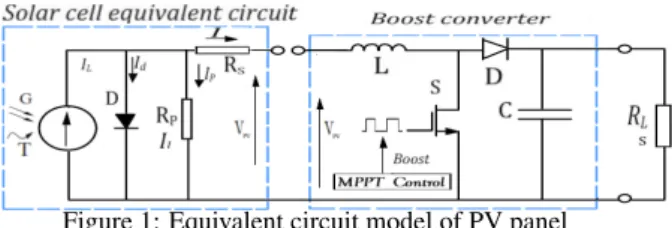
Figure 1: Equivalent circuit model of PV panel
section presents standard photovoltaic system equa-tions and features. Section three reviews the differ-ent control algorithms proposed for tracking the max-imum power point (MPP) and then in section four the analysis and discussion lead us to introduce our new algorithm. After VSAS-MPPT definition, we com-pare the results of the RUCA with the widely used MPPT algorithms; the performance is evaluated on the energy point of view, in simulation, considering different actual solar irradiation measured variations. Finally, a conclusion summarizes the work and pro-poses perspectives.
2
RENEWABLE ENERGY
SOURCES
PV modules (panels) are composed by combina-tion of several solar cells, connected in series and in parallel circuits, to generate higher power (Liu et al., 2008).
The equivalent circuit of the general model, as il-lustrated in left of figure 1, consists of a photo-current, diodes, a parallel resistor expressing a leakage cur-rent, and a series resistor describing an internal resis-tance to the current flow.
The PV circuit is connected to the load (RL) trough
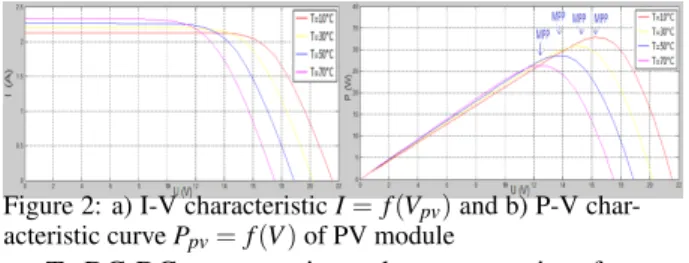
op-erating voltage and current of the PV panel at optimal values to maximize the harnessed power. The control of the boost has to tracks the Maximum Power Point (figure 2).
Mathematical description of I(V) Input/Output characteristics for a PV cell has been studied for over the past four decades. The PV system exhibits then a nonlinear I(V) characteristic which depend on the temperature and the solar radiation which vary during a day. The PV characteristics (I = f (V) and Ppv = f (V)) are represented by the figure 2 under constant temperatures (Ta=10, 30, 50 and 70°C) and irradia-tion Gs=1000 w/m2.
Figure 2: a) I-V characteristic I = f (Vpv) and b) P-V
char-acteristic curve Ppv= f (V ) of PV module
Te DC-DC converter is used as a power interface circuit between the PV panel and the load or bat-tery. This circuit consists, in its simple way, of only a switch (typically a MOSFET), an inductor, and a ca-pacitor connected as shown in figure 1. To achieve the optimum matching and track the power Maximis-ing point, a good control of the DC-DC is necessary.
3
THE MPPT CONTROL
3.1
The Open Loop Methods for MPPT
3.1.1 Fixed Operating PointThe problem is to find the voltage VMPP or the
cur-rent IMPP at which the PV array delivers the
maxi-mum power under a given temperature T and irradi-ance G. Then the method automatically puts the PV in this condition. The first remark was that the MPP varies in a small region and that on the left part of the P-V characteristic, the slope P/V is roughly constant.
Fractional Open-Circuit Voltage The first method uses the observation that, the ratio between array volt-age at maximum power VMPPto its open circuit
volt-age VOC is nearly constant. VVMPPOC ≈k1. The factor k1
is not constant but, has been remarked to be between 0.71 and 0.78. Once the constant k1 is known, VMPP
can be computed.
This method consists in measuring VOC
periodi-cally and then fixing VMPP= k1VOC.
The implementation is simple and cheap, but the tracking efficiency is relatively low due to inaccurate values of the constant k1in the computation of VMPP.
Fractional Short-Circuit Current This method is based on the remark that the current at maximum power point IMPPis approximately proportional to the
short circuit current ISCof the PV array. IMPP≈k2.ISC
The factor k2 is not constant but, has been
re-marked to be between 0.78 and 0.92. Once the con-stant k1 is known, VMPPcan be computed.
The accuracy of this method and its tracking ef-ficiency depend on the accuracy of knowledge of k2
and the periodic measurement of short circuit current ISC.
3.1.2 Artificial Neural Networks, ANN for MPPT
ANN are well known to provide universal approxi-mators providing non-linear models which are com-plementary to the conventional modeling techniques. Back propagation ANN are used as pattern classi-fier or as non-linear layered feed-forward networks to give a global approximations to a non-linear input-output mapping (Reisi et al., 2013). The first applica-tion of ANNs to MPPT, has been proposed by Hiyama et al (Hiyama and Kitabayashi, 1997).
In general a three layer structure, i.e. input layer, hidden layer and output layer are used with the back propagation. After a good learning, ANN are able to make generalizations in regions of the phase space where little is known or no data are available. The Neural network is composed by neuron cells, placed in 3 layers (or may be more) connected to all neurons through weights see figure below. The input variables are PV parameters like VOCand ISC, atmospheric data
(Irradiance and Temperature). The output of ANN gives reference signals, like the reference voltage or the duty cycle signal used to drive the power converter to operate at or close to the MPP.
The three layers of neural network have a hyper tangent sigmoid function (Noguchi et al., 2002). The algorithm used for training is back-propagation. The back-propagation training algorithm needs inputs and the desired output to adapt the weight by MSE.
The characteristics of a PV array are nonlinear and time-varying, this implies that the neural network has to be trained to guarantee accurate tracking of MPP. This is a time consuming process. Note also that it can use as inputs the voltage and current measurement, to become a closed loop method or a combination of both.
3.1.3 Fuzzy logic method (FL)
Fuzzy logic controllers offer the advantage of work-ing capability with imprecise inputs, and do not need an accurate mathematical model. They can han-dle nonlinearities, and have fast convergence. Their learning ability and accuracy depend on the number on the fuzzy levels and the the membership functions. The decision-making uses rules specified by a set of IF–THEN statements to define the control which pro-duce the desired behavior. The defuzzification stage, operates the reverse function to get numerical vari-ables for analog control using the membership func-tion.
In order to track MPP, the error is computed based on irradiance and temperature or instantaneous values such as power and voltage (Algazar et al., 2012). The output signal is either the duty cycle itself, or VMPP
and IMPPreference to generate the duty cycle.
The membership function associated with fuzzi-fication and defuzzifuzzi-fication, as well as the antecedent and the consequent fuzzy rules are determined by trial and error. This can be time-consuming. This method can be used in open loop or in closed loop when us-ing as feedback (in real time) the output variables like current, voltage and the power.
3.2
The Closed Loop MPPT
3.2.1 Perturb and Observe MethodsThe most commonly used MPPT algorithm is the Per-turbation and Observation (P&O) due to its easy im-plementation. It uses the P-V characteristics Ppv =
f(V ) of the PV module shown in figure 3 (b). Note that the point of maximum power P(n)=V(n)I(n) is ob-tained when the conditiondPdV = 0 is accomplished, re-gardless of the sun irradiance magnitude (Kim et al., 2001). In actual experiments, the system oscillates ar-roumd the MPP. To minimize the oscillations ampli-tude, we can reduce the perturbation step size. How-ever, small step size slows down the convergence of the MPPT.
The Modified Enhanced Perturb and Observe (MEPO) algorithm uses and adaptive step adjustment gain and simplify the implementation using on com-mutation functions. This algorithm have been revis-ited, its rationale behind have been clarified and then implementation obviated using commutation func-tions (Msirdi and Nehme, 2015).
3.2.2 Incremental Conductance Methods The incremental conductance (IncCond) (Femia et al., 2004), method is based on the fact that the slope (or
the PV conductance G = dVdI) of the PV array, in the power curve is zero at the MPP and it is positive (con-stant) on the left of the MPP. The slope becomes neg-ative on the right of th MPP.
3.2.3 Hill Climbing Method
The basic idea of the HC (Hill Climbing) method is the same as P&O method. It tests if P(n) is greater than P(n-1) or not, to reach MPP. The PO method uses instead a test on dP/dV to determine whether the max-imum power point has been found or not. However, the HC method uses a test condition on P(n)-P(n-1).
3.2.4 Extremum Seeking Control method (ESC)
Krstic et al. (Ariyur and Krstic, 2003), from au-tomatic control community interested on robust and adaptive control techniques, proposed an adaptive ESC methodology which has been proved to be ro-bust against parametric uncertainties for non linear dynamic uncertain systems. It is based on theories namely averaging theory, adaptive control and singu-lar perturbation techniques. This real-time optimiza-tion ESC method has been successfully applied in var-ious systems and has been specifically adapted for PV systems in order to track MPP (?; ?). Extension to ESC by Newton Like optimisation has been also con-sidered and compared to other ESC based methods (Zazo et al., 2012). The objective of ESC is to rapidly reach the MPP despite uncertainties and disturbances on the PV panel and the load.
The reference current is perturbed by a sinusoidal modulation. The power got at the output of the PV system is high pass filtered, to get only effect of the perturbation (4P(t)) on the obtained power P(t). Then, after the ripple demodulation to get the pro-duced power perturbation observed (ξ(t)), integration with an adaptive gain C(p) of this effect gives the ref-erence current. The adaptation gain C(p) is adjusted by a theoretical study to get fast convergence to the optimum power (MPP). The controller will, therefore, adjust the reference current until MPP is reached.
The main advantages of ESC are that the power optimization is got by a dynamic adaptation-based feedback for a sinusoidal perturbation and conver-gence to the MPP is guaranted. This approach does not require any parametrization or structural formal-ization of the modeling uncertainty. The disadvantage of ESC is its complexity and the implementation dif-ficulties regard to PO and MEPO.
3.2.5 RSMCA: Robust Sliding Mode Control Algorithm
A lot of algorithms have been proposed based on Sliding Mode. The most of them are not very pre-cise when defining the objective of the algorithm and chosing the sliding surface. They simply has been de-velop as alternative to use of a standard regulator like PID controller. This reduces the efficiency of the Slid-ing Mode Approach and does not tackle the robustnes problem. The most of them use a sliding surface to reach the MPP. The best choice seems to be given by the proposed criteria in equations (1 and 2).
In the following we propose an MPPT based on the VSAS and the Lyapunov theory which general-izes all the previous algorithms. The desired objective to get is that the MPP reached when the maximum power is obtaineddPdt = 0.
Note that the optimization is done versus time be-cause P varies during time in function of the voltage V and the current I. Only if current I (respectively the voltage V) is maintained constant we can consider P(V) (respectively P(I)) characteristic. Note also that in real weather condition the Operating Point do not moves on a unique (P-V) characteristic. If the irradia-tion or the temperature changes the MPP varies from one curve to another one.
Then as P(t) = V (t).I(t) = f (V, I,t), the power is function of the voltage, the current and time, then the required Maximum Power Point to Track is really de-fined by the following objective function which we propose to take as the generic sliding surface:
dP dt = dV I dt = I dV dt +V dI dt = 0 (1) Let us consider the control in case of discrete time, like do all the above presented algorithms, with the previously defined variables (see equation 5) the fetched MPPT may be defined by ∆P(k) = 0, then as dPdt = 0 can be approximated by ∆P(k) = (I(k)∆V (k) +V (k)∆I(k)).4t
The objective function that we propose in (M’Sirdi et al., 2014) becomes then:
∆P(k) = I(k)∆V (k) + V (k)∆I(k) = 0 (2) The control variable is either, in the first case, u1(k) = 4V (k), which means that the voltage
per-turbed and the current is fixed u2(k) = 4I(k) = 0,
or in the second case, the control variable is u2(k) =
4I(k), the current is pertubed and the voltage is fixed u1(k) = 4V (k) = 0. In control context, the previously
presented MPPT controllers use only one control variable u1or u2and impose the second to zero. Let
us consider the MPP reaching condition dP(t)dt = 0 and note that the maximum power is always Pmax≥ P(t)
every where and at any time. We can choose as Slid-ing Surface s(t) = Pmax− P(t) which goes to zero (or
at least to its minimum) when P(t) = Pmax (Msirdi
and Nehme, 2015). We can also take zero instead of a positive constant Pmax= 0.
Let us then consider the Lyapunov like function W(t) = s2= [P
max− P(t)]2> 0 which is strictly
pos-itive every where except at the MPP where it goes to zero. Lyapunov based control design is well known to give robust algorithms.
The derivative of this Lyapunov function W (t) = s2> 0, is ˙W= s ˙s= − [Pmax− P(t)] .dP(t)dt .
This term is negative when −dP(t)dt = −IdVdt − VdIdt<0. This equation is similar to the proposed Slid-ing Surface equations (1 2 ??). Please note also the similarity with the InCond equation (??). This means obviously that we only need, from control, to make
dP(t)
dt > 0, to reach the MPP.
as we imposedIdt = 0, we get ˙W= −IdV dt
It can be made negative by choosing the appro-priate control laws u1(k) = 4V (k) and u2(k) = 0.
Note that this can be reached by choosing the sign of u1(k) = V (k), such as to get ˙W < 0.
Choosing u1(k) = 4V (k) =
4P(k).α.sign(4V (k)) and knowing that we impose u2(k) = 4I(k) = 0 like in the
con-trol algorithm, we have previously proposed MEPO (Msirdi and Nehme, 2015). This gives us 4W = −α.4P(k).sign(4V (k))I(k). If the gain parameter α is positive constants, we then get a negative derivative
4W = −α.∆V (k).sign(4V (k))I2(k) < 0 (3) This method, called MEPO (Modified Enhanced Perturb and Observ) gives an enhanced and variable step size algorithm. The step size is adjusted in pro-portionally to the power variation produced in the pre-vious step. The step adjustment gain K = α.4P(k) is used for weighting this adjustment step. It may be useful for oscillation avoidance and noise sensitivity.
This proves, theoretically the convergence of the RSMC algorithm and shows that Robust Sliding Mode Control is equivalent to the MEPO algorithm got by enhancement of the P&O.
We propose, as a modified PO Algorithm which will be more robust, the reference voltage is given by V re f= V k + α.4P.sign(4V ) (4) The algorithms have been tested under various oper-ating conditions. The obtained results have proven
that the MPPT is tracked even under sudden change of irradiation level.
3.2.6 RUCA: Robust Unified Control Algorithm VSAS (Variable Structure Automatic Systems) con-trol methodology was applied to clarify the rationale behind Maximum Power Point Tracking and get the best optimization algorithm. We have seen previously that the control is either on voltage or on current in-put or both. For the proposed RUCA algorithm, both controls can be used if we look for adjusting both vari-ables (V and I), either at each control step or alterna-tively.
Two new algorithms can be developed, using this approach, the Modified and Enhanced Perturb and Observe Algorithm (MEPO) if the control input is on the voltage or the Modified Enhanced InCond (MEInCond) if the control input is on the current.
For the MEPO and the RSMC, we take for esti-mation of the power variation ∆P(k) = I(k)∆V (k), the current is assumed constant.
For the Modified Enhaced InCond (MEInCond), we consider the current as the only input control and we take ∆P(k) = V (k)∆I(k), the voltage is assumed constant.
The Robust Unified Control Algorithm (RUCA) will do both of them alternatively. Note that the hard-ware have to be considered in consequence. Com-pared to the other algorithms like Perturb and Observe (PO), Hill Climbing, Incremental Conductance (In-Cond) The RSMC approach it is proven more efficient and faster despite using low frequency commutation.
It can be noticed that all the previous algo-rithms can be considered as particular cases of this one (RUCA), when simplifying the proposed control method.
The implementation of the proposedRUCA con-troller can be summarised as follows:
1. The reference voltage is set be equal to the PV open circuit voltage.
2. Measurement of the of input signals (PV voltage, PV current and Load voltage).
3. Estimate the PV power at the sample time k : PPV(k) = Ipv(k)Vpv(k)
4. Calculate the PV current and the power incre-ments. ∆I = IPV(k) − IPV(k − 1) ∆V = VPV(k) −VPV(k − 1) ∆P = PPV(k) − PPV(k − 1) PPV(k) = VPV(k).IPV(k) (5)
The reference voltage Vre f(k) is calculated as below,
where α is the perturbation variation step (control gain). Note that ∆Vre f = α.sign(∆P∆V ) produces
ex-atly the same result as the classical PO algorithm with a much more simple implementation (one formula in-stead of an algorithm chart).
Recall that the system equations have been used also to define the classical Sliding Mode based algo-rithms by means of choosing a commutation (sliding) surface s. The proposed MPPT has several advan-tages: simplicity, high convergence speed and is in-dependent on PV array characteristics. In conclusion let us say that RUCAenhances and generalizes all the best algorithms presented in litterature and sug-gest new algorithmes like MEPO and MEInCond.
3.3
Hybrid Tracking Methods HTM
It is well known that combination of OLM (Open Loop Method) for anticipation with robust feedback (CLM: Closed Loop Method) gives the best way to control and track trajectories of uncertain and time varying systems. In HTM, the control sig-nal associates OLM, determined according to atmo-spheric conditions temperature and irradiance, and CLM based on feedcback control to track MPP. In a hybrid method consisting of two loops is proposed. In the first loop MPP is estimated based on the open circuit voltage at a constant temperature. Several au-thors use Neural Networks or Fuzzy Logic or combine Neuro Fuzzy Logic to anticipate on temperature and radiation effects. Tina et al proposed to use a simpli-fied model used to evaluate the MPP power in (Tina and Scrofani, 2008). It seems to be the most efficient way to predict the MPP.4
COMPARATIVE STUDY
In this section we present simulations based com-parison between different MPPT algorithms. Several algorithms are compared the classical P&O (Perturb and Observe), the MEPO (Modified Enhanced Per-turb and Observe), IncCond (Incremental Conduc-tance), RUCA (Robust Unified Control Algorithm), and NL-ESC (Newton-Like Extremum Seeking Con-trol).
The first step, for validation of the implementa-tion, uses the same simulated model as in the paper of Zazo et al (Zazo et al., 2012) to compare the dif-ferent algorithms. The second step is simulation with the PSIM software of the model of the experimental setup.
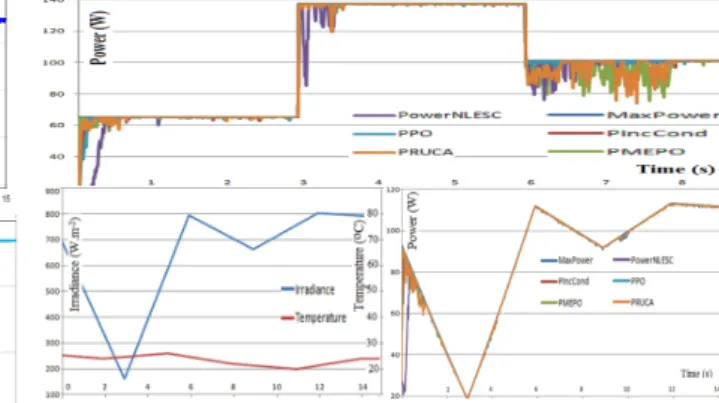
Figure 3: Power output of a PV panel with sudden variation in irradince controlled with the NL-ESC algorithm.
Figure 4: First order interpolation comparison of the 5 al-gorithms with real data.
Zero order sample and hold comparison of the 5 algorithms.
4.1
Simulations with PSIM software
The physical model of a PV panel is used with a Boost DC-DC converter using a MOSFET as a switch. The panel is considered to have 36 cells. A boost con-verter is built;The load is a 100Ω resistor. The al-gorithms are implemented in a C block and the duty cycle is calculated from Vref using another C block. The actual, measured irradiation and panel tempera-ture, when used, are read from a txt file as input to the simulation.We start first by retrieving all the simulation of the paper of Zazo et al (Zazo et al., 2012) and then compare to the other algorithms.
In order to compare the 5 algorithms we build un-der Psim software 5 identical PV systems. Each sys-tem is controlled by a different MPPT algorihm. The second simulation is done with the same input irradi-ance and temperature for the 5 systems. Zero order sample and hold is applied. The result is shown in figure 4.
The third simulation is done with first order inter-polation and shown in figure 5. In this simulation real weather data and real PV temperature are used.
4.2
Simulation results
The simulation was performed under Psim software. The simulated process is composed of two PV pan-els, a DC/DC converter, and 4 batteries. Each PV panel is composed of 10 cells mounted in serie. The panel short circuit current is 5.1 A and it can gen-erate 62W in STC. The two panels are mounted in series. The DC/DC converter is a boost (step up con-verter) mainly made of a capacitor, a self, a diode and a switching device. The batteries are connected in se-ries delivering 4 × 12 = 48V .
In order to compare the 5 algorithms we built 5 identical simulation systems. All systems have the
Figure 5: Brutal change in irradiance and temperature.
Figure 6: Simulation for change in irradiance and tempera-ture.
Interpolated change in irradiance and temperature.
same irradiance and temperature inputs.
The step of the P&O algorithm is fixed to 0.1V. The step of the IncCnd algorithm is also fixed to 0.1V. The gain of the MEPO algorithm is chosen 25. The gain of the RUCA algorithm is chosen 25. The gain of the NL-ESC is 0.15 and the gain of the hessian is 3000.
For the first simulation, we consider an irradiance of 1000W.m-2 and a temperature of 25 oC. We can
see that all the algorithms reach the maximum power point in less than 0.5 seconds. The NL ESC presents the less oscillations. The RUCA is the fastest with decreasing oscillations. Also the MEPO present the same features. The IncCnd and PO present high os-cillation and takes time to reach the MPP.
For the second simulation, we consider a zero or-der sample and hold for the irradiance and tempera-ture that change. The irradiance and temperatempera-ture rise and fall brutally during as shown in figure 3. The sim-ulation of figure 4 shows how all algorithms manage to reach the MPP after the brutal variation of environ-mental conditions. The NL-ESC presents the high-est oscillation amplitude after the brutal change. The RUCA and MEPO presents oscillation before stabi-lizing in the MPP after the brutal change. This is explained because these last algorithms uses the gra-dient of power to calculate the step, and after brutal change of environmental conditions, the power gradi-ent is high.
For the third simulation, we consider a variation in irradiance and temperature with first order interpo-lation. Real data are taken from measurement done on the 16/5/2012. We can see that all algorithms reaches the MPP. Oscillations do not occurs because the power gradient is low.
In summary, the simulation comparison between the 5 algorithms showed a convergence of all the
al-gorithms. Algorithms based on fixed step as P&O and IncCond must run at high frequency in order to reach the MPP. Algorithms based on the power gradient as MEPO and RUCA can operate at lower frequencies. MEPO, RUCA, and NL-ESC present oscillations in front brutal variation of irradiance and temperature.
5
Conclusion
The best MPPT algorithms of the litterature have been reviewed and analyzed in this work. This parison allowed us to select five of them to be com-pared in simulations and experimental application. The simulations was performed under PSIM software to use realistic physical models.
The analysis has shown the rationale behind MPPT and the generalization leading to a unified framework RUCA, as a Robust Unified Control Algo-rithm. The well known algorithms can be viewed as particular cases of the RUCA. The proposed approach RUCA generalizes the PO, the InC, the ESC and the Sliding Mode Control schemes to non linear systems with commutations. The proposed MPPT has several advantages: simplicity, high convergence speed, and is independent on PV array characteristics. The ob-tained results have proven that the MPPT is tracked even under sudden change of irradiation level or tem-perature.
The algorithms are tested under various operating conditions. Realistic simulations are used to show ease of implementation of our new algorithm, and to compare its execution efficiency and accuracy to the the studied MPPT methods.
In summary the best algorithms are those designed using the SASV-MPPT approach and Lyapunov de-sign method considering that the PV system can move from one characteristic to another. The proposed al-gorithms are the most efficient despite using low fre-quency commutation. They are the faster converging.
REFERENCES
Algazar, M. M., El-Halim, H. A., Salem, M. E. E. K., et al. (2012). Maximum power point tracking using fuzzy logic control. International Journal of Electri-cal Power & Energy Systems, 39(1):21–28.
Ariyur, K. B. and Krstic, M. (2003). Real-time optimization by extremum-seeking control. John Wiley & Sons. Femia, N., Petrone, G., Spagnuolo, G., and Vitelli, M.
(2004). Optimizing duty-cycle perturbation of p&o mppt technique. In Power Electronics Specialists Conference, 2004. PESC 04. 2004 IEEE 35th Annual, volume 3, pages 1939–1944. IEEE.
Hiyama, T. and Kitabayashi, K. (1997). Neural network based estimation of maximum power generation from pv module using environmental information. IEEE Transactions on Energy Conversion, 12(3):241–247. Kim, T.-Y., Ahn, H.-G., Park, S. K., and Lee, Y.-K. (2001).
A novel maximum power point tracking control for photovoltaic power system under rapidly changing so-lar radiation. In Industrial Electronics, 2001. Proceed-ings. ISIE 2001. IEEE International Symposium on, volume 2, pages 1011–1014. IEEE.
Liu, F., Kang, Y., Zhang, Y., and Duan, S. (2008). Com-parison of p&o and hill climbing mppt methods for grid-connected pv converter. In Industrial Electronics and Applications, 2008. ICIEA 2008. 3rd IEEE Con-ference on, pages 804–807. IEEE.
Msirdi, N. and Nehme, B. (2015). The vsas approach gives the best mppt for solar energy sources. Renewable Energy and Sustainable Development, 1(1):60–71. M’Sirdi, N., Nehme, B., Abarkan, M., and Rabbi, A.
(2014). The best mppt algorithms by vsas approach for renewable energy sources (res). In Environmental Friendly Energies and Applications (EFEA), 2014 3rd International Symposium on, pages 1–7. IEEE. Noguchi, T., Togashi, S., and Nakamoto, R. (2002).
Short-current pulse-based maximum-power-point tracking method for multiple photovoltaic-and-converter mod-ule system. IEEE Transactions on Industrial Electron-ics, 49(1):217–223.
Reisi, A. R., Moradi, M. H., and Jamasb, S. (2013). Clas-sification and comparison of maximum power point tracking techniques for photovoltaic system: A re-view. Renewable and Sustainable Energy Reviews, 19:433–443.
Schaefer, J. (1990). Review of photovoltaic power plant performance and economics. IEEE Transactions on Energy Conversion, 5(2):232–238.
Tavares, C. A., Leite, K. T., Suemitsu, W. I., and Bellar, M. D. (2009). Performance evaluation of photovoltaic solar system with different mppt methods. In Indus-trial Electronics, 2009. IECON’09. 35th Annual Con-ference of IEEE, pages 719–724. IEEE.
Tina, G. and Scrofani, S. (2008). Electrical and thermal model for pv module temperature evaluation. In Elec-trotechnical Conference, 2008. MELECON 2008. The 14th IEEE Mediterranean, pages 585–590. IEEE. Yu, T.-C. and Shen, Y.-T. (2009). Analysis and simulation
of maximum power point tracking for photovoltaic systems. In Proceedings of the 30th ROC Symposium on Electrical Power Engineering, Taoyuan, Taiwan, pages 92–96.
Zazo, H., Del Castillo, E., Reynaud, J. F., and Leyva, R. (2012). Mppt for photovoltaic modules via newton-like extremum seeking control. Energies, 5(8):2652– 2666.