HAL Id: hal-00837033
https://hal-polytechnique.archives-ouvertes.fr/hal-00837033
Submitted on 19 May 2014
HAL is a multi-disciplinary open access
archive for the deposit and dissemination of
sci-entific research documents, whether they are
pub-lished or not. The documents may come from
teaching and research institutions in France or
abroad, or from public or private research centers.
L’archive ouverte pluridisciplinaire HAL, est
destinée au dépôt et à la diffusion de documents
scientifiques de niveau recherche, publiés ou non,
émanant des établissements d’enseignement et de
recherche français ou étrangers, des laboratoires
publics ou privés.
Application of classical models of chirality to surface
second harmonic generation
François Hache, H. Mesnil, Marie-Claire Schanne-Klein
To cite this version:
François Hache, H. Mesnil, Marie-Claire Schanne-Klein. Application of classical models of chirality
to surface second harmonic generation. Journal of Chemical Physics, American Institute of Physics,
2001, 115 (14), pp.6707. �10.1063/1.1404983�. �hal-00837033�
Application of classical models of chirality to surface
second harmonic generation
F. Hache,a) H. Mesnil, and M. C. Schanne-Klein
Laboratoire d’Optique et Biosciences—CNRS/INSERM/Ecole Polytechnique/ENSTA, 91128 Palaiseau Cedex, France
~Received 12 September 2000; accepted 30 July 2001!
Two classical models ~Kuhn and Kauzmann! are extended to calculate the second-order nonlinear response of an isotropic layer of chiral molecules. Calculation of the various nonlinear susceptibilities ~electric dipolar, magnetic dipolar, and electric quadrupolar! is performed and applied to the derivation of the second harmonic field radiated by the molecules. It is shown that the two models give strikingly different results about the origin of the chiral response in such experiments. Previously published results are analyzed in view of this calculation which allows to understand the different interpretations proposed. This calculation emphasizes the interest of surface second harmonic generation to access information about the microscopic origin of optical activity in chiral molecules. © 2001 American Institute of Physics. @DOI: 10.1063/1.1404983#
I. INTRODUCTION
Chiral molecules which have no plane of symmetry and occur as right- or left-handed enantiomers are very intriguing from a physicist’s viewpoint. They display chiroptical prop-erties such as optical rotatory dispersion or circular dichro-ism that are currently used to control chirality of molecules. The microscopic origin of this optical activity lies in the nonlocality of the light–matter interaction; one must con-sider the variation of the electric field associated to the light across the spatial extension of the molecule. By such nonlo-cal effects, the light is able to probe the spatial organization of the molecule and is sensitive to the handedness of the molecular arrangement. As far as linear optics in isotropic liquids is concerned, nonlocality translates into the influence of the magnetic dipole on the light–matter interaction and molecules must possess together an electric and a magnetic allowed dipolar transition to display optical activity.
Surface second harmonic generation ~SHG! has been used for some times to study thin layers of chiral molecules and has proved to be very sensitive to the chirality and to
bring new interesting features.1–5In particular, one can get a
chiral signature with purely electric dipolar response without considering nonlocal effects. This feature is due to the fact that second-order optics involves three electromagnetic fields that can probe the three directions of space. Such phenom-enon has been utilized to explain experimental results such as the rotation of the polarization of the second harmonic
beam with respect to the fundamental one on a
enantiomerically-pure dihydroxy-binaphtyl surface.2 This
electric dipolar response has, however, proved not to be suf-ficient to explain all the results obtained in SHG experiments on chiral surfaces. In particular, careful analyses of the ex-perimental results, especially in terms of the phase of the nonlinear susceptibilities, have shown that pure electric
ef-fects cannot account for all experimental cases.4,5 Indeed,
nonlocal effects exist and one must introduce electric and magnetic second-order responses which are both comprised
of chiral and achiral components to interpret such
experiments.3,5 Chiral components are those which cancel
out if there exists a plane of symmetry on the surface whereas achiral ones are those which do not cancel. One of the striking features of SHG on chiral surfaces is the follow-ing: Playing around with the polarizations of the fundamen-tal or the harmonic beams, it is possible to separate the elec-tric and magnetic contributions on one hand and the achiral and chiral ones on the other hand. Utilizing this procedure, Kauranen et al. showed for example that magnetic contribu-tions were dominant in chiral polymers whereas electric ones
were sufficient for helicenebisquinone.6
The difference between these experimental results is to be sought in the microscopic origin of the optical activity. Two main classical approaches have been proposed to model
the mechanisms of optical activity:7In the coupled-oscillator
model, the optical activity arises from the coupling of two
separate, noncollinear oscillators.8In the one-electron model,
an electron is bound on a helix giving electric and magnetic
characters to the optical transitions.9 The former model has
been successfully applied to describe excitonic coupling and the latter helical polymers for example. However, extension of these models to second-order nonlinear optics has not been fully undertaken. It is the purpose of the present paper to introduce nonlinearity in these two models so as to gain insight in the origin of the nonlinear optical activity and to understand better the differences observed in the previously reported experimental results. In the next section, we will first introduce the general framework; starting from the clas-sical equations of motion and taking nonlocal effects into account, we explain how to get the microscopic hyperpolar-izabilities and the macroscopic nonlinear susceptibilities and to calculate the second harmonic radiation. This calculation is then applied to the Kuhn ~coupled-oscillators! model ~Sec. a!Fax: ~133!1-69-33-30-17; electronic mail: francois.hache@
polytechnique.fr
6707
0021-9606/2001/115(14)/6707/9/$18.00 © 2001 American Institute of Physics
III! and to the Kauzmann ~helix! one ~Sec. IV!. These two calculations give very different results as for the origin of the second-order optical activity. Finally, Sec. V provides a dis-cussion in relation with former experimental results. II. GENERAL FRAMEWORK
In this section, we want to give a general account of the calculation of the second harmonic generation by an isotro-pic layer of chiral molecules, starting from the microscoisotro-pic response of individual molecules. SI units are used through-out this calculation. To begin with, one considers the classi-cal equations of motion for the electrons in the system under consideration. The internal forces which constrain this mo-tion depend on the particular model, as described in the fol-lowing sections. On the other hand, the driving force always originates from the Lorentz force acting on the electrons. Note that only the electric field plays a role as the magnetic term is perpendicular to the electron motion. The following treatment is therefore quite general and applicable to many cases.
First of all, as we are interested in the chiroptical phe-nomena, we must introduce nonlocal effects in the calcula-tion. This is readily done by expanding the electric field along the spatial directions,
E5E~0 !1r"“E. ~2.1!
Use of this first-order expansion is justified as the mo-lecular extension is small compared to the wavelength of the light. Higher-order terms are therefore negligible.
So as to introduce nonlinear response in the system, we suppose that the internal forces can be described by anhar-monic oscillators. In that case, considering a monochromatic
electric field oscillating at fundamental frequency v, the
electronic response displays terms which oscillate at the
sec-ond harmonic frequency 2v. From this second harmonic
mo-tion, it is possible to calculate the induced electric dipole and, according to Eq. ~2.1!, we write
mi~ 2v!5e0bi jk eeeE j~v!Ek~v!12e0b˜i jkl eeqE j~v!¹kEl~v!. ~2.2! Beside the usual electric dipolar hyperpolarizability
beee, we have introduced a nonlocal oneb˜eeqthat takes the
electric field gradient contribution into account. We neglect the terms with two gradients as they correspond to higher-order contributions. Note that there is no particular symmetry
for the rank-4 tensor b˜eeq and that, for example, b˜
i jkl eeq
Þb˜i jlk
eeq in general. However, we can rewrite Eq. ~2.2! by
symmetrizing and antisymmetrizing the gradient term, mi~ 2v!5e0bi jk eee Ej~v!Ek~v!12e0bi jk eem Ej~v!Bk~v! 12e0bi jkl eeqE j~v!¹kEl~v!. ~2.3!
This expression corresponds to the usual multipolar ex-pansion where beside the electric dipole term, one has the magnetic dipole and the electric quadrupole ones. The fac-tors 2 take into account the fact that the magnetic field ~or the gradient term! can originate from one of the two
funda-mental photons. The tensor beeq is now symmetrical with
respect to the inversion of the last two indices. We choose to
first evaluate the tensorb˜eeqand then deducebeemandbeeq,
as the origin of the nonlocality appears more readily. Beside this induced electric dipole, we must also calcu-late the induced magnetic dipole and electric quadrupole,
mi~ 2v!5e0bi jk mee Ej~v!Ek~v!, ~2.4! Qi j~ 2v!5e0bi jkl qee Ek~v!El~v!. ~2.5!
The above expressions describe the second-order re-sponse of an individual molecule. To get the total rere-sponse of an assembly of such molecules, we have now to average these expressions over the distribution of molecules and to derive the macroscopic electric and magnetic polarizations as well as the quadrupolarization. Nonlinear susceptibilities are then defined by connecting these latter to the electric and magnetic fields.
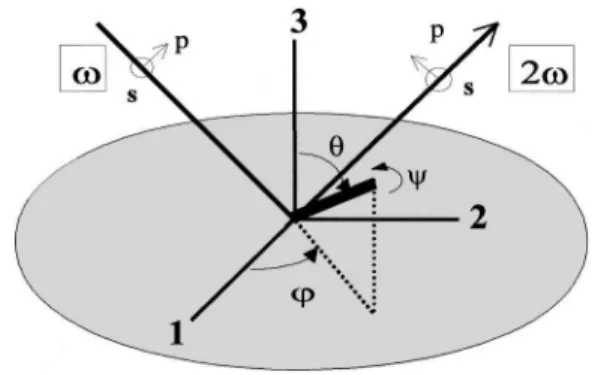
Let us consider a surface perpendicular to the axis 3 in the laboratory frame ~Fig. 1!. Considering the usual Euler
angles u ~polar angle!, w~azimuthal angle!, and c~rotation
angle! to describe the molecular orientation, we suppose that
the last two angles are uniformly distributed whereas u is
fixed. This corresponds to a simple isotropic surface. If the
molecules in the layer are not chiral, the symmetry is C`v,
all the planes perpendicular to the surface become symmetry planes. For chiral molecules, such symmetries are no longer
allowed and the symmetry is C`. Calculation of the
macro-scopic nonlinear susceptibilities follows the general rules of tensor analysis and one has, for example,
xIJK eee
5N
^
~ I"i!~J"j!~K"k!&
avbi jk eee, ~2.6!
where i, j,k(5x,y,z) refer to the molecular frame and
I,J,K(51,2,3) to the laboratory one,
^ &
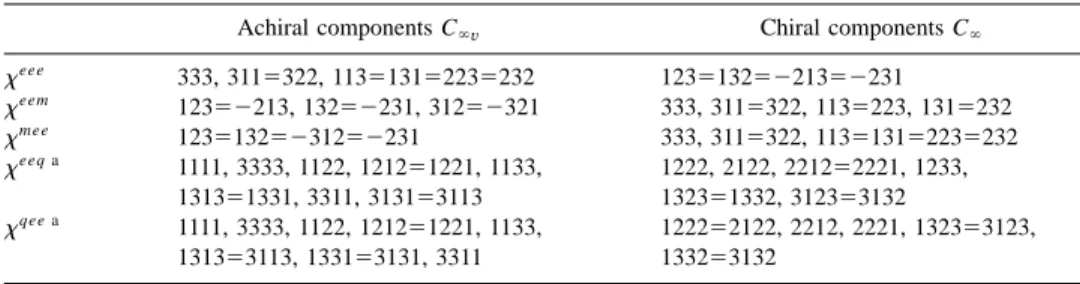
avrepresenting the averaging operation. N is the number of molecules per unit surface. Similar relations exist to connect the nonlinear sus-ceptibilitiesxeem,xmee, xeeq, andxqee~the latter two beingrank-4 tensors! to their microscopic counterparts. It is pos-sible to reduce the number of nonvanishing independent components by taking the symmetry of the surface into
account.10The results in the case of SHG are given in Table
I. Note that forxeee,xmee, andxqee, the last two indices can
be interchanged without changing the value of the compo-nent as both indices refer to the same ~fundamental! fre-quency, further reducing the number of nonzero components.
It is not true for the first two indices ofxeemandxeeqwhich
refer to the harmonic and fundamental frequencies,
respec-FIG. 1. Geometry of surface SHG. The thick bar represents a molecule referenced by the Euler angles.
6708 J. Chem. Phys., Vol. 115, No. 14, 8 October 2001 Hache, Mesnil, and Schanne-Klein
tively. In the first column, the ‘‘achiral’’ components are
given, i.e., the components that do not vanish for a C`v
symmetry. In the second column, we have written the
addi-tional components that do not vanish for the C` symmetry,
which we call the ‘‘chiral’’ components. The first three lines correspond to electric and magnetic dipolar contributions ~rank-3 tensors! and the last two correspond to the electric quadrupolar terms ~rank-4 tensors! which have not been con-sidered previously.
The tensor xeem has already been introduced by
Persoons3and utilized to interpret experimental results.3,5
In-troduction of the tensorxeeq has also been proposed from a
formal point of view11but never distinguished from the
pre-vious one as far as experiments are concerned. It is one of the purpose of this paper to elucidate this point. To do so, we must not consider only the susceptibility tensors, convenient to gather the different terms contributing to the nonlinear response, but not directly accessible to a surface SHG experi-ment. Instead, we calculate the second harmonic electric field
which is the quantity measured in the experiments.3,5 This
field originates from the far-field radiation of the light-induced electric ~P! and magnetic ~M! polarization and from
the quadrupolarization ~Q! and reads12
E~ 2v!}
F
~ n3P!3n21cn3M2ik2 ~ n3Q~n!!3n
G
, ~2.7! where n is a unit vector in the direction of observation andQ~n! is the tensor contraction of Q and n. From the above
discussion, we know that we must consider three terms in P
~xeee, xeem, and xeeq!, one in M (xmee) and one in Q
(xqee). With obvious notation, we therefore decompose the
second harmonic electric field in
E~ 2v!5Eeee
1Eeem1Eeeq1Emee1Eqee. ~2.8! These various contributions are readily calculated from the nonlinear susceptibilities. In order to stick to the experimen-tal situations, we also write
Ep,s~ 2v!5 fp,sEp 2 ~v!1gp,sEs 2 ~v!1hp,sEp~v!Es~v!, ~2.9! where s, p refer to the beam polarization. Indeed, surface SHG experiments utilizing quarter- and half-waveplates
al-low to measure these f, g, h parameters independently.3,5,13
By analyzing the different terms of Eq. ~2.8! in terms of Eq. ~2.9!, we will be able in the following to assess more
pre-cisely the signature of chirality in the SHG signal and to understand better the role of quadrupolarization in it.
From the above discussion, we can define a procedure to study surface SHG from a microscopic model: ~i! derive the nonlinear motion equation for the model; ~ii! derive the cor-responding hyperpolarizabilities; ~iii! average over the iso-tropic layer of molecules to get the nonlinear surface suscep-tibilities; ~iv! calculate the radiated second harmonic electric field and redistribute the different mechanisms in the f, g, and
h parameters. We will now apply this procedure to the Kuhn
and Kauzmann models in the next sections.
III. COUPLED OSCILLATOR„KUHN…MODEL
We consider two coupled oscillators as depicted in Fig.
2. The two oscillators have the same frequency v0
and the same friction coefficient g and are coupled through
dipole–dipole interaction with a coupling parameter k
~supposedly small!. The microscopic frame is (x,y,z). The
oscillator A is in the xz plane and makes an angle a with
the x-direction, its rest position is (0,0,2d/2). The oscillator
B is in the y z plane and makes an angle a with the
y-direction, its rest position is (0,0,d/2). The introduction of
the angle a is important to get a chiral response, as it will
become clear later on. This system is excited by a
monochro-matic wave Ee2ivtwhich induces the oscillation of the
elec-trons. Let us call ae2ivt~resp. be2ivt! the elongation of the
oscillator A ~resp. B!. The coordinates of the electron A
FIG. 2. Coupled oscillators used for the Kuhn model. Oscillator A ~resp. B! is in the xz ~resp. y z! plane.
TABLE I. Nonvanishing components of the nonlinear susceptibilities for C`vand C`symmetries.
Achiral components C`v Chiral components C`
xeee 333, 3115322, 113513152235232 12351325221352231 xeem 12352213, 13252231, 31252321 333, 3115322, 1135223, 1315232 xmee 12351325231252231 333, 3115322, 113513152235232 xeeq a 1111, 3333, 1122, 121251221, 1133, 131351331, 3311, 313153113 1222, 2122, 221252221, 1233, 132351332, 312353132 xqee a 1111, 3333, 1122, 121251221, 1133, 131353113, 133153131, 3311 122252122, 2212, 2221, 132353123, 133253132
aInterchanging 1 and 2 change signs in the chiral components, but not in the achiral ones.
~resp. B! are (ae2ivtcosa,0,2d/22ae2ivtsina) @resp.
(0,be2ivtcosa,d/21be2ivtsina)#. Let us first consider the
linear response of the system. The equations of motion of the electrons along their respective oscillators can be written,
Dva~ 1 !1kb~ 1 !5 2e m
FS
Ex2 d 2EzxD
cosa 2S
Ez2 d 2EzzD
sinaG
, ~3.1! ka~ 1 !1Dvb~ 1 !5 2e mFS
Ey1 d 2EzyD
cosa 1S
Ez1 d 2EzzD
sinaG
,where we have introduced the following notation: Dv5v0
2 2v2
22ivg, Ei j5¹iEj, and where the superscript ~1!
means first-order solution. Solving this set of equations
al-lows us to recover well-known results of this model.14 Due
to the coupling, the degeneracy of the two oscillators is split-ted and two new optical transitions appear with frequencies v0(16(k/2v0
2
)) and opposite rotational strengths. These new states can be viewed as resulting from the in-phase and out-of-phase excitations of the two oscillators, the optical activity coming from the geometric arrangement. The
intro-duction of the parameter k allows us to take empirically
these effects into account. One passes from one enantiomer
to the other by changing the sign ofk and reversing one of
the anglesa.
To introduce a second-order nonlinear response, we sup-pose that the restoring force is not harmonic and reads for oscillator A,
2mv0 2
a2mba2, ~3.2!
the same being true for oscillator B. Looking for the
solu-tions oscillating at 2vand including the contributions
com-ing from the development of the electric field @Eq. ~2.1!#, we get the following set of equations:
D2va~ 2 !1kb~ 2 !52ba~ 1 !22
e ma
~ 1 !@~ cosaE
xx
2sinaEzx!cosa2~ cosaExz
2sinaEzz!sina#, ~3.3! ka~ 2 !1D2vb~ 2 !52bb~ 1 !22 e mb ~ 1 !@~ cosaE y y
1sinaEzy!cosa1~ cosaEy z
1sinaEzz!sina#.
Plugging the solutions of Eq. ~3.1! in Eq. ~3.3!, we ob-tain the general expressions of the second-order solutions
a(2) and b(2). These solutions are used to derive the electric
and magnetic dipole moments as well as the electric quadru-pole one which read
px~ 2 !52ea~ 2 !cosa, py~ 2 !52eb~ 2 !cosa,
~3.4! pz~ 2 !52e~ b~ 2 !2a~ 2 !!sina; mx~ 2 !52ivde 2 b ~ 2 !cosa, m y ~ 2 ! 52 ivde 2 a ~ 2 !cosa, ~3.5! mz~ 2 !50;
Qxx~ 2 !52ea~ 1 !2cos2a, Qy y~ 2 !52eb~ 1 !2cos2a,
Qzz~ 2 !52e@d sina~ a~ 2 ! 1b~ 2 !!1sin2a~ a~ 1 !2 1b~ 1 !2!#, Qxy~ 2 !5Qy x~ 2 !50, ~3.6! Qy z~ 2 !5Qzy~ 2 !52e
F
d 2b ~ 2 !cosa 1b~ 1 !2sinacosaG
, Qzx~ 2 !5Qxz~ 2 !52eF
2d 2a ~ 2 !cosa 2a~ 1 !2sinacosaG
. In this last expression, we have chosen the definition Q 52err for which the trace is nonzero in accordance with Eq. ~2.7!. Utilizing the traceless form of Q would change thevalue of xqee, but would not change the radiated harmonic
field, which is the relevant quantity.
Plugging the expressions of a(1), a(2), b(1), and b(2) in Eqs. ~3.4!–~3.6! and utilizing Eqs. ~2.3!–~2.5! allows us to calculate all the hyperpolarizabilities. General expressions are quite heavy and do not allow to extract interesting physi-cal information. We therefore begin with some approxima-tion and discussions. First of all, we suppose that the
funda-mental frequencyvis far from the oscillator frequencyv0.
This assumption corresponds to most of the experimental cases where the SHG experiment is performed far from the electronic resonances. Note however that it does not preclude a resonance effect between an electronic transition and the
harmonic frequency. This hypothesis allows us to neglectk
compared to Dv'v0
2
in our expressions. Second, examining Eq. ~3.3! in detail, we see that there exists a nonlinear elon-gation a(2)@or b(2)# even ifb
50, i.e., even if the oscillator is perfectly harmonic. This is due to the intrinsic nonlinearity of the electric quadrupole moment @see also Eq. ~3.6!#. Look-ing at the general formulas ~not displayed here!, we observe that comparing this contribution to the anharmonic one
amounts to comparing Dv ~or v0
2! to bd. Considering the nature of electronic binding and calling l the equilibrium
elongation of the oscillator, one estimates that bl2'v0
2
l.15
We must therefore compare the elongation l of the oscillators and the separation d of the two oscillators. In order to be consistent with the hypothesis of a weak coupling and the use of dipole–dipole interaction, we suppose that d@l. This assumption is corroborated by a numerical estimation of l which is in the angstrom range for electronic transitions.
Making this hypothesis allows us to keep only the terms inb
in our expressions and to neglect the other ones. This as-sumption is very reasonable for the usual experimental con-figurations where the chiral molecules under study have al-ways been chosen so as to give a high nonlinear response.
Under these two assumptions ~Dv@k and d@l!, we get
very tractable expressions for the hyperpolarizabilities. Let
us now examine in detail the beee tensor. Out of the 27
components, there are only 6 independent ones and 3 null ones,
6710 J. Chem. Phys., Vol. 115, No. 14, 8 October 2001 Hache, Mesnil, and Schanne-Klein
bxxxeee 5by y y eee 5 b e3cos3a e0m2Dv 2 D2v , ~3.7! bxxy eee 5bx y x eee 5by x y eee 5by y x eee 52be 3kcos3a e0m2Dv 3 D2v , ~3.8! bxxz eee 5bxzx eee 52by y z eee 52by z y eee 5bzxx eee 52bzy y eee 52be 3cosasin2a e0m2Dv2D2v , ~3.9! bxzz eee 5bzxz eee 5bzzx eee 5by zz eee 5bz y z eee 5bzzy eee 5b e3cos2asina e0m2Dv 2 D2v , ~3.10! bxy y eee 5by xx eee 52be 3kcos3a e0m2Dv 2 D2v2 , ~3.11! bx y z eee 5bxzy eee 52by xz eee 52by zx eee 5be 3kcos2asina e0m 2D v 3D 2v 2 ~ D2v2Dv!, ~3.12! bzxy eee 5bz y x eee 5bzzz eee 50. ~3.13!
Examination of these coefficients is already very instruc-tive, as one can see that some components are independent of
the coupling parameter k whereas others are not. In fact
those which depend onkare those for which the two space
directions x and y come into play. This is understandable as only those components probing these two space directions will be sensitive to the coupling, and thus to the chirality of the molecules. Note that the x y z components, which will prove to be relevant in the forthcoming discussion, is
non-zero only under the condition thataÞ0 and DvÞD2v.
Simi-lar expressions are obtained forbeemandbmee. The number
of nonzero components is higher forbeeq ~41! and forbqee
~45!, but the conclusions still hold; they depend onkif they involve x and y.
Let us proceed now to the calculation of the nonlinear susceptibilities. Due to the high degree of symmetry of the
surface (C`) and also of the individual molecules, many
terms go to zero and the final results are quite simple. We give below the nonvanishing independent components for xeee, xeem, andxmee,
x123
eee
5Ne 3b 4e0m2
cos2asina~ 113 cos 2u!k~ D2v2Dv!
Dv3D2v2 , ~3.14! x132 eem 5x312 eem 5ivNe 3bd 8e0m
2 cos2asina~ 113 cos 2u!
3D 1 v 2D 2v , ~3.15! x123 mee 52ivNe 3bd 8e0m2
cos2asina~ 113 cos 2u! 1
Dv2D2v . ~3.16! Several points are worth commenting. Due to the high degree of symmetry of the system, only the components
in-volving the three space directions are nonzero. These
com-ponents are null for a50; in that case, there cannot be any
coupling between the three space directions at the molecular level and everything cancels out in the spatial averaging pro-cedure. According to Table I, we see that the only non-vanishing electric dipolar component is chiral. This chiral
component is directly proportional tokand vanishes for
un-coupled system, as expected. Furthermore, it is proportional
to D2v2Dv. This dependence comes from thebx y z
eee
terms,
the only ones contributing tox123
eeewhenwandcare random.
It means that if both the fundamental and the harmonic pho-ton energies are far from the electronic transition, this term cancels out. Such a cancellation is expected from a general
point of view: From Table I, we have x123
eee
52x213
eee
; on the other hand, far from resonances, Kleinmann symmetry im-plies x123
eee
5x213
eee, resulting in a null coefficient. It is
there-fore necessary to be not too far from a resonance ~for
ex-ample at 2v! to observe a SHG signal originating from chiral
electric components. Let us come now to the magnetic con-tributions: they are achiral and independent of the coupling
parameter. Note that the nonvanishing components of xeem
and of xmee are equal. This is not surprising as they
corre-spond to closely connected phenomena. All the above results are consistent with the linear response. Indeed, chirality in the Kuhn model derives not from a real magnetic moment,
but rather from am3mterm14and is therefore a pure electric
effect. This is recovered in the surface SHG where the chiral response is also a pure electric effect. Let us stress that the quadrupolar terms are not vanishing and are achiral and
in-dependent ofk.
To calculate the second harmonic electric field radiated by the molecules on the surface, we use Eq. ~2.7! together with the above calculations. In order to get readable results, we perform the derivation in a simplified case. First of all, we neglect the Fresnel coefficients in the following expres-sions. They are only multiplicative factors that do not change the discussion. Proper introduction of these coefficients can be found in Refs. 5 and 16. Second, we assume that the incidence and reflection angles are equal to 45° and that the index of refraction of the layer is equal to 1. The geometry of the experiment is shown in Fig. 1. With these assumptions, the relevant vectors for the calculation are: n51/&~1,0,1! ~direction of observation!, k5v/c
A
2(1,0,21) ~wave vectorof the fundamental beam!, E5(Ep/
A
2,2Es,Ep/A
2)~fun-damental electric field!. The second harmonic electric field is expressed on the polarization basis sˆ5(0,21,0) and pˆ
51/
A
2(21,0,1). Using these definitions, we calculate theexpressions of the various fields adding up to give the total
second harmonic field: E(2v)5Eeee
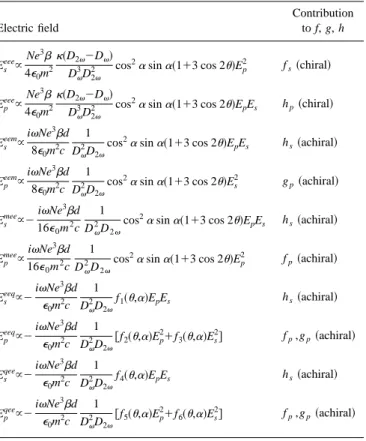
1Eeem1Eeeq1Emee 1Eqee @Eq. ~2.8!#. The expressions of these fields, together with their contributions to the f, g, h parameters @see Eq. ~2.9!# are given in Table II. These results are consistent with the conclusions drawn about the nonlinear susceptibilities. We recover that only the purely dipolar terms contribute to the chiral signal. All the magnetic dipolar or electric quadru-polar ones only give achiral signals. Furthermore, it is clear
from Table II that the second harmonic fields Eeem, Emee,
Eeeq, and Eqee have the same order of magnitude and that
they contribute to the same ~achiral! coefficients fp, gp, and This article is copyrighted as indicated in the article. Reuse of AIP content is subject to the terms at: http://scitation.aip.org/termsconditions. Downloaded to IP:
hs. Whereas it is not correct formally to introduce xeem,
xmee and to neglect xeeq, xqee, it is fully justified from a
practical point of view as all these terms are undistinguish-able in an experiment and can be cast under generic coeffi-cients as it is currently done.3,5
In this section, we have applied the general framework outlined in Sec. II to the Kuhn model of coupled oscillators. The chosen geometry ~Fig. 1! is however not quite general as, for example, the two oscillators lie in perpendicular ~xz and y z! planes. Generalization to more complex case is pos-sible. It is expected in such cases that the separation between chiral and achiral terms would be less strict with for example achiral contributions originating from the electric dipolar susceptibilities. The main conclusions are however not dif-ferent; chiral terms from electric dipolar terms exist and magnetic dipolar and electric quadrupolar contributions are not separable from an experimental point of view. In the next section, we examine the case of an helical oscillator ~Kauz-mann model! which gives strikingly different results.
IV. ONE-ELECTRON„KAUZMANN…MODEL
To study classically molecules in which the optical ac-tivity comes from a single electronic transition with electric and magnetic character, we use the model developed by
Kauzmann.9In this model, it is assumed that each molecule
contains two electrons which oscillate along two identical helices having a common axis, the motion of each electron being such that they are always diametrically opposite to each other across the common axis ~see Fig. 3!. This model
may seem artificial but it has the advantage of illustrating in a simple manner the essential feature of one-electron optical activity. By selecting the motion of the electrons along the helix axis, it raises the fundamental paradox that such helices with only one electron do not display optical activity in an
isotropic arrangement7 and it makes the calculations easier
and more informative. Note that a complete calculation with a more physical system ~a unique electron on a helix! has been developed in Ref. 17. As discussed below, the two ap-proaches agree on the main points.
Let us call a the radius of the helix and 2pb its pitch.
We define L5(a21b2)1/2. The handedness of the
enanti-omer is determined by the parameter b. The coordinates of the two electrons can be described with the help of a unique
parameter w by (a cosw, a sinw,bw) and (2a cosw,
2a sinw,bw). We suppose that these two electrons are bound
through an oscillator at frequencyv0with a friction constant
g. Exciting the first electron with a monochromatic wave
Ee2ivt, we get the following first-order equation of
motion:17 Dvw5 2e mLEt, ~4.1! where Dv5v0
8
2 2v222ivg(v0
8
5v0b/L). Etis thetangen-tial component of the electric field acting on the first elec-tron. It can be expressed as a function of the coordinates of the field as Et52 a LsinwEx1 a LcoswEy1 b LEz. ~4.2!
Nonlocal response is considered by expanding the elec-tric field around the center of the frame according to Eq. ~2.1!. When taking into account the equation of the second electron, several terms cancel out and Eq. ~4.1! reduces to
Dvw~ 1 !
52emL
S
bLEz1a2
L2Exy
D
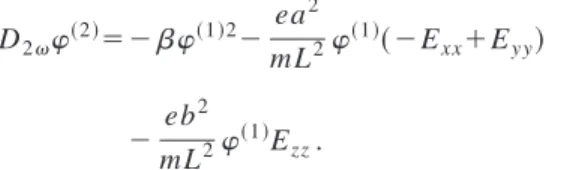
, ~4.3!where here again, the superscript ~1! means first-order solu-tion. To access the second-order nonlinear response, we sup-pose that the oscillators are anharmonic @Eq. ~3.2!# and we
look for the solution oscillating at 2v. The corresponding
equation is
FIG. 3. Representation of the Kauzmann model. The first electron is on the solid helix and the second one on the dotted helix.
TABLE II. Second harmonic electric field radiated by an isotropic layer of molecules described by the Kuhn model. The fi’s are involved functions that
are not given here for the sake of readability.
Electric field Contribution to f, g, h Es eee }Ne 3b 4e0m2 k~D2v2Dv! Dv 3 D2v 2 cos 2a sina~113 cos 2u!Ep 2 f s~chiral! Ep eee}Ne 3b 4e0m2 k~D2v2Dv! Dv3D2v 2 cos 2asina
~113 cos 2u!EpEs hp~chiral! Es eem }ivNe 3bd 8e0m 2 c 1 Dv 2 D2v cos2asina ~113 cos 2u!EpEs hs~achiral! Ep eem }ivNe 3bd 8e0m2c 1 Dv 2 D2v
cos2asina~113 cos 2u!Es
2 g p~achiral! Es mee }2ivNe 3b d 16e0m2c 1 Dv2D2v cos2asina
~113 cos 2u!EpEs hs~achiral! Ep mee }ivNe 3bd 16e0m 2 c 1 Dv 2 D2v cos2asina ~113 cos 2u!Ep 2 fp~achiral! Es eeq }2ivNe 3bd e0m2c 1 Dv 2 D2v f1~u,a!EpEs hs~achiral! Ep eeq }2ivNe 3b d e0m2c 1 Dv2D2v @f2~u,a!Ep 2 1f3~u,a!Es 2# f p,gp~achiral! Es qee }2ivNe 3bd e0m2c 1 Dv2D2v
f4~u,a!EpEs hs~achiral!
Ep qee }2ivNe 3bd e0m 2c 1 Dv 2 D2v @f5~u,a!Ep 2 1f6~u,a!Es 2# f p,gp~achiral!
6712 J. Chem. Phys., Vol. 115, No. 14, 8 October 2001 Hache, Mesnil, and Schanne-Klein
D2vw~ 2 !52bw~ 1 !22 ea2 mL2w ~ 1 ! ~ 2Exx1Ey y! 2 eb 2 mL2w ~ 1 !E zz. ~4.4!
From these equations, it is straightforward to obtain the second-order induced electric and magnetic dipole moments as well as the electric quadrupole one which read here,
p~ 2 !522ebw~ 2 !zˆ, ~4.5! m~ 2 !52ivea2w~ 2 !zˆ, ~4.6! Q~ 2 !52e
S
2a2w~ 1 !2 2a2w~ 2 ! 0 2a2w~ 2 ! 2a2w~ 1 !2 0 0 0 2b2w~ 1 !2D
, ~4.7!and from which we deduce the expressions of the hyperpo-larizabilities. The number of nonzero elements is reduced in this model thanks to Kauzmann’s simplifying assumptions and we get bzzzeee 5 2be3b3 e0m2L4Dv 2 D2v , ~4.8! bzzzeem 52 2ivbe3a2b2 e0m2L4Dv 2 D2v , ~4.9! bzzzmee 52 2ivbe3a2b2 e0m2L4Dv 2 D2v , ~4.10! and bzzxx eeq 52bzzy y eeq , b zzxy eeq 5bzzy x eeq , b zzzz eeq as nonvanishing
components, all the bqee being null. As for Kuhn’s model,
some of the quadrupole components do not depend on the
nonlinear parameterbbut we do not need to neglect them at
this point as they will prove not to contribute in the follow-ing.
Expressions of the nonlinear susceptibilities obtained
af-ter averaging over a C` distribution are readily obtained.
Here are the nonzero independent components, x113 eee 5x311 eee 5Nbe 3b3cosusin2u e0m2L4Dv 2 D2v , ~4.11! x333 eee 52Nbe 3b3cos3u e0m2L4Dv2D2v ; x113 eem 5x311 eem 52ivNbe 3a2b2cosusin2u e0m2L4Dv2D2v , ~4.12! x333 eem 522ivNbe 3a2b2cos3u e0m2L4Dv 2 D2v ; x113 mee 5x311 mee 52ivNbe 3a2b2cosusin2u e0m2L4Dv 2 D2v , ~4.13! x333 mee 522iv Nbe3a2b2cos3u e0m2L4Dv 2 D2v .
Examination of Table I shows thatxeee has only achiral
components, whereas xeem and xmee has only chiral ones.
This is in good agreement with the linear response; chirality
is clearly due to the magnetic moment induced by the helical motion of the electrons. An interesting point is that the
qua-drupolar terms xeeq andxqee are identically null. Reducing
the nonlocal effects to the magnetic ones is therefore fully correct for this model. Considering now the radiated second harmonic electric field, we recover the expressions
previ-ously obtained for magnetic terms.3,5They are given in Table
III for the same geometry as Fig. 1. Eeeecontribute only to
fp, gp, and hs~achiral!, whereas Eeem and Emeecontribute
only to fs, gs, and hp ~chiral!. Note that the exact
cancella-tion of the chiral electric contribucancella-tion is a consequence of the Kauzmann model which removes the contributions of the electric dipole in the surface plane. However, considering the calculation in Ref. 17 with a unique electron on a helix, one can show that the chiral electric susceptibility components give a negligible effect as soon as the optical nonlinear re-sponse is strong enough. Working in the same framework as for the Kuhn model, we therefore obtain a quite good agree-ment with Ref. 17.
Kauzmann model allows to obtain simple results and to show that the chiral signal in surface SHG originates in the magnetic terms and that electric quadrupolar susceptibilities vanish. This in in complete contrast with the Kuhn model introduced in the previous section. These two models are therefore very complementary. We will now examine previ-ously obtained experimental results in the light of these two models.
V. DISCUSSION
Before discussing the experimental results, we would like to stress again the difference between the two models. In the Kuhn model, optical activity occurs because the two electric dipole moments are arranged in a nonmirror-symmetrical configuration. This is known to be the main mechanism in molecules constituted of two ~or more!
mono-TABLE III. Second harmonic electric field radiated by an isotropic layer of molecules described by the Kauzmann model.
Electric field Contribution to f, g, h Es eee }2A2Ne 3bb3 e0m 2 L4 1 Dv 2 D2v cosusin2uE pEs hs~achiral! Ep eee }A2Ne 3bb3 8e0m 2 L4 1 Dv 2 D2v cosu@~113 cos 2u!Ep 2 14 sin2uEs 2# fp,gp~achiral! Es eem }A2ivNe 3ba2b2 e0m 2L4c 1 Dv 2 D2v cosusin2u@E p 2 2Es2# fs,gs~chiral! Ep eem }A2ivNe 3ba2b2 8e0m 2 L4c 1 Dv 2 D2v
~ 3 cosu15 cos 3u!EpEs hp~chiral!
Es mee }A2ivNe 3ba2b2 8e0m 2 L4c 1 Dv 2 D2v cosu@~113 cos 2u!E2p 14 sin2uE s 2# fs,gs~chiral! Ep mee }2A2ivNe 3ba2b2 e0m2L4c 1 Dv 2 D2v
cosusin2uEpEs hp~chiral!
mers in interaction.18,19As a consequence, we find that opti-cal activity in surface SHG is also due to purely electric terms. On the other hand, optical activity in the Kauzmann model is due to the helical path imposed to the electrons by the molecular backbone. It is clear here that excitation of an electric dipole moment will induce a magnetic moment and
vice versa9 and that optical activity is mainly a magnetic
effect. This is true also for second-order nonlinear optics. The two models depicted above, although simple, give a very physical approach of the microscopic origins of optical ac-tivity and of their consequences for surface SHG.
Let us consider now the interchange of the handedness of the enantiomers. Interchanging the two enantiomers by mirror imaging of the system leads to changing the sign of the chiral parameter and of the nonlinear coupling term to-gether. This last feature can be understood as follows:
look-ing at Fig. 3, one sees that a positivebmeans that the
oscil-lator is stiffer in the y .0 direction compared to the y,0 one, i.e., when the electrons go upward. Taking the mirror image of the helix, the oscillator must still be stiffer for electrons going upward, i.e., for y ,0. This is possible only if
bchanges sign when going from an enantiomer to the other
one. Applying these changes shows that thexeeetensor does
not change sign whereasxeemandxmeedo for the Kauzmann
model. Applying similar rules to the Kuhn model ~which is somewhat more involved as one must change
concommi-tantly the sign of the angleaand of the nonlinear parameter
bfor one of the two oscillators!, one gets the opposite result.
However, the only nonvanishing components of xeem and
xmee ~resp.xeee! are chiral ~resp. achiral! in the Kauzmann
model while they are achiral ~resp. chiral! in the Kuhn one ~cf. Tables II and III!. Finally, both models are consistent with the very general symmetry rules of chirality in two
dimensions;20 chiral components change sign, whereas
achiral ones do not when interchanging enantiomers. As the components which change sign with the enantiomers are the electric ones in the Kuhn model and the magnetic ones in the Kauzmann model, this should be observed in an experiment measuring the absolute phase of the susceptibility tensors. However, experiments have only given relative phases ~if any! so far and could not access this information.
We can also estimate from our calculations the relative magnitudes of the radiated second harmonic fields so as to compare the chiral and achiral contributions. Such a com-parison is straightforward for the Kauzmann case. Looking at Table III, one gets that the chiral contributions over the
achiral ones scale as a2/lb. The molecular parameters a et b
being in the same range, but in any case, much smaller than the wavelength, this ratio is clearly much smaller than 1. As an example, we consider hexahelicene for which a52.50 Å
and b50.605 Å,21 and we get a ratio of 1023 for a
wave-length of 1mm. This is quite consistent with the fact that the
chiral parts come from magnetic effects whereas the achiral ones come from electric effect, and one recovers the usual ratio between both contributions. In the Kuhn model, such a comparison is not so simple. Indeed, two contradictory fea-tures occur. On one hand, the chiral part being of electric origin, it is expected to be larger that the achiral part, of magnetic origin. On the other hand, the chiral part is non
zero only if at least one of the frequencies is close to a molecular resonance. The ratio between chiral and achiral parts will therefore not depend only on geometrical factors of the molecule, as for the Kauzmann model, but will also be very sensitive to the excitation photon energies compared to the electronic or vibrational transitions of the molecule. In particular, if the second harmonic frequency is close to a
resonance, the ratio chiral/achiral scales as (k/D2v)
3(l/d) and can become quite large. As discussed below, this has been experimentally demonstrated in
helicenebis-quinone where the chiral electric contributions dominate.22
We can now proceed to an examination of previously published experimental results in view of our calculations. Considering the very simple models we have introduced, it is not possible to look for more than a qualitative agreement. However, we will see that our calculations allow to reconcile controversial interpretations that were given in the past about the origin of the chiral response in surface SHG experiments.
In a pionneering work, Byers et al.2demonstrated SHG from
a surface of chiral 2,2
8
-dihydroxy-1,18
binaphtyl. Theyclearly evidenced chiral effects in the harmonic signal ~namely, a rotation of the polarization of the harmonic beam compared to the fundamental one! which they explain by considering only the electric dipolar nonlinear susceptibility.
More recently, Van Elshocht et al.23confirmed this result in a
helical polymer based on binaphtyl monomers where no in-dication of magnetic contributions were observed. Similar results were obtained in Langmuir–Blodgett films of a chiral helicenebisquinone derivative which give very strong SHG
signal.22 Here again, no evidence of magnetic contributions
was found and the dominant contribution was x123
eee. This
chiral contribution was measured to be at least 6 times larger than the achiral ones. These three experiments rely on similar molecules. In every case, the molecules under consideration are composed of two identical monomers spatially arranged in a nonmirror symmetric configuration. Optical activity in
such molecules clearly originates from excitonic coupling18
and therefore should be correctly described by coupled os-cillators. The experimental results are consistent with the above calculation for the Kuhn model in which the electric terms are dominant. In particular, the helicenebisquinone compounds seem to be very well fitted to this model which implies that if the second harmonic frequency is not too far from an electronic resonance, the magnetic terms are negli-gible compared to the electric ones. This looks quite appro-priate to the helicenebisquinone molecule.
On the other hand, several experiments have proven that in some cases, the electric-dipole approximation is not
suffi-cient for explaining SHG on a surface of chiral molecules.4,5
More strikingly, there exist molecules for which the chiral components are dominated by the magnetic ones. It is the
case of polythiophene4or of chiral poly~isocyanide! films for
which the largest chiral magnetic component, of the order of 20% of the largest achiral electric one, is three times as big
as the largest chiral electric one.24 In such molecules, the
nonlinearity originates in the delocalization of p electrons
along a linear path which is slightly twisted due to the pres-ence of a chiral center. This motion is comparable to the motion of an electron on a helix and can therefore be mod-6714 J. Chem. Phys., Vol. 115, No. 14, 8 October 2001 Hache, Mesnil, and Schanne-Klein
elized by the Kauzmann model. Predominance of the mag-netic terms in the chiral response is expected from the above calculations.
In the general case, molecules cannot be modelized by a unique model. This is the case for example in Ref. 5 where the molecular backbone is not strictly linear and where many susceptibility components are expected to play a role. In that case, all the effects are mixed up and chiral components were measured to have similar orders of magnitude for the electric or magnetic contributions. However, by choosing the mo-lecular structure, one can favor the electric or the magnetic origin in the chiral SHG signal.
Before concluding, we would like to further comment on
the helicenebisquinone case.22 The experiments were
per-formed on Langmuir–Blodgett films and it was shown that enantiomerically-pure molecules were stacked in helical su-pramolecular aggregates. There seems to be a competition between the molecular level which pertains to the Kuhn model and the supramolecular one which introduces a helical path. It is experimentally clear that the Kuhn model is well fitted, which means that the chiral nonlinear response is dominated by the molecular level. The supramolecular orga-nization, although not prevalent as far as chirality is con-cerned, is nevertheless important as it allows the various mo-lecular entities to radiate in a coherent way and to interfere constructively.
VI. CONCLUSION
In this paper, we have made use of two classical models of the origin of the optical activity in chiral molecules and extended them to the second-order nonlinear response in or-der to unor-derstand better surface SHG experiments. The first model is the Kuhn one in which the optical activity comes from the coupling of two oscillators. The second one, intro-duced by Kauzmann, describes an electron harmonically bound on a helix. By allowing the oscillators to be anhar-monic, we are able to calculate the second-order hyperpolar-izabilities of the molecules, including the nonlocal ~magnetic dipolar and electric quadrupolar! response. From these coef-ficients, we get the nonlinear susceptibilities of an assembly of molecules deposited on a surface and derive the radiated second harmonic field, as measured in the experiments. The two models give strikingly different results. In the Kuhn model, the chiral response comes from the electronic suscep-tibility, whereas in the Kauzmann case, it comes from the magnetic ones. Furthermore, we show that the electric qua-drupolar contributions are not negligible in the Kuhn model, but that they are indiscernible from the magnetic dipolar ones and that it is therefore legitimate to cast both effects under a generalized magnetic term.
This calculation allows to understand better previously published experimental results on SHG on a layer of chiral molecules where various interpretations relying either on purely electric effects or on magnetic ones were given. In-deed, depending on the molecular structure, one of the two models is more appropriate and our calculation predicts that the chiral signatures in the SHG signal are very different. A close analysis of previous experiments shows that their re-sults are consistent with our modelizations.
This calculation, although simple, brings very instructive information about the link between the molecular structure and the surface SHG signal. A contrario, it shows the power of surface SHG to study the origin of chirality in molecules. By measuring separately the local/nonlocal susceptibility components as well as the achiral/chiral ones and by com-paring with the results of the model calculations, it allows us to get a more precise understanding of the microscopic mechanisms of chirality.
1T. Petralli-Mallow, T. M. Wong, J. D. Byers, H. I. Yee, and J. M. Hicks, J. Phys. Chem. 97, 1383 ~1993!.
2
J. D. Byers, H. I. Yee, and J. M. Hicks, J. Chem. Phys. 101, 6233 ~1994!. 3M. Kauranen, T. Verbiest, J. J. Maki, and A. Persoons, J. Chem. Phys. 101,
8193 ~1994!.
4S. Van Elshocht, T. Verbiest, M. Kauranen, B. M. W. Langeveld-Voss, and E. W. Meijer, J. Chem. Phys. 107, 8201 ~1997!.
5
M. C. Schanne-Klein, F. Hache, A. Roy, C. Flytzanis, and C. Payrastre, J. Chem. Phys. 108, 9436 ~1998!.
6M. Kauranen, T. Verbiest, and A. Persoons, J. Nonlinear Opt. Phys. Mater.
8, 171 ~1999!.
7
E. U. Condon, Rev. Mod. Phys. 9, 432 ~1937!. 8W. Kuhn, Z. Phys. Chem. Abt. B 4, 14 ~1929!.
9W. Kauzmann, Quantum Chemistry ~Academic, New York, 1957!, p. 616. 10Y. R. Shen, Annu. Rev. Phys. Chem. 40, 321 ~1989!.
11
M. Kauranen, T. Verbiest, and A. Persoons, J. Mod. Opt. 45, 403 ~1998!. 12
J. D. Jackson, Classical Electrodynamics, 3rd ed. ~Wiley, New York, 1999!, p. 407.
13F. Geiger, R. Stolle, G. Marowsky, M. Palenberg, and B. U. Felderhof, Appl. Phys. B: Lasers Opt. 61, 135 ~1995!.
14
S. F. Mason, Molecular Optical Activity and the Chiral Discrimination
~Cambridge University Press, Cambridge, 1982!, p. 42.
15N. Bloembergen, Nonlinear Optics ~Benjamin, New York, 1965!, p. 7. 16J. J. Maki, M. Kauranen, and A. Persoons, Phys. Rev. B 51, 1425 ~1995!. 17
J. J. Maki and A. Persoons, J. Chem. Phys. 104, 9340 ~1996!. 18
E. L. Eliel and S. H. Wilen, Stereochemistry of Organic Compounds
~Wiley, New York, 1994!, p. 1043.
19C. R. Cantor and P. R. Schimmel, Biophysical Chemistry ~Freeman, San Francisco, 1980!, Part II, p. 421.
20
L. Hecht and L. D. Barron, Mol. Phys. 89, 61 ~1996!. 21I. Tinoco and R. W. Woody, J. Chem. Phys. 40, 160 ~1964!.
22C. Nuckolls, T. J. Katz, S. Van Elshocht, T. Verbiest, H. G. Kuball, S. Kiesewalter, A. J. Lovinger, and A. Persoons, J. Am. Chem. Soc. 121, 3453 ~1999!.
23
S. Van Elshocht, T. Verbiest, M. Kauranen, L. Ma, H. Cheng, K. Y. Mu-sick, L. Pu, and A. Persoons, Chem. Phys. Lett. 309, 315 ~1999!. 24M. Kauranen, J. J. Maki, T. Verbiest, S. Van Elshocht, and A. Persoons,
Phys. Rev. B 55, 1985 ~1997!.