HAL Id: hal-00704199
https://hal.archives-ouvertes.fr/hal-00704199
Submitted on 4 Jun 2012
HAL is a multi-disciplinary open access
archive for the deposit and dissemination of
sci-entific research documents, whether they are
pub-lished or not. The documents may come from
teaching and research institutions in France or
abroad, or from public or private research centers.
L’archive ouverte pluridisciplinaire HAL, est
destinée au dépôt et à la diffusion de documents
scientifiques de niveau recherche, publiés ou non,
émanant des établissements d’enseignement et de
recherche français ou étrangers, des laboratoires
publics ou privés.
Reconfiguration with physical constraints in WDM
networks
Sonia Belhareth, David Coudert, Dorian Mazauric, Nicolas Nisse, Issam Tahiri
To cite this version:
Sonia Belhareth, David Coudert, Dorian Mazauric, Nicolas Nisse, Issam Tahiri. Reconfiguration with
physical constraints in WDM networks. Workshop on New Trends in Optical Networks Survivability,
2012, Canada. pp.5. �hal-00704199�
Reconfiguration with physical constraints in WDM
networks
Sonia Belhareth, David Coudert, Dorian Mazauric, Nicolas Nisse and Issam Tahiri
MASCOTTE, INRIA, I3S (CNRS/Univ. Nice Sophia Antipolis), France
Abstract—In a WDM network, setting up a new wavelength in a fiber requires recalibrating the other wavelengths passing through this fiber. This induces a cost (e.g., time, energy, degradation of QoS) that depends nonlinearly on the number of wavelengths using the fiber. When a set of connection requests must change their optical paths in the network (e.g., during a maintenance operation on a link in the network), the order in which requests are switched affects the total cost of the operation. That is, the reconfiguration of the routing in a WDM network has some cost due to physical layer impairments. We initiate the study of the corresponding optimization problem by modeling the cost of switching a request as a non-linear function depending on the load of the links used by the new lightpath. We prove that determining the optimal rerouting order is NP-complete for a 2-nodes network. We then give general lower and upper bounds on the minimum cost and we identify classes of instances where the problem can be solved in polynomial time. We design heuristics for this problem and analyze their behavior through simulations.
I. CONTEXT AND MOTIVATION
In connection oriented networks such as Wavelength Divi-sion Multiplexing (WDM) networks, each connection request d ∈ Π is assigned a lightpath under the wavelength continuity constraint, that is to say a path in the topology and an end-to-end wavelength. The Routing and wavelength assignment (RWA) problem consists in assigning such a lightpath for each request under the constraint that two optical paths sharing a fiber have distinct wavelengths [1], [2]. The set of lightpaths, or routes, obtained in that way is called a configuration.
Current WDM networks are becoming more flexible, offer-ing new on-demand services for provisionoffer-ing new lightpaths, but also allowing better management of maintenance opera-tions (requiring to switch off equipments) and equipments fail-ures – due to earthquake, tsunami, or a backhoe unfortunately breaking a pipe containing some fibers. A building block for flexibility and reliability is the possibility to reconfigure the routing, that is to compute new optical paths for some connection requests and then to switch the traffic from former to new optical paths. Such process may however affect the quality of service by inducing potential traffic disruptions. Moreover, due to physical layer impairments [3], reconfiguring the routing – setting up the new lightpaths – induces some cost for the network operator, in particular if service level agreements are not fulfilled. Thus, the routing reconfiguration process must be carefully optimized.
A classical approach for reconfiguring the routing is based on the Move-to-Vacant (MTV) scheme [4]–[6] which consists in sequentially choosing a lightpath, computing a new route using available resources for the corresponding request, and
then switching the request from its current lightpath to its new route in a make-before-break fashion as standardized for MPLS networks [7]. This process is repeated sequentially until the reached configuration achieves the desired constraints (e.g., overall usage of resources, availability of a desired route). The main issues when using the MTV approach are to guarantee the convergence of such a process and to control the number of route changes. Moreover, such solutions are not sufficient and interruptions may be necessary [8], [9].
To ensure both a fast termination and that the final con-figuration satisfies the desired performance criteria, another approach consists in pre-computing the target configuration and then to focus on the reconfiguration itself, that is deciding in which ordering the existing lightpaths should be switched to achieve the final configuration. More formally, the reconfig-uration problemis to determine the “best” sequence (order) of connections rerouting to move from the current configuration to a predetermined target configuration, under the constraint that the connections are moved one by one [8]. However, the final lightpath of a request d ∈ Π may use resources (e.g., a wavelength on a fiber) that are used by the initial lightpath of another request d0 ∈ Π. This latter request d0
must then be moved before the connection d. The difficulty of the reconfiguration problem lies mainly in the existence of dependency cycles that require to temporarily suspend some connections to allow switching the other requests. Such an interruption corresponds to the concept of break-before-make standardized for MPLS networks [7]. A break-before-make starts by interrupting the lightpath of a request before estab-lishing the new route. Several recent studies have considered the framework proposed by Jose and Somani [8] to minimize either the total number of interruptions, or the maximum number of requests that are simultaneously interrupted, during a reconfiguration [9]–[12].
In this article, we address the problem of reconfiguration in a different way, which is the inclusion of physical constraints to the establishment of an optical path. We aim at optimizing the reconfiguration cost which is induced by physical layer impairments. Indeed, the transmission of an optical signal in a fiber is subject to many parameters: bandwidth, transmission power, signal attenuation requiring the use of amplifiers every 50-80 km, phase shifts associated the imperfection of the laser and the distortion of the fiber, and various electro-magnetic effects (see [3] for more details). This requires extremely fine adjustments to ensure good transmission quality, but every-thing has to be redone (or adapted) when a new wavelength
is used in the fiber. Thus, setting up a new lightpath in a network has a cost (energy, time and/or man power) due to the recalibration on all fibers used by the path which depends (non-linearly) on the number of wavelengths already present. In addition, these changes can affect the entire network by spreading corrections to be made. See [13] for an example including these effects in the computation of optical routing.
1) Results: In this preliminary work, we propose to model the cost of rerouting a request in a configuration as a simple non-linear function depending on the load of the links used by the lightpath to be established, where the load of a link is the number of lightpaths crossing it in the current configura-tion. Our cost function also depends on a tunable parameter α ≥ 0 which is an exponent, e.g., α = 1 corresponds to a linear cost function. Given an initial configuration and a pre-computed target one, the objective is to switch sequentially the requests from their initial route to the final one in order to achieve a minimum global cost. Since minimizing the number of interruptions during a configuration is known to be NP-complete and difficult to approximate [9], [10], we have preferred studying the cost optimization problem by itself. Therefore, we assume that the reconfiguration may be performed regardless of unavoidable interruptions: we assume that all connections have different wavelengths and thus no interruptions are needed.
With this model and hypothesis, we prove that the routing reconfiguration problem is NP-complete even in a physical network with two nodes and when α = 0. We then characterize a particular class of instances where the problem can be solved in linear time, for any α ≥ 0. In the particular case of a ring topology and α = 1, we give a simple linear algorithm for solving the problem. Due to lack of space, proofs have been sketched or omitted and can be found in [14]. Finally, we design several heuristics and report on numerical simulations that are compared whenever possible to the optimal solutions (e.g., in the case of a ring and α = 1), and with generic upper and lower bounds that we have exhibited.
2) Related work: The reconfiguration problem has been widely studied using the Move-To-Vacant method. Integer Lin-ear Programming (ILP) modelisation [15], [16] and heuristic algorithms [4]–[6] have been proposed.
More recently, the notion of dependency digraph has been introduced to study routing reconfiguration problems [8]. The dependency digraph of an instance of the reconfiguration problem has one vertex per connection to be moved and an arc from request d to request d0 when d0 must be moved to allow the establishment of the new optical path of d [8]. Using this concept, Jose and Somani showed that the minimum number of requests to be interrupted during the reconfiguration equals the minimum feedback vertex set of the dependency digraph. In [10], the routing reconfiguration problem has been modeled in terms of digraph processing game on the depen-dency digraph. The main objectives studied in this context are the minimization of the total number of interruptions and the minimization of the maximum number of simultaneous interruptions. The corresponding decision problems are
NP-complete in general and difficult to approximate [9], [10]. Tradeoffs between these two objectives are studied in [9]. ILPs and heuristics to address this problem have been pro-posed [11], [12], [17].
II. MODELING
We start by defining the notations used throughout this paper. We then define formally the cost induced by switching a request from a lightapth to another one in a given configura-tion. The reconfiguration problem studied in this paper consists in minimizing the cost of a sequence of switchings to go from an initial configuration to a given final one.
Let D = (V, A) be the directed connected multi-graph modeling the physical network. A request d in D is a pair of vertices (sd, td), the source and the destination. Let Π ∈ V ×V
be the set of connection requests, and let m = |Π|. For any request d ∈ Π, a route Rdfor d is a lightpath for d, i.e., a path
from sd to td in D together with a wavelength. Abusing the
notation, Rddenotes also the path in D of the route Rd. Given
a physical network D and a set of requests Π, a configuration C is a set of routes in D, one for each request d ∈ Π. The load of a link e ∈ A in a configuration C is the number of routes using e in C, that is, lC(e) = |{d ∈ Π : e ∈ A(R
d), Rd∈ C}|
In this paper, we do not consider the capacity of wavelengths nor network’s links, that is the number of routes sharing some edge of E is not limited. Hence, given any configuration, it is always possible to establish the route of a new request – no interruption of existing requests is required. However, in order to take into consideration the physical constraints described in the Introduction, we define the cost of establishing a new request as the following non-linear cost function. Informally, the cost depends on the load (in the current configuration) of the links used by the route of new established request. More formally, let α ≥ 0, and let us consider the configuration C. Then, the cost of switching the request d from its initial route R0d to its final route Rd in configuration C is defined by:
cost(d, C) = X
e∈A(Rd)\A(R0d)
(lC(e))α
If α = 0, we set that xα = 1 if x > 0 and 0 otherwise. The case α = 0 is interesting since the cost is bounded by the optical path length, i.e., by the number of network links on which an intervention is necessary, independently from the load. Note that request d may be not already established in configuration C, in which case A(R0d) is set to ∅.
In the context of routing reconfiguration, we are given two configurations Cinit = (Rinit
d )d∈Π and Cf in = (R f in d )d∈Π
where, for any request d ∈ Π, Rinit
d is the initial route of d
and Rf ind is its final route. Let us emphasize that we are not considering the problem of computing the new routing, i.e, the initial and final configurations Cinit and Cf inare given as inputs of this problem which “only” consists in ordering the rerouting of every request.
The reconfiguration problem consists in rerouting sequen-tially the requests from their initial route to their final one, and
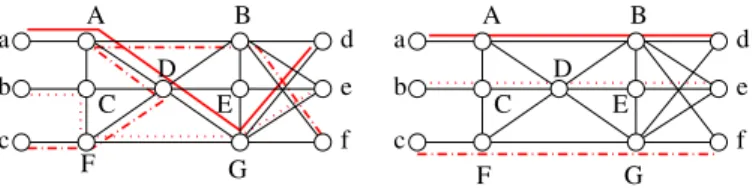
d F G c a b d e f A B C E D e f A B C E D F G c a b
Fig. 1. Example of instance of the reconfiguration problem
minimizing the global cost of the operation. More formally, given S ⊆ Π, let CS denote the configuration obtained from
Cinit after having rerouted the requests in S. That is, CS is
defined by the set (RS
d)d∈Πof optical paths where RSd = R f in d
if d ∈ S and RS
d = Rinitd otherwise. The initial configuration
Cinit is denoted by C∅. To simplify the notations, we will note
lS(e) (e ∈ A) instead of lCS
(e), that is, lS(e) is the number
of optical paths using the link e in configuration CS.
We are now able to formally define the reconfiguration problem. Given a network topology D, a set of requests Π, and the initial and final optical routings, the reconfiguration problem is to find an ordering O = hd1, d2, · · · , dmi on
the requests that minimizes cost(O) = P
j≤mcost(dj, C Sj),
where S1= ∅ and Sj= {d1, · · · , dj−1} for j > 1.
Reconfiguration problem.
Inputs: A digraph D = (V, A), a set of requests Π, two configurations Cinit and Cf in of Π. Output: An ordering O = hd1, d2, · · · , dmi of Π such
that cost(O) is minimum.
An important remark is that the cost of rerouting a request does not depend on the order in which previous requests have been rerouted, but only on the set S of those requests.
As an example, consider the physical network depicted in Figure 1, where the links are symmetric, together with the initial routing (left) and the final one (right) of three re-quests. Requests 1, 2 and 3 have initial routes (a, A, D, G, d), (b, C, F, G, e) and (c, F, D, A, B, f ) respectively. Their final routes are (a, A, B, d), (b, C, D, E, e) and (c, F, G, f ) respec-tively. If Request 1 is switched first, this induces a cost 1αdue to the load of the arc (A, B). Then, if Request 3 is moved, it costs 1α due to the load of the arc (F, G). Hence, switching the requests in the order h1, 3, 2i would cost 2 · 1α, while the
ordering h2, 3, 1i would have cost 0.
III. COMPLEXITY,BOUNDS AND SIMPLE INSTANCES
In this section, we prove that the routing reconfiguration problem defined in previous section is NP-complete even in the case of basic instances. We then characterize some instances in which the problem can be easily solved. We also provide easily computable upper and lower bounds for the minimum cost of a rerouting. These bounds will allow us to analyze the performances of the heuristics we propose in the next section. To prove the NP-hardness of the routing reconfiguration problem, we present a reduction from the Minimum Feedback Vertex Set (MFVS) problem. Given a digraph D = (V, A), a feedback vertex set S ⊆ V is a set of vertices the removal
of which leaves D acyclic, i.e., the subdigraph D[V \ S] of D induced by V \ S is a Directed Acyclic Graph. The MFVS Problem consists in finding a feedback vertex set with minimum size. This problem is a well known NP-complete problem [18]. It is easy to check that it is NP-complete in the class of loopless connected digraph with minimum in-degree at least one (since a vertex with no in-neighbors can be removed without changing the feedback vertex sets).
Theorem 1: The reconfiguration problem is NP-complete even if the physical network has only 2 nodes and α = 0.
Proof: Let D = (V, A) be a loopless n-node m-arc connected digraph with minimum in-degree at least one, which is an instance of the MFVS Problem. From D, we build the following instance of the routing reconfiguration problem.
Let the physical network be the digraph D∗ = (V∗, A∗)
with two nodes, V∗ = {u, v}, and n > 0 arcs from u to v. There is a one-to-one correspondence between the vertices of D and the arcs of D∗, i.e., A∗ = V = {a1, · · · , an}. Let Π
be a set of m ≥ n requests from u to v. There is a one-to-one correspondence between the arcs of D and the requests of Π, i.e., Π = A. Note that the path of a route for a request in Π must be an arc in A∗. Moreover, for any request d ∈ Π, corresponding to an arc (x, y) ∈ A, the initial route Rinit
d of
d is set to x ∈ A∗ and its final route Rf ind is set to y ∈ A∗. By definition, Rinitd 6= Rf ind for any d ∈ Π (because D is loopless), and, for any a ∈ A∗, there is d ∈ Π such that {a} = Rf ind (because D has minimum in-degree at least one). Let c(a) denote the number of requests using the link a ∈ A∗ in the final configuration, i.e., c(a) = |{d ∈ Π : {a} = Rf ind }|. Note that c(a) > 0 for any a ∈ A∗because any arc is
assumed to be the final route of at least one request (because D has minimum in-degree at least one).
Because α = 0, rerouting a request on an empty link does not cost anything and it costs one otherwise. Hence, for any arc a ∈ A, the contribution of the link a to the total cost of a reconfiguration is c(a) − 1 if a is empty when the first request with final route a is rerouted, and its contribution is c(a) otherwise. Indeed, after the first request has been rerouted on a, the rerouting of each of the reminding c(a) − 1 requests with final route a will cost one. Thus, for any ordering O,
m − n =X i≤n (c(ai) − 1) ≤ cost(O) ≤ X i≤n c(ai) = m.
More precisely, we show that the optimal cost of the rerouting equals m − n + M F V S(D), where M F V S(D) denotes the minimum size of a feedback vertex set in D, which proves the NP-hardness. The problem belongs to NP.
Even if the routing reconfiguration problem is NP-complete in general, there exist some instances where it can be solved efficiently. Hereafter, we characterize some cases where the problem is polynomialy-time solvable. In particular, we pro-pose a linear time algorithm for solving the problem optimally on a directed symmetric ring if α = 1. We start by giving some general bounds.
Let (D, Π, Cinit, Cf in) be an instance of the routing
number of requests using the link a only in their initial route by I(a), resp., only in their final route by F (a). Let P (a) denote the number of requests using the link a both in their initial and final routes. More formally,
• I(a) = |{d ∈ Π : a ∈ A(Rinitd ) \ A(Rdf in)}|;
• F (a) = |{d ∈ Π : a ∈ A(Rf ind ) \ A(Rinitd )}|;
• P (a) = |{d ∈ Π : a ∈ A(Rf ind ) ∩ A(Rinitd )}|.
Finally let A0 ⊆ A be the set of links a s.t F (a) > 0. The following bounds are straightforward. Abusing the notation, we consider that Py
i=xi α
= 0 if y < x.
Lemma 1: For any α ≥ 0 and any rerouting ordering O,
X a∈A0 P (a)+F (a)−1 X i=P (a) iα≤ cost(O) ≤ X a∈A0 P (a)+I(a)+F (a)−1 X i=P (a)+I(a) iα.
In particular, if I(a) = 0 for every a ∈ A0, the optimal cost equals the above lower bound and it is achieved by any order of request reroutings. More generally, we give a simple sufficient condition to decide whether the optimal cost matches with the above lower bound. To do so, we give an alternative definition of the dependency digraph of an instance of the routing reconfiguration problem.
The dependency graph Ddep of (D, Π, Cinit, Cf in) is the
digraph defined as follows. The vertex-set of Ddep is Π and
there is an arc from d ∈ Π to d0∈ Π if (A(Rdf in)\A(Rinit d ))∩
(A(Rinit
d0 ) \ A(R
f in
d0 )) 6= ∅. Note that this definition differs
from the classical definition [9], [10].
Theorem 2: Let α ≥ 0. If the dependency graph Ddep
of the reconfiguration instance is acyclic, then every inverse topological ordering of V (Ddep) corresponds to an ordering
with cost P
a∈A0
PP (a)+F (a)−1
i=P (a) i
α and therefore is optimal.
A directed symmetric ring is a digraph with vertex-set V = {v1= vn+1, v2, · · · , vn} (n ≥ 3) and for any i ≤ n, there are
the arcs (vi, vi+1) and (vi+1, vi). In such a physical topology,
we may assume that, for any request between two nodes, only two routes are possible: clockwise and anti-clockwise.
Theorem 3: Consider an instance of the routing reconfi-guration problem where the physical network is a directed symmetric ring. Let us consider the requests that must be switched be ordered in any non-increasing ordering of the length of their initial route. In the case α = 1, this ordering achieves the minimum cost.
IV. HEURISTICS AND SIMULATIONS
As the reconfiguration problem is NP-complete even on very simple physical instances (Theorem 1), we have proposed one heuristic to solve it.
Recall that the routing reconfiguration problem is a schedul-ing problem that aims at findschedul-ing a minimum cost orderschedul-ing of the requests. Therefore, two natural and simple other heuristics have been implemented to evaluate the performance of the heuristic. The Random Schedule (RS) simply returns a random ordering of the requests. Motivated by Theorem 3, we also consider the Decreasing Length Schedule (DLS) that returns any ordering of the requests in the non-increasing ordering of the length of their initial routes.
Next subsection describes the heuristic we propose and then, we will evaluate its behavior through simulations.
A. Heuristic by Local Optimization (HLOf)
Recall that our goal is to go from the initial configuration Cinitto the final one Cf in. For any subset S ⊆ Π, CS denotes
the configuration obtained from Cinit after having rerouted the requests of S.
Roughly speaking, this heuristic is based on a matrix that describes, in the current configuration CS, which requests
would be the cheapest one to be switched.
1) Cost Matrix: Given a configuration CS, where S =
{d1, · · · , dt−1} ⊆ Π = {d1, · · · , dm}, the corresponding cost
matrix M (CS) is defined as follows: M (CS) = (Mi,j)t≤i,j≤m where
Mij = cost(dj, CS∪{di}) − cost(dj, CS) if i 6= j and Mii= 0
Mij compares the cost of rerouting dj in the current
configu-ration to the cost of rerouting dj knowing that the request di
has already been rerouted (The cost of rerouting diis not taken
into account). Intuitively, if there exists a k ∈ {t, · · · , m} such that, for every ` ∈ {t, · · · , m}, Mk`≤ 0, Then locally (in the
current configuration) rerouting the request dk before all the
others is the cheapest.
2) Greedy heuristic by matrices: The heuristic we propose starts by computing the matrix M (C∅). Then, one request dk ∈ Π to be rerouted is chosen according to some choice
function f (M (C∅)) depending only on the matrix. The request dk is then rerouted and the matrix M (C{dk}) corresponding
to the next configuration is computed. Once the requests of the set S ⊂ Π have been rerouted, the request d` is rerouted
then, with ` = f (M (CS)), and the matrix M (CS∪{d`}) is
computed. In this preliminary work, f (M ) is the row index k such thatP
j≤mMkj is minimum.
3) Case of the linear cost function (α = 1): The complexity of the heuristics depends on the complexity of the choice function (in our case O(m2)) and on the complexity of
updating the matrix. The definition of the cost matrix makes this latter operation particularly easy in the case α = 1. In this case, Mij = |A(Rf indj ) ∩ A(Rf indi )| − |A(Rf indj ) ∩ A(Rinitdi )|
which is completely independent from the current network configuration. Therefore, for α = 1, only M (C∅) is initially computed and, after rerouting the request dk, the update only
consists of the deletion of the row and the column k. 4) Heuristic by local optimization: Given an ordering of the requests, the Heuristic by Local Optimization (HLO) consists in, while it is possible, inverting 2 consecutive requests if it decreases the global cost. More generally, k ≥ 3 being fixed, It is possible to perform local optimization by taking k consecutive requests and choosing the minimum cost among the k! orders. Finally, the heuristic HLOf consists of the following. We first compute an ordering of the requests via the greedy heuristic using matrices described above. Then, starting from the obtained ordering, we use the Local Optimization heuristic (for k = 2) to locally improve the solution.
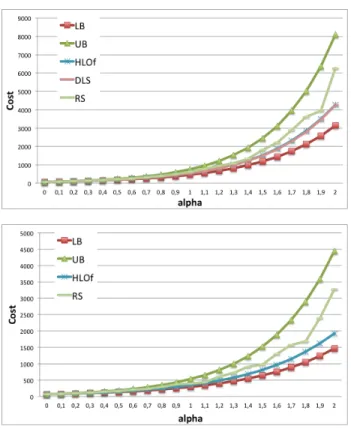
Fig. 2. Results on directed symmetric ring (up) and 2-node network (down)
B. Simulations’ results.
We have considered the two topologies studied in Sec-tion III: a directed symmetric ring (10 nodes, 60 requests) and a 2-node network with multi-edges (5 edges, 20 requests). Simulations are performed using the open-source mathematics software Sage [19] and the results are presented in Figure 2. On the abscissa axis, α varies from 0 to 2 with a step of 0.1, and on the ordinate axis, the total cost of the reconfiguration is represented. In both topologies and for each value of α, the depicted cost is the mean value over 100 executions where the set of requests, their initial and final routes have been chosen randomly in every run. We have simulated the heuristic by local optimization going from orders obtained using the heuristic by matrices (HLOf). Then, the obtained solutions are compared with the ones provided by the Random Schedule (RS) heuristic. In the case of the ring, the solution provided by Heuristic HLOf is compared with the ones obtained by the Decreasing Length Schedule (DLS) heuristic. Notice that DLS and RS are equivalent in the case of the second instance since all routes have same length. We compare as well all the results with the general bounds (LB and UB) given in Lemma 1.
The heuristic (HLOf) give results that are close to the lower bound and much better than those corresponding to random orders in both topologies. In Particular, HLOf is identical to DLS in the ring (optimal for α = 1 according to Theorem 3).
V. CONCLUSION
In this work, we present a first theoretical study of the routing reconfiguration problem including physical layer
im-pairments. While simple, the cost function we propose al-lows to capture several constraints due to physical layer impairments as the non-linearity. The preliminary simulations’ results indicate that the heuristic HLOf we have proposed achieves good performance on simple instances. Next, we plan to extend the study to more general topologies, and to investigate the challenging problem of determining jointly the best new configuration and the reconfiguration ordering taking into account possible interruptions.
ACKNOWLEDGMENT
The authors would like to thanks Daniel C. Kilper for fruitful discussions, and acknowledge the financial support of ANR DIMAGREEN and R´egion PACA.
REFERENCES
[1] B. Mukherjee, “WDM-based local lightwave networks-P. II: Multi-hop systems,” IEEE Network, vol. 6, no. 4, pp. 20–32, 1992.
[2] B. Jaumard, C. Meyer, and B. Thiongane, “Comparison of ILP formula-tions for the RWA problem,” Optical Switching and Networking, vol. 4, no. 3-4, pp. 157–172, 2007.
[3] C. V. Saradhi and S. Subramaniam, “Physical layer impairment aware routing (pliar) in wdm optical networks: issues and challenges,” IEEE Comm. Surveys and Tutorials, vol. 11, no. 4, pp. 109–130, 2009. [4] K.-C. Lee and V. Li, “A wavelength rerouting algorithm in wide-area
all-optical networks,” IEEE/OSA Journal of Lightwave Technology, 1996. [5] G. Mohan and C. Murthy, “A time optimal wavelength rerouting
algorithm for dynamic traffic in WDM networks,” IEEE/OSA Journal of Lightwave Technology, vol. 17, no. 3, pp. 406–417, 1999.
[6] X. Chu, T. Bu, and X.-Y. Li, “A study of lightpath rerouting schemes in wavelength-routed WDM networks,” in IEEE Intl. Conference on Communications (ICC). Hong-Kong: IEEE, 2007, pp. 2400–2405. [7] E. Mannie and D. Papadimitriou, “Recovery (protection and restoration)
terminology for generalized multi-protocol label switching (GMPLS),” IETF, RFC 4427, 2006.
[8] N. Jose and A. Somani, “Connection rerouting/network reconfiguration,” in Design of Reliable Communication Networks. IEEE, 2003. [9] N. Cohen, D. Coudert, D. Mazauric, N. Nepomuceno, and N. Nisse,
“Tradeoffs when optimizing Lightpaths Reconfiguration in WDM net-works,” in FUN, ser. LNCS, vol. 6099, 2010, pp. 121–132.
[10] D. Coudert, S. Perennes, Q.-C. Pham, and J.-S. Sereni, “Rerouting requests in wdm networks,” in AlgoTel, Presqu’le de Giens, France, 2005, pp. 17–20.
[11] F. Solano, “Analyzing two different objectives of the WDM network reconfiguration problem,” in IEEE Global Communications Conference (Globecom), 2009.
[12] F. Solano and M. Pi´oro, “Lightpath reconfiguration in WDM networks,” IEEE/OSA J. Opt. Commun. Netw., vol. 2, no. 12, pp. 1010–1021, 2010. [13] K. Manousakis, K. Christodoulopoulos, E. Kamitsas, I. Tomkos, and E. Varvarigos, “Offline impairment-aware routing and wavelength as-signment algorithms in translucent WDM optical networks,” IEEE/OSA Journal of Lightwave Technology, vol. 27, no. 12, pp. 1856–1877, 2009. [14] S. Belhareth, D. Coudert, D. Mazauric, N. Nisse, and I. Tahiri, “Reconfiguration with physical constraints in wdm networks,” IN-RIA, Tech. Rep., 2011, http://www-sop.inria.fr/members/Nicolas.Nisse/ publications/physicalConstraints.pdf.
[15] O. Klopfenstein, “Rerouting tunnels for MPLS network resource opti-mization,” European Journal of Operational Research, vol. 188, no. 1, pp. 293–312, 2008.
[16] J. Y. Zhang, O. W. W. Yang, J. Wu, and M. Savoie, “Optimization of semi-dynamic lightpath rearrangements in a wdm network,” IEEE J. Sel. Areas Comm., vol. 25, no. 9, pp. 3–17, 2007.
[17] D. Coudert, F. Huc, D. Mazauric, N. Nisse, and J.-S. Sereni, “Reconfig-uration of the routing in WDM networks with two classes of services,” in 13th Conference on Optical Network Design and Modeling (ONDM). Braunschweig, Germany: IEEE, 2009.
[18] M. R. Garey and D. S. Johnson, Computers and Intractability: A Guide to the Theory of NP-Completeness. W. H. Freeman, 1979.