HAL Id: hal-01499915
https://hal.inria.fr/hal-01499915
Submitted on 1 Apr 2017
HAL is a multi-disciplinary open access
archive for the deposit and dissemination of sci-entific research documents, whether they are pub-lished or not. The documents may come from teaching and research institutions in France or abroad, or from public or private research centers.
L’archive ouverte pluridisciplinaire HAL, est destinée au dépôt et à la diffusion de documents scientifiques de niveau recherche, publiés ou non, émanant des établissements d’enseignement et de recherche français ou étrangers, des laboratoires publics ou privés.
optimizations
Zaynah Dargaye, Xavier Leroy
To cite this version:
Zaynah Dargaye, Xavier Leroy. A verified framework for higher-order uncurrying optimizations. Higher-Order and Symbolic Computation, Springer Verlag, 2009, 22 (3), �10.1007/s10990-010-9050-z�. �hal-01499915�
(will be inserted by the editor)
A verified framework for higher-order uncurrying
optimizations
Zaynah Dargaye · Xavier Leroy
Abstract Function uncurrying is an important optimization for the efficient execution of functional programming languages. This optimization replaces curried functions by uncur-ried, multiple-argument functions, while preserving the ability to evaluate partial applica-tions. First-order uncurrying (where curried functions are optimized only in the static scopes of their definitions) is well understood and implemented by many compilers, but its exten-sion to higher-order functions (where uncurrying can also be performed on parameters and results of higher-order functions) is challenging. This article develops a generic framework that expresses higher-order uncurrying optimizations as type-directed insertion of coercions, and prove its correctness. The proof uses step-indexed logical relations and was entirely mechanized using the Coq proof assistant.
Keywords Functional programming languages · Compiler optimization · Compiler verification · Semantic preservation · Mechanized verification
1 Introduction
1.1 Currying in functional languages
Most programming languages support n-ary functions, that is, functions that take zero, one or several arguments. Following the models ofλ -calculus and set theory, some functional languages provide only unary functions, that is, functions of exactly one argument. This is the case in programming languages such as Standard ML, Caml, and Haskell, and also in specification languages of proof assistants such as HOL and Coq. In these languages, multiple-argument functions are encoded in terms of single-argument functions. One such encoding puts multiple arguments in a tuple or record, which is passed to the function as a single argument, and from which the function recovers the arguments by pattern-matching. For example, the two-argument function taking x and y and returning x + y is encoded as Zaynah Dargaye
ENSIIE, 1, square de la R´esistance, 91025 ´Evry, France. Author’s current address: CEA LIST, Saclay, 91191 Gif-sur-Yvette, France. E-mail: [email protected]
Xavier Leroy
INRIA Paris-Rocquencourt, Domaine de Voluceau, B.P. 105, 78153 Le Chesnay, France. E-mail: [email protected]
λ p.let(x, y) = pinx + y. Another encoding, called currying1, uses functions that return functions to achieve the effect of passing several arguments. Continuing the example above, the two-argument addition function is encoded as f =λ x. λ y. x + y; applying it to the arguments 1 and 2 is performed by two successive applications ( f 1) 2, also written f 1 2.
The choice between the two encodings is largely a matter of programming style. For ex-ample, the Standard ML community favors the use of tuples, while currying is the preferred approach among Caml and Haskell programmers. One technical advantage in favor of cur-rying, however, is the ease with which it expresses partial applications of n-ary functions to m < n initial arguments. For example, if f =λ x. λ y. x + y, the partial application f 1 computesλ y. 1 + y, that is, a one-argument function representing the specialization of f to x = 1.
1.2 The run-time cost of currying
Both encodings of n-ary functions entail significant run-time costs if implemented naively. We concentrate on the currying encoding in the following. Consider a simple call-by-value, “eval-apply” strategy (in the terminology of [27]) as embodied in the SECD [23] and CEK [16] abstract machines, for example. In this setting, a total application f 1 2 of a 2-argument curried function f proceeds as follows. First, f is evaluated to a function value λ x.λ y.M. Second, the first argument 1 is evaluated. Third, the function is entered, binding 1 to x, and returns the function closure representingλ y.M{x ← 1}. Fourth, the second argument 2 is evaluated. Fifth, the intermediate functionλ y.M{x ← 1} is entered with y bound to 2, and the function body M is evaluated at last. Generalizing over the number of arguments, we see that a total application of a n-ary curried function entails the creation of n − 1 short-lived intermediate closures, as well as 2n control-flow jumps between the caller and the callee. In contrast, an execution model that natively supports n-ary functions would perform only 2 such jumps and avoid the creation of intermediate closures entirely, saving significant run-time costs.
Some of these inefficiencies can be avoided by using a “push-enter” execution model (following again the terminology of [27]) instead of an “eval-apply” model. Examples of “push-enter” models include Krivine’s machine [22], the STG abstract machine [30], and the ZINC abstract machine [24]. In these models, a curried application such as f 1 2 is evaluated by first pushing the arguments on a stack, in right-to-left order (first 2, then 1), keeping track of the number of available arguments, then evaluating f to a function value, then entering its code. A prelude to the function checks that enough arguments were provided. If so, the body of the function is evaluated. If not, a function closure representing the partial application is immediately returned to the caller.
The “push-enter” model avoids most of the costs of currying in the “eval-apply” model, especially the creation of intermediate closures. Compared with a native implementation of n-ary functions, some overhead remains, however. For instance, parameters must be passed in memory: hardware registers cannot be used for parameter passing. Also, maintaining the count of available arguments at run-time and testing it on entrance to every n-ary func-tion is costly in execufunc-tion time. For these reasons, we now turn to another approach: static (compile-time) uncurrying, and concentrate on it in the remainder of this article.
1 In honor of the logician Haskell B. Curry. Curry himself attributes this technique to Sch¨onfinkel [13],
1.3 Static uncurrying
Static uncurrying is a compile-time optimization that translates an ML- or Haskell-like sur-face language of unary functions to an intermediate language featuring n-ary functions with-out partial applications (i.e. the number of arguments provided at calls must match exactly the arity of the callee). Such an intermediate language can, then, be compiled to efficient machine code, with registers being used for parameter passing and no run-time arity checks on entrance to functions.
We now describe the simple static uncurrying strategy that is implemented in the OCaml native-code compiler and recent versions of the Glasgow Haskell compiler, among others. It detects curried function abstractions that are bound by alet(or similar local, top-level or module-level binding construct) and turns them into n-ary functions of the target language2:
let f = λx.λy. x + y ⇒ let f = λ(x,y). x + y
Within the lexical scope of their bindings, total, curried applications of these functions are turned into single, n-ary applications:
in f 1 2 ⇒ in f(1, 2)
Partial applications of these functions, as well as any use of these functions as first-class values, are handled by re-constructing a curried version of the n-ary function. Changing only the “in” part of the example above, we have the following translations:3
in List.map2 f l1 l2 ⇒ in List.map2 (curry2(f), l1, l2)
in List.map (f 3) l3 ⇒ in List.map (curry2(f)(3), l3)
Thecurry2combinator is defined asλ ( f ). λ (x). λ (y). f (x, y) in the intermediate language. It takes a function f of arity 2 and returns the equivalent curried function. One suchcurryn combinator is defined for each arity n of interest.
There exist several variants of this uncurrying strategy. (The one outlined above is ap-proximately the one used in OCaml.) For instance, thecurrycombinators can be expanded in-line and reduced, at some cost in code size: the partial application f 3 would then be translated as let x=3 inλy.f(x,y). Also, the Glasgow Haskell compiler exploits com-binatorspappn,m=λ ( f , x1, . . . , xm).λ (xm+1) . . .λ (xn). f (x1, . . . , xn) to speed up the partial
application of a n-ary function f to m < n initial arguments.
The performance characteristics of this approach can be summarized as follows. Within the lexical scope of a named definition of a curried function, total applications of the func-tion name are compiled optimally to a n-ary applicafunc-tion. All other uses of curried funcfunc-tions (partial applications, passing a curried function as parameter to a higher-order function, stor-ing curried functions in data structures, etc) suffer from the same run-time costs exhibited by the naive “eval-apply” model. However, the first case (total applications of known func-tions) is very common: Marlow and Peyton Jones [27] report that it amounts for 80% of function calls on a Haskell benchmark suite; the second author observed similar numbers on an OCaml benchmark suite. This uncurrying strategy therefore performs well in practice. Compared with a “push-enter” execution model, it also simplifies the run-time system [27] and is more compatible with the use of standard, currying-unaware compiler back-ends.
2 Here and throughout this paper,λ (x, y) . . . denotes a two-argument function of the target language, not a
function that takes a pair as single argument. Likewise, f (x, y) is an application to two arguments, as in C or Java, not an application to the pair (x, y) as in ML or Haskell.
3 List.map and List.map2 are the familiar higher-order functions that iterate a function over the
The correctness of static uncurrying (that the generated intermediate code does not get stuck on an arity mismatch at application-time and computes the same results as the orig-inal code) is intuitively clear, but not obvious to prove in full details. As part of her work on the formal verification of a compiler front-end for the MiniML functional language, the first author developed a mechanically-checked proof of correctness for the uncurrying opti-mization outlined above [14]. The present article extends this work to more aggressive static uncurrying schemes that work across higher-order functions.
1.4 Higher-order static uncurrying
The static uncurrying strategy outlined in section 1.3 is first-order in nature: as soon as a cur-ried function is passed as argument to a higher-order function or used as a first-class value, no uncurrying takes place. This is clearly suboptimal: opportunities for uncurrying across higher-order functions are not uncommon, as the following example demonstrates. Con-sider themap2iterator from OCaml’sListmodule, which applies a two-argument function pairwise to the elements of two lists.
let rec map2 = λf.λl1.λl2. match (l1, l2) with
| ([], []) -> []
| (h1::t1, h2::t2) -> f h1 h2 :: map2 f t1 t2 | (_, _) -> fail
in map2 (λx.λy. x + y) l1 l2
First-order uncurrying produces the following intermediate code, wheremap2is uncurried but itsfparameter remains curried:
let rec map2 = λ(f, l1, l2). match (l1, l2) with
| ([], []) -> []
| (h1::t1, h2::t2) -> f(h1)(h2) :: map2(f, t1, t2) | (_, _) -> fail
in map2((λx.λy. x + y), l1, l2)
A higher-order uncurrying optimization could uncurry the parameter f as well, turning it into a 2-argument function and improving the efficiency of the code:
let rec map2 = λ(f, l1, l2). match (l1, l2) with
| ([], []) -> []
| (h1::t1, h2::t2) -> f(h1, h2) :: map2(f, t1, t2) | (_, _) -> fail
in map2((λ(x, y). x + y), l1, l2)
What happens if, somewhere else in the program, we need to applymap2to a functionfthat has not been uncurried? Just like thecurryn combinators were used previously to resolve mismatches between an uncurried function definition and a curried use site, we can use the uncurryn combinators
to resolve mismatches between a curried function definition and an uncurried use
site. For example, applying map2 above to a curried function f can be done as
map2(uncurry2(f),l1,l2).
The curryanduncurry combinators can be combined together to resolve more com-plicated mismatches. For example, the termλ (x).uncurry2(curry3( f )(x)) transforms a 3-argument uncurried function f into a semi-curried function that takes one 3-argument, then returns an uncurried function of 2 arguments.
Higher-order uncurrying is a natural extension of the familiar, first-order uncurrying optimizations, but it has not received much attention. The only prior work on higher-order uncurrying that we are aware of is that of Hannan and Hicks [19], who developed a type system to validate a posteriori the correctness of an uncurrying transformation. We are not aware of any compiler for a functional language that implements higher-order uncurrying. One possible reason is that choosing between different possible higher-order uncurryings (for example, to decide whether to uncurry thefparameter to the map2function above) is difficult and no good heuristics are known. We will not settle this issue in this paper, but rather concentrate on characterizing and proving correct a whole family of possible higher-order uncurrying optimizations.
1.5 This work
In this article, we develop a general framework for higher-order uncurrying optimizations and prove their correctness through a generic semantic preservation argument. Section 2 develops a nondeterministic specification of what constitutes a valid uncurrying of a source program written in a simple, untyped functional language with unary functions. The spec-ification is presented as a non-standard type system instrumented with the generation of uncurried terms. Coercions are introduced in a type-directed manner to solve arity mis-matches, generalizing the curry and uncurry combinators used in earlier examples. To prove that these uncurryings are correct (i.e. preserve the semantics of the source program), we use step-indexed logical relations, a powerful semantic tool introduced by Appel and McAllester [7] and reviewed in section 3. The proof of semantic preservation is presented in section 4. Two applications of our framework are worked out in section 5: one is a very sim-ple correctness proof for the first-order uncurrying optimization outlined in section 1.3; the other is a validating translation that exploits the results of an external uncurrying strategy, after checking them for correctness, to generate the corresponding uncurried code. Issues with non-terminating programs are discussed in section 6. Section 7 discusses related work, followed by concluding remarks and perspectives for future work in section 8.
Our work improves on that of Hannan and Hicks [19] in two ways. First, we show how to automate the insertion of coercions to resolve ‘impedance’ mismatches between parts of program that make different uncurrying decisions. This was mentioned but left as future work by Hannan and Hicks. Second, our framework is independent of the type system (if any) of the source language, while that of Hannan and Hicks relies on a specific type system (Hindley-Milner polymorphism). Extending their framework to the richer type systems of languages like Haskell or OCaml, or to the even richer type theories found in proof assistants like HOL or Coq4is challenging. In contrast, our framework also uses types to capture compile-time arity information, but uses them in the style of soft typing [38]: a
4 One application initially envisioned for this work is as part of a larger effort to develop and prove correct
a compiler for pure, formally verified functional programs directly written in the specification language of Coq.
universal “top” type of fully curried functions can always be used as an escape hatch when contradictory compile-time arity information arises. Our work is therefore applicable to any functional language, statically typed or not.
The formalization and proofs presented in this paper have been mechanically checked using the Coq proof assistant [11,9]. The complete Coq development is available on the Web athttp://gallium.inria.fr/~xleroy/uncurry/. Taking advantage of this, we only sketch the proofs in this paper, referring the reader to the Coq development for full details.
2 Specification of the uncurrying transformation 2.1 The source language
The source language for the uncurrying transformation is a standardλ -calculus with con-stants, enriched with aletbinding and aletrecbinding for defining recursive functions. While both bindings could be encoded in the λ -calculus fragment of the source language, having them as primitive constructs facilitates uncurrying. We omit other features of func-tional languages (arithmetic, data types, condifunc-tionals, pattern-matching, . . . ) since these fea-tures are orthogonal to the uncurrying optimization.
Constants: c ::= 0 | 1 | . . .
Terms: a ::= xn variable (as its de Bruijn index n)
| c constant
|λ .a (unary) function abstraction
| a a0 (unary) function application
|letaina0 local binding
|letrecλ .aina0 recursive binding of a function
Alpha-conversion of bound variables is a delicate issue in most mechanized formaliza-tions of program analyses and transformaformaliza-tions [8]. To avoid this issue, we represent variables by de Bruijn indices: xn is the variable bound by the (n + 1)th enclosing binding construct.
Consequently,λ .a binds x0 to the function parameter in the body a, andletaina0 binds the value of a to x0 during the evaluation of a0. Considerletrecλ .aina0. In a, the func-tion parameter is x0and the recursive functionλ .a itself is x1. In a0, x0refers to the recursive functionλ .a.
In examples and informal discussions, we will use variable names f , y, z, . . . for legibility. In standard named notation, our functions are of the shapeλ y.a and our local bindings are of the shapelety = aina0 andletrec f =λ y.aina0.
2.2 The target language
The target language for the uncurrying transformation is similar to the source language, except that it features n-ary function abstractions and applications.
Terms: b ::= xn variable (as its de Bruijn index n)
| c constant
|λn.b n-ary function abstraction
| b(b1, . . . , bn) n-ary function application
|letbinb0 local binding
|letrecλn.binb0 recursive binding of a n-ary function
The termλn.b denotes a function of n arguments, which are bound in b to xn−1, . . . , x1, x0 (in this order). In named syntax, such functions are writtenλ (y1, . . . , yn). b. The target
lan-guage naturally supports functions with no arguments (also known as thunks), but the un-currying transformation will not generate them.
The term b(b1, . . . , bn) applies the function b to the n arguments b1, . . . , bn. Partial
appli-cations and over-appliappli-cations are not supported: reduction takes place only if b evaluates to a function of exactly n arguments; evaluation is stuck otherwise. For a recursive function bind-ingletrecλn.binb0, variables x
n−1, . . . , x1, x0 are bound in b to the function arguments, and xn is bound to the recursive function itself.
To guide the uncurrying transformation, we classify terms of the target language accord-ing to their representation typesτ. These types capture information on the arity of functions. Representation types:
τ ::= > constants or fully-curried functions
| (τ1, . . . ,τn) →τ n-ary functions
Compilation environments:
Γ ::= τ0. . .τn maps de Bruijn indices to representation types
The representation type (τ1, . . . ,τn) →τ characterizes a function of arity n that expects n
arguments conforming to typesτ1, . . . ,τn and returns a result conforming toτ. For unary
functions (n = 1), we writeτ1→τ2instead of (τ1) →τ2.
The representation type > corresponds both to non-function values such as constants and to fully-curried functions: functions of arity 1 that expect a fully-curried argument and produce a fully-curried result. In other words, a function of type > → > can be viewed as having type >. (See rule SBASEin section 2.3.) Conversely, it is possible to apply a term b
of type > to one argument of type >, obtaining a result of type >. At run-time, such an application can succeed if b is a (fully-curried) function, or fail if b evaluates to a constant. The subset of target terms that have representation type > is therefore isomorphic to the source language. It is clear that our type algebra is too weak to guarantee type soundness, but this is not its purpose.
2.3 The uncurrying transformation
Many different uncurrying strategies can be considered, and even more so when uncurry-ing is performed across higher-order functions. Rather than prove the correctness of one particular strategy, we set out to specify (nondeterministically) a large class of uncurrying strategies, which we prove semantically correct in section 4. The specification is presented as a predicateΓ ` a =⇒ b : τ saying that a target term b is a correct uncurrying of the source term a. In this predicate,τ is the desired representation type for b (as we will see shortly, different representation types lead to different uncurryings), and the compilation environ-ment Γ associates representation types to the free variables of a, which are also the free variables of b.
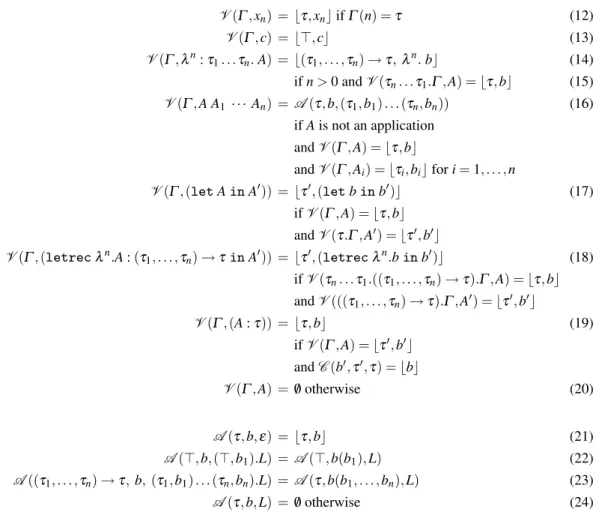
The predicateΓ ` a =⇒ b : τ is defined by a set of inference rules reminiscent of a type system. The rules are not syntax-directed, therefore b is not a function ofΓ , a, τ but rather of a whole derivation. Γ (n) = τ (TVAR) Γ ` xn=⇒ xn:τ Γ ` c =⇒ c : > (TCST) n > 0 τn. . .τ1.Γ ` a =⇒ b : τ (TABS) Γ ` λ . . . λ| {z } n times .a =⇒λn.b : (τ1, . . . ,τn) →τ Γ ` a =⇒ b : > Γ ` a0=⇒ b0: > (TAPP->) Γ ` a a0=⇒ b(b0) : > n > 0 Γ ` a =⇒ b : (τ1, . . . ,τn) →τ Γ ` ai=⇒ bi:τifor i = 1, . . . n (TAPP-N) Γ ` a a1 . . . an=⇒ b(b1, . . . , bn) :τ Γ ` a =⇒ b : τ τ.Γ ` a0=⇒ b0:τ0 (TLET) Γ `letaina0 =⇒letbinb0:τ0 n > 0 τn. . .τ1.((τ1, . . . ,τn) →τ).Γ ` a =⇒ b : τ ((τ1, . . . ,τn) →τ).Γ ` a0 =⇒ b0 :τ0 (TLETREC) Γ `letrec λ . . . λ| {z } n times .aina0=⇒letrecλn.binb0:τ0 Γ ` a =⇒ b : τ b :τ =⇒ b0:τ0 (TCOERCE) Γ ` a =⇒ b0:τ0
The rules for variables and constants (TVARand TCST) are straightforward. The first
inter-esting rule is TABS. At a function type (τ1, . . . ,τn) →τ, a source-level curried abstraction
of at least n parameters λ y1, . . . , yn. a uncurries to the n-ary abstraction λ (y1, . . . , yn). b,
provided that a uncurries to b at result type τ under the additional assumptions yi :τi
(i = 1, . . . , n). For example, the source termλ x.λ y. y becomes the binary function λ (x, y). y if the desired type is (>, >) → > but remains a curried function λ (x). λ (y). y if the de-sired type is > → > → >. Two rules deal with function applications. Rule TAPP-> matches
single applications a a0 at type > where the function part a is uncurried to b at type >,
meaning that it is a fully-curried function. The argument a0 is uncurried to b0 at type > as well and the generated target term is the unary application b(b0). The other application rule,
TAPP-N, deals with source-level curried applications a a1 . . . an at type τ. The function
part a must uncurry to b at some n-ary function type (τ1, . . . ,τn) →τ. In this case, a n-ary
application b(b1, . . . , bn) is generated, where bi is an uncurrying of ai at type τi. The case
oflet bindings (rule TLET) is straightforward. Forletrecbindings, rule TLETREC
com-bines rules TABS and TLET. The recursive nature of the binding is apparent in the extra
hypothesis xn: (τ1, . . . ,τn) →τ introduced in the compilation environment when translating
the left subterm of the binding. Rule TCOERCE accounts for most of the flexibility of our specification. It enables us to take an uncurrying b obtained at some typeτ and turn it into an uncurrying b0 at another typeτ0, provided there exists a coercion fromτ to τ0that trans-forms b into b0. (Typical examples of coercions are applications of thecurryanduncurry
combinators mentioned in Introduction.) Such a coercion is written b :τ =⇒ b0:τ0. A
spe-cial case of coercion is subtyping, writtenτ <: τ0, where the type changes but the result of the translation does not (b0= b). We now define subtyping and coercion via inference rules,
starting with the former.
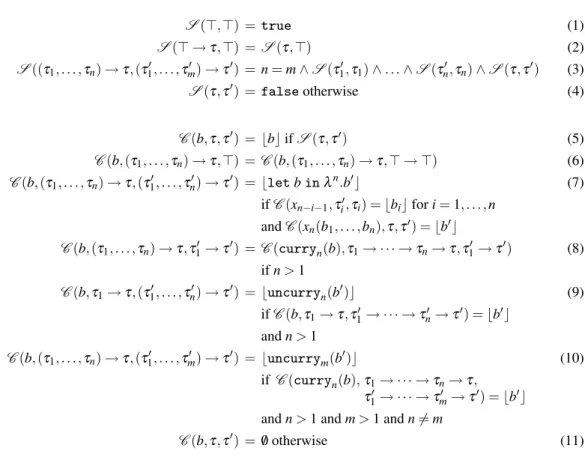
τ <: τ (SREFL) τ1<:τ2 τ2<:τ3 (STRANS) τ1<:τ3 > → > <: > (SBASE) τ0 i<:τifor i = 1, . . . , n τ <: τ0 (SFUN) (τ1, . . . ,τn) →τ <: (τ10, . . . ,τn0) →τ0
Subtyping is reflexive and transitive. The base case (rule SBASE) corresponds to > → > being a subtype of >. As mentioned in section 2.2, a target term of type > → > is a fully-curried function and can therefore be injected in the type > of constants or fully-fully-curried functions. Subtyping then extends across function types as usual (rule SFUN): covariantly
in the result type and contravariantly in the argument types. The following lemma (used in section 5.1) is an example of complex subtyping.
Lemma 1 Define the typeτn of curried functions of n > arguments by
τn= > → · · · → >| {z } n times
→ > We haveτn<: > for all n.
Proof The base case n = 0 is trivial by rule SREFL. For the inductive case, note thatτn+1=
> →τn. By induction hypothesis and rules SFUNand SREFL, we have > →τn<: > → >.
By rule SBASE, > → > <: >. We conclude by rule STRANS. ut
We now turn to the definition of coercions b :τ =⇒ b0:τ0.
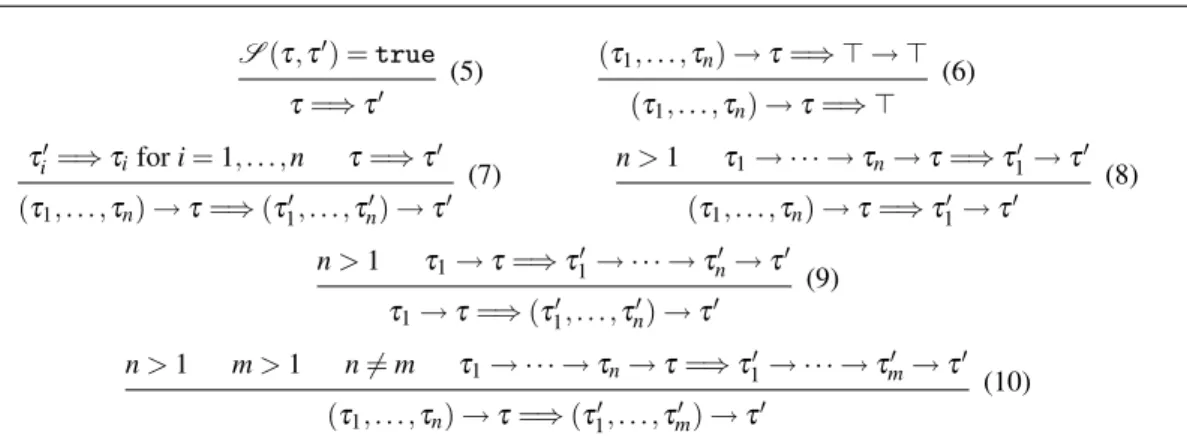
τ <: τ0 (CSUB) b :τ =⇒ b : τ0 b :τ =⇒ b0:τ0 b0:τ0=⇒ b00:τ00 (CTRANS) b :τ =⇒ b00:τ00 n > 0 (CCURRY) b : (τ1, . . . ,τn) →τ =⇒curryn(b) :τ1→ . . . →τn→τ n > 0 (CUNCURRY) b :τ1→ . . . →τn→τ =⇒uncurryn(b) : (τ1, . . . ,τn) →τ xn−i−1:τi0=⇒ bi:τifor i = 1, . . . , n xn(b1, . . . , bn) :τ =⇒ b0:τ0 (CFUN) b : (τ1, . . . ,τn) →τ =⇒ (letbinλn.b0) : (τ10, . . . ,τn0) →τ0
Coercions are defined by three base cases (rules CSUB, CCURRY and CUNCURRY), which
can be combined by transitivity (rule CTRANS) or extended across function types (rule
CFUN). One base case is when τ is subtype of τ0. Then, the coercion takes place
with-out changing the term (b0= b). The other two base cases correspond to applications of the currynoruncurryncombinators. There is one such combinator for each arity n > 0, defined as:
curryn =λ1. λ| {z }1. . .λ1
n times
. xn(xn−1, . . . , x0)
Source typeτ Destination typeτ0 Term b0after coercion of b
(>, >) → > > curry2(b)
τ1→τ2→τ (τ1,τ2) →τ uncurry2(b)
> → > ((>, >) → >) → > let f = b inλ (x). f (curry2(x))
(τ1,τ2,τ3) →τ τ1→ (τ2,τ3) →τ let f = curry3(b) inλ (x). uncurry2( f (x))
(τ1,τ2,τ3) →τ (τ1,τ2) →τ3→τ uncurry2(curry3(b))
Table 1 Some examples of coercions
or in more readable named notation:
curryn = λ ( f ). λ (y1) . . .λ (yn). f (y1, . . . , yn)
uncurryn = λ ( f ). λ (y1, . . . , yn). f (y1) · · · (yn)
As shown by rules CCURRY and CUNCURRY, these combinators mediate between the
un-curried function type (τ1, . . . ,τn) →τ and its curried counterpart τ1 → . . . →τn →τ. We
could dispense with thecurrynanduncurryncombinators and expand them at point of use, as in:
b : (τ1,τ2) →τ =⇒ (let f = binλ (x).λ (y). f (x, y)) : τ1→τ2→τ
replacing a function call by a cheaperletbinding. However, thecurryanduncurry combi-nators can be shared across several coercion sites, therefore reducing the overall code size. Finally, rule CFUN enables us to coerce from a function type (τ1, . . . ,τn) →τ to another
function type of the same arity, (τ0
1, . . . ,τn0) →τ0. By covariance and contravariance, there
must exist coercions from the result typeτ to τ0, and from each of the argument typesτ0 i to
τi. These coercions are combined in the standard way:
b1:τ1 . . . bn:τn → f (b1, . . . , bn) :τ
⇑ ⇑ ⇓
y1:τ10 . . . yn:τn0 → b0 :τ0
(In this diagram, ⇑ and ⇓ stand for coercions, and → denotes functions.) The term gener-ated as the result of the coercion,let f = binλ (y1, . . . , yn). b0, first binds b to a variable
to avoid recomputing it, then returns the n-ary function appropriate for the destination type. Note that the subtyping rule SFUN for function types is partially redundant with the
co-ercion rule CFUN: SFUN could be removed without changing the set of type pairs (τ, τ0)
between which coercions exist; however, the terms generated after coercion would be less efficient. For example, coercing b from > → > → > to > produces b if SFUNis available,
but λ x. b(x) if it is not. More generally, systematic use of the subtyping rules avoids gen-erating coercions that are β η-equivalent to the identity function; this is an easy but very profitable optimization. Table 1 shows some examples of coercions, using named notation. The first example combines rule CCURRYand subtyping to go from a 2-argument function to a fully-curried function. The third example illustrates the use of rule CFUN. The last two
examples show that combinations of currying and uncurrying can build “semi-uncurried” functions that successively take (in a curried manner) groups of uncurried arguments.
3 An introduction to step-indexed logical relations
Many program transformations can be proved to preserve the semantics of programs using a purely syntactic correspondence between the terms and values appearing during the exe-cution of the original program and those appearing during the exeexe-cution of the transformed program, then showing that this correspondence is preserved by the dynamic semantics. In the case of first-order uncurrying, the first author developed a Coq proof of semantic preser-vation that follows this approach [14]. However, this technique does not easily extend to the higher-order case.
For some program transformations, it is preferable to adopt a more semantic viewpoint and reason less on the syntactic shape of functions and more on their “input-output” behav-ior. In other words, the proof of semantic preservation relies on observational equivalence. For example, the two functionsλ x. x+x and λ x. x×2 are equivalent because they map iden-tical integer arguments to ideniden-tical integer results; therefore, one function can replace the other in any context. In the case of higher-order functional languages, function arguments can themselves be functions. Therefore, we would like to define a notion of equivalence between values such that:
– two constants are related if and only if they are equal;
– two functions are related if and only if they map related arguments to related results. However, this characterization is not a proper definition because it is circular: for instance, the argument to a function can be the function itself, in the case of a self-application.
One way to avoid this circularity and turn the characterization above into a proper def-inition is to stratify the language using types. This approach is known as logical relations [34]. Taking the simply-typedλ -calculus as an example, we would state that
– two constants are related at a base typeι if and only if they are equal and belong to ι; – two functions are related at typeτ1→τ2 if and only if they map arguments related at
typeτ1to results related at typeτ2.
This is a well-founded notion because the definition of the “is related to” relation at typeτ involves only the same relation at strict sub-terms of τ. However, this type-based stratifi-cation does not apply to all type systems. For example, recursive types, ML/Haskell-style datatypes or ML-style references reintroduce circularity in the characterization of logical relations. A fortiori, the type-based stratification is useless for untyped or weakly-typed lan-guages, such as the source and target languages of our uncurrying transformation.
To circumvent this difficult, Appel and McAllester [7] introduced step-indexed logical relations, a variant of Statman’s logical relation where the definition is well-founded not by induction on types, but by induction on the number of computational steps performed by the terms under consideration. More precisely, step-indexed logical relations do not directly capture the fact that two terms are observationally equivalent in the absolute, but only the fact that two terms cannot be distinguished in k steps of computation, where k can be chosen arbitrarily large. Taking the call-by-value λ -calculus with constants as an example, two terms M and N are indistinguishable in k steps if and only if:
– for all j ≤ k, if M reduces to a value v in j steps ofβ -reduction, there exists a value w such that N reduces to w (in any number of steps) and v and w are indistinguishable in k − j steps.
(We focus here on observational equivalence for terminating terms. Non-termination is dis-cussed in section 6.) Likewise, two values v and w are indistinguishable in k steps if and only if:
– v and w are identical constants, or
– v =λ x.M, w = λ y.N, and for all j < k and all arguments v0, w0 indistinguishable in j steps, the terms M{x ← v0} and N{y ← w0} are indistinguishable in j steps.
In the last case above, note that M{x ← v0} will run for at most j steps. In particular, if v0 is a function and M applies it, the function v0 cannot run for more than j steps. Therefore, it
suffices that v0 and w0 are indistinguishable for j steps.
The definition of “being indistinguishable” above is well-founded by induction on the number k of steps. In particular, in the case of function values, the arguments v0, w0 are
compared for j < k steps and the results v00, w00are compared for j − i steps, where i ≤ j is the length of the reduction sequence M{x ← v0}→ v∗ 00, and therefore j − i < k.
Appel and McAllester [7] and Ahmed [5] use the step-indexed approach to define unary and binary logical relations, leading to PER-style models, for rich type system including recursive types and quantifiers. Acar et al. [2] use step-indexed logical relations in an un-typed setting to prove a consistency property of a non-deterministic operational semantics. In the next section, we use step-index logical relations in a weakly-typed setting to show the correctness of the uncurrying transformation defined in section 2.3.
4 Semantic preservation 4.1 Dynamic semantics
We first give operational semantics to the source and target languages. To simplify the Coq mechanization, we use environments and function closures instead of substitutions at β -reduction time. The values resulting from computations are therefore either constants c or closures (λ .a)[e] or (λn.b)[ f ], that is, pairs of aλ -abstraction (unary in the source language,
n-ary in the target language) and an evaluation environment e or f . Owing to the use of de Bruijn notation, evaluation environments are simply list of values accessed by position.
Source language Target language
Values: v ::= c | (λ .a)[e] w ::= c | (λn.b)[ f ]
Evaluation environments: e ::= v0. . . vn f ::= w0. . . wn
Values are defined coinductively (that is, as finite or infinite regular terms satisfying the grammar above), so that we can use cyclic closures to represent the values of recursive func-tions. For example, evaluatingletrecλ .ain . . . in an environment e produces the cyclic closure v = (λ .a)[v.e], an infinite but regular term. When this closure is invoked, variable x1 is correctly bound to v, that is, the closure of the function itself. This device was introduced by Landin [23] and is also used in the Categorical Abstract Machine [12]. It is convenient to unify the treatment of recursive and non-recursive functions.
Reduction semantics with environments and function closures can be defined following theλ σ -calculus [1]. However, the Coq mechanization is further simplified if we use natural (big-step) semantics instead of reduction (small-step) semantics.
The dynamic semantics for the source language is therefore of the form e ` a⇒ v,n meaning “in environment e, term a evaluates in n steps to the value v”. This judgment is defined by the inference rules shown in figure 1. The rules are standard except for (1) the use of cyclic closures in the rule forletrec, as explained above, and (2) the addition of the index n, which counts the number ofβ -reductions (of functions andlet/letrecbindings) performed during evaluation. It is easy to check that e ` a⇒ v holds if and only if a reducesn
e(n) = v e ` xn⇒ v0 e ` c⇒ c0 e `λ .a⇒ (0 λ .a)[e] e ` a1⇒ (i λ .a0)[e0] e ` a2⇒ vj 2 v2.e0` a0 k⇒ v n = i + j + k + 1 e ` a1a2⇒ vn e ` a1⇒ vi 1 v1.e ` a2⇒ vj n = i + j + 1 e ` let a1in a2⇒ vn v1= (λ .a1)[v1.e] v1.e ` a2⇒ vi n = i + 1 e ` letrecλ .a1in a2⇒ vn
Fig. 1 Indexed natural semantics for the source language
f (n) = w f ` xn⇒ w f ` c ⇒ c f `λn.b ⇒ (λn.b)[ f ] f ` b ⇒ (λn.b0)[ f0] f ` b i⇒ wifor i = 1, . . . , n wn. . . w1. f0` b0⇒ w f ` b(b1, . . . , bn) ⇒ w f ` b1⇒ w1 w1. f ` b2⇒ w f ` let b1in b2⇒ w v1= (λn.b1)[v1.e] v1.e ` b2⇒ v e ` letrecλn.b 1in b2⇒ v
Fig. 2 Natural semantics for the target language
to a value related to v by a sequence of exactly n reductions. As explained in section 3, this count of reductions n is crucial in defining logical relations between the source and target languages. The dynamic semantics for the target language is also given in natural semantics, as a predicate f ` b ⇒ w (“in environment f , the term b evaluates to the value w”), following the inference rules of figure 2. The semantics is not instrumented to count the number of evaluation steps, since this is not needed to define logical relations. In the rule for function applications, note that the number n of arguments provided must exactly match the arity of the function closure being applied, otherwise execution goes wrong.
4.2 Relating values and computations between the source and target languages
Using the step-indexed approach summarized in section 3, we now define the following relations between terms or values of the source and target language that serve as the main invariants in our proof of semantic preservation:
– v≈ w :k τ the values v and w are related at representation typeτ for up to k computation steps
– a / e≈ b / f :k τ the source term a in environment e is related to the target term b in environment f , at typeτ, for up to k computation steps.
– a / e≈ w :k τ the source term a in environment e is related to the target value w at type τ for up to k computation steps.
We abbreviate “related for up to k computation steps”, or equivalently “indistinguishable in k steps”, as “k-related”. These three relations are specified by the following pseudo-inference rules.
c≈ c : > (R1)k τ = τ1→τ2orτ = τ1=τ2= > ∀ j, v, w, j < k ∧ v≈ w :j τ1 =⇒ a / v.e j ≈ b / w. f :τ2 (R2) (λ .a)[e]≈ (λk 1.b)[ f ] :τ n ≥ 2 ∀ j, v, w, j < k ∧ v≈ w :j τ1 =⇒ a / v.e j ≈ (λn−1.b)[w. f ] : (τ 2, . . . ,τn) →τ (R3) (λ .a)[e]≈ (λk n.b)[ f ] : (τ 1, . . . ,τn) →τ ∀ j, v, j ≤ k ∧ (e ` a⇒ v) =⇒ ∃w, ( f ` b ⇒ w) ∧ vj k− j≈ w :τ (R4) a / e≈ b / f :k τ ∀ j, v, j ≤ k ∧ (e ` a⇒ v) =⇒ vj k− j≈ w :τ (R5) a / e≈ w :k τ
The notion of k-relatedness between two values is specified by the first three rules (R1), (R2) and (R3). By rule (R1), a constant is related to itself at type >. Rule (R2) relates a source closure (λ .a)[e] with a unary target closure (λ1.b)[e]. These closures are k-related if and only if for all j < k and j-related argument values v, w, the computations corresponding to the applications of the closures, namely a in environment v.e and b in environment w. f , are j-related. The notion of j-relatedness between two computations is defined by rule (R4) and explained below. Concerning types, rule (R2) offers two possibilities: either the closures are related at a unary function typeτ1→τ2, in which case the argument values are related at typeτ1 and the result values at typeτ2; or the closures, the arguments and the results are all related at type >. These two choices correspond closely to the transformation rules TAPP->
and TAPP-N (with n = 1) in section 2.3. Rule (R3) relates a source closure (λ .a)[e] with a
n-ary target closure (λn.b)[ f ] at an uncurried function type (τ
1, . . . ,τn) →τ, where n ≥ 2. As
in rule (R2), we consider j-related argument values v and w, with j < k, and computations of the application of (λ .a)[e] to v that run for i ≤ j steps. However, there is no computation to be performed on the target language side. Therefore, we relate the computation a / v.e of the source language with the value (λn−1.b)[w. f ] or the target language, using the mixed re-latedness relation defined by rule (R5) and explained below. This target value (λn−1.b)[w. f ]
logically represents the application of (λn.b)[ f ] to w. Such a partial application is not
per-mitted by the semantics of the target language, but can easily be represented at the level of target values. Rule (R4) defines k-relatedness between two computations: whenever the source computation a / e terminates on a value v in j ≤ k steps, the target computation b / f must terminate on a value w that is (k − j)-related to v. Rule (R5) defines k-relatedness between a computation a / e of the source language and a value w of the target language. As in rule (R4), we consider evaluations of a / e that terminate on a value v in j ≤ k steps. Then, since there are no computations to perform on the target side, we just require that the result value v is related to the given value w in k − j steps. Rules (R1) to (R5) do not consti-tute a proper inductive definition by an inference system, because the underlying inference operator is not monotone [3]. Nonetheless, it admits a smallest fixpoint:
Lemma 2 There exist unique smallest predicates v≈ w :k τ and a / e≈ b / f :k τ and a / e≈k w :τ that satisfy rules (R1) to (R5).
Proof Treating rules (R4) and (R5) as equivalences between their premises and their con-clusions, and expanding these equivalences in rules (R2) and (R3), we see that v≈ w :k τ is uniquely defined in terms of v0 j≈ w0 :τ0 for j < k, as mentioned in section 3. Existence and uniqueness then follow by Peano induction over k. In Coq, Peano induction — defining f (n) in terms of { f (p) | p < n} — is not a primitive notion: only structural recursion — defining f (n + 1) in terms of f (n) — is primitive. We therefore use Noetherian induction on the well-founded ordering < over the natural numbers [9, chap. 15]. The proof uses the axioms of function extensionality ( f = g if ∀x, f (x) = g(x)) and proof irrelevance (any two proofs of the same proposition are equal). These two axioms are not provable in Coq but
consistent with Coq’s predicative logic. ut
An obvious but important property of k-relatedness is that it is decreasing in k: if two values are indistinguishable in k computation steps, they are a fortiori indistinguishable in k0 ≤ k
steps.
Lemma 3 If v≈ w :k τ, then v≈ w :k0 τ for all k0≤ k.
Proof Straightforward by definition of k-relatedness. ut
The following lemma gives necessary and sufficient conditions for two trivial computations (of constants, abstractions and variables) to be related.
Lemma 4
1. c / e≈ ck 0/ f :τ ⇐⇒ c≈ ck 0:τ ⇐⇒ c = c0∧τ = >
2. λ .a / e≈k λn.b / f :τ ⇐⇒ (λ .a)[e]≈ (λk n.b)[ f ] :τ
3. If e(n) = v and f (m) = w, then xn/ e k
≈ xm/ f :τ ⇐⇒ v k
≈ w :τ.
Proof Note that the source terms c,λ .a and xn evaluate in exactly zero steps to c, (λ .a)[e]
and v, respectively. The result then follows from (R4) and (R1). ut
The following two lemmas show that related functions map related arguments to related re-sults, as desired. Lemma 5 corresponds to unary “untyped” applications, where the functions are related at type >. Lemma 6 corresponds to n-ary applications, curried on the source side, uncurried on the target side, where the functions are related at a n-ary function type. Lemma 5 If a / e≈ b / f : > and ak 0/ e≈ bk 0/ f : >, then a a0/ e≈ b(bk 0) / f : >.
Proof Consider an evaluation e ` a a0 j⇒ v in j ≤ k steps. By inversion, we have e ` a⇒p (λ .a1)[e1] and e ` a0 q⇒ v0and v0.e1` a1⇒ v with p + q + r + 1 = j ≤ k. Exploiting the twor hypotheses, it follows that there exist wf and w0 such that
f ` b ⇒ wf (λ .a1)[e1]
k−p
≈ wf : > (1)
f ` b0⇒ w0 v0 k−q≈ w0: >
From (1) and (R2) and (R4), it follows that wf is of the form (λ1.b1)[ f1], and moreover there exists w such that
w0. f1` b1⇒ w v
k− j
≈ w : >
Lemma 6 If n > 0 and a / e≈ b / f : (τk 1, . . . ,τn) →τ and ai/ e k ≈ bi/ f :τifor i = 1, . . . , n, then a a1 . . . an/ e k ≈ b(b1, . . . , bn) / f :τ.
Proof As in the previous proof, consider an evaluation e ` a a1 . . . an⇒ v in j ≤ k steps. Byj
induction over n and inversion of this evaluation, we obtain values vi, intermediate closures
(λ .a0
i)[ei] and counts pi, qisuch that
e ` ai⇒ vqi i (i = 1, . . . , n)
e ` a⇒ (λ .ap0 01)[e1] vi−1.ei−1` a0i−1
pi−1 ⇒ (λ .a0 i)[ei] (i = 2, . . . , n) vn.en` a0n pn ⇒ v j = p0+ · · · + pn+ q1+ · · · + qn+ (n + 1)
Exploiting the first hypothesis, there exists wf such that
f ` b ⇒ wf (λ .a01)[e1]
k−p0
≈ wf : (τ1, . . . ,τn) →τ (1)
By (R3), it follows that wf is of the form (λn.b0)[ f0]. A second induction over n, exploiting
(1) and the second hypothesis, shows that there exists a list of values w1, . . . , wnand a value
w such that
f ` bi⇒ wi (i = 1, . . . , n)
wn. . . w1. f0` b0⇒ w vk− j≈ w :τ
The expected result follows. ut
The definition of k-relatedness at uncurried function types (τ1, . . . ,τn) →τ with n > 1 (rule
(R3)) is convenient to perform inductions over n, but somewhat mysterious. It is instructive to spell it out in the case n = 2. What does (λ .a)[e]≈ (λk 2.b)[ f ] : (τ
1,τ2) →τ entails? Ignoring step counts for the moment, this relation entails two guarantees. The first guarantee is a weak soundness property: applying (λ .a)[e] to one suitable value v1 (suitable meaning related to some value w1) cannot produce a constant: the result, if it exists, must be a closure that we can further apply to a second argument. The second guarantee is that if we apply (λ .a)[e] successively to two arguments v1 and v2, which are related to values w1 and w2 respectively, and obtain a result v, the application of (λ2.b)[ f ] to the two arguments w
1 and w2succeeds and returns a result w that is related to v. To formalize this discussion and generalize it from n = 2 to any n > 1, we introduce two predicates M and R:
– M (k,τ1. . .τn, v) captures the fact that the source value v can safely be applied in a
cur-ried fashion to n values matching typesτ1, . . . ,τn: none of the intermediate application
will return a value other than a closure.
– R(k,τ1. . .τn, v1. . . vn, w1. . . wn, v, v0, p) says that the values viand wiare pairwise related
at typesτiand for decreasing numbers of steps jn< . . . < j1< k. The value v0is the result of applying v successively to v1, . . . , vn. The count p is the number of steps that were not
consumed by the evaluation of this curried application and remain available to observe the result value v0.
These two predicates are defined by the following inference rules. (ε stands for the empty list.)
M (k,ε, v) ∀i, j, v, v0, w, i < k ∧ j ≤ i ∧ v≈ w :i τ ∧ v.e ` a⇒ vj 0 =⇒ M (i − j, −→τ , v0) M (k,τ.−→τ , (λ .a)[e]) R(k,ε, ε, ε, v, v, k) i < k j ≤ i v≈ w :i τ v.e ` a⇒ vj 0 R(i − j, −→τ , −→v , −→w , v0, v00, p) R(k,τ.−→τ , v.−→v , w.−→w , (λ .a)[e], v00, p)
We can then give an alternate characterization of k-relatedness at function types, which will be useful in proving theorem 11 below.
Lemma 7 v≈ w : (τk 1, . . . ,τn) →τ holds if and only if
1. n > 0;
2. w = (λn.b)[ f ] for some b and f ;
3. M (k,τ1. . .τn, v);
4. for all −→v , −→w , v0 and p,
R(k,τ1. . .τn, −→v , −→w , v, v0, p) =⇒ ∃w0, ←w . f ` b ⇒ w− 0 ∧ v0 p≈ w0:τ.
(The notation ←w denotes the list of values −− →w in reverse order.)
Proof By induction over n. Refer to the Coq development for a detailed proof. ut
4.3 Correctness of subtyping and coercions
Having defined semantic correspondences between values of the source and target lan-guages, we can now show that subtyping and coercions are sound with respect to these correspondences. For subtyping, we show that any pair of computations related at a typeτ are also related at any supertypeτ0 ofτ.
Lemma 8 Ifτ <: τ0, then a / e≈ b / f :k τ implies a / e≈ b / f :k τ0.
Proof By (R4), it suffices to show that v≈ w :k τ implies v≈ w :k τ0 for all values v, w. The proof proceeds by induction on the derivation of τ <: τ0 and case analysis on the last rule
used. The cases of rules SREFLand STRANSare trivial. For rule SBASE, we haveτ = > → >
andτ0= >. The result follows immediately from (R2). Finally, the case of rule SFUNfollows
from an induction on the number n of function parameters. ut
We now consider the semantic effect of thecurrynanduncurryncombinators. If the com-putations a in e and b in f are related at a n-ary function type (τ1, . . . ,τn) →τ, it is the case
that the computations a in e and curryn(b) in f are related at the corresponding curried function type.
Lemma 9 If a / e≈ b / f : (τk 1, . . . ,τn) →τ and n > 0, then
Proof Consider two closures (λn.b
1)[ f1] and (λn.b2)[ f2] of the target language such that, for all arguments w1, . . . , wn and result w,
wn. . . w1. f1` b1⇒ w implies wn. . . w1. f2` b2⇒ w (1)
By induction on n, we first show that
v≈ (λk n.b1)[ f1] : (τ1, . . . ,τn) →τ implies v k
≈ (λ| {z }1. . .λ1
n times
.b2)[ f2] :τ1→ . . .τn→τ (2)
Exploiting the first hypothesis with (R4), we obtain that if a in e evaluates to v in j ≤ k steps, b in f evaluates to a closure (λn.b
1)[ f1] such that v
k− j
≈ (λn.b
1)[ f1] : (τ1, . . . ,τn) →
τ. The application curryn(b), then, evaluates to the closure (λ| {z }1. . .λ1
n times
.b2)[ f2] with b2 = xn(xn−1, . . . , x0) and f2 = (λn.b1). f . It is easy to check that the hypothesis (1) above is
satisfied. The expected result follows from (2). ut
Unsurprisingly, theuncurryn combinator enjoys a semantic property that is exactly sym-metrical to that ofcurryn.
Lemma 10 If n > 0 and a / e≈ b / f :k τ1→ . . . →τn→τ, then
a / e≈k uncurryn(b) / f : (τ1, . . . ,τn) →τ.
Proof The proof is roughly similar to that of lemma 9, and we omit it. ut We can now prove the main semantic preservation result for coercions: if a target term b in f is related at typeτ to a source term a in e, and the coercion of b from type τ to type τ0 produces a term b0, then a in e and b0in f are related at typeτ0.
Theorem 11 If b :τ =⇒ b0:τ0, then a / e≈ b / f :k τ implies a / e≈ bk 0/ f :τ0.
Proof The proof proceeds by induction on the derivation of b :τ =⇒ b0:τ0and case analysis
on the last rule used. The cases of rules CSUB, CCURRY and CUNCURRY correspond to
lemmas 8, 9 and 10, respectively. The transitivity case (rule CTRANS) is trivial by induction
hypothesis. The difficult case is that of rule CFUN, where the initial type is (τ1, . . . ,τn) →τ
and the final type is (τ0
1, . . . ,τn0) →τ0. The premises of the rule are:
– xn−i−1:τi0=⇒ bi:τifor i = 1, . . . , n
– xn(b1, . . . , bn) :τ =⇒ b0:τ0
and the corresponding induction hypotheses hold. We use the alternate characterization of k-relatedness at function types provided by lemma 7, and show the following properties by induction over n and exploitation of the induction hypotheses for the argument types:
– If M (k,τ1. . .τn, v), then M (k,τ10. . .τn0, v).
– If R(k,τ10. . .τn0, v1. . . vn, w1. . . wn, v, v0, p), there exists values w01, . . . , w0n such that
R(k,τ1. . .τn, v1. . . vn, w01. . . w0n, v, v0, p) and wn. . . w1. f ` bi⇒ w0ifor i = 1, . . . , n.
4.4 Correctness of the translation
We are now ready to prove the main correctness theorem: if the target term b is an uncurrying of the source term a at typeτ in compilation environment Γ , then for any number of steps k, the computation a in e is k-related atτ to the computation b in f , provided the execution environments e and f are k-related at the compilation environmentΓ . Relatedness between environments, written e≈ f :k Γ , is defined straightforwardly as
– e,Γ and f have the same length n; – e(i)≈ f (i) :k Γ (i) for all i = 0, . . . , n − 1.
Theorem 12 IfΓ ` a =⇒ b : τ and e≈ f :k Γ , then a / e≈ b / f :k τ.
Most of the lemmas needed for the proof of theorem 12 have already been proved. To handle the case of function abstractions, we need the three additional lemmas below. (We write λ−n−. . .λ for n successive function abstractions in the source language.)
Lemma 13 Assume ∀k, e, f , e≈ f :k τn. . .τ1.Γ =⇒ a / e
k
≈ b / f :τ. If n > 0 and e≈ f :k Γ , then (λ−n−. . .λ .a)[e]≈ (λk n.b)[ f ] : (τ
1, . . . ,τn) →τ.
Proof If n = 1, the result follows from rule (R2). If n > 1, we first show thatλ−n−. . .λ .a / e≈k
(λn.b)[ f ] : (τ
1, . . . ,τn) →τ by induction over n, then conclude using rule (R3). ut
Lemma 14 Assume ∀k, e, f , e≈ f :k τn. . .τ1.τf.Γ =⇒ a / e k
≈ b / f :τ, where τf is the type
(τ1, . . . ,τn) →τ. Let v = (λ−n−. . .λ .a)[v.e] and w = (λn.b)[w. f ] be recursive closures of a and
b. If n > 0 and e≈ f :k Γ , then v≈ w :k τf.
Proof The proof is similar to that of lemma 13, except that in the base cases we need to assume that v≈ w :j τf in order to prove that v.e
j
≈ w. f :τf.Γ . Fortunately, this assumption
is needed only for j < k, therefore breaking circularity. The result thus follows by Peano
induction over the number of steps k. ut
Proof (of theorem 12) The proof of theorem 12 proceeds by induction on the derivation ofΓ ` a =⇒ b : τ and case analysis on the last rule used. Cases TVAR and TCST follow
from lemma 4, parts 1 and 3. Case TABSfollows from lemmas 13 and 4 (part 2). Lemmas
5 and 6 show cases TAPP-> and TAPP-N, respectively. The case oflet bindings (TLET)
is straightforward. Forletrecbindings (TLETREC), we use lemma 14. Finally, the case of
rule TCOERCEfollows from lemma 11. ut
As a corollary, we obtain the desired semantic preservation property for whole programs. Corollary 15 Let a be a closed term. Ifε ` a =⇒ b : τ and a evaluates a constant (ε ` a⇒ cn for some n), then b evaluates to the same constant (ε ` b ⇒ c).
Proof By theorem 12, a /ε ≈ b /n ε : τ. Therefore, there exists a value w such that ε ` b ⇒ w
5 Applications
This section presents two applications of the general framework developed in sections 2 and 4. The first application is a simple proof of correctness for a first-order uncurrying transformation similar to those used in GHC and OCaml. The second application is a generic translator cum validator that exploits the results of any external, untrusted static analysis for higher-order uncurrying after verifying their correctness.
5.1 First-order uncurrying
Following [14], the first-order uncurrying transformation presented here maintains a compile-time environmentΘ associating arity information to free variables.
Arity information: ρ ::= K(n) function of known arity n
| U constant or function of unknown arity
Arity environments: Θ ::= ρ0. . .ρn
The compile-time arity of a variable is either K(n), meaning that the value of this vari-able is an uncurried function of n arguments, or U, meaning that nothing is known about this value and it is assumed to be fully curried. Owing to the first-order nature of the trans-formation, arguments and results of functions, even of known arity, are assumed to be fully curried and therefore have arity U.
The first-order uncurrying of a source term a in arity environmentΘ , written T (Θ , a), is the target term b defined by the following recursive equations.
T (Θ , xp) = ½ curryn(xp) ifΘ (p) = K(n) and n > 1; xp otherwise T (Θ , c) = c T (Θ , λ .a) = λ1. T (U.Θ , a) T (Θ , xpa1 . . . an) = xp(T (Θ , a1), . . . , T (Θ , an)) ifΘ (p) = K(n) T (Θ , a a0) = T (Θ , a)(T (Θ , a0)) otherwise T (Θ ,let λ . . . λ| {z } n times .aina0) =letλn.T (U . . .U| {z } n times .Θ , a)inT (K(n).Θ , a0)
T (Θ ,letaina0) =letT (Θ , a)inT (U.Θ , a0) otherwise T (Θ ,letrec λ . . . λ| {z }
n times
.aina0) =letrecλn.T (U . . .U| {z }
n times
.K(n).Θ , a)inT (K(n).Θ , a0)
Uncurrying is performed along the lines mentioned in Introduction. Curried functions of n arguments bound bylet or letrecare transformed into uncurried functions and as-sociated with arity information K(n) within their scope. Anonymous functions are never uncurried. The curried application of a variable x of arity information K(n) to exactly n ar-guments is turned into an n-ary application. Any other use of a variable x of arity K(n), n > 1 is translated tocurryn(x), therefore recovering a fully-curried function.
Semantic preservation for this uncurrying transformation follows easily from the results of section 4. We first define the obvious translation from arity information and arity envi-ronments to representation types and representation envienvi-ronments:
[[U]] = > [[K(n)]] = (>, . . . , > | {z } n times ) → > [[Θ ]] = [[ρ0]] . . . [[ρn]] ifθ = ρ0. . .ρn Theorem 16 If T (Θ , a) = b, then [[Θ ]] ` a =⇒ b : >.
Proof The proof proceeds by structural induction over a and analysis on the corresponding case of the definition of T . We show the non-obvious cases.
Case a = xp. IfΘ (p) = U, the result follows from rule TVAR. IfΘ (p) = K(1), rule TVAR
shows [[Θ ]] ` xp =⇒ xp : > → >. Since > → > <: >, an application of rule TCOERCE
concludes. IfΘ (p) = K(n) with n > 1, we also apply TCOERCEto go from (>, . . . , >) → >
to >, using rule CCURRYfirst to go to > → · · · → >, then rule CSUBand lemma 1 to go to
type >.
Case a = λ .a0. Follows from the induction hypothesis, rule TABS (with n = 1), and
TCOERCEwith the trivial coercion from > → > to >. ut
Corollary 17 Let a be a closed term. If T (ε, a) = b and a evaluates to a constant (ε ` a⇒ cn for some n), then b evaluates to the same constant (ε ` b ⇒ c).
Proof Follows from theorem 16 and corollary 15. ut
5.2 Validating translation
Strategies for performing higher-order uncurrying have not been studied yet, and are likely to build on non-trivial static analyses. Instead of proving the correctness of one such strategy, we now develop and prove correct a generic translator that exploits the results of any external strategy. These results are not trusted: instead, the translator explicitly validates them and raises a compile-time error if they are not correct. This approach is inspired by translation validation [31,29] and proof-carrying code [28,6]. As remarked by Tristan and Leroy [36], a strength of this approach is that it suffices to prove the soundness of the generic validating translation (if it does not fail, the produced code is correct): the external strategy need not be proved correct, and we can experiment with several such strategies without having to re-do any formal proofs.
The results of the external strategy for uncurrying are transmitted to the validating trans-lation as source terms annotated with representation types and explicit coercions. These annotations are underlined in the grammar below.
Annotated source terms: A ::= xn
| c |λn:τ
1. . .τn. A curried function of n arguments
| A A0
|letAinA0
|letrecλn.A: (τ1. . .τn) →τ inA0
| (A :τ) coercion to representation typeτ
The external uncurrying strategy is responsible for annotating function parameters and re-cursive function declarations with their desired representation types. To further reflect the decisions taken by the strategy, curried abstractions are syntactically delimited in annotated terms.
Example 18 Consider the following unannotated source term (a simplified version of the map2example from section 1.4):
let app2=λ f .λ y.λ z. f y zin app2(λ y.λ z.y + z) 0 1
The uncurrying strategy can choose to uncurryapp2, its f parameter, and the λ y.λ z.y + z anonymous function, resulting in the following annotated term:
let app2=λ3( f : (>, >) → >)(y : >)(z : >). f y z in app2(λ2(y : >)(z : >). y + z) 0 1
If, on the other hand, the strategy chooses to leave the f parameter curried but still uncurry the anonymous function, it must insert an explicit coercion at point of call, obtaining the following annotated term:
let app2=λ3( f : > → >)(y : >)(z : >). f y z
in app2(λ2(y : >)(z : >). y + z : > → >) 0 1
u t Annotated source terms support partial applications and over-applications just like source terms: for a curried functionλn:τ
1. . .τn. A, there is no requirement that it receives n
arguments at once in a single curried application. Indeed, the semantics of annotated source terms is exactly that of source terms after erasing the annotations. Erasure of annotations, written A↓, produces a source term defined as follows:
xn↓ = xn c↓ = c (λn:τ1. . .τn. A)↓ = λ . . . λ| {z } n times . A↓ (A A0)↓ = A↓ A0↓
(letAinA0)↓ = letA↓inA0↓ (letrecλn.A : (τ1. . .τn) →τ inA0)↓ = letrec λ . . . λ| {z }
n times
. A↓inA0↓