
HAL Id: hal-01595877
https://hal.archives-ouvertes.fr/hal-01595877
Submitted on 8 Dec 2020
HAL is a multi-disciplinary open access
archive for the deposit and dissemination of
sci-entific research documents, whether they are
pub-lished or not. The documents may come from
teaching and research institutions in France or
abroad, or from public or private research centers.
L’archive ouverte pluridisciplinaire HAL, est
destinée au dépôt et à la diffusion de documents
scientifiques de niveau recherche, publiés ou non,
émanant des établissements d’enseignement et de
recherche français ou étrangers, des laboratoires
publics ou privés.
Population synthesis to constrain Galactic and stellar
physics
N. Lagarde, A. C. Robin, C. Reyle, G. Nasello
To cite this version:
N. Lagarde, A. C. Robin, C. Reyle, G. Nasello. Population synthesis to constrain Galactic and stellar
physics. Astronomy and Astrophysics - A&A, EDP Sciences, 2017, 601, pp.A27.
�10.1051/0004-6361/201630253�. �hal-01595877�
ABSTRACT
Context.The cornerstone mission of the European Space Agency, Gaia, together with forthcoming complementary surveys (CoRoT,
Kepler, K2, APOGEE and Gaia-ESO), will revolutionize our understanding of the formation and history of our Galaxy, providing accurate stellar masses, radii, ages, distances, as well as chemical properties for a very large sample of stars across different Galactic stellar populations.
Aims.Using an improved population synthesis approach and new stellar evolution models we attempt to evaluate the possibility of
deriving ages and masses of clump stars from their chemical properties.
Methods.A new version of the Besançon Galaxy model (BGM) is used in which new stellar evolutionary tracks are computed from
the stellar evolution code STAREVOL. These provide global, chemical and seismic properties of stars from the pre-main sequence to the early-AGB. For the first time, the BGM can explore the effects of an extra-mixing occurring in red-giant stars. In particular we focus on the effects of thermohaline instability on chemical properties as well as on the determination of stellar ages and masses using the surface [C/N] abundance ratio.
Results.The impact of extra-mixing on3He, carbon isotopic ratio, nitrogen, and [C/N] abundances along the giant branch is
quanti-fied. We underline the crucial contribution of asteroseismology to discriminate between evolutionary states of field giants belonging to the Galactic disc. The inclusion of thermohaline instability has a significant impact on12C/13C,3He as well as on the [C/N] values. We
clearly show the efficiency of thermohaline mixing at different metallicities and its influence on the determined stellar mass and age from the observed [C/N] ratio. We then propose simple relations to determine ages and masses from chemical abundances according to these models.
Conclusions.We emphasize the usefulness of population synthesis tools to test stellar models and transport processes inside stars. We
show that transport processes occurring in red-giant stars should be taken into account in the determination of ages for future Galactic archaeology studies.
Key words. Asteroseismology; Galaxy:stellar content, Galaxy:evolution, Galaxy:abundances, stars: evolution
1. Introduction
Galactic Archaeology explores the formation and evolution of our Galaxy using the chemical properties, kinematics, and their dependency on age, of different stellar populations, (Freeman & Bland-Hawthorn 2002; Turon et al. 2008). In this context, the determination of accurate stellar distances and ages along the Galactic disc is crucial to improving our understanding of the Milky Way.
The Gaia space mission provided astrometry for more than 2 million stars and photometry for 1 billion stars, with typical uncertainties of about 0.3 mas for the positions and parallaxes, and about 1 mas/yr for the proper motions (first data release, Gaia Collaboration et al. 2016).Asteroseismology data of red-giants stars observed by the space missions CoRoT (Baglin & Fridlund 2006), Kepler (Gilliland et al. 2010) and K2 provide crucial constraints on the stellar properties such as masses, radii, and evolutionary states (e.g. Stello et al. 2008; Mosser et al. 2012b; Bedding et al. 2011; Vrard et al. 2016), on the internal rotation profile (e.g. Mosser et al. 2012a; Beck et al. 2012), as well as on the properties of helium ionization regions (Miglio
et al. 2010). Thanks to asteroseismology, masses of red-giant stars can be directly related to stellar interior physics and stellar evolution (Lebreton et al. 2014a,b) allowing one to determine ages, without being limited to surface properties. Seismic data collected for more than 20,000 red-giant stars belonging to the Galactic-disc populations represent a huge sample to constrain stellar and Galactic physics (Miglio et al. 2013; Anders et al. 2016). A broad effort is ongoing with large spectroscopic sur-veys such as APOGEE (Majewski et al. 2015; SDSS Collabora-tion et al. 2016), ESO-Gaia (Gilmore et al. 2012), RAVE (Stein-metz et al. 2006), SEGUE (Yanny et al. 2009), LAMOST (Cui et al. 2012), HERMES (Ackerstaff et al. 1998) and for the future with WEAVE, 4MOST and MOONS from which stellar param-eters, radial velocities and detailed chemical abundances can be measured for CoRoT, Kepler, and K2 targets.
To exploit their full potential, it is crucial to perform a com-bined analysis of these different kinds of observations. The popu-lation synthesis approach is a powerful tool for such analysis, al-lowing the computation of mock catalogues under various model hypothesis, and to statistically compare them with any type of large survey data. The Besançon Galaxy model (hereafter BGM) is a stellar population synthesis model (Robin et al. 2003; Czekaj
A&A proofs: manuscript no. article_pop_astroph
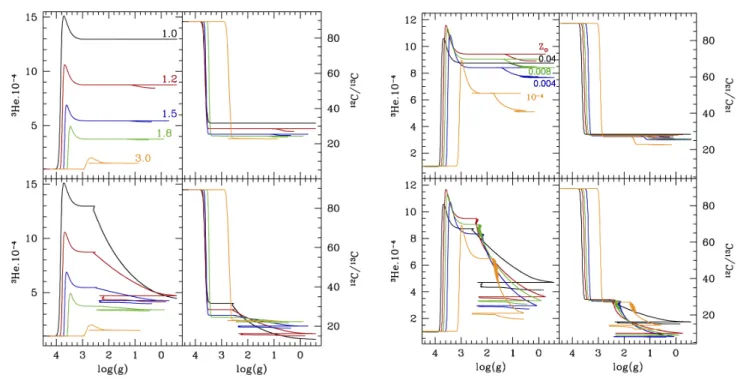
Fig. 1. Theoretical evolution of3He and carbon isotopic ratio at the stellar surface as a function of surface gravity for stellar models of : left panels
various masses (1.0 ; 1.2 ; 1.5 ; 1.8 ; 3.0 M represented by a black, red, blue, green and orange solid line, respectively) at Z=0.04 ; right panels
various metallicities ([Fe/H]= 0.5 ; 0 ; -0.23 ; -0.54 ; -2.14 represented by a black, red, blue, green and orange solid line, respectively) at M=1.2 M . These models include the effects of thermohaline instability (bottom panels) and following standard evolution (top panels). These tracks are
shown from the main sequence up to the early-AGB.
et al. 2014) intended to meld the formation and evolution scenarii of the Galaxy, stellar formation and evolution theory, models of stellar atmospheres, as well as dynamical constraints, in order to make a consistent picture of the Galaxy in comparison with available observations (photometry, asteroseismology, astrome-try, and spectroscopy) at different wavelengths.
To benefit from the combination of recent asteroseismic and spectroscopic surveys, we updated the evolutionary tracks that are used as inputs in the BGM. These stellar evolution models are computed with the code STAREVOL (e.g. Lagarde et al. 2012a), which follows the global, chemical and seismic properties of stars all along their evolution. This is done from the pre-main sequence (along the Hayashi track) to the early-asymptotic giant branch (early-AGB). These models include the effects of different transport processes such as thermohaline instability (discussed in this paper).
The aim of this series of papers is to investigate the impacts of different hydrodynamic processes that occur inside the stars on the chemical properties of Galactic stellar populations. In the context of the interpretation of large spectroscopic surveys such as APOGEE, or Gaia-ESO, we will perform comparison between theoretical synthetic populations and spectroscopic sur-veys in forthcoming papers (Lagarde et al. in prep. Part II). In this paper, we focus on presenting and discussing the implemen-tation in the Besançon Galaxy model of stellar evolution mod-els that include the effects of thermohaline instability on global, chemical and seismic properties. We discuss the determination of stellar ages and masses from the [C/N] ratio. We plan to fo-cus on the effects of rotation and the implementation of differ-ent prescriptions for thermohaline instability on stellar ages and chemical properties in a separate forthcoming paper (Part III). In Sect.2 we present the input physics of our stellar evolution
Table 1. Stellar Evolution models
Metallicity sets Stellar mass Mixing
Z ([Fe/H], [α/Fe]) (M ) Z=0.04 (0.51, 0) Z=0.0134 (0, 0) 0.6, 0.7, 0.8, 0.9, 1.0, Standard, Z=0.008 (-0.23, 0) 1.1, 1.2, 1.3, 1.4, 1.5, Thermohaline Z=0.004 (-0.54, 0) 1.6, 1.7, 1.8, 1.9, 2.0, Z=0.0001 (-2.15, 0.3)
models and briefly recall the impacts of thermohaline instability on the chemical properties of giant stars. The Besançon Galaxy Model is presented in Sect.3, while in Sect. 4 we present syn-thetic stellar populations, taking into account the effects of ther-mohaline mixing or following the standard prescription. We also present the new quantities that can be simulated by the BGM. In Sect. 5, we discuss the determination of stellar ages and masses from the surface carbon and nitrogen abundances, and we pro-vide relations for three metallicity ranges. We conclude and ex-plore some perspectives in Sect. 6.
2. Stellar evolution models
2.1. Description of stellar evolution models
Stellar evolution models are computed with the code STAREVOL (e.g. Lagarde et al. 2012b) for a range of masses between 0.6 M and 6.0 M at five metallicities Z=0.04 ([Fe/H]=0.51), Z=0.0134 ([Fe/H]=0), Z=0.008 ([Fe/H]=-0.23), Z=0.004 ([Fe/H]=-0.54) and Z=0.0001 ([Fe/H]=-2.14). These models are computed from the pre-main sequence to the early-AGB phase. We use the same main physical ingredients that are used and fully described in Lagarde et al. (2012b), except for:
burning. This instability develops as long thin fingers whose aspect ratio is consistent with prediction by Ulrich (1972) and with the laboratory experiments (Krishnamurti 2003). Although the efficiency of thermohaline instability in stellar interiors is still discussed in the literature by hydrodynamical simulations (Denissenkov 2010; Traxler et al. 2011, Prat et al in prep.), we adopt an aspect ratio equal to 5, which might correspond to the maximum efficiency of this instability.
As discussed by Charbonnel & Lagarde (2010) and Angelou et al. (2011, 2012), this mechanism has a crucial effect on surface chemical properties of red-giant branch stars. Its effect is consistent with most of spectroscopic observations of low-mass and intermediate-mass stars, especially in reproducing the low-12C/13C and the [C/N] ratio in open clusters (e.g. Tautvaišien˙e et al. 2016; Drazdauskas et al. 2016; Tautvaišien˙e et al. 2015, 2013; Mikolaitis et al. 2010; Smiljanic et al. 2009) as well as in CoRoT targets (Morel et al. 2014; Lagarde et al. 2015). It has also a very significant impact on the chemical evolution of light elements in the Milky Way (Lagarde et al. 2011) allowing the resolution of the long-standing ”3He-problem" in our Galaxy (Lagarde et al. 2012b).
In the following section, we briefly describe the evolution of stars and present the effects of thermohaline mixing on the surface abundances of3He and carbon isotopic ratio drawing the stellar evolution.
2.2. Chemical evolution of low- and intermediate-mass giant stars
Figure 1 presents the theoretical evolution of Helium-3 and car-bon isotopic ratio for different initial masses and metallicities from the main sequence to the early-AGB.
2.2.1. Standard evolution
After the main sequence, a star experiences core contraction to increase its central temperature, then evolves rapidly toward the red giant branch (RGB). During this phase, called the ”Sub giant branch“ (SGB) when the stars cross HR diagram almost hor-izontally, the convective envelope grows in mass and deepens inside the star. This is the first dredge-up, where the convective envelope is diluted with hydrogen-processed material, inducing changes of the surface abundances. This episode occurs at higher luminosity when the metallicity decreases as well as when the stellar mass increases. The surface mass fractions of7Li, 9Be,
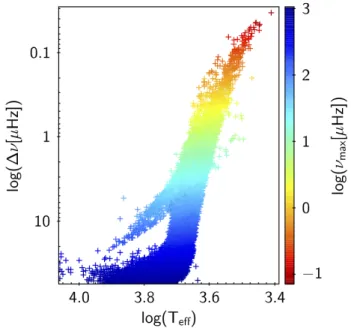
Fig. 2. The large separation,∆ν, as a function of the effective temper-ature, Teff, for synthetic population computed with the BGM. Colours
indicate the νmax, the frequency at which the power spectrum is
maxi-mum.
12C and18O decrease while those of3He,4He,13C,14N, and17O increase, implying a decrease at the surface of the isotopic ra-tios12C/13C, and12C/14N. Figure 1 clearly shows the signature of this episode (e.g. at log(g)∼3.8 for 1.2M ).
As shown by Charbonnel (1994), the first dredge-up e ffi-ciency (in terms of maximum depth of the convective envelope) decreases with decreasing metallicity. For a given stellar mass, Fig.1 (right panel) shows that the depletion of12C/13C and the increase of3He begin at lower gravity when the metallicity creases. The chemical variations during the first dredge-up de-pend on the initial stellar mass as well as on the metallicity. For a given metallicity, when the initial stellar mass increases, Fig.1 (left panels) shows that the post dredge-up values of carbon iso-topic ratio and3He decrease, as well as at the given stellar mass when the metallicity decreases (right panel). This dependence is true for12C/14N, as well as for oxygen isotopic ratios. This is due to the convective envelope reaching deeper regions during the first dredge-up. From the sub giant branch to the RGB tip, the temperature at the base of the convective envelope is always insufficient to activate nuclear reactions. As a consequence, in standard models (top panels of Fig. 1) the only change in sur-face abundances is due to the first dredge-up on the SGB; after this episode the surface abundances remain constant along the RGB once the convective envelope recedes and until the second dredge-up occurs at the end of the helium burning phase. 2.2.2. Thermohaline instability during the RGB
Thermohaline mixing has recently been flagged as the main mechanism that can govern the photospheric chemical compo-sition of low-mass bright giant stars (Charbonnel & Zahn 2007; Charbonnel & Lagarde 2010). In such stars, thermohaline in-stability is a double-diffusive instability induced by the molec-ular weight inversion created by the 3He(3He,2p)4He reaction in the external region of the hydrogen-burning shell (Eggleton et al. 2006, 2008). As discussed by Charbonnel & Zahn (2007) and Charbonnel & Lagarde (2010), this instability is expected to
A&A proofs: manuscript no. article_pop_astroph
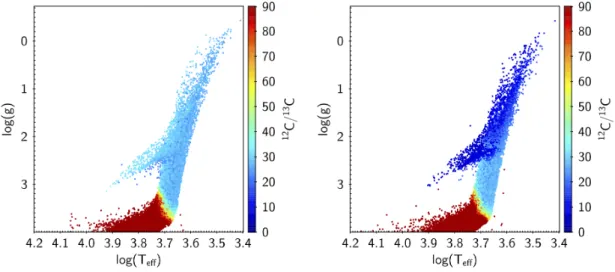
Fig. 3. Surface gravity as a function of effective temperature for synthetic populations computed with the BGM including the effects of thermoha-line instability (right panel) or not (left panel). The colour code represents the carbon isotopic ratio at the surface of stars in the thin disc.
set in after the first dredge-up when the star reaches the RGB-bump (at log(g)∼2.5 on bottom panels of Fig.1). In terms of stel-lar structure, the RGB bump corresponds to the moment when the hydrogen-burning shell encounters the chemical discontinu-ity created by the convective envelope at its maximum pene-tration during the first dredge-up. When the hydrogen burning shell (which provides the stellar luminosity on the RGB) reaches the H-rich previously mixed zone, the corresponding decrease in molecular weight of the H-burning layers induces a drop in the total stellar luminosity, creating a bump in the luminosity func-tion (i.e. Fusi Pecci et al. 1990; Charbonnel 1994; Charbonnel et al. 1998).
Thermohaline mixing induces a decrease of3He at the stellar surface after the RGB-bump. 13C and 14N diffuse outwards, while12C diffuses inwards (see for more details Charbonnel & Lagarde 2010), implying a decrease of12C/13C and [C/N]. The efficiency of thermohaline instability decreases when the stellar mass or stellar metallicity increase (see Fig. 1). In addition, thermohaline mixing induces a slight decrease of3He (Lagarde et al. 2011) and increase of nitrogen at lower metallicity during the central helium burning before the second dredge-up episode. Thermohaline instability does not change the evolutionary tracks in the HR-diagram and has not impact on stellar ages be-cause it has not significant effect on the stellar structure.
3. The Besançon Galaxy Model
The Besançon Galaxy Model (hereafter BGM) is a model using the population synthesis approach that simulates observations of the sky with errors and biases. It is based on assumptions and a scenario for the Galaxy formation and evolution that reflect the present knowledge about the Milky Way. Four stellar popu-lations are considered: a thin disc, a thick disc, a bar, and a halo, with each stellar population having a specific density distribu-tion. The stellar content of each population is modeled through an Initial Mass Function (IMF) and a Star Formation History (SFH), which can differ from one population to the other. To compute the stellar distribution at a given time, the stars gener-ated by these IMFs and SFHs follow evolutionary tracks. When they have reached their final age (the present time) their astro-physical parameters (mass, age, Teff, log(g), metallicity,
abun-dances...) are stored and used to compute their observational properties, using atmosphere models, and assuming a 3D extinc-tion map describing the interstellar extincextinc-tion they suffer. A dy-namical model is used to compute radial velocities and proper motions. In the simulations presented here, we make use of the 3D extinction map from Marshall et al. (2006).
For the time being, the metallicity of each star is the ini-tial metallicity of the gas when it was born, which is estimated assuming a time dependent metallicity from Haywood (2008), and a radial metallicity gradient of -0.7 dex/kpc. In the future a proper chemical evolution model will be incorporated.
The model takes into account the stellar binarity, by gener-ating secondary components at their birth, assuming a binarity probability depending on mass (see Czekaj et al. (2014) for more details). Then, according to the estimated spatial resolution of the observations to simulate, stars in systems are merged or not (that is, their fluxes are added if the stars are too close, projected on the plane of the sky).
In the present version of the model, only the thin disc is mod-elled this way, while the thick disc, bar and stellar halo are gen-erated using a Hess diagram computed from a fixed evolutionary scheme as described in Robin et al. (2003), which does not yet take into account binarity.
The stellar densities in different regions of the Galaxy are modulated by density laws for each population, which are given in detail in Robin et al. (2003) for the thin disc, Robin et al. (2012) for the bar, and Robin et al. (2014) for the thick disc and halo.
In the model version presented here, we use the evolutionary tracks described in Sect.2, instead of the Padova tracks used in Czekaj et al. (2014), from which surface abundances and astero-sismic parameters are computed for each simulated star. For stars of mass lower than 0.6 solar mass, Chabrier & Baraffe (1997) evolutionary tracks are still used, although those new properties are not computed yet.
4. Simulations of synthetic populations
As discussed in Part 2 and in the literature (Palacios et al. 2006; Lagarde et al. 2012a; Bossini et al. 2015), transport processes occurring in stellar interiors have significant impact on global (e.g. luminosity, effective temperature, age), chemical, and
seis-Fig. 4. Surface abundance of3He (in mass fraction, top-left panel),12C/13C (top-right panel), [C/Fe] (bottom-left panel), and [N/Fe] (bottom-right
panel) as a function of stellar mass for synthetic thin disc computed with the BGM. Stars have been selected to be in the clump according to their ∆Π`=1. The colour code represents the metallicity of stars. Simulations including or not the effects of thermohaline instability are represented by
colour-dots and crosses respectively.
mic properties. Population syntheses are powerful tools to study these processes using survey data. In the context of our study, we discuss the impact of thermohaline mixing on the properties of thin disc giants observed by asteroseismic and spectroscopic surveys. We shall consider in a future paper the thick disc pop-ulation, which differs from the thin disc by its [α/Fe] abundance ratio. For the present study we only consider stellar models ac-cording to solar α-abundance (i.e. [α/Fe]=0). In order to estimate the impact of these stellar models on the populations observed, we performed simulations with the BGM using these new stel-lar evolutionary tracks and assuming the IMF and SFR given in Czekaj et al. (2014). Simulations are performed, for example, in the Kepler field. They provide astrophysical parameters, as-teroseismic properties and surface abundances for 54 stable and unstable species. We study in this section the impact on the prop-erties of the simulated fields of this new models.
4.1. Asteroseismic properties
The detection of solar-like oscillations with the space missions CoRoT and Kepler provides powerful constraints on stellar mass and radius of giants stars. With the asymptotic period spacing of
gravity modes, these observations provide information on stellar structure (Mosser et al. 2012b; Lagarde et al. 2012a), as well as constraints on transport processes (Lagarde et al. 2016). Using the scaling relations (Tassoul 1980; Mosser et al. 2010; Belka-cem et al. 2011), the asteroseismic parameters of large separa-tion,∆ν, and frequency of maximum oscillation power, νmaxare directly related to stellar radii and masses:
M M ≈ νmax νmax, !3 ∆ν ∆ν !−4 T eff Teff, !3/2 (1) R R ≈ νmax νmax, ! ∆ν ∆ν !−2 T eff Teff, !1/2 (2) Solar reference values are∆ν =135.1µHz; νmax, =3090µHz, and Teff, =5777 K. Miglio (2012) and Mosser et al. (2013) pro-posed a relative correction to the scaling relations between red clump and RGB stars. This should affect the mass and radius de-terminations of clump stars up to ∼10% and ∼6% respectively. Different temperature scales have been tested in Miglio (2012) and agree within the quoted uncertainty range.
The population synthesis provides the seismic properties such as the large separation, the frequency with the maximum
A&A proofs: manuscript no. article_pop_astroph
amplitude, or the asymptotic period spacing of g-modes for stars in the thin disc (see Fig.2). It is well known that the age of gi-ant stars can be approximated by their lifetime on the main se-quence, which depends on the stellar mass and metallicity. In ad-dition, asteroseismology provides accurate stellar radii and thus allows the determination of distances. These observations of gi-ants belonging to the different populations of the Milky Way pro-vide additional constraints to study the formation and evolution of our Galaxy (Miglio et al. 2013). To fully exploit the potential of these observations, it is crucial to combine them with spectro-scopic surveys allowing the following of the chemical properties of the stars within the different stellar populations.
4.2. Surface chemical properties
Figure 3 shows the evolution of carbon isotopic ratio along the log(g) vs Teffdiagram in a simulation computed with the BGM. This figure clearly shows the impact of thermohaline instability on the12C/13C. The brighter-RGB and clump stars have a lower 12C/13C at the surface when thermohaline instability is included. Figure 4 shows the surface chemical properties of thin disc stars as a function of stellar mass, including or not the effects of thermohaline mixing. This figure focuses on clump stars selected by their asymptotic period spacing of g-modes∆Π(`=1). As shown by Charbonnel & Lagarde (2010) and recalled in Part 2, thermohaline mixing changes the surface chemical properties of stars more evolved than the RGB-bump. The efficiency of this mechanism with the metallicity and the stellar mass is also shown in Fig.4. Due to the strong effect of thermohaline mixing on its abundances, Helium-3 and12C/13C are the best indicators to constrain this mechanism during the RGB. Fig.4 shows also an impact on [C/Fe] and [N/Fe] but less important especially for upper metallicities.
Very recently, Masseron et al. (2016) used stellar models (at given mass and metallicity) to compare directly with the APOGEE observations. They claim that stellar evolution mod-els including transport processes (e.g. thermohaline instability and rotation-induced mixing) overestimate the N-abundance in red-clump stars. However this study only considers models with a given mass and does not account for the range of masses and metallicities that are present in observational data. To compare large surveys including stars at different masses and metallici-ties, synthetic population analysis is the most efficient method to validate the models by comparing the data with simulations, accounting for a realistic range of mass, metallicities and for ob-servational biaises. A detailed comparison between our synthetic populations and large surveys will be done in the Part II of this series (Lagarde et al in prep.).
5. Determination of age and mass using [C/N] ratio
Recent studies (e.g. Martig et al. 2015; Masseron & Gilmore 2015) have proposed to use [C/N] to determine stellar ages and masses of red-giant stars. However, these studies do not take into account the effects of mixing occurring in the stellar interiors, stellar input physics and possible changes of these relations at different evolutionary stages. Figure 5 shows [C/N]-dependency with stellar masses and ages, with and without thermohaline in-stability. Giant stars are divided into three groups: (1) Lower-RGB stars, stars ascending the red-giant branch before the Lower- RGB-bump (log(g)>2.2). These stars do not yet undergo thermohaline mixing ; (2) Upper-RGB : brighter RGB stars with log(g)≤2.2 ; (3) Clump stars selected according to their∆Π(`=1)values.
Considering standard stellar evolution models only (gray dots on Fig. 5), [C/N] seems to be a good proxy to determine stel-lar masses along the red giant branch and during the He-burning phase. Standard models show a more important dispersion of [C/N] with stellar age than with mass for the first ascent red-giant stars (lower-RGB and upper-RGB). Although [C/N] ratio at the stellar surface is directly related to the stellar properties (mass or metallicity), we point out the difficulty to determine an accu-rate stellar age from these properties. As discussed by Lebreton et al. (2014a) stellar evolution models are still affected by several uncertainties (e.g. [Fe/H], α-enhancement, solar mixture, initial He-abundances, transport processes) which can significantly af-fect the determination of stellar ages from the chemical proper-ties of stars.
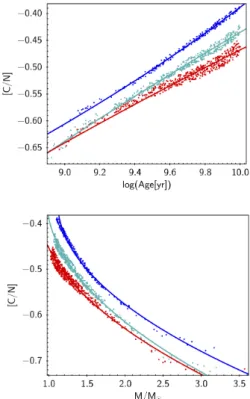
Fig. 6. Surface abundance of [C/N] for clump stars as a function of stellar ages (top panel) and stellar masses (bottom panel) for a synthetic thin disc computed with the BGM. Stars are divided in three metallicity-bins: -0.20≤ [Fe/H] ≤ -0.10 (blue dots), -0.05 ≤ [Fe/H] ≤ +0.05 (green dots), and+0.15 ≤ [Fe/H] ≤ +0.25 (red dots). Relations between [C/N] and mass and age (Eq. 3 and 4) are also shown with the solid lines.
In this context, Figure 5 (colour-dots) shows the impact of thermohaline instability on the [C/N] vs age and vs mass di-agrams. As thermohaline instability changes the surface abun-dances in carbon and nitrogen after the bump, large dispersions of [C/N] with mass and age are noticeable for upper-RGB stars. Since this mechanism does not significatively affect the surface chemical properties of clump stars, relationships between [C/N] with masses and ages can be establish. These relationships can be determined at a given metallicity for clump stars contrary to upper-RGB stars.
Figure 6 shows thin-disc clump stars divided in three [Fe /H]-bins: (1) lower metallicity (-0.20≤ [Fe/H] ≤ -0.10) ; (2) solar metallicity (-0.05 ≤ [Fe/H] ≤ +0.05) ; (3) higher metallicity (+0.15 ≤ [Fe/H] ≤ +0.25). In Eq. 3 and 4, we present relations al-lowing to estimate stellar masses and ages (resp.) of clump stars from [C/N] abundance ratio, in each metallicity range,
assum-= for − 0.05 ≤ [Fe/H] ≤+0.05 −2.766 · [C/N]2+ 1.845 · [C/N] + 11.13 for+ 0.15 ≤ [Fe/H] ≤ +0.25 Importantly, the relation with age depends on the stellar model used. It is then crucial to validate the models and the mix-ing processes before usmix-ing ages for Galactic archeology. In a forthcoming paper, we shall discuss the effects of rotation on these relations and estimate the accuracy of age and mass deter-minations using surface chemical properties.
6. Conclusions
In this paper, we have presented a new version of the Besançon stellar population synthesis model of the Galaxy including a new grid of stellar evolution models computed with the code STAREVOL. This new stellar grid of single-star evolution mod-els is computed for five metallicities in the mass range between 0.6 and 6.0 M , including the effects of thermohaline instabil-ity during the red-giant branch. These models provide the global (e.g. surface gravity, effective temperature,...), chemical (surface properties for 54 stable and unstable species) as well as seismic properties (∆ν,νmax,∆Π(`=1)). Thermohaline mixing occuring in thin disc giants has been shown to produce measurable effects on the chemical properties, in particular on12C/13C and [C/N] ratios. Stellar evolution models at different α-enhancement are being computed to study the older populations, such as the thick disc, the halo and the bulge, and will be presented in a forthcom-ing paper.
By comparing the BGM simulations with observations from large spectroscopic and seismic surveys, we are able to constrain the physics of the transport processes occurring in stellar interi-ors. Red giants observed from asteroseismology can be now used as new cosmic clock, allowing age calibration from chemical observations. Applying the new version of the BGM, we derive mean relations between [C/N] and age, usable to estimate ages for thin-disc red-clump giants, knowing their metallicity. Con-trarily to previously derived relationships, ours take into account the natural spread in mass and metallicity of the underlying pop-ulation, and allows to include selection biases in the surveys. In a forthcoming paper of this series, we shall investigate the impact of different prescriptions for thermohaline instability on these relations, as well as the effect of rotation-induced mixing.
Thanks to WEAVE, 4MOST, and PLATO the future looks extremely promising in terms of collecting spectroscopic and seismic data for a large number of stars. The Besançon Galaxy
Baglin, A. & Fridlund, M. 2006, in ESA Special Publication, Vol. 1306, The CoRoT Mission Pre-Launch Status - Stellar Seismology and Planet Finding, ed. M. Fridlund, A. Baglin, J. Lochard, & L. Conroy, 11
Beck, P. G., Montalban, J., Kallinger, T., et al. 2012, Nature, 481, 55 Bedding, T. R., Mosser, B., Huber, D., et al. 2011, Nature, 471, 608 Belkacem, K., Goupil, M. J., Dupret, M. A., et al. 2011, A&A, 530, A142 Bossini, D., Miglio, A., Salaris, M., et al. 2015, MNRAS, 453, 2290 Chabrier, G. & Baraffe, I. 1997, A&A, 327, 1039
Charbonnel, C. 1994, A&A, 282, 811
Charbonnel, C., Brown, J. A., & Wallerstein, G. 1998, A&A, 332, 204 Charbonnel, C. & Lagarde, N. 2010, A&A, 522, A10
Charbonnel, C. & Zahn, J.-P. 2007, A&A, 467, L15
Cui, X.-Q., Zhao, Y.-H., Chu, Y.-Q., et al. 2012, Research in Astronomy and Astrophysics, 12, 1197
Czekaj, M. A., Robin, A. C., Figueras, F., Luri, X., & Haywood, M. 2014, A&A, 564, A102
Denissenkov, P. A. 2010, ApJ, 723, 563
Drazdauskas, A., Tautvaišien˙e, G., Randich, S., et al. 2016, A&A, 589, A50 Eggleton, P. P., Dearborn, D. S. P., & Lattanzio, J. C. 2006, Science, 314, 1580 Eggleton, P. P., Dearborn, D. S. P., & Lattanzio, J. C. 2008, ApJ, 677, 581 Freeman, K. & Bland-Hawthorn, J. 2002, ARA&A, 40, 487
Fusi Pecci, F., Ferraro, F. R., Crocker, D. A., Rood, R. T., & Buonanno, R. 1990, A&A, 238, 95
Gaia Collaboration, Brown, A. G. A., Vallenari, A., et al. 2016, ArXiv e-prints [arXiv:1609.04172]
Gilliland, R. L., Brown, T. M., Christensen-Dalsgaard, J., et al. 2010, PASP, 122, 131
Gilmore, G., Randich, S., Asplund, M., et al. 2012, The Messenger, 147, 25 Haywood, M. 2008, MNRAS, 388, 1175
Krishnamurti, R. 2003, Journal of Fluid Mechanics, 483, 287
Lagarde, N., Bossini, D., Miglio, A., Vrard, M., & Mosser, B. 2016, MNRAS, 457, L59
Lagarde, N., Charbonnel, C., Decressin, T., & Hagelberg, J. 2011, A&A, 536, A28
Lagarde, N., Decressin, T., Charbonnel, C., et al. 2012a, A&A, 543, A108 Lagarde, N., Miglio, A., Eggenberger, P., et al. 2015, A&A, 580, A141 Lagarde, N., Romano, D., Charbonnel, C., et al. 2012b, A&A, 542, A62 Lebreton, Y., Goupil, M. J., & Montalbán, J. 2014a, in EAS Publications Series,
Vol. 65, EAS Publications Series, 99–176
Lebreton, Y., Goupil, M. J., & Montalbán, J. 2014b, in EAS Publications Series, Vol. 65, EAS Publications Series, 177–223
Majewski, S. R., Schiavon, R. P., Frinchaboy, P. M., et al. 2015, ArXiv e-prints [arXiv:1509.05420]
Marshall, D. J., Robin, A. C., Reylé, C., Schultheis, M., & Picaud, S. 2006, A&A, 453, 635
Martig, M., Rix, H.-W., Aguirre, V. S., et al. 2015, MNRAS, 451, 2230 Masseron, T. & Gilmore, G. 2015, MNRAS, 453, 1855
Masseron, T., Lagarde, N., Miglio, A., Elsworth, Y., & Gilmore, G. 2016, ArXiv e-prints [arXiv:1610.03286]
Miglio, A. 2012, Asteroseismology of Red Giants as a Tool for Studying Stellar Populations: First Steps, ed. A. Miglio, J. Montalbán, & A. Noels, 11 Miglio, A., Chiappini, C., Morel, T., et al. 2013, MNRAS, 429, 423 Miglio, A., Montalbán, J., Carrier, F., et al. 2010, A&A, 520, L6
Mikolaitis, Š., Tautvaišien˙e, G., Gratton, R., Bragaglia, A., & Carretta, E. 2010, MNRAS, 407, 1866
Morel, T., Miglio, A., Lagarde, N., et al. 2014, A&A, 564, A119 Mosser, B., Belkacem, K., Goupil, M.-J., et al. 2010, A&A, 517, A22 Mosser, B., Goupil, M. J., Belkacem, K., et al. 2012a, A&A, 548, A10
A&A proofs: manuscript no. article_pop_astroph
Mosser, B., Goupil, M. J., Belkacem, K., et al. 2012b, A&A, 540, A143 Mosser, B., Michel, E., Belkacem, K., et al. 2013, A&A, 550, A126 Palacios, A., Charbonnel, C., Talon, S., & Siess, L. 2006, A&A, 453, 261 Robin, A. C., Marshall, D. J., Schultheis, M., & Reylé, C. 2012, A&A, 538,
A106
Robin, A. C., Reylé, C., Derrière, S., & Picaud, S. 2003, A&A, 409, 523 Robin, A. C., Reylé, C., Derrière, S., & Picaud, S. 2003, A&A, 409, 523 Robin, A. C., Reylé, C., Fliri, J., et al. 2014, A&A, 569, A13
SDSS Collaboration, Albareti, F. D., Allende Prieto, C., et al. 2016, ArXiv e-prints [arXiv:1608.02013]
Smiljanic, R., Gauderon, R., North, P., et al. 2009, A&A, 502, 267 Steinmetz, M., Zwitter, T., Siebert, A., et al. 2006, AJ, 132, 1645 Stello, D., Bruntt, H., Preston, H., & Buzasi, D. 2008, ApJ, 674, L53 Tassoul, M. 1980, ApJS, 43, 469
Tautvaišien˙e, G., Bariseviˇcius, G., Chorniy, Y., Ilyin, I., & Puzeras, E. 2013, MNRAS, 430, 621
Tautvaišien˙e, G., Drazdauskas, A., Bragaglia, A., Randich, S., & Ženovien˙e, R. 2016, A&A, 595, A16
Tautvaišien˙e, G., Drazdauskas, A., Mikolaitis, Š., et al. 2015, A&A, 573, A55 Traxler, A., Garaud, P., & Stellmach, S. 2011, ApJ, 728, L29+
Turon, C., Primas, F., Binney, J., et al. 2008, The Messenger, 134, 46 Ulrich, R. K. 1972, ApJ, 172, 165
Vrard, M., Mosser, B., & Samadi, R. 2016, A&A, 588, A87 Yanny, B., Rockosi, C., Newberg, H. J., et al. 2009, AJ, 137, 4377
Fig. 5. Surface abundance of [C/N] as a function of stellar ages (left panels) and stellar masses (right panels), colour-coded by metallicity, for a synthetic thin disc computed with the BGM. Stars have been selected to be in the clump according to their∆Π`=1, as well as before and after the RGB-bump according to their log(g) values. Simulations including or not the effect of thermohaline instability are shown as colour-dots and gray crosses respectively.
![Fig. 4. Surface abundance of 3 He (in mass fraction, top-left panel), 12 C/ 13 C (top-right panel), [C/Fe] (bottom-left panel), and [N/Fe] (bottom-right panel) as a function of stellar mass for synthetic thin disc computed with the BGM](https://thumb-eu.123doks.com/thumbv2/123doknet/14759656.584401/6.892.115.790.94.651/surface-abundance-fraction-panel-function-stellar-synthetic-computed.webp)
![Fig. 5. Surface abundance of [C/N] as a function of stellar ages (left panels) and stellar masses (right panels), colour-coded by metallicity, for a synthetic thin disc computed with the BGM](https://thumb-eu.123doks.com/thumbv2/123doknet/14759656.584401/10.892.75.823.91.961/surface-abundance-function-stellar-stellar-metallicity-synthetic-computed.webp)
