by
Edward Yik Chow
S.B., Massachusetts Institute of Technology 1974
SUBMITTED IN PARTIAL FULFILLMENT OF THE REQUIREMENTS FOR THE DEGREE OF
MASTER OF SCIENCE at the
MASSACHUSETTS INSTITUTE OF TECHNOLOGY February, 1976
Signature
of Author......
r.
-. r.-Department of Electrical Engineering and Computer Science, January 30, 1976
Certified by .
... .A0".
. . . .-4-. . . .Thesis
Supervisor
Accepted by . . .W.j
-Chairman, Departmental Committee on Graduate Students
ICH
vu:
CAPR
2
1976
IRRA Lby
Edward Yik Chow
Submitted to the Department of Electrical Engineering and Computer Science on 30 January 1976 in partial fulfillment of the requirements for the Degree of Master of Science
ABSTRACT
The generalized likelihood ratio (GLR) technique has been suggested for detecting failures in linear dynamical systems. This thesis reports a study of this technique in an effort to provide a framework in which one can systematically study the
various tradeoffs involved in the design of GLR failure detection systems. Some performance indices are defined. Important ques-tions related to the performance of the detection scheme such as the detectability and distinguishability of failures are examined. Possible modification of the original scheme for improved per-formance is also considered.
THESIS SUPERVISOR: TITLE:
Alan S. Willsky
Assistant Professor of Electrical Engineering
-2-I would like to express my deep gratitude to Prof. Alan Willsky for his guidance and patience throughout the research, Drs. K. P. Dunn and S. B. Gershwin for many discussions and encouragements.
Sincerely, I would like to thank Mr. Arthur Giordani, Ms. Susanna Natti and Ms. Margaret Flaherty for preparing the final draft of this report.
This research was conducted at the Electronic Systems Laboratory, M. I. T. with support from the NASA Langley Research Center under Grant No. NSG-1112.
-3-Abstract 2 Acknowledgements 3 Table of Contents 4 List of Figures 6
1.
Introduction 71.1
Motivation
7
1.2 Description of the GLR Technique 9
1. 3 Overview of the Research 17
2. Static Analysis 18
2.1 Summary of the GLR Equations 18
2.1.1 The General Case 19
2.1.2 Steady-State, Time-Invariance Simplification 23
2.2 Static Probabilities 25
2.2.1 Full GLR:
X
Probabilities 272.2.2 SGLR: Gaussian Probabilities 31
2.2. 3 Discussion 33
2.3 The Information C Matrix 35
2.3.1 C
1(k;
0): the Error Covariance of V 352.3.2 Asymptotic Behavior of C(r) 39
2.4 Undetectable Failure Directions 43
-4-2.5 Distinguishability of Failures 49
3. Correlation Studies 57
3.1 The Covariance of ,(k; 0) 57
3.2 Some Additional Probabilities 60
3.3 Other Possible Decision Rules 65
4. A Numerical Example and Conclusions 68
4.1 A Simplified Aircraft Model 68
4.2 Conclusions and Suggestions for Future Research 87
Appendix
90
References
94
-5-Figure
1.
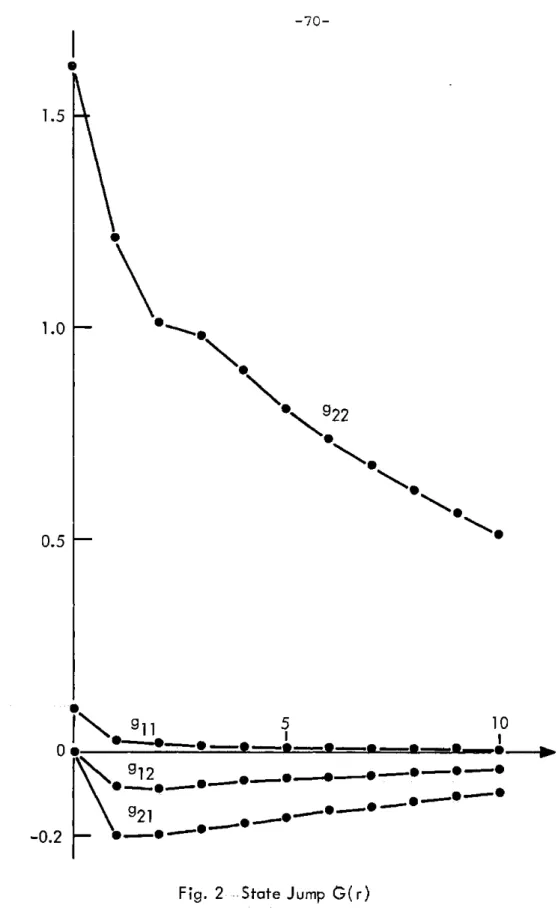
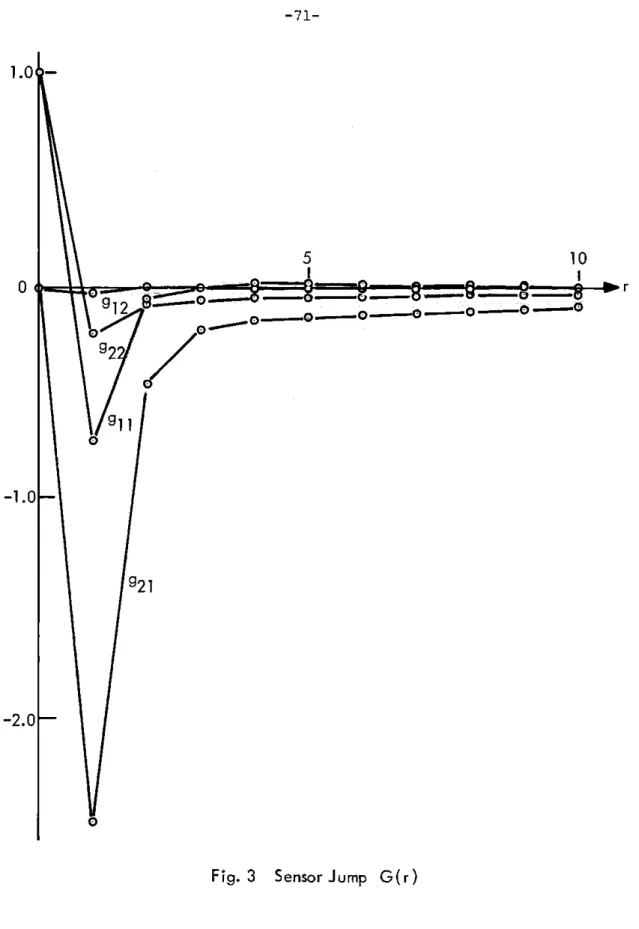
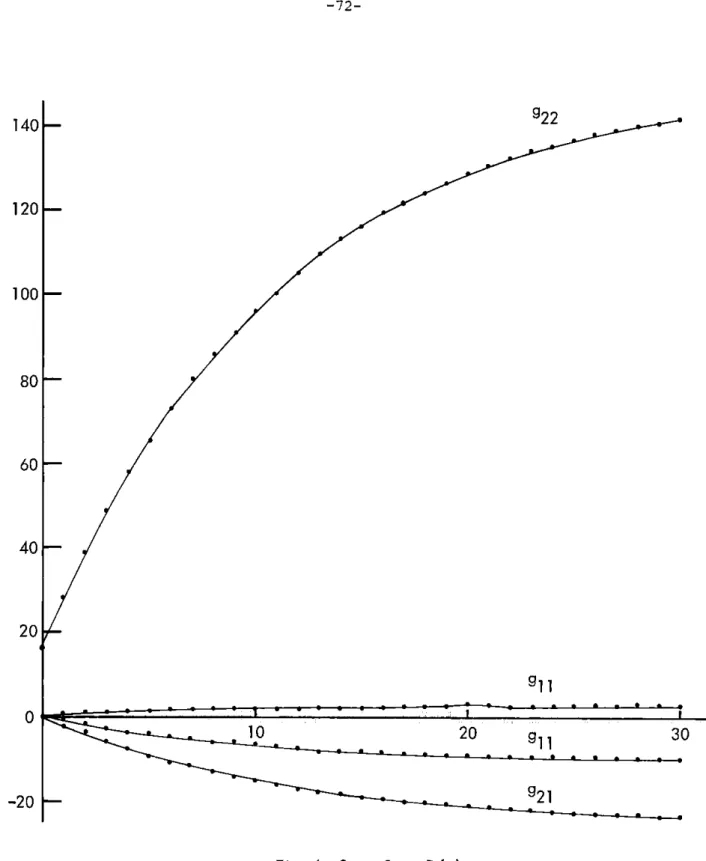
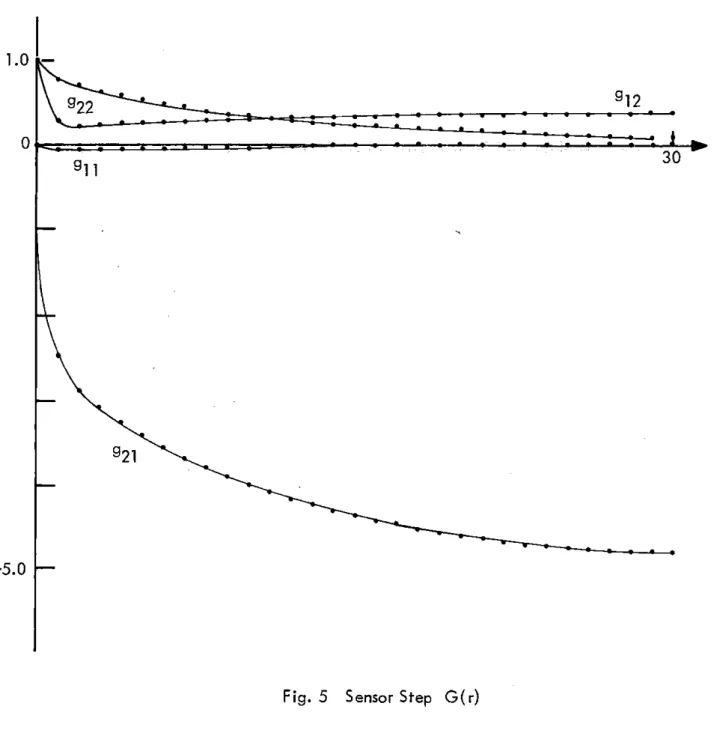
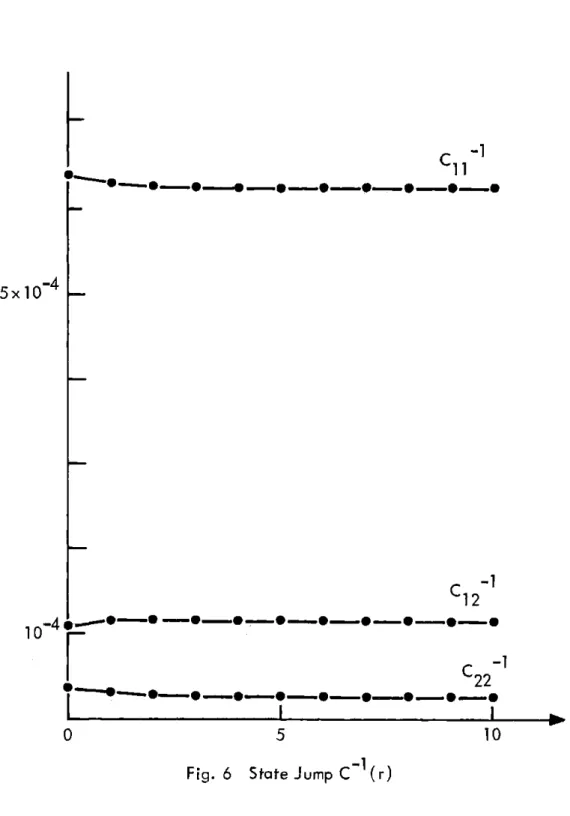
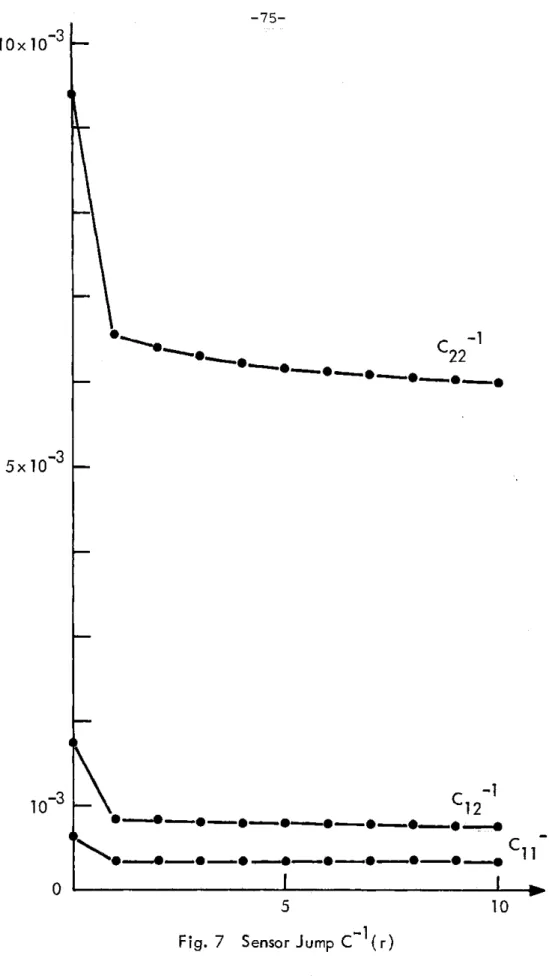
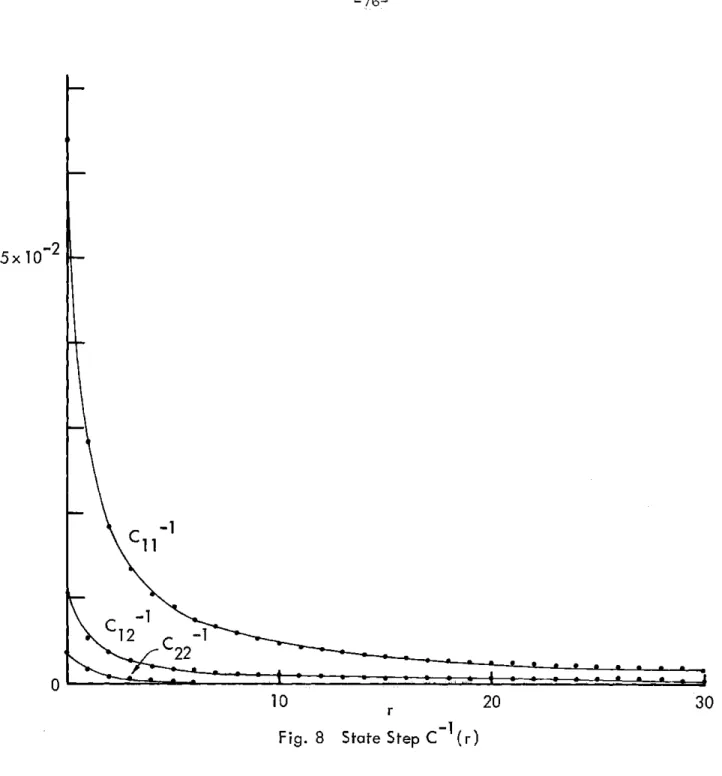
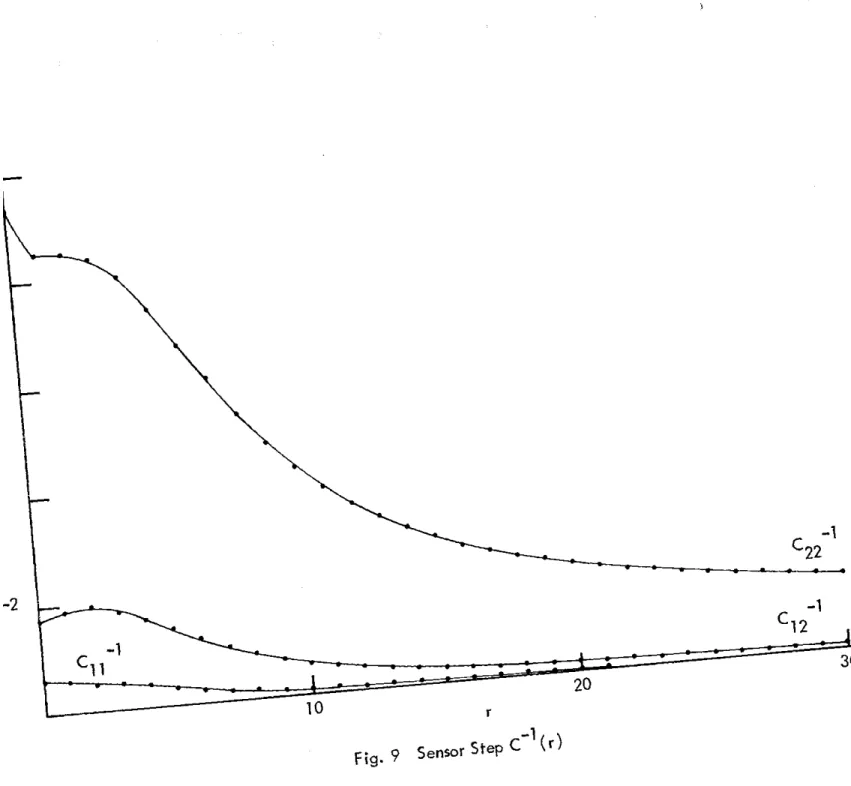
-6-Full GLR Detector Scheme with Growing Bank of Filters State Jump G(r) Sensor Jump G(r) State Step G(r) Sensor Step G(r) State Jump C (r)
-l
Sensor Jump C (r) State Step C (r) Sensor Step C (r) 25(TxState Jump5 and P
DwithE:=
5
5a
Sensor
Jump 2 and P withE=
5 D2
1G
StateStep
6
and PD
with e = 5 2lcY
Sensor Step
6
and P with c
=5
D
Wrong Time Cross Detection Probability
Pk of a Chi Squared Random Variable with 2 Degrees of Freedom Figure Figure Figure Figure Figure Figure Figure Figure Figure Figure Figure Figure Figure Figure 2. 3.
4.
5.
6.7.
8.
9.10.
11.
12. 13. 14.15.
14
70
71
72
73
74
75
76
77
78
79
80
81
82
93
1.1 Motivation
Many aspects of recent developments of systems theory are con-cerned with the improvement of the performance of control systems. One such concern is the detection of abrupt changes in dynamical systems. Examples of abrupt changes are actuator or sensor failures in an
air-craft and sudden changes in the rhythm of cardiac activities as measured on an electrocardiagram [6]. For simplicity, all such abrupt changes will be termed as "failures" even though a physical failure may not be the cause of the abrupt change. The detection of failures may be viewed as consisting of three tasks: set off an alarm when a failure develops, then isolate the failure type, and estimate the extent of the failure.
Most of the failure detection analysis has been performed in the context of a state space description of a linear dynamical system as
follows:
State Equation:
x(k+l) =
c(k)x(k)
+ B(k)u(k) + w(k) (1-1) Sensor Equation:z(k)
= H(k)x(k) + J(k)u(k) +v(k)
(1-2)where u is a known input, w and v are independent, zero mean, white
-7-gaussian random sequences with covariances:
Efx(j)w'(k)} =
Qd
;Ev(j)v'
(k)} =R6.(1-3)
jk
jk(13
where
6
. is the Kronecker delta.jk
Abrupt changes of the system may appear in (1-1) ("actuator failure") or in (1-2) ("sensor failures"). Actuator failures may take the form of a shift in the control gain matrix B, a bias on the right hand side (RHS) of (1-1) or a change in the process noise, correspond-ing, for example, to the failure of the actuator or control surfaces on an aircraft, a leak in the thruster of a space vehicle and a sudden shift in wind conditions (in an aircraft control situation) respec-tively. In these cases, an accurate knowledge of the failure is clearly vital (assuming there is a re-organizational procedure to compensate for the failure), as an undetected failure could easily lead to the loss of the vehicle. Changes in sensor noise and the H and J matrices are examples of sensor failures. These are the causes of erroneous state estimates and produce very undesirable effects in a feedback control system that utilizes these sensor outputs in the feedback loop.
Recent studies have provided different approaches to the problem of detecting failures. The "failure sensitive" filter developed by Beard [1] and Jones [2], the voting system studied by Broen [3] and the multiple hypotheses filters employed by Gustafson, Willsky and Wang in the classification of rhythms and detecting rhythm shifts in
electrocardiagram [6] are examples of some failure detection schemes. Very often, the tradeoffs among the various approaches are detector
complexity vs. detector sensitivity and detector sensitivity vs. detec-tor false alarm rate. Hence the applicability of the different schemes depends on the particular situation and the performance criteria under consideration. With the decreasing cost of digital hardward and in-creasing availabiltiy of computers, many of these detection methods are becoming feasible for on-line implementation.
In [4], [5], Willsky and Jones have suggested the generalized likelihood ratio (GLR) approach to failure detection. As noted by
Willsky [9], the GLR approach can be applied to a wide range of actuator and sensor failures. The method also provides an estimate of the
failure size which is useful in system reorganization after the failure is determined to have occurred. The technique may be simplified in a number of ways making it more attractive from an implementation point of view. In addition, the tradeoff between complexity and performance may be studied analytically. In this thesis research, the GLR approach to
failure detection is studied to obtain insights into its limitations and to develop some guidelines in the design of GLR failure detection systems.
1.2 Description of the GLR Technique
The GLR failure detection system assumes a linear system des-cribed by (1-1), (1-2) and a Kalman Bucy filter (that assumes no failure)
characterized by the following:
x(kjk) = x(k k-l) + K(k)y(k) (1-5)
y(k)
= z(k) - H(k) (kik-1) - J(k)u(k) (1-6)where x(ijj) is the mean of x(i) given z(O), z(l), ... , z(j) and P(iij) is the associated error covariance. The quantity y is the zero mean, white gaussian innovations process (or the residual) with covariance V.
K is the Kalman Bucy filter gain computed as follows:
P(k+ljk) =
P(k)P(k
k)'(k) +Q
(1-7)V(k)
= H(k)P(klk-l)H'(k) + R (1-8)K(k) = P(klk-l)H'(k)V~1(k) (1-9)
P(klk) = P(klk-1) - K(k)H(k)P(kJk-l) (1-10)
The four basic failure types (modes) under consideration are modeled as:
Type 1: state jump
x(k+1)
=4)k)x(k)
+B(k)u(k)
+w(k)
+V
6k+l
(11 )
Type 2: state step
x(k+l) =
1(k)x(k)
+ B(k)u(k) + w(k) +V6k+1;6
(1-12) Type 3: sensor jumpz(k) = H(k)x(k) + J(k)u(k) +
v(k)
+v6k;e
(1-13) Type 4: sensor stepz(k) = H(k)x(k) + J(k)u(k) +
v(k)
+V
6k;e
(1-14)
where1
if
k= S
k;O = 0 otherwise
0 k < 8
k;
1
=>(1-16)
Thus 0 has the meaning as the "failure time" and V is the failure vector of appropriate dimension. We note that the original GLR method devised by Willsky and Jones [4], [5] was developed for type 1 failures.
Due to the linearity of the system and filter, in the event of a failure, the residual can be expressed as:
y(k)
=y(k)
+ G. (k;0)v (1-17)where y is the residual in the absence of any failure. G. is a matrix (i=l,2,3,4, denoting the failure type). The equations that one can use to compute the G. are given in Section 2.1. Then G. (k;0) is the effect of the type i failure V that occurred at time
0
on the residual attime k. We can establish two hypotheses: H 0: no failure has occurred
H. : a failure of type i (V and 0 unknown) has occurred. Then the generalized likelihood ratio (GLR) is defined by
p(Y(1),...,
y(k)H.8, 0
= 0(k),V
= v(k))L
.(k)
= 1(1-18))p
(Y(l),...,
y(k)1H
0
)
where p denotes probability density function; 0(k) and
V(k)
are the maximum likelihood estimates (MLE) of V and 0 assuming H. to be true defined by:0(k), V(k)
= arg max p(y(1), ...y(k)H.
0
=0,
v
=v)
(1-19)
(k) G. (k;8)
v
(1-20) for some unknown8
and V. When H0 is true, the residual becomesy(k)
=y(k)
(1-21)Using the fact that the y's are gaussian independent variables and equations (1-20) and (1-21), the logarithm of (1-18) can be expressed as PI(k) = 2 Zn L. (k) 1
k
-EY'(j)v y(j)
j=l
k
[Y(j)-G
(k;6(k))v(k)] 'v(j)
[y(j)-G (k;e(k))v(k)]
j=1
(1-22) To choose between H0 and H we use the decision rule:
H.
(k) < s (1-23)
H
0where E is some predetermined threshold. Hence 0(k) and
v(k)
also maximize Z.(k). Also, V(k) can be solved as an explicit function of6(k):
-1
V(k)
=C.
(k;0(k))
d. (k;0(k))
(1-24)k
C.(k; 6) =
1
G.(j; 6) V (j)G(j; 6) (1-25)1
j=l1
and d (k; 6) is a linear combination of the residuals: k
d.(k; 6) =
.G.(j)y(j)
(1-26)j=1
Then
6(k)
is the value of 6 < k that maximizes 2. (k; 6):-l
.(k;
6)
d.'(k; 6) C. (k; 6) d.(k;6)
(1-27)1 1 1 1
Therefore, the GLR system (also known, for reasons that will become clear, as full GLR) will declare a type i failure V occurring at 6 if
(k;
6)
> E and k.Z(k;6)
>z.
(k;6)
for1
<6 <
k. As time progresses, the number of possible values of 6 increases. Hence, the implementation of this scheme involves a growing bank of filters. (See Figure 1.)When detectors for different failure types are implemented simultaneously, one is confronted with the additional problem of deciding among the failure types. A simple maximization of Z. (k; 6) over V, 6 and i may not provide satisfactory isolation of the failure
type.
In the following, the subscript i is dropped for the sake of
simplifying the notation.A number of simplifications of the approach have been suggested by Willsky and Jones [5] such as the finite window assumption where 6 is restricted to a range, k-M < 6 < k-N. The physical assumptions made here are: 1) no decision can be made with less than N observations (an observability constraint), 2) failures before time k-M should have been
A
Kalman
Bucy
~zY7k
Filter
G(k;Q),
Ca(k;0)
0=0
Compute
f(k;O)
G(k;1), C-(k;1)
6=1
Compute
j(k;1)
C
mpar
Choos
e
* 5 *0(k) 0 0G k;k), Cm(k;k)
0= k
Compute
(k;k)
9
t'(k~~k))
Failure
T
(o(k))
To Compensator
Fig. 1
Full GLR
Detector
Scheme with Growing Bank of
Filters
H
4
detected at an earlier time and compensated for already (a limitation imposed by computational complexity). Both of these assumptions are reasonable, and the resulting "sliding window" reduces the computational burden imposed by the growing bank of filters described earlier (where
calculation of
9Mk; 0)
for6
=1,
... , k is required). When the system under consideration is time invariant and the associated Kalman-Bucyfilter (KBF) has reached a steady state, the G and C matrices become dependent on k-0 only. Thus, these matrices may be computed once and stored, greatly simplifying the required calculations. To reduce required calculations even further, one may wish to consider approxi-mating G and C (by polynomials, for example). Of course this will degrade the quality of the estimate of V.
Another simplification is the constrained GLR (CGLR) which in-volves the assumption that
V
=af.
(where a is a scalar and f. is oneJ
J
of a finite set of directions). Thus, in computing V(k), we require it to be along one of these directions and estimate its magnitude (a). The CGLR detector takes the form:
^
b(k;
6
(k),
j(k))
a(kW
=(1-28)a(k; 0(k), j(k))
where
6(k)
andj(k)
are the quantities that maximize9(k; 0,
j)
= b (k;6,
j)
(1-29)a(k;hrj)
where
a(k;
0,
)
= f.C(k; )f.b(k;
6,
j)
= f' d(k;6)
(1-31) and d(k;6)
is defined by (1-26). The decision rule is:H.
Z(k;
6(k),
j(k)
< E (1-32)H0
If V is further restricted to be some constant V00, one has the
simplified GLR (SGLR). We note that SGLR does not require maximization over V and hence 91k; 6) becomes
k
9(k; 6)
= [2y(j) - G(j; )V0]'V1(j)G(j;
e)%0 (1-33)j=l
Both CGLR and SGLR reqnire less computation than full GLR. How-ever, they are directionalized, i.e., most sensitive to certain
direc-tions only.
This limits their ability to detect failure of other
directions. Consequently, they may be suitable only for a certain class of failure detection problems.
From the above discussion, it is clear that the GLR method offers a range of implementations from the point of view of computational
complexity. In order to develop a useful detector design methodology, one must study much more carefully the properties of the GLR method
and the tradeoffs involved in the design. The purpose of this research is to study certain of these issues in order to provide some guidelines
for the use of the GLR technique. Our aim is to develop an analytic framework in which one can systematically study the various tradeoffs
involved in the design of a GLR failure detection system.
1. 3 Overview of the Research
The two aspects of the performance of the GLR detector most closely examined in this research are the detector's sensitivity to failures and its ability to isolate the types of the failures. Effec-tively, the GLR detector concentrates failure information into the variable, Z(k; 0) as the decision rule considers only these quantities. Hence, a starting point in the analysis of the GLR detection scheme is the study of this random variable.
In Chapter 2, we present the static analysis where we consider the V's as static variables, i.e. the correlation among them is not considered. There, we derive expressions for probabilities such as the probability of correct detection and the probability of false alarm. We also consider the questions of the detectability of failures by a GLR detector and the ability of the detector to, in some way, dis-tinguish among the different types of failure.
In Chapter 3, we study the correlation behavior of the V's in an attempt to obtain more precise performance indices, such as the pro-bability of time to detection and to derive more information about the failure from the temporal behavior of the likelihood ratios.
Finally, in Chapter 4, a summary of the study is presented along with a numerical example (failure detection for a simplified aircraft model) illustrating the performance of the GLR technique. We also outline several directions in which we feel further work should be done.
2.1 Summary of the GLR Equations
The implementation of GLR detectors requires the G matrices described in Section 1.2. In this section, we present the equations necessary for computing these matrices for the four basic failure types
(state jump, state step, sensor jump and sensor step) as modelled by equations (1-11), (1-12), (1-13), and (1-14). The unfailed dynamical system is represented by equations (1-1) and (1-2) which are repeated here for easy reference.
x(k+1) =
@(k)x(k)
+ B(k)u(k) + w(k) (2-1) z(k) = H(k)x(k) + J(k)u(k) + v(k) (2-2) The associated KBF: x(k+llk) = 1(k)x(kjk) + B(k)u(k) (2-3)(klk)
= x(kik-1) + K(k)y(k) (2-4)y(k)
= Z(k) - H(k)x(klk-1) - J(k)u(k) (2-5)where K is the filter gain computed from equations (1-7), (1-8), (1-9) and (1-10).
Since the failures under consideration do not involve the known control u, the control terms in the above equations may be omitted to simplify the mathematics. However, the subsequent analysis is still valid for cases where the control is present due to the following
reason. Since u is deterministic, its effects may be computed exactly;
-18-by linearity of the system and filter, the control effects may be added directly to the uncontrolled system and filter to obtain the controlled situation. Consequently, the analysis throughout this
report assumes the absence of controls without sacrificing the validity of the results for systems with deterministic controls.
2.1.1 The General Case
The linearity of the system and the KBF enables us to mathemati-cally decompose the residual y and the state estimate x(klk) into two parts:
Y(k)
=y
1(k) +y
2(k) (2-6)x(klk) =
Xj(klk)
+x
2(klk) (2-7)when the variables with subscript
1
denote the residual and state esti-mate when no failure has occurred and the subscript 2 denote the "bias" developed in the KBF due to failures. (Note thaty
is the same as y defined in 1.2.) Similar decomposition is also applicable to x and z.In addition, we find that for the four failure types:
y
2(k) = G(k;6)V
(2-8)x
2(kjk) = F(k;G)V
(2-9)where G and F are matrices that are functions of the system and filter matrices, K,
e
and failure type.After some manipulation of equations (2-3), (2-4) and (2-5), we obtain a recursive expression for x(klk):
where
®D(k-1)
=[I
-K(k)
H (k)>] (k-l) (2-11)To simplify some of the notations, we define
G(k,
j)
=O(k-1)®(k-2)
...0(j)
(2-12)1(k,
j)
= (D(k-1)D(k-2) ... 1(j) (2-13)Now, we are ready to consider the effects of the four types of failures.
State Step Failures
Consider a state step failure. Its effect on the system can be described by x2 (k+l) = (k+l, k) x2 (k) + e ,xk+, x2(0) =
0
(2-14) z2 (k) = H(k)x2 (k) (2-15) Thus z2(k) = x2 (k) = 0 k<O (2-16) kx2
(k) = ((k, i)v k >6
(2-17) i=O k z2 (k) = H(k)t(k , i) v k >0
(2-18) i=eThe effect on the filter:
x2 (kik) =
0(k,
k-l)22 (k-lk-1) + K(k)Z2 (k)), x2 (010) =0
(2-19)2
(kk)
=0
k
x
2(k~k)
=j=0
k
j=6
k
i=0
®(kj)K(j) Z2(j)
0(krj)K(j) FwH(j)(D(jri)Vi= 0
k
j (ki
j)K(j)H(j)
(j,i)V
j=i
2 (kIk)
F (k;
0)
= =F(k; G)o
0
k
(2-22)k <0
(2-23)k
j=i
O(k,j)K(j)H(j)(j,
)P
From the definition of the residual (2-5), we have
Y
2 (k) = Z2(k) -H(k)cI
(k, k-1)x2 (k-ik-i)
y
2 (k) =G(k;
)V G(k;0)
=0
k
H (k)
(k,
j) -((k rk-1)
F( -;)Lj=e
k0
(2-24)
(2-25)
k <08
k > 0
Following similar calculations, we obtain the expressions of the F and G matrices for the other failure types [7].
k <O6
(2-20)k>
6
Hence
(2-21)
State Jump Failures
0
kj=6
0
H (k)O(kj)K(j)H(j)(j,
8)
b
(k,) - (Uk,k-l)F(K-1;6)
Sensor Step Failures
0
k
j=e
0(k, j) K(j)
0
I
I-H(k) (k,k--1)F(k-1; 6)
Sensor Jump Failures
F(k; 6)
=0
'(0(k,
6)K(6)
0 G(k;6)
= I -H (k) (kik-l)F(k-1; 6) F (k;6)
= G(k;0)
=k <6
(2-27)k >6
k <68
(2-28)
F (k;6)
= G(k;0)
=k <6
(2-29)
k> 6
k>6
k = 6
k > 6
(2-30)
k <k>
k<6
k = 6
k > 6
(2-31)
(2-32)We note that the matrix G is essentially the only quantity that
is needed in the implementation of the. GLR detector.
The matrix F is
important in the implementation of a mechanism for compensation
follow-ing detection.
Examples of such a mechanism are discussed in
[4]
and
are not pursued here.
Due to the fact that G(K;
6)
=0 for k
<
0
and for all types of
failures, the summation in the expression of C(k;
6)
(1-25) need only
be performed from
j=
to k instead
of
j
=1 to k.
k
C(k;
0)
= G'(j;e)VG(j;
0)
(2-33)j=6
2.1.2 Steady-State, Time-Invariance Simplification
When
the system (2-1) and (2-2), under consideration is
time
invariant and the associated KBF has reached a steady state,
(k)
and
0(k) become constant matrices 4 and 0 respectively.
Then
S(k,
j)
= Ek-j
(2-34)
(k,
j)
=(Dk-
(2-35)
Substituting (2-33) and (2-34) in the expressions of F and G, one
finds, after some simple manipulation, that these matrices become
dependent on the value k-0 instead of k and e explicitly.
Letting
r
=
k-6, we summarize the expressions under the steady-state
State Step Failures
k <O
F(r)
= r i=0®r-j Hj-i
j=i
0 G(r) =r H-F(r-l)1
3=0J
k >6
k <
8
(2-37)k > 0
State Jump Failures
k <0
0 i=Ok >
0
k<
e
k > 6
0IH[
-F~r1
Sensor Step Failuresk < 0
F (r) =~
0
G(r)
= Ir
C3
=d0k >0
k <0
- HF(r-l) (2-36) (2-38) (2-39) (2-40)(2-41)
k >8
Sensor Jump Failures
0
k<
6
F(r) = (2-42) GrK k >0
k <6
0(r)
=I
k =6
(2-43)-HDF(r-l)
k
>6
We further note that under the same assumption the matrix C(k;
6)
as defined in 1.2 becomes dependent on r (r = k-e): r
C(r) = G;(j)V01G(j) (2-44)
j=0
where V is the steady state covariance of the residual under no failure.
2.2 Static Probabilities
As some measures of performance of a detection system, the pro-babilities of correct detection (PD), false alarm (PF), cross detection
(P CD), wrong time (P
)
and time to detection (PTD) are defined as follows:PD(k,
a,
6,V)
= Prob (Z(k;6) > Ejc, 6, ) (2-45) PF (k, a,6)
= Prob (Z(k;6) > EIa, 6) (2-46) PTD(T, a, 6,V)
= Prob (9(k;6)
> E for some k <Tct,
6,
)
(2-47) P (k,
a,
6,V,
) Prob (Q(k;6) > Ela, 6,V)
(2-48)where
a
is the actual type of the failure of size V and is also the failure type the GLR detector hypothesizes,8
is the true time offailure and 0 is the hypothesized time of failure. Also, we define: P (k,
a,
A,
6,
v)
= Prob(k
(k;6) >Ejca,
(3, 6,V)
(2-49)CD
where
a
is the failure mode the detector assumes,1
is the actual failure mode, 6 andv
are the time of failure and the failure vector respectively. We note thatPD (k,
a,
0,
0)
= PF (k, x, 6) (2-50)PCD (k,
a,
cx, 6, ) = P (k,a,
6,
V)
(2-51) PW (k,at,
,,
8)
= PD (k, u, 6,V)
(2-52) There are many aspects to the evaluation of a detection scheme and a single index is not sufficient to indicate the quality of the scheme. The above defined probabilities are some convenient quantities defined to provide some insights into GLR detector performance. PDis a measure of detector sensitivity, since it is the probability of detecting a failure when a failure actually occurred. PF measures thenegative quality of the detector, as it is the probability that a failure is signaled when none has developed. Both P and P are
CD
WT
more subtle measures of performance, since they pertain to the ability of the detector to distinguish failures of different types and different failure times respectively. PTDs the probability of the time delay until detection and therefore is a measure of the speed of detection. This quantity is of obvious importance in evaluating detector performance.
Excepting PT, these probabilities are defined at each point in time assuming no knowledge of the 9(k;
6)
at other times. It is evident that the variable21k;
6) is correlated with the values of M k ;8
) for k 1 k and 61/
6.
Thus a better set of performance measures may takethis temporal correlation into consideration. P is an example of one
TD
such measure. The correlation behavior of the Z's will be investigated in Chapter 3.
In this chapter, we study the performance of the GLR detectors as measured by the above defined probabilities. The probability density of 9(k; 6) is shown in sections 2.2.1 and 2.2.2 to be chi squared (X2
)
and gaussian for full GLR and SGLR respectively. As the density is: determined, the required probabilities may be computed relatively easily.
2.2.1 Full GLR: X Probabilities
Consider a detector that hypothesizes a type i failure with
failure time = 6 while an actual failure V of type
j
occurred at 6t. The actual residuals and GLR outputs then are given byY(k) =
y(k)
+ G (k; 6t)v (2-53)J
t
k
d(k; 6) =2G.
'(s;)V(s)Y(s)
S=8 k E G. ' (s;G)V1
(s)[Y(s)+G.
(s;6)v]
(2-54) s=61
J
t
(1k;
6)
=d' (k;6) C.
1(k;6j6) d(k;6)
(2-55)
where
G (k; 6) is the G matrix corresponding to a type
j
failure, y(k) is the unbiased white part of the residual, andk
C.. (k;00)A
O
j
=)
G'(s; )v 1 (s)G. (s;
8)
(2-56)
=m
=
6 )(
-
6
Note that C. Ole)
66(k;
= C.:(k; 6) of a type i detector.Since the sensor noise covariance, R, is symmetric and positive
-l
definite, V (m) is a positive definite symmetric matrix. Therefore, C i (k;
616)
is positive semi-definite and symmetric. Then there exists an orthonormal matrix T such thatA (k;
616)
= TC C 1 (k;6J6)T
(2-57)where A.1.(k;
616)
is a diagonal matrix and the diagonal elements are the eigenvalues X1 ,A
2 nif C;(k;616)
(n is the dimension of C j(k;616)).
Assuming C (k;616)
exists (we will consider this existence question later), define-l
-P.(k; 6) = {d' (k; 6) T}'{T C. 1. (k;
616
)Tj {T
d(k;
e)}
A
-l
=
v'(k; 6)A
1k;eAiji
(k;6
1
)v'(k;62)
2
(2-58)Then v(k;
6)
is a gaussian random vector: kv(k;
6)
= T'G.'(s;
)V (s)
[y(s) + G.(s;6t)v]
(2-59)s=6
'k
E{v(k;
6)}
=T'
G.'(s;6)v
(s)Gi(s ; 6t) C(k;e
Iet s=6e2I)E
{v(k; 0) v'
(k;0)1
= T'C.1 .(k; 0j)T + T'VC..(k;
OIet)C'.I.(k;OIet)v'T
=
A
11(k; 0j0)
+ [E{v(k;0)}][E{v(k;0)}]' (2-61)Hence A.1.(k;
018)
is the covariance of v(k; 0). SinceA (k; Ole) is diagonal, elements of v(k; 0) are independent of one another. Also, 91k; 0) can be expressed as the summation:
n
2
rv
(k; 0)
9(k;
)
= s(2-62)s=l
s
where vs (k; 0) is the sth component of v(k; 0). Then each term in the above summation is the square of a gaussian random variable with unit
is
(k; 0)
variance and mean of (v (k;0) is the mean of v
(k;
0)).2ss
Therefore, P (k; 0) is a noncentral X random variable with n degrees of freedom [10]. The noncentrality parameter (62) can be computed as follows.
n -2
2A E vs(k; 0)
s=l
s
= [E{v(k;
0)11'
A.i'(k;
aje)
[E{v(k;8)1]
=
VC'
1 (k;Ole )
C.j.1 (k; OjO) C.j.(k;OI1t)v
(2-63)i1 t i i ili t)V(-3
The expected value of 9(k; 0) is then simply n +
62
Note that no assumption is made on i,
j,
0 and 0t. The deriva-tion includes the condideriva-tions defining PD' F CD, and P as specialinstance, i may be different from
j
while 0 is different from6t
(but the G's are computed according to the same system and filter). This corresponds to a case of wrong time cross detection and it could be of interest. The associated probability (of wrong time cross detection) may be greater than the probability of correct time cross detection implying that a mismatched failure is more likely to be regarded as a matched failure but at a failure time different from the true one. In any event, (k; 0) is a noncentral X2 random variable with n degrees of freedom and a noncentrality parameter62
dependent on the conditions hypothesized.Specializing to the four cases of current interest, we have,
Correct Detection
8
t
262
=V'C.
1.(k; OOe)v
(2-64) False alarmi
=j,
v = 02
6
=0 (2-65) 2L(k; ) becomes a central X random variable
Cross Detection i
j, 0
=t 2 =)k
2 =V'C0.k;01)C
.i(lj(i
k;ii'V(2-66)
Wrong timei=j
650t
Note that the different relationships among
6,
8t,
k have different physical interpretations, for instance,k < t <
k < 0 <
0t
not meaningfult
k < 8
-<o<
k
<
0t false alarmo
<O8
<k
t-wrong time (2-67)
0<6
<
<kI
then under the wrong time assumption and (2-66),
2
6
=V'C'
1.(k;
O!O)C.I.(k;
016)C.
1.(k;
GI6
)V (2-68)ill t ill ill t
The probabilities, PD'
PF'
PCD and P can be computed by simjly integrating the chi squared densities with the appropriate degrees of freedom and noncentrality parameters from Z =s
to = +o. There are computer subroutines for computing central X2 probability [13]. Analgorithm for computing noncentral X2 probabilities has been developed and is described in the appendix.
2.2.2 SGLR: Gaussian Probabilities
Consider a simplified GLR detector set to detect a failure
0
of type i with failing time 0 while a true failure V of typej
actually occured at 0t. The actual residuals and log likelihood ratios are given byy(k) =
y(k)
+ G.(k;8t)v
(2-69) k P(k;0) =E [2Y(s)-G. (s;8)V ]V (s)G.(s;0)v
s=1 k 2y'(s)V~1(s)G (s;8)V s=1k
+ 2Y1V'G.'(s;0
)V1(s)G.(s;0)V
=O
3
t 10
k
%)0'Z
G.'(s;e)V
(s)G (s;0)0
k -=G2
V
G.
'(s;0)V (s)y(s)
s0
i
+ 2 V 'C (k;GIG
)v
-V
'C.(k;
eje)%
(2-70)0
ij
ti(i
G
0
Since
y(s)
are zero mean, independent gaussian random vectors, (k;G)2
is a gaussian random variable with mean (m) and variance (a2
M = E{Z(k;G)} = 2v0 'Ci (k;
G6t
)v - v0 'C1 . (k;GJG)v
0 (2-71)2
2
G
=E{[2(k;e)
-ml]2
k 4 N'0[E G. '(m;)V1(m)G.
(m;G)j V0 =4
09
5C.
.(k;0)V0 (2-72)Note that the variance is the same for all cases whereas the mean varies. For the four cases of interest:
Correct Detection
i = j,
=
=Vt
0
m = V 'C. .(k;61
)
V0(2-73)
0
ii
i
,J) 0 False Alarm i = j, = 0 m =-v
' C. . (k; .9)0 (2-74) Cross Detectioni
/ j,
V
/
v
0t
m=
2 vol C. .(k;60)v
- Vol C.1 (k;010)
V
(2-75) Wrong Timei
=iF V
= V0l0
< 0t
<
k
or
0t <O
<
k
m= 2 V0' C.1 k;010
t)V
- V ' C. (k; 01)v
(2-76)Then the desired probabilities can be obtained by integrating the appropriate gaussian densities. This involves the evaluation of error functions.
2.2.3 Discussion
For chi squared densities, the probabilities PD' PCD' PWT ,are 2
increasing functions of the noncentrality parameter
6
for a fixed threshold E (see Figure 15).
For SGLR, a similar relation between the probabilities and the mean of Z holds. The variance of thelikeli-hood ratio of a SGLR set to detect a particular failure is a constant for all different time failures. Only the mean m varies with the time failures. Hence, both
62
and m are (alternative measures of GLR per-formance.When considering PD,
5
takes the form v'C(k;O)v, wherev
is the true failure. Then for any threshold, the probability (PD) of detecting2
this failure V is directly determined by the effect of V on 6
.The
failure becomes more "detectable" as
V
results in a larger62
andcon-2
sequently a higher PD. A zero
6
will make PD equal PF signifying that the detector is unable to tell between the failure and the noise in the system. Hence, a failure V that occurred at 0 is viewed as "undetec-table" at time k ifV'C(k;0)V
(the62
for computing PD) is zero.Simplified GLR behaves in a similar manner. In considering P for SGLR, a is 2 m, and thus - =)-- (which represents effective
D m 2
SGLR signal to noise ratio). Hence, an increase in m will give a
larger PD for any threshold. The only difference is as follows. Here, the mean value Cm) of the likelihood ratio takes the same form as
62
for full GLR. A failure V that causes a zero m will make a zero and consequently (k;0) zero deterministically and independent of the residuals. In this case, failure detection is clearly meaningless.
As the C matrix is closely related to the detectability of failures, it is studied in section 2.3 to explore its significance and behavior as functions of k and 0. In section 2.4, the C matrix is
After consideration of P and P similar to that of P in the
CD WT D
above, we note that the
62
associated with these probabilities and con-sequently the C.3 matrix are crucial factors of the detector's abilityto "distinguish" between different failures and failure times. This issue is further explored in section 2.5.
2.3 The Information C Mattix
The C matrix is called the failure information matrix for reasons that will become apparent. In addition to its relation to the proba-bility of correct detection, the C matrix has one other important property. In section 2.3.1, we will show that C
1(k; 6)
is the error covariance of the MLE of the true failure assuming that the full GLR detector has determined the true failure type and failure time.The general time varying situation is too complex for initial analysis. To obtain some basic understanding of the behavior of C(k;6) as a function of k and
6,
we have turned to the time invariant, steady state situation. In 2.3.2 we will discuss the asymtotic behavior ofC(k-O).
-1
2.3.1 C (k;6): the Error Covariance of V
Consider the situation where a full GLR detector has determined the type of a true failure V and the true failure time 6. Then the MLE of
V
is V as described by equation (1-24).8-1
For easy reference, we repeat the definition of C and d here. k C(k;
6)
=E
G'(j; 6)
V1(j)G(j;
6)
(2-78)j=8
k d(k; 6) = G'(j;6)V
(j)y(j) (2-79)j=0
whereY(j)
=y(j)
+ G(j; 6)v (2-80)The actual residual Y contain a zero mean white independent component y with covariance V and a bias G(j; )U due to the actual failure. We also define
k
d(k;
6)
= G'(j;6)V
(j)Y(j) (2-81)j=6
The d is also zero mean, white independent with covariance:
E{d(k;
6)d'
(k; 8)} = C(k;6)
(2-82)Furthermore, we have
d(k;
6)
=d(k;
6)
+ C(k; e)'V (2-83)We can compute the error covariance of the
MLE
as follows:E{(v
-v)
(v -)
'1 =vv'
- E{vv'} - E{vv'} + E{vv'} (2-84)Second term on the RHS of (2-82):
SA -1
EfvV'}
=E{C
(k;6)d(k;6)v'}
-J1 -l
= E{C
(k;6) d(k;6)v'
+C
(k;6)C(k;6)vv'}
Third term:
E{VV}
={VV'
' =V')'(2-86) Fourth term:E{NV'}
=E{C
1(k;6)d(k;Q)cd(k;)C
(k;6)}
-1
-1
C (k;6)E{[d(k;6) + C(k;6)v][d(k;6)
+ C(k;)v] '}C (k;6) -l1--C
(k;t) E{d(k;3)ad'(k;8) + d(k;6)v'C(k;6)-l
+ C(k;8)vd'(k;O) + C(k;6)v' C(k;O)} C (k;8)-1
-1
=C
(k;6)[C(k;O)
+ C(k;O)vv' C(k;6)] C
(k;6)
=C
(k;8)+VV'
(2-87)Summing up the terms,
-l
Ef(\ -
v)
(V
-v)
'}
=C
(k;)
(2-88)Under the assumption that the full GLR detector has decided on the true failure type and failure time (6), we have shown that C (k;6) is the error covariance of the MLE of the true failure. From the
theory of linear algebra [16) we know that both C and C have the same eigenvectors and that these eigenvectors are orthogonal to one another since the matrices C and C- are symmetric. Suppose a failure V lies in the direction of an eigenvector x1 of C corresponding to a large eigenvalue
A1
(X >> 1). Then6
( = V'CV) and PD for this failure is large. The error covariance of the MLE ofV
isA
(=x'C
x1) which is small. The failure direction x1 is a detectable direction as it can be detected easily as well as estimated accurately. Ifv
lies in the direction of an eigenvector x2 with small eigenvalues X2 21)the associated 62 is small and consequently P is close to P . In
D F
addition, the error covariance of the MLE of V,
X
, is large. Hence, 2the failure direction x2 is "less" detectable. Indeed, the matrix C describes the directional sensitivity of GLR.
We will describe a failure direction as undetectable if it results 2
in a zero
6
. Thus a direction is detectable if it produces a nonzero62.
In order to gain insight into the detection problem, it is appro-priate to study the subspace of undetectable directions (which is similar to the concept of unobservable subspace in linear systems). By under-standing it one can provide an analytical foundation for questions such as the distinguishability of various failure modes. Note that the set of detectable directions is not a subspace and two directions are totally indistinguishable if they differ by an undetectable direction. With this idea as a foundation, one may be in a position to define aconcept of distance between failure directions -- i.e., a measure of the degree of distihguishabiliy (see section 2.5).
For full GLR, we have assumed the existence of C . (Otherwise, a pseudo inverse may be used [5].) When C is noninvertible, it must have some zero eigenvalues. If we allow some eigenvalues of an invertible C to approach zero, the noninvertible situation is reached. By a limit argument, the above discussion may be extended to a noninvertible C matrix and hence leads to the notion of undetectable direction mentioned earlier. The relationship between invertibility of C and detectable failure directions is further examined in 2.4.
2.3.2 Asymptotic Behavior of C(r)
In a time invariant system, C(k;
6)
becomes dependent on thedifference between the true failure time and observation time (k-). For convenibnce, we let r = k-S. Furthermore, we assume the associated Kalman filter has reached a steady state. The four different types of detectors are considered separately.
State Jump Detector r
F (r) =
Z
r-j (2-89)j=0
where 0 = [I - KH]t; K is the steady state Kalman gain, 4' is the system matrix and H is the observation matrix.
Both the system and the filter are assumed to be stable. Then the magnitude of the eigenvalues of 4' and 0 is strictly less than 1, i.e.
A()
< 1 i = 1, 2, ... n (2-90)1X(o)
<1
i
FR1, 2, ... n (2-91)where X.C(4) and
X.(0)
denote the ith eigenvalues of 4 and0
respectively and n is the dimension of (D and0.
Consider the normj
of an nxmmatrix A, 1
I
All
= max (x'A7Ax)2 (2-92)lx
1=1
where x is an
m-vector.
For a square matrix A with all eigenvalues of magnitudes less than 1, it can be shown that
IAl
I
< 1.For a jaump in the s tate,
r
F
(r)
=0I
r-jKH&
j(2-93)
j=O
rr
(r)jf<
0-j(j,
KH
'
'Ht
nv
j=0
j=0
=HKHI1
(r+l)p
r
(2-94)
where
P=
max
{j)JjoIi
S
ince p
<1,
there exist an a >
0
such that p
=ea
Then
H
IF(r)J
I I
KH
(r+) e ar
(2-95)
The P115
goes to zero
as
r
- CTherefore
urn
F(r)= 0
(2-96)
r -*
Similarly, for 0(r),
0I(r)I=
ljH[(,r
I -)I
:S IIHJ
r +
HIKHII
rpr]
(2-97)
Hence
0
(r) also
approaches
zero as r+
oo.Now
consider
C(r).
Define
AC(r,s)=
C(r)-
C(s),r
<s
=
14G'(j)V 0G(j)
(2-98)
s
11AC(r,s)11
S1Hv'
I
1182 H.<[pJ
+IfKHll jp]2
j=r+l
< II HlIV 2181
[(s-r)pr
+ iKHI (s-r) rpr 2 (2-99) As r +o,
the terms in the bracket approach0.
Hencelim
IAC(r,
s)I = 0 r < s (2-100)r +00
This showsthat {C(l), C(2), ... C(r) ...
}
is a Cauchy sequence and hence converges to a finite constant matrix. This has the implication that62
in the state jump case will approach a finite limit; as this limit is reached, we are getting no more information about the jump from y. Thus, waiting further will not improve PD nor the error in the failure estimate. Therefore, the rate of convergence of C(r) to its limit may be used in determining the length of the detector window (i.e., the value of M for the window: k-M < 6 < k-N).Step
in the stater r r
F (r) =r-j> (r j -i
4
r-ji=0
j=i
j=0
i=0
r
-2 0 r-j KH [I-
j+
1
-lj=0
r r
E>
0 r-jKH[I- ]
-Or-j
[Tj+1 ]= 1I-®r+1
r-0jlKH[I-]
-1
-f
r-
jJ
[
-l
(2-101)
j=0
-1
-1
As r -* , the first term becomes [1-0] KH[I-0b] and the second goes to 0 following the reasoning for the state jump case. [I-0] and [I-4]l exist because
XC()
<
1, X.(cb)j
C for i = 1, 2, ... n.r
G(r) = H
i
Z
r - OF(r-1)1j=0
=
H[I-4
]
r+[1-01
-HF(r-1) (2-102)As r + o, the first term becomes H[I-t]
1
and the second,-1
-1
-
-1
H [I-®] KH[I-D]1. Hence G(r) reaches a constant, H{I-[I-] 1} [TI-] as r -+ co. G' (j)V G(j) is positive semi-definite and attains a steady
state value G'(O)V
1G(M).
Thus at least some eigenvalues of C(r) grow as r increases indicating that some failure vectors will cause a2
growing
6
. Therefore, an actual failure lying in the direction of an-l
eigenvector of G' (O)V G(OO) with a nonzero eigenvalue will cause P to approach 1 as the waiting time (r) increases.
Jump in Sensor
lim
F(r)
= limrR =
0
(2-103)r -+ o r -+ o
lim G(r) = lim -HF(rl) =
0
(2-104)Hence sensor jump C(r) behaves much like that of state jump failures; C(r) approaches constant as r approaches
o,
Step in Sensor
r lim F(r) =rlimK
r + c>O r + C--0 (2-105) =[I-]
Klim
G(r)
=lim
I-HDF(r-1l)]
(2-106)
=
I-H'P[FO]
1K
Therefore, the sensor step C(r) behaves in a manner similar to that of the state step C(r) as r approaches 0.
2.4 Undetectable Failure Directions
One moment's reflection upon the physical meaning of an unde-tectable failure leads us to believe that a failure is not deunde-tectable if it cannot be observed by the system's sensors. Therefore, state failures that lie in the unobservable subspace are not detectable and all sensor failures are detectable as they have direct effects on the sensor outputs. From the discussion in 2.3.1, all failure directions are detectable if
C is positive definite (i.e., invertible). Now we will determine the condition for C to be invertible under the time invariant steady state assumption,
The positive semi-definite synmetric matrix C(r) may be re-written as
4(0)
G(r)
G
()VG
()
G()0
0
i
V
G(r
(2-107)
"-1
Since V
is
positive definite,
V
is also positive definite.
It is clear
that
C(r)
is positive definite if and only if
the null space of
G
(r) is
{0}.
We will examine G(r) for the four different failure types separately.
State Jumps
After some manipulation of the expression of G(r) (2-39), we can
wtite
G(r) as a product of two matrices:
G (r)
0
-HOKr-4l
-nQ0
K
I
-H®r
2K
---
Ij
H CH(D
=A (r) B(r)
(248
(2-108)A (r) is a lower triangular matrix with identity blocks on the diagonal and is thus of full rank, On the other hand, the null space of B(r) is the null space of Q(r). We note that B'(r) B(r) is the observability
gaussian,, Therefore, C(r) is positive definite if the system is observable in r steps. Since the unobservable subspace in r steps is the null space of B (r) and
G
(r), the observable subspace coincides with the "undetectable subspace". One other property of system observability maybe applied here,i.e.,
if an n dimensional constant system is not completely observable in n-1 steps, it will never be completely observable. Then if C(r) of an n dimensional system is not invertible for r = n-l, it will not be invertible for r > n-l. Hence, after waiting n-l steps (r = n-l), the undetectable subspace becomes constant. However, C(r) may be noninvertible for r < r0 but invertible for r > r0 and r0< n-l. These last two pro-perties of state jump detection may be used to determine the value of Nin
the window k-M < 0 < k-N,That is, if a jump V is in the nullspace of C(r-1) but C(r)v
#
0, we will certainly take N > r when looking for a jump of this type. InSGLR and CGLR (where we prespecify failure direction), we will set different window constraints for different jump 'directions, depending upon their
observability. In full GLR, the failure direction (as well as magnitude) is determined on-line. One obvious design concept for full GLR is to choose N large enough so that C(N) is invertible (assuming the system is
we choose N such that det C(N) =
0,
we must take care in utilizing the full GLR equations given earlier, That is, we must replace C' by a pseudo-inverse and should take care in making sure that V lies in the orthogonal complement of the nullspace of C (as it will if we use the standard Penrose inverse).State Steps G(r) = I I-HDK I-HD O K =
A Cr)
B(r) r-2 I-H 2 K ..Ar (r) is of full rank. B(r) is identical with that of the state jump cases. Therefore, similar comments applies here also.
Sensor Jumps and Steps
Upon examining the expressions of G(r) (2-40) and (2-41) of these
two failure types, we find that G(0)
=I for both types.
Consequently,
the null space of G(r) is {0} implying that C(r) is always invertible
for sensor failures,
0
Hrj
I
The above discussion on state
jump,
senior jump and sensor step failures maybe extended easily to the general time varying cases, It is clear that in the state jump case, observability has to be consideredfor a time varying system and the value of r for which C(k; k-r) is in-vertible will generally vary with time k.
For state steps in an n dimensional time varying systems, the in-vertibility of C(k; 0) is related to the observability of an augmented system. An n dimensional system with state step failures (2a-110) (2-111) can be represented by a 2n dimensional system with state jump failures
(2-112) (2-113).
An n dimensional system with state step failure
x(k+1) = (k) x(k) +VGk+lG, (2-110)
z(k) = H(k) x(k) (2-111)
An augmented system with state jump failure x(k+l] =qR(k) I]
Lx(k+1)i
+0
b 0 1- b + kl _1 (2-112)
z (k) =
[H(k)
01
[x(k)j (2-113)Recall that in the state jump case, a failure direction is undetectable if it lies in the null space of the corresponding C matrix. Then, jump failures of the form as described in (2-112) i.e,, [0,