A Bioclimatic Approach to Integrated Design
Form, Technology, and Architectural Knowledge
by
Matthew J. O'Connell
Bachelor of Arts in Design of the Environment University of Pennsylvania, Philadelphia, PA
May, 1989
SUBMITTED TO THE DEPARTMENT OF ARCHITECTURE
IN PARTIAL FULFILLMENT OF THE REQUIREMENTS FOR THE DEGREE OF MASTER OF ARCHITECTURE
AT THE
MASSACHUSETTS INSTITUTE OF TECHNOLOGY JANUARY 1996
© Matthew J. O'Connell. All Rights Reserved
The author hereby grants M.I.T. permission to reproduce and to distribute publicly paper and electronic copies of this thesis document in whole or in part.
Signature of the Author Ma
Certified by
tthew J. O'Connl Department of Architecture January 19, 1996
Andrew M. Scott, RIBA Associate Professor of Architecture and Planning
Thesis Supervisor
Accepted by AnryM. Pendleton-Jullian
Chair, Departmental Committee on Graduate Students .as~musr S TUT
OF TECHNoLOGY
MAR
2
0 1996
A Bioclimatic Approach to Integrated Design
"I know of nothing more pleasant, or more
instructive, than to compare experience with
expectation, or to register from time to time
the difference between idea and reality.
It is by this kind of observation that we grow
daily less liable to be disappointed."
Samuel Johnson
31.4 Two Well Chas
.Uk1
Fi~jcj.J:::J.I...
. . .
U Untitled Graph -1, YW.Y MUjSlI -161 -760 000 .6 G raph:Pap 2 Y 0:55 12/6/"5Table of Contents
A Bioclimatic Approach to Integrated Design
Form, Technology, and Architectural Knowledge
by Matthew J. O'Connell
TABLE OF CONTENTS
Abstract 5 0. Preface 6 1. Introduction 9 2. Design Process 25 3. Integrated Design 29 4. A Bioclimatic Approach 41 5. Architectural Knowlege 49 6. Systems Dynamics 657. Case Study Precedents 85
8. Design Innovation 101
9. Case Study Description 114
10. Conclusion 157 Bibliography 161 Notes 173 Figure Credits 177 Acknowledgements 180 I
A Bioclimatic Approach to Integrated Design
0
C, L/ 41 C
I-'
Our traveling globe in galactic endlessness is divided into latitude and longitude. With help of this grid, every point on the earth's surface has its number.
At the grid's intersections each receives nourishment, each creature receives its individual technology, its structure formed and created by the clouds' movements, the wind's strength, and the shifting positions of the sun.
On this organic mat, the acrobat (builder) attempts, with the help of instruments, to deceive gravity and challenge death with every leap.
And when the perplexities of thought within your soul should create space on earth, arises a duel with substance. Midst brutality's heat, beauty is born...
Abstract
A Bioclimatic Approach to Integrated Design
Form, Technology, and Architectural Knowledge
by Matthew J. O'Connell
Submitted to the Department of Architecture on January 19, 1996 in partial fulfillment of the requirements for the degree of Master of Architecture
ABSTRACT
This thesis explores a holistic design process through which architectural elements can engage the dynamic forces of natural phenomena and integrate the spatial and temporal experience of building form with its physical environment.
The framework for this exploration is a contextual mapping of dynamical systems and complexity theory to the processes of architectural design. By incorporating concepts and methods from the study of non-linear dynamics, a broad base of scientific knowledge aimed at understanding physical behavior in nature, this thesis proposes a synthetic relationship between architectural elements, their physical performance in the context of natural phenomena, and their contribution to a coherent spatial structure.
Modern technological imperatives have rephrased the sensible relationships between architecture, climate, and inhabited space as a problem for "environmen-tal controls". The contemporary urban office building, under economic pretenses, exhibits a particular over-dependence on external machinery for light, ventilation, and thermal comfort, often to the detriment of physical experience.
This thesis emphasizes the use of scientific knowledge and computational tools in the early processes of design in an attempt to investigate the manifestations of physical energy -- light, air, and heat --in the building's final form. By addressing these physical performance criteria as spatial influences during preliminary design, this thesis supports an integrated framework for professional collaboration and examines a cultural context for the application of architectural knowledge.
A bioclimatic approach to design, therefore, is a synthetic response to the dialectic
between the tectonics of physical experience and the dynamics of the natural environment.
Thesis Supervisor: Andrew Scott, RIBA
A Bioclimatic Approach to Integrated Design
Preface
This Thesis emphasizes the development of a practi-cal and theoretipracti-cal context for a bioclimatic approach to architectural design. As in any directed inquiry, it is
an effort to characterize the dimensions of future investigations which might be pursued in a profes-sional environment.
Recognizing the limits of an academic exercise, practiced in isolation from the kinds of collaboration and interaction found in many other design settings, this document is intended to stake out the dimensions
of the design process. Many of the issues which deserve more careful investigation, and which could substantiate an integrated philosophy, were simply not possible for one individual to undertake in the limited amount of time allocated to this Thesis.
The Case Study Design is intended to phrase specific questions and explore their answers through the medium of architectural form. It should be noted that the site chosen for the design has seen an almost continous series of proposals for renewal and reuse over the last twenty years. This Study should be understood, therefore, as a conceptual proposal,
borrowing on the specific qualities -- physical, cultural, and environmental -- which the site has to offer.
At a critical point in the process, it was decided to emphasize the potential of a exploring a strongly vertical building. While this diverges with the sensible
Preface
capacity of this particular site, and quite likely with its zoning regulations, this decision reflects the freedom of an academic exercise. In the end, this direction to the experiment was more effective in clarifying those architectural principles which might characterize a bioclimatic approach to commercial building design.
I would like to acknowledge and thank my Advisor,
Professor Andrew Scott, for his ongoing support and sensitive direction during the preparation of this The-sis. If there exists a modicum of clarity in the Case Study Design, much of its purposefulness has derived from our conversations, which always emphasized the potential, rather than the limitations, of form-making and the architectural design process.
I trust our paths will continue to evolve -- and perhaps converge again -- in our search for quality at the
intersections of architecture and the environment. Your friendship is the greatest dividend of our work. In addition, I would like to recognize the members of my Thesis Committee, Professor Akos Moravanszky, and Professor Ken Kao. To each I extend my gratitude for their patience and support as ideas and concepts slowly converged into architecture. You will always hold my great respect as a teachers, scholars, and active contribuors to your specific areas of practice. Inevitably this process has revealed more questions than firm answers, yet as a result of this preliminary research, it is possible that such questions might now be more clearly phrased, and serve to direct future research .
A Bioclimatic Approach to Integrated Design
Introduction
Introduction
Architecture and the Realm of Science:
Symbol, Function, and Technology in Modern Design
The assumption that architecture can derive its meaning from functionalism has marked the evolution of Western architecture in the past two centuries 1. As a result of this influence, specific knowledge about a building which can be understood through the laws of science has taken precedence over the more ambiguous dimensions of reality, embodied in Husserl's Lebenswel --the world as lived - which are often accessible only through the realm of "poetics" 2. Therefore, the communication of a truly relevant frame of reference, one which connects body and space through experience, is often obscured behind formal justifications for an architecture of efficiency and economy.
Prior to the nineteenth century, architectural inten-tions were necessarily symbolic, and form was asso-ciated with metaphor. Such constructs were a means of reconciliation between the logos and the mythos 3, the finite and the eternal, expressed in a proposal for
R
I
cA.z:.
Tgh. .. ..-.-... ...:, ;g
v
WwIntroduction building. Various incarnations of this dialectic have been reiterated throughout the modern architectural movement, notable among them the short-lived tenure of Johannes Itten in the Bauhaus (1919
-1922). His replacement by Laszlo Moholy-Nagy
shifted the school's focus from creative, almost spiritual explorations of art and architecture to the functional integration of craft design and industrial production. The consequent authority asserted upon the "objective" gave increased meaning to the deriva-tion of form from the productive method, material constraints, and programmatic necessity 4.
The genesis of form is arguably the most contentious problem in architectural design. Increases in the transfer of technological knowledge from science and engineering into products for building construc-tion 5 has reinforced a positivistic approach to the
morphology of individual components and entire building assemblies.
Among the consequences of the rule of reason is the illusion of control over the human environment, and a corresponding loss of a sense of mystery once nur-tured through mythology. Having forgotten about fragility and a capacity for wonder, our culture thrives on the assumption that all phenomena, from ele-ments of nature to aspects of human behavior, can be explained with scientific theories 6.
A Bioclimatic Approach to Integrated Design
Architecture has yet to recover its place in popular
culture as a profound form of knowledge in its own
subjective entirety, rather than merely an aggregation
of physical sub-systems and elements. The failure of
a functionalist approach to design can be traced to
the invariance demanded by a reductive process
based on mathematics, a process which lacks the
transient ambiguity of time and the registration of
human form.
LeCorbusier once described "Architecture", as the
"masterly,
correct, and magnificent play of masses
brought together in light. Our eyes are made to see
forms in light."
7
This poetic appeal begins to engage
the dynamic quality of space occupied by a
phenom-enon of nature, yet remains consistent with Boullee's
views on the certainty between the causes and
effects of perceptions in space 8. The legacy of
Modern form-making can be interpreted as a visual
coda based on image values often wholly separated
from the experience of a particular building. By
identi-fying it with a static visual condition, the appropriation
of Bauhaus ideals under the guise of a "style" has,
intentionally or not, undermined whatever potential
for reconciling mythos and logos the "machine for
living" may have once possessed.
Introduction
The current state of introspection regarding this planet's physical resources is a reminder of a signifi-cant uncertainty regarding the sustainability of our exploitative society. Paradoxically, the awareness of our own condition has been generated by the very same advancements in knowledge and technology which threaten our collective resources.
While Western thought appears to be floundering in its arrays of excessively formal systems, the meaning and consequences of these complex syntaxes are being expressed as physical realities - including pollution, resource shortages, and price increases
-which can be understood through natural ecosys-tems 9. How to design, or dwell, with knowledge of such an untenable course ? The extension of this self-awareness into architecture has not surprisingly shown characteristics of a functional approach sub-sumed by technology.
The relationship between a building's physical perfor-mance and its spatial experience can be most
crudely framed by using energy consumption as a signifier for the complex flows and interactions which the building experiences during any particular period of time. As a commercial exchange, the ebb and flow of people and the energy requirements for a
A Bioclimatic Approach to Integrated Design aH -M-Et:CtR XA £ 0 U0 CL 2 -A 0 u2 iI-z SS Fig. 4 Biometrics 14
Introduction buidling's inhabitation can be brought into a dialogue which recognizes the symbiosis between empirical functionalism and a phenomenological experience, albeit weighted towards its financial value.
Although such an approach risks marginalizing a more poetic approach to spatial constructs, there exists in an open dialogue an opportunity to re-estab-lish the connections between performance and expe-rience, regardless of which path might prove the most elegant means of achieving this link.
Current efforts to mitigate the unbounded consump-tion of natural resources through conservaconsump-tion and the use of renewable energy sources have evolved
as a direct consequence of the "crisis" of fuel avail-ability over two decades ago. The sense of imme-diacy brought by day to day shortages has passed, thanks in part to the political control of significant fuel
reserves, but the architectural implications for building design which began in that recent era have taken strong roots and caused a re-assessment of the strategies and technologies necessary for dwelling with the natural environment rather than against it 10. Despite the progressive demeanor which the archi-tectural profession attempts to project, strategies for low-energy design can be exceedingly difficult to bring from concept to production. Typical preliminary
A Bioclimatic Approach to Integrated Design
Fig. 5 Computer Visualization of the Earth's Ozone Depletion
3500 3000 2500 2000 - ~ 1500 500~ J F MA M -4 J J A S O N D
Introduction design approaches deal with the necessities of
energy-intensive mechanical systems in far more detail than the fundamentals of passive or hybrid climatic systems.
The logistics of generating a "comfort zone" on the interior of a building remains an exercise indepen-dent from the true dynamics interactions of light, heat, and air in the outdoor environment. By satisfy-ing "set-" and "balance-points" with increases in auxiliary power, in the form of heating, cooling, or often both simultaneously, the comprehensive effect is to reinforce the boundary between indoors and out. Not without coincidence, the thrust of research and development in low-energy design involves the application of dynamic building envelope systems to the boundary layers of an occupied space. Although technologically sophisticated and beautifully detailed, this approach risks to further polarize the dialogue between the experiential quality of a room or build-ing and the specifications for its physical perfor-mance at the level of the sub-system. In terms of the
mathemata, this disparity is driven in part by the
exclusive insistence on low-energy results, a reduc-tive agenda with invariant criteria.
The power of the brief, the onset of an architectural idea, is its influence on perception and the
implica-A Bioclimatic implica-Approach to Integrated Design
' (
(
I /
Fig. 7 Ken Yeang, China Tower 1, Sketch
I M/5
WI WWW
30*1.6;'!
/
I
I\ /1
100'.1.I
I
Fig. 8 Ken Yeang, Penggiran Apartments # 1, Airflow Sketch
I
I
Introduction
tions for specific architectural explorations. Among the qualities of historically sound design is a
reciproc-ity between multiple scales of the building's intentions and eventual actions. As such, the detail evokes some quality which is germane to the site as a whole, for example, or the movement organized through a series of spaces manages to establish an association with some relevant condition in the region.
So, the layering approach developed to support technological innovations at the scale of the enclo-sure could also serve as a metaphor for interaction with a mesoclimate, leading to strategies for open-ness, permeability, and interaction at a holistic level as well as in detailed, localized phenomena.
This type of bioclimatic approach has been
exhuberantly tested through the global continuity of vernacular expression, and selectively transformed
over time by means of associative derivations of form, materials, and spatial experience. This is notably evident in the work of Alvar Aalto 11 and more
recently Ken Yeang 12, each of whom generated a heuristic understanding of localized interplays be-tween climate and form, although half a century apart, and produced a body of architecture which integrates specific qualities of light, in the case of Aalto, and the interplay of multiple natural phenom-ena in the work of Yeang.
A Bioclimatic Approach to Integrated Design
PARTIAL 9UILDING SECTION
Fig. 9 Future Systems, Green Building, Section Study
Introduction
A fundamental address of the environmental
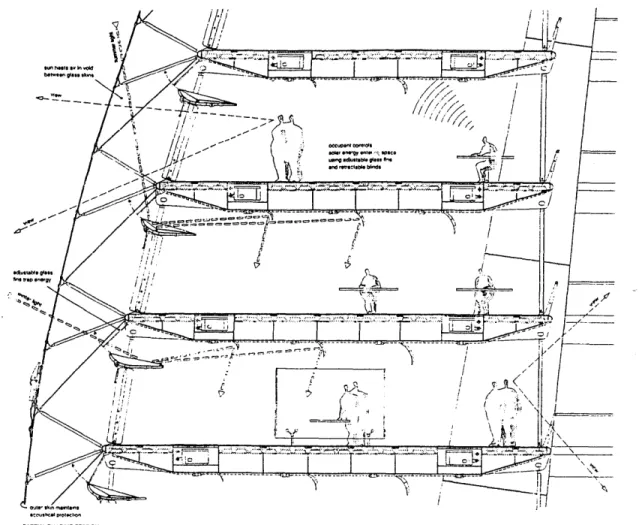
opportu-nities and their ecological effects separates the archi-tecture of Ken Yeang from the lexicon of Modern design. The importance of an integrated approach to site and detail is infused in his projects from their conception to their gradual inhabitation by clientele, plant life, and the forces of nature 13. This vision of an open and permeable framework for the interaction between climate and occupant recalls Future
System's Green Building project 14, devised as an alternative to the conventional urban office block. Developed in collaboration with Ove Arup & Partners, the Green Building was an attempt to derive a physi-cal form from the conceptual premise of an environ-mental filter which met with standardized program-matic criteria for office use.
The technical feasibility of a proposition such as the Green Building is well within today's capacity, benefitting from recent developments in building envelope systems as well as efficient lighting strate-gies. However, few buildings since have taken the concept in its largest sense as far as Yeang and his senior contemporary Michael Hopkins 15.
While Rogers16, Foster17, Grimshaw18, and to a
A Bioclimatic Approach to Integrated Design
Fig. 10 Norman Foster, ARAG Headquarters Sectional Study
Introduction assault on the application of sophisticated technology to the problem of low-energy design, Yeang's sky-scrapers and Hopkins' recent offices completed for the Inland Revenue centre 20 clearly approach a comprehensive understanding of the dialogue be-tween climate, building form, physical performance, and spatial experience. Foster's proposal for a pas-sively ventilated and naturally daylit office tower in Frankfurt, Germany 21, should place his practice among those which are beginning to fulfill the con-ceptual potential of the Green Building.
By clarifying the teleological differences between a "
system boundary " approach to low-energy buildings and a "holistic" and spatially driven strategy for biocli-matic design, there exists the potential for under-standing how one might approach a reintegration of the physical forces in nature - gravity, light, air, heat, sound - with the phenomenological dimensions of direct communication and sensory interactions, enabling us to extend the geometry of experience into architecture 22. Further, this approach engages the design team on a directed journey which
ac-knowledges the power and influence of a quantita-tively informed process without divesting of the
metaphorical potential and associative quality of a sophisticated architectural proposal.
A Bioclimatic Approach to Integrated Design
"Morphology is not only the study of material things,
and the forms of material things, but the dynamical
aspects, in terms of force, of the operation of energy."
-- DArcy Thompson
On Growth and Form
Design Process
Design Process
Like many applied arts and sciences, the practice of architecture which results in built form relies on an appreciation of its context at many levels. To develop a design proposal so that it may become "architec-ture" requires knowledge of aesthetics, siting, func-tion, structures, mechanical systems, graphic conven-tions, and perhaps, according to Vitruvius, even a "theory of the heavens".
The artifacts of practice, the buildings themselves, are socially and physically constructed by an array of
individuals. However, these individuals inevitably fall subject to the influence of larger cultural forces which,
if poorly understood, can undermine the final artifact in a number of ways. While the contributions of cre-ative designers are necessary for the production of a successful building, they are by no means sufficient. This Thesis investigates a particular congruence of formal, technical, and philosophical issues under the
label of "integrated design". This term deserves clarifi-cation, as do the constituent elements themselves. The primary focus of this Thesis is to examine how
building form and spatial organization can respond to criteria for environmental performance. The hypoth-esis is that these two realms - architecture and
natural phenomena - can be mutually supportive. By creating an artifact whose physical behavior and
A Bioclimatic Approach to Integrated Design
Design Process
symbolic presence are shaped by environmental responses, a building can foster in its inhabitants an appreciation for their role amidst complexities of the world around them.
Such a building may at least invoke a sense of won-der, and possibly inspire a sense of responsibility for the quality of our natural environment concomitant to the privilege entrusted to homo fabricans, creators of the built environment.
The experience of space through the movement of light and air, temporal changes in thermal sensation suited to specific environments, and the opportunity for users to control their immediate climate have each informed the evolution of the Case Study Design presented in following chapters.
The degree to which this Design can be judged "inte-grated" is therefore related to its capacity, as a pre-liminary proposal, to be thoughtfully inhabited through the experience of time, to harness and direct the
power of natural phenomena, and to reflect these values as a symbolic entity in the surrounding cityscape.
A Bioclimatic Approach to Integrated Design
S061}{
Fig. 13 Nicholas Grimshaw, Seville Pavillion, Solar Axis
28
Integrated Design
Integrated Design
Towards an Architecture of Elements
The development of an environmentally integrated design proposal involves the consideration of multiple physical phenomena and their interaction with archi-tectural elements. The behavior of these elements can be characterized by the scale at which they respond to environmental forces and the system boundary asso-ciated with this effect.
While any design can be holistically understood as a series of embedded layers, each dependent on an-other for function and form, the building envelope bears a primary role in communicating an exterior physical presence and suggesting (or perhaps veiling) the interior spatial functions. Whether tacit or highly expressed, the interior spaces rely explicitly on the building envelope for their mediation with the outdoor environment.
In the last half of this century, commercial buildings have come to rely almost exclusively on the applica-tion of technology, in the form of external machinery, for the thermal comfort of their inhabitants. This
artifi-cial separation between inside and outside came about, in part, through the propagation of deep-plan spaces, made possible by artificial lighting, resulting in
a further distancing from the influence of natural phe-nomena.
One consequence of this unseemly evolution is a current acceptance of the high energy intensity
A Bioclimatic Approach to Integrated Design
quired for commercial office space. This condition is
so entrenched in our design culture that many central
mechanical plants, beyond simply being accepted as
a viable solution, are often oversized by a factor of
1.5 to 2.0, resulting in further demand without
signifi-cant improvements in the quality, or the temperature,
of the working environment.
This canonized approach to personal comfort suffers
several shortcomings. First, as a design process, it
responds to a limited set of criteria for engineering
performance. The resulting "optimization" of a closed
mechanical system undermines the possibility of
engaging localized phenomena - strategies for solar
gain, natural ventilation, and thermal mass - while
eliminating the involvement of the occupants in their
personal comfort.
Second, the current approach does not include any
built-in measures for efficiency, be they in scale or in
performance. More significant than the cost of the
energy itself, including the larger ecological effects of
generating this energy, is the loss of working
produc-tivity related to poorly designed environments.
This point should be reinforced, as it qualifies the
importance of the design context in the broadest
sense. Current architectural practice holds an almost
wholly ignorant view of those aspects of economic
viability which, ironically, could instead define the
added value of a design project, thereby supporting
those formal innovations which architects relinquish in
the purgatory of detailing and construction processes.
Integrated Design Recent case studies of the links between environmen-tal quality and occupant productivity are outlined in later chapters, yet the paucity of knowledge regarding the economic implications of specific design propos-als heralds the importance of clearly defining an
intended system boundary - both physical and and
cultural - within which the negotiated art of design can take place. This boundary can help clarify and define the working principles which guide interactions at different scales, but at the very least the boundary can serve as a measure of effectiveness of design strategies within its limits before addressing the larger context.
Returning to the building envelope as a study in system boundaries, what follows is an assessment of recent design initiatives which attempt to develop the relationship between inside and outside with architec-tural form.
The examples chosen characterize five layers of tectonic integration between natural phenomena and architectural form. These layers reflect an increasing degree of commitment to a holistic design agenda, and are also useful in understanding, evaluating, and predicting physical perfomance criteria.
For example, traditional scientific methods assert that system boundaries are defined by areas exhibiting no energy interaction beyond their limits. As adiabatic elements, therefore, performance within these bound-aries can inform what role technology can play in the design and construction process.
A Bioclimatic Approach to Integrated Design
Fig. 14 Norman Foster, Duisberg Business Centre, Envelope Detail
32
Jn 11;I
Integrated Design
Design Research: Innovative Envelope Systems
For the purpose of this study, the layers are
discretized based on the building envelope element's areas of influence, represented by an emphasis on:
1. Materials and Molecular Behavior
2. Surfaces and Boundary Conditions
3. External Elements and Peripheral Conditions
4. Sectional Assemblies and Construction Sequence
5. Spatial Organization and Tectonic Legibility
The latter categories are shown to lead more directly to solutions whose performance criteria are best
integrated with sensible qualities of space, such as improved daylight and comprehensive airflow strategies.
Further, as the system boundary under consideration expands, opportunities for assimilating incremental
strategies - specific materials or assemblies
-become more apparent, allowing for embedded strategies to develop.
mY
A Bioclimatic Approach to Integrated Design
....
I
..
7
JlK...
.
F
...
..
T...
.
Fig. 15 Thomas Herzog, Silica Gel Glazing Material
Fig. 16 Arup Associates, Dynamic Envelope System
Integrated Design
Materials and Molecular Behavior
Developments in material science have expanded the
vocabulary of behaviors which become possible as
the result of an enclosure element. Typically these
advanced materials allow for increased thermal
resis-tance within a pane of fenestration without eliminating
access to daylight. In some applications, a clear panel
can be made opaque with the transmission of an
electric current, hinting at the kind of environmental
interactions possible either through active or passive
means.
Surfaces and Boundary Conditions
The transition from the application of discrete
mate-rial-intensive strategies to ones which define surface
areas is demonstrated by the following examples.
These projects vigorously address the layer between
inside and outside of the building, but this intensity
does not appear to affect the treatement of the interior
spaces based on this threshold. In addition, these
enclosures limit the degree of interaction between
inside and out, leaving the occupation of the spaces a
hermetic experience, if partially mediated by the
envelope surfaces.
A Bioclimatic Approach to Integrated Design
Fig. 17 Norman Foster, Sun Shading Device
Fig. 18 Norman Foster, Hong Kong Bank, Element Diagram
Integrated Design External Elements and Peripheral Conditions
Typified by attachements to the exterior of the enve-lope, these elements can have siginficant advantages in shading unwanted solar gains, collecting solar energy, and protecting the exterior of the building from weather, while possibly collecting water for reuse. However, this approach often takes a reactive stance towards these natural forces, and while defining an external image, seldom directly affect the internal organization of spaces.
Sectional Assemblies and Construction Sequence This definition of system boundary applies to strate-gies which make use of pre-fabricated assemblies whose performance criteria are designed for low-energy uses. Technological innovations of this kind are advancing our knowledge about the integration of manufacturing processes as a means of engaging building form within a variety of environmental condi-tions. A "kit of parts" approach can simplify the design process and promote the consideration of life-cycle replacement and recycling criteria.
As these developments in technology and procure-ment evolve, architects will have the potential to design prototype elements within a class of assem-blies which can be tuned to the specific to the needs of their building and site.
A Bioclimatic Approach to Integrated Design .*.~~~~ >~.. -- ~ ..- .... . .4g. f g., t!t. ' .. ... . ..
Fig. 19 Michael Hopkins, Inland Revenue Centre, Site and Elements
Integrated Design
Spatial Organization and Tectonic Legibility
The most comperehensive design strategies demon-strate a holistic approach to the design of the enve-lope in which the form and use of the interior spaces directly correspond to the technological manipulations of the materials, surfaces, and assemblies which enclose them.
Fig. 20 Michael Hopkins, Inland Revenue Centre, Environmental Interaction
A Bioclimatic Approach to Integrated Design COOL TEMPERATE ARID iN Shaded in
hot
climates
TROPICAL-Centre
of
building
for
light
and
heat
Centre of building for light and heatCentre of building for cool shading
To provide ventilation
3
Fig. 21 Ken Yeang, Biodimatic Design Strategies for Daylighting
A Bioclimatic Approach
A Bioclimatic Approach
Redefining the Modern Vernacular
The evidence found in contemporary architecture suggests that even progressive solutions to a low-energy mandate can lack a deeper, more holistic appreciation of the relationship between building form, the use of space or territory, and the conditions par-ticular to the surrounding environment. Architect and
educator William McDonough has observed that architecture in the past few decades is a "monument to the designer's ignorance of where the sun is"1,
notably the multitude of monolithic urban buildings with identical four-sided envelopes in complete denial of their vastly different climatic loads.
The preceding study of building envelope systems reveals the technological opportunities which have come about as a result of low-energy or environmen-tally responsive intentions during the design process. Yet these examples, with rare exception, tend to shift the focus towards the exploits of the technology itself,
instead of engaging the building's occupants to con-sider, even to influence the manner in which they dwell with the environment.
A fundamental question of this Thesis has been to
develop an understanding of how vernacular architec-tural principles can evolve to serve the requirements of modern, urban, commercial buildings. Much of the recent work investigating vernacular form has cen-tered on rural and often pre-industrial precedents, yet
A Bioclimatic Approach to Integrated Design
there is a pressing need to regenerate the powerful
relationship between urban form, building fabric, and a
collective understanding of how to inhabit them as
mediating elements in our daily lives.
Critical debates about style have tended to focus on
facade issues - drawing attention to the surface
appearance and image quality of a building, and away
from the processes that underlie its construction and
subsequent interactions, be they social, physical, or
cultural
2.
Any progress from such a condition requires a more
comprehensive framework than simply a low-energy
mandate. In the interest of developing a more holistic
appreciation of this problem as an architectural
ques-tion, the issue can be phrased in terms of a
"biocli-matic approach" which takes into consideration the
complexities of biological systems and the realities of
a particular climate.
As such, an example of vernacular architecture
repre-sents the specific instance, in the artifact of a building,
of a bioclimatic process - an act of creation
respond-ing to and engagrespond-ing the environment. What follows is
some pathfinding along these principles which may
allow designers to exercise their architectural
knowl-edge in order to reinvent the modern urban vernacular.
Like so many classifying words, the word "vernacular"
has of late acquired a perplexing amount of nuance,
allowing itself to confuse rather than clarify its
associa-tions. A nascent interest in this genre promises to
invigorate the dialogue regarding place-making within
the bounds of stylistic innovation
3. However, much of
A Bioclimatic Approach
the discourse remains within the limits of traditional typologies, again, often rural in their instances. It is useful, therefore, to qualify attempts at a modern vernacular within the specifics of its original definition. Writer and landscape architect J. B. Jackson inter-prets this definition to have first been phrased by the English architectural historian R. W. Brunskill in his work A Handbook of Vernacular Architecture, pub-lished in 1973. Brunskill says that a vernacular style is the embodied in the creation of local building tradi-tions, using forms, materials, and techniques long familiar to the region. The design of a vernacular dwelling is furthermore the product of a local artisan or of the prospective occupant. The basic forms are domestic in origin, and the style emphasizes continu-ity, while maintaining a strict regard for function4.
Jackson notes that this understanding of vernacular style tends not to welcome radically new techniques, or materials imported from elsewhere. He further points out that according to this interpretation, ver-nacular architecture ceased to be produced at some point in time, depending on regional circumstances
-presumably upon the expansion of cultural bound-aries by improvements in transportation.
Hence, in its reluctance to take on new ideas and techniques, and in its loyalty to historical types, Brunskill's vernacular stands outside of an architec-tural discourse which calls for continuous innovation and progressive technological integration.
The one aspect of Brunskill's definition which does, however, embody relevant design possibilities is the deterministic attitude through which vernacular form
A Bioclimatic Approach to Integrated Design
LITTLE bACK HOUSE HOUSE
ROAD
Fig. 22 Thomas Hubka, New England Farm Buildings: Site Elements
44
7
A Bioclimatic Approach
extends itself towards the natural environment - the integration of soil, topography, and climate in the form of a building. This direct relationship to local natural settings has over time encouraged the proliferation of a rural bias, and a separation from the economic and technological aspects of dwelling. By layering a theo-retical blanket on the dialectic between nature and architecture, writers including Heidegger, Eliade, and Jung further polarized the existential dimensions of dwelling from more practical ones.
In a study tracing the historial development of a New England building type, architect Thomas Hubka has analyzed the evolution of connected farms according to patterns of construction, usage, and change over time5. While the stylistic implications of this study are consistent with a conservative attitude towards
change, the importance of this building type is the specificity with which building form is manipulated to create original microclimates where open land existed before.
The pervasive manner through which territory is assimilated and changed over time, based on its social functions and seasonal circumstances, reflects a direct engagement of natural phenomena through tectonic elements. These bioclimatic strategies can be directly mapped to the design of contemporary build-ings, making use available technology, and providing similar capacity for change as either the climate or specifics of social function evolve over time.
The subtle yet sophisticated lessons demonstrated by the connected farm buildings of New England have
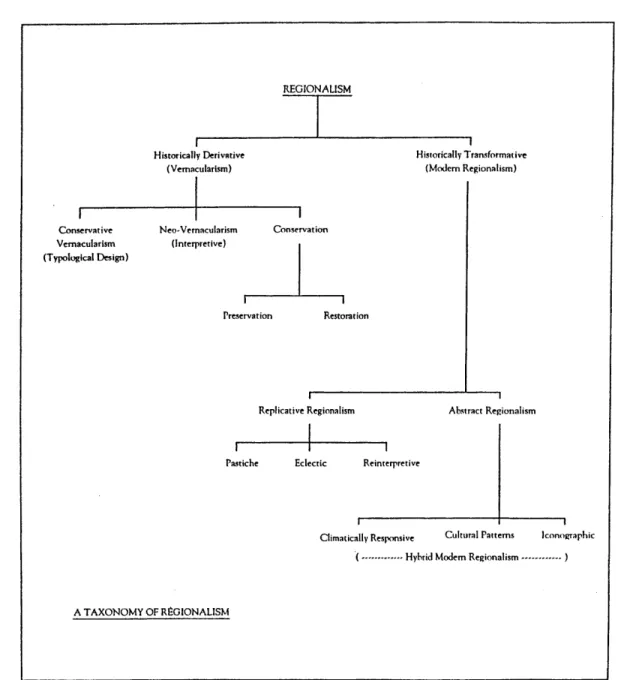
A Bioclimatic Approach to Integrated Design REGIONALISM Historically Derivative (Vemacularism) Historically Transformative (Modern Regionalism) Conservative Vemacularism (Typological Design) Neo-Vernacularism (Interpretive) Conservation Restoration Replicative Regionalism
Pastiche Eclectic Reinterpretive
Climatically Responsive
Abstract Regionalism
I I
Cultural Patterns IconogRaphic
( ...- - -~Hybrid Modem Regionalism ~~~~~~ )
A TAXONOMY OF RI-GIONALISM
Fig. 23 Kenneth Powell, A Taxonomy of Regionalism
46
A Bioclimatic Approach
includeAlvar Aalto's continuous interpretation of light, specifically the northern light of his home region, resulting in a characteristic form language which is both innovative and sensitive to the site. By returning to the importance of climate and site as form-finding criteria, a bioclimatic approach allows for endless innovation within the bounds of intended perfor-mance.
This opportunity in fact underscores the flexibility of true vernacular form, and the emphasis on adaptation
over time which is subtly missing from Brunskill's snapshot definition. Innovation, therefore, has to be included in a modern reinterpretation of the vernacu-lar, be it urban or suburban. The notion that any artifact of history is a static in its measure can be
misleading, since its existence - perhaps even its
fortuitous survival - involves a complex matrix of social and physical elements which define the artifact as it evolves.
A Bioclimatic Approach to Integrated Design
"There is a common chord in all this [building] that will
be heard; and it is not a plea for ugliness. It is a plea
for first principles -- for less heat and parasitism, more
light and pragmatic integrity; for less architecture in
quotation marks and more engineering.
I feel that the sceptre has all but passed from the
hands of the architects to the hands of the engineer,
and if it is ever to be the architect's again, [s]he must
take it from the engineer by force of superior virtue."
-- Frank Lloyd Wright, 1909
[responding to a critic's evaluation
of the daylighted Larkin Building]
Architectural Knowledge
Architectural Knowledge
Learning Function through Form
The antecedents of a deterministic architecture based on function can be found as early as the mid-eigh-teenth century. With the advent of modernism, argu-ably coincident with the increase in attention paid to the sciences and their methods, discourses in archi-tecture developed a penchant for postulating rule-based laws by which design could elevate itself with the rising culture of scientific endeavors.
The outfall of this empirical focus is still evident today, albeit in a supposed counterreaction to the formula-tion of rules and dictums for explaining or informing
design. Working someplace between the service, manufacturing, and professional sectors, architects have grown to become suspicious of constraints to their creative efforts. What could now be interpreted
as constraints or limits, however, were historically a collective effort to position the epistemology of archi-tectural design in an applicable frame of reference. In short, the movement towards a science of architec-ture did not set out to subvert building form, only to provide its designers with the benefits of the latest knowledge, both theoretical and practical.
Manfredo Tafuri reports on the contemporary results of this tension between process in product as the "theoretical knot that must be confronted" in order to
A Bioclimatic Approach to Integrated Design
Philosophy
Knowledge of nature
Physics
Mathematics
Knowledge of man
Logic
Ethics
Fig. 24 Nature and Man
Architectural Knowledge
arrive "at the heart of those [design] strategies
-arriving, that is, at their modes of production"1. This attention to the design of design may appear too self-conscious, even self-referential at times, yet its reoccurence underlines the notion that one cannot successfully make architecture with architecture alone, rather one must make architecture through an understanding of life - in whatever direction that "life" is interpreted.
The story of late nineteenth century theoreticians is the story of attempts to interpret and understand the
notions of utility and function through architectural form. Among the questions which remain ideologically current, the ones which this Thesis poses are:
e what is the basis for knowledge about design ?
- how is this knowledge applied as a means
towards an end ?
In its barest phraseology, architectural knowledge can be defined as the process by which designers assimi-late materials into the form of a building for the pur-pose of inhabitation or sheltered use. The implica-tions of this process, and the consequences of their results, are the basis for studies beyond the scope of this discussion. The essential argument presented here is that the creation of space - the making of architecture - is a formal response to a matrix of needs and requirements. This response is also one of the most lasting and continuous processes known to our civilization. Therefore, how is it that designers interpret this matrix, or more importantly, establish one in the first place ?
A Bioclimatic Approach to Integrated Design
Architectural Knowledge
Vernacular form was often synonynous with a "spon-taneous" process clearly outside of the territory
claimed by professional designers, yet the buildings which result from this process often embody a clarity of knowledge about materials, uses, and climate which appealed to those architects sensible enough to notice. Believing that some aspect of this knowl-edge lay in the natural sciences, the task of theorists amidst the industrial revolution was to make use of scientific methods as the basis for connecting theories of form with the practice of design.
Writer and philosopher Francis Bacon was directly influential in supporting a connection between theory and practice, whereby the former might lead to an
understanding of the latter2. Bacon encouraged an identification of the universal principles which underlie real technical phenomena. The nascent methodolo-gies propagating in the natural sciences appeared ready to support this endeavor, and this process to a great extent defines the philosophical base of the Enlightenment Period.
The close relationship which was presumed to relate form and technique was the basis for justifying claims to both architectural innovation as well as stylistic retrenchement. Among those theorists who attempted to clarify the relationship between aesthetics and construction, Gottfried Semper was particularily ad-vanced in his efforts to account for innovative form-making through the application of specific design
principles drawn from outside the methods of archi-tectural production3.
While John Ruskin did emphasize the importance of analyzing hierarchical structures within natual forms,
A Bioclimatic Approach to Integrated Design
Architectural Knowledge
his concept of a "truthful" form tended towards a reductive rather than synthetic reasoning. Likewise,
E.E. Viollet-le-Duc believed that the truth of a formal
style lay in the extent to which a hidden order of relationships became evident, and led directly to the construction and form of a building. Although he did argue that the developments of new materials and production methods necessitated new forms, his consideration was restricted to the systematization of constituent parts based on their interrelationships. The principles for which he was an able spokesman did not overtly extend to a holistic framework which included the natural environment as the site and context of architectural form.
Gottfried Semper was critical of architectural theories which tended towards a mechanical aggregation of
elements. Instead, like Bacon, he sought to under-stand first the principles of organic law as the basis for creating formal relationships4. His interest in these principles evolved according to his interest in architec-tural "function", an understanding which was richer than that of his contemporaries and still valid today. Semper's most important writing on the subject of style in the technical arts, Der Stil, emphasized the interrelationship of form and technique5. According to his ideas, any artifact was considered the result of a creative process which took into account a series of
parameters6. Semper borrowed from the sciences a
generalized notation by which Y = F { x,y,z,etc...
}
represented the variables for design. These variables included utilitarian factors as well as the importance of symbolic expression7.A Bioclimatic Approach to Integrated Design
Architectural Knowledge
In his clear attempt to represent architectural knowl-edge as a set of functional relationships, Semper did emphasize the importance of innovation and creativity as much as any technical of material influence. By casting the symbolic aspects of form into the realm of his abstracted scientific discourse, he may have been buying some freedom for the justification of form on a symbolic basis alone. However, his interests were more clearly directed towards a systematic adaptation of the mathematical thinking he found attarctive in comparative sciences and the vernacular production techniques he believed formed the basic elements of
architecture.
Scientific advances in the practical knowledge of systemic behavior led theorists of the Enlightenment period to the determination of a "calculus" which was useful in determining the apparent regularity of any physical change in nature. Semper openly wondered whether reality as a whole was governed by math-ematical principles8, and whether such laws could be derived for a variety of cultural domains which exhib-ited less empirical evidence of behavioral patterns, but followed patterns nonetheless.
In his efforts to substantiate the existence of a prin-cipled framework for the evolution of form, Semper sought to define the basic elements of architecture. The basis for defining the base, hearth, walling and
roof were not only practical in nature but directly associated with their symbolic purposes. As each primary human situation, therefore, became known in terms of both its mythical and functional relationships
A Bioclimatic Approach to Integrated Design
PERFORMANCE
SBIC-SYMBOLIC
MEANING
UNIFIED COMPLEX COST REUABILITY MAINTAINABILITY DARING
Fig. 28 Levels of Performance in Architecture
CONSTRUCTIBILITY SCIENTIFIC MEANING SAFETY SOCIAL MEANING DEMAND ON ENVIRONMLNT
Architectural Knowledge to building elements.
Semper's concept of "function" was both comprehen-sive and universal in a way that may be difficult to fully understand today. Only by stripping both its
mythical and mathematical substance can we recog-nize the contemporary use of the word and measure its effect on modern design9. While Semper's writings became popular in Europe, and later in the US via Chicago, the fundamental importance of his frame-work for design - the symbolic aspects of form and
the human experiences from which they stem
-became lost in favor of a more deterministic formula-tion in which "form followed funcformula-tion", according to Sullivan.
Reduced to technological imperatives and the conse-quences of economies of material, this derivative use
of "function" lacked the essential connections to the
ideas described in Der Stil. For Semper, a function was to be a calculus of the relationships inherent to the variables of the design process, which were understood as unlimited and changing.
Semper further distinguished between "intrinsic" variables - belonging to principles of natural law: symmetry, axiality, properties of materials, and the like
- and those "extrinsic" to the work itself. Of the
latter, he included local influences, matters of climate, politics, social habits, and so on 10. The design of a building, therefore, was inconcievable without the multiple factors of its embodiment, yet Semper be-lieved that a single, formal purpose determined its formation, ruling the inner logic of its development11. The separation of form and content which defines current theoretical discourse prevents a clear appre
A Bioclimatic Approach to Integrated Design
Table 5. Three Ways of Being-with Technology
Basic Attitudes
Ancient Skepticism Enlightenment Optimism Romantic Uneasiness Conceptual Elements (suspicious of technology) (promotion of technology) (ambivalent about technology) Volition Will to technology in- Will to technology is or- Will to technology is an aspect (transcendence) volves tendency to turn dained by God or by of creativity, which tends to
away from God or the nature crowd out other aspects gods
Activity Personal: Technical afflu- Personal: Technical activi- Personal: Technology engen-(ethics) ence undermines individ- ties socialize individuals ders freedom but alienates
ual virtue Societal: Technology cre- from affective strength to exer-Societal: Technical change ates public wealth cise it
weakens political stability Societal: Technology weakens social bonds of affection
Knowledge Technical information is Technical engagement Imagination and vision are (epistemology) not true wisdom with the world yields true more crucial than technical
knowledge (pragmatism) knowledge
Objects Artifacts are less real than Nature and artifice operate Artifacts expand the process of (metaphysics) natural objects and thus by the same mechanical life and reveal the sublime
require external guidance principles
Architectural Knowledge ciation of Semper's belief in a building's function. Much
of this discourse marginalizes any attempt to direct design by means of empirical principles, but this view misses the point of Semper's assimilation of scientific methods and cultural anthropology in the service of architectural form.
As a theorist, Semper wondered about the relationship between geometry and conduct, between form and behavior. He emphasized the potential of an integrated framework within which spatial order, formal purpose, and organic law responded to a flexible matrix of principles. While this framework continues to evolve with our expanding knowledge of the natural environ-ment, the argument for defining the elements of such a matrix is still currently valid.
The need for a clearly defined framework for the appli-cation of architectural knowledge is especially relevant in cases where architecture and technology are com-bined with the interest of mediating those extrinsic variables specific to climate, since this direction is prone to considering functional aspects alone, and ignoring the capacity and importance which Semper placed on tradition, innovation , and symbolic expres-sion12.
Since analysis of climatic conditions alone cannot provide insight for an architectural response to indi-vidual natural phenomena, this Thesis proposes to look at current scientific models which aim at a deeper understanding of behavior in a variety of natural - and
by extension, cultural - processes. This direction is
motivated by a strong belief that the application of architectural knowledge to technical problems must be informed by such scientific knowledge. Failing to do so
A Bioclimatic Approach to Integrated Design
Fig. 30 Battle McCarthy, Design Exploration for a Tropical Tower
Architectural Knowledge
is an abdication of our relationship with nature to the functions defined by "machines for living".
Therefore, one vision of how to dwell with the environ-ment is to broaden our understanding of the way in which natual systems behave, and explore how an
intervention in these systems - an act of building
-reacts within their boundaries. Just as there exist many practical reasons for re-establishing a balance between the ecosystems of man and nature, including a reduction in pollution and a conservation of eco-nomic and material resources, there are also incen-tives for a conceptual redefinition of the architect's role as a synthetic collaborator.
Without a sound appreciation of the physical and social ramifications of a design proposal, an architect in current climates risks finding a limited role - and a surface one at that - in the definition of our collective environment.
A Bioclimatic Approach to Integrated Design
"Symbolic analysts, who identify, broker, and solve new problems, are by and large succeeding in the world economy... The education of the symbolic
analyst emphasizes systems thinking."
-- Robert Reich
System Dynamics
Systems Dynamics
Principles of Behavior in Natural Phenomena
If architecture can be reinvested with a sense of
responsibility for its physical and cultural context, it
follows that within such a condition, there should exist
equal measures of a potential for wonder and a
ca-pacity for function. An accurate course of action for
such a holistic design strategy would be a clear set of
objectives based on an iterative evaluation of the
design proposal within an expanding set of system
boundaries.
In the best of circumstances, traditional design
prac-tice seldom allows for such a controlled adventure in
discovery, even towards an agreed upon end such as
a low-energy objective. Instead, as creative designers
we rely on a generalized set of heuristics based on
experience, common practice, and problem solving
techniques.
Design innovation in this context can prove difficult,
however, without an appreciation for the manner in
which a proposal succeeds in meeting the overall
complexities of a particular building or program,
especially one which involves technical challenges.
While the use of system boundaries can be helpful in
exploring design principles in their smaller instances,
removed artificially from the larger context, these
boundaries can also be misleading in their suggestion
A Bioclimatic Approach to Integrated Design
Energy
System Dynamics
of actual performance - whether spatial or physical. Semper and his colleagues were diligent in outlining the importance of a clear symbolic expression, yet did
not specify with any precision how the variables of a design problem could be sorted out or prioritized. How then to apply architectural knowledge ?
In the case of this Thesis, investigating a bioclimatic approach to the problem of integrated design, it was necessary to become educated in the realities of behavior in physical phenomena prior to proposing any integration with this behavior. This lead to a study of what has become known as "complexity theory" or "non-linear dynamical systems theory".
Hardly established long enough to take its place among the natural sciences, complexity theory is an ongoing, interdisciplinary quest to answer questions about some of nature's most common phenomena, which turn out to have very complicated answers. In fact, more often than answers, these questions lead to
a better understanding of phyical and social phenom-ena, recognizing that instead of predicting behavior, science can only sometimes characterize the possibili-ties and outcomes, thereby leaving it to direct experi-ence for the final measure of reality.
The importance of this study is the understanding that people, buildings, and phenomena are connected in very sophisticated ways. The most lucrative approach to a design problem, in terms of its effect on the sys-tem, is therefore one which takes a broad view of the design context and yet accounts for the important details of form, behavior, and their systemic interac-tions .
A Bioclimatic Approach to Integrated Design
Fig. 32 Gottfried Semper, Snowflakes
System Dynamics
The categories of problems which dynamical systems
analysis finds on its desktop are as wide and
unre-lated as imagineable. They range from issues in
population, economics, physics, and biology to the
realm of artificial intelligence, social interactions, and
the structure of the universe.
What they have in common is that each question,
embedded as it is in its particular context, is complex;
specifically, each question involves many independent
agents or pieces of the problem interacting in a great
many ways. In addition, the essential richness of
these interactions allows the system as a whole to
undergo evolutions - often several and continuous
- of spontaneous self-organization2.
Organisms, for example, constantly adapt to each
other through evolution, organizing themselves into
environments we recognize as ecosystems. One of
the hallmarks of such ecosystems is their ability to
adapt, turning their circumstances into an advantage
for survival or development. Many complex systems
exhibit the capacity to adapt
-organizations of
people, wildlife, and matter - such that it has
be-come a characteristic sign of complexity.
Last, these systems exhibit a dynamism that separate
them from static objects such as snowflakes and
computer chips, in that they respond to the ebb and
flow of energy in a spontaneous manner, never
re-peating the pattern, yet not so dynamically as to
qualify as chaotic.
Chaos theory has shaken the foundations of modern
science in the last twenty years with its explanation of
A Bioclimatic Approach to Integrated Design
Fig. 33 Fractal Landscape, Aerial Photograph