HAL Id: hal-03027324
https://hal.archives-ouvertes.fr/hal-03027324
Submitted on 27 Nov 2020
HAL is a multi-disciplinary open access archive for the deposit and dissemination of sci-entific research documents, whether they are pub-lished or not. The documents may come from teaching and research institutions in France or abroad, or from public or private research centers.
L’archive ouverte pluridisciplinaire HAL, est destinée au dépôt et à la diffusion de documents scientifiques de niveau recherche, publiés ou non, émanant des établissements d’enseignement et de recherche français ou étrangers, des laboratoires publics ou privés.
Outsourcing recruitment as a solution to prevent
discrimination: A correspondence study *
Clémence Berson, Morgane Laouenan, Emmanuel Valat
To cite this version:
Clémence Berson, Morgane Laouenan, Emmanuel Valat. Outsourcing recruitment as a solution to prevent discrimination: A correspondence study *. Labour Economics, Elsevier, 2020. �hal-03027324�
Outsourcing recruitment as a solution to
prevent discrimination: A correspondence
study
∗
Cl´emence Berson
†Morgane Laou´enan
‡Emmanuel Valat
§Abstract
In this work, we assess how the organization of recruitment in large com-panies affects ethnic discrimination. We consider large multi-establishment companies and distinguish two types of organization of recruitment: hiring made through a human resources (HR) department at a centralized level of the company and hiring made at only the level of the establishment concerned by the position, generally by managers in charge of recruitment. Our results indicate that access to a centralized HR department in the selection of appli-cations has an important effect on the level of discrimination, i.e., this type of organization of recruitment results in a significant decrease in the probability that applicants with native-sounding names are solely selected.
Keywords: Hiring discrimination, large companies, organization of human re-sources.
JEL Classification: A13, C93, J21, J71, J78, O15.
∗We would like to thank Anthony Edo, Corinne Prost, Marie Ruault, Fabrice Foroni and Eric
C´ediey for their relevant comments as well as the participants of the DARES seminar, the INSEE inequality seminar, the University Paris 1 - Panth´eon - Sorbonne seminar, the Swedish Institute for Social Research (SOFI), the LAGV conference and the EALE conference. We also thank the editor in charge of this paper, and three referees for their comments and suggestions that made us improve significantly the paper. We also thank the DARES for providing data. We gratefully acknowledge financial support from ANR within the INEQ AT WORK project (ANR-17-CE41-0009) and from Sciences-Po LIEPP (ANR-11-LABX-0091,ANR-11-IDEX-000502). All errors are our own.
†Banque de France and Sciences Po, LIEPP, [email protected], (Corresponding
author)
‡CNRS - Sorbonne University, Sciences-Po LIEPP & IZA,[email protected] §ERUDITE, Universit´e Gustave Eiffel and Dares,[email protected]
1
Introduction
In many countries, experiments conducted in recent years have revealed a relatively widespread discriminatory behaviour among employers (seeRich(2014),Bertrand and Duflo(2017), Baert (2018) andNeumark (2018) for literature reviews). Several recent works have studied different actions to prevent this discrimination. The in-troduction of anonymous resumes is the most studied policy. However, the results are mixed. Behaghel et al.(2015) show that setting up an experimental anonymous resume policy is not efficient for ethnic minorities in France. In contrast, Aslund and Skans(2012) find an increase in the number of interviews for both ethnic mi-norities and women in Sweden. Krause et al. (2012) conclude that the method of implementation of the policy is a crucial factor in obtaining a positive impact. Some other studies focus on the content of the resumes. Fremigacci et al.(2015) assess the potential impact of merit labelling by making the ”best apprentice in France” dis-tinction appear on the resume. However, this attempt was not effective in reducing discrimination because, although all applicants benefits from this distinction, those with a native-sounding name benefit more than other groups. Edo and Jacquemet
(2013) evaluate the impact of a satisfactory level of native language on resumes. Their results are more encouraging than the results in the literature because such a signal makes it possible to reduce the differences observed. Another type of pol-icy is the introduction of diversity in hiring committees to reduce discrimination.
Bertrand and Duflo (2017) gather the literature on this topic. They point out that the results on discrimination are not obvious and could even be negative (see, for instance, Bursell (2007), Bagues and Esteve-Volart (2010), Zinovyeva and Bagues
(2011) and Bagues et al.(2017)). Overall, few tools have proven effective in fighting discrimination in recruitment and more research on this point is worth pursuing. In this article, we assess the effect of the organization of recruitment in large com-panies on the degree of hiring discrimination. More specifically, we compare the intervention of a centralized human resources (HR) department to the selection made only within the establishment concerned by the position, generally by a man-ager responsible for recruitment. We expect a lower rate of discrimination for three reasons. HR professionals are better trained and more aware than other recruiters regarding discrimination. HR professionals are also less influenced by local con-straints that can generate discrimination (e.g., conforming to consumer preferences or seeking to maintain homogeneous teams to facilitate their management). Finally, HR professionals also have more time to devote to the selection of applications and
therefore make their choices less often on the basis of stereotypes (Chugh, 2004). To conduct our analysis, we use the data from a correspondence study realized by the French Ministry of Labour (Foroni et al., 2016). We find a net discrimination rate of 20.2% against second-generation immigrants, which is the lower bound of the literature,1 but in line with Carlsson and Rooth (2007) and Kaas and Manger
(2012), who find that the net discrimination rate decreases with the size of the firm. The aim of this experiment was to establish a dialogue with some large companies about their recruitment practices on the basis of the experimental results and encourage them to implement policies to prevent discrimination. This dialogue was also an opportunity to gather information related to the recruitment process for each job offer, in addition to those related to the experimental design. Thus, we can distinguish recruitment for which the selection was made through a centralized HR department of the company (e.g., at national or regional levels), by an external service provider, or by a person in charge of hiring if the recruitment was managed at the level of the establishment the offer concerns.
In this paper, we evaluate the impact of centralized HR recruitment on the degree of discrimination in large companies. Approximately two-thirds of the tested job offers are managed in this manner, while the other job offers are managed solely at the establishment level. Notably, because we consider very large companies, the organization of recruitment varies across job offers and not only across companies. Indeed, data show intra-firm heterogeneity in terms of organization of recruitment for many companies. Next, because the organization of recruitment is potentially endogenous, we use an instrument to evaluate a causal effect. We exploit the infor-mation regarding whether the tested job offer is from a company that developed a franchising network.
Our results suggest that acting on the organization of recruitment in large com-panies can be considered a relatively effective tool in the fight against discrimina-tion in recruitment, at least as far as the first stage of recruitment is concerned. Centralized HR departments lead to a significant decrease in the probability that applicants with a native-sounding name are preferred.
The study is organized as follows. Section 2 describes the experimental design of the correspondence study and compares the net discrimination rate of this ex-periment to the literature. Then, Section 3 presents the results depending on the organization of recruitments. Section4 discusses the influence of the organization
of the recruitment process on the degree of discrimination. Section5concludes.
2
Experiment: design and discrimination rate
In this section, we first present the features of the experiment conducted by the French Ministry of Labour. Its objective was to carry out a sufficient number of tests to obtain exploitable results for each tested company. Unlike most experi-ments in which each company is generally tested only once, this experiment com-prised responding to several dozen offers per company. All of the companies were subsequently met by the Ministry of Labour in order to debrief on their poten-tial discriminatory behaviour. Consequently, data concern only large companies, which is relatively original and results in new research questions.
2.1
Experimental design
Selection of companies and occupations The selected companies are multi-establishment companies or franchising networks with more than 1,000 employees in the trade,
bank/insurance, and hotel/catering sectors. These sectors have been chosen to ensure they include several large companies with a significant number of vacant positions for a small number of occupations. The companies targeted during the design of the experiment that did not publish a sufficient number of offers on the targeted occupations were excluded from the experiment. Finally, only compa-nies with several dozen offers published on their website in March 2016, for ten relatively common occupations, were selected (see Table 1). To have a sufficient number of tests per company, job offers are located throughout France.
Profiles of fictitious applicants In France, several correspondence studies have revealed that workers with a North African-sounding name are particularly con-cerned by discrimination (Foroni and Cediey(2008),Berson(2012),Petit et al.(2015) and Edo et al. (2019) among others). For that reason, the experiment focuses on this specific ethnic group. Each pair of applications contains one application with a North African-sounding name and another with a French-sounding name, sug-gesting that the former one is a second-generation immigrant. Relatively common surnames and given names for each type were chosen by ISM-Corum, the
special-ized firm that realspecial-ized the correspondence study2. They based their decisions on the French Census, depending on the age category. They were careful that those names were not correlated with a particular social background.
The other criteria are identical for each applicant in the same pair, including the indication of French nationality. Compared with the tests usually carried out, the experimentation on which we rely required the use of a relatively large number of profiles for two reasons. First, this correspondence study targeted a greater number of occupations than the other studies in the literature. Consequently, we consid-ered it was necessary to create profiles adapted to each occupation and each sector. Second, because several applications were potentially sent to the same recruiters, special attention also had to be paid to the increased risk of detection, which also explains some variations in terms of experience, age, or diploma. Finally, the res-idential locations of the fictitious applicants are chosen to be socially neutral. In all, the experiment used 147 pairs of applications for 1,500 tests, where each pair consists of two resumes and two cover letters, one for each ethnicity. For each application of the same pair, permutations were made from one test to another between the North African- and French-sounding names in order to avoid possible biases linked to the quality of resumes and cover letters.
Data collection Applications were only sent in response to job offers between April and July 2016, with a 1-day spacing between the two applications for low-skilled job offers, which was sometimes reduced to half a day to test companies recruiting within very short deadlines, and a time limit of up to 3 working days for tests concerning the most qualified applications; this limit could be slightly longer when responding to offers for which qualified applications are potentially rare. In all cases, the objective was not to risk arousing recruiters’ suspicions. Both applications were always sent in the same manner, using the application form proposed on the website where the offer was published or, less frequently, by e-mail. Responses were collected until August 31, 2016.
Responses are considered positive when the recruiter has expressed an interest (by telephone or e-mail) by offering a telephone or face-to-face interview or more rarely, by indicating that he/she wishes further details on the application received. Responses are considered rejections when a message has been received that indi-cates the application has not been accepted and/or that the offer has already been
filled. We exclude the invalid tests due to the withdrawal of the offer by the em-ployer between the two applications. Finally, for some applications, no reply was received.3
Human resources organization Information on the organization of recruitment was collected in two steps. First, during the elaboration of the experiment, several types of information were crossed. Information on the identity and/or function of the recruiter may have been collected from the information provided for some of the job advertisements. Where appropriate, this information has been cross-checked with information appearing on company websites regarding how recruit-ment is organized. The identity and/or function of the person who sent the reply message or acknowledgement was also considered.
Second, the dialogue with the Ministry of Labour made it possible to collect a cer-tain amount of information on the organization of recruitment of each company and to know that the experiment was not detected. In particular, for each applica-tion, we know whether recruitment was carried out at the level of the establishment concerned or through a centralized HR department of the company.4 In particular, the organization of the human resources management, local or centralized, may affect the degree of discrimination. According to our review of the literature, no other correspondence studies have analysed the impact of the recruitment organi-zation on discrimination.
2.2
Descriptive statistics
Table1summarizes the characteristics of the job offers. One objective of this study was that half of the offers should be managerial positions and the other half non-managerial positions (48.8% of the tests). Moreover, the type of contract offered was not selective. More than three-quarters of the positions provide permanent
3Automatically generated acknowledgements of receipt are not considered responses, except for
those indicating that ”the application will be considered rejected if no response is made before X weeks.”
4We consider the HR department of the company or ”entity” - subsidiary, brand, company,
etc. - centralized at the national, regional, etc., level. However, in 3% of the cases, the selection of applications was made by an external service provider. Insofar as, similar to centralized HR departments, these are professional HR departments external to the establishment concerned by the offer, we associate this method of selecting applications with selections made by a centralized HR department. For simplicity, we then refer only to the notion of centralized HR departments. The results are robust when we simply drop those observations.
contracts and the remaining one-quarter of the positions provide mainly fixed-term contracts.
In this analysis, we eliminated tests that concern job offers with an unknown loca-tion. Approximately one-quarter of the job offers are located in the ˆIle-de-France region (Paris). The Auvergne-Rh ˆone-Alpes region is also widely represented with 13.5% of the offers. For over half of the offers tested, the company shows on its website a commitment to diversity, equal treatment and/or the fight against dis-criminatory risks linked to the criterion of origin. This indicator does not take into account mentions concerning other criteria (e.g., disability, professional equality between women and men). Overall, we retain 1,433 tests among the 1,500 tests covering 40 companies and 1,208 establishments. Table2shows that 30 companies were tested approximately 40 times and 10 were tested approximately 30 times. Each company possesses between 15 and 38 tested establishments.
Of the 1,433 tests, the resumes are almost equally distributed by gender. The aver-age aver-age of the applicants is 26 years old, their level of diploma is from lower than bachelor to graduate, and they have either medium experience (4 to 6 years for slightly more than half of the resumes) or confirmed experience (9 to 11 years).5
2.3
Discrimination in large companies
Overall, 50.8% of the tests received at least a positive reply from the employer. This relatively high return rate reveals the good quality of the applications and a certain tension in the job market for at least some of the occupations we are considering. Recruiters expressed interest in French-sounding name applicants in approximately one-half of the cases (47%) and in North African-sounding name applicants, in slightly more than one-third of the cases (36.8%).
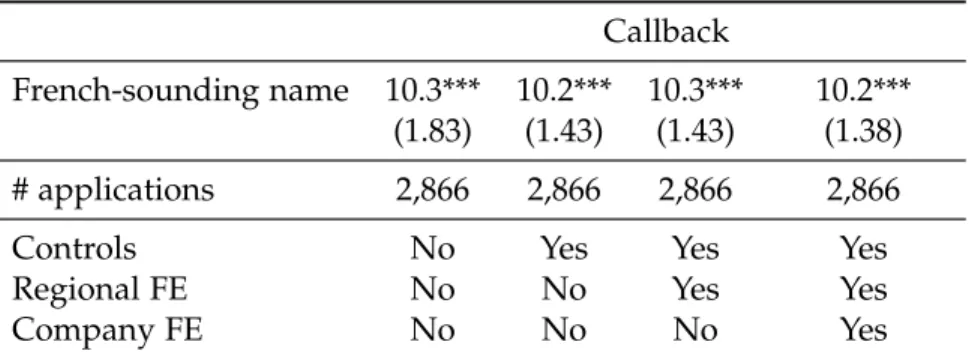
Using a probit model, we estimate the callback rates taking into account the com-position effects (age, gender, degree level, experience and gender of the pair, type of contract, position level (managerial or non-managerial), order of application, occupation considered by the test and the company commitment to diversity) and fixed effects of regions and companies (see Appendix B.1). The dummy French−sounding name highlights the gap between both types of applicants. The estimated coefficient is 10.2, meaning that everything else equal, French-sounding name applications receive 10 pp more callbacks than North African-sounding name
Table 1: Descriptive statistics concerning the tested job offers Share of centralized Full sample HR % # tests % Occupation
Sales and technical sales managers 7.2 103 86.4 Retail store operators & intermediaries1 13.8 198 59.6 Self-service employees 4 58 48.3
Sellers 18 259 34.8
Banking and insurance managers2 6.6 94 100.0 Banking and insurance employees 5.8 80 98.7 Banking and insurance technicians 8.4 121 93.4 Hotel, cafe and restaurant managers 6.3 91 74.7 Hotel & catering employees & operators 12.6 181 30.4
Cooks 17.3 248 60.5 Region Auvergne-Rh ˆone-Alpes 13.5 193 63.7 Bourgogne-Franche-Comte 4.4 63 73.0 Bretagne 4 57 61.4 Centre-Val de Loire 4.1 60 66.7 Grand Est 8 115 60.0 Hauts-de-France 5.7 82 74.4 ˆIle-de-France 24.3 348 64.7 Normandie 5.1 73 56.2 Nouvelle-Aquitaine 8.2 117 54.7 Occitanie 7.2 103 61.2 Pays de la Loire 5.9 85 54.1 PACA 9.6 137 51.8 Management position 48.8 699 71.8 Labour contract Permanent (CDI) 78.3 1,122 64.1 Fixed-term (CDI) 18.1 360 50.4 Unknown 3.6 51 66.7
Company committed to diversity 52.8 757 71.1
Sample 100 1,433 61.7
1Department managers, sales consultants, customer managers, shop managers. 2Agency managers, customer advisers.
Scope: panel of 40 companies of 1,000 employees or more; France. Source: ISM Corum-Dares.
Table 2: Share of tests for which a centralized HR department is involved per company
# of # of Centralized HR
Company establishments tests %
AA 37 39 0 .0 AB 24 30 70.0 AC 26 29 100.0 AD 28 38 0.0 AE 33 38 100.0 AF 34 34 100.0 AG 37 40 50.0 AH 33 39 100.0 AI 38 39 100.0 AJ 35 39 100.0 AK 38 38 100.0 AL 29 35 100.0 AM 36 40 37.5 AN 26 29 100.0 AO 30 36 0.0 AP 34 40 100.0 AQ 23 34 44.1 AR 37 40 60.0 AS 27 30 100.0 AT 22 38 47.4 AU 31 38 47.4 AV 35 40 22.5 AW 29 30 50.0 AX 28 39 2.6 AY 15 30 100.0 AZ 19 29 69.0 BA 30 34 100.0 BB 15 30 53.3 BC 34 40 0.0 BD 32 38 47.4 BE 32 39 0.0 BF 21 26 65.4 BG 31 40 100.0 BH 30 38 100.0 BI 35 38 100.0 BJ 24 28 46.4 BK 29 33 100.0 BL 37 38 100.0 BM 38 40 0.0 BN 36 40 7.5 Total 1,208 1,433 61.7
Scope: panel of 40 companies of 1,000 employees or more; France.
applications.6 This result is robust if we estimate a heteroscedastic probit to answer to theHeckman and Siegelman(1993) critics (see Appendix B.2).
Compared to the literature, the success rate gap between native-sounding name applicants and North African-sounding name applicants is slightly higher. We find 10.2 pp vs. 6.9 pp in Duguet et al. (2010), 9.3 pp in Berson (2012) and 7.4 pp in
Edo et al. (2019) for the same populations in France. Carlsson and Rooth (2007) find 9.6 pp. in Sweden concerning second-generation immigrants from the Middle East. This higher gap should be put in perspective with the high rate of positive responses received by candidates, which is ten times higher than inDuguet et al.
(2010), for example. Most of studies are using a net discrimination rate, which takes this point into account. This is the number of situations where the applicant of the majority is preferred minus those when the applicant of the minority is preferred, divided by the number of cases where at least one of the applicants receive a positive answer. The net discrimination rate of our study is 20.2%, which is much lower than most of the studies we are aware of, exceptCarlsson and Rooth
(2007) who find 29.4%. For example, Bertrand and Mullainathan(2004) find 41.1% for the US, Foroni and Cediey (2008) 46.0% and Berson (2012) 59.8% for France. This lower net discrimination rate is mainly explained by our sample of large firms. It is consistent with Carlsson and Rooth (2007) and Kaas and Manger (2012) that find a negative correlation between the size of the firm and hiring discrimination.
3
Discrimination by HR organization
In this section, we analyse the results by HR organization and identify endogeneity issues.
3.1
Level of discrimination differs by HR organization
Table2 shows that selections made through a centralized HR department concern slightly less than two-thirds of the tests (61.7%). Moreover, they are non-existent for six of the 40 companies in our sample, whereas they are systematic for 18 of them,
6Some audit studies on ethnic discrimination by the International Labour Organization (ILO)
distinguish discrimination at the selection for interview and job offer stage, and find that approxi-mately 90% of the discrimination occurs at the first stage (seeRich(2014);Foroni and Cediey(2008)). Therefore, this suggests that callbacks for interviews represent the key part of the hiring process.
particularly in the banking/insurance sector. In 16 companies, the organization of recruitment varies across establishments and offers.
A cost-benefit trade-off is inherent in the choice of using a centralized recruit-ment system. It depends on the structural organization of the company, the sector and the position of the occupation that has to be filled. A centralized recruitment model allows a company to pursue a coherent strategy concerning hiring in taking advantage of certain economies of scale. It is widely known that HR professionals (working for a centralized recruitment team) will likely have a good knowledge about best hiring practices, in order to reduce the risk of both staffing issues and higher turnover. However, the HR professionals may lack more specific knowledge about the position they are filling. A centralized recruitment system works well if the company’s recruitment needs are simple and do not change often. If it is not the case, a centralized system might not be flexible enough. With a decentralized model, the recruiting process is more flexible in nature because it is managed lo-cally and is therefore tailored to local circumstances. Decentralizing recruitment within each establishment can increase responsiveness (less administrative inter-mediaries) and adaptation to the local context. Moreover, establishment managers in charge of the recruitment work with a specific team and can learn about its working culture and unique hiring needs.
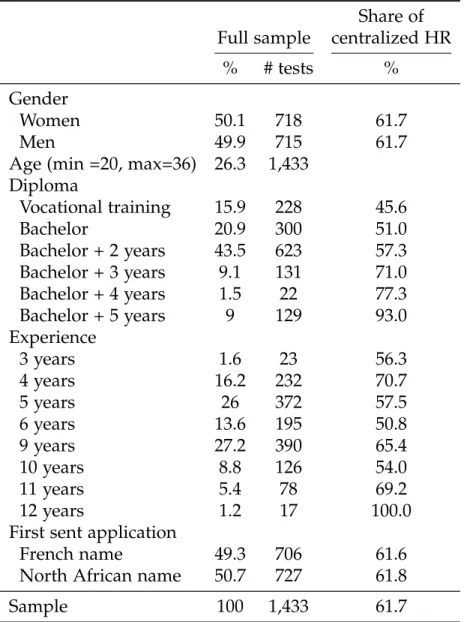
In our sample, there are significant variations in terms of HR organization depend-ing on the level of education of the applicants and the characteristics of the posi-tion. Recruitment made through a centralized HR department more often concerns positions involving management functions and permanent positions (Table1). Sig-nificant variations are also observed depending on the occupation. Within each sector, applications for the most senior positions in the hierarchy generally involve a more centralized HR department. Moreover, and notably, the bank/insurance sector is strongly marked by the centralization of recruitment because few appli-cations are selected at the establishment level. Additionally, the share of tests for which selection via a centralized HR department is involved is identical for female and male pairs (Table A1 in Appendix). Finally, offers from companies showing their commitment to diversity are more often those for which a centralized HR de-partment is involved. This result suggests that the centralization of the HR function is not neutral from a discrimination perspective.
Table3provides the raw results. Where the selection is managed solely within the establishment, the rate decreases from 36.8% to 25.5% for North African-sounding name applications and remains relatively high for French-sounding name
appli-cations (47.0% vs 41.3%). When a centralized HR department is involved, North African-sounding name applications are selected in 43.8% of cases compared with 50.6% of the French-sounding name applications. It shows that hires made solely at the establishment level generate a higher level of discrimination than hires in-volving a centralized HR department. The difference in the positive response rate between North African- and French-sounding name applications is 15.8 pp. for recruitment made only at the establishment level compared with 6.8 pp. when a centralized HR department is involved.7
Table 3: Success rate and preferences for French- and North African-sounding name applications
% Positive responses % Preferences Equality French name North African name French name North African name of Treat-ment # of tests All tests 47.0 36.8 14.1 3.8 32.9 1,433
Tests by recruitment organization
At the est. level 41.3 25.5 19.5 3.6 21.9 549
Centralized HR 50.6 43.8 10.7 4.0 39.8 884
Reading: applications with a French-sounding name interested recruiters, exclusively or not, in 47.0% of cases against 36.8% for North African name applications.
Scope: panel of 40 companies of 1,000 employees or more; France. Source: ISM Corum-Dares.
We can split the share of positive responses between favouritism for one origin ver-sus another (either the French-sounding name application has been favoured com-pared to the North African-sounding name application or the other way around) and equality of treatment (both applications have been either accepted or rejected).8 Overall, it shows that favouritism towards French-sounding name applicants is much higher than that towards North African-sounding name applicants. When we distinguish by organization of recruitment, we observe that favouritism towards North African-sounding name applicants remains the same whatever the type of
7We do not have any data on subsequent interviews and the fact that they are conducted at a
centralized level or at the establishment level. However, one can assume that in our framework, as in others, the interview stage often involves members of the establishment that are more directly concerned by the job.
8The probability of receiving a response is not significantly correlated with the organization of
HR organization (3.6% versus 4%), whereas it decreases dramatically for French-sounding name applicants when the HR organization is centralized. This is because both types of applicants receive positive responses more often in this case (39.8% vs. 21.9%). Therefore, it means that the organization of recruitment affects the level of discrimination. We can identify several reasons:
(i) Members of HR departments are more aware of discrimination and its pre-vention, unlike managers in charge of recruitment within the establishment. An increasing number of companies have become more involved in order to comply with the legislation in the fight against discrimination in recruit-ment. The company’s HR departments are likely more systematically in-volved than others in these actions. In addition to drawing up charters or pacts for equal treatment, these may include the dissemination of guides aimed at overturning stereotypes, the financing of requested tests aimed at evaluating and rethinking recruitment practices, the creation of tools for tracking recruitment processes (to provide recruiters with greater incentives to motivate their choices), or the implementation of training campaigns on non-discrimination.9 Moreover, large companies are more concerned about non-discrimination training, insofar as the ”Equality and Citizenship” law obliges, since January 2017, all personnel in charge of recruitment in large companies to receive training in non-discrimination at least every 5 years. (ii) The second reason is that HR departments have more time dedicated to HR
tasks and therefore to recruitment, unlike operational staff whose primary function is not recruitment. Giving more time to the selection of applicants reduces the risk that choices are based on automatism or stereotypes (Chugh,
2004; Bartoˇs et al., 2016).
(iii) Finally, professional HR departments are likely less subject to field constraints than managers in charge of recruitment. Consequently, their objective func-tion is different from line managers that are more focused on productivity. For example, managers are more tempted to adapt to consumer preferences than HR professionals (Combes et al., 2016), or to seek to maintain a certain homogeneity of teams to facilitate their management.10 Thus, some of these constraints can generate discriminatory behaviour.
9For example,Kamakami et al.(2000) show that training lab subjects in negating specific
stereo-typical thinking reduces the stereostereo-typical activation.
3.2
Endogeneity issue
The implication of a centralized HR department potentially contains an endogene-ity issue. Unobservables can influence the probabilendogene-ity that the selection is managed by a centralized HR department and the existence of discrimination. Based on company monographs, the qualitative work ofFondeur(2013,2014) shows that the centralization of HR departments is generally linked in part to a strategy of better control of recruitment combined with the ambition of protecting oneself from the risks of discrimination. This phenomenon can bias the analysis in either direction. On the one hand, companies with a proactive anti-discrimination culture (which cannot be observed in our data) could be less likely to discriminate and more likely to rely on a centralized HR department. The negative correlation observed between using a centralized HR department and the level of discrimination would then partly reflect this unobservable element. Thus, the impact of the involvement of centralized HR departments on discrimination would lead to an overestimation. On the other hand, companies would favour the use of a centralized HR depart-ment for job offers most at risk in terms of discrimination (e.g., if strong pressure is linked to consumer preferences or to maintain teams of homogeneous workers to avoid disrupting management). Such a bias in the ”use of a centralized HR depart-ment” treatment would lead to an underestimation of the impact of the involve-ment of centralized HR departinvolve-ments on the degree of discrimination. However, measuring this impact is not straightforward and requires the implementation of an appropriate econometric strategy.
4
Impact of HR organization on hiring discrimination
We propose an evaluation of the causal link between the implication of a centralized HR department and the probability that the French-sounding name application will be favoured based on the use of an instrumental strategy and a recursive bivariate probit model (cf. Maddala(1983) andWooldridge(2010)).11
current employees (Becker,1957), which may have an effect on productivity (Hamilton et al.,2004), whileKurtulus (2011) shows that the impact of origin or gender does not raise any issues within companies.
11These authors show that the bivariate recursive probit model is typically specified when there
are two binary responses. However, a two-step least squares estimation is also often used in this case. It yields similar results in our study, see TableB5in Appendix.
4.1
Instrumental strategy
We need an instrumental variable that is correlated with the HR organization but not linked to hiring discrimination. To achieve this goal, we propose an instrumen-tal variable that is not correlated with a discriminatory behaviour: ”the company is a franchisor”. In Appendix, TableB6, we test a second instrument, which is ”the establishment is a franchise.” This second one is more precise, but we do not have this status for all establishments and consequently lose some observations. The results are similar in both cases.
Franchising is a commercial relationship between a franchise and a franchisor. This relationship is broadly described in the literature as a low-cost expansion strategy for the franchisor and a means for the franchise to run its business with logistical and strategic support from the franchisor (Williams, 1999; Hoy et al., 2019). Some of the literature has studied the specificities of franchisees in terms of human re-sources management. Castrogiovanni and Kidwell(2010) show that the differences between the manager of the unit, who is an employee of the franchisor, and the owner of the unit are based on entrepreneurial orientation capabilities, the applica-tion of franchise characteristics and the lesser adverse selecapplica-tion effects for owners.
Truss(2004) points out that, in the franchising network he studied, franchisors have a right to control hiring and human resource management, and in particular the most experienced employees.
The franchisor that has developed a franchising network consents to establishments using their brand and gives support and expertise to franchisees in exchange for a fee. However, all establishments of a franchisor are not necessarily franchisees even if they generally operate with some autonomy. By developing a franchising network, franchisors acquire a better knowledge of the advantages due to the au-tonomy of their establishments (e.g., better adaptation to the local context, greater responsiveness, and shorter recruitment times). Thus, it is possible that compa-nies that have developed franchisees entrust both franchisees and non-franchisees establishments with more tasks, including in terms of recruitment. Our results clearly indicate that the use of a centralized HR department is less frequent (a 0.36 point less probability) when the establishment concerned by the offer belongs to a franchising company.
Concerning franchisees, they have by definition a certain independence, primarily financial. However, it also likely concerns other aspects of company management, including recruitment. Even if certain agreements with the franchisor impose a
right of supervision in the recruitment (Truss, 2004), franchisees more frequently control their hiring than non-franchise establishments.
Furthermore, our instrumental variable ”the company is a franchisor” does not affect the likelihood that the employer will adopt a discriminatory attitude. Ac-cording to the literature on discrimination, employers’ discriminatory behaviour may be driven by three different motives. First, it could be the unconscious prej-udices of employers (see Bertrand et al. (2005) andRooth (2010)). Discriminatory behaviour can also be linked to recruiters’ beliefs about the productivity of certain demographic groups (statistical discrimination; seePhelps(1972)). Finally, discrim-ination may also result from the preferences of employers, employees or consumers (Becker(1957);Combes et al. (2016) for consumer preferences).
According to the literature on franchising, there is no link between franchisors and discrimination. Being a franchisor is essentially linked to commercial purposes and the type of activity. Blair and Lafontaine (2005) suggest, in particular, that large companies have an overall economic and financial interest in developing a franchising network. Above all, however, if not all of companies (approximately one-third of the companies in our sample) do so, it is essentially because their main activity does not allow it. As the authors indicate, two essential conditions must be fulfilled. First, products must be made relatively uniform between establishments. Second, the risks and costs associated with a possible deterioration of the brand image by a franchise must be limited, which is again essentially due to the nature of the production. Nevertheless, if certain activities are more confronted with the question of consumer preference towards the company’s employees, franchising and the level of discrimination are both linked to the type of activity. However, being a franchisor and occupations in contact with the public are not correlated in our experimental data. The coefficient of correlation is 0.03. Moreover, we control for occupations in our estimates. Consequently, the determinants of franchising are not linked to the existence of discriminatory behaviour from recruiters.
Regarding the case where the employer is a franchise, the literature shows that their main characteristics are their desire for financial independence and their ex-pectations in terms of the franchisor’s support and experience in order to ensure the smooth running of the business. Thus, in some cases, hiring is likely to be highly supervised by the franchisor (Truss, 2004), and in other cases, franchisors grant a certain autonomy to their franchisees to ensure franchisees are free to adapt to the context in which they work (Brander and Croonen, 2010). There is therefore a priori no reason why the recruitment practices of franchisees should be more
or less discriminatory than those of other employers because the determinants of discrimination are of a completely different nature. A possible argument could be that franchisees are partly independent; thus, franchisees are better able to express preferences for types of applicants or stereotypes or beliefs leading to discrimina-tory recruitment. Two counterarguments must be mentioned. Franchisees are not totally independent entrepreneurs but rather independent ”under control” ( Feld-stead, 1993). Entrepreneurs who want complete autonomy would likely not have chosen to open a franchise. Moreover, another possibility is that recruiters in non-franchised institutions also express, to some extent, preferences, stereotypes or beliefs. The results in Table4confirm our intuitions as, when we separate the type of recruitment, there is no direct effect of franchise on hiring discrimination; thus, there merely might be an indirect effect through the organization of recruitment (franchisees more often recruit at the establishment level).
Another concern is the non-response behaviour. Using a centralized HR depart-ment increases the probability of receiving a response, positive or not. To be sure that our results are not due to a selection issue, we verify that the correlation be-tween the probability of non-response and the centralized HR department is not correlated. We find that the coefficient, controlling for the companies characteris-tics, is not significant.
Table 4: Likelihood that the French-sounding name application is favoured for each type of recruitment organization (probit model)
Centralized HR Selection at the est. level
The company is a franchisor 0.01 0.02 0.04 0.03 (0.02) (0.02) (0.05) (0.04)
Controls No Yes No Yes
# of tests 1,768 1,768 1,098 1,098
Reading: the probability that the French-sounding name application is favoured increases by 0.04 pp. when the company is a franchisor in the case where the selection of applications is made only within the establishment, but this difference is not significant. Standard errors are clustered by com-pany and are in brackets. Asterisks indicate statistically significant at 1% ***, 5% ** and 10% *.
Scope: panel of 40 companies of 1,000 employees or more; France. Source: ISM Corum-Dares.
allows us to separate establishments that have a high probability of operating rel-atively independently in terms of recruitment from the other establishments. We estimate the following bivariate recursive probit model:
Pre f f renchij =1[δ HRij+γ Xij+µij >0] (1)
where Pre f f renchij is a variable equal to 1 for application pair i if the applicant
with a French-sounding name has interested the recruiter of company j and 0 otherwise; Xij is a vector of characteristics of application pair i and company j;
µij is the error term, clustered by company; and HRij is a dummy indicating the
level of recruitment, centralized or not, that the applicant in pair i faces when applying for a post in company j. This variable is endogenous and estimated from the probit model:
HRij =1[ζ Franchiseij+φχij+νij >0] (2)
where Franchiseij is an indicator of the existence (or not) of a franchising network in
company j (our instrumental variable), and νij is the error term. In both equations,
the vector Xij and χij include all variables available on the applicants and
compa-nies tested (occupation, age, age squared, sex, diploma, labour contract, manage-ment position, experience, diversity label, order of application). We also include ”region” fixed effects to control for local economic context. However, we do not include a ”company” fixed effect. Because some companies use a centralized HR department for all of their recruitments (Table2), the concomitant introduction of the recruitment organization type indicator and a ”company” fixed effect would involve collinearity and would be likely to disrupt evaluation.
4.2
Results
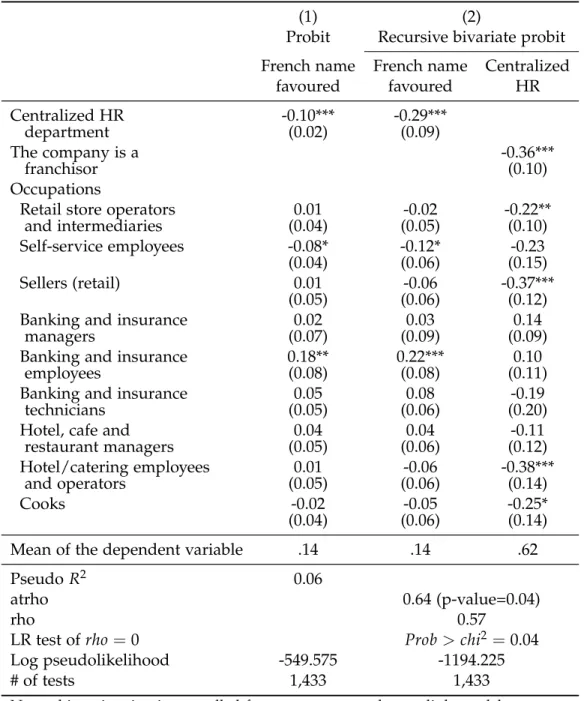
Table 5 summarizes the empirical results. Column (1) shows the coefficients of the simple probit model. Column (2) reports the estimates of the recursive bivari-ate probit using ”the company is a franchisor” as the instrumental variable. All controls are available in the Appendix, Table B3. The probit estimation (column (1)) shows that using a centralized HR department decreases in 10 pp the proba-bility that the French-sounding name application is favoured. As this application is favoured in 14% of cases, it means that it reduces the coefficient to 4%, which is relatively similar to the share of cases where the North African-sounding name
application is favoured. The net discrimination rate becomes roughly zero.
The impact of involving a centralized HR department is even larger when we in-strument. Indeed, when we correct for endogeneity (Column (2)), the probability that the French-sounding name applicant is favoured is approximately 0.30 points less when the selection involves a centralized HR department.12 The significance of the negative correlation between the unexplained elements of our two variables of interest (cf. the terms atrho and ρ) also confirms the validity of our estimation strategy. Unobservable characteristics simultaneously influence the probability that the recruiter has a discriminatory attitude and that a centralized HR department is involved in recruitment. In other words, the companies that use a centralized HR department are places for which the discriminatory risk is the greatest and for which the effect of using the centralized HR department is lower (leading to an un-derestimation of the effect by means of an uncorrected estimate). Our econometric strategy allows us to correct this bias. Moreover, we know the franchise status for 985 establishments (over 1,208) and, as a robustness check, we can exploit this in-formation to use the instrument ”establishment is a franchise” on a sub-sample of 1,160 tests (instead of 1,433) and find similar results (TableB6in the Appendix). This finding is also confirmed by the estimations on sub-samples (Appendix, Table
B7 by gender; TableB8 without the banking/insurance sector, where applications are mostly selected by a centralized HR department). The effect of the organiza-tion of recruitment on discriminaorganiza-tion is therefore a priori relatively homogeneous, except for the occupations. In particular, considering the organization of recruit-ment reduces the level of discrimination compared with the reference group for the retail and hotel and catering sectors, it tends to increase for the banking and insurance sectors, for which the centralization of the HR function is higher (Table
2). These observations indicate a downward effect of the centralization of recruit-ment on the level of discrimination. The magnitude of the estimated coefficients is large, meaning that using a centralized HR department eliminates favouritism towards candidates with French-sounding names. Consequently, this kind of orga-nization has to be encouraged to reduce discrimination against second-generation immigrants.
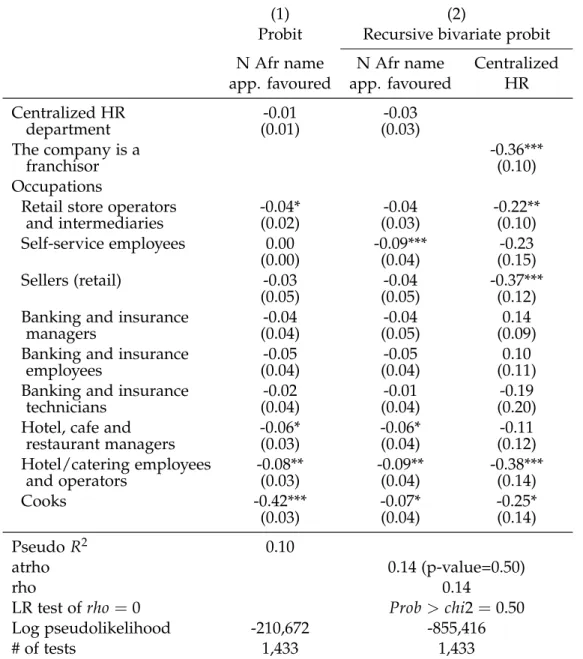
12Table B4 in the Appendix shows that the HR organization has no impact on favouritism for
Table 5: Likelihood that the French-sounding name application is favoured (marginal effects)
(1) (2)
Probit Recursive bivariate probit French name French name Centralized
favoured favoured HR Centralized HR -0.10*** -0.29*** department (0.02) (0.09) The company is a -0.36*** franchisor (0.10) Occupations
Retail store operators 0.01 -0.02 -0.22**
and intermediaries (0.04) (0.05) (0.10)
Self-service employees -0.08* -0.12* -0.23
(0.04) (0.06) (0.15)
Sellers (retail) 0.01 -0.06 -0.37***
(0.05) (0.06) (0.12)
Banking and insurance 0.02 0.03 0.14
managers (0.07) (0.09) (0.09)
Banking and insurance 0.18** 0.22*** 0.10
employees (0.08) (0.08) (0.11)
Banking and insurance 0.05 0.08 -0.19
technicians (0.05) (0.06) (0.20)
Hotel, cafe and 0.04 0.04 -0.11
restaurant managers (0.05) (0.06) (0.12)
Hotel/catering employees 0.01 -0.06 -0.38***
and operators (0.05) (0.06) (0.14)
Cooks -0.02 -0.05 -0.25*
(0.04) (0.06) (0.14)
Mean of the dependent variable .14 .14 .62
Pseudo R2 0.06
atrho 0.64 (p-value=0.04)
rho 0.57
LR test of rho=0 Prob>chi2=0.04
Log pseudolikelihood -549.575 -1194.225
# of tests 1,433 1,433
Note: this estimation is controlled for age, age squared, sex, diploma, labour con-tract, management position, experience, diversity label, order of application and a regional fixed effect. Standard errors are clustered by company and are in brackets. Asterisks indicate statistically significant differences at the 1% ***, 5% ** and 10% * thresholds.
Reading: the probability that the French-sounding name application is favoured decreases by 29 pp. when a centralized HR department is involved (Column (2)). Scope: panel of 40 companies of 1,000 employees or more; France.
5
Conclusion
Based on a correspondence study, our results show a significant risk of hiring dis-crimination for workers with a North African-sounding name in large companies in France. The results confirm the raw results observed by Foroni et al. (2016), even when we control for observable characteristics. One of the original features of this finding is that the discriminatory risk is lower than the one detected by most of the experiments conducted in France on the same population. Unlike other experiments, this study examines only large companies in different sectors, which explains the lower discrimination rate. We show that the use of centralized HR departments in the recruitment of applicants, instead of recruitments made only within the establishment (often by operational staff and not HR professionals) plays an important role in the degree of discrimination for North-African-sounding name applicants: the process results in approximately a 29 points decrease in the probability that native-sounding name applicants are favoured.
This finding suggests that acting on the organization of recruitment in large com-panies can be considered an effective tool in the fight against discrimination in recruitment, at least for the first stage of recruitment, i.e., before interviews. The professionalization of the recruitment position is therefore a potential solution in the fight against discrimination in recruitment, and this aspect, according to our review of the literature, has never been highlighted by a study of this type.
Notably, further exploration of the mechanisms at work is crucial. Indeed, we do not know to what extent this effect is linked to the following: (i) HR profession-als being better trained and more aware of discrimination than managers, (ii) HR professionals being farther away from field issues and having a different objective function (considering customer preferences or team management issues can gener-ate discriminatory hiring behaviour to which managers are likely more sensitive), or (iii) HR professionals having more time that they can dedicate to recruitment, which allows them to make their selection more on the basis of assessing appli-cants’ skills and less on the basis of stereotypes.
References
Aslund, O. and O. N. Skans (2012): “Do Anonymous Job Application Procedures Level the Playing Field?” ILR Review, 65, 82–107.
Baert, S. (2018): “Hiring Discrimination: An Overview of (Almost) All Correspon-dence Experiments Since 2005,” in Audit Studies: Behind the Scenes with Theory, Method, and Nuance, ed. by S. Gaddis, Springer, Cham, vol. 14.
Bagues, M., M. Sylos-Labini, and N. Zinovyeva (2017): “Does the Gender Com-position of Scientific Committees Matter?” American Economic Review, 107, 1207– 1238.
Bagues, M. F. and B. Esteve-Volart (2010): “Can Gender Parity Break the Glass Ceiling? Evidence from a Repeated Randomized Experiment,” Review of Eco-nomic Studies, 77, 1301–1328.
Bartoˇs, V., M. Bauer, J. Chytilov, and F. Matjka (2016): “Attention Discrimina-tion: Theory and Field Experiments with Monitoring Information Acquisition,” American Economic Review, 106, 1437–1475.
Becker, G. (1957): The Economics of Discrimination, University of Chicago Press. Behaghel, L., B. Cr´epon, and T. L. Barbanchon (2015): “Unintended Effects of
Anonymous R´esum´es,” American Economic Journal: Applied Economics, 7, 1–27. Berson, C. (2012): “Does Competition Induce Hiring Equity?” Documents de
tra-vail du Centre d’Economie de la Sorbonne 12019, Universit´e Panth´eon-Sorbonne (Paris 1), Centre d’Economie de la Sorbonne.
Bertrand, M., D. Chugh, and S. Mullainathan (2005): “Implicit Discrimina-tion,” American Economic Review, 95, 94–98.
Bertrand, M. and E. Duflo (2017): “Field Experiments on Discrimination,” Hand-book of Field Experiments, 1, 309–393.
Bertrand, M. and S. Mullainathan (2004): “Are Emily and Greg More Employ-able Than Lakisha and Jamal ? A Field Experiment on Labor Market Discrimi-nation,” American Economic Review, 94, 991–1013.
Blair, R. and F. Lafontaine (2005): The Economics of Franchising, Cambridge Uni-versity Press.
Brander, M. and E. Croonen (2010): “Franchised and small, the most beauti-ful of all: HRM and performance in plural systems,” Journal of Small Business Management, 48, 225–239.
Bursell, M. (2007): “What’s in a name? A field experiment test for the existence of ethnic discrimination in the hiring process,” SULCIS Working Papers 2007:7, Stockholm University, Linnaeus Center for Integration Studies - SULCIS.
Carlsson, M. and D.-O. Rooth (2007): “Evidence of ethnic discrimination in the Swedish labor market using experimental data,” Labour Economics, 14, 716–729. Castrogiovanni, G. and R. Kidwell (2010): “Resource Management practices
affecting Affecting Unit Managers in Franchise Networks,” Human Ressources Resource Management, 49, 225–239.
Chugh, D. (2004): “Why Milliseconds Matter: Societal and Managerial Implica-tions of Implicit Social Cognition,” Social Justice Research, 17, 20322.
Combes, P.-P., B. Decreuse, M. Laou´enan, and A. Trannoy (2016): “Customer Discrimination and Employment Outcomes: Theory and Evidence from the French Labor Market,” Journal of Labor Economics, 34, 107–160.
Duguet, E., N. Leandri, Y. L’horty, and P. Petit (2010): “Are Young French Job-seekers of Ethnic Immigrant Origin Discriminated Against? A Controlled Exper-iment in the Paris Area,” Annals of Economics and Statistics, 187–215.
Edo, A. and N. Jacquemet (2013): “Discrimination l’embauche selon l’origine et le genre : d´efiance indiff´erenci´ee ou cibl´ee sur certains groupes ?” ´Economie et Statistique, 464, 155–172.
Edo, A., N. Jacquemet, and C. Yannelis (2019): “Language skills and ho-mophilous hiring discrimination: Evidence from gender and racially differen-tiated applications,” Review of Economics of the Household, 17, 349–376.
Feldstead, A. (1993): “The Social Organization of Franchise: A Case of Controlled Self-Employment,” Work, Employment & Society, 5, 37–57.
Fondeur, Y. (2013): “Syst`emes d’emploi et pratiques de recrutement,” La revue de l’Ires, 76, 31–43.
——— (2014): “La ”professionalisation du recrutement” au prisme des dispositifs de s´election,” Revue Fran¸caise d’ ´Economie, 14, 135–153.
Foroni, F. and E. Cediey (2008): “R´esultats du testing sollicit´e par le groupe Casino,” ISM-CORUM.
Foroni, F., M. Ruault, and E. Valat (2016): “Discrimination l’embauche selon l’origine : que nous apprend le testing aupr`es des grandes entreprises ?” DARES Analyses.
Fremigacci, F., L. D. Parquet, P. Petit, and G. Piern´e (2015): “Le m´erite : un rempart contre les discriminations ?” Revue fran¸caise d’ ´Economie, 0, 155–182.
Hamilton, B., J. Nickerson, and H. Owan (2004): Diversity and Productivity in Production Teams, Bingley: Emerald Group Publishing Limited, 99–138.
Heckman, J. and P. Siegelman (1993): The Urban Institute Audit Studies: Their Methods and Findings., Washington D.C.: The Urban Institute Press, 187–258, fix and struyk ed.
Hoy, F., R. Perrigot, and A. Terry (2019): Research contributions to understanding franchising, Washington D.C.: Collection Business, chap. 1, edward elgar publish-ing ltd ed.
Kaas, L. and C. Manger (2012): “Ethnic Discrimination in Germany’s Labour Market: A Field Experiment,” German Economic Review, 13, 1–20.
Kamakami, K., J. F. Dovidio, J. Moll, S. Hermsen, and A. Russin (2000): “Just Say No (to Stereotyping): Effects of Training in the Negation of Stereotypic As-sociations on Stereotype Activation,” Journal of Personality and Social Psychology, 75, 817.
Krause, A., U. Rinne, and K. Zimmermann (2012): “Anonymous job applications in Europe,” IZA Journal of European Labor Studies, 1.
Kurtulus, F. (2011): “What Types of Diversity Benefit Workers? Empirical Evi-dence on the Effects of Co-Worker Dissimilarity on the Performance of Employ-ees,” Industrial Relations: A Journal of Economy and Society, 50, 678 – 712.
Maddala, G. (1983): Limited dependent and qualitative variables in econometrics, Cam-bridge University Press.
Neumark, D. (2018): “Experimental Research on Labor Market Discrimination,” Journal of Economic Literature, 56, 799–866.
Petit, P., E. Duguet, and Y. L’Horty (2015): “Discrimination r´esidentielle et origine ethnique : une ´etude exp´erimentale sur les serveurs en ˆIle-de-France,” Economie & Pr´evision, 206-207, 55–69.
Phelps, E. (1972): “The Statistical Theory of Racism and Sexism,” American Eco-nomic Review, 62, 639–651.
Rich, J. (2014): “What Do Field Experiments of Discrimination in Markets Tell Us? A Meta Analysis of Studies Conducted since 2000,” IZA Discussion Papers 8584, Institute for the Study of Labor (IZA).
Rooth, D.-O. (2010): “Automatic associations and discrimination in hiring: Real world evidence,” Labour Economics, 17, 523–534.
Truss, C. (2004): “Who’s in the driving seat? Managing human resources in a franchise firm,” Human Resources Management Journal, 14, 57–75.
Williams, D. L. (1999): “Why do entrepreneurs become franchisees? An empirical analysis of organizational choice,” Journal of Business Venturing, 14, 103–124. Wooldridge, J. M. (2010): Solutions Manual and Supplementary Materials for
Econo-metric Analysis of Cross Section and Panel Data, vol. 1 of MIT Press Books, The MIT Press.
Zinovyeva, N. and M. Bagues (2011): “Does Gender Matter for Academic Promo-tion? Evidence from a Randomized Natural Experiment,” IZA Discussion Papers 5537, Institute of Labor Economics (IZA).
A
Supplementary descriptive statistics
Table A1: Descriptive statistics concerning applicants Share of Full sample centralized HR
% # tests % Gender
Women 50.1 718 61.7 Men 49.9 715 61.7 Age (min =20, max=36) 26.3 1,433
Diploma Vocational training 15.9 228 45.6 Bachelor 20.9 300 51.0 Bachelor + 2 years 43.5 623 57.3 Bachelor + 3 years 9.1 131 71.0 Bachelor + 4 years 1.5 22 77.3 Bachelor + 5 years 9 129 93.0 Experience 3 years 1.6 23 56.3 4 years 16.2 232 70.7 5 years 26 372 57.5 6 years 13.6 195 50.8 9 years 27.2 390 65.4 10 years 8.8 126 54.0 11 years 5.4 78 69.2 12 years 1.2 17 100.0 First sent application
French name 49.3 706 61.6 North African name 50.7 727 61.8 Sample 100 1,433 61.7
Scope: panel of 40 companies of 1,000 employees or more; France. Source: ISM Corum-Dares.
B
Online Appendix
B.1
Estimation of success rate by ethnicity
Using a probit model, we control for company and individual characteristics: Callbackij =1[β Frenchi+γ Xij+µij >0] (3)
where Callbackij is a variable equal to 1 if the applicant has interested the recruiter
of company j and 0 otherwise; Frenchi equals 1 if the applicant has a
French-sounding name; Xij is a vector of characteristics of application pair i and company
j, whose content varies according to the specifications adopted; µijis the error term,
clustered by company. The estimate of β is summarized in TableB1depending on different specifications of the model.
Table B1: Likelihood to receive a callback (probit)
Callback
French-sounding name 10.3*** 10.2*** 10.3*** 10.2*** (1.83) (1.43) (1.43) (1.38)
# applications 2,866 2,866 2,866 2,866
Controls No Yes Yes Yes
Regional FE No No Yes Yes
Company FE No No No Yes
Reading: The difference between the application rates of French- and North African-sounding names that interested the recruiters is 10.3 pp. without controls and 10.2 pp. taking into account the effects of struc-tures and fixed effects of regions and companies. Variables to correct for ”composition effects” include age, gender, degree level, experience and gender of the pair, type of contract, position level (managerial or non-managerial), first application sent for the test (”North African” or ”French”), occupation concerned by the test and company com-mitment to diversity. Standard errors are in brackets and clustered by company. Asterisks indicate statistically significant deviations at thresholds of 1% ***, 5% ** and 10% *.
Scope: panel of 40 companies of 1,000 employees or more; France. Source: ISM Corum-Dares.
These results are consistent with the literature. As a robustness check, we verified that the level of discrimination we find at the regional level is correlated with the figures we can compute with the Labour Force Survey (LFS). We identify French
people with at least one North African parent and those with two French parents. Then, we considered the correlation between the response gap found in our ex-periment and the main outcomes from the LFS at the regional level. The response gap is the difference in percentage points between the success rate of applicants with a French-sounding name and those with a North African one. We compute an employment gap, which is the difference of both groups in terms of the em-ployment and wage gap between both groups, of which the correlations are 0.20 and 0.58, respectively. We also estimate the probability of being employed and a Mincer equation using a sample of the LFS containing only French individuals with French parents and French individuals with at least one North African parent and the coefficient of the dummy at least one North African parent is correlated with our response gap (0.56 and 0.36, respectively). These findings reinforce the representativeness of our data.
B.2
Heteroscedastic Probit
Heckman and Siegelman(1993) suggest that the differences measured by the test-ing method between two identical candidates (except for the criterion tested) do not necessarily reflect discrimination linked to employers’ preferences (Becker,1957) or ”classical” statistical discrimination (Phelps, 1972) linked to the attribution by em-ployers of different levels of productivity to two candidates of the same pair. These differences may also be related to productivity being imperfectly observed by em-ployers. Even if employers assign similar levels of productivity to two candidates in the same pair, there is no reason why the variances should be the same. Thus, there is uncertainty about the candidates’ skills, which may vary in either direction, that may lead to differences in treatment of similar resumes and perceived average productivity levels between the two candidates. Some refer to this as ”second-order statistical discrimination.”
The heteroscedastic probit works as follows. No matter how complete the resumes, the productivity of candidates is imperfectly observed by employers and the prob-ability of accurately evaluating the application contains a portion of unobservables from the employers’ perspective. Thus, even if employers assign similar average unobservable skills to each of the two applicants in the same pair, they may as-sign different variances for the unobservable share of skills for the two applicants. These differences in terms of variances in the unobservable share of skills may lead recruiters to make different choices regarding the two candidates in the same
pair when these are similar from the perspective of the designers of the experi-ence. Employers do not express differences in taste and think that the two types of candidates are on average equally competent. Either candidate may be favoured depending on the circumstances. For example, depending on whether the candi-dates have high or low average skill levels, the candidate with the greatest variance in unobservable skills may be rejected or preferred.
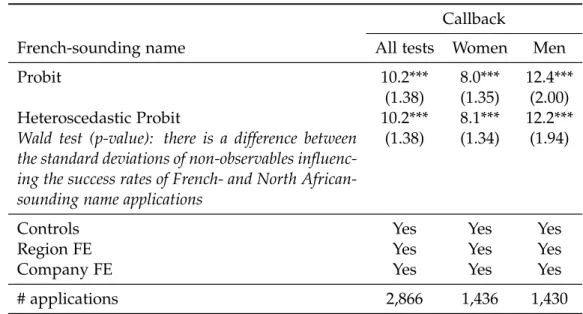
Table B2 summarizes the results of the estimation of Equation 3 using a het-eroscedastic probit. The coefficients are very similar to those of the probit esti-mation, showing that our data are not biased.
Table B2: Likelihood to receive a callback corrected for structural effects and fixed effects for region and company (probit and heteroscedastic probit)
Callback
French-sounding name All tests Women Men
Probit 10.2*** 8.0*** 12.4***
(1.38) (1.35) (2.00)
Heteroscedastic Probit 10.2*** 8.1*** 12.2***
Wald test (p-value): there is a difference between the standard deviations of non-observables influenc-ing the success rates of French- and North African-sounding name applications
(1.38) (1.34) (1.94)
Controls Yes Yes Yes
Region FE Yes Yes Yes
Company FE Yes Yes Yes
# applications 2,866 1,436 1,430
Reading: the difference between the French- and North African-sounding names applications rates that interested recruiters is 10.2 percentage points, taking into account the effects of structures and the fixed effects of regions and companies. The variables used to correct for ”structural effects” include sexe, age, education, experience, the type of contract, the level of the position (management or not), the first application sent for the test (North African- or French-sounding name), the occupation concerned by the test, the company’s commitment to diversity. Standard errors are in brackets and clustered by company. Asterisks indicate statistically significant deviations at thresholds of 1% ***, 5% ** and 10% *.
Scope: panel of 40 companies of 1,000 employees or more; France. Source: ISM CORUM-Dares.
B.3
Additional Results
Table B3: Likelihood that the French name application will be favoured (marginal effects)
(1) (2)
Probit Recursive bivariate probit French name French name Centralized app favoured app favoured HR Centralized HR department -0.10*** -0.29***
(0.02) (0.09)
The company is a franchisor -0.36***
(0.10) Age -0.03 -0.04 -0.02 (0.04) (0.04) (0.04) Age squared 0.00 0.00 0.00 (0.00) (0.00) (0.00) Men 0.02 0.02 0.00 (0.02) (0.02) (0.01) Diploma Vocational training 0.04 0.02 -0.03 (0.04) (0.04) (0.05) Bachelor + 2 years -0.04 -0.04 -0.01 (0.04) (0.04) (0.04) Bachelor + 3 years -0.01 0.01 0.05 (0.05) (0.06) (0.05) Bachelor + 4 years 0.07 0.11 0.06 (0.13) (0.14) (0.12) Bachelor + 5 years -0.01 0.01 0.10 (0.08) (0.08) (0.09) Experience 3 years -0.00 -0.01 0.09 (0.10) (0.10) (0.11) 4 years -0.06 -0.06 0.03 (0.05) (0.05) (0.07) 5 years -0.10** -0.11** -0.02 (0.05) (0.05) (0.06) 6 years -0.04 -0.05 -0.04 (0.04) (0.04) (0.04) 10 years -0.06 -0.06* -0.06 (0.03) (0.04) (0.05) 11 years 0.01 0.02 0.02 (0.04) (0.04) (0.05) 12 years -0.08 -0.02 1.65*** (0.11) (0.11) (0.18)
(1) (2)
Probit Recursive bivariate probit Occupations
Retail store operators 0.01 -0.02 -0.22**
and intermediaries (0.04) (0.05) (0.10)
Self-service employees -0.08* -0.12* -0.23
(0.04) (0.06) (0.15)
Sellers 0.01 -0.06 -0.37***
(0.05) (0.06) (0.12)
Banking and insurance managers
0.02 0.03 0.14
(0.07) (0.09) (0.09)
Banking and insurance em-ployees
0.18** 0.22*** 0.10
(0.08) (0.11) (0.08)
Banking and insurance tech-nicians
0.05 0.08 -0.19
(0.06) (0.06) (0.20)
Hotel, cafe and restaurant managers 0.04 0.04 -0.11 (0.05) (0.06) (0.12) Hotel/catering employees 0.01 -0.06 -0.38*** and operators (0.05) (0.07) (0.14) Cooks -0.02 -0.05 -0.25* (0.04) (0.06) (0.14) Management position -0.00 0.00 0.04 (0.03) (0.07) (0.04) Labour contract Permanent 0.01 0.03 0.03 (0.02) (0.03) (0.04) Unknown 0.02 0.04 0.08 (0.07) (0.09) (0.14)
First sent application ”North African” 0.03* 0.04** 0.01 (0.02) (0.02) (0.01) Region Bourgogne-Franche-Comte 0.05 0.05 0.00 (0.06) (0.06) (0.06) Bretagne -0.01 -0.01 -0.00 (0.04) (0.04) (0.06) Centre-Val de Loire 0.02 0.01 -0.03 (0.04) (0.04) (0.05) Grand Est 0.01 -0.01 -0.08* (0.04) (0.04) (0.04) Hauts-de-France 0.04 0.05 0.08* (0.04) (0.04) (0.05) Ile-de-France 0.01 0.01 0.02
(1) (2)
Probit Recursive bivariate probit
(0.04) (0.04) (0.04) Normandie 0.01 -0.01 -0.07 (0.04) (0.04) (0.05) Nouvelle-Aquitaine -0.04 -0.06* -0.10* (0.03) (0.04) (0.06) Occitanie 0.03 0.03 -0.03 (0.04) (0.04) (0.05) Pays de la Loire 0.04 0.02 -0.09 (0.05) (0.05) (0.06) PACA 0.02 0.01 -0.04 (0.03) (0.03) (0.04)
Company involved in diver-sity 0.03 0.05 0.03 (0.03) (0.03) (0.10) Pseudo R2 0.06 atrho 0.64 (p-value=0,04) rho 0.57
LR test of rho=0 Prob >chi2=0.04
Log pseudolikelihood -549,575 -1194,225
# of tests 1,433 1,433
Reading: The probability that the French-sounding name application is favoured decreases by 29 pp. when a centralized HR department is involved (column (2)). Standard errors are clustered by company and are into brackets. Asterisks indicate statistically significant differences at the 1% ***, 5% ** and 10% * thresholds. Scope: panel of 40 companies of 1,000 employees or more; France.
Table B4: Likelihood that the North African-sounding name application will be favoured (marginal effects)
(1) (2)
Probit Recursive bivariate probit N Afr name N Afr name Centralized app. favoured app. favoured HR
Centralized HR -0.01 -0.03
department (0.01) (0.03)
The company is a -0.36***
franchisor (0.10)
Occupations
Retail store operators -0.04* -0.04 -0.22**
and intermediaries (0.02) (0.03) (0.10)
Self-service employees 0.00 -0.09*** -0.23
(0.00) (0.04) (0.15)
Sellers (retail) -0.03 -0.04 -0.37***
(0.05) (0.05) (0.12)
Banking and insurance -0.04 -0.04 0.14
managers (0.04) (0.05) (0.09)
Banking and insurance -0.05 -0.05 0.10
employees (0.04) (0.04) (0.11)
Banking and insurance -0.02 -0.01 -0.19
technicians (0.04) (0.04) (0.20)
Hotel, cafe and -0.06* -0.06* -0.11
restaurant managers (0.03) (0.04) (0.12) Hotel/catering employees -0.08** -0.09** -0.38*** and operators (0.03) (0.04) (0.14) Cooks -0.42*** -0.07* -0.25* (0.03) (0.04) (0.14) Pseudo R2 0.10 atrho 0.14 (p-value=0.50) rho 0.14
LR test of rho=0 Prob >chi2=0.50
Log pseudolikelihood -210,672 -855,416
# of tests 1,433 1,433
Note: This estimation is controlled for age, age squared, sex, diploma, labour con-tract, management position, experience, diversity label, order of application, re-gions. Standard errors are in brackets and clustered by company. Asterisks indicate statistically significant differences at the 1% ***, 5% ** and 10% * thresholds. Reading: The probability that the French-sounding name application is favoured decreases by 1 pp. when a centralized HR department is involved (column (1)). Scope: panel of 40 companies of 1,000 employees or more; France.
Table B5: Likelihood that the Frenchsounding name application will be favoured -linear model
(1) (2)
OLS 2SLS
French name French name Centralized app favoured app favoured HR
Centralized HR -0.10*** -0.25***
department (0.03) (0.07)
The company is a franchisor -0.35***
(0.10)
R2 0.05 0.01
Wu-Hausmann test (p-value) 0.02
# of tests 1,433 1,433
Note: This estimation is controlled for age, age squared, sex, diploma, labour con-tract, occupation, management position, experience, diversity label, order of appli-cation and a regional fixed-effect. Standard errors are in brackets and clustered by company. Asterisks indicate statistically significant differences at the 1% ***, 5% ** and 10% * thresholds.
Reading: The probability that the ”French” application is favoured decreases by 10 pp. when a centralized HR department is involved (column (1)).
Scope: panel of 40 companies of 1,000 employees or more; France. Source: ISM Corum-Dares.
Table B6: Likelihood that the Frenchsounding name application will be favoured -Alternative IV (the establishment is a franchise) (marginal effects)
(1) (2)
Probit Recursive bivariate probit French name French name Centralized app favoured app favoured HR Centralized HR department -0.09*** -0.32**
(0.03) (0.15)
The establishment is a franchise -0.21**
(0.09)
Pseudo R2 0.06
atrho 0.79 (p-value=0.21)
rho 0.66
LR test of rho=0 Prob >chi2=0.21
Log pseudolikelihood -438.429 -903.319
# of tests 1,160 1,160
Note: standard errors are in brackets and clustered by company. Asterisks indicate statistically significant differences at the 1% ***, 5% ** and 10% * thresholds. Scope: panel of 40 companies of 1,000 employees or more; France.