HAL Id: hal-00411842
https://hal.archives-ouvertes.fr/hal-00411842v2
Submitted on 1 Mar 2010HAL is a multi-disciplinary open access archive for the deposit and dissemination of sci-entific research documents, whether they are pub-lished or not. The documents may come from teaching and research institutions in France or abroad, or from public or private research centers.
L’archive ouverte pluridisciplinaire HAL, est destinée au dépôt et à la diffusion de documents scientifiques de niveau recherche, publiés ou non, émanant des établissements d’enseignement et de recherche français ou étrangers, des laboratoires publics ou privés.
Measuring, in solution, multiple-fluorophore labeling by
combining Fluorescence Correlation Spectroscopy and
photobleaching
Antoine Delon, Irène Wang, Emeline Lambert, Silva Lerbs-Mache, Régis
Mache, Jacques Derouard, Vincent Motto-Ros, Rémi Galland
To cite this version:
Antoine Delon, Irène Wang, Emeline Lambert, Silva Lerbs-Mache, Régis Mache, et al.. Measuring, in solution, multiple-fluorophore labeling by combining Fluorescence Correlation Spectroscopy and photobleaching. Journal of Physical Chemistry B, American Chemical Society, 2010, 114 (8), pp.2988. �10.1021/jp910082h�. �hal-00411842v2�
Measuring, in solution, multiple-fluorophore labeling by combining
Fluorescence Correlation Spectroscopy and photobleaching
Antoine Delon[a]*, Irène Wang[a], Emeline Lambert[b],[c], Silva Mache[b], Régis Mache[b], Jacques Derouard[a], Vincent Motto-Ros[a],[d], Rémi Galland[a]
[a] Univ. Grenoble I / CNRS, Laboratoire de Spectrométrie Physique UMR 5588, BP 87,
38402 Saint Martin d'Hères
[b]Univ. Grenoble I / CNRS, Laboratoire de Physiologie Cellulaire et Végétale UMR 5168, BP
53, 38041 Saint Martin d'Hères
[c]Present adress: Univ. Grenoble I / IAB, Equipe13, 38706 La Tronche Cedex
[d]Present adress: Univ. Lyon I / CNRS, LaSIM UMR 5579, 69622 Villeurbanne Cedex
Abstract
Determining the number of fluorescent entities that are coupled to a given molecule
(DNA, protein, etc.) is a key point of numerous biological studies, especially those based on a
single molecule approach. Reliable methods are important, in this context, not only to
characterize the labeling process, but also to quantify interactions, for instance within
molecular complexes. We combined Fluorescence Correlation Spectroscopy (FCS) and
photobleaching experiments to measure the effective number of molecules and the molecular
brightness as a function of the total fluorescence count rate on solutions of cDNA (containing
a few percent of C bases labeled with Alexa Fluor 647). Here, photobleaching is used as a
control parameter to vary the experimental outputs (brightness and number of molecules).
Assuming a Poissonian distribution of the number of fluorescent labels per cDNA, the
FCS-photobleaching data could be easily fit to yield the mean number of fluorescent labels per
cDNA strand ( 2). This number could not be determined solely on the basis of the cDNA brightness, because of both the statistical distribution of the number of fluorescent labels and
their unknown brightness when incorporated in cDNA. The statistical distribution of the
number of fluorophores labeling cDNA was confirmed by analyzing the photon count
distribution (with the cumulant method), which showed clearly that the brightness of cDNA
strands varies from one molecule to the other. We also performed complementary continuous
photobleaching experiments and found that the photobleaching decay rate of Alexa Fluor 647
in the excited state decreases by about 30% when incorporated into cDNA, while its non
radiative decay rate is increased such that the brightness of individual Alexa labels is
decreased by 25% compared to free Alexa dyes.
Keywords: Fluorescence Correlation Spectroscopy, photobleaching, DNA labeling,
1. Introduction
The multiple labeling of biological molecules, such as proteins or DNA strands, with
fluorophores, is a key point for molecular imaging in microscopy, the investigation of
biomolecular processes,1, 2 biochips, DNA sequencing,3, 4, 5, 6, 7 etc… The knowledge of the
number of fluorophores incorporated into the molecules is an important issue since it
determines the brightness of the molecules to be detected and affects the detection limit. This
is especially true for single molecule measurements,8 that have, for instance, revealed
aggregation that would have not been detected otherwise.9 When the goal is to measure a
single molecule, it is important to be able to distinguish aggregates of various sizes, which
implies a proper understanding of multiple labeling. Especially demanding are experiments
that aim at quantifying aggregation of molecular systems.10, 11 One possible method to
measure the number of dyes present in an aggregate is to count the number of steps observed
in the time trace of the fluorescence of single molecules before they are completely
photobleached.1, 12, 13 More sophisticated methods have also been proposed, that rely on a
statistical analysis of the fluorescence trajectories during photobleaching or on the
deconvolution of the intensity distribution of single molecules.14, 15 However, all of them
require the molecules to be immobilized on a substrate and observed using a high detection
efficiency and specificity. Moreover a large number of cases need to be analyzed to get the
whole statistical distribution of labeling and brightness. This may not be compatible with any
biological system. Therefore bulk experiments, that would nevertheless reveal information at
time. Note that these methods often take benefit from the possibility to titrate the sample in
order to vary the degree of aggregation, which is not always doable.
Here we present a new approach to estimate the number of fluorescent labels by
combining Fluorescence Correlation Spectroscopy (FCS) and photobleaching. We have
studied single strand cDNA labeled with Alexa-Fluor-647 as a typical system of molecules
randomly labeled with a small number of fluorophores. Although the measurements are
primary averaged over an ensemble of molecules, we will show that it is still possible to
extract information concerning the statistical distribution of labeling. Our method relies on the
measurement of the effective brightness of cDNA molecules in solution, defined as the ratio
of the total fluorescence signal to the effective mean number of molecules in the observation
volume and on the analysis of its behavior, while the sample is being sequentially
photobleached. Photobleaching is thus used as an additional degree of freedom (like titration)
that makes it possible to extract more information from the system. The experiments have
been carried out using two main tools: i) FCS to measure the effective mean number of
molecules in the observation volume,21 together with their brightness and ii) photobleaching
of the molecules confined in small volumes (with dimensions a few tens of µm). In addition,
the fluctuations of intensity have been studied, using the Fluorescence Cumulant Analysis
(FCA), to confirm the statistical nature of the number of fluorophores labeling the cDNA
strands.22 The FCA approach has the other advantage of offering a powerful theoretical
framework to interpret the brightness measurements. The data are then analysed and
interpreted in terms of multiple labeling. Finally, our results give some insights into the
photophysical properties (non radiative and photobleaching decay rates) of Alexa
fluorophores when grafted to the cDNA backbone as compared to free fluorophores.
The material and experimental set-up are presented in Section 2; Section 3 introduces
photobleaching, FCS and sequential photobleaching) and their discussion; the conclusion is
made in Section 5.
2. Material and methods
2.1. Samples and preparation
The experiments have been carried out on two types of single strand cDNA of
different size:
i) The so-called long cDNA was prepared from RNA obtained by in vitro transcription
of the EcoRI linearised plasmid pTZ19/PLS-Ta using T7 RNA polymerase (MaxiScript
SP6/T7 in vitro transcription kit, Ambion).23 The produced RNA was reverse transcribed in
the presence of 500 µM dATP, dGTP and dTTP. For dCTP three different solutions were
used. The final concentration of dCTP was kept at 30 µM but contained either 67% (20 µM)
or 100% Alexa-Fluor-647 labeled dCTP (Invitrogen).
ii) To produce the short cDNA, part of the pTZ19/PLS-Ta sequence was cloned after
PCR amplification (primers 5’-CATTAAGGCCTAATTTATGTCG-3’ and
5’-AAGCCCGCACTGTCAGG-3’) into the vector pCR2.1 (Invitrogen). The resulting plasmid
was transcribed with T7 RNA polymerase after linearization with HindIII and the obtained
RNA was reverse transcribed under the same conditions as for the long cDNA (see above).
The sequence of the primer used for cDNA synthesis was
5’-CGTGCCTGTTCTTCGCGTCC-3’ for the long and the short cDNA.
The presence of Alexa-Fluor-647 labeled deoxynucleotides in the reverse transcription
reaction diminishes the quantity of the produced cDNA considerably. No cDNA is detectable
if only Alexa-Fluor-647 labeled dCTP is present in the reaction. In the following, all cDNA
synthesis was performed in the presence of 67% Alexa-Fluor-647-dCTP.
A specific problem that arose with the short cDNA concerned dimerisation: the short
cDNA migrates at a size that is larger than 200 nucleotides. This band corresponds to cDNA
dimers. The two strands can be separated by denaturation of the sample at 95°C for 5 mn
before loading. However, in the following, we will only consider the case of native short
cDNA strands (i.e. hybridized), unless specified.
Free Alexa-Fluor-647 (Alexa) and Cy5 dyes were purchased from Invitrogen
Molecular Probes and stock solution were prepared without further purification.
2.2 Photobleaching
In order to achieve photobleaching of the fluorophores in solution in a reasonable
amount of time (a few minutes), with a reasonable laser power (a few mW), the solutions
were confined in small volumes. Sample solutions were thus confined into
poly(dimethylsiloxane) (PDMS) micro-wells. These micropatterned surfaces were prepared in
two steps. First the negative pattern was obtained by standard UV lithography on Si substrate.
A regular array containing pillars of 60 µm in diameter and 50µm in height with a pitch of
350 µm was fabricated on the Si wafer. Then, a 10:1 mixture of PDMS base with curing agent
(Sylgard 184, Dow Corning) was poured directly on the wafer and baked at 65°C for 2 hours.
After peeling off the mold, the 2-mm thick PDMS micropatterned slabs were treated with
atmospheric RF plasma to make the surface hydrophilic and facilitate PDMS bonding with
glass slides. After this treatment, a drop of the solution of interest (Alexa or cDNA in water)
top of the PDMS surface to cover the micro-wells. We controlled that the wells were filled
with solution using an optical microscope in transmission. The experiments were performed
within c.a. 3 hours following the sample preparation, in order to avoid evaporation.
The experimental setup consisted of a helium-neon laser for excitation (HRP170,
Thorlabs) emitting 17 mW maximum power at 633 nm wavelength. This laser beam was sent
through a beam expanding telescope and a focusing lens, then into an inverted microscope. In
the object plane of the microscope objective (Olympus UMPlanFl, 10×), the laser spot had a
Gaussian shape with a 230-µm waist (at 1/e2 radius) as measured using a uniformly
fluorescent polymer film. This beam was large compared to the micro-wells (diameter 60
µm), so that the excitation intensity was supposed to be constant over a micro-well placed at
the center of the laser spot. The excitation intensity was varied from 5 W/cm2 to 18 W/cm2.
The fluorescence emission from the solution trapped in the micro-well was collected in an
epifluorescence configuration by the microscope objective and imaged on a cooled CCD
camera (Princeton Instruments). The fluorescence emission signal was obtained by averaging
the camera pixels values in a central 26 µm square region. At each excitation power, the
fluorescence decays obtained from three micro-wells were averaged.
Continuous photobleaching experiments were performed with aqueous solutions of
Alexa, Alexa-dCTP, and Alexa labeled cDNA strands of both lengths. We checked that the so
called photobleaching process is really irreversible, on the time scale of our experiment. The
fluorescence signal followed a perfectly mono-exponential decay, for all the samples and
where B is the time constant, Iph is the incident photon intensity (in photon/s/m2),
supposed uniform over the sample, w is the waist of the excitation laser in the sample plane
and P is the total power of the excitation laser (in photon/s).
For the Alexa dye solution, the exponential decay confirms that our measurements are
not distorted by other effects such as diffusion inside the sample or adsorption on the walls of
the wells. We checked our measurements by determining the photobleaching quantum yield
(i.e. the ratio between the photobleaching and absorption cross-sections). The absorption
cross-section was obtained independently from transmission measurements on concentrated
solutions. We found a photobleaching quantum yield of 2.4×10⁻⁶ for Alexa and of 4.7×10⁻⁶ for
Cy5. The latter value is in good agreement with the value of 5×10⁻⁶ determined elsewhere24.
These results indicate that Alexa is approximately twice more photostable than Cy5, which is
also consistent with the literature. 25
For the cDNA strands, the mono-exponential behaviour means that, due to the weak
degree of labeling, the Alexa labels of the same strand behave like independent fluorophores
with negligible interactions between each other, though they may interact with the cDNA
backbone. As a matter of fact, if self-quenching (due to Förster-type energy homo-transfer)
would occur,26, 27 the excited state lifetime of individual fluorescent labels (hence their
brightness and the photobleaching decay rate) would vary during photobleaching, since the
labeling density varies.
2.3 Fluorescence Correlation Spectroscopy
We have used a home made, though rather standard, experimental set-up to record the
time trace of the fluorescence fluctuation intensity of the molecules in solution from which we
is mostly composed of an inverted microscope (Olympus IX70) working in the confocal
configuration. The fibered incident laser beam of power 50 to 100 µW (637 nm, LDM635,
Thorlabs), was firstly collimated and expanded (2.4) through a telescope, then sent, via a periscope, to a dichroic mirror (z633rdc, Chroma), before being focused within the sample,
through the water objective (60, NA 1.2) of the inverted microscope. The fluorescence light was then spectrally filtered (HQ700/75m, Chroma) and focused on a multimode fiber (core
diameter 100 µm), used as point detector. Note that a pair of lenses, located after the tube
lens, produces an additional 3× magnification, such that the total magnification was about
180×. Finally, an Avalanche Photodiode, (SPCM-AQR-13, PerkinElmer) was connected to a
home made data acquisition system and correlator. Typically a series of 5 acquisitions of 10
to 20 s was performed for each FCS measurement, to properly calculate the averaged
autocorrelation curve and standard error of the mean. Data plotting and non linear least square
fitting were performed using Origin software (OriginLab Corporation), to extract the effective
number of molecules, Neff, and effective brightness, eff, as explained in the following section.
This set-up has also been used to sequentially photobleach the cDNA solutions,
confined into the PDMS micro-wells, as previously described, in combination with FCS
measurements. The corresponding protocol consisted in increasing the laser power to several
mW, while monitoring the total fluorescence decrease, until it has typically dropped by a
factor 1.5. Then the laser power was adjusted back to a power of a few tens of µW, to avoid
photobleaching and saturation during the consecutive FCS measurement. When finished, a
3. Theory
3.1 Fluorescence Correlation Spectroscopy
The Fluorescence Correlation Spectroscopy (FCS) is an experimental method that
aims at measuring concentration (or number density), diffusion constant and brightness of
molecules (or particles) in solution, cellular media, membranes, etc. This method exploits the
temporal fluctuations of the fluorescence intensity emitted by a small amount of fluorescent
molecules diffusing in and out a detection volume, generally under confocal geometry. Using
single photon detector like avalanche photodiode, it is possible to detect and measure
concentrations from about 0.1 nM to 1 µM. It is thus perfectly adapted to the present situation
where we want to analyze cDNA solutions in the nM range, mainly to get information in
terms of number concentration and molecular brightness.
For quantitative evaluation, the FCS analysis is performed using the so-called
autocorrelation function G(τ), the amplitude of which is inversely proportional to the effective
mean number of molecules in the observation volume, Neff :
) ( N 1 I(t) ) I(t)I(t ) ( eff 2 2 g G (2)
where γ2 is a geometric factor that takes into account the exact shape of the observation
volume. Using factorial cumulant analysis, we estimated this factor to be 0.23 (see next
Section 3.2.2).
The time dependant part, g(), is characterized by the diffusion time, D, that is
dependant upon the diffusion constant, D, and the radius of the confocal observation volume,
D = w02/4D (3)
Another important output of FCS experiments, which will be used throughout this
paper, is the effective photon count rate per molecule, defined as the total photon count rate
CR divided by the effective number of molecules:
CRMeff = CR/Neff (4)
For more details about FCS data analysis see for instance21, 28. Throughout this paper
we will also refer to the so called effective brightness, eff, defined as the number of photon
counts per molecule, during a given binning time, t (that must be much smaller than the diffusion time):
eff = CRMeff ×t (5)
The theoretical interest of the brightness will be introduced in the next section. Note that the
subscript eff used for the number of molecules, the count rate per molecule or the brightness,
refers to the fact that these quantities can be measured on a non uniform population of
molecules, with a statistical distribution of brightness. In general, eff is different from the
average brightness , so is Neff from the actual number of molecules.
3.2 Fluorescence cumulant analysis
3.2.1 General properties
Like other methods developed to analyze intensity fluctuations,17-20 Fluorescence
Cumulant Analysis (FCA) provide information about the brightness distribution. However,
contrary to the Photon Counting Histogram (PCH) or to the Fluorescence Intensity
Distribution Analysis (FIDA), FCA is considerably simpler to implement and mathematically
well suited to the present situation. The factorial cumulants, [i], are statistical quantities
linearly related to the moments of the photon counts detected during a given binning time,
t.29 Following Müller,22 if the photon counts are those of a population of fluorescent molecules (in our case, cDNA strands) having a distribution of brightness characterized by its
moments r , the factorial cumulant of order r is simply given by (for a binning time, t, much smaller than the diffusion time):
r rNDNA r
(6)
where r is a geometric factor depending upon the shape of the observation volume and NDNA
stands for the number of all cDNA molecules in the observation volume (i.e. including those
having a nil brightness). Note that, correspondingly, the moments r are also defined over the whole population of molecules. In case of one photon excitation, Huang et al. have shown
that r is well approximated by the formulae r = 1/[(1 + F)r3/2], except for 1, which is equal
to 1.30 F is a parameter that accounts for the deviation of the observation volume from a
3.2.2 Single valued brightness and low order cumulants
If the photon counts come from a homogenous solution of N fluorescent molecules in
the observation volume, with all the same brightness, , one can calculate (using eq 6) the number of molecules, N, with the ratio:
2 2 1 2 N (7a)
and the brightness, , from:
1 2 2 1 (7b)
Of course, in this case, = eff = and N = Neff. Here, we emphasize the fact that the number
of molecules N and the brightness calculated from the two first cumulants are strictly equivalent to those obtained by FCS, providing the binning time, t, is properly chosen.
Note that the F parameter, which characterizes our setup, can be determined using
measurements on homogeneous dye, since the ratio [2]2/[1][3] is equal to 22/3 = 33/2/[8(1 +
F)] in this case. Using a pure solution of Alexa, we found F = 0.56, that is 2 = 0.23, instead
1 NDNA (8a)
2 2 2
NDNA (8b)
Let us assume that the brightness distribution of cDNA molecules is only due to the
distribution of the number, n, of Alexa fluorophores attached to a cDNA strand. If A is the
brightness of individual fluorophores, we thus have An and 2 A2n2 . For a
Poissonian distribution of average value n , n2 n1n and the two first cumulants then become: NDNAAn 1 (9a) 2 2NDNAA2nn1 (9b)
It is now possible to relate the effective number of molecules Neff and the effective brightness
eff, which can also be obtained from FCS measurements, to the average number n of
fluorescent labels per molecule.
2 1 2 1 2 n n N Neff DNA (10a)
1 1 1 2 2 A n eff (10b)
We point out the fact that Neff is smaller than the total number of molecules, NDNA, because
molecules that do not carry any fluorescent label are not observed. Consistently, eff does not
tend towards zero when n does, but to A, because the cDNA strands that remain fluorescent
bear, at least, one label. The above expressions will prove useful in section 4.4 to extract
information about the average number of fluorescent labels from FCS-photobleaching
measurements.
3.2.4 Brightness distribution and higher order cumulants
Let us now consider the consequence of the brightness distribution for the factorial
cumulants of higher order (3 to 5). In particular, it is interesting to find out what information
the analysis of higher order cumulants could afford on the statistical distribution of brightness.
We still assume that the brightness distribution results only from that of the number, n, of
Alexa labels in cDNA strands (i.e. r Arnr ). Hence we have, according to eq 6:
r rNDNAArnr
1 1 2 1 1 2 1 1 2 r r r r r r r r r n n n (12)
The first term on the right hand side of eq 12, let us call it A(r), depends upon the observation
volume. The second term on the right hand side is equal to 1 for a homogeneous dye solution,
since in this case n 1. We can thus measure the first geometrical term A(r) with a solution of Alexa and use it to obtain the normalized ratios of factorial cumulants, rr,r-1,r+1, that depends
only on the moments of the number of label distribution:
1 1 2 1 1 2 1 , 1 , ) ( 1 r r r r r r r r rr n n n r A (13)
If the distribution is Poissonian, the moments are all related to the first moment, n, according
to: n2 n1n (14a)
2
3 3 1 n n n n (14b) n4 n
17n6n2 n3
(14c) n5 n
115n25n2 10n3 n4
(14d)In this case, the coefficients rr,r-1,r+1depend only on the average number of fluorophores per
cDNA strand, n , as can be seen in Figure 2, for n = 3 and 4.
Note that the upper limit of rr,r-1,r+1 is 1, which corresponds to a single valued
distribution (n 1). It is asymptotically attained when n tends towards infinity, because in this case the relative width of the Poissonian distribution tends to zero. The upper limit of
rr,r-1,r+1 is also attained when n tends to zero, since, in this case, the only molecules that are
bright are those having 1 Alexa label and no more.
We present in section 4.3 the experimental estimation of these factorial cumulants and
to what extent they can provide information on the statistical distribution of fluorescent labels.
4. Results and Discussions
4.1 Fluorescence Correlation Spectroscopy
By fitting the autocorrelation function to the appropriate model for free diffusion, the
effective number of molecules in the observation volume, Neff and the diffusion time, D of the
different species (Alexa, Alexa-dCTP, short and long cDNA) can be extracted. We observed
that cDNA strands diffuse about ten times slower than Alexa fluorophores (see Figure 3a and
Table 1). Of course, because of their much larger molecular mass, cDNA molecules have an
hydrodynamic radius much larger than Alexa fluorophores. However, a precise theoretical
native sample, which confirms that short cDNA strands tend to hybridize and form dimers as
mentioned in Section 2.1.
Actually, in the scope of the present paper, the most useful data we have obtained from
the FCS measurement are the effective brightness of the cDNA strands, eff, or, equivalently,
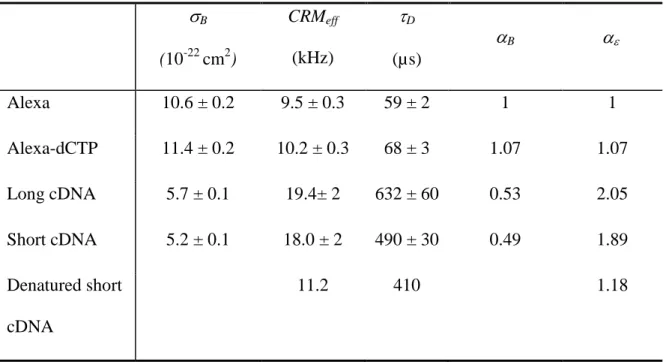
the effective photon count rates per molecule, CRMeff. Table 1 shows that the effective photon
count rates per molecule of the long and short native strands is about twice that of free Alexa,
while that of denaturated short cDNA strands is close to Alexa. The brightness of a cDNA
strand bearing n Alexa fluorophores is simply given byeff nA, where εA is the brightness of
individual Alexa labels in cDNA (note that self-quenching between Alexa fluorophores is
unlikely due to the sparse labeling obtained by our method). However, the value of n cannot
be deduced solely from the FCS measurements, since the brightness εA of individual Alexa
fluorophores linked to cDNA may be different from that of free Alexa molecules in solution.
Nevertheless, εA can be expressed as a function of the excited state radiative and non-radiative
decay rates, because it is proportional to the fluorescence quantum yield, it:
nr r r F A k k k 0 0 (15)
Throughout this paper, we shall assume that: i) the laser intensity is sufficiently low so
that the molecular transitions are not saturated and that the triplet state population is
negligible; ii) the absorption cross-section from the ground state and the radiative decay rate
of the excited state are the same for Alexa labels in cDNA and free Alexa dyes, hence the
notation 0
r
k . However, the non-radiative decay rate knr may change when the Alexa
the possible differences in photophysical properties, we performed continuous photobleaching
experiments and measured the photobleaching cross-sections of our various samples.
4.2 Continuous photobleaching
Table 1 summarizes the photobleaching cross-section values for our four samples:
Alexa dye, Alexa-dCTP, long and short cDNA strands. We see that the addition of the dCTP
side group to the Alexa dye does not significantly affects its photobleaching cross-section. On
the other hand, the cDNA-substituted Alexa dye exhibits a photobleaching cross-section
lower by a factor of 2, compared to free Alexa.
The photobleaching cross-section σB of Alexa-labeled cDNA is proportional to the
photobleaching quantum yield ηB which can be expressed as a function of the radiative decay
rate 0
r
k , the non-radiative decay rate knr and the photobleaching decay rate kB of the excited
state of Alexa fluorophores:
nr r B B nr r B B B k k k k k k k 0 0 (16)
The photobleaching decay rate kB can be neglected in the denominator since it is much
smaller than the two other terms. The above expression clearly shows that there are two
possible reasons for the reduced photobleaching cross-section of Alexa in cDNA strands: the
These two possibilities lead to different estimations of the number, n, of Alexa
fluorophores in cDNA strands. To make these estimations, we consider the normalized
photobleaching cross-sections B and the normalized brightness (see Table 1) obtained by
dividing the values relative to cDNA to those for free Alexa molecules. These normalized
quantities can be respectively written as:
0 0 0 0 0 B B nr r nr r B B B k k k k k k (17a) and nr r nr r A A A eff k k k k n n 0 0 0 0 0 (17b)
so that their ratio is given by:
B B B k k n 0 (18)
Let us estimate n for the two possible hypotheses mentioned earlier. If we assume the
photobleaching decay rate to be the same than for free Alexa dye (i.e. kB = kB0 ), the ratio
/B directly gives the number, n, of Alexa labels on the strands, so that we deduce, from Table
1, n 4. Conversely, in the case of a constant non radiative decay rate (i.e. knr = knr0 ), the
Alexa fluorophores in cDNA. When comparing theses values of n to the number of C bases
(74 for the long strands and 2 times 45 for the native short strands), we find that the degree of
labeling is probably quite low, of the order a few %, in agreement with other reports5, 32, 33.
Finally, from the FCS and continuous photobleaching results, one cannot conclude
precisely about the number of Alexa fluorophores labeling the cDNA strands. This is because
information is lacking about the brightness of the Alexa molecules linked to cDNA. It is also
worthwhile to note that the number of Alexa labels is likely to be statistically distributed and
not single valued as implicitly assumed so far.
4.3 Statistical distribution of the number of fluorescent labels
The statistical properties of the molecular brightness reflects the distribution of the number n of labeled C-bases, which in turn results from the statistical nature of the
incorporation of the labeled C bases during the cDNA polymerization. So far, different tools
have been developed to study the molecular brightness through the intensity fluctuations.17-20,
22
Among this family of methods, FCA has the advantage, compared to PCH or FIDA, to
provide analytical expressions of the moments (more precisely, the factorial cumulants) of the
photon count distribution versus the moments of the brightness distribution (see eq 6). This is
especially convenient in the present situation, since the cumulants are directly related to the
moments of the statistical distribution of the number of labels (eq 11). Assuming n to be
distributed according to a Poisson law, which is justified by the weak degree of labeling, it
brightness of the cDNA molecules is statistically distributed and that the corresponding
distribution is consistent with a Poisson one with a small value of n . For this purpose, we
have used the normalized ratios of factorial cumulants, rr,r-1,r+1, introduced in the theoretical
Section 3.2.4 (see eq 13) and compared the theoretical values, to the experimental ones
(Figure 2).
Due to the uncertainty of the experimental results, that increases with r, the
meaningful ratios rr,r-1,r+1 are limited to r = 3 and 4. We did not consider r = 2, because the
ratio 22,1,3 is always found lower than the values expected for a Poissonian distribution. This
is attributed to the fact that [1] (at the denominator of 22,1,3) may be increased by scattered
light and other parasitical photons, while higher order cumulants are not affected by photons
following a Poissonian distribution (which is the case of this unwanted light).
As an experimental result, we found 33,2,4 = 0.88 ± 0.08 and 44,3,5 = 0.9 ± 0.1. These
values are to be compared to the theoretical curves, as shown in Figure 2. Despite significant
uncertainty and variability, our results shows that the cDNA strands are not uniformly labeled
and that n is very probably limited to a small value. This is an important conclusion that only
a detailed intensity fluctuation analysis make it possible to do. However, the experimental
data are such that it is not possible to conclude about the mean number of labels, so that an
additional technique is needed. This is the motivation of the sequential photobleaching
experiments.
4.4 Sequential photobleaching experiments
4.4.1 cDNA labeling
Up to now, some uncertainties remain concerning the estimation of the number of
Alexa fluorophores per cDNA strand, that depends upon the assumption of a change in the
linked to cDNA. Hereafter, we provide an estimation that just relies on the hypothesis that the
number of fluorophores is statistically distributed according to a Poisson law. To this avail,
we performed FCS measurements on a small volume of sample which is sequencially
photobleached. In this way, we measured the effective number of molecules Neff and the count
rate per molecule CRMeff at different values of the total count rate CR. The total count rate is a
control parameter here, since it can be made to decrease using photobleaching.
To fit the experimental results, we use the expressions derived in the theoretical part
(Section 3.2.3) that relate the effective number of molecules Neff and the effective brightness
eff obtained via FCS to the average number n of fluorescent labels (see eqs 10a and 10b).
Note that n refers to the number of labels at a specific step of the photobleaching process, so
that it varies during the experiment, as opposed to the number of labels initially carried by the
cDNA strands which is characteristic of the sample. We need to introduce the total count rate
CR in eq 10, since it is the quantity we directly control. CR can be written using the number of
cDNA strand NDNA and the count rate per Alexa fluorophore CRMA,
CR NDNA nCRM A NDNA nA /t (19)
where the values of the brightness and the count rate per molecule are related by the binning
time, t. Now n can be eliminated from eq 10, so that the effective number of molecules, Neff
and count rate per molecule, CRMeff (i.e. eff/t) are expressed as a function of the total count
CRMeff A DNA A CRM N CR CRM 1 (20b)
Note that these two eqs are in fact strictly equivalent to each other, since CRMeff = CR/Neff.
The parameters NDNA and CRMA can be obtained by fitting the experimental curves, CRMeff(CR) and Neff(CR). Then we finally obtain the average number of labels initially
present before photobleaching (i.e. when the total count rate is still CR0):
DNA AN CRM
CR
n 0 (21)
The experimental data are shown in Figure 4. The effective count rate per molecule,
CRMeff, decreases linearly as a function of the total count rate. According to eq 20b, we
obtain, from the slope and the value at CR = 0, NDNA, the effective number of cDNA
molecules (fluorescent or not) inside the confocal volume and CRMA, the count rate per Alexa
fluorophore. Then, using these values, the theoretical curve for Neff given by eq 20a is drawn.
The experimental behavior of Neff(CR) is shown to be perfectly predicted by this equation,
with no variable parameter. Finally, using eq 21, we can deduce from these fitting parameters
the mean value of the Poisson law describing the distribution of number of fluorophores
initially present on the cDNA strands: n = 1.80 0.22 for the long cDNA strand (Figure 4a is a typical example) and n = 1.49 0.46 for the short cDNAs. We also find n = 0.49 for the denaturated short cDNAs (see an example in Figure 4b). Note that these low values of n can
explain some of the observations made in FCS: the effective brightness of the denaturated
strands is not exactly half that of the native strands, while their effective number of molecules
effective number of molecules is lowered compared to the actual number of molecules. It is
also worthwhile to note that n is a mean value calculated over the population of all the cDNA
strands, i.e. including the dark cDNAs, having no Alexa fluorophore. Therefore, the visible
cDNAs have a mean number of Alexa labels slightly larger, since it is given by n /(1 – e-n ).
Let us comment on the shape of the experimental curves shown in Figure 4. The
decrease of CRMeff versus CR, is more pronounced for the long strands (Figure 4a) than for
the denaturated short strands which are labeled with a smaller number of fluorophores (Figure
4b). The effective number of molecules, Neff, tends to be constant when there are many
fluorophores per strand, as can be seen for long strands in Figure 4a. Then it becomes
proportional to the count rate, CR, when only a few fluorophores are left. These observations
could be understood by considering two limiting cases. The first one is that of a large number
of fluorophores per cDNA strand: as we start to photobleach, the effective count rate per
molecule decreases because cDNA strands lose fluorophores (eq 10b), but since no cDNA
molecule becomes totally dark (because the strands are still carrying numerous fluorophores),
the effective number of molecules remains almost constant (eq 10a with n >> 1). The other
limiting case occurs for a population of cDNA strands labeled with such a small number of
fluorophores, that the probability to find a strand with two labels is negligible. In that case, the
effective count rate per molecule is almost constant and equal to that of one label (see eq
10b), while the effective number of (visible) molecules decreases (eq 10a with n << 1).
In fact, we see from eq 10 that it is necessary to cross over the transition between the
well adapted for situations where the mean number of fluorescent entities per diffusing
species is limited (for a very large number of labels, one would have to photobleach the
solution till the transition regime is reached, which can be difficult).
4.4.2 From cDNA labeling to photophysical properties
To conclude this section, we come back to the photophysical changes caused by the
incorporation of Alexa fluorophores in cDNA. We can use the values of the average number
of fluorescent labels obtained in the last paragraph to deduce the photobleaching decay rate,
kB and the non-radiative decay rate, knr (in Section 4.2, we were left with two
indistinguishable possibilities). Using eq 10b, eff
n 1
A, eq 17b must be written again to take into account the statistical distribution of the number of fluorophores, so that,contrarily to eq 18, we obtain: ( 1) 0 n k k B B B (22)
Using the values displayed in Table 1 for B and and the values of n from above, we find
0
B
B k
k = 0.72 for long cDNA and 0.65 for short non-denatured cDNA. This result suggests
that the photobleaching decay rate kB lowers when Alexa fluorophore is linked to cDNA,
which is consistent with observations made by Widengren and Schwille.34 According to these
authors who characterized, by FCS, the cyanine dye Cy5 (of which Alexa is a derivative), the
rates of intersystem crossing and triplet state decays were noticeably reduced for the DNA
substituted dye. This fact may reflect that the dye is shielded by the cDNA strand from the
oxygen molecules of the aqueous solution. Moreover, inserting the values obtained for 0
B
B k
k
) (
)
(kr0 knr kr0 knr0 is 1.36 for long cDNA and 1.33 for short non-denatured cDNA. Therefore, we can infer that the non-radiative decay rate of Alexa is increased when linked to
cDNA, so that the brightness of individual fluorophores is reduced, that is: A 0.740A for
long cDNA and 0.75 0
A
A
for short non-denatured cDNA. Note that the decay rate of the excited state of Alexa could be directly measured by lifetime measurements (since
/ 1 0 nr r k k ).
5. Conclusion
We have introduced a theoretical framework in order to characterize multiple labeling
using fluorescence data, independently of any assumption about the photophysical properties
of the fluorophores (apart from the fact that we have neglected non linear processes and
singlet-triplet transitions, because of the moderate power of our laser beam). The brightness of
the cDNA strands could not have been straightforwardly used to scale the number of
fluorescence labels for two reasons: i) one does not know the brightness of a single Alexa
fluorophore in cDNA; ii) the brightness depends upon the statistical distribution of the
number of labels. Thus, photobleaching was used as a control parameter to analyze the
variations of the number of molecules and brightness versus the total count rate. The approach
is somewhat analogous to that often used in PCH (or FIDA) analysis where one modifies the
biological conditions or performs titration experiments to monitor the molecular brightness.In
labeling (C bases) compared to the number of sites actually labeled.14 Such a distribution has
the important property to be preserved during photobleaching. As a result, we found a mean
value of 1.5 and 1.8 Alexa labels for the short (hybridized) and long cDNA strands, that
corresponds to a labeling efficiency of less than 2%. The consequence of such a weak degree
of labeling is that the brightness necessarily fluctuates quite a lot, together with the fact that a
significant amount of strands are not labeled at all. For instance, for a mean value of 2 labels
per cDNA and a brightness proportional to the number of labels, each species with 1 to 5
fluorophores contribute in a comparable way to the total fluorescence signal!
When combining our approach with independent measurements of the photobleaching
cross-section and FCS, we got additional information about the interplay between the
different decay rates of the excited state of the labeling dye: we thus found that, when
incorporated in cDNA, the photobleaching decay rate is decreased by 30%, while the
non-radiative decay rate increases such that the brightness is lowered by 25%. These
photophysical outputs are usually provided by dedicated single molecule experiments,36-38 or
time resolved ones.39-41
The method presented in this paper can be applied to DNA samples of low
concentration, while standard measurements of labeling efficiency are based on absorption
spectroscopy and thus require amplification of the genetic material.33 More generally, the
quantification of multiple labeling is a very common problem for protein or DNA analysis
involved in biochemistry, pharmacology, medicine, etc. The question is especially crucial
with the development of ultra sensitive techniques to detect biomolecules, among which,
single molecule measurements play a central role but are also, unfortunately, quite sensitive to
multiple labeling. We believe that our approach is very general and relatively easy to
implement, since it implies bulk measurements with concentrations in the nM - µM range and
interactions, the model could be extended to situations where the number of label distribution
follows different statistical laws.12,42
6. Acknowledgements
This project was funded by the French Agence Nationale de la Recherche under con-
tract ANR-07-GPLA-013-001.
The authors also gratefully thank Jie Gao for helpful and fine technical assistance on
References
(1) R. Luchowski, E. G. Matveeva, I. Gryczynski, E. A. Terpetschnig, L. Patsenker, G.
Laczko, J. Borejdo, Z. Gryczynski, Current Pharmaceutical Biotechnology 2008, 9,
411-420
(2) N.C.Shaner, P.A.Steinbach, R.Y.Tsien, Nat. Meth. 2005, 2, 905-909
(3) D. Singh, V. Kumer, K.N. Ganesh, Nucleic Acids Res. 1990, 18, 3339-3345
(4) A.C. Cuppoletti, Y. Cho, J.-S. Park, C. Strässer, E. T. Kool, Bioconjugate Chem. 2005,
15, 528-534
(5) J. Hesse, J. Jacak, M. Kasper, G. Regl, T. Eichberger, M. Winklmayr, F. Aberger, M.
Sonnleitner, R. Schlapak, S. Howorka, L. Muresan, A.-M. Frischauf, G.J. Schütz,
Genome Res. 2006, 16, 1041-1045
(6) M.L. Metzker, Genome Res. 2005, 15, 1767-1776
(7) H.-A. Wagenknecht, Ann. N.Y. Acad. Sci. 2008, 1130, 122-130
(8) W. E. Moerner, J. Phys. Chem. B 2002, 106, 910-927
(9) V.T. Nguyen, Y. Kamio, H. Higuchi, EMBO J. 2003, 22, 4968-4979
(10) Y.P. Wang, J. Biernat, M. Pickhardt, E.Mandelkow, E.-M. Mandelkow, Proc. Natl.
Acad. Sci. USA 2007, 104, 10252-10257
(11) E.H. Koo, P. T. Lansbury Jr., J.W. Kelly, Proc. Natl. Acad. Sci. USA 1999, 96,
9989-9990
(12) S.K. Das, M. Darshi, S. Cheley, M.I. Wallace, H. Bayley, ChemBioChem, 2007, 8,
994-999
(13) M. H. Ulbrich, E. Y. Isacoff, Nat. Meth. 2007, 4, 319-321
(14) T.C. Messina, H. Kim, J.T. Giurleo, D.S. Talaga, J. Phys. Chem. B 2006, 110,
(15) S.A. Mutch, B.S. Fujimoto, C.L. Kuyper, J.S. Kuo, S.M. Bajjalieh, D.T. Chiu,
Biophys. J. 2007, 92, 2926-2943
(16) Z. Petrasek, P. Schwille, J. R. Soc. Interface USA 2009, 6, S15-S25
(17) Y. Chen, J. D. Müller, P. T. So, E. Gratton, Biophys. J. 1999, 77, 553-567
(18) Y. Chen, L.-N. Wei, J. Müller, Proc. Natl. Acad. Sci. USA 2003, 100, 15492-15497
(19) P. Kask, K. Palo, D. Ullmann, K. Gall, Proc. Natl. Acad. Sci. USA 1999, 96,
13756-13761
(20) S. Saffarian, Y. Li, E. L. Elson, L. J. Pike, Biophys. J. 2007, 93, 1021-1031
(21) E.L. Elson, J. Biomed. Opt. 2004, 9, 857-864
(22) J. D. Müller, Biophys. J. 2004, 86, 3981-3992
(23) L.-J. Chen, E. M. Orozco, Nucleic Acids Res. 1988, 16, 8411-8431
(24) C. Eggeling, J. Widengren, R. Rigler, C. A. M. Seide in Applied fluorescence in
chemistry, biology and medicine, (Eds.: W. Rettig, B. Strehmel, S. Schrader, H.
Seifert), Springer-Verlag, Berlin, 1999, p. 193
(25) J.E.Berlier, A.Rothe, G.Buller, J.Bradford, D.R.Gray, B.J.Filanoski, W.G. Telford,
S.Yue, J.Liu, C.-Y.Cheung, W.Chang, J.D.Hirsch, J.M. Beechem, R.P.Haugland, R.P.
Haugland, J. Histochem. Cytochem. 2003, 51, 1699-1712
(26) R. Luchowski, E. G. Matveeva, I. Gryczynski, E. A. Terpetschnig, L. Patsenker, G.
Laczko, J. Borejdo, Z. Gryczynski, Curr. Pharm. Biotechnol. 2008, 9, 411-420
(27) J. R. Lakowicz, J. Malicka, S. D'Auria, I. Gryczynski, Anal. Biochem. 2003, 320,
(30) B. Huang, T. D. Perroud, and R. N. Zare, ChemPhysChem 2004, 5, 1523-1531
(31) B. Tinland, A. Pluen, J. Sturm, G. Weill, Macromolecules 1997, 30, 5763-5765
(32) T. Margaritis, P. Lijnzaad1, D. van Leenen, D. Bouwmeester, P. Kemmeren, S.R. van
Hooff, F.CP Holstege, Molecular Systems Biology 2009, 5:266
(33) P.A. C. 't Hoen, F. de Kort, G.J.B. van Ommen, J.T. den Dunnen, Nucleic Acids Res.
2003, 31, e20
(34) J.Widengren, P. Schwille, J. Phys. Chem. A. 2000, 104, 6416-6428
(35) B. Wu, Y. Chen, J.D. Muller, Biophys. J. 2009, 96, 2391-2404
(36) L.A. Deschenes, D.A. Vanden Bout, Chem. Phys. Let. 2002, 365, 387-395
(37) E. Füreder-Kitzmüller, J. Hesse, A. Ebner, H.J. Gruber, G.J. Schütz, Chem. Phys. Let.
2005, 404, 13-18
(38) Z. Huang, D. Ji, S. Wang, A. Xia, F. Koberling, M. Patting, R. Erdmann, J. Phys.
Chem. A 2006, 110, 45-50
(39) M.E. Sanborn, B.K. Connolly, K. Gurunathan, M. Levitus, J. Phys. Chem. B 2007,
111, 11064-11074
(40) P. Sarkar, S.V. Koushik, S.S. Vogel, I. Gryczynski, Z. Gryczynski, J. Biomed Opt.
2009, 14, 340471-340479
(41) I. Gregor, J. Enderlein, Photochem. Photobiol. Sci. 2007, 6, 13–18
Figure captions and Table
Figure 1. Time-derivative of the decay of the fluorescence signal, F(t), due to
photobleaching, on a semi-log scale measured with 4 mW excitation power. Results are
shown for three samples: Alexa (open circles), Alexa-dCTP (open squares) and Alexa labeled
long cDNA strands (open triangles). Fluorescence decays obtained from short cDNA strands
are similar to that of long strands (data not shown).
Figure 2. Normalized ratios of factorial cumulants, 33,2,4 (dashes) and 44,3,5 (dots), versus
n . The continuous curves correspond to the theoretical calculations done by assuming a
Poissonian distribution with a mean value of n Alexa fluorophores per cDNA strand. The
vertical error bars represent the experimental values of the normalized ratios with their
uncertainties.
Figure 3 Example of experimental autocorrelation functions (symbols), acquired with
different species and concentrations, with their fits for free diffusion (solid lines). (a)
autocorrelation functions for Alexa (open triangles) and long cDNA strands (open circles),
exemplifying the difference of diffusion times; they are normalized so that G(0)=2. (b)
autocorrelation functions of short cDNA strands, the amplitude of which is about twice when
strands. The count rates per molecule are fit with eq 20b and the initial number of labels per
cDNA molecule (n ) is then determined from eq 21.
Table 1 Photophysical parameters of Alexa, Alexa-dCTP and cDNA strands, determined by
continuous photobleaching and FCS experiments.a
B (10-22 cm2) CRMeff (kHz) D (µs) B Alexa 10.6 ± 0.2 9.5 ± 0.3 59 ± 2 1 1 Alexa-dCTP 11.4 ± 0.2 10.2 ± 0.3 68 ± 3 1.07 1.07 Long cDNA 5.7 ± 0.1 19.4± 2 632 ± 60 0.53 2.05 Short cDNA 5.2 ± 0.1 18.0 ± 2 490 ± 30 0.49 1.89 Denatured short cDNA 11.2 410 1.18 aσ
B is the photobleaching cross-section; CRMeff is effective the photon count rate per
molecule, normalized at 1 µW of laser power; D is the diffusion time; B and are the
normalized photobleaching cross-section and brightness, that represent the photobleaching
cross-section and brightness (eff) of the various Alexa labeled entities (dCTP, cDNA),
relative to the corresponding values for free Alexa molecules (0B, A and 0A), i.e. B = B/
0 , A
B
F ig u re 1
0
1 0 0
2 0 0
3 0 0
4 0 0
5 0 0
6 0 0
1 E -5
1 E -4
1 E -3
0 .0 1
-d
I/
d
t
t (s)
L o n g stran d
A lex a
A lex a-d C T P
F ig u r e 20 .9 0
0 .9 5
1 .0 0
0
1
2
3
4
5
6
n
rr ,r -1 ,r + 11 0
01 0
11 0
21 0
31 0
41 0
51 0
61 .0
1 .2
1 .4
1 .6
1 .8
2 .0
A lex a
N = 1 .5 5 4 ± 0 .0 0 2
D= 5 5 .7 9 ± 0 .2 2
L o n g cD N A
N = 3 .0 4 4 ± 0 .0 0 4
D= 6 1 7 .2 3 ± 2 .2 8
G(
)
(
s)
F ig u re 3(a)
F ig u re 31 0
-11 0
01 0
11 0
21 0
31 0
41 0
51 0
61 .0
1 .1
1 .2
1 .3
1 .4
1 .5
N ativ e
sh o rt cD N A
N
eff= 2 .6 5 0 ± 0 .0 0 8
D= 4 7 4 .1 0 ± 6 .0 2
D en atu red
sh o rt cD N A
N
eff= 4 .4 7 1 ± 0 .0 1 1
D= 4 3 3 .2 7 ± 3 .3 1
G(
)
(
s)
(b )
F ig u re 4
2 5 0
2 0 0
1 5 0
1 0 0
5 0
0
0
1 0
2 0
3 0
4 0
5 0
6 0
7 0
8 0
0
1
2
3
4
C
R
M
(
k
H
z
)
C R (k H z)
N
e ff96
.
1
n
(a)
F ig u re 41 0
2 0
3 0
4 0
5 0
4
6
8
1 0
1 2
1 4
1 6
C
R
M
(
k
H
z
)
N
e ff
(b )
Table of Contents
2 0 0 1 0 0 0 0 2 0 4 0 6 0 8 0 0 1 2 3 4 C R M e ff ( k H z ) C R (k H z) N e ff 96 . 1 nTypical count rate per molecule (CRMeff, solid squares) and effective number of molecules
(Neff, open circles) as a function of the total count rate, CR, determined from FCS
measurements during photobleaching of a solution of cDNA strands. These strands are 306
base long, including 74 dCTP, some of them being labeled by Alexa-Fluor-647. The fit of the
effective count rate per molecule (solid line) provides the initial number of labels per cDNA
molecule (n ). The dashed curve is the effective number of molecules that corresponds to this