Dense Visual Learning for Robot Manipulation
by
Peter R. Florence
A.B., Princeton University (2012)
M.Phil., Cambridge University (2013)
S.M., Massachusetts Institute of Technology (2017)
Submitted to the Department of Electrical Engineering and Computer
Science
in partial fulfillment of the requirements for the degree of
Doctor of Philosophy
at the
MASSACHUSETTS INSTITUTE OF TECHNOLOGY
February 2020
c
○ Massachusetts Institute of Technology 2020. All rights reserved.
Author . . . .
Department of Electrical Engineering and Computer Science
September 30, 2019
Certified by . . . .
Russ Tedrake
Professor of Electrical Engineering and Computer Science
Thesis Supervisor
Accepted by. . . .
Leslie A. Kolodziejski
Professor of Electrical Engineering and Computer Science
Chair, Department Committee on Graduate Students
Dense Visual Learning for Robot Manipulation
by
Peter R. Florence
Submitted to the Department of Electrical Engineering and Computer Science on September 30, 2019, in partial fulfillment of the
requirements for the degree of Doctor of Philosophy
Abstract
We would like to have highly useful robots which can richly perceive their world, se-mantically distinguish its fine details, and physically interact with it sufficiently for useful robotic manipulation. This is hard to achieve with previous methods: prior work has not equipped robots with the scalable ability to understand the dense visual state of their varied environments. The limitations have both been in the state representations used, and how to acquire them without significant human labeling effort. In this thesis we present work that leverages self-supervision, particularly via a mix of geometrical computer vision, deep visual learning, and robotic systems, to scalably produce dense visual inferences of the world state. These methods either enable robots to teach themselves dense visual models without human supervision, or they act as a large multiplying factor on the value of in-formation provided by humans. Specifically, we develop a pipeline for providing ground truth labels of visual data in cluttered and multi-object scenes, we introduce the novel ap-plication of dense visual object descriptors to robotic manipulation and provide a fully robot-supervised pipeline to acquire them, and we leverage this dense visual understanding to efficiently learn new manipulation skills through imitation. With real robot hardware we demonstrate contact-rich tasks manipulating household objects, including generalizing across a class of objects, manipulating deformable objects, and manipulating a textureless symmetrical object, all with closed-loop, real-time vision-based manipulation policies. Thesis Supervisor: Russ Tedrake
Acknowledgments
There are many people I’d like to thank for making my time during graduate school a fantastic journey.
First and foremost I would like to thank my advisor, Russ. Russ has a remarkable mix of abilities - combining deeply rigorous technical skills with inspiration and vision for the future of robotics. I’m also immensely thankful to Russ for taking me, a kid who had only previously done research in Chemistry and Physics, into our incredible lab to start working on robotics.
I’d also like to thank the rest of my committee for their time, guidance, and support throughout this process. Thank you Leslie, Nick, and Dieter.
There have been many other professors at MIT that have been generous with their time and encouragement. In particular I’d like to thank Tomas Lozano-Perez, Alberto Rodriguez, Bill Freeman, and Antonio Torralba.
I have had a world-class set of labmates to work with and learn from. I am indefinitely grateful to Andy Barry and John Carter for teaching me so many things during the start of my PhD. In the second half of my PhD I’ve been lucky to work closely with Lucas Manuelli, Pat Marion, and Wei Gao. Extra thanks to Lucas for being a ski-buddy, friend, and research partner in my later work. Additionally, a broad cast of other characters have been great to work with and have around the lab for inspiring discussions: Greg Izatt, Matthew O’Kelly, Benoit Landry, Ani Majumdar, Vincent Tjeng, Robin Deits, Twan Koolen, Aykut Satici, Hongkai Dai, Michael Posa, Frank Permenter, Shen Shen, Geronimo Mirano, Tao Pang, and YunZhu Li. Steve Proulx provided fantastic hardware engineering with various robot projects. Also thanks to Mieke Moran and Gretchen Jones for being awesome at supporting our lab.
I’ve also learned from and enjoyed working with great folks at organizations outside of our lab. My internship at Facebook Reality Labs was hugely influential in developing my appreciation of perception. I’d like to thank: Steven Lovegrove, Richard Newcombe, Julian Straub, and Jeong Joon Park. Additionally, it was an awesome and fun learning experience to work on DARPA FLA with people from both MIT and Draper Laboratory:
(from MIT) John Carter, Jake Ware, Brett Lopez, Nick Greene, Kris Frey, and Katherine Liu, (from Draper) Ted Steiner, Steve Paschall, Julius Rose, Rob Truax, Scott Rasmussen, Chris Wardman, and Tye Brady. It’s also been great trading ideas with the team at Toy-ota Robotics Institute, in particular: Duy Nguyen, Alex Alspach, Eric Cousineau, Sammy Creasey, Siyuan Feng, and Allison Fastman.
And of course I would like to thank my family! Mom, Dad, and TJ, thank you for everything. Susanne, you are very wonderful and thank you for all your support. Varun – you were my MIT family for a big chunk there! Special thank you also goes to: Murphy, Huxley, Sidney, Maisy.
Funding Acknowledgement
This work was supported by Lockheed Martin Corporation, Award No. RPP2016-002, Draper Laboratory, Incorporated; Award No. SC001-0000001002, and Amazon, Award No. 2D-01029900.
Contents
1 Introduction 11
1.1 Contributions . . . 14
1.2 Motivation. . . 16
1.3 Related Work . . . 19
2 LabelFusion: A Pipeline for Generating Ground Truth Labels for Real RGBD Data of Cluttered Scenes 23 2.1 Introduction . . . 23
2.2 Related Work . . . 24
2.2.1 Methods for Generating Labeled RGBD Datasets . . . 25
2.2.2 Object-Specific Pose Estimation in Clutter for Robotic Manipulation 26 2.2.3 Empirical Evaluations of Data Requirements for Image Segmenta-tion GeneralizaSegmenta-tion . . . 27
2.3 Data Generation Pipeline . . . 27
2.3.1 RGBD Data Collection . . . 27
2.3.2 Dense 3D Reconstruction . . . 28
2.3.3 Object Mesh Generation . . . 29
2.3.4 Human Assisted Annotation . . . 29
2.3.5 Rendering of Labeled Images and Object Poses . . . 30
2.3.6 Discussion . . . 31
2.4 Results. . . 31
2.4.2 Empirical Evaluations: How Much Data Is Needed For Practical
Object-Specific Segmentation? . . . 33
2.5 Conclusion . . . 37
3 Dense Object Nets: Learning Dense Visual Object Descriptors By and For Robotic Manipulation 39 3.1 Introduction . . . 39
3.2 Related Work . . . 41
3.3 Methodology . . . 43
3.3.1 Preliminary: Self-Supervised Pixelwise Contrastive Loss . . . 43
3.3.2 Training Procedures for Object-Centric Descriptors . . . 44
3.3.3 Multi-Object Dense Descriptors . . . 46
3.4 Experimental . . . 47
3.5 Results. . . 48
3.5.1 Single-Object Dense Descriptors . . . 48
3.5.2 Multi-Object Dense Descriptors . . . 49
3.5.3 Selective Class Generalization or Instance Specificity . . . 51
3.5.4 Example Applications to Robotic Manipulation: Grasping Specific Points . . . 52
3.6 Conclusion . . . 53
4 Dense Spatial-Temporal Distributional Correspondence Learning 55 4.1 Introduction . . . 55
4.2 Motivation. . . 56
4.3 Background and Related Work . . . 56
4.4 Contributions . . . 59
4.5 Formulation . . . 59
4.5.1 Preliminaries . . . 62
4.5.2 Learning Correspondence Localization on Distributions . . . 64
4.5.3 Extending Image-to-Image Correspondence Learning into 3D Spa-tial Distributions . . . 67
4.5.4 Correspondence Learning on Temporal Distributions . . . 73
4.5.5 Correspondence Learning Across Space-Time . . . 74
4.5.6 Dense-to-Sparse Correspondences . . . 75
4.6 Conclusion . . . 76
5 Self-Supervised Correspondence in Visuomotor Policy Learning 79 5.1 Introduction . . . 79
5.2 Related Work . . . 80
5.2.1 Visual Training Methods for Visuomotor Policies . . . 81
5.2.2 Methods for Learning Vision-Based Closed-Loop Policies . . . 82
5.3 Visuomotor Formulation . . . 83
5.3.1 Preliminary: Visuomotor Policies . . . 83
5.3.2 Visual Correspondence Models for Visuomotor Policy Learning . . 84
5.4 Visual Imitation Formulation . . . 86
5.4.1 Imitation Learning Visuomotor Policies . . . 86
5.4.2 Robot Observation Space, Action Space, and Interface to Low-level Control . . . 87
5.4.3 Training for Feedback through Data Augmentation . . . 89
5.4.4 Dynamic-Scene, Multi-View Time-Sychronized Correspondence Train-ing . . . 91
5.4.5 Policy Models . . . 92
5.5 Experimental . . . 93
5.5.1 Evaluating Visual Representations for Visuomotor Policy Learning 93 5.5.2 Simulation Experimentation . . . 95
5.5.3 Real-Hardware Experimentation . . . 97
5.5.4 Imitation Learning Demonstration Modality . . . 97
5.6 Results. . . 98
5.6.1 Simulation Results . . . 98
5.6.2 Hardware Results . . . 100
6 Conclusion 107
Appendices 128
A 129
A.1 Policy Models and Training. . . 129
A.2 Vision Networks . . . 131
A.3 Simulation Tasks . . . 131
A.4 Additional Simulation Results . . . 133
Chapter 1
Introduction
A nice motivational insight for this thesis work comes from Geoff Hinton: “The brain has
about 1014synapses and we only live for about 109 seconds. So we have a lot more
param-eters than data. This motivates the idea that we must do a lot of unsupervised learning since the perceptual input (including proprioception) is the only place we can get 105dimensions
of constraint per second.”1 We view this comment as particularly relevant to the challenges
of robotic manipulation and computer vision “in the wild”. We would like robots, for exam-ple, to be able to inspect arbitrary scenes of objects and complete arbitrary tasks with them.
Yet from the firehose of raw perception data, for example 2.8 × 10⁷dimensions per second
for just a medium-resolution camera2, it is challenging to provide enough constraints with
just manual specification or sparse rewards.
In this thesis our primary interest is in how to scalably enable robots to acquire percep-tual knowledge useful for robotic manipulation. This leads us to naturally ask: what type of perceptual knowledge is useful, and how can it scalably be acquired? In this thesis we address both of these, questioning both the representations that are used, and how to ac-quire them. We aim to enable robots to efficiently supervise their perceptual inputs entirely by themselves, or to leverage self-supervision in order to make the most out of minimal human input. The benefits of this perceptual self-supervision may be interpreted in various ways: on the one hand, it may provide the ability to lift raw data into regimes in which
1November 7, 2014, Reddit A.M.A., https://www.reddit.com/r/MachineLearning/
comments/2lmo0l/ama_geoffrey_hinton/
explicit geometrical planning can thrive, and alternatively, perceptual self-supervision can be thought of as a type of multi-task learning providing a sizable source of otherwise inac-cessible supervision.
To address our goal, we leverage the structure of robotic 3D perception data and a variety of tools including multi-view geometry, new object representations, deep visual models, general-purpose grasping pipelines, and robot learning from demonstration. One of the main contributions of this thesis is in introducing dense visual description of objects as a representation useful for manipulation (Dense Object Nets [1]), and in showing that this representation can be fully autonomously acquired without human input. Another area of contribution is a method to provide ground-truth labels of 6DOF object poses in cluttered scenes (LabelFusion [2]), which does require human input but does so in a highly efficient manner due to dense 3D-based labeling. Finally, we demonstrate using self-supervised correspondence learning to efficiently learn visuomotor policies from demonstrations of manipulation tasks.
Problem Statement
This thesis places primary importance on robotic visual learning being both dense and scal-able. Perhaps the best way to appreciate our definition of dense is by analogy and contrast (Figure1-1) with a different domain area which was a focus of the first half of my PhD: ob-stacle avoidance for autonomous vehicles in static environments. For this task, perceiving the dense state of the environment is not strictly necessary. In obstacle avoidance, the pri-mary goal is to not touch anything, and it is sufficient to have conservative approximations of free space [3], without ever perceiving, for example, large portions of fine geometric detail, or distinguishing semantics.
For the applications of focus for this thesis, however, the detail at dense resolution is critical. In this thesis we take a broad view of the definition of dense to refer to all types of understanding at approximately the millimeter-scale of what is relevant to the physics of robot fingers. This includes both the geometry of the world’s objects, but also what this geometry is. For some tasks, robots may need to understand the explicit semantics of objects in cluttered environments (“this is a drill”), and for other tasks we may need robots
(a) (b)
(c) (d)
Figure 1-1: The lack of necessity for dense visual understanding in some tasks, and the need in others. The comparison between (a) and (b) is adapted from Bachrach [4] who nicely observes: “Two corridors with very different geometry, but similar feasible trajectories. For planning purposes, there is no reason to expend effort modeling all of the intricacies of the tree trunks and branches.” In contrast, the task of cleaning up a kitchen requires considerable understanding of the difference in intricacies between (c) and (d). Image sources in appendix.
to be able to densely correspond the fine structure of objects (“grab this part of the object and put it on top of that part of the other object“). In some of our work, dense is used as it is commonly in the computer vision literature for 2D images, which means “every pixel”, but the term also applies to 3D representations, as in dense 3D reconstructions.
In addition to robotic manipulation, there are many other applications of computer vi-sion “in the wild” for which this type of dense visual understanding is useful. Automated computer vision systems such as those that enable automatic-checkout grocery stores (i.e., Amazon Go) require semantic understanding of considerable density. In augmented reality, dense understanding is critical for virtual-physical interactions (i.e., a virtual person sitting down in a real-world chair), and occlusions of virtual agents. For autonomous navigation, beyond just the static obstacle avoidance problem, agents may benefit from densely under-standing the environment in order to leverage priors on, for example, its layout beyond the sensor horizon [5]. Additionally, in dynamic environments for autonomous cars it’s highly useful to identify all bicyclists, pedestrians, and cars with their 3D locations and semantic
classes in order to increase the prediction accuracy of their behavior.3
The second primary robotic vision property of interest in this thesis is scalability, which concerns whether the desired perception knowledge is actually attainable at large scale. In other words, “how do we actually get the data”? The key underlying factor determining scalability is how much cost (human time, computation time, hardware cost, etc.) is re-quired in order to provide the requisite data. It is probably unattainable, for example, to have precise 3D mesh models of every object a general-purpose manipulation robot would interact with, particularly in a world full of shape variation, deformable objects, granular media, and fluids.
In a recent review, Mason [6] gives a careful definition of manipulation as: “manipula-tion refers to an agent’s control of its environment through selective contact”. As depicted in Figure1-2, a core current challenge in robotic manipulation is in enabling manipulation of arbitrary scenes of objects, rather than controlled environments with pre-known object configurations. Accordingly, the primary problem this thesis addresses is how to enable robots to perceptually understand arbitrary scenes of objects in order to inform the choice of selective contact.
1.1 Contributions
This thesis develops novel contributions in robotic dense visual learning, including in in-troducing dense visual object representations to robotic manipulation, in self-supervised systems to scalably acquire data for dense visual understanding, and in leveraging self-supervised vision to increase the ability to accomplish complex tasks demonstrated by hu-mans.
In particular, in Chapter 2 we develop a pipeline to rapidly generate ground truth labels for RGBD data of cluttered scenes, which researchers can use to build their own datasets that include pixelwise labels and 6DOF poses of multi-object data with occlusions, with the only hardware requirement being the RGBD sensor itself. To demonstrate the
useful-3Note: in this application, perhaps centimeter-scale or pixel-scale is sufficient, but still, it is a fine-scale
visual understanding, and the world scale relevant to fast-moving cars is much larger than the world scale immediately relevant to a manipulation robot.
Robots that can: • Clean kitchens • Make sandwiches • Do the dishes • Etc. Environment: • Heavily controlled airspace • Track with no other cars or obstacles • Objects in precisely pre-known configurations Environment: • Uncontrolled environments • Uncontrolled city streets with other cars, bikes, pedestrians • Uncontrolled environments with objects in unknown configurations
Figure 1-2: A primary challenge for robotic manipulation is in moving from controlled environments to increasingly uncontrolled environments, similar to the comparison of moving from commercial planes and subways to modern autonomous drones and cars.
ness of this pipeline we generated the largest known RGBD dataset with object-pose labels (352,000 labeled images, 1,000,000+ object instances) in only a few days. In Chapter 3 we introduce dense descriptors as a representation useful for robotic manipulation. We also show that self-supervised dense visual descriptor learning can be applied to a wide variety of potentially non-rigid objects and classes (47 objects so far, including 3 distinct classes), can be learned quickly (approximately 20 minutes), and can enable new manipulation tasks. In example tasks we grasp specific points on objects across potentially deformed configu-rations, do so with object instance-specificity in clutter, or transfer specific grasps across objects in a class. We also contribute novel techniques to enable multi-object distinct dense descriptors, and show that by modifying the loss function and sampling procedure, we can either acquire descriptors which generalize across classes of objects, or descriptors that are distinct for each object instance. In Chapter 4, we develop a new formulation for improved correspondence localization. Finally, in Chapter 5, we leverage self-supervised correspon-dence learning to improve visual imitation learning, and improve the sample efficiency and precision with which robots can imitate manipulation skills.
AI Level Definition
∅ below the level of an average human toddler I at or above the level of the average human toddler II at or above the level of the average human adult III above the world’s best human expert
Figure 1-3: A simple scale for categorizing the level of artificial intelligence (AI level) for a given task. The scale compares skill on a task to three levels of human skill: average toddler, average adult, and world expert human.
1.2 Motivation
We would like to have friendly robots be able to do labor-intensive things for us like clean the kitchen, make us a sandwich, do the dishes, or help the elderly with daily manipulation tasks. It should come as no surprise to anyone, however, that we don’t have C-3PO or Baymax robots walking around in anybody’s homes that are generally capable of these types of tasks.
Remarkable progress, however, has been made in the last few years in related domains of other artificial agents: we now have autonomous cars that are capable of navigating some degree of regular traffic in mapped areas, autonomous drones that are capable of nav-igating in fully unstructured environments and are available for purchase by consumers, humanoid robots that can perform backflips, and artificial agents that are capable of
beat-ing the world’s best human player in the game of Go. One qualitative way (Table1-3) to
analyze the intelligence level for these different AI systems is by a simple metric: how do these systems compare in their capabilities to the skill levels of average human toddlers, av-erage human adults, and the world’s best human expert? These artificial agents exhibit high levels of mastery, in large parts comparable or better than human adults at these respective tasks (Table1-4).
Why, then, are artificial agents still at approximately toddler level or below in visual scene understanding and robot manipulation? This thesis aims to increase our understand-ing of the inherent challenges and provide tools that increase the skill level of autonomous systems at these tasks.
A set of primary challenges though with the route of bringing perception information into the right state for dense visual understanding and robot manipulation is: what even
Task AILevel Metric Explanation Repeatedly welding
a known pattern III Speed and accuracy
Robot arms have been capable of superhuman repeated precise patterns since at least the 1980s.
Playing the game of
Go III Rules of Go AlphaGo beat Lee Sedol in 2016. Piloting a drone in
unstructured environments
II or
III Safe (obstacle-free)and fast navigation
A commercially-available Skydio drone is easily superior to the average human at navigating a drone. The world’s best FPV (first-person-view) pilots probably still win in gracefulness and speed, even if they are riskier.
Piloting a car in
urban environments I or II Safe navigation onstreets
There is no doubt that a modern autonomous car is safer than a human toddler, so above level ∅. For large parts of the autonomous driving problem, arguably autonomous cars are above average human level (level II), although some challenges remain (highly robust perception, other driver behavior prediction, etc.).
Bipedal walking on unstructured terrain ∅ or Ior II
Ability to not fall and gracefully navigate difficult terrain
Modern Boston Dynamics robots can do some highly dynamics skills more gracefully than average humans (like backflips), and have been shown to handle a wide variety of terrains, although once children learn to walk they are formidable.
Visual scene
understanding ∅ or I
Ability to answer questions asked by a human of a scene
While image classification is “super-human” on a static dataset like ImageNet, we do not have computer vision systems capable of answering arbitrary questions like, “why is the human standing under the umbrella?”, so below level II. Manipulating arbitrary objects in unstructured environments ∅ or I Ability to be presented a new object and accomplish an arbitrary manipulation task
The average adult can easily tie a shoe, open a book, hang a mug on a rack, etc, so below level II.
Figure 1-4: Respective levels of intelligence of existing AI systems as measured by the simple scale (Table
is the right state of the world, and how should it be acquired? This question may inspire a variety of responses from the research community. An easily stated and often preferred answer has been to have the 6DOF pose of each object instance in the world (with this pose referring to a pre-known 3D mesh model), but this raises scalability concerns, and doesn’t apply to deformable objects. Additionally, once we involve occlusions and de-formable objects, we must accept the world may not be fully observable. Note that a partial view of a rigid object may be enough to infer its state, but for deformable objects, often “self-occlusions” (one part of the object occluding another part) prevent full observability, since for example we can not see the bottom of a clumped-up towel. Another challenge is that many details of the environment are not relevant to tasks, but some of the fine detail matters – for example, to zip open a backpack, the small zipper handle of the backpack must be manipulated. To compare again with research challenges for other robotics plat-forms, these types of challenges (partial observability, and a small proportion of state that is task-critical) are prevalent as well in other primary unsolved challenges – for example, for autonomous vehicles to ideally model the behavior of other cars on the road, the mental state of those drivers is both very task-relevant, and not fully observable. For the three robot domains of autonomous cars, autonomous drones, and legged robots, these domains are all centered around mobility, and the primary problem is to navigate the world safely and avoid obstacles. Coarse approximations of the world state may still be viable for plan-ning – for example, all obstacles can be inflated without estimating fine geometric detail. The primary contract in autonomous mobility, for the most part, is to not hit anything. In robot manipulation, in contrast, the goal is to actually change the state of the world, and fine geometric detail does matter, at least in the places where the robot makes contact with the environment.
Also, as robot manipulation skills become more sophisticated, I expect the communi-cation of goals to the robot to increasingly be a bottleneck. The complexity of possible different goals to communicate is worth emphasizing in contrast to autonomous naviga-tion robots — while mobility platforms may need to handle some level of variability in the tasks they are asked to perform (“take me here”, “go there”, etc), these are essentially three-dimensional goal states. In robot manipulation the variability of the possible tasks
are enormous. Even just putting a deformable object into a specific 3D configuration is an infinite-dimensional goal state (although probably approximated sufficiently well with a modest number of dimensions), and real useful manipulation problems often involve the combinatorial complexity of many different objects interacting. One route to shortcutting the challenge of communicating goals is to specify goals to the robot through demonstra-tion. Indeed, Learning from Demonstration (LfD) has been a long-studied area of research in robotics and related fields. In the final chapter of this thesis, we take an LfD approach to teaching robot manipulation skills.
1.3 Related Work
There is a broad array of related work to this thesis. Rather than have repeated sections of related work, in this section I will briefly comment on the overall body of work in the literature that relates to this thesis, and highlight where additional detail can be found within each chapter.
This thesis largely sits between the worlds of computer vision and robotic manipula-tion, and these two worlds are intimately related in their origins. Although what we might consider the study of computer vision to hark back to at least early studies of perspective vision by Da Vinci, the first known work using digital computers to actually perform the analysis of image pixels was Lawrence Roberts’ 1963 MIT PhD thesis [7], which started the study of what we affectionately know as “Blocks World” [8]. As nicely summarized
by Steve Seitz 4, this study inspired for example the 1970 MIT “copy-demo” by Patrick
Winston and colleagues5, which used the computer vision principles from Roberts’ Blocks
World to manipulate blocks with a robot arm. Seitz highlights that a key takeaway from the MIT copy-demo was that the task of reliably finding edges in images proved to be a pri-mary challenge. This helped spawn a significant amount of research focus in the computer vision field in edge detection, providing us with well-known results such as Canny Edge
4Steve Seitz. "3D Computer Vision: Past, Present, and Future" - February 2012, on YouTube.
5Although I could not find any published formal description of this demo, an informal description of the
event can be found online, for example athttps://people.csail.mit.edu/bkph/phw_copy_ demo.shtml
Detection [9]. This process, of having a perceptual representation in mind, testing it out with real robot hardware and discovering what the real challenges are, and then investing new research into those challenges, is a fruitful process. It is also useful to return to the representation itself (in this case, blocks) and question what are its fundamental limitations. A few broad trends in computer vision have had an enormous impact on this thesis. For one, the decades-long development of modern geometrical computer vision including visual Simultaneous Localization and Mapping (SLAM) has underpinned each and every chapter in this thesis. Comprehensive reviews of these topics can be abundantly found, for example [10, 11]. Additionally underpinning each chapter in this thesis has been the maturation of deep learning [12]. While geometrical computer vison and deep learning have each impacted huge swaths of research in perception, the overlap between them is of particular interest in this thesis. Additionally, and perhaps more uniquely related, is our interest in dense vision: dense SLAM, dense correspondence, and dense deep learning. Dense SLAM in real-time has been made possible by systems like KinectFusion [13], and dense correspondence across scenes was introduced by Liu et al. [14]. Within deep learn-ing, there are many different tasks that we might consider “dense” – any task that involves a prediction for every pixel. This includes pixelwise semantic or instance segmentation, and video prediction. We are especially interested in methods which learn dense corre-spondence, i.e. with deep dense descriptor models [15, 16]. We provide a review of works in correspondence in Chapter 4.
A central theme of this thesis is in robots teaching themselves about vision. There have been many inspiring works in self-supervision as a theme to train visual systems [17]. In Chapter 2’s related work we review a variety of systems that have demonstrated automating the labeling of certain types of perceptual representations. A special type of a robot teaching itself about vision is a robot that actually interacts with the world via its own actions, and through this interaction learns more about the world. Primary examples of this type of paradigm are works that self-supervise video prediction models [18, 19] which can then be used to accomplish robot manipulation tasks. In Chapter 3, since our robot can autonomously reorient objects in order to continue its correspondence learning process, our work also fits into this category of interactive perception. We review additional types
of robots actively teaching themselves perception in Chapter 3, and for a more extensive review of interactive perception we refer the reader to Bohg et al. [20].
In the final chapter of this thesis, we interact with an additional body of work in the literature, namely that of Imitation Learning and Learning from Demonstration (LfD). We refer the reader to existing reviews of imitation learning in robotics [21–23], and focus our review of related work on visual imitation methods [24–26]. Chapter 5 reviews these works in more detail.
Chapter 2
LabelFusion: A Pipeline for Generating
Ground Truth Labels for Real RGBD
Data of Cluttered Scenes
2.1 Introduction
Advances in neural network architectures for deep learning have made significant impacts on perception for robotic manipulation tasks. State of the art networks are able to produce high quality pixelwise segmentations of RGB images, which can be used as a key com-ponent for 6DOF object pose estimation in cluttered environments [27, 28]. However for a network to be useful in practice it must be fine tuned on labeled scenes of the specific objects targeted by the manipulation task, and these networks can require tens to hundreds of thousands of labeled training examples to achieve adequate performance. To acquire sufficient data for each specific robotics application using once-per-image human labeling would be prohibitive, either in time or money. While some work has investigated closing the gap with simulated data [29–32], our method can scale to these magnitudes with real data.
In this chapter we tackle this problem by developing an open-source pipeline that vastly reduces the amount of human annotation time needed to produce labeled RGBD datasets for
training image segmentation neural networks. The pipeline produces ground truth segmen-tations and ground truth 6DOF poses for multiple objects in scenes with clutter, occlusions, and varied lighting conditions. The key components of the pipeline are: leveraging dense RGBD reconstruction to fuse together RGBD images taken from a variety of viewpoints, labeling with ICP-assisted fitting of object meshes, and automatically rendering labels us-ing projected object meshes. These techniques allow us to label once per scene, with each scene containing thousands of images, rather than having to annotate images individually. This reduces human annotation time by several orders of magnitude over traditional tech-niques. We optimize our pipeline to both collect many views of a scene and to collect many scenes with varied object arrangements. Our goal is to enable manipulation researchers and practitioners to generate customized datasets, which for example can be used to train any of the available state-of-the-art image segmentation neural network architectures. Using this method we have collected over 1,000,000 labeled object instances in multi-object scenes, with only a few days of data collection and without using any crowd sourcing platforms for human annotation.
Our primary contribution is the pipeline to rapidly generate labeled data, which re-searchers can use to build their own datasets, with the only hardware requirement being the RGBD sensor itself. We also have made available our own dataset, which is the largest available RGBD dataset with object-pose labels (352,000 labeled images, 1,000,000+ ob-ject instances). Additionally, we contribute a number of empirical results concerning the use of large datasets for practical deep-learning-based pixelwise segmentation of manipulation-relevant scenes in clutter – specifically, we empirically quantify the generalization value of varying aspects of the training data: (i) multi-object vs single object scenes, (ii) the number of background environments, and (iii) the number of views per scene.
2.2 Related Work
We review three areas of related work. First, we review pipelines for generating labeled RGBD data. Second, we review applications of this type of labeled data to 6DOF object pose estimation in the context of robotic manipulation tasks. Third, we review work related
to our empirical evaluations, concerning questions of scale and generalization for practical learning in robotics-relevant contexts.
2.2.1 Methods for Generating Labeled RGBD Datasets
Rather than evaluate RGBD datasets based on the specific dataset they provide, we evaluate the methods used to generate them, and how well they scale. Firman [33] provides an extensive overview of over 100 available RGBD datasets. Only a few of the methods used are capable of generating labels for 6DOF object poses, and none of these associated datasets also provide per-pixel labeling of objects. One of the most related methods to ours is that used to create the T-LESS dataset [34], which contains approximately 49K RGBD images of textureless objects labeled with the 6DOF pose of each object. Compared to our approach, [34] requires highly calibrated data collection equipment. They employ fiducials for camera pose tracking which limits the ability of their method to operate in arbitrary environments. Additionally the alignment of the object models to the pointcloud is a completely manual process with no algorithmic assistance. Similarly, [27] describes a high-precision motion-capture-based approach, which does have the benefit of generating high-fidelity ground-truth pose, but its ability to scale to large scale data generation is limited by: the confines of the motion capture studio, motion capture markers on objects interfering with the data collection, and time-intensive setup for each object.
Although the approach is not capable of generating the 6 DOF poses of objects, a rel-evant method for per-pixel labeling is described in [28]. They employ an automated data collection pipeline in which the key idea is to use background subtraction. Two images are taken with the camera at the exact same location – in the first, no object is present, while it is in the second. Background subtraction automatically yields a pixelwise segmentation of the object. Using this approach they generate 130,000 labeled images for their 39 objects. As a pixelwise labeling method, there are a few drawbacks to this approach. The first is that in order to apply the background subtraction method, they only have a single object present in each scene. In particular there are no training images with occlusions. They could in theory extend their method to support multi-object scenes by adding objects to the
scene one-by-one, but this presents practical challenges. Secondly the approach requires an accurately calibrated robot arm to move the camera in a repeatable way. A benefit of the method, however, is that it does enable pixelwise labeling of even deformable objects.
The SceneNN [35] and ScanNet [36] data generation pipelines share some features with our method. They both use an RGBD sensor to produce a dense 3D reconstruction and then perform annotations in 3D. However, since SceneNN and ScanNet are focused on producing datasets for RGDB scene understanding tasks, the type of annotation that is needed is quite different. In particular their methods provide pixelwise segmenation into generic object classes (floor, wall, couch etc.). Neither SceneNN or ScaneNet have gometric models for the specific objects in a scene and thus cannot provide 6DOF object poses. Whereas ScanNet and SceneNN focus on producing datasets for benchmarking scene understanding algorithms, we provide a pipeline to enable rapid generation labeled data for your particular application and object set.
2.2.2 Object-Specific Pose Estimation in Clutter for Robotic
Manipu-lation
There have been a wide variety of methods to estimate object poses for manipulation. A challenge is object specificity. [27] and [28] are both state of the art pipelines for esti-mating object poses from RGBD images in clutter – both approaches use RGB pixelwise segmentation neural networks (trained on their datasets described in the previous section) to crop point clouds which are then fed into ICP-based algorithms to estimate object poses by registering against prior known meshes. Another approach is to directly learn pose esti-mation [37]. The upcoming SIXD Challenge 2017 [38] will provide a comparison of state of the art methods for 6DOF pose estimation on a common dataset. The challenge dataset contains RGBD images annotated with ground truth 6DOF object poses. This is exactly the type of data produced by our pipeline and we aim aim to submit our dataset to the 2018 challenge. There is also a trend in manipulation research to bypass object pose estimation and work directly with the raw sensor data [39–41]. Making these methods object-specific in clutter could be aided by using the pipeline presented here to train segmentation
net-works.
2.2.3 Empirical Evaluations of Data Requirements for Image
Segmen-tation Generalization
While the research community is more familiar with the scale and variety of data needed for images in the style of ImageNet [42], the type of visual data that robots have avail-able is much different than ImageNet-style images. Additionally, higher object specificity may be desired. In robotics contexts, there has been recent work in trying to identify data requirements for achieving practical performance for deep visual models trained on sim-ulation data [29–32], and specifically augmenting small datasets of real data with large datasets of simulation data [29–32]. We do not know of prior studies that have performed generalization experiments with the scale of real data used here.
2.3 Data Generation Pipeline
One of the main contributions of this chapter is an efficient pipeline for generating labeled RGBD training data. The steps of the pipeline are described in the following sections: RGBD data collection, dense 3D reconstruction, object mesh generation, human assisted annotation, and rendering of labeled images.
2.3.1 RGBD Data Collection
A feature of our approach is that the RGBD sensor can either be mounted on an automated
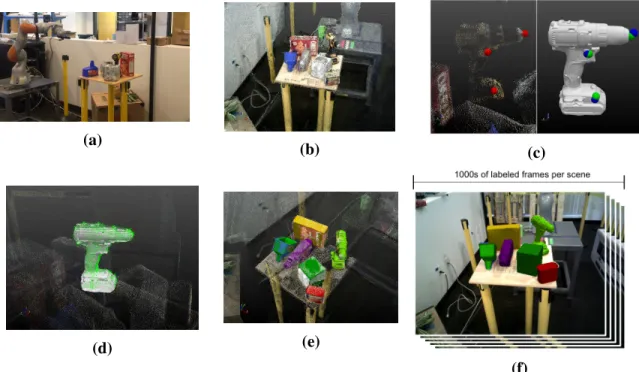
arm, as in Figure (2-1a), or the the RGBD sensor can simply be hand-carried. The benefit
of the former option is a reduced human workload, while the benefit of the latter option is that no sophisticated equipment (i.e. motion capture, external markers, heavy robot arm) is required, enabling data collection in a wide variety of environments. We captured 112 scenes using the handheld approach. For the remaining 26 scenes we mounted the sensor
on a Kuka IIWA, as shown in Figure (2-1a). The IIWA was programmed to perform a
(a) (b)
(c)
(d) (e)
(f)
Figure 2-1: Overview of the data generation pipeline. (a) Xtion RGBD sensor mounted on Kuka IIWA arm for raw data collection. (b) RGBD data processed by ElasticFusion into reconstructed pointcloud. (c) User annotation tool that allows for easy alignment using 3 clicks. User clicks are shown as red and blue spheres. The transform mapping the red spheres to the green spheres is then the user specified guess. (d) Cropped pointcloud coming from user specified pose estimate is shown in green. The mesh model shown in grey is then finely aligned using ICP on the cropped pointcloud and starting from the user provided guess. (e) All the aligned meshes shown in reconstructed pointcloud. (f) The aligned meshes are rendered as masks in the RGB image, producing pixelwise labeled RGBD images for each view.
does not require one to know the transform between the robot and the camera; everything is done in camera frame. Our typical logs averaged 120 seconds in duration with data captured at 30Hz by the Asus Xtion Pro.
2.3.2 Dense 3D Reconstruction
The next step is to extract a dense 3D reconstruction of the scene, shown in Figure (2-1b), from the raw RGBD data. For this step we used the open source implementation of Elastic-Fusion [43] with the default parameter settings, which runs in realtime on our desktop with an NVIDIA GTX 1080 GPU. ElasticFusion also provides camera pose tracking relative to the local reconstruction frame, a fact that we take advantage of when rendering labeled images. Reconstruction performance can be affected by the amount of geometric features and RGB texture in the scene. Most natural indoor scenes provide sufficient texture, but
large, flat surfaces with no RGB or depth texture can occasionally incur failure modes. Our pipeline is designed in a modular fashion so that any 3D reconstruction method that provides camera pose tracking can be used in place of ElasticFusion.
2.3.3 Object Mesh Generation
A pre-processing step for the pipeline is to obtain meshes for each object. Once obtained, meshes speed annotation by enabling alignment of the mesh model rather than manually intensive pixelwise segmentation of the 3D reconstruction. Using meshes necessitates rigid objects, but imposes no other restrictions on the objects themselves. We tested several different mesh construction techniques when building our dataset. In total there are twelve objects. Four object meshes were generated using an Artec Space Spider handheld scanner. One object was scanned using Next Engine turntable scanner. For the four objects which are part of the YCB dataset [44] we used the provided meshes. One of our objects, a tissue box, was modeled using primitive box geometry. In addition our pipeline provides a volumetric meshing method using the VTK implementation of [45] that operates directly on the data already produced by ElasticFusion. Finally, there exist several relatively low cost all-in-one solutions [46], [47], [48] which use RGBD sensors such as the Asus Xtion, Intel RealSense R300 and Occipital Structure Sensor, to generate object meshes. The only requirement is that the mesh be sufficiently high quality to enable the ICP based alignment
(see section2.3.4). RGB textures of meshes are not necessary.
2.3.4 Human Assisted Annotation
One of the key contributions of the chapter is in reducing the amount of human annotation time needed to generate labeled per-pixel and pose data of objects in clutter. We evaluated several global registration methods [49–51] to try to automatically align our known objects to the 3D reconstruction but none of them came close to providing satisfactory results. This is due to a variety of reasons, but a principle one is that many scene points didn’t belong to any of the objects.
input to assist traditional registration techniques. The user interface was developed using Director [52], a robotics interface and visualization framework. Typically the objects of interest are on a table or another flat surface – if so, a single click from the user segments out the table. The user identifies each object in the scene and then selects the corresponding mesh from the mesh library. They then perform a 3-click-based initialization of the object pose. Our insight for the alignment stage was that if the user provides a rough initial pose for the object, then traditional ICP-based techniques can successfully provide the fine alignment. The human provides the rough initial alignment by clicking three points on the object in the reconstructed pointcloud, and then clicking roughly the same three points
in the object mesh, see Figure (2-1c). The transform that best aligns the 3 model points,
shown in red, with the three scene points, shown in blue, in a least squares sense is found using the vtkLandmarkTransform function. The resulting transform then specifies an initial alignment of the object mesh to the scene, and a cropped pointcloud is taken from the points
within 1cm of the roughly aligned model, as shown in green in Figure (2-1d). Finally, we
perform ICP to align this cropped pointcloud to the model, using the rough aligment of the model as the initial seed. In practice this results in very good alignments even for cluttered scenes such as Figure (2-1e).
The entire human annotation process takes approximately 30 seconds per object. This is much faster than aligning the full object meshes by hand without using the 3-click tech-nique which can take several minutes per object and results in less accurate object poses. We also compared our method with human labeling (polygon-drawing) each image, and found intersection over union (IoU) above 80%, with approximately four orders of magni-tude less human effort per image (supplementary figures on our website).
2.3.5 Rendering of Labeled Images and Object Poses
After the human annotation step of Section 2.3.4, the rest of the pipeline is automated.
Given the previous steps it is easy to generate per-pixel object labels by projecting the 3D object poses back into the 2D RGB images. Since our reconstruction method, ElasticFu-sion, provides camera poses relative to the local reconstruction frame, and we have already
aligned our object models to the reconstructed pointcloud, we also have object poses in each camera frame, for each image frame in the log. Given object poses in camera frame it is easy to get the pixelwise labels by projecting the object meshes into the rendered images.
An RGB image with projected object meshes is displayed in Figure (2-1f).
2.3.6 Discussion
As compared to existing methods such as [27,34,53] our method requires no sophisticated calibration, works for arbitrary rigid objects in general environments, and requires only 30 seconds of human annotation time per object per scene. Since the human annotation is done on the full 3D reconstruction, one labeling effort automatically labels thousands of RGBD images of the same scene from different viewpoints.
2.4 Results
We first analyze the effectiveness of the LabelFusion data generation pipeline (Section 2.4.1). We then use data generated from our pipeline to perform practical empirical ex-periments to quantify the generalization value of different aspects of training data (Section 2.4.2).
(a) (b)
(c) (d) (e)
Figure 2-2: Examples of labeled data generated by our pipeline: (a) heavily cluttered multi-object, (b) low light conditions, (c) motion blur, (d) distance from object, (e) 25 different environments. All of these scenes were collected by hand-carrying the RGBD sensor.
# objects 12
# distinct scenes 105 single/double object
33 with 6+ objects # unique object instances aligned 339
avg duration of single scene 120 seconds, 3600 RGBD frames
# labeled RGBD frames 352,000
# labeled object instances 1,000,000+
Table 2.1: Dataset Description
2.4.1 Evaluation of Data Generation Pipeline
LabelFusion has the capability to rapidly produce large amounts of labeled data, with min-imal human annotation time. In total we generated over 352,000 labeled RGBD images, of which over 200,000 were generated in approximately one day by two people. Because many of our images are multi- object, this amounts to over 1,000,000 labeled object in-stances. Detailed statistics are provided in Table2.1. The pipeline is open-source and in-tended for use. We were able to create training data in a wide variety of scenarios; examples
are provided in Figure2-2. In particular, we highlight the wide diversity of environments
enabled by hand-carried data collection, the wide variety of lighting conditions, and the heavy clutter both of backgrounds and of multi-labeled object scenes.
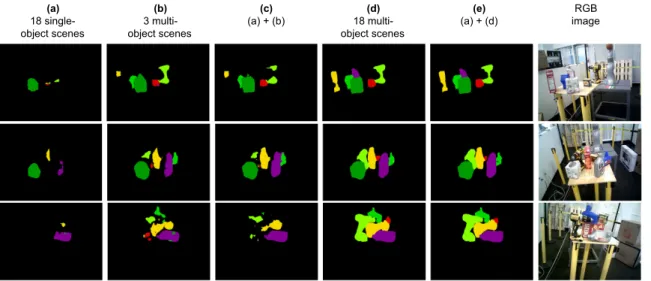
Figure 2-4: Example segmentation performance (alpha-blended with RGB image) of network (𝑒) on a multi-object test scene.
For scaling to large scale data collection, the time required to generate data is critical. Our pipeline is highly automated and most components run at approximately real-time, as
shown in Figure 2-3. The amount of human time required is approximately 30 seconds
per object per scene, which for a typical single-object scene is less than real-time. Post-processing runtime is several times greater than real-time, but is easily parallelizable – in practice, a small cluster of 2-4 modern desktop machines (quad-core Intel i7 and Nvidia GTX 900 series or higher) can be made to post-process the data from a single sensor at real-time rates. With a reasonable amount of resources (one to two people and a handful of computers), it would be possible to keep up with the real-time rate of the sensor (generating labeled data at 30 Hz).
2.4.2 Empirical Evaluations: How Much Data Is Needed For
Practi-cal Object-Specific Segmentation?
With the capability to rapidly generate a vast sum of labeled real RGBD data, questions of “how much data is needed?” and “which types of data are most valuable?” are ac-cessible. We explore practical generalization performance while varying three axes of the training data: (i) whether the training set includes multi-object scenes with occlusions or only single-object scenes, (ii) the number of background environments, and (iii) the num-ber of views used per scene. For each, we train a state-of-the-art ResNet segmentation network [54] with different subsets of training data, and evaluate each network’s general-ization performance on common test sets. Further experimental details are provided in our supplementary material; due to space constraints we can only summarize results here.
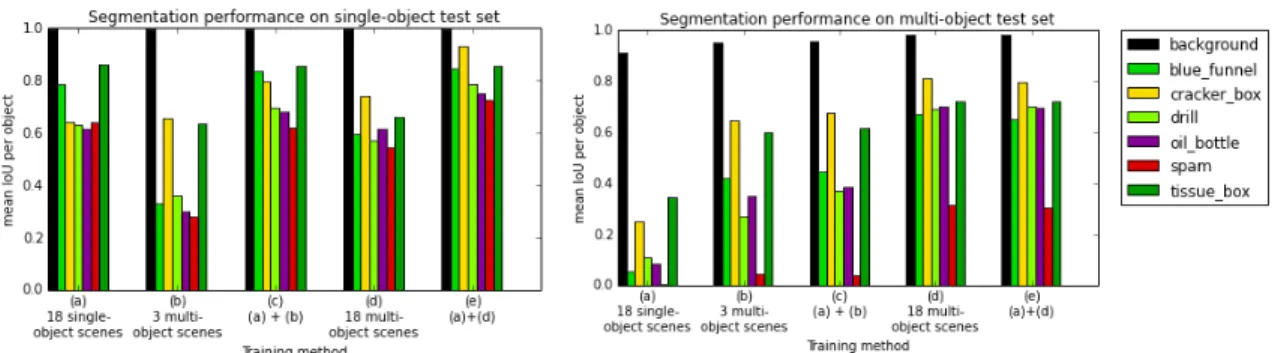
First, we investigate whether there is a benefit of using training data with heavily occluded and cluttered multi-object scenes, compared to training with only single-object scenes. Although they encounter difficulties with heavy occlusions in multi-object scenes, [28] uses purely single-object scenes for training. We trained five different networks to enable comparison of segmentation performance on novel scenes (different placements of the objects) for a single background environment. Results of segmentation performance
Figure 2-5: Comparisons of training on single-object vs. multi-object scenes and testing on single-object (left) and multi-object (right) scenes.
on novel scenes (measured using the mean IoU, intersection over union, per object) show an advantage given multi-object occluded scenes (𝑏) compared to single-object scenes (𝑎) (Figure2-5, right). In particular, the average IoU per object increases 190% given training set (𝑏) instead of (𝑎) in Figure2-5, right, even though (𝑏) has strictly less labeled pixels than (𝑎), due to occlusions. This implies that the value of the multi-object training data is more valuable per pixel than the single-object training data. When the same amount of scenes for the single-object scenes are used to train a network with multi-object scenes (𝑑), the increase in IoU performance averaged across objects is 369%. Once the network has been trained on 18 multi-object scenes (𝑑), an additional 18 single-object training scenes have no noticeable effect on multi-object generalization (𝑒). For generalization performance on single-object scenes (Figure 2-5, left), this effect is not observed; single-object training scenes are sufficient for IoU performance above 60%.
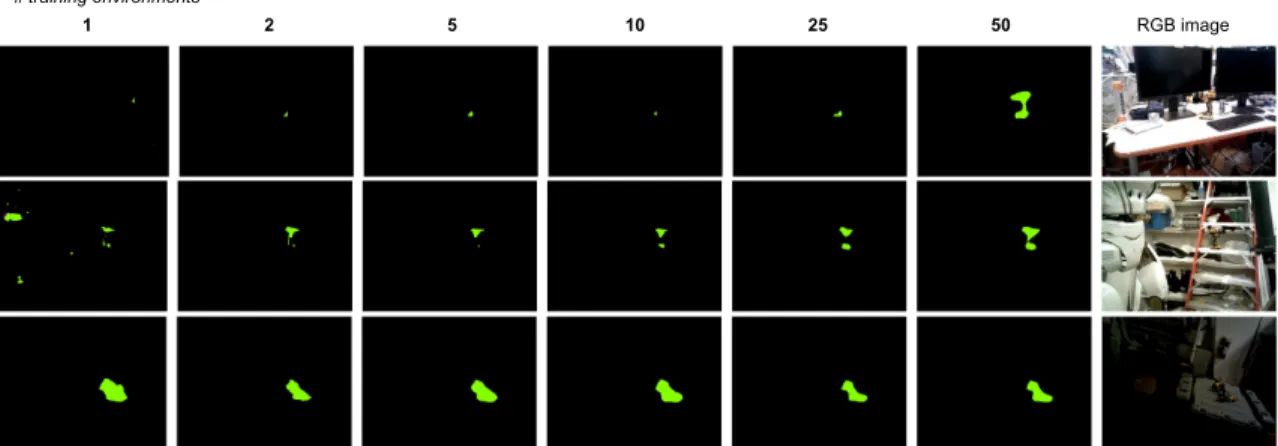
Second, we ask: how does the performance curve grow as more and more training data is added from different background environments? To test this, we train different networks respectively on 1, 2, 5, 10, 25, and 50 scenes each labeled with a single drill object. The smaller datasets are subsets of the larger datasets; this directly allows us to measure the value of providing more data. The test set is comprised of 11 background environments which none of the networks have seen. We observe a steady increase in segmentation performance that is approximately logarithmic with the number of training
scene backgrounds used (Figure2-7, left). We also took our multi-object networks trained
on a single background and tested them on the 11 novel environments with the drill. We observe an advantage of the multi-object training data with occlusions over the
single-(a) 18 single- object scenes (b) 3 multi- object scenes (c) (a) + (b) (d) 18 multi- object scenes (e) (a) + (d) RGB image
Figure 2-6: Comparison of segmentation performance on novel multi-object test scenes. Networks are either trained on (a) single object scenes only, (b,d), multi-object test scenes only, or a mixture (c,e).
Figure 2-7: (left) Generalization performance as a function of the number of environments provided at training time, for a set of six networks trained on 50 different scenes or some subset ({1, 2, 5, 10, 25}) of those scenes. (right) Performance on the same test set of unknown scenes, but measured for the 5 training configurations for the multi-object, single-environment-only setup described previously.
object training data in generalizing to novel background environments (Figure2-7, right). Third, we investigate whether 30 Hz data is necessary, or whether significantly less data
suffices (Figure2-9). We perform experiments with downsampling the effective sensor rate
both for robot-arm-mounted multi-object single-background training set (𝑒), and the hand-carried many-environments dataset with either 10 or 50 scenes. For each, we train four different networks, where one has all data available and the others have downsampled data at respectively 0.03, 0.3, and 3 Hz. We observe a monotonic increase in segmentation performance as the effective sensor rate is increased, but with heavily diminished returns after 0.3 Hz for the slower robot-arm-mounted data (∼0.03 m/s camera motion velocity). The hand-carried data (∼0.05 - 0.17 m/s) shows more gains with higher rates.
1 2 5 10 25 50 RGB image # training environments
Figure 2-8: Comparison of segmentation performance on novel background environments. Networks were trained on {1, 2, 5, 10, 25, 50} background environments.
(36 scenes)
Robot-arm-mounted data (~0.03 m/s avg. velocity) Tested on same background
Hand-carried data (~0.05 - 0.17 m/s avg. velocity) Tested on novel backgrounds
Figure 2-9: Pixelwise segmentation performance as a function of the number of views per scene, reduced by downsampling the native 30 Hz sensor to {0.03, 0.3, 3.0.} Hz.
2.5 Conclusion
This chapter introduces LabelFusion, our pipeline for efficiently generating RGBD data annotated with per-pixel labels and ground truth object poses. Specifically only a few minutes of human time are required for labeling a scene containing thousands of RGBD images. LabelFusion is open source and available for community use, and we also supply an example dataset generated by our pipeline [55].
The capability to produce a large, labeled dataset enabled us to answer several ques-tions related to the type and quantity of training data needed for practical deep learning segmentation networks in a robotic manipulation context. Specifically we found that net-works trained on multi-object scenes performed significantly better than those trained on single object scenes, both on novel multi-object scenes with the same background, and on single-object scenes with new backgrounds. Increasing the variety of backgrounds in the training data for single-object scenes also improved generalization performance for new backgrounds, with approximately 50 different backgrounds breaking into above-50% IoU on entirely novel scenes. Our recommendation is to focus on multi-object data collection in a variety of backgrounds for the most gains in generalization performance.
We hope that our pipeline lowers the barrier to entry for using deep learning approaches for perception in support of robotic manipulation tasks by reducing the amount of human time needed to generate vast quantities of labeled data for your specific environment and set of objects. It is also our hope that our analysis of segmentation network performance provides guidance on the type and quantity of data that needs to be collected to achieve desired levels of generalization performance.
Chapter Acknoweldgement
This chapter was joint work with Pat Marion, Lucas Manuelli, and Russ Tedrake. We thank Matthew O’Kelly for his guidance with segmentation networks and manuscript feed-back. We also thank Allison Fastman and Sammy Creasey of Toyota Research Institute for their help with hardware, including object scanning and robot arm automation. David
Johnson of Draper Laboratory and Shuran Song of Princeton University provided valuable input on training. We are grateful we were able to use the robot arm testing facility from Toyota Research Institute. This work was supported by the Air Force/Lincoln Laboratory award no. 7000374874, by the Defense Advanced Research Projects Agency via Air Force Research Laboratory award FA8750-12-1-0321, and by NSF Contract IIS-1427050. The views expressed are not endorsed by the sponsors.
Chapter 3
Dense Object Nets: Learning Dense
Visual Object Descriptors By and For
Robotic Manipulation
3.1 Introduction
What is the right object representation for manipulation? We would like robots to visually perceive scenes and learn an understanding of the objects in them that (i) is task-agnostic and can be used as a building block for a variety of manipulation tasks, (ii) is generally applicable to both rigid and non-rigid objects, (iii) takes advantage of the strong priors provided by 3D vision, and (iv) is entirely learned from self-supervision. This is hard to achieve with previous methods: much recent work in grasping does not extend to grasp-ing specific objects or other tasks, whereas task-specific learngrasp-ing may require many trials to generalize well across object configurations or other tasks. In this chapter we present Dense Object Nets, which build on recent developments in self-supervised dense descriptor learn-ing, as a consistent object representation for visual understanding and manipulation. We demonstrate they can be trained quickly (approximately 20 minutes) for a wide variety of previously unseen and potentially non-rigid objects. We additionally present novel contri-butions to enable multi-object descriptor learning, and show that by modifying our training
procedure, we can either acquire descriptors which generalize across classes of objects, or descriptors that are distinct for each object instance. Finally, we demonstrate the novel application of learned dense descriptors to robotic manipulation. We demonstrate grasp-ing of specific points on an object across potentially deformed object configurations, and demonstrate using class general descriptors to transfer specific grasps across objects in a class.
While task-specific reinforcement learning can achieve impressively dexterous skills for a given specific task [39], it is unclear which is the best route to efficiently achieving many different tasks. Other recent work [40, 41] can provide very general grasping functionality but does not address specificity. Achieving specificity, the ability to accomplish specific tasks with specific objects, may require solving the data association problem. At a coarse level the task of identifying individual objects to manipulate can be solved by instance segmentation, as demonstrated in the Amazon Robotics Challenge (ARC) [56, 57] or [58]. Whole-object-level segmentation, however, does not provide any information on the rich structure of the objects themselves, and hence may not be an appropriate representation for solving more complex tasks. While not previously applied to the robotic manipulation domain, recent work has demonstrated advances in learning dense pixel level data asso-ciation [15, 16], including self-supervision from raw RGBD data [16], which inspired our present work.
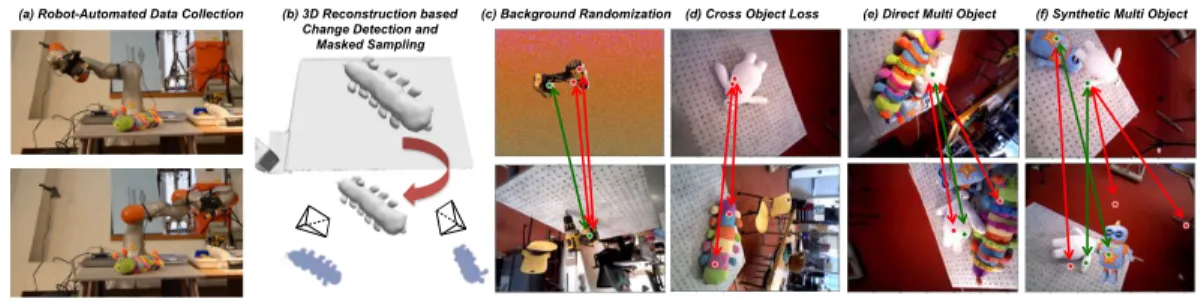
In this chapter, we propose and demonstrate using dense visual description as a rep-resentation for robotic manipulation. We demonstrate the first autonomous system that can entirely self-supervise to learn consistent dense visual representations of objects, and the first system we know of that is capable of performing the manipulation demonstra-tions we provide. Specifically, with no human supervision during training, our system can grasp specific locations on deformable objects, grasp semantically corresponding locations on instances in a class, and grasp specific locations on specific instances in clutter. To-wards this goal, we also provide practical contributions to dense visual descriptor learning with general computer vision applications outside of robotic manipulation. We call our vi-sual representations Dense Object Nets, which are deep neural networks trained to provide
dense (pixelwise) description of objects.
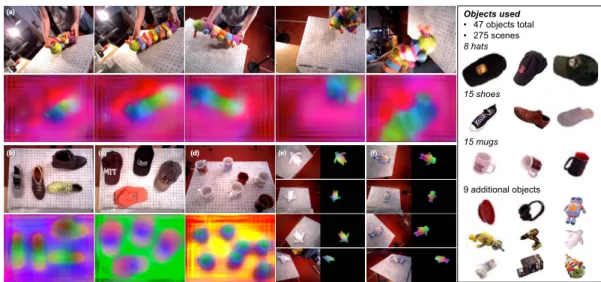
Contributions. We believe our largest contribution is that we introduce dense de-scriptors as a representation useful for robotic manipulation. We’ve also shown that self-supervised dense visual descriptor learning can be applied to a wide variety of potentially non-rigid objects and classes (47 objects so far, including 3 distinct classes), can be learned quickly (approximately 20 minutes), and can enable new manipulation tasks. In example tasks we grasp specific points on objects across potentially deformed configurations, do so with object instance-specificity in clutter, or transfer specific grasps across objects in a class. We also contribute novel techniques to enable multi-object distinct dense descrip-tors, and show that by modifying the loss function and sampling procedure, we can either acquire descriptors which generalize across classes of objects, or descriptors that are dis-tinct for each object instance. Finally, we contribute general training techniques for dense descriptors which we found to be critical to achieving good performance in practice.
Chapter Organization. In Section 3.2 we describe related work. As preliminary in
Section3.3.1we describe the general technique for self-supervising dense visual
descrip-tor learning, which is from [16] but reproduced here for clarity. We then describe additional techniques we’ve developed for object-centric visual descriptors in Section3.3.2, and Sec-tion3.3.3describes techniques for distinct multi-object descriptors. Section3.4describes our experimental setup for our autonomous system, and Section 5 describes our results: our learned visual descriptors for a wide variety of objects (Section3.5.1) multi-object descrip-tors and selective class generalization (Sections3.5.2and3.5.3), and robotic manipulation
demonstrations (Section3.5.4). The next chapter, Chapter 4, presents new formulations of
the underlying visual correspondence problem.
3.2 Related Work
We review three main areas of related work: learned descriptors, self-supervised visual learning for robots, and robot learning for specific tasks. The task of correspondence esti-mation from multiple views of the same scene is fundamental in computer vision, whereas dense semantic correspondence across different scenes was popularized by [14]. Recent
advances have been made by introducing a pixel-wise variant of contrastive loss [59] com-bined with deep convolutional networks, as in Choy et al. [15] and Schmidt et al. [16]. For cross-instance semantic correspondence, [15] relies on human annotations, while [16] learns these unsupervised, as we do here. Other work [60] uses image warping to learn descriptors, and most require manually annotated labels [61–63]. Zeng et al. [64] also uses dense 3D reconstruction to provide automated labeling, but for descriptors of 3D volume patches. Some of these works [16, 60, 63], like ours, learn descriptors for specific object instances or classes, while others [64] learn descriptors for establishing correspondence of arbitrary data. None of these prior works in dense visual learning involve robots.
In the area of self-supervised visual robot learning, while some recent work has sought to understand ‘how will the world change given the robot’s action?” [18,65] in this work we instead ask “what is the current visual state of the robot’s world?”. We address this question with a dense description that is consistent across viewpoints, object configurations and (if desired) object classes. At the coarse level of semantic segmentation several works from the Amazon Robotics Challenge used robots to automate the data collection and annotation process through image-level background subtraction [56,57,66]. In contrast this work uses 3D reconstruction-based change detection and dense pixelwise correspondences, which provides a much richer supervisory signal for use during training.
In the area of robot learning for a specific task there have been impressive works on end-to-end reinforcement learning [39, 67]. In these papers the goal is to learn a specific task, encoded with a reward function, whereas we learn a general task agnostic visual representation. There have also been several works focusing on grasping from RGB or depth images [40, 41, 66, 68]. These papers focus on successfully grasping any item out of a pile, and are effectively looking for graspable features. They have no consistent object representation or specific location on that object, and thus the robotic manipulation tasks we demonstrate in Section3.5.4, e.g. grasping specific points on an object across potentially deformed object configurations, are out of scope for these works.
3.3 Methodology
3.3.1 Preliminary: Self-Supervised Pixelwise Contrastive Loss
We use self-supervised pixelwise contrastive loss, as developed in [15, 16]. This learns
a dense visual descriptor mapping which maps a full-resolution RGB image, R𝑊×𝐻×3
to a dense descriptor space, R𝑊×𝐻×𝐷, where for each pixel we have a 𝐷-dimensional
descriptor vector. Training is performed in a Siamese fashion, where a pair of RGB images,
𝐼𝑎 and 𝐼𝑏 are sampled from one RGBD video, and many pixel matches and non-matches
are generated from the pair of images. A pixel 𝑢𝑎 ∈ R2 from image 𝐼𝑎 is a match with
pixel 𝑢𝑏from image 𝐼𝑏if they correspond to the same vertex of the dense 3D reconstruction
(Figure3-1(c-f)). The dense descriptor mapping is trained via pixelwise contrastive loss.
The loss function aims to minimize the distance between descriptors corresponding to a match, while descriptors corresponding to a non-match should be at least a distance 𝑀 apart, where 𝑀 is a margin parameter. The dense descriptor mapping 𝑓(·) is used to map
an image 𝐼 ∈ R𝑊×𝐻×3 to descriptor space 𝑓(𝐼) ∈ R𝑊×𝐻×𝐷. Given a pixel 𝑢 we use
𝑓 (𝐼)(𝑢)to denote the descriptor corresponding to pixel 𝑢 in image 𝐼. We simply round the
real-valued pixel 𝑢 ∈ R2 to the closest discrete pixel value 𝑢 ∈ N2, but any
continuously-differentiable interpolation can be used for sub-pixel resolution. We denote 𝐷(·) as the 𝐿2
distance between a pair of pixel descriptors: 𝐷(𝐼𝑎, 𝑢𝑎, 𝐼𝑏, 𝑢𝑏) ,||𝑓(𝐼𝑎)(𝑢𝑎)− 𝑓(𝐼𝑏)(𝑢𝑏)||2.
At each iteration of training, a large number (on the order of 1 million total) of matches 𝑁matches and non-matches 𝑁non-matches are generated between images 𝐼𝑎 and 𝐼𝑏. The images
are mapped to corresponding descriptor images via 𝑓(·) and the loss function is ℒmatches(𝐼𝑎, 𝐼𝑏) = 1 𝑁matches ∑︁ 𝑁matches 𝐷(𝐼𝑎, 𝑢𝑎, 𝐼𝑏, 𝑢𝑏)2 (3.1) ℒnon-matches(𝐼𝑎, 𝐼𝑏) = 1 𝑁non-matches ∑︁ 𝑁non-matches max(0, 𝑀 − 𝐷(𝐼𝑎, 𝑢𝑎, 𝐼𝑏, 𝑢𝑏))2 (3.2) ℒ(𝐼𝑎, 𝐼𝑏) =ℒmatches(𝐼𝑎, 𝐼𝑏) +ℒnon-matches(𝐼𝑎, 𝐼𝑏) (3.3)