HAL Id: hal-03044478
https://hal.archives-ouvertes.fr/hal-03044478
Submitted on 10 Dec 2020
HAL is a multi-disciplinary open access
archive for the deposit and dissemination of
sci-entific research documents, whether they are
pub-lished or not. The documents may come from
teaching and research institutions in France or
abroad, or from public or private research centers.
L’archive ouverte pluridisciplinaire HAL, est
destinée au dépôt et à la diffusion de documents
scientifiques de niveau recherche, publiés ou non,
émanant des établissements d’enseignement et de
recherche français ou étrangers, des laboratoires
publics ou privés.
The Araucaria Project Establishes the Most Precise
Benchmark for Cosmic Distances
G. Pietrzyński, D. Graczyk, A. Gallenne, W. Gieren, I. Thompson, B. Pilecki,
P. Karczmarek, M. Górski, K. Suchomska, M. Taormina, et al.
To cite this version:
G. Pietrzyński, D. Graczyk, A. Gallenne, W. Gieren, I. Thompson, et al.. The Araucaria Project
Establishes the Most Precise Benchmark for Cosmic Distances. 2020, �10.18727/0722-6691/5189�.
�hal-03044478�
Astronomical Science DOI: 10.18727/0722-6691/5189
component to the matter-energy content of the Universe, the physical explanation of the nature of dark energy has become a major challenge for astronomers and physicists. Recent empirical determina-tions of H0 have further complicated our understanding of the Universe. The most precise empirical determination of H0 to date is 74.03 ± 1.42 km s-1 Mpc-1 and is
based on Cepheids and Type Ia super-novae (Riess et al., 2019). The value obtained differs by about 4σ from the value predicted by the Planck Collabora-tion et al. (2016), which is based on a ΛCDM model and the Planck CMB data (66.93 ± 0.62 km s-1 Mpc-1). This
discrep-ancy between the two values of H0 is
sometimes called a crisis, and may indi-cate the need for new physics beyond the standard cosmological model. A sig-nificant improvement in the accuracy of the measurement of H0 by the Cepheid -supernova Ia method is therefore of para-mount importance for deciding if the cur-rent discrepancy between it and the Planck H0 value does indeed exist. This is critical for cosmology in general, and necessary to drive truly significant pro-gress towards the understanding of the dark energy phenomenon.
After about 100 years of intensive work on the empirical determination of the Hubble constant, it is evident that any significant reduction in its uncertainty can Grzegorz Pietrzyński1, 2 Dariusz Graczyk1, 2, 3 Alexandre Gallenne1, 2, 4, 5 Wolfgang Gieren2 Ian Thompson6 Bogumił Pilecki1 Paulina Karczmarek2 Marek Górski2 Ksenia Suchomska1 Monica Taormina1 Bartłomiej Zgirski1 Piotr Wielgórski1 Nicolas Nardetto5 Pierre Kervella7 Fabio Bresolin8
Rolf Peter Kudritzki8, 9
Jesper Storm10
Radosław Smolec1
Weronika Narloch1
Mikołaj Kałuszyński1
Sandro Villanova2
1 Nicolaus Copernicus Astronomical
Centre, Warsaw, Poland
2 Universidad de Concepción,
Departamento de Astronomía, Concepción, Chile
3 Millennium Institute of Astrophysics
(MAS), Santiago, Chile
4 Unidad Mixta Internacional Franco-
Chilena de Astronomía (CNRS UMI 3386), Universidad de Chile, Santiago, Chile
5 Laboratoire Lagrange, UMR7293,
Université de Nice Sophia-Antipolis, CNRS, Observatoire de la Côte dAzur, Nice, France
6 Carnegie Observatories, Pasadena,
USA
7 LESIA, Observatoire de Paris,
Université PSL, CNRS, Sorbonne Université, Université Paris Diderot, Sorbonne Paris Cité, Meudon, France
8 Institute for Astronomy, Honolulu, USA 9 University Observatory Munich, LMU,
Germany
10 Leibniz Institute for Astrophysics,
Potsdam, Germany
In the last 20 years, over the course of the Araucaria project, we have studied 20 very special eclipsing binary sys-tems in the Large Magellanic Cloud (LMC). Based on these systems and our newly calibrated surface brightness – colour relation we have measured a dis-tance to the LMC that is accurate to
1%. This is currently the best bench-mark for cosmic distances and it will therefore impact several fields of astro-physics. In particular, it has allowed a determination of the Hubble constant with a precision of 1.9%.
Introduction
Since the earliest observations in ancient times to present-day astrophysics, the determination of distances to astrophysi-cal objects has been one of the most important, fascinating and challenging goals in astronomy. Knowing distances is about much more than just knowing the scale; it also means knowing the physical nature of the objects in the Universe, and each significant improvement in the accu-racy of the distance scale has traditionally opened up new fields of astrophysical research.
Distance determinations to galaxies led to the discovery of the expansion of the Universe, one the most important break-throughs in astrophysics. Since then the precise and accurate measurement of distances to galaxies provides the basis for determining the famous “Hubble con-stant” (H0) which describes the expansion rate of the Universe and has become a central problem in astrophysics. After the detection of the accelerated expansion of the Universe and the intro-duction of an enigmatic dark energy
The Araucaria Project Establishes the Most Precise
Benchmark for Cosmic Distances
Figure 1. The Large and Small Magellanic Clouds in the southern sky.
J. C . M uñ oz /E S O
2002), and relatively small extinction (Gorski et al., 2020). Exquisite period– luminosity relations have already been obtained based on the LMC Cepheids in both optical and near-infrared bands (Soszynski et al., 2017; Persson et al., 2004).
The LMC is also the perfect laboratory with which to study many different pro-cesses and objects. Therefore, a precise geometrical distance to this galaxy is extremely important, not only for cosmol-ogy, but also for many different fields of modern astrophysics. For this reason, more than 600 distance determinations to the LMC can be found in the literature (with the NED database, Mazzarella & the NED team, 2007). However, their rela-tively low precision and lack of control of systematic errors prevent the use of the LMC distance to significantly improve the determination of H0.
Eclipsing binaries as precise and accurate distance indicators
Detached eclipsing double-lined spectro-scopic binaries offer a unique opportunity to measure directly, and very accurately, stellar parameters like mass, luminosity, and radius, and consequently the dis-tance (Graczyk et al., 2014; see also Kruszewski and Semeniuk, 1999 for a very detailed historical review). With current observational facilities, and the application of an appropriate surface brightness-colour relation, eclipsing bina-ries have the potential to yield the most direct (one-step), and the most accurate (~ 1%) distance to the LMC. Indeed, the distances to individual systems can be obtained from the simple equation: d(pc) = 9.2984 × R(R⊙)
ϕ(mas)
The linear radii of the components of the binary systems R are determined from the standard, well known modelling of radial velocities and photometric light curves, while angular diameters are derived from the surface brightness- colour relation. The surface brightness is defined as Sv = V0 + 5 log(ϕ), where V0 is
the V-band magnitude corrected for the reddening and ϕ is the stellar angular now only be achieved by improving the
accuracy of the absolute calibration of the Cepheid method, which constitutes the largest contribution to the total error budget of the H0 determination (see, for
example, Riess et al., 2018).
The Large Magellanic Cloud as a perfect astrophysical laboratory
The Large Magellanic Cloud (LMC), which can be seen with the naked eye in the southern sky (Figure 1) is our closest neighbour galaxy and provides the road to calibrating Cepheids and other dis-tance indicators. Indeed, it possesses a large population of Cepheids (Soszynski et al., 2017), has a relatively simple geome try (see, for example, van der Marel et al., 0.02 O– C (fl ux ) Normalised flu x Orbital phase 0 –0.02 1 0.9 0.8 0.7 0 0.2 0.4 0.6 0.8 1 220 230 240 250 260 270 280 290 300 Radial ve loci ty (k m s –1) –1 0 O– C (k m s –1) Orbital phase 0 0.2 0.4 0.6 0.8 1 0 0.2 0.4 0.6 0.8 1
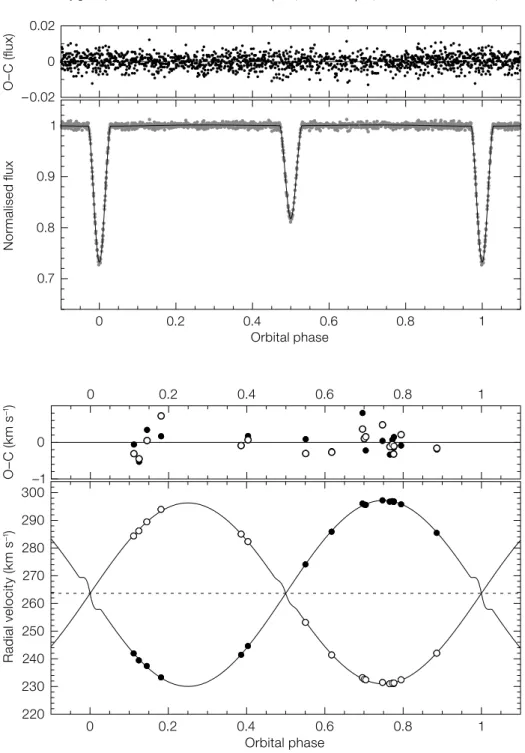
Figure 2. The light curve and radial velocity curve and corresponding residuals obtained for one of our target eclipsing binaries in the LMC, demonstrating the high quality of the data. Based on observations such as these we obtained stellar physical parame-ters with a very good precision of 1–2%.
Astronomical Science Pietrzyński G. et al., The Araucaria Project
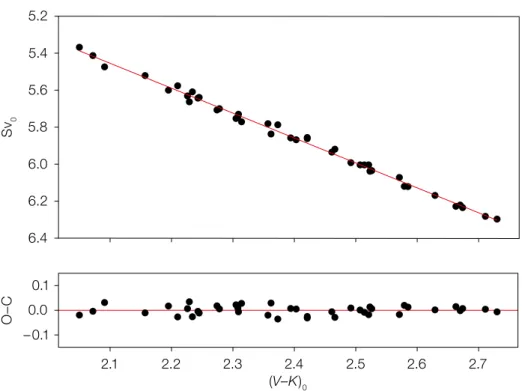
angular diameters are measured uni-formly and that all stars are at compara-ble evolutionary phases as the compo-nents of the LMC eclipsing binaries. In order to provide a significantly improved calibration of the surface brightness-colour relation, we carefully selected a sample of 41 nearby red clump giants, which are in the core helium burning phase of stellar evolution. We made sure that our sample does not contain variable stars or binaries. For our sample stars we collected precise near-infrared photometry at the South African Astronomical Observatory (Laney, Joner & Pietrzyński, 2012), and angular diameters to a precision of 1% using the Precision Integrated Optics Near-infrared Imaging ExpeRiment (PIONIER) instru-ment on ESO’s Very Large Telescope Interferometer (VLTI) (see Gallenne et al., 2018). These data are complemented with high-quality homogenous V-band photometry (Mermilliod, Mermilliod & Hauk, 1997). Based on these exquisite data, the following surface brightness- colour relation was obtained:
Sv = 1.330(± 0.017) × [(V–K)0 – 2.405] + 5.869(± 0.003) magnitudes,
with a rms scatter of 0.018 magnitudes. The relation is presented in Figure 3. It diameter. An empirical surface
bright-ness-colour relation is very well estab-lished for stars with spectral types later than A5, coming from accurate deter
-
minations of stellar angular diameters using interferometry (Di Benedetto, 2005; Kervella et al., 2004; Pietrzyński et al., 2019).The only concern in using this approach was that late-type main sequence bina-ries located in the LMC are too faint to secure accurate high-resolution spectra even with the biggest telescopes. For a long time, it had not been possible to use the full potential of eclipsing binaries to determine the distance to the LMC because of the lack of suitable systems. This situation changed when microlens-ing teams, in particular the Optical Gravitational Lensing Experiment (OGLE), provided an enormous amount of precise photometric data for about 35 million stars in the LMC obtained over around 20 years. Based on these data a few dozen extremely rare binaries composed of helium-burning giants were detected (Graczyk et al., 2011). The orbital periods of such systems are very long, typically several hundred days, and the eclipses are very narrow, which explains why they are extremely difficult to discover.
The Araucaria project delivers a 1% geometrical distance to the LMC
About 20 years ago we began a long-term study called the Araucaria project with the aim of improving the calibration of major stellar distance indicators, and, as a result, the determination of the Hubble constant (Gieren et al., 2005; Pietrzyński et al., 2019). The eclipsing binaries were a very important part of this from the very beginning. In particular, we selected a sample of binaries composed of helium-burning giants in the LMC and we have collected high-quality spectro-scopic data with the MIKE, HARPS and UVES high-resolution spectrographs, and near-infrared photometry with the SOFI
camera at ESO’s La Silla Observatory (see Figure 2). We then used these data together with OGLE photometry to deter-mine very precise astrophysical parame-ters for the systems (1–3% masses, radii, temperatures, etc.).
In 2013, based on our analysis of eight eclipsing binaries and applying the surface brightness-colour relation of Di Benedetto (2005) we managed to measure a 2% distance to the LMC (Pietrzyński et al., 2013). We demon-strated that our result was only weakly affected by a number of factors, including reddening, metallicity, gravity, limb dark-ening and blending. Indeed, the method is very simple and powerful and provides a unique opportunity to precisely quantify all possible error contributions (Pietrzyński et al., 2013; Graczyk et al., 2014). The total error budget of this measurement is completely dominated by the error in the surface brightness-colour relation of Di Benedetto (2005). The root-mean-square (rms) scatter on this relationship is 0.03 magnitudes, which translates to 2% precision in the determination of the angular diameter. The observed scatter is mainly caused by observational errors on the K-band magnitudes. Another very important issue while striving for 1% accuracy of the surface brightness-colour relation calibration is to ensure that the Figure 3. The new surface brightness–colour
relation-ship obtained over the course of the Araucaria project based on interferometric observations with the VLTI and PIONIER and photometric data from the litera-ture. The rms scatter on this relation is 0.018 magni-tudes, which corresponds to 0.8% precision in stellar angular diameters. 5.2 Sv0 O– C (V–K)0 5.4 5.6 5.8 6.0 6.2 6.4 0.1 0.0 –0.1 2.1 2.2 2.3 2.4 2.5 2.6 2.7
tances to nearby eclipsing binaries will allow a cross-check with Gaia parallaxes at the level of 1%, which is extremely important for evaluating the accuracy of both techniques. Finally, the method pro-vides an independent precise zero point for the extragalactic distance scale and the calibration of the Cepheid period- luminosity relation in different environ-ments, paving the way for a precise determination of the Hubble constant from the combined Cepheid period- luminosity relation — supernova Ia method. Indeed our 1% LMC distance has already allowed a precise calibration of the LMC Cepheids and, as a result, a determina-tion of H0 to a precision of 1.9% (Riess et al., 2019). Moreover, it has allowed a pre-cise calibration of another interesting dis-tance indicator, the tip of the red giant branch (Gorski et al., 2018; Freedman et al., 2020). This method was then used to obtain H0 in an independent way
(Freedman et al., 2020).
Summary and future work
Eclipsing binaries composed of late-type stars have become a unique tool for the precise measurement of distances within a volume of about 1 Mpc. We would like to highlight the role of interferometric measurements of stellar diameters in calibrating the surface brightness-colour allows the measurement of angular
diam-eters with a precision of 0.8%, and there-fore distances to eclipsing binaries with a precision close to 1%.
We then applied our new surface brightness- colour relation to measuring distances to 20 eclipsing binaries located in the LMC. The location of the binaries is shown in Figure 4. The individual dis-tances are precise to 1.5–2%. Combining them, the following distance measure-ment to the centre of the LMC was obtained: 18.477 ± 0.004 (statistical) ± 0.026 (systematic) magnitudes. With 20 precise individual distances we con-strained the geometry of the central parts of the LMC and convincingly demon-strated that the geometrical extent of the galaxy has no influence on the distance measurement within the quoted errors. To demonstrate that the method delivers, not only precise but also accurate dis-tances, one has to compare results from independent methods. Pietrzyński et al. (2019) measured the distance to the nearby eclipsing binary TZ For at 185.1 ± 2.0 (stat) ± 1.9 (sys) pc using exactly the same approach as for the LMC systems. A very precise distance to TZ For of 186.1 ± 1.0 (stat+syst) pc was also obtained based on spectroscopic and astrometric orbits (Gallenne, 2016). These
two independent geometrical distance determinations are in an excellent agreement.
With the final Gaia parallaxes expected a few years from now, a comparison between Gaia distances and distances determined for binaries with our surface brightness-colour relation will be per-formed for many eclipsing binaries at the 1% level. This work will allow us to defini-tively mutually test and verify the accu-racy of our method against Gaia.
A new benchmark for cosmic distances
As can be appreciated from Figure 5, eclipsing binaries offer us an opportunity to determine stellar distances at a similar level of precision to that of Gaia at 1 kpc from the Sun, and to retain that precision out to the outskirts of the Local Group of galaxies. With the advent of the new extremely large telescopes in the near future, this will be extended even to gal-axies far beyond the Local Group. The precise and accurate distances from this one-step geometrical method will continue to be very important for several reasons. They provide the unique possi-bility of measuring geometrical distances to nearby galaxies, which is very impor-tant for a wide variety of studies. As we already mentioned, independent
dis-○ ○ ○ ○○ ○ ○ ○ ○ ○○ ○ ○ ○ ○ ○ ○ ○ ○ ○
Figure 4. Location of our 20 eclipsing binaries in the LMC. As can be seen here, all of them are located close to the centre of the LMC and to its line of nodes. The final LMC distance derived is only very weakly dependent on the geometry of this galaxy.
Figure 5. The methods that can be used to cali-brate the Cepheid period -luminosity rela-tion and, as a result, the brightness of Type Ia supernovae. Eclipsing binaries, together with our new relation, offer us the opportunity to determine distances competitive in precision to those with Gaia at about 1 kpc from the Sun. Contrary to Gaia parallaxes, however, they retain their high precision for distances up to 1 Mpc.
Astrometric binaries
Distance from the Sun (pc) (1%) Gaia Local group Cepheids P–L (to be calibrated) Supernova la (to be calibrated) Eclipsing binaries SBCR (1%) Distant galaxies Galaxy 101 103 105 107 109
References
Di Benedetto, G. P. 2005, MNRAS, 357, 174 Freedman, W. L. et al. 2020, arXiv:2002.01550 Gallenne, A. et al. 2016, Astron. Astrophys., 586, 35 Gallenne, A. et al. 2018, A&A, 616, 68
Gallenne, A. et al. 2019, A&A, 632, 31 Gieren, W. et al. 2005, The Messenger, 121, 23 Gorski, M. et al. 2018, AJ, 156, 278
Gorski, M. et al. 2020, ApJ, accepted, arXiv:2001.08242
Graczyk, D. et al. 2011, Acta Astron., 61, 103 Graczyk, D. et al. 2014, ApJ, 780, 59 Graczyk, D. et al. 2019, ApJ, 872, 85 Kervella, P. et al. 2004, A&A, 426, 297
Kruszewski, A. & Semeniuk, I. 1999, Acta Astron., 49, 561
Laney, C. D., Joner, M. D. & Pietrzyński, G. 2012, MNRAS, 419, 1637
Mazzarella, J. M. & the NED team 2007, ASP Conf., 376, 153
Mermilliod, J. C., Mermilliod, M. & Hauck, B. 1997, A&A Supplement Series, 124, 349
Persson, S. E. et al. 2004, AJ, 128, 2239 Pietrzyński, G. et al. 2013, Nature, 495, 76 Pietrzyński, G. et al. 2019, Nature, 567, 200 Planck collaboration et al. 2016, A&A, 594, 13 Riess, A. et al. 2018, ApJ, 855, 136 Riess, A. et al. 2019, ApJ, 876, 85
Soszynski, I. et al. 2017, Acta Astronomica, 67, 103 Taormina, M. et al. 2019, ApJ, 886, 111
Taormina, M. et al. 2020, ApJ, 890, 137 Van der Marel, R. P. et al. 2002, AJ, 124, 2639 The research leading to these results has received
funding from the European Research Council (ERC) under the European Union’s Horizon 2020 research and innovation program (Grant Agreement No. 695099). We acknowledge support from the IdP II 2015 0002 64 and DIR/WK/2018/09 grants of the Polish Ministry of Science and Higher Education. We also very gratefully acknowledge financial support for this work from the BASAL Centro de Astrofisica y Tecnologias Afines (CATA, AFB-170002), and from the Millenium Institute for Astrophysics (MAS) of the Iniciativa Milenio del Ministerio de Economía, Fomento y Turismo de Chile, Project IC120009. We also acknowledge support from the Polish National Science Centre grants MAESTRO UMO-2017/26/A/ ST9/00446. We acknowledge the support of the French Agence Nationale de la Recherche (ANR), under grant ANR-15-CE31-0012-01 (Project Unlock-Cepheids). Sandro Villanova gratefully acknowledges the support provided by Fondecyt Reg. No. 1170518. Alexandre Gallenne acknowledges support from FONDECYT grant 3130361. Grzegorz Pietrzyński would like to thank support from the Polish National Science Center grant UMO-2018/31/G/ST9/03050. Based on observations made with ESO telescopes under Programme ID 092.D-0297, 094.D-0074, 098.D-0263(A,B), 097.D-0400(A), 097.D-0150(A), 097.D-0151(A) and CNTAC program CN2016B-38, CN2016A-22, CN2015B-2, CN2015A-18. This research was supported by the Munich Institute for Astro- and Particle Physics (MIAPP) of the DFG cluster of excellence “Origin and Structure of the Universe”.
relation, which is at the heart of this method. Thanks to this, our method is completely independent and does not require any calibrations or assumptions. It has opened up the opportunity to measure geometric distances to nearby galaxies with an accuracy of about 1%, which is very important for many fields of modern astrophysics. In particular it allows the precise calibration of second-ary distance indicators like Cepheids and the tip of the red giant branch and, as a result, to significantly improve the deter-mination of the Hubble constant. Despite this significant progress in using eclipsing binaries as a precise and accu-rate distance indicator, a lot of work is still required before we can realise the full potential of eclipsing binaries and apply them to measuring cosmic distances on a larger scale. Our team has been work-ing intensively on improvements to the surface brightness-colour relation. We are working on precision calibration of the surface brightness-colour relation for early-type stars (Taormina et al., 2019, 2020). Eclipsing binary systems com-posed of such stars are much easier to discover in nearby galaxies than systems composed of the late-type giants that we have studied in the LMC.
We have also been working on a very extensive verification of our method. We have already obtained astrometric orbits with the VLTI and PIONIER for more nearby eclipsing binaries (Gallenne et al., 2019). Moreover we have prepared an extended list of eclipsing binaries which can be analysed with even greater preci-sion, and for which we expect very pre-cise Gaia parallaxes (see, for example, Graczyk et al., 2019). These data will allow us to compare very precise (better than 1%) distances from three independ-ent methods and verify their accuracy.
Acknowledgements
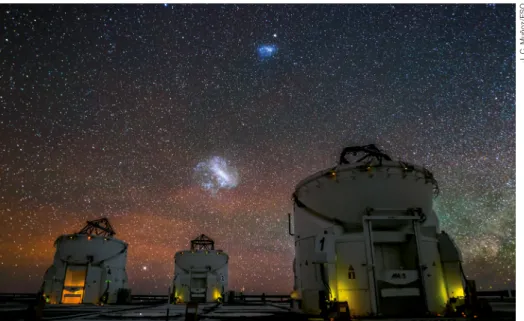
First of all, we would like to thank the staff at La Silla, Cerro Paranal, Las Campanas, and the South African Astronomical Observatory for their profes-sional support during our frequent observing runs. Figure 6. One of the auxiliary telescopes forming the VLTI; these telescopes were crucial in our project. Photograph taken by Grzegorz Pietrzyński during one of the team’s frequent observations of the LMC eclipsing binaries at ESO’s Paranal observatory.