Combinatorics of Ribbon Tableaux
by
Thomas F. Lam
Bachelor of Science in Pure Mathematics
University of New South Wales, 2001Submitted to the Department of Mathematics
in partial fulfillment of the requirements for the degree ofDoctor of Philosophy
at the
MASSACHUSETTS INSTITUTE OF TECHNOLOGY
June 2005©
Thomas F. Lam, MMV. All rights reserved.
MASSACHU''r'irS NS
OF TECHNOLY MAY 2 7 2005
LIBRARIES
The author hereby grants to MIT permission to reproduce and distribute publicly
paper and electronic copies of this thesis document in whole or in part.
Author
...
.
. .
...
. .,.
...
Department of Mathematics
April 29, 2005Certified by ... .-
.-
·7...
'.
....
..
'
*--- -'..-.-.--...
-Richard P. Stanley
Levinson Professor of Applied MathematicsThesis Supervisor
Accepted
by
...
...
...
...
Pavel Etingof
Chairman, Department Committee on Graduate Students
___
Combinatorics of Ribbon Tableaux
by
Thomas F. Lam
Submitted to the Department of Mathematics
on April 29, 2005, in partial fulfillment of therequirements for the degree of
Doctor of Philosophy
Abstract
This thesis begins with the study of a class of symmetric functions {x} which are generating functions for ribbon tableaux (hereon called ribbon functions), first defined by Lascoux, Leclerc and Thibon. Following work of Fomin and Greene, I introduce a set of operators called ribbon Schur operators on the space of partitions. I develop the theory of ribbon
functions using these operators in an elementary manner. In particular, I deduce their
symmetry and recover a theorem of Kashiwara, Miwa and Stern concerning the Fock spaceF of the quantum affine algebras Uq(sI).
Using these results, I study the functions E in analogy with Schur functions, giving:
* a Pieri and dual-Pieri formula for ribbon functions,
* a ribbon Murnaghan-Nakayama formula,
* ribbon Cauchy and dual Cauchy identities,
* and a C-algebra isomorphism w,n: A(q) -- A(q) which sends each
Gx
tog,.
The study of the functions .x\
will be connected to the Fock space representation F of Uq(sn)
via a linear map 4 : F -- A(q) which sends the standard basis of F to the ribbon functions. Kashiwara, Miwa and Stern [29] have shown that a copy of the Heisenberg algebra H acts on F commuting with the action of Uq(srn). Identifying the Fock Space of H with the ring of symmetric functions A(q) I will show that · is in fact a map of H-modules withremarkable properties.
In the second part of the thesis, I give a combinatorial generalisation of the classical
Boson-Fermion correspondence and explain how the map $ is an example of this more general phenomena. I show how certain properties of many families of symmetric functions arise naturally from representations of Heisenberg algebras. The main properties I consider are a tableaux-like definition, a Pieri-style rule and a Cauchy-style identity. Families of symmetric functions which can be viewed in this manner include Schur functions, Hall-Littlewood functions, Macdonald polynomials and the ribbon functions. Using work of Kashiwara, Miwa, Petersen and Yung, I define generalised ribbon functions for certain affine root systems 1 of classical type. I prove a theorem relating these generalised ribbon functions to a speculative global basis of level 1 q-deformed Fock spaces.Thesis Supervisor: Richard P. Stanley
Title: Levinson Professor of Applied Mathematics
4
_i__
Acknowledgments
First of all, I would like to thank my family for supporting my mathematics from 16000 kilometres away: to help me when I have called home, and also to fret and worry when I have forgotten to call home.
The work in this thesis would not have begun without the guidance and advice of my supervisor, Richard Stanley, to whom I give my sincerest thanks. My love of this subject began with a course on symmetric functions taught by Professor Stanley. The study of the ribbon functions in this thesis was suggested to me several days after I passed my qualifying exams, around two and a half years ago.
I thank Sergey Fomin, Marc van Leeuwen, Anne Schilling and Mark Shimozono for discussions related to this thesis. I would like to thank Cedric Bonnaf6, Meinolf Geck, Lacri Iancu, Luc Lapointe, Ezra Miller, Jennifer Morse, Igor Pak, Alexander Postnikov, Pavlo Pylyavskyy, Mark Shimozono, Dan Stefanica and Jacques Verstraete for working with me on various mathematical projects while I have been at MIT. I would also like to thank my professors from the University of New South Wales: Michael Cowling, Tony Dooley, Ian Doust, David Hunt, Norman Wildberger and most of all my undergraduate advisor Terence Tao for teaching me my first tidbits of mathematics and giving me my first problems in Combinatorics.
I thank my roommates Damiano and Ilya for tolerating my intermittent housework and vampiric hours. Life in an often very cold Boston was made possible by Vigleik's lectures on operads, heating at my apartment, Amos's gou liu, Karen breaking Andrew's foot, XuHua's WeiQi lessons, Igor's vodka parties, Terence's salt-baked chicken, my black winter coat, Cilanne's frequent potential food poisoning, Calvin skating next to me, The Eulers
showing me the world of hockey, Andrew and Christina talking about home, Susanna and
her Cookies, Sergi and his reputation, Wai Ling and her toothpaste, Minji always being on MSN, Bladerunners letting me play more hockey, Federico and Peter doing fun stuff in far away places, Kai's pointless messages, Eggettes' spam, Alex's really nice office, Queenie'smoliuness, Alan and Puerto Rico, late night Mafia games, Anna getting really drunk really
often, Josh's topoi, Marj being on MSN even more than Minji, HKSS Hockey letting me play even more hockey, MIT Go Club, Donald getting hit by my snowball, Ian and suicidal robots, FangYun's S2 x R3, Suhas giving me a place to stay outside Boston, the MIT IceRink, the Cambridge Combinatorics and Coffee Club, Tushiyahh not getting an A+, my
(now lost) blue-white-black beanie, Jerin sleeping in even later than me, Petey, Alexei trying to explain mathematics, Andre letting me play with his putty, Alice never working, Eric's alcohol collection, the Red Sox actually winning, Emily's screaming, Reimundo growing and cutting his beard, Fumei's fun crutches, Hugh not answering questions, Diana's 2amIHOP service, Brian's naked arms, Zhou's haircuts, Kevin and the bridge lectures, the
[Y]clan message board, Sueann not understanding jokes, Six Pac letting me play yet more hockey, Fu's name, Miki not talking, Joyce and food truck lunch boxes, gummies sent by mysister, one Danny's project and one Danny making crosswords, clothes sent by my parents,
Lauren's long formula, Danielle and 50 hours of Gum Yong tapes, my 17" fiatscreen, Richard asking me how my hockey is going, and Yiuka's frequent missed cell phone calls.Contents
1 Introduction 11
2 Ribbon tableaux and ribbon functions
17
2.1 Ribbon tableaux ...
17
2.1.1 Partitions and Tableaux ...
17
2.1.2 Cores and ribbons . . . ... 18
2.2 Ribbon functions ... 19
2.2.1 Symmetric functions ... 19
2.2.2 Lascoux, Leclerc and Thibon's ribbon functions ... 21
3 Ribbon Schur operators
23
3.1 The algebra of ribbon Schur operators ...
..
23
3.2 Homogeneous symmetric functions in ribbon Schur operators ... 25
3.3 The Cauchy identity for ribbon Schur operators ...
26
3.4 Ribbon functions and q-Littlewood Richardson Coefficients ...
30
3.5 Non-commutative Schur functions in ribbon Schur operators ... 31
3.6 Final remarks on ribbon Schur operators ...
.
35
3.6.1 Maps involving Un. ... 35
3.6.2 The algebra U ...
.
36
3.6.3 Another description of U ... 36
3.6.4 Connection with work of van Leeuwen and Fomin ... . 36
4 Ribbon Pieri and Cauchy Formulae
37
4.1 Ribbon functions and the Fock space ...
37
4.1.1 The action of the Heisenberg algebra on F ...
37
4.1.2 The action of the quantum affine algebra Uq(s[n) ... 39
4.1.3 Relation to upper global bases of F ... 41
4.2 The map
:F -, A(q) ...
42
4.3 Ribbon Pieri formulae ...
43
4.4 The ribbon Murnaghan-Nakayama rule ...
..
45
4.4.1 Border ribbon strip tableaux ...
45
4.4.2 Formal relationship between Murnaghan-Nakayama and Pieri rules . 47
4.4.3 Application to ribbon functions ...
..
49
4.5 The ribbon involution wn ... 50
4.6 The ribbon Cauchy identity ...
51
4.7 Skew and super ribbon functions ...
52
4.8 The ribbon inner product and the bar involution on A(q) ...
54
4.9 Ribbon insertion.
4.9.1 General ribbon insertion .
4.9.2 Domino insertion.4.10 Final Remarks ...
5 Combinatorial generalization of the Boson-Fermion correspondence
5.1 The classical Boson-Fermion correspondence ... 5.2 The main theorem.
5.2.1 Symmetric functions from representations of Heisenberg algebras . . 5.2.2 Generalisation of Boson-Fermion correspondence ....
5.2.3 Pieri and Cauchy identities ... 5.3 Examples ... 5.3.1 Schur functions. 5.3.2 Direct sums . 5.3.3 Tensor products. 5.3.4 Macdonald polynomials ...
5.3.5 Ribbon functions ..
...
...
5.4 Ribbon functions of classical type ...5.4.1 KMPY.
5.4.2 Crystal bases, perfect crystals and energy functions...
5.4.3 The Fock space and the action of the bosons ...
5.4.4 Generalised ribbons, ribbon strips and ribbon functions
5.4.5 The case <( = A_)l ...
5.4.6 The case = A
...
5.4.7 Global bases.5.5 Ribbon functions of higher level ...
8 55 55 56 58 61 62 63 63 64 66 68 68 68 68 69 70 70 70 71 73 74 75 76 78 80
__
List of Figures
1-1 A 3-ribbon tableau with shape (7, 6, 4, 3, 1), weight (2, 1, 3, 1) and spin 7... 12
2-1 The edge sequence p(31) = (...,1,, 1,0, 1, 0, 0, 1, 0, 0,...). . . . ...
18
2-2 A horizontal 4-ribbon strip with spin 5. ...
19
2-3 The semistandard domino tableaux contributing to (2 3) (X, 1 X2; q)
...
213-1 Calculating relation (3.5) of Proposition 3.1 ... 24
3-2 The bottom row contains some 3-commuting tableaux and the top row
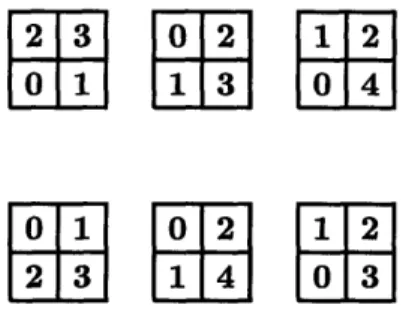
con-tains some tableaux which are not 3-commuting. ... 333-3 The 3-commuting tableaux with shape (2, 2) and squares filled with {0, 1, 2, 3}. 35 (2,2) 4
3-4 The Yamanouchi ribbon tableau corresponding to
c(4'4,4)(q)
..35
4-1 Calculation of the connected horizontal strips C which can be added to the
shape S
1= (7, 5,2, 1)/(4, 2,2, 1) to form a border ribbon strip. The resulting
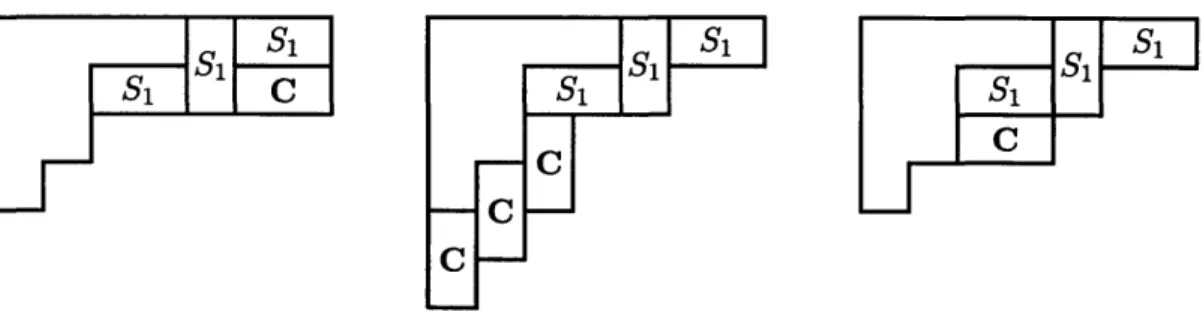
border ribbon strips all have height 1. ... .. 474-2 The result of the insertion ((((0 +- (1, 3)) +- (0, 4)) +- (0, 2)) - (1, 1)). . .. 57
Chapter 1
Introduction
The study of symmetric functions has grown enormously since Girard and Newton first
studied the subject in the seventeenth century. In the last century, symmetric function
theory has developed at the crossroads of combinatorics, algebraic geometry and represen-tation theory. The ring of symmetric functions A = AQ contains a distinguished basis {(s)known as the Schur functions. Schur functions simultaneously represent the characters of
the symmetric group Sn, the characters of the general linear group GL(N), the Schubert
classes of the Grassmannian Grkn and the weight generating functions of Young tableaux.
In recent years, there has been an explosion of interest in q- and q, t-analogues of sym-metric functions; see for example [48, 37, 55, 64]. With each such family of symsym-metric
functions, the initial aim is both to connect the functions with representation theory,
al-gebraic geometry or some other field; and to generalise the numerous properties of Schurfunctions to the new family of symmetric functions. The first part of this thesis is concerned
with the latter task for a family of symmetric functions which we call ribbon functions, de-fined by Lascoux, Leclerc and Thibon [39]. The second part of this thesis tries to explainthe results of the first part in the wider context of representations of Heisenberg algebras
and the Boson-Fermion correspondence.
Ribbon functions are defined combinatorially as the spin-weight generating functions of
ribbon tableaux:
(n)
(X; q)
=E
qspin(T)xw(T)T
where the sum is over all semistandard n-ribbon tableaux (see Figure 1-1) of shape A, and
spin(T) and w(T) are the spin and weight of T respectively. The spin of a ribbon is the
number of rows in the ribbon, minus 1. The definition of a semistandard ribbon tableau
is analagous to the definition of a semistandard Young tableau, with boxes replaced by
ribbons (or border strips) of length n. When n = 1, ribbon functions reduce to the Schur
functions. When q = 1, we obtain products of n Schur functions. The definition of ribbonfunctions can be extended naturally to skew shapes A/tt.
To prove that the functions g(n)(X; q) were symmetric Lascoux, Leclerc and Thibon connected them to the (level 1) Fock space representation F of the quantum affine algebra
Uq(s[n). The crucial property of F is that it affords an action of a Heisenberg algebra H,
commuting with the action of Uq(srn), discovered by Kashiwara, Miwa and Stern [29]. In particular, they showed that as a Uq(s[n) x H-module, F decomposes as
F
-
VAo Q(q)[H_]
0Figure 1-1: A 3-ribbon tableau with shape (7, 6, 4, 3, 1), weight (2, 1, 3, 1) and spin 7.
where VAo is the highest weight representation of U~(s[r) with highest weight A0 and
Q(q)[H_] is the usual Fock space representation of the Heisenberg algebra.
The initial investigations of ribbon functions were focused on the q-Littlewood Richard-son coefficients c(q) of the expansion of
G(n)(X;
q) in the Schur basis:G(n)(X;q) = cE
c(q) s(X).
These polynomials c\(q) are q-analogues of Littlewood Richardson coefficients. Leclerc and Thibon [411 showed that the c(q) are coefficients of global bases of the Fock Space F. Results of Varagnolo and Vasserot [62] then imply that they are parabolic Kazhdan-Lusztig polynomials of type A. Finally, geometric results of Kashiwara and Tanisaki [30] show that they are polynomials in q with non-negative coefficients. Much interest has also developed in connecting ribbon tableaux and the q-Littlewood Richardson coefficients to rigged configurations and the generalised Kostka polynomials defined by Kirillov and Shimozono [31], Shimozono and Weyman [54] and Schilling and Warnaar [52].
In a mysterious development, Haglund et. al. [17] have conjectured connections between diagonal harmonics and ribbon functions. More recently, Haglund, Haiman and Loehr [16] have found an expression for Macdonald polynomials in terms of the skew ribbon functions
G(/ Unfortunately, the positivity of the skew q-Littlewood Richardson coefficients does not follow from the representation theory, so a proof of the Macdonald positivity conjecture
is yet to result from this approach.
The Fock space F can be viewed as the vector space over Q(q) spanned by partitions with a natural inner product (., .) : F x F -¢ Q(q) given by (A, ) = d,. Our study of ribbon functions begins in Chapter 3 with the definition of combinatorial operators un) i E Z}, called ribbon Schur operators, on F:
(n)A qspin(//A)/ if
p/A
is a n-ribbon with head lying on the i-th diagonal,0
otherwise.
Following work of Fomin and Greene [12], many properties of ribbon functions can be phrased in terms of ribbon Schur operators. In particular, we identify a commutative
subalgebra A(u) C Q(q)[..., ul, uo, u l,...] abstractly isomorphic to the ring of symmetric
functions. This algebra should be thought of as the (Hopf)-dual of the symmetric function algebra in which ribbon functions are defined. We give explicit formulae for certain "non-commutative Schur functions" s(u) E A(u) which are related to ribbon functions by the formula(sA(u) , ) = l (q
.)12
Our results thus imply some new positivity results for skew q-Littlewood Richardson coef-ficients.
Making computations involving A(u) and the adjoint algebra A-(u) c EndQ(q)(F), we
obtain a non-commutative "Cauchy identity" for the operators ui. In this way we recover
using just linear algebra and combinatorics of ribbons the action of the Heisenberg algebra on F due to Kashiwara, Miwa and Stern mentioned above. In particular, we obtain an elementary proof of the symmetry of ribbon functions.In Chapter 4, we use the action of the Heisenberg algebra on F to deduce properties of ribbon functions in analogy with Schur functions:
* A ribbon Pieri formula (Theorem 4.12):
hk[(1 +
q2
+... + q2(n-1))X]gv(X; q)
= E qs(/iV)g (X;
q)
where the sum is over all i such that l/v is a horizontal ribbon strip of size k. The
notation hk[(l + q
2+ ... + q
2(n-1)) X] denotes a plethysm.
* A ribbon Murnaghan-Nakayama-rule (Theorem 4.22):
(1
+
q
2k
+
.. +q2k(n-1)) pkgv(X; q)
=j
X/v(q)u,(X; q)
where Xk/,(q) can be expressed as an alternating sum of spins over certain "border n-ribbon strips" of size k.
* A ribbon Cauchy (and dual Cauchy) identity (Theorem 4.28):
n-11
z,
gA/6(X; q)
g/6(Y;q) =
II
]I
1
- xiyjq 2kX i,j k=O
where the sum is over all partitions A with a fixed n-core 6. A combinatorial proof of this identity was given recently by van Leeuwen [44].
* A Q-algebra isomorphism wn: A(q) -- A(q) (Theorem 4.26) satisfying
Wn(g(X; q)) =
gx,(X;
q).
Even the existence of a linear map with such a property is not obvious as the functions
G\are not linearly independent.
One should expect these formulae to be important properties. For example, the Pieri
formula for Schur functions calculates the intersection of an arbitrary Schubert variety with
a special Schubert variety in the Grassmannian. The Murnaghan-Nakayama rule calculates
the irreducible characters of the symmetric group.
The connection between ribbon functions and the action of the Heisenberg algebra is
made explicit by showing that the map 4,: F
-A(q) defined by
A, , (1.1)
is a map of H-modules, after identifying Q(q)[H_] with the ring of symmetric functions
A(q) in the usual way. The map -i has the further remarkable property that it changes
certain linear maps into algebra maps, as follows.Lascoux, Leclerc and Thibon [38] have constructed a global basis of F which extends
Kashiwara's global crystal basis of VAO. They used a bar involution -
F -
F which
extends Kashiwara's involution on VAo. Another semi-linear involution, denoted v - v' wasalso introduced and further studied in [41] which satisfied the property (, v) = (u',
)
for
u, v E F. We shall see that if we restrict 4o to the space of highest weight vectors of F for
the Uq(s[,) action, then both involutions become algebra isomorphisms under the map .
In particular the "image" of the involution v - v is simply w,.In Chapter 5, we explain how (1.1) should be thought of as a generalisation of the
Boson-Fermion correspondence. The classical Boson-Boson-Fermion correspondence identifies the image
of semi-infinite wedges in the Fermionic Fock space as the Schur functions in the Bosonic Fock space. Our investigations are motivated by the observation that many classical families of symmetric functions possess a trio of properties: a combinatorial tableaux-like definition, a Pieri-style rule and a Cauchy-style identity. Such families of symmetric functions include Schur functions, Hall Littlewood functions, Macdonald polynomials and ribbon functions. We shall explain these phenomena using representations of Heisenberg algebras.
Our aim is to generalise the Boson-Fermion correspondence to any representation of a Heisenberg algebra H with "parameters" ai. A Heisenberg algebra is generated by {Bk: k E Z\{0}} satisfying
[Bk, B] =
I
al $ k,-Ifor some non-zero parameters al satisfying al = -a-l. Given a representation V of H with a distinguished basis {(v I s E S} for some indexing set S and a highest weight vector in
V, we define two families {Fs I s E S} and {G I s E S} of symmetric functions. These definitions are combinatorial and tableaux-like in the sense that they give the expansion of
Fs or Gs in terms of monomials. The map v
,-÷ Gs turns out to be a map of H-modules for
a suitable action of H on A. The sum Es Fs(X)Gs(Y) satisfies a Cauchy identity: it has an explicit product formula involving only the parameters ai. Lastly, we find symmetric functions hk[ai] E A so that both hk[ai]Fs and hk[ai]Gs have Pieri-like expressions.
There is another part of the Boson-Fermion correspondence involving vertex operators
which we have chosen to largely ignore. This point of view has been studied by Jing and Macdonald [19, 20, 48].In the last part of the thesis, we use our generalisation of the Boson-Fermion corre-spondence to define ribbon functions for other Fock space representations. Our definition uses a construction of the Fock space representations for quantum affine algebras due to Kashiwara, Miwa, Petersen and Yung [28]. They define Fock space representations F for
the quantum affine algebras of types A
(2)B
(2)A
(2D1) and D(2) The main theorem
of [28], for our purposes, is that F decomposes as V
®
Q[H_] as a Uq(g)®
H module.Another construction of F is given by Kang and Kwon [24] in terms of Young walls, though they do not consider the action of the Heisenberg algebra.
The construction of these Fock spaces in [28] relies on a choice of a (level 1) perfect crystal
B for the quantum affine algebra. The Fock space representation is indexed by certain
"normally-ordered" elements bl ®
b
2®
... in a semi-infinite tensor product B
®
B
®
...of this crystal. In the notation above, this will be our indexing set S. The action of a Heisenberg algebra on the Fock space is also given explicitly in [28], and we use it to define
14
generalised ribbon functions F? E A(q). In the case T) = A( 1), we explain how one recovers Lascoux-Leclerc-Thibon ribbon functions. We also give examples of ribbons and ribbon functions for = A(2)
These generalised ribbon functions are likely to be interesting from both the
combinato-rial and representation theoretic points of view, though the calculation of ribbon functions
is considerably harder. We generalise a result of Leclerc and Thibon to show that the gen-eralised q-Littlewood Richardson coefficients ced E Q(q) given by Ft = - x c= .sx are also coefficients of a speculative "global basis" of F.16
Chapter 2
Ribbon tableaux and ribbon
functions
In this chapter we give the definitions for tableaux and symmetric functions needed
through-out this thesis, and define the ribbon tableaux generating functions of Lascoux, Leclerc and
Thibon.
2.1 Ribbon tableaux
2.1.1
Partitions and Tableaux
A partition A = (A1 > A2 >_ .-. > A1 > 0) is a finite sequence of non-increasing positive integers. We will call the length of A, and denote it by l(A). We will say that A is a
partition of A
1+ A
2+ ...
+ A
1 =IAI and write A - A1. A composition
a = (al, a2, ... , l) is an ordered list of non-negative integers. As above, we will say that a is a compositionof
lal
=
al + a2 +
.--+ al. We use the usual notation concerning partitions and do not
distinguish between a partition and its Young diagram. Let mk(A) denote the number of parts of A equal to k. Let A' denote the partition conjugate to A, given by Ai = #j I Aj > i}.We shall write P for the set of partitions. We shall always draw our partitions in the English
notation, so that the parts are top left justified.
The edge sequence p(A)
= (... ,p-2,p-l,po,Pl,P2, ... )of a partitions A is the doubly
infinite bit sequence obtained by drawing the partition in the English notation and reading
the "edge" of the partition from bottom left to top right - writing a 1 if you go up and
writing a 0 if you go to the right (see Figure 2-1). We shall normalise our notation for edgesequences by requiring that the empty partition 0 has edge sequence p(O)i = 1 for i < 0
and p(0)
i= 0 for i > 1. Adding a box to a partition corresponds to changing two adjacent
entries of the edge sequence (i, Pi+l) from (0, 1) to (1, 0). This box will then lie on diagonal
i.
If A and p are partitions we say that A contains p if Ai > pi for each i, and write p c A.
A skew shape is a pair of partitions A, such that p, C A, denoted A/j. The skew shape
A/p is a horizontal strip if it contains at most one square in each column. A skew shape A//p is a border strip if it is connected, and does not contain any 2 x 2 square. The height
h(b) E N of a border strip b is the number of rows in it, minus 1. A border strip tableau T
of shape A/p is a chain of partitions
= 0o C /u1 C .. C r =
o 0 0 1 0 1 1 1
Figure 2-1: The edge sequence p(31) = (... ., 1, 1, 0, 1, 0, 0, 1, 0, 0,...).
such that each pi+l/pi is a border strip. The height of a border strip tableau T is the sum
of the heights of its border strips.
The square or box (i, j) on row i and column j is said to lie on diagonal j - i. A
semistandard tableau T of shape A/u is a filling of each square (i, j) E A/zu with a positive
integer such that the rows are non-decreasing and the columns are increasing. We write
sh(T) = A/p. The weight w(T) of such a tableau T is the composition ac such that ai is the
number of occurrences of i in T. The tableau is standard if the numbers which occur are exactly those of [m] = {1, 2,..., m} for some integer m. A semistandard tableau of shape A/p can be thought of as a chain of partitions pu = A0 C A1 C ... C Al = A such that each Ai/Ai-l is a horizontal strip.2.1.2
Cores and ribbons
Let n > 1 be a fixed positive integer. When a border strip has n squares for the distinguished
integer n, we will call it a n-ribbon or just a ribbon. The height of the ribbon r will then
be called its spin spin(r). The reader should be cautioned that in the literature the spin is
often defined as half of this. The head of a ribbon is its top-right most square.
Let A be a partition. Its n-core A
is obtained from A by removing n-ribbons until it is
no longer possible to do so, and does not depend on how the ribbons are removed. Addinga n-ribbon to a partition A corresponds to finding an index i
E Z such that pi(A) = 1 andpi+n(A) = O, then changing those two bits to pi(A) = 0 and Pi+n(A) = 1.
Let A be an n-core with edge sequence p(A) = (... ,P-2P-,P,P2l,P2, ... ). Then there is no index i so that pi(A) = 0 and pi+n(A) = 1. Equivalently, the subsequences
p(i)
()
= (..., Pi-2n, Pi-n Pi, Pi+n,
Pi+2n
,.. .)
all look like (..., 1,1,1,1,0,0,0,0,0,...) with a suitable shift. Define the offset sequence
(do, dl, ... , dn_1) E Zn by requiring that Pi+ndi = 0 and Pi+n(di-l) = 1. The offsets satisfy
di-n = di +
1
and dl + d
2+
.-
+ dn =
0 and completely determine the n-core.
The n-quotient of A a n-tuple of partitions denoted by (A(), ... , A(n-1)) and are defined
by requiring that pi(A
()) = P(i+dj)n+j(A)
where dj = dj(A). The n-quotient and n-core of
A completely define A. They satisfy AI = 1A1 + n(lA(O)I + * + A(n-l)).Let P6 to denote the set of partitions A such that A = for an n-core = 3. A ribbon
tableau T of shape A/p is a tiling of A//u by n-ribbons and a filling of each ribbon with a
positive integer (see Figure 1-1). If these numbers are exactly those of [m], for some m, then the tableau is called standard. We will use the convention that a ribbon tableau of shape A
18
where A
$:
0 is simply a ribbon tableau of shape A/A. A ribbon tableau is semistandard if for each i1. removing all ribbons labelled j for j > i gives a valid skew shape A<i/p and,
2. the subtableau containing only the ribbons labelled i form a horizontal n-ribbon strip.
A tiling of a skew shape A/tt by n-ribbons is a horizontal ribbon strip if the topright-most
square of every ribbon touches the northern edge of the shape (see Figure 2-2). Abusing notation, we will also call the skew shape A/p a horizontal ribbon strip A// if such a tiling exists (which is necessarily unique). Similarly, one has the notion of a vertical ribbon strip.If A//g is a horizontal ribbon strip then A'/i' is a vertical ribbon strip. If A//s has k ribbons
then we have spin(A/I) + spin(A'/') = k(n - 1), where in one case we are taking the spinof the tiling as a horizontal ribbon strip and in the second case we are taking the spin of
the tiling as a vertical ribbon strip.
Figure 2-2: A horizontal 4-ribbon strip with spin 5.
We will often think of a ribbon tableau as a chain of partitions
= PO C /1 C ... C /r =
where each /gi+l-
1/iis a horizontal ribbon strip. The spin spin(T) of a ribbon tableau T
is the sum of the spins of its ribbons. If A/p is a horizontal ribbon strip then spin(A/p)
denotes the spin of the unique tiling of A/p as a horizontal ribbon strip. The weight w(T)
of a tableau is the composition counting the occurrences of each value in T.
Littlewood's n-quotient map ([45], see also [59]) gives a weight preserving bijection
between semistandard ribbon tableaux T of shape A and n-tuples of semistandard Young
tableau T(),...,T(
n -l)} of shapes
(A(°),...,
(n-l)) respectively. The n-quotient map
for tableaux can be defined by treating a tableau as a chain of partitions and applying the n-quotient operation for each partition in the chain. Abusing language, we shall also refer to {T(°), ... , T(n -1) } as the n-quotient of T. Schilling, Shimozono and White [53] and separately Haglund et. al. [17] have described the spin of a ribbon tableau in terms of an
inversion number of the n-quotient. Note that a shape A/p is a horizontal ribbon strip if
and only if its n-quotient is a n-tuple of horizontal strips.
2.2 Ribbon functions
2.2.1 Symmetric functions
We review some standard notation and results in symmetric function theory (see [48] for details).
Let A = Aq denote the ring of symmetric functions over Q. We will write A(q) for the ring of symmetric functions over Q(q). If K is any field of characteristic 0, we write AK for the algebra of symmetric functions over K. It is well known that the Schur functions sA E A
are orthogonal with respect to the Hall inner product (.,.) on A. If
fE A then fl denotes
the adjoint to multiplication by f with respect to (.,.), so that (fg, h) = (g, fl
.h). We
will denote the homogeneous, elementary, monomial and power sum symmetric functions
by hA, e, max and px respectively. Recall that we have (hx, ml) = , and (px,p,) =
zA6
.I where z = ml(A)ml(A)!2m2(\)m2(A)! .'". Each of the sets {Pi}, {ei} and {hi} are algebraically independent and generate A. We will write X to mean (l, X2,...). Thus
S (X) = SA(X1,X2, --
)-The Schur functions can be defined combinatorially in terms of Young tableaux:
s =
E xw(T)
T
where the sum is over all semistandard tableaux T of shape A and x
a= x?1x1
2.-.. Recall
that the Kostka numbers K~A, are defined by sx = A, Kx,m,. Thus K,, is equal to the
number of semistandard tableaux of shape A and weight .
The ring of symmetric functions has an algebra involution w : A -, A defined by w(hi) =
ei. It satisfies w(sx) = s and is an isometry with respect to (.,.). The Cauchy kernel
fQ(X, Y) := i,j 1 satisfies
Q(X,Y) = E h(X)mx(Y)
=
s(X)s,(Y)
,
=
zz lp(X)px(Y).
The Pieri rule allows one to calculate the product of a Schur function by a homogeneous
symmetric function:hAsx
=
s,
where the sum is over all p such that /A is a horizontal strip. Let A = (A1, A2, Ak). The Jacobi-Trudi formula expresses Schur function s as a determinant of homogeneous symmetric functions:
hA1 ha+l *-- hl+k-2 h+k-1l
hA2-1 hA2 ... hA2+k_3 h 2+k-2
sx = det
...
.
hAk-k+l hAk-k+2 "' .. hAk- hAk
Here we take ho = 1 and hi = 0 for i < 0.
Let f E A. We recall the definition of the plethysm g - g[f]. Write g = A, cApA. Then we have
1(A)
g[r
=ECA
f
li
xAi
.
A i=l
Thus the plethysm by f is the (unique) algebra endomorphism of A which sends pk
-f(xk, 2k,...). When f(x, 2,... ;q) E A(q) for a distinguished element q, we define the
plethysm as
pk -+ f (X, x2,... ; qk).Note that plethysm does not commute with specialising
q to a complex number.20
f [(1 +
q)p].
2.2.2 Lascoux, Leclerc and Thibon's ribbon functions
We now define the central objects of this thesis as introduced by Lascoux, Leclerc and Thibon. An integer n > 1 is fixed throughout and will often be suppressed in the notation.
Definition 2.1 ([39]). Let A/ be a skew partition, tileable by n-ribbons. Define the
symmetric functions (n)
(X; q)
=x/,(X;q)
E A(q) as:g/, (X; q) = EqSpin(T)x(T)
T
where the sum is over all semistandard ribbon tableaux T of shape A//L. These functions will be loosely called ribbon functions.
When = 0 we will write g(X; q) in place of g,/ 0(X; q). The fact that the functions
9g/ (X; q) are symmetric is not obvious from the combinatorial definition, and was first
shown by in [39] using representation theoretic results in [29]. We shall give an elementary
proof of the symmetry in Theorem 3.12.
Example 2.2. Let n = 2 and A = (3, 3). Then we have
(2))(X1, 2;
q)
= q3(x + X2X2 + X1X + 3) + q(X2 + X2X1),corresponding to the domino tableaux in Figure 2-3. In fact,
5(
3
2) (X; q) =
qs2,1(X) + q3s3(X).The symmetry of
g?(2)
(X; q) is already non-obvious. Note alsothat
g(2))
(X; 1) = S12(3,3 (3,3
Let A/z be a skew shape tileable by n-ribbons. Then define
KCA/a(q)
= Eqspin(T)T
the spin generating function of all semistandard ribbon tableaux T of shape A//L and weight
a. Thus
/ (X; q) =
,
/ ,~(q)xc. Also define the q-Littlewood Richardson coefficients
c/,,(q) by
Gx/,(X;q) :=
C/,(q)v(X)
V
When q = 1, the ribbon functions become products of Schur functions (see [39]):
\/, (X; 1) = S(o)S:A(1) ... S(n-1). (2.1)
This is a consequence of Littlewood's n-quotient map. In fact, up to sign, g(X;1) is essentially qn(sA) where On is the adjoint operator to taking the plethysm by pn ([39]). More generally, g/,,(X; q) reduces to a product of skew Schur functions at q = 1.
When n = 1, we have x(X; q) = s(X) and we just obtain the usual Schur functions. One of the main aims of this thesis is to generalise some of the properties of Schur functions described in Section 2.2.1 to arbitrary ribbon functions.
Remark 2.3. In [39], another set of symmetric functions 7Ht(X; q) defined by 7/x (X; q) =
gnx(X;q) is studied. It is not hard to see that 'H7(X; 1) = s(X) +
d,, s
d
,s,(X)
for some d,, E Z where -< denotes the usual dominance order on partitions. Thus the functions -t(X; q) form a basis of A(q) over Q(q). In [39] it is shown that the "cospin" version 17(X; q) generalise the modified Hall-Littlewood functions Q (X; q); see [48].
22
Chapter 3
Ribbon Schur operators
This chapter contains material from the paper [36], with some minor changes.
3.1 The algebra of ribbon Schur operators
Let K denote the field Q(q). Let F denote a vector space over K spanned by a countable basis {A
I
A E P} indexed by partitions. We shall call F the Fock space. Define linearoperators u(n): F -- F for i E Z which we call ribbon Schur operators by:
u(n) ,), A qspin(~/)/ if ps/A is a n-ribbon with head lying on the i-th diagonal,
Ai
{qtflI0otherwise.
We will usually suppress the integer n in the notation, even though ui depends on n. If
we need to emphasize this dependence, we write un). We say that a partition A has ani-addable ribbon if a n-ribbon can be added to A with head on the i-th diagonal. Similarly,
A has an i-removable ribbon if a n-ribbon can be removed from A with head on the i-th diagonal. Suppose the core A of A has offset sequence (do, di,... , dnl). Then the operator
u
(dj+k)n+jj(n)+nacts on the j-th partition
A() of the n-quotient by adding a square on the k-th
diagonal, and multiplying by a suitable power of q.
Observe that a skew shape A/p is a horizontal ribbon strip if there exists i < i
2< ... <
ik so that UikUik_l ... ui2uil · p = qaA for some integer a = spin(A/p).
Let U = Un C EndK(F) denote the algebra generated by the operators {u)} over K.
Proposition 3.1. The operators ui satisfy the following commutation relations:
uiuj = ujui
for i - j
n + 1,
(3.1)
u
i= 0
for i E Z,
(3.2)
Ui+nUiUi+n
= 0
for i E Z,
(3.3)
UiUi+nUi = 0 for
i
E Z, (3.4)uiuj = q2ujui
for n > i - j > 0.
(3.5)
Furthermore, these relations generate all the relations that the ui satisfy. The subalgebra
generated by
{ujii}ln
has dimension (Ck)
nwhere Ck =
2+(k)
is the k-th Catalan number.
4-4
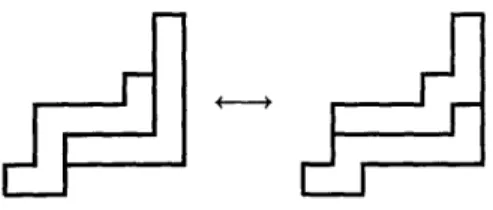
Figure 3-1: Calculating relation (3.5) of Proposition 3.1.
Proof. Relations (3.1-3.4) follow from the description of ribbon tableaux in terms of the
n-quotient and the usual relations for the operators ui') (see for example [12]). Relation (3.5) is a quick calculation (see Figure 3-1), and also follows from the inversion statistics of [53, 17] which give the spin in terms of the n-quotient.
Now we show that these are the only relations. The usual Young tableau case with
n = 1 was shown by Billey, Jockush and Stanley in [2]. However, when q = 1, we are
reduced to a direct product of n copies of this action as described earlier. The operators
{ui i = k mod n} act on the k-th tableau of the n-quotient independently.
Let f = auu + avv + -
..E U and suppose f acts identically as 0 on F. First suppose
that some monomial u acts identically as 0. Then by the earlier remarks, the subword of u consisting only of {ui i = k mod n} must act identically as 0 for some k. Using relation
(3.5), we see that we can deduce u = 0, using the result of [2].
Now suppose that a monomial v does not act identically as 0, so that v l p = qtA for some t E Z and p, A E P. Collect all other monomials v' such that v' I = qb(v')+tA for some
b(v) E Z. By Lemma 3.2 below, v = qb(v')v. Since f Il = 0 we must have ,,v a,,v' = 0
and by Lemma 3.2 this can be deduced from the relations (3.1-3.5). This shows that we can deduce f = 0 from the relations.
For the last statement of the theorem, relation (3.5) reduces the statement to the case
n = 1. When n
=1, we think of the ui as the Coxeter generators si of Sk+l. A basis of the
algebra generated by i( l}i=l is given by picking a reduced decomposition for each321-avoiding permutation - these are exactly the permutations with no occurrences of sisi+lsi
in any reduced decomposition. It is well known that the number of these permutations isequal to a Catalan number.
0
Lemma 3.2. Suppose u =
Uiuik_l ...uil and v = uj
1uj,_ ... ujj
.
If u-.
I
= qtv .
1p
O0
for
some t E Z and i E P then u = qtv as operators on F, and this can be deduced from the
relations of Proposition 3.1.
Proof. Using relation (3.5) and the n-quotient bijection, we can reduce the claim to the
case n = 1 which we now assume. So suppose u
I
= v = A. Then the multiset ofindices {il,i
2, ... , ik)and
jl,j2,... ,jl}are identical, since these are the diagonals of A/p.
In particular we have k = I.
We need only show that using relations (3.1-3.4) we can reduce to the case where uil =
uj,, and the result will follow by induction on k. Let a = min b I b = i where we set
i = i. We can move uja to the right of v unless for some c < a, we have j = i
i1. But l
has an i-addable corner, and so v
= uj._Iuj_ 2 ... ujlalso has an i-addable corner. This
implies that ui±l v = O so no such c can exist.
]
24
3.2 Homogeneous symmetric functions in ribbon Schur
op-erators
Let
hk(U) := Eil<i2<...<ik Uik ... uilbe the "homogeneous" symmetric functions in the
operators ui (the name makes sense since u = 0). Since the ui do not commute, the ordering of the variables is important in the definition. The action of hk(u) on F is well defined even though hk(u) does not lie in U but in some completion. Alternatively, we maywrite
i=-o0 00
If (1 + xu,) = E xkhk(u)
i=0o i=O
where if i < j then (1 + xui) appears to the right of (1+ zuj) in the product. By the remarks
in Section 3.1, the operator hk(u) adds a horizontal ribbon strip of size k to a partition, so
that
hk(U) X
=E
qspin(/X)L)where the sum is over all horizontal ribbon strips /A of size k.
The following proposition was shown in [39] using representation theoretic results in [29] (see Chapter 4). Our new proof imitates [12, 11].
Theorem 3.3. The elements
{hk(u)}k=l1commute and generate an algebra isomorphic to
the algebra of symmetric functions.
Proof. Given any fixed partition only finitely many ui do not annihilate it. Since we are
adding only a finite number of ribbons, it suffices to prove that
hk (Ua, Ua+l,..., ub)commute
for every two integers b > a. First suppose that n > b - a. We may assume without loss ofgenerality that a =
1 and b
=
n+ 1. We expand both
hk(Ua, Ua+1,...,ub)hl(ua,
Ua+l, * Ub)and hl(ua,
ua+l,...ub)hk(ua, ua+l,...,ub)and collect monomials with the same set of
indices I = {il < i
2< ... < ik+l}. By Proposition 3.1, any operator ui can occur at
most once in any such monomial. Suppose the collection of indices I does not con-tain both 1 and n + 1. Then by Proposition 3.1 we may reorder any such monomial
u = uj1
uj2
... ujk+.into the
form qtuiu 2Ui+-- ... I = qtuI.The integer t is given by
twice the number of inversions in the word jlj2 ... jk+l. That the coefficient of ui is the same in hk(Ua, Ua+l1,..., ub)hl(ua, Ua+1,. .., ub) and hi (ua, Ua+l, .. ., Ub)hk(ua, a+l,... , Ub)
is equivalent to the following generating function identity for permutations (alternatively, symmetry of a Gaussian polynomial).
Let Dm,k be the set of permutations of Sm with a single ascent at the k-th position and
let dm,k(q) = EwEDm,k qinv(w) where inv(w) denotes the number of inversions in w. Then
we need the identity
dk+l,k(q) = dk+l,l(q).
This identity follows immediately from the involution on Sm given by w = Wl ... wm v =
v · · ·vm where vi = m + 1 - wm+1-i.
When I contains both 1 and n + 1 then we must split further into cases depending on
the locations of these two indices: (a) un+l ... ul ; (b) ... ulun+l .. ; (c) ...un+
1... Ul;(d)
un+
... Ul. We pair case (a) of hk(ua, Ua+l,... ub)hi(ua, ua+l,... ub) with case (c) of hl(ua, Ua+, ... , Ub)hk(Ua, Ua+l, .. , Ub) and vice versa; and also cases (b) and (d) with itself.After this pairing, and using relation (3.5) of Proposition 3.1, the argument goes as before. For example, in cases (a) and (c), we move un+1 to the front and ul to the end.
Now we consider
hk(Ua, . ,ub)for b-a > n. Let
Eb,a(x) = (1 + XUb)(1 + XUb) . ." (1 +XUa). Note that Eb,a() - l = (1 - xua)(1 - XUa+l) (1 - XUb) is a valid element of U[x].
The commuting of the hk(ua, Ua+l, ... , Ub) is equivalent to the following identity:
Eb,a(Z)Eb,a(Y) = Eb,a(Y)Eb,a(X)
as power series in x and y with coefficients in U which we assume to be known for all (b, a)
satisfying b - a <1
I for some
>n. Now let b = a + . In the following we use the fact that
ua and ub commute.
Eb,a(X)Eb,a(Y)
= Eb,a+l() (1 + xua)(1 + YUb)Eb-l,a(Y)
= Eb,a+l(Y)Eb,a+l(X)
(Eb,a+l(Y))
- 1(1 + yUb)(1 + XUa)
(Eb-l,a(X))
1Eb
- l,a(Y)Eb
- l,a(X)
= Eb,a+l
(y)Eb,a+l
(X) (Eb-l,a+l (X)Eb-l,a+l (Y))-1 Eb-l,a(Y)Eb-l,a(X)
= Eb,a+l(Y)(1
+ XUb)(l + yUa)Eb-l,a(X)
= Eb,a(Y)Eb,a
()
This proves the inductive step and thus also that the hk(u) commute. To see that they
are algebraically independent, we may restrict our attention to an infinite subset of the operators {ui} which all mutually commute, in which case the hk(u) are exactly the classicalelementary symmetric functions in those variables. 0
Theorem 3.3 allows us to make the following definition, following [12].
Definition 3.4. The non-commutative (skew) Schur functions s/,(u)
are given by the
Jacobi-Trudi formula:S,/(u)
=det (hAi_i+j_-j(U))ij=
1Similarly, using Theorem 3.3 one may define the non-commutative symmetric function f(u) for any symmetric function f.
It is not clear at the moment how to write sA(u), or even just ek(u) = slk(U), in terms of monomials in the ui like in the definition of hk(u). One can check, for example, that p2(u) cannot be written as a non-negative sum of monomials.
3.3 The Cauchy identity for ribbon Schur operators
The vector space F comes with a natural inner product (., .) such that (A, p) = l,. Let di
denote the adjoint operators to the ui with respect to this inner product. They are given
bydiA · qspin(A/P)u if A//i is a n-ribbon with head lying on the i-th diagonal,
0di otherwise.
The following lemma is a straightforward computation.
Lemma 3.5. Let i A j be integers. Then uidj = djui.
26Define U(x) and D(x) by
U(x) =
(1+ xu2)(1 + xul)(1 + XUo)(1
+ xu-1)
and
D(x) =
(1 + xd-
2)(1 + xd-1)(1 + xdo)(1 + xdl)
.
So U(x)
= Ekxkhk(u) and we similarly define h (u) by D(x) =
SZkxkh(u). The operator
h (u) acts by removing a horizontal ribbon strip of length k from a partition.
The main result of this section is the following identity.
Theorem 3.6. The following "Cauchy Identity" holds:
n-1 1
U(x)D(y)
II
1 q2y
D(y)U(x).
(3.6)
i=A combinatorial proof of this identity was given by Marc van Leeuwen [44] via an explicit shape datum for a Schensted-correspondence. Our proof is suggested by ideas in [11] but considerably different from the techniques there. The following Corollary is immediate after equating coefficients of xayb in Theorem 3.6.
Corollary 3.7. Let a, b > 1 and m = min(a, b). Then
m
hbl(U)ha(u)
=
E
hil, q
2,
. .
,l-)h_.
2nlai(u)hb'i(u).
i=O
Define the operators h
)= (idi)
j- (diui)
jfor i,j E Z and j > 1. The operators hi
)act as follows:
[-q
2jSPin(A/X)A if A has an i-addable ribbon i//A, hi) :A -
q2ijspin(/v)A if A has an i-removable ribbon A/v,0 otherwise.
Since h?) acts diagonally on F in the natural basis, they all commute with each other. We will need the following proposition, due to van Leeuwen [44].
Proposition 3.8. Let A be a partition and suppose ribbons Ri and Rj can be added or
removed on diagonals i < j such that no ribbons can be added or removed on a diagonal
d E (i, j). Then one of the following holds:
1. Both Ri and Rj can be added and spin(R
j) = spin(R)
-1.
2. Both Ri and Rj can be removed and spin(Rj) = spin(R) + 1.
3. One of Ri and Rj can be added and the other can be removed and spin(Rj) = spin(Ri).
For example, writing down, from bottom left to top right, the spins of the ribbons that
can be added and removed from the partition in Figure 1-1 gives 2, 1, -1, 1, -1, 1, 0 wherepositive numbers denote addable ribbons and negative numbers denote removable ribbons.
Lemma 3.9. Let A be a partition, i E Z and j > 1 be an integer. Suppose that A has an
i-addable ribbon with spin s. Then
(::hk1
) A
=
-(1
+
q
2j + ...
+q(
)
k=i+l
Suppose that a A has an i-removable ribbon with spin s.. Then
(E
h:1) A = -(1 +
q2j
+ ...+ q2sj)A
k=i+l
Also, if i is sufficiently small so that no ribbons can be added to A before the i-th diagonal,
then
k=oo \
E°hk')
A
=-(1+
q2j + ... + q2(n-l)j).
Proof. This follows from Proposition 3.8 and the fact that the furthest ribbon to the right
(respectively, left) that can be added to any partition always has spin 0 (respectively,
n-l).
0
Lemma 3.10. Let i, j E Z and j > 1. Then
/ k=oo
\ k=oo \
k=i+l k=i Similarly we have, k=oo k=oodi
hk')
=
(::
hj) d.
\ k=i k=i+lProof. We consider applying the first statement to a partition A. The expression vanishes
unless A has an i-addable ribbon y/A, which we assume has spin s. Then we can compute both sides using Lemma 3.9. The second statement follows similarly. 0
We may rewrite equation (3.6) as
n-1
U(x)D(y) = D(y) I (1 - qixy)U(x).
i=0 Now
n-1
n-1
H (1 -q
2ixy) = E(-)iei(,q2.
2(n-1))(xy)
i=O i=O
and
hioohi)
acts as the scalar -p(1l, q
2,
.,q 2(n-l)) = (1+
2+
+2(n-l)j)
+ q2
by
Lemma 3.9. Let us use the notation pj(hi) = - =i h(j), for i E Z U
{oo.
We also writeen(hi) = E pz
,
lpp(hi)
pFn
28
where pp(hi) = p,, (hi)pp2 (hi) ... and p = (-1)IPI- (P) and zp is as defined earlier. As scalar
operators on F we have,
n-1 n 00
H
(1 - q
2'xy)
-=
(-1)jej(h.o)(xy)
j=
(-)ej(ho
)(xy)
j.
j=o
j=o
j=o
Lemma 3.11. Let i E Z. Then
(1 + ydi)
(-1)kek(hi)(xy)k
(1 + xui) = (1 + xui)
(-1)kek(hi+l)(xyk))
(1 + ydi).
Proof. First we consider the coefficient of xk+lyk. We need to show that ek(hi)ui =
uiek(h i+l) which just follows immediately from the definition of ek(hi) and Lemma 3.10.
The equality for the coefficient of xkyk+l follows in a similar manner.
Now consider the coefficient of (xy)k. We need to show that
diek-l(hi)ui - ek(hi) - uiekl(hi+l)di + ek(hi+l)
= 0.
By Lemma 3.10, this is equivalent to((uidi - hi)ek-l(hi+l)
- ek(hi) - uidekl(hi) + ek(hi+l)) = 0
(3.7)
for every partition A. We now split into three cases depending on A.
1. Suppose that that A has a i-addable ribbon with spin s. Then di .A = 0 so (3.7) reduces
to (ek(hi+l) + q
2ekl(hi+l) - ek(hi)) A = 0. Using Lemma 3.9, this becomes
ek(l, q2, ... , q2(S-1)) + q2sek_(1, q2
,...
q2(s-1)) = ek(1, q2,... q2S)which is an easy symmetric function identity.
2. Suppose that that A has a i-removable ribbon with spin s. Then uidi · A = hi · A so we are reduced to showing
ek(hi+l) - ek(hi) - q9ek-1 (hi) = 0
which by Lemma 3.9 becomes the same symmetric function identity as above. 3. Suppose that A has neither a i-addable or i-removable ribbon. Then (3.7) becomes
ek(hi) ·A = ek(hi+l) ·A so the result is immediate.
Theorem 3.6 now follows easily.
Proof of Theorem 3.6. We need to show that U(x)D
A=(1
(y)
- q
2iXy)U(x) *
A for each partition A. But if we focus on a fixed coefficient xayb, then for some integers s < tdepending on A, a and b, we may assume that ui = di = 0 for i < s and i > t for all our
computations. Thus it suffices to show that
(1 + xus) . . (1 + xut)(l + ydt) ... (1 + yds) =
(1 + ydt)
...(1 + yds) (lk=o(-l)kek(hs)(xy)k)
(1 + xus)
...(1 + xut).
29Since by Lemma 3.5, (1 + xua) and (1 + ydb) commute unless a = b, this follows by applying
Lemma 3.11 repeatedly. El
3.4 Ribbon functions and q-Littlewood Richardson
Coeffi-cients
In this section we connect the non-commutative Schur functions sv(u) with the q-Littlewood Richardson coefficients c/,(q). The set up here is actually a special case of work of Fomin and Greene [12], though not all of their assumptions and results apply in our context.
Let xl, x2, ... be commutative variables. Consider the Cauchy product in the commuta-tive variables {x}i and non-commutacommuta-tive variables {ui} (not to be confused with the Cauchy identity in Section 3.3):
Q(x, u) = II
p(1 + ju)
j=l
i=o
where the product is multiplied so that terms with smaller j are to the right and for the
same j, terms with smaller i are to the right. We have
Q(x,u)
=
ii
(xhk(U))
=
Es(X)sA(u)= EmA(x)hA(u)
j=l k A
where we have used Theorem 3.3 and the classical Cauchy identity for symmetric functions. Since each hk(u) adds a horizontal ribbon strip, we see that
gx/,(X;
q) =
Exa (ha(u) , A) =
Emv(x) (h,(u)
, A) = ((x, u) -., A)
A·
a! v
where the sum is over all compositions a or all partitions v. In the language of Fomin and Greene [12], these functions were denoted Fg/h. The symmetry of the ribbon functions follows from the fact that ha(u) = hp(u) if the compositions a and 3 are rearrangements of each other.
Theorem 3.12. The power series {x/(X; q) are symmetric functions in the (commuting)
variables {x
1,
X2,...}with coefficients in K.
Other elementary proofs of Theorem 3.12 appear in [16, 35].
Let (., )x be the (Hall) inner product in the X variables. The action of the noncom-mutative Schur functions in ribbon Schur operators s,(u) calculate the skew q-Littlewood Richardson coefficients.
Lemma 3.13. The q-Littlewood coefficients are given by c'/ (q) = (sv(u) , A).
Proof. We can write
c/,(q) = (9,/v(X; q), s,(X)) x
= ((Q(x, u) , A) , s,(X))x
= E (sp(X) (Sp(u) , ), s (X))x
P= (s,,(u)
,
A)
A·
30O
Proposition 3.14. The noncommutative Schur function s(u) can be written as a
non-negative sum of monomials if and only if the skew q-Littlewood Richardson coefficients
c/1(q) E N[q] are non-negative polynomials for all skew shapes A/p.
Proof. The only if direction is trivial since (u ,, A) is always a non-negative polynomial
in q for any monomial u in the ui. Suppose cl,(q) are non-negative polynomials for all skew shapes A/p. Write s(u) as an alternating sum of monomials. Let u and v be two monomials occurring in s,(u). If u = v -* M 5 0 for some partition then by Lemma 3.2,
u = v. Now collect all terms v in s(u) such that u = qa()v. . Collecting all monomials
v with a fixed a(v), we see that we must be able to cancel out any negative terms since all
coefficients in c 1 (q) = (sv(u) , A) are non-negative. El
To our knowledge, a combinatorial proof of the non-negativity of the skew q-Littlewood Richardson coefficients is only known for the case n = 2 via the Yamanouchi domino tableaux of Carr6 and Leclerc [5]. When p = 0, Leclerc and Thibon [41] have shown using results of [62], that the q-Littlewood Richardson coefficients c(q) are non-negative polynomials in q; see also Section 4.1.3.
3.5 Non-commutative Schur functions in ribbon Schur
oper-ators
This section is logically independent of the remainder of the thesis. Based on Proposi-tion 3.14, we suggest the following problem, which is the main problem of this Chapter.
Conjecture 3.15. We have:
1. The non-commutative Schur functions s(u) can be written as a non-negative sum of
monomials.
2. A canonical such expression for s(u) can be given by picking some monomials
oc-curring in hA(u). That is, s(u) is a positive sum of monomials u = uikuik_
1 ... Ulwhere ix > il-
1>
...> i and iA
1+A2> iA+A2_-1
> ... > i+
and so on, where
k=I 1AI.
By the usual Littlewood-Richardson rule, Conjecture 3.15 also implies that the skew Schur functions s/, (u) can be written as a non-negative sum of monomials. If Conjecture 3.15 is true, we propose the following definition.
Conjectural Definition 3.16. Let A/p be a skew shape and v a partition so that nlvl =
JA/p
I. Let u
=UikUik_l
...
Uilbe a monomial occurring in (a canonical expression of) s(u)
so that u.tt
=qaA for some integer a. If Conjecture 3.15.(2) holds, then the action of u
on
tnaturally corresponds to a ribbon tableau of shape A/p and weight v. We call such a
tableau a Yamanouchi ribbon tableau.
In their work, Fomin and Greene [12] show that if the ui satisfy certain relations then s\(u) can be written in terms of the reading words of semistandard tableaux of shape A. These relations do not hold for our ribbon Schur operators. We shall see that a similar description holds for our s(u) when A is a hook shape, but appears to fail for other shapes.