HAL Id: hal-00299417
https://hal.archives-ouvertes.fr/hal-00299417
Submitted on 12 Mar 2007
HAL is a multi-disciplinary open access
archive for the deposit and dissemination of
sci-entific research documents, whether they are
pub-lished or not. The documents may come from
teaching and research institutions in France or
abroad, or from public or private research centers.
L’archive ouverte pluridisciplinaire HAL, est
destinée au dépôt et à la diffusion de documents
scientifiques de niveau recherche, publiés ou non,
émanant des établissements d’enseignement et de
recherche français ou étrangers, des laboratoires
publics ou privés.
Residential building and occupant vulnerability to
pyroclastic density currents in explosive eruptions
R. Spence, I. Kelman, A. Brown, G. Toyos, D. Purser, P. Baxter
To cite this version:
R. Spence, I. Kelman, A. Brown, G. Toyos, D. Purser, et al.. Residential building and occupant
vulnerability to pyroclastic density currents in explosive eruptions. Natural Hazards and Earth System
Science, Copernicus Publications on behalf of the European Geosciences Union, 2007, 7 (2),
pp.219-230. �hal-00299417�
© Author(s) 2007. This work is licensed under a Creative Commons License.
and Earth
System Sciences
Residential building and occupant vulnerability to pyroclastic
density currents in explosive eruptions
R. Spence1, I. Kelman1,2, A. Brown3, G. Toyos1, D. Purser4, and P. Baxter51Department of Architecture, University of Cambridge, UK
2National Center for Atmospheric Research (supported by the National Science Foundation), USA 3Cambridge Architectural Research, Ltd, UK
4Hartford Environmental Research, UK
5Institute of Public Health, University of Cambridge, UK
Received: 28 November 2006 – Revised: 19 February 2007 – Accepted: 19 February 2007 – Published: 12 March 2007
Abstract. A major hazard during the eruption of explo-sive volcanoes is the formation of pyroclastic density cur-rents (PDCs). Casualties and physical building damage from PDCs are caused by the temperature, pressure, and parti-cle load of the flow. This paper examines the vulnerability of buildings and occupants to the forces imposed by PDCs along with associated infiltration of PDC particle and gas mixtures into an intact building. New studies are presented of building and occupant vulnerability with respect to tem-perature, pressure, and ash concentration. Initial mitigation recommendations are provided.
1 Impacts of pyroclastic density currents on buildings and people
1.1 Introduction
Explosive volcanic eruptions can be accompanied by pyro-clastic density currents (PDCs) which are clouds of erupted particles and gases capable of flowing down volcano slopes at high speeds. They pose severe hazards to settlements and their inhabitants from their high temperature and their lat-eral dynamic pressure loading due to their density and ve-locity. Several historical examples exist of disasters caused by PDCs, such as St. Pierre Martinique in 1902, where over 28 000 people were killed and at Mt. Lamington, Papua New Guinea, in 1953, when nearly 3000 people were killed. The mechanisms which govern the destructiveness of PDCs and the vulnerability of buildings and people to their impacts have, until now, been rarely examined systematically.
This paper contributes to ongoing work in this area by in-vestigating the vulnerability of buildings and occupants to the impacts of PDCs, including the hazard from the infil-Correspondence to: R. J. S. Spence
tration of their hot air and gas mixture into intact buildings. New studies are presented which could be applied to any lo-cation threatened by PDCs, although the buildings on which the material here is based were mainly in locations at four explosive volcanoes in Europe. The details of the building surveys we undertook are outlined in Spence et al. (2005a, b).
1.2 Literature overview
The previous literature on this topic falls into three main cate-gories: the main causes of death, the causes of building dam-age, and the first attempts at modelling loss of life and build-ing damage from pyroclastic flows. This section summarises that work.
In an overview of deaths in volcanic eruptions since AD 1, Simkin et al. (2001) showed that PDCs have been the most important single cause of death with 28% of all fatalities be-ing attributed to them. However, PDCs are second to tephra fallout in terms of the number of volcanic eruptions with fa-talities because ash falls occur in almost all eruptions and can inflict damage to buildings and their occupants over more ex-tensive areas than the much more lethal PDCs. Blong (1984) and Baxter (1990) provided information on the occurrence and mechanisms of death in PDCs from a sparse literature that relies on descriptive accounts of a few major events with only one city destroyed by a PDC (St. Pierre, Martinique, in 1902).
Autopsies have been rare after volcanic eruptions, but were performed at Mount St Helens in 1980 (Eisele et al., 1981). This detailed study, based on 25 victims, indicated how the cause of death was related to the distance from the vent as the velocity, density and temperature of the PDC fell over the course of a run-out that extended as far as 28 km. Thus, instant death due to the high temperature (over 400◦C),
and complete occlusion of the airways by ash, was found in bodies which had not been buried or obliterated in the di-rect flow area. Asphyxia, severe thermal injuries to the skin,
inhalation injury to the lungs and trauma from being struck by missiles and falling trees were fates further away. The 58 deaths all occurred out in the open in a wilderness area, and evidence from other eruptions (see Blong, 1984) has been consistent in showing that survival outdoors is only possible in the periphery of a PDC when it has been well diluted by air and has almost stopped moving. For example, extreme heat was the overwhelming cause of death in victims sheltering in the beach chambers at Herculaneum in the AD 79 eruption of Vesuvius (Mastrolorenzo et al., 2001).
However, Baxter et al. (2005) have summarised the sparse evidence for human survival inside buildings and studied the impacts of PDCs during the eruption of the Soufriere Hills volcano on Montserrat to provide a detailed account of build-ing vulnerability to PDCs, includbuild-ing the implications for the survival of occupants in future eruptions if warning and ad-vanced evacuation fails. This work formed the conceptual basis for understanding the likely behaviour of the more di-lute PDC and the causes of building vulnerability in a densely urbanised area, such as around Vesuvius. The most common PDCs in recent volcanic disasters have had a light load of erupted particulate matter (dominated by ash) and have been well-mixed with air. Therefore, these PDCs are important for emergency planners to consider and they are the type studied for this paper. More dilute PDCs can be compared with dense PDCs, often termed pyroclastic flows, which are highly de-structive with effects which can be difficult to mitigate (Bax-ter et al., 2005).
Baxter et al. (2005) devised for the first time a damage scale based on lateral dynamic pressure applied to the build-ing shell by the directional flow of the PDC. The build-ingress of ash to the interior causing combustion of flammable contents such as furniture is identified as the main cause of damage at low dynamic pressure ranges. In the faster moving flow parts, where dynamic pressure is higher, particulates, debris, stones and missiles of all sorts become entrained in the main current and add to the destructive impact. The most vulnerable parts of the buildings are the openings, especially the windows, where glass panes or shutters can be readily be broken and then penetrated by hot ash. Petrazzuoli and Zuccaro (2004) calculated horizontal limit collapse loads for reinforced con-crete structures around Vesuvius which could be affected by PDCs. Luongo et al. (2003) focus on a single house in Pom-peii to identify factors influencing PDC damage from the AD 79 eruption.
Incorporating the variety of possible causes of deaths and building damage into models is a complex task and the nec-essary detailed investigations are all recent. Alberico et al. (2002) examine urban and population density as predic-tive variables for risk to and subsequent damage from PDCs. They do not examine how either specific buildings or build-ing elements would be damaged, nor how specific casual-ties could result. Spence et al. (2004a, b) develop a de-tailed model to estimate building damage and casualties from a PDC affecting four villages around Mt. Vesuvius, Italy.
Specific modes of failure and causes of death were identi-fied through engineering and medical analyses, some prob-abilistic and some deterministic. One PDC scenario is run producing deterministic casualty and building damage out-comes. This paper uses Spence et al. (2004a, b) as the basis for further probabilistic calculations.
Zuccaro and Ianniello (2004) analysed for the first time the complex process of interaction between a PDC and an urban area. One likely consequence is a shielding effect where the first row of buildings is severely damaged by a current, but protects the buildings behind, though the broken building el-ements can be entrained as missiles, thereby damaging sub-sequent buildings in the run-out. Further elaboration of the effect of urban areas on PDCs along with the possibility of urban firestorms resulting from a PDC’s impact, are aspects currently under investigation. This paper does not consider these effects.
1.3 Overview of this paper
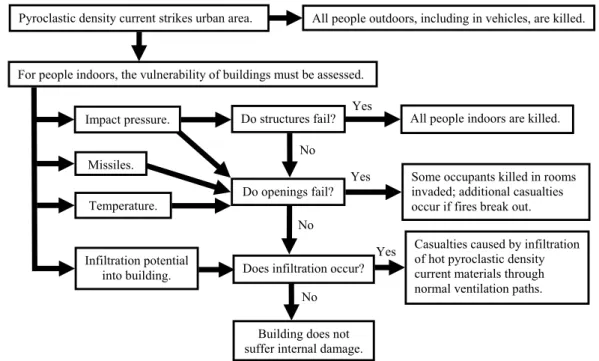
The literature review suggests a sequence of specific techni-cal problems to be solved quantitatively with respect to the effects of PDCs on buildings and people (Fig. 1). When a PDC strikes an urban area, the main impacts are missiles, heat, and dynamic and isostatic pressure. Indoor fires caused by the flow temperature are a secondary, but important issue. In some cases external fires might be a significant factor too, but those are complex enough to require separate study and will not be addressed further here. In this paper, it is assumed that people outdoors will be killed when a PDC arrives, but that survival of people remaining indoors may be possible.
If a building collapses, it is assumed that every occupant is killed. For people inside buildings which do not collapse, the main factor which governs vulnerability is the resistance of openings. Glazing is assumed to be a building’s weak point (Baxter et al., 2005), so probability density functions for win-dow glass failure under the combination of the three loads are calculated (Sect. 2.2). Protection of windows with shutters, cyclone boards, or other forms of protection are discussed in the conclusion.
If an opening were penetrated, i.e. if glass breaks, some occupants would be killed instantly, while others would be able to retreat to an inner room or a non-penetrated room, where they might survive, or might be killed by subsequent fires. Alternatively, if no openings were penetrated, or if peo-ple were in an interior room, then infiltration of the hot gases carrying abundant fine particles would lead to casualties from the rising temperature (causing hyperthermia and burns, or asphyxiation from inhaling abundant hot ash particles). Es-timates of likely casualties from these effects are given, in relation to measures of the PDC flow (pressure and tempera-ture), and of the building’s configuration.
This paper’s results may be used to provide a basis for first-order estimates of casualties and building damage in an urban area impacted by a PDC, if parameters of the flow can
Temperature. Impact pressure.
Pyroclastic density current strikes urban area.
Do structures fail?
Some occupants killed in rooms invaded; additional casualties occur if fires break out.
Casualties caused by infiltration of hot pyroclastic density current materials through normal ventilation paths. All people indoors are killed. Yes
No Missiles.
All people outdoors, including in vehicles, are killed.
For people indoors, the vulnerability of buildings must be assessed.
Infiltration potential into building.
Do openings fail?
Does infiltration occur? No
No
Yes
Yes
Building does not suffer internal damage.
Fig. 1. Overview of factors that govern building and occupants’ vulnerability to pyroclastic density currents.
be estimated and if the building stock’s characteristics are known.
2 Window failure
2.1 Combined effects of pressure and temperature
The resistance of glazed openings to the pressures of PDCs was examined in earlier papers (Spence et al., 2004a, b), and the probability of failure as a function of flow pressure for small, typical and large openings derived in that work has been used here and extended. In this paper, we look at the ef-fect on windows of the flow temperature and of the presence of missiles entrained in the flow.
Preliminary estimates of the probability of window failure due to temperature alone have been derived from work com-pleted at the UK’s Building Research Establishment (BRE) (Purser, 2005). Based on other standard forms of interaction curves related to material strengths, we propose a parabolic form of interaction between temperature and flow pressure such that:
T i = T o(1 − (P i/P o)2) (1)
P o and T o are the pressure and temperature respectively re-quired for a given probability of failure independently. P i and T i are the pressure and temperature respectively acting together to give that same failure probability. From Eq. (1), a set of failure probability distributions has been constructed as a function of pressure for different flow temperatures. These curves can be interpreted as constant offsets or shifts
to the ambient temperature failure probability curve, where the shift, 1P , at each temperature is defined by Eq. (2):
1P = c × T2 (2)
where c has a value of 9×10⁻⁵, 4×10⁻⁵, and
3×10⁻⁵Pa/◦C2 for small, typical and large windows
respectively.
2.2 Effect of entrained missiles
Missile generation in a PDC depends on the aerodynamics of the flying debris and the availability of the potential missile objects. The damage done by flying debris depends upon the kinetic energy of the missile and the vulnerability of build-ings and people to kinetic energy damage. Here, missiles are not considered to include ballistic rocks ejected from the volcanic vent or tephra-related bombs.
Wills et al. (1998) discuss the aerodynamics of flying de-bris with respect to cyclones and wind storms. They cate-gorise debris into three types: compact objects for which the dimensions are of the same order of magnitude in three di-rections, sheet objects for which two dimensions are of the same order of magnitude but the third dimension is much smaller; and rods/poles for which two dimensions are of the same order of magnitude but are much smaller than the third dimension. Wills et al. (1998) then develop equations for the flow velocity that permits flight. The equations suggest that, in general, the size of an object that can be lifted by a PDC is proportional to the square of the velocity. The potential to cause damage is related to the kinetic energy of the moving object. If the flight velocity of the object is a fraction J of the
0 1 10 100 1,000 10 12 14 16 18 20 22 24 26 Wind speed (m/s) Ki n e ti c En e rg y (J) 10 m/s 0.044 kg 12.5 m/s 0.17 kg 15 m/s 0.5 kg 17.5 m/s 1.3 kg 20 m/s 2.8 kg 22.5 m/s 5.7 kg 25 m/s 11 kg envelope
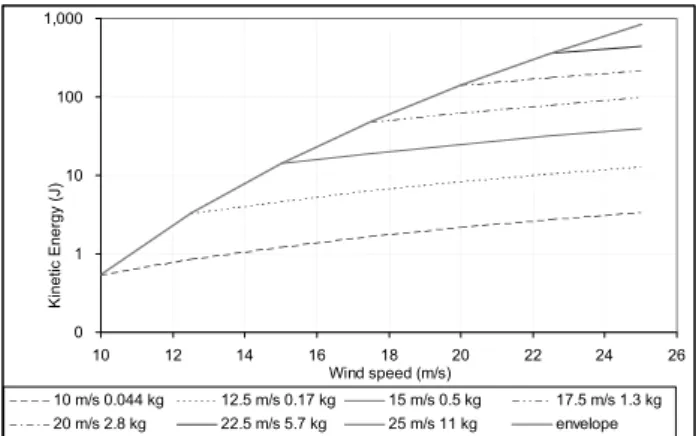
Fig. 2. Kinetic energy in wooden battens of slenderness ratio 25.
The wind speed is the sustained value of wind speed needed to maintain flight.
velocity of the density current (i.e. the object’s flight velocity is J ×U m/s), the equations can be re-arranged to give the ki-netic energy Ekof the largest likely flying object in the flow
in relation to the flow velocity, U .
Compact objects : Ek=1/16ρo(ρpfCf/ρoI g)3J2U8 (3)
Sheet materials : Ek=1/4ρpf(CfJ2/I g)AU4 (4)
Rods and poles : Ek=1/4ρpf(CfJ2/I g)(Ld)U4 (5)
Figure 2, calculated for this paper, shows the kinetic en-ergy of wooden battens of slenderness ratio 25, where slen-derness ratio is length divided by a representative lateral di-mension. That illustrates the energy of the flying batten after the conditions for flight have been reached. The uppermost line “envelope” indicates the maximum energy of an object entrained in the flow for any velocity.
Wills et al. (1998) report that corrugated iron and ply-wood sheets commonly become missiles during hurricanes. Unanwa and McDonald (2000) examine debris from three tornadoes and provide data to show that 50×100 mm timber length pose a major hazard. Such objects as failing build-ing elements – includbuild-ing awnbuild-ings, claddbuild-ing and ornaments – loose flower pots, mobile refuse bins, and terrace and street furniture are other debris sources which could become debris in a PDC.
The probability of missile impact on windows depends on the flow velocity, flow density, density of potential missiles in the area upflow from the window, and the area and orien-tation of windows. Missile impact will cause failure when a missile with sufficient kinetic energy to break the window strikes the window. It is assumed here that the energy re-quired to break a glass panel is equal to the energy absorbed by the panel in its elastic deformation up to the point of fail-ure. Given a Young’s Modulus for glass of 65 000 MPa (ISE, 1999, and Makoviˇcka, 1998), the energy required to break a
Probability of missile-related failure
0 0.2 0.4 0.6 0.8 1 0 10 20 30 40 50 60 Flow velocity (m/s) P ro b a il it y o f fa il u re Normal missile density High missile density
Fig. 3. Probability of missile-related window failure for ground
floor windows at normal and high missile densities.
window ranges from 8 to 20 J for typical and large window panes of 3–4 mm thickness (see also Spence et al., 2004a, b). It can therefore be assumed that, at any given flow ve-locity, missiles with a kinetic energy less than 8 J will break few windows, missiles with a kinetic energy between 8 and 20 J will break some windows, and missiles with a kinetic energy above 20 J will break most windows. This is a rel-atively small energy transition range from few breakages to most breakages.
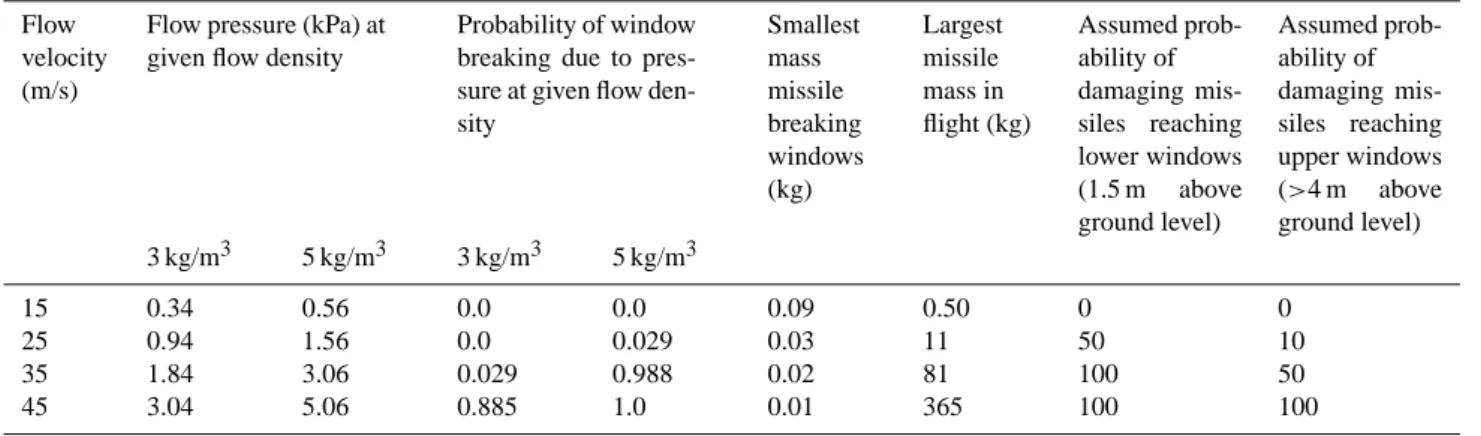
Based on these calculations, Table 1 gives missile masses, and an estimate of the probability of damaging missiles in the flow reaching both lower and upper storey windows, at var-ious flow speeds, and using densities which are considered to be typical of those which might be found in dilute PDCs (Spence et al., 20071). The probability of windows breaking due to the flow pressure alone is shown for comparison.
In the absence of any detailed data on missile availability, in Table 2 the availability of missiles is assessed according to two categories: either normal or high. Normal missile avail-ability would apply to most urban environments where some of the items mentioned above are found; high missile avail-ability would apply in situations where there are many loose building components, refuse items or plant material available for missiles. Numerical probabilities are then assigned: 5% to “few”, 30% to “some”, and 70% to “many”. The proba-bility of missile failure at ground floor windows is then es-timated (using the author’s judgement, based on the data in Table 1) as a function of flow velocity based on the combined probability of missile availability, and the ability of the avail-able missiles to reach the ground floor. Using the data points in Table 2, a best-fit cumulative normal distribution function was fitted in order to calculate the resulting probability of missile-related glass failure as a function of flow velocity for normal- and high-missile environments (Fig. 3).
1Spence, R. J. S., Komorowski, J.-C., Saito, K., Brown, A.,
Pomonis, A., Toyos, G., and Baxter, P.: Modelling the impact of a hypothetical sub-Plinian eruption at La Soufri`ere of Guadeloupe (West Indies), J. Volcanol., forthcoming, 2007.
Table 1. Size ranges of potential missiles, and an estimate of the probability of damaging missiles in the flow reaching both lower and upper
storey windows at given flow speeds and densities. Flow
velocity (m/s)
Flow pressure (kPa) at given flow density
Probability of window breaking due to pres-sure at given flow den-sity Smallest mass missile breaking windows (kg) Largest missile mass in flight (kg) Assumed prob-ability of damaging mis-siles reaching lower windows (1.5 m above ground level) Assumed prob-ability of damaging mis-siles reaching upper windows (>4 m above ground level) 3 kg/m3 5 kg/m3 3 kg/m3 5 kg/m3 15 0.34 0.56 0.0 0.0 0.09 0.50 0 0 25 0.94 1.56 0.0 0.029 0.03 11 50 10 35 1.84 3.06 0.029 0.988 0.02 81 100 50 45 3.04 5.06 0.885 1.0 0.01 365 100 100
Table 2. Probability of missile failure at ground floor windows.
Flow velocity (m/s) Normal High Normal High
15 None None 0.0 0.0
25 Few Some 0.02 0.15
35 Some Many 0.2 0.7
45 Many Many 0.7 0.9
Mean of normal distribution (m/s) 42 32 Standard deviation of normal distribution (m/s) 9 7
2.3 Combined probability of window glass failure
The joint probability of pressure-related (Spence et al., 2004a) and missile-related failure of glass can be combined as a function of flow pressure, using the joint failure proba-bility relationship:
pf =1 − (1 − pf m) × (1 − pfp) (6)
where pf is the combined failure probability, pf mis the
fail-ure probability due to missiles alone, pfpis the failure
prob-ability due to flow pressure and temperature.
Figure 4 shows the joint failure probability of missile-related failure and failure due to dynamic pressure alone as a function of dynamic pressure, assuming a flow density of 5 kg/m3, for typical windows, in an environment of normal missile availability.
3 Human casualties from failure of openings
This section proposes a way to estimate the proportion of human casualties (deaths and serious injuries) which will oc-cur in dwellings which have been invaded by PDC materials resulting from the failure of one or more windows or other openings. The scenario derives from earlier work, based on
Combined missile and pressure failure
0.000 0.200 0.400 0.600 0.800 1.000 0 1 2 3 4
Flow pressure (kPa)
P ro b a b il it y o f fa il u re Missile failure Pressure Failure Combined
Fig. 4. Separate and joint failure probabilities for typical windows
for missile-related and pressure-related failure for a flow density of 5 kg/m3.
observation at Montserrat (Spence et al., 2004a; Baxter et al., 2005), as well as extensive experience of fire spread at BRE (Purser, 2002, 2005).
The ingress of hot PDC materials is expected to be im-mediately life-threatening to anyone in the room directly in-vaded. Immediate casualty rates among those people will depend primarily on the temperature of the flow materials. Depending on the internal arrangement of the dwelling, and
0 10 20 30 40 50 60 70 0 50 100 150 200 250 300 350 temperature (degrees C) to le ra n ce ( m in s) fatal seriously injured
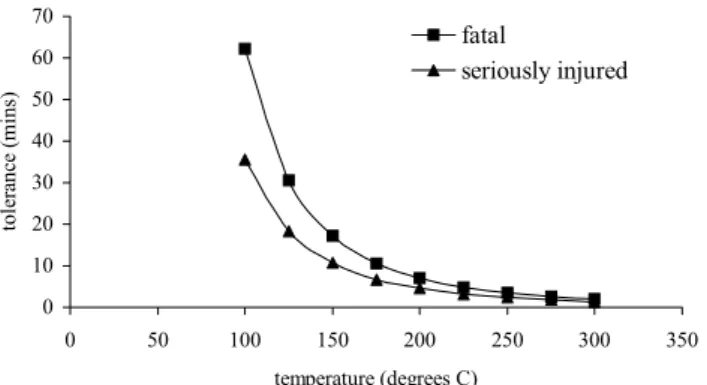
Fig. 5. Tolerance time (i.e. average time required to result in death
or serious injury) for a person exposed to a constant indoor air tem-perature.
the number of windows which fail, some of the occupants may initially escape to other areas of the dwelling. However, a secondary effect if the temperature of the flow materials is high enough, is that fires will break out and spread, threat-ening those who have escaped the room initially impacted. This will cause additional casualties.
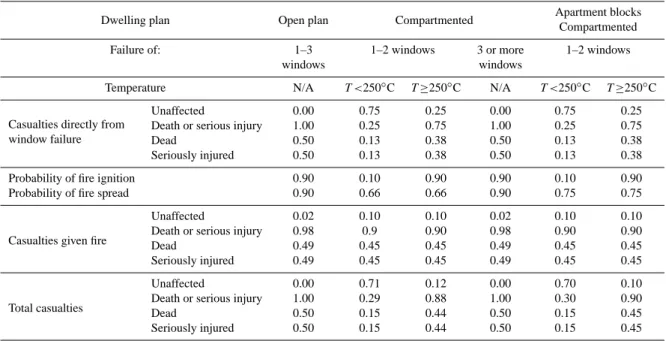
There are a number of variables in this scenario. The au-thors’ judgement on the human casualties which are likely to result are summarised, for a simplified set of assump-tions, in Table 3. Three sets of dwelling configuration are first distinguished: open-plan dwellings, dwellings which are compartmented (i.e. divided into a number of rooms, sepa-rated by doors), and apartments, which are here assumed to be compartmented. A secondary consideration is the num-ber of windows which have failed, allowing ingress of PDC materials. The table distinguishes, for the compartmented dwellings, cases where one or two windows have failed, and cases where three or more have failed. For cases where just one or two windows have failed, the table distinguishes PDC materials according to their temperature. Temperatures be-low 250◦C, though sufficient to cause casualties to people
directly exposed to the temperature, are much less likely to cause fires than those above 250◦C. Thus, six cases are
dis-tinguished, which we consider to include the important cases we have found in our studies of the building stocks around major European explosive volcanoes (Spence et al., 2004a, b; Spence et al., 2005a, b; Mart´ı et al., 20072).
The first three rows of Table 3 set out our estimates of the casualties arising directly as a result of window failure. In open-plan dwellings and those in which three or more win-dows fail, all occupants are affected, regardless of tempera-ture, while in compartmented dwellings in which only one or two windows fail, casualty rates are expected to depend
2Mart´ı, J., Spence, R. J. S., Calogero, E., Ordo˜nez, A., Felpeto,
A., and Baxter, P. J.: Estimating Building Exposure and Impact from Volcanic Hazards in Icod de los Vinos, Tenerife, J. Volcanol., forthcoming, 2007.
on temperature. The next two rows give our estimates of the probability of fire ignition, and then fire spread. Probabil-ity of fire ignition depends on temperature, but probabilProbabil-ity of spread depends on the building configuration. Of some im-portance is the potential in apartment blocks for fire to spread externally via the windows from one apartment to an apart-ment on the level above, reflected in a higher probability of spread for apartment blocks. The following three rows show the casualty estimates, given a fire, among those who sur-vived the initial impact. Survival rates, given the occurrence of a fire, are taken from the BRE’s experience of domestic fires; and casualties among those affected are divided equally among those killed and those seriously injured. Finally, the total casualties shown in the last three rows, are obtained by adding the casualties directly from window failure to those resulting from the subsequent fires.
4 Human casualties from infiltration 4.1 Casualty estimation
Even when openings remain intact, indoor casualties can oc-cur during PDCs as a result of infiltration of the hot particle-laden gases into a dwelling through the normal ventilation routes. The internal conditions will be related to the temper-ature and duration of the flow external to the building and to the ventilation rate of the building. This section proposes a way to estimate the infiltration casualties based on an under-standing of these variables.
Although the particle content of the PDC materials may cause breathing problems, it is expected that indoor casual-ties will be primarily caused by heatstroke. Based on Purser (2005) we propose the following expressions for the toler-ance time required to cause death or serious injury at a con-stant temperature, T:
tinjury=3 × 10⁷×T−2.96 (7)
tfatal=108×T−3.11 (8)
where tinjuryis the time required (minutes) for 50%
probabil-ity of serious injury, tfatalis the time required for 50%
prob-ability of death amongst occupants, and T is temperature. These expressions are plotted in Fig. 5.
Because the internal temperature is not constant, but varies over time, we use the notion of a dose per unit time (1D [min−1], which is defined as the inverse of the tolerance time
(tinjury or tfatal). The total dose (D) after time t, is then
de-fined as the cumulative sum of all unit doses over a period of exposure at varying temperature. We then estimate the prob-ability of death (Pdeath) (or serious injury) as a function of
total dose with a ramp function as follows:
Pdeath=0 if 0 ≤ D < 0.5tfatal (9)
Pdeath=D − 0.5, if 0.5tfatal≤D ≤ 1.5tfatal (10)
Table 3. Proposed casualty vulnerability, expressed as a ratio of occupants, resulting from pyroclastic density current damage to buildings
and ingress of hot ash.
Dwelling plan Open plan Compartmented Apartment blocks
Compartmented
Failure of: 1–3 1–2 windows 3 or more 1–2 windows
windows windows
Temperature N/A T <250◦C T ≥250◦C N/A T <250◦C T ≥250◦C
Casualties directly from
Unaffected 0.00 0.75 0.25 0.00 0.75 0.25
window failure
Death or serious injury 1.00 0.25 0.75 1.00 0.25 0.75
Dead 0.50 0.13 0.38 0.50 0.13 0.38
Seriously injured 0.50 0.13 0.38 0.50 0.13 0.38
Probability of fire ignition 0.90 0.10 0.90 0.90 0.10 0.90
Probability of fire spread 0.90 0.66 0.66 0.90 0.75 0.75
Casualties given fire
Unaffected 0.02 0.10 0.10 0.02 0.10 0.10
Death or serious injury 0.98 0.9 0.90 0.98 0.90 0.90
Dead 0.49 0.45 0.45 0.49 0.45 0.45
Seriously injured 0.49 0.45 0.45 0.49 0.45 0.45
Total casualties
Unaffected 0.00 0.71 0.12 0.00 0.70 0.10
Death or serious injury 1.00 0.29 0.88 1.00 0.30 0.90
Dead 0.50 0.15 0.44 0.50 0.15 0.45 Seriously injured 0.50 0.15 0.44 0.50 0.15 0.45 external temperature 0 20 40 60 time (min) 0 20 40 60 time (min) 0 20 40 60 time (min) Pulse type 1 Pulse type 2 Pulse type 3
Fig. 6. Temperature time relationships for the three PDC pulses
considered (peak temperatures vary).
4.2 Internal temperature in dwellings
To estimate injury and fatality rates for a given building and PDC conditions we need to find how indoor temperature re-sponds to the external conditions. To do this, we have exam-ined alternative PDC pulses of three types (Fig. 6) which on the basis of previous modelling work (Todesco et al., 2002) we consider plausible. Three shapes of pulse and two alter-native peak temperatures (300◦C and 600◦C) have been
ex-amined. All three pulses have a repetition time of 20 min, but have different lengths. Pulse type 1 lasts 3 min, Pulse type 2 lasts 5 min and Pulse type 3 lasts 10 min, with an assumed instantaneous rise, but each with a ramping-down period to ambient temperature of the same length of time as the pulse duration. We have also examined a number of alternative ventilation rates from 4 to 10 air changes per hour (ac/h), the range we expect in the building stocks we have examined.
To model the internal conditions, a simple time-stepping model has been adopted, in which the volumetric inflow is
Pulse type 1 600 deg
0 100 200 300 400 500 600 700 0 20 40 60 Time secs T e m p e ra tu re External temperature Internal temperature
Fig. 7. Internal and external temperature for pulse type 1, max
tem-perature 600◦C.
calculated in each time-step (typically one minute), and the internal temperature at the end of the time interval is calcu-lated assuming complete mixing of the current internal air with the incoming gases in a single internal volume. During the first two minutes of the pulse, the ventilation rate is as-sumed to be increased by a factor of 5 to allow for the short-term build-up of isostatic pressure which occurs at the onset of each PDC pulse. Figure 7 shows the external temperatures and the resulting internal temperatures for Pulse type 1 at an assumed ventilation rate of 4 ac/h.
The results of this model (Fig. 7) suggest that at the as-sumed infiltration rates, temperatures rise quite quickly to a temperature between 50% and 70% of the external tempera-ture; remain at that temperature for the duration of the pulse
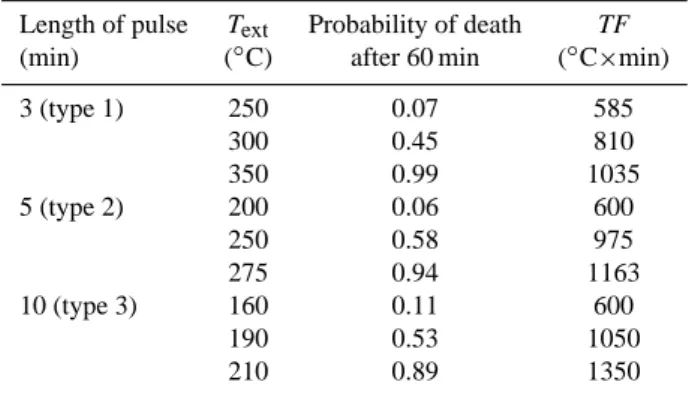
Table 4. Probability of death for a ventilation rate of 4 ac/hour
using pulses of 3, 5 and 10 min, and the corresponding temperature flux (TF) calculated with the best fit curve: TF=(Text−120)×pulse length×1.5.
Length of pulse Text Probability of death TF
(min) (◦C) after 60 min (◦C×min)
3 (type 1) 250 0.07 585 300 0.45 810 350 0.99 1035 5 (type 2) 200 0.06 600 250 0.58 975 275 0.94 1163 10 (type 3) 160 0.11 600 190 0.53 1050 210 0.89 1350
and then start to decline gradually. The onset of the next pulse leads to an increase to a higher peak temperature, the increment depending on the interval between pulses; but the impact of the first pulse is likely to be the most important.
4.3 Casualties as a function of external temperature
The internal temperature calculation model has been used in conjunction with the casualty model described above to ex-amine the relationship between external temperature and ca-sualties, and to enable the prediction of deaths and casualties as a function of external temperature and time of flow. We define the external temperature flux (TF) corresponding to any length of PDC pulse as:
TF = (Text−T0) × length of pulse × 1.5 (12)
where Textis the peak external temperature, the length of the
pulse is the dwell time at the peak temperature T0is a base
temperature corresponding to the onset of casualties and the factor 1.5 accounts for half of the time required by the tem-perature to ramp down to ambient temtem-perature.
An empirical approach was used to find a relationship be-tween the probability of death or serious injury as a function of TF and ventilation rate, and also the best value of T0, using
Eqs. (7) to (11). We did several runs with different peak tem-peratures, pulses of 3, 5 and 10 min and ventilation rates of 2, 4 and 10 ac/h to compute the probability of death and the probability of serious injury after 60 minutes. Some results are shown in Table 4.
Adjusting the factor T0 to reduce to a minimum the
dif-ferences between the results for the different pulse lengths, we found the best-fit values of T0(Eq. 12) to be 120◦C and
100◦C for death and serious injury, respectively. Finally, we
fitted a normal probability function to enable the prediction
0.0 0.2 0.4 0.6 0.8 1.0 0 700 1400 2100 2800 3500
Temperature flux (degrees- min)
P roba bi li ty of de at h 2 ach 4 ach 10 ach
Fig. 8. Probability of death as a function of external temperature
flux for different ventilation rates.
Flow direction
Zone 2:
Down stream zone experiences a negative velocity pressure Zone 3 Zone 4 Zone 1: External Larger of openings from flow direction
Larger of openings to down stream zone
Smaller opening, about 10% of larger opening to flow direction
Fig. 9. Arrangement of zones for two internal-zone model.
of the probability of death and of serious injury based on the temperature flux and the ventilation rate:
Pdeath/serious injury=8(TFµ, TFσ) (13)
where 8(µ, σ ) is the cumulative normal distribution with mean value µ and standard distribution σ .
For the probability of death, we found that TFµ=3960/VR
and TFσ=0.24×TFµ, while for the probability of serious
injury, TFµ=3380/VR and TFσ=0.28×TFµ, where VR is
the typical ventilation rate of the building, expressed in air changes per hour.
The resulting curves for calculating the probability of death in buildings with ventilation rates of 2, 4, and 10 ac/h are shown in Fig. 8. Similar curves can be obtained for the probability of serious injury.
5 Multi-zone models 5.1 Modelling method
The above analysis assumes a simple one-zone building in-terior with a single ventilation rate through the envelope. To investigate the possible benefits of sheltering provided by in-ternal spaces, a more sophisticated computational fluid dy-namics model has been employed to calculate the infiltration
0% 25% 50% 75% 100% 125% 150% 00:00 00:10 00:20 00:30 00:40 00:50 01:00 01:10 01:20 01:30 01:40 Tim e (hrs:m ins) Pe rc e n t o f le th a l th e rma l d o s e Zone 3 Zone 4
Fig. 10. Two-zone model. Percent of lethal thermal dose as a function of time in each of the zones for the model of Fig. 6. (Assumes an
external PDC pulse of 300◦C for 3 minutes (Type 1) repeated every 20 min and opening area of 0.01 m2both to external zone and between
internal zones (equivalent to 4.5 ac/h at 50 Pa test pressure).)
of pyroclastic materials into buildings for different assumed building configurations, and to compare the thermal dose ex-perienced by occupants in different zones.
The indoor particle concentration rise and air temperature rise were predicted with fluid-dynamic modelling using the software Phoenics from CHAM (Concentration Heat & Mo-mentum Ltd, Wimbledon Village, U.K.) along with other cal-culations using the standard Newtonian equations for mass transfer and momentum. This analysis allows for increased velocity pressure from the flow, fluctuations in isostatic pres-sure, and the effect of particle concentration. A Microsoft Visual Basic programme was written that models the event in small time steps and records the parameters in several con-nected zones within a building.
The model uses temperature, isostatic pressure and parti-cle concentration for a PDC in order to predict the tempera-ture and thermal dose in each zone. The programme permits the user to select an event definition, a zone definition, and an output file for the simulation results. The simulation then solves basic flow and energy equations for each time step and writes the data to the output file.
Simulations using the pulses in Fig. 6 were run with two pulse velocities: 15 m/s and 25 m/s. Each pulse repeats every 20 min. Up to six cycles (two hours) was modelled. The par-ticle concentration was fixed at 0.01% for each event. Three pulse types, two pulse peak temperatures, and two flow ve-locities yield twelve possible permutations for each assumed building model. Three different building models were also examined with different ventilation rates . A regression anal-ysis was developed to predict the proportion of fatal dose experienced for different inputs for a single zone model.
5.2 Two internal zone simulations
Configurations with two zones were tested with a Type 1 (Fig. 6) pulse at 300◦C. The model was symmetrical, with the
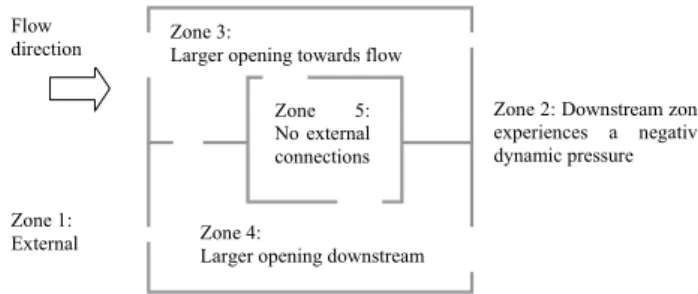
two internal zones each having 3 effective openings (Figs. 9 and 10). The total upstream and downstream infiltration ar-eas are the same as the single-zone models with 90% of the
Flow direction
Zone 2: Downstream zone experiences a negative dynamic pressure Zone 3:
Larger opening towards flow
Zone 4:
Larger opening downstream Zone 1:
External
Zone 5: No external connections
Fig. 11. Arrangement of zones and openings for three-zone model.
opening from each external zone being to different internal zones. The two zones are also linked by one of three equiva-lent area openings used in the single zone models. Thus, nine configurations were specified.
The configuration is designed so that the predominant flow is from the upstream zone, Zone 1, through Zone 3 to Zone 4 and out to the downstream zone, Zone 2. The temperature rises rapidly in Zone 3 but the rate of increase in Zone 4 is attenuated since the temperature in zone 3 is less than the external zones (Fig. 10).
5.3 Three internal zone simulation
A partially-sealed refuge within a building is likely to pro-vide better protection from a PDC. An additional zone was added to the model to evaluate the effect of a separate space with no connection to the outside (Figs. 11 and 12).
As expected, temperatures and subsequent rates of thermal dose decrease in the internal zone. A comparison was made of the effect of increasing the extent of sealing in the internal space (Fig. 12).
The computational model described permits the configu-ration of the vulnerable building to be considered for infiltra-tion and temperature rise rates. It shows a near-linear rela-tionship between the vulnerability of occupants in any zone and the ventilation exchange rate of that zone. It also sug-gests (Figs. 10, 12) increasingly effective protection from
0% 25% 50% 75% 100% 125% 150% 00:00 00:10 00:20 00:30 00:40 00:50 01:00 01:10 01:20 01:30 01:40 01:50 02:00 Tim e (hrs:m ins) P e rce n t o f le th a l th e rma l d o s e
Z3 - low Z4 -low Z5 - low Z5 -medium Z4 - high
Fig. 12. Three-zone model. Percent of lethal thermal dose as a function of time and the degree of sealing of the internal envelope. (Assumes
an external PDC pulse of 300◦C for 3 min (Type 1) repeated every 20 min, and opening areas both to external zone and between internal
zones of 0.01 m2for low, 0.02 m2for medium, and 0.04 m2for high (equivalent to 4.5, 9.0 and 18 ac/h at 50 Pa test pressure).)
barriers to flow through the building and the creation of refuges.
These results suggest that creating reasonably-sealed refuges in buildings is more effective for saving lives than trying to seal the entire external envelope. In well-ventilated buildings, the temperature of the outer zones may drop below the temperature in the refuge after the peak of external tem-perature has passed. Active control of the ventilation may in theory be able to decrease casualty rates, but occupants would have to be aware of the distinction between a pause between PDC events, (when they might think about open-ing internal doors), and the “all clear”, when it would be safe leave the refuge. These results, however, do not consider fire.
6 Conclusions
A set of vulnerability models and relationships to enable the calculation of expected number of casualties and fatalities by pyroclastic density currents in an urban area has been proposed. New analyses have been presented regarding the threats from missiles entrained by the PDC and the infiltra-tion of ash and hot air, with or without window breakage. The state of damage to windows has been used to estimate casualties.
The research results suggest possible mitigation measures which are likely to be relevant irrespective of the effects of turbulence and fire:
– Reduce the amount of potential missiles in the urban environment.
– Strengthen window glass, particularly in openings fac-ing the volcano.
– Add shutters to all glass openings and ensure that they are shut before evacuating or when a PDC warning is issued.
Other potential mitigation measures could be considered, but they should not be implemented until further research has been conducted on turbulence in PDCs and fire from PDCs so that these effects have been incorporated into the models:
– Create a well-sealed internal room as a refuge.
– If a structure does not have a sealable internal room, consider evacuating residents to a structure which does. – Sealing the building envelope could be an alternative, but would rarely be as effective a robust internal room. – New structures should be built with a sealable internal
room.
A common rating and labelling procedure for buildings and communities could be considered as an option for communi-cating PDC vulnerability and for assisting people in making informed decisions about their safety.
In applying and communicating mitigation options for PDCs, care must be taken that other vulnerabilities are not exacerbated. The impacts on social vulnerability would need to be examined. For example, suggesting that an action provides houses resistant to PDCs could encourage people to stay put during a volcanic eruption, potentially expos-ing them to other life-threatenexpos-ing volcanic hazards such as tephra. Any strategy to combat PDC vulnerability should be linked to overall building safety including all volcanic and non-volcanic hazards threatening a community.
Appendix
Symbols and abbreviations
A Area of an sheet-shaped object. [m2]
ac/h Air changes per hour, a measure of how well a room is ventilated. [h−1]
c Offsetting constant for Eq. (2). [Pa/◦C2] Cf Force coefficient applicable to different shapes
of potential missiles in PDC (compact ob-jects=1, sheets=0.3, rods=0.6). [–]
d Rod diameter for Eq. (5). [m]
D Total dose of heat received after time t, cal-culated as the cumulative sum of all 1D over a period of exposure at varying temperatures. [min−1]
1D Dose of heat received per unit time. [min−1] Ek Kinetic energy of a moving object. [J]
g gravitational acceleration on Earth. [9.81 m/s2] I Fixity coefficient for small objects in a built
en-vironment, assumed equal to 1 for loose ob-jects, although if an object’s fixing strength is less then its weight, I might be less than one. Better restrained objects have I >1 [–]
J A fraction of a PDC’s velocity representing the flight velocity of an object transported by the pyroclastic flow, i.e. the object’s flight velocity is J ×U m/s. [–]
L Rod length for Eq. (5). [m] PDC Pyroclastic density current.
pf The combined failure probability for missiles
and PDC pressure and temperature. [–] pf m Failure probability due to missiles. [–]
pfp Failure probability due to PDC pressure and
temperature. [–] Pdeath Probability of death. [–]
P i Pressure imposed by a PDC required for glazing to fail at temperature T i. [kPa]
P o Pressure imposed by a PDC required for glaz-ing to fail without considerglaz-ing temperature in-fluences. [kPa]
t An arbitrary time period. [time] T Temperature. [◦C]
TF Temperature flux, the amount of heat which has been experienced in a location. [◦C-min]
Ti Pressure imposed by a PDC required for glazing to fail at pressure P i. [◦C]
To Temperature imposed by a PDC required for glazing to fail without considering pressure in-fluences. [◦C]
U PDC velocity. [m/s]
µ Arithmetic mean or data or mean of a normal distribution 8. [any units]
ρpf Pyroclastic flow density. [kg/m3]
ρo Density of an object such as a potential
mis-sile. [kg/m3]
σ Standard deviation of data or of a normal dis-tribution 8. [any units]
8(µ, σ ) Normal distribution with mean µ and stan-dard deviation σ . [any units]
Acknowledgements. The authors thank A. Neri, J. Gaspar, J.-C.
Komorowski, J. Mart´ı, and their teams for assistance which made this work possible. R. Blong provided helpful suggestions and the EGU Editorial Office provided support. The European Union provided the funding which made this research possible through the project Explosive Eruption Risk and Decision Support for EU Populations Threatened by Volcanoes (EXPLORIS) EVR1-2001-00047.
Edited by: J. Mart´ı Reviewed by: R. Blong
References
Alberico, I., Lirer, L., Petrosino, P., and Scandone, R.: A methodol-ogy for the evaluation of long-term volcanic risk from pyroclastic flows in Campi Flegrei (Italy), J. Volcanol., 116, 63–78, 2002. Baxter, P. J.: Medical effects of volcanic eruptions. 1. Main causes
of death and injury, B. Volcanol., 52, 532–544, 1990.
Baxter, P. J., Boyle, R., Cole, P., Neri, A., Spence, R. J. S., and Zuccaro, G.: The impacts of pyroclastic surges on buildings at the eruption of the Soufri`ere Hills volcano, Montserrat, B. Vol-canol., 67, 292–313, 2005.
Blong, R. J.: Volcanic Hazards: A Sourcebook on the Effects of Eruptions, Academic Press, London, UK, 1984.
Eisele, J. W., O’Halloran, R. L., Reay, D. T., Lindholm, G. R., Lew-man, L. V., and Brady, W. J.: Deaths during the May 18, 1980, eruption of Mount St Helens, New Eng. J. Med., 305, 931–936, 1981.
ISE: Structural Use of Glass in Buildings, Institution for Structural Engineers, London, UK, 1999.
Luongo, G., Perrotta, A., Scarpati, C., De Carolis, E., Patricelli, G., and Ciarallo, A.: Impact of the AD 79 explosive eruption on Pompeii, II. Causes of death of the inhabitants inferred by strati-graphic analysis and areal distribution of the human casualties, J. Volcanol., 126, 169–200, 2003.
Makoviˇcka, D.: Shock Wave Load of Window Glass Plate Structure and Hypothesis of Its Failure, in: Structures Under Shock and Impact V (Fifth International Conference, SUSI 98), edited by: Jones, N., Talaslidis, D. G., Brebbia, C. A., and Manolis, G. D., Computational Mechanics Publications, Southampton, UK and Boston, USA, 43–52, 1998.
Mastrolorenzo, G., Petrone, P. P., Pagano, M., Incoronato, A., Bax-ter, P. J., Canzanella, A., and Fattore, L.: Herculaneum Victims of Vesuvius in AD 79, Nature, 410, 769–770, 2001.
Petrazzuoli, S. M. and Zuccaro, G.: Structural resistance of rein-forced concrete buildings under pyroclastic flows: A study of the Vesuvian area, J. Volcanol., 133, 353–367, 2004.
Purser, D. A.: Toxicity Assessment of Combustion Products, in: The SFPE Handbook of Fire Protection Engineering, 3rd ed.,
edited by: DiNenno, P. J., National Fire Protection Association, Quincy, Maryland, 2/83–2/171, 2002.
Purser, D. A.: Vulnerability of humans to fire and pyroclastic flows, EXPLORIS Deliverable 4.5, The Martin Centre, Cambridge Uni-versity, 2005.
Simkin, T., Siebert, L., and Blong, R.: Volcano Fatalities – Lessons from the Historical Record, Science, 291, 255, 2001.
Spence, R. J. S., Baxter, P. J., and Zuccaro, G.: Building vulner-ability and human casualty estimation for a pyroclastic flow: a model and its application to Vesuvius, J. Volcanol., 133, 321– 343, 2004a.
Spence, R. J. S., Zuccaro, G., Petrazzuoli, S., and Baxter, P. J.: Re-sistance of Buildings to Pyroclastic Flows: Analytical and Exper-imental Studies and Their Application to Vesuvius, Nat. Hazards Rev., 5(1), 48–59, 2004b.
Spence, R. J. S., Kelman, I., Baxter, P. J., Zuccaro, G., and Pe-trazzuoli, S.: Residential building and occupant vulnerability to Tephra Fall, Nat. Hazards Earth Syst. Sci., 5, 477–494, 2005a.
Spence, R. J. S., Kelman, I., Calogero, E., Toyos, G., Baxter, P. J. and Komorowski, J.-C.: Modelling expected physical impacts and human casualties from explosive volcanic eruptions, Nat. Hazards Earth Syst. Sci., 5, 1003–1015, 2005b.
Todesco, M., Neri, A., Esposti Ongaro, T., Papale, P., Macedo-nio, G., Santacroce, R., and Longo, A.: Pyroclastic flow hazard assessment at Vesuvius (Italy) by using numerical modeling. I. Large-scale dynamics, B. Volcanol., 64, 155–177, 2002. Unanwa, C. O. and McDonald, J. R.: Statistical Analysis of
Tornado-Generated Wood Missiles, 8th ASCE Speciality Con-ference on Probabilistic Mechanics and Structural reliability, University of Notre Dame, Indiana, USA, 2000.
Wills, J., Wyatt, T., and Lee, B.: Warnings of High Winds in Densely Populated Areas, Book 4 of the IDNDR Flagship Pro-gramme – Forecasts and Warnings, Thomas Telford, London, 1998.
Zuccaro, G. and Ianniello, D.: Interaction of pyroclastic flows with building structures in an urban settlement: a fluid-dynamic sim-ulation impact model, J. Volcanol., 133, 345–352, 2004.