RESEARCH OUTPUTS / RÉSULTATS DE RECHERCHE
Author(s) - Auteur(s) :
Publication date - Date de publication :
Permanent link - Permalien :
Rights / License - Licence de droit d’auteur :
Bibliothèque Universitaire Moretus Plantin
Dépôt Institutionnel - Portail de la Recherche
researchportal.unamur.be
University of Namur
Numerical testing of the Fowler-Nordheim equation for the electronic field emission from a flat metal and proposition for an improved equation
Mayer, A.
Published in:
Journal of vacuum science and technology B
DOI:
10.1116/1.3455495
Publication date:
2010
Document Version
Early version, also known as pre-print
Link to publication
Citation for pulished version (HARVARD):
Mayer, A 2010, 'Numerical testing of the Fowler-Nordheim equation for the electronic field emission from a flat metal and proposition for an improved equation', Journal of vacuum science and technology B, vol. 28, no. 4, pp. 758-762. https://doi.org/10.1116/1.3455495
General rights
Copyright and moral rights for the publications made accessible in the public portal are retained by the authors and/or other copyright owners and it is a condition of accessing publications that users recognise and abide by the legal requirements associated with these rights. • Users may download and print one copy of any publication from the public portal for the purpose of private study or research. • You may not further distribute the material or use it for any profit-making activity or commercial gain
• You may freely distribute the URL identifying the publication in the public portal ?
Take down policy
If you believe that this document breaches copyright please contact us providing details, and we will remove access to the work immediately and investigate your claim.
electronic field emission from a flat metal and proposition for an
improved equation
A. Mayer∗
Laboratoire de Physique du Solide, University of Namur-FUNDP, Rue de Bruxelles 61, B-5000 Namur, Belgium
We use a transfer-matrix technique to simulate field electronic emission from a flat metal. We compare in particular the results provided by this numerical scheme with those predicted by the standard Fowler-Nordheim equation. We consider for this study electric fields between 1 V/nm and 10 V/nm as well as work functions between 1.5 eV and 5 eV. The results demonstrate that the Fowler-Nordheim theory and the transfer-matrix calculations are globally in good agreement. With the Fermi energy of 10 eV considered in this work, the results provided by the standard Fowler-Nordheim equation are however systematically larger than the quantum-mechanical result, especially for low values of the work function and for high electric fields. This is essentially due to the fact the standard Fowler-Nordheim theory relies on the sim-ple Jeffreys-Wentzel-Kramers-Brillouin approximation for evaluating the electronic transmission through the surface barrier of the emitter. A correction factor is thus established that enables the temperature-dependent version of the standard Fowler-Nordheim equation to match the exact quantum-mechanical result.
MATERIAL NAMES: /
I. INTRODUCTION
Field electron emission is a process by which electrons are emitted from a material because of the application of external fields. The process by which this emission occurs, in the cold-emission regime in which the thermal excitation of electrons to energies that are above
the apex of the surface barrier can be neglected, turns out to be the quantum-mechanical tunneling of electrons through the surface barrier of the material. The work function of the material essentially determines the energies at which this tunneling takes place, while the role of the external field is essentially to reduce both the height and the width of the surface barrier. Reducing the work function or increasing the external field thus lead to an increased probability of tunneling and therefore to an increased emission of current.1
The first successful model for the electronic emission achieved from a flat metal through a triangular barrier was proposed by Fowler and Nordheim in 1928.2 This work was sub-sequently extended in order to also account for the image interaction between the emitted electrons and the metal.3–5 This extension lead to the ”standard Fowler-Nordheim equa-tion” J = at−2φ−1F2exp[−bvφ3/2/F ] for the current density J achieved from a flat metal that is subject to an external field F . In this expression, a = 1.541434 × 10⁻⁶ A·eV·V−2,
b = 6.830890 eV−3/2·V·nm−1, v and t are tabulated functions that account for the im-age interaction4,6 and φ is the work function of the emitter.7,8 To account for a non-zero temperature T of the emitter, J must be multiplied by (πkBT /d)/ sin(πkBT /d), where
d = ¯heF/(2√2mφt) (kB is Boltzmann’s constant, e is the elementary positive charge, m the mass of the electron, ¯h = h/2π with h the constant of Planck).3,4 The resulting equa-tion, JMG= sin(πkπkBT /dBT /d× at−2φ−1F2exp[−bvφ3/2/F ], is also referred to as the ”Murphy-Good (MG) expression”.
The derivation of the standard Fowler-Nordheim equation relies on the use of the simple Jeffreys9-Wentzel10-Kramers11-Brillouin12 (JWKB) approximation for evaluating the elec-tronic transmission through the surface barrier of the emitter. As argued by Forbes,13 this approximation does not provide the exact result for this transmission so that the standard Fowler-Nordheim equation should actually be completed by a prefactor in order to account for the discrepancy between the transmission provided by the simple JWKB approximation and a more exact quantum-mechanical approach. This conclusion was confirmed by nu-merical simulations in which we compared the transmission obtained using either the simple JWKB approximation or a transfer-matrix technique for the case of one-dimensional barriers that are relevant to field-emission problems.14
Since the standard Fowler-Nordheim (FN) theory is so widely used by the field-emission community,15 it is important to deal with any issue that may question its validity. It is the objective of this work to confront the results provided by the FN theory with those provided
by a more exact quantum-mechanical approach. In Sec. II, we present the transfer-matrix methodology (TM) that is used for these numerical simulations.16,17 In Sec. III, we then compare the results provided by the TM methodology and the FN theory. The results show that the results provided by these two approaches are globally in good agreement. For the Fermi energy of 10 eV considered in this work, the results provided by the standard FN equation are however systematically smaller than the exact solution by a factor of the order of 1.1-2.1 for the conditions considered. These results hence confirm Forbes’s opinion that a prefactor should be included in the standard Fowler-Nordheim equation in order to account for these deviations. A correction factor is hence established that enables the Murphy-Good expression to match the exact quantum-mechanical result. A polynomial adjustment of this correction factor is finally provided.
II. METHODOLOGY
For the quantum-mechanical simulation of field emission, we consider a model that con-sists of three regions: (i) Region I (z ≤ 0), which stands for the metal that provides the electrons, (ii) Region II (0 ≤ z ≤ D), which describes the surface barrier through which the electrons have to tunnel in order to be emitted, and (iii) Region III (z ≥ D), which represents the region in which the electrons are transmitted. This is the general framework used in our previous work and the theory presented in this section is actually valid for a three-dimensional barrier. For the applications considered in this article, we will however consider a flat surface so that the potential energy only changes along z. We assume that a potential difference V of 30 V is established across Region II. The length D of Region II is related to the field strength F considered by the formula D = V /F . We then define
VI = eV − φ − EF as the potential energy in Region I, V (z) = eV − eF z − 16π²1 0e
2
z as the potential energy in Region II, and VIII = 0 as the potential energy in Region III. In these expressions, e refers to the absolute value of the electronic charge, φ is the work function of the metal, EF is the Fermi energy, and ²0 is the electric constant. The potential energy
V (z) is prevented from going to −∞ as z → 0 by using the reference energy VI in Region I as cutting value.3,7,14,18 For typical metals, we have E
F=10 eV and φ=4.5 eV.
We work in cylindrical coordinates and assume that the electrons of this model are con-fined in a cylinder with radius R. The boundary states in Region I and III are then given
by19 ΨI/III,±m,j (r, t) = qRJm(km,jρ) exp(imφ) 2R0Rdρρ[Jm(km,jρ)]2 e±i q 2m ¯ h2(E−VI/III)−k 2 m,jze−iEt/¯h, (1)
where E refers to the total electron energy and the ± signs to the propagation direction relative to the z-axis. The Jm refer to Bessel functions and the km,j to the radial component of the wave vector. The km,j are defined by either Jm(km,jR) = 0 or Jm0 (km,jR) = 0, where
J0
mrefers to the derivative of the Bessel functions. For R sufficiently large, it does not matter which of these two conditions is actually considered. We get however a faster convergence as R → ∞ by taking the average of the results obtained using the two conditions separately. For the simulations presented in this work, we used a value of R=14 nm. The m values were allowed to go as high as necessary (typically up to m=100-160 depending on the field and work function considered).
One can then use Schr¨odinger’s equation to propagate these boundary states across Re-gion II. This leads to a set of scattering solutions of the form19
Ψ+ m,j z≤0 = ΨI,+m,j+ X m0,j0 S−+ (m0,j0),(m,j)ΨI,−m0,j0 z≥D = X m0,j0 S++ (m0,j0),(m,j)ΨIII,+m0,j0, (2)
which correspond to single incident states ΨI,+m,j in Region I. The coefficients S++
(m0,j0),(m,j)
and S(m−+0,j0),(m,j) correspond to the amplitudes of respectively the transmitted and reflected
states. The way these solutions are established for a one-dimensional barrier is presented in Ref.14. Technical details for the consideration of three-dimensional aspects and for the control of numerical instabilities are given in Refs20–23.
The current density provided by the metal in Region I is then obtained by integrating the contributions of every scattering solution. Referring to previous work for technical details,19,20 this current density J is finally given by
J = 1 πR2 2e h Z ∞ VI X m,j X m0,j0 f (E)vIII,(m0,j0) vI,(m,j) |S++ (m0,j0),(m,j)|2dE, (3)
where f (E) = 1/{1 + exp[(E − µI)/kBT ]} is the Fermi factor of the metal in Region I (µI = VI+EF is the chemical potential, kBis the constant of Boltzmann and T =300 K is the room temperature assumed in this work). vI,(m,j) = m¯h
q 2m ¯ h2(E − VI) − k2m,j and vIII,(m0,j0) = ¯ h m q 2m ¯
h2(E − VIII) − km20,j0 refer finally to the group velocities in respectively Region I and III.
III. APPLICATION
We consider first that the Fermi energy EF is 10 eV and that the work function φ is 4.5 eV. These are indeed typical values for a metal. We also assume a room temperature
T of 300 K. One can then compute the current density one would obtain from a perfect
metal characterized by these parameters when the field strength F takes values between 1 V/nm and 10 V/nm. For this first situation, we actually consider that the potential energy in the intermediate Region II of our model is either (i) a triangular (T) barrier
V (z) = eV − eF z, or (ii) a Schottky-Nordheim (SN) barrier V (z) = eV − eF z − 1 16π²0
e2 z. The current density obtained in the first case is given by the original model of Fowler-Nordheim,2 while the current density obtained in the second case corresponds to the standard Fowler-Nordheim equation in which the image interaction is taken into account.4,6When using either the elementary or the standard Fowler-Nordheim equation, we actually include the factor (πkBT /d)/ sin(πkBT /d) that accounts for the temperature T =300 K of the emitter (this temperature-dependent version of the standard Fowler-Nordheim equation is also referred to as the ”Murphy-Good expression”). We compare in both cases these analytical solutions with our matrix calculations. These results are presented in Fig. 1. The transfer-matrix results turn out to be in excellent agreement with the analytical solutions provided by the FN theory (for both the triangular and the Schottky-Nordheim barrier). At this point, this essentially validates the results provided by the transfer-matrix technique.
The materials considered for current applications are characterized by work functions that can be smaller than the value of 4.5 eV considered so far. We thus represented in Fig. 2 the current density obtained from a flat metal when the work function φ is 1.5 eV, 2.5 eV, 3.5 eV and 4.5 eV as previously. We compare the results provided by the Murphy-Good expression and the transfer-matrix technique. The representation is restricted to fields F that keep below the critical value Fcrit = 4π²0φ
2
e3 for which the apex of the barrier
corresponds to the Fermi level of the metal. This corresponds indeed to the limit of validity of the standard Fowler-Nordheim theory. Realistic devices would anyway not stand the currents that correspond to fields higher than that critical value. The MG and TM results are globally in good agreement, but a closer examination reveals that the Murphy-Good expression actually over-estimates the quantum-mechanical result by a factor of the order of 1.1-2.1 for the conditions considered (this will be better illustrated in Fig. 4). This
discrepancy is more significant for lower values of the work function and for higher values of the field strength F . These conditions are actually those that reduce both the height and the width of the surface barrier and therefore lead to higher emissions of current.
In Fig. 3, we provide the Fowler-Nordheim representation of the J − F data presented in Fig. 2 (this representation consists in representing the log(J/F2) data as a function of 1/F ). This representation reveals as previously that the standard Fowler-Nordheim theory over-estimates the quantum-mechanical result. It also shows that the Fowler-Nordheim representation of the J − F data that corresponds to a flat metal is not a straight line as often expected. The deviations from a mere linear dependence of log(J/F2) on 1/F are actually more important on the left side of this representation (strong fields F ). They are also more significant for smaller values of the work function φ. Deviations of this type are actually inherent to the standard Fowler-Nordheim theory because the functions t and v depend on the field strength F .6 This was made explicitly clear in 1953, when Burgess, Kroemer and Houston25 showed how values of the slope correction factor s varied with field and work function. Space-charge effects are invoked to justify deviations that are higher than that expected from the standard FN theory. Our simulations reveal however that deviations from a straight line are actually inherent to the basic phenomenon (to an extend that exceeds that expected from the standard FN theory).
The deviations between the results provided by the standard Fowler-Nordheim theory and those provided by a more exact quantum-mechanical approach are essentially due to the fact the standard FN theory relies on the simple Jeffreys9-Wentzel10-Kramers11-Brillouin12 (JWKB) approximation for evaluating the electronic transmission through the surface bar-rier of the emitter. As shown in previous work,14 the simple JWKB approximation over-estimates this transmission by a typical factor between 1.0 and 3.5 for the conditions consid-ered in this work (the highest deviations correspond to small work functions φ and to high electric fields F ). One can account for these deviations by including an effective correction factor Peff in the electronic transmission, thus yielding the Landau and Lifschitz24expression
T = Peffexp[−G] for this transmission (G = 2
√ 2m ¯ h Rz2 z1[V (z) − E] 1/2dz, with z 1 and z2 the classical turning points of the potential barrier V (z) at the energy E).13,14 The current den-sities J depend however on a whole range of energies (typically energies that are close to the Fermi level of the metal) and an averaging of these deviations actually occurs. The current densities provided by the standard Fowler-Nordheim theory are therefore over-estimated by
a factor that takes values between 1.1 and 2.1 for the conditions considered in this article (instead of a factor between 1.0 and 3.5 for the transmission coefficient).
It is actually remarkable that the standard Fowler-Nordheim theory provides results that keep so close to the exact solution despite the fact J ranges over orders of magnitude when
φ and F are changed. For the interpretation of J − F data, it is however essential to rely on
an equation that is as exact as possible. It is therefore useful to provide the correction factor
λMG to use with the Murphy-Good expression J
MG= sin(πkπkBT /dBT /d× at−2φ−1F2exp[−bvφ3/2/F ] in order to match the exact quantum-mechanical result (the adapted equation is therefore
J = λMG × πkBT /d
sin(πkBT /d) × at
−2φ−1F2exp[−bvφ3/2/F ]). This is done in Fig. 4, where we represented the ratio λMG = J
TM/JMG between the current densities JTM obtained using the TM technique and the values JMG provided by the Murphy-Good expression. The representation corresponds to work functions φ between 1.5 eV and 5 eV and to fields F between 1 V/nm and 10 V/nm (with however F < 4π²0φ2
e3 to keep in the range of parameters
for which the standard FN theory holds). The data represented in Fig. 4 can actually be represented by the polynomial adjustment λMG = J
TM/JMG =
P6
i=0
P6
j=0aijXiYj, where
X = F − 5 with F the field strength in V/nm and Y = φ − 3.5 with φ the work function in
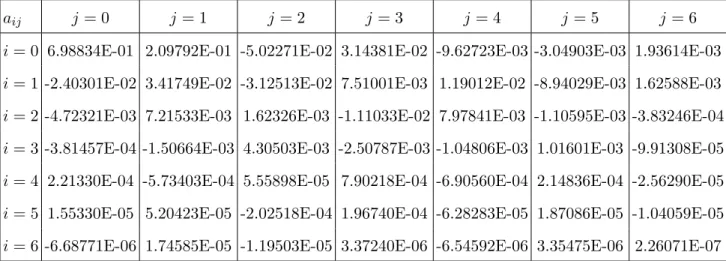
eV. The coefficients aij are provided in Table I. This adjustment provides a mean absolute error of 2.2 × 10⁻⁴ on the data represented in Fig. 4, with a maximal absolute error of 5.9 × 10⁻³. This adjustment is represented with the original data in Fig. 4.
IV. CONCLUSION
A transfer-matrix technique was used for the quantum-mechanical simulation of electronic field emission from a flat metal. This study essentially aimed at testing the accuracy of the standard Fowler-Nordheim theory and at determining the correction factor to include in the Murphy-Good expression in order to match the exact quantum mechanical result. The results show that, for typical values of the field strength F and of the work function φ, and for an assumed Fermi energy of 10 eV, the standard Fowler-Nordheim theory actually over-estimates the current densities by a factor between 1.1 and 2.1. These deviations appear essentially for low work functions φ and for high electric fields F . They are responsible for the Fowler-Nordheim representation of the J − F data achieved from a flat metal to deviate from an expected straight line (to an extend that exceeds that expected from the standard
FN theory and without the implication of space charge effects). These deviations between the results provided by the standard Fowler-Nordheim theory and the quantum mechanical result are essentially due to the fact the standard FN theory relies on the simple JWKB approximation for evaluating the electronic transmission through the surface barrier of the metal. This approximation typically over-estimates this transmission by a factor between 1.0 and 3.5 for the conditions considered in this work.14 One can however account for these deviations by including an effective correction factor Peff in the electronic transmission as well as a corresponding correction factor λMGin the Murphy-Good expression.13 This work thus confirms the conclusions formulated by Forbes on the need to account for these prefactors in theories of field emission.13 We provided in particular an accurate determination of the correction factor λMG to include in the Murphy-Good expression. A polynomial adjustment that enables λMG to be calculated for practical but otherwise arbitrary values of F and
φ was given. This work hence clarifies the issue raised by the limits of the simple JWKB
approximation. The results of this article should improve the accuracy of J −F data analysis that are based on the standard FN theory.
Acknowledgments
This work was funded by the National Fund for Scientific Research (FNRS) of Belgium. It used resources of the Interuniversity Scientific Computing Facility located at the University of Namur, Belgium, which is supported by the F.R.S.-FNRS under convention No. 2.4617.07. The author is grateful to R.G. Forbes and F. Moreau for valuable suggestions and references regarding this work.
1 N.S. Xu and S.E. Huq, Mat. Sci. Eng. R 48, 47 (2005).
2 R.H. Fowler and L.W. Nordheim, Proc. R. Soc. London Ser. A 119, 173 (1928). 3 E.L. Murphy and R.H. Good, Phys. Rev. 102, 1464 (1956).
4 R.H. Good and E.W. M¨uller, Handbuch der Physik (S. Flugge, Springler Verlag, Berlin) 21,
176 (1956).
5 R.D. Young, Phys. Rev. 113, 110 (1959).
7 A. Modinos, Solid State Electron 45, 809 (2001). 8 R.G. Forbes, J. Vac. Sci. Technol. B 26, 788 (2008). 9 H. Jeffreys, Proc. London Math. Soc. 23, 428 (1925). 10 G. Wentzel, Z. Phys. 38, 518 (1926).
11 H.A. Kramers, Z. Phys. 33, 828 (1926). 12 L. Brillouin, Compt. Rend. 183, 24 (1926). 13 R.G. Forbes, J. Appl. Phys. 103, 114911 (2008).
14 A. Mayer, J. Phys.-Condens. Matter 22, 175007 (2010).
15 P.H. Cutler, J. He, N.M. Miskovsky, T.E. Sullivan, and B.L. Weiss, J. Vac. Sci. Technol. B 11,
387 (1992).
16 A. Mayer and J.-P. Vigneron, J. Vac. Sci. Technol. B 17, 506 (1999). 17 A. Mayer and Ph. Lambin, Nanotechnology 16, 2685 (2005).
18 A.B. Petrin, J. Exp. Theor. Phys. 109, 314 (2009).
19 A. Mayer, M.S. Chung, B.L. Weiss, N.M. Miskovsky, and P.H. Cutler, Phys. Rev. B 78, 205404
(2008).
20 A. Mayer and J.-P. Vigneron, Phys. Rev. B 56, 12599 (1997). 21 A. Mayer and J.-P. Vigneron, Phys. Rev. E 59, 4659 (1999). 22 A. Mayer and J.-P. Vigneron, Phys. Rev. E 60, 7533 (1999). 23 A. Mayer and J.-P. Vigneron, Phys. Rev. E 61, 5953 (2000).
24 L.D. Landau and E.M. Lifschitz, Quantum Mechanics (Pergamon, Oxford, 1958). 25 R.F. Burgess, H. Kroemer and J.M. Houston, Phys. Rev. 90, 515 (1953).
aij j = 0 j = 1 j = 2 j = 3 j = 4 j = 5 j = 6
i = 0 6.98834E-01 2.09792E-01 -5.02271E-02 3.14381E-02 -9.62723E-03 -3.04903E-03 1.93614E-03 i = 1 -2.40301E-02 3.41749E-02 -3.12513E-02 7.51001E-03 1.19012E-02 -8.94029E-03 1.62588E-03 i = 2 -4.72321E-03 7.21533E-03 1.62326E-03 -1.11033E-02 7.97841E-03 -1.10595E-03 -3.83246E-04 i = 3 -3.81457E-04 -1.50664E-03 4.30503E-03 -2.50787E-03 -1.04806E-03 1.01601E-03 -9.91308E-05 i = 4 2.21330E-04 -5.73403E-04 5.55898E-05 7.90218E-04 -6.90560E-04 2.14836E-04 -2.56290E-05 i = 5 1.55330E-05 5.20423E-05 -2.02518E-04 1.96740E-04 -6.28283E-05 1.87086E-05 -1.04059E-05 i = 6 -6.68771E-06 1.74585E-05 -1.19503E-05 3.37240E-06 -6.54592E-06 3.35475E-06 2.26071E-07
TABLE I: Coefficients aij of the polynomial adjustment λMG= JTM/JMG =P6i=0
P6
j=0aijXiYj for the prefactor λMGto use with the Murphy-Good (MG) expression in order to match the current densities JTM provided by the transfer-matrix technique. In this expression, X = F − 5 with F
the field strength in V/nm and Y = φ − 3.5 with φ the work function in eV. This expression is restricted to 1 V/nm ≤ F ≤ 10 V/nm, 1.5 eV ≤ φ ≤ 5 eV and F < 4π²0φ2
FIGURE CAPTIONS
FIG. 1. (Color online) Current density J obtained from a flat metal that is subject to an external field F . The results correspond to (i) a Schottky-Nordheim (SN) barrier (solid, as given by the standard Fowler-Nordheim equation) and (ii) a triangular barrier (dashed, as given by the elementary Fowler-Nordheim equation). The temperature-dependent version of these equations is used in order to account for the temperature T =300 K of the emitter. The dots indicate the results obtained using a transfer-matrix technique. The Fermi energy
EF is 10 eV and the work function φ is 4.5 eV.
FIG. 2. (Color online) Current density J obtained from a flat metal that is subject to an external field F and whose work function φ is 4.5 eV (solid), 3.5 eV (dashed), 2.5 eV (dot-dashed) and 1.5 eV (dotted). These curves correspond to the results provided by the temperature-dependent version of the standard Fowler-Nordheim equation. The dots indicate the results obtained using a transfer-matrix technique. The Fermi energy EF is 10 eV.
FIG. 3. (Color online) Fowler-Nordheim representation of the current density J obtained from a flat metal that is subject to an external field F and whose work function φ is 4.5 eV (solid), 3.5 eV (dashed), 2.5 eV (dot-dashed) and 1.5 eV (dotted). These curves correspond to the results provided by the temperature-dependent version of the standard Fowler-Nordheim equation. The dots indicate the results obtained using a transfer-matrix technique. The Fermi energy EF is 10 eV.
FIG. 4. (Color online) Prefactor λMG to use with the Murphy-Good (MG) expression in order to match the current densities JTM provided by the transfer-matrix technique for a flat metal that is subject to an external field F . The work function φ ranges between 1.5 eV and 5 eV (upwards, by increments of 0.25 eV). The Fermi energy EF is 10 eV. Solid lines stand for the original data and dashed lines for the adjustment provided in the text.