HAL Id: hal-00318403
https://hal.archives-ouvertes.fr/hal-00318403
Submitted on 6 Nov 2007
HAL is a multi-disciplinary open access
archive for the deposit and dissemination of
sci-entific research documents, whether they are
pub-lished or not. The documents may come from
teaching and research institutions in France or
abroad, or from public or private research centers.
L’archive ouverte pluridisciplinaire HAL, est
destinée au dépôt et à la diffusion de documents
scientifiques de niveau recherche, publiés ou non,
émanant des établissements d’enseignement et de
recherche français ou étrangers, des laboratoires
publics ou privés.
midnight plasma sheet
M. N. Nishino, M. Fujimoto, G. Ueno, K. Maezawa, T. Mukai, Y. Saito
To cite this version:
M. N. Nishino, M. Fujimoto, G. Ueno, K. Maezawa, T. Mukai, et al.. Geotail observations of
two-component protons in the midnight plasma sheet. Annales Geophysicae, European Geosciences Union,
2007, 25 (10), pp.2229-2245. �hal-00318403�
Ann. Geophys., 25, 2229–2245, 2007 www.ann-geophys.net/25/2229/2007/ © European Geosciences Union 2007
Annales
Geophysicae
Geotail observations of two-component protons in the midnight
plasma sheet
M. N. Nishino1,2, M. Fujimoto2, G. Ueno3, K. Maezawa2, T. Mukai4, and Y. Saito2
1School of Science, The University of Tokyo, Tokyo 113-0033, Japan 2ISAS/JAXA, Kanagawa 229-8510, Japan
3Institute of Statistical Mathematics, Tokyo 106-8569, Japan 4JAXA, Tokyo 100-8260, Japan
Received: 5 March 2007 – Revised: 3 September 2007 – Accepted: 18 October 2007 – Published: 6 November 2007
Abstract. Through the effort to obtain clues toward understanding of transport of cold plasma in the near-Earth magnetotail under northward IMF, we find that two-component protons are observed in the midnight plasma sheet (−10>XGSM>−30 RE, |YGSM|<10 RE) under
north-ward IMF by the Geotail spacecraft. Since the two-component protons are frequently observed on the duskside during northward IMF intervals but hardly on the dawnside, those found in the midnight plasma sheet are thought to come from the dusk flank. The cold proton component in the mid-night region occasionally has a parallel anisotropy, which re-sembles that in the tail flank on the duskside. The flows in the plasma sheet with two-component protons were quite stag-nant or slightly going dawnward, which supports the idea that the observed two-component protons in the midnight region are of duskside origin. Because the two-component protons in the midnight plasma sheet emerge under strongly northward IMF with the latitudinal angle larger than 45 de-grees, and because the lag from the strongly northward IMF to the emergence can be as short as a few hours, we suggest that prompt plasma transport from the dusk to midnight re-gion occurs under strongly northward IMF. We propose that the dawnward flows result from viscous interaction between the high-latitude portion of the plasma sheet and the lobe cell. Another candidate for plasma transport process from the dusk to the midnight region is turbulent flow due to vortical structures of the Kelvin-Helmholtz instability that developed around the dusk low-latitude boundary under strongly north-ward IMF. In addition, we also suggest that gradual cooling of hot protons under northward IMF is a global phenomenon in the near-Earth magnetotail.
Keywords. Magnetospheric physics (Magnetotail; Plasma convection; Plasma sheet)
Correspondence to: M. N. Nishino
1 Introduction
It is important to know signatures of the plasma sheet in the Earth’s magnetosphere, because the plasma sheet works as a plasma reservoir and plays important roles in magne-tospheric dynamics. It has been known that the plasma sheet in the near-Earth magnetosphere becomes cold and dense under northward IMF (e.g. Zwolakowska et al., 1992; Zwolakowska and Popielawska, 1992; Terasawa et al., 1997; Borovsky et al., 1998; Nishino et al., 2002; Wing et al., 2005). The cold plasma is thought to be of solar wind ori-gin and to come into the magnetosphere across the low-latitude boundary, because it is often found in both flanks (Terasawa et al., 1997). Continuous spatial distribution of the cold plasma from the dusk flank to deeper inside the plasma sheet also supports the idea that solar wind plasma intrudes into the plasma sheet (Fujimoto et al., 1998). While the cold plasma is frequently found in both flanks, we notice that the cold plasma is occasionally found in the midnight region as well. Zwolakowska et al. (1992) reported that the cold plasma is observed in the high-latitude portion of the midnight plasma sheet under northward IMF. Nishino et al. (2002) also pointed out that the cold plasma sheet emerges in the midnight region under northward IMF. A recent ob-servational study showed that the plasma sheet in the mid-night region becomes cold under strongly northward IMF, basing on the data remote-sensed from low altitude satellites (Øieroset et al., 2005). These studies implied that the cold plasma may come into the flank regions and then moves to-ward the midnight region under northto-ward IMF. Solar wind entry across the magnetopause as well as cold plasma trans-port in the magnetotail is under debate at present.
Inspection of the proton distribution function may be use-ful for obtaining information on the origin of the cold plasma found in the midnight region, because one of the features of the cold plasma sheet should be a dawn-dusk asymmetry found in the velocity distribution function of protons. It has
been known that protons on the duskside occasionally consist of two separate (cold and hot) components under northward IMF while those on the dawnside usually do of one compo-nent that is dominated by low-energy (cold) ions (Hasegawa et al., 2003; Wing et al., 2005). The two components on the duskside are thought to have different origins; the cold com-ponent is thought to come from solar wind, and the hot one is of magnetosphere origin. The cold proton component in the plasma sheet near the dusk low-latitude boundary occa-sionally has a temperature anisotropy (Traver et al., 1991), and the sense of the anisotropy depends on the locations; it has a parallel anisotropy in the tail flank and a perpendicular anisotropy on the dayside (Nishino et al., 2007).
In addition to the proton velocity distribution functions, time lag of response of the midnight plasma sheet to the northward IMF may bring us some information on plasma transport in the near-Earth plasma sheet as well as on plasma entry under northward IMF. Terasawa et al. (1997) proposed a diffusive transport from the solar wind into the plasma sheet under northward IMF, showing a time scale as long as 9 h. Wing et al. (2005, 2006) suggested the cold plasma sheet for-mation in the flanks by a lag of about 3 h, and discussed that the cold plasma sheet formation can be explained either by diffusive processes or high-latitude reconnection.
In this paper, we present that two-component protons are found in the midnight plasma sheet under strongly northward IMF, suggesting prompt plasma transport from dusk to mid-night region in the near-Earth magnetotail.
2 Instrumentation
We use moment data obtained every 12 s by the low en-ergy particle (Geotail/LEP) experiment (Mukai et al., 1994) and the magnetic field data obtained by the flux-gate mag-netometer (Geotail/MGF) (Kokubun et al., 1994). The ion energy-per-charge analyzer of LEP-EAi detects ions between 32 eV/q and 39 keV/q, which covers most of typical en-ergy range of plasma sheet ions. All of detected positively-charged ions are assumed to be protons. The moment cal-culations are performed onboard Geotail (see Mukai et al., 1994, for details). We also use data from 3-D ion distribution functions obtained by Geotail/LEP, although the data exist for limited intervals. From the 3-D distribution functions, we obtain plasma moment parameters of the cold and hot proton components separately, using a two-Maxwellian mix-ture model with a scheme developed by Ueno et al. (2001). Perpendicular and parallel temperatures of the cold (hot) pro-ton component are denoted as TC⊥ and TCk(TH⊥ and THk),
respectively. The estimation error of the ion bulk velocity is considered to be less than a few percent of the thermal veloc-ity; for example, an error bar for ions whose temperature is 200 eV is within several km/s.
Solar wind parameters observed by the Wind and ACE spacecraft are provided by the CDAWeb. We use the GSM coordinate system throughout the paper.
3 Case studies
3.1 16 May 2001 event
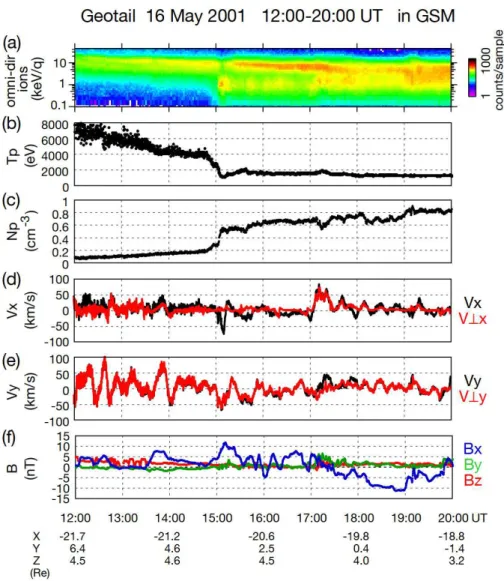
We perform a case study of two-component protons in the midnight plasma sheet on 16 May 2001. Figure 1 shows the Geotail data between 12:00–20:00 UT. From the top, (a) energy-time (E-t) spectrogram of protons (omni-directional summation of 2-D data) in keV/q, (b) proton temperature in eV, (c) proton density in cm−3, (d) V
X(black line) and V⊥X
(red line: velocity perpendicular to the local magnetic field) in km/s, (e) VY and V⊥Yin km/s, and (f) three components
of the magnetic field in nT are presented. The spacecraft locations in the GSM coordinate are shown at the bottom of the figure. Before 15:00 UT, Geotail stayed in the hot and tenuous plasma sheet whose temperature gradually de-creased from 7 keV to 4 keV between 12:00–14:50 UT. Be-tween 14:50–15:03 UT the low-energy proton flux (∼1 keV) gradually increased and the temperature of protons decreased to be 2.6 keV. Geotail encountered the two-component pro-tons around 15:03 UT as it relatively moved to high-latitude portion of the northern plasma sheet where the magnetic field was (7.0, 0.6, 0.7) nT. The location of Geotail around 15:03 UT was (−20.9, 3.5, 4.6) RE. The temperature
and density of the two-component protons obtained from onboard moment calculation were about 1.5–1.8 keV and 0.5–0.8 cm−3, respectively. The observation of the two-component protons ended around 19:00 UT when Geotail was (−19.3, −0.6, 3.7) RE, as the border between the two
components became ambiguous.
The two-component protons were superposition of the cold component with a peak (in count) around 1 keV and the hot component with a peak around several ∼10 keV, which resemble those observed on the duskside (Nishino et al., 2007). A dawnward-tailward flow (VX, VY∼−50 km/s)
was observed when the cold component emerged (15:02– 15:17 UT). After the emergence of the two-component pro-tons, dawnward-tailward flows were frequently observed (e.g. 15:27–15:51 UT). The average flow direction between 15:03–17:05 UT was (−10, −14, 7) km/s, which is opposite to the average flow pattern in the near-Earth plasma sheet (Hori et al., 2000). Note that VY was almost same as V⊥Y,
which means that the observed dawnward flows were cross field plasma transport. Before the emergence of the two-component protons and after 17:05 UT, the flow directions were consistent with the average pattern; that is, duskward flows were observed. Since the spacecraft was predomi-nantly in the Northern Hemisphere before 17:05 UT while it stayed in the Southern Hemisphere after that, the flow di-rections might depend on the hemisphere. The duskward
M. N. Nishino et al.: Two-component protons in the midnight plasma sheet 2231
Fig. 1. Geotail observation between 12:00–20:00 UT on 16 May 2001. From the top, (a) energy-time (E-t) spectrogram of protons
(omni-directional summation of 2-D data) in keV/q, (b) proton temperature in eV, (c) proton density in cm−3, (d, e) X and Y components of bulk velocity, and (f) three components of the magnetic field are shown. Bulk velocity is shown by black lines, and velocity perpendicular to the local magnetic field are shown by red lines. Locations of the spacecraft in the GSM coordinates are written at the bottom of the figure.
flowing plasma might be originated from the dusk low-latitude boundary, transported into the midnight region in the Northern Hemisphere, cross the central plasma sheet, and turn back toward the dusk in the Southern Hemisphere.
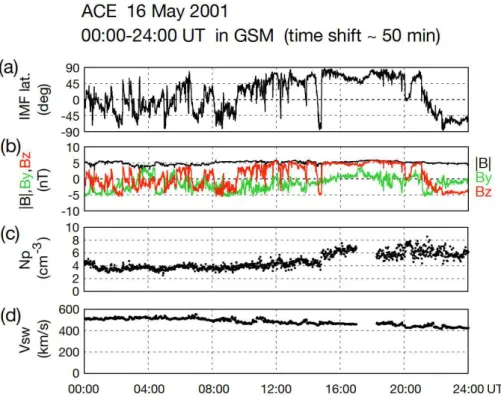
We next examine the solar wind conditions for the event. Figure 2 shows the solar wind parameters for the day ob-tained by the ACE spacecraft, including the solar-wind trav-eling time of 50 min from the ACE location (X∼229 RE) to
the Earth. From the top, (a) latitudinal angle of the IMF (θIMF) in degree, (b) strength and the Y and Z components
of the magnetic field in nT, (c) proton density in cm−3, and (d) bulk flow speed in km/s are shown. After an extended in-terval of predominantly southward IMF that lasted for more than 24 h, the IMF pointed northward around 09:32 UT (the convection time included). The IMF became strongly
north-ward (θIMF∼53◦) for roughly 3 h between 11:20–14:30 UT
with negative BY. After a brief southward IMF interval
between 14:33–14:49 UT, the IMF again directed strongly northward until 20:02 UT. There is a sudden increase in the proton density from 4 cm−3to 6 cm−3at 14:49 UT. The so-lar wind speed was gradually decreasing, and it was about 480 km/s around 15:00 UT when the two-component protons emerged (mentioned below). For simplicity, we fix the con-vection time to be 50 min in the analysis.
The time lag from the northward turning of the IMF (around 09:32 UT) to the emergence of the two-component protons (at 15:03 UT) is 5.5 h. We also mention that the time lag from the beginning of the strongly northward IMF (around 11:20 UT) to the emergence of the two-component protons was 3.7 h. The sudden increase in the solar wind
Fig. 2. ACE observation of the solar wind between 00:00–24:00 UT on 16 May 2001, including a time shift of 50 min from the ACE location
to the Earth’s magnetosphere. From the top, (a) latitudinal angle of the IMF (θIMF), (b) strength and Z component of the magnetic field, (c) proton density, and (d) bulk flow speed are shown.
density around 14:49 UT seems to coincide with the emer-gence of the two-component protons in the midnight plasma sheet. Compression of the magnetosphere by the increase in the solar wind dynamic pressure might change relative loca-tion of the Geotail spacecraft.
3.2 29 May 1999 event
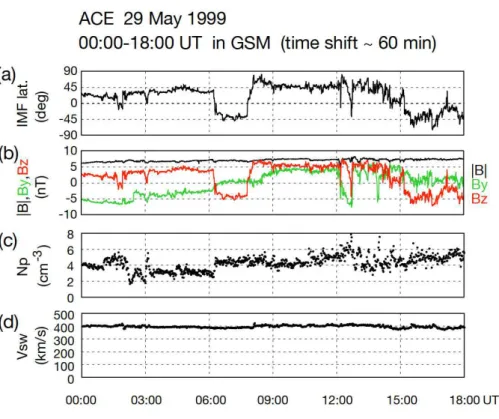
We next study another event of the two-component protons in the midnight plasma sheet observed by the Geotail space-craft on 29 May 1999. Figure 3 shows solar wind data from the ACE spacecraft (at X∼225 RE) between 00:00–
18:00 UT in the same format as Fig. 2, including the con-vection time of 60 min. The IMF pointed weakly northward from 22:42 UT of the previous day (data are not shown). After a southward IMF interval between 06:16–07:49 UT, the IMF pointed strongly northward (θIMF∼62◦) between
08:04–08:56 UT, and it kept the northward direction since then (θIMF∼46◦between 08:56–12:40 UT). The proton
den-sity and the speed of the solar wind when the two-component protons (around 08:53–12:18 UT, discussed below) were ob-served were roughly 4–5 cm−3and 410 km/s, respectively.
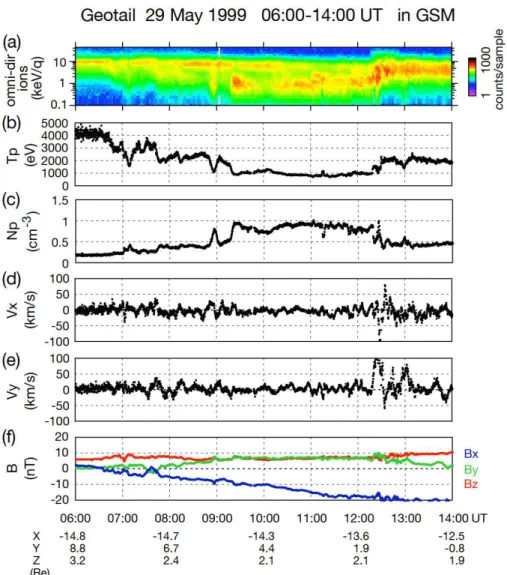
Figure 4 shows the Geotail data between 06:00–14:00 UT in the same format as Fig. 1. Before 06:40 UT Geotail was in the hot plasma sheet where the temperature and density of protons were 4 keV and 0.2 cm−3. Around 06:40 UT the ion
flux of medium energy range (around a few keV) increased, and proton temperature ranged from 2 to 3 keV. Around 08:53 UT the cold proton component with the peak energy around 1 keV was briefly observed, and proton temperature decreased to be 1.1 keV. Geotail was located at (−14.6, 5.8, 2.2) RE, staying in the southern plasma sheet where the
mag-netic field was about (−8.1, 6.0, 7.2) nT. The cold component disappeared within a few min, but it again emerged around 09:18 UT and was continuously observed for 3 h. In the plasma sheet with the two-component protons, plasma flows were quite stagnant (<40 km/s). The observation of the two-component protons ended at 12:18 UT when Geotail was at (−13.5, 1.4, 2.1) RE, in the middle of the strongly northward
IMF interval.
The time lag from the beginning of the strongly north-ward IMF (around 08:04 UT) to the emergence of the two-component protons (08:53 UT) was as short as 50 min. If we adopt the previous northward turning of the IMF (around 22:42 UT of the previous day), the time lag was as long as 10.2 h. Although the passage of the southward IMF between 06:16–07:49 UT possibly gave rise to enhance transport of cold plasma in the tail (Nagai et al., 1998), no fast flow was detected at the Geotail location in this event. No sud-den change in the solar wind flow was found when the two-component protons emerged.
M. N. Nishino et al.: Two-component protons in the midnight plasma sheet 2233
Fig. 3. ACE observation of the solar wind between 00:00–18:00 UT on 29 May 1999, with a time shift of 60 min, in the same format as
Fig. 2.
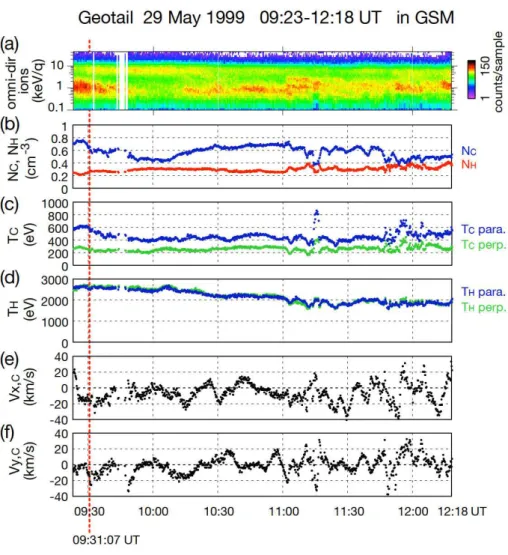
We further investigate the two-component protons, since we have 3-D count data for the interval after 09:23 UT. Fig-ure 5 expands the ion observations between 09:23–12:18 UT. From the top, (a) E-t spectrogram of omni-directional ions, (b) densities of the cold and hot components, (c) perpendicu-lar and parallel temperatures of the cold component, (d) tem-peratures of the hot component, (e, f) X and Y components of the velocity of the cold component are shown. The perpen-dicular (parallel) temperature is shown by the green (blue) points, the density of the cold (hot) component is shown by the blue (red) points. As for the two-component pro-tons, the density of the cold component (0.4–0.7 cm−3) dom-inated over that of the hot one (0.3 cm−3). The cold compo-nent went dawnward until 10:20 UT, while it went slightly duskward after 10:25 UT. After 11:00 UT bulk flows of the cold component were highly fluctuated.
We find that the cold proton component had a strong par-allel anisotropy. The ratio of the perpendicular to parpar-allel temperature of the cold component (TC⊥/TCk) was in the
range of 0.4–0.7. The perpendicular and parallel tempera-tures (TC⊥ and TCk) were 0.2–0.3 keV and 0.4–0.6 keV, and
those normalized by the kinetic energy of the solar wind pro-tons (ESW∼0.88 keV) were roughly 0.2–0.3 and 0.5–0.7,
re-spectively. The parallel temperature is higher than that in the dusk tail-flank cases (Nishino et al., 2007). The hot compo-nent was almost isotropic and its temperature gradually
de-creased from 2.6 keV to 1.8 keV. The decrease in the peak energy of the hot protons occurred during the extended north-ward IMF interval, as was seen in the previous event.
Figure 6 presents cuts of the ion PSD for the 12-s inter-val between 09:31:07–09:31:19 UT. The left panel (a) shows two-dimensional contour of the ion PSD in the plane that in-cludes the local magnetic field. The maximum speed shown in the panel is 1920 km/s, and the magnetic field was (−9.1, 7.2, 7.2) nT in the GSM coordinates and shown as a red bar in the figure. An elongation of the PSD contours along the magnetic field is seen in the low-energy portion of the PSD (red-yellow colored region), while contours of the medium-to high-energy part are hardly elongated (green-blue colored region). The right panel (b) shows 1-D cuts of the PSD in the perpendicular (green) and parallel (blue) directions. Two red curves correspond to the one-count level of the detector. We can clearly see dominance of the parallel temperature over the perpendicular one.
3.3 9 February 1995 event
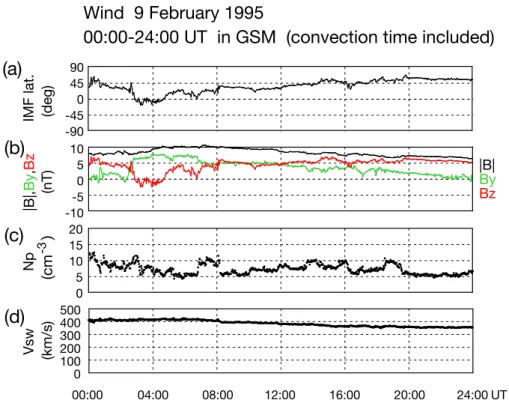
On 9 February 1995 an extended and strongly northward IMF occurred. Figure 7 shows solar wind data from the Wind spacecraft at X∼193–194 RE, in the same format as
Fig. 2. The plotted data includes the solar-wind convection time from the Wind location to the Earth’s magnetosphere. As the solar wind speed gradually decreased through the
Fig. 4. Geotail observation between 06:00–14:00 UT on 29 May 1999, in the same format as Fig. 1.
day from ∼410 km/s to ∼350 km/s, the convection time in-creased from 50 min to 58 min. The density of the solar wind protons was about 5–10 cm−3. After a southward IMF in-terval between 02:52–04:40 UT (convection time of 50 min included), the IMF pointed northward and kept the polarity until the end of the day. After 04:40 UT the IMF was weakly northward (θIMF∼30◦) until 12:00 UT, and it gradually
in-creased to be 40◦until 14:30 UT. Around 14:30 UT the IMF became strongly northward (θIMF>50◦), and the strongly
northward IMF continued until the end of the day except a brief interval of weakly northward IMF around 16:20 UT. The IMF BYwas positive throughout the northward interval
of our interest.
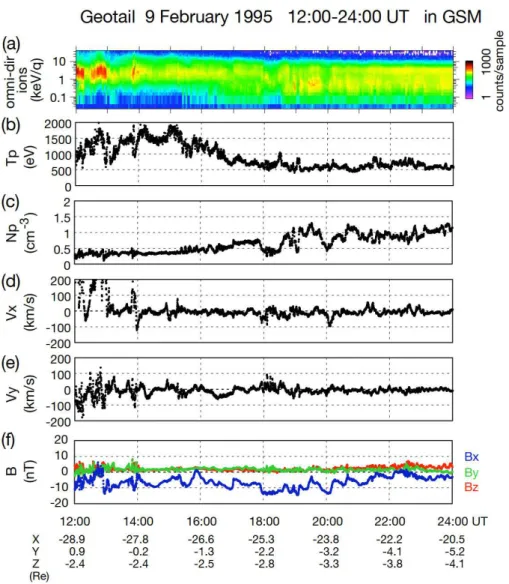
On the day Geotail was in the midnight region and served two-component protons. Figure 8 shows Geotail ob-servation for the latter half of the day (12:00–24:00 UT), in a similar format as Fig. 1 but the lowest energy shown
in the E-t spectrogram of protons is about 0.02 keV. The arrival of the southward IMF around 02:52 UT led to an isolated substorm that started at 04:32 UT (Nagai et al., 1997), and Geotail observed fast flows (>300 km/s) inter-mittently between 04:38–13:51 UT. Around 14:00 UT the fast flows ceased and the plasma sheet became quite stag-nant. Between 14:00–15:23 UT the temperature and density of protons in the plasma sheet were roughly 1.5 keV and 0.4 cm−3, respectively. Around 15:23 UT low-energy
pro-tons whose energy were 0.05–0.5 keV was observed for a brief interval, and such low-energy component was intermit-tently observed with dawnward flows (VY∼−30 km/s) until
16:40 UT. Around 16:44 UT the count of the low-energy pro-tons increased and two-component propro-tons began to be ob-served (Fig. 8a) when Geotail was located at (−26.1, −1.6,
−2.6) RE and moving relatively to the high-latitude
M. N. Nishino et al.: Two-component protons in the midnight plasma sheet 2235
Fig. 5. Expansion of the Geotail observations between 09:23–12:20 UT during which the two-component protons were observed and the 3-D
count data exist. From the top, (a) E-t spectrogram of omni-directional ions, (b) densities of the cold and hot components, (c) perpendicular and parallel temperatures of the cold component, (d) temperatures of the hot component, (e, f) X and Y components of the velocity of the cold component are shown. The perpendicular (parallel) temperature is plotted by the green (blue) points, and the density of the cold (hot) component is done by the blue (red) points.
two-component protons was accompanied by a dawnward flow (VY∼−40 km/s). The two-component protons were
ob-served until 00:20 UT of the following day except for short intervals. The temperature of protons from moment calcula-tions were 0.6–0.7 keV. The proton density was 0.7 cm−3for the initial period of the two-component proton observation between 16:44–17:52 UT, and it increased to be 1.1 cm−3 af-ter 18:30 UT.
We examine the emergence condition of the two-component protons in this event. The time lag from the northward turning of the IMF to the emergence of the two-component protons in the midnight plasma sheet was as long as 12 h. We note that the emergence (16:44 UT) occurred 2.2 h after the arrival of the strongly northward IMF (14:30 UT). The speed of the dawnward flow observed around the initial period of the two-component protons was
about 40 km/s, with which it takes about 70 min to transport plasma from the dusk flank to the Geotail location.
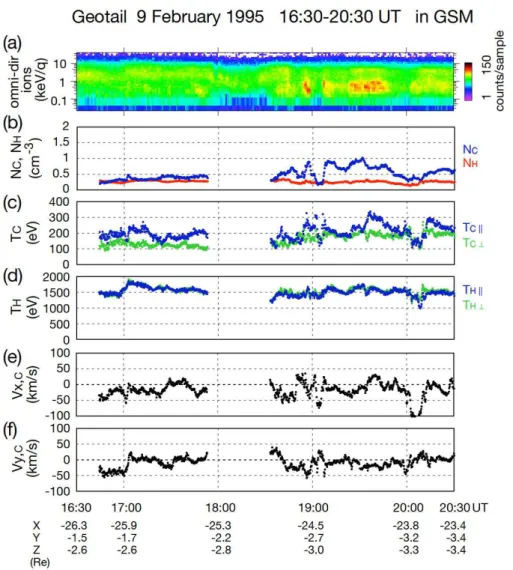
Since 3-D data of proton distribution function are available for this event (until 20:30 UT), we proceed to further analysis of the two-component protons, separating the cold and hot components by the two-Maxwellian mixture model (Ueno et al., 2001). Figure 9 expands the Geotail observation for the 4-h interval between 16:30–20:30 UT, in a similar format as Fig. 5 but the lowest energy of the protons presented in the E-t spectrogram is about 0.02 keV. We have calculated mo-ment parameters of the two components for the interval when two components are apparent in count (i.e. 16:44–17:52 UT and 18:31–20:30 UT). The density of the hot component was 0.2–0.3 cm−3 throughout the two-component interval, and that of the cold component increased from ∼0.4 cm−3 to
Ion PSD
log(PSD) log(PSD)29 May 1999 09:31:07-09:31:19 UT
-10 -17 Vmax=1920 km/s(a) 2D contour
(b) 1D cuts
-17 -16 -15 -14 -13 -12 -11 -10 -3000 -2000 -1000 0 1000 2000 3000 perp. parallel 1cnt V (km/s)
Fig. 6. Cuts of ion phase space density (PSD) for the 12-s interval between 09:31:07–09:31:19 UT on 29 May 1999. The left panel (a)
shows the contour of the PSD in the plane that includes the local magnetic field which is shown as a red bar in the figure. The right panel (b) presents one-dimensional cuts of the ion PSD. The green (blue) line shows the PSD in the direction perpendicular (parallel) to the magnetic field. Two red curves correspond to the one count level of the detector.
Wind 9 February 1995
00:00-24:00 UT in GSM (convection time included)
00:00 04:00 08:00 12:00 16:00 20:00 24:00 UT 0 100 200 300 400 500 IM F la t. (d eg ) N p V sw (k m /s ) (n T)
(a)
(b)
(c)
(d)
-90 -45 0 45 90 -10 -5 0 5 10 |B |, B y , B z 0 5 10 15 20 (cm -3 ) |B| By BzFig. 7. Wind observation of the solar wind between 00:00–24:00 UT on 9 February 1995, in the same format as Fig. 2. The time is shifted
from the Wind location to the Earth’s magnetosphere.
For the initial period of the two-component proton observation between 16:44–17:52 UT, the averaged
den-sities of the cold and hot components were 0.38 and 0.29 cm−3, respectively. The cold proton component had
M. N. Nishino et al.: Two-component protons in the midnight plasma sheet 2237
Fig. 8. Geotail observation between 12:00–24:00 UT on 9 February 1995, in the same format as Fig. 1.
a parallel anisotropy (TC⊥/TCk∼0.67), where TC⊥ and TCk
were 130 eV and 190 eV, and those normalized by ESW
(∼0.68 keV) were 0.19 and 0.28, respectively. After an ex-cursion to the high-latitude part of the southern plasma sheet between 17:45–18:30 UT, Geotail again approached the cen-tral plasma sheet and observed the two-component protons. The density of the cold component (∼0.7 cm−3) was higher than that observed during the previous stay. After 19:33 UT a strong parallel anisotropy of the cold component was again observed (TC⊥/TCk∼0.6). In contrast to the cold
compo-nent with a strong parallel anisotropy, the hot compocompo-nent was isotropic, and its temperature was about 1.5 keV throughout the intervals of our interest.
4 Superposed analysis
In order to further investigate the two-component protons in the midnight plasma sheet, we surveyed the Geotail E-t spec-trograms of protons by eyes between 1995–2003, and picked up the proton data with two peaks in count. The criteria for the midnight plasma sheet are as follows:
−10 > X > −30 RE |YGSM|<10 RE β >0.5
In this paper we concentrate on the events with two-component interval longer than 1 h. The condition for β (the ratio of proton thermal to magnetic pressure) is to exclude data of the plasma sheet boundary layer. We find 5 events
Fig. 9. Expansion of the Geotail observation between 16:30–20:30 UT, in the same format as Fig. 5.
that include 3 cases studied above, which are listed in Ta-ble 1.
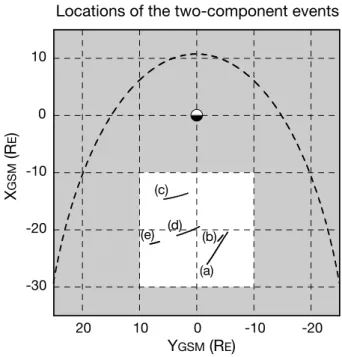
Figure 10 shows projection onto the GSM-XY plane of observed locations of the two-component proton events. The symbols in the figure (a, b, ..., e) correspond to events listed in Table 1. The dotted curve shows the averaged location of the magnetopause calculated with a model by Roelof and Sibeck (1993), and data in the gray-hatched region are out of survey in this paper.
4.1 Solar wind conditions
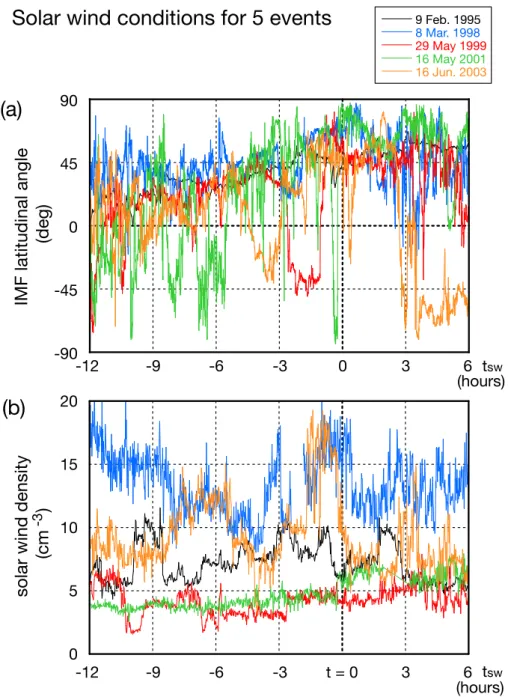
We superpose solar wind parameters of the 5 events in Fig. 11, where time series of the latitudinal angle of the IMF (a) and the proton density (b) are shown. The zero (tSW=0)
is set to the beginning of the two-component proton obser-vation in the midnight plasma sheet, and data for 18-h in-terval between tSW=−12 h and tSW=6 h are shown. All of
5 events occurred under the strongly northward IMF condi-tion (θIMF>45◦). The two-component protons began to be
observed within 3 h after the arrival of the strongly north-ward IMF. Although 2 events occurred during the extended northward IMF interval that lasted for more than 10 h, the two-component protons were not observed under prolonged but weakly northward IMF conditions. In one event (16 May 2001) a sudden increase in the solar wind density might lead to dawnward flows in the midnight region as well as rela-tive satellite motion, through transformation of the magne-tosphere by the sudden compression. However, the increase in the solar wind density is not the necessary condition for plasma transport from the dusk flank to the midnight region, because other 4 events were not accompanied by increases in the solar wind density. In another event (16 June 2003) a sudden decrease in density occurred just before the emer-gence of the two-component protons. The solar wind speed had a wide variation between 285 km/s and 520 km/s in the 5
M. N. Nishino et al.: Two-component protons in the midnight plasma sheet 2239
Table 1. Two-component proton events found in the midnight region. In the column of the anisotropy, “N/A” is the abbreviation for “not available”. As for hemispheres, S and N represents the Southern and Northern Hemispheres, respectively. The hemisphere where the two-component protons were initially observed is focused on.
Event Date UT Location (start) IMF BZ anisotropy (a) 9 Feb 1995 17:01–24:20 (−24.2, −2.9, −3.2) prolonged, strong N weakly parallel (b) 8 March 1998 17:10–18:55 (−21.8, −3.7, −1.3) prolonged, strong N isotropic (c) 29 May 1999 08:53–12:18 (−14.6, 5.8, 2.2) strong N strongly parallel (d) 16 May 2001 15:03–19:00 (−20.9, 3.5, 4.6) strong N N/A (e) 16 June 2003 06:16–08:40 (−22.4, 8.2, 1.3) strong N N/A
event IMF BY hemisphere etc.
(a) + S
(b) + S
(c) + S
(d) − N NSWincrease (e) + S NSWdecrease
events, while no sudden change in the speed occurred (data are not shown).
4.2 Signatures of the two-component protons
Figure 12 shows superposed plots of the time series of the plasma sheet parameters of the 5 events. From the top, (a) proton density, (b) proton temperature, (c) VX, (d) VY, (e)
latitudinal angle of the magnetic field, (f) BXare shown. The
zero of the horizontal axis (tPS) corresponds to the
begin-ning of the two-component proton observation at the Geo-tail location in each event, and data for 1-h interval between
tPS=−30 min and tPS=30 min are presented. Increase in
pro-ton density (Fig. 12a) and decrease in propro-ton temperature (Fig. 12b) around tPS=0 are due to emergence of the
two-component protons. 4.2.1 Plasma flows
The plasma flows in the cold plasma sheet were quite stag-nant and the averaged flow directions pointed dawnward. Es-pecially, emergence of the two-component protons were ac-companied by the dawnward flows (−20∼−70 km/s) in 4 events (event a, b, d, e). However, bulk flows were at times highly fluctuated and even went duskward.
4.2.2 Latitude
In 4 events (event a, c, d, e), emergence of the two-component protons was accompanied by decrease in the lat-itudinal angle of the local magnetic field (Fig. 12e), which means that the two-component protons began to be observed at the higher-latitude portion of the plasma sheet. In 1 event (event b), the two-component protons emerged without de-crease in the latitudinal angle of the local magnetic field.
-20 -10 0 10 20 -30 -20 -10 0 10 YGSM (RE) X GSM (R E ) (a) (b) (c) (d) (e)
Locations of the two-component events
Fig. 10. Observed locations of the two-component proton events
in the midnight plasma sheet. Projection onto the GSM-XY plane is shown. A dotted curve in the figure shows the averaged location of the magnetopause calculated with a model by Roelof and Sibeck (1993).
4.2.3 Anisotropies
In 3 events we have 3-D distribution function with which we examine temperature anisotropies of the cold and hot com-ponents. In 2 of the 3 events (event a, c) the cold component
-12 -9 -6 -3 t = 0 3 6 (hours) -12 -9 -6 -3 0 3 6 tsw tsw (hours) 9 Feb. 1995 8 Mar. 1998 29 May 1999 16 May 2001 16 Jun. 2003
(a)
(b)
-90 -45 0 45 90 0 5 10 15 20(deg)
IMF latitudinal angle
solar wind density
Solar wind conditions for 5 events
(cm
-3
)
Fig. 11. Superposed plots of the solar wind parameters for the 5 events. The upper panel (a) shows the latitudinal angle of the IMF, and
the lower one (b) does the density of the solar wind protons. The zero of the horizontal axis (tSW) corresponds to the emergence of the two-component protons.
had a parallel anisotropy, and in 1 event (event b) it was isotropic. The hot component was almost isotropic in all of the 3 events. These features resemble those observed in the tail-flank plasma sheet near the dusk low-latitude bound-ary, where the cold component of the two-component pro-tons at times has a parallel anisotropy while the hot one is less anisotropic (Nishino et al., 2007).
4.2.4 Hot proton component
The hot component temperatures normalized by ESW were
2–3, which was lower than that of the dusk tail flank cases (3–4). In 3 events (event c, d, e), the peak energy of the hot proton component gradually decreased during prolonged northward IMF intervals, which is equivalent to decrease in the hot component temperatures. The observed gradual cool-ing of the midnight plasma sheet is consistent with the in-situ
M. N. Nishino et al.: Two-component protons in the midnight plasma sheet 2241 0 30 60 90 -20 -10 0 10 10 0 20 30 (min)
t
ps -30 -20 -10 20theta
Vy
Vx
(km/s)
(km/s)
Np
Tp (eV)
(deg)
(nT)
Bx
0 0.5 1 1.5 2 0 1000 2000 3000 4000 5000 -80 -40 0 40 80(c)
Plasma sheet parameters for 5 events
(d)
(a)
(b)
(e)
(f)
-80 -40 0 40 80 9 Feb. 1995 8 Mar. 1998 29 May 1999 16 May 2001 16 Jun. 2003(cm
-3)
Fig. 12. Superposed plots of the plasma sheet parameters for the 5 events. From the top, (a) proton density, (b) proton temperature, (c) VX,
(d) VY, (e) latitudinal angle of the magnetic field, (f) BXare shown. The zero of the horizontal axis (tPS) corresponds to the emergence of the two-component protons.
observations on the duskside (Øieroset et al., 2005) as well as remote-sensed observations from low altitude satellites in both flanks (Wing et al., 2006). In other 2 events (event a, b), gradual decrease in the hot proton component was not ob-served, where the hot component temperature was as low as 1.5 keV.
4.3 Hemisphere
When the two-component protons were observed, Geotail was located in the Southern Hemisphere (BX<0) for the
positive IMF BYcases, while it was in the Northern
Hemi-sphere (BX>0) for the negative IMF BYcase (Table 1).
lobe cell
Z
Y
lobe cell
central plasma sheet
GT
flow
(a) IMF By<0
Proposed scenario for dusk-to-midnight flow generation
under strongly northward IMF
lobe cell
lobe cell
central plasma sheet
GT
flow
(b) IMF By>0
two-component protons on the duskside GT : Geotail locationviewed from the tail lobe cell circulation
Fig. 13. A schematic view of the proposed scenario for generation of the dusk-to-midnight plasma flows in the high-latitude region of the
plasma sheet. Cuts of the magnetotail for (a) neagtive and (b) positive IMF BYcases are presented. The arrows with dotted curves show the lobe cell circulations whose sense depends on the IMF BY. The abbreviation “GT” shows the plausible spacecraft locations, and the black arrows correspond to the expected dusk-to-midnight (dawnward) flows. Twisting of the plasma sheet that depends on the IMF BY(Maezawa and Hori, 1998) is also represented in the figure.
dusk-to-midnight (dawnward) flows under strongly north-ward IMF. The direction of the lobe-cell circulation under northward IMF depends on the sign of the IMF BY(e.g. Reiff
and Burch, 1985), and panels (a) and (b) represent the neg-ative and positive BYcases, respectively. In all of 5 events,
the two-component protons were observed in the hemisphere where the circulation on the plasma sheet side of the lobe cell goes toward the dusk-to-midnight direction.
5 Discussion
We have reported that the two-component protons were ob-served in the midnight plasma sheet under northward IMF. Since the two-component protons are frequently observed on
the duskside but hardly on the dawnside, we suggest that the source of the two-component protons found in the midnight region is the duskside magnetopause. In 4 events, the start of the two-component proton observation was accompanied by dawnward flows (discussed later), which also supports the idea that the two-component protons move from the dusk flank to the midnight region. However, bulk plasma flows were highly fluctuated and at times went duskward.
We compare anisotropies of the two-component protons in the midnight plasma sheet with those in the dusk flank plasma sheet. Nishino et al. (2007) analyzed the two-component protons in the dusk plasma sheet near the low-latitude boundary and found that the cold proton component has a parallel anisotropy (TC⊥/TCk<1) in the tail flank region
M. N. Nishino et al.: Two-component protons in the midnight plasma sheet 2243 dayside. In the present study we have found that the cold
proton component in the midnight region possesses at times a parallel anisotropy. The sense of the anisotropy of the cold proton component in the midnight region is same as that of tail flank plasma sheet in the dusk low-latitude boundary, and it is different from that on the dayside. The isotropic distri-bution function of the hot proton component in the midnight region also resembles that in the dusk tail flank. We therefore conclude that the origin of the two-component protons in the midnight region is the dusk tail-flank plasma sheet.
Let us compare the cold proton component in the midnight region with that in the dusk tail-flank region. In the event on 29 May 1999, normalized parallel temperature of the cold component (TCk/ESW∼0.5–0.7) was higher than that in the
dusk tail-flank region (0.2–0.4) obtained in a statistical study by Nishino et al. (2007). We therefore suggest that some heating process may work on the cold component on the way from the dusk flank to the midnight region, while we could not conclude it because we do not have data of the plasma sheet near the dusk low-latitude boundary on the day and cannot directly compare the dusk and midnight regions.
On the other hand, normalized temperatures of the hot pro-ton component in the midnight region (TH/ESW∼2–3) are,
statistically, lower than those in the dusk flank plasma sheet (3–4 (Nishino et al., 2007)). The difference between the hot component temperature in the midnight and that in the dusk flank may be partly due to spatial gradient of the tempera-ture (Wing et al., 2005), and partly due to gradual cooling of the plasma sheet during prolonged northward IMF intervals. In 3 events, gradual decrease in the peak energy of the hot proton component was observed. Since gradual cooling of the plasma sheet occurs in the flanks (Wing et al., 2006) as well as on the duskside (Øieroset et al., 2005) under north-ward IMF, our observations in the midnight region suggest that cooling of the hot plasma sheet under northward IMF is a global phenomenon in the near-Earth magnetotail. Addi-tionally, results of previous studies of the plasma sheet using the moment parameters (e.g. Baumjohann, 1993; Terasawa et al., 1997) do not necessarily mean solar wind entry thereto but might show cooling of the plasma sheet.
In other 2 events, gradual cooling was not observed for the intervals of our interest. These two events occurred un-der extended (>10 h) northward IMF, and there the hot com-ponent temperature was as low as 1.5 keV from the begin-ning of the two-component proton observation. The fact that the hot component temperature was nearly constant and rel-atively low may suggest existence of a lower limit of the hot component temperature, as was also implied by Wing et al. (2006). Terasawa et al. (1997) showed that response time of the plasma sheet to the solar wind parameters during north-ward IMF is as long as 9 h, suggesting a diffusion-like trans-port from the flanks to the midnight region. However, the long time lag presented by their study might correspond to time scale of the plasma sheet cooling.
Let us consider the emergence condition of the two-component protons in the midnight region. In all of the 5 events the observation of the two-component protons started within 3 h after the strongly northward IMF arrived at the Earth’s magnetosphere. Two events occurred with-out extended northward interval; the two-component protons emerged 3–6 h after the northward turning of the IMF. Al-though two events in our study were observed during very ex-tended northward IMF intervals (>10 h), the two-component protons were not observed during weakly northward IMF but found after the strongly northward IMF passed by the magnetosphere. We conclude that the condition for the two-component proton emergence in the midnight region is strongly northward IMF (θIMF>45◦) which continues for a
few h. The relatively short time scale is sufficient for the plasma transport from the dusk flank to the midnight region, because it takes about 1–2 h with the observed dawnward flows (−20∼−70 km/s).
We discuss the relation between previous observations un-der strongly northward IMF and what we have found in the present study. Studying the dusk low-latitude boundary un-der strongly northward IMF, Fairfield et al. (2000) mentioned that wavy structures observed in the dusk tail flank were at-tributed to the Kelvin-Helmholtz (KH) instability which can play an important role in plasma transport across the topause as well as in mixing of the solar wind and the magne-tospheric plasma. In addition, Nishino et al. (2007) discussed that the parallel anisotropy of the cold proton component on the duskside might be explained by magnetic reconnection in the KH vortices. Although apparent vortical structures by the KH instability exist only in the region within a few REfrom
the magnetopause (Hasegawa et al., 2006), highly fluctuated bulk plasma flows might transport the cold plasma from the dusk flank to the midnight region.
Another mechanism that is believed to occur under strongly northward IMF is double high-latitude reconnec-tion on the dayside (e.g. Song and Russell, 1992; Li et al., 2005; Øieroset et al., 2005). According to the double-lobe reconnection model, the solar wind flux trapped onto the dayside magnetosphere goes down to the tail region, and the cold plasma sheet can form in the midnight region as well. However, the cold proton component on the dayside has a perpendicular anisotropy (Nishino et al., 2007), which disagrees with the parallel anisotropy observed in the mid-night region. Therefore, double high-latitude reconnection, although it may actually take place (Onsager et al., 2001; Lavraud et al., 2005, 2006), does not seem to directly con-tribute to refilling of the midnight plasma sheet.
The observed locations of the two-component protons can be a clue to understand transport paths. In 4 events the cold component started to be observed at the high-latitude portion of the plasma sheet. This feature is consistent with previous observations of the cold plasma in the near-Earth magnetotail under northward IMF; Zwolakowska et al. (1992) showed that the cold plasma is observed in the high-latitude portion
of the near-Earth magnetotail, and Phan et al. (1998) showed that the cold plasma in the flank plasma sheet starts to be observed in the high-latitude regions. Keeping in mind these previous observations, we suggest that the two-component protons move in the high-latitude portion of the plasma sheet from the dusk flank to the midnight region.
Finally, we consider generation mechanism of the dusk-to-midnight plasma flows under strongly northward IMF. We have found that the two-component protons were observed in the hemisphere where the circulation on the plasma sheet side of the lobe cell goes toward the dusk-to-midnight direc-tion (Fig. 13). We propose that viscous interacdirec-tion between the high-latitude portion of the plasma sheet and the lobe cell generates the dusk-to-midnight flows in one hemisphere. The other hemisphere was not observed by Geotail for all events in the present study, which is possibly due to plasma sheet twisting whose sense depends on the sign of the IMF BY
(Maezawa and Hori, 1998). In future works, multi spacecraft observations as well as ground observations will help us un-derstand plasma transport paths in the near-Earth magnetotail under strongly northward IMF.
6 Conclusions
We have found that two-component protons are observed in the midnight plasma sheet under strongly northward IMF (θIMF>45◦). The cold proton component with a parallel
anisotropy and the isotropic hot component in the midnight region show that the source of the two-component protons is the dusk tail flank. We suggest that prompt transport of the two-component protons from the dusk flank to the mid-night region occurs under strongly northward IMF. We pro-pose that the dusk-to-midnight (dawnward) flows result from viscous interaction between the high-latitude portion of the plasma sheet and the lobe cell. Another candidate for plasma supply into the midnight region is vortical structures due to the KH instability that may highly develop around the dusk low-latitude boundary under strongly northward IMF. Pro-longed northward IMF intervals result in gradual cooling of the hot proton component in the plasma sheet, and the cool-ing may be a global phenomenon in the near-Earth magneto-tail.
Acknowledgements. We thank T. Nagai for providing the
mag-netic field data from the MGF instrument on board Geotail space-craft. We also thank the principal investigators of ACE MAG and SWEPAM experiments and Wind MFI and SWE instruments for providing the solar wind data via CDAWeb. We are grateful to T. Terasawa for providing tools for visualization of Geotail parti-cle data. M. N. Nishino thanks M. Hoshino for fruitful discussion.
Topical Editor I. A. Daglis thanks Y. Ebihara and another anony-mous referee for their help in evaluating this paper.
References
Baumjohann, W.: The near-Earth plasma sheet: An AMPTE/IRM perspective, Space Sci. Rev., 64, 141–163, doi:10.1007/BF00819660, 1993.
Borovsky, J. E., Thomsen, M. F., and Elphic, R. C.: The driving of the plasma sheet by the solar wind, J. Geophys. Res., 103(A8), 17 617–17 639, 1998.
Fairfield, D. H., Otto, A., Mukai, T., Kokubun, S., Lepping, R. P., Steinberg, J. T., Lazarus, A. J., and Yamamoto, T.: Geotail ob-servations of the Kelvin-Helmholtz instability at the equatorial magnetotail boundary for parallel northward fields, J. Geophys. Res., 105(A9), 21 159–21 174, 10.1029/1999JA000316, 2000. Fujimoto, M., Terasawa, T., Mukai, T., Saito, Y., Yamamoto, T.,
and Kokubun, S.: Plasma entry from the flanks of the near-Earth magnetotail: Geotail observations, J. Geophys. Res., 103, 4391– 4408, 1998.
Hasegawa H., Fujimoto, M., Maezawa, K., Saito, Y., and Mukai, T.: Geotail observations of the dayside outer boundary region: Interplanetary magnetic field control and dawn-dusk asymmetry, J. Geophys. Res., 108(A4), 1163, doi:10.1029/2002JA009667, 2003.
Hasegawa, H., Fujimoto, M., Takagi, K., Saito, Y., Mukai, T., and R`eme, H.: Single-spacecraft detection of rolled-up Kelvin-Helmholtz vortices at the flank magnetopause, J. Geophys. Res., 111, A09203, doi:10.1029/2006JA011728, 2006.
Hori, T., Maezawa, K., Saito, Y., and Mukai, T.: Average profile of ion flow and convection electric field in the near-Earth plasma sheet, Geophys. Res. Lett., 27, 1623–1626, 2000.
Kokubun, S., Yamamoto, T., Acu˜na, M. H., Hayashi, K., Shiokawa, K., and Kawano, H.: The GEOTAIL magnetic field experiment, J. Geomag. Geoelectr., 46, 7–21, 1994.
Lavraud, B., Thomsen, M. F., Taylor, M. G. G. T., Wang, Y. L., Phan, T. D., Schwartz, S. J., Elphic, R. C., Fazakerley, A., R`eme, H., and Balogh, A.: Characteristics of the magnetosheath elec-tron boundary layer under northward interplanetary magnetic field: Implications for high-latitude reconnection, J. Geophys. Res., 110, A06209, doi:10.1029/2004JA010808, 2005.
Lavraud, B., Thomsen, M. F., Lefebvre, B., Schwartz, S. J., Seki, K., Phan, T. D., Wang, Y. L., Fazakerley, A., R`eme, H., and Balogh, A.: Evidence for newly closed magnetosheath field lines at the dayside magnetopause under northward IMF, J. Geophys. Res., 111, A05211, doi:10.1029/2005JA011266, 2006.
Li, W., Raeder, J., Dorelli, J., Øieroset, M., and Phan, T. D.: Plasma sheet formation during long period of northward IMF, Geophys. Res. Lett., 32, L12S08, doi:10.1029/2004GL021524, 2005. Maezawa, K. and Hori, T.: The distant magnetotail: Its structure,
IMF dependence, and thermal properties, New Perspectives on the Earth’s Magnetotail, Geophys. Monogr. Vol. 105, edited by: Nishida, A., Baker, D. N., and Cowley, S. W. H., pp. 1–19, Amer-ican Geophysical Union, Washington, D.C., 1998.
Mukai, T., Machida, S., Saito, Y., Hirahara, H., Terasawa, T., Kaya, N., Obara, T., Ejiri, M., and Nishida, A.: The Low Energy Par-ticle (LEP) experiment onboard the GEOTAIL satellite, J. Geo-mag. Geoelectr., 46, 669–692, 1994.
Nagai, T., Mukai, T., Yamamoto, T., Nishida, A., Kokubun, S., and Lepping, R. P.: Plasma sheet pressure changes during the sub-storm growth phase, Geophys. Res. Lett., 24, 963–966, 1997. Nagai, T., Nakamura, R., Kokubun, S., Saito, Y., Yamamoto, T.,
M. N. Nishino et al.: Two-component protons in the midnight plasma sheet 2245
during substorms, Geophys. Monogr., 104, 213–226, 1998. Nishino, M. N., Terasawa, T., and Hoshino, M.: Increase of the
tail plasma content during the northward interplanetary magnetic field intervals: Case studies, J. Geophys. Res., 107(A9), 1261, doi:10.1029/2002JA009268, 2002.
Nishino, M. N., Fujimoto, M., Terasawa, T., Ueno, G., Maezawa, K., Mukai, T., and Saito, Y.: Geotail observations of tempera-ture anisotropy of the two-component protons in the dusk plasma sheet, Ann. Geophys., 25, 769–777, 2007,
http://www.ann-geophys.net/25/769/2007/.
Øieroset, M., Raeder, J., Phan, T. D., Wing, S., McFadden, J. P., Li, W., Fujimoto, M., R`eme, H., and Balogh, A.: Global cooling and densification of the plasma sheet during an extended period of purely northward IMF on October 22–24, 2003, Geophys. Res. Lett., L12S07, doi:10.1029/2004GL021523, 2005.
Onsager, T. G., Scudder, J. D., Lockwood, M., and Russell, C. T.: Reconnection at the high-latitude magnetopause during north-ward interplanetary magnetic field conditions, J. Geophys. Res., 106(A11), 25 467–25 488, 10.1029/2000JA000444, 2001. Phan, T. D., Paschmann, G., Raj, A., Angelopoulos, V., Larson,
D., and Lin, R. P.: Wind observations of the halo/cold plasma sheet, in Astrophysics and Space Science library, Substorms-4, vol. 238, edited by: Kokibun, S. and Kamide, Y., pp. 219–222, Terra Scientific/Kluwer Academic, Boston, 1998.
Roelof, E. D. and Sibeck, D. G.: Magnetopause shape as a bivari-ate function of interplanetary magnetic field Bz and solar wind dynamic pressure, J. Geophys. Res., 98, 21 421–21 450, 1993. Reiff, P. H. and Burch, J. L.: IMF By-dependent plasma flow and
Birkeland currents in the dayside magnetosphere: 2. A global model for northward and southward IMF, J. Geophys. Res., 90(A2), 1595–1609, 1985.
Song, P. and Russell, C. T.: Model of the formation of the low-latitude boundary layer for strongly northward interplanetary magnetic field, J. Geophys. Res., 97(A2), 1411–1420, 1992. Terasawa, T., Fujimoto, M., Mukai, T., Shinohara, I., Saito, Y.,
Ya-mamoto, T., Machida, S., Kokubun, S., Lazarus, A. J., Steinberg, J. T., and Lepping, R. P.: Solar wind control of density and tem-perature in the near-Earth plasma sheet: Wind/Geotail collabora-tion, Geophys. Res. Lett., 24, 935–938, 1997.
Traver, D. P., Mitchell, D. G., Williams, D. J., Frank, L. A., and Huang, C. Y.: Two encounters with the flank low-latitude bound-ary layer: Further evidence for closed field topology and in-vestigation of the internal structure, J. Geophys. Res., 96(A12), 21 025–21 035, 1991.
Ueno, G, Nakamura, N., Higuchi, T., Tsuchiya, T., Machida, S., Araki, T., Saito, Y., and Mukai, T.: Application of multivariate Maxwellian mixture model to plasma velocity distribution func-tion, J. Geophys. Res., 106(A11), 25 655–25 672, 2001. Wing, S., Johnson, J. R., Newell, P. T., and Meng, C.-I.:
Dawn-dusk asymmetries, ion spectra, and sources in the northward in-terplanetary magnetic field plasma sheet, J. Geophys. Res., 110, A08205, doi:10.1029/2005JA011086, 2005.
Wing, S., Johnson, J. R., and Fujimoto, M.: Timescale for the for-mation of the cold-dense plasma sheet: A case study, Geophys. Res. Lett., 33, L23106, doi:10.1029/2006GL027110, 2006. Zwolakowska, D., Koperski, P., and Popielawska, B.: Plasma
popu-lations in the tail during northward IMF, Proceedings of the inter-national conference on substorms (ICS-1), ESA SP-335, 57–62, 1992.
Zwolakowska, D. and Popielawska, B.: Tail plasma domains and the auroral oval: results of mapping based on the Tsyganenko 1989 magnetosphere model, J. Geomag. Geoelectr., 44, 1145– 1158, 1992.