HAL Id: insu-02612331
https://hal-insu.archives-ouvertes.fr/insu-02612331
Submitted on 19 May 2020
HAL is a multi-disciplinary open access
archive for the deposit and dissemination of
sci-entific research documents, whether they are
pub-lished or not. The documents may come from
teaching and research institutions in France or
abroad, or from public or private research centers.
L’archive ouverte pluridisciplinaire HAL, est
destinée au dépôt et à la diffusion de documents
scientifiques de niveau recherche, publiés ou non,
émanant des établissements d’enseignement et de
recherche français ou étrangers, des laboratoires
publics ou privés.
Heating of protons by resonant absorption in a
multicomponent plasma: 2. Theoretical model
Dominique Le Quéau, Alain Roux, Jean-Louis Rauch, François Lefeuvre,
Jean-Michel Bosqued
To cite this version:
Dominique Le Quéau, Alain Roux, Jean-Louis Rauch, François Lefeuvre, Jean-Michel Bosqued.
Heat-ing of protons by resonant absorption in a multicomponent plasma: 2. Theoretical model. Journal of
Geophysical Research Space Physics, American Geophysical Union/Wiley, 1993, 98 (A8),
pp.13363-13375. �10.1029/91JA02186�. �insu-02612331�
JOURNAL OF GEOPHYSICAL RESEARCH, VOL. 98, NO. A8, PAGES 13,363-13,375, AUGUST 1, 1993
Heating of Protons by Resonant Absorption in a Multicomponent Plasma
2.
Theoretical
Model
DOMINIQUE LE QUI•AU, 1 ALAIN ROUX, 2 JEAN LOUIS RAUCH,
3 FRANCOIS
LEFEUVRE,
3
AND JEAN MICHEL BOSQUED 4A theory is proposed to explain the selective heating of protons in a direction transverse to the geomagnetic field lines, which has been observed on board the AUREOL 3 satellite, as shown in a companion paper. This process, which occurs only in multicomponent plasma, ultimately leads to the formation of a conical distribution, inside and above the heating region. It is shown that magnetosonic Alfv6n waves generated at higher altitudes can undergo a resonant mode conversion process as they propagate downward. The efficiency of the subsequent resonant absorption depends rather strongly on the propagation angle of the waves and on the relative abundance of H + ions: up to 25% of the incident energy flux can be transferred to protons. The present theory moreover foresees that a strong parallel electric field component has to occur at the altitude at which the wave frequency matches the proton gyrofrequency. The corresponding spectral signature has been unambiguously identified in the AUREOL 3 data, together with an intensification of the upward flux of suprathermal protons, which indicates the presence of proton conics. We have verified that within the uncertainties of the measurements the energy balance between the incoming electromagnetic power and the outgoing flux of kinetic energy is well explained by the theory.
1. INTRODUCTION
Since the first observations of ion "conics" by Sharp et al. [1977], much work has been done on this phenomenon, both observationally (see review by Klurnpar [1986] or Burch [ 1988] and references therein) and theoretically. This interest is related to the fact that this process leads to the extraction
of a large number of ions from the ionosphere. It is therefore an efficient way of supplying suprathermal ions into the
magnetosphere.
It is widely admitted that the observed conical shape of the
ion distribution function results from a two-stage process
involving (1) an acceleration transverse to the magnetic field
and (2) an upward motion along the geomagnetic field lines,
under the effect of the mirror force. This second stage is easy to understand; the conservation of the first adiabatic invari-
ant leads to a decrease of the semiapical angle of the conic as the ion moves upward from the acceleration region. The
acceleration stage, however, still remains a challenging question. Many different heating or acceleration mecha-
nisms have already been invoked. More than one could play
a role in the formation of conics, taking into account the variety of waves generated in different magnetospheric re- gions.
Ungstrup et al. [1979] first suggested that electrostatic ion cyclotron waves (EICWs), driven unstable by a field-aligned current, accelerate the ions in a direction transverse to the magnetic field. This idea was further investigated, in partic-
lEntit6 Centre
National
de la Recherche
Scientifique
du Centre
de Recherche en Physique de l'Environnement, Vdlizy, France.2Centre
de Recherche
en Physique
de l'Environnement,
Centre
National d'Etude des Tdldcommunications, Centre National de la
Recherche Scientifique, issy_les_Moulineaux, France.
3Laboratoire de Physique et Chimie de l'Environnement, Centre National de la Recherche Scientifique, Orldans, France.
4Centre
d'Etude
Spatial
des Rayonnements,
Centre
National
de
la Recherche Scientifique, Toulouse, France.Copyright 1993 by the American Geophysical Union. Paper number 91JA02186.
0148-0227/93/91JA-02186505.00
ular by Dusenbery and Lyons [1981] and by Ashour-Abdalla and Okuda [1984]. Chang and Coppi [1981] advocated that
lower hybrid waves, destabilized by beams of precipitating
auroral electrons, locally heat the ions. Crew and Chang
[1985] have analytically determined the shape of the distri-
bution function which would result from the resonant inter-
action between ions and lower hybrid waves, and Retterer et al. [1986] have numerically proven the efficiency of the overall process.
Although both EICWs and lower hybrid waves have been
observed in various magnetospheric regions [Kintner et al., 1978; Mozer et al., 1979], these interpretations are at vari-
ance with some observations that do not establish a clear
correspondence between such electrostatic waves and the occurrence of conics. This is the case of O + conics mea- sured in the central plasma sheet on board the high-altitude polar-orbiting satellite DE 1 [Klumpar, 1986; Winningham and Burch, 1984]. What is generally observed, instead, is an intense flux of broadband ULF electromagnetic waves prop- agating downward through the magnetic flux tubes where conics are produced [Gurnett et al., 1984]. This led to the idea that the perpendicular heating of ions that leads to the formation of conics might be due to the gyroresonant inter-
action of minor ions (e.g., O +, at high altitudes)
with these
electromagnetic waves [Chang et al., 1986; Crew and Chang, 1988]. These authors have introduced the concept of
ion cyclotron resonance heated conics (ICRHC) to explain
the main features of the distribution function of the supra-
thermal O + observed
by DE 1 [Crew et al., 1990]. In the
ICRHC framework, as in other heating mechanisms, the ion motion essentially follows, to the lowest order, the adiabatic approximation. The perpendicular acceleration undergone by the ions at each altitude does not need to be very large, provided that the overall process is cumulative such that the energy of the conics will increase with altitude. Since the ions can interact gyroresonantly with the observed broad-
band ULF waves over a large fraction of the geomagnetic
field line, the acceleration can indeed be cumulative [Chang et al., 1986; Retterer et al., 1987; Crew et al., 1990].
For this process to be efficient, the spectral power of the
13,364 LE QUIgAU ET AL.: FORMATION OF H + CONICS BY RESONANT ABSORPTION, 2
waves must be sufficiently large at frequencies close to the local gyrofrequency of the heated ions. Moreover, the waves must have a significant left-handed component in this fre- quency range, such that the resonant wave-particle interac- tion can occur. Yet Alfv6n waves are not expected to have a left-handed polarized component at the ion gyrofrequencies [Stix, 1962; Smith and Brice, 1964]. One possibility is to assume that the resonant process occurs at a frequency w =
f/o + q- k llvll,
for O + heating.
If the Doppler
shift
is large
enough, the ions can resonantly interact with left-handed (LH) polarized waves both below and above their gyrofre- quency [Chang et al., 1986]. This, however, would imply some kind of preheating (or preaccelerating) process in order to produce the required Doppler shift. The possibility that the acceleration process is linked to nonlinear double- cyclotron absorption has also been advocated [Temerin and Roth, 1986; Ball, 1989].
For obliquely propagating Alfv6n waves and in the pres- ence of magnetic field gradients, the mode conversion of downgoing right-handed (RH) Alfv6n waves into upgoing LH ion cyclotron waves (ICWs) is also possible, as pointed out by Retterer et al. [1987] and by Johnson et al. [1988,
1989], in the case of O + conics.
When the inhomogeneous
magnetospheric plasma contains two ionic species, new
cutoff
<llkll
-- 0> or reflection
points
(kll - 0) can occur,
which allow upgoing ICWs to be produced from the down- going Alfv6n waves. The latter waves undergo a resonance
(kll --> oo) at the local ion gyrofrequencies
and thus can
transversally heat ions, even if they are initially cold. This gives rise to the so-called resonant absorption process [Gin- zburg, 1970]; the efficiency of this heating process can beestimated from the energy deficit of the transmission/
reflection budget [Budden, 1966]. Even if a fluidlike cold plasma model is chosen to describe the plasma, which thus does not explicitly exhibit the kinetic cyclotron absorption process, the resonant absorption can be taken into account if one handles correctly, with respect to all causality require- ments, the singularities of the differential equation describ- ing the full wave propagation [Ginzburg, 1970]. The mathe- matical method we have used here is based on a Laplace
integral solution of the full wave propagation equation, which is approximated near the gyrofrequency layer at
which the wave frequency matches the ionic gyrofrequency. It closely follows that employed earlier to determine the
efficiency of the plasma heating by radio waves, within
thermonuclear fusion devices [Fuchs et al., 1981; White et al., 1982; Cairns and Lashmore-Davies, 1983; Lashmore- Davies et al., 1985].
The present paper is devoted to a detailed analytical study of both mode conversion and resonant absorption as they occur in an inhomogeneous magnetoplasma that mainly
contains
O + ions, together
with a small amount
of protons.
The heating process then occurs in the vicinity of the proton gyrofrequency layer. We do not consider the heating of
minor O + ions, which will be studied
in a forthcoming
paper.
This theoretical study has been triggered by the analysis of
observations made on board the AUREOL 3 satellite. The
corresponding data are extensively discussed in a compan- ion paper by Rauch et al. [this issue], and here we only briefly summarize the main results of this study. AUREOL 3 was a mid-altitude orbiting satellite designed to study the upper ionosphere, at altitudes ranging from 400 to 2000 km. In these regions the minor ion species is usually hydrogen, in
contrast to the conditions that prevail at higher altitudes.
AUREOL 3 mainly observed
H + conics,
essentially
within
the so-called light ion trough [Taylor and Walsh, 1972], where at AUREOL 3 altitudes the relative density of the
protons is particularly low (10% or less). Coincident with
these proton conics, strong activity of electromagnetic ELF waves was observed. Their spectra exhibit some very pecu- liar features, the most unforeseen being the occurrence of
very narrow (Aw/w of a few percent) and intense spectral
lines just below the gyrofrequency of the protons. Such a narrow-banded feature is only seen on the parallel compo-
nent of the electric field (Ez), and it will be shown to give
evidence of the mode conversion plus resonant absorption
process. The theory indeed predicts that the E z component
of the waves strongly diverges at the proton gyrofrequency layer. Moreover, the precise study of the wave spectrum in this very narrow spectral range shows that the ellipticity of the waves there unambiguously changes from RH to LH, exhibiting further evidence of the mode conversion process. All these phenomena, observed over the entire altitude range covered by AUREOL 3, are closely connected with the occurrence Of enhanced fluxes or primarily upgoing supra- thermal hydrogen ions, which are strong in the high-altitude part of the orbit.
The paper is organized as follows. Section 2 is devoted to a presentation of the model and of the equations that determine the behavior of the various components of the electromagnetic field. The main properties of the dispersion equation in a homogeneous plasma are briefly discussed. A qualitative discussion of the role of the inhomogeneity is also presented, to investigate the effect of the relative density of
H + ions. The propagation
equations
are solved
in section
3
using an approximation valid near the altitude at which the wave frequency matches the proton gyrofrequency. The
efficiency of the resonant absorption process is determined,
and the behavior of the solution near the coupling region is
discussed. In section 4, present theoretical results are com- pared with the data from AUREOL 3. The details of the
mathematics are presented in an appendix.
2. BASIC EQUATIONS
2.1. Propagation Equations in Cold Inhomogeneous
Plasma
The only inhomogeneity considered here is the gradient of
the magnetic
field intensity along O z, the direction of the
geomagnetic field lines, taken to be vertical. Let us consider
a low-frequency
wave (w << fie, Wpe, the electronic
gyrofrequency and plasma frequency, respectively) propa- gating through such an inhomogeneous magnetized cold
plasma
with an electron
density
n e and two ion species
O +
and H + with relative densities
ca+ = na+/ne and cid+ =
nH+/n e (Ca+ + CH+ = 1). Fourier analysis is performed in the direction perpendicular to the magnetic field. After some
straightforward calculations the following equations are ob-
tained: d
bx=i
• Ey
(la)
i dby =
Ex
(lb)
- (n 2,/p)
de
LE QUP•AU ET AL ' FORMATION OF H + CONICS BY RESONANT ABSORPTION, 2 13,365
b z = nñEy
(lc)
and inñ d EZ --- •p[1
- (n
}/p)]
d• Ex
(ld)+ s - n 2
z Ey + idex
= 0
(2a) d1- (n2z/p)
d-•
Ex + sEx
- idEy
= O
(2b)Here • = 4A(oo/c)z
and bx,y,z
= (c/4A)Bx,y,z,
where
c is the
velocity
of light.
Bx,y,z
and
Ex,y,z
are the components
of the
magnetic and electric fields of the waves. The parameter A =
/z 1/2 /fl e >> 1 is here
OOpetaken
as a scaling
constant,
despite
the variation of the magnetic field along z (more precisely, the nondimensional variable • can be thought of as divided by $ Adz); tz is the ratio between the proton and the electron rest masses. The quantities nñ, p, s = 1/2(r + l), and d = 1/2(r - l) are derived from the perpendicular index of refraction Nñ = kñ c/oo and from the usual functions of the cold magnetoionic theory (P, S, D, R, L) [Stix, 1962, chapter 2] by the scaling transformation(n}, p, s, d, r, l)= (4A)-2(N2z,
P, S, D, R, L)
Since the wave frequency is supposed to be small with
respect
to wee and fie, these various
quantities
can be
written as follows, to the lowest order in the small quantity(4A) -2.
EO+ EH+ r = •+ (3a) 16x + 1 16(x + 1)EO
+ EH+
}
I
16x-
1 16(x-
1)
EO
+ EH+
}
=-
+
2 1)'
s
(16x)
2- 1 16(x -
16eo+
ell+
]
= +d x (16x)2
- 1 16(x
2- 1)
(3b) (3c) (3d)p = 16x2
(3e)
This biquadratic polynomial provides two solutions for the square of the parallel index of refraction, corresponding to
two modes'
2 n2z
- • +_ d 2 +
{ _•}1/2
(5)
n_+
=s
2
Three branches correspond to these two modes (positive and negative). These branches are referred to as I, II, and III in the work by Rauch and Roux [ 1982] and Rauch et al. [this
issue], and we shall here follow the same numbering. The
topologies of the corresponding dispersion curves, which
depend on n ñ, are sketched
in Figure 1. Notice, for further
reference, that when one passes through a gyrofrequency, the divergence of the square root appearing on the right-hand side of (5) means that a given mode does not correspond tothe same branch above and below this frequency. For this
reason, a given branch can correspond to different modes,
depending
on the value of x' II (III) corresponds
to the
positive mode for x > xi_i + (x > Xo+) and to the negative mode for x < xi•+ (x < Xo+).Besides the two ion gyrofrequencies (xi-i+ = 1, Xo+ = 1/16), four characteristic real frequencies play an important
role in determining the propagation and polarization proper-
ties of the propagating waves [Smith and Brice, 1964]. The
reflection frequency
{( 15 ) 1-(15/16)eH+-n}}
'/2
Xr
= 1 16
ei-i+
1-n2z(1
+ •ei-i+) (6)
is the minimum frequency of the magnetosonic branch (II),
for n2z
< (1 + 15ei_i+)
-1, or of the H + cyclotron
branch
(III), for n2z
> 1 - (15/16)ei-i+.
The minimum
Xr for branch
II (for n ñ = 0) is the cutoff frequency
Xco = 1 - (15/16)ei-i+,
and the maximum X r for branch III is the bi-ion frequencyXbion
= {[1 -- (15/16)ei-i+]/[1
+ 15ei-i+]}
m where
this
branch
undergoes a resonance (n ñ -• c•).
At the crossover
frequency
Xcrover
-- [1 -- (255/256)ei_i+]
m
where the polarization of the propagating modes is linear,the H + cyclotron
branch
III and the magnetosonic
branch
II
verify n 2 = 1/17 (fixed
point of the dispersion
curves)
and
n2 + n 2z
= 1/17, respectively.
The magnetosonic
branch
is
RH for x -> Xcrover
and LH for x -< Xcrover.
The converse
is
true for the H + cyclotron
branch.
The O + cyclotron
branch
(I) is always LH. The above quoted frequencies alwaysverify the inequality (Figure 2)
-- -- <X <XH+ = 1
1 / 16 = x o + < Xbion < Xco -- crover --
We have introduced the normalized frequency x(0 =
w/fii•+, fii• + being the proton gyrofrequency. Equations (lb), (ld), and (2b) can be further simplified by noting that
in the frequency
range under consideration,
IIp ll is a large
number
(->102)
so that n 2
z <- 1 << lip
II.
2.2. Dispersion Equation: Modes and Branches
For a homogeneous plasma the dispersion equation and the mode polarization can be obtained from equations (1), (2), and (3) after a Fourier transform is performed on the
spatial variable •. One then gets
•(n, x) = (n 2 -/)(n 2 - r) + n2z(n
2 - s) = 0
(4)
2.3. Qualitative Discussion of the Coupling Process Prior to describing the mathematical formalism allowing us to study the coupling and absorption processes, a quali-
tative discussion might be helpful. •
The heating
of the H + ions results
from the conversion
of
initially downgoing magnetosonic waves (MSW) into upgo-ing proton cyclotron
waves (H + ICW). The latter waves
have the possibility of reaching, "from below," the layer at which their frequency matches fii_i + (or x = 1). As theselatter waves are left handed, cyclotron absorption can occur,
resulting in the perpendicular heating of the protons. Thus, before being absorbed, the electromagnetic energy thus has
first to be reflected, which occurs essentially when the wave
13,366 LE QUI?.AU ET AL.' FORMATION OF H + CONICS BY RESONANT ABSORPTION, 2
0 Xo+ Xblen X•o Xc .... I
n 2
I
Xo+ Xblon X• X .... I
0 Xo+ Xldmt X•o Xcrover I
n 2
I d
0 Xo+ Xblen X•o Xcrever I X
Fig. 1. Qualitative sketch of the shape of the dispersion curves for the various propagating modes of a magnetized plasma contain- ing two ion species. The square of the parallel index is shown as a
function of the normalized frequency x = odflH+. The following
values of the perpendicular refractive index n ñ are considered: (a)
rt21
= 0, (b) rt21
• [0, (l + 15EH+)-I],
(C) rt23_
• [(1 + 15EH+)
-1,
1 - (15/16)en+]
, and (d) n2j_
> 1 - (15/16)ell+.
Eh+
0.5 0 i i i i i .. l
I
0[5
I I IFig. 2. Evolution of the various characteristic frequencies,
Xbion,
Xco
, and
Xcrov•,
as
a function
of the
relative
densities
of the
two ionic species H and O +.
fiB+). One thus intuitively expects that the absorption pro-
cess will be more e•cient if this frequency lies below, but
not far from, fiB+. The proximity of the two frequencies will
indeed allow the converted electromagnetic power to imme- diately reach the absorption layer without a complex inter- mediary propagation path. Moreover, the amplitude of the electromagnetic field is then expected to be strong because of the decrease of the group velocity occurring near the reflection layer. As shown by Fuchs et al. [1981] and more specifically, for the case we are dealing with here, by Lashmore-Davies et al. [1985], the coupling has to be
studied in the complex frequency plane (and thus the com-
plex s • plane). It is expected to occur at the points where the two solutions of the local dispersion equation, •[n, x(s•)] =
0, coincide, and thus at •c, where n+(•c) = n-(•c), or
n4j_
+ 4d 2 = 0. The point •0, where
the wave frequency
matches the reflection frequency X r (corresponding to n = 0), and •c are the branch points of the mapping •--> n(•) inthe complex plane. At both points the two conditions •(n, •)
= 0 and O/On •(n, •) = 0 are indeed verified. When ell+ << 1, it is simple to show that X(•c), the complex normalized
frequency at which the coupling occurs, verifies
X(•c) = 1- EH+
2(1 - 8in
•)
For ell+ << 1 the real part of X(ic) remains near 11H+ for all
the propagation angles of the incident Alfv6n waves, param-
eterized by n j_. Then the characteristic frequencies where
wave reflection, mode conversion, and resonant absorption all occur are in the near vicinity of the proton gyrofrequency
for a very broad range of n j_. Thus ion heating is intuitively
expected to be favored under such conditions.
Another reasoning, proposed by Johnson et al. [1989], consists in assuming that the coupling does occur at X crover
(Figure 2) and that the wave energy then simply tunnels up to the gyrofrequency layer, where it is absorbed. The two branches indeed have the same linear polarization at this frequency, but they do not have the same wave vector, and the reason for assuming that the coupling occurs there and thus for approximating the full wave equation around this
LE QUI•AU ET AL.' FORMATION OF H + CONICS BY RESONANT ABSORPTION, 2 13,367
point is far from being clear. Moreover, this approximation cancels the role played by the singularities of the full wave equation, which occurs at the gyrofrequencies of the ionic species and at which various components of the electromag- netic field of the solution exhibit a divergent behavior, which leads to observable effects, as shown by the AUREOL 3 data. To retain this behavior in the wave equation is also essential in order to handle correctly the gyroabsorption of the upgoing converted waves.
3. SOLUTION OF THE WAVE EQUATIONS
3.1. Simplified Wave Equations
To go beyond the qualitative reasoning presented in section 2 and to explicitly determine the absorption rate, one now solves the full wave equation (2a) and (2b), which will be done as in the work by White et al. [1982], by a Laplace integral method. In order to get, from (2a) and (2b), equations amenable to an analytical solution, the expres-
sions of the various functions s, d, r, I are simplified such that the corresponding dispersion equation retains all the
mathematical features which have been discussed in section
2. Since the singularity occurring at the proton gyrofre- quency layer is essential for determining the behavior of the solution, we have chosen to approximate these functions by expressions which are fully valid in this range of altitudes. This moreover allows us to correctly handle the entire
conversion-reflection-absorption process, which is expected
to be favored in this vicinity.
It is assumed that eI•+ << 1, and only the linearized
variation of the magnetic field amplitude occurring near the gyrofrequency layer is retained; one gets from (2a) and (2b)
I nx=
0 I
11+ [i 2 I12-a - Ex
= i 13
+-•--}
Ey (2a)
(
-a-n•- • + Ey=-i
• + •"+ E
x
(2b')
m
_
n,(•)
with • = 4A(w/c)L•(x - 1) and •+ = e•+(wL•/8c)A. Here L• • R/3 is the scale length of the magnetic gradient, R the distance from the Earth's center to the coupling layer. The parameter •+ is of the order of e•+ times the product L •k, where k is the typical value of the MSW wave number, at the proton gyrofrequency' •H + is thus a scaling parameter which, in some sense, determines the width of the coupling
region measured with the dimensionless variable •. In these
equations
the
parameters
a and
fl depend
on e•+.
To the
[
lowest order, a = 1/255, and/3 = 16/255. The role played by higher-order corrections in eI•+ will be discussed in the
appendix (see formula (A5)). In particular, it can be shown
that the coupling point loci linked to the local dispersion
equation obtained from (2a') and (2b') are quantitatively
similar to those which can be determined from the complex dispersion equation, for q_i + < 0.9, thus ensuring that the
overall coupling process will be similar, in that parameter
range.
Equations (2a') and (2b') describe the coupling between
the right-handed
MSW (II) and the left-handed
H + EICW
(III), which at infinity (•:--> ___•) corresponds to the single propagating mode n + (o•), n_ (o•) being always purely imag- inary (see Figure 3). The incidence angle of the waves with respect to the magnetic field lines, taken for •:--> ___o•, far
15
Fig. 3. The shapes of the dispersion curves near •i.i +, when
q.i
+ << 1. At n2x
= 2/17 the "classical"
cutoff
frequency
of the
MSW (type II branch) crosses fli. i +.from
the coupling
point,
is given
by 0+ = tan
-I [n _•/n
+ (•)].
This corresponds to the propagation angle of the MSWlinked to this mode, which has the approximate dispersion
equation •o = kVA (for fli-i+ << •o << l-Ice)where VA is the
Alfv6n velocity: once the frequency and the perpendicular
wave vector are fixed (by the constant n •_), the angle of
propagation is indeed determined. In what follows we will simply write n _+ for n _+ (•).
In order to solve (2a') and (2b'), we closely follow the Laplace integral method used by White et al. [1982]. The
13,368 LE QUI•AU ET AL.' FORMATION OF H + CONICS BY RESONANT ABSORPTION, 2 calculations are performed in the appendix. As a result, the
various components
of the electromagnetic
field of the wave
can be derived by applying simple differential operators
to
the function
q,(e,
_fm
(rt + n+)l+iti+(n
+ n_)l+iti-(n
exp
(n•)
- n_)l-iti-(n
dn
- n+)
1-/ti+
One gets 2 E-= • •(•, •) 2
Ez
= F(kt
-1)
•- n21
-- •-• d• d•3
qg) (7) (8a) (8b) (8c) where F = 16.The /i_+
are functions of n •_; they are determined
in the
appendix. • is an appropriate contour which is defined in accordance with the boundary conditions, namely that no power flux comes from below (from • = -o,), to be consis- tent with a source located at high altitudes. The method usedfor choosing
a contour that respects
the causality
conditions
and the transformations which have to be applied to it, to ensure that the same convergent solution of the differentialequations (2a') and (2b') is properly matched over the
whole • axis, is explained
in the appendix.
These matching
conditions
provide the transmission,
reflection,
and absorp-
tion factors corresponding
to the overall coupling
process.
Moreover, once • is determined, equations (8a)-(8c) allowus to estimate the spatial distribution
of the components
of
the electromagnetic field, or their spectrum, as measured ata given altitude.
3.2. Structure of the Wave Electric Field
Since n_ is purely imaginary, only n + intervenes
in the
coupling occurring near the proton gyrofrequency (the mo- nomials linked to n_ in (7) do not vary much over theintegration path). The contributions
of that part of the
contour ß that encircles these purely imaginary poles can beneglected
in (7). As discussed
in the appendix,
• can be
expressed in terms of the so-called irregular Kummer's
functions U(_+/i+, 0, _+2n+i•), which are "logarithmic"
solutions
of the confluent
hypergeometric
differential
equa-
tion [Abramowitz
and Stegun, 1970, chapter
13];/•+ is given
by
•, 1/2
_ (16/255)
/i+
= r/H+
2(A)
1/2[A
1/2
_ (1/255)
- (n•/2)]
1/2 (9)
where
A = n •/4 + (16/255)
2.
For z • 0 [Abramowitz and Stegun, 1970, chapter
13.5.11],
U(-+ili+, O, z)• l/F(1 _+
i/i+) + O(Iz In
Thus, at • = 0, ß is finite but has a logarithmically divergent
derivative. From (8) one sees
that while the RH component
of the electric field remains bounded
at the gyrofrequency,
the
LH component
diverges
like •-l, and
the
component
E z ,
parallel
to the geomagnetic
field line, diverges
like •-2. As
seen by an observer measuring
the electric field power
spectrum near the conversion layer, this leads to a strong intensification of the parallel electric field at or near the proton gyrofrequency. The LH electric field component is also intensified, as expected for a conversion from RH into LH waves, but its effective divergence is smoother than thatof the parallel component.
Since no strong
parallel electric
field is expected
to be observed
otherwise
in this frequency
range, the measurement
of this spectral peak is a major
token of the role played by the inhomogeneity
of the medium
and thus strongly suggests the occurrence of the mode conversion process.
The cold plasma theory used in this study does not allow
the determination
of the width of this spectral
peak. This is
linked to the fact that this plasma
model does not include
any
typical length (or time) for characterizing
the resonant cy-
clotron wave-particle
interaction
which is at work during the
absorption.
Here this kinetic effect indeed only enters the
equation
through
the •-• term appearing
in (2a') and (2b'),
which comes
from the divergent
(to - lln.) -• cyclotron
resonant terms occurring in the cold plasma dielectric ten- sor. This term allows the resonant process to occur only at a single point and gives rise to the divergent behavior of thesolution.
Conversely,
if the thermal dispersion
of the protons
is taken into account, together with the magnetic field inhomogeneity, a characteristic interaction length Az can be constructed which gives a finite size to the coupling region,and thus a finite width to the spectral peak. Without going
into the details of this calculation, which is left for a furtherwork, an order-of-magnitude
estimate can be given, for the
sake of comparison
with observations.
In the spatial
Fourier
space the spatial width of the peak Az corresponds to a rangeof parallel
wave
vectors,
Akll • 2 rr/Az, and
thus
to a range
of Doppler-shifted
frequency
Ato
• Akll(Vthi)11
as seen
in the
particle
rest
frame,
(Vthi)ll
being
the parallel
thermal
velocity
of the ions. On the other hand, this frequency range must
also correspond to the frequency mismatch due to the detuning of the cyclotron resonance by the inhomogeneity of the magnetic field, over the interaction length Az: Ato •fli_I+(Az/Lb). Combining
these two relations, one gets, for
the minimal half width of the spectral peak,•'•H
+(V
thi)II)
1/2
Ato= 27r (10)
Lb
(Ato)
-! can also
be considered
as a measure
of the typical
heating time, at a given altitude.
3.3. Transmission, Reflection and Absorption
As shown in the appendix, the energy transmission, re-
flection,
and absorption
factors
of the earthward
propagating
magnetosonic waves are related in the usual way [Budden, 1966]:T= exp (-2,r/i+)
R = (1 - T) 2
A = T(1 - T)
LE QUI•AU ET AL..' FORMATION OF H + CONICS BY RESONANT ABSORPTION, 2 13,369 9O 80 70 60
0max
50
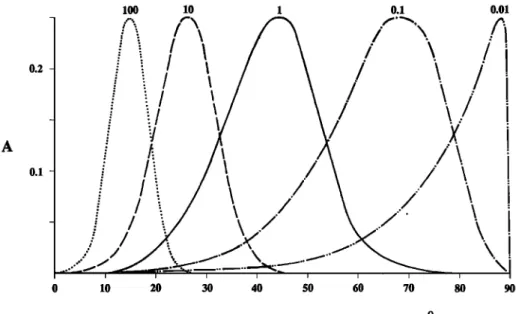
40 30 20 10 0 0.01 0.1 1 10 100 q h+Fig. 4. Incidence angle of MSW for which the resonant absorption is maximum, as a function of the parameter •7i_I +.
The shaded area corresponds to the half width of the absorption curve.
This is due to the fact that only a single resonance-cutoff pair plays a role, because only one mode propagates at infinity. The relation (11) between R, A, and T can be interpreted in a very simple way, following a heuristic reasoning suggested by Cairns and Lashmore-Davies [1983]. Let us suppose that the electromagnetic energy initially comes from the right
(e.g., from high altitudes) toward the conversion layer, on
branch II (Figure 3). Let T be the energy transmission
coefficient from branch II to branch III, and thus on the same mode (also from branch III to branch II). Then, only a fraction (1 - T) of the incident power will be reflected, on
branch II, near the reflection point •0- Of this reflected
power, a fraction T will be again transferred to branch III
and thus be incident from the left at the gyrofrequency level,
where H + heating
has to occur. The fraction
of absorbed
power will thus be T(1 - T). The remaining fraction of theincident
power,
(T - 1)9_,
will finally
be reflected
back
from
the conversion layer to the right.
As n ñ varies from 0 to 1, the incident angle 0+ varies from 0 ø to 90 ø , and /5+, which has nothing to do with any
"tunneling distance," varies from 0 to o•. Thus the transmis-
sion coefficient T = exp (-2½r/5+) varies from 1 to 0, and the
absorption rate is maximum for A = 0.25 (T = 0.5, or
/5+ = 0.11) and thus for an intermediate angle which depends on •i•+ (Figure 4). This will not necessarily correspond to a
reflection point occurring below the H + gyrofrequency
layer, which points out the weakness of the "intuitive" reasoning at the beginning of section 2.3.
The efficiency of the heating process will depend on the
angular width of the absorption curve and on the distribution
of the angles of incidence of the MSW. As shown in Figures 4 and 5, the most efficient cases likely correspond to values of TIH+ varying from 0.1 to 1, when the absorption is strong over a large angular range. When Wi•+ is larger, absorption
occurs only for small propagation angle and over a smaller
angular width. When it is smaller, strong absorption is mainly restricted to incident angles very close to 90 ø .
Figure 6 shows how these results will be modified if fi-
nite-ei•+ corrections were retained in equations (2a') and (2b and thus in the expressions of n + and/5+ given in the appendix. It exhibits the evolution of the absorption curve for increasing values of EH+ when the parameter T/H+ is artificially kept constant. Then, the angle where the maximal absorption oc-
curs decreases only slightly with si•+, as the half width of the absorption curve. The main variation of the absorption is thus given by the change of •/H +. This is the optimizing value of this
parameter,
linked
to both SH+
and the typical
magnetic
gradient
length L b (always of the order of the Earth's radius), whichmakes it necessary for the hydrogen to be a minor species in order to be efficiently heated.
4. DISCUSSION
On board the AUREOL/ARCAD 3 satellite, five compo-
nents of the electromagnetic field (two electric, three mag- netic) were measured in waveforms. Rauch et al. [this issue]
give evidence of the signature of resonant absorption events observed at altitudes ranging from 1000 to 2000 km, in the light ion trough (LIT). During such events the dynamic
spectrum of the magnetic component shows a low-frequency
cutoff, slightly below the proton gyrofrequency fi•+ (typical- ly 5-10 Hz below). The polarization of the electromagnetic turbulence, which was RH above fi•+, becomes linear just below and LH close to the cutoff frequency fco- This could a priori be interpreted as a simple polarization reversal at the crossover frequency fcrover, which would explain why a downgoing type II MSW would change from RH to LH. Electric field data, however, cannot be explained only by a polarization reversal, for the following reasons. First, the transverse component of the electric field (EH) decreases just below fH + , before falling to noise level below fco- Such a decrease of EH is not consistent with a simple reflection of MSWs at fco, which would only give an enhancement of the
spectral power, at this frequency, due to an Airy function
effect. Second, the parallel component
(E z) shows a large
peak between fco and fi•+. If the observed waves were MSWs, E z would be exceedingly small. Thus, below fi•+, atleast part of the energy of the downgoing MSWs has to mode
convert into a type III H + ICW. Present
calculations
sup-
port this idea. Indeed, in section 3 the parallel electric field resulting from the resonant mode conversion process has
been shown to be large in the conversion layer, and even to diverge at fH + . The E H component is still expected to have large values, but its divergence is still smoother, and the
expected very small value of E z, except at fH +, must
produce the very large contrasting effect which is indeed13,370 LE QUP_,AU ET AL.' FORMATION OF H + CONICS BY RESONANT ABSORPTION, 2
A
0.2 -
0.1 -
Fig. 5. Values of the absorption coefficient as a function of 0+, the incidence angle of the MSW far from the
gyrofrequency
layer.
Five values
of ,?H
+ have
been
used,
from
,?H
+ = 102
(left curve)
to ,?H
+ = 10
-2 (right
curve);
,?H + = 10 is relevant to the event of orbit 3162, studied by Rauch et al. [this issue].
observed.
While not important
for the heating
of the H + ions
by itself, the intense and narrow spectrum of E z gives
evidence of the existence of a resonant mode conversion of
the downgoing MSW into an upgoing ICW, close to f•i +. The
heating
of the H + ions is due to the transverse
component
(EH) of the electric field, which is consistent with the observed decrease of E H between fco and •i +. The abrupt polarization change just below f•i + is also consistent with a resonant mode conversion and absorption process; indeedthe theory
foresees
that the ratio lie + II/llE-II diverges
at the
same location as the E z component.
We expect the slight frequency difference between the
peak in E z and f•i + (=5 Hz) to be linked to thermal effects,
which also have to explain the observed spectral width of the peak. For the event of orbit 3162, described by Rauch et al.[this issue], the magnetic gradient length can be estimated to
be L b • 2.5 x 10
6 m, and
the proton
gyrofrequencyf•i+
=
(2•r)-•f•i
+ • 400
Hz. Assuming
1/2m(vthi)211
• 10 eV, one
gets from equation (10) Af = 2.2 Hz. This is indeed of the order of magnitude of the half width of the observed spectralpeak.
The efficiency of the energy absorption process depends only upon the size of the positive parameter ,/•i +, and thus
the value of both e•i+ and the angular range covered by the
downgoing MSW. From the measured frequency cutoff of the MSW, e•i+ = 10% for orbit 3162 [Rauch et al., this issue]. With the plasma parameters corresponding to the studied event, one gets ,/•i + • 10. As shown in Figures 4, 5, and 6, the heating process thus maximizes for 0+ = 200-25 ø, which is consistent with the propagation angle of the incidentA 0.25 - 0.2 - 0.15 - 0ol - 0.05 0 50 60 70 80 90
Fig. 6. Same as Figure 5, but ,/I_i + • 10 is artificially maintained constant and eI-i + is varied to show the effect of the finite -eI_i + corrective terms' eI_i + = 0 (solid), 0.25 (dashed), 0.5 (dot-dashed), 0.75 (dot-dot-dashed), and 1 (dotted).
LE QUI•AU ET AL ß FORMATION OF H + CONICS BY RESONANT ABSORPTION, 2 13,371
Alfv6n waves which has been determined from the observa-
tions [Rauch et al., this issue].
According to the present calculation, the parallel phase velocity of the downgoing MSWs must be of the order of
g•ll • [c/n+(o•)](•e/cot•e)/(16/2
) 1/2
= c/40 (12)
with
n + (o•)
= (17)
- •/2 and
fie • COpe,
as observed
during
the event of orbit 3162. This value of the phase velocity can be checked from the data by determining the experimentalvalue
of the ratio •SEH/•SBH
• 10 -7 in this
frequency
range.
Particle data give evidence of enhanced fluxes of suprath- ermal protons, with an upward flux larger than the down- ward one, during the same event. We interpret this asym- metry in the observed proton fluxes as the signature of a proton conic resulting from the cumulative acceleration of hydrogen ions below the satellite. Since the altitude is relatively large for the quoted event (= 1950 km), the accel-eration of the ions is expected to take place over a broad
altitude range below the satellite (Ah = 1000 km), thus leading to the formation of a hydrogen ICRHC, which is here
observed as a strong enhancement of the flux of suprather-
mal upgoing protons.
Let us now compare the expected heating with the flux of
kinetic energy emerging from the postulated heating region.
One has first to determine the electromagnetic energy input.
For orbit 3162 the typical values of the spectral densities, for
each component
of the electromagnetic
field, are /•B 2 =
2.5 x 10 -5 T 2 Hz -• andtSE
2 = 4 x 10 -3 (mV)
2 Hz -•.
The approximate energy flux entering the box where the wave absorption by the observed protons has to occur thusis written
(I)er
n VallAf
3tSB
2 + 2
(13)
4/20
where Val
I is the parallel
group velocity of the incident
waves over the frequency range Af = 3Ah/Rfw • 200 Hz
above the local proton gyrofrequency, which is the range of
proton gyrofrequencies over the altitude range Ah -• 1000
km. In (13) the factors 3 and 2 correspond to the number of
field components of the propagating waves. Slightly above
the proton
gyrofrequency,
V•l I is expected
to be of the order
of V•l I • c/40. In fact, the parallel
group
velocity
of the
magnetosonic waves has a nontrivial behavior, as a functionof both n ñ and the frequency (x = co/coW). In Figure 7 the
shaded
area gives
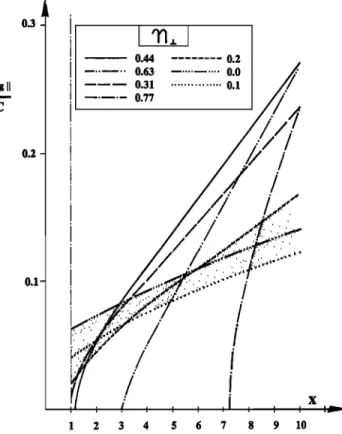
the value of V•l I for the range
of asymp-
totic angles of propagation corresponding to the Gaussianshaped absorption curve of Figure 5, with r/i-i+ '• 10. For the frequency range of interest (from x = 1 to x -• 2), one thus
gets V•l I • c/20 as a mean value. From the data and
equation (13) the contribution of the electric field is clearly negligible in the determination of the energy flux, and one finally gets the incident electromagnetic flux:(I)em
'• 9 x 10 -8 J m -2 s -1
Taking into account that only one quarter of this energy can be converted into mechanical energy, one gets an available
energy
flux of -•2.2 x 10
-8 J m -2 s -• for heating
the protons
below the satellite.
The output of mechanical energy can be roughly deter- mined from the particle data presented in the companion
paper.
The net H + energy
flux tI)i-i+
is given
by
Vg
II
C 0.3 0,2 - 0,1 -Iqq
0.44 ... 0.2 ... 0.63 ... 0.0 0.31 ... 0.1 ... 0.77/
/
1 2 3 4 5 6 7 8 9 10Fig. 7. The group velocity of the magnetosonic waves, as a
function of the normalized frequency x = to/fli-i+. Here ,/i_i + = 10,
as for the event of orbit 3162. Each curve corresponds to a value of n ñ, given in the figure. The shaded area corresponds to the values of the parameter that lead to a strong absorption coefficient, as shown in Figure 5.
tI)i-i+ = 2,r sin (a) da j(a, E)E dE (14)
where j(a, E) is the differential flux at energy E and pitch
angle a. If we assume that downward and upward ion fluxes
remain isotropic and constant within the lowest energy
channel of width AE m -• 100 eV, tI)H+ can be approximated
by
ß • + • ,rr
AE2m[j
4,
- cos
a 0 J I ]
•5 x 10-14[j•
-cos a0j•, ] Jm -2 s -1
where
expressed
a0
is the
in units of ions cm s -• sr -• keV -•. For an
atmospheric
lo_s2s
cone
and
j ½ and
j • are
upward
H + ion flux of the order of 107, one obtains
an
upward
directed
energy
flux of the order of •6.7 x 10
-8 J
m -2 s -• . After taking
into account
the fact that the flux of
upgoing protons is often cut above 40 eV (as is observed when an intermediate energy channel is used), the upgoingkinetic
energy
flux is lowered
to •5 x 10
-8 J m -2 s -•.
As it is likely that we overestimate the mechanical energy
fluxes, since the conical shape of the distribution function of
the suprathermal protons is not taken into account, we consider that the above described theory gives a satisfying
estimate for the energetic transfer that is required to explain
the formation of hydrogen conics inferred from AUREOL 3
13,372 LE QUI•AU ET AL.' FORMATION OF H + CONICS BY RESONANT ABSORPTION, 2
5. SUMMARY AND CONCLUSIONS
Recent measurements from DE 1 [Crew et al., 1990], Viking [Andrd et al., 1988], and AUREOL 3 [Ranch et al.,
this issue] have given evidence of a strong correlation
between the transverse
heating of minor ions and the pres-
ence of large-amplitude
Alfv6nic fluctuations.
The present
work is an attempt to explain how such downgoing
electro-
magnetic Alfv6n waves can heat these thermal ions up to
perhaps a few hundred electron volts. Motivated by the
observational results presented by Ranch et al. [this issue],our analysis has been focused on the case where there is a
majority
of O + ions. The opposite
case, where H + is the
main species,
will be presented
in a forthcoming
paper. It
has been shown
that magnetosonic
waves, as they propagate
earthward, can be mode converted, via the inhomogeneity ofthe geomagnetic
field, into low phase velocity ion cyclotron
waves propagating upward. Since this conversion occursmainly at the altitude where the wave frequency
matches
the
gyrofrequency
of the protons, these waves can resonantly
heat
these
minor
H + ions.
The resulting
resonant
absorption
process has been studied in detail, in the framework of the cold plasma approximation, which allows an estimate of the reflection, transmission, and absorption coefficients, as a
function
of the incidence
angle and of the relative density
of
the minor ion. This heating process
is likely to occur over a
relatively broad altitude range. The cumulative heating,
combined
with the adiabatic upward motion of the ions, is
expected to produce the conical distribution functions at
higher altitudes, as suggested by Chang et al. [1986], Ret- terer et al. [1987], and Crew et al. [1990].
At the low altitudes covered by AUREOL 3, H + conics
were found in the light ion trough, where these ions provide
the minor species
of the plasma. This is expected
from our
theory,
which
foresees
that only minor
H + can be efficiently
heated
by the resonant
absorption
process.
The most prom-
inent feature found in wave data during
these
heating
events
is the existence
of a narrow peak affecting
the spectra
of the
parallel electric component
Ez, at frequencies
lying just
below (a few hertz) the proton gyrofrequency.
While not
important
for the transverse
heating
of H +, this spectral
line
testifies
to the existence
of the resonant
absorption
process.
According to our calculations, this component is indeed
expected to be strong close to fix + , in the vicinity of the
conversion layer. The corresponding spectral width can be roughly estimated by taking into account thermal effects. The need for a low H + concentration is consistent with thissignature
of the mode conversion
being found primarily in
the light ion trough
region, as firmly established
by the data.
Finally, it has been shown
that the electromagnetic
energy
flux that can be extracted from the incident waves matches
the mechanical
energy
flux supplied
by the upgoing
H + ions.
When the O + ions become
the minor species,
it is ex-
pected that they could also be heated by Alfv6n waves
propagating
downward
and having frequencies
in the fo +
range. Observationally,
the oxygen heating
process
does not
seem to have been observed
on board AUREOL 3, partly
because
of the altitude range covered by this satellite and
partly because the wave measurements were not sensitive
enough close to fo +. Detailed comparisons
between mea-
surements effected over a broader altitude range and includ-ing waveform measurements
of the electric and magnetic
components of the waves are required to determine the roleplayed by the process discussed here. Such measurements
will be done, in the near future, by the missions Interbal,
Freja, and Polar.
APPENDIX
From equations
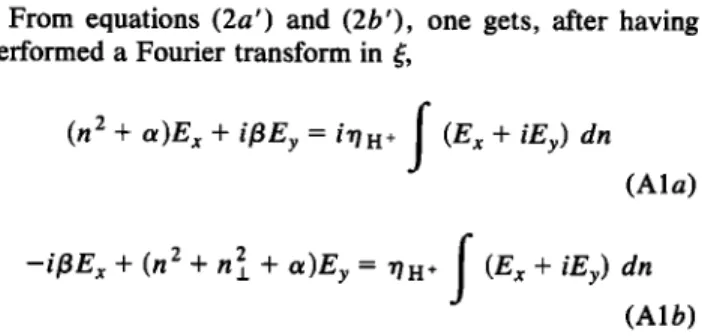
(2a') and (2b'), one gets, after having
performed a Fourier transform in •,(n
2
+
a)Ex
+
il3Ey
=
i•/H
+
• (Ex
+
iEy)
dn
(Ala)
-il3E
x
+
(n
2
+
n2a_
+
ot)Ey
= ,/H
+
f (E
x
+
iEy)
dn
(Alb)
where a = 1/255,/3 = 16/255,
and/3 - a = 1/17. After having
performed linear combinations
of these two equations,
one
gets
n 2 + n•- (1/17)
Ex = i
2
Ey
(A2a)
n - (1/17)
Po•(n)E
+=
2i•qH+Q(n)
f E+(n)
dn
where P•(n) and Q(n) are polynomials,
given by
(A2b)
Po•(n) = (n - n+)(n - n_)(n + n_)(n + n+)
Q(n) = n 2 + n2z/2- 1/17
with n2_+
= ___A
•/2- (1/255 + n2z/2)and
A = (16/255)
2 +
n4z/4.
E+(n) is the Fourier transform
of the left-handed
component
of the electric
field (E + = Ex + iEy). As
expected,
the negative
mode is nonpropagating
for Ilsell-->
oo
(Figure A 1).
From (A2) the function
H(n) = Po•(n)Q-i(n)E+(n) can
be determined: Im(n ) +n+ C - 0.5 - • 0.5 • - n + Re (n) - 0.5
Fig. A1. Position of the poles of the integrand defining •. The arrows show their motion in the complex plane, for increasing n ñ. The _+ n + must have a small imaginary part to be consistent with causality requirements. For • < 0 the integration path q• can be chosen along the real axis. Closing this path in the negative imaginary plane, where the integral defining • is convergent, ensures that only downgoing waves contribute, as required from the