HAL Id: hal-02109147
https://hal.archives-ouvertes.fr/hal-02109147
Submitted on 24 Apr 2019
HAL is a multi-disciplinary open access
archive for the deposit and dissemination of
sci-entific research documents, whether they are
pub-lished or not. The documents may come from
teaching and research institutions in France or
abroad, or from public or private research centers.
L’archive ouverte pluridisciplinaire HAL, est
destinée au dépôt et à la diffusion de documents
scientifiques de niveau recherche, publiés ou non,
émanant des établissements d’enseignement et de
recherche français ou étrangers, des laboratoires
publics ou privés.
IODP Expedition 335: Deep Sampling in ODP Hole
1256D
Damon A.H. Teagle, Benoit Ildefonse, Peter Blum
To cite this version:
Damon A.H. Teagle, Benoit Ildefonse, Peter Blum. IODP Expedition 335: Deep Sampling in ODP
Hole 1256D. Scientific Drilling, Copernicus Publications, 2012, �10.2204/iodp.sd.13.04.2011�.
�hal-02109147�
Science Reports
IODP Expedition 335: Deep Sampling in ODP Hole 1256D
by Damon A.H. Teagle, Benoit Ildefonse, Peter Blum and
the IODP Expedition 335 Scientists
doi:10.2204/iodp.sd.13.04.2011
Science Reports
Abstract
Observations of the gabbroic layers of untectonized ocean crust are essential to test theoretical models of the accretion of new crust at mid-ocean ridges. Integrated Ocean Drilling Program (IODP) Expedition 335 (“Superfast Spreading Rate Crust 4”) returned to Ocean Drilling Program (ODP) Hole 1256D with the intention of deepening this reference pene-tration of intact ocean crust a significant distance (~350 m) into cumulate gabbros. Three earlier cruises to Hole 1256D (ODP 206, IODP 309/312) have drilled through the sedi-ments, lavas, and dikes and 100 m into a complex dike-gabbro transition zone.
Operations on IODP Expedition 335 proved chal-lenging throughout, with almost three weeks spent re-opening and securing unstable sections of the hole. When coring com-menced, the comprehensive destruction of the coring bit required further reme-dial operations to remove junk and huge volumes of accumulated drill cuttings. Hole-cleaning operations using junk baskets were successful, and they re-covered large irregular samples that document a hitherto unseen sequence of evolving geological con-ditions and the intimate coupling between tempo-rally and spatially interca-lated intrusive, hydrother-mal, contact-metamorphic, partial melting, and retro-gressive processes.
Hole 1256D is now clean of junk, and it has been thor-oughly cleared of the drill cuttings that hampered
op-erations during this and previous expeditions. At the end of Expedition 335, we briefly resumed coring before underta-king cementing operations to secure problematic intervals. To ensure the greatest scientific return from the huge efforts to stabilize this primary ocean lithosphere reference site, it would be prudent to resume the deepening of Hole 1256D in the nearest possible future while it is open to full depth.
Why Study Ocean Crust Forming at Fast
Spreading Rates?
The vast majority (~70%) of magma derived from the mantle is brought into the Earth’s crust at the mid-ocean ridges, and approximately two-thirds of that magma cools
Science Reports
Science Reports
Science Reports
Fast-spreading: East Pacific Rise Slow-spreading: Mid-Atlantic Ridge
A
B
C
D
340 350 W -20 S -10 0 -5500 -5000 -4500 -4000 -3500 -3000 -2500 -2000 -1500 -1000 -500 0 240 250 260 W -20 S -10 0(meters below sea level)
basalt sheeted dikes gabbro
segment center segment center
lithosphere
asthenosphere Strike-slip and
oblique-slip faults peridotite serpentinite 0 2 4 6 8 10 moho moho moho 2 -120 -100 8°15' 8°30' 8°45' 9°00' 9°15' 9°30' 9°45' 10°00' 10°15' -80 -60 -40 -20 0 20 40 60 80 100 4 6 8 10 12 Latitude (N) Distance (km)
depth (below sea level. km)
Clipperton FZ
Siqueiros FZ 9°03’N OSC
West of EPR axis
Figure 1. Bathymetric maps of the [A] fast spreading southern East Pacific Rise (EPR) compared to the
[B] slow spreading Mid-Atlantic Ridge (MAR) from the equator to 25°S. Note the more pronounced bathymetric relief and axial graben along the MAR as well as the more closely spaced transform faults. Interpreted along-axis sections for the [C] EPR from ~8° to 10° N (after Canales et al., 2003) and [D] MAR (after Cannat et al., 1995).
Science Reports
Science Reports
309/312 in 2005 (Wilson et al., 2003; Teagle et al., 2006; Wilson et al., 2006) that prepared the first scientific borehole for deep drilling by installing a large reentry cone secured with almost 270 meters of 16-inch casing through the 250-m-thick sedimentary overburden and cemented into the uppermost basement. Hole 1256D was then deepened through a ~810-m-thick sequence of lavas and a thin (~346 m) sheeted dike complex, the lower 60 meters of which is strongly contact metamorphosed to granoblastic textures (Fig. 4). The first gabbroic rocks were encountered at 1407 meters below seafloor (mbsf) where the hole entered a com-plex dike-gabbro transition zone that includes two 20- to 50-m thick gabbro lenses intruded into granoblastic dikes. As of the end of Expedition 312 in December 2005, Hole 1256D had a total depth of 1507.1 mbsf, and it was open to its full depth.
It was expected that even with a shortened cruise (~6 weeks), coring on IODP Expedition 335 would be able to deepen Hole 1256D ~350 m, completely through the dike-gabbro transition zone and varitextured gabbros and a and crystallizes in the lower portion of the ocean crust.
Seismic, bathymetric, and marine geological observations indicate that ocean crust formed at fast spreading rates (full
rate >80 mm yr -1) is much less variable than crust formed at
slow spreading rates (<40 mm yr -1; Fig. 1) and is closer to the
ideal “Penrose” pseudo-stratigraphy developed from ophi-olites. Hence, understanding fast-spreading accretion proc-esses at a few sites might reasonably be extrapolated to describe a significant portion of the Earth’s surface. Although <20% of modern ridges are moving apart at fast spreading rates (Fig. 2), nearly 50% of present-day ocean crust and ~30% of the Earth’s surface were produced by this pace of spreading. The great majority of crust that subducted back into the mantle over the past ~200 m.y. formed at fast-spreading ridges (Müller et al., 2008), making charac-terizing this style of crust most relevant for understanding the recycling of crustal and ocean-derived components back into the mantle.
The rate of spreading of the oceanic lithosphere has pro-found effects on the style of accretion at mid-ocean ridges due to changing balances between plate motion, magma pro-duction, conductive and hydrothermal cooling, detachment tectonics, and serpentinization of the upper mantle (Fig. 1c vs. 1d; Dick, 1989; Cannat et al., 1995, 2004, 2009; Chen and Phipps Morgan, 1996; Dick et al., 2003; Escartin et al., 2008). Although insights on formation of intrusive crust at detachment-dominated, slow-spread lithosphere have been obtained (e.g., Holes 735B, U1309D, and other sites; ODP Legs 118, 153, 176, 209, and IODP Expeditions 304–305; Dick et al., 2000; Ildefonse et al., 2007; Kelemen et al., 2007), the thermal regime and the melt supply and delivery in these settings differ significantly from those of the axial zone in fast-spreading lithosphere. Detailed understanding of the relatively uniform mechanisms operating at fast spreading ridges would provide a vital benchmark against which het-erogeneous accretion on slow-spreading ridges could be compared.
Geological Setting of Site 1256 and
Science Objectives of IODP Expedition 335
IODP Expedition 335 (13 April to 3 June 2011) was the fourth scientific drilling cruise of the Superfast campaign, and it returned to ODP Hole 1256D (6°44.163'N, 91°56.061'W) to deepen this ocean crust reference penetration a signif-icant distance into cumulate gabbros. ODP Hole 1256D is located on 15-Ma-crust in the eastern equatorial Pacific Ocean in oceanic basement that formed during a sustainedepisode of superfast ocean ridge spreading (>200 mm yr -1;
Wilson, 1996). Ocean crust formed at a superfast spreading rate was deliberately targeted because there is strong evi-dence from mid-ocean ridge seismic experiments that gab-bros occur at shallower depths in intact ocean crust with higher spreading rates. Therefore, the often difficult-to-drill upper ocean crust should be relatively thin. Expedition 335 follows on from ODP Leg 206 in 2002 and IODP Expeditions
Science Reports
Science Reports
Figure 2. Distribution of spreading rates for major active plate
boundaries, presented in [A] histogram form and as [B] cumulative distribution. The rates are the best-fit rates of the MORVEL model (DeMets et al., 2010), and ridge length is measured as the component perpendicular to spreading direction. Horizontal lines on the cumulative plot show the range of spreading rate for each plate pair, with line width scaled approximately to plate boundary length. Plate-pair labels follow the MORVEL convention, except in the Indian Ocean where the southeast, southwest, and northwest branches of the ridge system are grouped for 2–3 plate pairs to simplify labeling 0 20 40 60 80 100 120 140 0 400 800 1200 1600 2000
Full Spreading Rate (mm yr-1)
Frequency (km ridge axis per mm yr
-1) Cumulative Frequency (%) A B 0 20 40 60 80 CO-PA AN-PA RI-PA NZ-AN JF-PA NA-PA CO-NZ SEIR SWIR NWIR NB-SA NB-NA EU-NA NZ-PA AR-SM AR-NB 100 0 20 40 60 80 100 120 140 Slow <40 mm yr-1 Intermediate 40 to 80 mm yr-1 Fast >80 mm yr-1
Science Reports
significant distance into true cumulate gabbros. Listed below are the specific sci-entific objectives of IODP Expedition 335 that were to be addressed by deepening Hole 1256D a significant distance into cumulate gabbros.
What is the major mechanism of mag-matic accretion in crust formed at fast spreading rates? Is the lower crust form-ed by gabbro glaciers or sheetform-ed sills (Korenaga and Kelemen, 1998; Fig. 5) or by some mixed or unknown mechanism?
How is heat extracted from the lower ocean crust? Specifically, what is the role of hydrothermal circulation in extracting latent heat from the lower ocean crust?
What is the geological significance of the seismic layer 2/3 boundary at Site 1256?
What is the magnetic contribution of the gabbro layer? Can the magnetic polar-ity structure of the lower crust be used to constrain cooling rates?
Operations
Expedition 335 reentered Hole 1256D more than five years after the last expedi-tion to this site. The expediexpedi-tion encoun-tered and overcame a series of significant engineering challenges, including a major obstruction at a depth of ~922 mbsf that had initially prevented reentry into the hole to its full depth of 1507 meters. At the bottom of the hole, coring resumed in the very hard granular rocks recovered during the previous Superfast expedition. Although there may only be a few tens of meters of these particularly tenacious granoblastic basalts formed by the contact metamorphism of sheeted dikes, their extreme toughness once more proved challenging to sample, resulting in the grinding down of one of the hardest forma-tion coring bits (C9) into a smooth stump (Fig. 6a,b).
Action was then undertaken to clear the bottom of the hole of metal debris from the failed coring bit and drilling cuttings. These efforts returned hundreds of kilo-grams of rocks and drill cuttings (Fig. 6d), including large blocks (up to 3.5 kg) of the
Science Reports
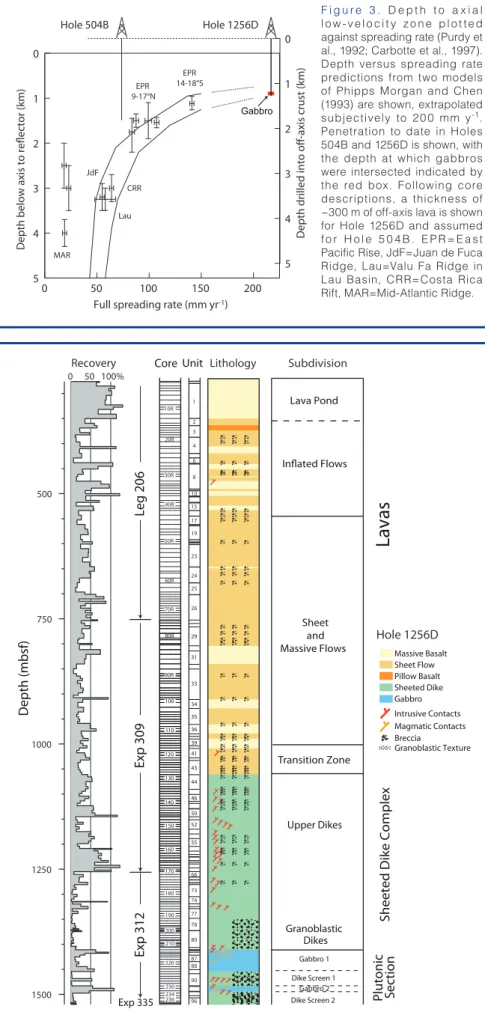
F i g u r e 3 . D e p t h t o a x i a l l o w - ve l o c i t y zo n e p l o t te d against spreading rate (Purdy et al., 1992; Carbotte et al., 1997). Depth versus spreading rate predictions from two models of Phipps Morgan and Chen (1993) are shown, extrapolated subjectively to 20 0 mm y-1.
Penetration to date in Holes 504B and 1256D is shown, with the depth at which gabbros were intersected indicated by the red box. Following core descriptions, a thickness of ~300 m of off-axis lava is shown for Hole 1256D and assumed fo r H o l e 5 0 4 B . E P R = E a s t Pacific Rise, JdF=Juan de Fuca Ridge, Lau=Valu Fa Ridge in Lau Basin, CRR=Costa Rica Rift, MAR=Mid-Atlantic Ridge.
B
EPR 14-18°S EPR 9-17°N JdF Lau CRR 0 50 100 150 200Full spreading rate (mm yr-1)
0 1 2 3 4 5
Depth below axis to reflector (km)
Hole 1256D Hole 504B 0 1 2 3 4 5
Depth drilled into o
ff-axis crust (km) Gabbro MAR 500 750 1000 1250 1500 0Recovery50 100% Depth (mbsf) Hole 1256D Massive Basalt Pillow Basalt Sheet Flow Gabbro Sheeted Dike Breccia Granoblastic Texture Magmatic Contacts Intrusive Contacts 66 73 74 77 78 80 88 87 90 96
Sheeted Dike Complex
Transition Zone Sheet and Massive Flows Subdivision Lava Pond Inflated Flows 29 31 33 35 34 36 39 41 43 44 46 50 52 55 1 2 3 4 6 10 15 17 19 23 24 25 26 8 Lithology Core Unit 180 190 200 210 220 230 80R 90R 100 110 120 130 140 150 160 170 20R 30R 40R 50R 60R 70R 10R Leg 206 Exp 312 Exp 309 236 234 Gabbro 1 Gabbro 2
Lavas
Plutonic Section Dike Screen 1 Dike Screen 2 Upper Dikes Granoblastic Dikes Exp 335Figure 4. Stratigraphic column for Hole 1256D at the end of Expedition 335, showing the
Science Reports
culprit granoblastic basalts that hitherto had only been very poorly recovered through coring . A limited number of gabbro boulders were also recovered, indicating again that we are tantalizingly close to breaking through into the gabbroic layer.
Scientific Results
Hole opening and remediation operations resulted in a major loss of time from the coring and wireline activities planned for Expedition 335. Coring on this expedition deepened Hole 1256D only modestly, from 1507.1 mbsf to
1521.6 mbsf (Fig. 4) at low rates of penetration (0.9 m hr -1)
and recovery (11%).
Hole cleaning operations at the bottom of Hole 1256D, particularly those runs that deployed the reverse-circulation junk basket, brought back a unique collection of large cobbles, angular rubble, and fine cuttings of principally strongly to completely recrystallized granoblastic basalt with minor gabbroic rocks and evolved plutonic rocks. The granoblastic basalts record high-temperature (granulite facies) metamorphism of previously hydrothermally al-tered sheeted dikes, with unequivocal evidence for hydro-thermal alteration before and after the formation of grano-blastic textures (Teagle et al., 2006; Koepke et al., 2008; France et al., 2009; Alt et al., 2010). The large blocks ex-hibit intrusive, structural, and textural relationships, and overprinting and cross-cutting hydrothermal alteration and metamorphic paragenetic sequences. Some of the rubble and ~30% of the fine cuttings recovered by fishing and cleaning operations most likely came from the lava sequences at the top of the hole on the basis of igneous textures and low-temperature alteration minerals (Mg-saponite, amorphous silica). In contrast, the high extent of metamorphic recrystallization exhibited by the granoblastic basalts, and operational factors (e.g., pipe movements), provide strong evidence that the granoblastic
Science Reports
Figure 5. Diagrams of crustal accretion models (modified from Korenaga and Kelemen, 1998). Black arrows show the movement of the solid
lower crust; blue arrows show the dominant zones where hydrothermal circulation will remove latent and sensible heat; red arrows show the movement of magma (unknown in all models). [A] Gabbro glacier ductile flow model (Henstock et al., 1993; Phipps Morgan and Chen, 1993; Quick and Denlinger, 1993). Ductile flow down and outward from a high level axial magma chamber constructs the lower crust. [B] A hybrid model of ductile flow with sill intrusions (Boudier et al., 1996). [C] “Sheeted” or “stacked” sill model of in situ formation of the lower crust by on-axis sill intrusions (Bédard et al., 1988; Kelemen et al., 1997; Kelemen and Aharonov, 1998; MacLeod and Yoauancq, 2000). (Original figure by Rosalind Coggon).
B
C
A
Lavas Dikes Upper gabbro Lower gabbro Moho?
?
?
A B C D E FFigure 6. Photographs of some drilling, fishing, and milling tools illustrating the
multiple operations achieved during IODP Expedition 335. [A] & [B] Remains of the Ulterra C9 RCB coring bit used during Run 9. The bit was probably used for ~10 h after it disintegrated, which resulted in this spectacularly abraded and sculptured bit (“Stumpy”), something never seen before by the drillers. [C] Bottom of the Bowen Reverse Circulation Junk Basket (RCJB), showing its hard-facing structure and the junk catcher spring fingers inside. This tool recovered a series of large-scale cobbles (up to 5 kg) of granoblastic basalt. [D] A series of RCJB runs returned a bottom hole assembly packed by fine-grained cuttings. This contributed efficiently to cleaning Hole 1256D. [E] Heavily worn and under-gauge 9-inch flat-bottomed milling tool. This tool worked at the bottom of the hole for 12 h; its final state indicates the very abrasive nature of metal debris and/or rocks at the bottom of the hole and an under-gauge lowermost portion (tens of centimeters) of the hole. Note for comparison the hard-facing structure of the next milling tool on the right side of the picture. [F] 9-inch Smith FH3VPS tricone bit used for Run 16. This armored bit was efficient to ream and clean the under-gauge bottom of the hole.
Science Reports
Conclusions
Although the extensive remedial operations on Expedition 335 precluded significant deepening of Hole 1256D, signif-icant progress was made in improving the stability of the borehole. The most problematic out-of-gauge zone at ~920–960 mbsf that caused reentry problems on Expeditions 312 and 335 has been stabilized with cement. The bottom of the hole has been cleared of rubble and junk, and there appears to be only a short (<1 m) under-gauge zone. What is important is that the regular, large sweeps of high viscosity mud have finally overcome and expunged the vast amount of fine cuttings recirculating in the hole, some most likely resident since ODP Leg 206. This is shown by the absence of soft fill in the final ~5 reentries, compared to upwards of 50 meters of soft fill at the end of Expedition 312. The engi-neering efforts on Expedition 335 have repaired and pre-pared Hole 1256D for further deep drilling, following five years of neglect. Hole 1256D is 1500 m of hard rock coring closer to cumulate gabbros than any other options in intact ocean crust and once more poised to answer fundamental basalts, minor gabbros, and
evol-ved plutonic rocks were sourced from the lowermost reaches of Hole 1256D (1494.9–1521.6 mbsf), most probably from below the lower-most recovered gabbroic interval (Fig. 4). Hence, the rocks recovered during Expedition 335 represent a ~15-m interval of the upper crust/lower crust transition, occurring below the ~90-m sec-tion, recovered during Expedition 312, of two gabbroic bodies (Gabbro 1 and Gabbro 2) separated by Dike Screen 1 (Fig. 4).
When the textural and contact relationships exhibited by the rocks recovered from the junk bas-kets are placed in the geological context of the Hole 1256D strati-graphy, a vision emerges of a com-plex, dynamic thermal boundary layer zone. This region of the crust between the principally hydrother-mal domain of the upper crust and the intrusive magmatic domain of the lower crust is one of evolving geological conditions. There is inti-mate coupling between temporally and spatially intercalated magmat-ic, hydrothermal, partial melting, intrusive, metamorphic, and retro-grade processes.
With only a minor depth advance
in Hole 1256D, we are yet to recover samples of cumulate gabbros required to test models of ocean ridge magmatic accretion and the intensity of hydrothermal cooling at depth. The total vertical thickness of granoblastic basalts is over 114 m, and Dike Screen 2 is now about the same thickness (so far) as Dike Screen 1. Highly perched, isolated gabbro intrusions are uncommon in ophiolites. The energy require-ments for the granoblastic recrys-tallization at granulite facies condition of a >114-m-thick zone of sheeted dikes mas-sively exceeds the thermal capacity of Gabbros 1 and 2 (Coggon et al., 2008; Koepke et al., 2008) if a simple sub-horizontal arrangement of these layers is assumed. The enormous heat requirements for such extensive granulite facies recrystallization, the evidence for partial melting, tog-ether with the tantalizing presence of minor but not uncom-mon gabbroic rocks and felsic intrusives, dikelets, and veins, strongly indicates that the layer of purely plutonic rocks should be at most only a few tens of meters deeper in the hole.
Science Reports
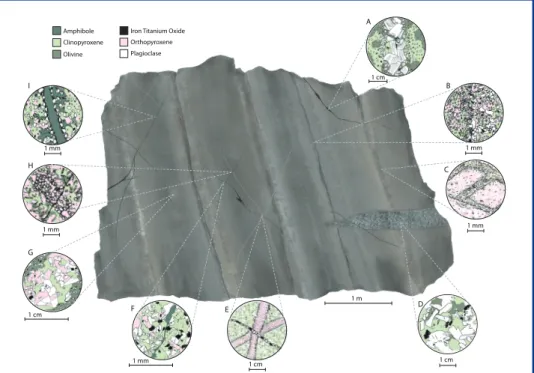
Figure 7. Sketch of a hypothetical outcrop in a future Site 1256 ophiolite of the dike-gabbro transition
zone showing the contact relationships observed in the cores and junk basket rocks recovered during Expedition 335. Small sketches are drawn from sample and thin-section descriptions done during Expedition 335. [A] Diorite dikelet, comprised predominantly of primary igneous amphibole and plagioclase, cross-cutting granoblastic basalt. [B] Fine-grained dike chilled against coarser grained dike. The entire sample is recrystallized to granoblastic assemblages of plagioclase, orthopyroxene, clinopyroxene, magnetite, and ilmenite. Later fine post-contact-metamorphic hydrothermal amphibole veins (not shown) cut across the contact and both dikes. [C] Chilled and brecciated dike margin recrystallized to granoblastic assemblages. Angular clasts consist of granoblastic plagioclase with minor orthopyroxene, clinopyroxene, ilmenite, and magnetite. They are recrystallized from chilled dike margin breccia protolith. Clast matrix is orthopyroxene rich with minor clinopyroxene, plagioclase, and oxides; it is recrystallized from hydrothermal minerals (amphibole and chlorite) that veined and cemented the breccia protolith. [D] Subophitic texture in gabbro. [E] Diorite vein cross-cutting a conjugate set of metamorphic orthopyroxene veins. [F] Post-contact-metamorphic hydrothermal hornblende vein cutting granoblastic basalt. [G] Granoblastic basalt with a diorite patch. [H] Granoblastic orthopyroxene vein, recrystallized from precursor hydrothermal vein, in granoblastic dike. Orthopyroxene vein is cut by small post-contact-metamorphic hydrothermal amphibole vein. [I] Post-contact-metamorphic hydrothermal amphibole vein cutting granoblastic basalt, with 1-mm-wide amphibole-rich alteration halo where pyroxenes are replaced by amphibole.
1 mm 1 mm 1 cm 1 cm 1 mm 1 mm 1 mm 1 cm 1 cm 1 m I H G F E D C B A Amphibole Olivine Clinopyroxene Orthopyroxene Plagioclase Iron Titanium Oxide
Science Reports
degrees 15' N-10 degrees 5' N) from wide-angle seismic refraction profiles. Geophys. J. Int., 152:766–794.
Cande, S.C., and Kent, D.V., 1995. Revised calibration of the geomag-netic polarity timescale for the Late Cretaceous and Cenozoic. J. Geophys. Res., 100: 6093–6095. doi:10.1029/ 94JB03098
Cannat, M., Cann, J.R., and Maclennan, J., 2004. Some hard rock con-straints on the heat supply to mid-ocean ridges. In German, C., Lin, J., and Parson, L. (Eds.), Mid-Ocean Ridges:
Hydrothermal Interactions Between the Lithosphere and Oceans. Geophys. Monogr. Ser., 148:111–150. Washington,
D. C. (American Geophysical Union). doi:10.1029/148GM05 Cannat, M., Manatschal, G., Sauter, D., and Peron-Pinvidic, G., 2009.
Assessing the conditions of continental breakup at magma-poor rifted margins: What can we learn from slow spreading mid-ocean ridges? Compt. Rend. Geosci. 341:406–427. doi:10.1016/j.crte.2009.01.005
Cannat, M., Mevel, C., Maia, M., Deplus, C., Durand, C., Gente, P., Agrinier, P., et al., 1995. Thin crust, ultramafic exposures, and rugged faulting patterns at Mid-Atlantic Ridge (22°–24°N). Geology, 23:49–52. doi:10.1130/0091-7613 (1995)023%3C0049:TCUEAR%3E2.3.CO;2
Carbotte, S., Mutter, C., Mutter, J., and Ponce-Correa, G., 1997. Influence of magma supply and spreading rate on crustal magma bodies and emplacement of the extrusive layer: Insights from the East Pacific Rise at lat 16°N. Geology, 26: 455–458. doi:10.1130/0091-7613(1998)026<0455:IOMSAS> 2.3.CO;2
Chen, Y.J., and Phipps Morgan, J., 1996. The effects of spreading rate, the magma budget, and the geometry of magma emplace-ment on the axial heat flux at mid-ocean ridges. J Geophys.
Res., 101:11475–11482. doi:10.1029/96JB00330
Coggon, R.M., Alt, J.C., and Teagle, D.A., 2008. Thermal history of ODP Hole 1256D lower sheeted dikes: Petrology, chemistry and geothermometry of the granoblastic dikes. Eos, Trans.
Am. Geophys. Union, 89 (53, Suppl.): V44B-08 (Abstract)
http://www.agu.org/meetings/fm08/waisfm08.html DeMets, C., Gordon, R.G., and Argus, D.F., 2010. Geologically
cur-rent plate motions, Geophys. J. Int., 181:1–80. doi:10.1111/ j.1365-246X.2009.04491.x
Dick, H.J.B., 1989. Abyssal peridotites, very slow spreading ridges and ocean ridge magmatism. In Saunders, A.D., Norry, M.J. (Eds.), Magmatism in the ocean basins. Geol. Soc. Spec. Pub., London, 42:71–105. Oxford (Blackwell Scientific Publications).
Dick, H.J.B., Lin, J., Schouten, H., 2003. An ultraslow-spreading class of ocean ridge. Nature, 426:405–412. doi:10.1038/nature 02128
Dick, H.J.B., Natland, J.H., Alt, J.C., Bach, W., Bideau, D., Gee, J.S., Haggas, S., et al., 2000. A long in situ section of the lower ocean crust: Results of ODP Leg 176 drilling at the Southwest Indian Ridge. Earth Planet. Sci. Lett., 179:31–51. doi:10.1016/S0012-821X(00)00102-3
Escartin, J., Smith, D.K., Cann, J., Schouten, H., Langmuir, C.H., and Escrig, S., 2008. Central role of detachment faults in accre-tion of slow-spreading oceanic lithosphere. Nature, 455:790–795. doi:10.1038/nature07333
questions about the formation of new crust at fast spreading mid-ocean ridges. This would be best achieved by a timely return to the site.
Acknowledgments
IODP Expedition 335 was not an easy cruise. Engineering difficulties throughout the expedition presented a continu-ous series of challenges. The Shipboard Science Party is extremely grateful for the immense efforts of the transocean crew aboard JOIDES Resolution for their perseverance, inno-vation, open discourse, and “can-do” attitude. This team was aboard when Hole 1256D was first spudded in and cased into basement on ODP Leg 206; they were not going to allow the hole to fail. The Texas A&M University (TAMU) Operations Superintendent Ron Grout has sailed on three of the four cruises to Hole 1256D, and his advice in testing situations proved invaluable. The proponents of the Superfast cam-paign thank the IODP Science Advisory Structure (SAS) for their extension of Expedition 335; without the extra two weeks there could have been the catastrophic loss of Hole 1256D, but this extra time allowed the clearing of junk and cuttings and preservation of the hole for future deepening into the cumulate gabbro layers.
IODP Expedition 335 Scientists
Damon A.H. Teagle (Co-Chief Scientist), Benoit Ildefonse (Co-Chief Scientist), Peter Blum (Staff Scientist), Natsue Abe, Bénédicte Abily, Yoshiko Adashi, Jeffrey C. Alt, Ryo Anma, Graham Baines, Jeremy Deans, Henry J.B. Dick, Daisuke Endo, Eric C. Ferré, Lydéric France, Marguerite Godard, Gilles Guérin, Michelle Harris, Yoon-Mi Kim, Juergen H. Koepke, Mark D. Kurz, C. Johan Lissenberg, Sumio Miyashita, Antony Morris, Ryo Oizumi, Betchaida D. Payot, Marie Python, Parijat Roy, Jessica L. Till, Masako Tominaga, Douglas S. Wilson, and Natalia Zakharova.
References
Alt, J.C., Laverne, C., Coggon, R.M., Teagle, D.A.H., Banerjee, N.R., Morgan, S., Smith-Duque, C.E., Harris, M., and Galli, L., 2010. Subsurface structure of a submarine hydrothermal system in ocean crust formed at the East Pacific Rise, ODP/ IODP Site 1256. Geochem., Geophys., Geosyst. 11:Q10010– Q10038. doi:10.1029/2010GC003144
Bédard, J.H., Sparks, R.S.J., Renner, R., Cheadle, M.J., and Hallworth, M.A., 1988. Peridotite sills and metasomatic gabbros in the Eastern layered series of the Rhum complex. J. Geol. Soc.
London, 145(2):207–224. doi:10.1144/gsjgs.145.2.0207
Boudier, F., Nicolas, A., and Ildefonse, B., 1996. Magma chambers in the Oman ophiolite: Fed from the top or from the bottom?
Earth Planet. Sci. Lett., 144:239–250. doi:10.1016/0012-
821X(96)00167-7
Canales, J.P., Detrick, R.S., Toomey, D.R., and Wilcock, W.S.D., 2003. Segment-scale variations in the crustal structure of 150-300 kyr old fast spreading oceanic crust (East Pacific Rise, 8
Science Reports
France, L., Ildefonse, B., and Koepke, J., 2009. Interactions between magma and hydrothermal system in Oman ophiolite and in IODP Hole 1256D: Fossilization of a dynamic melt lens at fast spreading ridges. Geochem. Geophys. Geosys. 10:Q10O19. doi:10.1029/2009GC002652
Henstock, T.J., Woods, A.W., and White, R.S., 1993. The accretion of oceanic crust by episodic sill intrusion. J. Geophys. Res., 98(B3): 4143–4161. doi:10.1029/92JB02661
Ildefonse, B., Blackman, D.K., john, B.E., Ohara, Y., Miller, D.J., MacLeod, C.J., and the IODP Expeditions 304–305 Party, 2007. Oceanic core complexes and crustal accretion at slow-spreading ridges. Geology, 35:623–626. doi:10.1130/ G23531A.1
Kelemen, P.B., and Aharonov, E., 1998. Periodic formation of magma fractures and generations of layered gabbros in the lower crust beneath oceanic spreading ridges. In Buck, W.R., Delaney, P.T., Karson, J.A., and Lagabrielle, Y. (Eds.),
Faulting and Magmatism at Mid-Ocean Ridges. Geophysical
Monograph, 106:267–289. Washington, DC (American Geophysical Union). doi:10.1029/GM106p0267
Kelemen, P.B., Koga, K. and Shimizu, N., 1997. Geochemistry of gab-bro sills in the crust-mantle transition zone of the Oman ophiolite: implications for the origin of the oceanic lower crust. Earth Planet. Sci. Lett., 146:475–488.
Kelemen, P.B., Kikawa, E., Miller, D.J., and Shipboard Scientific Party, 2007. Leg 209 summary: Processes in a 20-km-thick conductive boundary layer beneath the Mid-Atlantic Ridge, 14°–16°N. In Kelemen, P.B., Kikawa, E., and Miller, D.J. (Eds.), Proc. ODP, Sci. Results, 209:1–33. College Station, TX (Ocean Drilling Program). doi:10.2973/odp.proc.sr.209. 001.2007
Koepke, J., Christie, D.M., Dziony, W., Holtz, F., Lattard, D., Maclennan, J., Park, S., Scheibner, B., Yamasaki, T., and Yamazaki, S., 2008. Petrography of the dike–gabbro transi-tion at IODP Site 1256 (equatorial Pacific): the evolutransi-tion of the granoblastic dikes. Geochem., Geophys., Geosyst., 9(7):Q07O09–Q07O37. doi:10.1029/2008GC001939 Korenaga, J., and Kelemen, P.B., 1998. Melt migration through the
oceanic lower crust: A constraint from melt percolation modeling with finite solid diffusion. Earth Planet. Sci. Lett., 156:1–11. doi:10.1016/S0012-821X(98)00004-1
MacLeod, C.J., and Yaouancq, G., 2000. A fossil melt lens in the Oman ophiolite: Implications for magma chamber processes at fast spreading ridges. Earth Planet. Sci. Lett., 176:357–373. doi:10.1016/S0012-821X(00)00020-0
Müller, R.D., Sdrolias, M., Gaina, C., and Roest, W.R., 2008. Age, spreading rates, and spreading asymmetry of the world’s ocean crust. Geochem. Geophys. Geosys., 9:Q04006. doi:10.1029/2007GC001743
Phipps Morgan, J., and Chen, Y.J., 1993. The genesis of oceanic crust: Magma injection, hydrothermal circulation, and crustal flow. J. Geophys. Res., 98:6283–6297. doi:10.1029/92JB02650 Purdy, G.M., Kong, L.S.L., Christeson, G.L., and Solomon, S.C., 1992.
Relationship between spreading rate and the seismic structure of mid-ocean ridges. Nature, 355:815–817. doi:10.1038/355815a0
Quick, J.E., and Denlinger, R.P., 1993. Ductile deformation and the
origin of layered gabbro in ophiolites. J. Geophys. Res., 98:14015–14027. doi:10.1029/93JB00698
Teagle, D.A.H., Alt, J.C., Umino, S., Miyashita, S., Banerjee, N.R., Wilson, D.S., and Expedition 309/312 Scientists, 2006.
Proc. IODP, 309/312: Washington, DC (Integrated Ocean
Drilling Program Management International, Inc.). doi:10.2204/iodp.proc.309312.2006
Wilson, D.S., 1996. Fastest known spreading on the Miocene Cocos-Pacific Plate Boundary. Geophys. Res. Lett., 23:3003–3006. doi:10.1029/96GL02893
Wilson, D.S., Teagle, D.A.H., Acton, G.D., et al., 2003. Proc. ODP, Init.
Repts., 206: College Station, TX (Ocean Drilling Program).
doi:10.2973/odp.proc.ir.206.2003.
Wilson, D.S., Teagle, D.A.H., Alt, J.C., Banerjee, N.R., Umino, S., Miyashita, S., Acton, G.D., et al., 2006. Drilling to gabbro in intact ocean crust. Science, 312(5776):1016–1020. doi:10.1126/science.1126090
Authors
Damon A.H. Teagle, National Oceanography Centre,
Southampton, University of Southampton Waterfront Campus, European Way, Southampton SO14 3ZH, U.K., e-mail: [email protected].
Benoit Ildefonse, Géosciences Montpellier, CNRS,
Université Montpellier 2, CC 60, 34095 montpellier cédex 05, France.
Peter Blum, Integrated Ocean Drilling Program, Texas
A&M University, 1000 Discovery Drive, College Station, TX 77845-9547, U.S.A.
and the IODP Expedition 335 Scientists
Photo Credit
Fig. 6: Photos [A] to [D], and [F]: Benoit Ildefonse, CNRS; Photo [E]: Johan Lissenberg, Cardiff University.
![Figure 1. Bathymetric maps of the [A] fast spreading southern East Pacific Rise (EPR) compared to the [B] slow spreading Mid-Atlantic Ridge (MAR) from the equator to 25°S](https://thumb-eu.123doks.com/thumbv2/123doknet/14793738.602634/2.892.252.829.578.1080/figure-bathymetric-spreading-southern-pacific-compared-spreading-atlantic.webp)
![Figure 2. Distribution of spreading rates for major active plate boundaries, presented in [A] histogram form and as [B] cumulative distribution](https://thumb-eu.123doks.com/thumbv2/123doknet/14793738.602634/3.892.463.827.104.608/figure-distribution-spreading-boundaries-presented-histogram-cumulative-distribution.webp)