Complex Population Models with Coalescent
Simulations
by
Catherine Foo
Submitted to the Department of Electrical Engineering and Computer
Science
in partial fulfillment of the requirements for the degree of
Master of Engineering in Gmputer Science =d
-Electrical Engineering and Computer Science
at the
MASSACHUSETTS INSTITUTE OF TECHNOLOGY
May 2003
@Massachusetts
Institute of Technology, MMIII. All rights reserved.
MASSACHUSETTS INSTITUTE
OF TECHNOLOGY
JUL 3
0
2003
Author ...
...
. LIBRARIES
Department of Electrical Engineering and Computer Science
May 21, 2003
C ertified by ....
...
Mark J. Daly
Whitehead Fellow
Thesis Supervisor
C ertified by ...
...
David C. PageProfessor
Thesis Supervisor
Accepted by...
...
Arthur C. Smith
Chairman, Department Committee on Graduate Theses
Complex Population Models with Coalescent Simulations
by
Catherine Foo
Submitted to the Department of Electrical Engineering and Computer Science on May 21, 2003, in partial fulfillment of the
requirements for the degree of
Master of Engineering in Computer Science and Engineering
Abstract
Simulated single nucleotide polymorphism data play an important role in human ge-netics. They provide a mechanism for analyzing genetic patterns on a genomic scale, examining theories of human evolution, inferring properties of recombination, and comparing efficiencies of medical genetic study designs. However, the simple popu-lation models used in most experiments pose a critical obstacle to drawing reliable inferences from these simulations.
This thesis introduces a powerful and flexible tool, CoSi, that generates haplo-type data based on the coalescent process. CoSi includes key features for accurate simulation of empirical data: support for non-uniform recombination and the ability to model multiple populations and population events. Here we use CoSi to examine models of human recombination and demonstrate its capabilities by matching diverse
empirical data.
Thesis Supervisor: Mark J. Daly Title: Whitehead Fellow
Thesis Supervisor: David C. Page Title: Professor
Acknowledgments
No thesis could be possible without the support of many others, and this one is no exception.
I would like to thank my lab mates - Claire Wade, Jeff Barrett, Shaun Purcell, and Andrew Kirby - with whom my time has been educational, entertaining, and at times absolutely confounding. Steve Schaffner and Nick Patterson spent hours brainstorming with me, and played a definitive role in designing this simulator. In addition, Steve taught me everything I know about coalescent simulations. David Page provided me with insights and context, and his interest in my work is greatly appreciated. Mark Daly is a one-of-a-kind advisor, whose enthusiasm and superlatives propelled me through my work. I could not have asked for better.
The genesis of this thesis began at the Fred Hutchinson Cancer Research Center, where Leonid Kruglyak and Mike Eberle gave me a crash course in computational biology in just three months. All of this is entirely due to the most fortuitous sequence of introductions. I owe a huge debt to my aunt and uncle, Luna Yu and Chen-Wei Lin, who introduced me to Leonid, who in turn introduced me to Mark.
I also need to thank the following people for making this work possible in many
other ways: my parents for giving me constant support and guidance; Peip for re-minding me what life was like three years ago; the one and only Megan Galbraith, for tolerating the unwashed dishes and the general disarray of my life; Dan Chak, my partner-in-crime; Aman Loomba, who gave me perspective through absurdity; Shawdee Eshghi, for suddenly appearing in my life; Deborah Ann White and Selam Daniel for their friendship and love over the past five years; Anna Levin and Eliz-abeth Hein whose presence in Boston made this year truly spectacular, along with all my girls from home; and Matt DeBergalis, who I can never thank enough for his unwavering belief in me.
I would like to dedicate this work to my grandmother, Wan-Chiao Chan Foo, who
Contents
1 Introduction 2 Background
2.1 Single nucleotide polymorphisms (SNPs) 2.2 Linkage disequilibrium and recombination
2.3 Limitations of empirical data . . . . 2.4 A brief review of population genetics . . .
2.4.1 Effective population size . . . . 2.4.2 Out of Africa theory . . . .
3 State of the art in population simulations 3.1 The coalescent process . . . .
3.2 Null m odel . . . . 3.3 Non-uniform recombination . . . . 3.4 Multiple populations . . . .
3.5 Haplotypes . . . . 4 Problem statement
4.1 The need for an enhanced simulator . . . . . 4.2 Needed features . . . . 4.2.1 Non-uniform recombination rate . . .
4.2.2 Support for multiple populations and events . . . . 4.2.3 Haplotype output . . . . 4.2.4 History log . . . .
4.3 Engineering constraints . . . . 4.4 Advantages of a flexible simulator . . . .
5 Implementation of CoSi
5.1 Null model, no recombination . . . .
5.2 Uniform recombination . . . .
5.3 Non-uniform recombination . . . .
5.4 Population events: single populations . . . .
5.4.1 Population size changes . . . .
5.4.2 Bottlenecks . . . . population 13 15 . . . . 15 . . . . 16 . . . . 16 . . . . 18 . . . . 18 . . . . 19 21 . . . . 2 2 . . . . 24 . . . . 26 . . . . 26 . . . . 2 7 29 . . . . 29 30 30 31 31 31 32 32 33 33 36 37 37 37 37
5.5 Population events: multiple populations
6 Using CoSi
6.1 Developing a recombination model . . . .
6.2 Comprehensive model . . . . 6.2.1 Allele frequency . . . .
6.2.2 LD versus physical distance . . . .
6.2.3 Fraction of ancestral chromosomes . . . .
6.2.4 Genetic distance between subpopulations .
6.2.5 Haplotype blocks and block coverage . . . 7 Conclusions
7.1 G oals m et . . . .
7.2 Uses and extensions of CoSi . . . .
A Additional background information
A.1 Linkage disequilibrium . . . . A.2 Finding haplotype blocks . . . . B CoSi inputs
B.1 Parameter file . . . . B.2 Recombination input file
41 . . . . 41 . . . . 42 . . . . 44 . . . . 44 . . . . 44 . . . . 50 . . . . 50 53 53 54 55 55 56 57 . . . . . 57 . . . . . 59 38
List of Figures
2-1 How SNPs are ascertained. . . . . 17
2-2 Average LD versus physical distance for African-American and non-African populations . . . . 19
3-1 Genetic history of a constant population size 10 . . . . 23
3-2 A coalescent tree . . . . 24
3-3 Ancient versus recent mutations . . . . 25
3-4 Empirical versus simulated data. . . . . 26
5-1 Structure of CoSi ... ... 34
5-2 Distribution of coalescent times over 10' independent trials. . . . . . 35
5-3 Minor allele frequency distribution for 102 independent trials . . . . . 36
5-4 Multiple populations and migration . . . . 39
6-1 LD versus physical distance for uniform recombination, HO . . . . 42
6-2 LD patterns for regional uniform recombination rates chosen from a distribution, H , . . . . 43
6-3 LD patterns for hotspot recombination model H2 . . . . 43
6-4 Population model used in Section 6.2. . . . . 45
6-5 Allele frequency of simulated European population . . . . 46
6-6 Allele frequency of simulated Asian population . . . . 46
6-7 Allele frequency of simulated African-American population . . . . 47
6-8 LD for African populations with uniform recombination. . . . . 47
6-9 LD for European and Asian populations with uniform recombination. 48 6-10 LD for African populations using the H2 model of recombination. . 48 6-11 LD for European populations using the H2 model of recombination. 49 6-12 Fraction of ancestral alleles in empirical data . . . . 49
List of Tables
4.1 Current simulators and available features . . . . 30
6.1 Block statistics for HO,H1, and H2 recombination models. . . . . 42
6.2 FST values for simulated and empirical data . . . . 50
Chapter 1
Introduction
Characterizing patterns of genetic variation in the human genome is a critical first step towards understanding how genotype and biomedical phenotype are related. This information can reveal genetic factors in disease that suggest possible treatments, or can help scientists understand the genetic basis behind a patient's response to certain drugs. Knowledge of these patterns has already enabled researchers to reduce the amount of time necessary to screen a region of the genome for involvement in disease
[12, 24].
Simulated data is often used to formulate or test hypotheses about these patterns of variation. For example, models have been used to estimate the number of common single nucleotide polymorphisms in the human genome [16] or to suggest recombi-nation patterns that lead to observed characteristics [29]. Simulations can also be used to further our understanding of human evolution. For example, by comparing empirical data to simulated data modeled upon an out of Africa hypothesis, we can make estimates as to when major movements of the human population occurred. And because simulated data contains complete information about the alleles and history of a hypothetical chromosome, we can analyze the effects of different methods of collecting empirical data on the completeness and accuracy of results.
Current models, however, are often limited in their flexibility. This leads to dis-crepancies between simulated and observed data. For example, recent empirical data have suggested much longer regions of high linkage disequilibrium, or correlation
be-tween variable sites, than observed in population simulations [3, 6, 23]. While simple models of population evolution and recombination are adequate for formulating basic hypotheses, more complex models must be available in order to make comparisons to specific features of empirical data. Many studies compare empirical data to simu-lated data to draw conclusions about selection events [4], but whether the observations could be explained simply by random drift in a more complex and accurate popula-tion model is still unclear. The recent rapid increase of empirical data provides us with the opportunity to create more complex models that can be matched to our emerging detailed understanding of genetic variation patterns.
This thesis describes the design and development of CoSi, a coalescent simulator with capabilities for multiple populations and non-uniform recombination. CoSi pro-duces simulated data which has been tested to match the output of state of the art simulators in simple scenarios, but is also capable of simulating more complex models of human demography and recombination. These complex models, unlike those used frequently in population genetics literature [21, 29, 34], generate data which resem-ble empirical genetic variation patterns and can thus be used to draw more reliaresem-ble inferences about human history and patterns of recombination.
Chapter 2
Background
To understand the need for simulations and the limitations of currently available tools, we first explain what we are simulating and the experimental reasons why we need simulations, then discuss some population genetics concepts.
2.1
Single nucleotide polymorphisms (SNPs)
Human DNA differs from individual to individual only at points where ancestral mutations have occurred. By far the most common type of mutation is one that occurs at a single site, referred to as a single nucleotide polymorphism (SNP)1. Other types of
genetic markers exist as well but are not discussed here. SNPs, being most common, are likely responsible for most observed phenotypic variation, and are therefore the focus of many studies which seek out genetic factors in disease. SNPs can also serve as markers for other types of variation. Since mutations in DNA accumulate and are passed down to an individual's offspring, mutations that originate in ancient generations appear in the population with higher frequency than mutations from more recent generations. Based on an analysis of existing data, Kruglyak and Nickerson [17] predict about ten million SNPs in the human population with minor allele frequency
> 1%.
1SNP: a nucleotide base where some copies of a particular chromosome carry a particular base (A,C,G,T) and other copies carry a different base. In this document, the terms marker and SNP are used interchangeably.
Empirical data have revealed that groups of nearby SNPs are non-randomly as-sociated with each other. This association, or linkage disequilibrium (LD), can be used to track and pinpoint genes associated with complex diseases, and suggests that genotypes can be determined using lower-resolution data and a good knowledge of LD patterns in the genome [6]. Some studies examine pairs of SNPs which are known to be linked, while others involve examining an entire region where limited haplotypes, or patterns of SNP alleles, are observed. For a review of the LD measure we use in this thesis, r2, refer to Appendix A.1.
2.2
Linkage disequilibrium and recombination
The major force disrupting LD is recombination, because it promotes the creation of new haplotypes. When a mutation first appears on a chromosome, the mutation exhibits high LD with all neighboring markers, since it only appears in a particular haplotype. Recombination breaks up this correlation.
Because sites close to each other have a smaller chance of experiencing a re-combination event between them, expected linkage disequilibrium will decrease with distance. Two SNPs tend towards linkage equilibrium at a rate dependent on the
distance between the SNPs and the local recombination rate.
2.3
Limitations of empirical data
Error and bias is introduced into SNP studies through genotyping errors, sampling errors, and the ascertainment process. Since data are collected marker by marker,
a heterozygous individual2 is said to be of ambiguous phase: it is unclear from the observation which allele was paternally derived and which was maternally derived. Various methods can be employed to infer the haplotypes, but they introduce an element of uncertainty.
2
Heterozygous individual: an individual who has two different alleles for a marker (one each
500bp snippets
referencE seqL ence
0
00
..- position
Figure 2-1: How SNPs are ascertained. Random shotgun snippets are lined up against a reference sequence (generally the Human Genome Project). The snippets are compared to the reference sequence and differences are noted as discovered SNPs. Some regions will be covered with more than one snippet, others will not be covered at all.
Most SNPs are discovered by sequencing a small number of chromosomes before
examining these SNPs in larger study samples. This ascertainment biases the
collec-tion of SNPs towards high frequency markers. For example, The SNP Consortium
(TSC), the largest SNP discovery project to date, ascertains SNPs using a shotgun
method (Figure 2-1). Most SNPs are detected using only one or two sequence
com-parisons, and some areas of the genome are not covered at all. A public database3 contains all TSC SNPs along with a collection of SNPs discovered in other
stud-ies. Most genetic studies now base their experiments on the SNPs available in this
database. Many studies such as as Phillips et al. [21] intentionally choose evenly spaced SNPs that are separated by several kilobases.
3
2.4
A brief review of population genetics
This section covers some basic concepts of population genetics that relate to this thesis.
2.4.1 Effective population size
Under neutral theory, where changes in variation are caused by genetic drift, popu-lation size determines the rate at which allele frequencies change. Most organisms, including humans, have frequent and significant changes of population size. The rele-vant population size for genetic studies is the size of the population which is currently breeding, which may be anywhere from one-third to one-quarter of the entire pop-ulation [5, p.57]. Also, panmictic4 populations exhibit lower genetic diversity than non-panmictic populations. Instead of using the actual population size, population geneticists use an effective population size Ne that is chosen to approximate the diver-sity of the actual population. Fluctuations in population size, non-uniform mating, and gender ratio can all affect Ne. Population size changes can be incorporated by taking the harmonic mean of the population sizes,
r 1 *-1 1 _
Ne~
t j_0 Ni
where t is the total time, and Ni is the population size at time i. Thus, the time spent at a smaller sizes will have a greater impact on Ne than time spent at larger population sizes.
When simulating the human population as a constant size model, Ne is conven-tionally considered to be 10,000 individuals'. However, this estimate is not based on a large empirical analysis and, as we will note later, does not explain the full range of empirical data.
4Panmictic: breeding uniformly and randomly.
0.7-A- non-African 0.6 -- African-American 0.5 0.4-0.3 -0.2 -0.1 -0 0 20 40 60 80 100 120 140 160 Distance (kb)
Figure 2-2: Average LD versus physical distance for African-American and
African populations. Average LD is lower for African populations than
non-African populations, indicating a longer genetic history for non-African sequences. Data from Gabriel et al. [6].
2.4.2
Out of Africa theory
Based on archaeological evidence, and now substantiated by examination of the ge-nome, scientists believe that a small group of modern Homo sapiens left Africa around
100,000 years ago and eventually founded the European and Asian populations. The
founding group of these populations would have carried only a subset of the diversity
present on the African continent at that time. The bottlenecks experienced during these migrations caused many alleles to fixate6 or dramatically change in frequency.
Thus, since the SNPs found in European and Asian populations are on average more recent, these populations should exhibit less diversity, fewer ancient mutations, and
higher LD. Indeed, as shown in Figure 2-2, the empirical LD of non-African samples is higher than that of African-American samples.
6
Fixate: To cease being a variation in a population, either by reaching 100% frequency or by disappearing entirely.
Chapter 3
State of the art in population
simulations
When empirical data is limited, simulations are often used to generalize or confirm results of analyses. Gabriel et al. [6] used simulations to estimate the underlying structure that produced the given empirical results. Zhang et al. [34] used simulations to evaluate the effect of genetic drift on linkage disequilibrium.
The naIve method of generating a set of chromosomal samples is to start with a founding population or individual that replicates to produce the current day chromo-somes. These chromosomes are then randomly sampled for analysis. This approach is computationally intensive, as the number of chromosomes increases to an unwieldy value. Moreover, at the end of the process, all the chromosomes which are not sam-pled represent wasted compute time and memory. Forward simulations are still used in cases where one needs to track the evolution of the entire population over time [18], but more efficient methods are now available.
Since we are only concerned with coalescent simulations in this document, we refer the reader to other sources for descriptions of approaches such as diffusion1.
3.1
The coalescent process
The coalescent process is commonly used to efficiently generate a population history, using a Monte Carlo method [7, 8, 14]. The simulation works backwards, starting with the final sampled chromosomes, and constructs their ancestral histories. Coalescence assumes the neutral theory, although selection has been considered in some models [9,
10, 19, 20]. In addition, each subpopulation is assumed to be panmictic.
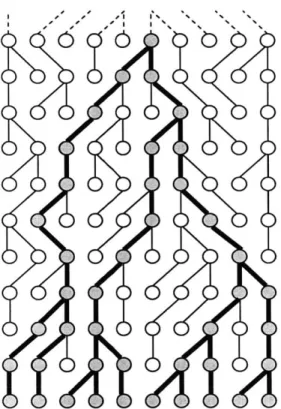
As an example, Figure 3-1 shows a population of 10 chromosomes over several generations. Some chromosomes will have multiple descendents, while others will have no descendents. Eventually, looking back far enough will identify a common ancestor for all 10 current chromosomes in the population. As described later in Section 6.2.3, the ancestral state of a human polymorphism can be discovered by examining the corresponding site in non-human primates.
Coalescent simulations are based upon this assumption that all chromosomes are ultimately derived from a single ancestral chromosome. The lineages of chromosomes in the resulting sample are traced back until a common ancestor is found. From that point on backwards, these chromosomes share the same genetic history. The genetic history in Figure 3-1 can also be represented as the tree shown in Figure 3-2, which
only shows the relevant nodes rather than the entire population.
A mutation that occurs in an ancestral chromosome also appears in all descendent
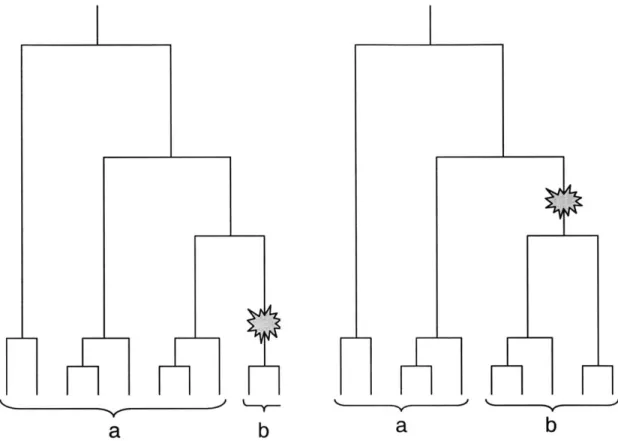
chromosomes. After constructing the coalescent tree, mutations are placed on certain ancestral chromosomes, indicating that an individual during that branch of genetic history underwent a mutation. Since mutations only affect chromosomes that descend from the individual in which the mutation first occurred, recent mutations tend to have lower frequencies than older mutations (Figure 3-3).
The simulation then constructs the chromosomes using the ancestral trees and mutations. The simulated data gives complete sequence information for the popula-tion sample, where each mutated posipopula-tion is known, as are the identities of ancestral alleles.
Figure 3-1: Genetic history of a constant population size 10. The oldest generation is at the top; the darkened nodes and lines represent the ancestors of the current population (bottom row).
E
0K1
77
0_ 0 0E
Figure 3-2: A coalescent tree. The same population as in Figure 3-1, but showing only the relationships among the chromosomes in the current generation.
3.2
Null
model
The model most often used to generate simulated data produces data which differs from empirical data in many important respects. The typical model, hereafter referred to as the null model, includes the following parameters:
" constant population size Ne = 10,000
" constant mutation rate p = 2 * 10-8 muts/base/gen " uniform recombination rate r =1 * 10-8 recs/base/gen
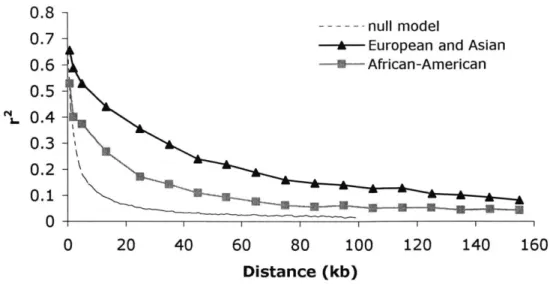
As seen in Figure 3-4, LD patterns produced by this model do not match empir-ical data. The choice of constancy for the three parameters (Ne, p, r) is not based on biological evidence (indeed, each is implausible), but is a computational conve-nience that produces ease of modeling. The null model provides a surprisingly good approximation for examining basic genetic observations, but in light of the increas-ingly detailed human genetic data available today, we need to go beyond these simple assumptions and build more realistic models.
k
K
7I
b
K
a
7I
a
6
2
Figure 3-3: Ancient versus recent mutations. The figure on the left shows a recent mutation producing a low frequency marker, while the figure on the right shows an older mutation producing a higher frequency marker. The chromosomes in group a have the ancestral allele; the chromosomes in group b have the new mutation.
0.8
- ---- null model
0.7 ---- European and Asian
0.6 -- U- African-American 0.5 L 0.4 - 0.3- 0.2- 0.1-0 20 40 60 80 100 120 140 160 Distance (kb)
Figure 3-4: Empirical versus simulated data. Empirical data is from Gabriel et al. [6], simulated data is generated under the null model and ascertained with a TSC-like method described in Section 2.3.
3.3
Non-uniform recombination
Regional recombination rates (average rates over a few hundred kilobases) vary across the genome, from less than 0.5 cM/Mb to more than 3 cM/Mb [15]. In addition, Jeffreys et al. [11] and many other studies have shown evidence of recombination hotspots in humans and other organisms [2, 13, 27, 32, 33], implying some regional variation may be due to the variable distribution of these hotspots.
The ability to simulate these hotspots is key to obtaining an accurate picture of the LD patterns in the genome, since hotspots tend to preserve LD in areas between the hotspots. Without hotspots, the simulations produce data with a much shorter extent of LD than is observed in empirical data [34].
3.4
Multiple populations
Simulating multiple populations allows us to compare differences between popula-tions. One such measure is FST, a measure of the genetic distance between subpop-ulations by comparing the allele frequencies for each marker. Here we use the Weir
and Cockerham formula [30].
Gabriel et al. [6] found that block boundaries are often preserved across popu-lations. The ability to model multiple populations will allow us to simulate these observations.
3.5
Haplotypes
A simulator that outputs haplotypes rather than the relationship between only two
markers has the advantage that patterns over several SNPs can be analyzed. Studies have investigated the extent and causes of regions of limited haplotype diversity, or
haplotype blocks [3, 6, 12, 18, 21, 29, 34]. These regions often have only four or
five common haplotypes throughout the population, even when 10 or more SNPs are examined. In this paper we use the haplotype block definition in Gabriel et al. [6], which searches for series of SNPs that have high pairwise LD. For a review of this definition, please refer to Appendix A.2.
Chapter 4
Problem statement
4.1
The need for an enhanced simulator
As seen in Figure 3-4, the null model does not fit empirical data well for characteristics such as LD. To draw accurate conclusions from simulated data, we need to be able to create data which looks realistic.
Specifically, we would like to match the following characteristics: Allele frequency
Allele frequency is the distribution of frequency of alleles at variable sites.
LD patterns
As described in Section 2.1, LD is the measure of non-random asso-ciation between two markers. We examine the relationship between LD and physical distance.
Fraction of ancestral alleles
This is the probability that an allele of a given frequency is ancestral. Genetic distance between subpopulations
As defined in Section 3.4, FST is a measure of genetic distance be-tween subpopulations.
variable recombination multiple populations haplotypes
Hudson N Y Y
Schaffner Y Y N
Posada Y N Y
Table 4.1: Current simulators and available features The three simulators
com-pared are Hudson's make samples simulator[8], Schaffner's two-locus simulator[26], and Posada's SNPsim program[22].
Length of haplotype blocks
For each population, we examine the average length of haplotype
blocks for three groups of blocks: all blocks, blocks longer than 20kb
and blocks longer than 10kb. As noted in Section 3.5, the definition used in this paper is from Gabriel et al. [6].
Haplotype block genome coverage
After calculating the length of haplotype blocks, we are also
inter-ested in how much of the genome falls within blocks.
Of the capabilities described in Sections 3.3-3.5, Table 4.1 shows that of the three
coalescent simulators surveyed, none of them has all the desired features. The goal of this thesis is to create a tool to fulfill that need.
4.2
Needed features
This section describes the needed features for the simulator.
4.2.1
Non-uniform recombination rate
We need the flexibility to model non-uniform recombination rates. The user should have complete freedom to specify any recombination model.
4.2.2 Support for multiple populations and population events
The user should be able to specify a wide variety of population events involving one or more populations. These events include:
Population size changes
Populations size changes will include both instantaneous and expo-nential size changes.
Bottlenecks
A bottleneck represents a brief period with a very small population
size, or any event which produces a similar effect. Expansions
An expansion is an exponential growth of a population, such as the population growth following the agricultural revolution.
Admixtures
Admixtures occur when two populations mix and breed with each other.
Splits
Splits occur when one part of a population leaves to form, or to join, another population.
4.2.3 Haplotype output
The output should be simulated haplotypes, in order to examine relationships between a sequence of SNPs, rather than just pairwise SNP comparisons. This allows us to study characteristics such as haplotype blocks.
4.2.4 History log
After drawing conclusions from the simulated data, we can look at the various events and correlate the characteristics of the haplotypes to the underlying historical events. For example, we may be interested in determining the contribution of recombination
events to haplotype block boundaries. We can generate our sequences, find the hap-lotype blocks, and return to the history log to determine where the recombination events occurred.
4.3
Engineering constraints
In addition we also need to observe the following constraints.
Programming in ANSI C Current software in population genetics is often written in C. Because we are creating a tool that population geneticists will need to be able to alter and add functions to, we need to use a commonly used language.
Modularity The program must be as modular as possible, both for ease of devel-opment but also ease of customization by others. We may want to add features as new datasets become available.
Ease of use Since we are providing the ability to use complex models, we need to ensure that the input to the program is easily read by the user.
4.4
Advantages of a flexible simulator
The data generated by this simulator will better resemble empirical data. This flexi-bility will let researchers tailor the simulated output to their relevant data sets. They can then analyze available data in the context of more accurate simulations.
This simulator can also be used to examine theories of human migration. The out of Africa theory has been shown to contribute to the reduced diversity in non-African populations. One can estimate the likelihood of a proposed event by examining the event's effects on the characteristics of the simulated sequence, and comparing those characteristics to the same measures derived from empirical sequence.
Chapter 5
Implementation of CoSi
The options when approaching this project were to modify an existing program by adding necessary features, or to write a simulator from scratch. After investigating existing programs, we decided to write an original program, in order to meet our desired constraints specified in the last chapter.
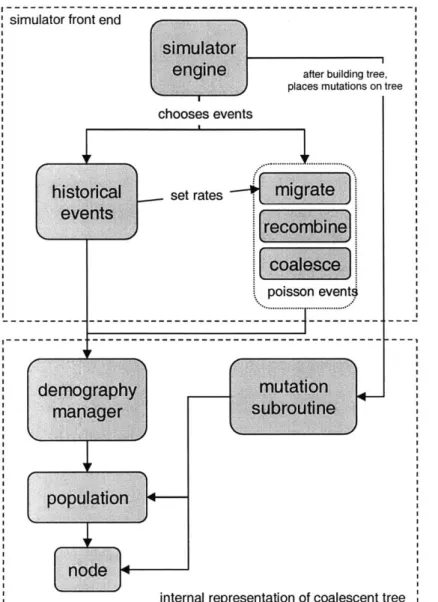
Figure 5-1 shows the structure of the program, CoSi (Coalescent Simulator). The simulator engine executes the simulation by manipulating the data representation maintained by the demography manager, through Poisson and historical events. After constructing the complete coalescent tree, the engine calls the mutation subroutine to place mutations and output haplotypes.
5.1
Null model, no recombination
Initially we implemented a simple coalescent simulator and ensured that it met the-oretical values for the time to the most recent common ancestor. The time to reduce
the population from n to n - 1 chromosomes is Ts,
4N
E [Tn] =~ n(n -1)
where N is the population size. For k chromosomes sampled from a population of
simulator front end
simulator
engine after building tree, places mutations on tree
chooses events
historical
set rateseve nts [recombine coalesce poisson event---... ... ...-demography mutation
manager
subroutine
population
ncodeinternal representation of coalescent tree F
-- : tru-t- r --- I
30- 25- 20- 15- 10- 5-0 0 20 40 60 80 100 120 140 160 180 200 generations (10)
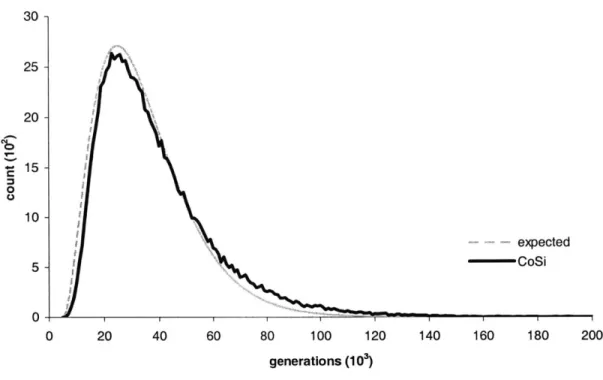
Figure 5-2: Distribution of coalescent times over 105 independent trials.
The expected distribution is given by
P(tjk, 0) P(t, kj|) P(k|9) (OT)2 e-T(1+)/2 1+0 1+0 t 2Ne 9 = ANy
where [p is the mutation rate and k is the number of samples.
Figure 5-2 shows the distribution of these values for 10' independent simulations (null model, no recombination) against the expected distribution. This simulation, and all described in this thesis, are for 100 randomly sampled chromosomes per pop-ulation. Cv 0 0 -1 expected -CoSi I
0.45 - 0.4- 0.35- 0.3- 0.25- 0.2- 0.15-E CoSi 0.1 - E3 expected 0.05 0--<5% 5-10% 10-15% 15-20% 20-25% 25-30% 30-35% 35-40% 40-45% 45-50%
minor allele frequency
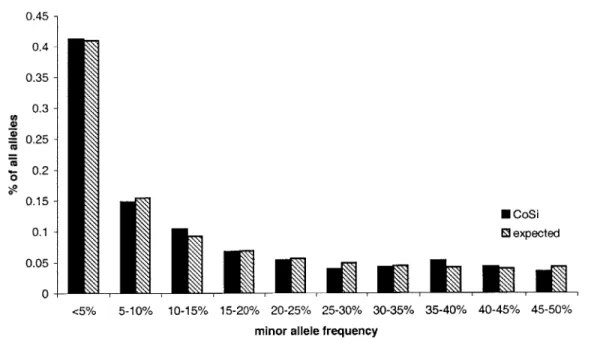
Figure 5-3: Minor allele frequency distribution for 102 independent trials.
5.2
Uniform recombination
Uniform recombination completes the basic coalescent simulator. Recombinations, like coalescences, are Poisson events with parameter A,
A = rl ni
iCP
where r is the recombination rate, I is the length of the chromosome, P is the set of all populations, and ni is the number of nodes in population i.
Mutations are placed on the chromosome in an exponentially distributed manner. The number of mutations for each segment unbroken by recombination is proportional to the time in all the branches of the genetic tree for that segment.
The expected number of SNPs with frequency
f
is proportional to1
fk
where k is the number of samples
[25,
p.26]. Figure 5-3 shows the graph of allele5.3
Non-uniform recombination
In lieu of limiting the user to predefined recombination models, we allow complete freedom by defining the recombination rate with a piecewise model specified by the user in a text file. The total recombination rate is determined by integrating the rate over the region, and the recombination events are distributed accordingly.
A more extensive look at non-uniform recombination rate will be given in
Sec-tion 6.1.
5.4
Population events: single populations
The events in the next two sections are described briefly, along with implementation details when relevant.
5.4.1
Population size changes
Two types of population size changes were implemented. Populations can either undergo an instantaneous size change, or can change their size exponentially over a specified number of generations.
5.4.2
Bottlenecks
A bottleneck is a specific instance of population size change. Bottlenecks are events
where the population size is severely reduced for a short period. Many coalescences occur during the bottleneck and as a result, many variations become fixed or are lost. As described in Section 2.4.2, the out of Africa event was a major bottleneck event.
The inbreeding coefficient F defines the severity of the bottleneck. F is the prob-ability that two randomly chosen chromosomes share a common ancestor during the bottleneck. F can be calculated from the length of the bottleneck t and the size of the population during the bottleneck N,
The value of F completely determines the effect of the bottleneck. In other words, the effect of a bottleneck can be considered without the specific knowledge of t and
N, and can thus be considered an instantaneous event. To simulate this event, we set the length t to one generation, and calculate the appropriate population size. Using this size (which will be improbably small), we then calculate how many coalescences occur in that generation.
5.5
Population events: multiple populations
Each population is a list of chromosomes we are currently simulating. Coalescences can only happen within a population, so to represent a migration we move a chromo-some from one population to another (Figure 5-4).
A migration rate can be specified for every pair of populations {i,
j},
which is the probability per chromosome that a chromosome migrates from i to j in each generation. This is implemented as a Poisson event, along with coalescence and recombination.Larger scale moves between populations are implemented as user-specified events.
A split occurs when a population breaks into two separate populations; an admixture
occurs when two populations combine. Because the coalescent works in the reverse direction, a split is represented by combining two populations. An admixture is repre-sented by creating a new population, with a certain probability that each chromosome in the original population will join the new population.
p---
A
---
_P...
popB
B---Figure 5-4: Multiple populations and migration. During a migration event (in the forward direction), one chromosome moves from population B to population A
(dotted arrow). The simulator represents this event by moving a chromosome from population A to population B (solid arrow) and allowing it to coalesce (and recombine, not shown here) with any of the chromosomes in population B.
Chapter 6
Using CoSi
This section describes experiments using CoSi on complex models. First we examine models of recombination, then we simulate a comprehensive population model.
All simulated data shown in this section is ascertained in a TSC-like method
described in Section 3.5.
6.1
Developing a recombination model
We use CoSi to build a model of non-uniform recombination. We start with uniform recombination, which we will refer to as HO for recombination, and build a model using nested hypotheses. Because we are using a constant population, we compare our results with empirical African-American data, which appears to fit the constant population model. All simulations are 100kb in length, with 100 independent trials. For the constant recombination rate in HO we use the standard value r 1 * 10-.
We also use the mean recombination rate for hypothesis H1 described below, 1.6*10-',
denoted as model H 6. LD patterns for HO are shown in Figure 6-1 and block statistics
are shown in Table 6.1 (along are the block statistics for the next two models). The first variation that we explore, H1, is regional variation across the genome.
We draw our rates from a distribution based on the Gabriel et al. dataset [6]. Each of these segments has a uniform recombination rate. As seen in Figure 6-2, regional variation creates only a slight increase in LD.
0.8 0.7 0.6 0.5 1 0.4 0.3 0.2 0.1 0 40 60 Distance (kb) 80 100
Figure 6-1: LD versus physical distance for uniform recombination, HO Average block size
(%
Genome coverage)all blocks > 20 kb > 10 kb
Ho 5.9 (84.8) 23.9 (5.37) 15.2 (23.5)
H01.6 1.9 (29.6) - 12.2 (1.6)
H1 2.2 (31.3) 22.4 (0.7) 13.2 (5.0)
H2 10.5 (70.8) 33.6 (34.4) 21.9 (57.4)
Table 6.1: Block statistics for HO,H 1, and H2 recombination models. Gabriel et al
observed block sizes of 9kb in African populations.
. [6]
Next, we vary the local recombination rate by adding hotspots (H2), in addition to
using the distribution of H1. We add hotspots with an exponential distribution with
mean spacing 9kb, and distribute the recombination probability as a 10% background rate and a 90% hotspot rate. LD patterns and block statistics are shown in Figure 6-3.
6.2
Comprehensive model
The model shown in Figure 6-4 is the comprehensive model developed by S.F. Schaff-ner and used in this section. This model is used with both the HO (r = 1x10⁻⁸)
and H2 recombination model described in Section 5.1. The empirical data referred to
in the next section are from Gabriel et al. [6], which surveyed 51 autosomal regions
0 20
.
40 60
Distance (kb)
80 100
Figure 6-2: LD patterns for regional uniform recombination rates chosen from a distribution, H, 0.8 0.7 -0.6 -0.5 -LM 0.4 0.3 0.2 0.1 -0 0 20 40 60 80 100 Distance (kb)
Figure 6-3: LD patterns for hotspot recombination model H2
0.8 -0.7 0.6 0.5 N 0.4 0.3 0.2 0.1 0 0 20 ' . . . . .
spanning 13 Mb.
6.2.1
Allele frequency
Figures 6-5, 6-6, and 6-7 show the allele frequency distribution for the European, Asian, and African-American populations, against the empirical values. The allele frequencies are for all markers found across all populations. The African-American population has low monomorphic alleles as expected, since the bottlenecks in non-African populations tend to fixate alleles, resulting in more monomorphisms.
6.2.2
LD versus physical distance
The LD graphs referred to in this section use only alleles with minor allele frequency
> 20%, for both empirical and simulated data. Figures 6-8 and 6-9 show the LD patterns for the model with constant recombination. The extent of LD is higher than the null model (Figure 3-4) but does not show as much high LD as the empirical data. Figures 6-10 and 6-11 show the patterns for the complete model. LD levels at shorter distances are elevated, possibly due to the lack of gene conversion, but the LD values at distances greater than 40kb appear to approximate the empirical data well.
6.2.3
Fraction of ancestral chromosomes
For empirical data, the probability that an allele of a given frequency is ancestral,
P(ancestral), is found by comparing human sequences to chimpanzee sequences. For
a constant size population, the probability that an allele represents the ancestral state is equal to its frequency. The African population history is the closest to a constant population, and P(ancestral) appears to have the expected linear relationship. For European and Asian populations, however, P(ancestral) deviates from the linear value (Figure 6-12). This deviation indicates a bottleneck in the history of these populations.
As seen in Figure 6-13, the CoSi model produces patterns in the African and non-African populations that are similar to the empirical observations.
nd N = 24,000
L~I~
Bottleneck F = 0.075 Bottleneck Bottleneck F=0.06 F = 0.04 N = 100,000 100,000 Migration.r.te Migration rate 200 2 / 10000 chroms N = 100,000 ---Migration rate 15 / 10000 chromsFigure 6-4: Population model used in Section 6.2. The gray boxes indicate the time of the event, where the number indicates how many generations ago the event occurred. The migration rates are given in the number of migrations per chromosome per generation.
N = 16,000
0.3 -E 0.25 -7. L E 0.2-0 E 20.15-0 C. o 0.1 C nNN 0 mono < 1 .1 - .2 .2 .3 .3- .4 .4- .5
Minor allele frequency
Figure 6-5: Allele frequency of simulated European population. The gray bars represent the allele frequencies observed in empirical data. Error bars represent
standard deviation. 0.3- 0.25-E 0.2-0 E 0.15-7. o 0.1 -C 0 U 0.05- 0--mono T TN .1-2 2-3 3- 4 4 4.5 < .1
Minor allele frequency
Figure 6-6: Allele frequency of simulated Asian population. The gray bars rep-resent the allele frequencies observed in empirical data. Error bars reprep-resent standard deviation.
T T 0.3 E ( 0.25 . E 0.2 -0 E 0.15 -.5 00.1 -0. 0.05 - 0-K N < .1 .1 - .2 Minor allele .4 - .5 .2 -. 3 .3-frequency
Figure 6-7: Allele frequency of simulated African-American population. The gray bars represent the allele frequencies observed in empirical data. Error bars represent standard deviation.
--- Sim:African Sim:AA U AA U U U U U 20 0 N 40 60 Distance (kb) E N E 80 100
Figure 6-8: LD for African populations with uniform recombination. In this and following figures and tables, AA and Sim:AA refer to the empirical and simulated African-American datasets, respectively.
mono 0.8 0.7 0.6 0.5 " 0.4-0.3 0.2 0.1 - 0-0 'g
IN
0.8 0.7 -0.6 -0.5 -' 0.4 0.3 0.2 -0.1 0 -0 --- -Sim:European Sim:Asian
A European and Asian
A A '',,. A ''A,,. A AA 20 40 60 80 100 Distance (kb)
Figure 6-9: LD for European and Asian populations with uniform recombination.
A African X AA - Sim:African -Sim:AA A 0 20 40 60 80 100 120 140 160 Distance (kb)
Figure 6-10: LD for African populations using the H2 model of recombination.
N 0.9-0.8 -0.7 -0.6 - 0.5- 0.4- 0.3- 0.2- 0.1-
0-0.9 0.8 * European X Asian 0.7 - Sim:Asian 0.6 - Sim:European 0.5 -* 0.4- 0.3- 0.2- 0.1-0 f 0 20 40 60 80 100 120 140 160 Distance (kb)
Figure 6-11: LD for European populations using the H2 model of recombination.
0.5-* 0.4- 0.3--+- European A-Asian c -U-AA -x- African U 0.1 -0 0 0.1 0.2 0.3 0.4 0.5
Minor allele frequency
Figure 6-12: Fraction of ancestral alleles in empirical data. The dotted line indicates the linear relationship.
-+- Sim:European -a- Sim:Asian
-U- Sim:AA
-x- Sim:African
0.2 0.3
Minor allele frequency
0.4 0.5
Figure 6-13: Fraction of ancestral alleles in simulated data. graph to Figure 6-12, which shows the corresponding empirical data.
Compare this Sim. Emp. African, European 0.168 0.157 African, AA 0.010 0.016 African, Asian 0.158 0.200 European, AA 0.116 0.110 European, Asian 0.102 0.139 AA, Asian 0.109 0.162
Table 6.2: FST values for simulated and empirical data
6.2.4
Genetic distance between subpopulations
Table 6.2 shows the FST values for each pair of populations. The non-Asian compar-isons represent the empirical data well, but the Asian values are low. This will later be examined by further altering the population parameters.
6.2.5
Haplotype blocks and block coverage
See Figure 6.3 for haplotype block statistics for simulated populations. Gabriel et al. found average block lengths of 9kb in the African samples and 18kb in the European and Asian samples, with a wide range of sizes (< 1kb to 174kb) [6}. As seen in Figure 6.3, the average block size for the simulated African populations is close to the
0.5-0.4 c) 0.3 cc " 0.2 0 0.1 0 0 0.1
A Uniform recombination
Average block size
(%
Genome coverage)All blocks > 20 kb > 10 kb
Sim:African 2.5 (15.8) - 11.8 (1.9)
Sim:AA 2.4 (15.8) - 12.8 (2.2)
Sim:European 6.0 (28.9) 25.1 (5.0) 16.0 (16.0)
Sim:Asian 4.2 (24.9) 22.1 (1.1) 14.1 (8.7)
B Recombination hotspot model Average block size (% Genome coverage)
All blocks > 20 kb > 10 kb
Sim:African 9.6 (65.5) 32.2 (32.5) 21.7 (51.9)
Sim:AA 9.5 (65.7) 31.9 (32.8) 22.2 (51.3)
Sim:European 16.0 (77.0) 41.1 (55.1) 30.8 (67.5)
Sim:Asian 14.0 (74.8) 35.8 (48.3) 26.2 (64.8)
Table 6.3: Haplotype block statistics for complex population model, with
(A) and without (B) recombination hotspots. Gabriel et al. observed blocks of 9kb
and 18kb for African and non-African populations respectively.
desired average. Non-African populations show a lower than desired block average, which will be investigated in future work. These figures also indicate that a hotspot recombination model is essential for reproducing the desired block lengths.
Chapter 7
Conclusions
This paper has described CoSi, a new coalescent simulator with the flexibility to model SNP data that resembles empirical data.
7.1
Goals met
This section reiterates the requirements set in Chapter 4, and how CoSi satisfies these requirements.
Development of CoSi A simulator, CoSi, which provides much-needed flexibility was developed as described in Chapter 5. CoSi allows for user-specified non-uniform recombination, multiple populations, and a variety of population events.
Correctness of CoSi CoSi implements the basic coalescent process correctly. Re-sults using simple models match theoretical reRe-sults, as shown in Sections 5.1-5.3. Desired features available CoSi is capable of simulating a variety of popula-tion events for one or more populapopula-tions, and can use any user-defined recombinapopula-tion model.
Simulated data resembles empirical data As seen in Section 6.4, CoSi can
researchers to draw more accurate conclusions about the underlying causes of observed genomic patterns.
Software engineering CoSi is implemented in ANSI C. The program is modular, as evidenced by the design in Section 5.1. Crucial elements are abstracted from the simulator to allow for greater flexibility, such as the recombination model described in Section 6.1. The parameter file is clear and easily read (Appendix B.1).
7.2
Uses and extensions of CoSi
As seen in Section 6.4, CoSi can be used to simulate complex population models. The data have characteristics which are also exhibited by empirical data. This thesis used a model developed to match a specific dataset, but CoSi could be used to model any proposed scenario.
In Section 6.1, we use CoSi to compare various recombination models. Other models could also be evaluated, such as the "warm and cool zones" proposed by Zhang et al. [34]. The advantage of the user-defined recombination model used in CoSi is that it offers complete flexibility to the researcher.
CoSi can easily be modified to include other components such as gene conver-sion [1], selection [9, 10, 19], or double mutations (for example, to simulate mitochon-dria).
The ability to generate realistic simulation data with CoSi provides researchers with the unprecedented opportunity to use simulations in a reliable way. Studies will be able to look at the entire model at once, rather than simulating each component separately. As genomics continues to expand into larger scale studies, simulations will become indispensable for proposing new studies, and for analyzing the underlying forces that shape our genetic information.
Appendix A
Additional background information
A.1
Linkage disequilibrium
Linkage disequilibrium (LD) is the measure of allelic association between two markers, and is often measured by r2 and D'. Both r2 and D'
are related to a quantity D which measures the difference between expected and observed haplotypes. For two alleles with values A/a and B/b, these values are defined as follows:
D = fAB - fAfB f 2 D 2 A fa B fa D'= D| Dmax
,Dmax ={
mirt(fA f, fafB), D > 1 min(fA fB, fafb), D < 1where fA is the frequency of allele A, fa is the frequency of allele a (equal to 1 - fA),
A.2
Finding haplotype blocks
Gabriel et. al [6] describes a block definition that uses a confidence limit on D'. Since
D' gives high values to low frequency SNPs, the limit is calculated by determining the probability that a given D' could have produced the observed data, over all values of D', and examining the upper and lower 5% bounds.
Based on their confidence limits, each pair of markers is classified as a pair in strong
LD, a pair with strong evidence of recombination, or an uninformative pair. Blocks
are defined as continuous stretched of segments where at least 95% of the informative pairs exhibit strong LD. The specific parameters were determined empirically.
Appendix B
CoSi inputs
Inputs to CoSi are shown in this section.
B.1
Parameter file
This is the parameter file used to generate the simulations in Section 6.2. Comparison with Figure 6-4 should be straightforward. Keep in mind that the simulator works backwards. The following section explains the recombination file.
# sample file
# comments have #s in front of them
# newlines don't matter.
# sets the length of the segment, in base pairs.
length 200000
# mu, here it is 2e-8
mutation-rate 0.00000002
# recomb file
recomb-file model.out
# population info
# for each population, include a line:
# pop-define pop-index pop-label
pop-define 1 european pop-define 3 african-american pop-define 4 asian pop-define 5 african pop-define 6 afr2 pop-define 7 eurafr
# for each sample set, include
# pop-size pop-label pop-size
# sample-size pop-label sample-size
#european pop-size 1 100000 sample-size 1 100 #african american pop-size 3 100000 sample-size 3 100 #asian pop-size 4 100000 sample-size 4 100 #african pop-size 5 100000 sample-size 5 100
# FORMAT OF POPULATION EVENTS
# pop-event admix "label" from-pop-index to-pop-index gen to-pop-size .moved
# pop-event split "label" origin-pop-index new-pop-index gen
# pop-event bottleneck "label" pop-index gen coeff
# pop-event migration-rate "label" from-pop-index to-pop-index gen rate
# pop-event change-size "label" pop-index gen new-size
# pop-event exp-change-size "label" pop-index start-gen end-gen startsize endsize
# Comprehensive population model
# Set migration rates
pop-event migration-rate "afr->eur migration" 5 1 0 .00002 pop-event migration-rate "as->eur migration" 4 1 0 .00015
# Create African-American population
pop-event admix "african american pop" 3 7 5 100000 .2
pop-event split "european to aa" 1 7 6 pop-event split "african to aa" 5 3 7
# Agricultural expansions
pop-event change-size "agriculture - african" 5 200 24000
pop-event change-size "agriculture - european" 1 350 7500 pop-event change-size "agriculture - asian" 4 400 7500
# Mixing of African2 and European populations, followed
# immediately by Asian and European split and bottlenecks. # Eliminate migration rate, since Asian population ceases # to exist.
pop-event migration-rate "as->eur migration" 4 1 1997 0
pop-event bottleneck "asian bottleneck" 4 1998 .04 pop-event bottleneck "european bottleneck" 1 1999 .06
pop-event split "asian and european split" 1 4 2000
pop-event admix "african2 european admix" 1 6 2001 16000 .04
# Out of Africa event
pop-event migration-rate "afr->eur migration" 5 1 3498 0 pop-event bottleneck "OoA bottleneck" 1 3499 .075 pop-event split "out of Africa" 5 1 3500
# African expansion
pop-event change-size "african pop size" 5 5000 16000
# African2 population split
B.2
Recombination input file
The format of the recombination file is a piecewise definition of the recombination model:
[Position (bp)] [recombination rate (recs/bp/gen)]
The following is a recombination file from a model with hotspots.
1 1.3306e-09 79444 8.50665e-05 79445 1.3306e-09 80251 7.76718e-05 80252 1.3306e-09 81680 0.00111013 81681 1.3306e-09 112343 1.9749e-09 112344 1.3306e-09 113767 0.000157409 113768 1.3306e-09 116201 1.42287e-05 116202 1.3306e-09 130617 2.90585e-07 130618 1.3306e-09 130792 0.000124841 130793 1.3306e-09 131085 1.10916e-05 131086 1.3306e-09 131213 0.00096577 131214 1.3306e-09 133475 0.000215526 133476 1.3306e-09 134662 0.00140553 134663 1.3306e-09 137603 0.000639362 137604 1.3306e-09 140671 8.91719e-06 140672 1.3306e-09 167331 3.19626e-05 167332 1.3306e-09 169877 0.00056655 169878 1.3306e-09 173184 2.73664e-06 173185 1.3306e-09



![Table 4.1: Current simulators and available features The three simulators com- com-pared are Hudson's make samples simulator[8], Schaffner's two-locus simulator[26], and Posada's SNPsim program[22].](https://thumb-eu.123doks.com/thumbv2/123doknet/14420563.513232/30.918.173.752.90.186/current-simulators-available-features-simulators-simulator-schaffner-simulator.webp)