HAL Id: hal-01217897
https://hal.archives-ouvertes.fr/hal-01217897
Submitted on 20 Oct 2015HAL is a multi-disciplinary open access archive for the deposit and dissemination of sci-entific research documents, whether they are pub-lished or not. The documents may come from teaching and research institutions in France or abroad, or from public or private research centers.
L’archive ouverte pluridisciplinaire HAL, est destinée au dépôt et à la diffusion de documents scientifiques de niveau recherche, publiés ou non, émanant des établissements d’enseignement et de recherche français ou étrangers, des laboratoires publics ou privés.
Proceedings of the 8th Cologne-Twente Workshop on
Graphs and Combinatorial Optimization
Sonia Cafieri, Antonio Mucherino, Giacomo Nannicini, Fabien Tarissan, Leo
Liberti
To cite this version:
Sonia Cafieri, Antonio Mucherino, Giacomo Nannicini, Fabien Tarissan, Leo Liberti. Proceedings of the 8th Cologne-Twente Workshop on Graphs and Combinatorial Optimization. Paris, France. 2009. �hal-01217897�
8
th
Cologne-Twente Workshop on
Graphs and Combinatorial
Optimization
CTW09
´
Ecole Polytechnique and CNAM
Paris, France, June 2-4, 2009
Proceedings of the Conference
Sonia Cafieri,
Antonio Mucherino,
Giacomo Nannicini,
Fabien Tarissan,
Leo Liberti
8
thCologne-Twente Workshop on
Graphs and Combinatorial Optimization (CTW09)
´
Ecole Polytechnique and CNAM
Paris, France, June 2-4, 2009
The Cologne-Twente Workshop (CTW) on Graphs and Combinatorial Opti-mization started off as a series of workshops organized bi-annually by either K¨oln University or Twente University. As its importance grew over time, it re-centered its geographical focus by including northern Italy (CTW04 in Menaggio, on the lake Como and CTW08 in Gargnano, on the Garda lake). This year, CTW (in its eighth edition) will be staged in France for the first time: more precisely in the heart of Paris, at the Conservatoire National d’Arts et M´etiers (CNAM), between 2nd and 4th June 2009, by a mixed organizing committee with members from LIX, ´Ecole Polytechnique and CEDRIC, CNAM.
As tradition warrants, a special issue of Discrete Applied Mathematics (DAM) will be devoted to CTW09, containing full-length versions of selected presentations given at the workshop and possibly other contributions related to the workshop topics. The deadline for submission to this issue will be posted in due time on the CTW09 websitehttp://www.lix.polytechnique.fr/ctw09.
The Proceedings Editors wish to thank the members of the Program Commit-tee: U. Faigle (Universit¨at zu K¨oln), J. Hurink (Universiteit Twente), L. Liberti ( ´Ecole Polytechnique), F. Maffioli (Politecnico di Milano), G. Righini (Universit`a degli Studi di Milano), R. Schrader (Universit¨at zu K¨oln), R. Schultz (Universit¨at Duisburg-Essen), for setting up such an attractive program. Special thanks also go to the anonymous referees. This conference was partially sponsored by: the Digiteo (www.digiteo.fr) foundation, CNRS, and the Thales Chair at LIX.
Editors: SONIA CAFIERI ANTONIO MUCHERINO GIACOMO NANNICINI FABIEN TARISSAN LEO LIBERTI
Organization
The CTW09 conference is co-organized by the Laboratoire d’Informatique (LIX) at ´Ecole Polytechnique and by the Centre d’Etude et Recherche en Informa-tique du CNAM (CEDRIC) at the Conservatoire National d’Arts et Mtiers (CNAM).
Scientific Committee
• U. Faigle (Universit¨at zu Koln) • J.L. Hurink (Universiteit Twente) • L. Liberti ( ´Ecole Polytechnique, Paris) • F. Maffioli (Politecnico di Milano)
• G. Righini (Universit`a degli Studi di Milano) • R. Schrader (Universit¨at zu Koln)
• R. Schultz (Universit¨at Duisburg-Essen)
Organizing Committee
• S. Cafieri (LIX, ´Ecole Polytechnique) • M.-C. Costa (CEDRIC, CNAM) • C. D¨urr (LIX, ´Ecole Polytechnique)
• L. Liberti (Chair – LIX, ´Ecole Polytechnique) • A. Mucherino (LIX, ´Ecole Polytechnique) • G. Nannicini (LIX, ´Ecole Polytechnique) • C. Picouleau (CEDRIC, CNAM)
• M.-C. Plateau (GdF) • J. Printz (CMSL, CNAM)
• E. Rayssac (LIX, ´Ecole Polytechnique) • F. Tarissan (LIX, ´Ecole Polytechnique)
Table of Contents
Traveling Salesman Problem
Lecture Hall A, Tue 2, 08:45–10:15
C. Dong, C. Ernst, G. Ja¨eger, D. Richter, P. Molitor
Effective Heuristics for Large Euclidean TSP Instances Based on Pseudo Backbones 3
M. Casazza, A. Ceselli, M. Nunkesser
Efficient Algorithms for the Double Traveling Salesman Problem with Multiple Stacks 7
M. Bruglieri, A. Colorni, A. Lue
The Parking Warden Tour Problem 11
Graph Theory I
Lecture Hall B, Tue 2, 08:45–10:15 I. Sau, D. Thilikos
On Self-Duality of Branchwidt in Graphs of Bounded Genus 19
S. Nikolopoulos, C. Papadopoulos
A Simple Linear-Time Recognition Algorithm for Weakly Quasi-Threshold Graphs 23
H. Gropp
From Sainte-Lagu¨e to Claude Berge — French Graph Theory in the Twentieth Century 28
Combinatorial Optimization
Lecture Hall A, Tue 2, 10:30–12:30 J. Maßberg, T. Nieberg
Colored Independent Sets 35
V. Lozin
A Note on the Parameterized Complexity of the Maximum Independent Set Problem 40
G. Nicosia, A. Pacifici, U. Pferschy
On Multi-Agent Knapsack Problems 44
L. Simonetti, Y. Frota, C. Souza
Coloring I
Lecture Hall B, Tue 2, 10:30–12:30 R. Machado, C. de Figueiredo
NP-Completeness of Determining the Total Chromatic Number of Graphs that do not
Contain a Cycle with a Unique Chord 55
R. Kang, T. M¨uller
Acyclic and Frugal Colourings of Graphs 60
P. Petrosyan, H. Sargsyan
On Resistance of Graphs 64
E. Bampas, A. Pagourtzis, G. Pierrakos, V. Syrgkanis
Colored Resource Allocation Games 68
Cutting and Packing
Lecture Hall A, Tue 2, 14:00–15:30 C. Arbib, F. Marinelli, C. Scoppola
A Lower Bound for the Cutting Stock Problem with a Limited Number of
Open Stacks 75
H. Fernau, D. Raible
Packing Paths: Recycling Saves Time 79
J. Schneider, J. Maßberg
Rectangle Packing with Additional Restrictions 84
Paths
Lecture Hall B, Tue 2, 14:00–15:30 F. Usberti, P. Franc¸a, A. Franc¸a
The Open Capacitated Arc Routing Problem 89
M. Maischberger
Optimising Node Coordinates for the Shortest Path Problem 93
R. Bhandari
The Sliding Shortest Path Algorithms 97
Quadratic Programming
Lecture Hall A, Tue 2, 15:45–16:45 W. Ben-Ameur, J. Neto
A Polynomial-Time Recursive Algorithm for some Unconstrained
I. Schuele, H. Ewe, K.-H. Kuefer
Finding Tight RLT Formulations for Quadratic Semi-Assignment Problems 109
Trees
Lecture Hall B, Tue 2, 15:45–16:45
V. Borozan, R. Muthu, Y. Manoussakis, C. Martinhon, A. Abouelaoualim, R. Saad
Colored Trees in Edge-Colored Graphs 115
K. Cameron, J. Fawcett
Intermediate Trees 120
Plenary Session I
Lecture Hall A, Tue 2, 16:45–17:30 A. Lodi
Bilevel Programming and Maximally Violated Valid Inequalities 125
Integer Programming
Lecture Hall A, Wed 3, 08:45–10:15 R. Schultz
Decomposition Methods for Stochastic Integer Programs with
Dominance Constraints 137
S. Kosuch, A. Lisser
On a Two-Stage Stochastic Knapsack Problem with Probabilistic Constraint 140
G. Cornu´ejols, L. Liberti, G. Nannicini
Improved Strategies for Branching on General Disjunctions 144
Graph Theory II
Lecture Hall B, Wed 3, 08:45–10:15 G. Katona, I. Horv´ath
Extremal Stable Graphs 149
V.A. Leoni, M.P. Dobson, Gr. Nasini
Recognizing Edge-Perfect Graphs: some Polynomial Instances 153
M. Freitas, N. Abreu, R. Del-Vecchio
Some Infinite Families ofQ-Integral Graphs 157
Applications
Lecture Hall A, Wed 3, 10:30–12:30 A. Ceselli, R. Cordone, M. Cremonini
V. Cacchiani, A. Caprara, M. Fischetti
Robustness in Train Timetabling 171
F. Roda, L. Liberti, F. Raimondi
Combinatorial Optimization Based Recommender Systems 175
G. Righini, R. Cordone, F. Ficarelli
Bounds and Solutions for Strategic, Tactical and Operational Ambulance Location 180
Coloring II
Lecture Hall B, Wed 3, 10:30–12:30 E. Hoshino, C. de Souza, Y. Frota
A Branch-and-Price Approach for the Partition Coloring Problem 187
M. Soto, A. Rossi, M. Sevaux
Two Upper Bounds on the Chromatic Number 191
F. Bonomo, G.A. Dur´an, J. Marenco, M. Valencia-Pabon
Minimum Sum Set Coloring on some Subclasses of Block Graphs 195
A. Lyons
Acyclic and Star Colorings of Joins of Graphs and an Algorithm for Cographs 199
Exact Algorithms
Lecture Hall A, Wed 3, 14:00–15:30
H. Fernau, S. Gaspers, D. Kratsch, M. Liedloff, D. Raible
Exact Exponential-Time Algorithms for Finding Bicliques in a Graph 205
L. Bianco, M. Caramia
An Exact Algorithm to Minimize the Makespan in Project Scheduling with
Scarce Resources and Feeding Precedence Relations 210
R. Macedo, C. Alves, V. de Carvalho
Exact Algorithms for Vehicle Routing Problems with Different Service Constraints 215
Networks I
Lecture Hall B, Wed 3, 14:00–15:30 D. Lozovanu, S. Pickl
Algorithmic Solutions of Discrete Control Problems on Stochastic Networks 221
L. Belgacem, I. Charon, O. Hudry
Routing and Wavelength Assignment in Optical Networks by Independent Sets
in Conflict Graphs 225
A. Guedes, L. Markenzon, L. Faria
Complexity
Lecture Hall A, Wed 3, 15:45–16:45 A. Scozzari, F. Tardella
On the Complexity of Graph-Based Bounds for the Probability Bounding Problem 235
B. Engels, S. Krumke, R. Schrader, C. Zeck
Integer Flow with Multipliers: The Special Case of Multipliers 1 and 2 239
Polyhedra
Lecture Hall B, Wed 3, 15:45–16:45 R. Stephan
Classification of 0/1-Facets of the Hop Constrained Path Polytope
Defined on an Acyclic Digraph 247
A. Galluccio, C. Gentile, M. Macina, P. Ventura
Thek-Gear Composition and the Stable Set Polytope 251
Plenary Session II
Lecture Hall A, Wed 3, 16:45–17:30 M. Habib
Diameter and Center Computations in Networks 257
Polynomial-time Algorithms
Lecture Hall A, Thu 4, 08:45–10:15 M. Bodirsky, G. Nordh, T. von Oertzen
Integer Programming with 2-Variable Equations and 1-Variable Inequalities 261
D. M¨uller
Faster Min-Max Resource Sharing and Applications 265
A. Bettinelli, L. Liberti, F. Raimondi, D. Savourey
The Anonymous Subgraph Problem 269
Graph Theory III
Lecture Hall B, Thu 4, 08:45–10:15
A. Rafael, F.-T. Desamparados, J.A. Vilches
The Number of Excellent Discrete Morse Functions on Graphs 277
F. Bonomo, G.A. Dur´an, L.N. Grippo, M.D. Safe
Partial Characterizations of Circle Graphs 281
T. Shigezumi, Y. Uno, O. Watanabe
Graph Theory IV
Lecture Hall A, Thu 4, 10:30–12:30
A. Darmann, U. Pferschy, J. Schauer, G. Woeginger
Combinatorial Optimization Problems with Conflict Graphs 293
J.M. Sigarreta, I. Gonzlez Yero, S. Bermudo, J.A. Rodr´ıguez-Vel´azquez
On the Decomposition of Graphs into Offensivek-Alliances 297
M. Brinkmeier
Increasing the Edge Connectivity by One inO(λGn2log(∗)n) Expected Time 301
V. Giakoumakis, O. El Mounir
Enumerating all Finite Sets of Minimal Prime Extensions of Graphs 305
Networks II
Lecture Hall B, Thu 4, 10:30–12:30 C. Bentz
On Planar and Directed Multicuts with few Source-Sink Pairs 313
F. Usberti, J. Gonzlez, C.L. Filho, C. Cavellucci
Maintenance Resources Allocation on Power Distribution Networks with
a Multi-Objective Framework 317
E. Grande, P.B. Mirchandani, A. Pacifici
Column Generation for the Multicommodity Min-cost Flow Over Time Problem 321
F. Tarissan, C. La Rota
Inferring Update Sequences in Boolean Gene Regulatory Networks 325
Bioinformatics
Lecture Hall A, Thu 4, 14:00–15:30 N. Van Cleemput, G. Brinkmann
NANOCONES– A Classification Result in Chemistry 333
A. Mucherino, C. Lavor, N. Maculan
The Molecular Distance Geometry Problem Applied to Protein Conformations 337
G. Collet, R. Andonov, N. Yanev, J.-F. Gibrat
Protein Threading 341
Clustering
Lecture Hall B, Thu 4, 14:00–15:30
J. Correa, N. Megow, R. Raman, K. Suchan
F. Liers, G. Pardella
A Simple MAX-CUT Algorithm for Planar Graphs 351
E. Amaldi, S. Coniglio, K. Dhyani
k-Hyperplane Clustering Problem: Column Generation and a Metaheuristic 355
Games
Lecture Hall A, Thu 4, 15:45–16:15 U. Faigle, J. Voss
A System-Theoretic Model for Cooperation and Allocation Mechanisms 361
Matrices
Lecture Hall B, Thu 4, 15:45–16:15 L.A. Vinh
Distribution of Permanent of Matrices with Restricted Entries over Finite Fields 367
Plenary Session III
Lecture Hall A, Thu 4, 16:45–17:30 J. Lee
On the Boundary of Tractability for Nonlinear Discrete Optimization 373
List of Authors 385
List of Sessions 388
List of Timeslots 389
Traveling Salesman Problem
Lecture Hall A
Effective Heuristics for Large Euclidean TSP
Instances Based on Pseudo Backbones
1C. Dong, C. Ernst, G. J¨ager, D. Richter, P. Molitor
Computer Science Institute, University Halle, D-06120 Halle, Germany{dong,ernstc,jaegerg,richterd,molitor}@informatik.uni-halle.de
Abstract
We present two approaches for the Euclidean TSP which compute high quality tours for large instances. Both approaches are based on pseudo backbones consisting of all common edges of good tours. The first approach starts with some pre-computed good tours. Using this approach we found record tours for seven VLSI instances. The second approach is window based and constructs from scratch very good tours of huge TSP instances, e. g., the
World TSP.
Key words: Euclidean Traveling Salesman Problem, Pseudo Backbone, Problem
Contraction, Iterative Approach, Window Based Approach
1. The overall approach
Given a set of cities and the distances between each pair of them, the Traveling Salesman Problem (TSP) is the N P-hard problem of finding a shortest cycle vis-iting each city exactly once. In this paper we consider Euclidean TSP whose cities are embedded either in the Euclidean plane using the Euclidean distance or a ball using the spherical grid of latitude and longitude. The backbone of a TSP instance consists of all edges, which are contained in each optimum tour of the instance, and is an important criterion for the hardness of a TSP instance. The larger the back-bone of an instance, the simpler is the remaining sub-instance. Unfortunately it is usually hard to compute the backbone of an instance. An interesting observation is that tours of an instance with good quality are likely to share many edges. We can presume that these edges are also contained in optimum tours and call them pseudo
backbone edges. This basic observation is elaborated in detail in our approach.
As-sume that for a given TSP instance a set of pseudo backbone edges is computed.
a b c
d e f
Fig. 1. Illustration of the first approach. The instance has 12 points in the Euclidean plane. By the three starting tours given in (a), (b), and (c), we receive the pseudo backbone edges (d). From the maximal paths consisting only of pseudo backbone edges, only one has a length greater than 1. Only this path contributes to the size reduction. After contracting, we receive a new instance with 8 points which contains 3 p-edges (e). The three p-edges are fixed while searching tours for the new instance. In (e) an optimal tour t0 for the new instance is shown. After re-contracting the p-edges by the corresponding paths, we receive a tour t for the original instance (f). For this instance, the final tour is optimal.
Our idea is to contract maximal paths of pseudo backbone edges to single edges which are kept fixed during the following process. By the contraction step, a new TSP instance with smaller size is created which can be attacked more effectively.
2. Using good starting tours for pseudo backbone computation
Let a TSP instance be given as a complete graphG = (V, E) with E = V ×V .
Our first approach undergoes the following five steps (see Fig. 1). The first step is to find a setΩ of good tours for G which are called starting tours. The second step
is to collect the pseudo backbone edges, i. e., compute the setB := {e ∈ E; e ∈
∩T∈ΩT} of edges which are contained in each tour of Ω. Let VB be the set of
vertices which are endpoints of at least one edge ofB. The third step is to construct
all maximal paths consisting only of edges inB and contract each of these maximal
paths to an edge, the endpoints of which are that of the path. We denote them by
p-edges (path p-edges) and the set of all end points of thep-edges by Vp. The contraction
step results in a new TSP instance H = (W, F ) with W = (V \ VB) ∪ Vp ,
F = W×W , where the weight of the p-edges can be chosen arbitrarily. The fourth
step is to find a good tourt0 for the new TSP instanceH subject to the condition
that allp-edges must be in the tour. Finally, the fifth step is to obtain a tour t for the
original TSP instanceG by re-contracting the p-edges by the corresponding paths in
the computed tourt0. The experimental results strongly demonstrate the effectivity of the approach: for seven VLSI instances with sizes 13584, 17845, 19402, 21215, 28924, 47608 and 52057 we could find better tours than the best tours known so far (see TSP homepage: http://www.tsp.gatech.edu/). The success of this approach
strongly depends on having good starting tours generated by different methods – for the above mentioned results we used starting tours which had been constructed by different tolerance based algorithms presented in [3] (see [1] for more information on tolerances).
3. Iterative window based pseudo backbone computation
Our second approach computes tours of large Euclidean TSP instances from scratch, i. e., it does not require starting tours. In fact, computing multiple different good starting tours for theWorld TSPwith 1,904,711 cities is hardly realizable in reasonable time. The basic idea of our window based approach consists of splitting the bounding box of the vertices of the TSP instance in non-disjoint windows by moving a window frame across the bounding box of the vertices of the TSP instance with a step size of half the width (height) of the window frame (see Fig. 2). Thus each vertex is contained in up to four windows. Each window defines a sub-instance for which a good tour is computed, e. g., by Helsgaun’s LKH [2], independently of the neighboring sub-instances. Now, the approach is based on the assumption that an edge(u, w), which is contained in the same four windows and in each of the four
tours, has high probability to appear in an optimal tour of the original TSP instance – in some sense the four windows together reflect the surrounding area of (u, w)
with respect to the four directions. Such edges are declared as pseudo backbone edges (see Fig. 3(a)-3(c)). After the contraction of the maximum paths of pseudo backbone edges, the approach is iterated with monotonically increasing window frame. We applied the described algorithm to theWorld TSPand required about 4.75 days for computing from scratch a tour of length 7,569,766,108 which is only at most 0.7661% greater than the length of an optimum tour. Currently, our ap-proach is still dominated in some sense by LKH. By assigning the right values to the parameters, LKH computes a tour for the World TSPin less than two days which is at most 0,1174% greater than the length of an optimal tour [4].† How-ever, note that till now we have used only default parameters for LKH without any parameter tuning. By detailed parameter tuning – as done by Helsgaun – the win-dow frames of our approach can be chosen much larger which should lead to an improvement of the computed tours and running times.
References
[1] B. Goldengorin, G. J¨ager, and P. Molitor. Tolerances applied in combinatorial optimization. J. Comput. Sci. 2(9), 716-734, Science Publications, 2006.
† Note that the computation times, Helsgaun states in [2], do not include the computation
Fig. 2. Illustration of the window based technique of splitting large TSP instances into sub-instances.
(a) Pseudo backbone edges found by the four top left-hand windows
(b) Pseudo backbone edges found in the current iteration.
(c)Constrained ETSP after con-traction of the paths shown in (b).
Fig. 3. Window based pseudo backbone computation and contraction.
[2] K. Helsgaun. An Effective Implementation of K-opt Moves for the Lin-Kernighan TSP heuristic. Writings on Computer Science 109, Roskilde Uni-versity, 2007.
[3] D. Richter, B. Goldengorin, G. J¨ager, and P. Molitor. Improving the Effi-ciency of Helsgaun’s Lin-Kernighan Heuristic for the Symmetric TSP. Proc.
of the 4th Workshop on Combinatorial and Algorithmic Aspects of Network-ing (CAAN), Lecture Notes in Comput. Sci. 4852, 99-111, 2007.
[4] K. Helsgaun. Private Communication, March 2009.
Efficient algorithms for the Double Traveling
Salesman Problem with Multiple Stacks
Marco Casazza,
aAlberto Ceselli,
aMarc Nunkesser
baDept. of Information Technologies - University of Milan
{marco.casazza, alberto.ceselli}@unimi.it
bInst. of Theoretical Computer Science - ETH Z¨urich
Key words: Traveling Salesman Problem, LIFO constraints, efficient algorithms
1. Introduction
Routing is a key issue in logistics, and has been deeply studied in the liter-ature; however, several practical applications require the loading of vehicles to be explicitly considered. The Double Traveling Salesman Problem with Multiple Stacks (DTSPMS) is one of the simplest examples of integrated routing and load-ing problem: two cities are given, in which N customers are placed. Items have to
be collected from the customers through a tour in the first city, and then delivered through a tour in the second city. During the pickup tour, the items have to be or-ganized in stacks on the back of the vehicle; the delivery operations can start only from the top of the stacks. The DTSPMS is NP-Hard, as it includes the TSP as a special case. Both heuristics [1] [2] and exact methods [3] have been proposed to solve it.
The main aim of this paper is to investigate on theoretical properties of the DT-SPMS; we also propose and test an efficient heuristic algorithm which exploits such properties.
2. Formulation and properties
The DTSPMS can be modeled as the following graph optimization problem. We are given a set of customers numbered1 . . . N and two (di-)graphsG+(N+,A+)
andG−(N−,A−) with weights c+andc−respectively on the arcs. The former is the
pickup graph and latter is the delivery graph. Both sets N+and N− consist of one vertexn+i andn−i for each customeri, and an additional vertex 0 which represents
a depot. Hence the number of vertices is the same in the two graphs. Each customer
i requires the pickup of an item in vertex n+i and the delivery of the same item in
pickup graph (resp. delivery graph). Each tour starts from and ends at the depot. Each tour has a cost, which is the cost for traveling from one vertex to the next, according to the order indicated by the permutation. Given two customersi and j,
we say thati precedes j on the pickup tour if n+
i appears to the left ofn+j in the
corresponding permutation. In a similar way,i precedes j on the delivery tour if n−i
appears to the left ofn−j in the corresponding permutation.
The vehicle has a given numberS of stacks available for transportation. A loading
plan is a mappingl from each customer i to a pair (s, p), representing the
arrange-ment of the items in the stacks of the vehicle. In particular,l(i) = (s, p) if the item
of customeri occupies position p on stack s, with (s, 1) representing the bottom of
stacks.
Each stack actually represents a Last-In-First-Out structure: a loading plan is
feasi-ble with respect to a pickup tour (and vice versa) if, given any pair of customersi
andj such that i precedes j in the pickup tour, either l(i) = (s, p) and l(j) = (t, q)
with s 6= t, or p < q. That is, if item i is picked up before item j, i cannot be
placed on top ofj in the same stack. A similar definition holds for the delivery tour.
If i precedes j in both the pickup and the delivery tour, it must be l(i) = (s, p)
andl(j) = (t, q) with s 6= t, and we say that customers i and j are incompatible.
Hence, a solution of the DTSPMS is composed by two ingredients: a pair of pickup and delivery tours and a loading plan; such solution is feasible if the loading plan is feasible with respect to both tours.
In the following we show that, given one of the two ingredients of a feasible so-lution, the remaining one can be found in polynomial time. This holds in particular for an optimal solution. We present only a sketch of the proofs.
Problem (1): Given a pickup tour and a delivery tour, find a feasible loading
plan using the minimum number of stacks.
Proposition 1. Problem (1) can be solved in polynomial time.
We define a conflict graphC having one vertex for each customer, and one edge for
each pair of incompatible customers. Problem (1) can be re-stated as the problem of coloring graphC with the minimum number of colors: different colors represents
different stacks; since no adjacent vertices can take the same color in a feasible coloring, no incompatible customers can be assigned to the same stack. The or-der of the items inside each stack can be chosen according to their oror-der in one of the tours. We show that C is a permutation graph, which is a special case of
perfect graph. In these graphs coloring problems can be solved in polynomial time by means of flow computations [4]. As far as efficiency is concerned, we show that Problem (1) can be solved inO(N · logN) time by an adaptation of the algorithm
presented in [4].
Problem (2): Given a loading plan, find a delivery tour which is feasible with
respect to the loading plan and has minimum cost.
Problem (3): Given a loading plan, find a pickup tour which is feasible with respect
to the loading plan and has minimum cost.
Proposition 2. Problem (2) and Problem (3) can be solved in polynomial time.
In fact, once a feasible loading plan is given, suppose to incrementally build partial delivery tours by choosing items on the top of the stacks. Let f (s1, . . . , sS, p) be
the minimum cost of a partial tour in whichs1 items are left in stack1, s2items are
left in stack2 and so on, and in which the item on the top of stack p is the next to
be delivered. Leti be the customer corresponding to the item on top of stack p; if i
is the first customer to be visited, then f (s1, . . . , sS, p) = c−0,i; otherwise, consider
any stackq, which has on top item j: f (s1, . . . , sS, p) = minq=1..S{f(s1, . . . , sq+ 1, . . . , sS, q) + c−j,i}. An optimal solution can be found in O(|N|S+1) time by
com-puting all the values forf () using dynamic programming recursion. Informally, the
computation can be repeated to solve Problem (3) by considering the items of each stack in reverse order.
However, given two random tours, it might not be possible to find a loading plan using at mostS stacks. Therefore we define as partial loading plan a loading
plan in which the items of a subset of customers do not appear, and we consider the following:
Problem (5): Given a pickup and a delivery tour, find a feasible partial loading plan
using at mostS stacks, including the maximum number of items.
Proposition 3. Problem (5) can be solved in polynomial time.
We build a graph having a vertex for each customer and two vertices for the depot (start and end), an arc between the vertex of each customer and the vertices of its compatible customers, between the start depot vertex and each customer vertex, and between each customer vertex and the end depot vertex. The start and end depot vertices are respectively a source and a sink ofS units of flow. We assign capacity 1
and cost0 to each arc, and cost−1 to each customer vertex. Problem (5) can be
re-stated as the problem of finding a minimum cost flow on a suitable modification of this graph. Informally, theS units of flow define sequences of customers included
in the same stack. Every time a vertex receives flow, the corresponding customer is inserted in a stack, and a value−1 is collected; therefore in an optimal solution the maximum number of customers is included.
3. Algorithms
We elaborated on the previous results to obtain a heuristic algorithm for the DTSPMS. The algorithm works in five steps: (a) find a pickup tour and a deliv-ery tour (b) solve Problem (5), creating a feasible partial loading plan including the highest number of customers (c) solve Problem (2) and Problem (3) consider-ing only customers in the partial loadconsider-ing plan, creatconsider-ing optimal partial pickup and delivery tours (d) create a feasible DTSPMS solution by including the remaining customers in the stacks using a best insertion policy (e) create a candidate solution for the next iteration of the algorithm by including the remaining customers in the partial tours using a best insertion policy (f) repeat steps (b) – (f).
First we note that the number of customers which are inserted in the partial loading plan, which is found in step (b), is always non decreasing from one iteration to the
iterationk appear in the tours according to the order given by the partial loading
plan; our insertion algorithm do not change that order; hence, during iterationk + 1
it is always possible to rebuild the partial loading plan of iteration k. Therefore,
we stop the algorithm whenever no additional customer is inserted in the partial loading plan during step (c). In order to obtain a feasible solution in step (d), we consider the items which are not included in the loading plan in a random order. We try to place every item in each possible position in the stacks, and in each com-patible insertion point in the tours. Then, we place each item in the position of the loading plan giving minimum insertion cost. Instead, in order to obtain a candidate solution in step (e), we consider in a random order each customer whose item is not in the partial loading plan, and we perform a best insertion operation in both the pickup and delivery tours. We keep the best solution found in step (d) during the iterations of the main algorithm as final solution. In the literature, it is common to further constrain the problem by imposing a limit on the number of items which can be placed in the same stack. When such a constraint is imposed, during step (d) we remove from the partial loading plan each item exceeding the limit, and we care not to insert additional items in full stacks.
We implemented our heuristic algorithm in C, using MCF library for the flow sub-problems and CONCORDE to obtain tours in step (a). We considered the testbed of
10 instances involving 33 customers proposed in [1] and [3]. We run experiments
on a1.83GHz notebook ∗. As a benchmark, we considered the results of the HVNS
metaheuristic [1], when let run for ten seconds. Our method provides in a fraction of a second solutions whose quality is about8% worse than those given by HVNS.
This highlights as a promising research direction to combine our algorithm with local search methods.
References
[1] A. Felipe, M.T. Ortuno and G. Tirado (2008) Neighborhood structures to solve the double TSP with multiple stacks using local search. FLINS Proceedings, Madrid, September 21–24 2008
[2] H. Petersen and O. Madsen. (2008) The double travelling salesman problem with multiple stacks - formulation and heuristic solution approaches. Euro-pean Journal of Operational Research, forthcoming
[3] H. Petersen, C. Archetti and M.G. Speranza (2008) Exact Solutions to the double TSP with multiple stacks. Tech. rep, University of Brescia
[4] A. Brandst¨adt (1992) On Improved Time Bounds for Permutation Graph Problems. Lecture Notes in Computer Science 657
∗ A full table is available at: http://www.dti.unimi.it/∼ceselli/DTSPMS.thml
The Parking Warden Tour Problem
Maurizio Bruglieri,
aAlberto Colorni,
aAlessandro Lu´e
baINDACO, Politecnico di Milano, via Durando 38/a, 20158 Milano, Italy
{maurizio.bruglieri,alberto.colorni}@polimi.it
bPOLIEDRA, Politecnico di Milano, via Garofalo 39, 20133 Milano, Italy
Key words: irregular parking, parking warden tour, arc routing problem.
1. Introduction
Irregular parking is a scourge for most of the Italian cities and in most of the cases enforcement ([6]) is not effective. Unfortunately, municipalities have lim-ited resources to hire a sufficient number of parking wardens, and the tours and schedule of the existing wardens are not planned using quantitative models. For the municipality of Como (Italy), we are studying how to re-configure the park-ing system, considerpark-ing both pricpark-ing and organizational aspects. Within this study, we developed a model to improve the level of efficiency of the parking enforce-ment optimizing the parking warden tours. The problem is the following. The team of parking wardens, the city road network, the link travel time, and the estimated profit deriving from the sanctions applied to the cars irregularly parked are given. We want to determine the tour of each warden (that is a cycle where both vertices and edges may be repeated and having total duration less than the warden service time), with the aim of maximizing the total profit collected. In the literature, we do not find mathematical models that face this problem. This problem differs from the Profitable Arc Tour problem [1] since in the latter both the arc profits and costs are fixed whereas in our problem they depend on the moment of the day (the average number of irregular parked cars can vary during the day) and on the time passed from the previous inspection of a warden (the profit on a link slumps to zero if a warden has just visited this link). This peculiarity occurs in other different rout-ing problems. For instance, in the snowplough vehicles routrout-ing problem the profit collected is the amount of snow removed, which depends on the time passed from the previous transit of a snowplough, supposing that it is snowing during the op-erations. At the best of our knowledge ( [1], [4] [5]), this is the first study of an arc routing problem where the arc profit depends also on the solution itself. For
this new arc routing problem, we present a MILP formulation from which we also develop a simple but effective heuristic approach.
2. Graph representation of the problem
Since the wardens inspect the road network by foot, the problem can be mod-elled by way of an undirected graph where each edge represents a road link that can be travelled in both the directions. In each road link the cars can be parked from one to four sides according to the width of the road and the presence or not of a traffic island. Each side is visited by the wardens in different moments, except the two sides of the traffic islands. Therefore, we have to duplicate the ending vertices of the original road links if they have two parking sides or triplicate the ending ver-tices if in addition there is a traffic island, to avoid parallel edges. The edges linking the copies of the same vertex represent the action of crossing the road to change the side and no profit is associated to them.
3. Mixed Integer Linear Programming formulation
Beside the undirected graphG = (V, E) described in the previous section, we
suppose also given the following data:
W = parking warden set T = parking warden service time ce= travel time by foot of edgee q = time needed to sanction one car p = profit for one irregularly parked car
se= estimation of irregularly parked cars on edgee Re= estimation of turn-over time on edgee
We assume that a team of wardens is available at a single depot, represented by vertex 0, and they have to come back to depot at the end of the service. Moreover we assume that the profit of an edgee slumps to zero when such edge is visited
by a warden. Afterwards, the profit increases linearly from 0 topse until the
turn-over timeReis reached, after which it remains constant until the next visit. Under
these assumptions, we state that the Parking Warden Tour Problem (PWTP) can be modeled by way of the following Mixed Integer Linear Program (MILP), whereK
is an upper bound on the number of edges that the wardens can visit along their tour (for instanceK = minT
e∈Ece ) andδ(0) denotes the edges incident to the depot.
maxPw∈WPKk=1πkw (3.1) PK
k=1 P
e∈EP(cexekw+ qsezekw)≤ T ∀w ∈ W (3.2)
e∈δ(0)xe1w= 1 ∀w ∈ W (3.3) P e∈Exekw≤ 1 ∀k = 2,...,K, ∀w ∈ W (3.4) v01w= 1 ∀w ∈ W (3.5) PK k=2v0kw= 1 ∀w ∈ W (3.6) P i∈Vvikw≤ 1 ∀k = 2,...,K + 1, ∀w ∈ W (3.7) P i:{i,j}∈Evik+1w≥ vjkw ∀j ∈ V, ∀k = 1,...,K, ∀w ∈ W (3.8) P i∈N PK+1 k0=k+1vik0w≤ (K − k + 1) (1 − v0kw) ∀k = 2,...,K, ∀w ∈ W (3.9)
xekw≥ vikw+ vjk+1w− 1 ∀e = {i, j}∈ E, ∀k = 1,...,K, ∀w ∈ W (3.10)
xekw≤ vikw ∀e = {i, j}∈ E, ∀k = 1,...,K, ∀w ∈ W (3.11)
xekw≤ vjk+1w ∀e = {i, j}∈ E, ∀k = 1,...,K, ∀w ∈ W (3.12)
zekw≤ xekw ∀e = {i, j}∈ E, ∀k = 1,...,K, ∀w ∈ W (3.13)
t1w= 0 ∀w ∈ W (3.14)
tkw≥ tk−1w+Pe∈E(cexek−1w + qsezek−1w)
∀k = 2,...,K + 1, ∀w ∈ W (3.15) πkw≤ pPe∈Esezekw ∀k = 1,...,K, ∀w ∈ W (3.16) πk00w≤ pse tk00 w−tk0 w Re + pS(2− zek00w− zek0w+ kX00−1 k=k0+1 zekw) ∀e ∈ E, ∀k0, k00= 1,...,K : k00> k0,∀w ∈ W (3.17) πk00w00 ≤ pse t k00 w00−tk0 w0 Re +pS(1 + T Re )(3− zek00w00− zek0w0− yk0k00w0w00) ∀e ∈ E, ∀k0, k00= 1,...,K,∀w0, w00∈ W : w0< w00 (3.18) πk0w0 ≤ pse t k0 w0−tk00 w00 Re +pS(1 + T Re )(2− zek00w00− zek0w0− yk0k00w0,w00) ∀e ∈ E, ∀k0, k00= 1,...,K,∀w0, w00∈ W : w0< w00 (3.19) yk0k00w0w00 ≤ 3 + tk00w00− tk0w0 T − zek0w0 − zek00w00 ∀e ∈ E, ∀k0, k00= 1,...,K,∀w0,w00∈ W : w0< w00 (3.20) yk0k00w0w00≥ −2 + tk00w00− tk0w0 T + zek0w0 + zek00w00 ∀e ∈ E, ∀k0, k00= 1,...,K,∀w0,w00∈ W : w0< w00 (3.21) xekw≥ 0 ∀e ∈ E, ∀k = 1, ...,K, ∀w ∈ W (3.22) yk0k00w0w00∈ {0, 1} ∀k0, k00= 1, ...,K,∀w0, w00∈ W : w0< w00 (3.23) vikw∈ {0, 1} ∀i ∈ V, ∀k = 1, ...,K + 1, ∀w ∈ W (3.24) zekw∈ {0, 1} ∀e ∈ E, ∀k = 1, ...,K, ∀w ∈ W (3.25) πkw≥ 0 ∀k = 1, ...,K, ∀w ∈ W (3.26) 0≤ tkw≤ T ∀k = 1, ...,K + 1, ∀w ∈ W (3.27)
Variablesπkw model the profit collected by wardenw when visiting the k-th
edge of his/her tour: these variables are settled by constraints (3.16) and bybig-M
constraints (3.17), (3.18) and (3.19), whereS = maxe∈Ese. Therefore the objective
function (3.1) models the maximization of the total collected profit.
otherwise. Thanks to constraints (3.10), (3.11) and (3.12), variablesxekware binary
although not directly constrained to be so: in particular they are equal to 1 if edge
e is the k-th edge visited by warden w in his/her tour (independently on the fact
that its profit is collected or not), are equal to 0 otherwise. Indeed (3.10), (3.11) and (3.12) can be seen as McCormick linearization constraints ([3]) imposing that variablesxekw have the same behaviour of bilinear termsvikwvjk+1wwheree is the
edge linking verticesi and j.
Variableszekware equal to 1 if edgee is the k-th edge visited by warden w in his/her
tour and its profit is collected, are equal to 0 otherwise.
Variablestkw model the time instant when thek-th edge is visited by warden w;
variablesyk0k00w0w00model the precedence relationships in the visit of the same edge by different wardens: in particular when thek0-th edge travelled by wardenw0 and
thek00-th edge travelled by wardenw00 coincide, such variables are equal to 1 ifw00
precedesw0 , are equal to 0 otherwise.
4. Some computational results
We notice that MILP (1)-(27) involves O(|E|K|W | + K2|W |2) binary
vari-ables andO(|E|K2|W |2) linear constraints, therefore in practice we cannot think
of applying this model directly to the whole team of wardens, unless to consider just small instances. Anyway from the MILP model we can build a simple but ef-fective heuristic approach. It consists in iteratively solving, with the MILP (1)-(27),
|W | instances of PWTP with one warden, where, at each iteration, the profit
collec-tion of the edges already visited with profit in the previous iteracollec-tions, is forbidden. We have implemented the MILP (1)-(27) in AMPL [2] and considered random in-stances with number of vertices between 10 and 50, number of edges between 30 and 150 and up to 4 wardens. The preliminary computational results obtained with CPLEX11.0 solver show that the heuristic is able to find a solution always in few seconds, whereas the MILP can require hundreds of seconds up to 2 wardens and also several hours for 4 wardens. Concerning the solution quality, we have found an average percentage gap between the heuristic and the optimal solution of about 5.8%.
References
[1] D. Feillet, P.Dejax, M.Gendreau. The Profitable Arc Tour Problem: Solution with a Branch-and-Price Algorithm. Transportation Science, 39(4):539–552, 2005.
[2] R. Fourer and D. Gay The AMPL Book. Duxbury Press, Pacific Grove, 2002. [3] G.P. McCormick. Computability of global solutions to factorable nonconvex
programs: part I-convex underestimating problems. Mathematical
Program-ming, 10:146–75, 1976.
[4] N. Perrier, A. Langevin, J.F. Campbell. A survey of models and algorithms for winter road maintenance. Part IV: Vehicle routing and fleet sizing for plowing and snow disposal. Computers & Operations Research, 34:258–294, 2007. [5] N. Perrier, A. Langevin, A. Amaya. Vehicle routing for urban snow plowing
operations. Les Cahiers du GERAD, G-2006-33, 2006.
[6] R. Petiot Parking enforcement and travel demand management. Transport
Graph Theory I
Lecture Hall B
On Self-Duality of Branchwidth
in Graphs of Bounded Genus ?
Ignasi Sau,
aDimitrios M. Thilikos
baMascotte project INRIA/CNRS/UNSA, Sophia-Antipolis, France; and Graph Theory and
Comb. Group, Applied Maths. IV Dept. of UPC, Barcelona, Spain.
bDepartment of Mathematics, National Kapodistrian University of Athens, Greece.
Abstract
A graph parameter is self-dual in some class of graphs embeddable in some surface if its value does not change in the dual graph more than a constant factor. Self-duality has been examined for several width-parameters, such as branchwidth, pathwidth, and treewidth. In this paper, we give a direct proof of the self-duality of branchwidth in graphs embedded in some surface. In this direction, we prove that bw(G∗)≤ 6 · bw(G) + 2g − 4 for any graph G embedded in a surface of Euler genus g.
Key words: graphs on surfaces, branchwidth, duality, polyhedral embedding.
1. Preliminaries
A surface is a connected compact 2-manifold without boundaries. A surfaceΣ
can be obtained, up to homeomorphism, by adding eg(Σ) crosscaps to the sphere. eg(Σ) is called the Euler genus of Σ. We denote by (G, Σ) a graph G embedded
in a surface Σ. A subset of Σ meeting the drawing only at vertices of G is called G-normal. If an O-arc is G-normal, then we call it a noose. The length of a noose is
the number of its vertices. Representativity, or face-width, is a parameter that quan-tifies local planarity and density of embeddings. The representativityrep(G, Σ) of
a graph embedding(G, Σ) is the smallest length of a non-contractible noose in Σ.
We call an embedding(G, Σ) polyhedral if G is 3-connected and rep(G, Σ) ≥ 3.
See [7] for more details. For a given embedding (G, Σ), we denote by (G∗, Σ) its
dual embedding. Thus G∗ is the geometric dual ofG. Each vertex v (resp. face r)
in(G, Σ) corresponds to some face v∗(resp. vertexr∗) in(G∗, Σ). Also, given a set
X ⊆ E(G), we denote as X∗ the set of the duals of the edges inX.
? This work has been supported by IST FET AEOLUS, COST 295-DYNAMO, and by the Project “Kapodistrias” (AΠ 02839/28.07.2008) of the National and Kapodistrian Univer-sity of Athens (project code: 70/4/8757).
Given a graphG and a set X ⊆ E(G), we define ∂X = (Se∈Xe)∩(Se∈E(G)\Xe)
(notice that∂X = ∂(E(G)\X)). A branch decomposition (T, µ) of a graph G
con-sists of an unrooted ternary treeT (i.e., all internal vertices are of degree three) and
a bijectionµ : L → E(G) from the set L of leaves of T to the edge set of G. For
every edgef ={t1, t2} of T we define the middle set mid(e) ⊆ V (G) as follows:
LetL1 be the leaves of the connected component ofT \ {e} that contain t1. Then
mid(e) = ∂µ(L1). The width of (T, µ) is defined as max{|mid(e)|: e ∈ T }. An
optimal branch decomposition ofG is defined by a tree T and a bijection µ which
give the minimum width, called the branchwidth ofG, and denoted by bw(G).
SupposeG1andG2are graphs with disjoint vertex-sets andk ≥ 0 is an integer.
For i = 1, 2, let Wi ⊆ V (Gi) form a clique of size k and let G0i (i = 1, 2) be
obtained fromGi by deleting some (possibly none) of the edges fromGi[Wi] with
both endpoints inWi. Consider a bijectionh : W1 → W2. We define a clique-sum G1 ⊕ G2 ofG1 and G2 to be the graph obtained from the union of G01 andG02 by
identifyingw with h(w) for all w ∈ W1.
Let G be a class of graphs embeddable in a surface Σ. We say that a graph
parameterCRRAP is (c, d)-self-dual on G if for every graph G ∈ G and for its
geometric dualG∗,CRRAP (G∗)≤ c · CRRAP (G) + d. Results concerning
self-duality of pathwidth can be found in [4; 1]. Branchwidth is(1, 0)-self-dual in planar
graphs that are not forests [9], while analogous results have been proven for other parameters such as pathwidth [3; 1] and treewidth [5; 2; 6]. In this note, we give a proof that branchwidth is(6, 2g− 4)-self-dual in graphs of Euler genus at most g. We also believe that our result can be considerably improved. In particular, we
conjecture that branchwidth is(1, g)-self-dual.
2. Self-duality of banchwidth
If(G, Σ) is a polyhedral embedding, then the following proposition follows by
an easy modification of the proof of [4, Theorem 1].
Proposition 2.1. Let(G, Σ) and (G∗, Σ) be dual polyhedral embeddings in a
sur-face of Euler genusg. Then bw(G∗)≤ 6 · bw(G) + 2g − 4.
In the sequel, we focus on generalizing Proposition 2.1 to arbitrary embeddings. For this we first need some technical lemmata, whose proofs are easy or well known, and omitted in this extended abstract. Note that the removal of a vertex inG
corre-sponds to the contraction of a face inG∗, and viceversa.
Lemma 2.2. The removal of a vertex or the contraction of a face from an
embed-ded graph decreases its branchwidth by at most 1.
Lemma 2.3. (Fomin and Thilikos [3]) LetG1andG2be graphs with one edge or
one vertex in common. Then bw(G1∪ G2)≤ max{bw(G1), bw(G2), 2}.
Theorem 2.4. Let (G, Σ) be an embedding with g = eg(Σ). Then bw(G∗) ≤
6· bw(G) + 2g − 4.
Proof. The proof uses the following procedure that applies a series of cutting
operations to decomposeG into polyhedral pieces plus a set of vertices whose size
is linearly bounded by eg(Σ). The input is the graph G and its dual G∗embedded
inΣ.
1. SetB = {G}, and B∗ ={G∗} (we call the members of B and B∗blocks).
2. If(G, Σ) has a minimal separator S with |S| ≤ 2, let C1, . . . , Cρbe the
con-nected components ofG[V (G)\ S] and, for i = 1, . . . , ρ, let Gi be the graph
obtained by G[V (Ci)∪ S] by adding an edge with both endpoints in S in
the case where |S| = 2 and such an edge does not already exist (we refer to this operation as cuttingG along the separator S). Notice that a (non-empty)
separator S of size at most 2 corresponds to a non-empty separator S∗ of
G∗, and let G∗
i, i = 1, . . . , ρ be the graphs obtained by cutting G∗ along S∗.
We say that each Gi (resp G∗i) is a block of G (resp. G∗) and notice that
each G and G∗ is the clique sum of its blocks. Therefore, from Lemma 2.3,
bw(G∗) ≤ max{2, max{bw(G∗
i) | i = 1, . . . , ρ}} (1). Observe that we
may assume that for each i = 1, . . . , ρ, Gi and G∗i are embedded in a
sur-faceΣi such thatGi is the dual ofG∗i and eg(Σ) =
P
i=1,...,ρeg(Σi). Notice
that bw(Gi) ≤ bw(G), i = 1, . . . , ρ (2), as the possible edge addition does
not increase the branchwidth, since each block of G is a minor of G. We set B ← B \ {G} ∪ {G1, . . . , Gρ} and B∗ ← B∗ \ {G∗} ∪ {G∗1, . . . , G∗ρ}.
3. If (G, Σ) has a non-contractible and non-surface-separating noose meeting a
set S with|S| ≤ 2, let G0 = G[V (G)\ S] and let F be the set of of faces in
G∗ corresponding to the vertices inS. Observe that the obtained graph G0has an embedding to some surfaceΣ0 of Euler genus strictly smaller thanΣ that,
in turn, has some dual G0∗ inΣ0. Therefore eg(Σ0) < eg(Σ). Moreover, G0∗
is the result of the contraction in G∗ of the|S| faces in F . From Lemma 2.2,
bw(G∗) ≤ bw(G0∗) +|S| (3). Set B ← B \ {G} ∪ {G0} and B∗ ← B∗ \
{G∗} ∪ {G0∗}.
4. Apply (recursively) Steps 2–4 for each blockG∈ B and its dual.
We now claim that before each recursive call of Steps 2–4, it holds that bw(G∗)≤
6· bw(G) + 2eg(Σ) − 4. The proof uses descending induction on the the distance
from the root of the recursion tree of the above procedure. Notice that all embed-dings of graphs in the collectionsB and B∗constructed by the above algorithm are polyhedral, except from the trivial case that they are just cliques of size 2. Then the theorem follows directly from Proposition 2.1.
Suppose that G (resp. G∗) is the clique sum of its blocks G
1, . . . , Gρ (resp. G∗
1, . . . , G∗ρ) embedded in the surfacesΣ1, . . . , Σρ(Step 2). By induction, we have
that bw(G∗i)≤ 6 · bw(Gi) + 2eg(Σi)− 4, i = 1, . . . , ρ and the claim follows from
Suppose now (Step 3) thatG (resp. G∗) occurs from some graphG0 (resp.G0∗)
embedded in a surface Σ0 where eg(Σ0) < eg(Σ) after adding the vertices in S
(resp.S∗). From the induction hypothesis, bw(G0∗)≤ 6 · bw(G0) + 2eg(Σ0)− 4 ≤
6· bw(G0) + 2eg(Σ)− 2 − 4 and the claim follows easily from Relation (3) as
|S| ≤ 2 and bw(G0)≤ bw(G).
3. Recent results and a conjecture
Very recently Mazoit [6] proved that treewidth is a(1, g + 1)-self-dual
param-eter in graphs embeddable in surfaces of Euler genusg. Using that the branchwidth
and the treewidth of a graphG, with|E(G)| ≥ 3, satisfy bw(G) ≤ tw(G) + 1 ≤ 3
2bw(G) [8], this implies that bw(G∗) ≤
3
2bw(G) + g + 2, improving the
con-stants of Theorem 2.4. We believe that an even tighter self-duality relation holds for branchwidth and hope that the approach of this paper will be helpful to settle the following conjecture.
Conjecture 1. If G is a graph embedded in some surface Σ, then bw(G∗) ≤
bw(G∗) + eg(Σ).
References
[1] O. Amini, F. Huc, and S. P´erennes. On the Pathwidth of Planar Graphs. SIAM
Journal on Discrete Mathematics, 2009. To appear.
[2] V. Bouchitt´e, F. Mazoit, and I. Todinca. Chordal embeddings of planar graphs.
Discrete Mathematics, 273(1-3):85–102, 2003. EuroComb’01 (Barcelona).
[3] F. V. Fomin and D. M. Thilikos. Dominating Sets in Planar Graphs: Branch-Width and Exponential Speed-Up. SIAM Journal on Computing, 36(2):281– 309, 2006.
[4] F. V. Fomin and D. M. Thilikos. On self duality of pathwidth in polyhedral graph embeddings. Journal of Graph Theory, 55(1):42–54, 2007.
[5] D. Lapoire. Treewidth and duality for planar hypergraphs, 1996:
http://www.labri.fr/perso/lapoire/papers/dual planar treewidth.ps. [6] F. Mazoit. Tree-width of graphs and surface duality. To appear in DIMAP
workshop on Algorithmic Graph Theory (AGT), Warwick, U.K., March 2009.
[7] B. Mohar and C. Thomassen. Graphs on surfaces. John Hopkins University Press, 2001.
[8] N. Robertson and P. Seymour. Graph minors. X. Obstructions to Tree-decomposition. J. Comb. Theory Series B, 52(2):153–190, 1991.
[9] P. Seymour and R. Thomas. Call routing and the ratcatcher. Combinatorica, 14(2):217–241, 1994.
A simple linear-time recognition algorithm
for weakly quasi-threshold graphs
1Stavros D. Nikolopoulos, Charis Papadopoulos
Department of Computer Science, University of IoanninaP.O.Box 1186, GR-45110 Ioannina, Greece
{stavros,charis}@cs.uoi.gr
Abstract
Weakly quasi-threshold graphs form a proper subclass of the well-known class of cographs by restricting the join operation. In this paper we characterize weakly quasi-threshold graphs by a finite set of forbidden subgraphs: the class of weakly quasi-threshold graphs co-incides with the class of{P4, co-(2P3)}-free graphs. Moreover we give the first linear-time
algorithm to decide whether a given graph belongs to the class of weakly quasi-threshold graphs, improving the previously known running time. Based on the simplicity of our recognition algorithm, we can provide certificates of membership (a structure that charac-terizes weakly quasi-threshold graphs) or non-membership (forbidden induced subgraphs) in additionalO(n) time. Furthermore we give a linear-time algorithm for finding the largest induced weakly quasi-threshold subgraph in a cograph.
1. Introduction
The well-known class of cographs is recursively defined by using the graph op-erations of ‘union’ and ‘join’ [4]. Bapat et al. [1], introduced a proper subclass of cographs, namely the class of weakly quasi-threshold graphs, by restricting the join operation and studied their Laplacian spectrum. In the same work they proposed a quadratic-time algorithm for recognizing such graphs. Here we characterize the class of weakly quasi-threshold graphs by the class of graphs having noP4
(chord-less path on four vertices) or co-(2P3) (the complement of two disjoint P3’s). This
characterization also shows that the complement of a weakly quasi-threshold graph is not necessarily weakly quasi-threshold graph. Moreover we give a tree represen-tation for such graphs, similar to the cotrees for cographs, and propose a linear-time recognition algorithm.
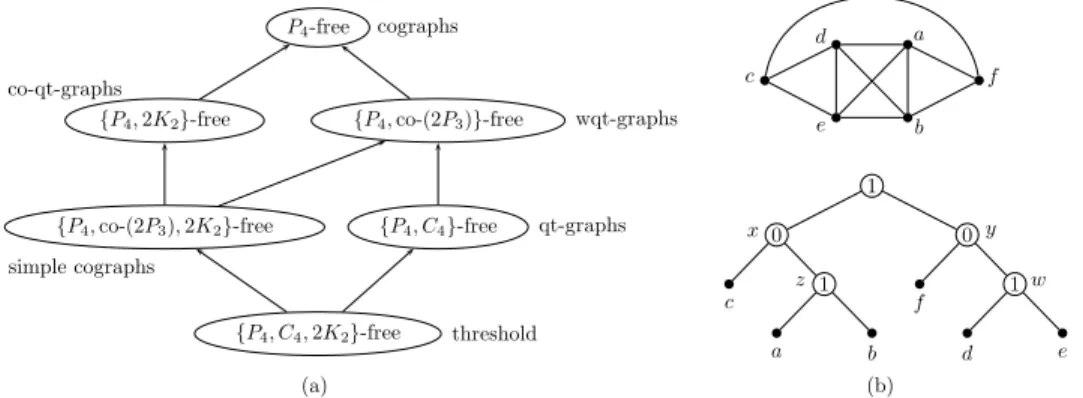
cographs P4-free
co-qt-graphs
{P4,2K2}-free {P4,co-(2P3)}-free wqt-graphs
simple cographs
{P4,co-(2P3), 2K2}-free {P4, C4}-free qt-graphs
threshold {P4, C4,2K2}-free c d a f e b 1 0 x 0 y c 1 z f 1 w a b d e (a) (b)
Fig. 1. (a) Subclasses of cographs and (b) a co-(2P3) and its cotree.
The class of cographs coincides with the class of graphs having no inducedP4
[5]. There are several subclasses of cographs. Trivially-perfect graphs, also known as quasi-threshold graphs, are characterized as the subclass of cographs having no inducedC4(chordless cycle on four vertices), that is, such graphs are{P4, C4
}-free graphs, and are recognized in linear time [3; 6]. Another interesting subclass of cographs are the{P4, C4, 2K2}-free graphs known as threshold graphs, for which
there are several linear-time recognition algorithms [3; 6]. Clearly every threshold graph is trivially-perfect but the converse is not true. Gurski introduced the class of
{P4, co-(2P3), 2K2}-free graphs in his study of characterizing graphs of certain
re-stricted clique-width [7]. Together with the class of weakly quasi-threshold graphs (that are exactly the class of{P4, co-(2P3)}-free graphs as we show in this paper),
we obtain the inclusion properties for the above families of graphs that we depict in Figure 1 (a).
For undefined terminology we refer to [3; 6]. A vertex x of G is universal if
NG[x] = V (G) and is isolated if it has no neighbors in G. Two vertices x, y of G are
called false twins ifNG(x) = NG(y). A clique is a set of pairwise adjacent vertices
while an independent set is a set of pairwise non-adjacent vertices. A chordless cycle onk vertices is denoted by Ck and a chordless path onk vertices is denoted
byPk. The complement of the graph consisting of two disjointP3’s is denoted by
co-(2P3). Given two vertex-disjoint graphs G1 = (V1, E1) and G2 = (V2, E2), their
union isG1∪ G2 = (V1∪ V2, E1∪ E2). Their join G1+ G2 is the graph obtained
fromG1∪ G2by adding all the edges between the vertices ofV1andV2. The class
of cographs, also known as complement reducible graphs, is defined recursively as follows:
(c1) a single vertex is a cograph;
(c2) ifG1 andG2 are cographs, thenG1∪ G2is also a cograph;
(c3) ifG1 andG2 are cographs, thenG1+ G2 is also a cograph.
The class of cographs coincides with the class of P4-free graphs [5]. Along with
other properties, it is known that cographs admit a unique tree representation, called a cotree [4]. For a cographG its cotree, denoted by T (G), is a rooted tree having O(n) nodes. The vertices of G are precisely the leaves of T (G) and every internal
node ofT (G) is labelled by either 0 (0-node) or 1 (1-node). Two vertices are
cent inG if and only if their least common ancestor in T (G) is a 1-node. Moreover,
if G has at least two vertices then each internal node of the tree has at least two
children and any path from the root to any node of the tree consists of alternating
0- and 1-nodes. The complement of any cograph G is a cograph and the cotree of
the complement ofG is obtained from T (G) with inverted labeling on the internal
nodes ofT (G). Note that we distinguish between vertices of a graph and nodes of a
tree. Cographs can be recognized and their cotrees can be computed in linear time [5; 8; 2].
2. A characterization of weakly quasi-threshold graphs
Bapat et al., introduced in [1] the class of weakly quasi-threshold graphs (or
wqt graphs for short) and defined the given class as follows:
(w1) a single vertex is a wqt graph;
(w2) ifG1 andG2are wqt graphs thenG1∪ G2is a wqt graph;
(w3) ifG is a wqt then adding a universal vertex in G results in a wqt graph;
(w4) ifG is a wqt graph then adding a vertex in G having the same neighborhood
with a vertex ofG results in a wqt graph.
By definition the class of cographs and wgt graphs have certain similarities. Clearly every wqt graph is a cograph but the converse is not true. Properties c1,c2 and w1,w2 completely coincide, whereas properties w3–w4 correspond to a restricted version of c3. Moreover it follows that in a connected wqt graph there is either a universal vertex or a false twin. Then it is not difficult to see that the class of wqt graphs is closed under taking induced subgraphs, that is, the class of wqt graphs is
hereditary.
Lemma 2.1. The class of wqt graphs can be defined recursively as follows:
(a1) an edgeless graph is a wqt graph; (a2) if G1 and G2 are wqt graphs then G1 ∪ G2 is a wqt graph; (a3) ifG is a wqt graph and H is an edgeless graph then G + H is a wqt graph.
Proof. Properties w2 and a2 are exactly the same. By properties w1 and w2
we have that edgeless graphs are wqt graphs. We need to show that property a3 can substitute both properties w3–w4. If G is a wqt graph and H is an edgeless
graph then the graph G + H is obtained by first adding a universal vertex in G
and then by the addition of false twins. Hence G + H is a wqt graph. For the
converse let G be a connected wqt graph. First observe that G can be reduced
to a disconnected wqt graph G[A] by repeatedly removing a universal vertex or
a false twin vertex. Let S be a set of the removal vertices. Let xn, . . . , xk be an
order ofS where xi is either universal or false twin inGi = G[{xi, . . . , xk} ∪ A],
n ≤ i ≤ k. We show that there is such an order of {xn, . . . , xk} where all the false
twin vertices appear consecutive. If there is a universal vertexxj between two false
between two false twin vertices and obtain an order of the vertices ofS where the
false twin vertices appear consecutive. Observe that the set of the false twin vertices induces an edgeless graph inG. Thus the join operation between a wqt graph and
an edgeless graph is sufficient to construct a connected wqt graph.
Next we give a characterization of weakly quasi-threshold graphs through for-bidden subgraphs based on Lemma 2.1.
Theorem 2.1. A graphG is weakly quasi-threshold if and only if G does not
con-tain anyP4or co-(2P3) as induced subgraphs.
3. A linear-time recognition algorithm
In this section we give a linear-time algorithm for deciding whether an arbitrary graph is wqt. LetG be the input graph. We first apply the linear-time recognition
algorithm for checking whetherG is a cograph [5]. If G is not a cograph then we
know that G is not a wqt graph as it contains a P4. Otherwise G admits a cotree T (G) that can be constructed in linear time [5; 8]. Now it suffices to efficiently
check an induced co-(2P3) on G by using the cotree T (G). For that purpose, we
modifyT (G) and obtain T∗ fromT (G) by applying the following two operations:
(i) delete the subtree rooted at a 0-node having only leaves as children and (ii) remove a leaf that has 1-node as parent. Next we check if every 1-node inT∗ has at most one child. In case of an affirmative answer we output thatG is a wqt graph;
otherwise, we output that G is not a wqt graph. Correctness of the algorithm is
based on the following lemma.
Lemma 3.1. LetG be a cograph and let T∗ be its modified cotree. ThenG is wqt
graph if and only if every 1-node ofT∗has at most one child.
Theorem 3.1. Weakly quasi-threshold graphs can be recognized inO(n+m) time.
Furthermore given a graphG there is anO(n + m) algorithm that reports either an
inducedP4 or co-(2P3) of G whenever G is not a weakly quasi-threshold graph.
As already mentioned every wqt graph is a cograph but the converse is not neces-sarily true. We show that the problem of removing the minimum number of vertices from a cograph so that the resulting graph is wqt can be done in linear time. Note that the proposed algorithm can serve as a recognition algorithm as well. LetT (G)
be the cotree ofG and let T∗be the modified cotree. Our algorithm starts by
travers-ing bothT (G) and T∗ from the leaves to the root and computes for each node of T (G) a largest induced wqt subgraph; the one computed at the root of T (G)
pro-vides the largest induced wqt subgraph of G. The computed graph is represented
by a cotreeT0 that we construct during the traversal of T (G). Let H
u be the
in-duced subgraph ofG corresponding to the leaves of the subtree rooted at a node u
ofT (G). Every time the algorithm visits a node u of T (G) it computes the triple
(n(u), MC(u), MI(u)) where n(u) is the number of vertices of Hu, MC(u) is the
maximum clique of Hu, and MI(u) is the maximum independent set of Hu. Let u1, u2, . . . , uk be the children ofu in T (G). If u is a 0-node or a 1-node with at
most one child then the algorithm assigns tou the correct triple by Lemma 3.1 and
copies nodeu in T0. Ifu is a 1-node and u has at least two children in T∗ then we
need to modify the subtree rooted at u. Let u∗
1, u∗2, . . . , u∗` be the children of u in T∗; note that each childu∗
1 is a 0-node,1 ≤ i ≤ `. Based on Lemma 3.1 we
mod-ify every subtree in T (G) rooted at u∗
i except that u∗p having the maximum value
amongmin{n(u∗
i)− |MC(u∗i)|, n(u∗i)− |MI(u∗i)|}. For every other node u∗j 6= u∗p
we do the following operations: if|MC(u∗j)| > |MI(u∗
j)| then we delete the subtree
rooted atu∗
j and add the vertices of MC(u∗j) as children of u; otherwise we remove
the nodes of the subtree rooted at u∗
j and add the vertices of MI(u∗j) as children of u∗j.
Theorem 3.2. Given a cograph G there is an O(n + m) algorithm that finds a
largest induced weakly quasi-threshold subgraph ofG.
References
[1] R.B. Bapat, A.K. Lal, and S. Pati. Laplacian spectrum of weakly quasi-threshold graphs. Graphs and Combinatorics, 24:273–290, 2008.
[2] A. Bretscher, D. Corneil, M. Habib, and C. Paul. A simple linear time LexBFS co-graph recognition algorithm. SIAM Journal on Discrete Mathematics, 22:1277–1296, 2008.
[3] A. Brandst¨adt, V.B. Le, and J.P. Spinrad. Graph Classes: A Survey. SIAM Mono-graphs on Discrete Mathematics and Applications, 1999.
[4] D.G. Corneil, H. Lerchs, and L.K. Stewart. Complement reducible graphs. Discrete
Applied Mathematics, 3:163–174, 1981.
[5] D.G. Corneil, Y. Perl, and L.K. Stewart. A linear recognition algorithm for cographs.
SIAM Journal on Computing, 14:926–934, 1985.
[6] M. C. Golumbic. Algorithmic Graph Theory and Perfect Graphs. Second edition. Annals of Discrete Mathematics 57. Elsevier, 2004.
[7] F. Gurski. Characterizations for co-graphs defined by restricted NLC-width or clique-width operations. Discrete Mathematics, 306:271–277, 2006.
[8] M. Habib and C. Paul. A simple linear time algorithm for cograph recognition.
From Sainte-Lagu¨e to Claude Berge — French graph
theory in the twentieth century ??
Harald Gropp
aaHans-Sachs-Str. 6, D-65189 Wiesbaden
Key words: graph theory, Berge graph
1. Introduction
Dedicated to CLAUDE BERGE (1926-2002), mathematician and man of culture
In 1926 the zeroth book on graph theory was published by A. Sainte-Lagu¨e [9]. It collects the knowledge on graphs at this early stage and particularly focusses on the French development of this new field in mathematics. The first French pioneer in graph theory, Georges Brunel (see [7]) prepared the first decades of the last century. Ten years after the zeroth book, in 1936, the first book on graph theory by D. K¨onig [8] was published.
Sainte-Lagu¨e’s life and work is discussed in [6]. His book [10] of 1937 (and reprinted in 1994) contains the analysis of many mathematical games and famous problems in combinatorics, e.g. La Tour d’Hano¨ı, Les quinze demoiselles, Les
trente-six officiers, La ville de Koenisberg and Le jeu d’Hamilton.
In the annexe of the new edition of 1994 Claude Berge discusses the starting points of the abstract theory of graphs.
De tr`es nombreux probl`emes de ce livre ont ´et´e le point de d´epart de th´eor`emes g´en´eraux. Encore fallait-il poser les bases d’une th´eorie abstraite.
??This paper was not actually presented at the conference, as the author withdrew his par-ticipation.