HAL Id: hal-03084432
https://hal.archives-ouvertes.fr/hal-03084432
Submitted on 22 Dec 2020
HAL is a multi-disciplinary open access archive for the deposit and dissemination of sci-entific research documents, whether they are pub-lished or not. The documents may come from teaching and research institutions in France or abroad, or from public or private research centers.
L’archive ouverte pluridisciplinaire HAL, est destinée au dépôt et à la diffusion de documents scientifiques de niveau recherche, publiés ou non, émanant des établissements d’enseignement et de recherche français ou étrangers, des laboratoires publics ou privés.
Bifunctional Amidophosphonate Molecules for Uranium
Extraction in Nitrate Acidic Media
A. Artese, Sandrine Dourdain, N. Felines, Guilhem Arrachart, N. Boubals, P.
Guilbaud, S Pellet-Rostaing
To cite this version:
A. Artese, Sandrine Dourdain, N. Felines, Guilhem Arrachart, N. Boubals, et al.. Bifunctional Ami-dophosphonate Molecules for Uranium Extraction in Nitrate Acidic Media. Solvent Extraction and Ion Exchange, Taylor & Francis, 2020, 38 (7), pp.703-718. �10.1080/07366299.2020.1790527�. �hal-03084432�
1 1
Bifunctional Amidophosphonate Molecules for Uranium Extraction in Nitric
2Media
3ARTESE A.
1,2, DOURDAIN S.
1*, FELINES N.
1, ARRACHART G.
1, BOUBALS
4N.
2, GUILBAUD P.
2, PELLET-ROSTAING S.
15
1 ICSM, Univ Montpellier, CEA, CNRS, ENSCM, Marcoule, France 6
2 CEA, DES, ISEC, DMRC, Univ Montpellier, Marcoule, France 7
8
*corresponding author: [email protected] 1
2
Bifunctional Amidophosphonate Molecules for Uranium Extraction in Nitric
3Media
4 5Abstract
6Bifunctional amidophosphonate derivatives, already known as efficient ligands in uranium 7
extraction from phosphoric media, have been evaluated and compared to the conventional tri-8
n-butyl phosphate (TBP) for uranium extraction from nitric medium. The efficiency of U 9
extraction and its selectivity towards competing elements such as Th, Zr, Mo, Fe and V was 10
evaluated with various ligand structures. It was found that extractant molecules containing a 11
monosaponified phosphonate moiety instead of phosphonate moieties are less effective and 12
selective. Furthermore, it was observed that alkylation of the methylene bridge linking the two 13
functional groups prevent the formation of precipitates during the uranium loading. Effects of 14
acidity as well as ligand concentration were also investigated to estimate the loading capacity 15
of the molecules. More detailed stoichiometry and transfer energy were further determined by 16
the slope analysis method and a thermodynamic study. The possible uranium recovery from the 17
organic phase has finally been demonstrated thanks to stripping steps at low nitric acid 18
concentration. 19
20
Keywords: Solvent extraction, bifunctional extractant, uranium extraction, nitric media
21 22
Introduction
23
The refining plants of natural uranium concentrates rely on a solvent extraction process to 24
produce uranium at so-called "nuclear" purity. Purification of uranium is obtained from yellow 25
cake thanks to an organic phase containing the well-known extractant molecule tri-n-butyl 26
phosphate (TBP).[1] This organic phase is further washed to recover pure uranium which is
27
exploited to produce 10% of the annual global electricity consumption.[2] Despite the extensive
28
application of TBP at industrial scale, it is still of research interest to find optimized and highly 29
efficient systems. Higher selectivity towards Zr or Mo, optimized loading capacity, and a 30
minimized extractant loss due to solubilization in aqueous phase are some of the targeted 31
optimizations. Several research groups have proposed alternatives to TBP,[3-5] among them 32
3
monoamide derivatives[6-9] exhibit high potential as well as carbamides which have been studied 33
very recently.[10-11] 34
Another approach consists of designing multifunctional molecules, various multi-functional 35
compounds have shown promising properties, for example, iminomethylenediphosphonic acids 36
(phosphorus and nitrogen functions)[12] or amidosulfoxide structures (sulfur and nitrogen 37
functions)[13] have been proposed for uranium extraction and purification from diluted or 38
concentrated nitric acid solutions. Taking into account the potential of this approach, a new 39
series of N, P bifunctional extractants was patented and showed excellent properties in nitric 40
media in terms of affinity for uranium extraction.[14] 41
N,P bifunctional extractants such as carbamoylalkylphosphonates involving an amido and a 42
phosphorus functionality and especially the butyl-1-[N,N-bis(2-ethylhexyl)carbamoyl]nonyl 43
phosphonic acid, called DEHCNPB, have shown unprecedented extraction properties for 44
uranium from phosphoric media.[15-19] So far, DEHCNPB efficiency has never been evaluated
45
for uranium extraction from nitric media, and the patented N, P bifunctional family has not 46
been investigated in the literature for this media. In the present study, two amidophosphonates, 47
are therefore studied and compared to both DEHCNPB and TBP as reference extractants. As 48
illustrated in Figure 1, these two molecules differ by the alkylation of the methylene bridge 49
between the amido and the phosphonate functions: 50
51 52
53
Figure 1. Structure of extractants TBP, DEHCMPDB (1), DEHCNPDB (2), and DEHCNPB (3) involved in this study. 54
55
In this work, the influence of the molecular design of these N,P bifunctional molecules through 56
the presence of alkyl chains, and the saponification of the phosphonate function are studied and 57
correlated with their extraction efficiency. A comparative study was conducted on their 58
selective extraction properties for U(VI) towards several competitors and the parameters of the 59
4
extraction processes (loading capacity, solubility in the aqueous phase, thermodynamic 60
behavior and their back-extraction properties). 61
Materials and methods
62
63
Synthesis of amidophosphonate
64
Amidophosphonates were synthesized as described in references.[15-16] The synthesis is
65 illustrated in Scheme 1. 66 67 68 69 70 71 72 73 74
Scheme 1. Synthesis of amidophosphonate extractant involved in this study 75
Butyl-1-[N,N-bis(2-ethylhexyl)carbamoyl]nonyl phosphonic acid 3 (DEHCNPB) was 76
synthesized in four steps with an overall yield of 81%. 77
78
- Amidation (step A) of N,N-ethylhexylamine with chloroacetyl chloride in the presence 79
of K2CO3 in dichloromethane afforded an amide intermediate.
80
- Subsequently this intermediate is engaged in an Arbusov reaction (step B) with 81
tributylphoshite to afford, with an overall yield of 90%, the Dibutyl N,N di(2-82
ethylhexyl)carbamoylmethylphosphonate (DEHCMPDB) named extractant 1 in the 83
following. 84
5
- C-alkylation of extractant 1 (step C) using 1-iodooctane and sodium hydride in order to 85
introduce an octyl group on the methylene bridge afforded the Dibutyl N,N di(2-86
ethylhexyl)carbamoylnonylphosphonate (DEHCNPDB) with an overall yield of 86% 87
(extractant 2). 88
- The corresponding amido-monophosphonate (extractant 3) was finally obtained by 89
mono-saponification with an aqueous sodium hydroxide solution (step D). 90
91
Extraction experiments
92
The organic phases were prepared by dissolving each extractant in n-dodecane. Aqueous 93
solutions at desired acidity were obtained using uranyl nitrate, thorium nitrate (Th(NO3)4), iron
94
nitrate (Fe(NO3)3), molybdenum oxide (MoO3), zirconyl nitrate (ZrO2(NO3)2) in their salt form
95
(from Sigma Aldrich), and vanadium from Inductively Coupled Plasma ICP standard from SCP 96
Science (aqueous solution of NH4VO3 1000 µg/mL in HNO3 4%). The desired concentrations
97
were prepared by dilution in ultrapure water (MilliQ, Millipore, 18 MΩ.cm−1). Acidities (HNO3
98
0.1 to 8 M) were adjusted with 69% nitric acid. Solvent extraction experiments were carried 99
out in 2 or 15 mL vials. 100
Organic phases were pre-equilibrated with an aqueous phase at the same acidity as the 101
extraction step without cations in a thermostated shaker (Infor-ht® ecotron) at 25°C and 102
400 rpm for 30 min. The volume ratio of organic to aqueous phases was O/A=1/3. The 103
concentration of nitric acid was kept constant for the extraction experiments carried out 104
thereafter. The aqueous and organic phases were separated by centrifugation at 19017 rcf for 105
10 min (Rotina 380R or Eppendorf centrifuge 5417R). 106
The pre-equilibrated organic phases were then contacted with an equal volume of aqueous 107
acidic stock solution of cations (O/A = 1) in a thermostated shaker at 25°C and 400 rpm for 1 h, 108
(this time is sufficient to reach thermodynamic equilibrium).[14] Phases were separated after 109
centrifugation at 19017 rcf for 10 minutes. The acid concentration in the aqueous and organic 110
phases before and after extraction was analyzed by titration with NaOH 0.1M or 0.01M (Fluka 111
analytical) using a Metrohm 809 Titrando. 112
The concentrations of metals in aqueous phase were measured by inductively coupled 113
plasma/atomic emission spectroscopy (ICP/OES Spectro Arcos - AMETEK Materials 114
6
Analysis). The ICP calibration samples were prepared from 1000 ±4 mg/L uranium, thorium, 115
iron, molybdenum, zirconium and vanadium standard solution (SCP Science PlasmaCal). 116
Uncertainties relating to the metal concentration were determined by repeated measurement of 117
different samples of the same concentration. These uncertainties were estimated to be of the 118
order of ±5%. 119
As commonly defined in liquid-liquid extraction, the distribution coefficient DM of an element
120
M corresponds to the ratio between the concentrations of this element in the organic and 121
aqueous phases at equilibrium. The metal concentration in the organic phase, [M]org, was
122
estimated by the difference between the initial concentration in the aqueous phase, [M]aq,ini, and
123
the concentration at equilibrium,[M]aq,eq, such as the following relation for a volume ratio of
124
organic to aqueous phases O/A=1: 125
DM = [Morg]/[Maq] = ([M]aq,ini]-[M]aq,eq)/[M]aq,eq (1)
Additionally, the separation factor for a specific metal towards another metal is defined by the 126
ratio of the distribution coefficient such as: 127
SFM1/M2 = DM1/DM2 (2)
The concentrations of the elements in the organic phase were also confirmed after a back-128
extraction step. The previous organic phase loaded with cations was contacted with a stripping 129
aqueous solution typically a HNO3 0.05 M acidic solution. When the back-extraction is total,
130
the concentration of the element in the aqueous phase is equal to the concentration in the initial 131
loaded organic phase. The efficiency of the back-extraction was estimated thanks to ICP/AES. 132
The amount of organic phase transferred in the aqueous phase was determined by measuring 133
the Total Organic Content (TOC) using a Shimadzu TOCVCSH analyser based on a 680°C 134
combustion catalytic oxidation/NDIR method. 135
7
Results and discussion
137 138
Extraction studies
139Separation factors
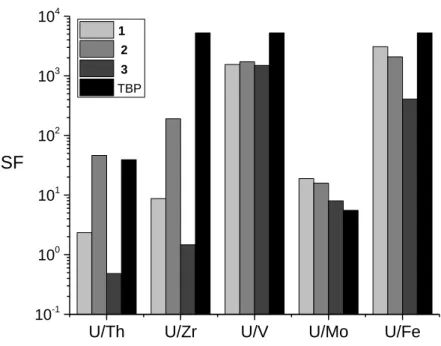
140 141The efficiency of amidophosphonate 1, 2 and 3 to selectively extract uranium from an 142
aqueous phase containing competitive metals was compared to TBP. The extraction profile of 143
the extractants was established for U(VI), Fe(III), Mo(VI), V(III), Zr(IV) and Th(IV), which 144
are metals potentially present in uranium refining solutions. 145
Extraction experiments were carried out by contacting an equal volume (Vorg = Vaq) of a 4 M
146
nitric acid aqueous phase consisting of a 1 mM of each cation (U(VI), Fe(III), Mo(VI), V(III), 147
Zr(IV) and Th(IV)) with an organic phase containing 0.2 M of extractants in dodecane. The 148
results are summarized in Table 1 for the distribution coefficients and in Figure 2 for the 149
separation factors for the extraction of U(VI). 150
151
Table 1. Distribution coefficients for 1, 2, 3 and TBP compound diluted at 0.2 M in dodecane 152 extractant 1 2 3 TBP D U 22 16 238 5.2 D Th 9.4 0.35 492 0.13 D Zr 2.5 0.08 162 >0.01 D V 0.01 0.01 0.16 >0.01 D Mo 1.2 1 30 0.95 D Fe 0.01 0.01 0.58 >0.01
Aqueous phase: [U]=[Th]=[Zr]=[Mo]=[V]=[Fe]=1 mM, [HNO3]=4 M.
153 154
8
U/Th U/Zr U/V U/Mo U/Fe
10-1 100 101 102 103 104 1 2 3 TBP SF 155
Figure 2. Extraction result for compounds 1, 2, 3 and TBP diluted at 0.2 M in dodecane - Aqueous phase: 156
[U]=[Th]=[Zr]=[Mo]=[V]=[Fe]=1mM, [HNO3]=4 M – separation factors
157 158
As shown in Table 1 and Figure 2, extractant 3 exhibits the highest distribution coefficients for 159
all the elements, leading to poor separation factors for U towards Th, Zr and Mo. However, 160
when the unsaponified amidophosphonates 1 and 2 are used, the extraction of competitive 161
metals is much lower and comparable to those achieved with TBP, while the distribution 162
coefficient for uranium is much higher (DU >16 for amidophosphonate compared to 5.24 for
163
TBP). 164
These results show that the unsaponified amidophosphonates 1 and 2 display interesting 165
features for the specific extraction of uranium (VI). At the same time, extractant 3 shows low 166
separation factors and high distribution coefficients (which suggests potential issues for back 167
extraction), indicating that it cannot be considered for a uranium refining process in nitric 168
media. 169
Subsequently, the extraction capacities and the parameters of the extraction processes of the 170
two amidophosphonates 1 and 2 have been compared to TBP. The influence of the alkyl chain 171
grafted on the methylene bridge has been studied with regards to the solubility in the aqueous 172
phase and the uranium loading capacity. 173
9
Extractant solubility in the aqueous phase
175176
Solubility of extractants 1 and 2 in aqueous phase was evaluated by contacting an organic phase 177
containing 0.5 M of the extractant in dodecane, with an aqueous phase of 4 M nitric acid with 178
A/O = 3. After centrifugation, the organic and aqueous phases were separated and the Total 179
Organic Carbon concentration (TOC) of the aqueous phase was measured by COT meter. Table 180
2 shows the mass percentages of carbon solubilized in the aqueous phase obtained from total 181
organic carbon concentration analysis. The solubility of each extractant was determined by 182
taking into account the volume ratio involved, the concentration and molar mass of the 183
extractant and by considering that dodecane solubility is negligible. 184
185
Table 2. Solubility of the extractant molecules in the aqueous phase 186
Extractant [C]aq (g/L) Mass loss (%) [L]aq (mM)
TBP (0.5 M in dodecane)* 0.6*
Extractant 1 (0.5 M in dodecane) 0.141 ± 0.007 0.27 0.45 ± 0.01
Extractant 2 (0.5 M in dodecane) 0.044 ± 0.002 0.065 0.11 ± 0.01
*data for TBP extrapolated from literature[20]
187 188
As expected, due to the presence of a lipophilic alkyl chain on the methylene bridge it appears 189
that the mass loss of extractant 2 is lower than for extractant 1. This difference in solubility is 190
coherent with higher lipophilicity due to the alkylation of the molecule, log P = 11 vs. 7.63, 191
respectively, for extractants 2 and 1 (log P estimated from ACDlab2015 - Percepta software). 192
In comparison to data obtained from literature[20], extractants 1 and 2 have lower solubility than 193
TBP, with an interesting result for extractant 2 . 194
It should be noticed that the carbon concentration measured in the aqueous phase may come 195
from degradation products of the extractants as well as from impurities. However, the analyses 196
after pre-equilibration and/or successive contact suggests that the carbon concentration 197
probably does not come from impurities. A degradation study of the molecules 1 and 2 as well 198
as of the solubility of the possible degradation products should be performed in the future. 199
Influence of uranium (VI) loading on uranium extraction
20010
The uranium (VI) loading capacity of the extractants was investigated by extraction 201
experiments carried out contacting the organic phases (0.2 M of extractant 1, 2 or TBP in 202
dodecane) with increasing concentrations of uranium from 10 to 300 mM in 4 M nitric acid. 203 0 50 100 150 200 250 300 0 20 40 60 80 100 [U] or ga ,e q (mM) [U]aq,init (mM) 1 2 TBP 204
Figure 3. Loading uranium extraction isotherm- Aqueous phase: [U] = 10 mM to 300 mM, [HNO3] = 4 M; Organic phase:
205
1, 2 or TBP extractant at 0.2M in dodecane; (Vorg = Vaq). 206
207
The loading capacity of extractant 1 in dodecane reached 52 mM when the aqueous phase used 208
had a concentration of 100 mM in uranium and decreased for higher concentration because of 209
the formation of precipitates. This result demonstrates the importance of the alkyl chain in order 210
to prevent the apparition of precipitates. 211
As plotted in Figure 3 up to 90 mM (> 21 g/L) of uranium(VI) can be loaded into the organic 212
phase when the extractant 2 is used. At its maximum loading capacity with 0.2M of extractant 213
2 in dodecane, neither third-phase nor precipitate formation were observed. From these results,
214
an extractant/U molar ratio of about two is estimated at saturation in these conditions, which 215
suggests that two molecules of extractant 2 are necessary to extract uranium(VI) into the organic 216
phase at saturation. This result was correlated by applying the slope analysis method which 217
enables determining complementary information regarding the number of extractant molecules 218
in the extracted complex. 219
11
Therefore, extractant 2 allows a higher loading capacity than TBP (70 mM in the same 220
conditions). This measured value is also consistent with the relationship experimentally found 221
by B. Narasimha Murty et al. with TBP diluted in kerosene[21] : 222
Y = 3.9753 X + 0.10143 (3)
223
where Y represents the concentration of uranium saturation in g/L and X the volume percentage 224
of TBP in the organic phase. From this equation and considering our operating conditions, a 225
uranium saturation concentration of 77 mM in the organic phase can be assumed. 226 227
Thermodynamic studies
228 Slopes analysis 229 230To analyze the effect of the concentration on the extraction efficiency, a range of 231
extractant concentrations was engaged in the same extraction conditions. The concentration in 232
extractant 1, 2 or TBP was varied from 0.025 to 0.2 M. The organic phase was subsequently 233
contacted with an aqueous phase containing 1 mM of U(VI) in 4 M nitric acid media. The 234
logarithm of the distribution coefficient of uranium is plotted as a function of the logarithm of 235
free extractant concentration in Figure 4. 236
12 -1.5 -1.0 -0.5 -1.0 -0.5 0.0 0.5 1.0 1.5 Lo g(D U ) Log([L]free) 1 2 TBP 237
Figure 4. Slopes analysis of uranium extraction as a function of free ligand concentration 238
Logarithm of the distribution ratio of uranium (VI) as a function of free extractant [L]free:
239 log DU = f(log[1]): y = 1.505(±0.026)x + 2.432(±0.033), R2 = 0.999 240 log DU = f(log[2]): y = 1.736(±0.063)x + 2.667(±0.096), R2 = 0.995 241 log DU = f(log[TBP]): y = 1.726(±0.036)x + 1.947(±0.041), R2 = 0.998 242
Aqueous phase: [U] = 1 mM, [HNO3] = 4 M; Organic phase: 1, 2 or TBP extractant from 0.025 to 0.2 M in dodecane; (Vorg
243
= Vaq), 25°C.
244 245
Considering a solvation mechanism of extraction with TBP, 1 and 2, uranium extraction can be 246
described by the following equation: 247
𝑈𝑂22++ 2𝑁𝑂3 −+ 𝑥𝐿̅ ↔ 𝑈𝑂̅̅̅̅̅̅̅̅̅̅̅̅̅̅̅̅̅̅ 2(𝑁𝑂3)2𝐿𝑥 (4)
248
where x represents the number of extractants required for the transfer of one uranyl from the 249
aqueous phase to the organic phase. The overbar refers to species in the organic phase, and the 250
absence of the overbar denotes aqueous species. 251 𝐾𝑒𝑥 = [𝑈𝑂̅̅̅̅̅̅̅̅̅̅̅̅̅̅̅̅̅̅̅2(𝑁𝑂3)2𝐿𝑥] [𝑁𝑂3 −]2. [𝑈𝑂 22+]. [𝐿̅]𝑥 . 𝛾̅𝑈𝑂2(𝑁𝑂3)2𝐿𝑥 𝛾̅𝐿𝑥. 𝛾𝑈𝑂 22+. 𝛾𝑁𝑂3 − 2 (5) 252
13
If the ratio of activity coefficients is considered constant (which is acceptable in such diluted 253
solutions and with a constant nitric acid concentration), the following equation can be 254 established: 255 [𝐿̅]𝑓𝑟𝑒𝑒𝑥 = 𝐷𝑈. 1 𝐾𝑒𝑥. [𝑁𝑂3 −]2 (6) 256
Considering a constant nitrate concentration, log-log plots of distribution ratios vs. total 257
concentration of the extractant indicate the number of free extractants in the extracted complex 258
(Figure 4). 259
𝑙𝑜𝑔(𝐷𝑈) = 𝑥 𝑙𝑜𝑔([𝐿̅]𝑓𝑟𝑒𝑒) + 𝑙𝑜𝑔(𝐾𝑒𝑥) + 2𝑙𝑜𝑔([𝑁𝑂3−]) (7)
260
The [𝐿̅]𝑓𝑟𝑒𝑒 can be calculated from the ligand concentration after subtracting the part of 261
extractant complexed with uranium and the part of ligand complexed with nitric acid: 262
[𝐿̅]𝑓𝑟𝑒𝑒 = [𝐿̅]𝑖𝑛𝑖− 𝑥. [𝑈]𝑜𝑟𝑔𝑎− [𝐻𝑁𝑂3]𝑜𝑟𝑔𝑎 (8) 263
Acid titration demonstrated that very little nitric acid was extracted into the organic phase, 264
therefore the free ligand concentration was obtained from the following equation: 265
[𝐿̅]𝑓𝑟𝑒𝑒 = [𝐿̅]𝑖𝑛𝑖− 𝑥. [𝑈]𝑜𝑟𝑔𝑎 (9)
266
Concentrations of free extractants were calculated by iteration considering x values from 1 to 5 267
with the assumption that the fraction of extractants protonated or associated with nitric acid can 268
be neglected. 269
The plot of the logarithm of distribution ratio is linear with the logarithm of the concentration 270
of extractant with a slope between 1.5 and 1.75. It suggests that uranium is similarly extracted 271
by the three molecules investigated. The stoichiometry of complexation between the extractant 272
and uranium is expected to be 2:1. For extractant 2, this result is consistent with the molar ratio 273
obtained at saturation. Also, these values are similar to those that can be encountered in the 274
literature for this type of bifunctional molecule in the context of the extraction of uranium from 275
phosphoric acid.[22] The value found for TBP is also in agreement with that reported by Stas 276
and coworkers.[23] 277
14 278
Temperature dependency of uranium extraction
279
Uranium distribution ratio was determined for various temperatures from 25 to 55°C at 280
4 M of nitric acid containing 1 mM of U(VI) and with 0.2 M of extractant in dodecane. The 281
results point out the exothermic nature of the extraction process with a decreasing D-value with 282
increasing temperature for each extractant. 283 0.0030 0.0031 0.0032 0.0033 0.0034 6.0 6.2 6.4 6.6 6.8 7.0 7.2 1 2 TBP Lo g Ke x 1/T 284
Figure 5. Influence of the temperature on uranium extraction (25 – 55 °C). 285
Logarithm of the distribution ratio DU as a function of the reverse of the temperature T:
286 log Kex(1) = f (1/T): y = 1364(±202) x + 2.400(±0.647); R2 = 0.958 287 log Kex(2) = f (1/T): y = 1594(±161) x + 1.635(±0.514); R2 = 0.980 288 log Kex(TBP) = f (1/T): y = 714(±53) x + 3.898(±0.170); R2 = 0.989 289
Aqueous phase: [U] = 1 mM, [HNO3] = 4 M; Organic phase: 1, 2 or TBP extractant at 0.2 M in dodecane; (Vorg = Vaq).
290 291
Uranium extraction was measured for various temperatures to estimate different 292
thermodynamic parameters, which can provide trends regarding the complexation of U with the 293
various extractants. 294
If we consider the direct proportionality between DU and Kex, van't Hoff's law enables
295
calculation of the different free enthalpies related to the extraction of uranium. 296 𝐿𝑛𝐾𝑒𝑥= − Δ𝐻𝑒𝑥𝑡0 𝑅 . 1 𝑇+ Δ𝑆𝑒𝑥𝑡0 𝑅 (10)
15 297
The logarithm plot of the distribution coefficient vs. the inverse of the absolute temperature 298
(Figure 5) produces a straight line function, from which enthalpy can be calculated with the 299
slope of the linear regression plot. The value of the thermodynamic parameters (ΔH, ΔS, and 300
ΔG) are provided in the Table 3. 301
302
Table 3. Thermodynamic parameters (ΔH, ΔS, and ΔG) for the extraction of uranium with 1, 2 and TBP 303
extractants
304
H (kJ/mol) S (J/mol/K) G (kJ/mol)
313 K 323 K 333 K
1 -11.34 ± 1.68 19.95 ± 5.38 -17.59 ± 3.36 -17.79 ± 3.42 -17.98 ± 3.47
2 -13.25 ± 1.34 13.59 ± 4.27 -17.51 ± 2.68 -17.64 ± 2.72 -17.78 ± 2.76
TBP -5.94 ± 0.44 32.41 ± 1.41 -16.08 ± 0.88 -16.40 ± 0.90 -16.73 ± 0.91
Aqueous phase: [U] = 1 mM, [HNO3] = 4 M; Organic phase: 1, 2 or TBP extractant at 0.2 M in dodecane; (Vorg = Vaq).
305
Negative values of free enthalpies indicate that each compound reacts spontaneously to extract 306
uranium through an exothermic reaction. Also, the Gibbs free energy values (−ΔG) for the 307
extractants follow the order: -ΔG(1) ≥ -ΔG(2) > -ΔG(TBP), which suggests that uranium 308
extraction is thermodynamically more favorable for the amidophosphonates than for TBP. 309
Furthermore, the similar values obtained for the amidophosphonates 1 and 2 show that the 310
complexes formed with the two bifunctional extractants have a similar stability. 311
Stripping of uranium
312Influence of the nitric acid concentration in the aqueous phase
313
The effect of nitric acid concentration on the uranium extraction was investigated for all three 314
extractants. Extractions were carried out using organic phases containing 0.2 M of extractants 315
and with aqueous phases containing 5 mM of uranium(VI) at nitric acid concentrations ranging 316
from 0.1 to 8 M. 317
Figure 6 shows uranium distribution ratio as a function of nitric acid concentration. For the 318
three extractants tested, distribution values increase sharply with low nitric acid concentrations 319
and reach a saturation plateau. No difference is observed between extractants 1 and 2, and both 320
amido-phosphonates exhibit higher distribution ratios than TBP over the whole range of nitric 321
acid tested. Figure 6 also shows a clear correlation between nitric acid concentration and 322
16
extraction efficiency, which is in accordance with a solvating mechanism during the extraction. 323
At low acidity the distribution coefficient of uranium is lower than one, suggesting a possible 324
efficient back-extraction with a decrease of concentration in nitric acid. 325 326 0 1 2 3 4 5 6 7 8 1E-3 0.01 0.1 1 10 D U [HNO3]aq,init (M) 1 2 TBP 327
Figure 6. Uranium distribution coefficient versus the initial acidity in aqueous phase – aqueous phase: [U] = 5 mM with 0.1 328
M to 8 M of nitric acid; organic phase 1, 2 or TBP extractant at 0.2 M in dodecane.
329 330 331
Uranium back-extraction by nitric acid
332
Given the low extraction performance of the compounds at low nitric acid concentration, 333
the possibility of carrying out the back-extraction step was investigated for the purpose of 334
quantitatively stripping uranium from the organic phases. After the extraction step (0.2 M of 335
extractant in dodecane was contacted with 4 M nitric acid solution containing 5 mM of uranium) 336
the loaded organic solution was then engaged in the back-extraction step which was performed 337
by three successive contacts of the organic phase with 0.05 M HNO3. Figure 7 shows the
338
uranium concentration in organic phase as a function of the number of nitric acid back-339
extractions. The results highlight that the uranium concentrations in organic phases gradually 340
decrease after the different back-extraction steps from uranium concentration of 5 mM to less 341
17
than 2 mM. Back-extraction of uranium appears possible with a simple [HNO3] decrease,
342
however at least two back-extraction contacts are required. 343
Uranium stripping appears less efficient with extractant 1 and 2 than with TBP, suggesting that 344
the uranium complexes in the organic phase may be more stable with the amidophosphonates 345
than with TBP. This behavior is coherent with the thermodynamic study described earlier. 346 347 0 1 2 3 0 1 2 3 4 5 [U] org (mM) Contact 1 2 TBP 348
Figure 7. Back-extraction of uranium –– aqueous phases: [HNO3]=0.05M O/A=1 ; organic phase: 1, 2 or TBP extractant at
349
0.2 M in dodecane loaded with [U]=5 mM.
350 351
Conclusion
352
Amidophosphonates as bifunctional extractants were evaluated and compared to TBP 353
for uranium extraction from nitric media. To exhibit high extraction efficiency and selective 354
properties, the importance of the presence of biphosphonate moiety instead of 355
monophosphonate was demonstrated as well as the increase of the separation factors. Indeed, it 356
was found that the monosaponified amidophosphonate DEHCNPB (named 3) gives poor 357
separation factors (SFU/Th=0,5; SFU/Zr=1,5) compared to the unsaponified molecules,
358
DEHCNPDB 1 and DEHCMPDB 2. The latter molecules, which only differ by an octyl chain 359
on their methylene bridge between their two functions, gave promising performance for the 360
specific extraction of uranium (VI) in nitric media and were therefore studied in more detail in 361
18
this work. Preliminary extraction studies and mechanistic investigations have been performed, 362
such as the feed acidity and extractant concentration dependencies. 363
It was shown for extractant 1 and 2 that the octyl chain on the methylene bridge between the 364
functions implies a decrease of the extractant solubility in the aqueous phase and a significant 365
increase of uranium loading capacity. This alkylation also prevents the appearance of the third 366
phase and precipitate formation at high uranium concentration. In comparison to TBP, it was 367
also found that the bifunctional extractant 2 improves uranium loading capacity by a factor of 368
ca 1.3 and presents a slightly lower solubility in the aqueous phase.
369
As for TBP, uranium extraction is favored for high nitric acid concentrations, which suggests 370
also that a back extraction at low acidity would be possible. This was confirmed in this study 371
that up to 80% of uranium can be back extracted after 3 contacts of an organic phase (loaded 372
with 5 mM of uranium) with an aqueous phase of 0.05 M nitric acid. The stoichiometry of the 373
extracted complex has been determined by the slope method. As for TBP, two bifunctional 374
molecules are necessary to extract one uranyl. The free energy (ΔG), enthalpy (ΔH) and entropy 375
(ΔS) were estimated showing an exothermic and spontaneous reaction for the extraction 376
process. Extractions at different temperatures showed that the bifunctional molecules form 377
slightly more stable complexes, which is consistent with the easier stripping of uranium in TBP. 378
All these results demonstrate the potential use of the alkylated amidophosphonate 2 for the 379
selective extraction of uranium from nitric acid solution. This extractant molecule has 380
interesting extraction properties. Indeed, it extracts more uranium than TBP, induces a very low 381
extractant loss due to its solubility in the aqueous phase, provokes no third-phase nor precipitate 382
problems and allows a possible back-extraction of uranium by [HNO3] decrease.
383
Additional experiments, in particular on real solutions, would be useful to validate such 384
promising ligand for uranium extraction at the front end of the nuclear fuel cycle. 385
Complementary experiments such as a study on the degradation of the extractant, on the impact 386
of degradation products on the extraction performance, the development of a process diagram 387
and a study on a semi-industrial scale, would however be necessary before proposing 388
amidophosphonate 2 as an alternative to TBP for the industrial process. 389
390
Acknowledgement
391
This research was supported financially by CEA. We thank Beatrice Baus Lagarde, Fabrice 392
Giusti and Bruno Corso for the help in ICP, synthesis and SAXS experiments. 393
19 394
References
395
[1] Kumar, J. R.; Kim, J. S.; Lee, J. Y.; Yoon, H. S., A Brief Review on Solvent Extraction 396
of Uranium from Acidic Solutions. Separation and Purification Reviews 2011 40 77-125. DOI: 397
10.1080/15422119.2010.549760. 398
[2] OECD; NEA Uranium 2016: Resources, Production and Demand NEA No. 7301; 399
Organisation for Economic Co-operation and Development / Nuclear Energy Agency: Paris, 400
France, 2017. 401
[3] Shen, C. H.; Bao, B. R.; Bao, Y. Z.; Wang, G. D.; Qian, J.; Cao, Z. B., Extraction of 402
U(VI), TH(IV) and some fission-products from nitric-acid medium by sulfoxides and effect of 403
gamma-irradiation on the extraction. Journal of Radioanalytical and Nuclear Chemistry-404
Articles 1994 178 91-98. DOI: 10.1007/BF02068660.
405
[4] Wang, Y. S.; Sun, G. X.; Xie, D. F.; Bao, B. R.; Cao, W. G., Extraction of uranium(VI) 406
and thorium(IV) ions from nitric acid solutions by N,N,N',N'-tetrabutyladipicamide. Journal of 407
Radioanalytical and Nuclear Chemistry-Letters 1996 214 67-76. DOI: 10.1007/bf02165059.
408
[5] Han, J. T.; Sun, G. X.; Fang, J. H.; Bao, B. R., Solvent extraction of uranium (VI) by 409
N-octanoylpyrrolidine in toluene. Journal of Radioanalytical and Nuclear Chemistry 1999 241 410
215-217. DOI: 10.1007/BF02347316. 411
[6] Manchanda, V. K.; Pathak, P. N., Amides and diamides as promising extractants in the 412
back end of the nuclear fuel cycle: an overview. Separation and Purification Technology 2004 413
35 85-103. DOI: 10.1016/j.seppur.2003.09.005.
414
[7] McCann, K.; Drader, J. A.; Braley, J. C., Comparing Branched versus Straight-chained 415
Monoamide Extractants for Actinide Recovery. Separation & Purification Reviews 2018 47 416
49-65. 10.1080/15422119.2017.1321018. 417
[8] Pathak, P. N., N,N-Dialkyl amides as extractants for spent fuel reprocessing: an 418
overview. Journal of Radioanalytical and Nuclear Chemistry 2014 300 7-15. DOI: 419
10.1007/s10967-014-2961-0. 420
[9] Condamines, N.; Musikas, C., The Extraction by N.N-Dialkylamides. II. Extraction of 421
Actinide Cations. Solvent Extraction and Ion Exchange 1992 10 69-100. DOI: 422
10.1080/07366299208918093. 423
[10] Berger, C.; Marie, C.; Guillaumont, D.; Tamain, C.; Dumas, T.; Dirks, T.; Boubals, N.; 424
Acher, E.; Laszczyk, M.; Berthon, L., Coordination Structures of Uranium(VI) and 425
Plutonium(IV) in Organic Solutions with Amide Derivatives. Inorganic Chemistry 2020 59 426
1823-1834. DOI: 10.1021/acs.inorgchem.9b03024. 427
[11] Berger, C.; Marie, C.; Guillaumont, D.; Zekri, E.; Berthon, L., Extraction of 428
Uranium(VI) and Plutonium(IV) with Tetra-Alkylcarbamides. Solvent Extraction and Ion 429
Exchange 2019 37 111-125. DOI: 10.1080/07366299.2019.1630095.
20
[12] Bouhoun Ali, M.; Badjah Hadj Ahmed, A. Y.; Attou, M.; Elias, A.; Didi, M. A., 431
Synthesis under Microwave Irradiation, Characterization and Application of 432
Alkyliminodimethylenediphosphonic Acids in Solvent Extraction of Uranium (VI). Journal of 433
Applied Sciences 2011 11 284-291. DOI: 10.3923/jas.2011.284.291.
434
[13] Gamare, J. S.; Chetty, K. V.; Mukerjee, S. K.; Kannan, S., Extraction Studies of 435
Uranium(VI), Plutonium(IV) and Americium(III) from Nitric Acid Using the Bi-functional 436
Carbamoyl Methyl Sulfoxide Ligands. Analytical Sciences 2009 25 1167-1170. DOI: 437
10.2116/analsci.25.1167. 438
[14] Pellet-Rostaing, S.; Arrachart, G.; Leydier, A.; Turgis, R.; Chapron, S. Use of 439
bifunctional compounds with phosphonic acid / phosphonate and amino functions for extracting 440
uranium (VI) from aqueous nitric acid solutions. FR3072824A1, 2017. 441
[15] Turgis, R.; Leydier, A.; Arrachart, G.; Burdet, F.; Dourdain, S.; Bernier, G.; 442
Miguirditchian, M.; Pellet-Rostaing, S., Uranium extraction from phosphoric acid using 443
bifunctional amido-phosphonic acid ligands. Solvent Extraction and Ion Exchange 2014 32 444
478-491. DOI: 10.1080/07366299.2014.898435. 445
[16] Turgis, R.; Leydier, A.; Arrachart, G.; Burdet, F.; Dourdain, S.; Bernier, G.; 446
Miguirditchian, M.; Pellet-Rostaing, S., Carbamoylalkylphosphonates for Dramatic 447
Enhancement of Uranium Extraction from Phosphates Ores. Solvent Extraction and Ion 448
Exchange 2014 32 685-702. DOI: 10.1080/07366299.2014.951279.
449
[17] Turgis, R.; Leydier, A.; Arrachart, G.; Burdet, F.; Dourdain, S.; Bernier, G.; 450
Miguirditchian, M.; Pellet-Rostaing, S., Carbamoylalkylphosphonates type ligand for uranium 451
extraction from phosphates ores. Procedia Engineering 2016 138 258-266. DOI: 452
10.1016/j.proeng.2016.02.083. 453
[18] Miguirditchian, M.; Bernier, G.; Pacary, V.; Balaguer, C.; Sorel, C.; Berlemont, R.; 454
Fries, B.; Bertrand, M.; Cames, B.; Leydier, A.; Turgis, R.; Arrachart, G.; Pellet-Rostaing, S.; 455
Mokhtari, H., Development of a new solvent extraction process based on butyl-1- N,N-bis(2-456
ethylhexyl)carbamoyl nonyl phosphonic acid for the selective recovery of uranium(VI) from 457
phosphoric acid. Solvent Extraction and Ion Exchange 2016 34 274-289. DOI: 458
10.1080/07366299.2016.1169147. 459
[19] Leydier, A.; Arrachart, G.; Turgis, R.; Bernier, G.; Marie, C.; Miguirditchian, M.; 460
Pellet-Rostaing, S., Recovery of uranium (VI) from concentrated phosphoric acid using 461
bifunctional reagents. Hydrometallurgy 2017 171 262-266. DOI: 462
10.1016/j.hydromet.2017.05.008. 463
[20] Velavendan, P.; Ganesh, S.; Pandey, N. K.; Geetha, R.; Ahmed, M. K.; Mudali, U. K.; 464
Natarajan, R., Studies on solubility of TBP in aqueous solutions of fuel reprocessing. Journal 465
of Radioanalytical and Nuclear Chemistry 2013 295 1113-1117. DOI:
10.1007/s10967-012-466
1945-1. 467
[21] Murty, A. N.; Rao, B. S. P.; Lingaiah, L.; Yadav, R. B.; Gopalan, B.; Syamsunder, S., 468
Determination of percentage saturation of uranium in TBP samples from uranium extraction 469
21
plant. Journal of Radioanalytical and Nuclear Chemistry 2001 247 329-334. DOI: 470
10.1023/A:1006753618076. 471
[22] Pecheur, O.; Guillaumont, D.; Dourdain, S.; Berthon, L.; Turgis, R.; Fillaux, C.; 472
Arrachart, G.; Testard, F., Uranium Extraction by a Bifunctional Amido-Phosphonic Acid: 473
Coordination Structure and Aggregation. Solvent Extraction and Ion Exchange 2016 34 260-474
273. DOI: 10.1080/07366299.2016.1169146. 475
[23] Stas, J.; Dahdouh, A.; Shlewit, H., Extraction of uranium (VI) from nitric acid and 476
nitrate solutions by tributylphosphate/kerosene. Periodica Polytechnica: Chemical 477
Engineering 2005 49 3-18.
22
List of Figures
479 480 481 482 483 484 485Figure 8. Structure of extractants TBP, DEHCMPDB (1), DEHCNPDB (2), and DEHCNPB (3) involved in this study. 486
487 488 489
U/Th U/Zr U/V U/Mo U/Fe
10-1 100 101 102 103 104 1 2 3 TBP SF 490
Figure 9. Extraction result for compounds 1, 2, 3 and TBP diluted at 0.2 M in dodecane - Aqueous phase: 491
[U]=[Th]=[Zr]=[Mo]=[V]=[Fe]=1mM, [HNO3]=4 M – separation factors
492 493 494
23 0 50 100 150 200 250 300 0 20 40 60 80 100 [U] or ga ,e q (mM) [U]aq,init (mM) 1 2 TBP 495
Figure 10. Loading uranium extraction isotherm- Aqueous phase: [U] = 10 mM to 300 mM, [HNO3] = 4 M; Organic phase:
496
1, 2 or TBP extractant at 0.2M in dodecane; (Vorg = Vaq). 497 498 -1.5 -1.0 -0.5 -1.0 -0.5 0.0 0.5 1.0 1.5 Lo g(D U ) Log([L]free) 1 2 TBP 499
Figure 11. Slopes analysis of uranium extraction as a function of free ligand concentration 500
Logarithm of the distribution ratio of uranium (VI) as a function of free extractant [L]free:
501 log DU =f(log[1]): y = 1.505(±0.026)x + 2.432(±0.033), R2 = 0.999 502 log DU =f(log[2]): y = 1.736(±0.063)x + 2.667(±0.096), R2 = 0.995 503 log DU =f(log[TBP]): y = 1.726(±0.036)x + 1.947(±0.041), R2 = 0.998 504
Aqueous phase: [U]= 1mM, [HNO3]=4 M; Organic phase: 1, 2 or TBP extractant from 0.025 to 0.2M in dodecane; (Vorg =
505
Vaq), 25°C.
506 507
24 0.0030 0.0031 0.0032 0.0033 0.0034 6.0 6.2 6.4 6.6 6.8 7.0 7.2 1 2 TBP Lo g Ke x 1/T 508
Figure 12. Influence of the temperature on uranium extraction (25 – 55 °C). 509
Logarithm of the distribution ratio DU as a function of the reverse of the temperature T:
510 log Kex(1) = f (1/T): y = 1364(±202)x + 2.400(±0.647); R2 = 0.958 511 log Kex(2) = f (1/T): y = 1594(±161)x + 1.635(±0.514); R2 = 0.980 512 log Kex(TBP) = f (1/T): y = 714(±53)x + 3.898(±0.170); R2 = 0.989 513
Aqueous phase: [U] = 1mM, [HNO3]=4 M; Organic phase: 1, 2 or TBP extractant at 0.2 M in dodecane; (Vorg = Vaq).
514 0 1 2 3 4 5 6 7 8 1E-3 0.01 0.1 1 10 D U [HNO3]aq,init (M) 1 2 TBP 515
Figure 13. Uranium distribution coefficient versus the initial acidity in aqueous phase – aqueous phase: [U]=5 mM with 0.1 516
M to 8 M of nitric acid; organic phase 1, 2 or TBP extractant at 0.2 M in dodecane.
25 518 0 1 2 3 0 1 2 3 4 5 [U] org (mM) Contact 1 2 TBP 519
Figure 14. Back-extraction of uranium –– aqueous phases: [HNO3]=0.05M O/A=1 ; organic phase: 1, 2 or TBP extractant at
520
0.2 M in dodecane loaded with [U]=5 mM.
521 522 523
26
List of Schemes
524 525 526 527 528 529 530 531 532 533 534Scheme 1. Synthesis of amidophosphonate extractant involved in this study 535 536 537 538
List of Tables
539 540Table 4. Distribution coefficients for 1, 2, 3 and TBP compound diluted at 0.2 M in dodecane 541 extractant 1 2 3 TBP D U 22 16 238 5.2 D Th 9.4 0.35 492 0.13 D Zr 2.5 0.08 162 >0.01 D V 0.01 0.01 0.16 >0.01 D Mo 1.2 1 30 0.95 D Fe 0.01 0.01 0.58 >0.01
Aqueous phase: [U]=[Th]=[Zr]=[Mo]=[V]=[Fe]=1 mM, [HNO3]=4 M.
542 543 544
Table 5. Solubility of the extractant molecules in the aqueous phase 545
Extractant [C]aq (g/L) Mass loss (%) [L]aq (mM)
TBP (0.5 M in dodecane)* 0.6*
Extractant 1 (0.5 M in dodecane) 0.141 ± 0.007 0.27 0.45 ± 0.01
Extractant 2 (0.5 M in dodecane) 0.044 ± 0.002 0.065 0.11 ± 0.01
*data for TBP extrapolated from literature[20]
27
Table 6. Thermodynamic parameters (ΔH, ΔS, and ΔG) for the extraction of uranium with 1, 2 and TBP 547
extractants
548
H (kJ/mol) S (J/mol/K) G (kJ/mol)
313 K 323 K 333 K
1 -11.34 ± 1.68 19.95 ± 5.38 -17.59 ± 3.36 -17.79 ± 3.42 -17.98 ± 3.47
2 -13.25 ± 1.34 13.59 ± 4.27 -17.51 ± 2.68 -17.64 ± 2.72 -17.78 ± 2.76
TBP -5.94 ± 0.44 32.41 ± 1.41 -16.08 ± 0.88 -16.40 ± 0.90 -16.73 ± 0.91
Aqueous phase: [U] = 1mM, [HNO3]=4 M; Organic phase: 1, 2 or TBP extractant at 0.2 M in dodecane; (Vorg = Vaq).
549 550



![Figure 3. Loading uranium extraction isotherm- Aqueous phase: [U] = 10 mM to 300 mM, [HNO 3 ] = 4 M; Organic phase:](https://thumb-eu.123doks.com/thumbv2/123doknet/13208192.393080/11.892.201.651.247.607/figure-loading-uranium-extraction-isotherm-aqueous-phase-organic.webp)



![Figure 6. Uranium distribution coefficient versus the initial acidity in aqueous phase – aqueous phase: [U] = 5 mM with 0.1](https://thumb-eu.123doks.com/thumbv2/123doknet/13208192.393080/17.892.212.654.281.640/figure-uranium-distribution-coefficient-initial-acidity-aqueous-aqueous.webp)
![Figure 7. Back-extraction of uranium –– aqueous phases: [HNO 3 ]=0.05M O/A=1 ; organic phase: 1, 2 or TBP extractant at](https://thumb-eu.123doks.com/thumbv2/123doknet/13208192.393080/18.892.213.661.351.710/figure-extraction-uranium-aqueous-phases-organic-phase-extractant.webp)