LIBRARY OF THE
MASSACHUSETTS INSTITUTE OF
TECHNOLOGY
WORKING
PAPER
ALFRED
P.SLOAN
SCHOOL
OF
MANAGEMENT
Cartel Deception in Nonrenewable Resource Markets Tracy R, Lewis
University of Arizona Richard Schmalensee
Massachusetts Institute of Technology
WP # 1010-78 July, 1978
MASSACHUSETTS
INSTITUTE
OF
TECHNOLOGY
50
MEMORIAL
DRIVE
Cartel Deception in Nonrenewable Resource Markets Tracy R. Lewis
University of Arizona Richard Schmalensee
Massachusetts Institute of Technology
ABSTRACT
Following Salant (1976) , a nonrenewable resource market is
considered in which a single cartel faces stationary demand and a competitive fringe of price-taking producers. A price-setting cartel can generally benefit either by secretly hoarding the resource or by covertly selling large amounts of its reserves in early time periods. In the first case buyers are hurt by the deception, while in the second case they are made better off. The impacts of various sorts of futures contracts on the cartel's strategy options are analyzed.
It is useful to think of the world markets for oil and some other nonre-newable natural resources as composed of a cartel, with a sizeable fraction of total world reserves, facing a competitive fringe of many small price-taking producers. In an interesting paper, Salant (1976) combines the Hotelling (1931) theory of the mine with the standard static dominant firm model to pro-duce a theoretical structure applicable to such markets. Salant's analysis is
based on the assumption of perfect information; this essay examines the impli-cations of relaxing that assumption. In particular, we are concerned with the consequences of imperfect knowledge of output over time. We begin by presenting Salant's model in order to establish some notation and to set the stage for our own analysis
.
1. Salant Equilibrium
Let I (t) , I (t) , and I(t) be the reserves of the cartel, the competitive
m c
fringe, and the total market, respectively, at time t. Time is continuous, capital markets are perfect with constant interest rate r, and the stationary inverse demand function is given by P = P[Q(t)], where P is the market price and Q(t) is total market production at time t. Buyers are assumed unable to
store the resource. At any instant, Q(t) is the sum of q (t) , the cartel's
production, and q (t), the competitive fringe output. We follow Salant (1976)
c
2
and assume in addition that (1) extraction costs are zero , (2) the absolute
value of the price elasticity of demand, E, is increasing in price, (3) there exists Q > such that E[P(Q)] = 1, and (4) P(0) = F is finite.
Salant (1976) assumes that all producers choose paths of output over time, each taking all others' output paths as fixed, so as to maximize discounted revenue. He then proves the existence of a (Cournot-Nash) solution to this
4
noncooperative differential game and exhibits a number of its properties. In what follows, the superscript "e" is used to denote quantities associated with this solution, which is referred to as the "Salant equilibrium" for con-venience, and time arguments are omitted where no confusion will result. There are two phases in a Salant equilibrium.
e e e
Phase I For < t < S , both q and q are positive. Both discounted
—
m cprice and discounted cartel marginal revenue are constant:
pV"
= Pq. < t < s^, (1)[P^' + (dP/dQ)^q^]e"'^^ = mr^, < t < S^. (2)
m U
—
—
e e e e e
Both q and I decline to zero as t->-S , but I (S ) is positive,
c c m
e e e c
Phase II For S
—
< t < T , q is zero and q is positive. Cartel (andc m
market) discounted marginal revenue is constant. This implies that P is
e e e
increasing and q = Q is decreasing. Since E is thus increasing, P rises m
at less than the rate of interest everywhere:
d(P^e~^'^)/dt < 0, S^ < t < T^, (3)
[P'^ + (dP/dQ)V]e"'"' = mr^, S^ < t < T^. (4)
m U
—
e e 6 e
Both q and I approach zero as t->-T , so that P approaches F.
^m m "^"^
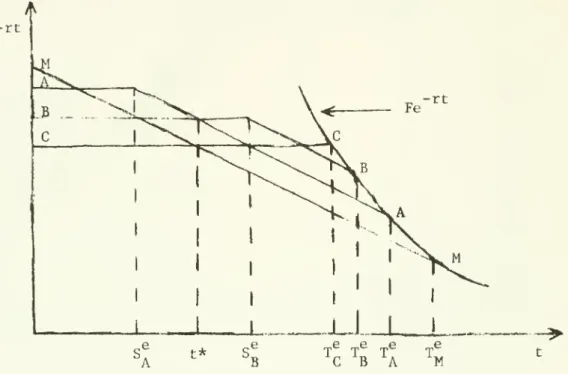
Intertemporal arbitrage by the competitive fringe keeps the discounted price constant during Phase I. Figure 1 exhibits discounted price paths cor-responding to different market structures. Path MM holds under monopoly; discounted price is everywhere declining. Path CC holds if all reserves are owned by competitive, price-taking producers. Paths AA and BB are alternative Salant equilibria in which both I
cm
and I are positive.
-3-The relations among price paths corresponding to different distributions of total reserves are given by the following Lemma, which is proven in
Appendix A:
Lemma 1 For fixed 1(0), let I (0) = wl(0) and I (0) = (l-w)I(O), with
j< w
£
1. In Salant equilibrium, increases in w (a) lower P (0) and(b) raise net discounted consumers' surplus. Further (c) the Salant equilibrium price paths corresponding to different values of w cross only once.
For fixed 1(0), paths MM and CC in Figure 1 thus correspond to w = and w = 1,
respectively, and the competitive share of reserves is larger for BB than for AA. Consumers in aggregate prefer CC to BB, BB to AA, and AA to MM.
2. Feasible Cartel Deception
The assumption that all producers know the outputs of all rivals in all future periods seems strong. It follows naturally, or course, if all reserves are comitted by transactions in futures markets at time zero. Even if some spot markets operate over time, the perfect foresight assumption is defensible
if both reserves and outputs can be costlessly monitored at each instant. Given initial reserves, all participants in the market can compute the equili-brium output paths for both the cartel and the competitive fringe. If outputs can be monitored, each sector's reserves at any instant can be computed. Then any deviation from equilibrium output paths will provoke a response, since reserves will be known to deviate from equilibrium levels. Absent crystal balls or complete futures contracts, the assumption that outputs and reserves can be continuously and accurately monitored at negligible cost thus seems crucial if a Salant equilibrium is to be maintained.
-4-But it seems unlikely that such perfect monitoring is possible in the markets for oil and other nonrenewable resources. It appears difficult enough for any one nation accurately to estimate its own reserves, let alone
to police the accuracy of others' published estimates. Similarly, it is not obvious that any producer can accurately monitor the sales of all others. It
might thus be both possible and profitable for individual producers to lie about their reserves or outputs for some finite period of time. If the market proceeds along the Salant equilibrium price path corresponding to the false data, reserves in the hands of all producers at the end of the deception will generally be different than they would have been had all told the truth. Even
if all parties insist on careful monitoring after the lie has been revealed, the shift in reserve positions may make the lie profitable.
It seems plausible that no single member of the competitive fringe can profitably affect the market by any believable lie, just as no such producer can affect market price at any instant. Accordingly, I (0) is assumed known by all parties. Then, since the demand curve is known also, the cartel can compute q (t) at all points by observing P(t) and q (t) . This implies that
the cartel can compute I (t) for all positive t. In what follows, our concern
is entirely with lies that would be privately profitable for the cartel.
In Lewis and Schraalensee (forthcoming) , we assume that all of the resource
is sold on spot markets, and we allow the cartel to misrepresent its initial reserves. We assume that its output is accurately monitored, however, so that
is must produce the Salant equilibrium outputs that correspond to its announced reserves until it decides or is forced to reveal its true holdings. We assume
that the Salant equilibrium corresponding to actual reserves determines prices and outputs thereafter. For a largo family of demand curves, we prove that
-5-the cartel's optimal strategy is always to tell the truth about its reserves. It is easy to see that this must be true when demand is linear. Salant (1976,
p. 1085) shows that in this case q (t) is independent of the cartel's actual or announced reserve holdings. Since a lie cannot alter competitive reserve holdings at any instant, and since lying requires the cartel to deviate from its optimal response, Q (t), to the competitive output path, it must be best to tell the truth. Thus, perfect monitoring of output makes lies about reserves non-optimal even if they are possible.
The present essay goes one step further and assumes that cartel output
is not strictly monitored. In order to tie down the analysis, I (0) and I (0)
m c
are assumed known to all parties. These stocks, along with r and the market demand function, determine a unique Salant equilibrium, computable by and thus assumed known by all sellers. Competitive suppliers initially expect the Salant equilibrium price path to prevail. While some futures contracts may be signed at prices P (t) at time zero, it is realistic to assume that these do not commit all reserves of both producing sectors. Competitive suppliers know
their own sales and reserves, and they can observe market price. But they are assumed not to know cartel output or total competitive output. (With known demand function, of course, they can compute Q(t) from P(t) at each instant.)
As long as the Salant equilibrium prices determined at time zero are main-tained, members of the price-taking competitive fringe simply produce whatever amount is demanded of them at each instant before the expected exhaustion date,
e e
S . Although there is a unique aggregate competitive fringe supply path, q (t),
no individual competitive supplier cares when it sells reserves during Phase I,
since expected discounted price is constant until S . Further, each such
-6-each is tiny relative to the market, however, none can infer anything about
Q
cartel sales from such fluctuations. Thus expectations will not be upset simply because q (t) differs from q (t).
All competitive suppliers will know that something is wrong, of course, if P(t) ^ P (t) at some point or if they find themselves with positive
reserves at time S . But since competitive suppliers are price-takers, and
since they expect Salant equilibrium prices to prevail, they will act to sup-port those prices regardless of the cartel's (unobservable) sales. If P (t)
is to be maintained, total output, Q(t), and thus total reserves, l(t), must follow the Salant equilibrium path. But since only the cartel knows I (t)
(and thus I (t)), it will be possible for the reserves of each sector to
deviate to some extent from their Salant equilibrium levels without upsetting expectations. By covertly deviating from Q (t) during Phase I, the cartel can thus secretly move the distribution of total reserves between the two sec-tors away from equilibrium.
Suppose that at some time t before S the cartel discovers that reserves
in both sectors do in fact differ from their equilibrium levels, I (i) and m
I^(t). Suppose for now (this assumption is relaxed below) that there are no
c
outstanding futures contracts at T. Let the cartel announce any price path,
P(t) for t > T, as long as it can support those prices in the face of compe-titive fringe behavior. To restrict the cartel's options, suppose that the announced price path must be followed, perhaps because gun-shy buyers and competitive suppliers now sign futures contracts for all their purchases and sales. That is, the cartel can make a once and for all change in prices at T.
Then the following Lemma, established in Appendix B, indicates that the car-tel's best policy is to announce and support the Salant equilibrium prices
-7-corresponding to the actual levels of reserves:
Lemma 2 Suppose that at time t there are no outstanding futures contracts, and the cartel can announce any price path, P(t) for
t > T, that it can support given competitive fringe behavior. This price path must be followed. Cartel wealth is then maximized by announcing the Salant equilibrium price path corresponding to actual reserves at time x.
By itself, Lemma 2 is essentially a stability result, with the cartel as the stabilizing force. This Lemma also suggests that the cartel can
benefit by secretly forcing reserve levels away from their Salant equilibrium values to facilitate later changes in the price path. It will be employed below to show that this suggestion is correct.
For tractability, it is assumed in what follows that the cartel can only
change price trajectories once, (As above, this may be because futures mar-kets are more intensively used immediately after such a change, so that the cartel's freedom of action is eliminated.) Absent futures contracts, Lemma 2
then gives the post-change price path. Section 3 shows that it will generally be possible for the cartel to gain by selling more than q (t) early in Phase I.
m
Such covert dumping makes buyers better off and fringe suppliers worse off. Section 4 then shows that the cartel can also profitably alter the distribu-tion of reserves by selling less than q (t) early in Phase I. Covert hoarding of this sort makes buyers, but not fringe suppliers, worse off. The conse-quences of various assumptions about the pattern and terms of outstanding futures contracts are explored in both Sections, and Section 5 considers some
implications of the formal analysis for buyers and competitive suppliers. Our aim throughout is not to characterize optimal cartel deception, but rather
-8-to identify some types of covert activity that can increase cartel wealth and
to analyze their implications.
3. Covert Dumping
Let us begin by assuming that all sales are on spot markets. Covert dumping involves the cartel's selling more than q (t) early in Phase I. On the assumption that fringe suppliers are pure price takers, such a policy
e e
will not be discovered until some time T, with < t
—
< S , when Imm
(t) < I (t) .In the simplest case, the cartel manages to dump all its reserves before
T. At that instant, a competitive equilibrium must be established, with price taking a discrete jump downward by Lemma 1. In terms of Figure 1, the price path in this extreme case jumps from a trajectory like AA to one like CC at some point before S . In the original Salant equilibrium, the cartel would
have made some sales at discounted prices below p (during Phase II) . By
e
selling all its reserves at p^, the cartel has clearly increased its wealth.
Q
Competitive suppliers now make some sales at discounted prices below p , which
they would not have done in the original Salant equilibrium, so that they are worse off. Discounted consumers' surplus is unaffected by the deception until
time T, since P(t) = P (t) for t _< t . After t, discounted surplus rises by
Lemma 1 since the market is competitive. Thus buyers in aggregate are made better off.
e
All other cases, in which < I
mm
(t) < I (t) , are onlyJ slightlyo J morecomplicated. By Lemma 2, the price path after t will be the Salant equili-brium corresponding to actual reserves at that Instant. By Lemma 1, this
implies a discrete drop in prict' .iL i , so th.ii in terms <.)f Figure 1, we are e
considering a jump from a path like
M
to one like BB at some time before SAj',.iin, fringe suppliers must make some sales at discounted prices below p
-9-after the shift at T, so that they are worse off. Discounted consumers' sur-plus before T is not changed by the deception, and it rises after x by Lemma 1,
so that buyers in aggregate are better off.
To complete the analysis under the assumption of no futures contracts, it remains to show that covert dumping in which the cartel does not completely sell out before x also increases cartel wealth. There are two cases to be considered: (a) I (x) > I^(S®), and (b) I (x) < I^(S^). In case (a), the
m
—
mmm
cartel can support the original Salant equilibrium prices by selling [I (x)
e e e e
- I (S )] during the period (x,S ) and selling Q (t) at all times thereafter. Since the cartel's total Phase I sales (all at discounted price p ) and
Phase II revenues are unchanged from the original Salant equilibrium, the cartel's wealth is also unchanged. But Lemma 2 shows that supporting prices
P (t), though feasible, is not optimal. This means that the cartel's wealth is strictly increased by covert dumping (and optimally announcing prices at x)
in case (a)
.
To analyze case (b) , in which the original Salant equilibrium prices
cannot be supported, consider Figure 2. There the discounted price path cor-responding to P (t) is ABC. Time t' is defined by I (x) = I (t'). Suppose that at X the cartel announces the price path A'B'BC. Discounted price is
^ e
constant at p in (x,t'), and, after a drop in price at t ', P(t) = P (t) until
T . Such a path can be supported by cartel sales of zero during (x,t') and
q (t) thereafter. As long as p is chosen appropriately between p' and p ,
the competitive fringe will maintain tliat price and exhaust at t ' . (Total
sales during (x,t') must equal I (x) = r^(x) - I (t) = T(x) - I (t').) Cartel
( m m
wealth under this new policy is greater tlian in the original Salant
equili-e e e
brium, since cartel sales of [I (S ) - I (t') ] that would have been made in
-10-the interval (S ,t') at discounted prices below p are replaced by sales before t at discounted price p^ . But the price path A'B'BC is not the
opti-mal announcement at time i, by Lemma 2, so it follows a_ fortiori that the
cartel's wealth is strictly increased by covert dumping in case (b) as well. Let us now consider the implications of outstanding futures contracts for covert dumping policies. If at any time t the competitive fringe must
produce q (t) to satisfy its contractual obligations, the cartel obviously cannot sell more than Q (t) without altering market price. But if there
exists a time t, < t < S , such that total fringe committments for all dates
before x are less than expected fringe sales during the period before t,
1 (0) - I (t), the cartel will generally be able to do some covert dumping during the interval (0,t). Assume that this condition is satisfied.
In order to lend credibility to its initial announcement of price path
e
P (t), the cartel might be required to contract for delivery of any amount up
e e e
to q (t) at prices P (t) for all t < T . To consider the extreme case,
sup-ra
—
pose that all these contracts are signed and that no such contract can be broken without the consent of both parties. Suppose, for the moment, that no futures contracts are signed by competitive suppliers for times after t.
After a dumping policy is revealed at time x, the cartel's reserves are inade-quate to meet its committments. It could honor them by buying from the compe-titive fringe on the spot market at prices P (t), thus reproducing the original Salant equilibrium price path and cartel wealth. But buyers in aggregate are better off if prices are permitted to change to the Salant equilibrium cor-responding to actual reserves at T. This means that the cartel can obtain more than enough from those who would gain by being allowed to break their contracts to compensate those who would loose by being forced to buy at the
-11-new prices. Futures contracts signed by the cartel thus cannot restrict its ability to dump.
Futures contracts signed by the competitive fringe for times after t do not affect the cartel's profits, though they alter the distribution of gains and losses between the competitive fringe and buyers. Refer to Figure 1 and recall that covert dumping corresponds to a jump from AA to BB at some time
e e
T before S . Competitive futures contracts would not extend beyond S , and
since price is lower along BB than along AA during the interval (t,S ), it
is clear that these contracts must cover less than total output along BB dur-ing that interval. If the contracts are honored, buyers are worse off and competitive sellers are better off than if they are breached and all
transac-tions are at spot prices. Such contracts thus permit competitive suppliers to capture part of the gains that would have accrued to buyers.
Finally, if the cartel can operate strategically in futures markets, it
can increase its gains from dumping by capturing some of this surplus itself. In terms of Figure 1, it can do this by contracting for sales at prices P (t)
,
corresponding to the originally announced price path AA, only for times before
t*, when paths AA and BB (the post-T path) cross. It can always honor these committments by buying on the spot market from the competitive fringe, if
necessary, and re-selling at a profit. Note that it can contract for its entire expected (at time zero) output before t*, since total output is greater
(because price is lower) in the new equilibrium.
4. Covert Hoarding
Again, let us initially assume that all sales are spot. Covert hoarding is simply the inverse of covert dumping: over some initial period (0,t) during
-12-Phase I, the cartel sells less than q (t) on average. Although competitive
suppliers are thus producing more than q (t) on average in aggregate, the
original Salant equilibrium prices are not upset by this, since no individual competitive supplier can be expected to attribute brisk demand for its product to cartel hoarding.
At time T, when by assumption the cartel's deception is revealed,
e e e
I (t) > I (t) . Since I(t) = I (x) because prices P (t) were supported in the
m m
interval (0,t), the net effect of covert hoarding is to increase the cartel's share of total reserves at x. (Recall that covert dumping served to decrease this share.) By acting in part like a competitor, the cartel could continue
to support prices P (t) after x. (This would involve cartel sales of
e e e
I (x) - I (S ) during the period (x,S ).) Total cartel sales during Phase I,
m m
at constant discounted price p_, would then be the same as in the original Salant equilibrium, and the Phase II revenue stream would clearly be unchanged. Thus cartel wealth would be exactly as in the original Salant equilibrium. But Lemma 2 establishes that it is not optimal to support P (t) after x, so
that cartel wealth must be strictly increased by covert hoarding.
With all sales on spot markets, Lemma 2 further establishes that the price path after x must be the Salant equilibrium path corresponding to actual reserves at x. From Lemma 1, this means that price rises discontinuously at x,
when the cartel's greater-than-expected share of reserves is revealed. In terms of Figure 1, covert hoarding thus implies a jump from a price path like
Q
BB to one like AA at some time before S.. In the extreme case in which A
I (x) = 0, the jump can be thought of as occurring at time S or as being
C A
-13-The implications of covert hoarding for buyer and competitive supplier welfare are the reverse of those of covert dumping. If I (t) = 0, the
com-c
petitive fringe are unaffected by covert hoarding, since all fringe reserves
e
are sold at discounted price p , as in the original Salant equilibrium. If
I (t) > 0, competitive producers with positive reserves at x gain from covert
e
hoarding; those reserves are sold at discounted prices above p_ after t. On the other hand, a simple reversal of the relevant argument in Section 3
(using Lemma 1) shows that buyers in aggregate are made worse off by covert hoarding.
Let us now consider the implications of outstanding futures contracts for covert hoarding policies. From the cartel's point of view, the most troublesome such contracts involve promises by competitive suppliers to make deliveries late in Phase I. Any attempt to drive fringe reserves below those needed to honor later obligations will likely upset the Salant equilibrium price. But some covert hoarding will generally be possible if there exists some time T, < T < S , such that total fringe futures contracts for all
dates after T total less than I (x), expected competitive reserves at that date. Assume that this condition is satisfied, so that some covert hoarding
is possible.
It is harder to show the profitability of covert hoarding in the presence of arbitrary patterns of futures contracts. Since buyers are made worse off in aggregate by covert hoarding under spot markets, the arguments of Section 3
cannot be employed to dispose of futures contracts signed by the cartel. Still, even with futures contracts, the cartel should find covert hoarding profitable except, possibly, in very special cases. To support this asser-tion, we first show that the cartel can never loose by covert hoarding. We
-14-then analyze two polar cases in which it clearly gains and argue that such gains must be realizable in all but the most bizzare situations.
Even if the cartel has signed contracts for Q (t) for all t >^ T, covert
hoarding before T leaves it with uncommitted reserves at that time. Regard-less of the pattern of competitive fringe futures contracts outstanding at T,
the cartel's uncommitted reserves can be used to support the original Salant equilibrium price path. In order to do so, the cartel would have to sell
[I
mm
(t) - I^(S^)] between T and S^ and to sell q^(t) for all t > S^. Sincem
—
e
total Phase I sales at discounted price p and the Phase II revenue stream
are as in the original Salant equilibrium, it follows that cartel wealth is
also as before. The cartel thus cannot loose by covert hoarding.
In the first polar case, the cartel has promised no deliveries for times after T, but competitive suppliers have committed all of their reserves. Suppose that the cartel announces the Salant equilibrium price path corres-ponding to actual reserves at x. By Lemma 1, discounted price during Phase T
of the new equilibrium must be higher than p_, the discounted price at which all competitive supplier futures contracts were signed. This means that parties to such contracts can share capital gains by agreeing to ignore their former plans and instead selling all competitive reserves during the new Phase I. (Buyers who have signed futures contracts with competitive fringe suppliers thus share in the latters' gains.) But this means that the announced price path can be supported. The cartel can thus behave as if there were no competitive futures contracts outstanding, and its wealth must rise as before.
In the second polar case, the cartel has promised delivery of q^(t) for all times after T, but I (l) = 0. Tin.' cartel's deception is not revealed
-15-until competitive fringe reserves are exhausted. (This means that no fringe suppliers signed contracts for delivery after t.) Total cartel reserves at t
e e e
must equal I (t) , since P (t) was supported until T. Of this total, I (t) is
committed by futures contracts, and I (t) is unconunitted. As before, the
car-tel could simply refuse to break any of its contracts and support the original Salant equilibrium price path. This would require selling all uncommitted
e
reserves before S . If it did this, discounted marginal revenue at all points
e e
in Phase II would be mr^, from Section 1. During the period (t,S ), the
remainder of Phase I, discounted marginal revenue would be less than mr at
9
all points. By still refusing to break any contracts and shifting some of
its uncommitted reserves to times after S , the cartel can thus clearly raise
its discounted revenue above that in the original Salant equilibrium. The cartel may even do better, of course, if it allows some futures contracts to
be broken.
The difference between discounted marginal revenue before and after S
if the original Salant equilibrium price path is supported implies the general possibility of increasing cartel wealth by covert dumping for more general patterns of outstanding futures contracts. The cartel will always benefit if it can shift sales of its uncommitted reserves after t so as to reduce or eliminate this difference. Outstanding futures contracts and competitive fringe control of some uncommitted reserves will constrain its ability to
alter price and output paths. These constraints may be quite complex. But
it is hard to imagine cases in which they would bind the cartel so tightly as to eliminate any gains (over cartel wealth in the original Salant equilibrium) from shifts in the timing of sales of uncommitted reserves.
-16-As was the case under covert dumping, the cartel may be able to enhance the profits from covert hoarding by strategic actions in futures markets. Consider Figure 1 and recall that covert hoarding involves a jump from a price
Q
path like BB to one like AA at some time before S , If the cartel can arrange
A
to sell futures contracts only for times after t*, when the paths cross, and
if such contracts can be broken only with mutual consent, the cartel will cap-ture additional revenue. Again, the cartel can contract for its entire
expected output during such periods, since total market demand at the new (post-x) price will be greater than initially expected.
5. Conclusions and Implications
If competitive fringe suppliers exhibit pure price-taking behavior, and
if all sales of the resource are on spot markets, we have shown that the car-tel can increase its wealth either by covert hoarding or by covert dumping. That is, it can profitably over-produce o£ under-produce until its deception
is uncovered. By covert dumping (over-producing), the cartel manages to sell all or part of its reserves on good terms before the day of reckoning; the brunt of the sudden price fall on that day is borne by the competitive fringe. By covert hoarding (under-producing), the cartel manages to remove the compe-titive fringe from the market sooner, thus in effect monopolizing a larger fraction of initial reserves.
It should be clear that our formal analysis relies heavily on the assump-tion of price-taking behavior. If any non-cartel suppliers hold non-negli-gible reserves, detection of covert dumping or hoarding is more likely. But as Lemma 2 and the analyses of profitability in Sections 3 and 4 showed, any
-17-between it and competitive suppliers (even if only slightly) is profitable for the cartel. The most profitable feasible deception in any particular case will depend on the details of that case. In particular, the optimal lie may
12
be of either sign.
We showed that buyers in aggregate would prefer covert dumping to the
original Salant equilibrium, which they would in turn prefer to covert hoarding, Competitive fringe suppliers, on the other hand, do at least as well under
covert hoarding as under the original Salant equilibrium, but they prefer both possibilities to covert dumping. Thus, buyers would like to restrict the car-tel's ability to hoard, while competitive suppliers would like to restrict its ability to dump.
Our analysis of futures contracts indicates steps that sophisticated buyers and fringe suppliers might take in light of these objectives. In the first place, neither should ever sell to the cartel. Spot purchases by the cartel from the fringe during Phase I may facilitate hoarding. A fringe sup-plier cannot be worse off by refusing to sell to a hoarding cartel, and he will be better off if he has reserves when the cartel's deception is announced. Similarly, buyers who sell futures contracts purchased from competitive sup-pliers to the cartel may find that they have facilitated a hoarding policy that then forces them to buy spot at higher prices. By refusing to sell, they are no worse off and, if hoarding occurs, they may gain. (Refusal to
sell to the cartel cannot restrict its ability to dump, of course.)
Buyers cannot reliably protect themselves by signing futures contracts with the cartel. As Sections 3 and 4 showed, such contracts may reduce the
-18-Moreover, as those Sections also noted, cartel profits from deception can be enhanced by strategic sale of futures contracts, and the gain comes entirely at buyers' expense.
As a group, buyers and competitive suppliers can protect themselves against cartel deception by contracting in futures markets for all of the latter's equilibrium output during Phase I. If buyers in aggregate purchase
q (t) on futures markets from competitive suppliers for delivery early in Phase I, however, they run the risk of preventing covert dumping that would make them better off. Similarly, fringe suppliers as a group can inadvert-ently prevent covert hoarding that would benefit them by selling all their expected production late in Phase I on futures markets. All else equal, buyers should thus try to contract with the competitive fringe for as much of the latter's Salant equilibrium output as they can obtain for periods late in
Phase I, while competitive suppliers should focus their selling efforts on contracts calling for delivery early in Phase I.
If both buyers and fringe suppliers are sufficiently active in futures markets, so that the entire Salant equilibrium competitive fringe output is
sold, no profitable cartel deception will be possible. If all non-cartel par-ticipants in the market are risk-averse, and if costs of transacting in the futures market are low enough, this would of course be the expected outcome. But in all other cases in which it can believably lie about production, the cartel can pursue a covert strategy that will make it better off than in a
13
Salant equilibrium, at the expense of buyers or competitive fringe suppliers.
-19-Appendix A: Proof of Lemma 1
For simplicity, let I = 1(0), I = I (0) , and I = I (0) . Consider two
c c
mm
alternative situations with the same I: (i) I = wl, I = (l-w)I, and (ii)
c
m
I = w'l, I = (l-w')l, with < w < w' < 1. Let S and S' be the
correspond-c m
—
—
ing competitive exhaustion dates under Salant equilibrium, let T and T' be the coresponding cartel exhaustion dates, let P(t) and P'(t) be the corres-ponding price paths, and treat other quantities similarly. From Section 1,
P(T) = P'(T') - T. Our first task Is to
show
that P(t) and P*Ct) Intersect only once, with P(0) > P'(0).Suppose P(t) < P'(t) everywhere. But it is then clear that total produc-tion under w would exceed total production under w'. Thus the two paths must cross at least once or coincide everywhere.
For t less than both S and S', both P and P' are increasing at the same rate, so the paths cannot intersect unless they are equal everywhere. Simi-larly, if t exceeds both S and S', P(t) = P'(t) implies that the cartel mar-ginal revenues are equal. But cartel marginal revenue grows at the same rate
in both equilibria in Phase II and is monotonic in price. Unless the two price paths are everywhere identical, they can intersect only for t between
S and S'. In this interval, one equilibrium is in Phase I and the other is
in Phase II. Since price always rises more rapidly in Phase I, there can be only one intersection unless the paths coincide.
We now show that P(0) > P'(0) by contradiction. Suppose P(0) < P'(0). Then by the geometry of the intersection point if P(0) < P'(0), it must be
that S > S'. (In terms of Figure 1, associate P'(t) with trajectory AA and P(t) with BB.) Since P(t) > P'(t) for t > S, and both price paths approach F,
it must be that T -'
-20--rT -rT'
mr^ = Fe
^
Fe = mr'. That Is, cartel marginal revenue is no greater with w than with w'. For£
t£
S', we have P'(t) <_ P(t) . This implies thatover this range E(t) >^ E'(t), where these are the respective elasticities of
demand, and Q'(t) >^ Q(t). Writing cartel marginal revenue as a function of
E, the foregoing results establish that q (t) >^ q'(t) for
£
t£
S'. But theintegral of q' from to S ' equals w'l by the reserve constraint, and the
integral of q over this same interval is less than or equal to wl (since S
>_ S'). The two preceding sentences then imply that w'l
£
wl, contradictingthe assumption with which we began. Therefore P'(0) < P(0), as was to be shown. It follows from this and the preceding paragraph that P(t) =^ P'(t)
except at one t; the paths do not coincide and intersect only once. Thus parts (a) and (c) of Lemma 1 are established.
Net discounted surplus can be written as a function of w for fixed I:
T(w) Q(w,t) /
W = / { / P(u)du - P[Q(w,t)]Q(w,t)}e ''^dt, (1)
where P(*) is the inverse demand function. Since Q(w,t) emerges as the solu-tion to the differential equations describing the Salant equilibrium, as long as the demand function is smooth enough, Q(w,t) will be differentiable in w.
Thus we can differentiate (1) and obtain
T(w)
9W/9w = / [-(dP/dQ)Qe '"'^][9Q(w,t)/3w]dt, (2)
using Q[w,T(w)] = and P(0) = F, a finite number. Let the first term in the -rt
integrand be Z(w,t). It is easy to show that Z = (Pe )/E. Since discounted price is non-increasing in Salant equilibria, but P and thus E are monotone increasing, Z is a decreasing function of time. The preceding ]).-iragr.i[)h.s
-21-establish that 9Q/8w must be positive for small t (since 9P (0)/3w < 0),
reach zero at some finite time t', and be negative thereafter. Combining all this, (2) implies
f
T(w) 3W/9w = / Z(w,t) [9Q(w,t)/3w]dt + / Z(w,t) [9Q(w,t)/9w]dt (3) t' t' T(w) > Z(w,t'){ / [9Q(w,t)/9w]dt+
/ t9Q(w,t)/9w]dt} = 0, t'where the last equality follows from differentiation of the market reserve
constraint and Q[w,T(w)] = 0. The proof of part (b) of Lemma 1 is thus complete.
Appendix B: Proof of Lemma 2
For notational convenience, let the time at which price is changed, t,
be time zero. Let P(t) be an announced path of prices at which the cartel agrees to support sales over time until its inventories are exhausted. Given P(t), price-taking fringe suppliers choose sales to maximize profits. During periods of fringe production, the absence of profitable arbitrage
opportuni-ties in the market requires that
— rt P(t)e = p whenever q (t) > o c (4) —rt P(t)e < n whenever q (t)
=0
—
'o cDuring periods in which fringe production is zero, cartel profits are maxi-mized by choosing prices so as to satisfy
{P + (dP/dQ)Q}e~'^'^ = mr whenever q (t) = Q(t) (5)
o m
-22-q (t) = Q(t). By (4) this implies that it is not feasible to have a period m
in which q (t) = followed by an interval during which fringe production is
positive. Thus any feasible price path will involve an initial period [0,S]
during which q (t) > and Q (t) >_ 0, and all fringe suppliers are exhausted,
followed by a second period, [S,T] in which q_(t) > 0, where S < T and I (T)
m
—
mGiven these conditions, P(t) is uniquely determined by the reserve con-straints (see Lewis and Schmalensee (forthcoming). Theorem 1):
/ q (t)dt = I (0)
/ q (t)dt + / q (t)dt = I (0)
Q m s " "
(6)
Treating P(t) as a function of I , the total cartel inventories sold during
m [0,S], let
S T
TT(I^) = / e"'''^[P(q +q )q ]dt + / e""^*^[P(Q)Q(t)]dt
m Q
mem
g (7)be the cartel profits earned along the price path corresponding to initial
S S
period sales of I . The affect of variations in I on cartel profits is
m m given by m , -rt ;;
—
= / e 91'm
m m m dt +/{[P+Qg]e""}
dq. dl' dt m m e dt - rar. (8)Since total profits during the first inLL-rval , p I , are independent of the
o m
sales path q (t) , let us assume witliouL loss of generality that sales are
-23-allocated during [0,S] such that the marginal revenue accruing to the cartel mr =[P +(dP/dQ)qlis constant. Rewriting (8) we thus obtain
3tt(I^)
m_
m
S = J mr da m dl^ - (mr^ - P^) dq. dl -rt ,^ e dt - mr. (9) = mr^ - mrThis implies that cartel profits are maximized by choosing a price path for
2 2 S
which mr = mr . (It is easy to verify that 9 Tr/8l < given our
assump--L u m
tion that E is increasing with price.) In Salant (1976) and Lewis and
Schmalensee (forthcoming) it is demonstrated that marginal revenue is equated across all time periods if and only if P(t) = P (t) . Thus given the behavior
-24-REFERENCES
Hotelling, H., "The Economics of Exhaustible Resources." Journal of Political Economy 39 (April 1931): 137-175.
Lewis, T.R., and Schmalensee, R., "Cartel and Oligopoly Pricing of Nonrenewable Natural Resources." In Dynamic Optimization and Applications to Economics,
edited by P.T. Liu. New York: Plenum Press, forthcoming.
Pindyck, R.S., "Gains to Producers from the Cartelization of Exhaustible Resources." Review of Economics and Statistics 60 (May 1978): 238-251. Salant, S.W., "Exhaustible Resources and Industrial Structure: A Nash-Cournot
Approach to the World Oil Market." Journal of Political Economy 8A
(October 1976): 1079-1093.
Stigler, G.J., "A Theory of Oligopoly." Journal of Political Economy 72
-25-FOOTNOTES
1. See, for instance, Pindyck (1977).
2. Salant (1976) drops this assumption in some of his analysis. It will be retained in this essay for simplicity, though our results also hold for the case of constant marginal extraction cost.
3. It is worth noting that this is not implied by the assumption that E is
-bP increasing in price. Consider the demand function Q = ae
, where a and
b are positive constants. Here E = bP, but P(0) is infinite.
4. In Lewis and Schmalensee (forthcoming), uniqueness as well as existence of
equilibrium are proven under more general demand assumptions, and a number of new comparative dynamic results are established.
5. The assumption that the resource cannot be stored by buyers is needed here
to avoid intertemporal arbitrage.
6. Some of the results in this Lemma are given by Salant (1976, pp. 1086-7); see Lewis and Schmalensee (forthcoming) for more properties of these equilibria.
7. Specifically, we consider inverse demand curves of the form P(Q) = F - aQ ,
where F, a, and b are positive constants. This family has linear, convex, and concave members. For all positive values of the constants, E is
increasing in P. We conjecture that the result stated in the text holds
whenever E is increasing in P, but we have been unable to prove this formally,
8. This is essentially a limiting case of the sort of argument made in Stigler (1964).
9. This follows from equation (2) and the observation that in order to support
e e
P (t) after covert hoarding, tlic cartel would have to sell more than q (t)
-26-10. If the cartel can act covertly in futures markets, it can simplify this problem drastically. Since buyers are price-takers also, the cartel (or
some entity secretly its agent) can buy up competitive fringe committments by paying discounted prices an arbitrarily small amount above p . With
luck, it can obtain control of all competitive reserves in this fashion. At I, it can re-contract, shifting delivery dates but not changing dis-counted price (so as to leave competitive suppliers indifferent) . If it
did this and supported the original Salant equilibrium price path, it would take negligible losses when it re-sold competitive fringe deliveries on the spot market. But it now has effective control of fringe reserves and is
not limited to this strategy. In fact, the situation is exactly as in the preceding paragraph, and the cartel can thus clearly increase its wealth.
11. It also depends critically on the assumption of zero extraction cost. If
all producers have constant unit costs, then, as Salant (1976, p. 1081) notes, this sort of analysis goes through with appropriate changes in the assumptions about demand. On the other hand, if marginal extraction cost rises with output, then only the competitive output path is consistent with the Salant equilibrium price path, and profitable deception is impossible.
12. One can imagine a variety of sophisticated deceptions in more realistic settings. By spreading rumors of its breakup, the cartel might encourage risk-averse competitors to expand output, permitting it covertly to hoard. Rumors of a sharp price rise might permit covert dumping.
13. Since futures markets are more likely to be active for deliveries relatively close to the present, rather than in the distant future, hoarding may be more easily affected than covert dumping in many markets.
-27-Pe-rt t* S, G e p rp*- 'T' T C B A M
-28-Pe-T-t
^-HD28IV1414 no.1009- 78
Robinson, Rich/The quality and relevan
735340. . D.XBK5 3 TOflO
QDl
125bl3
HD28-IVt414 no.1019- 78 \^'i'^lJ°^" °P?BKr" 'TOk0873 '™ 822506 3 TDfiQ 001im
ss? HD28.M414 no,1010- 78Lewis. Tracy R/Cartel deception in non
818318 O^fBKS On057fi8,5..
3
TOAD
001 102 ?t.DHD28.IV1414 no.lOll- 78
Von Hippel. Er/Product designs which e 81831.6... ... .O.sfBKS . . .00057B""
3 TOflO 001 102 a2fl
HD28.M414 no 1012- 78
Dnscoll. Jame/Coping with role confli
"111
liiiiiiiir
TOflO 001 125 b5MHD28.IVI414 no-1013- 78
Ischoegl, Adn/Weak-form efficiency m
822505.,. D^BKS _. 00060872
3 TOflO
001
im
545HD28.M414 no,1014- 78
Jerrett, Rober/Job creation and the ec
73534.2 .0*B.KS. 000595
3
TOaO
001 125 ST7HD28.M414 no.l015- 78
Paddock, James/Corporate investment un
735344 .D*.B.I<S... 000595
3 TOfiO 001 125 571
H028M414 no.1016- 78
Allen, Thomas /The relation of interna 735346 D»BKS
^yH^^S^^
3 To'flO 001 125 555
HD28-M414 no 1017- 78
Mass, Mathanie/Destabilizinq impacts o
735648 D»B-
•^---3 TOflO
001
15T &^^HD28.M414 no.1018- 78
Mass, Nathanie/A microeconomic theory
73564.7 . . n>'BKS On062382
3
TOaO
001
illIII!nil