I
HH
^
APPLICATION OF THE "DEFENDER" CONSUMER MODEL by
John R. Hauser, Massachusetts Institute of Technology and
Steven P. Gaskin, Management Decision Systems
Revised: December 1983
no.
IHOH-S3
i-WP #1404-83, Alfred P. Sloan School of Management Massachusetts Institute of Technology
Cambridge, Massachusetts 02139
THE
MARKETING CENTER
Massachusetts Institute ofTechnology
Alfred P. Sloan School of Management
50 Memorial Drive
Cambridge, Massachusetts 02139
APPLICATION OF THE "DEFENDER" CONSUMER MODEL by
John R. Hauser, Massachusetts Institute of Technology
and
Steven P. Gaskin, Management Decision Systems
Revised: December 1983
no-
i ~*-WP #1404-83, Alfred P. Sloan School of Management
Massachusetts Institute of Technology Cambridge, Massachusetts 02139
ABSTRACT
This paper examines the feasibility, practicality, and predictive ability of
the consumer model which was proposed by Hauser and Shugan (1983). We report
results in two product categories, each representing over $100 million in annual
sales. We develop "per dollar" perceptual maps and empirical consumer "taste"
distributions. As a first test of the model, we compare the predictive ability
of the consumer model in one category to (1) pretest market laboratory
measurement models, (2) traditional perceptual mapping procedures, (3) a hybrid
model using price as an attribute, and (4) actual market shares in test market
cities. In the second product category, we illustrate the application of the
quantitative model to augment managerial judgment. Besides developing an
empirical version of the 'Defender' consumer model, our analyses raise a number
ACKNOWLEDGEMENTS
We wish to thank Glen Urban, Al Silk, John Little and Leigh McAlister of
M.I.T. and Karl Irons, Robert Klein, Bruce Donath and Peter Guadagni of
Management Decision Systems (M.D.S.) for their advice, insights, and support
throughout this project. The data were supplied by an unnamed sponsor and by
Management Decision Systems. The necessary computer support was provided by Management Decision Systems. This paper has benefitted from seminars at M.I.T.
,
M.D.S. , the University of Connecticut, the University of Osaka (Japan),
ORSA/TIMS Orlando, Marketing Science Institute Special Mini-Conference, Kao Soap Ltd. (Japan), Johnson and Johnson, Ltd, (Japan), and numerous unnamed consumer
1. MOTIVATION
In their paper, "Defensive Marketing Strategy", Hauser and Shugan (1983)
develop a number of qualitative normative implications on how a firm marketing
an established product should defend its profit when facing an attack by a new
competitive product. For example, their analyses suggest decreasing budgets for
distribution and awareness-advertising while improving the product and
reposi-sioning in the direction of the defending product's strength; price should be
decreased in unsegmented markets but potentially increased in segmented
markets. These implications are derived from a mathematical model of consumer
response that assumes heterogeneous consumers maximizing utility in a "per
dollar" multi-attributed space. We call this descriptive mathematical model the
'Defender' consumer model.
A key feature of the Defender consumer model is that attributes are measured
"per dollar"; for example, laundry detergents might be evaluated with respect to
'efficacy per dollar' and 'mildness per dollar'. However, the "per dollar"
assumption is untested and, hence, has become quite controversial in marketing
science. See discussions in Rao (1982), Ratchford (1982), Sen (1982), and
Gavish, Horsky, and Srikanth (1983).
Another key feature is that consumer "tastes", i.e., tradeoffs among the
attributes, are assumed heterogeneous. The distribution of these tastes across
consumers is estimated by a sum of piece-wise uniform distributions. Like "per
dollar" maps, this assumption has not been tested empirically prior to this
paper.
While Hauser and Shugan's qualitative results require only the existence of
"per dollar" perceptual maps and heterogeneous taste distributions, quantitative
of the theoretical constructs. Furthermore, an examination of "per dollar"
perceptual maps and heterogeneous taste distributions has implications beyond defensive marketing strategy. For example, Lane (1980), Lancaster (1979), and
Hauser and Simmie (1981) each assume the existence of "per dollar" perceptual
maps in their analyses. Similarly, the debate on the need for heterogeneous
preferences is a long standing debate in marketing science. (E.g., see Green
and Srinivasan (1978)).
This paper describes in detail an initial application of the consumer model
proposed by Hauser and Shugan (1983). In particular, we estimate empirically a
"per dollar" perceptual map and the corresponding taste distribution in a
cate-gory with over $100 million in annual sales. Our analyses explore a number of
technical issues and suggest that "per dollar" perceptual maps and heterogeneous taste distributions are feasible to measure. We compare the estimated consumer
model to a variety of alternative models and to "actual" consumer behavior.
While recognizing that a single empirical test is not sufficient to accept a
basic model, we feel that such a test is sufficient to demonstrate that the
consumer model is reasonable and worth further exploration.
We also describe a second application in which market research data,
mana-gerial judgment, and the Defender consumer model are combined to obtain
stra-tegic insight about a new product and a potential defense via the launch of a
flanking product.
2. PERSPECTIVE
The primary purpose of this paper is to test the feasibility and
practi-cality of a consumer model based on "per dollar" perceptual maps and
hetero-geneous taste distributions. If the model is not feasible, if it is onerous to
measure and estimate, or if it predicts poorly in our initial test, then we must
-reexamine its basic assumptions. If the consumer model is feasible, reasonably
cost effective, and reasonably accurate in this initial test, then we can
proceed to develop the model further and explore its quantitative implications.
In either case, we advance our understanding of how to model consumer response.
To apply the consumer model, we follow procedures developed by Hauser and
Shugan (1983), making some minor modifications that are justified theoretically
prior to parameter estimation. We estimate the model based on products which
are in the market prior to the new entrant. We compare predictions to (1)
predictions of two well-documented marketing science models, (2) a hybrid model,
and (3) measures of market share taken after the new product had entered the
test market. The first comparison enables us to understand better alternative
marketing science models and assumptions. The second comparison explores the implications of "per dollar" attributes vs. price as an attribute. The third
comparison is an initial test of the model's external validity.
For established model comparison, we chose (1) Silk and Urban's (1978)
'Assessor' model and (2) traditional perceptual mapping/ preference regression
models as described by Urban and Hauser (1980, chapters 9 and 10).
Assessor has been applied commercially to over 300 products and its
predi-ctive accuracy has been scientifically examined by Urban and Katz (1983).
Fur-thermore, it is representative of a class of commercially available 'pretest
market models' such as those described in Eskin and Malec (1976), Tauber (1977),
Burger, Lavidge and Gundee (1981), Yankelovich, Skelley, and White (1981), and
Pringle, Wilson and Brody (1982). Data collection is clearly feasible for
models in this class and predictive accuracy is acceptable to many marketing
managers. If Defender can predict as well as Assessor, then we have some
confi-dence in its predictive ability.
Analysis with traditional perceptual maps is state-of-the-art methodology as
recommended by new product develoment textbooks (Urban and Hauser, 1980,
-chapters 9, 10; Pessemier, 1982, chapter 5; Wind, 1982, chapter 4; Choffray and
Lilien, 1980, chapter 6) as well as basic marketing textbooks (Kotler, 1983,
chapter 2). Traditional maps serve as a standard to which "per dollar"
percep-tual maps can be compared. Data collection is feasible for traditional maps
although their predictive accuracy is not documented as well as for pretest market
models.
The hybrid model is included in recognition of the debate in marketing science
(e.g., Rao and Gautschi 1982 and Srinivasan 1982) on whether or not price should
be treated as an attribute. Since the Defender consumer model differs from
traditional perceptual maps in two ways, "per dollar" scaling and heterogeneous tastes, a comparison of Defender to traditional methods is a simultaneous test of
both assumptions. By using heterogeneous tastes with a traditional perceptual map
using price as an attribute, we can explore the differential impacts of the two
assumptions.
We choose as our measure of predictive accuracy, the share of the new product
as measured by SAM1 for the test cities. SAM1 is based on a reasonably complete
universe of warehouse withdrawals and is the market share measure in which the
cooperating firm has the most confidence. While no measure is perfect, we feel
SAMI is a reasonable benchmark to which to compare Defender's predictions. (For a
discussion of other methods to track market share such as Nielson audits and diary
panels, see Wind and Lerner 1979.) Remember that this application of Defender is
based on data collected prior to test market and, hence, prior to the SAMI measure.
Finally, because this paper is empirical, a number of tradeoffs (sample size,
methods of measurement, model estimation, comparison models, measures of external
validity, etc.) were made to construct the empirical realization of the
theorectical model. We made one set of judgments. Other researchers with
dif-ferent goals and philosophies might have made difdif-ferent empirical judgments.
-We recognize also that Defender is a paramorphic model in the sense that
con-sumers respond as if they followed its assumptions. Other models may also be
acceptable within the measurement error bounds to which Defender is subject.
Thus, when we make interpretations of our data we provide as much evidence as
confidentiality constraints will allow in the hopes that each reader can make
his (her) own interpretations of our analyses.
3. REVIEW OF THE 'DEFENDER' CONSUMER MODEL
For ease of exposition, we present the model for two perceptual dimensions
and then illustrate its extension to three or more dimensions. (Hauser and
Shugan, 1983, deal with two dimensions.) This section presents a verbal
des-cription of the model. For the interested reader, an appendix contains analytic
formulae.
Evoked Set Issues
As documented in Silk and Urban (1978) consumers vary in the brands that
they consider when making a choice. We call a set of brands an evoked set and
we observe which consumers use which evoked sets in making a choice. For
example, if there are four "Gypsy Moth Tape" products on the market, called
Pro-Strip, Cata-Kill, Tree Guard, and Store Brand, then one evoked set is all
four products. Another evoked set might be {Pro-Strip, Tree Guard} and
another {Tree Guard, Cata-Kill}. With four products there are 15 possible
evoked sets.
••-Gypsy Moth Tape is a specialized product used in the forests of New
England to protect against insect infestation. Throughout the paper, we use it
as a disguise for a real $100 million category.
-Defender analyzes each evoked set separately and predicts for each evoked
set the share among brands in that evoked set. Catagory share is then logically
the weighted average across evoked sets where the weights are the fraction of
consumers who use that evoked set as their choice set.
Note that because of variation in evoking, a brand may be dominated by
another brand yet be predicted by the model to have non-zero category share.
Predicted purchases result in the model from purchases by consumers who evoke
the dominated brand but not the dominating brand. There are many reasons why
they may not evoke the dominating brand, for example, it may be underadvertised
and they are not aware ot it, or it may not be available where they shop. (Of
course, there are other reasons why a dominated brand might be chosen including
omitted variables and model misspecif ication.)
Share Within Evoked Sets
Defender assumes (1) that each consumer choses from his evoked set the
product which maximizes utility, (2) that utility is linear in the "per dollar"
perceptual dimensions, and (3) that consumers vary in their tastes. Linear
utility implies straight-line indifference curves in perceptual space.
For example, suppose that consumer 1 cares only about 'Effective Control'/^,
then his indifference curve will be a vertical line and he will choose Pro-Strip
as indicated in figure la. If consumer 2 cares only about 'Ease of Use'/&, his
indifference curve will be a horizontal line and he will choose Tree-Guard as
indicated in figure lb. Finally, if consumer 3 cares equally about 'Effective
Control'/^ and 'Ease of Use/$, his indifference curve will make an angle of 45°
with the vertical axis and he will choose Cata-Kill as indicated in figure lc.
Clearly, consumers can vary in their tastes, that is, in their willingness
to tradeoff "Ease of Use' for 'Effective Control*. For two perceptual
-dimensions, we can represent each consumer by the angle, a, that his
indif-2
ference curve makes with the vertical axis. See figure Id.
EOU/$ Tree-Guard >Cata-kill Pro-strip. EC/$ a) Consumer 1 EOU/$ Tree-Guard
+
Cata-kill Pro-strip—
• EC/$ b) Consumer 2 EOU/$ Tree-Guarda
Pro-strip EC/$ EOU/$Y
a=90c OF oc EC/$c) Consumer 3 d) Variation in Tastes
FIGURE 1: Illustration of How Taste Variation Affects Choice.
2Techically, a represents tradeoffs among 'Effective Control' and
'Ease of Use' as well as 'Effective Control'/^ and 'Ease of Use'/$ since the 'per dollar* scaling cancels out in computing the tradeoffs.
-£(")
_T
'Effective Control' 'Ease of Use'
_J"
0° a., a favors a
Cata-kill
Figure 2: Hypothetical Histogram of Consumer Tastes,
represents market share of Cata-Kill.)
90'
(Shaded Area
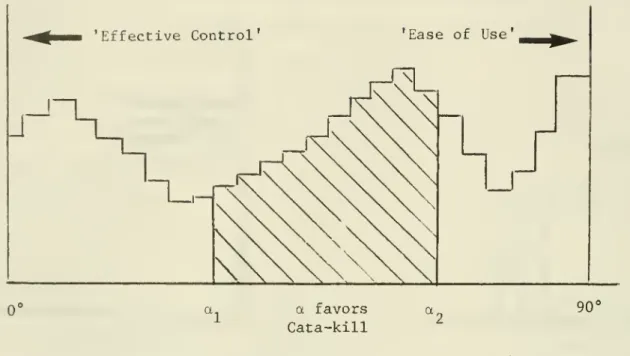
The market share of the brand, say Cata-Kill, will be the percent of
consumers whose taste-angles, a, favor Cata-Kill. Thus, if we know the
dis-tribution of a within the population of consumers who use the evoked set as a
choice set, and if we know the perceptual positions of all brands in the evoked
set, we can readily compute Cata-Kill's market share. The computation is
represented in figure 2. f(a) represents the distribution of tastes, a.
All consumers with a's between ou and ou will choose Cata-Kill, hence,
the market share will be the shaded area in figure 2.
Hauser and Shugan (1983) derive analytic formulae for two dimensions, but
for three or more dimensions the formulae become extremely complex.
Empirically, we use numerical methods rather than analytic formulae. We divide
the range of a into equal line segments, say 1° each. For each line segment,
i, we use the a. for that segment to compute the utility of each product.
I.e. ,
-Ilrt^'w
utility of
product j
''effectiveness'
per dollar /tan a±
'ease of use' per dollar
of product j
(1)
of product j
The product with the maximum utility, for a., is assigned to the ith segment
and f(a.j) tells us how many consumers are in that segment. Summing the
f(a.) across those line segments, i, where product j is the maximum utility
3
product, gives us an estimate of the market share of product j.
This procedure is easily automated and readily generalizes to three or more
dimensions. For example, for three dimensions, indifference curves become planes
and we require two angles, a and (3, to represent each consumer. The angle a
still represents tradeoffs among 'Ease of Use' and 'Effective Control', while the
angle 8 represents tradeoffs among 'Professional Quality' and 'Effective Control'. See figure 3. We could also define an angle y to represent
tradeoffs among 'Professional Quality' and 'Ease of Use' but y is uniquely
determined by a and 13 and, therefore, redundant. (In particular,
tan y = tan 6/tan a.)
EC vs.
f(a, 6) f(a, 6)
a) Uniform Distribution b) Distribution Favors 'Effective Control'
f(a, 6)
c) "Triangle" Distribution d) Complex Distribution
Figure 4: Some' Alternative Taste Distributions
In three dimensions we divide the a-B feasible region (shown in Figure
3) into equal areas. Empirically, we have found 441 areas work well. We
extend equation (1) to compute utility:
utility of /'effectiveness*^
/
\/'Ease of Use'\/
\/
'Professionalproduct 1 = I per doLlar of )+ [tan a
i II
P^
dollar1+
[tan (3.11 Quality' per\
product jJ
y
/
\
of Product j/ \ /^dollar of product
(2)
-We assign the maximum utility product to the area corresponding to
(a , (3 ). The taste distrubition, f(a., 6.), tells us how many
con-sumers have tastes represented by (a,, 13.). Market share is obtained by
summing fCotj, (3^) across the areas where product j is the maximum utility
product.
Figure 4 provides a visualization of different taste distributions. Figure 4a
is a uniform distribution in which all possible taste tradeoffs are equally
likely. Figure 4b is a distribution favoring 'Effective Control' over both 'Ease
of Use' and 'Professional Quality' while figure 4c favors 'Professional Quality'
over 'Ease of Use' and 'Effective Control' but assumes all possible tradeoffs
amon,; 'Effective Control' and 'Ease of Use' are equally likely. Figur ; 4d is an
example of a more complex multimodal distribution.
Estimation of Taste Distribution
Equations (1) and (2) are quite simple to use. Market share is readily
ob-tained if we know fCctj) or f(a., (3.) for each area i. We estimate
f(a) or f(a, 6) by adjusting piecewise uniform distributions to fit existing
market shares within evoked sets, then summing across evoked sets.
For example, consider a three product, two-dimensional perceptual map such as
shown in figure 1. As drawn, those consumers with angles between 0° and 30° will
choose Pro-Strip, consumers with angles between 30° and 60° will choose Cata-Kill,
and consumers with angles between 60° and 90° will choose Tree-Guard. If we know
that the market shares of Pro-Strip, Cata-Kill, and Tree-Guard are 20%, 50%, and
30%, respectively, then the piecewise uniform approximation of f(a) shown in
figure 5 will reproduce the existing market shares exactly.
-f(«)
The above describes a reasonable empirical implementation of the Hauser-Shugan
analytic formulae. However, we have found one modification useful. Suppose that an evoked set consists of but one product, say Pro-Strip, and that that product is
very effective but not very easy to use. The Hauser-Shugan procedure would assign
a uniform distribution from 0° to 90° to that evoked set. Logically, we would
expect consumers who evoke only Pro-Strip to care more about 'Effectiveness' than
'Ease of Use'. Thus, we would expect the f(a) corresponding to that evoked set
to favor 'Effectiveness' over 'Ease of Use'. There are, of course, an infinity of
f(a)'s to choose from so that 'Effectiveness' is favored relative to 'Ease of
Use'. We choose what we believe is the most parsimonious distribution that is
consistent with the logical requirement that it favor one dimension over another.
In particular, we choose a triangle distribution such as shown in figure 6.
f(o)
<£zz
'Effective Control'
'Ease of
Use'=f>
90°
Figure 6: Triangle distribution favoring 'Effective Control' over 'Ease of Use'
-This procedure is extendable to three or more dimensions. For example, the
"triangle" distribution in figure 4c favors 'Professional Quality' and would be
used for a product which is very good on 'Professional Quality' but not
parti-cularly strong on other dimensions.
Forecasting of Evoking
Hauser and Shugan (1983, page 349) provide two formulae for forecasting the
numoer of consumers who will be in each evoked set after the new product enters
the market. We chose the simpler of the two formulae for our applications. We
assume that (1) if a consumer evokes an existing brand before Attack enters the
marcet, he will continue to evoke that brand after Attack is launched, (2) that
the probability Attack will be evoked is independent of pre-Attack evoking, and
(3) this probability is equal to an advertising index times a distribution index.
(One can think of the advertising index as 'Awareness' and the distribution index
as 'Availability', but the model is not limited to these interpretations. What is
important is that the product of the advertising and distribution indices gives a
reasonable estimate <f the probability that the new product is evoked.)
Forecasting for a New Product
To forecast the market share for a new product we first compute 'Unadjusted
Share', that is, the share that the new product would obtain if everyone evoked
it. We do this by first placing the new product on the perceptual map and
compu-ting for every a. (or a. - (3. combination) the utility of the new product.
For each evoked set we identify that region of the a~line (or a~(3 plane) that
the new product captures and obtain its unadjusted share by adding up f(a.) for
all a. (or f(a., 6.) for all a. - 13.) that the new product captures.
The revised, unadjusted market shares of the existing products are computed
ana-logously by identifying the region of the a-line (or a - 13 plane) that they
retain within each evoked set.
-Note that we use f(a) (or f(a, 13)) estimated on existing brands only. We
assume that the taste distribution is not affected by the introduction of the new
product. This is the same assumption implicit in conjoint analysis (Green and
Srinivasan 1978), preference regression (Urban and Hauser 1980, chapter 10), and
logit analysis (McFadden 1980).
The actual market share for the new product must recognize that it will not be
evoked by everyone, but rather will be evoked in proportion to the advertising and
distribution indices. In particular,
market share = (advertising index) x (distribution index) x (unadjusted share) (3)
For existing products, we recognize that only a fraction evoke the new product and
that the remainder of the market is unaffected. In particular, for existing
products,
market share = (adv. index) x (dist. index) x (unadjusted, revised share)
+ [1 - (adv. index) (dist. index)] x (prior market share) (4)
Forecasting for a Change in Strategy of an Existing Product
We forecast for existing products in an analogous manner. A change in price
or repositioning affects the existing product's position on the map. Based on
this new position we recompute utility for every a. (or a. and 13.) and
use the taste distribution to recompute share within each evoked set. Weighting
across evoked sets gives us the new share.
A change in advertising or distribution spending causes more evoking as
modeled by the advertising or distribution indices. Based on the new indices we
recompute evoking and proceed as above.
-Controversial Measurement Issues
Two unresolved measurement issues in the Defender model are the estimation of
the consumer taste distribution and the use of "per dollar" perceptual maps. While Hauser and Shugan (1983) propose the piecewise uniform estimation
pro-cedure, it has never before been applied to real data. Section 5 describes the
first application. Since the estimation procedure per se does not depend on "per
dollar" perceptual maps we estimate a model using price as a fourth dimension as
well as the 'Defender' model which uses "per dollar" perceptual maps.
The more controversial issue is the "per dollar" perceptual map. Factor
scores are, at best, interval scaled dimensions. To obtain a "per dollar"
percep-tual map, we divide the measure of a product's perceptual position by the
pro-duct's price. However, division assumes that the perceptual dimension is a
ratio-scaled measure and that a zero-point, e.g., zero 'Effective Control', can be
identified. The existence of a zero-point does not imply that a product will
exist with zero 'Effective Control', afterall, even a 1972 Cadillac did not get
zero 'miles per gallon' yet 'miles per gallon' is a ratio scale. A "per dollar"
ratio scale requires that positions of reil products can be measured relative to
some reference and that a consumer's willingness to pay for an improved brand can
be measured relative to that reference point.
However, even if a zero-point is identified, there is no assurance that tie
resulting "ratio-ized" scale will provide a reasonable description of consumer
behavior. In fact, we may find that no usable zero-point exists. For the
pur-poses of this paper, we treat this issue as an empirical question and attempt to
find a usable zero-point. Section 6 addresses this issue empirically and, to some
extent, theoretically.
-4. DATA FOR THIS APPLICATION
We limit ourselves to the data collected by documented market research
proc-edures. In particular we use data collected for Assessor (Silk and Urban 1978)
supplemented with attribute ratings as collected for traditional perceptual maps,
e.g., Urban and Hauser (1980, chapter 9). We observe price directly in the market
place. If we can develop a reasonable taste distribution and a feasible "per
dollar" perceptual map with this standard data, then a careful, evolutionary,
Defender-specific improvement of data collection procedures should be feasible,
reasonable, and better.
For our initial applications, we chose two categories in which variety
seeking, complicated package size issues, and non-monotonic attributes, do not
play a major role. We found many categories satisfying these constraints although
we recognize that such issues may need to be faced in other categories. Each
category is sold through grocery stores and related retail outlets. Because the
f rms' defensive strategies derive in part from the Assessor and Defender
analy-ses, we have agreed to disguise the data for publication. The disguising
pro-cedure and the measured constructs are described below.
Disguising Procedure
All comparison statistics such as predictive error are reported without
modi-fication. Market share figures are rounded off to the nearest share point.
Per-ceptual dimensions are reported to one significant digit after the decimal point
and prices are reported as ratios relative to the lowest price product.
For expositional purposes, we have renamed the first product category, "Gypsy
Moth Tape", a product used in the forests of New England to combat insect
infest-ation. We have renamed the attribute dimensions, 'Effective (insect) Control',
'Ease of Use', and 'Professional Quality'. These dimensions make sense for Gypsy
-Moth Tape and capture the flavor of the disguised category's dimensions. We have
renamed the new product, "Attack", and the three dominant defending products,
"Pro-Strip", "Cata-Kill", and "Tree-Guard", respectively. "Store Brand" repre-sents private label and generic products. To the best of our knowledge, these
names are ficticious, but show some relationship to the perceptual dimensions and
products in the disguised category. For the second product category, we simply
labeled the products A, B, and C, ami the perceptual dimensions 1 and 2.
(Details on this category are given in Section 8.)
Data Collected
The details of Assessor and perceptual mapping data collection are contained
in Silk and Urban (1978) and Urban and Hauser (1980, chapters 9 and 10),
respect-ively. For Defender, we use the fol Lowing data:
(1) Attribute ratings are obtaiied on semantic scales for each product in
each consumer's evoked set. The evoked set is those products which the
consumer has used, has on hand at home, or would seriously consider using. (These scales are n >t necessarily ratio scales. See section 6 for further discussion.)
(2) Attribute ratings, by consuaer, for the new brand are obtained after the
consumer has been exposed tn the brand.
(3) For each consumer, brand la ;t purchased is recorded. And,
(4) Unit price Is observed in the pretest market cities.
The sample size for the "Gypsy Mith Tape" category was 297. Samples were
drawn randomly via mall intercept wi hin two pretest market cities as per standard
Assessor procedure. See Silk and Ur' an (1978) and Urban and Katz (1983) for
de-tails and discussion of sampling var ance.
The attribute ratings are factor analyzed as described in Urban and Hauser
(1980, chapter 9). While other rese. rchers may wish to try other procedures for
developing perceptual maps, our expei ience with traditional perceptual maps has
shown factor analytic maps to have tie best predictive power. For example, see
-Hauser and Koppelman (1979), Simmie (1978), and Urban and Hauser (1980). In the
"Gypsy Moth Tape" category, the best solution was three-dimensions explaining
92.6% of the common variance (61% of the total variance). Table 1 is a disguised
version of that factor analysis. The factor loadings themselves are not disguised
but the names of the dimensions are changed to reflect the fictious "Gypsy Moth
Tape" category. For interested readers, appendix 2 provides a plot of the average
attribute ratings on the disguised semantic scales.
For Defender, we require only the factor scores for each product as averaged
across consumers. For the "Gyspy Moth Tape" category, the standard
devia-tions of the mean scores of major brands varied from .04 to .09 which is small
compared to the range (-.28 to -.38) of factor scores used in the perceptual map.
Figure 7 is the resulting perceptual map for major "Gypsy Moth Tape" brands.
For comparison to traditional perceptual maps, we used preference regression
with constant sum paired comparison preference measures for all pairs of brands in
each consumer's evoked set as the dependent measures. Following standard
pro-cedure, the explanatory variables were the factor scores representing each con-sumer's perceptions. See Urban and Hauser (1980, chapter 10). The importarce
weights were .48, .38, and .14 for 'Effective Control*, 'Ease of Use', and
'Pro-fessional Quality', respectively. Forecasting procedures are explained in the
next section.
For comparison to Assessor, we recorded the market shares and awareness and
availability forecasts as contained in the final Assessor reports provided to the
firms. Forecasting procedures are detailed in Silk and Urban (1978).
^Defender assumes homogeneous perceptions and heterogeneous tastes.
Empirically, this assumption is reasonable, in part, because some of the hetero-geneity in perceptions is picked up through heterogeneity in preferences. See discussions in Lancaster (1971), Hauser aid Simmie (1981), and section 10 of
this paper. Future research may relax this assumption.
-TABLE 1
DISGUISED FACTOR ANALYSIS FOR "GYPSY MOTH TAPES"
FACTOR LOADING
wPro-strip
1 I J * I 8 1. EFFECTIVE CONTROL Protects the treesStays on trees Strong/Durable Good in wet weather Complete barrier Keeps trees healthy Keeps trees from dying Clings to trees Stays tightly on trees
Stops GM caterpillars Trees retain leaves Stays effective all season (Transparent on trees)
2. EASE OF USE
Easy to handle
Comes in handy dispenser Comes off roll easily Does not stick to itself
Easy to find start
Easy open box
3. PROFESSIONAL QUALITY
Difficult to rip
Made from top quality materials
Weatherproof
Never fails to stop caterpillars
(Can be reused) PROFESSIONAL QUALITY (+) .75 .71 .54 .66 .68 .76 .77 .73 .66 .68 .70 .70 .49 .59 .52 .72 .59 .78 .66 .52 .59 .59 .68 .47 EFFECTIVE CONTROL
FIGURE Perceptual Map
for Category (Disguised) . _EASE OF USE (+) Store Brand
5. ESTIMATION OF TASTE DISTRIBUTION
Assume for a moment that a zero-point for the perceptual map has been
identi-fied at 'Effective Control' = -.3, 'Ease of Use' = -.2, and 'Professional Quality'
= -.4. (Details are given in the next section.) This zero-point assures, at
least, that all brands have positive perceptual scores. (Positive scores are
necessary to assure that market share is declining in price for taste angles, a
and 13, between 0° and 90°.) We also rescale all perceptual dimensions such that
"more is better", for example 'Difficulty of Use' could be rescaled to 'Ease of
Use'.5
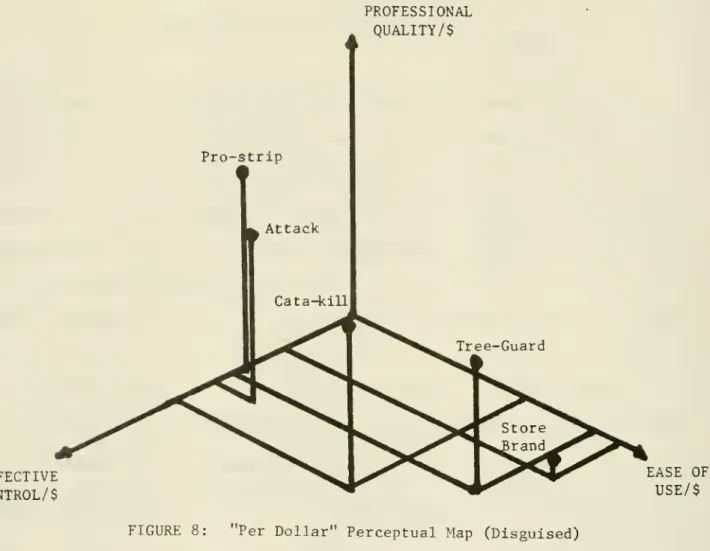
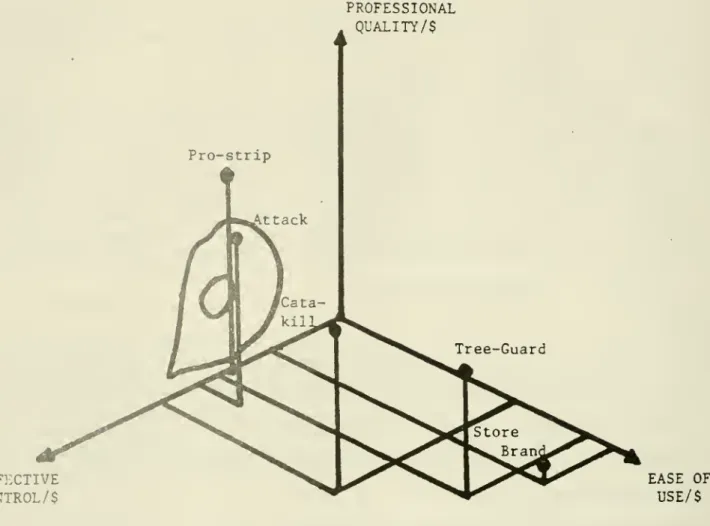
Setting the price of store brand equal to 1.0, the relative prices of
"Pro-Strip", "Cata-Kill", and "Tree-Guard" are approximately 2.9, 1.3, and 1.2,
respec-tively. The new product "Attack", came in as a premium priced product with
rela-tive price approximately 2.9. A "per dollar" perceptual map based on this
zero-point and these prices is shown in figure 8.
Based on figure 8, we compute utility for each a.. - 13. combination and
we identify for each evoked set those areas of the a - 13 region where each
pro-duct has the highest utility. Adjusting piecewise uniform distributions as per
section 4 and summing across evoked sets we obtain the taste distribution,
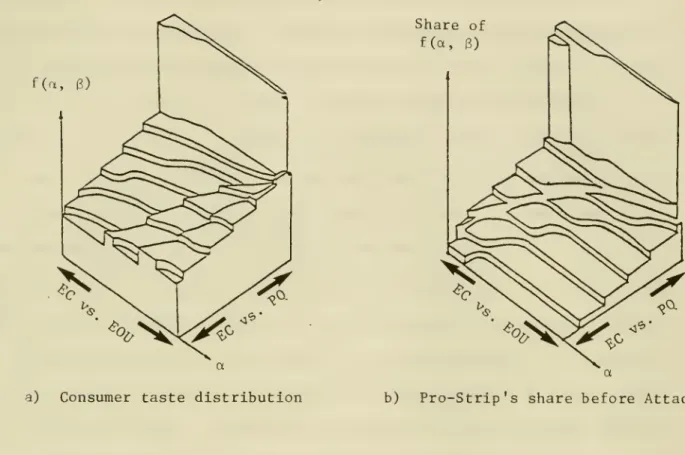
f(a. 13)• Since four products imply 15 evoked sets, the resulting taste
distri-bution is reasonably smooth as shown in figure 9. Figure 9 also shows that
por-tion of the taste distribution captured (before attack) by "Pro-Strip"
"Cata-Kill", and "Tree-Guard", respectively.
Ideal points would require more complex scaling. For example, 'Sweetness* could become the 'Right Amount of Sweetness'. Such scaling usually occurs at
measurement in the selection of the raw semantic scales.
PROFESSIONAL QUALITY/$ Pro-strip EFFECTIVE CONTROL/ $ EASE OF USE/$
FIGURE 8: "Per Dollar" Perceptual Map (Disguised)
For convenience of exposition, we have not shown the portion of the taste
distribution captured by "Store Brand", but is can be readily obtained from figure
9. Since market shares must sum to 1.0, the portions captured by each brand must
sum to f(a, S). Empirically, we have found that physical models of figure 9,
which fit together as a puzzle to form f(a,6), are valuable guides to help brand
managers visualize their markets.
Interpretation "
Examine figure 9a. Tradeoffs among 'Effective Control' and 'Ease of Use' are
approximately uniformly distributed, but tradeoffs among 'Effective Control' and 'Professional Quality' slope toward 'Professional Quality' with a "tower" at
extreme 'Professional Quality' . We call this tower a 'Professional Quality'
seg-ment because it represents those consumers who put a very high weight on
'Profes-sional Quality'
.
-Share of f(a, 6)
a) Consumer taste distribution b) Pro-Strip's share before Attack
share of
f(a, 8)
share of
f(a, B)
c) Cata-Kill's share before Attack d) - Tree-Guard's share before Attack
Figure 9: Consumer Taste Distribution, f(a, 3), representing tradeoffs
among attributes; shares of Pro-Strip, Cata-Kill, and Tree-Guard before Attack.
-Now examine figure 9b which illustrates that portion of the taste distribution
representing consumers who choose "Pro-Strip". Because "Pro-Strip" is clearly the
best brand (before "Attack") on 'Professional Quality' (review figure 8), it
cap-tures the entire 'Professional Quality' segment. It also captures other portions
of the taste distribution representing consumers that evoke only "Pro-Strip" or
only "Pro-Strip" and one or two other brands. Similarly, figures 9c and 9d
illus-trate that "Cata-Kill" and "Tree-Guard" capture more central portions of the taste
distribution. Finally, "Store-Brand" (not shown) is left with that portion of the
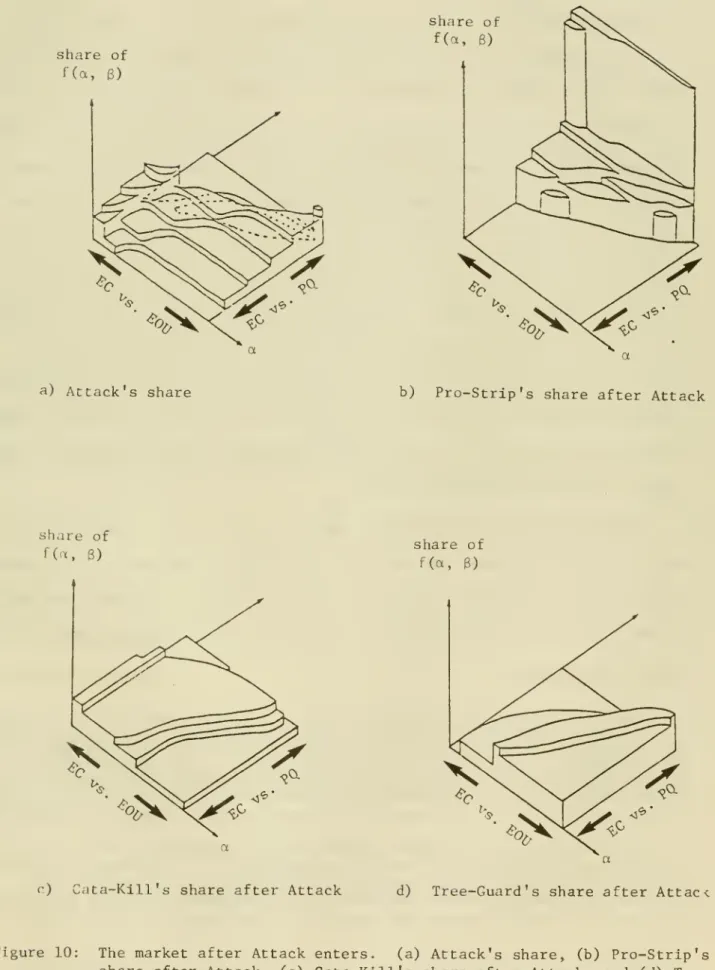
taste distribution favoring 'Ease of Use'. When "Attack" enters, the market
changes. Based on the perceptual map in figure 8, we expect that while "Attack"
does well on 'Professional Quality', it does not do as well as Pro-Strip. We
compute Attack's unadjusted share by recomputing utility for each a. - B
pair and summing across i as indicated in section 3. Indeed, as figure 10
illus-trates, at 100% evoking, Attack captures a central portion of the taste
distribution leaving the 'Professional Quality' segment to Pro-Strip. However,
Attack (at 100% evoking) does hurt Pro-Strip by stripping away the more moderate
consumers that Pro-Strip used to capture. (Compare figure 9b to figure 10b.) Of
course, at less than 100% evoking, Attack's share will be scaled down Ln
proportion to its evoking and Pro-Strip's share will be a weighted combination of
its before and after shares (figures 9b and 10b). See equations (3) and (4).
According to figures 9 and 10, Pro-Strip has retained its 'Professional
Qual-ity' franchise. If it is to regain share it must regain it from consumers with
more moderate taste tradeoffs. However, strategically, it must maintain its
'Professional Quality' image to preempt a repositioning challenge by Attack.
Figure 10 also indicates which consumers Cata-Kill and Tree-Guard will lose.
Although they lose fewer consumers, they can not ignore Attack's entry.
-share of
f(a, 6)
share of f(a, 6)
a) Attack's share b) Pro-Strip's share after Attack
share of
f<a, S)
share of f(a, 3)
c) Cata-Kill's share after Attack d) Tree-Guard's share after Attac<
Figure 10: The market after Attack enters. (a) Attack's share, (b) Pro-Strip's share after Attack, (c) Cata-Kill's share after Attack, and (d)
Tree-Guard's share after Attack. All shares are unadjusted for awareness
and availablility
.
-Comparison of Forecasts
Because f(a,G) is a probability distribution, Attack's unadjusted share is
the volume (figure 10a) of f(a,(3) that is captures. Analytically, this is a 17%
share. This is within one standard deviation (based on Urban and Katz (1983)) of
the Assessor unadjusted prediction of 19%. For comparison, we forecast based on
preference regression and the traditional perceptual map in figure 7. Based on
standard prodecures we forecast an unadjusted share of 43% for Attack, much
greater than the share predicted by either Assessor or Defender. Such a large
share is not surprising if we place an ideal vector on figure 7 as implied by the
preference regression weights. Such an ideal vector would be shaded away from
'Ease of Use' toward 'Effective Control' and low on 'Professional Quality'.
Attack does well relative to that ideal vector and, hence, traditional analysis
predicts a high share for Attack. The share is lower based on Defender because
the taste distributions in figures 9 and 10 suggest a large 'Professional Quality'
segment that Attack does not capture.
Defender differs from traditional analysis because of the taste distribution
and the "per dollar" map. We performed two additional analyses in an attempt to
identify their differential effects. First, we modified preference regression to
include price as a fourth attribute. A priori we expect this to lower Attack's
"Following established procedures (Urban and Hauser 1980, chapters 10 and
11, , we use the impoctance weights, .48, .38, and .14, and the perceptions for
each consumer to compute the utility of each brand, j, for each consumer, c.
The market share of a brand, j, is the percent of consumers for whom j is the
maximum utility brand. See appendix for equations. Note that figure 7 is just
average perceptions, the forecasting procedure uses each consumer's perceptions.
'One can interpret preference regression as a normal distribution for tana and tanB centered at the angles corresponding to the importance weights.
I.e., taa a = (.38)/(.43) and tan 13 = (.l4)/(.43) or a = 41° and 13 = 18°.
The taste distribution in a-13 space would be transformed, but would not have a
'Professional Quality' segment as identified by Defender.
-share since Attack is a high priced product. However, although price has a
sign-ificant coefficient, the coefficient is positive, probably because the higher priced brands, which are also better in the perceptual dimensions, get higher
o
market share. Thus, preference regression with price does not do as well as
traditional analysis (using Assessor as a standard) and does much worse than
Defender. See table 2.
We also undertook Defender-like analyses based on (1) a perceptual map without
price and (2) a perceptual map with price as a fourth dimension. That is, we
estimated a taste distribution, f(a,&) or f(a,(3,y), based on the perceptual
maps and forecast using the procedures of section 3. Since we do not divide by
9
price, the ranking of utility via equation (2) does not depend on the
zero-point. The forecasts are shown in table 2.
Defender-like analysis without price as either a dimension or a scale factor
does poorly because high priced brands tend to dominate low priced brands.
TABLE 2
PREDICTED UNADJUSTED MARKET SHARES (Disguised Product Names)
ATTACK PRO-STRIP CATA-KILL TREE GUARD STORE BRAND
Pre-Attack Assessor
Defender* (Per dollar maps)
Traditional Perceptual Maps
(With price)
Defender-like (traditional maps) Defender-like (price as a dimension)
-Defender-Like analysis with price as a fourth dimension is much more
inter-esting. Although the forecast (unadjusted) share of Attack is nine percentage
points larger than the Assessor forecast the forecast is more moderate than
traditional analysis. Interesting, the marginal distribution of f(a,R),
Inte-grating y out °f f(a,(3, y) » is quite similar to the taste distribution in
figure 9a. That is, tradeoffs among 'Effectiveness' and 'Ease of Use' are
approx-imately uniformly distributed, and tradeoffs among 'Effectiveness' and 'Profes-sional Quality' slant upwards toward 'Professional Quality' to achieve their
maximum at extreme 13. Tradeoffs among price, 'Effectiveness', and 'Ease of Use'
are approximately uniformly distributed and tradeoffs among price and 'Professional Quality' favor 'Professional Quality'.
It appears, from this initial application, that Defender predictions differ
from traditional predictions because of both the method of estimating taste
vari-ation and use of "per dollar" perceptual maps.
For this initial application, Defender appears to reproduce Assessor's
fore-cast better than any of the other four models tested. External validity against
SAMI share is examined in section 7. We caution the reader that this is but an
initial test and it would be unfair to reject any of the models without extensive
experience across product categories. Furthermore, models not included in our
test such as conjoint analysis could also provide reasonable forecasts. However,
we can infer that the Defender predictions are reasonable and that the Defer der
consumer model is worth further study.
Table 2 also compares the post-Attack predictions for all brands in the
cate-gory. Comparing Defender and Assessor predictions, we see that Defender predicts
a greater draw from Pro-Strip than does Assessor. As illustrated in figures 9 and
10, this makes intuitive sense since Attack is positioned to draw moderate con-sumers who will accept a less 'Professional Quality' product if it is slightly
-easier to use and more effective than Pro-Strip. In test market, Attack, did
in-deed draw more heavily from Pro-Strip than from other brands.
A Comment
At this point the reader may wonder why Defender should be developed if
pre-test market models (e.g., Assessor) already fulfill the predictive function.
First, the Defender prediction requires only that we measure the new product's
perceptual position and observe its price. Defender does not require the
exten-sive Laboratory measures that are required by pretest market models. Second, and
more importantly, the goal of our predictive test is not to establish a better
forecasting model, but to investigate the reasonableness of the Defender corsumer
model. If the consumer model can predict well in at least one category, then we
ha/e more confidence in the strategy implications that are based on figures ) and
10. Finally, the issues of "per dollar" perceptual maps and heterogeneous taste
distributions are scientifically interesting independent of normative managerial
corsiderations.
6. RATIO SCALING OF "PER DOLLAR" PERCEPTUAL MAPS
The estimates of the preference distribution, f(a, S) , and the predictive
accuracy of Defender will vary depending upon the reference zero-point chosen.
This section examines the sensitivity of these estimates and predictions as the
zero-point is varied. We also examine thi sensitivity of the predictions to the
choice of the preference distribution.
-Feasible Region
In order to ensure that all products in the "per dollar" perceptual map have
positive scores on each dimension, and thus that market share is a decreasing
function of price, we must choose a zero-point which is below the minimum value
among brands along each dimension of the traditional perceptual map. For "Gy,>sy
Moth Tape", these minimum values are (-.21, -.17, -.38), respectively, for
'Effective Control', 'Ease of Use*, and 'Professional Quality'. The zero-point
selected for the analyses in section 5 was chosen to be within the feasible
region, but not right on the border of the feasible region. We simply rounded
downward to one significant digit. These decisions were made prior to the
pre-dictive test.
Sensitivity
We were somewhat surprised that an arbitrarily chosen zero-point did as well
as it did. Afterall, it is not guaranteed that a zero-point will exist for which
f(a, (3) can be chosen to fit market shares of existing brands within evoked
sets. Predictive ability is certainly not guaranteed.
We systematically varied the zero-point, re-estimated f(a, 13) for eich
zero-point, and re-predicted "Attack's" market share. The results are summarized in
Table 3 for the feasible region. Table 3 indicated that the prediction:; vary, but
not dramatically, as we vary the zero-point within the feasible region.
(Pred-ictions vary from 19% to 13% for the feasible zero-point in Table 3). Predictions
do vary dramatically outside the feasible region, .13 to .35, as might be
ex-pected. Interestingly, had we chosen the point (-.21, -.17, -.38), whi':h is the
maximum allowable point in the feasible region, we would have predicted 19.5%
which is even better than our a priori conservative selection.
-TABLE 3
SENSITITITY TO ZERO POINT
(Predicted Share of 'Attack' as a Function of the Zero-Point)
Z = -.4 X = -.4 X = -.3 X = -.2 o o o o Y = -.1 .15 .17 .19 o Y = -.2 .15 .17 .19 o Y = -.4 .14 .16 .18 o z = o
the choice of the zero-point as long as it is close to the boundary of the
feas-j
ibLe region (upper right of Table 3). We turn now to a brief discussion of
pos-sible theoretical explanations for this empirical phenomenon.
Anchc ring Effect
For "Gypsy Moth Tape" Defender predicts best if we choose the zero-point to be
near the maximum allowable point in the feasible region. At this point, we do not
know whether this phenomenon is specific to the product category or whether it is
a generalizable behavioral phenomenon.
If it is a generalizable phenonomon, then it raises an interesting set of
strategies in which a firm can launch a "decoy" brand to shift the zero-point and perhaps increase the share of another of the firm's products. Such decoying
phenomena have been established experimentally in marketing science. For example,
see Huber, Payne, and Puto (1982) and Huber and Puto (1983). In fact, Huber
,
Payne, and Puto suggest that the (dominated) decoy brand anchors perceptual
dimensions and that other brands are then measured relative to the decoy.
The liuber-Payne-Puto anchoring effect explains the predictive ability of the
maximum feasible zero-point by suggesting that consumers evaluate products rela-tive to the worst product along each dimension. Such an anchoring effect is also
consistent with the framing theories of Tversky and Kahneman (1978). See also
discussions of price referents in Rao and Gautschi (1982) and Rao and Weiss (1982).
^A
decoy brand is a brand that is worse than all existing brands on oneor more perceptual dimensions. In a true decoy strategy, the form would expect
that few if any consumers would purchase the decoy brand, but that the decoy brand would make the firm's existing brands look better and, hence, increase
their share.
-If the anchoring results generalize to other product categories, then such
generalizations would suggest further investigations of the anchoring effect. We
leave this opportunity to future research.
Unjform Distribution
The Defender model requires us to estimate a taste distribution, f(a, &).
We wondered how sensitive predictive results were to variations in this taste
distribution. For example, how badly would predictions deteriorate if we used a
uniform distribution (as in Figure 4a) rather than the appropriate f(a, S)?
First, we tried a uniform distribution without any model adjustments and found
that we could not even fit existing shares. Reviewing the literature, we
recog-nized that traditional models which assume a priori taste distributions all re-quire "brand specific constants", that is, constants that are added to the utility
of each existing product. For example, both logit analysis, which assumes double
exponential taste distributions, and preference regression, which assumes Normal taste distributions, require brand specific constants for consistent estimators.
See discussion in Coslett (1982). For a related viewpoint, see Srinivasan
(1980). Thus, for a uniform taste distribution, we felt it was appropriate to
include brand specific constants in the Defender model.
Analogous to logit and preference regression procedures, we selected brand
specific constants for each of the existing brands by fitting the Defender model
to existing market shares. It was feasible to find brand specific constants.
However, to predict, we need to forecast the brand specific constant for
Attack. Since this is equivalent to forecasting market share, we conclude
11The problem of estimating brand specific constants for new brands is a
recurring problem in logit analysis. The problem Defender faces when f(a» S)
is limited to a uniform distribution is not different qualitatively from that
faced Ln logit analysis.
-that, at least for "Gypsy Moth Tape", the taste distribution contains important
information about the product category and is, therefore, necessary to the model.
A uniform distribution is not sufficient.
The empirical importance of the taste distribtion f(a, R) is satisfying
since Hauser and Shugan (1983) allocate considerable theoretical effort to
invest-igating the impact of the taste distribution. For example, a uniform distribution
implies that the optimal defensive price response is to decrease price, but a
multi-modal taste distribution may imply a price increase.
Stability
As a final test, we assumed a uniform distribution, fit brand specific
con-stants, and, with those constants, systematically varied the zero-point. Figure
11 is a contour map in which the sum of squared errors (SSE) of true market share
versus predicted market share is plotted as a function of the zero-point. (Figure
11 is for z. = -.4, we obtain similar plots as we vary z«.) As figure 11
indicates, model fit is unimodal in the sense that it systematically degrades as
we move away from the chosen zero-point. We obtained similar stability for a
variety of chosen zero-points with and without Attack in the market.
The continued stability of the fitting algorithm under a variety of
condi-tions, even for a mis-specified taste distribution, is further evidence to suggest
that the choice of a zero-point is a "well-behaved" optimization problem.
Summary
Based on the above sensitivity analyses, for the product category under
test, we posit that:
(1) With the appropriate taste distribution, Defender predicts well for
zero-points close to the maximum feasible values.
(2) Predictions are reasonably insensitive to the choice of a zero-point it if is close to the maximum feasible value.
(3) Predictions are sensitive to the choice of the taste distribution.
-We expect some of these propositions to generalize while others will need to
be modified as we gain further experience in a variety of product
cate-gories. At present, they are empirical propositions based on one empirical
test. x 0.4 0.3 0.2 0.1 0.0 -0.1 -0.2 -0.3 -0.4 -0.5 -1.0 -0.9 -0.8 0.7 -0.6 - -0.5 -0.4 -0.3 -0.2 -0.1 -0.0
Figure 11; Contour plot of Sum of Squared Error (SEE) for Uniform Distribution of
Consumer Tastes (x = zero-point for 'Effective Control' y =
zero-o v o
point for 'Ease of Use', for this plot z = zero-point for 'Professional Quality' is set to -0.4. Plots are similar for other z ).
7. COMPARISON TO SAMI DATA
We are encouraged by the ability of Defender to match the predictive
ability of Assessor for unadjusted share. However, actual share is based on
adjustments due to awareness and availability (actually, advertising and
-distribution indices). For our purposes, we use the awareness and
avail-ability forecasts contained in the Assessor report as appropriate indices
for the Defender consumer model. This is an empirical assumption subject to
future research. As described in detail in Silk and Urban (1978), these
forecasts are judgmental based on the firm's and the consultant's experience
in the product category and based on expected levels of advertising and
distribution budgets for the new product. For a discussion related to the
effect of error in these forecasts see Urban and Katz (1983, p. 224). For
Attack, these estimates were .7 and .6, respectively, yielding an adjusted
share forecast of 7.1 percent (.071 = .7 x .6 x .17).
External validity tests always contain an element of judgment. We
describe here our judgments so that the reader can make his (her) own
assessment.
"Last brand purchased" is the raw data used to estimate market shares
within evoked sets in order to fit Defender's taste distribution and to
estimate the preference logit model in Assessor. For Assessor, at least,
models based on this raw data seem to forecast reasonably well the test
market shares as reported by brand managers.
In our case, the managers of Pro-Strip felt that the SAMI shares were
the best measures of test market shares. SAMI shares are the share figures
they use in their owr strategic planning. However, like any empirical
measure, SAMI measures are not perfect. SAMI measures a virtual universe of
warehouse withdrawals for large grocery stores, but may under represent drug
stores and mass merchandisers. For "Gypsy Moth Tape", the latter is a small
fraction of sales and the Pro-Strip managers felt that brand shares thr )ugh
the minor channels would be similar to those for the large grocery stores.
Furthermore, in discussing validation of diary panels, Wind and Lerner
(1979, p. 41) suggest that in addition to factory shipments, "SAMI and
Nielson retail audits offer other means of validation".
-The "actual" shares available to us from test market are SAMI measures
of volume share and of dollar share. At first, one might expect the
appropriate measure is volume share, but in this category Attack and
Pro-Strip tend to be reused occasionally whereas Store Brand requires
slightly more product per use. Thus, volume share will be less than last
brand purchased for Attack and Pro-Strip and more for Store Brand. Dollar
share corrects for some of this measurement bias since the reusable brands
cost more and Store Brand costs less. Together, volume share and dollar
share bracket "last brand purchased" share. Subject to these considerations
we feel the reader will find comparisons to SAMI shares interesting.
Table 4 reports both the volume and dollar SAMI shares for the two test
market cities one year after the initial data collection. For ease of
comparison and confidentiality, we have averaged across the two cities.
Examining Table 4, we see that the SAMI shares are 7% for volume share
and 8% for dollar share. Thus, the corresponding "last brand purchased"
share would be in the range of 7% to 8%. Both Defender and Assessor
forecast shares in this range whereas traditional perceptual maps are off by
over a factor of 2. Defender-like analysis with price as a dimension does
better with a forecast of 12%. We note that in other product categories,
predictions may not be as close as the predictions in Table 4. Only
comparisons across a large number of categories can truly assess external
validity.
Urban and Katz (1982) report a standard deviation in predictive errors
of Assessor of about 2.0 percentage points. We expect Defender to be in
that range. Based on this standard deviation, there is a 40% chance that
predictions are within one percentage point of "actual". If favorable
roundoff truncations are considered, there is a 40% - 68% chance that
predictions are within one percentage point of "actual". Thus, it appears
-reason; ble that the accuracy reported in table 4 is compatible with
published error bounds on Assessor.
In summary, Defender appears to make predictions within the range of
"actual" share. Thus, subject to future validation tests in other product
categories, we feel the Defender consumer model is a reasonable marketing
science model.
TABLE 4
COMPARISON OF FORECAST MARKET SHARES TO TEST MARKET RESULTS
SHARE Predictions:
Assessor 8%
Defender 7%
Traditional Perceptual Maps 18%
Defender-like with Price as Dimension 12%
Test Market Results*
SAMI dollar share 8%
SAMI volume share 7%
*Test market shares are four-week SAMI shares measured one year after
data collection. All shares are rounded to the nearest percentage point for confidentiality. Awareness and availability are assumed
to be .7 and .6, respectively, as per Assessor report.
-8. APPLICATION TO A SECOND PRODUCT CATEGORY
A.fter applying Defender analysis to the "Gypsy Moth Tape" category, the manu-facturers of Pro-Strip asked us is we would apply Defender to another category in
which they were under attack. This application illustrates the use of
Defender-like analysis to guide and expand managerial judgment.
Managerial Problem
In spring of 1981, a major $100 million product category, which we call
A-B-C, was about to be attacked by a new product, which we call N. Product
N had been in test market for nine months and its share had been oscillating
between 10 and 14 percent. In that test market the share of brand C, the market
12
leader, was down between 2 and 6 percent. In response, the managers of brand
C commissioned a number of market research studies including Assessor and
perceptual mapping. The Assessor analysis suggested that brand N could maintain
a 12 percent adjusted share in a national launch. The perceptual map suggested
that brand N was positioned between brands B and C and that, qualititively
,
13
a 2 - 6 percent draw from C could be maintained in a national launch.
In response, the manufacturers of brand C began work on a defensive flanker,
which we will call brand D. By fall 1983, brand N had not yet been launched
-^Shares were oscillating due to promotion and trial/repeat phenomena. Such oscillation is normal for a test market.
l-*rhe perceptual map was based on factor analysis of 17 semantic scales. The factor solution yielded two dimensions explaining 95.7 of the common vari-ance (45.6% of the total variance). We label the dimensions 1 and 2 for
confi-dentiality.
-in Lhe national market, but the manufacturers of C judged a national launch to
be imminent. Brand D was not yet ready for a full Assessor study, but the brand
C managers wanted an early reading on the potential impact of brand D.
Defender-Like Map
Despite the lag of two and one-half years from the original data collection, a
time lag in which the market may have changed, we were asked to retrofit the 1981
perceptual map. Furthermore, in 1983 there was some concern by the brand C
managers with the apparent position of brand B in the 1981 map, which they felt
was overstated relative to the current market position of brand B. Thus, based
on the original map, secondary market research data, and the combined judgment of
thi manigement and analysis teams we produced the map in figure 12a as
representa-tive of the 1983 (test) market. The relative prices are 1.0, 1.02, 2.5, and 2.4
for brands A, B, C and N, respectively.
Because the map was modified by the judgment of managers who were aware of
both the Assessor and the test market results, analyses based on this map cannot
be considered tests of external validity. We present these analyses to illustrate
the merging of quantitative Defender-like analyses with qualitative managerial
judgment.
Analyses
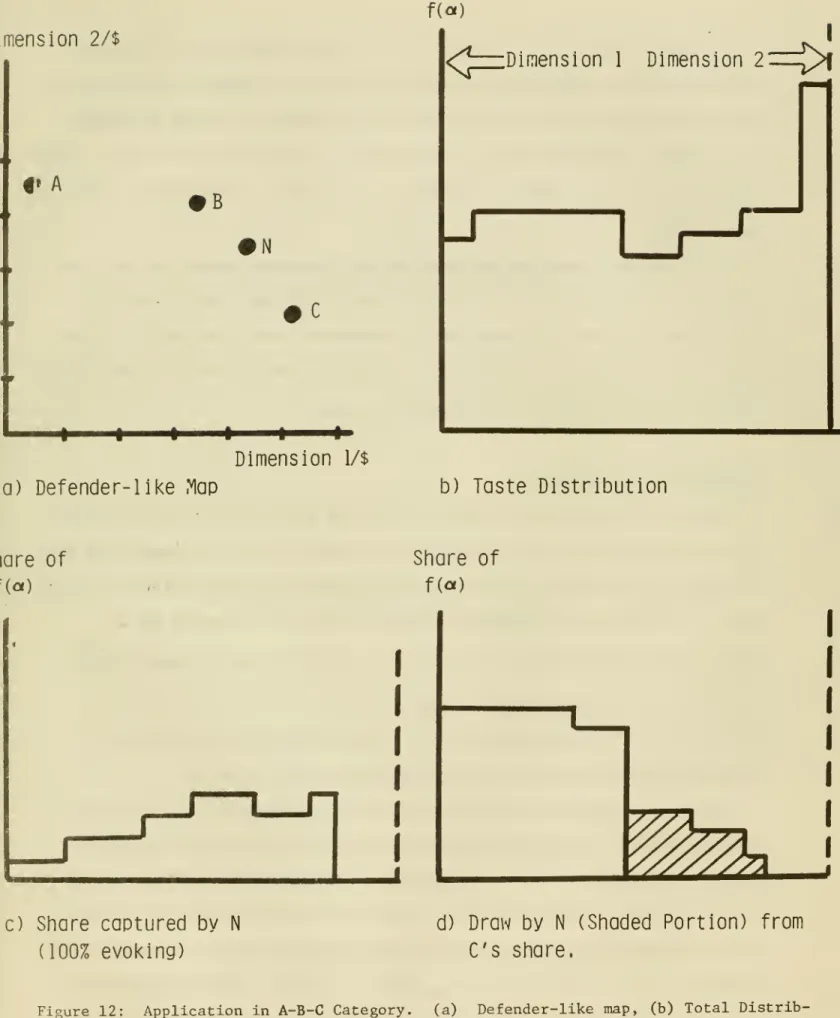
Following the procedures outlined in Section 3 we use the m^.p in figure 12a
and estimates of the market shares of A, B, and C (from Assessor) for every
evoked set to estimate the taste distribution. The empirical taste distribution,
f(a), is shown in figure 12b. It is close to a uniform distribution but with a
minor 'dimension 2' segment.
-Dimension
2/$#»
A
B
I I
a)
Defender-
like Map
I l I l
Dimension
1/$ f(«)<^zz:Dimension
1Dimension
2=^>f
b)Taste
Distribution
)hareof
f(«) c)Share
captured
by
(100% evoking)
Share
of
f(a)d)
Draw
by
N(Shaded
Portion)
from
C's
share.
Figure 12: Application in A-B-C Category. (a) Defender-like map, (b) Total Distrib-ution, (c) Share Captured by N, and (d) Draw by N from C's share.
-Based on the position of brand N and the taste distribution, we calculate
that the portion of the taste distribution captured by brand N is 12 percent and
that the draw from brand C is 4 percent. Since the map was drawn by managers
and analysts implicitly aware of these results, these predictions indicate simply
that we have been successful in developing an analytic representation of the test
market results.
The management team was satisfied that the Defender-like map captured their
intuition in a usable way. Brand D was placed on the map; share, draw, and
cannibalization were calculated; and the management team is proceding, in part,
based on the analysis. (For reasons of confidentiality, we do not report brand
D's target position and the resulting predictions.)
Sensitivity to Zero-Point
A priori we expect the Defender map in the A-B-C category to be more
sensi-tive to the choice of a zero-point than the Defender nap in the "Gypsy Moth Tape"
category. In particular, there are fewer dimensions and fewer products and, as a
result, movements in the position of brand N relative to brands B and C,
which closely surround brand N in figure 12, will cause major changes in the
portion of the ot's that brand N captures. Since brand N is the highest
priced brand and brand B is one of the lowest priced brands, changes in the
zero-point will cause such relative movements in brands B and N.
As table 5 indicates, we did indeed obtain this sensitivity as we \aried the
zero-point +.1 from the implicit zero-point representing managerial judgment.
Seven of the eight (87.5%) entries are within two standard deviations of
pre-dictions based on the managerially chosen map, but the upper-right entry (.21) is
more sensitive. Since the map is, in part, judgmental, we cannot interpret this
evidence for or against the anchoring effect. However, table 5 does indicate
-that in certain two-dimensional configurations we must be concerned about the
sensitivity of predictions to our choice of the zero-point. To date, we have not
found such sensitivity in three-dimensional Defender maps.
TABLE 5
SENSITIVITY OF PREDICTED SHARE TO THE CHOICE
OF A ZERO-POINT IN THE A-B-C CATEGORY
DIMENSION 2 +.1 -.1 DIMENSION 1 ,1 +.1 .15
perceptual position to forecast market share. Occasionally, managers are faced
with a related problem. Suppose we already know the positions of all existing
products and we have estimated the taste distribution. Suppose further that we
have an early indication of the new product's market share and of its draw from
existing products. For example, we may have market share data from consumer diary
panels, UPC panels, simulated stores, questionnaires, SAMI, or Nielson. Based on
such data we may wish to use the Defender consumer model to estimate the position
of the new product.
Hauser and Shugan (1983, section 5) suggest a Bayesian procedure to estimate
the new product's position from market share data. Conceptually, their procedure
is simple. They first ask the manager to quantify his (her) intuition by
speci-fying his (her) prior probabilities as to where the new product is positioned.
They then treat the market share information as sample data from a multinomial
process. For each potential new product position, they use the Defender consumer
mod<:l to compute the multinomial probabilities that each product is chosen and use
the multinomial distribution to compute the likelihood that the observed market
shares were generated by that market position. The likelihood function then
updates the prior beliefs to form posterior beliefs via Bayes theorem. Since the
Baynsian mathematics are standard (e.g., DeGroot, 1970, pp. 48-49, 69-82, 147-148;
Drake 1967, 250-257) and since detailed equations are available in Hauser and
Shugan (1983, page 345-347) we do not repeat the equations here.
12
We implemented the Bayesian procedure in an attempt to predict Attack's
shace in the "Gypsy Moth Tape" category. Normally, the manager would have
reasonable prior beliefs as to where Attack was positioned, however, ir the
interest of exploring the power of the Bayesian procedure, we chose that prior