HAL Id: hal-01913459
https://hal.archives-ouvertes.fr/hal-01913459
Submitted on 6 Nov 2018HAL is a multi-disciplinary open access archive for the deposit and dissemination of sci-entific research documents, whether they are pub-lished or not. The documents may come from teaching and research institutions in France or abroad, or from public or private research centers.
L’archive ouverte pluridisciplinaire HAL, est destinée au dépôt et à la diffusion de documents scientifiques de niveau recherche, publiés ou non, émanant des établissements d’enseignement et de recherche français ou étrangers, des laboratoires publics ou privés.
Sub-Ocean: Subsea Dissolved Methane Measurements
Using an Embedded Laser Spectrometer Technology
Roberto Grilli, Jack Triest, Jérôme Chappellaz, Michel Calzas, Thibault
Desbois, Pär Jansson, Christophe Guillerm, Benedicte Ferré, Loic
Lechevallier, Victor Ledoux, et al.
To cite this version:
Roberto Grilli, Jack Triest, Jérôme Chappellaz, Michel Calzas, Thibault Desbois, et al.. Sub-Ocean: Subsea Dissolved Methane Measurements Using an Embedded Laser Spectrometer Technology. En-vironmental Science and Technology, American Chemical Society, 2018, 52 (18), pp.10543 - 10551. �10.1021/acs.est.7b06171�. �hal-01913459�
1
Sub-Ocean: Subsea Dissolved Methane Measurements Using an
Embedded Laser Spectrometer Technology
Roberto Grilli,*,† Jack Triest,† Jérôme Chappellaz,† Michel Calzas,‡ Thibault Desbois,§ Pär Jansson,∥ Christophe Guillerm,‡ Bénédicte Ferré,∥ Loïc Lechevallier,†,§ Victor Ledoux,† and Daniele Romanini§
† Université Grenoble Alpes, CNRS, IRD, Grenoble INP, Université Grenoble Alpes, IGE, F-38000
Grenoble, France
‡ CNRS DT INSU, 29280 Plouzané, France
§ Université Grenoble Alpes, CNRS, LIPhy, F-38000 Grenoble, France
∥ CAGE - Center of Arctic Gas Hydrate, Environment and Climate, Department of Geology, UiT
University of Norway, N-9019 Tromsø, Norway
*Corresponding Author: Roberto Grilli. Phone: +33 (0) 4 76 82 42 66. E-mail: [email protected].
Corresponding author address: Institut des Géosciences de l’Environnement (IGE), Université Grenoble Alpes, 54 rue Moliére - BP 96, 38400 St. Martin d’Hères, France.
2
Abstract. We present a novel instrument, the Sub-Ocean probe, allowing in situ and
continuous measurements of dissolved methane in seawater. It relies on an optical
feedback cavity enhanced absorption technique designed for trace gas measurements
and coupled to a patent-pending sample extraction method. The considerable advantage
of the instrument compared with existing ones lies in its fast response time of the order
of 30 s, that makes this probe ideal for fast and continuous 3D-mapping of dissolved
methane in water. It could work up to 40 MPa of external pressure and it provides a
large dynamic range, from subnmol of CH4 per liter of seawater to mmol L-1. In this
work, we present laboratory calibration of the instrument, intercomparison with
standard method and field results on methane detection. The good agreement with the
headspace equilibration technique followed by gas-chromatography analysis supports
the utility and accuracy of the instrument. A continuous 620-m depth vertical profile in
the Mediterranean Sea was obtained within only 10 min and it indicates background
dissolved CH4 values between 1 and 2 nmol L-1 below the pycnocline, similar to previous
observations conducted in different ocean settings. It also reveals a methane maximum
at around 6 m of depth that may reflect local production from bacterial transformation
of dissolved organic matter.
1. Introduction
The measurement of dissolved gases in a liquid medium (notably in water) is
essential for different applications, such as environmental monitoring, search for natural
gas reservoirs in the seafloor, deep-sea oil and gas pipeline inspection, monitoring the
activity of bioreactors, safety control of industrial facilities or monitoring water quality
3
focus over the last two decades has been the investigation of the fate of methane hydrate
degassing from the seafloor and its relationship with global warming.1 Although methane
released from hydrate reservoirs in the sediments appears to be mostly oxidized in the
water column (see Ruppel and Kessler 2017 for a recent review), its contribution to ocean
acidification is still under debate.2,3 Therefore, a quantitative evaluation of methane fluxes
from the seafloor in gas hydrate-bearing regions remains needed, as well as the spatial
and temporal dissolved methane evolution along the water column due to aerobic
oxidation, diffusion, and transport. Other important scientific issues also require in situ
measurements of dissolved methane, like the interactions between seasonal thawing of
permafrost and organic transfer through Arctic river systems or methane fluxes from
deep ocean seeps. These devices are also important in the study of microbial methane
production in the oxic waters of oceans and lakes, a source of methane that can be
important for carbon cycling in the aquatic environments and water to air methane
fluxes.4-7
In the last years to decades, knowledge of physical properties of ocean surface water has
been considerably improved thanks to remote (satellite) measurements8,9 and
near-surface water sampling and analysis. However, three-dimensional distributions of
dissolved gases are far less constrained since marine subsurface environments are more
difficult to access. Parameters such as temperature, salinity, and oxygen are acquired
using instruments such as a CTD (conductivity, temperature, and depth devices) that can
run autonomously and can be implemented in floats, moorings, and gliders.10 Information
about dissolved trace gases is more commonly extracted using discrete sampling
(employing Niskin bottles) followed by laboratory measurements. This process is time
consuming and provides data with poor spatial and temporal resolution, not adapted for
4
some situations, water samples degassing from the Niskin bottles have been observed
during the ascent, causing a degradation of the samples.11 Furthermore, in the case of
supersaturated samples, outgassing during water sampling is difficult to prevent or
quantify, leading to a possible underestimation of the amount of dissolved gas in deep
waters. For these reasons, in situ instrumentation has more recently been developed, with
the aim to provide more reliable (less sample manipulation) and fast measurements of
dissolved gases. Most of it relies on embedded optical devices or mass spectrometers
(MS). A review on the available sensors has been presented by Boulart et al.12 discussing
the performances of existing commercial devices and other systems based on membrane
separation, equilibrators, and in situ MS. Apart from in situ MS,13 the other approaches
have limited response time (on the order of tens of minutes and mainly limited by the
extraction method), making these devices less suitable for fast 3D mapping applications.14
In situ MS provide acceptable sensitivity and response time, but are often not sensitive
enough for background concentrations. Their deployments as a stand-alone instruments
are limited by the payload, power consumption, and cost. Furthermore, application of MS
can suffer from interferences due to the presence of water vapor in the analyzed gas
mixture, while optical techniques can work in spectral regions where water absorption is
weak. If isotopic ratio MS (IRMS) are currently not compact enough to be embedded in
subsea probes, optical spectrometers have already been successfully embedded in subsea
sensors for in situ isotopic analysis, with applications to deep-sea measurements.15,16
Today, optical techniques are largely employed for in situ high resolution measurements
of gas mixtures either directly in the atmosphere (from ground measurements to airborne
monitoring or stratospheric balloons measurements), in ice cores (in the laboratory17 but
soon also in situ18) and finally for measuring dissolved gases in liquids. The use of optical
5
direct absorption techniques, leading to robust and compact devices with small sample
volume, easy to implement into a specific probe for field applications that require small
sample flow. In this work we used optical feedback cavity enhanced absorption
spectroscopy (OFCEAS),19,20 and further information can be found in Morville et al.21 The
employment of this technique for dissolved gas measurements leads to advantages such
as multiple species detection and the possibility to avoid interferences such as the
presence of water vapor and other species present in the gas mixture (e.g. other
hydrocarbons).
In this work, we describe the first application of the OFCEAS technique – combined with
a patent-pending gas extraction module22 - for in situ real-time measurements of
dissolved methane in seawater. Measurements have been conducted as a
proof-of-concept in the Mediterranean Sea in July 2014.
2. Materials and Methods
2.1 The in Situ Sensor
The optical instrument used in this study is the SUBGLACIOR spectrometer,18
developed as a drilling probe embedded device for in situ real-time measurements of air
bubbles trapped in Antarctic glaciers.23,24 As a new design, it required calibration and
testing in real environments before deployment to Antarctica, and the Mediterranean
Sea was for us a good compromise (because of temperature fluctuations and increase of
pressure with depth) even though not as extreme as Polar Regions. The spectrometer
was made of an optical part that fits in a tube of 6.3 cm external diameter and 1.3 m long
and an electronic part (8 cm ext. diameter, 1.2 m long). The optical spectrometer, based
6
measuring simultaneously CH4 and δD of H2O. The dissolved air from the extraction unit
(discussed below) was continuously pumped to the optical cavity of the spectrometer.
The internal volume of the cell is less than 20 cm3 and provides sample residence times
< 30 s for optimal running conditions (combination of pressure and total gas flow). The
instrument was equipped with an embedded PC, for processing and storing the data.
Two protocols were implemented in order to communicate with the instrument during
the field campaign. The first one used a wireless connection (ad-hoc network
configuration), providing easy access to the embedded instrument via a PC-PC
communication. The second protocol employed cabled communication, allowing
real-time transfer of data together with remote control of the spectrometer, if necessary.
Extraction of dissolved gases from seawater was performed using a silicon rubber
membrane, for which the technology has previously been described in terms of physical
properties such as adsorption, permeation, and desorption.25-30 Existing sensors,
including commercial instruments from Contros (Kongsberg), Franatech, Los Gatos
Research and Pro-Oceanus, employ membrane extraction for measuring dissolved
gases.31,32 Membrane extraction techniques found in the literature rely on gas
equilibration across the membrane that allows for precise measurements of dissolved
gas concentration, at the cost of slow response time (>20 min).14,33 Here, we propose a
different approach consisting of maintaining the dry side of the membrane at low
pressure, while continuously flushing it with dry “zero” gas. The pressure at the
membrane dry side controls the total flow of dry and wet air through the membrane,
and the system was designed to keep this pressure constant. While the spectrometer
operates at about 20 mbar, the pressure against the dry side of the membrane was
7
Gas permeation through a membrane depends on the solubility in the membrane
itself, followed by diffusion (migration of molecules through the membrane lattice) and
finally evaporation out of the membrane.27 It is well known that the partial pressure
difference of a given gas species controls the diffusion across the membrane and
therefore the response time of the extraction system. Other parameters affecting the
permeation efficiency are the membrane thickness, water flow over the membrane and
ambient temperature: lower thickness, larger flow and higher temperature lead to
higher permeability, and therefore faster response time. With respect to the membrane
properties, a higher temperature increases the free volume as well as the mobility of the
polymer chain, leading to higher diffusivity of gases through the membrane. With
respect to any given gas, higher temperature means higher mobility, diffusivity and
permeability. Water flow and temperature therefore need to be accurately and precisely
controlled for an optimal behavior of the membrane extraction system. Biofouling,
salinity, pressure and pH of the water may also affect the efficiency of the permeability,
but, apart from salinity, this has not been investigated here, and it will require further
investigation.
In our setup, two 10 µm thick polydimethylsiloxane (PDMS) membranes of 56 mm diameter, were mounted face-to-face in a stainless steel housing in order to double the
membrane surface. The membranes were simultaneously flushed with the water sample
using a submersible water pump (Sea-Bird Electronics, SBE 5T) providing a flow of 0.8 L
min-1. The membranes were supported by porous bronze frits of 3 mm of thickness
(Poral, grade 20), providing mechanical strength for the membrane under high pressure
differences. The membrane block was designed to ensure that the water sample
continuously flushed the entire surface of the membranes (a schematic of the membrane
8
The dissolved methane sensor runs on 24 VDC power supply, with 50 W nominal
consumption. During the present study it was powered through an electromechanical
coaxial cable allowing for long-term deployment, but the system can also run on 24 VDC
battery packs. Long-term deployment endurance will be further limited by the gas
storage capacity inside the instrument, and by the carrier gas flow. The instrument was
successfully deployed while measuring continuously for up to 12 h. A CTD unit
(Aanderaa, Seaguard TD262a) was attached to the probe, providing salinity-, water
temperature-, depth-, and dissolved oxygen data.
2.2 The Site of Study
The Sub-Ocean probe was deployed as proof-of-concept onboard the CNRS-INSU
research vessel Téthys II in the northwest part of the Mediterranean Sea on July 12and
13, 2014. Because of adverse meteorological conditions, the deployment was limited to
an area with only 620 m of depth available. The first tests of the instrument were
conducted at ~200 m from Toulon’s harbor (43°6.20 N - 5°56.73 E) for proving its
stability and functioning. Vertical profiles were obtained in an area between Fréjus and
the Gulf of the Napoule, at ~8 km from the coast (43°24.89 N - 7°00.61 E), not far from
the Gulf of Lions. The Gulf of Lions was a target site for measurement of dissolved
greenhouse gases34 and sediment core analysis35 because of its particular hydrological
character, mainly marked by the presence of large fresh water incoming from the Rhone
River (with a flux on the order of 1600 m3 s-1).
2.3 The Laboratory Apparatus
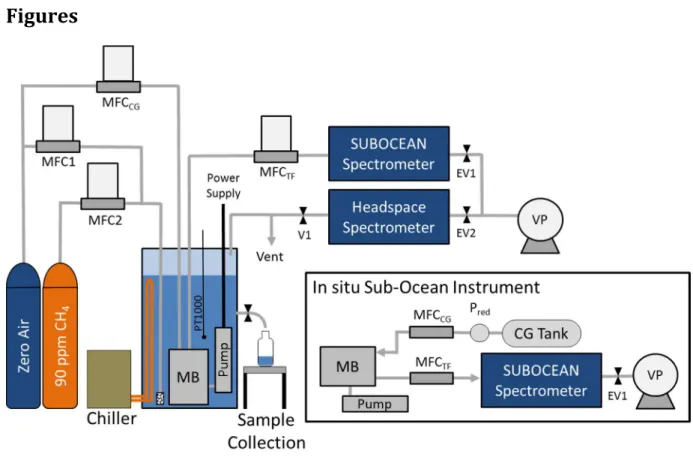
The schematic of the laboratory experimental setup is represented in Figure 1. It was
composed of a 14 L, 21 cm diameter, 40 cm high aluminum chamber, containing about 8
9
NaCl (Merck, purity >99.5%) was added for reproducing particular salinity conditions.
Salinity was measured with a digital refractometer (Bellingham and Stanley, 38-51
Aquatic). The temperature of the water in the chamber was stabilized between 2 and
25°C using a water cooling system (RM6, Lauda) and monitored by an immerged
PT1000.The pressure above the water was maintained at atmospheric pressure (~101.3
kPa). The water was continuously bubbled with a gas mixture composed of zero air
(ALPHAGAZ 2, Air Liquide) and synthetic air containing CH4 at concentrations between
0 and 90 ppmv (SAPHIR 90 ppmv of CH4 in air, Air Liquide) by means of a diffuser
installed at the bottom of the chamber. The role of the diffuser was to reduce the
bubbles size and to achieve dissolved gas saturation in a short time. The dilution system
consisted of two mass-flow-controllers (MFC1 and MFC2, Bronkhorst) delivering up to
100 sccm (standard cubic centimeters per minute) of gas. Water circulation was
provided by the SBE 5T pump, ensuring a well mix of water in the chamber. The pump
and the diffuser were positioned at maximum distance from each other to allow the best
homogeneity of the water sample during the measurement and to avoid trapping air
bubbles in the extraction system. The water circulated on the wet sides of the
membranes included in the membrane block (MB, cf SI-3) and dissolved gases were
extracted on the dry side and further transferred to the Sub-Ocean spectrometer. A dry
carrier gas flow (zero air, ALPHAGAZ 2, Air Liquide) was supplied by a 0-10 sccm mass
flow controller (MFCCG) to the dry side of the membrane extraction system, for
continuously flushing the permeated gases from the membrane. This maintained CH4
partial gas pressures at the lowest possible level on the dry side of the membrane in
order to optimize the extraction efficiency and response time. A flowmeter (IQF+,
Bronkhorst) was used for monitoring the total gas flow (composed of the carrier gas
10
the headspace of the calibration chamber was continuously monitored by a laser
spectrometer based on the same principle as the Sub-Ocean instrument, but designed
for laboratory purposes (headspace spectrometer in Figure 1). Ten sccm of the
headspace gas was supplied to the headspace spectrometer, while the overflow was sent
to an exhaust vent. For inter-comparison with the discrete sample technique, water
samples were collected in 115 ml vials. During collection, 1 ml of 1M NaOHwas added in
order to inhibit bacterial activity. The vials were fully filled and closed with butyl rubber
caps and aluminum crimps tops. Subsequently, 5 ml of the samples were replaced with
pure nitrogen (Air Liquide) at atmospheric pressure and 20°C. The samples were
analyzed at the University of Tromsø by gas-chromatography under blind conditions. A
ThermoScientific Trace 1310 GC equipped with a FID and a ThermoScientific TG-Bond
Msieve 5A column was used with hydrogen as carrier gas (10 ml/min). The oven was
operated at a constant temperature of 150°C and the system was calibrated with three
external methane standards at 1.8, 19, and 1800 ppmv. Instrument precision was
estimated based on the standard deviation of replicates, and found to be 4% of
measured methane concentration.
2.4 The calibration in the laboratory
The challenge in quantifying variations in membrane permeability makes
measurements performed by gas-extraction membranes rather uncertain.12 Therefore,
we paid special attention for calibrating and evaluating the performance of the
instrument under laboratory controlled conditions.
Both spectrometers used in the calibration apparatus (for measuring the headspace
air and the dissolved gases, Figure 1) were calibrated using certified standard gas
(Restek, Scott/Air Liquide 99 ppmv ± 5%). Different concentrations were obtained with
11
1). A linear response over the whole range of concentrations was obtained with a good
agreement between the two devices (slope 1.090 ± 0.0027, R2 = 0.99995 in 2015 and
slope 0.9926 ± 0.003, R2 = 0.99989 in 2018. See SI-1 and SI-2).
After each change in concentration, once equilibration of the system was achieved
(2-3 h was required depending on the flow of the bubbling mixture), CH4 concentrations
were averaged for about 10 min. With both instruments connected directly to the
headspace, the measured CH4 concentration for individual mixing ratios was in good
agreement with the concentration expected from the gas mixture production
(Sub-Ocean spectrometer: slope = 1.07 ± 0.01, R2 = 0.99926; headspace spectrometer: slope =
0.981 ± 0.007, R2 = 0.9996).
In order to relate the concentration of dissolved gas with respect to its abundance
in the headspace in equilibrium with the liquid phase, the gas solubility in water is
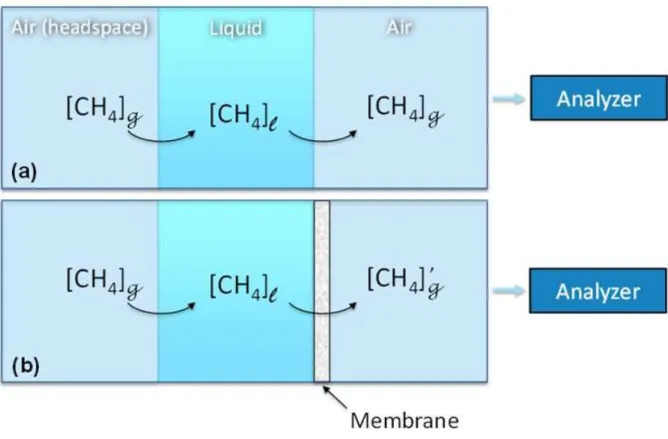
required. However, if we assume a system with two independent headspace volumes in
contact with the same liquid volume, they will reach the same headspace concentration,
[CH4]g, providing that the pressure and the temperature in the headspaces are equal.
Therefore, for this experiment, knowledge of the gas solubility is not required (Figure
2a). The ratio [CH4]g/[CH4]l ([CH4]l being the quantity of CH4 dissolved in water and
[CH4]g in the headspace) will depend on the solubility of CH4 and other air components
(mainly N2, O2, CO2 and Ar) in water, which depends on temperature, pressure, and
salinity. When a membrane is positioned between the water volume and the second air
reservoir (containing the air analyzed by the Sub-Ocean spectrometer; Figure 2b), the
concentration in the latter will be affected by the membrane gas permeability. Here, the
concentration of CH4 in the gas side of the membrane will differ from that in the
headspace ([CH4]’g ≠ [CH4]g). The concentration in the dry gas downstream from the
12
membrane permeability coefficients for CH4, N2 and O2 (reported by Robb26) and the
concentration of the species in air, with the following equation
’ = ∙ ∙ ∙ (1)
where Pr values are the permeability coefficients expressed as the product of the
diffusion rate times solubility and reported by Robb for 25°C and atmospheric pressure.
The quantity
∙ ∙ corresponds to the enrichment factor (meff) in eq 2,
which is measured using our calibration setup for different temperatures and salinities.
[CH4], [N2]g and [O2]g are the mixing ratios of methane, molecular nitrogen and oxygen in
air, respectively. The presence of argon and CO2 can be neglected here because of their
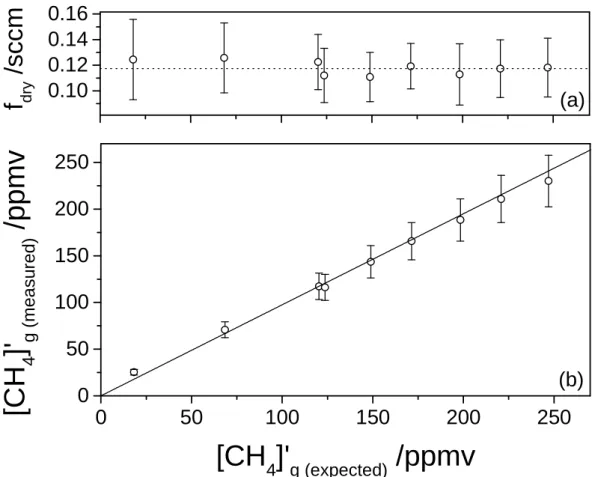
low abundance with respect to nitrogen and oxygen. In Figure 3b, CH4 concentrations of
the dry gas permeating through the membrane and measured by the Sub-Ocean
instrument has been plotted versus the expected concentrations calculated from the
headspace gas content and silicon membrane permeability coefficients using eq 1. The
observed and calculated concentrations are in good agreement, with a slope of 0.975 ±
0.027. The relatively large errors (±12%) are due to the uncertainty related to the
measurement of the small dry gas flow permeating through the membrane and the
water concentration in the gas flow. These errors could be reduced if a larger number of
measurements were used for retrieving the enrichment factor (meff) related to the
selectivity of the membrane to permeation.
Measuring the concentration of water vapor [H2O]g is required in order to
retrieve the dissolved CH4 concentration, [CH4]dissolved, since water vapor flow will cause
dilution of the measured gas mixture (as the carrier gas flow). This measurement was
13
simultaneously to the CH4 measurement. [CH4]’dissolved is then calculated from the
following equation
′ ! = ' "#$% × '( ( – ' * – +'( × , -×
.
/#00 (2)
where [CH4]meas is the methane concentration in mixing ratio measured by the optical
spectrometer, ft and fCG are the total- and carrier-gas flow (ml/min) respectively, and
[H2O]g corresponds to the amount of water in mixing ratio permeating through the
membrane. The complete denominator term (ft – fCG – (ft × [H2O]g)) corresponds to the
dry flow permeating the membrane (Figure 3a). meff represents the enrichment factor
due to the membrane, and its dependency with temperature and salinity is calculated by
running calibrations at different conditions, as reported for fresh water in SI-5. From
this data, a meff of 2.84 ± 0.11 for fresh water at 25°C and 120 KPa was calculated. This is
in agreement with an expected literature value of 2.76 calculated from the permeation
coefficients reported by Robb26.
In this work, methane concentrations are reported as molar fraction (number of
moles of the species over the total number of moles in the gas mixture, e.g. µmol mol-1 or
ppm) and as concentration per volume of water (nmol L-1) by employing Wiesenburg
equations.36 Further information about unit conversion can be found in the SI.
3. Results and Discussion
3.1 The Fast Response Time
In order to establish the response time of the Sub-Ocean probe, the instrument was
placed in a container with water open to the atmosphere, with the membrane block
immersed into about 20 L of ultrapure water. At the beginning of the experiment, the
14
ml of water enriched with a high concentration of dissolved CH4 was added to the water
tank and a rapid CH4 increase was observed when the enriched methane solution was
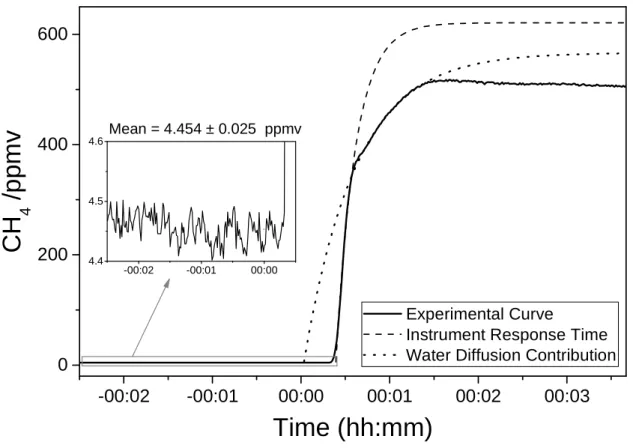
added (Figure 4). The curve resulting from the continuous measurements shows a
double-exponential trend, which accounts for two contributions: a 46 s time constant
exponential growth caused by the slow water mixing (dotted line), and a faster
exponential growth profile (dashed line) with a time constant of ~13 s (τ90 = 30 s)
corresponding to the response time of the instrument. The time lag between the two
exponential growth functions (~18 s) is due to the fact that, while the water mixing
takes place as soon as the enriched water is added, the instrumental response is delayed
due to the transit time of the gas from the dry side of the membrane to the optical cavity
inlet. The laboratory experiment described here simulates the detection of a natural
source of CH4 leaking from the seabed, which was detectable in its full amplitude (up to
500 ppmv of CH4) by our instrument. The slow decreasing trend observed after the
maximum is due to the progressive degassing of the dissolved methane from the water
sample into the atmosphere. A mathematical approach based on the mass balance of
such an analytical system has recently been developed by Gonzalez-Valecia et al.31. The
model allows to retrieve the gas composition at any time, automatically correcting for
the instrumental response time. This could also be applied to the Sub-Ocean instrument.
However, it requires an accurate characterization of the system beforehand. In addition,
considering the time scale of the Sub-Ocean measurement series presented here, such a
correction is not of prime importance with respect to the small residual response time of
15
3.2 Comparison with Discrete Measurements
In order to prove the reliability of the extraction technique, a blind inter-comparison
with standard headspace equilibration technique followed by GC analysis was
performed. Seven independent measurements were conducted at different experimental
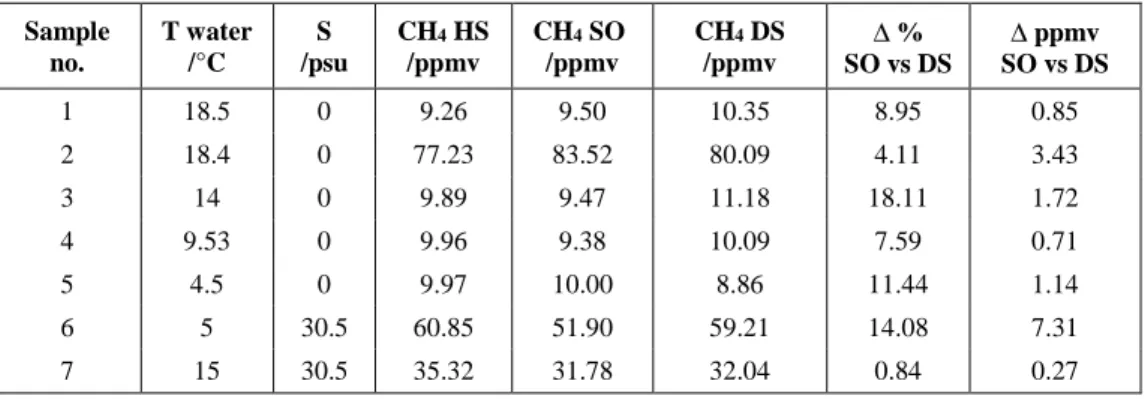
conditions of temperature and salinity. The results are summarized in Table 1.
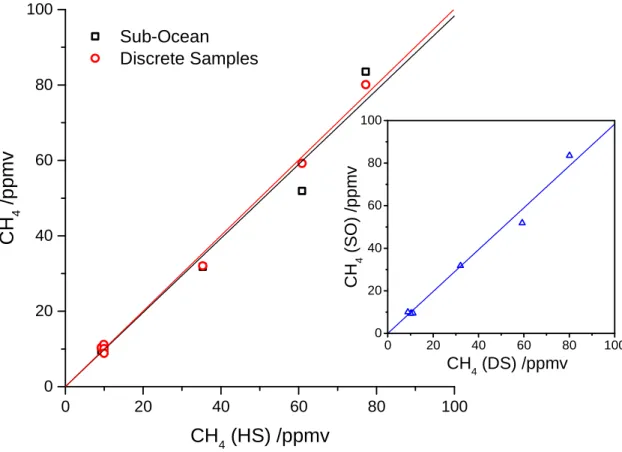
The concentrations measured by the Sub-Ocean spectrometer and by the GC from
the discrete samples was compared to the continuous measure obtained by the
spectrometer connected to the headspace. Slopes of 0.9830 ± 0.044 and 1.0016 ± 0.019
were obtained for SO/HS and DS/HS respectively (Figure 5). In the inset of Figure 5, the
results from SO and DS were directly compared and resulted in a slope of 0.9831 ±
0.031. The larger disagreement between the data corresponds to 18 % for sample No.3
(at 10 ppmv) and 7.3 ppmv for sample No.6 (60 ppmv) as reported in Table 1.
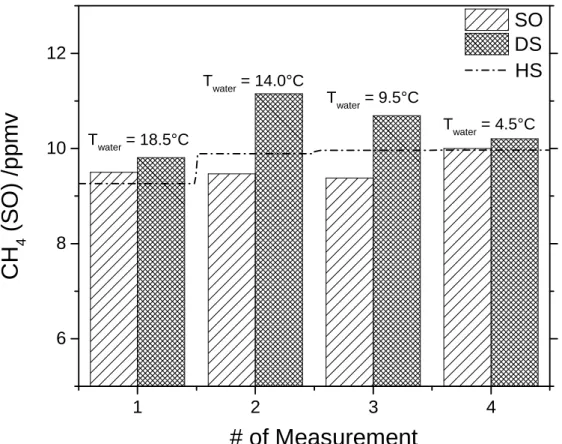
Four samples (1, 3, 4 and 5) were collected at different temperatures but similar
concentrations (10 ppmv) and used for studying the reproducibility of the measurement
with respect to the reference discrete sample method. Data are shown in Figure 6,
highlighting a comparable accuracy between the SO and DS measurement. Average
standard deviation for the four measurements at 10 ppmv with respect to the HS
measurement was 3.3% for the SO and 9.3% for the DS, while for the full set of the seven
measurements it was 6.6% for SO and 7.6% for DS.
3.3 Field measurements
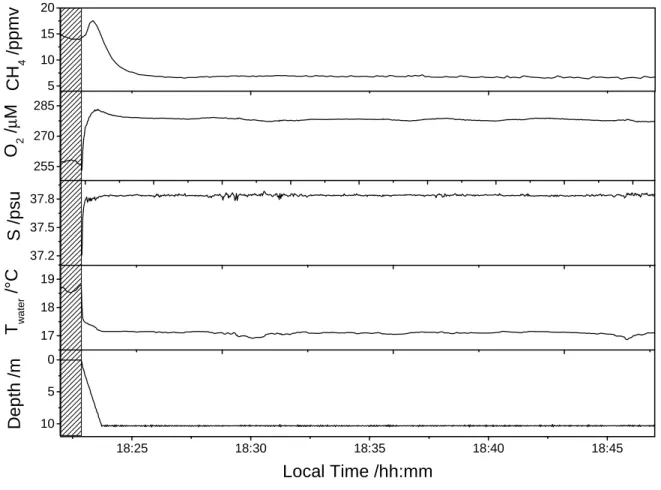
During the field campaign the probe was first tested by immersion at 10 m depth for
20 min, allowing for verification of the stability of the instrument as well as the full
functioning of the probe. This test was performed on July 12th at the position 43°6.20 N -
5°56.73 E, close to the Toulon seaport. An example of the resulting data is shown in
16
after 50 s. The probe was left at the same depth for about 20 min, before being pulled up.
The standard deviation of the CH4 measurements over 20 min of immersion was 0.16
ppmv. It should be noted that the instrument was calibrated for subsea measurements,
therefore, the concentrations obtained in air (filled pattern area) are not correct, and are
reported here as a time reference. Afterward, the vessel was moved to an area off the
coast of Fréjus (position: 43°24.89 N - 7°00.61 E), where we performed vertical profiles
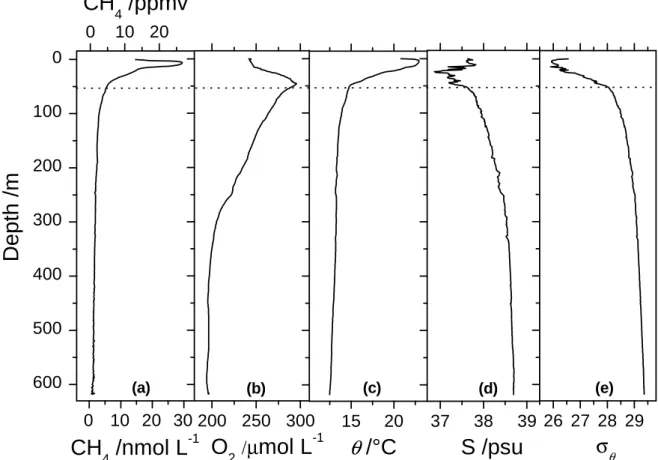
to greater depths. An example of the vertical profiles obtained is reported in Figure 8.
Here, 620 m of depth were reached in only 10 min.
A temperature-salinity plot of this profile can be found in the SI-6. The potential
density anomaly increased from 26 to 28 kg m-3 from the surface down to 56 m (Figure
8e), highlighting a strong stratification dominated by the temperature (Figure 8c).
Presence of fresh water above 56 m was observed through low salinity, but was
concealed in the top 25 m, where evaporation could be inferred through increased
salinity toward the surface. The dissolved oxygen peaked at 56 m, where the density
stratification weakened, and tapered off toward 350 m, but remained high down to the
end of the profile at 620 m.
The fast continuous measurements produced by the Sub-Ocean instrument
provide more details (600 data points) in the dissolved methane profile compared to
standard Niskin bottle sampling, where resolution is normally up to only 24 data points
per depth profile. Methane concentrations were 13 ppmv (15.4 nmol per liter of water)
at the surface, and they reached a maximum of 26.7 ppmv (30.2 nmol L-1) at 6 m water
depth. Descending towards 620 m, CH4 concentrations decreased, approaching a
minimum of 0.6 ppmv (0.81 nmol L-1) close to the bottom. Unfortunately, during the
campaign there were no facilities for collecting discrete samples for comparison.
17
indirect validation of the measurements can be done by comparing literature data of
background dissolved CH4 in seawater. 37
The relatively high methane levels observed at the surface (0 – 56 m),
supersaturated with respect to the atmosphere, are typical of most marine waters.38
This is the so-called “marine methane paradox” where methane (normally resulting
from the biological activity of strict anaerobes) is produced locally, while the
surrounding environment is rich in dissolved oxygen. This phenomena could be due to
aerobic bacterial degradation of phosphonate esters in dissolved organic matter as
revealed recently through incubation of seawater.7 No cytometry measurements or
other biological and kinetic analyses were performed during our test campaign and
therefore, this hypothesis cannot be confirmed.
Another explanation for the CH4 profile could be that surface waters are mixed
with incoming freshwater. Water masses from the Rhone river plume, for instance, are
known to bear relatively large concentrations of dissolved methane, up to 1300 nmol L
-1.34 A similarly CH4 enriched water source, for instance from the Var river, would also
bear a minimum salinety signature. Such a signal appeared in our data set above 56 m,
(e.g. S = 36.9 at 24 m) but is located deeper than the methane maximum, which discards
the hypothesis of a freshwater anomaly to explain the methane one.
Comments and Recommendations
As shown in this initial work, the Sub-Ocean instrument opens new perspectives
for continuous monitoring of dissolved methane (and possibly other dissolved gases) in
sea- or lake waters. Its major advantages, compared with other instruments and
sampling methods include (1) short response times (τ90 = 30 s), (2) continuous in situ
18
laboratory analyses, (3) measurements that are immune to the presence of water vapor
or to interferences by other species present in the gas mixture, (4) high sensitivity of the
measurements (± 25 ppbv in air, translating into ± 0.03 nmol L-1 at 20°C and 38 psu of
salinity in water) obtained with the highly sensitive OFCEAS optical spectrometer
embedded in the probe, allowing to measure anomalies in background concentrations,
(5) a large dynamical range, covering five orders of magnitude in CH4 concentrations.
Drawbacks of this approach are that (1) the measurement accuracy depends on the
stability of the extraction system (and particularly on the water flow through the
membrane) (2) enrichment factor (meff) will depends on the main components of the
dissolve gas and particular calibrations are required for environments where nitrogen
and oxygen are no longer the most abundant gas species.
This type of instrument could be employed for several applications such as studying
the stability of methane hydrates in the seafloor, monitoring biological activity in
seawater and lakes, checking leaks of natural gas pipes in deep water and pipelines
inspection. The telemetry feature, available by powering the sensor using a battery,
could provide real-time data at the surface via an electromechanical cable. This would
allow quantification of the evolution of dissolved gas in real-time from the ship, enabling
the design of more optimal ship-based sampling tracks. Here, we report the
measurement of dissolved methane, but this type of optical spectrometer also allows to
probe other target molecules such as CO2, N2O, and small hydrocarbons (C2 and C3), or
accessing to isotopic signatures of dissolved species such as δ13C and δD of CH4, δ13C of
CO2or directly the isotopic signature of the water mass (δD and δ18O). Further effort will
be made to miniaturize the device as well as to reduce the power consumption (50 W at
the moment with respect to 15-20 W for a commercial instrument) in order to allow
19
References
(1) Gentz, T.; Damm, E.; Schneider von Deimling, J.; Mau, S.; McGinnis, D. F.; Schlüter, M.
A water column study of methane around gas flares located at the West Spitsbergen
continental margin. Cont. Shelf Res. 2014, 72, 107–118.
(2) Ruppel, C. D.; Kessler, J. D. The interaction of climate change and methane hydrates.
Rev. Geophys. 2017, 55, 126–168.
(3) Bollmann, M.; Bosch, T.; Colijn, F.; Ebinghaus, R.; Froese, R.; Güssow, K.; Khalilian,
S.; Krastel, S.; Körtzinger, A.; Langenbuch, M.; et al. World Ocean Review, Living with
the oceans – A report on the state of the world’s oceans; 2010; Vol. WOR 1.
(4) Grossart, H.; Frindte, K.; Dziallas, C.; Eckert, W.; Tang, K. W. Microbial methane
production in oxygenated water column of an oligotrophic lake. PNAS 2011, 6 (49),
19657–19661.
(5) Damm, E.; Helmke, E.; Thoms, S.; Schauer, U.; Nothig, E.; Bakker, K.; Kiene, R. P.
Methane production in aerobic oligotrophic surface water in the central Arctic
Ocean. Biogeosciences 2010, 7, 1099–1108.
(6) Karl, D. M.; Beversdorf, L.; Bjorkman, K. M.; Church, M. J.; Martinez, A.; Delong, E. F.
Aerobic production of methane in the sea. Nat. Geosci. 2008, 1 (7), 473–478.
(7) Repeta, D. J.; Ferrón, S.; Sosa, O. A.; Johnson, C. G.; Repeta, L. D.; Acker, M.; DeLong,
E. F.; Karl, D. M. Marine methane paradox explained by bacterial degradation of
dissolved organic matter. Nat. Geosci. 2016, 9 (12), 884–887.
(8) Dohan, K.; Maximenko, N. Monitoring ocean currents with satellite sensors.
Oceanography 2010, 23 (4), 94–103.
(9) Gentemann, C. L.; Meissner, T.; Wentz, F. J. Accuracy of Satellite Sea Surface
Temperatures at 7 and 11 GHz. IEEE Trans. Geosci. Remote Sens. 2010, 48 (3), 1009–
20
(10) Abraham, J. P.; Baringer, M.; Bindoff, N. L.; Boyer, T.; Cheng, L. J.; Church, J. A.;
Conroy, J. L.; Domingues, C. M.; Fasullo, J. T.; Gilson, J.; et al. A review of global ocean
temperature observations: implications for ocean heat content estimates and
climate change. Rev. Geophys. 2013, 51, 450–483.
(11) Schlüter, M.; Linke, P.; Suess, E. Geochemistry of a sealed deep-sea borehole on the
Cascadia Margin. Mar. Geol. 1998, 148 (1–2), 9–20.
(12) Boulart, C.; Connelly, D. P.; Mowlem, M. C. Sensors and technologies for in situ
dissolved methane measurements and their evaluation using Technology
Readiness Levels. TrAC - Trends Anal. Chem. 2010, 29 (2), 186–195.
(13) Chua, E. J.; Savidge, W.; Short, R. T.; Cardenas-valencia, A. M.; Fulweiler, R. W. A
Review of the Emerging Field of Underwater Mass Spectrometry. Front. Mar. Sci.
2016, 3 (209).
(14) Newman, K. R.; Cormier, M.; Weissel, J. K.; Driscoll, N. W.; Kastner, M.; Solomon, E.
A.; Robertson, G.; Hill, J. C.; Singh, H.; Camilli, R.; et al. Active methane venting
observed at giant pockmarks along the U . S . mid-Atlantic shelf break. Earth Planet.
Sci. Lett. 2008, 267, 341–352.
(15) Wankel, S. D.; Huang, Y.-W.; Gupta, M.; Provencal, R.; Leen, J. B.; Fahrland, A.;
Vidoudez, C.; Girguis, P. R. Characterizing the distribution of methane sources and
cycling in the deep sea via in situ stable isotope analysis. Environ. Sci. Technol. 2013,
47 (3), 1478–1486.
(16) Michel, A. P. M.; Wankel, S. D.; Kapit, J.; Sandwith, Z.; Girguis, P. R. In situ carbon
isotopic exploration of an active submarine volcano. Deep. Res. Part II 2017.
(17) Faïn, X.; Chappellaz, J.; Rhodes, R. H.; Stowasser, C.; Blunier, T.; McConnell, J. R.;
Brook, E. J.; Preunkert, S.; Legrand, M.; Debois, T.; et al. High resolution
21
evidence for in situ production. Clim. Past 2014, 10 (3), 987–1000.
(18) Grilli, R.; Marrocco, N.; Desbois, T.; Guillerm, C.; Triest, J.; Kerstel, E.; Romanini, D.
Invited Article : SUBGLACIOR : An optical analyzer embedded in an Antarctic ice
probe for exploring the past climate. Rev. Sci. Instrum. 2014, 85 (111301), 1–8.
(19) Morville, J.; Kassi, S.; Chenevier, M.; Romanini, D. Fast, low-noise, mode-by-mode,
cavity-enhanced absorption spectroscopy by diode-laser self-locking. Appl. Phys. B
2005, 80 (8), 1027–1038.
(20) Morville, J.; Romanini, D.; Chenevier, M. WO03031949, (Université J. Fourier,
Grenoble FRANCE, 2003). WO03031949, 2003.
(21) Morville, J.; Romanini, D.; Kerstel, E. Cavity Enhanced Absorption Spectroscopy with
Optical Feedback. In Cavity-Enhanced Spectroscopy and Sensing; Gagliardi, G., Loock,
H.-P., Eds.; Springer Berlin Heidelberg, 2014; pp 163–209.
(22) Triest, J.; Chappellaz, J.; Grilli, R. Patent 08276-01: System for fast and in-situ
sampling of dissolved gases in the ocean (CNRS, Grenoble FRANCE, 2017). 8276–1.
(23) Chappellaz, J.; Alemany, O.; Romanini, D.; Kerstel, E. The IPICS « oldest ice »
challenge : a new technology to qualify potential sites. Ice Snow 2012, 4, 57–64.
(24) Fischer, H.; Severinghaus, J.; Brook, E.; Wolff, E.; Albert, M.; Alemany, O.; Arthern, R.;
Bentley, C.; Blankenship, D.; Chappellaz, J.; et al. Where to find 1.5 million yr old ice
for the IPICS “Oldest-Ice” ice core. Clim. Past 2013, 9 (6), 2489–2505.
(25) Lin, D.; Ding, Z.; Liu, L.; Ma, R. Gas Permeation through Polydimethylsiloxane
Membranes: Comparison of Three Model Combinations. Chem. Eng. Technol. 2012,
35 (10), 1833–1841.
(26) Robb, W. L. Thin silicon membranes. Their permeation properties and some
applications. Ann. N. Y. Acad. Sci. 1968, 146, 119–137.
22
Tech. Conf. Glob. Adv. Mater. Process Eng. 2006, 72–75.
(28) Merkel, T. C.; Bondar, V. I.; Nagai, K.; Freeman, B. D.; Pinnau, I. Gas sorption,
diffusion, and permeation in poly(dimethylsiloxane). J. Polym. Sci. Part B Polym.
Phys. 2000, 38 (3), 415–434.
(29) Mavroudi, M.; Kaldis, S. P.; Sakellaropoulos, G. P. A study of mass transfer resistance
in membrane gas-liquid contacting processes. J. Memb. Sci. 2006, 272 (1–2), 103–
115.
(30) Atchariyawut, S.; Feng, C.; Wang, R.; Jiraratananon, R.; Liang, D. T. Effect of
membrane structure on mass-transfer in the membrane gas-liquid contacting
process using microporous PVDF hollow fibers. J. Memb. Sci. 2006, 285 (1–2), 272–
281.
(31) Gonzalez-valencia, R.; Magana-rodriguez, F.; Gerardo-nieto, O.; Sepulveda-jauregui,
A.; Martinez-cruz, K.; Walter-anthony, K.; Baer, D.; Thalasso, F. In Situ Measurement
of Dissolved Methane and Carbon Dioxide in Freshwater Ecosystems by Off-Axis
Integrated Cavity Output Spectroscopy. Environ. Sci. Technol. 2014, 48, 11421–
11428.
(32) Schlüter, M.; Gentz, T. Application of Membrane Inlet Mass Spectrometry for Online
and In Situ Analysis of Methane in Aquatic Environments. J. Am. Soc. Mass Spectrom.
2008, 19 (10), 1395–1402.
(33) Schmidt, M.; Linke, P.; Esser, D. Recent Development in IR Sensor Technology for
Monitoring Subsea Methane Discharge. Mar. Technol. Soc. J. 2013, 47 (3), 27–36.
(34) Marty, D.; Bonin, P.; Michotey, V.; Bianchi, M. Bacterial biogas production in coastal
systems affected by freshwater inputs. Cont. Shelf Res. 2001, 21, 2105–2115.
(35) García-garcía, A.; Orange, D.; Lorenson, T.; Radakovitch, O.; Tesi, T.; Miserocchi, S.;
23 Gulf of Lions. Mar. Geol. 2006, 234, 215–231.
(36) Wiesenburg, D. A.; Guinasso, N. L. Equilibrium solubilities of methane, carbon
monoxide, and hydrogen in water and sea water. J. Chem. Eng. Data 1979, 24 (4),
356–360.
(37) Bates, T. S.; Kelly, K. C.; Johnson, J. E.; Gammon, R. H. A reevaluation of the open
ocean source of methane to the atmosphere. J. Geophys. Res. 1996, 101 (D3), 6953–
6961.
(38) Reeburgh, W. S. Oceanic Methane Biogeochemistry. Chem. Rev. 2007, 107, 486–513.
(39) Fofonoff, N. P.; Millard Jr., R. C. Algorithms for computation of fundamental
properties of seawater. Unesco Tech. Pap. Mar. Sci. 1983, 44, 53.
Acknowledgements
The research leading to these results has received funding from the European
Community’s Seventh Framework Programmes ERC-2011-AdG under grant agreement
n° 291062 (ERC ICE&LASERS), as well as ERC-2015-PoC under grant agreement no.
713619 (ERC OCEAN-IDs). This study is also a part of CAGE (Centre for Arctic Gas
Hydrate, Environment and Climate), Norwegian Research Council grant no. 223259).
The Téthys II ship time for the probe deployment in the Mediterranean Sea was
provided by the Commission Nationale de la Flotte Côtière of CNRS-INSU. We deeply
thank the captain of Téthys II Dany Deneuve and his crew, as well as the personnel of
DT-INSU and IFREMER at La Seyne sur Mer, for their help in setting up and deploying
the probe.
We acknowledge the SATT Linksium of Grenoble, France, and the Service Partenariat &
24
evaluate the valorisation potential of the Sub-Ocean instrument. We thank Dominique
Lefevre, Christian Tamburini at MIO-Marseille and Thierry Penduff at IGE-Grenoble for
25
Figures
Figure 1. Experimental setup for laboratory tests. Two mass flow controllers (MFC1 and MFC2) have been employed to bubble different mixtures of CH4 in air into the water
sample via a diffuser place in the liquid solution. The membrane block (MB) and the water pump are immersed into the water sample, stabilized in temperature using an external chiller unit. The dry side of the membrane is continuously flushed with a small (1 to 6 sccm) dry gas flow supplied by the MFCCG, and the mixture (carrier gas plus
extracted gas) is sent to the Sub-Ocean spectrometer. The total flow is measured by a fourth mass flow controller MFCTF. A portion of the headspace CH4 concentration is
monitored using a second optical spectrometer based on the same absorption
spectroscopy technique (OFCEAS), while the overflow is sent to a vent. The exhausts of the analyzers are connected to two electronic valves (EV1 and EV2) and to a vacuum pump (VP) to ensure pressure regulation in the measurements gas cells. The inset shows the schematic of the in situ spectrometer, where the carrier gas flow is ensured using a gas tank and a pressure reducer, Pred.
26
Figure 2. Schematic diagram showing the effect of a membrane for extracting dissolved
gas. (a) represents the (ideal) case without a membrane; here, the concentration of CH4 at
equilibrium found in the analyzed air will correspond to its concentration in the
headspace. (b) In the presence of a membrane, the measured CH4 concentration will be
affected by gas permeation through the membrane, resulting in a different measured
27
Figure 3. (a) Calculated flow of dry gas permeating through the membrane as a function
of the expected methane concentration. The average flow is 0.1173 ± 0.0017 sccm.(b)
CH4 concentrations measured downstream from the membrane by the Sub-Ocean
spectrometer are plotted against concentrations expected from the CH4 measured in the
headspace, after accounting for the methane enrichment due to its preferential
permeability through the silicon membrane, compared with molecular nitrogen and
oxygen. The measurement was performed with unsalted water at 18°C and 120 kPa of
pressure.
0
50
100
150
200
250
0
50
100
150
200
250
0.10
0.12
0.14
0.16
[C
H
4]'
g ( m e a s u re d )/
p
p
m
v
[CH
4]'
g (expected)/ppmv
(b)
f
dry/
s
c
c
m
(a)
28
Figure 4. Typical response of the Sub-Ocean instrument when a water mass with high
concentration of dissolved CH4 is added to the analyzed water sample. The curve can be
fitted with a double-exponential growth function: a slow exponential (dotted line)
accounting for water mixing contribution, and a short one (dashed line) which
corresponds to the instrument response time. The τ90 of this second component corresponds to 30 s. A precision of ± 25 ppbv is obtained on the baseline (inset frame).
-00:02 -00:01 00:00 00:01 00:02 00:03 0 200 400 600 Experimental Curve
Instrument Response Time Water Diffusion Contribution
Mean = 4.454 ± 0.025 ppmv
C
H
4/
p
p
m
v
Time (hh:mm)
-00:02 -00:01 00:00 4.4 4.5 4.629
Figure 5. Results from a laboratory inter-comparison between the Sub-Ocean probe (SO)
and the discrete sample method based on headspace equilibration followed by GC
analysis (DS). In the main plot is shown the comparison of both techniques with the
expected concentration measured by the headspace spectrometer (HS). In the inset plot
is shown the direct comparison between the two experimental methods.
0 20 40 60 80 100 0 20 40 60 80 100 Sub-Ocean Discrete Samples
C
H
4/
p
p
m
v
CH
4(HS) /ppmv
0 20 40 60 80 100 0 20 40 60 80 100 C H 4 ( S O ) /p p m v CH4 (DS) /ppmv30
Figure 6. Reproducibility of Sub-Ocean (SO) and the discrete sample (DS) method at
similar concentrations and different water temperatures. The dashed line shows the
values expected from the headspace measurement during water equilibration and the
bars show the measured values for both methods. Averaged standard deviation
corresponds to 3.3 and 9.3 % for SO and DS methods, respectively.
1 2 3 4 6 8 10 12
C
H
4(
S
O
)
/p
p
m
v
# of Measurement
SO
DS
Twater = 4.5°C Twater = 9.5°C Twater = 14.0°CHS
Twater = 18.5°C31
Figure 7. Static measurement at 10 m of depth for testing the Sub-Ocean system stability.
This test was done on July 12th, 2014 at the position 43°6.20 N - 5°56.73 E. In the plot is
also reported the O2 concentration, temperature and salinity from a CTD that was
attached to the instrument. The standard deviation on CH4 concentration at 10 m of
depth over 20 min is 0.16 ppmv. 5 10 15 20 255 270 285 17 18 19 18:25 18:30 18:35 18:40 18:45 10 5 0 37.2 37.5 37.8 C H 4 / p p m v O 2 / µ M T w a te r / °C D e p th / m Local Time /hh:mm S / p s u
32
Figure 8. A continuous vertical profile of (a) CH4 (Sub-Ocean), (b) O2, (c) potential
temperature,
θ
, (d) salinity, S and (e) potential density,σ
θ, recorded on July 13th 2014 at3h50 local time at the position 43°24.89 N - 7°00.61 E. Dissolved methane
concentrations have been converted in nmol per liter of water considering the solubility
of methane in water given by Wiesenburg, at 1 bar and at given temperature and salinity
according to CTD data. Potential density has been calculated according to ref 39. 0 10 20 600 500 400 300 200 100 0 200 250 300 15 20 (e) (d) (c) (b)
CH
4/ppmv
D
e
p
th
/
m
(a)O
2/µ
mol L
-1θ
/°C
37 38 39S /psu
0 10 20 30CH
4/nmol L
-1 26 27 28 29σ
θ33
Tables
Table 1. Summary of the inter-comparison results. HS = headspace, SO = Sub-Ocean, DS = discrete samples.
Sample no. T water /°C S /psu CH4 HS /ppmv CH4 SO /ppmv CH4 DS /ppmv ∆ % SO vs DS ∆ ppmv SO vs DS 1 18.5 0 9.26 9.50 10.35 8.95 0.85 2 18.4 0 77.23 83.52 80.09 4.11 3.43 3 14 0 9.89 9.47 11.18 18.11 1.72 4 9.53 0 9.96 9.38 10.09 7.59 0.71 5 4.5 0 9.97 10.00 8.86 11.44 1.14 6 5 30.5 60.85 51.90 59.21 14.08 7.31 7 15 30.5 35.32 31.78 32.04 0.84 0.27