Publisher’s version / Version de l'éditeur:
International Discussion Meeting and Workshop 2006: Laser-induced
Incandescence, Quantitative interpretation, modelling, application, p. 10, 2006
READ THESE TERMS AND CONDITIONS CAREFULLY BEFORE USING THIS WEBSITE. https://nrc-publications.canada.ca/eng/copyright
Vous avez des questions? Nous pouvons vous aider. Pour communiquer directement avec un auteur, consultez la
première page de la revue dans laquelle son article a été publié afin de trouver ses coordonnées. Si vous n’arrivez pas à les repérer, communiquez avec nous à [email protected].
Questions? Contact the NRC Publications Archive team at
[email protected]. If you wish to email the authors directly, please see the first page of the publication for their contact information.
NRC Publications Archive
Archives des publications du CNRC
This publication could be one of several versions: author’s original, accepted manuscript or the publisher’s version. / La version de cette publication peut être l’une des suivantes : la version prépublication de l’auteur, la version acceptée du manuscrit ou la version de l’éditeur.
Access and use of this website and the material on it are subject to the Terms and Conditions set forth at
Inverse analysis of time-resolved LII data
Daun, K. J.; Liu, F.; Smallwood, G. J.; Stagg, B. J.; Snelling, D. R.
https://publications-cnrc.canada.ca/fra/droits
L’accès à ce site Web et l’utilisation de son contenu sont assujettis aux conditions présentées dans le site LISEZ CES CONDITIONS ATTENTIVEMENT AVANT D’UTILISER CE SITE WEB.
NRC Publications Record / Notice d'Archives des publications de CNRC:
https://nrc-publications.canada.ca/eng/view/object/?id=8f265c8d-80e8-4b05-95c2-a2127c4457af https://publications-cnrc.canada.ca/fra/voir/objet/?id=8f265c8d-80e8-4b05-95c2-a2127c4457afInverse analysis of time-resolved LII data
K. J. Daun1∗, F. Liu1, G. J. Smallwood1, B. J. Stagg2, and D. R. Snelling1
1National Research Council of Canada, Ottawa, ON, Canada
2Columbian Chemicals Company, West Oak Commons Ct., Marietta, GA, USA
This study reviews techniques for recovering aerosol particle size distributions from time-resolved laser-induced incandescence data in the context of solving a mathematically ill-posed inverse problem.
* Corresponding author: [email protected]
International Discussion Meeting and Workshop 2006: Laser-induced Incandescence, Quantitative interpretation, modelling, application
Introduction
Time-resolved LII has recently evolved into a tool for evaluating particle size distributions in aerosols. Since larger particles cool slower than smaller particles the size distribution can be recov-ered from the observed monochromatic incandes-cence or effective temperature decays.
This involves solving a mathematically ill-posed inverse problem, which is complicated by the fact that ill-posed problems may not have a solution, have multiple solutions, or have a solution that is sensitive to perturbations to the problem. Although solution existence is guaranteed in this case, uniqueness and stability are not, which is of particular concern in LII experiments since physical parameters are not known with a high-degree of certainty and experimental data often contains substantial shot-noise. Because of these difficul-ties, special explicit and implicit techniques must be used to solve ill-posed inverse problems.
Explicit Methods
Explicit methods solve the mathematically ill-posed governing equations directly. In this prob-lem, the monochromatic incandescence at any instant, Jλ(t), is governed by a Volterra integral
equation of the first-kind,
(1) where Cλ is a constant, f(dp) is the unknown
parti-cle size distribution, and Kλ(t, dp) is the radiation
emitted by particles of diameter dp at time t and
wavelength λ. Explicit methods transform ill-posed integral equations into ill-conditioned matrix equa-tions, Ax = b, which are then solved using regu-larization methods. Roth and Filippov [1] used iterative regularization to solve Eq. (1) for f(dp). Implicit Methods
Implicit methods work on the well-posed for-ward problem, which in this case is to determine the Jλ(t) or the effective temperature, Te(t) that
corresponds to a particular f(dp). Different size
distributions are then substituted into the governing equations until the modeled Jλ(t) or Te(t) matches
the experimentally-observed values. This is most efficiently done by casting the problem as a least-squares minimization problem,
(2) where x specifies f(dp) (which is usually
log-normal) and fexp and fmod(x) contain experimentally-observed and modeled data, respectively. F(x) is then minimized using nonlinear programming; the minimizer x* specifies the particle size distribution that best describes the experimentally-observed results. This approach has been used [2-5] to find f(dp) using Jλ(t) or Te(t). Liu et al. [5] transform this
problem into an easier-to-solve univariate minimi-zation problem.
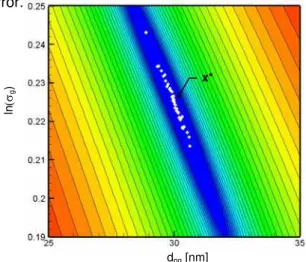
Although implicit methods work on the well-posed forward problem, the ill-well-posedness of the inverse problem is manifested in the topography of F(x), shown in Fig. 1. The valley surrounding x* corresponds to particle size distributions that nearly produce the experimentally-observed data. Diamonds show solutions found using data conta-minated with shot noise. Accordingly, care must be taken to select a method that is insensitive to un-certainties in the parameters and experimental error.
Fig. 1: Plot of F(x), showing solutions obtained using perturbed incandescence data.
[1] P. Roth, A. V. Filippov,J. Aerosol Sci. 27, 95-104 (1996). [2] T. Lehre, B. Jungfleisch, R. Suntz, H. Bockhorn, App.
Opt. 42, 2021-2029 (2003).
[3] S. A. Kuhlmann, J. Schumacher, J. Reimann, S. Will, PARTEC, Nuremburg, Mar. 16-18 (2004)
[4] S. Dankers, A. Leipertz, App. Opt. 43 3726-3730 (2004) [5] F. Liu, B. J. Stagg, D. R. Snelling, G. J. Smallwood,
IJHMT, 49, 777-788 (2006).