UNIVERSITY OF ABDLHAMID IBN BADIS MOSTAGANEM FACULTY OF FOREIGN LANGUAGES
DEPARTMENT OF ENGLISH LANGUAGE
MASTER
Didactics of Foreign Languages
This Dissertation is submitted for the Fulfilment of the Master Degree in English – Didactics of Foreign Languages - (University of Mostaganem)
Submitted by: BEKADDOUR Sarah
Board of Examiners:
President: Mrs. DERRAZ Amel UNIVERSITY OF MOSTAGENEM
Examiner: Dr. BENOSMAN Naziha UNIVERSITY OF MOSTAGENEM
Supervisor: Mrs. BENAOUDA Sihem UNIVERSITY OF MOSTAGANEM
Academic Year: 2019-2020
INVESTIGATING THE LEARNERS’ NEEDS IN AN EAP CONTEXT
The Case of First Year Master Students in the Islamic Studies Department of HumanI
Dedication
To my beloved parents Lazreg and Hamidi Fatima. To my dear brothers Mohamed and Bilal. To my friends: Djamila, Fatima, Rachida and Amina.
II
I would like to express a special thanks and gratitude to my honourable supervisor Mrs. Sihem BENAOUDA for her guidance, advice and support during this period of research. I would also thank in advance all the members of the board of examiners who were generous
III
Learning English for academic studies and professional purposes is one of the major demands of globalisation; therefore, meeting the specific needs of learners requiring English for Academic Purposes has become a necessity. In this regard, the present research aims at investigating the students‟ needs in the use of English for Academic Purposes at the Islamic Studies field in the context of Algerian higher education. It also aims to improve the teaching/ learning processes of English language through providing a guideline to English for Islamic Studies courses which cope with the students‟ target needs. To carry out this study, a triangulation of data gathering instruments was employed. It includes a questionnaire and a semi-structured interview; the questionnaire was submitted to twenty one First-Year Master students at the Islamic Studies Department of Human Sciences and Islamic CultureFaculty, in Oran 1 University, Algeria. Whereas the semi-structured interview was conducted with two English for Specific Purposes teachers who are supposed to know more about their students‟ needs. Thus, needs analysis process has a crucial importance in making English for Islamic Studies learning more effective and successful. The research results revealed the absence of both real ESP courses for Islamic Studies and the formation of the teachers in ESP field. In addition, the target students have a palpable weakness in English language and they need to develop the four language skills, especially the interactive ones (listening and speaking). Moreover, conducting a needs analysis is a necessity so as to identify the Islamic Studies students‟ linguistic needs (lacks, necessities and wants) in English language for the design of effective courses for Islamic Studies. Based on the research findings, some recommendations have been provided for teachers or course designers to enhance the process of teaching English for Islamic Studies
Keywords: English for Specific Purposes; English for Academic; English for Islamic Studies (EIS), Needs Analysis.
IV
EAP English for Academic Purposes EFL English as a Foreign Language
EGAP English for General Academic Purposes EGOP English for General Occupational Purposes EGPP English for General Professional Purposes EIS English for Islamic Studies
EOP English for Occupational Purposes EPP English for Professional Purposes ESP English for Specific Purposes
ESAP English for Specific Academic Purposes ESPP English for Specific professional Purposes ESOP English for Specific Occupational Purposes
GE General English
NA Needs Analysis
LSA Target Situation Analysis PSA Present Situation Analysis TSA Target Situation Analysis
etc et cetera
ibid. ibidem „in the same work‟ i.e. idest, „that is in other words‟
V
Figure 1.1 : The Role of ESP Teacher, Dudley-Evans & St. John (1988, p.13) 09 Figure 1.2: Hutchinson and Waters‟ Classification of Needs (1987) 12 Figure 2.1: The Departments of Human sciences and Islamic Culture Faculty 22 Figure 3.1: Research Process in Sequential Explanatory Design (McMilan &
Schumaher, 2010)
28
Figure 3.2: Students‟ Gender 29
Figure 3.3: Students‟ Master 1 Speciality 30
Figure 3.4: Learners‟ Perception about Language skills According to their Priority 33 Figure 3.5: Students‟ Frequency of their Need of English Language Skills 35 Figure 3.6: Students‟ Perceptions towards the Type of English Language Course 38
Figure 3.7: Time Allocation 38
Figure 3.8: Students‟ Viewpoints about Learning Styles 39
VI
Table 1.1: Areas of ESP Teaching (Basturkmen2006) 07
Table 2.2: Participants‟ Demographic Information 23
Table 3.1: Students‟ Attitudes towards English Language Learning 30 Table 3.2: The importance of the Use of English for Islamic Studies 31
Table 3.3: Subjects Taught 32
Table 3.4: Findings of Students‟ Classification of English Language Skills 33 Table 3.5: Students‟ Perceptions about Language Difficulties 34 Table 3.6: Students‟ Opinions about Why They Need writing Skill 36 Table 3.7: Students‟ Opinions about Why They Need Reading Skill 36 Table 3.8: Students‟ Opinions about Why They Need Listening Skill 37 Table 3.9: Students‟ Opinions about Why They Need Speaking Skill 37
VII Dedication I Acknowledgments II Abstract III List of Abbreviations IV List of Figures V List of Tables VI
Table of Content VII
General Introduction 01
Chapter One: English for Islamic Studies
Introduction 05
1.1 Definitions to English For Specific Purposes 05
1.2 Branches of ESP 06
1.2.1 English for Academic Purposes 07
1.2.2 English for Occupational Purposes 08
1.3 ESP Teachers 08
1.3.1 Characteristics of ESP Teachers 08
1.3.2 The Role of ESP Teachers 08
1.3.3 Collaboration between ESP Teachers and Content Teachers 10
1.4 Needs Analysis (Understandings and Purposes) 10
1.4.1 Types of Needs Analysis 12
1.4.1.1 Target Needs 12
a)- Necessities 12
b)- Lacks 12
c)- Wants 13
VIII
1.4.2.1 Present Situation Analysis (PSA) 13 1.4.2.2 Learning Situation Analysis (LSA) 13 1.4.2.3 Target Situation Analysis (TSA) 13
1.5 ESP Course Design 14
1.5.1 English for Islamic Studies Course‟ Goals and Objectives 14 1.5.2 English for Islamic Studies Instructional Materials 15
1.5.3 English for Islamic Studies Terminology 17
Conclusion 19
Chapter Two: Research Methodology Design
Introduction 21
2.1 Description of the ESP Situation at Oran 1 University (Context) 21 2.1.1 The Faculty of Human Sciences and Islamic Culture 21 2.1.2 The Department of Islamic Studies as a Sample 22
2.2 Research Methodology Design and Instrumentation 22
2.2.1 Choice of the Method 23
2.2.2 Participants 23
2.2.2.1 Target Students‟ Profile 24
2.2.2.2 Target Teachers‟ Profile 24
2.2.3 Data Collection Instruments 24
2.2.3.1 The Design of the Students‟ Questionnaire 25 2.2.3.2 Design of Teachers‟ Semi-Structured Interview 25
Conclusion 26
Chapter Three: Data Analysis and Recommendations
Introduction 28
3.1 Data Analysis and Interpretation 28
IX
3.2.1 Part One: Background Information 29
3.2.2 Part Two: Importance of Using English Language to Islamic Studies Field 30
3.2.3 Part Three: Students‟ Target Needs 32
A. Students‟ Lacks 32
B. Students‟ Necessities 34
C. Students‟ Wants 38
3.3 Teachers‟ Semi-Structured Interview Analysis 40
3.4 Summary and Interpretation of the Data Collected 42
A. The Students‟ Questionnaire 42
B. The Teachers‟ Semi-Structured Interview 44
3.5 Suggestions and Recommendations 45
Conclusion 46
General Conclusion 48
Bibliography 51
1
General Introduction
Today, teaching of ESP is gaining popularity throughout the world. Most authorities and institutions are aware that well organized ESP courses can prepare students for the encounter with globally competitive world. Despite the importance of teaching English for Specific Purposes in Algeria, particularly Islamic Studies learners, there have been very rare studies that generally and specifically examine the English language needs of Islamic Studies learners. Hence, the English for Academic Purposes courses for Islamic Studies students are very limited in comparison with the other field of study.
Personally, I have chosen to deal with English for Islamic Studies because I have always been influenced by studying in the Islamic Studies Department but I never do. Now I am specializing in English language and as already know that English language taught to different students from different specialties then why not dealing with it. I also have found that there are rarely if any study research undertaken to investigate the ESP teaching/learning process in the discipline of Islamic Studies. Based on this my research is conducted.
In fact, ESP courses in the department of Islamic Studies of Human Sciences and Islamic Culture at Oran University in Algeria are limited to learning general English basing on teaching grammar, vocabulary and pronunciation using the same methods and the same instructional materials used in different departments. A method which fundamentally ignores the learners‟ personal interests and weaknesses leads to low motivation in their English studies and, in turn, low performance when they use English in their future career. So the main problematic of teaching English to Islamic Studies learners is the lack of concern about the Islamic Studies students‟ needs in English language and the English courses offered are not designed on the basis of the analysis of the English language needs.
The present study aims at investigating the role of needs analysis to identify the Islamic Studies students‟ needs in order to improve the process of teaching/ learning of English language and provide a guideline for the effectiveness of English for Islamic Studies courses which help the Islamic Studies students understand their own discipline in the target language.
Based on these objectives, two main research questions are asked and analyzed all along the research study:
1. What are the Islamic Studies students‟ linguistic needs to grasp a proficiency in English?
2
2. Do the present ESP/EAP courses offered to Islamic Studies students fulfill their target needs?
Since the study is based on three major research questions and so as to find answers to these questions, It is suggested these following hypotheses:
1. If learners‟ lacks, necessities and wants are taken into consideration, the learning of English would be successful and students would achieve an efficient proficiency in English.
2. The ESP/EAP courses offered to Islamic Studies students do not meet their target needs and do not develop the English learning skills that are required in the learners‟ academic studies as well as their professional career.
The present research study makes use of both the quantitative and qualitative methods to produce a more accurate and credible analysis of the data. The quantitative data collected via a questionnaire that provides the research with the necessary data in order to identify the Islamic Studies learners‟ lacks and weakness in English language and reveal their real needs and wants in EAP courses.The students‟ questionnaire was translated into Arabic in order to make the questions comprehensive for the sample students. The second method is qualitative where data are collected via a semi-structured interview which is used in this study as additional data from teachers to obtain direct information about the learner‟s lacks, necessities and wants and know more about the current situation of teaching English in the context of Islamic Studies.
Thus, the sample population is First-Year Master students in the Department of Islamic Studies, Faculty of Human Sciences, at Oran University in Algeria. The teachers who took part in the investigation are English language teachers from the Department of Islamic Studies.
As far as the structure of this research study is concerned, it is divided into three chapters. The first one deals with the literature review where the theoretical background about the topic is tackled. This chapter presents definitions to ESP and its types. It also sheds light on the ESP teacher; his characteristics, his role as well as his collaboration with subject teachers. Besides, it deals with the definition of ESP, its types and its approaches. Lastly, it tackled the ESP courses with much concern on English for Islamic Studies courses, instructional materials and specific terminology.
The second chapter is mainly concerned with the description of the methodology design of the present research study taking into consideration many aspects of the investigation such as: the setting where English is used through clarifying the actual situation
3
of teaching English for Islamic Studies in one of the Algerian universities (the one of Oran 1), the choice of the method, the participants, the research tools and the data collection procedure. The third chapter represents the analytical part. It deals with the analysis and interpretation of the students‟ questionnaire, the teachers‟ semi-structured interview and finally provides some suggestions and recommendations for the improvement of English for Academic Purposes courses in the discipline of Islamic Studies.
Chapter One
5
Introduction
This purely theoretical chapter tackles very important points. it starts with different definitions of ESP provided by different scholars moving to its branches. In addition, it provides some information about the ESP teacher (his characteristics, his role and his co-operation with content teacher). Moreover, this chapter provide a theoretical review about needs analysis, its types and approaches. It also highlights the significance of ESP course design. Finally, and in order to limit the scope of the present study, the last titles tackles the core of this investigation and looks specifically at the objectives of English for Islamic Studies course, EIS instructional materials and EIS terminology.
1.1 Definitions to English for Specific Purposes:
Despite the existence of ESP for more than decades, it is not easy to reach an acceptable definition of ESP and there still has been a considerable debate regarding its exact meaning. In this context, Strevens (1980) states “a definition to ESP is both simple and watertight and not easy to produce” (p.109). Accordingly Ewer (1981, p.2) cited by McDonough (1984) indicates that:
…the terminology of ESP is now getting into such a confused and contradictory state that in my experience it is impossible to carry on a discussion about the subject with practitioners outside one‟ work-group for more than a few minutes without misunderstandings arising from this source (p.1).
However, many scholars have come with a different perspective and have addressed the task of defining ESP. For Mackay and Mountford (1978) state that ESP is generally used “to refer to the teaching/ learning of foreign language for clearly utilitarian purposes of which there is no doubt” (p.2). Furthermore, they indicate that “this purpose is usually defined with reference to some occupational requirement” (ibid.).
Similarly, Harmer (1983) specified that “ESP is situations where the learner has some specific reasons to learn a language i.e. learners want to learn the target language to fulfil specific reasons which can be academic or occupational” (p.1).
6
According to Hutchison and Waters (1987) ESP is regarded as an approach to language teaching where decisions as to content and method are centred on the learners‟ aim from learning.
However, in a more recent study, Dudley-Evans and St. John (1998) have modified Strevens‟ (1988) definition and exposit their revised view on ESP in terms of „absolute‟ and „variable‟ characteristics. They are as follows:
A. Absolute Characteristics
1. ESP is defined in terms of the learners‟ specific needs
2. ESP makes use of underlying methodology and activities of the discipline it serves. 3. ESP is centred on the language appropriate to these activities in terms of grammar,
lexis, register, study skills, discourse and genres appropriate to these activities. A. Variable Characteristics
1. ESP may be related to or designed for specific disciplines.
2. ESP may use, in specific teaching situations, a different methodology from that of General English.
3. ESP is likely to be designed for adult learners, either at a tertiary level institution or in a professional work situation. It could, however, be for learners at secondary school level.
4. ESP is generally designed for intermediate or advanced Students.
5. Most ESP courses assume some basic knowledge of the language system, but it can be used with beginners.
Based on these absolute and variable characteristics, the students of Islamic Studies can study English in the form of ESP because they fulfil the characteristics such as the specificity of the discipline.
All in all, in the light of the above cited definitions, it can be concluded that the researchers agree on the fact that ESP is about: the specific context and the learners‟ needs for learning the target language.
1.2 Branches of ESP
Researchers such as Strevens (1988), Dudley-Evans and St. Johns (1998), Jordon (1989) and Basturkmen (2010) divided ESP into two main branches: English for Occupational Purposes (EOP) and English for Academic Purposes (EAP).
7
1.2.1 English for Academic Purposes
English for Academic Purposes or as it is referred (EAP) implies teaching English in an academic setting as colleges, institutes or universities for the motif of achieving academic objectives. In this context, Kennedy et al (1984) claim that ESP is taught generally within educational institutions to students reading English in their studies.
According to Johns (1990), EAP courses emphasize the development of vocabulary, discourse and register set to the field of specialisation using a foreign language. Within these courses students develop language skill pertinent to the teachings and research in their future area of specialism.
As far as this investigation is concerned, basing on the areas of ESP teaching developed by Basturkmen (2010), English for Islamic Studies (EIS) can be put underneath the branch of English for Academic Purposes (EAP), sub branch of English for Specific Academic Purposes (ESAP) together with English for Law Studies.(cited in Muhsinin,2013) (See Table 1.1)
Branch Sub branches Examples
English for Academic Purposes (EAP)
English for General
Academic Purposes (EGAP)
English for academic writing English for Specific
Academic Purposes (ESAP)
English for law studies English for Islamic Studies English for Professional
Purposes (EPP)
English for General Professional Purposes (EGPP)
English for the health care sector
English for Specific Professional Purposes (ESPP)
English for nursing
English for Occupational Purposes (EOP)
English for General Occupational Purposes (EGOP)
English for the hospitality Industry
English for Specific Occupational Purposes (ESOP)
English for hotel receptionists
Table 1.1: Areas of ESP Teaching (Basturkmen2006)
Therefore, by using Islamic teaching materials written in English as the content of the course, this will enable learners develop their English language proficiency and at the same time learn Islamic values. This sub-branch uses special terms and aims at advancing both students‟ academic and professional development.
8
1.2.2 English for Occupational Purposes
English for Occupational Purposes or EOP, as Kennedy (1984) et al define, “is taught in a situation in which learners need to use English as part of their work profession” (p.4). Similarly, Dudley-Evans and St. John (1998) focus on the link between professional activity (profession) and the knowledge of the English language. The content of the language teaching is defined by the learners‟ work-related needs. Moreover, EOP course aim at teaching language practical skills in a specific contexts in order to enable the learners operating successfully in their subject of specialisation, professions and workplaces.
1.3 ESP Teachers
The majority of ESP teachers are majoring at general English, graduating from ELT. They haven‟t experienced of using ESP teaching materials or techniques. Strevens (1988) regards an ESP teacher as a virtually a teacher of general English but has suddenly been asked to teach students been asked to teach students with ESP needs.
1.3.1 Characteristics of ESP teachers
According to Hutchinson and Waters (1987), ESP teacher require having: ● a positive attitude towards the ESP content;
● a knowledge of fundamental principles of the subject area; ● an awareness of how much they probably already know (p.163).
Thus, the ESP should become an interested learner of the subject matter; he does not need learn highly specialized texts but rather should know the basic knowledge of the target discipline (Hutchinson and Waters, 1987).
1.3.2 The Role of ESP Teachers
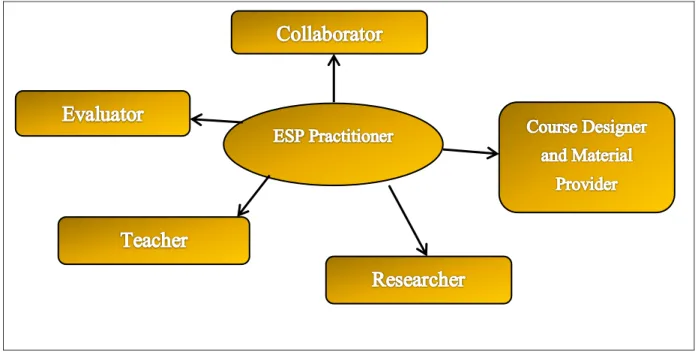
The term of ESP practitioner, instead of ESP teacher, is preferred by Dudley-Evans and St. John (1998). They specified “five diverse key roles to be performed by the ESP practitioner: teacher, course designer and material provider, collaborator, researcher and evaluator” (p.13). (See Figure 1.1)
9
Figure 1.1: the Role of ESP Teacher, Dudley-Evans & St. John (1988, p.13)
As a teacher, the main role of ESP teacher is to create opportunities of learning through choosing adequate teaching methods and appropriate materials to be convenient with the learners‟ requirements.
As a course designer and material provider, the ESP practitioner should create his proper personal courses and adjust authentic materials used in workplace. besides, he must take into account: environment analysis, students‟ needs principles, goals, content and sequencing.
As a researcher, the ESP practitioner should investigate the students‟ target needs, goals and wants; what they really want to achieve.
As a collaborator, the ESP practitioner should work closely with the content specialists since he lacks knowledge of the target discipline.
Moreover, the ESP practitioner works as an evaluator in order to investigate the several stages in the evaluation process; before the course, during the course and after the course.
10
1.3.3 Collaboration between ESP Teacher and Content Subject Teacher
In the purpose of developing knowledge in the field of specialization and realizing proficiency in the target language, Dudley-Evans and St. John (1988) propose the collaboration with subject specialist pointing out that materials should be produced in joining between a language instructor and content specialist. Furthermore, they classified the teamwork into three stages: operation, collaboration and team teaching. Firstly, co-operation means collecting materials from the subject department about course content and the tasks required of students. Secondly, collaboration refers to the mutual work of the ELT teacher and the content specialist the ESP classroom so as to provide the learners with appropriate tasks and activities. Thirdly, the team-teaching is the joint between ELT teacher and content subject teacher in the same classroom as giving advice to clarify points about the core of the subject. However, this latter is difficult to put it into practice in ESP domain because of its complexity.
1.4 Needs Analysis (Understandings and Purpose)
Needs analysis has become a part of language teaching and systematic curriculum development since mid-1970s. Needs Analysis (NA) also known as needs assessment has a crucial role in the process of designing and carrying out any language course whether it is English for Specific Purposes (ESP) or English for General Purposes (EGP).
Accordingly, the vast majority of researchers and ESP practitioners consider the process of needs analysis as a key parameter to the specification of the students‟ needs and the first stage for the design of successful ESP course. According to Dudley-Evans and St. John (1998) needs analysis is regarded as the corner stone of ESP and leads to a very focused course.
In fact, Needs analysis have been defined variously by many researchers. Among them, Iwai et al. (1999), needs analysis generally denotes the activities involved in collecting information that will serve as the basis to elaborate a curriculum consistent with the needs of a particular group of students.
In the same line of thoughts, Nunan (1988) defines „needs analysis‟ as “the techniques and procedures for obtaining information from and about learners to be used in curriculum development” (p.158). Furthermore, Nunan pinpoints that information about learners could be obtained from other sources (e.g. content instructors).
11
Similarly, Brown (2001, p. 35) defines needs analysis as “the activities involved in gathering information that will serve as the basis for developing a curriculum that will meet the learning needs of a particular group of students”.
With regard to Hutchinson and Waters‟ (1987) definition, it seems that it is of paramount importance since they define needs analysis as a cyclic process that can be proceeded before the planning of the course takes place as well as during the course and may be carried on till the end of the designed course if the objectives are not met. Thus, Hutchinson and Waters‟ definition gives insights to the continuity of assessment and evaluation of the learners needs.
Furthermore, NA plays an important role in designing of ESP courses and provides the learner with effective and successful English learning. In this context, Therefore, Richards (2001), has described some potential purposes to needs analysis:
● To find out what language skills a learner needs in order to perform a particular role, such as sales managers, tour guides, or university students.
● To help determine if an existing course adequately addresses the needs of potential students.
● To identify a gap between what students are able to do and what they need to be able to do.
● The information obtained can then serve as a basis for planning a training program (p.52).
In short, it is remarkable that achieving a unified and absolute definition for needs analysis seems to be far reaching. The various definitions of needs analysis provided by researchers are due to the changeability of learners‟ needs. However, it can be concluded that needs analysis needs analysis helps the course designer place a learner on an appropriate course, and gives focus to the course. It serves as an important initial step in designing ESP courses for further development of teaching materials, learning activities, tests, program evaluation strategies. Besides, NA is a continuous process through which ESP teachers or course designers can add, adjust or adapt items to the ESP course.
12
1.4.1 Types of Needs Analysis
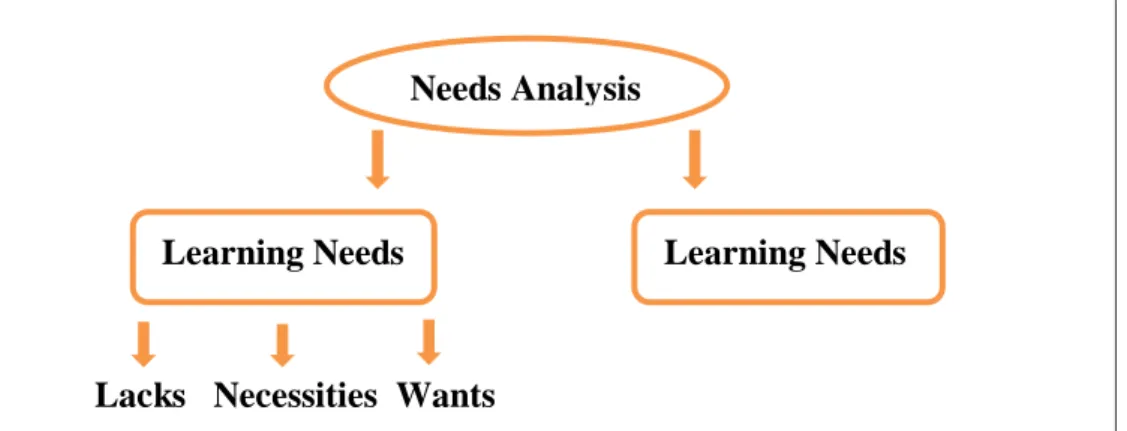
Hutchinson and Waters (1987) suggest two types of needs: target needs and learning needs; they can be illustrated as follows:
Figure 1.2: Hutchinson and Waters‟ Classification of Needs (1987) 1.4.1.1 Target Needs
It referred to what the learner needed to do in the target situation. It is about the identification of the linguistic component of the target situation. Hutchinson and Waters (1987) consider the target needs as an umbrella term that hides a number of distinctions that were defined as lacks, necessities and Wants.
a) Necessities
Necessities refer to the type of need determined by the demands of the target situation, that is, what the learner has to know in order to function effectively in the target situation.
In the case of Islamic Studies, Smaihi (2019) notes that learners need to understand theological English which helps to create interest in them to learn English.
a) Lacks
In brief, lacks refer to the gap between the existing proficiency level of the learner and his target proficiency level. In others, the gap between the existing knowledge and the part they are lacking and which needs more focus.
Lacks Necessities Wants
Needs Analysis
13
a) Wants
Wants refer to what learners personally want the course to provide them with, i.e. Learners‟ wants are considered as the most important input in the Needs Analysis process and cannot be ignored in the improvement of ESP courses.
1.4.1.2 Learning Needs
It refers to what the learner needs to do in order to learn. In this regard, Xiao (2007) extends the definition saying that “learning needs are factors that affect the learning like attitude, motivation, awareness, personality, learning styles and strategies, together with the social background (p.2).
1.4.2 Approaches to Needs Analysis
At present, to design an ESP course, one should rely on one of the following approaches to needs analysis which are explained below:
1.4.2.1 Present Situation Analysis (PSA)
This kind of analysis is mainly concerned with the strengths and the weaknesses of the learners. Its objective is to assess the learners‟ lacks through looking at their current use of language.
1.4.2.2 Learning Situation Analysis (LSA)
This type of analysis is concerned with identifying the learners‟ wants as it helps the course designer to know about the learners' previous learning experience as well as their reasons for learning, and their expectations from the course. It is more concerned with the learners‟ learning styles, their level of motivation and their methodological experience.
1.4.2.3 Target Situation Analysis (TSA)
Target Situation Analysis helps the course designer to identify the language needs of the learner through making an idea about the learners' objective and the product-oriented needs. This will make it easy to find out more activities and tasks for the appropriate English use.
To conclude, it is very crucial to take into account the three above approaches when designing any needs analysis which is undoubtedly the cornerstone of an ESP course.
14
1.5 ESP Course Design
Hutchinson and Water (1987) define Course design as the process of interpreting the raw needs analysis data to produce an integrated series of learning experiences to lead learners to a particular state of knowledge. In addition, Strevens (1988) states this definition:
ESP courses are those in which the aims and the content are determined, principally or wholly not by criteria of general education… but by functional and practical English language requirements of the learner (p.90).
Before designing any ESP course, there are four essential points that have to be studied and analysed as a pre-design process provided by Miliani (1994), namely: First, situation analysis aims at considering the general requirements of both learners and institutions, their profiles and attitudes, also the existing materials. Second, setting aims and objectives; stating what would be achieved at the end of the course. Third, generating syllabus content is done “through the sequencing of materials whose layout and presentation should form a continuum”. (Benyelles, 2009:58). Fourth, assessment refers to gathering data regarding syllabus before or during the course implementation to readjust the content of the syllabus.
As far as this section is concerned, it is an opportunity to bridge the gap between English for specific Purpose which has been dealt with so far in the previous section and English for Islamic Studies which is supposed to be discussed in detail in the next section. 1.5.1 English for Islamic Studies Course’s Goals and Objectives
Formulating goals and objectives for a particular course helps to build a clear image of what the course is going to be about. Additionally, a clear understanding of goals and objectives will help teachers or course designer to produce suitable instructional materials to teach, when and how should be taught. Therefore, goals reflect the ideology of the curriculum and how it is reached. Whereas objectives which are intended to be achieved in a short time span, refer to more specific aims or purposes of an activity within a lesson to achieve one goal of study (Brown, 2006).
15
Aiming at making these definitions into practice, it is crucial to clarify the general goals and objectives of the EAP course for Islamic Studies discipline. Smaihi (2019) states the following objectives:
● To provide Islamic Studies students with the terminology used in the context of Islamic Studies;
● To familiarize them of how to use English properly related to students‟ specialism and subject are so that they would be able to communicate properly through a set of activities moving in sequence from simple to more complex
● To equip learners religion-related interest to interact the target language vigorously ● To make them conversant with basic communication and presentation skills for use in
their academic life and future career…. At the end of the course, the learner will be able to:
● to comprehend basic terminology proper to Islamic Studies background knowledge ● to develop an effective communicative competence
● to deal with four skills and to summarize an Islamic Studies text (p.161). 1.5.2 English for Islamic Studies Instructional materials
Instructional Materials in ESP courses is very crucial and it shows the effort and creativity of the course designers as well as the teachers. They have an important role in the English language classroom. According to Richards and Renandya (2002), materials are one of the components of the instructional process. Teaching them is a key component in most language programs.
Hence, the production of mediated materials requires an artistic and technical skill (Carey, 2001). In this respect, Crawford (2002) cited main attributes principles for the design of effective teaching materials which are:
● language is functional and must be contextualized;
● language development requires engagement in purposeful use of language; ● language use should be realistic and authentic;
16
● classroom materials will usually seek an audio-visual component;
● learners need to develop the ability to deal written as well as spoken genres; ● effective teaching materials foster autonomy;
● materials need to be flexible enough for individual and contextual differences;
● learning needs to engage learners both affectively and cognitively (cited in Richards and Renandya, 2002).
In fact, authentic materials that are used in the real world are the best materials that should be used in any English for Academic Purposes (EAP) or English for Occupational Purposes (EOP) courses. Therefore, designers should consider using real life, authentic materials that reflect the target audience specialization. This will help students who are weak in the English Language to at least comprehend reading text for example due to the background knowledge that they have.
Authentic materials and ESP courses can never be separated. Students or learners should be provided with authentic materials that reflect their real world. They should benefit students or learners so that when they go out to the real world they will be not only able to function well in the real world but also they should be able to use English in their working life.
Therefore, Harding (2007) suggested three recommendations to consider while coming up with a set of authentic materials:
● Use context, texts, and situations from the students‟ subject area – Whether they are real or stimulated they will naturally involve the language the students need.
● Exploit authentic materials that students use in their specialism or vocation – Do not be put off by the fact that it may not look like „normal English‟.
● Make the tasks authentic – Get the students doing things with the materials that they actually need to do their work (p.10 -11).
17
Subsequently, in the case of Islamic Studies field, the need for Islamic teaching materials for teaching English to Islamic Studies students has been proposed by some ELT educators such as Ashraf (1997), Rohmah (2012) and Mclennan (2013). They argue that, to a certain extent, cultural resistance emerges in Muslim students regarding the use of English teaching materials containing western culture, values and norms. This can demotivate the students which consequently hinder their language skills development.
Accordingly, in the context of Islamic studies, the materials used for these students are supposed to be integrated with the text that they use in the real world. It could be a text or sermons that preachers or Imams used while preaching. It could also be a dialogue or questions and answers sessions or discussions between preachers in Islam. The main aim is that texts used should reflect their real life and also should relate to their background knowledge. A material designer should be aware that the goal is not to teach these students the content of Islamic Studies in English but how to use English properly in related to their field of study so that they would be able to communicate whatever they have learnt in the university to the community. (Rabiathul Adhabiyyah et al, 2014).
Moreover, Smaihi (2019) points out
“the EIS material content encloses the knowledge about tenets of Islam, Islamic jurisprudence, prophetic tradition, Islamic history…etc. which enables the learners to reach out proficiency over the target language and at the same time developing the knowledge in their field of specialisation” (p.71).
In a nutshell, In the case of Islamic Studies field, materials used should be able to link and relate to the students background knowledge as well as their language ability with the ultimate aim of contextualizing the English language and fostering to a great extent the communication in the real-life
1.5.3 English for Islamic Studies Terminology
When deciding on items to be put into teaching materials, authors and designers should take into account the language and register to be used. This input can be gathered from the analysis of Target Situation Analysis and the students‟ needs too. It is an issue raised at all ESP courses on what kind of language that is most suitable to be used in the materials and also in the classrooms. (Rabiathul Adhabiyyah et al, 2014).
18
Accordingly, a research labeled “Islam and Language Planning in the Arab World” conducted in Jordon (2009) by Al-Haq and Al-Masaeid I Yarmuk University, concluded that English is highly required in preaching Islamic values through tailored materials on the one hand, and for the development of individuals, religion and nation on the other (cited in Smaihi, 2019).
In this context, it is of paramount importance to highlight the need for Islamic English. Al Faruqi (1986) defines this concept as follows:
Islamic English is the English language modified to enable it to carry Islamic proper nouns and meanings without distortion, and, thus to serve the linguistic needs of Muslim users of the English language (p.7).
In addition, Al Faruqi‟s (ibid.) goal was to foster the inclusion into English a wide range of Arabic terms that were, in his view, untranslatable and would enrich and enlarge English language vocabulary.
Similarly, Sameh (2016) notes that:
The continuous growth of Muslim communities in English-speaking countries has been accompanied by increased demand for authoritative English versions of religious texts such as the Qur‟ān and Ḥadīth. In this context, the rendering of Islamic religious terms (IRTs)1 into English also acquires special significance. In this article, IRTs are lexical items that include names of Allah (Al-Raḥmān1, Al-Raḥīm, etc.), names of the prophets (Muḥammad, Nūḥ, Mūsā, etc.) and their companions (Abū Bakr, ʻAlī, Abū Hurayrah, etc.), names of sacred places (Makkah, Madīnah , etc.), and terms related to the pillars of Islam (shahādah, ṣalāh, zakāh, etc.), fiqh and sacred texts (Qur‟ān and Ḥadīths) (p.118).
1
19
Consequently, this inclusion of Islamic religious terms regarded as an important step to familiarize learners of how to use English properly related to their specialism and subject area, so that they would be able to communicate properly and effectively in real world situation.
Conclusion
In this chapter, a number of important points have been tackled under five major sections. It started with providing definitions to ESP which they are given by various scholars, followed by the description and definition of its branches. The third point tackled was ESP teachers; his characteristics, his role and the importance of his co-operation with content teachers. Moreover, the research was dealt with the purpose of needs analysis with its various definitions, its types and approaches. The last point was about course design with much focus on the literature about English for Islamic Studies in terms of objectives of the course, the EIS teaching materials and the EIS terminology. The next chapter will explain the methodology of the current study in terms of the setting and participants, instruments, procedure and the learning situation.
Chapter Two
21
Introduction
This chapter represents the preparatory stage for the next coming analytical side of the investigation. It is mainly concerned with the description of the methodology design of the present research study taking into consideration many aspects of the investigation such as: the setting where English is used through clarifying the actual situation of teaching English for Islamic Studies in one of the Algerian universities (the one of Oran), the choice of the method, the participants, the research tools and the data collection procedure. This helps the investigator to analyse the data in detail in the next coming chapter.
2.1 Description of the ESP Situation at Oran 1 University (Context)
Due to the emergence of a new university system in Algeria called the LMD reform, Algeria has started to implement a new policy based on teaching foreign languages particularly English at the tertiary level for its crucial role in all the fields of university. ESP courses are offered at almost all the faculties of the Algerian universities in general and of Oran 1 University in particular.
However, ESP is still at its beginning in the Algerian universities including the University of Oran 1 where curriculum developers still give no particular attention to English courses and do not provide specifications for the course content and methodology. Consequently, most teachers are free to teach whatever they see relevant to their students and most of the time they tend to teach general English. This is unfortunately the situation of teaching ESP at the Faculty of Human Sciences and Islamic Culture.
2.1.1 The Faculty of Human Sciences and Islamic Culture
The Faculty of Human Sciences and Islamic Culture is one of the eight (08) faculties of the Oran 1 Ahmed Benbella University. It consists of five departments (see Figure 2.1) namely: First, the Department of Islamic Studies. Second, the Department of History and Islamic Culture. Third, the Department of History. Fourth, the Department of Libraries Science. Fifth, the Department of Information and Communication Sciences (ICS).
English language is taught in all the above departments and is regarded as a secondary course. Thus, the investigator has chosen the department of Islamic Studies as a sample of study from the above mentioned departments of the faculty.
22
Figure 2.1: The Departments of Human sciences and Islamic Culture Faculty 2.1.2 The Department of Islamic Studies as a Sample
Islamic Studies Department is one of the five (05) departments in the Human Sciences and Islamic Culture Faculty where students are offered English courses for both undergraduate and post graduate degree i.e., for about five years. In this department, ESP teachers set their own programs by themselves and they are free to teach whatever they see it relevant to their students. Consequently, students‟ language needs haven‟t been met and students are demotivated to learn English. Thus, it is of paramount importance to study the situation of English language teaching and learning in this department.
2.2 Research Methodology Design and Instrumentation
Undertaking an authentic and evaluable research respecting a well-organized methodology is of paramount importance since it specifies the proper method that will be adopted for gathering and analysing the data. The present work is based on three essential elements which are: choice of the method, participants and data-collection instruments. All of these elements attribute to better understand the situation of teaching English in the department of Islamic studies of Oran 1 University.
Department of History F ac u lty of H u man S ci en ce s an d I sl amic C u ltu re
Department of History and Islamic Culture
Department ofInformation and CommunicationSciences (ICS).
Department of Islamic Studies
23
2.2.1 Choice of the Method
The current research is a case study at the Department of Islamic Studies, in the Human Sciences and Islamic Culture faculty, at Oran 1 University, in 2019/2020. The case is based on the general assumption that English language teaching at the university level is considered ESP/EAP. The present study intends to investigate the English language needs of First-Year Master Islamic Studies EAP learners in the context of Algerian higher education. According to Yin (2003: 5), case study types are three: exploratory, descriptive and explanatory.
Subsequently, this work is intended to be a descriptive and analytical investigation i.e., it is descriptive since it aims at providing descriptions and explanations of the situation under investigation, the population and data gathering tools. It is analytical because it is carried out by Hutchinson and Waters‟ (1987) target needs framework of needs analysis (NA). In this context, Mason (1994: 1) claims that “Hutchinson and Waters provide a more manageable
framework for analysing the target situation and also a parallel framework for analysing learning needs”. Consequently, the choice of the method is of a pivotal importance because it
enables the researcher to clarify the actual situation of teaching ESP for Islamic Studies students.
2.2.2 Participants
To achieve this research, two categories of participants were consulted on. First, 21 First-Year Master students of Islamic Studies Department represented the basis of the present study. They were not chosen randomly but they belong to two different master specialities namely: the speciality of Interpretation and Quranic Studies and the specialty of Islamic Law (Shariaa and Law).
Second, two ESP teachers working in that department were also taken into account as they were able to determine the objectives of this research study. They were part-time teachers having different qualifications such as: Master Certificate, Classical Licence.
Participants The sample Degree of study
10 Interpretation and Quranic Studies First-Year Master students 11 Islamic Law (Shariaa and Law) First-Year Master students
02 ESP teachers Classical Licence/ Master
Certificate Table 2.2: Participants‟ Demographic Information
24
2.2.2.1 Target Students’ Profile
This investigation comprises twenty one First-Year Master students, 11 students from Islamic Law (Shariaa and Law) and 10 students from Interpretation and Quranic Studies, with a medium age of 22 years, 67% of them are girls. They were chosen to answer a needs analysis questionnaire about different aspects related to ESP learning during the first semester of the academic year 2019/2020.
2.2.2.2 Target Teachers’ Profile
For the objective of the research, two participants working as ESP teachers in the department of Islamic Studies were interviewed about the situation of teaching English for Islamic Studies. They were a male and a female. Both of them were part time teachers, the first with Classical License degree has an experience of five years. The latter with Master degree has an experience of not more than two years.
2.2.3 Data Collection Instruments
Data collection is the corner stone in any research study since it is a link between theory and practice. Griffee (2012: 128) defines data collection instruments as “The means
(physical or nonphysical) of producing quantitative or qualitative data to be analysed and interpreted”. The physical means represent (a questionnaire) and the nonphysical ones
represent (an interview).
To collect data, the study used two instruments. The first one was a questionnaire for students. The selection of the questionnaire as a tool for this research was in the purpose for it is less time and energy consuming to respondents. In the context of the present study, the main concern of the questionnaire was to obtain information about the Islamic studies‟ learners‟ wants, lacks and necessities and their perceptions regarding the learning of English.
The second instrument was an interview. It is the best technique so as to gather informative data. Hence, an interview can be a semi-structured or a structured one. The study under investigation adopted a semi-structured interview with ESP teachers teaching at Islamic Studies Department. The purpose from choosing the interview in this investigation was to get additional data from ESP teachers regarding the learners‟ needs and the way they teach EAP to their learners.
25
2.2.3.1 The Design of the Students’ Questionnaire
The questionnaire was administrated to (21) First-Year Master students of Islamic Studies Department belonging to two different specialties; Shariaa and Law or Islamic Law (11 students) and Interpretation and Quranic Studies (10students) during the academic year 2019/2020. The questionnaire was translated into Arabic language for the collection of credible and comprehensible data.
The questionnaire was composed of three main sections. The first section was about the students‟ background information. It was made up of three items: gender, speciality and the language of instruction in their department. The second section shed light on the importance of using English in the study of Islamic Studies. It contains three questions about the students‟ perceptions towards English learning whether it is important or no, either for their academic studies or for their professional career. The third section was the essential part of the questionnaire. It was devoted to the students‟ target needs; their lacks, their necessities and their wants following Hutchinson and Waters model of needs analysis. In this part, students were asked about their current level, their difficulties with English language use, their English proficiency and how they want the course to be (materials, topics, time…).
As a result of the emergence of Corona Covid-19, Algeria country has obliged the total confinement to almost all the Cities; thus, the researcher was obliged to distribute the questionnaire to the students via Facebook and Gmail accounts.
2.2.3.2 Design of Teachers’ Semi-Structured Interview
Relying only on questionnaires may not cover all the intended goals. Thus, it is necessary to conduct an interview with ESP teachers to obtain more information about the situation of teaching English to students of Islamic Studies and to specify their needs. The semi-structured interview was conducted with two (02) ESP teaching at the Islamic Studies Department. They were a male with a Classical Licence degree and a female with a Master degree. The semi-structured interview was built on a series of closed and open-ended questions. They were eleven (11) questions (see appendix n°2) with the purpose to: determine the profile of the informants and their experience in the teaching of English for Islamic Studies, to know their way of teaching ESP, to ask about the importance of English language to Islamic Studies learners, to know their perceptions regarding the duration of ESP course, to ask about the existence of available instructional materials, to highlight the use of translation in teaching, to classify the four language skills according to their importance, to determine if
26
there was a cooperation between content teachers and English language teachers and to identify the way they assess their students.
Before interviewing the respondents, the investigator informed them about the nature of the research, the objective from conducting the interview and the way data were to be used. (Nunan 1988).
Conclusion
In the second chapter, much emphasis was putted on the identification of the methodological considerations of the research. It described the methodology design of the research, the context, the participants and the useful research instruments used to gather data. It also explained the design of the students‟ questionnaire and the teachers‟ semi-structured interview. This would pave the way to the analysis of the collected data in the next chapter.
Chapter Three
28
Introduction
The third chapter of the present work represents the analytical part since it is mainly devoted to the needs analysis of First-Year Master students of Islamic Studies. It deals with the analysis and interpretation of the students‟ questionnaire, the teachers‟ semi-structured interview and finally provides some suggestions and recommendations for the improvement of EIS/EAP courses.
3.1 Data Analysis and Interpretation
Data analysis process is an important stage in any research study since it enables the researcher to examine data using analytical reasoning. In the present research, data were analysed using three different types of questions: closed, open-ended and multiple-choice questions. With regard to the students‟ questionnaire, data were presented quantitatively, then the results were analysed descriptively. For the teachers‟ semi-structured interview, the results are analysed qualitatively then presented descriptively.
3.1.1 The Quantitative and Qualitative Approaches
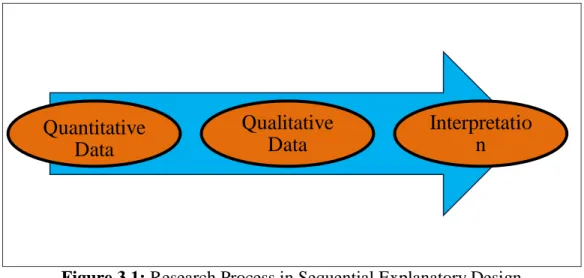
The research method used in this study was a mixed method which combines quantitative and qualitative methods. Furthermore, the type of mixed method design used in this study was sequential explanatory design in which quantitative data will be collected first, and depending on its results, qualitative data are gathered to elucidate, elaborate on, or explain the quantitative findings (McMilan & Schumaher, 2010). The model of sequential explanatory model can be visually seen as follows:
Figure 3.1: Research Process in Sequential Explanatory Design (McMilan & Schumaher, 2010)
Quantitative
Data
Qualitative
Data
Interpretatio
n
29
3.2 Analysis of the Students’ Questionnaire
This part of the research aims at analysing the collected data from the perspectives of First-Year Master students of Islamic Studies. The questionnaire was generally composed of three main parts: background information, importance of using English language to Islamic Studies field and the students‟ target needs which was categorized into three main aspects: students‟ lacks, necessities and wants.
3.2.1 Part One: Background Information
The first part of the students‟ questionnaire was devoted to gather general information about the 21 First-Year Master students who represented the Islamic Studies Department of the faculty of Human Sciences and Islamic Culture of Oran 1 University. It is made up of five items: gender, speciality and the language of instruction used in the department of Islamic Studies.
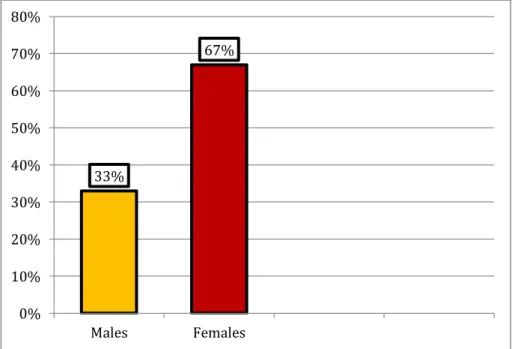
According to gender item, the statistics shows that the majority of the informants were females as they represented 14 participants out of 21 with a percentage of 67%, while the males were 07 representing 33% of the total sample. The following pie chart shows the results.
Figure 3.2: Students’ Gender
As it is mentioned above in Figure 3.2, female respondents are higher in number than the male informants.
33% 67% 0% 10% 20% 30% 40% 50% 60% 70% 80% Males Females
30
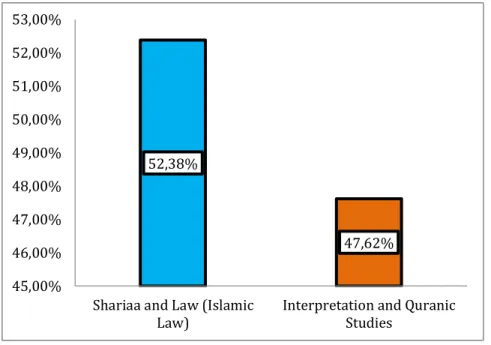
With regard to the respondents „specialisation, they were First-Year Master students belonging to two different Master specialities; there were 11 students from Shariaa and Law (Islamic Law) speciality representing (52.38%) and 10 students from Interpretation and Quranic Studies speciality representing (47.62%). Figure 3.3 below illustrates the distribution of the informants according to their Master speciality.
Figure 3.3: Students‟ Master 1 Speciality
The last item in the general information part of the students‟ questionnaire was about the medium of instruction; all of the respondents replied that Arabic language is the language of instruction used in the department.
3.2.2 Part Two: Importance of Using English Language to Islamic Studies Field
The second part of the questionnaire consisted of question 2 and 3. It was dedicated for the sake of eliciting data on the students‟ attitudes towards teaching English for Islamic Studies. The students‟ answers demonstrated that English is of paramount importance for nearly all the respondents in their studies. The following table indicates the informants‟ responses to question 2:
Question 2: Do you think learning English language is important in your studies?
Number Percentage
Yes 18/21 85.71%
No 03/21 14.29%
Table 3.1: Students‟ Attitudes towards English Language Learning
52,38% 47,62% 45,00% 46,00% 47,00% 48,00% 49,00% 50,00% 51,00% 52,00% 53,00%
Shariaa and Law (Islamic
31
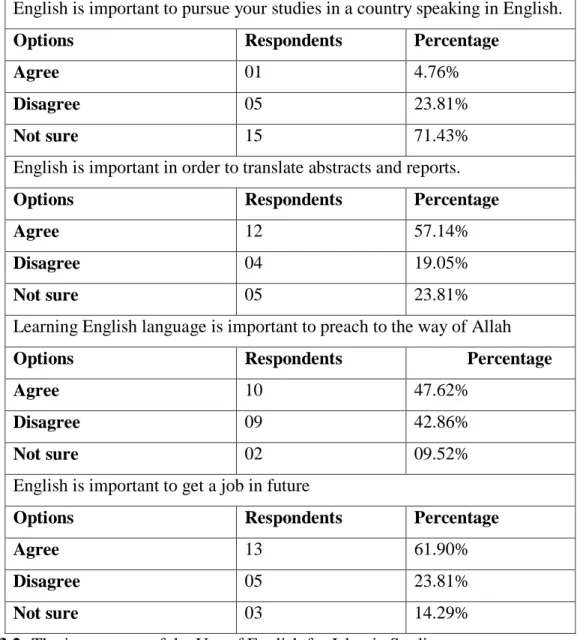
The table above indicates that approximately all the students (18), representing (85.71%) have answered positively while (03) rate of (14.29%) have answered negatively. Consequently, it can be concluded that Islamic Studies‟ students consider English courses more significant in their studies and this is related to different reasons in their opinions. Thus, the next questions sought to know why English language is important for the Islamic Studies students. Respondents‟ answers were rated on a three points Likert Scale: agree, disagree and not sure.
English is important to pursue your studies in a country speaking in English.
Options Respondents Percentage
Agree 01 4.76%
Disagree 05 23.81%
Not sure 15 71.43%
English is important in order to translate abstracts and reports.
Options Respondents Percentage
Agree 12 57.14%
Disagree 04 19.05%
Not sure 05 23.81%
Learning English language is important to preach to the way of Allah
Options Respondents Percentage
Agree 10 47.62%
Disagree 09 42.86%
Not sure 02 09.52%
English is important to get a job in future
Options Respondents Percentage
Agree 13 61.90%
Disagree 05 23.81%
Not sure 03 14.29%
Table 3.2: The importance of the Use of English for Islamic Studies
The above table illustrates the students‟ perceptions regarding the importance of using English to Islamic Studies field. The findings show that a large number of respondents (13 out of 21), a rate of (61.90%) agreed that English language is important to get job in future. With respect to the importance of learning English in translating abstracts and reports, 12
32
informants (a rate of 57.14%) agreed on its crucial importance for them to translate their Master dissertations‟ abstracts. English is important for preaching to the way of Allah also received a high rate (47.62%). The majority of participants gave no attention to the importance of English for pursuing their studies in a country speaking in English; it was rated with (4.76%).
3.2.3 Part Three: Students’ Target Needs
The second part of the students‟ questionnaire aimed at exploring the actual students‟ linguistic needs in English language basing on Hutchinson and Waters‟ approach about Needs Analysis. Hence, the researcher has adopted this approach of needs analysis to identify the needs of First-Year Master students of Islamic Studies taking into account three major aspects of analysis; the first aspect is lacks: what are the difficulties and problems of the target students in learning English? The second one is necessities: what kind of language do the Islamic Studies students really need? The third point is learners‟ wants which refer to the personal aims and wishes that the learner wants to obtain from an ESP course.
A. Students’ Lacks
This sub-part of the questionnaire survey aimed at investigating the learners‟ lacks in English language. The questions used for this aim are: questions 04, 05, 06 and 07.
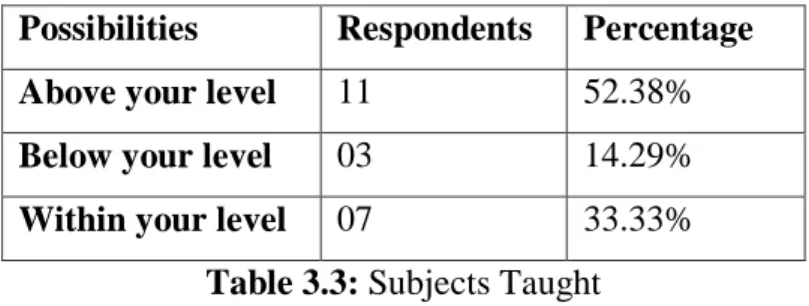
Question 04 of the questionnaire required the participants to indicate to what extent do the subjects taught are adequate to their levels. To answer, informants had to cross one of the three suggested possibilities: within your level, below your level and above your level. The table below summarises the target students‟ responses.
Possibilities Respondents Percentage
Above your level 11 52.38%
Below your level 03 14.29%
Within your level 07 33.33%
Table 3.3: Subjects Taught
As the Table 3.4 displayed, the findings clearly revealed that 07 respondents, a rate of (33.33%) replied that the English courses are within their level while, only a few of them 14.29% answered that the subjects taught are below their level. However, a considerable number of Islamic studies‟ informants (11 out of 21) answered that the English course are within their level.
33
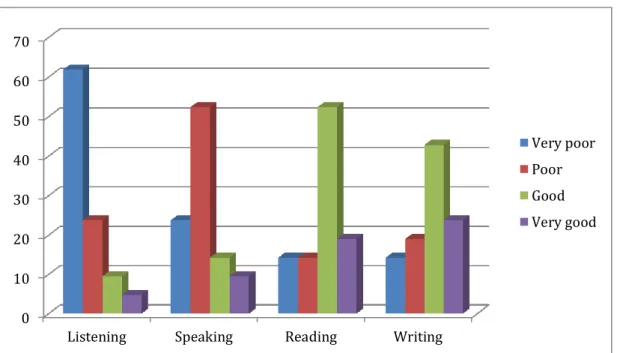
With respect to question 05, students were asked to evaluate their English proficiency in the four skills in terms of priority. In order to answer this question, students were given four suggested possibilities: very poor, poor, good and very good. The following table and figure displayed the data obtained from the learners.
Question 05: How would you rate your English proficiency in the following skills?
Possibilities Very poor Poor Good Very good
English Skills F P F P F P F P
Listening 13 61.90% 05 23.81% 02 9.52% 01 4.76% Speaking 05 23.81% 11 52.38% 03 14.29% 02 9.52% Reading 03 14.29% 03 14.29% 11 52.38% 04 19.05% Writing 03 14.29% 04 19.05% 09 42.86% 05 23.81%
Note: F= Frequency P= Percentage
Table 3.4: Findings of Students‟ Classification of English Language Skills
Figure 3.4: Learners‟ Perception about Language skills According to their Priority The data presented in both the table and figure shows that Islamic Studies students‟ weakness was highly in listening and speaking skills. First, in listening skill, 13 respondents (a rate of 61.90%) expressed their very poor level. Second, after listening, speaking was the second skill of the students‟ weakness. There were 11 out of 21 students, a proportion of 52.38%, consider their level to be poor in speaking. Generally, this deficiency in the interactive English language skills refers to the lack of EAP courses efficacy. For reading
0 10 20 30 40 50 60 70
Listening Speaking Reading Writing
Very poor Poor Good Very good
34
skill, the results show that 52.38% of students are good. Concerning writing skill, 09 out of 21 students representing 42.86%, expressed that they have a good level in writing.
Furthermore, concerning the identification of the learners‟ lacks, question 6 of the questionnaire asked the participants to pinpoint their difficulties and constraints in learning English aiming at finding useful solutions and appropriate strategies to their language problems. The table below illustrates the responses of the informants.
Question 6: Do you encounter a difficulty in: Yes No (a) Translating of Islamic related materials from
Arabic to English?
17/21 04/21
(b) Answering simple questions? 12/21 09/21 (c) Pronouncing Islamic Studies English
terminology correctly?
14/21 07/21
(d) Writing correct meaningful sentences? 06/21 15/21 (e) Holding a conversation in English? 18/21 03/21
Table3.5: Students‟ Perceptions about Language Difficulties
On the basis of the data presented in Table 3.5, the statistics show that the highest items‟ score where the respondents encountered problems were in both: translating and holding conversation in English (speaking and listening) with approximately an equal rate (nearly 83%). Followed by 14 out of 21 students who found a difficulty to pronounce English terminology related to Islamic Studies field. In addition, 14 out of 21 students, a rate of 57.14%, encounter a difficulty while answering simple questions. However, a few respondents (6/21) have a problem in writing correct sentences.
B. Students’ Necessities
The second sub-section of the students‟ linguistic needs was the learners‟ necessities. It sought to elicit the necessities of the Islamic Studies‟ students in terms of language skills. In other words, what do they need to do with language? Overall, this part was made up of three questions: questions N° 7, 8 and 9.
Firstly, question 7, the participants were asked to indicate how often they needed learning the English language skills. Figure 3.5 below illustrates the students‟ opinions about the frequency of the need for language skills.