JUN -1 21It
DYNAMI STABILImY OF HYDRAULIC POPPET VALVES
by
Jens E. Jorgensen
S.B. Massachusetts Institute
of Technology 1959
SUBMITTED IN PARTIAL FULFILLMENT OF THE REQUIREMENTS FOR THE DEGREE OF MASTER OF SCIENCE
AT THE
MASSACHUSETTS INSTITUTE OF TECHNOLOGY May, 1963
Signature of Author:.
..
_.;
...
. ,; ...
..
.
*
Dep tmenchlnical Enginee ring,
May, 193
CertifPied by: ... ... . ..
/
, .*
.. . . .....
*
/' Thesis Supervisor
Chairman, Department Committee on
ii
DYNAMIC STABILITY OF HYDRAULIC POPPET VALVES
by
Jens E. Jorgensen
Submitted to the Department of Mechanical
Engineering on May 17, 1963, in partial fulfillment of the requirements for the degree of Master of Science.
ABSTRACT
Stability criterion for a hydraulic poppet valve
have been analysed and experimentally verified.
The analysis were based on the linearized equations. and on this basis a stability criterion for stable
operation of a hydraulic poppet valve as a function of valve position and upstream geometry was formulated.
The validity of the equations developed were checked
agoainst an experimental
model
in the laboratory.
Thesis Supervisor:
Shihn-Ying Lee
i-i
ACKNOWLEDGMENTS
The author wishes to express his sincerest appreciation and irndebtness to the following individuals for their
con-tribution towards successful ompletion of this roJect: Professor S.Y. Lee, thesis advisor, for introducing me to the problem and for his helpful guidance and
con-struc
t
ive evaluations.Mr. Kermit Harner for his sincere interest in the problem and constructive suggestions.
Mr. Karl Reid and all other members of the Engineering Projects Laboratory for valuable aid given whenever needed. This thesis was supported in part by a Grant in Aid of the Hamilton Standard Division, United Aircraft Corporation and sponsored by the Engineering Projects Laboratory at Massachusetts Institute of Technology.
.1iv-L-r T i rL TTRAp\ TO NT
S
i-
t a i.
oe
ia
e
-
Sytem de cra ? tion
: yt
;ont ro vo
y
lume
.
i
h eorti l1 stti- f'or-e and '?ressurevs. v::tv
yc e m7
mW
o iOs
. s,:o01
lr
....
.. . .
ion.
.a
.
.
C6....-4
Gener:,lized
sysr em response ....
12a
&i
Ystern mode
ln9me
...
Dimensionie time o nstant ·KJ
_o
peJ
v-ie
oe
...
n
inge
1
b
Z*lq92-7
Dimensionless l:
oTopet
v- e oen:ng ....
ime
econstant
...
vs.
..
.ooet v':, owen g ... o...
2-3
r
T
1nead
ameonstant vs. pressure...
b
.-
... 9Combined
effect models...
...
23a?
r9!vs.
ind
TR ...
- 1i 7 h Downstream :omressibi yt ...
:
... .. 3
2-12
com
ressibit
s
s
,lde
r
v
ve p osit in.
30b
3
'-Stati
s
poe oe
of resurevnd
foce
vis.ace
_-2
t it, ic
v
force
pressure vs. oopet
'nd:osition ...
...
32b
P ase
ag
of presure
and orce
s.
v.ive freqency
...
nd
.
.
4
T=asa
e Ug
ofD
of !essure
an
d
*forcevs.
fr~equemc,
Lo
nc
d
.,3n-
7
Expe
im
entail
time
Ig vs.
o opet
oasitnL
t
33c
t ..? f 1 ut t:r tis i t d .
F'
.
u re:3-
.. se
-ead
6 of measure and fore
s.
V
I.f
e.uency
4.nd
P
... * .-35
31-
L ne I - d e , me n onstint v s o etvlve
position, (ex · eriten ) 35b3-q Lead
ffecs
(summay) ... 35c3-10 Oytem stability vs. ressu -rIe and
dis-3-i_ S.ystem stabiity vs. voiume and ositon.. 1L 37b
37b
j-o
System
stability
vs.
valve osit
on
. .37c
k- S hemati2 of rpar:
tus
.39s
B-I Dynamics of 'ine... 48
B- OComuter ogrm schemtic ... 7
D-! OrLfice flow coef:ficient Cu vs. Reynolds
i .0 65a
D-2 Nozzle ( o.a90° ) flow coefficient n vs.
Reynolds no. .... ... b
D-3 Nozzle ( c -00)flow coefficient Cn vs.
Reynolds no... . ... o
NQOMENCLATURE
f
-ymnboI
Descr is..ti
ion
and Unit
A
ar'ea *:re: of the Line L ( n')
C7 2oe ff ient of damning (L bs-sec /in)
j
di,;meter of line L and nozzle di meter (in)
F poppret forcee (lbs)
f
valve frequency (s)
G
valve ressure gain (ibs/in
3)
K
spring rate of external sring (bs/in)
K,
oppet flow ensitivity
with disl
a
cemrent (in
2/se c
KQ popoet flow sensitivity wiSh pressure (in/l.bs-se
)
K
3upstream orifice f ow sensitivity
with pressure (n/lbs-sec
K
4poppet downstream flow sensitivity
with pressure
(in'/lbs-sec)
K
5downstream orifice
flow senS tivity
with
resure
(
n//l
bs- sec)
L
length of line
in)
M mass of poppet (ibs-sec 2/in)
P fluid pressure, aiso ressure immediately pstre-m of the -poppet valve
C :Flow rate through the poppet (ln3/sec)
T time for wave to travel the length of line L (see)
9o
system upstream volume (involume (in3)
;V fluid velocity (in/sec)
X valve disrlacement (n)
,-
Nomenc I -t-ure continut -d.ae
Symbol De s ri:g-t ion nrd UTni t
pO( pet cone ha
lf ina
e (der .)P
c-h.se a, betewee
er
teLe
ertnd
for
e
(der.
)
(0
,P
fluid
densit
(s-sec/n
)
/3
ffl-uid
elasticity
(psi)
kinenmatic viscosity (inS/se)
VD
R _
Reynolis
no ()
3>
_
nondimensional valve dislp
.cementA Av
nondimensional valve displ-.cement
Aut
valve time constint (see)60 v:ilve frequency (rad/sec)
incremental chinge of v-,riibie
D . differential operator
dt
SubscripDts:
o mean or time -Lverage condition of a vriable
s
supply condition
v
vive
- ref.
to poppet
vve
u
ustreamm ond
t
ion
R
-return condition
I
and
2 refers to sections I nd 2 (adjacent)i
TABLE OF " ONTENTS
I.-,'0
INTRODUCTLN...
....
.
.*
*...*
A DescriotiGEMonS . ... i i NO~ENfr R vB
Bckground
...
...
1 ."20Con lusion
i
I.0 Recommendations ... 4TAnRT II ANALY ITSS
2.00 introduction...
-.
0 Model and 'ystem descriotion ...2.20 Static charcteristics nd s tbiity ...
'2.30
Dynamic
stabilty.
.
..
0.!0
?.31 Forces on the onoet ... 10
2.32 General stability considertions .... 12 ?.40 Compressibiiity model ... . 16
41 Dynamic quation ...
1 Stib - t y .*19
2
.5'*0
Inertia
model...-
...
..
i51 D rnam~c c--u .o...20.. tion ....T
I' "on:-nt
s
orin-
nued.
2
mb
ned
efes. ...
....
;,.s
D
iDynami
- e q u, at
t
i
t
i.i.
.
.t.
RTTTT Exe r ment Re .ulS
-nO n~ 0 B , g .
round
*
*
. ..*
*.
. 3...w > )tir @ t.j bt. . .· ,::,
D
:y
r .0 Dyna-ii'
C, cbha.
IrP~
f
'56
'
- ,i
t'C
.3.2!
-ssbity ...
3 - ^,>R e uit s ... , os IA R -.,L l i L - Discussion . ...qi o,:: ine rt:. ia m ef fec s
.30 'tabiility .
3.31
Simrli
fid
model- ..
B- Inertia ... ...
ti
...p.
3?
Combi'ned
=fgc.
s..
.3
-3
Downsitream
e
fec
s-,
A PPENDIX A.JOJO~OO~l~O~Oo~OOO~O·oOOOOOJ600dOO~JOO0
xevri
ment
..
i acoa
' ?. .us . nd
cro
c
edur
e.
T-.. t us
..
... ,.. 2 3 e90 ).
'2 - J , * 34 ,a . n, 34 36"~_.: k Df'' · s····*·,··*···* re·*r···re·a···b · · · · ·,r·d···,·*, ·*8*··*·86· · · · · ,····r··· · *····r··+··O··r, .··,r···r,··· · · · ,,·e·,···r *···,··· · · · · · · ·CI·rJ···rc · · r · , · + · · · · * · , · o , · · ····r·*··*r · · *····r*r·rr·,··· · · · ····*··,·r··· ,s*r·rr·*r··r··r·r* · b*·*···*··*·· · · · ,··a,,·+r+·r·· e*r···rl·r···· · · · *,··***··· · +···*··· 39 o li-I-.- Ie
. io
'L,
,-Vi-
0r
J. A L, " -cr-
-
.,
-i &-) so
rt
.1I ue
J
.
~/~.oL l ~ b 3 ·· .. e · · ·. · ·. · o , . · e ·o ® ® i ® ·* · · ® 4, * ·t
?o e du r, or ob inn and F v. r
Pr c- e u re f, or ,
h
k
ng c: b1i
A tyAPEND.X B
'
~lrrneaia
.
tion tecniq~
.
...
~° ·B- Dynan
s
of
.iin
&..
..._- ,: 2~t.bi
t
y
rnd
Routh
i :!
L...
P-4 Non
i nea
r.,3or umer
ogrlr
r...
.
.
r.
A?\ NDIX 2
Extension of Analiyis
.:
. .1
Inertia model with
astream
res triction.
·.-2_t Comined
e.feet-
s
models
...
...
PAfPENDIX
D: Flow coeffic ients
--
nd constants
...
-:
PTPENDI:X Re e
.. .,~R
?
~ ~-e 'ences
.. ...
· ~ 1 · · · · ~ e · ® l l·44 47 V~i- I- % 56 ,81-b . 64
L -.1
Part I Introductiorn, Conclusions and Recommendations 1 .10 Introduction
A) Desc riton
A opet valve s a seating type valve where the
valve member, poppet, has a relative motion erDendicular
to its seat. A schematic of a poppet valve is hown in
Figure i-I.
The design principle is simple in that
the fluid forces on the poppet are balanced by an
externally applied orce, usually a spring force, and
fluid
s allowed to
escaoe.
This type of device has extended use in high
er-formance hydraulic systems as regulators,
relief valves or
hydraulic ampli
i.f'iers.
Major
advantages
with the poppet
type
valve
is
iitsease
of manufacture, low .eakage and insensitivity to dirt.The major problems arise in dynamic stability. The valve
member itself is basically a mass spring system with little or no external damping and therefore oscillatory. Any
additional flui.d forces in hase with the valve velocity
will lead
to
rapid unstable
oscillations.
Cscillations o th s ype not only degrades the vaive performance, but when sustained will1 destroy the valve.
The purpose of this investigation s to determine
the cause of hi Instability and sow lits of stable
Q QL I I I I I
Poppet
valve.
J
I I I I I I I IF
Q,-
Supply flow
Qz-
Load flow
Q
- Relief or poppet flow
FP- System
POPPET
pressure
VALVE.
FIGURE 1-1
0._0 Qo
I ;f I I I I I I I I I II I I I I _ _ _.Ba .. g-...ound
Previous Lnve
stg' tion on stabil ty of ydra ul
valves h- s been done
n sl.ding
spston
: nd
ype vai ve.
Lee nd 3lackburn
(Reference
)nave shown that
transient
valve
forces
my cause nstabilitty.
Static
ot.abilLty
of poppet valves was
investigated
by Stone
(Ref.#2)
and
dynamic studies
on
neum ic
fla-rpertype
valves have been c:rried out. (Ref.,3,4 nd 5) In-vestigations by Ainsworth (Ref.#t6) pointed out that the fluid delivery line interacts with a valve to cause in-stability, n investigation extended to the pop)et valveby unk (Ref..#7).
The result here is that the critical frequency n
he system iS the fi st; hnrmonic of the delivery line
higher th,'n the natural frequency of the valve.
in interestlng
derivation by Frendenreich (Ref./#8)
shows that a spring loaded relief valve regul ating aconsta nt flow is stabiliz zed by the transient orces
created due to the change in volume by the poppet motion,
but will become nstabLe due to elaisticity of the'oil. In this invest-i ation the stabil ty of the vlve
itself will studied, rather than srtability due to inter-:.ction with other elements of . system as this is one steo ixE.
furtlse :r removed.
Assumptions will been
made
as to
the
articular
e:onfigu rat" on to be studied,
and an ana
1
-is
will
be
made
lnd
catin
he sstem chracterrisstics and stability
epending on the pnhysi
ai
characteristics.
The model to be studied will include the effects
of
fluid
nertia
and compressibii.itT
nd compared with
exper imental resuits.
The analysis is
resented in Part II and the
experimental results in Part III of this thesis.
1 .20 Conclusion
This invest^gation has lead to better understanding of the basic problem of poppet valve stabiilty.
The major fluid
orces acting on the poppet valve
are due to the fluid pressure. These pressure forces
have components n the drection
of the velocity and
may stabilize
or unstabilize
the valve.
It has been
shown
that the fluid eiastcity contributes an unstabilizing
force in the direction of the valve velocity and acts as
a negative damping, where as the inertia forces associated
with fluid acceleration have stabilizing
components opposing
the
valve velocity and hence acts as ositve
damping.
The effect of fluid e lasticity was by ar the largest
-,-
-4-f
actor
Ln theh cause of Lnstability.The stabilizing
component due to inertia
Ls also
decre.sed due to frictional
losses in the fluid flow.
The
system
nalysis
was made by linearizin
the
nonlinear differential
uations
predictions
:nd
were
m,-de with r-espect to system performance.
A limit for stable valve operation was derived and the experimental results verified the validity of the euat ions.
This study was only concerned with the condition upstream of the valve, but extension of the analysis to include the downstream effects are possible.
.30 Re commendat ions
Based on this investigation the following
recom-mendations are made. They are categorized in the two
groups, Experimental and Design Analysis.
A. Experimental
Further data could be needed to extend the theory
to some of the models not considered here.
A more important study cn be made on the stability due to the downstream fluid momentum effects. Studies re;ted o the ressure distribution and flow p-attern -round ;the ocpet when confined in a narrow downstream
chamber will be imortant, and qualitative information is lacking
B. Design nalysis
The nonllnear
equations
that describe this system
can easily be studied on a analog computer. A sudy
on he nonlinear characteristics could give more accurate information on valve stability, esnecially in the region of small valve openings or large disturbances.
A computer aided design would also reveal information not now available to the designer in the form of graphs and diagrams relating system stability and valve
per-formance as function of the physical parameters.
Part II. Analysis
2.00 introduction
The main task of this analysis is to conceive a
meaningful mathematical model and define the p-oblem. By
breaking the system down into basic components and
investigat-ing each, it is hoped to gain insight to the nature of the
stability.
The basic components are then combined and the overall system stability studied.
2.10 Model and System Description
A- general schematic of the system is shown on FFigure
2-a
.It s
comrised
of a
constant
ustream pressure
Ps, an u st,rea restr iton Au, a de ivery Iine L, and
the system vol ume
o
terminated by the poppet valve.
The
poppet va ve
s
desc
.ibed
by the motion x and ts
correspond-ing valve area 'v.
The
downstream
conditions are assumed
constant and n the analyss PR is ~rbitrarily set to zero.
The fluid s characterized by its density and elasticity
(3
(psi). A system of this nature can be looked uponas distributed or lumped parameter system.
The analysis ere will based on tlhe lumed arameter
model a this will yield the most information.
The borderline between the two cases is aoroached
when wave transmission due to valve motion becomes
important. The time T for a wave to travel the distan ce L is given by
T L;
(1)
and the particular
tme constant for the systemrr
may be
given as t. Our criteria then becomes
7
<
t
(2)
and for a line -it will be shown later that t so that we have
(3)
F?
-weere A iS th- L.izne ree .mean
flow.
1 Weassume ere that
Q.suat
on
(3) is va
il d.
From earlier
experi me nt.- (Re f.9) it
DwJas
estbl ised th1at the majorf luid f'orac
on
the oppet were contributed
by the
pres-sure forces.
The first t sk
Lhen
becomes to caicuiate
these presure forces,
and
to make the ainalysis easier
two basic models are first considered, nd shown on
Figure 2-1 b and c. Compressible Model
Inerti al effects a re assumed negligible and the
system
is
described
by
tneorifice
Au,
the poppet valve Av
s
system volume 2to and the fluid ropperties /
f
andndInertia
Model
The volume
%o
is assumed small and the fluid is incom-ressible. System is described by the line L,orifice, valve
nd the luid
density p
The total system is then described by these combinations in a combined model later, which will be the representation of the system as shown on Figure 2-1.
Before the actual nalysis on -he secific models are c-irried out, generai description of the forces nd
i, L
I-'
General
P
sSystem
Schematic.
(B)
Compressibility
Model
Inertia Model
SYSTEM
DESCRIPTION
Fig. 2-1
- .-(A)
(C)
------2.20 Static
C
,,.c ers
a
tieCs
and Stbility
Evaiuation of the tatic
force
is
done by a)pplyng
the
momenturnm
equation to the control
voume shown on
Figre ,-fo(- F (ZVZsJ eZrJ -- (4)
Relating the velocitles to the
.;agnation pressure and
use ontinuity equation for the control] volume gives:
6= ---
(6)
where the dimensionless valve displacement is defined only between
o S / -
(7)
Two variations of equation (¶) exist,: ifP he system employs an upstream.: rflce or not.
Without an upstream orfice, Po = P and for a flat faced oDDoet CaO)
F-
p
. (/-b'9
(s)
The satic
force is seen o ncrease with displacement, so
the oppet must be restrained by
an
external spring of rate
K.
I I ' sI- -r -
-c- I0(_
L - _l
_
h x sin
*.rSYSTEM CONTROL VOLUME
FIGURE - 2-2
Pv0 0V
2P
V
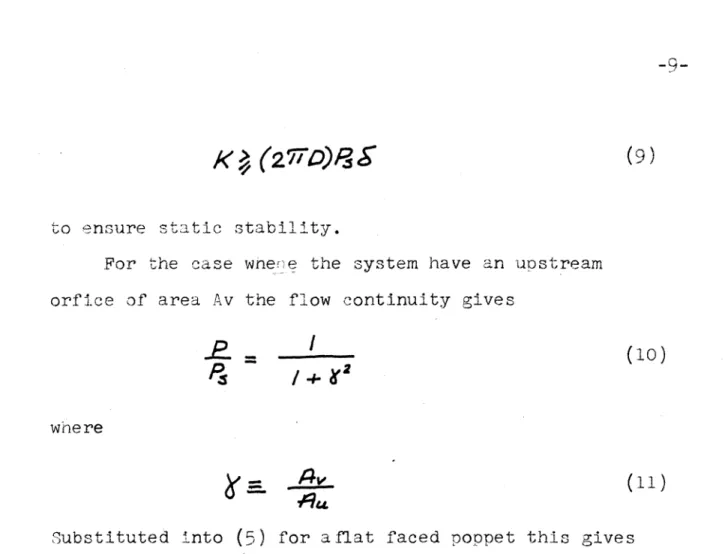
T5
I I ,4 xp I 0 IK (2a7')8
(9)
to nsure st<atic
stabil
ty.
For
he case wne!--;
the
system have an upstream
orf ice of area Av the
flow
continuity gives
Fa _ .P__= L I 1 (10)(Io)
where
Substituted
into
(5) for aflat faced poppet this gives
F
IFwhere
the
ssumpon
is made
t
hat
and
where he assumption is made -that
Cd yS and
23
Fo = Ps.,A This result is plotted on Fignare 2-2.
and since the force now decreases with displacement the
system is statically stable and with a hydraulic spring
rate
Ks=
-'2E7OD)p5
.-+
(13)
Figure 2-3 :iso shows he response to a slow sinusoidal
vari.tion
inthe
v
ve
displacement.
FIGURE
)cJ
c
Csj>0
0 >00)
V%--Q
vftft; LC)c)
Z)
2-3
OaJQ. ...
-l-The response s seen to deuend not only on the operating displacement x but also on the amplitude of the valve. Large amplitude represented by curve
(I) is seen to ve noninear output where as curve
(2) gives a linear operation. Operation at small valve
neutral position wil
also
give nonlinear operation
regardless of amplitude.
This analysis is most concerned with the linear operation because by linearizing the differential
equations analytic solutions may be obtained, where as graphical or comuter techniques must be employed in
the nonlinear case.
2.30 Dynamic Stability
In this section
a general
presentation
of system
stability
will be given.
The system is assumed statically
stable and the major consideration is given to linear
operat ion.
2.31 Forces on the Popepet
The momentum equation used on the control volume in
Figure 2-2 for the dynamic case yields:
-11-Eiuation (14) as wrirtten assumes that Pr is constant
everherp hre downstream and fluid is carried across the
boundary only by the fluid jet. This leaves out the
complexity of the downstream
"low
pattern
were turbulence
and
vorticitj
in general
complicates
t
e
.icture.
Considering a flat poppet only and assuming that VlcA V2
the momentum equation leaves only pressure force and external force to balance the momentum change within
the control volume. The poppet momentum is easily
evaluated, but the momentum of the oil is more complicated.
The assumption is made that this is small as previous experiments indicates this. (See Ref.
1/9
for detailed analysis). The momentum equation then reduces to thesimple form if P2 is constant and arbitrarily setto
zero, and pressure immediately upstream of the valve is P
PA
-
F
MX
(1)
M is the Doppet mass and F the external force.
This then shows that the major fluid force is the
pressure force actinrg on the poppet. The pressure P
can be derived analytically or determined experimentally as functions of system parameters. Both methods are employed
- i
2-_
e:ne
ra1.-
4 yon
dsidration
Ti e orc on te pop3 t Ls described by equation
(15)
whirh w2rliten
for
n systemshown
onFigure
... i,yiedas
P
F-
KX--
(15
)
In
I" nearized form where the motion x is
iven abott
some oint xo we havex x0 o AX
F
=
F+
AF
P
S
Po
+ AP
where it is specified
that
Fo
=
7 o
.
'his
T ives
(z:). -
X-,
-
-
M,- C'
- o
(17)
This equation is shown n the vector diagram on Figure 2-4
for a free vibration (F 0).
Let us look at the physics of the system first.
With the fluid incompressible and inertia effects neglected
the
fluid pressure behind the
-poppet
P is
given
by the
instantaneous
position of tihe
oppet.
For
the free vibration
this is shown on Figure
2-4 where
x vlbra.tes
about
x
and
the
or,'-ire
var.es
about the mern -res.ure
po,
given by
curve
a,
but opposite of the motlon x, so it acts as
-spring force.
'The net work done by the fluid pressure on
0
Q
r
Nuo\\\
A
(0-)=
-G(jeo)
IC
X sinwt
(AP)A-KX- CX-
MX=O
X= X; AXsinot
P= @
- APsinot
lertia)
)
)mpressibility)
GENERALIZED SYSTEM RESPONSE
FIGURE. 2-4
.AX
AP
I..,. I--~~~~-U. 9 lI"U-a" -I I I ,0~B to D the me-n oressure in
and .for the outward motion
D
- F the mean pressure s again po. The oppet neithergains nor loses
nergy
from
this component of pressure.
Clons-ider
first the effect of inerSia, and use the
suoer
ooswit;on
rinciple, as the inertia
effect will
modi
y
the existin
:
Dressure.
As the valve moves outwards, the flow ncreases
and the resulting fluid acceleration further decreases the
pressure.
On the nward motion the flow decreases and
the retardation of the flow increases the pressure further.
This gives rise to the additional pressure
P
1shown in
(on Figure 2-4) which has its minimum at position A and maximum at c. The total ressure is now given by op p1
(shown vectoriaily as (P A) on Figure 2- ) but as p does not clontribute any net energy to the system, we need
only consider p.' When the oppet moves from B - D
the mean ressure is greater than for the outward motion
from B - so that the net work done by the poppet is
negative. The pressure p depends on the velocity and opposes it, so it acts as a postive damping in that the
fluid gains energy from the motion, nd stabilizes
i
. The component in the direction of the velocity of (P A)'on Fi ure
?-4
s then p.again, this
added
storage
a
pacity modifies the original
press-ure shown in a .
s te
;copet moves outward trom
- .... the flow
exce
ed s h
mn
mnd
te
?seasure
s.tea
di
ly
droos w
eon the inward motion the flow is
less then the mean and the oressure rises.
The additional
pressure due to the compressibility
has a minimum at c
and maximum
:zt
A and
2,
so the total
pressure i
s now
+ P
(This
2s
shown veotoT-.lly
as (
) on Figure
?-4)
Again
we consider
the work done by pp only.
As the
poppet
moves
from B - D now it sees a mean pressure
less
Po and for the outward motion is !rger
than po so the net
work done by the fluid on the
-s
ositive.
Again the
pressure p depends on and is in the direction of the
velocity.
This is an unstable vi-bration, as once started
the fluid pumps energy into the 'system and the vibration
increase s.
If the effects of compressibility and inertia are
combined it depends on the vectorial. sum of the three
pressure forces if the resultant is to have a component
in pase or out of phase with the velocity.
Mathematically this will be exorressed by equation (17)
combined with the equation for P
f(x) that wi11 be
deveiooed later.
Assume this function is of the form
of a genera] diferen;al
equation
a()
-6(D)
(
-Combi.rned bwith equation (17) this ives
A
tF )=
/
(19)
\ <
H *CD * K -#-
46D0)
which when examined
for
stability
gives the frequency equation
/M
D
+
CD
+
K.,
,
6
(D)
~
x
9
0
(20)
where jA will be substituted for D.
Assume further that the general solution for G(D) i
of the form:
4(D)
DDzco
t
Ro
D+(21)
,
Substituted into 2D it gives a general fourth order
vibration equation.
/,"/I
.
D*'-,
(1
cR.
:C
)
+
+
(
c
K.
,
qz
,
(
,s,)
4c'C
6A3,)
#
(C
4-
)jkRo
(22)The stability of thiis equation is given by the Routh criteria (See Appendix B-3) and will be discussed in detail, as the various forms of G(D) are developed.
2.40
Compressib
I ity.41
Dynami
Euation
n Sthis se ion the analysis wll be made of the
adooted model b"y considering the e lastic propertes of
'he ui.d.
The
system under consideration s shown inFigure (2-'a)
The system consists of an upstream orifice (Au),
the volume VO, and poupe, valve (AV) and assumes Cs and
PR constant, density
e
and comprssibility
(3.
System eqn's:
9(as
Q ) % (%o)()3)
Qs=
RAL
L/
(24)
02
P;
(2)
-P
(26)
As is evident, these equations are nonlinear by the
nature of the flow, so we are going to cons-ider their linearized
.orm.
of he -pope, wi tlh .orresondinr' flows and pressures
~
v~e =np
~ ~,
~ ~: etc,
The bove operations
then
akes the form (Ref. Appendix B-L)
Os-Q=
'DP
(27)
Q's
= -
3P
(29)
where the variables
now denote changes f rom the mean,
and D is the linear differential
oerator
d/dt and Ko
and K are the flow sensitivity
coeffic ients wth respect
to ressure and K
ithe flow sensitivity
with resoect to
valve oosit on.
These equations
solved for p
vs.
x
give
o
2
3(,+,)
Jv i]
+
(30)
__ __
I3
_(
w he re
(33)
Z/3(K
3÷
K)
Equation (3i) describes the desired pressure variation
wit:h poppet posi tion, nd as expected
it
is a simple I.-gwith a
time constant
0 promortional tothe
voume andinversely pro-oortional
to
the
fluli
elasticity.
By
introducing the vaLues for Ki, K2
,
nd K
3as functions of
geometry (Ref. Appendix -1), we can further
educe equations
(32) and (33) to:
,a=~~i~l
2 770
(34)
Xs-I1 g7
(3
)Introduc
in
a system comrl iance z
given
by
YZc= Z
gP
(35)
and the 'break frequency
r,
I
iven by
te
rela
tions
,.
= I nd
=
z.''
so
r
Z.
31a
and
the function
i
piotted
on
Figur>e
'-t;*The minimum ooint for
i
given by
1s
which ive
mn,,
= 2.60
.t
(
38 )
' -.707.
The
poinh;
r
.7,7 t;en .re-resents the largest value oft
cand the minimum brea-kf'reuency.
2.4 2
t.-
i
1y
vWith
the
system transter
function as given by (31.)
w
e have
'or
the r-,equency ecuat ion (22 )
Ht-
.cD+
)D
+('C+C)D
,+
+
C6,X
(39)
F-'L;st ssume
e
()
0, andfrom
Arpp;endix B, equal,;on .B-30'
:a ,
6, >o
-(A) COMPRESSIBI
LITY
P F:L/x
FO
QR
(B) INERTIA
MODEL
SYSTEM MODELS
FIGURE 2-5
L_P
S i JpL-
-r L FAu
MODEL
rQC
rP
FDimensionless lag tnimecons
tan
ys
p.ppet valve openng
0
1.0
2.0
3.0
FIGURE
2-6
10
9
8
7
6
5
4
3
2
1
0
: n.
tr
K/
I
J
Mr
(K+
6r)
-6, <
o
But
the
i:: ;t;a
,:ttenentcontr
adie ts the
'.·.nequai
ity.l
iy ive by
euati(on
(4) , sowe
;one lude t":t '<
syster
!^
u~nsacbl.
T
^s
al
so agrees
with
the physic.
ieasoning
beca
se
t
-' Lge
-ntro
duCd
-ve.s
for e comprie ne
in thei
directior. of' velo i
t,
Mecessary dampring fCor system stability
_sr
by
genera system is shown in
Pr and a ine of area ienth nd erminated by
.D-~ramic a1 Equation
he fl1ud .i hce cons. dered _ncom-pes1ress *ble and
,qLith
denitg
p .
The
generaL system
1sshown in
F;Sffre 2--,-
-
;nd oonss
sf .J constant ressure s
uppl
, and
a
line of" length L and -ea
A erminated by
tre
us
o
-o
et
valve.
Again we consider the
lniearizeu
.fo orm :
System
eqla-
aions:
Li,
-,ne:
*C
P=
/-D- ,Q
;
Lo
c
(42
)
i" A d .'S "I?, 'e
-TValve:
Q S
=
~ X
-P iz
(4'7)
CSombinre
:nd soie
or p
A(pX)
oo
4)
whi.h
can bereduced.
to the ToLrmA
(9
A
-
G
L(15)
where the guantities are defined by equatiorn (44).
Substitution
or K
1
Ko
gives:
L/
ir
L
a
(
y47
and
=/+ z
(48)
These equatons
.
plotted on Figure 2-7 and 2-8 in
're
a
nondimensional
foirnm.
The eid f Cuency
c.
-s p-roorional to tole
;ine
vaive
ooenring
The vaive gain is given
by
Z
'
rso
(49)
For a ystem with anL upstream orifice included, the ca cuiations are the same arid shown in Appendix C-l.
The vaTa1ues for the time constant are changed by the
-tatio of the ucstrem to downstream area.
2 .72 Sta'bi
iy
With
G(D) given by equation (45) we have forthe frequency equation (22) with am 0,, .e., no
exernal damping.
[
M
DD'
'- (r.-' :
,)
+)
--
x60
O
Stability
is again given by
.-36 and 37 and
gives
and
Z
Ke
-o6
.
462
ZK)
2=
Z
/:)
which gives
(52)
Dim esionless
lead
timeconstant
2n
vs.
poppet
valve opening
1
.20
.80
.2.20
.40
.60
.80
1.00
&FIGURE 2-7
18
4
10
6
6
4
0
- --
L-l_--anu-hnT-·
-,_
.. vI C II I 11 11
'L v1;)
(O
FIGURE 2-8
WV)Z)
Z)
rv) L)QL
() ci,Q
V) V) LI)Q
(i
C) 040
0)
F
tN
C
C\;
C
C
C
C
C i, )i I 0 1 11 IFrom equattion ( we see that this system is always stable
as te above inequalitty always holds. This shows that
the
inerta
force
tabl izes
the
.alve,
which
verifes
The . descr ption given earlier and the commonentishlc
of force due ;o his lead ooooses the valve velocLty and
acts
.
s
ositive damning.
2.60
Combined
Effects
The orevious two sections showed the effect of' Vluid elasticity .4and inertia considered separately. These effects can be checked experimentally in a
laboratoratory experiment, but in a real model they
occur in combinaton.
In this section the model shown on Figure 2-la
(section 2.1) will be treated in a more general sense.
We are still
concerned with the lumped Darameter model"
only, and frictionless
flow.
Combning the effects of fluid inertia and elasticity
?-ve
rise
to three basic configurations
shown in F
gure
2-9*
Model a is the straight
forward inertia
and
com-pressibility
sfeot
ombined
with the pooppet valve.
Models b and
aIe two varia-tions
of
a
with the
introduction
*i n !A tm- ,
_
,
ro
nce 1L Theoes-wo
models
lcor
a
'l 1kleCombined
3
effects models
13 _- LaX
L
cOx
C
FIGURE 2-9
-~~~~~~~~~-_R
-24
pressur o dis
slacement
differ°e The analysis for these two cases are shown in the ATppendix (C-2).Attention will now be ocussed on node a.
2.6
5
Dynamic Equat
ion
The inertia
ompressiblity model nder considera tion
is model a of Fi-ure 2-9.
The system consists
o a
conotant ressure source po, with a delivery
lineo
length L and
crossection
A onnected to the volume
and the poppet valve.
The downstream condition
are steady, pR assumed constant and arbitrarily
set
to zero. The luid has density
p
and elasticity
/
(psi).
In this lumped parameter model all the volume is
lumped into
'
oand the line L considered incompressible.
From the previous analysis we exnect the system
stability
to depend on the relative
magnitude of the
lead (EL) and lag (')
time constants from the line
and volume models respecti vely.
System Equations:
Line:
p_-[+D*
A
0
(5:)
Volume:
Q,,- =hg
-DP
(54)
Q
=l
,
X
l
p
(55)
( / .., )?R
- J, K- and. K are the aive flow coef fiints asused
revLou sly.
By combniing and eliminating
the VI.ow
AP_
(56)which an be ritten as
(R7)
where the coefficients are defined by equation (56). By
introducing the values for coefficients using t LA/r' and
tc' 2 the equation reduces to
02(59)
I'
((6c)
These last euations with equation
(57) give
the des.ired
functions to ook at the combined stability
equations.
2 .62 Stab ity
The desired frequency equation is obtained by
substituting
(57) into (22) andgiven below
,qNoS/o3 -iYo
i9634o
cAX=O
().
-6-Her, - and K $ a a frst arro .Xiaton.
Thme
stabiALty
.
vena by
-35 is
Beo.fo substitutng we tan see two cases here: when the right hand sde smal1 or negligible, and when 't is large. In order to investigate further we htave "for the
roups involved: in (62)
;'
---
(X(T4,)
(63)
z94P&
(_
)4)
(6(
_
Cr
(65)
R
re t
a2ostans
(i6)
BoXth
and
R are
constants
rplaed
to the
cond]itions
-uastreamof the
oppet.
The two oonditions
now become
evident; as - 0 euation (63) 'secomes zero, but
equation
(64)
tends to _infinity. Tle inequality of
(62) is hen violated, so at very small displacement8 the
valve siould
fe
unstable.
Solving (62) gives
i--but for
tiIa
h
is redu
cs
o
(6)
ifth i=
7DT'X
6this
becomes
Eqauat-on
(693) ives the stability
limit for smal.l
valve dislaements.
For stable operation x must be greater
than the right hand side of
(69).
The other two roots to thLs equation can be found by
using equation
(67)
for the condition R-
0O
and
large.
Th. s yie ds
g
t
ii4
(70)
or
Xo
<
2"
e:
(71
)
Equation (71
)
only makes sense for values of the
s(quare oot
l.es;
then unity as x
olarger
than D/4 does
no t
r
ersent
a ::so:-D on (o e >,
"ter.(657) and (71) we ave.
_
4(72)
e
LR
i , o
Equation (72) then descr*ibes the
desired-stability limit on displacement of the poppet valve.
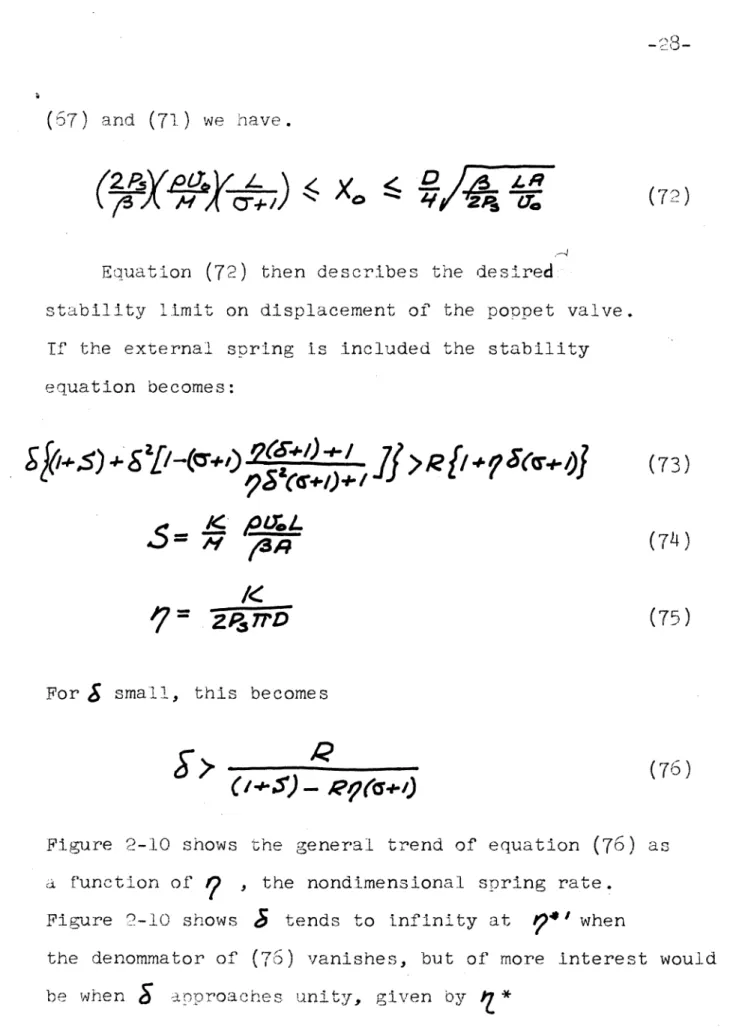
If the external scpring is included the stability equation becomes:
(74)
'7-
ZP
momD
(75)For
,
small, this becomes(/+5)- }?fR~ff+)
7(76)
Figure 2-10 shows he general trend of equation (76) as a f'unction of , the nondimensional sring rate.
Figure o-1i0 shows
;
tends to infinity at I? whenthe denominator of (76) vanishes, but of more interest wouid ,-e
when
S
unity,
ntproachs
given
by
*I1
I.
Y Il
I
/ / /I
I''
,
IFIGURE 2-10
I¢
If
then
7-
-
point of stable operation exists.
2.70 Downstream Eff'ect
Downstream effects are connected with the
possibility
of pressure variations behind the poppet due to flu.d
mot
ion.
These
are
due
o both fluid
nertia
and
comD-res-Ibility, but also are strongly affected by the luid
vorticity and turbulant mixing from the jet as it
leaves the poppet
Previous investigators
(Stone Ref#t42)
noted that
a popet stable when exhausting into a "infinite
?downstream chamber would oscillate when confined by a
circul'ir tube, indicating that the change n flow
pattern caused by downstream effects and largly due to
fluid compressibility. A simplified analysis will show
the adverse effect that this may cause.
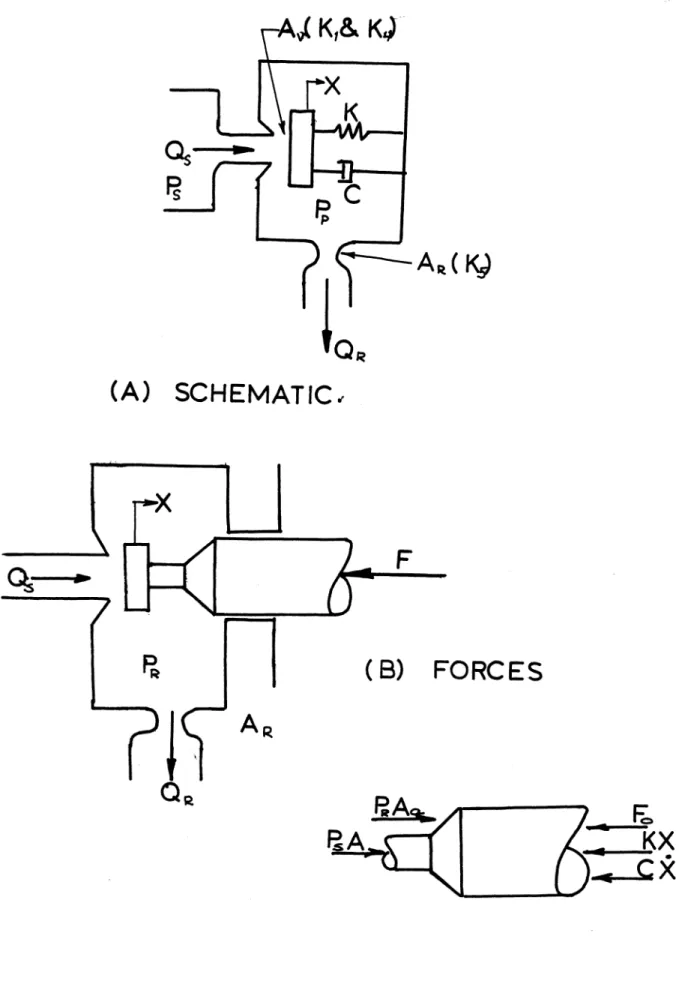
2.7i Downstream Compressibility
A simplified system is shown in Figure 2-i1a where
it is assumed the upstream pressure n, is constant, the do.wnnstr- ram volume
is
and the :restric tion is given by AR.y
simil
ity
we
know that
the equation
are those
of
co
_ 4 _o
, Tze it doH o- n t . e1t
-29-(7a)
rhe re
le
fr4l(
/Ll
(80)
K
4and K
5are the flow coefficients with respect to
D.ressure for valve and downstream restriction.
The
dynamic equation in this case depends on the downstream
construction
of the Doonpet as shown on Figue 2-11 b.
In this case we have
, ~ i A.
n -
,- -x - -
,,v,X
which for linearized considerations yield, with equation
(79) substituted
for
:
/
3
#zD
3
c
)OD
(f
z
kZR)O Q
6
R
Re
(82
)
For stability: (Ref. Aopendix C)
2,
>
Qs
ao
(83)
Qc0
>'G9
(84)(A) SCHEMATICS
'ORCES
AR
DOW N STR IEAM
COMPRESSIBILITY
FIGURE
2-11
-.
A(.(
A _F
meKXc
~i0
(o0,
0 0
<a
<'
0 0
rY) C'M0
I",.a.
C
-J
U) (D6
<
II cn U) U)w
cJ
So0
0
0
0
,·Z
31
-K
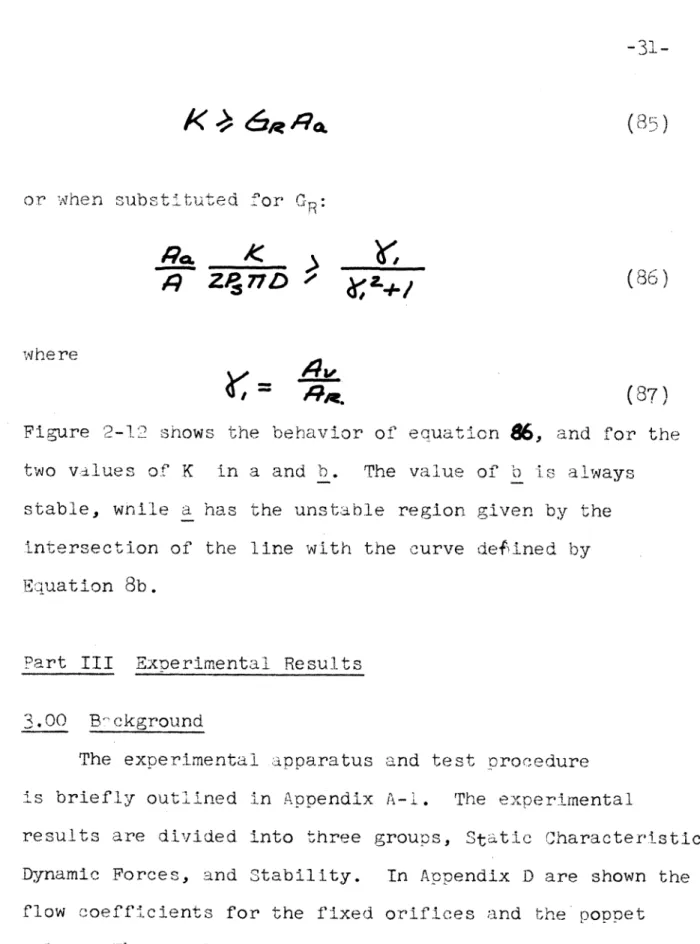
r&
/
(8)5)
o
r
hen
subst
tted
for
C
R
,9
ZP77Ln
9
Z
(86)
wIhe re
bt=
s*R.
(87)
Figure 2-1:2. shows tie behavior o ecuation
86,
nd for thetwo values o K in a and . The value of "O -.s always
stable, wile a has the unstable region iven by he
intersection of the line with the curve defined by E:uat-ion 8b.
Part III Exoerimentia Results
3. 00 B'ckground
The experimental ionaratus and test coreedure
is briefly outii red in Aooendix A- . The
ex.perimental
results are divided into hree groups, Statilc Characteristics, Dynamic Forces, and Stability. In Appendix D are shown the
flow oefficents for the fixed orifi es and the poppet
valve.
Thse vaLues are used in evaluating the results,
Al th;e "
,-suits
~reented are for
'a
O.
orpet
of'
l'i
ne
;'}Sdthe
ioZ
7 .]e
is D)
-1,'n-
'
Ae.1.0
Stat
c
tCha..erist°s
TMe s" tat1c or e and press; re curves ae shown n
Fi gu res 3-I and -. Figure
3-!
reoresents theforce
for constant
ipstream
oressure.
Figur e
3-shows the
fove and
utistrearm;
oressure:txed
Lwhenorifice
Au is
ntroduced.
The dashed curves
eyresent
the theory given
by equation
(12
and Figures
'-3
with the
response to a large input, slowly
varying,
sine wave. The
output is seen to be nonlinear as expected with the eak
pressures less than the teory predicts. The discsepancies
are largily due to the variations in flow coefficients, especially that of the poppet valve. (Ref. Fig. D-').
Again Figure 3-2 gives indications on the (low
frequency) output to be expected as function of vaire meran
.-
oS
'tion.
3.20 Dynamic Characteristics
In this section the val;dl t y of he equations
developed in sections 2-40 and 2.50 were checked out. The poppet valve 1is excited sinusoida1.ily and the force,
dis-lacement nd upstream pressure is recorded and
1o
(0.
\II
-\J
I _ IN
Ix
0 0 0
11'm ' aCM
-*: . zl\---_
I _0
0 o V"O rI
-Ol~0
0
0
0
t
0
0 0
0) eOFIGURE
CE
U0
U0
I.0
'Q0
0
Q U C) (n0
,n
_ I I1 II Ill L Ill II Ill I __ I I ii I I-i -4 I I - i i i ii I i I i - - _ _ . I I I I I -- - - I -I . A JA _ I\
Vwoa."
3-1
L
LI" c
6
i o
0t
0
c(i0
II ><>FIGURE 3-2
n0
0
0
0
L
0
Lc
.)SLnce tie
pce
paratusis F equ enc
ei
ii;
ed
(ot)e at
.rs'~n~
~on~
~from
0 h
cps)
~
a
mi o
u
ofth e
upstream
t i i omne y C )
the ma
.n .?erome
,ry as m
agnif
led to create measurale
, ead and
Lag values :'or pre ss re and force.
The results
from thicart
aresown
Li.n
Figtlres
3- trough 3-7
3
.a
C
ompre
s sib I ity
1k.
Rtesul
is ,
S:The system tested is that shown on Figure ~P-ib.
In the exoerimenta. st-u,
both L .nd
uare changable
as
:well as the
mean
valve
position
[o (or
Xo).
Figure
3-7 shows the phase lag ~ betw-veen
either force or
pressure with dis.olacement as a function of system
volume. Figure 3-4 shows the effect of changing both
volume and valve mean operating postion.
Fifgue
-*
-shows a crosspiot of data obtained from Figures 3-3
and
3-4 on a
nondimensional
b-:as.
and
i
to be ,compared with
the value of equat
ion (37)
·
B. Dis ussion
The results
oS Fi gure 3-5 follow the theory well.
The
vali
e
used
for
Pis
r50,00
,
OSi,
WiCiis high
when it
i
-
-onsidred
tl.t
the oil haes
ai
entrained
O
O-c
~J)C c
j 0uu u 0L
O
LO.L) O
U II 1 I1 C I1 1X)
-
CJ
U )
-4il--I ' I I I I I.. I I1 .-...
- --... ,
O
O
O
O
O
O
O
O
O
0)
00
N
()
LO10
Cv)
NM
FIGURE 3-3
0
QL
'0-J u
L c
C L0)>
O (n0
Ln LOC (Y)0
o U
CM VO u
LOo
0t
0 )'
0
LO O O ' a0. tI II II II (1 51 0 (~i
~
IIlii
I
Lf3 (DaELI II
<
I WA H~~~~~~~~~~~~~~~~~~~~~~~~~~~~~~~~~~~~~~~~~~~~~~
i iH i Ii (JsO
O
O
0
0
N CD I) o . (V) CFIGURE 3-4
FIGURE 3- 4
LCI
Lc
0 )
0
. c
u
O 3 1) U))0
t >
b O
aU
L
0 10
Ln0
(Y)0
0
Oo
CU c'J0
0
0
0
a) O0
0
vs
pet disp
cacment
0
1.0
2.0
3.0
6
FIGURE 3-5
10
9
8
7
6
5
4
3
2
.1
0
time lag
Ex imental
I I