Publisher’s version / Version de l'éditeur:
The Journal of Physical Chemistry B, 121, 8, pp. 1992-1995, 2017-03-02
READ THESE TERMS AND CONDITIONS CAREFULLY BEFORE USING THIS WEBSITE. https://nrc-publications.canada.ca/eng/copyright
Vous avez des questions? Nous pouvons vous aider. Pour communiquer directement avec un auteur, consultez la
première page de la revue dans laquelle son article a été publié afin de trouver ses coordonnées. Si vous n’arrivez pas à les repérer, communiquez avec nous à [email protected].
Questions? Contact the NRC Publications Archive team at
[email protected]. If you wish to email the authors directly, please see the first page of the publication for their contact information.
NRC Publications Archive
Archives des publications du CNRC
This publication could be one of several versions: author’s original, accepted manuscript or the publisher’s version. / La version de cette publication peut être l’une des suivantes : la version prépublication de l’auteur, la version acceptée du manuscrit ou la version de l’éditeur.
For the publisher’s version, please access the DOI link below./ Pour consulter la version de l’éditeur, utilisez le lien DOI ci-dessous.
https://doi.org/10.1021/acs.jpcb.7b00033
Access and use of this website and the material on it are subject to the Terms and Conditions set forth at
Comment on “Exploring dynamics and cage–guest interactions in
clathrate hydrates using solid-state NMR”
Moudrakovski, Igor L.; Ripmeester, John A
https://publications-cnrc.canada.ca/fra/droits
L’accès à ce site Web et l’utilisation de son contenu sont assujettis aux conditions présentées dans le site LISEZ CES CONDITIONS ATTENTIVEMENT AVANT D’UTILISER CE SITE WEB.
NRC Publications Record / Notice d'Archives des publications de CNRC:
https://nrc-publications.canada.ca/eng/view/object/?id=c0a59580-c74e-4d56-91a8-03eee57a8844 https://publications-cnrc.canada.ca/fra/voir/objet/?id=c0a59580-c74e-4d56-91a8-03eee57a8844Comment on “Exploring Dynamics and Cage−Guest Interactions in
Clathrate Hydrates Using Solid-State NMR”
Igor L. Moudrakovski
†and John A Ripmeester
*
,‡†
Max Planck Institute for Solid State Research, Stuttgart 70569, Germany
‡
National Research Council Canada, 100 Sussex Drive, Ottawa, Ontario K1A 0R6, Canada J. Phys. Chem. B 2015, 119 (50), 15485−15492. DOI:10.1021/acs.jpcb.5b08369
*
S Supporting InformationS
tructure II tetrahydrofuran (THF) hydrate is one of the most frequently studied clathrate hydrates as it is easily made by freezing a solution of composition THF·17H2O. Theresulting hydrate is stable at atmospheric pressure up to a congruent melting point of 277.5 K (4.4 °C).1,2This hydrate is often used as a proxy for studies of materials that are more difficult to prepare, such as natural gas hydrates.3−8As a system
for learning about guest−host interactions, the dynamics of both guest (THF/THF-d8) and host (H2O/D2O) have been of
wide interest as shown by the large number of solid-state NMR and dielectric measurements performed over a temperature range from ∼4 K up to near the melting point at 277.5 K.9−23
Both guest and water molecular reorientation and water diffusion have been observed, and various mechanistic models, including the effects of various defects, have been proposed to account for the experimental results. Transient guest−host hydrogen bond formation in THF and other ether and ketone hydrates was first proposed by Davidson11and confirmed from spectroscopic measurements,15,24 molecular dynamics simula-tion,25,26 and single crystal X-ray diffraction.27 The paper featured in the title of this Comment23recently reported yet another set of measurements, six longitudinal 1H relaxation
times (T1) on THF·17D2O, this time under magic angle
spinning (MAS) conditions, purportedly to obtain high resolution information as there are two sets of resolvable protons on the inequivalent methylene carbons. Since the results of these measurements were very different from T1
measurements taken on static samples, an explanation was proposed that involved changes in the THF reorientational activation energy from ∼4 kJ/m at T < 200 K to nearly 20 kJ/m at T > 200 K. This radical change was attributed to increased hydrogen bonding between THF and D2O. We think this is
rather unlikely for ether−water interactions. If we take the difference in activation energies for guest reorientation for cyclopentane hydrate and THF hydrate, ∼16 kJ/mol, attribute this to hydrogen bond formation in THF hydrate, and compare this to the estimated hydrogen bond energy in ice at 16−32 kJ/ mol,28 it would predict that THF should be a good hydrate inhibitor rather than a weakly interacting hydrate guest as it will compete with the hydrogen bond formation between water molecules. We have taken literature T1data obtained for static
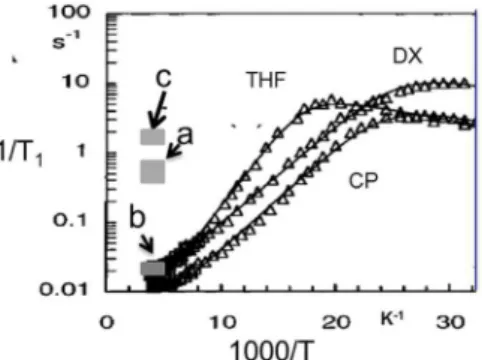
samples of sII deuteriohydrates of THF (ethylene oxide (EO)-d4), cyclopentane, and dioxolane (Figure 1) published by
Jacobs, Zeidler, and Kanert,18(Figure S1) and compared these with the MAS T1 measurements (gray rectangle marked a,
Figure 1).23The literature T1data for the three hydrates show
that the relaxation rates decrease with increasing temperature, with some flattening out of the curves at the highest temperature of measurements. In agreement with other measurements, this trend in T1 is associated with 1H dipolar
relaxation due to the reorientational motion of guest molecules in the hydrate cavities in the fast motion limit. The flattening out of the T1curves leads to a T1maximum,10,12and then to a
decrease in T1 with increasing temperature as slow water
motion starts to contribute to the relaxation. This gives a frequency-dependent T1decrease, evident from measurements
at lower frequencies (10 and 30 MHz10,12) to a new T1
minimum, not observed as it would occur above the sample melting point. This new motion is a reorientation of the water molecules, which is also observable by T1ρmeasurements and
usually assigned to be a process driven by the diffusion of Bjerrum defects.29,30The guest T1relaxation responds to this
motion by (a) cross relaxation of1H to2H in water, (b) spin
diffusion to residual1H in the D
2O, and (c) changes in guest
Received: January 2, 2017 Revised: February 6, 2017 Published: February 9, 2017
Figure 1.Relaxation rates 1/T1as a function of inverse temperature
for the sII doubledeuteriohydrate of tetrahydrofuran and ethylene oxide (1THF·0.5EO-d4) and the deuteriohydrates of cyclopentane
(CP) and 1,3-dioxolane (DX) from ref 18. The original figure is reproduced in theSupporting Informationwith permission from ref
18. Copyright 1997 American Chemical Society. The a marks the area in which the six MAS 1/T1measurements from ref25occur, and b
marks the area in which the 11 new MAS 1/T1 measurements are
found. The c marks the area in which the static sample 1/T1
measurements for CP hydrate from ref25are located.
motion as the symmetry of the hydrate cages changes when the disorder in the water proton positions becomes dynamic. This picture is generally consistent with all static line width, T1, and
T1ρexperimental results.
Upon examination of the MAS T1 data that were recently
reported (Figure 1, gray area marked as a), the question that arises is why the results for the spinning sample are so different (by a factor of ∼25) from the static sample results obtained from the literature. The authors also measured T1’s for a static
sample of THF deuteriohydrate which were somewhat different from the spinning sample results, but again this T1data set is
well over an order of magnitude different from the other static sample measurements reported in the literature. As explanation, the authors offer the following, “This further illustrates the importance of using MAS rather than static NMR for proper characterization of the dynamics of the guest at these temperatures” but offer no reason as to why one set of data is “better” than the other, or why both sets of their measurements are over an order of magnitude different from previously measured values. We note further that the cyclopentane deuteriohydrate T1 measurements reported in
the paper23suffer from the same problem as those for THF deuteriohydrate; in this case, the new measurements23 differ from previously published data by nearly 2 orders of magnitude (seeFigure 1). Considering NMR fundamentals, in going from nonspinning to spinning samples, one might expect the T1
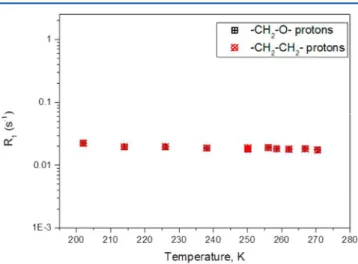
values to increase as some of the contributing relaxation pathways may become less efficient. Thus, this cannot explain the data from ref23, and it leaves us to consider experimental problems as a possible cause of the differences in relaxation time measurements. The most straightforward approach to check the validity of the data set that does not appear to match previous work is just to repeat the measurements. Following proper procedures for eliminating air from the samples during preparation, loading, and running the experiments, a new set of data was obtained.Figure S2shows1H MAS spectra, andTable
S1 lists MAS 1/T1 values obtained for a sample of THF
deuteriohydrate, and these are shown in outline in the gray box marked b inFigure 1and in detail inFigure 2. We note that the T1’s obtained on our MAS sample agree with the previously
reported data obtained for the static sample from ref18. The detailed plot shown inFigure 2indicates that the data follow the expected behavior as does the data set from the literature
shown inFigure 1. The main point of our Comment is to point out that the T1measurements reported in ref23are not correct,
as can be seen by comparison of the data in ref23 with both our measurements and previously published measurements.18 We also conclude that T1 measurements taken for static and
MAS samples of THF·17D2O are very similar, so that there are
no particular advantages in using MAS methods in this case. A further conclusion is that the mechanism based on the data in ref23should not be considered as meaningful in coming to an understanding of guest−host interactions in clathrate hydrates. It is beyond the scope of this Comment to explore the reasons for the discrepancies between the data in ref23and the other data presented. Most likely, the cause of the differences lies in oxygen contamination of the sample and/or poor sample quality.
Finally, a comment can be made regarding the magnitude of the THF−hydrogen bonding interaction with the hydrate lattice. The activation energy for guest reorientation in THF· 17D2O is 4.0 ± 0.2 kJ/m, and that in CP·17D2O is 2.6 ± 0.2
kJ/m. Because of the similar shape and size of these two guests, the difference between the two activation energies could be associated with H-bond formation of THF with cage water which amounts to ∼1.4 kJ/m. Thus, this indicates that there are differing degrees of “stickiness” between the guest molecules THF and CP and the cage walls because of multidirectional, transient hydrogen bonding of the THF guest.
■
EXPERIMENTAL DETAILSThe THF clathrate hydrate sample was prepared from anhydrous, inhibitor-free tetrahydrofuran (Sigma-Aldrich) and deuterium oxide (99.9 at. % D, Sigma-Aldrich), mixed in 1:17 molar ratio. The THF−D2O mixture was placed in a glass tube
equipped with a vacuum stopcock, connected to a vacuum line, and thoroughly outgassed by 5 consecutive freeze−pump−thaw cycles. The freezing was done in liquid nitrogen, and the frozen mixture was evacuated each time down to 10−2 mbar. For
avoidance of contamination with oxygen, the outgassed solution was transferred into a Bruker 4 mm o.d. ZrO2 MAS
spinner in a glovebag flushed multiple times with dry nitrogen gas (99.999%, Westfalen AG, Muenster). After being filled with the mixture, the spinner was closed with a cap equipped with a Viton ring to prevent any leaks. Solid clathrate hydrate was formed directly in a rotating MAS spinner by cooling it from the room temperature down to 240 K and keeping it at that temperature overnight. All NMR measurements were per-formed on a Bruker Avance-III 400 MHz instrument using a standard Bruker 4 mm double resonance MAS probe. Dry nitrogen is used as spinning, bearing, and cooling gas. The spinning rate was kept between 9.1 and 7.5 kHz, with the higher spinning rates used for the higher temperatures. The temperature during experiments was regulated with a Bruker BVT3000 temperature controller. Actual temperature inside the spinner was calibrated with Pb(NO3).31Most relaxation time
measurements were performed using standard saturation recovery (SR) pulse sequence.32 Several experiments were performed also using the inversion recovery (IR) sequence with virtually identical results. The RF field on the proton channel was set to 62.5 kHz (π/2 pulse of 4 μs), and 16 appropriately spaced time delays were used in each experiment.
Figure S2shows the1H NMR spectra for the complete range
of temperatures studied. Above 270 K there is a small contribution of liquid THF which is resolved from the spectrum of the solid. Similarly, a tiny signal from 1H in Figure 2. Relaxation rate of THF·17D2O obtained under MAS
conditions (this work).
The Journal of Physical Chemistry B Comment
DOI:10.1021/acs.jpcb.7b00033
J. Phys. Chem. B 2017, 121, 1992−1995
HDO is observable above 270 K at 4.8 ppm. Below the eutectic at around 270 K, the liquid contributions to the THF spectrum are no longer observed. This attests to the absence of excess liquid THF.
In our sample, made with 99.9% D2O, the residual protons in
HDO are outnumbered by THF protons by a factor of ∼240, so it is reasonable to ignore the contribution of the former to THF proton relaxation. We also expect that a larger number of HDO protons in the sample should be visible in the MAS NMR spectrum, since protons are dilute, 1H−1H dipolar
couplings are very small, and 1H−2H dipolar couplings are
averaged by MAS. Besides, at temperatures above 200 K, water molecules are mobile, yet again decreasing the various dipolar interactions. Thus, HDO should give a reasonably sharp resonance, and there would not be any spectral overlap of THF and HDO contributions to the spectrum. For these reasons we deem that the application of a T2filter, as employed in ref23, is
unnecessary.
■
ASSOCIATED CONTENT*
S Supporting InformationThe Supporting Information is available free of charge on the ACS Publications websiteat DOI:10.1021/acs.jpcb.7b00033.
Original figure used forFigure 1,1H MAS NMR spectra
of THF·17D2O at different temperatures, and a table of
T1 values for THF·17D2O at different temperatures
(PDF)
■
AUTHOR INFORMATION Corresponding Author *E-mail[email protected]. ORCID John A Ripmeester:0000-0002-4091-5120 Author ContributionsThe manuscript was written through contributions of all authors. All authors have given approval to the final version of the manuscript. The authors contributed equally.
Notes
The authors declare no competing financial interest.
■
ACKNOWLEDGMENTSThe authors thank the National Research Council Canada and the Max Planck Institute for Solid State Research for support of this work.
■
REFERENCES(1) Gough, S. R.; Davidson, D. W. Composition of tetrahydrofuran hydrate and the effect of pressure on the decomposition. Can. J. Chem. 1971, 49, 2691−2699.
(2) Makino, T.; Sugahara, T.; Ohgaki, K. Stability boundaries of tetrahydrofuran+ water system. J. Chem. Eng. Data 2005, 50, 2058− 2060.
(3) Davidson, D. W.; Leaist, D. G.; Hesse, R. Oxygen-18 enrichment in the water of a clathrate hydrate. Geochim. Cosmochim. Acta 1983, 47, 2293−2295.
(4) Parameswaran, V. R.; Paradis, M.; Handa, Y. P. Strength of frozen sand containing tetrahydrofuran hydrate. Can. Geotech. J. 1989, 26, 479−483.
(5) Dai, S.; Lee, J.; Santamarina, J. C. Hydrate nucleation in quiescent and dynamic conditions. Fluid Phase Equilib. 2014, 378, 107−112.
(6) Priest, J. A.; Best, A. I.; Clayton, C. R.I. A laboratory investigation into the seismic velocities of methane gas hydrate-bearing sand. J.
Geophys. Res.: Solid Earth 2005, 110 (B4), B04203.
(7) Delli, M. L.; Grozic, J. L. H. Prediction performance of permeability models in gas-hydrate-bearing sands. SPE Journal 2013,
18, 274−284.
(8) Zhao, J.; Yao, L.; Song, Y.; Xue, K.; Cheng, C.; Liu, Y.; Zhang, Y. In situ observations by magnetic resonance imaging for formation and dissociation of tetrahydrofuran hydrate in porous media. Magn. Reson.
Imaging 2011, 29, 281−288.
(9) Gough, S. R.; Hawkins, R. E.; Morris, B.; Davidson, D. W. Dielectric properties of some clathrate hydrates of structure II. J. Phys.
Chem. 1973, 77, 2969−2976.
(10) Hayward, R. J.; Packer, K. J. Proton magnetic relaxation in ethylene oxide, tetrahydrofuran, and triethylene diamine as clathrate deuterates. Mol. Phys. 1973, 25, 1443−1450.
(11) Davidson, D. W. Clathrate Hydrates. In Water. A Comprehensive
Treatise; Franks, F., Ed.; Plenum Press: New York, 1973; Vol. 2, pp
115−234.
(12) Garg, S. K.; Davidson, D. W.; Ripmeester, J. A. NMR behavior of the clathrate hydrate of tetrahydrofuran. I. Proton measurements. J.
Magn. Reson. 1974, 15, 295−309.
(13) Davidson, D. W.; Garg, S. K.; Ripmeester, J. A. NMR behavior of the clathrate hydrate of tetrahydrofuran. II. Deuterium measure-ments. J. Magn. Reson. 1978, 31, 399−410.
(14) Ripmeester, J. A.; Garg, S. K.; Davidson, D. W. NMR behavior of the Clathrate Hydrate of Tetrahydrofuran. III. Effect of Oxygen. J.
Magn. Reson. 1980, 38, 537−544.
(15) Davidson, D. W.; Ripmeester, J. A. NMR, NQR and Dielectric Properties of Clathrates. In Inclusion Compounds; Atwood, J. L., Davies, J. E. D., MacNicol, D. D., Eds.; Academic Press: London, 1984; Vol. 3, pp 69−123.
(16) Ripmeester, J. A. Pulsed nuclear magnetic resonance study of deuteron lineshapes in clathrate hydrates. Can. J. Chem. 1977, 55, 78− 81.
(17) Albayrak, C. M.; Zeidler, D.; Küchler, R.; Kanert, O. NMR relaxation of tetrahydrofuran in clathrate hydrate. Ber. Bunsengesellsch.
Phys. Chem. 1989, 93, 1119−1122.
(18) Jacobs, D. M.; Zeidler, M. D.; Kanert, O. Proton magnetic relaxation studies of various guest molecules in clathrate hydrates. J.
Phys. Chem. A 1997, 101, 5241−5249.
(19) Bach-Vergés, M.; Kitchin, S. J.; Harris, K. D. M.; Zugic, M.; Koh, C. A. Dynamic properties of the tetrahydrofuran clathrate hydrate, investigated by solid state2NMR Spectroscopy. J. Phys. Chem. B 2001,
105, 2699−2706.
(20) Kirschgen, T. M.; Zeidler, M. D.; Geil, B.; Fujara, F. A deuteron NMR study of the tetrahydrofuran clathrate hydrate. Phys. Chem.
Chem. Phys. 2003, 5, 5247−5252.
(21) Ba, Y.; Ripmeester, J. A.; Ratcliffe, C. I. Water molecular reorientation in ice and tetrahydrofuran clathrate hydrate from lineshape analysis of 17O spin-echo NMR spectra. Can. J. Chem.
2011, 89, 1055−1064.
(22) Nelson, H.; Ihrig, A.; Kahlau, R.; Kibies, P.; Kast, S. M.; Böhmer, R. Deuteron magnetic resonance and dielectric studies of guest reorientation and water dynamics in six clathrate hydrates containing ring-type guests. J. Non-Cryst. Solids 2015, 407, 431−440.
(23) Sengupta, S.; Guo, J.; Janda, K. C.; Martin, R. W. Exploring dynamics and cage−guest interactions in clathrate hydrates using solid-state NMR. J. Phys. Chem. B 2015, 119, 15485−15492.
(24) Buch, V.; Devlin, J. P.; Monreal, I. A.; Jagoda-Cwiklik, B.; Uras-Aytemiz, N.; Cwiklik, L. Clathrate hydrates with hydrogen-bonding guests. Phys. Chem. Chem. Phys. 2009, 11, 10245−10265.
(25) Alavi, S.; Susilo, R.; Ripmeester, J. A; Linking microscopic guest properties to macroscopic observables in clathrate hydrates: Guest-host hydrogen bonding. J. Chem. Phys. 2009, 130, 174501.
(26) Alavi, S.; Ripmeester, J. A. Effect of small cage guests on hydrogen bonding of tetrahydrofuran in binary structure II clathrate hydrates. J. Chem. Phys. 2012, 137, 054712.
(27) Alavi, S.; Udachin, K.; Ripmeester, J. A. Effect of guest−host hydrogen bonding on the structures and properties of clathrate hydrates. Chem. - Eur. J. 2010, 16, 1017−1025.
(28) Pimentel, G. C.; McClellan, A. L. The Hydrogen Bond; W.H. Freeman and Company: San Fransisco, 1960.
(29) Bjerrum, N. Structure and Properties of Ice. Science 1952, 115, 385−390.
(30) Onsager, L.; Runnels, L. K. Diffusion and relaxation phenomena in ice. J. Chem. Phys. 1969, 50, 1089−1103.
(31) Bielecki, A.; Burum, D. P. Temperature dependence of207Pb
MAS spectra of solid lead nitrate. An accurate, sensitive thermometer for variable-temperature MAS. J. Magn. Reson., Ser. A 1995, 116A, 215−220.
(32) Fukushima, E.; Roeder, S. B. W. Experimental Pulse NMR; Addison-Westley Publishing Company, Inc.: Reading, Massachsetts, 1981.
The Journal of Physical Chemistry B Comment
DOI:10.1021/acs.jpcb.7b00033
J. Phys. Chem. B 2017, 121, 1992−1995