Analytical Model for a Cylinder Sinking Into a
Thin Film
by
Kevin T. Chen
Submitted to the Department of Mechanical Engineering
in partial fulfillment of the requirements for the degree of
Bachelor of Science in Mechanical Engineering
at the
MASSACHUSETTS INSTITUTE OF TECHNOLOGY
June 2005
©
Massachusetts Institute of Technology 2005.
Author ... .
...
,;
n-.
,, ..
.--
-
A/r.
All rights reserved.
JepL.[ l-bIlUl l 131 IVliUnai'gllll. 11 111UzLIIL May 6, 2005 ( Certified by . ... .
..
.. Anette E. HosoiAssistant Professor
Thesis Supervisor
Accepted
by...
Ernest G. Cravalho
Chairman of Undergraduate Thesis Committee
ARCHIVES MASSACHUSES INSTIUtr OF TECHNOLOGY JUN 0 8 2005
I.... LIBRARIES
v j I...
.-.
~1..-..-
; .- l ' ns-r~
,
- .;
r .
. ...
Analytical Model for a Cylinder Sinking Into a Thin Film
by
Kevin T. Chen
Submitted to the Department of Mechanical Engineering
on May 6, 2005, in partial fulfillment of the requirements for the degree of
Bachelor of Science in Mechanical Engineering
Abstract
New technologies and techniques have enabled oil companies to access oil deposits by
drilling through the ground horizontally. These increased capabilites have improved drilling efficiencies, and have also reduced the effects that drilling has on the local environment. These boreholes can be enormously long, and it is often necessary to send a tethered robot into the hole in order to gather information. If these robots
remain stationary for too long, however, their tethering cables can become stuck in
the mud cake lining the walls. The recovery or replacement of these robots is time consuming and expensive, so it is desirable to understand how and why the cables
sink. In this analysis, the mud cake is modeled as a Newtonian fluid. The surface of the cable is approximated as being either parabolic or circular, and it is shown that the sinking is governed by exactly two dimensionless parameters in both cases.
Matlab is used to visualize the evolution of the fluid pressure distribution with time, as well as the time it takes for the cylinder to settle to 20 percent of the mud cake thickness.
Thesis Supervisor: Anette E. Hosoi
Acknowledgments
Special thanks to Peko Hosoi, Julio Guerrero, and Debra Blanchard for all of their thoughtful help.
Contents
1 Introduction 11
1.1 M otivation . . . 11 1.2 Scope of Analysis . . . 12
2 Derivation 15
2.1 General Case for Newtonian Fluid ... 15 2.2 Parabolic geometry ... ... 18 2.3 Circular geometry ... 20
3 Analysis 23
3.1 Parabolic Geometry ... 23 3.2 Circular Geometry ... 25
A List of symbols used 33
B Derivation of Fluid Velocity 35
C Matlab Code 37
C.1 Parabolic geometry ... 37 C.2 Circular geometry ... 40
List of Figures
1-1 Comparison of drilling strategies (taken from OTS Heavy Oil Science
Centre website) . . . 12
1-2 Example of an oil drill bit (taken from HowStuffWorks.com) .... . 13
1-3 Illustration of the sinking cylinder model ... . 14
3-1 Change in 1 with time ... . 24
3-2 Change in hb with time ... . 25
3-3 Change in
P
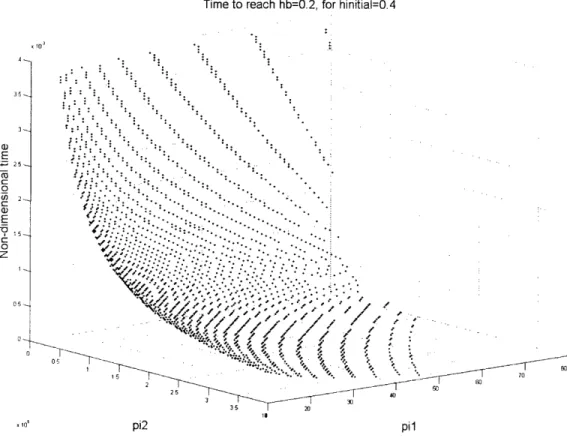
with time ... . 293-4 Change in hb with time ... . 30 3-5 Time to reach hb = 0.2 with respect to I 1 and H2 for an initial hb = 0.4 31
Chapter 1
Introduction
1.1 Motivation
Recent advances in oil drilling technology have enabled oil companies to bore horizon-tally through bedrock in order to access oil deposits. This reduces the environmental
impact of dlrilling, as it gives the drillers more flexibility in selecting their drilling
sites. With this added flexibility, oil deposits located directly below environmentally sensitive areas can be tapped without negative effects to the land above. In
addi-tion, multiple horizontal branches can be drilled from a single hole, which reduces the overall number of holes that must be drilled.
In order to drill such deep holes, oil companies must use specially designed hollow
drill bits. I)rilling mud is pumped through the drill string, and it flows out through holes in the drill bit. This mud lubricates the bit as it cuts through the bedrock, then carries sediment and debris from the drilling up to the surface. For horizontal drilling, the drill bit is attached to a steerable downhole motor, which allows operators to adjust the angle of the bit as it drills. Current technology enables drillers to change
the angle of a well up to 110 degrees within just a few hundred feet, and horizontal holes have been drilled to lengths of over 35,000 feet [4].
When drilling of the well has ceased, a remote-controlled robot is sent into the
hole on a steel cable tether to gather data about the well. These wells, however, are
Figure 1-1: Comparison of drilling strategies (taken from OTS Heavy Oil Science
Centre website)
the wells can be enormous (300-500 degrees F, and 20,000 psi). Although the pressure is naturally high due to hydrostatic pressure, drillers typically keep the mud-filled
holes artificially pressurized in order to prevent the walls from collapsing. Such high pressures force the mud to leach into the dirt covered walls of the well, forming a
thin, viscous mud cake layer between the mud and the bedrock. If left to settle, the robot's tether cable can sink into this layer of mud cake; after about 20 minutes, the cable is unrnovable. The cost of either recovering or replacing the robot is enormous, so gaining a thorough understanding about how the cylinder sinks is of great interest
to oil companies.
1.2 Scope of Analysis
The mud cake can be modeled as a Bingham fluid. In a Bingham fluid, the fluid does not shear until it reaches a certain yield stress, above which it behaves as a
Newtonian fluid. As a first-order approximation, this analysis models the problem as
/ ..
maps W
'ail-11100
I I " I ' ... 'zi I. 1. . : . - . . . . I _L, Ian infinite cylinder sinking onto an infinite plane, with the mud cake approximated
as a thin film of Newtonian fluid. In this case, it is shown that the sinking of the cylinder is governed by exactly two dimensionless parameters, whether the surface of
the cylinder is approximated as parabolic or circular.
7Ox
Mud
dV
Figure 1-3: Illustration of the sinking cylinder model
° ' .. .. . .' ' . ' ' ' ','' . . . .. . . . . .. · . · ·· .. .. . . .. .· . . .. . -. . . ., .- ,. . . . .
.... ... ...
...
...
. . . .. . . ....
... ...
. . . .. ....
. . . .... . ... ...
. . . ..... ... ... M
... ...
. . . . . . . ..u . ... . . . . . . . ... . . ....
. . . .... ...
...
... ...
...
Chapter 2
Derivation
2.1 General Case for Newtonian Fluid
The steel cable typically has a diameter of about one inch, whereas the diameter
of the oil well is usually six to twelve inches. Because the diameter of the cable is
significantly smaller than that of the well, the curvature of the well can be neglected,
and the problem can be approximated as a cylinder sinking on a flat surface (see Figure 1.3).
Furthermore, because the thickness of the mud cake is very small (usually about a quarter of an inch), the lubrication approximation can be used. This implies that the fluid velocity is small in the vertical direction, and that the pressure is a function only of x (horizontal position) and t (time). In the first part of the analysis, the mud
cake is modeled as a Newtonian fluid.
Using the lubrication approximation and imposing the no-slip boundary condition at the bedrock (y = ) and at the cylinder (y = h), one can find an analytical expression for the velocity in the x-direction (see Appendix B),
u(xyt)
(5)
)(y
- y), (2.1)h(x,
t) = hb(t) + A(x),where hb(t) represents the position of the bottom of the cylinder as a function of time, and A(x) represents the geometric shape of the cable. In this analysis, parabolic and circular profiles are examined.
Imposing a simple mass balance on a differential control volume under the sinking cylinder, one can derive the expression
Oh 1 .0 OP h3)= 0. (2.3)
a-7 12/i x 9,x °
Because only the hb portion of the expression for h varies with time, Equation 2.3 is
rewritten as
Ah 1b 0 (09 h3 h = . (2.4)
Otl 12 Ox Ox
J
The aP term can be found by performing a force balance on the cylinder. Gravity pulls the cylinder downwards while the fluid pressure pushes the cylinder upwards, and
inertial effects can be ignored because the cylinder sinks very slowly. An expression
for this resistance caused by fluid pressure can be determined from the dot product of fluid stress tensor and the normal vector to the cylinder surface. The fluid stress
tensor for a thin film of a Newtonian fluid, rTij, is
TiJ
-
Pay
uO
X,?
~ -P
and the unit normal vector to the cylinder surface, , is= -Oh 'I) 1 (2.5)
Ox}
1
The dot product of these two expressions then, is the force exerted on the fluid by the sinking cylinder. As the x-component of this force cancels due to symmetry,
the only component of interest is the vertical force,
R _ _
Oh
u1
ohy =oAA71+ (2.6)0
The overall force on the cylinder can be calculated by reversing the sign of
Equa-tion 2.6 to represent the vertical force exerted on the cylinder by the fluid, then integrating over the area of the cylinder in contact with the fluid. For a cylinder of unit length, the expression becomes
mg I h p I
hs[
+P
_dS,
=1 (2.7)W is 2 x Oz ~/ + (h)2
where m is the overall mass of the cable, W is the overall length of the cable, and g
is the gravitational constant. This can be rewritten as
__= 2 [ a - _ - h
+
p dx. (2.8)W
2.j
2Ox Ox
In the above expression, xm represents the maximum value of x at which the surface of the cylinder is in contact with the mud cake. It is clear, then, that xm increases as
the cylinder sinks.
Using this vertical force balance (Equation 2.8) along with the differential mass conservation equation (Equation 2.4), the height of the cylinder as a function of time
can be found. In order to obtain an analytically solvable set of equations, we use a
collocation method. To do this, the pressure p can be approximated as a second-order polynomial, namely
p(x, t)
=po(t) + pi(t)x + p
2(t)x
2.
(2.9)
Since the pressure must be horizontally symmetrical with respect to the cylinder, however, the term must equal zero, which yields the simpler expression:
Furthermiore, the value of the pressure, p, must approach the ambient pressure as the horizontal distance from the cylinder increases. If this ambient pressure is defined to be zero, then the pressure boundary condition that p = 0 when x = m can be
imposed. This produces an expression for Po in terms of xm:
P = -p2xm. (2.11)
Incorporating these constitutive relations for the pressure, the preceding equations
can then be solved by using a Euler time step. Also, this analysis focuses on a very
small area directly below the cylinder, so it is valid to evaluate this expression at a Gauss point of x = 0 to simplify the expression. Assuming some initial condition, the
following discretized version of Equation 2.4 can be used to solve for hb+l:
hn1- hn p(hn)pn 3
b b 2 b (2.12)
At 6p '
where h refers to the current height, and hn+l refers to the height after the next time step.
Using h + l as a new initial condition, one can then recalculate the value of p2,
which will yield the next value of hb. After repeated iterations, this process eventually
determines the overall change in hb with time.
2.2 Parabolic geometry
As a first approximation, the profile of the cylinder can be approximated as a parabola.
This means that the height of the cylinder, h(x, t), can be written as
h(x,
t) = hb(t) + kx2. (2.13)This, in turn, leads to the following expression for the force in the y-direction:
where xm can now be calculated as
Xm =
T-hb
(2.15)
k
Again, xm simply represents the maximum value of x at which the surface of the
cylinder is still in contact with the mud cake layer. Now, substituting this expression back into the y-direction force balance (Equation 2.14) and integrating, the force balance equation becomes:
mg = - k 4 2 5 2 3 23
P2 + -khb mP2 - _XmP2 (2.16)
W 5 m 33m
The constitutive relations between Po, P2 (2.11) and the expression for xm (2.15)
can be used to eliminate Po and xm from the above equation, which leaves only P2
and hb as unknowns. Assuming some initial value for hb, the value of P2 then can be
found analytically.
It is also helpful to non-dimensionalize the above equations so that the resulting
data are scalable to a variety of different physical parameters. The relevant variables are scaled as follows:
y = T (2.17) 1 x = x (2.18) k hb = Thb (2.19) t = -t (2.20)
P
x/P
=
(2.21)
VTg P2 = T P2 (2.22)-2
km vgT
P2 = PW (45 m+ 3 Tk.
-Xm = V/Tk(1l-h). (2.24)
Once the value for P2 is known, the dimensionless mass balance relation,
hn+l - hn T2k2
At 6 P2(hb) (2.25)
can be used to determine the change in hb with time.
2.3 Circular geometry
A more accurate expression for the profile of the cylinder surface is a circle.
means that the height of the cylinder above the bedrock must be written as
h(x, t) = hb + R- VR2- x.2
This
(2.26)
Integrating the pressure across the lower surface of the cylinder, an expression for
the force exerted on the cylinder by the fluid can be found as
2j mx
[( 2 R2)(&) ) (
vR
2 - x2) + p dx, (2.27) where xm is now written asXm
=
R
2-
(T-hb-
-R)
2.
(2.28)Again, this fluid pressure force can be balanced with the force of gravity and
combined with various constitutive relations to yield an expression for P2,
where
+ R) (R2 sin-1
It is helpful again to non-dimensionalize the governing equations in order to make them easily scalable. The parameters can be scaled with the same factors as in the
parabolic case, only using x = Rx in place of x = :. This yields an expression for
the non-dimensional P2 as
P2 = WR
+ 1)
(sin-l(m)-m
lFrn)
where 5m can be written as
-T2 - 2
-Jr = 2 -( -hb) + 2(I -hb).
Once P2 is found for a given hb, it can be plugged into the non-dimensional mass
balance,
hn+ l - hn T2
-t
6R
2P2(b)
At 6R2 b
to determine the evolution of hb with time.
-1 - 2(2 (2.31) (2.32) XM R ) -XM
R -
2 Xrn2 mg F2 __ W (hb (2.29) (2.30)-
2X3 MChapter 3
Analysis
3.1 Parabolic Geometry
The non-dimensionalized equations for 2 and hb appear to be extremely complicated, but actually depend only on two dimensionless parameters,
HI k-m ,gT 11 1 ' -- and 112 = Tk. (3.1) (3.2)
As such, Equation 2.23 can be rewritten as
P2 =1
(
±45
2x
-3 23-1
§2 =+ 3§2x 3§, i- = V2<1 -h) (3.3) where (3.4) Equation 2.25 then becomesn+l n i- 2
b~+ -b = 62(h)3.
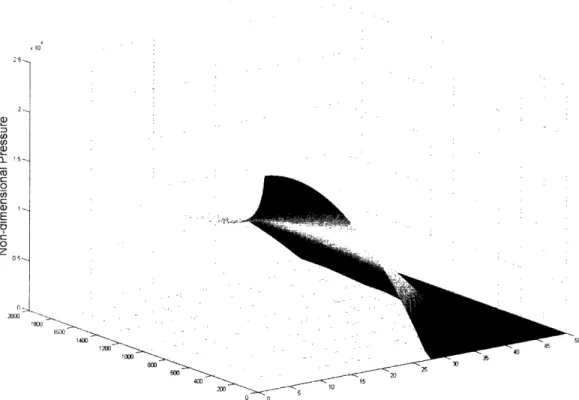
If typical physical parameters for the system are used, and the initial position of the cylinder is hb = 0.4, then the variation of non-dimensional pressure with x and
looks like: Viscosity = .001, k = 0.4 m-1, hinitial = 0.4 10 Cl) ID o) 0 V C a) E 0. g 05% In-20 00- .-.. - I law.30 11,00 a _ I . -',-'' -'.. 1200 1000 35 SOO ~0~~~~~~~~~~~~~~~~~~25 ~~~~400 C- ~ 15 10 0f 0 Non-dimensional Time*2000 Non-dimensional xm*1000
Figure 3-1: Change in
P
with timeI2I5
~..
q . .
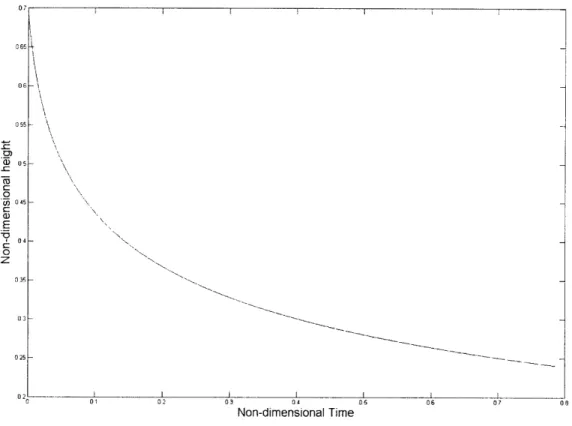
The change in the cylinder height with time looks like: 065 -to 05 _ t"-0 'j 045 E * 04 to 0 z 035 025 0 25 03 04 Non-dimensional Time 05 06 07 00
Figure 3-2: Change in hb with time
3.2 Circular Geometry
As with the parabolic geometry, the seemingly complicated expressions for P2 and hb
with circular geometry depend on just two dimensionless parameters. The parameters for the circular geometry are very similar to the parabolic parameters, and are defined
as
rgT
/1= (3.6) and ;\1, \ i\ II~~~~~~~~~~~~~~~~~~~~. \'k ",, I 01 02 07 02I 06iT
H12 - .
R
Using these H-groups in Equations 2.30, 2.31, and 2.32 respectively,
P2 = 1 [(I2hb + 1) (sin-(-m) - m
1-)
Xm = /2- H2(1 - hb)2 + 2H 2(l - hb), - - n b bt 6 P2 ), Ai67 (3.9) (3.10)It is interesting to note that the mass balance equations for both geometries are identical (Equations 3.5 and 3.10), differing only in the definition of their respective
Hl-groups.
(3.7)
- 2]3
and
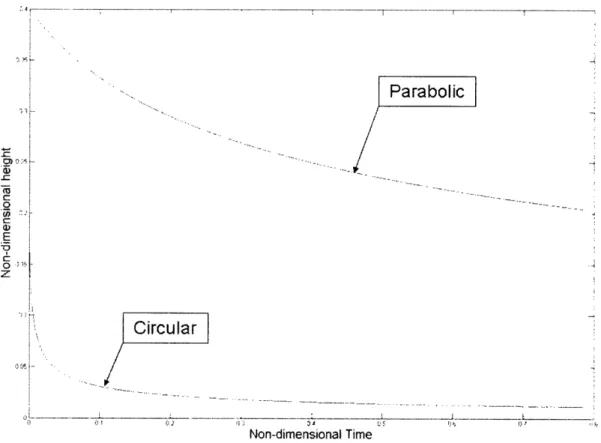
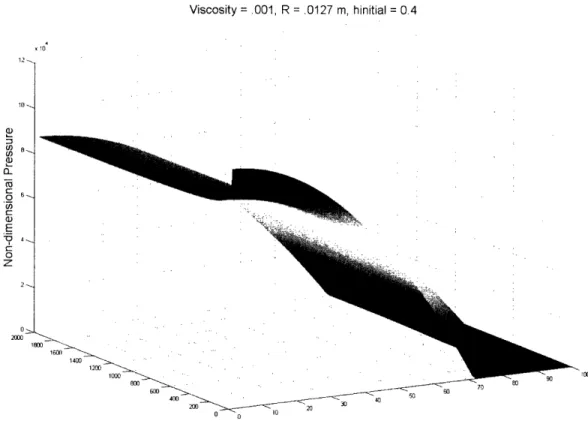
Assuming similar values to those in the parabolic case, but also that R = 0.5
inches, the variation in P with x and t looks like:
Parabolic
.... l*
Circular
... ...
Non-dimensional Time
Figure 3-3: Change in / with time
F) r-C .0 (O %2 C a) E z 4
The variation of hb with t looks like: Viscosity = .001, R = .0127 m, hinitial = 0.4 1400 1200 -. ~ ~~~~~~~~~~~~~~~~~~~ -1 ' Rnn - .. MA 6 4000 200 0 2 - 0 32 4 0 Non-dimensional Time*2000 70 Non-dimensional Position*100
Figure 3-4: Change in hb with time
It is also interesting to examine the time it takes for the cylinder to sink to the
point where hb = 0.2, or 20 percent of the mud cake thickness. The following figure
displays these points for a range of HIll and 1-2 values.
12 '6-R1) 10 -o S ._ 0) E 4 0 z 2-. nO 2000 L 90 .. ... - . ,, . , - - .
Time to reach hb=0.2, for hinitial=0.4 o 2-.--35 Q; E -+.,25~ 0 To (42 2-E z 05 o 0 ; 87 2 5 _0 i 2220 28 ~~20 1 ,0t pi2 Ad pi1
Figure 3-5: Time to reach hb = 0.2 with respect to Ill and fI2 for an initial hb = 0.4
Appendix A
List of symbols used
Fy = vertical component of force exerted on cylinder g= gravitational constant
h = distance between ground and surface of cylinder
hb distance between ground and lowest point of cylinder surface
k = parabolic scaling constant, units of 1/meter
/ = fluid viscosity
p fluid pressure
po = pressure scaling constant, f(t), units of pressure
P2 = pressure scaling constant, f(t), units of pressure/square meters
1I = dimensionless parameter
R radius of cylinder
t= time
T = thickness of the mud cake layer
-ij = stress tensor
u = horizontal component of fluid velocity
v = vertical component of fluid velocity
W = length of the cylinder (z-direction)
x = horizontal position, where x = 0 corresponds to center axis of cylinder
x = maximum value of x at which cylinder surface is in contact with mud cake
Appendix B
Derivation of Fluid Velocity
The vertical distance between the cable and the bedrock is small compared to the horizontal span of the system, therefore the lubrication approximation can be used. This means that it is valid to assume that the pressure does not vary in the vertical direction,
,P =0, (B.1)
-=0
and that the vertical component of the fluid velocity is negligible,
v 0. (B.2)
With these assumptions, the relationship between pressure and velocity,
(
II ) (B.3)
can be integrated twice to yield the following expression:
1 9 y2+Ay+B. (B.4)
u 21p Ox(B4
A and B are integration constants that can be found using boundary conditions. These no-slip boundary conditions simply state that the fluid velocities at the bedrock
Ulh=O = 0, and
Ulh=h = O. (B.6)
Imposing these boundary conditions yields the following expression for the fluid
velocity:
u(x,
y,t) = (1 a.)p. (y2hy).
2/t x] (B.7)
Appendix C
Matlab Code
C.1 Parabolic geometry
%4/5/05, modified 4/19/05 %Non-dimensionalized equations %h = hb + k*x^2 clear all;k = .4; %parabolic shape constant
T = .00635; %in m g = 9.81; mu = 0.001; in Pa-s :m = 3.98; %in kg %hb - T*hb Xx x/k Xp ~ p*mu/sqrt(T/g) Xp2 - p2*mu/k-2sqrt(T/g)
hn = hb;
deltat = .00001/sqrt(T/g); set time step amount
maxxm = round(1000*sqrt(T*k)); %maximum value of 1000*xm
for (i=1:2000) %i represents time step
hb = hn; xm = sqrt(T*k*(1-hb)); p2 = k*m*sqrt(g*T)/mu/(4/5*xm^5 + 2/3*T*k*hb*xm-3 - 2/3*xm^3); hn = TA2*k-2/6*p2*hb-3*deltat + hb; hlist(i) = hn; p21ist(i) = p2; pOlist(i) = -p2 * xm-2;
for (j = :maxxm) %j represents x step
if (j/1000 <= xm) plist(i,j) = -p2*xm^2 + p2*(j/1000)^2; else plist(i,j)=O; end end
end
t = [O:deltat:deltat*2000-deltat]; nondimensional time
%t = [0:.00001:.01999]; %dimensional time x = [0:.001:.036]; figure(1); plot(t,hl:ist); xlabel('Non-dimensional Time'); ylabel('Non-dimensional height'); figure(2); plot (t,polist); xlabel('Non-dimensional Time'); ylabel('Non-dimensional p0'); figure(3); plot(t,p2list); xlabel('Non-dimensional Time'); ylabel('Non-dimensional p2'); figure(4); surf(plist); ylabel('Non-dimensional Time*2000'); xlabel('Non-dimensional xm*1000'); zlabel('Non-dimensional Pressure');
C.2 Circular geometry
%4/28/05
%Non-dimensionalized equations
%h = hb + R - sqrt(R-2-x-2)
%variable Gauss point
clear all;
R = .0127; %radius of cylinder, in m
T = .00635; %thickness of mud cake, in m
g = 9.81;
mu = 0.001; %viscosity, in Pa-s
m = 3.98; %mass of cylinder per unit length, in kg
%hb T*hb
%x R*x
%p p*mu/sqrt(T/g)
%p2 - p2*mu*R-2sqrt(T/g)
hb = 0.4; %set initial condition
hn = hb;
deltat = .000001/sqrt(T/g); set time step amount
W = 1; %unit length of cylinder
xg = 0; %Gauss point
maxxm = 100; %maximum value of 10000*xm
hb = hn; xm = 1/R*sqrt(R^2 - (T-T*hb-R)-2); p2 = m*sqrt(g*T)/2/mu/R/((T/R*hb+1)*(-xm/2*sqrt(1-xm-2)+1/2*asin(xm))-xm-3); hn = R/6/T*p2*((T/R*hb+1-sqrt(1-xg-2))-3 - 3*xg-2*(T/R*hb+1-sqrt(1-xg-2))-2/sqrt( xmlist(i) = xm; hlist(i) = hn; p21ist(i) = p2; pOlist(i) = -p2 * xm-2;
for (j = :maxxm) %j represents x step
if (j/100 <= xm)
plist(i,j) = pOlist(i) + p2*(j/100)Y2;
e:Lse
plist(i,j)=O;
end
end
end
t = [O:deltat:deltat*2000-deltat]; nondimensional time
figure(1);
plot (t hlist);
xlabel(' Non-dimensional Time');
ylabel ( Non-dimensional height');
figure(2);
plot (t,polist);
xlabel( Non-dimensional Time'); ylabel( Non-dimensional p0'); figure(3); plot(t p2list); xlabel('Non-dimensional Time'); ylabel('Non-dimensional p2'); figure(4); surf(plist); ylabel('Non-dimensional Time*2000');
xlabel( 'Non-dimensional Position*100');
zlabel('Non-dimensional Pressure');
Bibliography
[1] I.S. Gradshteyn, I.M. Ryzhik, and Alan Jeffrey. Table of Integrals, Series, and
Products. Academic Press: 4th Edition, 1965.
[2] J. Happel and H. Bremer. Low Reynolds Number Hydrodynamics. Prentice-Hall, 1965.
[3] Ko Fei Liu and Chiang C. Mei. 1989. Slow spreading of a sheet of Bingham fluid
on an inclined plane. Journal of Fluid Mechanics, 207,505-529.
[4] Sara Pratt. A Fresh Angle on Oil Drilling. Geotimes, March 2004.