HAL Id: hal-01299817
https://hal.archives-ouvertes.fr/hal-01299817
Submitted on 8 Apr 2016
HAL is a multi-disciplinary open access
archive for the deposit and dissemination of
sci-entific research documents, whether they are
pub-lished or not. The documents may come from
teaching and research institutions in France or
abroad, or from public or private research centers.
L’archive ouverte pluridisciplinaire HAL, est
destinée au dépôt et à la diffusion de documents
scientifiques de niveau recherche, publiés ou non,
émanant des établissements d’enseignement et de
recherche français ou étrangers, des laboratoires
publics ou privés.
Distributed Active Objects – Extended Version
Ludovic Henrio, Justine Rochas
To cite this version:
Ludovic Henrio, Justine Rochas. From Modelling to Systematic Deployment of Distributed Active
Objects – Extended Version. [Research Report] I3S. 2016. �hal-01299817�
INFORMATIQUE, SIGNAUX ET SYSTÈMES DE SOPHIA ANTIPOLIS
UMR 7271
From Modelling to Systematic Deployment of
Distributed Active Objects – Extended Version
Ludovic Henrio, Justine Rochas
EQUIPE Scale
Rapport de Recherche
04-2016
Laboratoire d’Informatique, Signaux et Systèmes de Sophia-Antipolis (I3S) - UMR7271 - UNS CNRS 2000, route des Lucioles — Les Algorithmes - bât. Euclide B — 06900 Sophia Antipolis — France
From Modelling to Systematic Deployment of
Distributed Active Objects – Extended Version
Ludovic Henrio
1, Justine Rochas
2EQUIPE Scale
04-2016 - 51 pages
Abstract :
In the context of the expansion of actors and active objects, we are still facing a
gap between the safety guaranteed by modelling and verification languages and the efficiency
of distributed middlewares. In this paper, we reconcile two active object-based languages,
ABS and ProActive, that respectively target the aforementioned goals. We compile ABS
programs into ProActive, making possible to benefit from the strengths of both languages,
while requiring no modification on the source code. After introducing the translational semantics,
we establish the properties and the correctness of the translation. Overall, this paper presents
an approach to running different active object models in distributed environments, and more
generally studies the implementation of programming languages based on active objects.
Key-words
: active object, distribution, programming model, programming language,
semantics, parallelism, concurrency
1. Laboratoire I3S – CNRS – [email protected]
From Modelling to Systematic Deployment of
Distributed Active Objects – Extended Version
Résumé :
Dans le contexte de l’expansion des acteurs et des objets actifs, il existe toujours
un écart visible entre la sûreté garantie par les langages de modélisation et de vérification,
et l’efficacité des intergiciels distribués. Dans cet article, nous proposons de réconciler deux
langages de programmation à objets actifs, ABS et ProActive, qui ciblent respectivement les
deux objectifs précédents. En compilant des programmes ABS vers des programmes ProActive,
il est possible de bénéficier des avantages des deux langages, sans requérir de modifications
dans le code source ABS. Après avoir introduit la sémantique translationnelle, nous établissons
la correction de la traduction. Plus généralement, cet article étudie l’implantation efficace des
langages de programmation à objets actifs.
Mots-clefs
: objet actif, distribution, modèle de programmation, langage de programmation,
sémantique, parallélisme, concurrence
Distributed Active Objects – Extended Version
Ludovic Henrio and Justine Rochas
Univ. Nice Sophia Antipolis, CNRS, I3S, UMR 7271 06900 Sophia Antipolis, France [email protected], [email protected]
Abstract. In the context of the expansion of actors and active objects, we are still facing a gap between the safety guaranteed by modelling and verification languages and the efficiency of distributed middlewares. In this paper, we reconcile two active object-based languages, ABS and ProActive, that respectively target the aforementioned goals. We com-pile ABS programs into ProActive, making possible to benefit from the strengths of both languages, while requiring no modification on the source code. After introducing the translational semantics, we establish the properties and the correctness of the translation. Overall, this paper presents an approach to running di↵erent active object models in dis-tributed environments, and more generally studies the implementation of programming languages based on active objects.
1
Introduction
Writing distributed and concurrent applications is a challenging task. In dis-tributed environments, the absence of shared memory makes information shar-ing more difficult. In concurrent environments, data sharshar-ing is easy but shared data must be manipulated with caution. Several languages and tools have been developed to handle those two programming challenges and make distributed and concurrent systems safe by construction. Among them, the active object programming model [16] helps building safe multi-core applications in object-oriented programming languages. The active object model derives from the actor model [1] that is particularly regaining popularity with Scala [11] and Akka1. Such models are natively adapted to distribution because entities do not share memory and behave independently from each other.
There exist now several programming languages implementing and enhanc-ing in various ways the active object and actor models. In particular, emergenhanc-ing active object languages, like the Abstract Behavioral Specification language [14] (hereafter ABS), provide various programming abstractions or static guarantees that help the developer designing and implementing robust distributed systems. Among existing implementations of active objects, ProActive2is a Java middle-ware implementing multi-threaded active objects that provides a holistic support
1 http://akka.io
for deployment and execution of active objects on distributed infrastructures. This paper reconciles cooperative active object languages by translating their main concurrent paradigms into ProActive, thus benefiting from its support for deployment. We illustrate our approach on ABS, which has a wide support for modelling and verification. We translate all the concurrent object layer of ABS into ProActive. We also introduce in this paper Multiasp, a formal language that models ProActive, in order to verify the translation.
Beyond the generic high-level approach to cross-translating active object lan-guages, the practical contribution of this paper is a ProActive backend for ABS, that automatically translates an ABS application into a distributed ProActive application. As a result, the programmer can design and verify his program using the powerful toolset of ABS, and then generate efficient distributed Java code that runs with ProActive. The proof of correctness of the translation ensures the equivalence of execution in terms of the operational semantics. Consequently, it guarantees that the verified properties dealing with the program behaviour (e.g. absence of deadlocks, typing properties) will still be valid. Our approach re-quires no change in the ABS code except the minimal (required) deployment information. Overall, our contribution can be summarised in four points:
– We analyse existing active object programming paradigms in Section 2. – We provide Multiasp, a class-based semantics of the multi-threaded active
objects featured in ProActive in Section 3.
– We present a systematic strategy to translate active objects with coopera-tive scheduling into ProAccoopera-tive, and present more specifically the ProAccoopera-tive backend for ABS in Section 4. The translation is formalised in Section 5. – We prove translation equivalence in Section 6 and highlight similarities and
di↵erences between active object models. In particular the proof of equiva-lence reveals intrinsic di↵erences between explicitly typed futures and trans-parent first-class futures.
2
Background and Related Works
The actor model was one of the first to schematically consider concurrent en-tities evolving independently and communicating via asynchronous messages. Later on, active objects have been designed as the object-oriented counterpart of the actor model. The principle of active objects is to have a thread associated to them. We call this notion activity: a thread together with the objects man-aged by this thread. Objects from di↵erent activities communicate with remote method invocations: when a method is invoked on a remote active object, this creates a request in the remote activity; the invoker continues its execution while the invoked active object serves the request asynchronously. Requests wait in a request queue until they are executed. In order to allow the invoker to continue execution, a placeholder for the expected result is created, known as future [9]: an empty object that will later be filled by the result of the request. When the value of a future is known, we say that it is resolved.
2.1 Design choices for active object-based languages Implementing active objects raises the three following questions:
How are objects associated to activities? In uniform active object models, all objects are active and have their own execution thread (e.g. Creol [15]). This model is distinguished from non uniform active object models which feature active and passive objects (e.g. ASP [6]). Each passive object is a normal object not equipped with any thread nor request queue; there is no race condition on the access to passive object because each of them is accessible by a single active object. In practice, non uniform active object models are more scalable, but they are trickier to formalise than uniform active object models. A trade-o↵ between those two models appeared with JCoBox [18] that introduced the active object group model, where all objects are accessible from any object, but where objects of the same group share the same execution thread.
How are requests scheduled? The way requests are executed in active objects de-pends on the threading model used. In the original programming model, active objects are mono-threaded. With cooperative scheduling like in Creol, requests in execution can be paused on some condition (e.g. awaiting on the resolution of a future), letting another request progress in the meantime. In all cooperative ac-tive object languages, while no data race is possible, interleaving of the di↵erent request services (triggered by the di↵erent release points) makes the behaviour more difficult to predict than for the mono-threaded model. Still, the previous models are inefficient on multi-cores and can lead to deadlocks due to reentrant calls and/or inadequately placed release points. Newest active object models like multiactive objects [12] and Encore [5] feature controlled multi-threading. Such active object models succeed in maximising local parallelism while avoid-ing communication overhead, thanks to shared memory between the di↵erent threads [12]. Also, controlled multi-threading prevents many deadlocks in active object executions.
Is the programmer aware of distributed aspects? Existing implementations of ac-tive objects either choose to hide asynchrony and distribution or, on the contrary to use an explicit syntax for handling asynchronous method calls and to use an explicit type for handling futures. This makes the programmer aware of where synchronisation occurs, but consequently requires more expertise. The choice of transparency also impacts the language possibilities, like future reference trans-mission: it is easier to transmit futures between active objects when no specific future type is used, and the programmer does not have to know how many future indirections have to be unfolded to get the final value.
2.2 Overview of active object-based languages
Creol [15] is a uniform active object language that features cooperative schedul-ing based on await operations that can release the execution thread. In this language, asynchronous invocations and futures are explicit, and futures are not transmitted between activities. De Boer et al. formalised such futures based on
g∶∶=b � x? � g ∧ g′ guard s∶∶=skip � x = z � suspend � await g statement
� return e � if e { s } else { s } � s ; s
z∶∶=e � e.m(e) � e!m(e) � new [cog]C(e) � x.get expression with side e↵ect e∶∶=v � x � this � arithmetic-bool-exp expression v∶∶=null � primitive-val value
Fig. 1: Class-based syntax of the concurrent object layer of ABS. Field access is restricted to current object (this).
Fig. 2: An example of ABS program execution
Creol in [4]. Overall, explicit future access, explicit release points, and explicit asynchronous calls make Creol rich and precise but also more difficult to program than the languages featuring more transparency.
JCoBox [18] is an active object programming model implemented in a language based on Java. It has an object group model, called CoBox, and also features cooperative scheduling. In each CoBox, a single thread is active at a time; it can be released using await(). JCoBox better addresses practical aspects than Creol: it is integrated with Java and the object group model improves thread scalability, however JCoBox does not support distributed execution. Thread interleaving is similar and has the same advantages and drawbacks as in Creol.
AmbientTalk [7] is an object-oriented distributed programming language that can execute on the JVM. One original aspect of AmbientTalk is that a future access is a non-blocking operation: it is an asynchronous call that returns an-other future; the call will be performed when the invoked future is resolved. The AmbientTalk future model forces two activities to coordinate only through call-backs. This inversion of control has the advantage to avoid deadlocks but also breaks the program into independent procedures where sequences of instructions are difficult to enforce.
ABS [14] is an active object-based language that targets modelling of distributed applications. The fragment of the ABS syntax regarding the concurrent object layer is shown on Figure 1. ABS has an object group model, like JCoBox, based on the notion of concurrent object group (hereafter cog). Asynchronous method calls and futures are explicit:
1 Fut<V> future = object!method();
Figure 2 pictures an ABS configuration with a request sending between cogs. Requests are scheduled in a cooperative manner thanks to the await keyword,
inspired from Creol and JCoBox and used as follows:
1 future?; a > 2 && b < 3;
In those examples, the execution thread is released if the future is not resolved or if the condition is not fulfilled. ABS also features a get accessor to retrieve a future’s value; it blocks the execution thread until the future is resolved:
1 V v = future. ;
The ABS tool suite3 provides a wide variety of static verification engines that help designing safe distributed and concurrent applications. Those engines in-clude a deadlock analyser [10], a resource and cost analyser for cloud environ-ments [2], and general program properties verification with the ABS-Key tool [8]. The ABS tool suite also includes a frontend compiler and several backend transla-tors into various programming languages. The Java backend for ABS translates ABS programs into concurrent Java code that runs on a single machine. The Haskell backend for ABS [3] performs the translation into distributed Haskell code. The ABS semantics is preserved thanks to the thread continuation sup-port of Haskell, which is not supsup-ported on the JVM.
ASP and ProActive. Asynchronous Sequential Processes (ASP) [6] is a mono-threaded active object programming language that has a non-uniform object model. In ASP, active objects are transparent to the programmer and futures are created and manipulated implicitly. A wait-by-necessity is triggered upon access to an unresolved future. Futures are first class: they are transparently passed and updated across activities. ProActive is the Java library that implements ASP. ProActive is a middleware that supports application deployment on distributed infrastructures such as clusters, grids and clouds. The program below creates explicitly an active object using newActive instead of new. The variable v stores an implicit future that is the result of a (transparent) asynchronous call.
1 T t = PAActiveObject.newActive(T. , parameters, node);
2 V v = t.bar();
3 o.foo(v); // does not block even if v is unresolved (o is any active or passive object)
4 v.foobar(); // blocks if v is unresolved
Recently, ProActive integrated multiactive objects [12] to enable multi-threaded request processing. Multiasp, presented in the next section, is an update of ASP and thus formalises the new version of ProActive. In practice, a programmer declares which requests of an active object can safely be executed in parallel, namely which requests are compatible, as shown in the following example:
1 (name="group1", selfCompatible= ) 2 (name="group2", selfCompatible= ) 3 ({"group1", "group2"}) 4 MyClass { 5 ("group1") ... method1(...) { ... } 6 ("group2") ... method2(...) { ... } 7 }
In this example, a request for method1 can be executed at the same time as a request for method2, but two requests for method2 cannot be executed at the
same time. With similar annotations, it is also possible to set a limit on the number of threads running in parallel [13]. The limit can be applied in two ways: a hard limit restrains the overall number of threads whereas a soft limit only counts threads that are not in wait-by-necessity.
Encore. Encore [5] is an active object-based parallel language currently in devel-opment. Encore features active and passive objects but even if passive objects are private by default, they can be shared at di↵erent scales depending on qualify-ing keywords. Asynchronous calls are transparent for active objects (by default) but futures are explicit, using a dedicated type. Finally, an active object has a single thread of execution by default, but parallelism is automatically created by attaching callbacks to future updates and using parallel combinators.
2.3 Positioning of this work
The reason why there are many di↵erent implementations of the active object programming model is to better fit particular objectives, from reasoning about programs to optimised program execution. Implementations that focus on the deployment of real-world systems comply to constraints related to existing execu-tion platforms and languages. They are mostly used by programmers interested in the performance of the application. ProActive and Encore typically fit in this category. On the other side, some active object languages target verification and proof of programs, but have not been originally designed for efficient execu-tion, like typically ABS and Creol. They are massively used and developed by academics and less constrained by existing execution platforms.
We give a proven translation of ABS programs into ProActive code in order to reconcile both domains: verified applications also have the right to be run ef-ficiently. We also study the generalisation of our approach to other active object languages. Overall, our objective is to show that generic active object abstrac-tions can be correctly encoded with di↵erent active object implementaabstrac-tions.
3
Class-based Semantics of MultiASP
We start by introducing the semantics of Multiasp4, the calculus represent-ing ProActive and multiactive objects. Unlike the preliminary formalisation of multiactive objects in [12], we present here a class-based formalisation and the formalisation of threading policies. Multiasp is an imperative programming lan-guage and its syntax is close to the one of ABS.
Syntax of Multiasp. Figure 3 shows the static syntax of Multiasp. A program is made of classes and a main method. x denotes local variables in method bodies and object fields in class declarations. There are two ways to create an object: new creates a new object in the current activity, and newActive creates a new active object. e.m(e) is the generic method invocation, there is no syntactic distinction between local and remote (asynchronous) invocations. Similarly, as
4 Formalised in Isabelle/HOL:
P ∶∶= C { x ; s } program
S ∶∶= m(x) method signature C∶∶= class C(x) { x M } class
M ∶∶= S{ x s } method definition s∶∶= skip � x = z � return e � s ; s statement
z∶∶= e � e.m(e) � new C(e) � newActive C(e) expression with side e↵ects e∶∶= v � x � this � arithmetic-bool-exp expression
v∶∶= null � primitive-val value
Fig. 3: Class-based static syntax of Multiasp
v∶∶= o � ↵ � . . .
elem∶∶=fut(f, v, ) �fut(f, �) �act(↵, o, , p, Rq)
cn∶∶= elem E∶∶= {` � s} F∶∶= E � E ∶∶ F p∶∶= ���⇀q� F Storable∶∶= [���⇀x� v] � v � f ∶∶= �������⇀o� Storable q∶∶= (f, m, v) Rq∶∶= � � q ∶∶ Rq `∶∶= this � v, ���⇀x� v s∶∶= x = ● � . . .
Fig. 4: Runtime syntax of Multiasp
synchronisation on futures is transparent and handled with wait-by-necessity, there is no particular syntax for interacting with a future. A special variable this exists for accessing the current object.
Semantics of Multiasp. Multiasp semantics is defined as a transition relation between configurations, noted cn, and for which the runtime syntax is displayed in Figure 4. At runtime, the dynamic configuration of a Multiasp program con-sists of a set of activities and a set of futures. The transition relation uses three infinite sets: object locations in the local store, ranged over by o, o′, �; active objects names, ranged over by ↵, ,�; and future names, ranged over by f, f′, �. Activities are of the formact(↵, o, , p, Rq) where ↵ is an activity name; o is the location of the active object in ; is a local store mapping object locations to storable values; p is a set of requests currently served (a mapping from re-quests to their thread F); and Rq is a FIFO request queue of rere-quests awaiting to be served. A thread is a stack of methods being executed, and each method execution E consists of local variables ` and statement s to execute. The first method of the stack is the one that is executing, the others have been put in the stack due to local synchronous method calls. ` is a mapping from local variables (including this) to runtime values. A configuration also contains future binders. They are of two forms: fut(f, �), meaning that the value for the future has not been computed yet, and fut(f, v, ), when the reply value is known; if it is an object (and not a static value), then v will be its location in the store .
An object o is fresh if it does not exist in the store in which it is added. Similarly, a future or an activity name is fresh if it does not exist in the current configuration. Runtime values (v,�) can be either static values, object locations, or active object names. An object is a mapping from field names to their values, denoted [���⇀x� v]. We denote mappings by ��⇀� , and use union ∪ (resp. disjoint union�) over mappings. Mapping updates are of the form [x � v]. dom returns the domain of a mapping. Storable values are objects, futures, or runtime values.
serialise(o, ) =
(o � (o)) ∪ serialise( (o), ) serialise([���⇀x� v], ) = �v′∈vserialise(v′, ) serialise(f, )= serialise(↵, )= serialise(null, )=� serialise(primitive-val, )=� Fig. 5: Serialisation [[primitive-val]]( +`)� primitive-val [[f]]( +`) � � [[↵]]( +`) � ↵ [[null]]( +`) � null [[x]]( +`) � [[`(x)]]( +`) if x∈ dom(`) [[x]]( +`) � [[`(this)(x)]]( +`) if x∉ dom(`) [[o]]( +`) � o if (o) = f or (o) = [���⇀x� v] [[o]]( +`) � [[ (o)]]( +`) else
Fig. 6: Evaluation function
The following auxiliary functions are used in the semantic rules: [[e]]( +`) returns the value of e by computing the arithmetic and boolean expressions and by retrieving the values stored in or `; the evaluation function is displayed in Figure 6. If the value of e is a reference to a location in the store, it follows references recursively; it only returns a location if the location points to an object or a future. [[e]]( +`) returns the tuple of values of e. fields(C) returns fields as defined in the class declaration C. bind initialises method execution: bind(o, m, v′) = {���⇀y� v′, �����⇀z� null, this � o � s}, where the arguments of method m, typed in the class of o, are y, and where the method body is{z; s}. ready is a predicate deciding whether a request q in the queue Rq is ready to be served: ready(q, p, Rq) is true if q is compatible with all requests in p (requests currently served by the activity) and with older requests in Rq. Serialisation reflects the communication style happening in Java RMI; it ensures that each activity has a single entry point: the active object. Consequently, all references to passive objects are serialised when communicated between activities, so that they are always handled locally. serialise(o, ) marks and copies the objects referenced from o to deeply serialise, recursively; it returns a new store made of all the objects that are referenced by o. serialise is defined as the mapping verifying the constraints of Figure 5. rename (v, ′) renames the object locations appearing in v and ′, making them disjoint from the object locations of ; it returns a renamed set of values v′ and a store ′′.
Figure 7 shows the part of Multiasp semantics that regards active object execution. Rules involving classical objects, namely object creation, field assign-ment, passive invocation, and local return of method call have been removed due to space limitation. The full Multiasp semantics can be found in Appendix B. In all cases, rules only show activities and futures involved in the current re-duction. Serve picks the first request that is ready in the queue (compatible with executing requests and with older requests in the queue) and allocates a new thread to serve it. It fetches the method body and creates the execution context. Assign-Local assigns a value to a local variable. If the statement to be executed is an assignment of an expression that can be reduced to a value, then the mapping of local variables is updated accordingly. New-Active creates a new activity that contains a new active object. It picks a fresh activity name, and assigns serialised object parameters: the initial local store of the activity is the piece of store referenced by the parameters. Invk-Active performs an
Serve ready(q, p, Rq) q= (f, m, v) bind(o↵, m, v) = {` � s} act(↵, o↵, , p, Rq∶∶ q ∶∶ Rq’) →act(↵, o↵, ,{q � {`�s}} � p, Rq ∶∶ Rq’) Assign-Local x∈ dom(`) v= [[e]]( +`) act(↵, o↵, ,{q � {` � x = e; s} ∶∶ F} � p, Rq) →act(↵, o↵, ,{q � {`[x � v] � s} ∶∶ F} � p, Rq) New-Active
fields(C) = x o, fresh ′= {o � [��⇀x= v]} ∪ serialise(v, ) [[e]]( +`)= v
act(↵, o↵, ,{q � {` � x = newActive C(e); s} ∶∶ F} � p, Rq) →act(↵, o↵, ,{q � {` � x = ; s} ∶∶ F} � p, Rq) act( , o, ′,�, �) Invk-Active
[[e]]( +`)= [[e]]( +`)=v
f, o fresh 1= ∪ {o�f} (vr, r)=rename ′(v, serialise(v, )) ′′= ′∪ r
act(↵, o↵, ,{q � {` � x = e.m(e); s} ∶∶ F} � p, Rq)act( , o , ′, p′, Rq′)
→act(↵, o↵, 1,{q � {` � x = o; s} ∶∶ F} � p, Rq) act( , o , ′′, p′, Rq′∶∶ (f, m, vr)) fut(f, �) Return
v= [[e]]( +`)
act(↵, o↵, ,{(f, m, v) � {` � e; sr}} � p, Rq)fut(f, �)
→act(↵, o↵, , p, Rq) fut(f, v, serialise(v, ))
Update
(o) = f (vr, r) = rename (v, ′) ′′= [o � vr] ∪ r
act(↵, o↵, , p, Rq)fut(f, v, ′) →act(↵, o↵, ′′, p, Rq) fut(f, v, ′) Fig. 7: Semantics of Multiasp
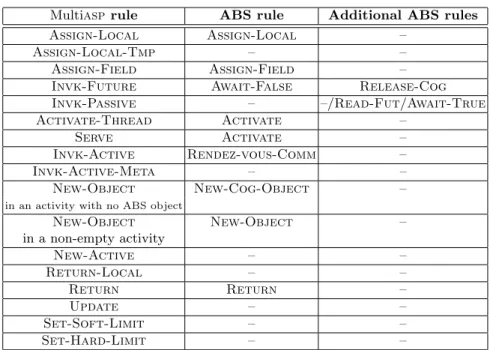
asynchronous remote method invocation on an active object. It creates a fresh future with undefined value. The arguments of the invocation are serialised and put in the store of the invoked activity, possibly renaming locations to avoid clashes. The special case ↵ = requires a trivial adaptation of this rule (not shown here). Return is triggered when a request finishes. It stores the value computed by the request as a future value. Serialisation is necessary to pack the objects referenced by the future value. Update updates a future reference with a resolved value. This is performed at any time when a future is referenced and the future value is resolved. Finally, the main e↵ect of the missing rules is to modify the local store (New-Object and Assign-Field) and to a↵ect the execution context (Invk-Passive and Return-Local).
Threading Policies. We extend the above semantics to specify the threading poli-cies featured in multiactive objects (see Section 2.2). First, we extend the syntax of Multiasp so that the threading policy can be programmatically changed from a soft limit, i.e. a thread blocked in a wait-by-necessity is not counted in the limit, to a hard limit, i.e. all threads are counted in the limit:
Each request q belongs to a group group(q). The filter p�g gives, among the active threads p, only requests of group g. There is a thread limit Lg defined for each group. We tag each of the currently served request as either active or passive. p contains then two kinds of served requests: active ones, noted qA� F, and passive ones, noted qP� F. Active(p) returns the number of active requests in p. Finally, each activity is either in a soft limit state written act(. . .)S (by default at activity creation), or in a hard limit state written act(. . .)H. sh is a variable ranging over S and H. Multiasp semantics is modified as follows:
– Each rule allowing a thread to progress requires now that the thread is active, i.e. q is replaced by qA in all rules except Serve and Update.
– The rule Serve is only triggered if the thread limit is not reached, i.e. if
Active(p�group(q)) < Lg. Simmilarly, a rule for activating a thread is added: Activate-Thread
Group(q) = g Active(p�g) < Lg
act(↵, o↵, ,{qP � F} � p, Rq)sh→act(↵, o↵, ,{qA� F} � p, Rq)sh
– There are two additional rules for switching the kind of limit, we show one hereafter (Set-Soft-Limit is the reverse):
Set-Hard-Limit
act(↵, o↵, ,{qA� {` � setLimitHard; s} ∶∶ F} � p, Rq)sh →act(↵, o↵, ,{qA� {` � s} ∶∶ F} � p, Rq)H
– If the kind of limit is a soft limit, a wait-by-necessity passivates the current thread5; a rule for method invocation on a future is added:
Invk-Future
[[e]]( +`)= o (o) = f
act(↵, o↵, ,{qA� {` � x = e.m(e); s} ∶∶ F} � p, Rq)S →act(↵, o↵, ,{qP� {` � x = e.m(e); s} ∶∶ F} � p, Rq)S
4
Example-Driven Translation Principles
In this section, we informally present the ProActive backend for ABS, that trans-lates ABS programs into ProActive code. Basically, this section shows how the formal translation that will be defined in Section 5 is instantiated in practice in ProActive. This backend is based on the existing Java backend for ABS. We keep the translation of the functional layer unchanged and provide a translation of the object and concurrency layers.
Object Addressing and Invocation. To handle the di↵erences between two active object languages, one needs first to define what happens when a new object (active or not) is created. As translating each ABS object into a ProActive active object is not a viable solution (because it is not scalable and because it requires a complex synchronisation of processes), we put several objects under the control of one active object, which fits the active object group model of
5 Wait-by-necessity occurs only in case of method invocation on a future since field access is only allowed on the current object.
ABS. To this end, in the translation, we introduce a class COG for representing ABS cogs; only objects of the COG class are active objects in the ProActive translation. We translate the ABS new statement that creates a new object in a new cog:
1 Server server = Server();
This instruction is translated into ProActive by the ProActive backend:
1 Server server = Server();
2 COG cog = PAActiveObject.newActive(COG. , Object[]{Server. }, node);
3 server.setCog(cog);
4 cog.registerObject(server);
Line 1 creates a regular server object. Lines 2 uses the newActive ProActive primitive to create a new cog active object. Additionally to the constructor parameters, ProActive allows the specification of the node onto which the active object is deployed. Line 3 makes the local server aware of its cog. Finally in line 4, due to the ProActive by-copy parameter passing, the server object is copied in the local memory space of the newly created remote cog, and is thus locally accessible there. For objects created with new local in ABS, the ProActive backend simply registers them locally in the current cog. To enable the same object invocation model as in ABS, we use a two-level reference system in the ProActive translation: each cog is accessible by a global reference and each translated ABS object is accessible inside its cog through a local identifier. The pair (cog, identifier) is a unique reference for each object and allows the runtime to retrieve any object. When objects are transmitted between cog (e.g. as parameter of method invocations), a lightweight copy is transmitted by the ProActive middleware; it can be used to reach the original object by using its cog and identifier. As only the cog and the identifier are needed to reference an ABS object, we tune the object serialisation mechanism so that only those fields are transmitted between active objects, thus saving memory and bandwidth. The same strategy can be applied to translate any language featuring active object groups into non uniform active objects. For uniform active objects, creating one active object per translated object handles straightforwardly the translation but limits scalability; grouping several objects behind a same active object (proxy) would produce a more efficient program.
In order to explain now how we translate ABS asynchronous method calls in ProActive, consider the following ABS asynchronous method call:
1 server!start(param1, param2);
In ProActive such a call becomes a remote method invocation. In order to handle it with our object translation model, we perform a generic method call (implicitly asynchronous) named execute, on the cog of the translated server object:
1 server.getCog().execute(server.getId(), "start", Object[]{param1, param2});
When run, the execute method of the COG class retrieves the target object through its identifier and runs the start method on it by reflection with the given parameters. Upon execute remote call, objects param1 and param2 are copied to
the memory space of the retrieved cog. Consequently, two copies of param1 and param2exist in the translation whereas only one of them exists in ABS. However, if method calls occurs on them, the requests for those objects always go to the cog that manages those objects. This callback ensures that only one copy of a translated object is manipulated, like in ABS. Consequently, the behaviour by reference of ABS-like languages can be simulated with the behaviour by copy of ProActive. This mechanism is also applied for future updates.
Cooperative Scheduling. Active object languages often support sophisticated thread-ing models and have constructs to impact on the schedulthread-ing of requests. Those constructs can be translated into adequate request scheduling of multiactive ob-jects. For demonstration, we consider here the translation that the ProActive backend gives for ABS await statements (representative of cooperative schedul-ing), and for ABS get statements (representative of explicit futures).
- await statements on futures. An await statement on an unresolved futures releases the execution thread, for example:
1 startedFut?;
In order to have the same behavior in the ProActive translation, we force a wait-by-necessity. We use the getFutureValue ProActive primitive to do that:
1 PAFuture.getFutureValue(startedFut);
As in ProActive a wait-by-necessity blocks the thread, we need to configure the ProActive cog class with multiactive object annotations (see Section 2.2) in order to qualify the execute method and to specify a soft thread limit:
1 (name="scheduling", selfCompatible= )
2 (threadPoolSize=1, hardLimit= )
3 COG {
4 ...
5 ("scheduling")
6 ABSValue execute(UUID objectID, String methodName, Object[] args) {...}
7 }
This configuration allows a thread to process an execute request while a current thread that processes another execute request is waiting for a future. Indeed, the hardLimit=false parameter ensures that the threads counted in the limit (of 1 thread) are only active threads. In the example, the thread can be handed over to another execute request if startedFut is not resolved, just like in ABS. - get statements. The ABS get statement blocks the execution thread to retrieve a future’s value, as for example on the previous future variable:
1 Bool started = startedFut. ;
The ProActive backend translates this ABS instruction into the following code:
1 getCog().switchHardLimit( ); // the retrieved COG is local: the call is synchronous
2 PAFuture.getFutureValue(startedFut);
3 getCog().switchHardLimit( );
This temporarily hardens the threading policy (i.e. all threads are counted in the thread limit) so that no other thread can start while the future is awaited.
- Other synchronisation constructs. We also tackled the translation of ABS suspend statements and of await statements on conditions. In this paper, we only provide the formal definition of their translation in Section 5. The details of their translation into ProActive code can be found in [17].
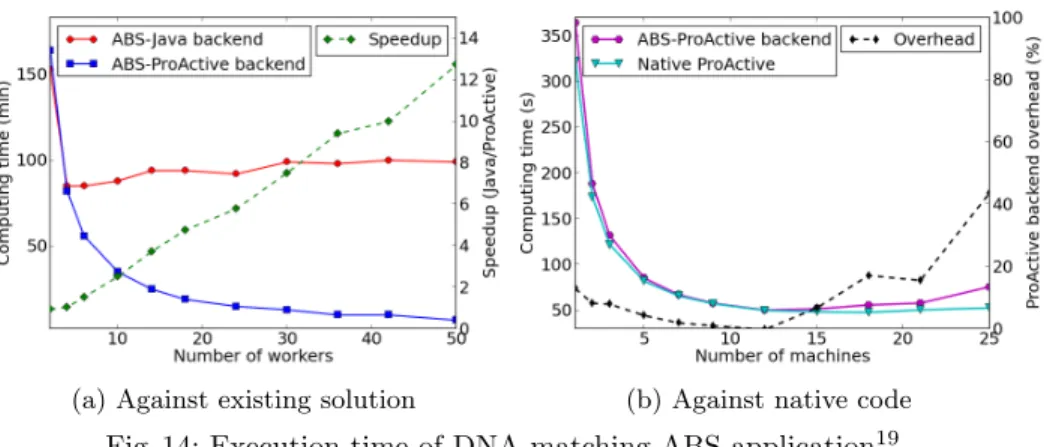
Wrap Up and Applicability. In order to finalise the ProActive backend for ABS, we add deployment information in the translation; for that we use the deploy-ment descriptor embedded in ProActive: configuration files binding virtual nodes to physical machines. On the ABS side, new cog is followed by the name of a node for deployment. This is the only modification that ABS programs must incur to be executed in a distributed way. An experimental evaluation (in Ap-pendix D) shows that a significant speedup can be achieved by a distributed execution of an ABS program thanks to the ProActive backend. It also shows that the program obtained with the ProActive backend incurs an overhead of less than 10% compared to a native ProActive application.
We have presented in details the ProActive backend for ABS and discussed the translation of common active object constructs. The concepts applied in the case of ABS are generic and can systematically turn various active object lan-guages into deployable active objects. As an example, JCoBox is similar enough to ABS so that the approach presented here is straightforwardly applicable. The most challenging aspect is that JCoBox features a globally accessible and im-mutable memory, which could be translated into one active object, or which could rely on copies since the immutable property holds. Regarding Creol, in which all objects are active, the best approach is to group several objects be-hind a same proxy for performance reasons. Then, preserving the semantics of Creol relies on a precise interleaving of local threads. The transposition to Am-bientTalk is trickier on the scheduling aspect, due to the existence of callbacks. However, we found that a callback on a future can be translated as a request that is ready to run but that starts by a wait-by-necessity on the adequate future.
5
Translational Semantics
This section formalises the translation given by the ProActive backend by intro-ducing the translational semantics from ABS to Multiasp. We refer to Figure 1 for the concurrent object layer of ABS. Runtime syntax and semantics of ABS can be found in Appendix A. Most of the translation from ABS to Multiasp im-pacts statements. The rest of the source structure (classes, interfaces, methods) is unchanged except the two following:
1) We define a new class COG. It has methods to store and retrieve local objects, and to execute a method on a local object; UUID is the type of object identifiers: Class COG {
UUID freshID()
UUID register(Object x, UUID id) Object retrieve(UUID id)
Object execute(UUID id, MethodName m, params) {w= .retrieve(id); x=w.m(params); x} }
2) All translated ABS classes are extended with two parameters: a cog parameter, storing the cog to which the object belongs, and an id parameter, storing the object’s identifier in that cog; methods cog() and myId() return those two parameters; a dummy method get() that returns null is added to each object.
The translation of statements and expressions is shown in Figure 8. Each of them is explained below. Object instantiation first gets a fresh identifier from the current cog. Then, the new object is created with the current cog and the iden-tifier6. It is stored in a reserved temporary local variable no. Finally, the object is referenced in the current cog and stored in x. Object instantiation in a new cog is similar to object instantiation in the current cog but method invocations on newcog variable are asynchronous remote method calls. The new object is thus copied to the memory space of the remote new cog via the register invocation, before being assigned to x. Await future uses the dummy get() method, that all translated objects have, in order to trigger the wait-by-necessity mechanism and potentially block the thread if the future is not resolved. Get future sets a hard limit on the current activity, so that no other thread starts, and then restores the soft limit after having waited for the future. Await on conditions performs sequential get() within an activity in soft limit. Conditional guards are detailed later in this section. Asynchronous method call retrieves the cog of the object and relies on the execute asynchronous method call as described in Section 4. Synchronous local method call distinguishes two cases, like in ABS. Either the call is local and an execution context is pushed in the stack, or the call is remote and, like in ABS, we perform an asynchronous remote method invocation and immediately wait the associated future within an activity in hard limit. Finally, instructions that do not deal with method invocation, future manipulation, or object creation, are kept unchanged.
In the translation, there exist di↵erent multiactive object groups and each group has its own thread limit. Group g1 encapsulates f reshId requests; those requests cannot execute in parallel safely, so g1 is not self compatible and can only use one thread at a time. Group g2gathers execute requests. It is limited to one thread to comply with the threading model of ABS, and the requests are self compatible to enable interleaving. Group g3 contains register requests that are self compatible and that have an infinite thread limit. Concerning compatibility between groups, they are all compatible except g3 and g2: their compatibility is defined dynamically such that an execute request and a register request are compatible only if they do not a↵ect the same identifier. In summary:
group(freshId) = g1 group(execute) = g2 group(register) = g3 Lg1= 1 Lg2= 1 Lg3= ∞
∀q, q′.(q ≠ q′≠ freshId() ∧ (�id.q = register(x, id) ∧ q′= execute(id, m, e))) ⇒ compatible(q, q′)
In order to support ABS conditional guards, for each guard g, we generate a method condition g that takes as parameters the needed local variables x. The method body can normally access the fields of the object this. A condition eval-uation g is defined as follows: condition g(x) = while(¬g) skip; return null.
6 The step in which the cog of the new object is set in ProActive is directly encoded in the object constructor in Multiasp.
Jx = e!m(e)K � t = e.cog(); id = e.myId();
x= t.execute(id, m, e) Jawait x?K � w = x.get()Jawait g ∧ g′K � Jawait gK; Jawait g′K Jx = y.getK � setLimitHard;
w= y.get(); setLimitSoft; x= y
Jx = eK � x = e
Jx=e.m(e)K � a = e.cog(); b = this.cog(); if(a == b) {x = e.m(e)} else {t = e.cog(); id = e.myId();
x= t.execute(id, m, e); setLimitHard;
w= x.get(); setLimitSoft} Jx=new local C(e)K � t= this.cog();
id= t.freshId(); no= new C(e, t, id); z= t.register(no, id); x= no
Jx=new C(e)K �newcog=newActiveCOG(); id= newcog.freshId(); no= new C(e, newcog, id); z= newcog.register(no, id); x= no
Jawait gKx� if(¬g) { t = this.cog(); id = this.myId();
z= t.execute condition(id, condition g, x); w = z.get } JsuspendK � t = this.cog(); id = this.myId();
z= t.execute condition(id, condition True, x); w = z.get
Fig. 8: Translational semantics from ABS to Multiasp
We encode the suspend statement the same way with a True condition. We define an execute condition method in the COG class; it executes generated condition methods. The execute condition method has its own group with an infinite thread limit because any number of conditions can evaluate in parallel. More formally, we have: group(execute condition) = g4 Lg4= ∞
6
Translation Equivalence and Active Object Insights
Proving that Multiasp executions exactly simulate ABS semantics is not possi-ble by direct bisimulation of the two semantics. Instead, we prove two di↵erent theorems stating under which conditions each semantics simulates the other. We present all technical details on the equivalence and the proof in Appendix C. We summarise below the highlights of the proof, the principles of the underly-ing equivalence between Multiasp and ABS terms, the di↵erences between the languages and the restrictions of the proof.
Communication and request serving ordering. The semantics of ABS relies on a completely asynchronous communication scheme while Multiasp ensures causal ordering of requests. The equivalence can only be valid for the ABS reductions that preserve causal ordering of requests. Also, Multiasp serves requests in FIFO order, so similarly we execute a FIFO service of ABS requests, like in the existing Java backend for ABS. Note that those di↵erences are more related to scheduling and communication patterns than to the nature of the two languages.
Shallow translation. ABS requests, cogs and futures respectively match one-to-one Multiasp requests, active objects and futures. Likewise, except for cog objects, for each ABS object there exist several copies of this object in Multiasp,
all with the same cog and the same identifier, but only one of those copies (the one hosted in the right cog) is equivalent to the ABS object.
Futures. Because of the di↵erence between the future update mechanisms of ABS and Multiasp, the equivalence relation can follow as many local future indirections in the store as necessary. A variable holding a pointer to a future object in Multiasp is equivalent to the same variable holding directly the future reference in ABS. But also, the equivalence can follow future references in ABS: a future might have been updated transparently in Multiasp while in ABS, the explicit future read has not been performed yet.
Equating Multiasp and ABS configurations. A crucial part of the correctness proof consists in stating whether an ABS and a Multiasp configuration are considered equivalent. The principles of this equivalence are the following:
– Equivalence can “follow futures”: A Multiasp value v is equivalent to an ABS future provided the future’s value is equivalent to v; indeed in Multiasp a future can be automatically updated earlier than in the ABS case.
– Objects are identified by their identifier and their cog name: the value of the object fields are meaningless except in the cog that initially created the object. It is in this cog that we check that fields are equivalent.
– Equivalence between requests distinguishes two cases. 1) active tasks: there is a single active task per cog in ABS and it must correspond to the single active thread serving an execute request in Multiasp. The second element in the call stack corresponds to the invoked request. 2) inactive tasks in ABS correspond either to passive requests being currently interrupted or to not-yet-served requests in Multiasp. For each task, equivalence of executed statements, of local variables, and of corresponding future is checked. Observational equivalence. The precise formulation of our theorems proves that the ABS behaviour is faithfully simulated by our translation (Appendix C.4) and conversely (Appendix C.5). This is proven by adequately choosing the ob-servable and not obob-servable actions in the weak simulation. For example remote method invocation, object creation, and field assignment can be observed and faithfully simulated. The most striking observable reduction in ABS that is not always observable in Multiasp is the future value update. For example, in ABS the configurations (a) fut(f, f′) fut(f′,�) and the configuration (b) fut(f, �) are observationally di↵erent, whereas in Multiasp they are not. Indeed, in Multiasp, there is no process able to detect whether the first future has been updated or not. However, this example is artificial as no information is stored in the first future of configuration (a); any access to the future’s value will have to follow indirections and eventually access the value that is not a future. Thus, trans-parency of futures and of future updates create an intrinsic di↵erence between the two languages. This is why, in the theorem, we exclude the possibility to have a future’s value being a future in the configuration. Eliminating syntacti-cally such programs is not possible, thus we reason on reductions for which the value of a future is not a future; this is not a major restriction on expressiveness because it is still possible to have a future value that is an object containing a future (as future wrappers).
In the other direction, namely from Multiasp to ABS, the translation adds several steps in the reduction. However, the added sequences of actions never introduce concurrency so equivalence still holds because we can ignore additional local actions such as assignments and method calls that are not in the ABS program source (e.g. myId()).
Theorem 1 (ABS to Multiasp). The translation simulates all ABS executions with FIFO policy and rendez-vous communications provided that no future value is a future reference.
Theorem 2 (Multiasp to ABS). Any reduction of the Multiasp translation corresponds to a valid ABS execution.
Globally, our translational semantics fully respects the ABS semantics and simulates exactly all executions complying to the aforementioned restrictions, which either are already existing restrictions of the Java backend for ABS, or for which we have given relevant alternatives.
7
Conclusion
This paper tackled the question of providing active object languages, aimed at modelling and verification, with systematic deployment for distributed comput-ing. For that, we have identified the necessary design choices for active object models and languages, involving: object referencing, language transparency, and request scheduling. These design choices have to be considered when implement-ing any active object language. We have introduced Multiasp, a multi-threaded active object language that has showed to be expressive enough to embody the main paradigms of ABS, featuring in particular cooperative scheduling. We demonstrated how to translate the constructs of an easy to program and verify active object language into the executable code of an efficient and scalable active object middleware. We have instantiated our approach by translating ABS into the ProActive middleware, that implements Multiasp in Java. The immediate outcome of this work is a ProActive backend for ABS. Our approach could be quite easily ported other active object languages since we reason more on ac-tive object abstractions than on language specifics. Typically, our work can be straightforwardly adapted to any active object language featuring cooperative scheduling, like Creol and JCoBox. Porting our results on AmbientTalk only requires minor adaptations. A comparison of the ProActive backend against a currently developed Java 8 backend for ABS [19] is ongoing. This analysis fo-cuses on the di↵erent implementation approaches for efficiently encoding the ABS semantics. More generally, the provided proof of correctness highlighted the intrinsic di↵erences between active object languages and models. This work will help active object users to choose the language that is the most adapted for their needs, and also help active object designers to identify the implication of specific language constructs and abstractions.
References
1. G. Agha and C. Hewitt. Concurrent programming using actors. In Foundations of Software Technology and Theoretical Computer Science. Springer, 1985.
2. E. Albert, P. Arenas, A. Flores-Montoya, S. Genaim, M. G´omez-Zamalloa, E. Martin-Martin, G. Puebla, and G. Rom´an-D´ıez. SACO: Static analyzer for concurrent objects. In TACAS’14. Springer, 2014.
3. N. Bezirgiannis and F. Boer. SOFSEM 2016, chapter ABS: A High-Level Mod-eling Language for Cloud-Aware Programming, pages 433–444. Springer Berlin Heidelberg, Berlin, Heidelberg, 2016.
4. F. S. D. Boer, D. Clarke, and E. B. Johnsen. A complete guide to the future. In ESOP’07. Springer, 2007.
5. S. Brandauer, E. Castegren, D. Clarke, K. Fernandez-Reyes, E. Johnsen, K. Pun, S. Tarifa, T. Wrigstad, and A. Yang. Parallel objects for multicores: A glimpse at the parallel language Encore. In Formal Methods for Multicore Programming, LNCS. Springer, 2015.
6. D. Caromel and L. Henrio. A Theory of Distributed Objects. Springer, 2004. 7. J. Dedecker, T. Van Cutsem, S. Mostinckx, T. D’Hondt, and W. De Meuter.
Ambient-oriented programming in ambienttalk. In ECOOP’06. Springer, 2006. 8. C. Din, R. Bubel, and R. Hahnle. KeY-ABS: A deductive verification tool for the
concurrent modelling language abs. In A. P. Felty and A. Middeldorp, editors, Automated Deduction - CADE-25, LNCS. Springer, 2015.
9. C. Flanagan and M. Felleisen. The semantics of future and its use in program optimization. In POPL ’95. ACM, 1995.
10. E. Giachino, C. Laneve, and M. Lienhardt. A framework for deadlock detection in ABS. Journal of Software and Systems Modeling, 2014.
11. P. Haller and M. Odersky. Scala actors: Unifying thread-based and event-based programming. Theor. Comput. Sci., Feb. 2009.
12. L. Henrio, F. Huet, and Z. Istv´an. Multi-threaded active objects. In COORDINA-TION’13. Springer, 2013.
13. L. Henrio and J. Rochas. Declarative Scheduling for Active Objects. In SAC’14. ACM, 2014.
14. E. Johnsen, R. H¨ahnle, J. Sch¨afer, R. Schlatte, and M. Ste↵en. ABS: A core language for abstract behavioral specification. In FMCO’12. Springer, 2012. 15. E. B. Johnsen, O. Owe, and I. C. Yu. Creol: A type-safe object-oriented model for
distributed concurrent systems. Theoretical Computer Science, 2006.
16. R. G. Lavender and D. C. Schmidt. Active object: an object behavioral pattern for concurrent programming. In Pattern languages of program design 2. 1996. 17. J. Rochas and L. Henrio. A ProActive Backend for ABS: from Modelling to
De-ployment. Research Report RR-8596, Sept. 2014.
18. J. Sch¨afer and A. Poetzsch-He↵ter. JCoBox: Generalizing active objects to con-current components. In ECOOP’10. Springer, 2010.
19. V. Serbanescu, K. Azadbakht, F. de Boer, C. Nagarajagowda, and B. Nobakht. A design pattern for optimizations in data intensive applications using ABS and JAVA 8. Concurrency and Computation: Practice and Experience, 2016.
Appendix
This appendix presents more details about the ProActive backend for ABS and its associated proof of correctness. More precisely, it adds:
– A recall of ABS runtime syntax and semantics, for self contents. – The full semantics of Multiasp.
– The proofs of Theorem 3 and Theorem 4, with restrictions, equivalence re-lation, and preliminary lemmas.
– An experimental evaluation of the ProActive backend for ABS.
A
ABS Runtime Syntax and Semantics
We first recall the runtime syntax of ABS below. ABS runtime syntax is taken from[2].
cn∶∶= ✏ � fut(f, val) � act∶∶= o � " ob(o, a, p, q) � invoc(o, f, m, v) � cog(c, act) � cn cn p∶∶= {l � s} � val∶∶= v � � q∶∶= ✏ � {l � s} � q q a∶∶= [�, x � v, �] s∶∶= (f) � . . . v∶∶= o � f � . . .
We also recall the semantics of ABS on Figure 9 and Figure 10. The ABS seman-tics presented below is based on the one presented in[2], which itself represents a more mature ABS semantics than the original one in[4](minor updates). The modifications we make on the semantics of ABS simply aim at making the proof clearer on concurrency aspects, and still keeping the essence of the translation. In particular, below is the list of the modifications we bring:
– Class fields and class parameters distinction have been removed, one of them simply being a syntactic sugar for fields initialised automatically to null. – When an object is created, it is and has no request in queue instead
of having the init request in the queue (New-Object case) or as current task (New-Cog-Object case). Consequently, a new cog coming from a new object has no current activated object instead of having the new object activated. As we enforce causal ordering of requests, it is easy to perform an init invocation on the newly created object; it will necessarily be executed first.
[2] E. Giachino, C. Laneve, and M. Lienhardt. A framework for deadlock detection in ABS. Journal of Software and Systems Modeling, 2014.
[4] E. Johnsen, R. H¨ahnle, J. Sch¨afer, R. Schlatte, and M. Ste↵en. ABS: A core language for abstract behavioral specification. In FMCO’12. Springer, 2012.
(Skip) ob(o, a, {l � ; s}, q) a → ob(o, a, {l � s}, q) (Assign-Local) x∈ dom(l) v = [[e]]A (a+l) ob(o, a, {l � x = e; s}, q) a → ob(o, a, {l[x � v] � s}, q) (Assign-Field)
x∈ dom(a) � dom(l) v = [[e]]A (a+l)
ob(o, a, {l � x = e; s}, q)
a
→ ob(o, a[x � v], {l � s}, q)
(Cond-True)
true= [[e]]A(a+l)
ob(o, a, {l � e {s1} {s2}; s}, q)
a
→ ob(o, a, {l � s1; s}, q)
(Cond-False)
false= [[e]]A(a+l)
ob(o, a, {l � e {s1} {s2}; s}, q) a → ob(o, a, {l � s2; s}, q) (Await-True) f= [[x]]A (a+l) v≠ � ob(o, a, {l � x ; s}, q) fut(f, v) a → ob(o, a, {l � s}, q) fut(f, v) (Await-False) f= [[x]]A (a+l) ob(o, a, {l � x ; s}, q) fut(f, �) a → ob(o, a, , q∪ {l � x ; s}) fut(f, �) (Release-Cog) ob(o, a, , q) cog(c, o) a → ob(o, a, , q) cog(c, ✏) (Activate) c= a(cog) ob(o, a, , q∪ {l � s}) cog(↵, ✏) a → ob(o, a, {l � s}, q) cog(c, o) (Read-Fut) f= JeKA(a+l) v≠ � ob(o, a, {l � x = e. ; s}, q) fut(f, v) a → ob(o, a, {l � x = v; s}, q) fut(f, v) (New-Object) o′= fresh(C) fields(C) = x v= [[e]]A (a+l) a′= [x � v, cog � c]
ob(o, a, {l � x = C(e); s}, q) cog(c, o)
a
→ ob(o, a, {l � x = o′; s}, q) cog(c, o)
ob(o′, a′, ,�)
(New-Cog-Object)
c′= fresh( ) o′= fresh(C) fields(C) = x v= [[e]]A (a+l) a′= [x � v, cog � c′] ob(o, a, {l � x = C(e); s}, q) a → ob(o, a, {l � x = o′; s}, q) ob(o′, a′, ,�) cog(c′, ✏)
Fig. 9: Semantics of core ABS(1).
– Statements following a instruction are discarded. This fits better with most of mainstream programming languages, and, in addition, having a second in further statements would cause a deadlock in the semantics since there would be no recipient for the future and the rule cannot be reduced. Additionally, the Java backend for ABS already implement this semantics for .
B
Multiasp Semantics
Figure 11 recalls the semantics of Multiasp, with the Assign-Local, New-Object, Invk-Passive, and Return-Local rules.
C
Proof of Theorem 3 and Theorem 4
In this section, we prove two theorems that corroborate the translation from ABS to Multiasp. The theorems specify under which conditions each seman-tics simulates the other. We first focus the proof on the less trivial and most
(Rendez-vous-Comm)
f= fresh( ) o′= JeKA
(a+l) v= JeKA(a+l)
p′′= bind(o′, f, m, v, class(o′)) ob(o, a, {l � x = e m(e); s}, q) ob(o′, a′, p′, q′) a
→ ob(o, a, {l � x = f; s}, q) ob(o′, a′, p′, q′∪ p′′) fut(f, �)
(Context)
cn→ cna ′ cn cn′′ a→ cn′cn′′
(Cog-Sync-Call)
o′= [[e]]A
(a+l) v= [[e]]A(a+l) f= fresh( )
c= a′(cog) f′= l(destiny) {l′� s′} = bind(o′, f, m, v, class(o′)) ob(o, a, {l � x = e m(e); s}, q) ob(o′, a′, , q′) cog(c, o) a → ob(o, a, , q∪ {l � f ; x= f. ; s}) fut(f, �) ob(o′, a′,{l′� s′; f′}, q′) cog(c, o′) (Cog-Sync-Return-Sched) c= a′(cog) f = l′(destiny) ob(o, a, {l � f}, q) cog(c, o) ob(o′, a′, , q′∪ {l′� s}) a → ob(o, a, , q) cog(c, o′) ob(o′, a′,{l′� s}, q′) (Self-Sync-Call) f′= l(destiny) o = [[e]]A
(a+l) v= [[e]]A(a+l)
f= fresh( ) {l′� s′} = bind(o, f, m, v, class(o)) ob(o, a, {l � x = e m(e); s}, q) a → ob(o, a, {l′� s′; (f′)}, q ∪ {l � f ; x= f. ; s}) fut(f, �) (Return) v= [[e]]A (a+l) f= l(destiny) ob(o, a, {l � e; s}, q) fut(f, �) a → ob(o, a, , q) fut(f, v) (Rem-Sync-Call) o′= [[e]]A
(a+l) f= fresh( ) a(cog) ≠ a′(cog)
ob(o, a, {l � x = e m(e); s}, q) ob(o′, a′, p, q′)
a → ob(o, a, {l � f = e m(e); x = f. ; s}, q) ob(o′, a′, p, q′) (Self-Sync-Return-Sched) f= l′(destiny) ob(o, a, {l � (f)}, q ∪ {l′� s}) a → ob(o, a, {l′� s}, q)
Fig. 10: Semantics of core ABS(2).
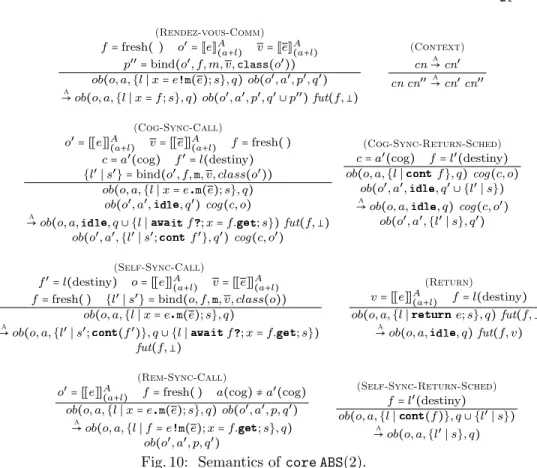
informative theorem: the proof that all ABS executions with FIFO policy and rendez-vous based communications are simulated by Multiasp executions. For the second proof, stating that a Multiasp translation corresponds to a valid ABS execution, we expose the di↵erences and similarities compared to the first theorem proof and conclude.
C.1 Restrictions
Before simulating the semantics of ABS and Multiasp, we define here three spe-cific restrictions. First, Multiasp ensures causal ordering of communications with a rendez-vous preceding all asynchronous method calls: the request is dropped in the remote request queue synchronously. This brief synchronisation does not ex-ist in ABS where requests can arrive in any order. We will reason on→, the ABSa semantics with rendez-vous communications, i.e. the semantics taken from [4] where the message sending and reception rule is replaced by:
[4] E. Johnsen, R. H¨ahnle, J. Sch¨afer, R. Schlatte, and M. Ste↵en. ABS: A core language for abstract behavioral specification. In FMCO’12. Springer, 2012.
Serve ready(q, p, Rq) q= (f, m, v) bind(o↵, m, v) = {` � s} act(↵, o↵, , p, Rq∶∶ q ∶∶ Rq’) →act(↵, o↵, ,{q � {`�s}} � p, Rq ∶∶ Rq’) Assign-Local x∈ dom(`) v= [[e]]( +`) act(↵, o↵, ,{q � {` � x = e; s} ∶∶ F} � p, Rq) →act(↵, o↵, ,{q � {`[x � v] � s} ∶∶ F} � p, Rq) Assign-Field
`(this) = o x∈dom( (o)) x∉dom(`) ′= [o � ( (o)[x � [[e]]( +`)])]
act(↵, o↵, ,{q � {` � x = e; s} ∶∶ F} � p, Rq) →act(↵, o↵, ′,{q � {` � s} ∶∶ F} � p, Rq)
New-Object
fields(C) = x o fresh ′= ∪ {o � [��⇀x= v]} [[e]]( +`)= v
act(↵, o↵, ,{q � {` � x = new C(e); s} ∶∶ F} � p, Rq) →act(↵, o↵, ′,{q � {` � x = o; s} ∶∶ F} � p, Rq) New-Active
fields(C) = x o, fresh ′= {o � [��⇀x= v]} ∪ serialise(v, ) [[e]]( +`)= v
act(↵, o↵, ,{q � {` � x = newActive C(e); s} ∶∶ F} � p, Rq) →act(↵, o↵, ,{q � {` � x = ; s} ∶∶ F} � p, Rq) act( , o, ′,�, �)
Invk-Active
[[e]]( +`)= [[e]]( +`)=v
f, o fresh 1= ∪ {o�f} (vr, r)=rename ′(v, serialise(v, )) ′′= ′∪ r
act(↵, o↵, ,{q � {` � x = e.m(e); s} ∶∶ F} � p, Rq)act( , o , ′, p′, Rq′)
→act(↵, o↵, 1,{q � {` � x = o; s} ∶∶ F} � p, Rq) act( , o , ′′, p′, Rq′∶∶ (f, m, vr)) fut(f, �) Invk-Passive
[[e]]( +`)= o [[e]]( +`)= v bind(o, m, v) = {`′� s′}
act(↵, o↵, ,{q � {` � x = e.m(e); s} ∶∶ F} � p, Rq) →act(↵, o↵, ,{q � {`′� s′} ∶∶ {` � x = ●; s} ∶∶ F} � p, Rq) Return-Local v= [[e]]( +`) act(↵, o↵, ,{q � {` � e; sr} ∶∶ {`′� x = ●; s} ∶∶ F} � p, Rq) →act(↵, o↵, ,{q � {`′� x = v; s} ∶∶ F} � p, Rq) Return v= [[e]]( +`) act(↵, o↵, ,{(f, m, v) � {` � e; sr} � p, Rq)fut(f, �)
→act(↵, o↵, , p, Rq) fut(f, v, serialise(v, ))
Update
(o) = f (vr, r) = rename (v, ′) ′′= [o � vr] ∪ r
act(↵, o↵, , p, Rq)fut(f, v, ′) →act(↵, o↵, ′′, p, Rq) fut(f, v, ′) Fig. 11: Semantics of Multiasp
1∃a. cog(↵, a) ∈ Cn i↵ ∃o↵, , p, Rq. act(↵, o↵, , p, Rq) ∈ Cn with
2 ∃v, p′, q.ob(i ↵, ��⇀x�v, p′, q)∈Cn i↵ ∃o, v′. (o)=[cog�↵, myId � i,���⇀x�v′] with 3 v≈Cnv′ ∧
4 � ∃l, s. p
′= {l�s} i↵ ∃f, i, m, v′′, `′, s′, `′′, s′′.�(f, execute, i, m, v′′)A� {`′�s′} ∶∶ {`′′�s′′} ∈ p ∧ `′(this) = o� with ∀x ∈ dom(l)�destiny. l(x) ≈Cn`′(x) ∧ l(destiny) = f) ∧ s ≈Cn
+`′s′� ∧ 5 ∀f. � �� �� � �∃l, s.({l�s} ∈ q ∧ l(destiny) = f) i↵
∃i, m, v′′, `′, s′, `′′, s′′.� �(f, execute, i, m, v′′)P � {`′�s′} ∶∶ {`′′�s′′} ∈ p ∧ `′(this) = o� ∨ �(f, execute, i, m, v′′) ∈ Rq ∧ o↵.retrieve(i)=o ∧ bind(o, m, v′′) = {`′�s′}� �
with (∀x ∈ dom(l)�destiny. l(x) ≈Cn`′(x)) ∧ s ≈Cn +`′s′� � �� �� � 6fut(f, v) ∈ Cn i↵ ∃v′, .(fut(f, v′, ) ∈ Cn ∧ Method(f) = execute) with v ≈Cnv′
7 fut(f, �) ∈ Cn i↵ fut(f, �) ∈ Cn ∧ Method(f) = execute
Fig. 12: Equivalence condition of two configurations7, 8
Rendez-vous-Comm
fresh(f) i′ = JeKAa+l v= JeKAa+l p′′= bind(i′ , f, m, v, class(o′)) ob(i ↵, a, {l�x = e!m(e); s}, q) ob(i′ , a′, p′, q′)
a
→ ob(i ↵, a, {l�x = f; s}, q) ob(i′ , a′, p′, q′∪ p′′) fut(f, �)
whereJKAis the expression evaluation in ABS. Another rule has to be added in case of a message to the same object. Secondly, in Multiasp, while thread ac-tivation can happen in any order, the order in which requests are served is FIFO by default instead of the non-deterministic activation of a thread featured by ABS semantics. In both the existing Java backend for ABS and the developed ProActive backend, activation and request service are FIFO, although multi-active objects support the definition of di↵erent policies [3]. Consequently, we only reason on executions with a FIFO policy, i.e. executions that serve requests and restore them in a FIFO order. Finally, the proof does not deal with local synchronous method invocations; indeed this would make the proofs more en-tangled and would bring no particular insight on the translation because this part is similar to the existing Java backend for ABS.
C.2 Equivalence
We define an equivalence relationR between Multiasp and ABS terms. We then prove that any single step of one calculus can be simulated by a sequence of steps
7 We use the following notation:∃y. P i↵ ∃x. Q with R means
(∃y. P i↵ ∃x. Q) ∧ ∀x, y. P ∧ Q ⇒ R. This allows R to refer to x and y. 8 Method(f) returns the method of the request corresponding to future f
[3] L. Henrio and J. Rochas. Declarative Scheduling for Active Objects. In SAC’14. ACM, 2014.
in the other. This is similar to the proof in[1]; we use the same observation notion: processes are observed based on remote method invocations.
Definition 1 (Equivalence Relation R). ≈Cn is an equivalence between val-ues (or between a value and a storable) in the context of a Multiasp store and an ABS configuration Cn: v≈Cnv f≈Cnf i ↵≈Cn[cog � ↵, Id � i, x � v′] v≈ (o) v≈Cno fut(f, v′) ∈ Cn v′≈Cnv f≈Cnv
Runtime values in ABS are either (global) object references, future references or primitive values. Equivalence ≈Cn specifies that two identical values or futures are equivalent if they are the same. Otherwise, an object is characterised by its identifier and its cog name. The two last cases are more interesting and are necessary because of the di↵erence between the future update mechanisms of ABS and Multiasp. First, the equivalence can follow as many local indirections in the store as necessary. Second, the equivalence can also follow future references in ABS: a future might have been updated transparently in Multiasp while in ABS the explicit future read has not been performed yet.
Furthermore, we have an equivalence on statements: s≈Cn
( +`′)s′i↵
− either JsK = s′
− or s = (x = v; s1) ∧ s′= (x = e; Js1K) with v ≈CnJeK( +`′ )
In words, two statements are equivalent if one is the translation of the other. Or, two statements are also equivalent if both statements start with an assignment of equivalent values to the same variable, followed by equivalent statements.
Finally, ABS configuration Cn and Multiasp configuration Cn are equivalent, written Cn R Cn, i↵ the condition on Figure 12 holds.
The equivalence condition of Figure 12 considers three cases:
– The first five lines deal with equivalence of cog. This case compares both activity content and activity requests on the ABS and Multiasp sides:
● To compare activity content, we rely on the fact that activities have the same name in ABS and in Multiasp. Each ABS object ob must correspond to one equivalent Multiasp object in the equivalent activity ↵. The object equivalent to ob must be in the store, must reference ↵ as its cog, must have i as identifier9, and must have other fields equivalent to the ones of ob. ● To compare activity requests, we need to compare the tasks that exist in
ABS ob terms to the tasks that exist in the corresponding Multiasp act terms. We consider again two cases:
1. Either the task is active, the single active task of ob (in p′) must have exactly one equivalent active task in Multiasp (in p). In Multiasp, this
9 Recall that the corresponding ABS identifier is i ↵.
[1] M. Dam and K. Palmskog. Location independent routing in process network over-lays. In PDP’14. IEEE, 2014.