Hanspeter Stamm ~, Markus Lamprecht ~, Bertino Somaini 2, Matthias Peters 3 Originalartikel I original article
1 Lamprecht and Stamm SFB AG ZOrich & Department of Physical Education, Swiss Federal Institute of Technology, ZOrich
2 Institute for Social and Preventive Medicine, University of ZOrich 3 IP50 Sozialforschung, DObendorf
I "Getting Switzerland to move": evaluation of
a new "Sport for All" programme
Summary
Objectives: Even though sports participation in Switzerland appears to be quite elevated~ recent research suggests that only about a third of the population are doing enough sports from a health perspective~
Methods: Against this background severat Swiss health insu- rance companies together with the Swiss Olympic Association have recently developed a novei approach to get people to start physicat exercise: Under the ~abe~ of (~Altez Hopb~ sport clubs offer training and informatio~ coarses aimed at motiva- ting and helping previously inactive peopte to take on regular exercise~
Results: The paper presents results from an interdisciplinary evaluation of the first three years of the ((AHez Hop!~ cam- paign. Starting from an ove~'~Jiew of the basic idea and fea- tures of the campaign it asks whe-ther ~Al[ez Hopb~ has reached its self-declared goal of "getting Switzerland moving". Available evidence on the social background of participants and their further activities shows that by systematically avoid- ing any reference to conventional notions of sport and by stressing the health and ~un aspect instead, (~AIlez Hopb~ has indeed managed to mobilise an important group with under- average levels of activity (particu~aHy middle-aged women}, in addition, on average the level of physicaA exercise of par- ticipants appears to have increased. "Yet, the number of parti- cipants is betow the original target vaiues and,. contrary to the campaign's initiat goal, participants are reluctant to teave the programme after one course to take up an independent activity or to join a dub.
Conclusions: The paper explores the achievements and pro- blems of the campaign so far and offers an explanation of recent problems which can a~so serve as a basis for the impte- enentation of similar programmes in other countries.
Soz.- Pr~ventivmed. 46 (2001) 020-028 0303-8408101/010020-09 $ 1.50 + 0.2010 9 Birkh~user Verlag, Basel, 2001
Key-Words: Health promotion - Sport- Physical activity - Evaluation study- Longitudinal comparison - Switzerland.
Switzerland has often been regarded as a successful example of the "Sport for All" idea. As early as 1969, six years before the Council of Europe introduced its "Sport for All" charter, the Swiss Association for Sport, the governing body of Swiss sport clubs and associations, had created a special "Sport for All" commission which subsequently started to develop pro- grammes and coordinate activities between different regions and federations. These programmes were mainly aimed at popularising sports and opening the somewhat rigid system of the clubs for new members and new kinds of activity (e.g. leisure and health sports as opposed to competitive sports). Even though the "Sport for All" campaign together with other developments at both the level of society and sports appears to have led to a democratisation of the Swiss sport system and increasing levels of participation 1, recent surveys indicate that only a minority of the population are doing
enough
sports from a health perspective. According to theEuropean Network for the Promotion of Health Enhancing Physical Activity (HEPA), people should engage in physical activities of at least 30 minutes per day and at medium levels of intensity to achieve a substantial health benefit 2 (see also3-6). The 1997 Swiss Health Survey shows, however, that about a third (31%) of the Swiss population must be classi- fied as completely inactive with respect to physical activity 7. According to a more recent survey on physical activity in Switzerland the share of inactive people amounts to 37% the population g. Even more strikingly, the proportion of inac- tive people appears to have increased since 1992 when the first Swiss Health Survey was carried out 7, 9.
Note: An earlier version of this paper was presented at the 1999 Symposium of the International Sociology of Sport Association (ISSA) "New Century - New Challenges", June 26-30, 1999, Budapest
Stamm H, Lamprecht M, Somaini B, Peters M "Getting Switzerland to Move"
Originalartikel I original article 21
In addition, and despite the democratisation process in sport, according to recent research on physical activity and sports in Switzerland 7,8,1~ there are still some important social differences in activity levels. The most important per- sisting differences refer to the well-known gender and age dimensions in the sense that women and elderly people are on average somewhat less active than men and younger people. There is also a very marked difference between lan- guage regions in the sense that sports activity is considerably higher in the German speaking part of Switzerland than in the French and Italian speaking parts. A n d finally, there are also differences with respect to education, occupational sta- tus, nationality (immigrant workers) and parenthood. Against this background, the focus in "Sport for All" cam- paigns has shifted during the past few years. The issue at hand was no longer to provide equal opportunities for sport participation - a task quite successfully performed by earlier "Sport for All" campaigns and political interventions -, but to convince people to do sports, or more generally to engage in regular physical activities to increase their health and quality of life as.
One of the initiatives undertaken to achieve this goal was the establishment of the so-called ~Allez Hopb> campaign in 1995 in a joint effort of three Swiss health insurance com- panies (Konkordia, Helsana and Wincare) and the Swiss Olympic Association (SOA). The basic idea of the campaign was to "get Switzerland to move" (~Allez Hopb> translates as "Get moving!") by bringing people together with quaff- fied coaches in the framework of specially designed courses aimed at giving them an initial push to do more exercise and keep it up. The campaign involved an innovative co-opera- tion of sports clubs and their coaches, sport associations and private sector companies. The courses were to be held in the well-established framework of existing sport clubs whose coaches underwent special training courses organized by the S O A and some selected sport associations 1). Thus, the organisational tasks at the grass-roots level were assigned to the sport associations and clubs whereas the insurance com- panies took over duties in the marketing and financing of the campaign and the S O A coordinated the effort.
The core of the campaign consists of moderately priced, low level physical education courses for people who do not do enough or any sports at all or want to increase their
~1 Switzerland has about 27000 sports clubs that could be involved in the campaign ~9. For organisational reasons, the campaign started with dubs from only four associations (Athletics, Swim- ming, Tennis and the Swiss Workers' Gymnastic and Sport association) including roughly 3000 clubs for which special formats were developed ("Walking ", "Water fun'% "Play" and "Indoor fun "). Later on, the Swiss Gymnastic Association (6100 clubs) also joined the campaign and the framework was also opened for clubs from other associations.
21 Recent studies show, however, that there are not too many "precontemplators" in the true sense of the word in Switzerland. Most people know quite well that physical activities are health enhancing s, 24,25.
Soz.- Praventivmed. 46 (2001) 020-028 9 Birkhguser Verlag, Basel, 2001
level of activity. In terms of the transtheoretical model of change 2~ the target group was defined as "precontempla- tors", "contemplators" and "preparators" 2) which should be motivated to reach the stages of "action" and "maintenance" of regular, health enhancing physical activity. The courses include 10 weekly lessons in which participants are not only taught physical activities, but also learn relaxation techni- ques and are given information regarding the connection between health and physical exercise. The basic idea is to provide participants with a flfll package of activities and in- formation that helps them to understand the benefits of phy- sical exercise and to integrate these activities into their dally lives. Importantly, however, sport is only one of several pos- sible ways to achieve the health benefits associated with phy- sical activity in the <<Allez Hopb~ programme. Rather than convincing people to do sports in a regular fashion, <~Allez Hopb> encourages them to take up dally physical activities which may or may not be defined as sport. Therefore, ~Allez Hopb> with its focus on physical activity rather than sport does not constitute a "Sport for All" initiative in the traditional sense of the word but rather a new and somewhat broadened combination of "Sport for All" with health related issues. As this new initiative with its focus on health enhancing physical activity rather than sport and its innovative co- operation between different actors may well be of a wider interest, the paper discusses some of its achievements and problems. After a short description of the research method- ology in the following section we shall focus on two main questions: First, whether the campaign is on target, i.e. whether it has successfully mobllised previously inactive persons and, second, whether it has induced a lasting change of behaviour. The final section offers a discussion of the find- ings as well as short assessment of achievements and future challenges for the ~Allez Hopb~ campaign.
M e t h o d s
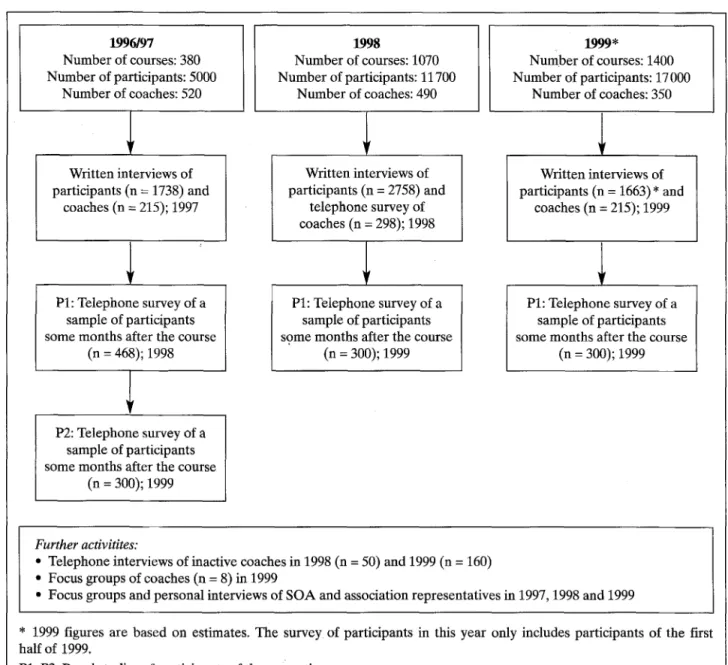
The data used in this paper comes from an interdisciplinary evaluation study on the <<Allez Hopb> campaign carried out between 1997 and 1999. Due to the multitude of potential problems and actors (insurance companies, sport federa- tions, clubs, coaches, and participants), the evaluation study carried out from 1996 onwards had to take into account dif- ferent perspectives and issues. Starting from general re- search findings on levels of physical activity in Switzerland, important target groups were identified. On this basis, the evaluation took a closer look at participants, coaches and representatives of the involved associations. In doing so, the evaluation was divided into several phases which roughly cover calendar years (see Fig. 1).
22 Originalartikel I original a~icle Stamm H, Lamprecht M, Sornaini B, Peters M "Getting Switzerland to Move"
1996197 Number of courses: 380 Number of participants: 5000 Number of coaches: 520 Written interviews of participants (n = 1738) and coaches (n = 215); 1997
PI: Telephone survey of a sample of participants some months after the course
(n = 468); 1998
l
P2: Telephone survey of a sample of participants some months after the course
(n = 300); 1999 1998 N u m b e r of courses: 1070 Number of participants: 11700 N u m b e r of coaches: 490 Written interviews of participants (n = 2758) and telephone survey of coaches (n = 298); 1998
PI: Telephone survey of a sample of participants some months after the course
(n = 300); 1999 1999" Number of courses: 1400 Number of participants: 17 000 Number of coaches: 350 Written interviews of participants (n = 1663) * and coaches (n = 215); 1999
PI: Telephone survey of a sample of participants some months after the course
(n = 300); 1999
Further activitites:
9 Telephone interviews of inactive coaches in 1998 (n = 50) and 1999 (n = 160) 9 Focus groups of coaches (n = 8) in 1999
9 Focus groups and personal interviews of S O A and association representatives in 1997, 1998 and 1999
* 1999 figures are based on estimates. The survey of participants in this year only includes participants of the first half of 1999.
P1; P2: Panel studies of participants of the respective years.
Figure 1 Summary o f data g a t h e r i n g efforts in connection w i t h t h e e v a l u a t i o n o f t h e ~Allez Hopb~ campaign
The basic design of the evaluation study involved inter- viewing samples of participants before, immediately after and a few months after the course to assess mid-term effects (P1). In one instance, a further interview was carried out more than a year after the course which gives an indication of longer term effects (P2). Whereas the first interviews were done with a written questionnaire handed out by the coaches, further contacts were made by telephone. In these follow-up studies, random samples of participants were in- terviewed regarding the assessment of the course and one's own physical activity levels.
Soz.- Pr,~ventivmed. 46 (2001) 020-028 9 Birkh~user Veriag, Basel, 2001
As can be seen from Figure 1, initial response rates from par- ticipants were quite low. In 1996/97 there was a response rate of about 35% which d r o p p e d in 1998 (24%) a n d 1999 (about 20%, only data from the first half of 1999 available). These low reponse rates are mainly due to coaches' reluctance or negligence to distribute and gather the questionnaires?) In addition, at later stages of the campaign courses became
31 A number of coaches reported that there was too much "paperwork". Apart from general administrative duties and the participant questionnaires they also had to administer and evaluate short medical questionnaires at the beginning of the course.
Stamm H, Lamprecht M, Somaini B, Peters M Originalartikel I original article 23 "Gettinc Switzerland to Move"
increasmgly occupied with participants who had already gone through one or more earlier courses (see also below) and who may not have felt inclined to answer the same questions all over again. Still, if one compares the charac- teristics of participants who have answered with general assessments by the coaches and association representatives there do not appear to be any systematic distortions in the sample of participants.
As can be seen from Figure 1, the evaluation study also in- volved interviews, focus groups and in-depth interviews with coaches (both active and inactive) and association as well as S O A representatives. Due to space limitations, the results of these data gathering efforts will not be discussed in detail, however. Starting from a short overview of general data relating to the reach of the campaign we shall confine the analysis to participants by addressing the questions whether the campaign has reached its target group of "(pre)contem- plators" and "preparators" and whether participants man- aged to reach the levels of "action" and "maintenance". Further information on these results as well as on coaches' and associations' perceptions can be found in a number of other reports published in connection with the ~Allez Hop!>~ campaign 25-z7,
Results
Reach of the campaign
As with other new initiatives, the development of the course format and the training programmes for coaches took more time than initially planned. In addition, the recruitment of associations, clubs and coaches also involved some problems in the initial phase of the programme so that the campaign started with some delay in late 1996. In that year only about 100 coaches were trained and the number of courses (about 10) and participants (about 200) was very low. Even though 1997 saw a substantial increase in the number of coaches (about 400), courses (about 400) and participants (5000) it was still below initial target values. In 1998, however, the cam- paign finally seemed to pick up momentum. During that year, a total of about 1070 courses with a total of about 11700 par- ticipants had been held (see Fig. 1). In 1999 this number fur- ther increased to about 1400 courses and 17000 participants. Two important qualifications are in order, however. First, it must be noted that the regional coverage of the campaign was very uneven. Whereas there are some regions in the core of the G e r m a n speaking part of Switzerland with quite a good coverage, the mountain regions and particularly the French and Italian speaking parts of the country have been only marginally integrated into the campaign. In 1998, only 10% of all courses were held outside of the G e r m a n part of Soz.- Pr~ventivmed. 46 (2001) 020 -0 2 8
9 Birkh~user Verlag, Basel, 2001
Switzerland. Even though this figure increased to 15% in 1999 it is still far below the share of the Italian and French speaking population in the total population (the six mainly French and Italian speaking cantons have a share of about a quarter in the total population of Switzerland) 28.
A second qualification relates to so-called "multiple partici- pants", i. e. the fact that the goal of the campaign to motivate participants to become active on their own or as a m e m b e r of a sports club after one course is increasingly threatened by a tendency of participants to sign up for another course once the first course had finished. In fact, in 1999 only 57% of the sample of participants interviewed some months after the course reported that they had only been in one course. A further 22% claimed to have visited two courses and the remaining 21% were in three or more courses. Thus, the numbers refering to participants cited above would have to be corrected substantially and would only include about 10000 persons in 1999, or a total of about 20000 to 25000 persons for the period 1996 through 1999.
Target groups
Against the background of the general findings regarding social differences in sports and physical activity levels, it is easy to identify a number of important "target groups" for ~Allez Hop!>>. These would have to include women, elderly people, people with a comparatively low degree of educa- tion, a low occupational status, immigrant workers and people with kids. In addition, the campaign should focus on the French and Italian speaking parts of Switzerland, where activity levels are lower.
With respect to language regions in Switzerland we have already mentioned that the campaign has not yet managed to get a strong foothold in the regions which are character- ised by lower average levels of physical activity. If we look at the socio-demographic and socio-economic profile of par- ticipants in Table 1, we can conclude that ~Allez Hopb> is on target, however. A b o u t 90% of the participants are women of an average age of about 50 years. A b o u t half of these women live with children - another important factor hampering regular physical activity. A n d even with respect to educational status we find that the highest, generally more active levels are somewhat underrepresented. It should be noted, however, that the data in Table i only refer to a small sample of all participants who were asked additional ques- tions regarding education and life situation in a telephone survey (P1). The more general surveys of participants described above only included age and gender. With respect to these two dimensions, however, the results from different surveys are largely identical. In this connection it is also noteworthy that participants appear to be very similar to
24 Originalartikel I original article Stamm H, Lamprecht M, Somaini B, Peters M "Getting Switzerland to Move"
lighest educational degree (percentage
ire situation (percentage. ~
Table 1 Social p r o f i l e o f <<Allez Hopb~ p a r t i c i p a n t s ( s a m p l e o f 300 p a r t i c i p a n t s o f 1998)
Level o f activity (15 minutes o r more,
Table 2 Physical activities o u t s i d e o f t h e courses ( p e r c e n t a g e , c o m - p a r i s o n o f 1997 a n d 1998)
their coaches: According to a survey of active coaches, 78% of the coaches were women, 91% were married and the average age was 45 years in 1998.
Of course, the data in Table i only gives an indication of the social profile of the target group but does not tell us whether the participants really belong to the group of previously inactive people. Even though there are no direct measures of activity levels before the course, a general assessment can be derived from a number of questions refefing to the fre- quency of several physical activities such as cycling, walking or gymnastics. The figures in Table 2 give an indication of how often participants of 1997 and 1998 engaged in such activities outside of the course.
The table shows that the proportion of truly inactive people, i.e. people active less than once a week, is quite small and has even diminished from 15 to 6% between 1997 and 1998. On the other hand, the proportion of regularly active parti- cipants is surprisingly high and has clearly increased over time. g) The data in Table 2 thus suggests that more than half of all participants must clearly be defined as physically active (i. e. "action" or "maintenance" phase of the transtheoretical 4) It should be noted, however, that this finding is to some extent due to the fact that in 1998 the sample included a great number of people who had already gone through several courses and had thus already reached higher stages of activity,
Soz.- Praventivmed. 46 (2001) 020-028 9 Nrkh~user Verlag, Basel, 2001
model). Even if "middle-aged women" exhibit under-aver- age activity levels at the level of the general population, a large proportion of the participants of <<Allez Hopb~ does not qualify as "(pre)contemplators" or "preparators" in the sense of the transtheoretical model.
However, it is also important to note that <<Allez Hopb~ does not just advocate regular activity but would rather like to see participants become active on a daily basis. Thus, if we look at Table 2 we can see that only a minority of a fifth to a quarter of participants exhibit this level of activity.
Changes in behaviour
Inducing a stable change of behaviour towards higher activi- ty levels regardless of initial activity levels is a main aim of ~<Allez Hopb>. To test whether this goal has been achieved one can use the panel data from participants who attended their (first) course in 1997 and were then interviewed again in 1998 (P1) and 1999 (P2) on their current activity levels. One question in these interviews directly asked whether participants had increased their level of physical activity as a result of the courses. In the panel study of participants which had finished their courses a year earlier (P2), over half of the respondents (59%) answered that they had in fact integrated more physical activity into their lives, and a further third (37%) reported stable activity levels. Only five persons (2%) in this sample of 300 earlier participants claim that they have reduced their activity. These numbers confirm findings from earlier panel interviews with participants some months after the courses (P1).
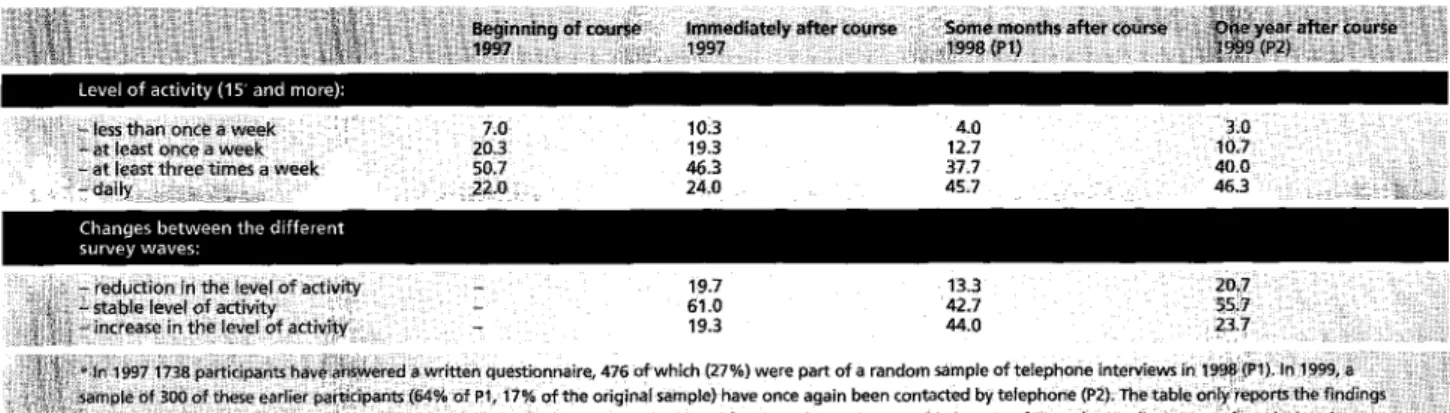
Of course, self-declared changes of behaviour may be dis- torted by effects of social desirability and wrong estimates of one's own activity. Against this background, Table 3 pre- sents the results of another analysis that was performed on the basis of reported activities outside of the courses. The data refer, once again, to people who entered the <<Allez Hopb> campaign in 1997 and were subsequently interviewed two times on the extent of their physical activity. Table 3 shows activity levels at different points in time for the same group of respondents, i.e. before, immediately after, and some months (P1) to over a year (P2) after the course. In addition, the lower half of the table includes an overview of whether respondents' activity levels have increased or de- creased between the different surveys.
A first noteworthy result in Table 3 is the strong increase in activity between 1997 and 1998 which, however, is to some extent due to different measurements of activity levels be- tween the written (1997) and the telephone surveys (1998, 1999). Still, even if one keeps these differences in mind, one can conclude that activity has increased. Most important, however, are the findings between the second and the third
Stamm H, Lamprecht M, Somaini B, Peters M "Getting Switzerland to Move"
Originalartikel I original article 25
!vel o1 activity (15" arlcl mor~
103 4,0 193 12,7 46.3 37.7 : 24.0 45,7 i9.7 133 61.0 4 2 . 7 19.3 44.0 )m sam ~ntaCtec n P2 th~ 297 ;
Table 3 A c t i v i t y levels a n d c h a n g e in a c t i v i t y levels a t d i f f e r e n t p o i n t s in t i m e ( p e r c e n t a g e s , p a n e l o f p a r t i c i p a n t s * )
wave which show that activity levels tend to increase slight- ly even one year after the course.
This is also evidenced in the lower half of the table: Most respondents report a stable level of activity, whereas about 20% either r e p o r t an increase or a decrease in activity be- tween 1998 and 1999. In this connection it should be noted that the comparatively big proportions of people who show stable or even decreasing activity levels is mainly due to the elevated initial activity levels of many participants, that is: if somebody is already in the highest category he or she can at best remain stable or go down. As over 80% of respondents in the first panel study of 1998 already belonged to the two higher groups, the potential for a further increase was a lot more limited than the potential for a decrease. Against this background, the high proportion of people with a stable level of activity in the latest study is not surprising and can thus be interpreted in a positive way.
Discussion
The results shown in section 3 point to positive as well as negative aspects of the <~Allez Hopb> campaign which also have some important implications for its future and similar initiatives.S)
A first problematic finding is the slow start of the campaign and its relatively low number of participants. <~Allez Hopb~ started from somewhat uncertain territory, and therefore it is clear that there were several organisational problems at the outset. Still, an estimated figure of about 20 000 to 25 000 persons (corrected for multiple participants) having partici- pated in the campaign until the end of 1999 is still very low compared to a total of maybe four million inhabitants which are estimated as not engaging enough in physical activity. A s Roger Staub, one of the former directors of the campaign, SOZ- Pr~iventivmed. 46 (2001) 020-028
@ Birkh~user Verlag, Basel, 2001
has calculated provocatively in a meeting of coaches in February 1999, at this rate it would take <~Allez Hop!>> sever- al decades or even centuries to reach its target of "getting Switzerland to move". As a consequence, there appears to be a need to step up the campaign and to increase "turnover" of participants, i.e. attracting new participants and creat- ing incentives for "multiple" participants to leave the cam- paign. 6)
Against the background of an increasing number of "mul- tiple" participants, it could be argued that the stable or in- creasing levels of activity reported in section 3 are rather due to a continuous participation in <~Allez Hop!>> than to effec- tive changes of behaviour at the level of the individual. This does not seem to be the case, however. If one compares the group of people whose last course ended at least a year ear- lier with the group who is either still involved in <<Allez Hopb~ or has attended their last course during the past few months, no substantial and significant differences in activity levels emerge. F r o m this finding one can conclude that, on the one hand, ~Allez Hopb~ does lead to a change in behav- iour after the first course, and that, on the other hand, these behavioural effects appear to remain stable in the long-run. Thus, if ~,Allez Hopb~ induces positive changes in behaviour, it becomes even more promising to step up and to extend the campaign to further target groups. In this connection, an im- portant issue at hand is the fact that the campaign has not done very well in the French and Italian speaking parts of the country up to 1999. A s several recent studies have shown7'B that these regions exhibit average levels of physical activity that are considerably lower than the ones found in the G e r m a n speaking part, this finding is very problematic. The more so, because the regional differences in coverage
sl For an international comparison of current programmes see 2.
61 As a means to correct this development, {~Allez Hop! >> has recently introduced a new, intermediate format for people which have already participated in a course but would like to stay within the cam- paign. For such people, special "meeting opportunities" are organised on a weekly basis. Another possibility would be to create special training environments within the sports clubs.
26 Originalartikel I original article Stamm H, Lamprecht M, Somaini B, Peters M "Getting Switzerland to Move"
only partially reflect a time-lag associated with the fact that the campaign was initially developed in the German spea- king part of Switzerland. Another reason for this finding might be cultural conflicts between the regions of Switzer- land which induce a certain reluctance of the French and Italian speaking populations to join a campaign that is per- ceived to be a typically Swiss German initiative. Thus, there appears to be a need for culture specific adaptations of the campaign. By improving public relations in the French and Italian speaking parts of Switzerland and recruiting additio- nal personnel in this region the S O A has made an important step into this direction in 1999. Consequently, the coverage rate for these regions started to improve in 1999.
In a similar way target group specific adaptations must also be considered. As the results show, <<Allez Hopb> has been a quite exclusive "middle-aged women's thing". This achieve- ment must not be underestimated because this group has certainly not attracted its due share of attention in earlier "Sport for All" campaigns. Yet, up to now the campaign has not managed to attract other social groups on a large scale. From the observation that <~Allez Hopb> primarily attracts participants who are very similar to their coaches one would have to conclude that a possible strategy to increase the reach of the campaign would lie in context specific courses and the recruitment of "different" coaches (e.g. men, older people etc.).
Despite these problems, the campaign offers a promising format for promoting health enhancing physical activities. Even though the campaign has not yet fully reached its target group of inactive people, it has attracted considerable attention in selected groups and shown favourable effects on the participants' levels of activity in the short and the long run. Important challenges for the future refer to increasing the reach of the campaign with respect to different geo- graphical regions as well as additional social groups beyond the important group of "middle-aged women".
Zusammenfassung
.Wir bewegen die Schweiz": Erfahrungen mit einer neuen ,,Sport fiJr Alle"-Kampagne
Fragestellung: Obwehl in der Schweiz im inte~nationalen Ver- g~ekh relativ vie~ Sport getrieben wird~ zeigen neue Untersu- chungen, dass im Hinb~ick auf die positiven Gesundheits- effekte k6rperficher IBewegung nur gerade ein Dritte~ der Bev6lkerung gen(Jgend aktiv ist.
Methoden: Vor diesem Hintergrund haben verschiedene
$chweizer Krankenversicherungen und der Schweizerische Olympische Verb~nd (5OV) vor einigen Jahren eine neue 9ewegungskampagne mit dem Titel <r Hopb~ entwickelt: lm Eahmen dieser Kampagne veransta~ten Sportvereine Bewe- gungs.~ und ~nformationskurse, mit denen inaktive Personen dazu motiviert werden solten, sich regelm~issig k6rperiich zu bet~tigen.
Ergebnisse: Der vortiegende Beitrag fasst einige Resuttate einer interdiszipiin~ren Evaluation der ersten drei Jahre der
((Allez Hop.b~oKampagne zusammen. Ausgehend yon einem Uberblick ~ber die grundlegenden Ans~tze und Merkrnale der Kampa~ne wird untersucht, ob ~r Hopb~ des selbst- gesteckte Ziel, ,,die 5chweiz z~ bewegen", erreicht hat. Die ve~f~g~aren Daten zum soziaIen Hintergrund und den Aktivit~tsprofilen der TeilnehmerInnen der Kurse zeigen, dass die Kampagne mit ihrer Betonung von Spass und Gesund- heit tats~ch~ich eine wkhtige Gruppe yon unterdurchschnitt- lich aktiven Personen - insbesondere Frauen mittleren Alters - erreicht hat. Uberdies ist bei den Teiinehmerinnen auch mittel- fristifl ein Ansteigen der k6rpertichen Aktivit~t zu beobachten. Gleich~eitig fNlt jedoch auf, dass die Anzahl Teilnehmerlnnen bistang deutHch unter den E r w a ~ n g e n liegt. Zudem steht das Verhaiten vieler Teitnehmerlnnen im Widerspruch zu den Vor- ste!lun~en der Kampagne, die die TeiInehmeHnnen dazu ani- mieren m6chte, nach einern oder zwei Kursen eine eigen- stBndige Aktivit;~t aufzunehmen oder einem Sportverein bei- zut~eten.
Schlussfolgerungen: Der Beitrag tiefert Erkt~rungen fiir die aktue~ten Probieme der Kampagne und kann damit durchaus auch Anhaltspunkte fi~r die Implementation anderer, ~hnlich gelagerter lnitiativen Iiefern.
Soz.- Pr~ventivmed. 46 (2001) 020- 028 9 Birkh~user Verlag, Basel, 2001
Stamm H, Lamprecht M, Somaini B, Peters M "Getting Switzerland to Move"
Originalartikel I original article 27
R 4 s u m ~
,,Faisons bouger la Suisse": evaluation d'une nouvelle cam- pagne ,,Sport pour tous"
Objectives: Bien que Ies Suisses fassent relativement beaucoup de sport en coraparaison internationate, de nouvelles 4tudes
r a o n t r e n t q u ' u n t i e r s s e u l e r a e n t d e ~a p o p u l a t i o n f a i t d e J'exer-
cice physique de maniere suffisante ~ avoir des effets b4n4fi-
q~es s u r ta s a n t ~ .
M~thodes: E t a n t d o n n e ces i n f o r m a t i o n s p~usieurs a s s u r a n c e s
raaiadies suisses ainsi que l'Association OJympique Suisse (AOS) ont d4veloppe une nouveHe campagne, intitul6e <~Attez Hopb~, pour inciter los gens ~ faire de ~'exercice physique. Dans le cadre de cette cae~pagne, des clubs de sport organisent des
c o u r s d q n f o r m a t i o ~ e t d ' e n t r a ~ n e r a e n t ~ a l i n e d e m o t i v e r ~es
p e r s o n n e s i n a c t i v e s g e n t r e p r e n d r e r 4 9 u [ i ~ r e m e n t d e s
activit4s p h y s i q u e s .
R~sultats: Cot article 9r4sente los resultats d'une evaluation interdiscip~inaire des trois prerai~res ann4es de la campagne
c~Altez Hopb~. A p a r t i r d ' u n s u r v o l d e s c a r a c t & i s t i q u e s prin-
cipales de la campagne, le but est de savoir si ~Ailez Hopb~ a atteint son objectif de ~,faire bouger ta Suisse". Les donn4es sur le milieu social et le profit d'activite des participants aux tours montrent que, en ir~sistant sur le c6t4 plaisir et sant4 piut6t que sur rues aspects traditionnels du sport, ~a carapagne a effectivement mobilis4 un groupe de personnes auparavant peu attires (on particulier des feraraes d%Sge raoyen). De ptus, Ie niveau moyen de pratique d'exercice physique a augraent~ chez ~es participants aux tours, CependanL le hombre d e
participants au programme est reste net~ement inferieur au but fix~; d'autre p a r t , contrairement au• objectifs de Sa campagne beaucoup de pa~icipants aux cours ne quittent pas le programme apr&s un ou deux cours pour entreprendre une activite sportive ind4pendante ou pour sfinscrire dans un club de sport.
Conclusions: L'artide analyse los probl~raes actuels de la cam- pagne et propose des points de repere pour la raise en oeuvre d'autres initiatives similaires.
I References
Stature H, Lamprecht M. Sport for all with- out sport policy: the case of Switzerland. Donnelly P, ed. Sport for all in Canada: learning from the European experience (forthcoming).
2 European Network for the Promotion of Health-Enhancing Physical ActMty. Guide- lines for health-enhancing physical activity promotion programmes. Tampere: UKK Institute mr Health Promotion Research, 2000.
U.S. Department of Health and Human Ser- vice. Physical activity and health: a report of the Surgeon General. Atlanta: U.S. Depart- ment of Health and Human Services, Cen- ters for Disease Control and Prevention, National Center for Chronic Disease Pre- vention and Health Promotion, 1996. 4 Abele A, Brehm W, Pahmeier L Sportliche
Aktivit~it als gesundheitsbezogenes Han- deln. Auswirkungen, Voraussetzungen und F6rdernngsm6glichkeiten. In: Schwarzer R, ed. Gcsundheitspsychologie. GSttingen: Hofgrefe, 1997: 11749.
Marti B. K6rperliche Bewegung. In: Weiss W, ed. Gesundheit in der Schweiz. Z0rich: Seismo, 1993: 161-76.
6 EidgenOssische Sportschule. Sport- Bewe- gung - Gesundheit. Provisorischer Bericht
Soz.- Pr~ventivmed. 46 (2001) 020--028 9 Nrkh~user Veflag, Basel, 2001
10
11
12
zum 34. Magglinger Symposium. Magglin- gen: Eidgentssische Sportschule, 1995. Lamprecht M, Stamm H. Sport und Ge- sundheit in der Schweizer BevNkerung. Sekund~iranalyse der Daten der Schweizeri- schen Gesundheitsbefragung im Auftrag des Bundesamtes far Sport. Ziirich: L & S SFB AG, 1999.
Martin B, Milder U, Calmonte R. Einstel- lung, Wissen und Verhalten der Schweizer Bev61kerung beziiglich k6rperlicher Akti- vitfit: Resultate arts dem Bewegungssurvey 1999. Schweiz. Z Sportmed Sporttraumatol, 1999; 47: 165-9.
Calmonte R, Kigin W. Ktrperliche Aktivit~it und Gesundheit in der Schweizer Bev61ke- rung. Bern: Institut far Sozial- und Pr~iven- tivmedizin, 1997.
Lalive d'Epinay C, Maystre C. Aging and cohort changes in pysical exercises and sport. From the cultural model of industrial society to the post-industrial model. Paper presented at the conference of the Austrian, German and Swiss Associations for Sociology, Frei- burg i.B., September 1998. (unpubl.) Lampreeht M. Sport trod Lebensalter. Magg- lingen: Eidgentissische Sportschule, 1991. Lamprecht M, Stature H. Dimensionen und Determinanten der Sportaktivit~it. Research report for the Federal Sport Commission.
Zttrich: Forschungsstelle Sportsoziologie ETH und Soziologisches Institut der Uni- versitfit, 1993.
13 Lamprecht M, Stamm H. Soziale Differen- zierung und soziale Ungleichheit im Brei- ten- und Freizeitsport. Sportwiss 1995; 25: 265-84.
14 Lamprecht M, Stamm H. Age and gender patterns of sport involvement among Swiss labor force. Sociology Sport J 1996; 13: 274-87.
15 Lamprecht M, Stature H. Soziale Lage, Frei- zeitstil und Sportaktivit~it in der Schweiz. In: Cachay K, Hartmann-Tews I, eds. Sport und soziale Ungleichheit. Stuttgart: Verlag Naglschmid, 1998: 141-62.
16 Stature H, Lamprecht M. Sport- Bewegung - Gesundheit. K6rperliche Aktivit~it und sportliche Bet~itigung als spezifische Variablen des Gesundheitsverhaltens der Schweizer Bevtlkerung. Research Report for the Federal Sport School. ZOrich: Sozio- logisches Institut der Universit~it Zflrich, 1994.
17 Htittich A. Bewegung trod Sport in der Schweiz. Magglingen: Eidgentssische Sport- schule, 1996.
18 Marti B, Hi~tlich A. Sport - Bewegung - Gesundheit: epidemiologisches Kompen- dium. Bern: Haupt, 1999.
28 Originalartikel I originaI article Stature H, Lamprecht M, Somaini B, Peters M "Getting Switzerland to Move"
19 20
21
22 23
Stamm H, Lamprecht M. Sportvereine in der Schweiz. Probleme - Fakten - Perspek- riven. Chur; Ztirich: Riiegger, 1998.
Grimley D, Prochaska JO, Vlicer WF, Blais LM, DiClemente CC. The transtheoretical model of change. In: Brinthaupt TM, Lipka R E eds. Changing the self: philosopies, techniques, and experiences. Albany, N.Y.: SUNY Press, 1994.
Marcus BH, Banspach SW, Lefevre R C
Using the stages of change model to increase the adoption of physical activity among community participants. A m J Health Promot 1992; 6: 424-9.
Marcus BH, Simkin LR. The transtheoreti- cal model: applications to exercise behavior. Med Sci Sports Exerc 1994; 26:1400-4. Prochaska JO, Redding CA, Evers KE.
The transtheoretical model and stages of change. In: Glanz K, Lewis FM, Rimer BK, eds. Health behavior and health education. San Francisco: Jossey-Bass, 1997: 60-84.
24 Htittich A, Martin E, Padlina O, Gehring TM, Somaini B. Bewegung. Projekt TRAM. Ziirich: Institut for Sozial- und Pr~iventiv- medizin, 1998. (unpubl.)
25 Somaini B, H~ittich A, Hunold C, Lamprecht M, Peters 3'1, Stature H. Evaluation der Phase I der ~Allez Hop!>~-Kampagne - Wissensehaftlicher Berieht. Ztirieh: Institut fiir Sozial- und Pr/~ventivmedizin der Universit~it Ztirich, 1998.
26 Swiss Olympic Association. Kurzbericht der Evaluation der Phase 1 der <<Allez Hop!>~- Kampagne. Bern: SOA, 1998.
27 Somaini B, Htittich A, Lamprecht M, et al. Evaluation der Phase II der <<Allez Hop!>>- Kampagne. Wissenschaftlicher Schlussbe- richt. Zt~rich: Institut fiir Sozial- und Pr~iventivmedizin der Universit[it Ziirich, 2000.
28 Bundesamt ftir Statistik. Statistisches Jahr- buch der Schweiz 2000. ZUrich: NZZ.
Address for correspondence
Hanspeter Stamm
Lamprecht and Stamm SFB AG Sonneggstrasse 30
CH-8006 Ziirieh Switzerland
e-maiL- [email protected]
5oz.- Praventivmed. 46 (2001) 020-028 9 Birkh~user Verlag, Basel, 2001