Assessing Multi-rotor UAV Controllability in Low
Altitude Fine-Scale Wind Fields
by
Alexander Hoekje List
S.B., C.S. M.I.T., 2017
Submitted to the
Department of Electrical Engineering and Computer Science
in partial fulfillment of the requirements for the degree of
Master of Science in Computer Science and Engineering
at the
MASSACHUSETTS INSTITUTE OF TECHNOLOGY
September 2019
c
○ Massachusetts Institute of Technology 2019. All rights reserved.
Author . . . .
Department of Electrical Engineering and Computer Science
September 18, 2019
Certified by . . . .
R. John Hansman
T. Wilson Professor in Aeronautics, Thesis Supervisor
September 18, 2019
Accepted by . . . .
Katrina LaCurts
Chair, Master of Engineering Thesis Committee
Assessing Multi-rotor UAV Controllability in Low Altitude
Fine-Scale Wind Fields
by
Alexander Hoekje List
Submitted to the Department of Electrical Engineering and Computer Science on September 18, 2019, in partial fulfillment of the
requirements for the degree of
Master of Science in Computer Science and Engineering
Abstract
This study presents a means of assessing unmanned aerial vehicle (UAV) control in various environments using control margin. The metric gives an instantaneous mea-sure of control authority and is defined by dividing required torque by maximum available torque. Required torque is the sum total of torque developed by a vehi-cle’s rotors and residual terms representing the torque required to compensate for any remaining disturbances. The metric was demonstrated on a representative small quadrotor UAV in real world and laboratory environments. Utilizing only rotor rev-olutions per second and inertial measurement unit information, the metric indicates degraded control in conditions consistent with loss of control. This metric may ulti-mately be useful in understanding the low level wind environment, for certification of vehicles, or for real-time monitoring of control authority.
Thesis Supervisor: R. John Hansman Title: T. Wilson Professor in Aeronautics
Acknowledgments
Dedicated to my dear friends– thank you from the bottom of my heart.
Dear sponsors at the FAA– thank you for your generous support without which this thesis would not have been possible. The task of integrating UAS and UAM into the airspace will continue to be enormous, and you all do tremendous work keeping all parties happy and safe.
Dave, I told you your name would make it in here. Thank you for never kicking me out of your lab, and for the good advice to boot.
Thank you to my advisor John Hansman, for helping me “think different”– former App developers are a fan of that– but I get to keep this skill for the rest of my life.
My family– thank you for everything, I love you.
To my loving partner– thank you for all your support. I love you too. To all educators– you do the most important work. Thank you.
Thank you to God for saying mass-energy should be conserved, and then putting tons of it in one place.
Last and probably least, thank you to software, without which my professional career or this thesis would not have happened.
To Massachusetts Institute of Technology, I hope you stay strange in the way that made me feel at home here for so long. The firehose is a beautiful thing- albeit one that grad students learn to enjoy differently. Life overflows because of the people I’ve met and taught and learned from here. Whether or not I return, there was probably no better place to be in orbit during these formative years of my young adulthood.
And MIT, you must become more assertive in relation to ethics. Our power as a community comes when we are motivated by what’s right, not when our morale and mental energy is sold on the cheap.
To anyone reading, instead of a “thank you,” this one is for Patrick Winston:
Contents
1 Introduction 15 1.1 Operating Limitations . . . 16 1.2 Controllability . . . 17 1.3 Degraded Modes . . . 18 1.4 Objectives . . . 192 Defining the Control Margin Metric 21 2.1 Partitioning Control Margin by Axis . . . 21
2.1.1 Angular Velocity Residual . . . 24
2.1.2 Full Form of Metric with Residual . . . 25
3 Experimental Test System 27 3.1 Vehicle Axes for Metric . . . 28
3.2 Instrumentation Payload . . . 28
3.2.1 Payload Mounting and Center of Mass . . . 32
3.3 Data Processing . . . 34
3.3.1 Revolutions Per Second . . . 34
3.3.2 Angular Velocity and Acceleration . . . 35
3.3.3 Filtering . . . 35
3.4 Sum of Torque Calibration . . . 35
3.4.1 Lift Torque by 𝑅𝑃 𝑆2 Calculation . . . 37
3.4.2 Inertial Moments . . . 41
3.5 Calculating Max Roll, Pitch and Yaw Torque . . . 45
3.6 Natural Response Time Constant Identification . . . 46
4 Results 49 4.1 Air Jet Impulse Test . . . 50
4.2 Physical Torque Test . . . 52
4.2.1 Physical Torque Test #1 . . . 52
4.2.2 Physical Torque Test #2 . . . 55
4.3 Turbulent Vertical Flow Test . . . 57
4.4 Outdoor Environment Test . . . 60
4.4.1 Outdoor Test #1 . . . 61
4.4.2 Outdoor Test #2 . . . 63
5 Discussion 65 5.1 Limitations and Improvements . . . 66
5.1.1 Infrared Sensors . . . 66
5.1.2 Influences on Max Torque . . . 67
5.1.3 Center of Mass . . . 67
5.1.4 Induced Velocity Model . . . 69
5.1.5 IMU Sampling Rate . . . 70
5.2 Conclusions . . . 70
5.3 Next Steps . . . 71
A Tables 73
List of Figures
1-1 Doubly nested control loops typical of multi-rotor UAVs. . . 19 3-1 The primary axes and rotor spin directions for the Tello quadrotor UAV. 28 3-2 Tello Roll Axis Dynamics. Rotor lift force scaled by distance from the
roll axis (4.32 𝑐𝑚) yields torque. Pitch axis is similar (with a 3.94 𝑐𝑚 lever). . . 29 3-3 Tello Yaw Axis Dynamics. Motor torque, depicted, constitutes all yaw
torque for the Tello. . . 29 3-4 The Tello quadrotor UAV with sensor payload. IMU, SD card writer
and IR blade-pass sensor are visible. . . 30 3-5 MicroSD card writer, H048W optical sensors and BNO55 IMU on the
Tello quadrotor UAV. The data log activation switch is also visible. . 30 3-6 The Tello on the bench for RPS calibration by an oscilloscope and
beam break sensor. . . 31 3-7 Data path and system diagram for the instrumentation payload. . . . 31 3-8 Wiring, Micro JST connectors and hot glue with the instrumentation
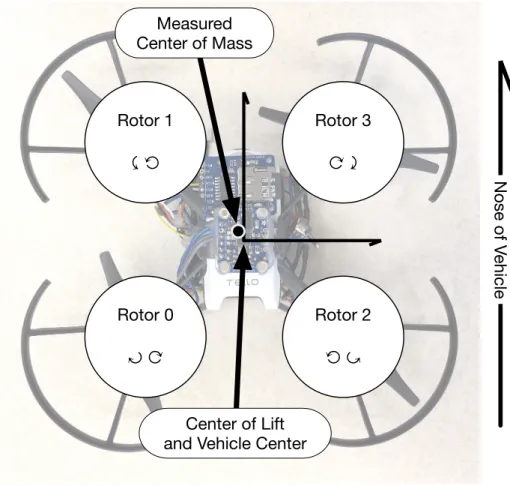
payload on the Tello quadrotor UAV. The Teensy v3.2 Arduino and battery pack are visible. Nose of the vehicle is at the top of the image, and the vehicle’s outer-loop optical flow sensors are near the bottom. 32 3-9 Tello COM was measured to be 2 𝑚𝑚 forward, 2.4 𝑚𝑚 left of the
vehicle’s geometric center. . . 33 3-10 Flight data post-processing diagram. . . 34
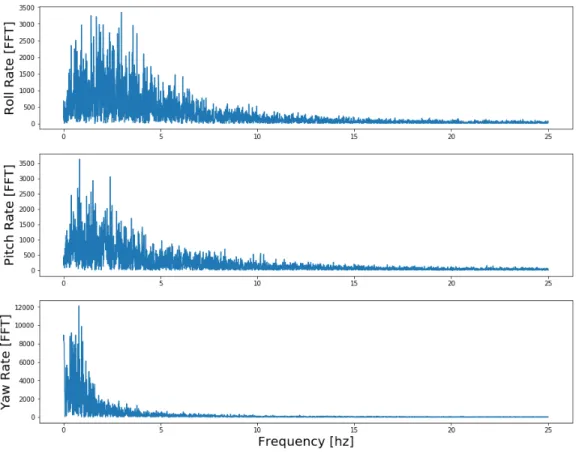
3-11 Gyroscope rates for a Tello flight, absolute value of the Fourier trans-form. Identified cutoffs: roll and pitch 12.5 ℎ𝑧, yaw 2.5 ℎ𝑧. . . 36 3-12 Effective angle of attack 𝛼 depends on blade pitch 𝛽 and induced angle
𝜑. . . 39 3-13 Yaw Torque Match ≡ 𝐼𝑧^* 𝛼𝑦𝑎𝑤/(𝑘𝑚𝑜𝑡𝑜𝑟*∑︀ ±𝑅𝑃 𝑆2). Vehicle torques
itself in still air. There is a minor external interaction with a guide cord at 1m:29s. Match is not reliable as∑︀ ±𝑅𝑃 𝑆2
approaches zero. 44 3-14 Roll and pitch response period identification during a Physical Torque
Impulse Test. . . 47
4-1 Setup of Air Jet Impulse Test. Compressed shop-air jets released into left tail corner of vehicle (under R0, Fig. 3-1) from a distance of about one foot. . . 50 4-2 Air Jet Impulse Test. Two air impulse jets causing pitch loss of control,
which is indicated for pitch. The first loss of control was deeper than the second and caused the vehicle to lose more position. . . 51 4-3 Setup of Physical Torque Test #1. Physical pitch-up impulses by tether
attached on the nose-side of Tello. . . 53 4-4 Physical Torque Test #1. . . 53 4-5 Setup of Physical Torque Test #2. Physical pitch-up step function by
tether attached on the nose-side of Tello. . . 55 4-6 Physical Torque Test #2. Physically pulling-up vehicle pitch from
tail-end of Tello. This example simulates a progressive torquing updraft. Note: a momentary IMU discontinuity at 6m:40s was not removed by filters. . . 56 4-7 Setup of Turbulent Vertical Flow Test. The vehicle is flown over the
vertical-facing shop fan. . . 57 4-8 Turbulent Vertical Flow Test. A high angular velocity yaw loss of
4-9 Setup of Outdoor Environment Test. The vehicle in flight, facing down the corridor and into the wind. . . 61 4-10 Outdoor Test #1. Illustrates roll, pitch and yaw margin degradation
in a low altitude wind field. . . 62 4-11 Outdoor Test #2. A large yaw disturbance and different control margin
change correlations are found in this test. . . 63 5-1 From McCormick [5] chapter 6, 𝜂 by advance ratio. . . 69
List of Tables
3.1 Extremes of inferred center of mass, associated hover torque, and
dis-tance from geometric center, by axis. . . 34
3.2 Tello with Payload Inertial Moments at Geometric Center . . . 42
3.3 Max Torque Values Identified . . . 45
3.4 Natural Time Constant Periods Identified . . . 47
Chapter 1
Introduction
This study concerns itself with the operating limitations of multi-rotor unmanned air vehicles (UAVs) in regard to the low level and fine scale wind environment as may be found in an urban windscape. There is great interest in operating multi-rotor UAVs in low altitude environments for purposes including delivery and urban air mobility [9]. The push towards autonomy and overflight of persons and property makes under-standing the vehicles’ operating limitations important. If control margin, a real-time measure of control authority, is definable, it is possible to measure a vehicle’s sus-ceptibility to various wind environments. Such a technique may ultimately be useful in understanding the low level wind environment, for certification of vehicles, or for real-time monitoring of control authority.
Chapter 1 describes the background research, motivation and objectives for this study. Chapter 2 describes the methods and rationale for developing the control mar-gin metric. Chapter 3 describes the application of the control marmar-gin metric to a small commercially available quadrotor vehicle. Chapter 4 discusses experimental evalua-tion of the control margin metric and results. Chapter 5 discusses the implicaevalua-tions of the research, its limitations and next steps. Appendix A has a table containing nomenclature, and Appendix B compares the control margin metric to a hypothetical time integrated metric.
1.1
Operating Limitations
Traditional airplanes have operating limitations and design requirements in relation to winds. For example, in traditional airplanes, operating limits include crosswind limitations, and design requirements include structural requirements showing integrity under different gust loads.
At this point it is unclear whether the same operating limitations and design requirements should apply to vehicles such as multi-rotor UAVs. One development and certification question is whether multi-rotor UAVs will need to be designed to handle all conceivable winds, or if instead during operations they must land if their control margin is substantially compromised. An objective of this work is to explore this question by developing a metric to measure vehicle controllability in regard to winds.
Adherence to the design requirements of gust loading is often demonstrated through use of system analysis of various wind spectra. Although design criteria such as the Dryden and von Kármán spectrum [7] have been available for analyzing structural loading of flight vehicles in cruise, the low altitude and fine scale environment have not been a focus. The low altitude environment is complicated, for example, by the presence of numerous bluff bodies.
The smaller scale of the vehicles under consideration also means they are suscep-tible to winds finer than have been relevant for vehicles up to this point. The current study defines control margin and shows the feasibility of measuring the response of smaller scale vehicles to various wind environments.
This study presents a means of assessing the controllability of multi-rotor systems. While the ultimate goal for this variety of research would be to characterize the winds in city micro-climates and potentially create a gust spectra specific to the low altitude fine scale wind field, a realistic first goal is to characterize the results of a wind field on particular vehicles. The study of the control margin metric proceeds in this way.
1.2
Controllability
For flight testing of smaller non-transport airplanes, the FAA has described control-lability as the ability to establish, maintain, or alter the attitude of an airplane in regard to its flight path. In particular, the criteria mention that the design of the aircraft should allow “control,” angular displacement, about each of the three main axes: roll, pitch and yaw. In test flights, humans judge the control as “satisfactory” or “unsatisfactory” [3].
A textbook produced for the Navy titled Aerodynamics for Naval Aviators de-scribes “controllability” as the ability of an aircraft to achieve a desired condition of flight adequately, so as to perform takeoff, landing and achieve various maneuvers in flight [4].
Controllability has been defined in Helicopter Controllability [2] as the ability for a vehicle to fly a series of maneuvers required for a mission. In this study, only the ability of a vehicle to maintain its attitude is considered because that is the maneuver required for “the mission” of position control on a multi-rotor UAV.
This study is able to produce a control margin metric with no knowledge of the control system’s desired attitude states, which for most vehicles are roll, pitch and yaw. In this study, the control margin metric is produced with only rotor revolutions per second (RPS) and attitude measurements from an inertial measurement unit (IMU) attached as a payload. Thus the technique described in this study is able to consider an arbitrary vehicle and control system combination without communication with the vehicle.
This study does not define loss of control. However, for the purposes of this study, loss of control is correlated with position loss as well as with attitude loss that remains uncorrected for longer than the vehicle and control system’s natural response period.
1.3
Degraded Modes
All factors related to control of multi-rotor UAVs are aggravated in degraded operating modes such as rotor failures. Multi-rotor vehicles, which maintain flight using the vertical thrust component, usually have rotors placed symmetrically about primary flight axes in order to inherently cancel body torques that would otherwise require asymmetric thrust to maintain stability in normal flight modes. Upon the failure of a single rotor, the thrust generated about (usually all) vehicle axes becomes asymmetric. A good option for vehicles to maintain roll and pitch control in this degraded state is to disable the symmetric rotor for lift maintenance, and utilize it only for attitude control.
The maintenance of yaw in this circumstance depends on the direction of motor spin. Symmetric (co-diagonal) rotors may be spun in the same or opposite directions. Either a rotor spins opposite to its symmetric partner or they rotate in the same direc-tion. In (e.g.) a quadrotor with counter-rotating symmetric rotors, only the roll axis perpendicular to the diagonal shared by the lift-disabled and failed rotor is degraded– in one direction –whereas in a quadrotor with co-directional symmetric rotors, loss of two co-directional rotors means loss of yaw control as well. The quadrotor DJI Tello UAV used as an experimental test system in this study utilizes co-directional symmetric motors, which has the advantage of allowing yaw control without coupling roll and pitch moments, but would lose control of multiple axes in a degraded mode. In any case, the Tello has not been programmed for degraded modes.
With two rotors offline, any multi-rotor UAV has a degraded and potentially lost attitude control in one or more axes, aggravated by a higher percentage utilization on all remaining rotors. In a degraded mode, if more thrust is needed, the vehicle must change its control law to allow error in at least one of yaw, pitch or roll. It is noted that at least one urban air mobility vehicle in development is a quadrotor, which can not be designed to fly with full attitude control in degraded modes. With typical UAV control strategies, symmetric quadrotors only have full attitude control in the no failures case [6]. However, with a model based on this research it would
possible to evaluate the control margin available under the various failure modes of the vehicle, for instance to see which control axes fail first, in order to consider the employment of alternate control strategies and mitigations (e.g. [6, 10]).
1.4
Objectives
This study presents a means of assessing multi-rotor UAV control authority in regard to winds using control margin. The approach defines utilization as the sum of rotor torque output and residual terms representing the torque required to compensate for any remaining disturbances, such as faster-than-control-response winds, divided by the maximum available torque. Control margin is the complement of utilization (cm = 1 − |𝑢𝑡𝑖𝑙𝑖𝑧𝑎𝑡𝑖𝑜𝑛|).
In this study, multi-rotors are UAVs with two or more rotors utilizing the ver-tical component of rotor thrust to maintain flight. This study considers the overall performance of a multi-rotor UAV and its installed control system. While making no assumptions about a particular control scheme, it’s noted that this initial study concerns itself only with a vehicle’s ability to maintain a hover attitude.
The majority of multi-rotor UAVs are controlled with an outer loop commanding position and an inner loop commanding attitude (Fig. 1-1). In this study, considera-tions are limited to the inner loop, justified by the fact that when the inner loop loses control the outer loop necessarily loses control as well. In fact, outer loop (position) error results from the time integration of inner loop (attitude) error.
_ + + Controller Vehicle Wind True Vehicle State Measured Attitude Throttle Commands Sensor Attitude and Throttle Setpoint Desired Position
and Altitude _ Controller
+ + Measured Position and Altitude Inner Loop Outer Loop
Neither the transient effects of rotor blade inertia change nor gyroscopic precession are considered in this study, nor is a wind shadow effect that can affect multi-rotors in forward flight. A vehicle’s drag profile and rotor downwash on itself is only implicitly considered. Blade flapping which can cause intense vibrations for multi-rotors in longitudinal flight is not included as a disturbance in this initial study.
Further, while some multi-rotor (and single-rotor) UAVs have been demonstrated to maintain inner loop attitude control only by the centrifugal force of a continuously changing attitude, usually yaw [10, 6], only vehicles that have inner loop stability without the need for continuous inertia are considered.
This research does not exhaustively review outer loop loss of control because there are a variety of reasons the outer loop can lose control that do not involve the inner loop, for example, insufficient thrust for the demanded rate of climb. Further, while testing was mostly conducted during vehicle hover, which for multi-rotors can include forward flight, there is no particular restriction on maneuvers that the metric applies to. In fact, there are aspects of the metric’s physics that automatically cancel the torque of angular accelerations for intended attitude changes. For increased accuracy under high angular rate maneuvers, it is possible to utilize desired angular velocity in the metric as well.
The goal of this study is to quantify a metric for “control margin.” The study intended to find a metric that could be used to indicate how close a multi-rotor UAV was to loss of control due to external disturbances, and in particular wind disturbances. The metric is defined as torque required to reject unwanted disturbances divided by torque available.
Chapter 2
Defining the Control Margin Metric
The basic form of the control margin metric is 𝑐𝑚^𝑥 = 1 − |𝜆𝑥^|, for a given axis ˆ𝑥.
Control margin is the complement of torque utilization, 𝜆.
Torque utilization metric is an instantaneous metric on the present state of the vehicle, dividing torque required by maximum torque available. Torque required is the sum total of torque developed by a vehicle’s rotors and residual terms representing the torque required to compensate for any remaining disturbances. An acceleration residual expresses unwanted angular acceleration, and a velocity residual expresses unwanted angular velocity by utilizing the natural response time of the vehicle.
2.1
Partitioning Control Margin by Axis
The basic form of the control margin metric is 𝑐𝑚𝑥^ = 1 − |𝜆𝑥^|, where 𝜆 utilization is
the proportion of torque required over the maximum torque the vehicle has available in that axis, Eq. (2.1).
𝜆𝑥^ =
(𝜏𝑥^)𝑟𝑒𝑞𝑢𝑖𝑟𝑒𝑑
(𝜏𝑥^)𝑚𝑎𝑥
(2.1) The control margin metric considers margin on each of the roll, pitch and yaw axes independently. At a high level a multi-rotor vehicle is a 6 degree of freedom device, and the vehicle can directly affect torques about roll, pitch and yaw axes.
The vehicles generally only directly affect position along their vertical axis.
Single axis consideration is a reasonable reduction: Vehicles typically handle roll, pitch and yaw with separate control loops, which combine to allow any desired atti-tude. Regardless of the axis of an external torque, control loss depends on whether any particular axis has lost control.
For an instantaneous controller, a controller where all torque required is instan-taneously provided by the rotors, the torque required in a hover state is defined in Eq. (2.2).
𝜏𝑟𝑒𝑞𝑢𝑖𝑟𝑒𝑑 = 𝑟𝑜𝑡𝑜𝑟𝑠
∑︁
(𝜏 ) (2.2)
Eq. (2.3) then shows 𝜆 for an instantaneous controller under the single-axis model.
𝜆 =
∑︀𝑟𝑜𝑡𝑜𝑟𝑠 𝜏 𝜏𝑚𝑎𝑥
(2.3) When maximum torque is provided by this instantaneous controller, 𝜆 = 1 and 𝑐𝑚 = 0.
Most vehicles do not have instantaneous controllers. However, the above definition of 𝜏𝑟𝑒𝑞𝑢𝑖𝑟𝑒𝑑 has a grounding in vehicle dynamics for a non-instantaneous controller.
With a strategy of single axis consideration, it’s possible to consider torque utilization due to the dynamics of a single axis at a time, Eq. (2.4).
𝜏𝑑𝑖𝑠𝑡𝑢𝑟𝑏𝑎𝑛𝑐𝑒+ 𝑟𝑜𝑡𝑜𝑟𝑠
∑︁
𝜏 = 𝐼 * 𝛼𝑚𝑒𝑎𝑠𝑢𝑟𝑒𝑑 (2.4)
𝛼𝑚𝑒𝑎𝑠𝑢𝑟𝑒𝑑is angular acceleration measured by the IMU. By moving the sum of rotor
torque to the other side of the equation, the torque due to an external disturbance is found as a function of acceleration and rotor torque.
𝜏𝑑𝑖𝑠𝑡𝑢𝑟𝑏𝑎𝑛𝑐𝑒 = 𝐼 * 𝛼𝑚𝑒𝑎𝑠𝑢𝑟𝑒𝑑− 𝑟𝑜𝑡𝑜𝑟𝑠
∑︁
𝜏 (2.5)
The definition of required torque, now including vehicle body acceleration is Eq. (2.6).
𝜏𝑟𝑒𝑞𝑢𝑖𝑟𝑒𝑑 = −𝜏𝑑𝑖𝑠𝑡𝑢𝑟𝑏𝑎𝑛𝑐𝑒 = 𝑟𝑜𝑡𝑜𝑟𝑠
∑︁
(𝜏 ) − 𝐼 * 𝛼𝑚𝑒𝑎𝑠𝑢𝑟𝑒𝑑 (2.6)
When the rotors are torquing in one direction, and the vehicle is accelerating in the other, 𝜏𝑟𝑒𝑞𝑢𝑖𝑟𝑒𝑑 becomes larger. This is the behavior desired for torque utilization.
Note that when 𝛼𝑚𝑒𝑎𝑠𝑢𝑟𝑒𝑑 is zero, as in the case of an instantaneous controller,
this equation (2.6) equals Eq. (2.2).
The definition of 𝜆 including 𝛼𝑚𝑒𝑎𝑠𝑢𝑟𝑒𝑑 exists in Eq. (2.7).
𝜆 = (𝜏 )𝑟𝑒𝑞𝑢𝑖𝑟𝑒𝑑 (𝜏 )𝑚𝑎𝑥 = ∑︀𝑟𝑜𝑡𝑜𝑟𝑠 (𝜏 ) − 𝐼 * 𝛼𝑚𝑒𝑎𝑠𝑢𝑟𝑒𝑑 𝜏𝑚𝑎𝑥 (2.7) The body 𝛼𝑚𝑒𝑎𝑠𝑢𝑟𝑒𝑑 acceleration is the motivation for what’s defined as the
resid-ual. The residual can be seen in the general form of the 𝜆 metric, Eq. (2.8).
𝜆 =
∑︀𝑟𝑜𝑡𝑜𝑟𝑠
(𝜏 ) + 𝑅𝑟𝑒𝑠𝑖𝑑𝑢𝑎𝑙
𝜏𝑚𝑎𝑥
(2.8) The residual is in units of torque. Residual terms represent the torque required to compensate for any remaining disturbances after ∑︀𝑟𝑜𝑡𝑜𝑟𝑠
(𝜏 ).
In this study, 𝑅𝑟𝑒𝑠𝑖𝑑𝑢𝑎𝑙 has the terms defined in Eq. (2.9), which are residual terms
for angular acceleration and angular velocity.
𝑅𝑟𝑒𝑠𝑖𝑑𝑢𝑎𝑙= 𝑅𝛼+ 𝑅𝜔 (2.9)
The angular acceleration residual is based on the dynamics equation’s definition of 𝜏𝑟𝑒𝑞𝑢𝑖𝑟𝑒𝑑 and is found in Eq. (2.10).
𝑅𝛼 = −𝐼 * 𝛼𝑚𝑒𝑎𝑠𝑢𝑟𝑒𝑑 (2.10)
Up to this point the numerator of 𝜆, Eq.(2.1), equaled the torque needed to reject the external disturbance torque, −𝜏𝑒𝑥𝑡𝑒𝑟𝑛𝑎𝑙 =
∑︀𝑟𝑜𝑡𝑜𝑟𝑠
(𝜏 ) − 𝐼 * 𝛼𝑚𝑒𝑎𝑠𝑢𝑟𝑒𝑑.
A conceptual step this thesis takes is that torque required for controllability is not just external torque, but depends also on higher order terms not expressed in the dynamics equation.
Angular acceleration is only the first order residual factor for controllability of a vehicle. A second order factor is angular velocity. Even after an angular accelera-tion is finished, angular velocity (𝜔) remains, which adversely affects controllability depending on its magnitude.
Angular velocity is not directly expressible as torque. Therefore the 𝜔 residual is expressed as angular momentum divided by some time constant, Eq. (2.11).
𝑅𝜔 =
−𝐼 * 𝜔𝑚𝑒𝑎𝑠𝑢𝑟𝑒𝑑
∆𝑡 (2.11)
2.1.1
Angular Velocity Residual
The time constant chosen for the angular velocity residual is 1/4𝑡ℎ the vehicle and
control system’s natural response time for the axis, 14𝑡𝑐.
Constant 𝑡𝑐 is the period in which the vehicle has been demonstrated to cycle
from maximum error to maximum bounce-back for all impulse disturbances within control. The behavior is approximately sinusoidal. If the vehicle can’t stop its inertia at the end of one fourth of this period, it can’t bounce-back by the whole period and has lost control.
The minimum torque required to nullify axis angular momentum in accordance with the natural response time of the vehicle and control system is thus the angular velocity residual, expressed in Eq. (2.12).
The sign is chosen such that a vehicle rotating opposite to the direction of rotor torque has a higher residual.
𝑅𝜔 =
−𝐼 * 𝜔𝑚𝑒𝑎𝑠𝑢𝑟𝑒𝑑 1
4𝑡𝑐
(2.12) The explanation for 1/4𝑡ℎ is the nature of a smooth periodic function and its first derivative, namely the 2𝜋 periodic sine and cosine. A simple demonstration: suppose sine is angle and cosine angular velocity. Note at 𝜋/2 of cosine, the amplitude is zero. Thus, a vehicle must be able to reach zero angular velocity at 1/4𝑡ℎ the natural
The time constant enables the conversion of angular velocity to the minimum torque required for complete deceleration within the appropriate period. Other time constants were considered besides natural response time, but alternatives required an arbitrary choice about an attitude limit for considering a vehicle under control.
This study considered vehicles in hover. For off-hover maneuvering conditions, the velocity residual may require an offset by desired 𝜔, requiring information from the vehicle control system.
2.1.2
Full Form of Metric with Residual
The full form of the control margin metric is Eq. (2.13). The fraction’s numerator is torque required to maintain control and the denominator is max torque available on the axis. Absolute value is used to keep control margin at or below 1.
𝑐𝑚𝑥^ = 1 − |
∑︀𝑟𝑜𝑡𝑜𝑟𝑠
(𝜏 ) + 𝑅𝑟𝑒𝑠𝑖𝑑𝑢𝑎𝑙
𝜏𝑚𝑎𝑥
| (2.13)
Substituting the first and second order residuals utilized in this study, 𝑅𝑟𝑒𝑠𝑖𝑑𝑢𝑎𝑙=
𝑅𝛼+ 𝑅𝜔, the study’s control margin definition is Eq. (2.14). For other applications,
the residual can include higher order torque terms.
𝑐𝑚𝑥^ = 1 − |
∑︀𝑟𝑜𝑡𝑜𝑟𝑠
(𝜏 ) − 𝐼𝛼𝑚𝑒𝑎𝑠𝑢𝑟𝑒𝑑−𝐼*𝜔0.25*𝑡𝑚𝑒𝑎𝑠𝑢𝑟𝑒𝑑𝑐
𝜏𝑚𝑎𝑥
| (2.14)
Chapter 3 describes calculation of sum of torques, max torque, time constants and residuals for a particular test vehicle, and Chapter 4 presents the results of experimental validation.
Chapter 3
Experimental Test System
An experimental test system based on the DJI Tello quadrotor was developed to evaluate the metric. This chapter focuses on calibrating the parameters and obtaining the data required by the control margin metric.
There are two sources of torque on the Tello UAV: the rotors’ lift force acting at a distance to a reference point, and the torque the motors produce to spin the rotors (3.1). The reference point used in this study is the vehicle’s geometric center, and each rotor’s vector from the center of the vehicle is defined ⃗𝑟𝑖.
𝑟𝑜𝑡𝑜𝑟𝑠 ∑︁ ⃗ 𝜏 = 𝑟𝑜𝑡𝑜𝑟𝑠 ∑︁ (⃗𝑟𝑖×𝐿𝑖𝑓 𝑡⃗𝑟𝑜𝑡𝑜𝑟+𝜏𝑚𝑜𝑡𝑜𝑟⃗ ) (3.1)
The control margin metric requires only rotor RPS data and IMU measurements. A description of sensors installed to make these measurements is in S 3.2.
This minimal instrumentation payload allows the calibration of lift and motor torques by 𝑅𝑃 𝑆2 as explained in S 3.4. Max torque is found in S 3.5, and finally the natural modes of the vehicle are identified using a physical impulse response method described in S 3.6.
The control system operates relative to the center of the vehicle, but it is invalid to assume that the center of the vehicle is the center of mass, and this is shown in S 3.2.1. The metric reveals the offset center of mass in the hover control margin, which is implicitly accounted for in the calculation of max torque.
3.1
Vehicle Axes for Metric
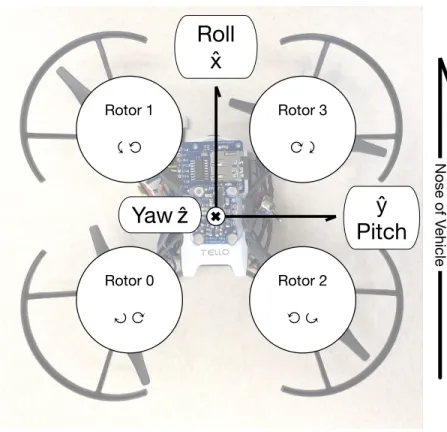
The fundamental flight axes of the vehicle are defined in Fig. 3-1.
Rotor 1 ⤹ ⟲ Rotor 0 ⤾ ⟳ Rotor 2 ⟲ ⤿ Rotor 3 ⟳ ⤸
Roll
x̂
ŷ
Pitch
Yaw
ẑ
Nose of V ehicleFigure 3-1: The primary axes and rotor spin directions for the Tello quadrotor UAV.
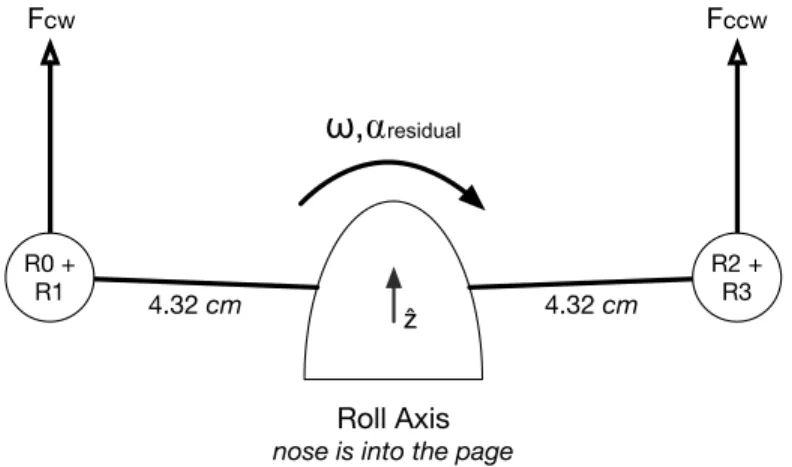
As described in S 2.1, each axis of the Tello UAV can be considered separately. Using the rotor numbering in Fig. 3-1, roll torque is the net contribution of torques from 𝑟𝑜𝑡𝑜𝑟0 + 𝑟𝑜𝑡𝑜𝑟1, and 𝑟𝑜𝑡𝑜𝑟2 + 𝑟𝑜𝑡𝑜𝑟3, Fig. 3-2. In the figure, 𝜔 and 𝛼 refer to
the residual disturbances that were not rejected by the control system.
Tello’s yaw torque is the net contribution of 𝑚𝑜𝑡𝑜𝑟0+𝑚𝑜𝑡𝑜𝑟3, and 𝑚𝑜𝑡𝑜𝑟1+𝑚𝑜𝑡𝑜𝑟2,
Fig. 3-3. Motor torque is the torque with which motors twist the rotor blades. For the Tello quadrotor this constitutes all yaw torque.
3.2
Instrumentation Payload
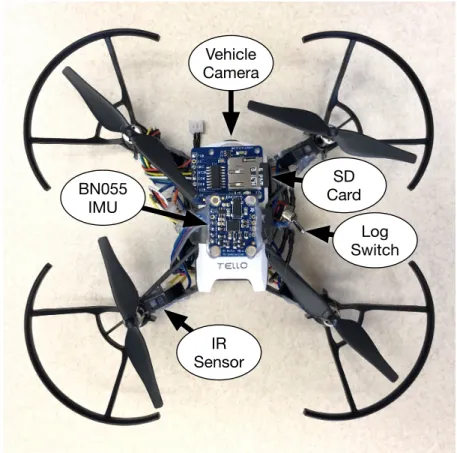
To measure 𝜔 and 𝛼, the Tello UAV was outfitted with a Adafruit BNO55 Absolute Orientation Sensor. For RPS sensing, H048W Reflective Infrared Optical Sensors
ѡ,⍺residual Fccw Fcw R2 + R3 R0 + R1 ẑ 4.32 cm 4.32 cm Roll Axis
nose is into the page
Figure 3-2: Tello Roll Axis Dynamics. Rotor lift force scaled by distance from the roll axis (4.32 𝑐𝑚) yields torque. Pitch axis is similar (with a 3.94 𝑐𝑚 lever).
R0 + R3 R1 + R2 τcw τccw ѡ,⍺residual ẑ Yaw Axis
looking down on vehicle
Figure 3-3: Tello Yaw Axis Dynamics. Motor torque, depicted, constitutes all yaw torque for the Tello.
were installed. Both are connected to a Teensy v3.2 Arduino Board, which writes to a microSD card attached as well (Fig. 3-5).
To measure RPS, reflected IR Sensors detect beam breaks, and the number of blade passes is recorded on the SD card. The presence of a rotor blade is sampled every 120 𝜇𝑠 by an interrupt driven C++ program on the Arduino. This was the rate determined to guarantee detection of a rotor blade based on blade width and max RPS (425 𝑅𝑃 𝑆). Max RPS was identified using a laboratory beam break sensor attached to a 150 𝑀 𝐻𝑧 oscilloscope that indicated beam breaks per second (Fig. 3-6). In order to have Tello spin its rotors while on a lab bench, it’s necessary to trick it into believing it is in flight. This is done by lifting the vehicle’s mount during takeoff, ensuring rotor spin-up, then placing it back down. Because the vehicle believes it is
IR Sensor Log Switch SD Card BN055 IMU Vehicle Camera
Figure 3-4: The Tello quadrotor UAV with sensor payload. IMU, SD card writer and IR blade-pass sensor are visible.
Figure 3-5: MicroSD card writer, H048W optical sensors and BNO55 IMU on the Tello quadrotor UAV. The data log activation switch is also visible.
lower than it wants to be, rotors are spun at max RPS at least part of the time. A margin of error was used in the calculation of the appropriate sample rate.
Figure 3-6: The Tello on the bench for RPS calibration by an oscilloscope and beam break sensor.
the session featuring the oscilloscope output were used to ensure the calibration of the IR sensors. Calibration involved adjusting the IR sensor angle, moving IR sensors closer to the rotor blades, and setting voltage thresholds in software. On each rotor, both blades are painted in silver reflective Sharpie ink to increase reflectance (visible in Fig. 3-8).
Attitude data is collected from the payload BNO55 IMU at approximately 50 ℎ𝑧. As soon as IMU data arrives at the Arduino, IMU data and the total number of blade passes are written to the microSD card in csv format. The data flow and separation of instrumentation system concerns is documented in Fig. 3-7.
IR Sensor
H048W Measurement UnitBNO55 Inertial Arduino
120 µs sampling 19.6 ms sampling
On-board SD Card < 20 ms data rate Blade pass counting Angles and velocities
Tello Quadrotor Pilot Phone
Tello Video Footage
3.2.1
Payload Mounting and Center of Mass
The vehicle’s payload would shift between flights, repositioning the vehicle’s center of mass. One center of mass measurement was made after the flight tests, while the center of mass of each flight was inferred by the torque utilized to maintain hover during that flight.
Minor center of mass changes were found to have a substantial impact on control margin. This study made torque calculations at the vehicle’s geometric center, a location likely co-located with the vehicle’s own IMU.
The torque observed by the sum of rotor lift torques at the geometric center is the torque required to stop a shifted center of mass from accelerating.1 The trade-offs
that would be associated with utilizing center of mass torques instead are described in S 5.1.3.
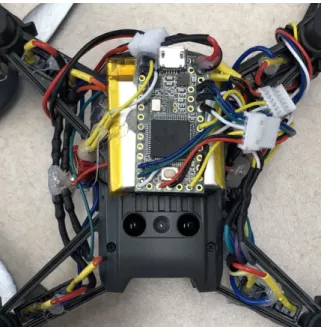
Fig. 3-8 shows the forward mounting of the payload on the bottom of the Tello.
Figure 3-8: Wiring, Micro JST connectors and hot glue with the instrumentation payload on the Tello quadrotor UAV. The Teensy v3.2 Arduino and battery pack are visible. Nose of the vehicle is at the top of the image, and the vehicle’s outer-loop optical flow sensors are near the bottom.
1From the center of mass’s perspective, it can also be considered that rotor lift is adjusted to place center of lift under the center of mass. In either case, the sum of torques is zero at the center of mass during a steady hover.
The measured center of mass by orthogonal wire-hang tests was 2 𝑚𝑚 forward and 2.4 𝑚𝑚 left of vehicle center, as visible in Fig. 3-9. The payload often shifted between flights, however, and this was the one measurement made after the flight tests and after re-securing components with hot glue. The center of mass calculation for each flight test was inferred by torque required to maintain hover.
Rotor 1 ⤹ ⟲ Rotor 0 ⤾ ⟳ Rotor 2 ⟲ ⤿ Rotor 3 ⟳ ⤸ Nose of V ehicle Measured Center of Mass Center of Lift and Vehicle Center
Figure 3-9: Tello COM was measured to be 2 𝑚𝑚 forward, 2.4 𝑚𝑚 left of the vehicle’s geometric center.
By processing flight test data, center of mass is calculated by the axes’ hover torque and ⃗𝜏 = ⃗𝑟 × ⃗𝐹 . The extremes of results over all test flights are tabulated in Table 3.1.
The vehicle’s battery was initially secured, but became loose after several crash landings. As a result, the payload’s battery (apprx. 23 𝑔) had as much as a centimeter of space to shift between flights. By ⃗𝑟 × ⃗𝐹 , the battery itself could account for an additional 0.0023 𝑁 · 𝑚 of torque (1.86 𝑚𝑚 shift in center of mass) at 1 𝑐𝑚 forward.
Table 3.1: Extremes of inferred center of mass, associated hover torque, and distance from geometric center, by axis.
Along Axis Min Distance Min Torque Max Distance Max Torque
ˆ
𝑥 2 [𝑚𝑚] .00247 [𝑁 · 𝑚] 6 [𝑚𝑚] .00740 [𝑁 · 𝑚]
ˆ
𝑦 -2.42 [𝑚𝑚] .00298 [𝑁 · 𝑚] 1.62 [𝑚𝑚] .00200 [𝑁 · 𝑚]
3.3
Data Processing
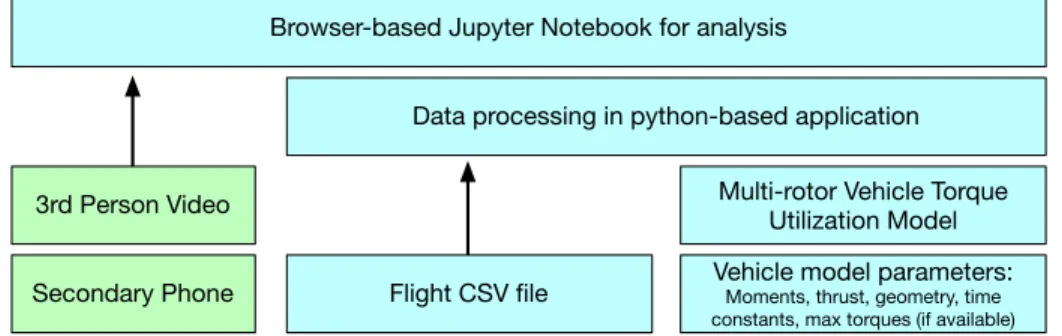
The data is processed primarily with the Pandas and Numpy Python packages and custom object and process-oriented programs for computing control margin. The separation of concerns detailed in Fig. 3-10.
Flight CSV file Vehicle model parameters:Moments, thrust, geometry, time constants, max torques (if available)
Multi-rotor Vehicle Torque Utilization Model Secondary Phone
3rd Person Video
Data processing in python-based application Browser-based Jupyter Notebook for analysis
Figure 3-10: Flight data post-processing diagram.
Each data-recording session was synchronized with at least one video stream to aid in the analysis. One video was recorded from a relevant 3𝑟𝑑 person perspective,
another was captured by the vehicle’s on-board camera, where because it lacked time-keeping ability, its feed was rarely used.
In general, video recordings are synchronized to flight logs at rotor spin-up. The processing software determines when rotors are spun-up, and the audiovisual record-ing is reviewed to determine the time interval to shift the data feed.
3.3.1
Revolutions Per Second
RPS was calculated using a sliding window sum of blade passes, divided by the 100 𝑚𝑠 window length. The result is the same as a numeric derivative with points from 50 𝑚𝑠 before and after each point considered.
The resolution is 5 𝑅𝑃 𝑆 for a sampling frequency of 10 ℎ𝑧. Larger windows give better resolution but at a lower frequency.
3.3.2
Angular Velocity and Acceleration
Angular acceleration was determined by a single difference derivative of angular ve-locity. Angular velocity was available from the IMU directly.
3.3.3
Filtering
Inspection of the Fourier transform of flight test data (Fig. 3-11) led to identification of a 12.5 ℎ𝑧 cutoff frequency for roll and pitch rates through a 2𝑛𝑑 order Butterworth low-pass filter. Yaw rates were given a cutoff of 2.5 ℎ𝑧. Zeroth-derivative angle data is only used in the analysis, is not used by the metric. Because of this, zeroth-derivative angle data was not filtered.
Numerical differentiation amplifies noise, but a Fourier analysis of angular velocity data showed that most energy in roll and pitch exists beneath 12.5 ℎ𝑧. Therefore, roll and pitch velocity and acceleration were filtered at 12.5 ℎ𝑧.
The gyroscope yaw rate data had almost all of its energy beneath 2.5 ℎ𝑧, therefore the cutoff was placed at 2.5 ℎ𝑧 for yaw velocity and acceleration.
Despite having a Nyquist rate of 5 ℎ𝑧, the 10 ℎ𝑧 motor data was found to have substantially all its energy beneath 2 ℎ𝑧. Therefore, motor data was filtered to 2.5 ℎ𝑧 before it was used in generating control margin output. This choice also aided in fitting yaw acceleration data in S 3.4.3.
3.4
Sum of Torque Calibration
In this chapter, lift and motor torques are determined to be functions of 𝑅𝑃 𝑆2. Rotor lift was determined by vehicle weight and shown to be a function of 𝑅𝑃 𝑆2. Rotor lift torque then depends on lift and the distance from the axis of rotation considered.
Figure 3-11: Gyroscope rates for a Tello flight, absolute value of the Fourier transform. Identified cutoffs: roll and pitch 12.5 ℎ𝑧, yaw 2.5 ℎ𝑧.
Motor yaw torque is determined by fitting 𝑅𝑃 𝑆2with acceleration × an estimated yaw inertial moment during controlled yaw of the vehicle.
At typical tip speeds of the rotor blades (80-110 𝑚/𝑠), the maximum longitudinal speed of wind supported by Tello (5 𝑚/𝑠) has very little ability to change the angle of attack of the rotors. This study neglects the effects of oblique (non-axial) flow on rotor performance, in favor of a model that requires no information about longitudinal wind velocity.
Torque effects of forward velocity are often canceled on a multi-rotor through sym-metric rotor layout; however, there are effects of wind shadow that are not considered in this study.
3.4.1
Lift Torque by 𝑅𝑃 𝑆
2Calculation
Rotor lift is first shown to be solely a function of 𝑅𝑃 𝑆2. Lift is defined as a function of flow velocity in Eq. (3.2), in a useful form in Eq. (3.3), where 𝐶𝑙 is a function
of angle of attack 𝐶𝑙 = 𝐶𝑙𝛼 * 𝛼, and 𝑉 is the rotor-experienced flow velocity, 𝑐𝑟 is
the cord width at radius 𝑟. 𝑉 is a combination of velocity of the rotor (𝜔𝑟) and the flow induced across the rotor by the pressure differential induced velocity (𝑈𝑖).
The relationship between 𝑅𝑃 𝑆 and induced velocity is complex, although able to be modeled linearly for Tello.
𝐿 = 1 2𝜌𝑉 2𝑆𝐶 𝑙 (3.2) 𝑑𝐿 = 1 2𝜌𝑉 2 𝑟 * 𝐶𝑙𝛼𝛼 * 𝑐𝑟𝑑𝑟 (3.3)
Rather than measure and curve fit, lift’s relationship to 𝜔 is developed in theory, and then required coefficients are found experimentally. The theory does not fully account for induced velocity, but the linearized model of induced velocity did not produce evidence of substantive errors at this rotor-blade scale.
The magnitude of vertical lift required was calculated with the knowledge that Tello’s rotors point straight up. Other test vehicles with angled rotors may need their weight vectors proportionately scaled to determine necessary rotor-aligned thrust.
𝑉 = √︁
𝑈2
𝑖 + (𝜔 * 𝑟)2 (3.4)
Eq. (3.4) gives velocity as a function of 𝑟 and 𝑤. It’s possible to compute the induced velocity 𝑈𝑖 by equating the momentum change of the flow with the thrust
generated. However, a model is needed to determine 𝑈𝑖 without first having thrust.
A model is generated for 𝑈𝑖 using values at hover and momentum theory.
Momentum theory with actuator disk theory as described by McCormick in [5] assumes a uniform velocity flow across a rotor. It assumes incompressible flow and well-defined stream tubes into and away from the rotor, which by symmetry makes
the velocity increase at the rotor one half of the downstream increase. This allows for simple physics treatment to determine rotor force by Eq. (3.5), multiplying mass flow and change in velocity.
𝐹 = 𝑑(𝑚 * 𝑣)
𝑑𝑡 =
𝑚
𝑑𝑡 * 𝑣 = ˙𝑚 * ∆𝑣 (3.5)
Velocity at the disk is halfway between free stream (𝑈∞) and downstream (𝑈𝑒𝑥𝑖𝑡)
velocities. This can be shown by equating power of momentum change and kinetic energy change, which allows solving for velocity at the rotor disk, as in Eq. (3.6) and Eq. (3.7). 𝑈𝑑𝑖𝑠𝑘 − 𝑈∞ is called induced velocity, or 𝑈𝑖. With 1/2 added velocity as
𝑈𝑖, the down-steam velocity is 𝑈∞+ 2 * 𝑈𝑖.
𝑃 𝑜𝑤𝑒𝑟 = ˙𝑚 * 1 2(𝑈 2 𝑒𝑥𝑖𝑡− 𝑈 2 ∞) = 𝐿 * 𝑈𝑑𝑖𝑠𝑘 = ˙𝑚 * (𝑈𝑒𝑥𝑖𝑡− 𝑈∞) * 𝑈𝑑𝑖𝑠𝑘 (3.6) 𝑈𝑑𝑖𝑠𝑘 = 1 2(𝑈𝑒𝑥𝑖𝑡+ 𝑈∞) (3.7)
Eq. (3.5) with ∆𝑣 = 2*𝑈𝑖 gives the thrust equation using actuator disk momentum
theory in Eq. (3.8). For a multi-rotor in hover, 𝑈∞ is 0. Therefore Eq. (3.9) shows
𝑈𝑖 ∝ √ 𝐿. 𝐿 = ˙𝑚 * (2 * 𝑈𝑖) = 𝜌𝜋𝑅2* 𝑈𝑖* (2 * 𝑈𝑖) = 2𝜌𝜋𝑅2* 𝑈𝑖2 (3.8) 𝑈𝑖 = √︃ 𝐿 2𝜌𝜋𝑅2 (3.9)
As a guess towards modeling 𝑈𝑖, suppose 𝑈𝑖 ∝ 𝑤, 𝑈𝑖 = 𝜔 * 𝑘𝑖, Eq. (3.10). Using
momentum theory (Eq. (3.9)), hover lift (𝑤𝑒𝑖𝑔ℎ𝑡/4– vehicle mass is 125.7 𝑔𝑟𝑎𝑚𝑠) requires 5.04 𝑚/𝑠 flow acceleration. Because hover is done at 325 𝑅𝑃 𝑆, parameter 𝑘𝑖 is identified, 𝑘𝑖 = 2.47 * 10−3 [𝑚 * (𝑟𝑎𝑑𝑖𝑎𝑛𝑠)−1].
𝑈𝑖 = 𝜔 * 𝑘𝑖 (3.10)
To see whether the 𝑈𝑖 model is correct, a two point validation is utilized through
the lift equation and momentum theory. Given 𝑈𝑖 = 𝑤 * 𝑘𝑖, the velocity equation is
simplified in Eq. (3.11).
𝑉 =√︀(𝜔 * 𝑘𝑖)2+ (𝜔 * 𝑟)2 = 𝜔
√︁ 𝑘2
𝑖 + 𝑟2 (3.11)
This allows an updated model for lift to be built in Eq. (3.12).
𝑑𝐿 = 1 2𝜌 * 𝜔
2
(𝑘2𝑖 + 𝑟2) * 𝐶𝑙𝛼𝛼 * 𝑐𝑟𝑑𝑟 (3.12)
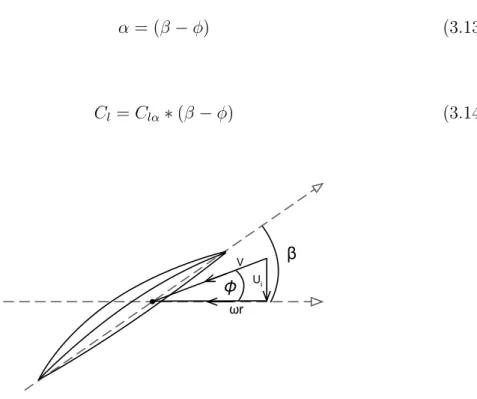
But now it’s important to consider 𝛼. Alpha is the angle of attack, which is the difference between the local blade pitch 𝛽 and induced velocity angle 𝜑, as seen in Fig. 3-12 and expressed in Eqs. (3.13), (3.14).
𝛼 = (𝛽 − 𝜑) (3.13) 𝐶𝑙= 𝐶𝑙𝛼* (𝛽 − 𝜑) (3.14) ωr φ V Uᵢ β
Figure 3-12: Effective angle of attack 𝛼 depends on blade pitch 𝛽 and induced angle 𝜑.
𝜑 = 𝑡𝑎𝑛−1𝑈𝑖
𝜔𝑟 (3.15)
𝜑 is the induced angle of attack, the angle of the incoming rotor wind relative to the plane of rotation of the rotor. When Eq. (3.15) is substituted into Eq. (3.12), the result is a complete differential form of the lift equation.
𝑑𝐿 = 1 2𝜌 * 𝜔 2 (𝑘2𝑖 + 𝑟2) * 𝐶𝑙𝛼(𝛽𝑟− tan−1 𝑈𝑖 𝜔𝑟) * 𝑐𝑟𝑑𝑟 (3.16)
Substituting the Eq. (3.10) model for 𝑈𝑖 yields Eq. (3.17), where it can be noticed
that 𝛼 becomes only a function of rotor blade geometry, 𝛼 = 𝛽𝑟− tan−1 𝑘𝑟𝑖.
𝑑𝐿 = 1 2𝜌 * 𝜔 2(𝑘2 𝑖 + 𝑟 2) * 𝐶𝑙 𝛼(𝛽𝑟− tan−1 𝜔𝑘𝑖 𝜔𝑟) * 𝑐𝑟𝑑𝑟 (3.17)
An integration by radius in Eq. (3.18) yields a model of lift that depends only on 𝑤2. The change in geometry and all other constants are captured in Eq. (3.19).
𝐿 = 𝜔2* ∫︁ 𝑟𝑡𝑖𝑝 𝑟𝑟𝑜𝑜𝑡 1 2𝜌 * (𝑘 2 𝑖 + 𝑟 2) * 𝐶𝑙 𝛼(𝛽𝑟− 𝑘𝑖 𝑟) * 𝑐𝑟𝑑𝑟 (3.18) 𝐿 = 𝜔2 * 𝑘𝑙𝑖𝑓 𝑡 (3.19)
If the linear 𝑈𝑖 model Eq. (3.10) holds, then Eq. (3.19), which is based on first
principles, is necessarily true. 𝑘𝑙𝑖𝑓 𝑡 is fit at hover, and
𝑘𝑙𝑖𝑓 𝑡 = 7.42 * 10−8 [𝑁 * 𝑠2 (𝑟𝑎𝑑𝑖𝑎𝑛𝑠)−1].
The 𝑈𝑖 model is linear. If the induced velocity phenomena is linear in 𝑅𝑃 𝑆, it
is sufficient to check that the model and momentum theory are in coherence at least one other 𝑅𝑃 𝑆 (see limitations § 5.1.4).
The thrust model at 425 𝑅𝑃 𝑆 predicts 0.529 𝑁 of thrust per rotor. By momentum theory Eq. (3.9), this is 𝑈 𝑖𝑚𝑜𝑚𝑒𝑛𝑡𝑢𝑚 = 6.60𝑚/𝑠, and by the linear model Eq. (3.10),
425 𝑅𝑃 𝑆 yields 𝑈 𝑖𝑙𝑖𝑛𝑒𝑎𝑟 = 6.59𝑚/𝑠.
The error here is minuscule, and it is judged unlikely that the underlying 𝑈𝑖 is
holds as a relation to 𝜔2, 𝐿 = 𝜔2 * 𝑘𝑙𝑖𝑓 𝑡.
Recalling the overall dynamics equation Eq. (2.4), rotor lift torque is ⃗𝑟 × ⃗𝐹 , which depends on the distance and direction of the rotor from a reference point. Rotors point directly up, and rotor distances from the vehicle geometric center are directly measured. On the Tello, the four rotors are displaced symmetrically, 3.94 𝑐𝑚 longi-tudinally (ˆ𝑥), 4.32 𝑐𝑚 laterally (ˆ𝑦). The lift torque equation is found in Eq. (3.20).
𝒯𝑙𝑖𝑓 𝑡 = ⃗𝑟 × 𝜔2𝑘𝑙𝑖𝑓 𝑡𝑧ˆ (3.20)
3.4.2
Inertial Moments
For their role in residuals and calibration of motor torque, it is necessary to determine the vehicle’s inertial moments with payload.
Inertial moments of the vehicle are estimated by separately modeling the main body of the vehicle and the rotors, motors and propeller guards, and combining their results.
A stock Tello with battery, rotors and rotor guards is 80 𝑔. With the payload, the vehicle weighs 125.7 𝑔. The body mass alone is 101.86 𝑔, longitudinal length is 6.47 𝑐𝑚, lateral width is 4.84 𝑐𝑚, and height is 3.94 𝑐𝑚, the body’s inertial moment is calculated on each axis as a rectangular box using Eq. (3.21).
𝐼𝑏𝑜𝑑𝑦−𝑥= 𝑏𝑜𝑑𝑦−𝑚𝑎𝑠𝑠 12. * (𝑤𝑖𝑑𝑡ℎ 2 𝑦 + ℎ𝑒𝑖𝑔ℎ𝑡 2 𝑧) (3.21)
The rotor (4.9 𝑔), motor blade and propeller guard together weigh 5.96 𝑔. For simplicity they are treated as small spheres with diameter equal to the motor height (2 𝑐𝑚), giving their inertial moments in Eq. (3.22). The distances stated in S 3.4.1 with the parallel axis theorem, Eq. (3.23), gives rotor inertial moments relative to the body coordinate system.
𝐼𝑟𝑜𝑡𝑜𝑟 =
2
5𝑟𝑜𝑡𝑜𝑟−𝑚𝑎𝑠𝑠 * 𝑟
Table 3.2: Tello with Payload Inertial Moments at Geometric Center
Axis Inertial Moment
Roll (𝐼𝑥^) 7.85 * 10−5 [𝑘𝑔 · 𝑚2]
Pitch (𝐼𝑦^) 8.68 * 10−5 [𝑘𝑔 · 𝑚2]
Yaw (𝐼𝑧^) 1.38 * 10−4 [𝑘𝑔 · 𝑚2]
𝐼𝑝𝑎𝑟𝑎𝑙𝑙𝑒𝑙−𝑎𝑥𝑖𝑠 = 𝐼𝑟𝑜𝑡𝑜𝑟+ 𝑟𝑜𝑡𝑜𝑟−𝑚𝑎𝑠𝑠 * 𝑑𝑖𝑠𝑡𝑎𝑛𝑐𝑒2 (3.23)
The result of the inertial moment calculations are in Table 3.2.
3.4.3
Motor Yaw Torque by 𝑅𝑃 𝑆
2Coefficient
Motor torque is the primary means of rotating the Tello quadrotor about its yaw (ˆ𝑧) axis (Fig. 3-3). Power equivalence determines the theoretical 𝜏𝑚𝑜𝑡𝑜𝑟 relationship with
𝜔2, which is then fit to data.
The power from lift and motor torque (𝜏𝑚𝑜𝑡𝑜𝑟) is equated in Eq. (3.24) to determine
𝜏𝑚𝑜𝑡𝑜𝑟’s relationship with 𝜔2 in Eq. (3.25).
𝑃 𝑜𝑤𝑒𝑟 = (𝐿𝑟𝑜𝑡𝑜𝑟* 𝑈𝑖)𝑜𝑢𝑡 = (𝜏𝑚𝑜𝑡𝑜𝑟* 𝑤)𝑖𝑛* 𝜂𝑒𝑓 𝑓 𝑖𝑐𝑖𝑒𝑛𝑐𝑦 (3.24) 𝜏𝑚𝑜𝑡𝑜𝑟 = 𝐿𝑟𝑜𝑡𝑜𝑟* 𝑈𝑖 𝑤 * 𝜂𝑒𝑓 𝑓 𝑖𝑐𝑖𝑒𝑛𝑐𝑦 = 𝜔 3* 𝑘 𝑙𝑖𝑓 𝑡𝑘𝑖 𝜔 * 𝜂𝑒𝑓 𝑓 𝑖𝑐𝑖𝑒𝑛𝑐𝑦 = 𝜔 2* 𝑘 𝑙𝑖𝑓 𝑡𝑘𝑖 𝜂𝑒𝑓 𝑓 𝑖𝑐𝑖𝑒𝑛𝑐𝑦 = 𝜔2𝑘𝑚𝑜𝑡𝑜𝑟 (3.25)
Motor torque coefficient was fit to yaw acceleration data which determines the corresponding efficiency coefficient.
Determining the motor torque coefficient is not as simple as it was for lift torque, which utilized vehicle weight and directly measurable vehicle geometry. Instead, calibration depends on a demonstrated acceleration through an inertial moment in still air, where the acceleration is known to be a result of the motor torque. That said, by 𝑘𝑙𝑖𝑓 𝑡*𝑘𝑖, it’s known that the motor torque is at least 5.98*10−11[𝑁 *𝑚*𝑠2(𝑟𝑎𝑑𝑖𝑎𝑛𝑠)−2].
A number of tests were performed in still air, where the vehicle yaws under its own control. A baseline for the 𝑘𝑚𝑜𝑡𝑜𝑟 is found by Eq. (3.26) where 𝑠𝑝𝑖𝑛−𝑑𝑖𝑟𝑒𝑐𝑡𝑖𝑜𝑛
is ±1 depending on direction of rotation.
For a baseline calibration of 𝑘𝑚𝑜𝑡𝑜𝑟 (∑︀ 𝜏𝑚𝑜𝑡𝑜𝑟/∑︀ ±𝜔2 = 𝐼 * 𝛼/∑︀ ±𝜔2 in still air),
the average value of Eq. (3.26) was taken over four still-air hover yaw actions. Thir-teen seconds of applicable data were used, which excludes intervals where∑︀ ±𝑅𝑃 𝑆2
crosses zero. 𝑘𝑚𝑜𝑡𝑜𝑟 = 𝐼𝑧^* 𝛼𝑦𝑎𝑤 ∑︀𝑚𝑜𝑡𝑜𝑟𝑠 𝑖 𝑅𝑃 𝑆 2 𝑖 * 𝑠𝑝𝑖𝑛−𝑑𝑖𝑟𝑒𝑐𝑡𝑖𝑜𝑛𝑖 (3.26) This baseline calculation is skewed initially by low (close to zero) ∑︀ ±𝑅𝑃 𝑆2
seg-ments, and segments with low 𝛼. Therefore, 𝑘𝑚𝑜𝑡𝑜𝑟 is manually adjusted such that at
peak torque (min or max ∑︀ ±𝑅𝑃 𝑆2) the quotient of yaw torque match, Eq. (3.27),
is equal to one (= 1).
𝑦𝑎𝑤−𝑡𝑜𝑟𝑞𝑢𝑒−𝑚𝑎𝑡𝑐ℎ = 𝐼𝑧^* 𝛼𝑦𝑎𝑤 𝑘𝑚𝑜𝑡𝑜𝑟*∑︀ ±𝑅𝑃 𝑆2
(3.27) 𝑘𝑚𝑜𝑡𝑜𝑟 is found to be 1.41 * 10−10 [𝑁 * 𝑚 * 𝑠2(𝑟𝑎𝑑𝑖𝑎𝑛𝑠)−2]. Fig. 3-13 contains the
Figure 3-13: Yaw Torque Match ≡ 𝐼𝑧^* 𝛼𝑦𝑎𝑤/(𝑘𝑚𝑜𝑡𝑜𝑟 *∑︀ ±𝑅𝑃 𝑆2). Vehicle torques
itself in still air. There is a minor external interaction with a guide cord at 1m:29s. Match is not reliable as∑︀ ±𝑅𝑃 𝑆2
approaches zero.
Motor Torque Efficiency Cross Check 𝜂𝑒𝑓 𝑓 𝑖𝑐𝑖𝑒𝑛𝑐𝑦 =
(𝐿𝑟𝑜𝑡𝑜𝑟* 𝑈𝑖)𝑜𝑢𝑡
(𝜏𝑚𝑜𝑡𝑜𝑟* 𝑤)𝑖𝑛
= .424 (3.28)
With a diameter 3.97cm and hover at 325 RPS and 𝑈𝑖 = 5.04 m/s, the efficiency
found by Eqs. (3.10), (3.19), (3.25), in Eq. (3.28), 𝜂𝑒𝑓 𝑓 𝑖𝑐𝑖𝑒𝑛𝑐𝑦 = .424, is in coherence
with McCormick [5] (Fig. 5-1) who predicts propeller efficiencies between 0.2 and 0.64 for the advance ratio found in Eq. (3.29).
𝐽ℎ𝑜𝑣𝑒𝑟 =
𝑈𝑖
𝑅𝑃 𝑆 * 𝑅 =
5.04
Table 3.3: Max Torque Values Identified
Axis Count Mean Std. Dev Max Torque
Roll 24 .00945 .00866 0.0268 [𝑁 · 𝑚]
Pitch 24 .00572 .00371 0.0131 [𝑁 · 𝑚]
Yaw 24 .000699 .000218 0.00114 [𝑁 · 𝑚]
𝜏𝑚𝑜𝑡𝑜𝑟 is 𝜔2* 𝑘𝑚𝑜𝑡𝑜𝑟.
3.5
Calculating Max Roll, Pitch and Yaw Torque
Six full flight sessions, 21.6 minutes of flight data, were examined to estimate maxi-mum roll, pitch and yaw for the control margin metric. Sessions contained a variety of flight behavior, including altitude-varying maneuvers.
Each flight session was split into two equal length parts and the minimum and maximum of rotor-expressed torque was tabulated for each part. The absolute value of all minimums and maximum were tabulated, and the mean (𝜇) and standard deviation (𝜎) was calculated by control axis.
Adding two standard deviations to mean was chosen to suppress false positive loss of control margin for this study, Eq. (3.30). As a result, the over-estimate requires residuals to degrade control margins to zero or below in many cases.
𝜏𝑚𝑎𝑥 = 𝜇𝑚𝑎𝑥−𝑡𝑜𝑟𝑞𝑢𝑒+ 2 * 𝜎𝑚𝑎𝑥−𝑡𝑜𝑟𝑞𝑢𝑒 (3.30)
Table 3.3 contains the session statistics, including the max torque values identified. The maximum torque on any vehicle axis is a factor of current lift trim and the relative severity of all errors as judged by the inner control loop of the multi-rotor vehicle. It is possible that maximum torques represent a statistical distribution. If so, with additional data it may be possible to assert probability characteristics for false positives of loss of control.
3.6
Natural Response Time Constant Identification
To determine the parameter for the 𝜔 residual, multiple measurements are made and a two standard deviations technique is employed for an over-estimate of each axis’ natural time constant, 𝑡𝑐. Per Eq. (2.12), 𝑡𝑐/4 is the time period during which the
vehicle would be expected to zero its velocity in order to return to maximum bounce back within 𝑡𝑐.
The actual time constant of the vehicle is difficult to measure because of coupling between roll and pitch, lift coupling, wind coupling or external body (e.g. a string) coupling. However, compared to max torque which depends on system state, there is a true natural frequency by axis. With enough measurements, it would be possible to use the mean of the measurements. However, to reduce false positives associated with incorrectly high torque in the residual, two standard deviations is again added to the mean to find 𝑡𝑐.
To measure the natural frequency, videos of the collected data are searched for rejections of impulse-type disturbances. The quadrotor was required to not “visibly” lose control, being required to substantially maintain position during that rejection. Qualifying disturbances were mostly found in Air Jet Impulse Tests (S 4.1) and Phys-ical Torque Tests (S 4.2), although two yaw events also met this criteria during an Outdoor Environment Test (S 4.4).
Fig. 3-14 shows the measurement process for a roll and pitch event during a Physical Torque Impulse Test. At each event, the more clearly defined sinusoid of degrees or angular velocity is measured, either from peak to peak, or from peak to trough. The measured value is scaled into seconds per oscillation for the time constant from that sample. Results of the measurements can be found in Table 3.4.
Figure 3-14: Roll and pitch response period identification during a Physical Torque Impulse Test.
Table 3.4: Natural Time Constant Periods Identified
Axis Count Mean Std. Dev Time Constant
Roll 5 .410 .139 0.689 [𝑠𝑒𝑐𝑜𝑛𝑑𝑠]
Pitch 4 .400 .151 0.703 [𝑠𝑒𝑐𝑜𝑛𝑑𝑠]
Chapter 4
Results
The tests were structured to evaluate whether control margin is an indicator for loss of control.
Indoor flight tests were conducted in a closed hangar environment with only a HVAC system circulating air. Test flights lasted roughly four to five minutes with the payload, whereas an unmodified Tello has approximately twelve minutes of flight time per battery.
Tests were video recorded from a third person camera with a view of the scene where the vehicle would be operating.
The takeoff procedure of the vehicle was complicated by a bulky payload and a forward center of mass. As a consequence, the vehicle was hand launched in a fashion characterized by gradual reduction of the support on the heavy side of the vehicle. The third party Android App ‘TelloFPV’ was used to control the vehicle, as it was quicker, more reliable and had better controls than the manufacturer’s Tello App, and allowed the automatic capture of first person video upon the beginning of the flight.
Usually, remote control was used only to move the vehicle into disturbances, repo-sition into the frame of the third person camera, or to reporepo-sition hover after a loss of control.
The Tello with payload was found to have very weak yaw authority, occasion-ally losing yaw authority with very minor disturbance. This effect may have been
exacerbated by battery depletion.
This said, there was no indication that the vehicle was confused about its attitude at any time. Even when yaw loss of control happened, the vehicle would respond to attitude control inputs relative to the direction the pilot had faced it prior to the loss of yaw control.
4.1
Air Jet Impulse Test
In this test compressed air at approximately 100 𝑝𝑠𝑖 was released from a shop air compressor under the Tello in hover, Fig. 4-1. The nozzle was approximately 5 𝑚𝑚 in diameter, and the air was released no more than a foot (30 𝑐𝑚) away. The nozzle was aimed at the rear left rotor of the vehicle so as to provide both roll and pitch impulses. Nose Tail Tail Nose ẑ x̂ Air Jet Pitch (-) and Roll (+) Air Jet Impulse Test
jets into left tail corner
Figure 4-1: Setup of Air Jet Impulse Test. Compressed shop-air jets released into left tail corner of vehicle (under R0, Fig. 3-1) from a distance of about one foot.
Fig. 4-2 shows the result of the vehicle being exposed to two different jets, with a hover and repositioning period between. The jets are clearly visible at 1m:04s and 1m:12s. Both jets blew the vehicle out of its hover position; as a result of the first jet, the vehicle flew further away.
Figure 4-2: Air Jet Impulse Test. Two air impulse jets causing pitch loss of control, which is indicated for pitch. The first loss of control was deeper than the second and caused the vehicle to lose more position.
Pitch margin in response to each jet is shown degraded below 0, indicating loss of control. As expected, the first jet on the vehicle is characterized by a greater loss of control margin in pitch than the second. This suggests that the metric correlates lower values with greater loss of control.
In response to the first jet, loss of roll control is not indicated by loss of roll control margin. Despite having a visibly higher attitude change over the same period as pitch, roll control margin is only degraded to about 0.5. First, Table 3.3 shows max torque for roll is twice that of pitch. This is attributable to vehicle geometry and the standard deviation of the roll axis’ max torque.
First, the vehicle has a larger lever arm for roll than for pitch. Second, the vehicle’s y-axis center of mass varied between flights, increasing the standard deviation of maximum roll torque. The dependence of max torque on center of mass exists due to the control system’s integral-of-error compensation of attitude errors from off-center center of mass. Additionally, flight tests more often stressed the pitch axis than the
roll axis, contributing to a larger standard deviation for maximum roll torques. The roll axis’ two times higher max torque, coupled with 10% lower inertial mo-ment (than pitch) yields a smaller margin degradation. It’s also important to consider relative change from hover control margin. In this context, the 1.2 drop in pitch mar-gin compared to the 0.5 drop in roll marmar-gin bemar-gins to make sense.
The over-estimate technique was designed to reduce false positives. Here it does, although a tighter correspondence is, in this case, desired for roll.
Further, max torque for roll and pitch control is, in reality, coupled in some scenarios. Simultaneous max roll and pitch control inputs may result in a diamond formation of thrust on the quadrotor’s rotors, which decreases total torque output for each flight axis. The vehicle control system decides how the commands are mixed.
The vehicle was indicated to have roughly 30% pitch utilization (margin 0.7) during the hover period between jets. Based on a max pitch of 0.0131 𝑁 ·𝑚 (Table 3.3), this represented 0.00393 𝑁 * 𝑚 of pitch torque. This quantity could be accounted for by the standard (measured) .00247 𝑁 *𝑚 (2 𝑚𝑚) forward center of gravity and .00146 𝑁 * 𝑚 from an approximately half-centimeter forward loose battery as explained in S 3.2.1.
4.2
Physical Torque Test
4.2.1
Physical Torque Test #1
The physical torque test had a tether tied about the nose (camera side) of the vehicle. The tether was used to put direct torque on the vehicle through a skyward pull, while the vehicle was at hover.
Data collected for this test can be found in Fig. 4-4. The vehicle is exposed to two physical torques. The first, at 3m:38.25s, is a smaller disturbance than 3m:40s. Both cause positional offset, suggesting loss of control, but the latter is a much stronger event, where the vehicle loses substantial position. At 3m:40s, the yaw axis is also accelerated during the tug, leading to degraded margin on the yaw axis.
Physical Torque Test #1 tether attached to both nose propeller guards
Nose Tail Nose Tail ẑ x̂ Tether Pitch (+)
Figure 4-3: Setup of Physical Torque Test #1. Physical pitch-up impulses by tether attached on the nose-side of Tello.
In the first moment of the first pitch-up impulse, the torque due to gravity is cancelled by a gradual up-pull on the tether. Next, the impulse is made, angle and velocity increase, and control margin is degraded below zero.
Figure 4-4: Physical Torque Test #1.
study, indicative of a far forward center of gravity. The vehicle was indicated to have roughly 50% baseline pitch utilization (control margin 0.5) during the hover between physical torques. Based on a max pitch of 0.0131 𝑁 · 𝑚 (Table 3.3), this represented 0.00655 𝑁 * 𝑚 of pitch torque. This quantity could not be entirely accounted for by the standard 0.00247 𝑁 * 𝑚 (2 𝑚𝑚) forward center of gravity and 0.0023 𝑁 * 𝑚 from a one 𝑐𝑚 forward loose battery as provided for in S 3.2.1.
The battery was moved slightly forward prior to the test in an attempt to move it out of the view of position-keeping sensors. Video review confirmed that the battery was likely forward during this test; however, it would have needed to move 1.77 𝑐𝑚 to fully account for this torque, much more than the 1 𝑐𝑚 afforded. With the forward battery torque subtracted, if the tether weighed 1 𝑔𝑟𝑎𝑚 including the tape used to hold it in place, the tether would need a lever arm of 18 𝑐𝑚 to present the remaining .00178 𝑁 * 𝑚. As it was, the tether weighed less than a 𝑔𝑟𝑎𝑚, most of the weight was held by a human most of the time, and the attachment point to the rotor guards was 8 𝑐𝑚 from geometric center.
The most plausible explanation is the tether hovering slightly under the front rotors’ flow, which may have caused enough drag to explain the remainder of the hover torque. This was the only test where the center of mass (requiring torque utilization at hover) was on the same side where the tether was placed. In fact, the Physical Torque Test #2 (S 4.2.2) has one of the lowest hover utilizations, at 25%, and the tether is under the rear flow. This was the explanation accepted.
At 3m:38s the control margin of pitch actually increases before dropping. This is connected with a very slight upward force on the tether before the actual impulse strikes, and is followed by a degraded margin beneath zero before 3m:38.50s. It is not expected that margin should increase before sinking beneath zero. The concern is that positive change in margin would ideally not be a predictor of control loss. Rather, it could make more sense for only negative change in margin to indicate impending control loss. A solution by computing torques about the center of mass is discussed in S 5.1.3.
4.2.2
Physical Torque Test #2
The test setup in Fig. 4-5 has a tether pulling up on the opposite sense of the vehicle’s pitch axis, at the tail-end of the vehicle, torquing it while having the vehicle climb substantially, reducing lift trim.
The progressive degradation of margin with increased pitch torque utilization simulates a steadily increasing shear wind. Different than winds, which don’t have intentional feedback characteristics1, in this test, the more the vehicle spins-down
rotors, the more torque acts on the vehicle.
Nose Tail Nose Tail ẑ x̂ Tether Pitch (-)
Physical Torque Test #2 tether attached to both tail propeller guards
Figure 4-5: Setup of Physical Torque Test #2. Physical pitch-up step function by tether attached on the nose-side of Tello.
Data collected in this test is presented in Fig. 4-6. The vehicle continues to be supported at or slightly above its desired altitude until torque plateaus and lift trim decreases the vehicle into loss of control.
Yaw accelerations were incidentally imparted during the session, as evidenced by the control margin degradation. The hover pitch lift trim is 75% for this position of tether, which was one of the lowest pitch utilizations at hover.
Figure 4-6: Physical Torque Test #2. Physically pulling-up vehicle pitch from tail-end of Tello. This example simulates a progressive torquing updraft. Note: a momentary IMU discontinuity at 6m:40s was not removed by filters.
Given the substantial (simulated) updraft, the 𝑐𝑚 metric may possibly record a false positive for a short period at 6m:30s, while the vehicle is still maintaining position and attitude control, but torque utilization was higher than max pitch torque. The metric registered loss of control margin at the mean plus two standard deviations max torque value, calculated from multiple flight sessions (Table 3.3). However, the disturbance in this test was of a level not ordinarily encountered in the flight data.
At about 6m:36s, lift trim hits a minimum, and pitch torque hits its maximum, with control margin resting at -0.75. As pitch torque was maximized, the vehicle no longer had the ability to sustain an additional pitch disturbance, and an apparent self induced oscillation beginning at 6m:37s leads to the vehicle’s total loss of control. The vehicle shuts off shortly thereafter at 6m:44s due to a safety feature in regard to runaway angle.
The metric was an indicator of loss of control, although max torque was inaccu-rately small for the initial loss of control in this case. As a result, the metric did not perform as an over-estimating sufficient condition as intended. That said, the metric performed as expected relative to the max torque parameter. In all likelihood, if