DEVELOPMENT OF THE GLOBAL WARMING AGENDA IN JAPAN
By Jacob Park
B.A. The University of Chicago (1987)
Submitted to the Department of Urban Studies and Planning in Partial Fulfillment of the
Requirements of the Degree of
Master In City Planning at the
Massachusetts Institute Of Technology May 1993
@ Jacob Park 1993 All Rights Reserved
The author hereby grants to MIT permission to reproduce and to distribute publicly copies of this thesis document in
whole or in part.
Signature of Author
Certified by
Department of Urban Studies and Planning May 20, 1993
Paul Smoke
Assistant Professor
iparpnent of Jylan Studies and Planning Accepted by
MASAC SETTS INS UTE
OF TFr'4Nomm Of
JUN 0 3 1993
LiBRAEinSRalph Gakenheimer Chair, MCP Committee
DEVELOPMENT OF THE GLOBAL WARMING AGENDA IN JAPAN
By Jacob Park
Submitted to the Department of
Urban Studies and Planning on May 20, 1993 in Partial Fulfillment of the Requirements for
the Degree of Master in City Planning Abstract
Japan's post-World War II economic development has had an important impact on the global environment. As one of the world's largest bilateral foreign aid donors, Japan exerts considerable influence on both the environments and the economies of developing countries. As a result, Japan's environmental policies have been subjected to extensive international scrutiny in the last few years. This paper traces the development of the global warming agenda in Japan, as a way to explain its environmental policy making process. Using the climate change issue as a case study, the paper explores the institutional factors that propelled this environmental phenomenon onto Japan's policy agenda. Three important factors contributed to the development of the global warming agenda in Japan. First, the climate change issue had an important impact on Japanese public consciousness. Second, five interest groups played an important role in pushing the climate change issue onto Japan's policy agenda. Third, due to the synergistic pressure caused by the end of the Cold War, the increasing use of environmental gaiatsu, and the increasing importance of kokusaika, Japan needed a credible international presence and the climate change issue provided the idea vehicle of fashioning such a policy initiative.
Thesis Supervisor: Paul Smoke
Assistant Professor of Political Economy Department of Urban Studies and Planning
Acknowledgements
This master's thesis could not have been written without the help of many people. I would like to thank the following people for their valuable assistance: Miranda Schreurs of Harvard University, Hirohiko Nishikubo, the environmental attache at the Japanese Embassy, Yasuko Matsumoto of Greenpeace Japan, Naoya Sugio of the Japan Times, Kazuo Yamazaki of Nikkan Kogyo Shinbun, Kazuto Suda of the Ministry of Foreign Affairs, Maura Hurley of the Japan Environmental Exchange, Lena Lindahl and Takashi Kosugi of Globe Japan, and Dr. Edward Malloy, the scientific and environmental counselor at the American Embassy in Japan.
I would also like to thank the MIT-Japan Program and the Air Force Office of Scientific Research for the travel grant, which made it possible for me to collect the necessary information in Japan.
I would especially like to thank Professor Paul Smoke and Professor John Dower for their valuable editorial assistance. A special note of thanks should also go to the DHL courier service for safely delivering documents between Boston and Jakarta, Indonesia.
Of course, where would I be without the emotional support of my parental unit, James and An Ja Park.
Table of Contents Abstract --- 2 Acknowledgements --- 3 Table of Contents --- 4 Glossary --- 5 Introduction --- 6 Chapters Environmental Policy Making In Japan ---Changing Political Dynamics ---Rising Importance of Global Environmental Issues and its Impact on Japan ---The Struggle to Shape Japan's Climate Change Policy ---Bibliography --- 69 One Two Three Four Conclusion ---Appendix ---9 21 31 42 59 62
Glossary
CO 2 Carbon Dioxide
EA Environment Agency
IPCC Intergovernmental Panel on Climate Change
LDP Liberal Democratic Party
MITI Ministry of International Trade and Industry
NGO Non-Governmental Organizations
OECD Organization of Economic Cooperation and Development UNCED United Nations Conference on Environment and Development UNEP United Nations Environment Program
Introduction
Japan post-World War II economic development has had an important impact on the global environment. As the world's largest timber importer, Japan has a large impact on the problem of deforestation. As one of the world's largest bilateral foreign aid donors, Japan exerts considerable influence on both the environment and economy of developing countries. As a nation with the second largest Gross Domestic Product, Japan has a large impact on the global economy.
As a result, Japan's environmental policies have been subjected to extensive international scrutiny in the last few years. However, unlike other industrialized countries who also promote environmentally-questionable policies, Japan seems to be labeled frequently as a political enigma. Why does a country with such a good record on energy efficient technologies have such poor environmental policies on tropical timber and overseas development assistance issues ? Similarly inconsistent policy approaches in other countries are rarely explored. This may be the reason why the title of one of the most best-selling books on Japan in the last five years turned out to be The Enigma of
Japanese Power. 1
This paper traces the development of the global warming agenda in Japan as way
' Karel van Wolfren. The Enigma of Japanese Power (New York: Alfred A. Knopf,
1989). An excerpt of the book also appeared in Fortune, May 8 1989, pp. 150-153. 6
to explain its environmental policy making process. Using the climate change issue 2 as case study, the paper explores the institutional factors that propelled this environmental phenomenon onto Japan's national policy agenda. Compared to global environmental problems like desertification and endangered species, why did the climate change policy receive so much more attention in Japan ? Why were Japanese policy makers so captivated by the climate change issue in the late 1980's ?
These questions are important because little work is being done to bridge the rapid pace of international events and domestic environmental policies, especially in the case of Japan. Although Japan is one of the most studied countries in the world, not much is known about the institutional factors within which decision-making occurs, what political theorist Robert Putnam refers to as the two-level game of chess where players must simultaneously develop strategies for play at the domestic and the international levels. 3 The discussion of Japan's climate change policy is organized into four chapters. The first chapter discusses the history of environmental policy making in Japan. The second chapter explores changes in the domestic and international politics. The third chapter analyzes the rising importance of global environmental issues, including the climate change issue, and its impact on Japan. The fourth chapter explores the struggle to shape Japan's climate change policy including the roles of five interest groups.
One note of caution has to be made. This paper should not be seen as a
2 The terms climate change, global warming, and the greenhouse effect will be used
interchangeably in the paper.
3 Robert Putnam, "Diplomacy and Domestic Politics: The Logic of Two-Level
Games," International Organization, Vol.42, No.3, 1988.
comprehensive scientific analysis of the climate change issue. Except for one small section in chapter three that discusses the policy implications of the climate change issue, the paper does not analyze the relevant scientific issues. It might be appropriate if such a discussion came from someone who has a background in atmospheric physics and chemical engineering.
Environmental Policy Making in Japan
It has become part of conventional folklore that Japanese people have a special relationship to nature. Both Japanese and non-Japanese point out such venerable cultural archetypes as bonsai, flower arrangement, and cherry blossom viewing to support their argument. Consider the recent publicity surrounding the yagamo (arrow duck) incident. Two months ago, a female pintail duck was found paddling on a river near Tokyo with an arrow shaft protruding from its back. For weeks, television news programs showed live footage of people trying to rescue the suffering duck. Newspapers published special editions with enormous headlines about the duck. Radio call-in shows were deluged with demands that the government save the duck. Even Prime Minister Kiichi Miyazawa ' added to the circus-like atmosphere one can only describe as a scene from a Frederico Fellini film. Miyazawa told one newspaper reporter that "It (yagamo) causes me great sorrow. Can anyone save the duck ?" A Boston Globe correspondent wrote that "young
women wept openly in the streets and even sober-suited salarymen had to gulp hard to avoid breaking the Japanese male taboo against open display of strong emotions."
If a visitor from a different planet witnessed such commotion about one duck, one might conclude that Japanese have a special kinship with nature and animals. Unfortunately, the yagamo incident probably reflects the overzealous nature tendencies of the media more than deep-seated environmental spirit among the Japanese. As Edwin
4 The family name will appear second for Japanese names in the paper.
9 Chapter One
Reischauer, a former U.S. Ambassador to Japan, pointed out in his book The
Japanese,"Ironically, the Japanese, for all their love for nature, have done as much as any
people to defile it." (Reischauer 1977) In this first chapter, two themes in the relationship between environmental problems and Japanese policy making processes will be explored. First, the history of environmental problems and pollution legislation in Japan and second, the role of interest groups in the policy making process.
History of Environmental Problems and Pollution Legislation
Environmental problems have long been associated with industrial and economic development in Japan. One of the oldest industrial pollution cases also happens to be one of the most infamous. While digging copper ore out of a mountainside in central Japan in the late 19th century, the Ashio Copper Mining Company accidently poisoned the drinking water and cropland of hundreds of farmers. Eventually, the farmers organized mass protest marches and forced the national government to recognize their grievances. 5
However, Japan's rapid post-World War II industrialization caused environmental damage many times the scale of the Ashio Copper Mining case. Beginning in 1960, Prime Minister Hayato Ikeda's administration devoted much of the country's energy toward industrial and economic development. 6 Led by growth-oriented government ministries
like the Ministry of International Trade and Industry (MITI) and the Ministry of Finance, Japan had become the second largest economy in the world by 1968 and the world's
s Unfortunately, litigation and negotiations continued for decades and substantial financial compensation to the farmers living near the mine was not paid until 1974.
6 Akio Suziki. "Japan's Struggle with Pollution", Pacific Friend, Volume 20, No. 2,
largest foreign aid donor by 1989. Despite the recent decline in the country's economy
7, Japan's successes in such industrial sectors as automobiles and steel have been elevated
to legendary status among economists and political scientists.
Unfortunately, the negative externalities of Japan's industrial development soon bubbled to the surface and by the mid-1960's, the health effects of industrial pollution had become visible to the Japanese public. Schoolchildren started to complain about sore throats and eye irritation whenever they played outside. Large scale petrochemical plants near Yokkaichi City produced many asthma sufferers. Discharge of industrial waste products like cadmium produced at least 70 deaths and hundreds of non-fatal victims of
the itai-itai (it hurts-it hurts) disease. The Minamata disease, the famous mercury
poisoning case, caused three hundred deaths and more than one thousand people to suffer from neurological damage. First identified in 1956, the Minamata disease affected people around the city of Minamata who consumed fish and shellfish that were tainted with mercury industrial effluent from a local factory. Frank Upham, Professor of Law at Boston College once observed that, "Japan has suffered perhaps more than any other nation from the consequences of environmental degradation." 8
Sensing that the environmental situation has reached crisis proportions, the Japanese public began to pressure the government to take some immediate steps to reduce the
' A March 10, 1993 article in the Wall Street Journal reported that "... (Bank of Japan's) quarterly survey, known as the tankan, found that Japan's major manufacturers are the most pessimistic about near-term business conditions they have been since 1976, when the national grappled with an unexpected global oil embargo."
8 Kodansha Encyclopedia of Japan. (Tokyo: Kodansha International Ltd, 1983),
pollution problems. Between 1970 and 1973, the number of environmental grass-roots pressure groups increased tenfold. (Vogel 1990) By 1973, more than 10,000 local disputes about pollution had sprung up throughout Japan.9 As the result of this change in the
political climate, Japanese environmental policy was radically altered. In 1967, the Japanese government passed the Basic Law for Environmental Pollution Control, the country's first comprehensive environmental legislation. In 1970, the Japanese government passed 14 different environmental regulations, creating new laws as well as revamping the 1967 environmental legislation. In 1971, the Environment Agency (EA) was created to coordinate the environmental policies of the various government ministries and agencies. By 1975, Japanese industry was spending 4.6% of its total investment on pollution control -more than any other country in the world. The comparable figures are
3.4% for the U.S. and 1.7% for Great Britain. This amounted to 1% of Japan's Gross National Product, as compared to .44% for the U.S. and .29% for Great Britain. (Vogel 1990) David Vogel, who frequently writes on global environmental issues, once observed, "In no nation did the politics of environmental protection change as rapidly as in Japan." Here is a short description of the major environmental laws: '*
Water Pollution Control Law
Enacted in 1970, this law monitors the quality of the drinking water as well as the
' Ellis Krauss and Bradford Simock, "Citizens Movements: The Growth and Impact of Environment Protest in Japan", in Kurt Steiner, Ellis Krauss, and Scott Flanagan (eds).
Political Opposition and Local Politics in Japan (Princeton, NJ: Princeton University
Press, 1980), pp. 187.
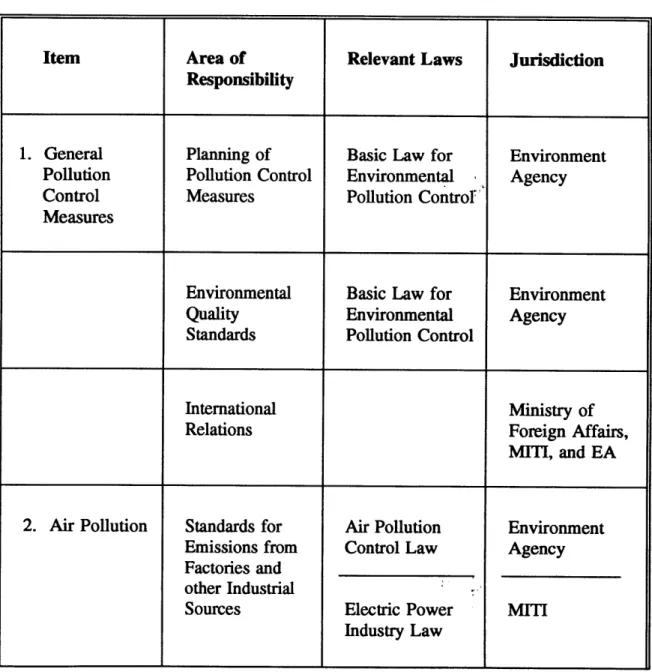
'0 Turn to table 1 in the appendix for more details on Japanese environmental regulations.
level of industrial discharges. Significant amounts of industrial effluent were dumped untreated into rivers and streams. Although most of the visible water pollution problems have been alleviated by environmental regulations, the percentage of Japanese residents who are not connected to a proper sewer system approaches the conditions of some developing countries. Less than 40% of Japanese households are currently connected to a sewer system, compared to 97% for the U.S. and 72% for England. (Barrett and Riki 1991)
Waste Control and Management Law
Enacted in 1970, the Waste Disposal and Public Cleaning Law governs waste from household, commercial, and industrial sources. Radioactive waste is regulated by a different law. The disposal of household and industrial waste has become a pressing problem due to the dramatic increase in volume. Between 1966 and 1985, the volume of wastes has more than doubled to 38 million tons a year and the cost of waste disposal has increased more than 100 times during the same period. (Barrett and Riki 1991) Although Japan is one of the world's leaders in recycling, there is a severe shortage of landfills. As a result, Japan's Health and Welfare Ministry had to increase its recycling budget more than 16 times in 1991. One important factor that contributes to Japan's waste problem is its cultural aversion to secondhand products and passion for the latest gadgets. According to the Tokyo city government, the Tokyo Bay landfill in 1990 had more than 128,029 television sets, 99,006 refrigerators, 88,841 washing machines, 20,352 microwave ovens, 124 pianos, and 78 cars. (McGill 1992) Anyone who thinks this is an overrated problem should try to sell an used car in Japan.
Air Pollution Control Law
Enacted in 1968, the law sets emission standards for certain pollutants like carbon monoxide, sulfur dioxide, and nitrate oxide and photochemical smog. Although nitrogen dioxide has remained constant or increased over the years, sulfur dioxide and carbon monoxide levels have declined dramatically in the last 25 years. Unfortunately, the overall air quality appears to be getting worse due to the rise in household energy consumption and in the usage of automobiles. A writer for the Far Eastern Economic Review recently observed, "More noticeable to the person on the street is the increase in the level of nitrogen dioxide, the toxic brown gas that belches from the exhausts of diesel-powered buses and trucks." "
Pollution-Related Health Damage Compensation Law Perhaps the most distinctive aspect of Japanese environmental policy, this law establishes a mediation and dispute resolution mechanism for civil disputes concerning pollution damages. Designed primarily to provide immediate relief to those who have suffered from pollution problems, the law does not obligate people to prove that their illnesses are caused by a specific pollution problem. For example, all asthma cases within certain areas with high air pollutants are considered to be "victims" whether or not they are smokers or if there is a family history of asthma. It also forces the company designated to be responsible to pay for all compensatory costs including all medical treatment, disability compensation, compensation to the surviving family, and even funeral
" Gavin Greenwood. "Environment in Asia 1991", Far Eastern Economic Review, September 19, 1991, pp. 37
expenses. In 1980, 76,000 people were designated as air pollution victims and received some form of financial compensation.
In recent years, international organizations such as the Organization of Economic Cooperation and Development (OECD) and World Resources Institute have promoted Japan's apparent environmental success as a model for both industrialized and developing countries. A 1977 OECD report found that Japan's antipollution measures were reducing both sulfur dioxide concentrations and the incidence of industrial waste contamination. 12
Since the history of environmental problems have been discussed, we can now turn to the role of interest groups in the environmental policy making process.
Interest Groups and the Environmental Policy Making Process
Like other public policy matters, the Liberal Democratic Party (LDP) - dominated Diet, the business establishment, and the government ministries represent the three interest groups who have a major influence on Japan's environmental policies. However, in contrast to traditional public policy matters, non-governmental organizations (NGOs), grass-root pressure groups, and the court system also play significant roles in environmental policy making. Three important characteristics can be identified in the interest group dynamics of environmental policies.
First, the Prime Minister's Office, which technically heads the LDP, has less power than any head of OECD governments. Unlike Prime Ministers and Presidents of these OECD countries, Kiichi Miyazawa, the current Japanese Prime Minister, does not have
12 Michio Hashimoto. Economic Development and the Environment: The Japanese
Experience, a report of the Ministry of Foreign Affairs, April 1992, pp. 18.
much institutional power to initiate government programs. " The implementation process is left to the discretion of senior civil servants of the relevant government minis
tries. Through the use of quasi-government decrees known as administrative guidances,14 ministry bureaucrats can adopt as well as implement government legislation. As Chalmers Johnson, a Japan specialist at the University of California - San Diego, argues, "Within the LDP the bureaucratic mainstream and the party politicians,... factions compete with each other with the bureaucrats usually dominant; but for the sake of party unity neither group is ever totally excluded." (Johnson 1982)
Second, the Environment Agency (EA) lacks the organizational capacity and strength of other government ministries. As matter of fact, the EA is not even a true government ministry in the sense that it is a division within the Prime Minister Office without the organizational autonomy of ministries like Finance, Foreign Affairs, and even Agriculture.1 5 The chronic underfunding and weak regulatory capability leaves the EA relatively powerless in the bureaucratic turf battles that often take place in Japanese government. For instance, the EA does not have regulatory power over such matters as
" There is some evidence to suggest that the Prime Minister Office and the LDP are gaining power at the expense of the government ministries. See Takashi Inoguchi's Essays
in Japan's Political Economy II (Tokyo: Institute of Oriental Culture, University of
Tokyo, 1983) and T.J. Pempel's "The Changing Dynamics of Japanese Policy Formation" in The Journal of Japanese Studies Vol.13 No.2 Summer 1987.
14 Administrative guidances are important to any discussion of Japanese public
policies since so many government rules are opaque to both Japanese and non-Japanese interest groups. These guidances have the power but not the rigidity of a formal government regulation.
15 Turn to table 2 on the organization of the Japanese Government and to table 3 for
hazardous waste disposal and radioactive waste storage. 16
The weakness of the EA's agency can be seen in the fate of the national recycling initiative in 1991. The EA thought that it would be a good idea to have a national recycling plan and submitted a proposal to the Diet. However, both MITT and the Ministry of Health & Welfare felt that EA's recycling initiative crossed over to their political jurisdictions and decided to devise their own plans. The Diet proceeded to pass MITI and Health & Welfare alternative proposals and ignore EA's original initiative. One EA official later told the Japan Times, an English daily newspaper, the MITI plan "lacked
an environmental conservation view." 1 7
Third, NGOs and grass-root pressure groups play an important role in environmental policy making. There are several thousand groups operating in Japan, with the membership ranging from a few dozen to tens of thousands. Environmental NGOs and grass-root pressure groups can be divided into three groups: "
Domestic Environmental NGOs
Although small by Western standards, there are several influential domestic environmental NGOs. The Wild Bird Society is probably the largest and most active
16 MITI is responsible for radioactive waste storage since they are in control of
nuclear power and other energy-related matters. Ministry of Health & Welfare is responsible for hazardous waste disposal since they are in control of all industrial and non-industrial waste disposal. Turn to table 1 for more details on the jurisdictions of government ministries.
17 Japan Environment Monitor, Feb. 28 1991, pp.12
1 Turn to table 4 in the appendix for a description of the environmental NGOs and grass-roots pressure groups.
group in this category. Started in 1934 by a devout Buddhist who promoted bird watching as an esthetic ritual, the group currently has a membership of 40,000 members and operates 10 bird sanctuaries throughout Japan. (McGill 1992) The Nature Conservation Society of Japan, which has a membership of 10,000 members, also focuses on domestic environmental issues and manages several conservation programs protecting marine ecosystems.
There are also dozens of smaller environmental conservation groups that have been organized to oppose specific construction projects. For instance, there are some groups that oppose the construction of golf courses due to the threat to the natural environment. There are also groups that oppose logging in specific forests, and even groups which oppose the construction of certain highways. Save the Nagara River Campaign is one of the well-known and largest grass-root conservation movements in Japan.
Pollution Victim Groups
Pollution victim groups provide legal and organizational support to industrial pollution victims and the Minamata disease survivors. Although the Minamata disease was identified as a potential health problem more than 35 years ago, many people are still fighting in the Japanese court system to obtain their compensation. The businesses who have to pay the pollution damages often appeal the government decisions and these cases usually take years to resolve in the courts, if indeed they are resolved. '9 Pollution victim
19 There is an extensive literature on the subject of environmental protests and
grass-roots citizen movements in Japan. Two of the more useful works are Margaret McKean's
Environmental Protest and Citizen Politics in Japan (Berkeley: University of California
Press, 1986) and Frank Upham's Law and Social Change in Postwar Japan (Cambridge: Harvard University Press, 1987).
groups provide legal advice and information to fight in the courts. According to the Environment Agency's 1987 Quality of the Environment in Japan report, there are 1,385 certified victims of the Minamata disease and about 94,639 people who suffer from pollution-related respiratory diseases
International Environmental NGOs
Greenpeace, Friends of the Earth, Worldwide Fund for Nature, and the Japan Tropical Forest Action Network compose the international environmental NGOs community in Japan. Each group focuses on a limited number of domestic as well as international environmental issues like tropical deforestation and overseas development assistance. Although they initially gained some interest due to their foreign origins, they had to spend considerable amount of their time emphasizing their Japanese roots. For instance, Greenpeace Japan has a strict policy of hiring only Japanese staffers, which led to some accusations of nationalism and ethnocentrism.
One interesting point about international NGOs in Japan is the strikingly large number of Japanese environmental groups that have been started by Americans or West Europeans. For instance, Jonathan Holliman, a planner at the United Nations University in Tokyo, is the co-founder of Friends of the Earth Japan. Rick Davis is the editor of the Kofu-based Japan Environmental Monitor that acts as a NGO watchdog on environmental policy issues. Jim Griffith is the founder and former director of Kyoto-based Japan Environmental Exchange, an all-volunteer international citizens' organization. Lena Lindahl, a young Swedish woman, is the manager of Japan office of Global Legislators' Organization for a Balanced Environment (Globe), a Tokyo-based environmental lobbying
group. There are also many smaller environmental NGOs operated by foreigners in the area around Kyoto.
There is no doubt that the heavy foreign presence among environmental activists can be traced to the stigma of working for groups that advocate social change in Japan. Unlike some Western countries, there is no strong philanthropic tradition in Japan, which makes it difficult for nonprofit groups to survive and for many people to regard social causes as viable career choices.
Although some government ministries like MITI initially resisted the adoption of environmental regulations as threats to the country's international competitiveness, Japan changed from a nation that paid the least attention to environmental concerns to one with the most ambitious pollution abatement programs in the world between the mid-1960's and the mid-1970's. Unfortunately, by the end of the 1970's, environmental policy ceased to become a major component of Japan's policy agenda. The weakness of the EA and widespread public impression that pollution problems no longer posed serious public health threats contributed to the decline in environmental activism. "The irony is that Japan has dealt so well with the earlier environmental problems that people assume all the problems have been solved," says Akira Arai, a reporter for the Nihon Keizai Shinbun, who covered the large scale air pollution problems in the early 1970's. 20 However, by
the middle of the 1980's, the changing political circumstances once again revived the importance of environmental policies in Japan.
20 "The Greening of Japan", Business Tokyo magazine, November 1990, pp. 27
Changing Political Dynamics
Japan has faced many international challenges to its domestic tranquility in the last forty years. As a country which imports much of its energy, Japan had to endure two major oil shortages. The first major shortage happened during the Arab oil embargo in the early 1970's and the second major shortage erupted during the Iraq and Iran War in the early 1980's. Despite fears of economic turmoil, Japan survived these oil shortages and actually improved its international competitiveness. Unlike the U.S., Japan chose to devote enormous amount of resources into energy-efficient technologies and consumer products. Hence, when American consumers started to demand fuel-efficient automobiles and consumer products, Japanese companies were ready to meet their demand.
By the late 1980's, Japan faced more significant changes in its international and domestic political landscape than any period since the end of World War II. This chapter explores three of these changes: fashioning a post-Cold War foreign policy, cultivating a new political image, and the increasing use of gaiatsu (outside pressure) in environmental policy making.
Fashioning a Post-Cold War Foreign Policy
Two recent political events have had a large impact on Japan's foreign policy. First, the end of the Cold War caused a tremendous political and economic dislocation in U.S.-Japan relations as well as in the international political landscape. Until the demise of the Soviet Union, Japan never had the opportunity to think about the geo-political Chapter Two
implications of living in a single superpower world. Ezra Vogel, professor of social sciences at Harvard University, once observed, "Most Japanese opinion leaders acknowledge that the alliance with America was in their best interest, but the issue was never squarely examined. Only now with the end of the Cold War does Japan have the opportunity to evaluate dispassionately the legacy that became their own without full public debate." (Vogel 1992) With economic competition replacing military competition as the most important foreign policy objective, Japan has already replaced the Soviet Union as the U.S.'s biggest foreign competitor. It is not surprising that some American political analysts are stressing the need to contain Japan, echoing the language of the Cold War.
Second, a strong interest in kokusaika (the internationalization of policy) has penetrated all sectors of Japanese society. Once limited to business executives talking about new ways to increase Japanese exports, kokusaika has become an obsession among the Japanese public and the political leadership. In a speech to the Soviet Academy of Sciences in 1988, Yasuhiro Nakasone remarked that, "Now is the time for the countries of the world in their respective regions to endeavor, not by words but by deeds, to find reasonable and constructive solutions to outstanding problems and to build better and more durable relationships appropriate to the coming century." " Although international cooperation is a favorite topic of political rhetoric, there is no doubt that kokusaika is more than an empty public relations gesture. Consider that Japan's Overseas Cooperation
21 Yasuhiro Nakasone, "Towards a New International Community", Survival, Volume
XXX, Number 10, November/December 1988, pp. 498. 22
Volunteers has almost as many youths per capita overseas as the Peace Corps, its American counterpart. (Vogel 1992)
Threats to Domestic and International Politics
While the Germans were ripping down the Berlin wall and the world was celebrating the end of geo-political competition between the Soviet Union and the U.S., Japan's political reputation began to suffer on an unprecedented scale in the late 1980's. In the domestic arena, the Recruit bribery scandal caused a plunge in public support for former Prime Minister Noboru Takeshita and other Japanese politicians. 2 According to a telephone survey conducted by Nihon Keizai Shinbun, Japan's version of the Wall Street
Journal, only 13% of the public approved while 65% of the people disapproved of the
Takeshita administration. More importantly, the Federation of Economic Organizations (Keidanren), which hands out millions of dollars in political contributions to the LDP and other political parties, lost faith in Takeshita and his LDP allies. 3
In the international arena, Japan faced three thorny political problems in the late 1980's. First, there was increasing perception that Japan's international influence was not commensurate with its economic influence and that Japan should increase its economic
2 Recruit Scandal:"The scandal centered on a publishing conglomerate called Recruit
Co. whose chairman tried to buy favors from powerful politicians with bargain priced shares of its subsidiary ... No top political leaders were charged, but the scandal forced to the sidelines a dozen powerful politicians. Takeshita was forced to resign as prime minister in April 1989 due to this link to the scandal." Boston Globe April 27 1991, pp.2 4
2 There is no comparable American institution that has the political and economic
clout of the Keidanren. While it is possible to be elected President or a senator in the U.S. without the support of the American Chamber of Commerce, the Business Roundtable, or other business interest groups, it would be difficult to rise to a LDP leadership position without Keidanren's political support.
assistance to developing countries. This view became so pervasive that many nations began to see Japan literally as an automatic aid dispenser. As an editorial in the Asahi
Shinbun, one of the most influential newspapers in Japan put it, "Many dignitaries from
many countries visited Japan for the recent Enthronement ceremony. (Former) Prime Minister Kaifu and Foreign Affairs Minister Nakayama spent most of their time at meetings. Kaifu had 59 one-on-one meetings and Mr. Nakayama had 64. At most of these meetings with Prime Ministers and Presidents of developing countries, only Japanese economic aid came up in the conversation. Money, money, and money." '
Second, trade problems erupted between Japan and the U.S., by far its most important economic partner. Discussions of trade legislation like Super 301 and the Structural Impediments Initiative turned into supercharged debates. Anyone who expressed an opinion on this issue risked permanent tenure in either the basher or the Japan-apologist club. To paraphrase poet William Butler Yeats, the middle ceased to exist.
Third, Japan began to get labeled as an ecological terrorist. Consider these two provocative news headlines: "Uchi/Soto:bandit or model" and "World's Eco-Outlaw?" " Many environmental NGOs like Greenpeace started international protest campaigns against Japan's environmental policies. There was so much negative coverage of Japan's global environmental policies that even the Japanese public detected this
eco-"2 Japan Free Press' translation of a July 24, 1989 editorial in the Asahi Shinbun. Japan Free Press is a English magazine that translates and publishes stories from Japanese newspapers and magazines.
25 The two headlines appeared in New Perspectives
Quarterly, Summer 1990, pp. 17 and Newsweek, May 1 1989, pp. 68.
terrorist image. According to a survey done by the Prime Minister Office, 41% of the people responded no to the question, "Do you think other nations see Japan as an international country ?" Of the people who responded no to this question, 59% of the
people cited environmental policies as the main reason. 2' Although it is difficult to draw
firm conclusions from political surveys, Japanese people appear to be sensitive to their country's anti-ecological reputation.
Japan's deteriorating domestic and international reputation did not go unnoticed by senior government officials. Senior LDP politicians began to rethink the country's positions on global environmental issues and formulate strategies to enhance Japan's international reputation. "Taking an initiative in the (environmental) field will improve Japan's image with foreign countries -- an area in which the nation has worked hard. Japan has not been good at publicizing what it has done since the international community believes the nation (Japan) is destroying the global environment," says Kazuo Aichi, a former head of the Environment Agency. (Masoni 1991)
Environmental Gaiatsu
Along with a deteriorating political situation, Japanese politicians had to deal with the
gaiatsu ("outside pressure" in Japanese) phenomenon. First used by trade negotiators to
gain access to the Japanese domestic market, gaiatsu now embodies all kinds of diplomatic pressures on Japan. " Why has gaiatsu become a familiar word on Capitol
26 Japan Free Press translation of a March 22, 1992 article in the Asahi Shinbun.
* It is important to distinguish gaiatsu from the Japanese tradition of appropriating policy ideas from abroad. Gaiatsu implies that outside pressure exerted unwelcome influence over Japanese policies.
Hill ? Yoichi Funabashi, a writer for the Asahi Shinbun, offers this explanation: "Japanese words like nemawashi (preparing the ground through one-on-one negotiations for a consensus decision) and zoku (tribe) are known among the people who deal directly with Japan, but gaiatsu has penetrated the entire Capitol Hill. Since Japan's political structure stresses consensus and bottom-up proposals, everything works against establishing a distinct order of priorities, against having a clear loser rather than having everyone bear part of the burden. That's why, regardless of international pressure, there were no moves toward new farm or land policies until gaiatsu was applied." 21
Any nation can technically apply outside pressure, but there is a tremendous difference between political pressures from the U.S. and say, Bolivia. The U.S. has had a major economic and political influence on Japanese policies since the end of World War II. The influence of the U.S. on Japanese international diplomacy can be seen in a recent survey of Diet members. In an answer to the question, "Who do you think is making the decision on Japanese diplomacy," 81 people mentioned the LDP, 67 mentioned the Ministry of Foreign Affairs, 55 mentioned the U.S., and only 15 mentioned the Prime Minister Office. "The fact that one in four legislators believe that Japanese diplomacy is determined in Washington is a rather painful reminder of Japan's dependence on America and its failure to implement its own unique foreign policy." (Fujigane 1991) Although some government ministries invite gaiatsu whenever they are politically convenient, many Japanese policy makers are beginning to realize that gaiatsu may proliferate if it gets too popular with foreign interest groups.
28 Japan Free Press translation of a July 16, 1990 article in the Asahi Shinbun.
Against this backdrop of political disequilibrium, international pressure, especially from the U.S., has forced Japan to go beyond diplomatic tokenism and respond more forcefully on environmental issues. Outside pressure can be seen in three specific examples:
Endangered Species
Japan has been the largest ivory importer in the world, accounting for 40% of the international market. In October 1989, Japan announced a total ban on the ivory trade. Tn
1991, they agreed to discontinue trade in certain endangered species like sea turtles and the hawkbill. Both actions followed intense political pressures from the U.S., West European Countries, and the environmental NGOs. (Miller 1991)
Driftnets
Japan is one of the largest users of driftnet fishing in the world. Many environmentalists refer to driftnet fishing as aquatic stripmining since the practice kills so many dolphins, sea turtles, and other marine animals. Following intense lobbying efforts by government and NGO organizations, the U.S. Supreme Court approved a ban on the use of driftnet fishing by Japanese fishing boats in U.S. water and 15 South Pacific countries called for a total ban in 1989. Following more actions by the U.S. Congress that pushed for an international ban on driftnet fishing, Japan reduced the number of fishing ships and suspended such driftnet fishing for one year in the South Pacific. (Miller 1991)
Overseas Development Assistance
Japan is now the world's leading foreign aid donor and its overseas development assistance (ODA) budget has grown faster than any country in the world. Between 1978
and 1989, ODA has increased more than 500%. Japan's 1990 ODA budget reached more than $10 billion, surpassing the U.S. budget of $9.5 billion. 29 Its 1990 aid budget was
also sixty percent greater than France's, two and half times Germany's, and five times Britain's. " Japan is also the top bilateral aid donor to 25 developing countries and is the largest or the second largest contributor to the Asian Development Bank, the World Bank, the International Monetary Fund, the Inter-American Development Bank, and the African Development Bank. Julia Chang Block, a former senior official in the U.S. Agency for International Development once observed, "In a short 25 years, Japan has gone from a major recipient of World Bank aid to become the Bank's second largest donor." 31
Ironically, large increases in Japan's ODA budget have led to two additional environmental gaiatsu cases. First, some NGOs charge that the chief beneficiaries of ODA environmental projects are Japanese companies. They cite the $2 billion dam in Asahan, Indonesia, built largely with Japanese aid as an example. Although the dam project is suppose to provide electricity and economic development to this part of Indonesia, most of the benefits from the new infrastructure tend to serve Japanese companies operating an aluminum refinery. The refinery also uses most of the electricity generated by the dam.
2 Richard Forrest. "Japan Aid and the Environment", The Ecologist, Vol.21, No. 1,
January/February 1991, pp. 24.
30 Please turn to table 5 in the appendix that compares Japan's ODA program with
those of other OECD countries.
31 Julia Chang Bloch. "A U.S.-Japan Aid Alliance: Prospects for Cooperation in an
Era of Conflict", The Program on U.S.-Japan Relations, Harvard University, USJP Occasional Paper 89-07, July 1989, pp. 1.
(McGill 1992)
Second, many pollution-intensive Japanese industries like petro-chemical and paper manufacturers are moving their factories to developing countries to escape stringent environmental regulations. Heavy-metal poisoning has been found in people living around Jakarta Bay, Indonesia, where many Japanese manufacturers operate factories. Citizen groups in the Philippines are now protesting pollution problems near a copper smelter owned by a Japanese trading company. A Malaysia court has ordered the shutdown of a Japanese chemical manufacturer due to the discovery of radioactive waste in nearby farmland and streams. (McGill 1992)
What are the merits of these environmental gaiatsu cases ? Are they all legitimate
gaiatsu cases or are they Japan bashing disguised as gaiatsu ? There is no doubt that
Japan has been less than vigilant on some environmental issues like driftnet fishing and tropical timber. Outside pressure on these two cases has probably yielded some positive results. However, whether or not criticisms of Japan's ODA program can be described as a legitimate gaiatsu case is less clear. For one thing, it is hypocritical to accuse Japan of promoting a foreign aid policy that favors its indigenous commercial interests, since most OECD countries have the same practice. It is also unfair to single out Japan for exporting polluting industries to developing countries since American and European companies have been transplanting their polluting industries for years. 2 There is no hard evidence that
Japan is a worse pollution exporter than other industrialized countries.
3 Consider the rapid movement of polluting industries from the U.S. to Mexico as
the result of the North American Free Trade Agreement. 29
Perhaps the most salient point about Japan's ODA program is that virtually all of the money is focused on economic development and other non-military uses. This is quite different than the case of the U.S. foreign aid program which has a strong military orientation and concentrates most of its assistance on two countries, Israel and Egypt. As noted earlier in the chapter, Japan is the largest bilateral aid donor to 25 developing countries. Although it is not always obvious, it is important to distinguish gaiatsu and Japan bashing.
Japan has faced numerous international challenges to its domestic tranquility in the last forty years. In the case of the two major oil shortages, the country was actually able to improve its international competitiveness. However, the end of the Cold War and the rising interest in kokusaika have forced this nation to fundamentally rethink its relationship with the U.S. as well as its role in international affairs. Should Japan try to form an Asian economic union to counter the European Economic Community and the North American Free Trade Agreement ? Should Japan play a more active role in military affairs ? Amidst this tremendous political turbulence, Japan faced yet another policy challenge: a rising importance of global environmental issues.
Chapter Three Rising Importance of Global Environmental Issues and its Impact on Japan
Many current environmental problems can be traced as far back as the start of the Industrial Revolution. Twenty years ago, the Club of Rome's Limits to Growth study warned the international community about the dangers of rapid population growth and resource degradation. Not surprisingly, these same issues dominated the 1992 U.N. Conference on Environment and Development in Brazil. Do environmental concerns reflect cyclical political dynamism, and how does our current environmental commitment compare to those of the past ? This chapter will focus on three themes. First, detailing the rising importance of global environmental issues. Second, discussing the climate change issue. Third, exploring the relationship between Japan and international environmental politics.
Rising Importance of Global Environmental Issues
Global environmental problems have been overlooked in favor of more immediate political objectives for a long time. Similar to what social theorist Thomas Kuhn calls a paradigm shift, however, there are signs that there has been a genuine change in the societal perception of environmental issues. Traditionally, environmental policies have always played a subservient role to economic and military policies. With the growing awareness of such issues as ozone depletion and climate change, the global environmental agenda has gained an unprecedented degree of diplomatic respectability and is redefining
what constitutes national security. * In an influential essay published in Foreign Affairs, Jessica Tuchman Matthews, Vice President of the World Resource Institute, argued that "Environmental strains that transcend national borders are already beginning to break down the sacred boundaries of national sovereignty .... The once sharp dividing line between foreign and domestic policy is blurred, forcing governments to grapple in international forums with issues that were contentious enough in the domestic arena." (Matthews 1990)
The Club of Rome's Limits to Growth study and the U.S. Council on Environmental Quality's Global 2000 report documented disturbing environmental trends and stressed the importance of international cooperation in the 1970's. The 1987 World Commission on Environment and Development and the 1992 United Nations Conference on Environment and Development in Brazil provide more concrete evidence that there is a growing realization that environmental threats pose serious socio-economic problems and that they will not be unilaterally solved by a single country
Although many global environmental problems have become major policy concerns, the climate change issue has arguably received the most attention. Eugene Skolnikoff, Professor of Political Science at Massachusetts Institute of Technology, points out that "climate change has become a staple of national and international politics. It is by far the most dramatic environmental issue yet to receive worldwide attention .... The threat has
I The election of Albert Gore as the Vice President of the U.S. is accelerating the importance of environmental politics. He recently chaired a panel of experts which tried to formulate a national government strategy that would encourage economic growth without environmental degradation.
spawned widespread proposals for treaties, international institutions, and major new policies, many of draconian dimension." (Skolnikoff 1990) What is the global warming and what are its policy implications ?
The Climate Change Issue
Also mentioned in the scientific literature as the greenhouse effect, global warming refers to the heat-trapping effects of rising atmospheric concentration of carbon dioxide and other greenhouse gases. Many mundane human activities including the burning of fossil fuels and firewood cause emissions of carbon dioxide and other greenhouse gases. According to a Royal Institute of International Affairs study, the atmospheric concentration of carbon dioxide, the most prevalent greenhouse gas, is 25% above the pre-1800 level. (Grubb 1990) Although the heat-trapping effects are referred to as global warming, climate change, and the greenhouse effect, the most accurate way to describe the phenomenon is climate change since our planet would experience temperature fluctuations (some areas of the world would see increases while other areas would see decreases) and seasonal variations in the distribution of rain, snow, humidity, and storm. However, no one knows what precise levels of temperature fluctuations and precipitation variations will be in the future. The 1990 IPCC report, considered by many people as the bible of the climate change issue, concluded that "emissions resulting from human activities are substantially increasing the atmospheric concentrations of the greenhouse gases" and that "knowledge of global mean change and change in precipitation is of limited use in determining the impacts of climate change. We cannot yet give
reliable regional predictions at the smaller scales demanded for impact assessment." " Simply put, there is strong evidence of climate change, but we do not know what the specific impacts are going to be. Thomas Schelling of Harvard University's Kennedy School of Government notes that "Europeans who migrated to North and South America similarly underwent drastic climatic changes .... Most people will not undergo in the next hundred years changes in their local climates more drastic than the changes in climate that people have undergone during the past hundred years. The climate of Nebraska may gradually change into the current climate of Kansas, but not into the climate of Massachusetts or Oregon." (Schelling 1990)
However, some scientists fear that even a slight change in temperature would cause several deleterious environmental consequences including agricultural damages, an increase in the sea-level and a sharp rise in the cost of electricity due to use of air conditioning. A 1992 study by the Institute for International Economics tried to quantify the possible damages: (Cline 1992)
Agriculture - Crop damages from possible temperature increases range from $12 to $18 billion in the U.S.
Sea-Level Rise -Global warming is expected to raise the level of the seas, as a result of thermal expansion of water and melting of land-based glaciers. A conservative estimate of an one meter sea-level rise will eliminate 3 percent of the earth's land area and will cost billions of
dollars in coastal damage. The damage for the U.S. alone range from $7 billion to $11 billion.
3 J.T. Houghton, G.J. Jenkins, and J.J. Ephraums (Eds). The Climate Change: The
Intergovernmental Panel on Climate Change Scientific Assessment (Cambridge, Great
Air Conditioning - The costs of increasing demand for air conditioning as a consequence of global warming will impose $11.2 billion in the U.S. There will also be a small cost saving associated with reductions in electric heating, estimated at around $1.3 billion.
Unfortunately, the major problem with these estimates is that they all have large margins of error. For instance, some scientists believe that there will be no agricultural damage in the U.S. since some states will benefit from the effects of global warming. (Cline 1992)
Although there are similarities between the climate change issue and other global environmental problems, three major differences can be noted. First, global warming stems from normal human activities that can not be categorized as aberrant. Many modem conveniences like driving a car produce some greenhouse gases no matter how energy-efficient or ecologically sound we try to make the activities. For example, even if all cars are made to be super fuel-efficient, this will not lead to an increase in air quality if there is also an increase in the number of people who drive automobiles. Second, there are time horizon differences. Unlike more physical environmental problems like the loss of some animal populations, the deleterious effects of global warming may not be evident for hundreds of years. Third, there is the difficulty of measuring and monitoring the greenhouse effect. Many countries are unwilling to compromise their economic growth to attain even a partial reduction in the CO 2 emissions. Moreover, some countries may actually benefit economically from temperature changes produced by climate change.
To adequately understand the history of the climate change issue, one needs to know the chronology of the important policy events. Here is a list of dates starting with the first
international policy meeting on the issue of climate change and ending with the signing of the Climate Change Convention in the 1992 UNCED."
1968 The first international conference is held in Paris on biosphere issues.
1972 United Nations Conference on the Human Environment is held in Stockholm.
1979 The World Meteorological Organization (WMO) sponsors the first World Climate Conference meets in Geneva.
1985 UNEP and the WMO sponsor an international conference on the assessment of the role of carbon dioxide and other greenhouse gases.
They issue a joint recommendation of national governments to consider climate change in policy making.
1988 Several hundred scientists and environmental officials meet at the
Conference on Changing Atmosphere in Toronto and advocate a 20% worldwide reduction in carbon dioxide by 2005.
1988 At an international conference sponsored by UNEP and WMO, the IPCC is created to assess scientific information on climate change and to formulate appropriate policy responses.
1989 Seventeen countries gather at the Hague and call for a new international institution with the powers to enforce the provisions of a global warming agreement.
1989 At the Ministerial Conference on Atmospheric and Climatic Change in the Netherlands, most participating nations except for Japan, the U.S., and the former
* The dates are based on Center for Global Change's briefing paper, International
Soviet Union, oppose a plan to enact a 20% cut in the carbon dioxide emissions.
1990 At the second World Climate Conference in Geneva, all OECD countries excluding the U.S. support a CO 2 stabilization plan. Japan and the European Community agreed to limit CO 2 emissions to 1990 levels by the year 2000.
1991 U.S. Office of Technology Assessment concludes in a report that the U.S. can achieve a 35% cutback in its CO 2 levels without technological breakthroughs.
1992 At the 1992 United Nations Conference on Environment and Development (UNCED) in Brazil, representatives of 153 countries sign the Convention on Climate Change. The objective of the convention is: "stabilization of greenhouse-gas concentrations in the atmosphere at a level that would prevent dangerous anthrogenic interference with the climate system ... within a time frame sufficient to allow ecosystems to adapt naturally." 3
Unfortunately, the convention does not spell out any specific commitments to limit the emissions of carbon dioxide. Instead of detailed commitments, the countries accept a vaguely worded goal of returning their emissions to "earlier levels" by the turn of the century."
1993 The U.S. decide to join the OECD countries and agree to limit CO 2 emissions to 1990 levels by the year 2000.
With the U.S.'s decision to reverse its policy and join Japan and the European
- Edward Parson, Peter Haas, and Marc Levy. "A Summary of the Major Documents
Signed at the Earth Summit and the Global Forum," Environment, Volume 34, No. 8, pp. 13.
3 Just because a country signs a climate change convention, it does not mean that
the country is signing a legally binding document. The convention merely sets the goals without specifying a certain time or level of commitment. Other than slight embarrassment, there is no penalty for disregarding both the letter and the spirit of the convention.
Community's stance on the climate change issue, all OECD countries now have the same position on the climate change issue: limit carbon dioxide emissions to 1990 levels by the year 2000. 3 Unfortunately, in order to have a real freeze or a reduction in the CO 2
emissions level, two large institutional roadblocks need to be resolved. First, there has to be a more credible enforcement of emissions pledges. For instance, Germany's plan to cut carbon dioxide emissions by 25% by the year 2005 is widely applauded by many environmentalists. However, since there is no penalty for not fulfilling the emissions pledge, all proposals are somewhat empty gestures until they are actually realized.
Second, some of the largest carbon dioxide emitting countries have not yet committed to any timetables to stabilize or reduce their emissions. Russia/the former Soviet Republics, China, India, and most of the developing countries make up more than half of the world's annual CO 2 emissions and any effective international agreement has to include their participation. 39 Some countries like China, which has large deposits of
high sulfur coal, may not be willing to sacrifice their economic growth unless the industrialized countries agree to provide substantial technical and economic assistance.
Japan and Environmental Politics
What is the impact of rising importance of climate change and other global
- Germany has a slightly more ambitious plan to cut carbon dioxide emissions by 25% by the year 2005.
1 According to the 1991 Environment Agency report, Environmental Protection
Policy in Japan, the U.S. emits 24.2% of the world's CO 2, Russia and former Soviet
Republics - 18.7%, China -9.7%, Japan -4.7%, West Germany -3.4%, and India -2.9%. With the merger of East and West Germany, Germany may have replaced Japan as the fourth largest CO 2 emitter.
environmental issues on Japan ? In the last five years, there has undoubtedly been a dramatic increase in environmental awareness in Japan. ' The Japanese translation of 50 Simple Things You Can Do to Save The Earth became a best-selling book. According to a 1990 survey by the Prime Minister Office, 42% of respondents were concerned about global environment problems, with the emphasis on protecting the ozone layer and reducing carbon dioxide emissions. This increase in concern is particularly impressive considering that a 1989 survey revealed that only 20% of respondents expressed a strong interest in environmental issues. 41
On the business level, a 1990 Japan Economic Journal survey found that more than half of 113 major companies have established or plan to establish environmental departments. In 1991, even Keidanren, the conservative business organization, produced a charter that outlined its global environmental principles. The charter stated that:
"We must aim to construct a society whose members cooperate together on environmental problems, a society where sustainable development on a global scale is possible, where companies enjoy
relationship of mutual trust with local citizens and consumers, and where they vigorously and freely develop their operations while preserving the environment." 42
On the government level, almost every major ministry or agency has added a global
* A 14-nation UNEP survey (May 1989) concluded that Japan had the lowest percentage of people who expressed a desire to contribute money or labor to improve their environment. Since multi-nation surveys are notorious for their methodological problems, it would be wise not to attach too much significance to the results.
41 Japan Free Press translation of a August 6, 1990 article in the Yomiuri Shinbun.
I Global Environmental Charter printed in the July/August 1991 issue of Japan