Adsorption-based atmospheric water
harvesting device for arid climates
The MIT Faculty has made this article openly available.
Please share
how this access benefits you. Your story matters.
Citation
Kim, Hyunho et al. “Adsorption-Based Atmospheric Water
Harvesting Device for Arid Climates.” Nature Communications 9, 1
(March 2018): 1191 © 2018 The Author(s)
As Published
http://dx.doi.org/10.1038/s41467-018-03162-7
Publisher
Nature Publishing Group
Version
Final published version
Citable link
http://hdl.handle.net/1721.1/115224
Terms of Use
Attribution 4.0 International (CC BY 4.0)
Adsorption-based atmospheric water harvesting
device for arid climates
Hyunho Kim
1
, Sameer R. Rao
1
, Eugene A. Kapustin
2,3
, Lin Zhao
1
, Sungwoo Yang
1
,
Omar M. Yaghi
2,3,4
& Evelyn N. Wang
1
Water scarcity is a particularly severe challenge in arid and desert climates. While a
sub-stantial amount of water is present in the form of vapour in the atmosphere, harvesting this
water by state-of-the-art dewing technology can be extremely energy intensive and
impractical, particularly when the relative humidity (RH) is low (i.e., below ~40% RH). In
contrast, atmospheric water generators that utilise sorbents enable capture of vapour at low
RH conditions and can be driven by the abundant source of solar-thermal energy with higher
ef
ficiency. Here, we demonstrate an air-cooled sorbent-based atmospheric water harvesting
device using the metal
−organic framework (MOF)-801 [Zr
6O
4(OH)
4(fumarate)
6] operating
in an exceptionally arid climate (10
–40% RH) and sub-zero dew points (Tempe, Arizona,
USA) with a thermal ef
ficiency (solar input to water conversion) of ~14%. We predict that
this device delivered over 0.25 L of water per kg of MOF for a single daily cycle.
DOI: 10.1038/s41467-018-03162-7
OPEN
1Department of Mechanical Engineering, Massachusetts Institute of Technology, 77 Massachusetts Ave, Cambridge, MA 02139, USA.2Department of
Chemistry, Kavli Energy NanoScience Institute, and Berkeley Global Science Institute, University of California–Berkeley, Berkeley, CA 94720, USA.3Materials
Sciences Division, Lawrence Berkeley National Laboratory, Berkeley, CA 94720, USA.4King Abdulaziz City for Science and Technology (KACST), Riyadh,
11442, Saudi Arabia. Hyunho Kim and Sameer R. Rao contributed equally to this work. Correspondence and requests for materials should be addressed to O.M.Y. (email:[email protected]) or to E.N.W. (email:[email protected])
123456789
E
nabling access to fresh potable water in desert and arid
regions is a critical challenge and tightly coupled to social
and economic development
1. Water scarcity is difficult to
address in areas that are landlocked and have limited
infra-structure, such that mature water purification technologies, i.e.,
reverse osmosis and multi-stage
flash, are challenging to
imple-ment. Atmospheric water generators (AWGs) can take advantage
of solar energy via photovoltaics (refrigeration-based)
2,3or solar
thermal (sorption-based)
4–6to harvest moisture from air. Typical
AWGs utilise refrigeration to cool large volumes of air well below
the dew point to condense water. The amount of energy
con-sumed to harvest water from the air dramatically increases as the
humidity or ambient temperature decreases. Desert and arid
regions, unfortunately, have day-time relative humidities (RH;
P
vap/P
sat, vapour pressure over saturation pressure) as low as
~10% with a vapour content of approximately 3 L of liquid water
for every one million litres of air. For these conditions, the dew
point can be sub-zero, requiring a large amount of energy to
freeze and collect water out of air. Though the typical night-time
RH can be as high as ~40%, the lower ambient temperature
(~20 °C) prevents water harvesting with refrigeration-based
AWGs.
As
a
result,
the
practical
implementation
of
refrigeration-based AWGs is infeasible
3,7.
AWGs that take advantage of solar-thermal processes are a
promising alternative to capture and deliver water in arid regions.
In this approach, a sorbent is
first saturated with water from air
and subsequently heated to release and condense the water
4–6,8.
By selecting the desired sorbent characteristics (e.g., shape and
step position of the isotherm, saturation capacity, and binding
energy), solar-thermal-driven water harvesting is viable and
efficient even in low RH conditions. Recently, we demonstrated
that metal−organic frameworks (MOFs) are particularly
attrac-tive because they can capture more water and require lower
regeneration temperatures
4for its release compared to
conven-tional sorbents (e.g., zeolites/silica gels or liquid brines). In
addition, their step-like isotherms suggest that a small change in
temperature and/or RH can lead to a large change in uptake and
water release. Our previous proof-of-concept device showed that
with MOF-801
4, water harvesting is possible (Cambridge, MA,
USA, with ~65% RH), with a temperature differential of ~45 K
between the MOF layer and condenser. While this demonstration
as well as several prior studies
5,6,8have shown that the approach
is viable, demonstration under representative conditions of
desert/arid climates has not been achieved. Here, we
experi-mentally demonstrate an air-cooled MOF-801-based water
har-vesting device operating in the arid climate of southwestern
United States (Tempe, AZ, USA) with a day-time RH as low as
10% and under sub-zero dew points. In addition, we analysed the
water from the adsorption−desorption/condensation process
with MOF-801 and confirmed that the MOF compound is stable
to water and the metal ions and organic linkers do not
con-taminate the produced water.
Cyclic water harvesting (i.e., multiple adsorption−desorption
cycles a day) is challenging in extremely arid regions due to the
low day-time humidity (~10% RH) that prevents water
adsorp-tion, i.e., the RH is lower than the adsorption step of MOF-801.
Consequently, to achieve maximum water production for a single
cycle, in this work, we implemented significant design
improve-ments over our prior proof-of-concept
4. First, we optimised and
engineered the device to completely saturate during the
night-time humidity swing (20–40% RH). Second, with an optical
concentration of less than 2× and buoyancy-assisted vapour
transport during condensation, the overall thermal efficiency (i.e.,
product of latent heat of water and mass of harvested water per
unit input solar energy) was estimated to be ~14%. This
corre-sponds to an increase of ~5× in comparison to operation without
optical concentration and enabled complete regeneration with
MOF-801.
Operation in such arid regions also opens an interesting avenue
for increasing water harvesting output with passive radiative
cooling by leveraging the typically clear sky. The clear night sky
and low vapour content in the atmosphere enables dissipation of
long-wavelength (infrared) thermal radiation from the device to
the cold sky to cool it below its ambient temperature. By facing
the device to the sky during adsorption, a ~3 K temperature drop
was achieved, which corresponds to an increase in 5–7% RH
experienced by the adsorbent. This passive cooling can lead to
opportunities to utilise other adsorbents that have their
adsorp-tion steps located beyond the typical levels of RH in specific
regions.
Results
Device design and operation. Our operational principle involves
a single daily cycle where adsorption occurs during night-time at
a higher humidity (20–40% RH) and solar-assisted desorption/
water production occurs during day-time at a lower humidity
(10–20% RH), schematically described in Fig.
1
a. The device
consists of two key components, an adsorbent layer (MOF) and
an air-cooled condenser in an enclosure. The back side of the
MOF layer is coated black and serves as a solar absorber. During
night-time adsorption, the enclosure side walls are opened and
the MOF layer is saturated with vapour from the natural
flow of
ambient air and passively cooled with radiation to the sky.
During day-time water production, the enclosure is closed and
the solar absorber side is covered with an optically transparent
thermal insulator (OTTI aerogel)
9,10. The MOF layer is heated
by exposure to solar irradiance, causing water release
(deso-rption). The desorbed water vapour diffuses from the MOF layer
to the condenser due to a concentration gradient. Accumulation
of vapour in the enclosure leads to saturation conditions and
consequently, the condensation process occurs at ambient
temperature. The heat of condensation is dissipated to the
ambient by a heat sink. The adsorbents need to be selected based
on the typically available ambient RH for water adsorption.
MOF-801 was chosen in our study because it exhibits an
adsorption step located around 20% RH and is well-suited for
the specific climate tested (Tempe, AZ, USA). Furthermore,
MOF-801 is hydrothermally stable and well-characterised for
water adsorption including having high stability to cycling water
in and out of the pores
4,11.
The amount of water that can be harvested in a single cycle
using MOF-801 can be evaluated based on the adsorption
isotherm shown in Fig.
1
b. For representative conditions in our
test location, with a night-time ambient temperature of 15–25 °C
and RH of ~30% during adsorption, the equilibrium uptake is
estimated to be ~0.25 kg kg
−1(kg of water per kg of MOF-801).
To achieve complete desorption (at ~10% RH, see Fig.
1
b), with a
day-time ambient (condenser) temperature of 30 °C (saturation
vapour pressure, P
sat= 4.2 kPa), the adsorbent must be heated to
a minimum of 77 °C (P
sat= 42 kPa). This corresponds to a target
temperature difference of ~45 K between the adsorber and the
condenser.
To attain these operating conditions, based on the
computa-tional simulation (Supplementary Note
1
), the prototype design
described in our prior study was further optimised and
engineered (Supplementary Note
4
). A MOF layer (base of 5
cm by 5 cm with ~3 g of MOF-801) was fabricated using a
porous copper foam. The solar absorber side of the MOF layer
was coated with pyromark paint with a solar absorptance of
~0.95. The MOF layer density and thickness were optimised for
operation in arid climates based on the transport properties of
MOF-801. A packing porosity of 0.67 (or packing density of 464
kg m
−3) and thickness of 2.57 mm were chosen for the MOF
layer (see Supplementary Fig.
7
). These optimised parameters
enable saturation within the limited time window, i.e., during
the humidity swing (increase) in the night-time (roughly under
8 h in a 20−40% RH environment) and to maximise water
harvesting capacity. Due to the
fixed side walls of the small-scale
device (unlike Fig.
1
a), which prevented access to air
flow
(vapour source), the MOF layer was secured in a separate
enclosure that allowed adequate access to air (Supplementary
Fig.
1
). The condenser of the device was fabricated with a copper
plate (4 cm by 4 cm and 0.6 cm thick) attached to a commercial
air-cooled heat sink (NH-L9x65, Noctua) to efficiently dissipate
the heat from condensation to the ambient. The condenser was
air-cooled throughout the entire experiment. To suppress
convective heat loss from the solar absorber side of the MOF
layer during solar-assisted desorption, an OTTI aerogel with a
thermal conductivity of less than 0.03 W m
−1K
−1and solar
transmittance of ~0.94 (see Methods) was stacked on the MOF
layer as shown in Figs.
1
a,
2
. The use of OTTI aerogel is
well-PyranometerBiconvex lens
OTTI aerogel
Insulated enclosure
Heat sink and fan Camera Tracking stage MOF layer Thermocouples Condenser and thermocouples Heat-pipe heat sink 2 cm OTTI aerogel
b
a
Viewport InsulationFig. 2 Water harvesting device test apparatus. a Photo of the device test apparatus during the solar-assisted water production with 1.8× optical concentration. Test location: Tempe, AZ, USA.b Photo of the water harvesting device showing the MOF layer (5 cm by 5 cm base, porosity of 0.67 or packing density of 464 kg m−3with 2.57 mm thickness), condenser (4 cm by 4 cm), and thermocouples through the view port. The OTTI aerogel, heat pipe heat sink and insulation are also shown
Desorption Adsorption Solar irradiance
Vapour
OTTI aerogel MOF layer
Condenser
Air (vapour source) Radiative cooling Cond. heat Night-time adsorption Day-time water production
a
b
Water uptake (kg kg –1 ) 0.3 0.2 0.1 0.0 0 10 20 30 40 15 °C 25 °C 45 °C 65 °C 85 °C 105 °C* Relative humidity (P P–1 , %) satFig. 1 Working principle of the MOF-801-based water harvesting device and adsorption isotherms. a Illustrative schematic of the water harvesting device undergoing adsorption (night-time, left half) and solar-assisted water production (day-time, right half) processes. During adsorption, air is circulated around the MOF layer and water from air is adsorbed. Passive radiative cooling lowers the MOF layer temperature below the ambient by dissipating thermal radiation to the clear cold sky to increase the effective RH for adsorption. During water production, the OTTI aerogel is stacked on top of the MOF layer to suppress convective heat loss from the solar absorber. The desorbed vapour is condensed on a condenser and the heat of condensation is rejected to the ambient by a heat pipe heat sink.b Water adsorption isotherms of MOF-801 in kg kg−1(kg of water per kg of MOF-801) as a function of relative humidity (P Psat−1, vapour pressure over saturation pressure) at temperatures of 15, 25, 45, 65 and 85 °C measured using a sorption analyser (Q5000 SA,
TA Instruments). *The isotherm at 105 °C was predicted using the characteristic curve based on the isotherm at 85 °C24. The dotted red circles indicate representative conditions achieved during night-time adsorption and day-time water production in Arizona, USA
suited for arid climates due to the inherently low RH and no
degradation during testing was observed. In order to prevent
vapour leak during desorption, a transparent plastic wrap (solar
transmittance of ~0.93) was used to seal the device, leading to an
overall solar transmittance and absorptance loss of ~17% (83%
sun to thermal conversion efficiency) with an effective heat loss
coefficient of 9−10 W m
−2K
−1. To help overcome these
solar-thermal losses and improve water harvesting thermal
efficiencies, experiments were also performed with a biconvex
lens (9 cm diameter) that was used to achieve an optical
concentration of 1.8× during desorption. The spacing between
the MOF layer and condenser (~1.8 cm) was also reduced in
comparison to our prior study to enable faster vapour diffusion
during condensation while maintaining minimal heat loss from
the MOF layer to the condenser. One of the lateral walls of the
device was made transparent to serve as a view port for
visualisation.
Water harvesting experiments. Five water harvesting cycles
were performed between May 11 and May 18, 2017 (Tempe, AZ,
USA) with the same MOF layer. Prior to the
first cycle, the MOF
layer was heated and dehydrated under direct solar radiation to
~50 °C and in an ambient of 35 °C and RH less than 20% for
~1.5 h. The experimental procedures and
measurement/instru-mentation details are presented in Methods. We initiated the
water harvesting cycle around 20:00 hours local time. The
absorber (black) side was positioned to face the clear sky to
enable passive radiative cooling, reducing the MOF layer
tem-perature below its ambient. Temtem-perature drops of ~3 K were
consistently observed throughout the adsorption phase of the
five consecutive water harvesting cycles. This reduction in
temperature corresponds to a 5−7% increase in effective RH
experienced by the MOF layer. While the ambient vapour
pressure was constant in this case, the saturation pressure is now
defined by the temperature of the cooler adsorbent layer. After
the overnight adsorption process, the MOF layer was installed
back into the device between 06:00 and 07:00 hours local time,
before the ambient RH started to decrease. The solar-assisted
desorption phase of the water harvesting cycle started typically
between 10:00 and 11:00 hours local time. For water harvesting
cycles with non-concentrated solar irradiance, the global
hor-izontal irradiance (GHI) was measured directly using a
pyr-anometer.
Water
harvesting
cycles
with
1.8×
optical
concentration and direct normal irradiance (DNI) was achieved
by facing the sun, where the measured global normal irradiance
(GNI) was used to evaluate DNI for a clear day in Arizona, USA
(see Methods). In addition, the tilting of the device at the
ele-vation angle of solar irradiance enhanced mass transfer due to
buoyancy-assisted transport and condensation of the hot
des-orbed vapour (see Supplementary Note
5
). Due to the limited
quantity of MOF-801 used in the device (~3 g), accurate
mea-surement of the quantity of harvested water was not possible,
albeit we expected ~0.75 g of water production. Therefore, we
used validated computational predictions
4based on the
mea-sured conditions during the water harvesting cycles (ambient
and condenser temperatures, RH, and solar
flux) to evaluate
the deliverable water capacity.
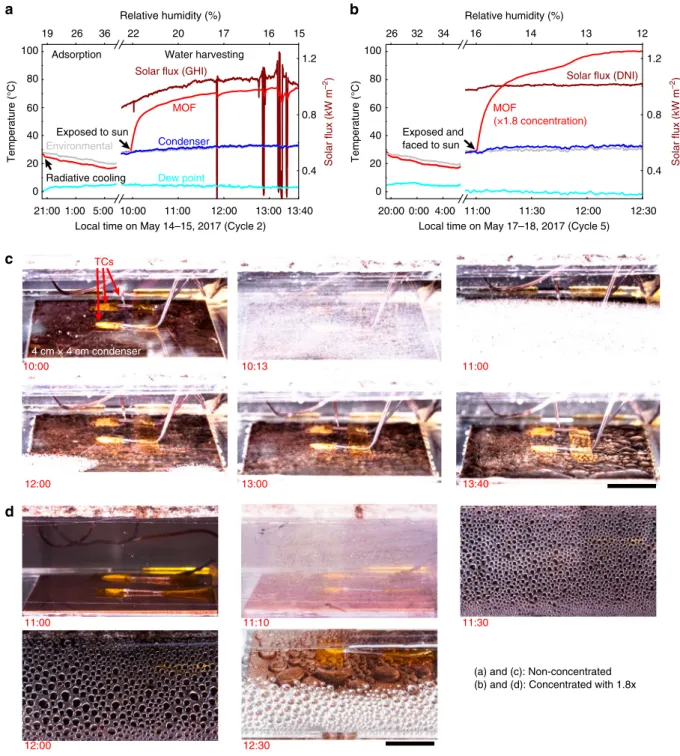
Representative water harvesting cycles without optical
con-centration (May 14–15, 2017; see Supplementary movie
1
) and
with concentration (May 17–18, 2017) with the associated
temperature profiles (MOF layer, environmental, dew point and
condenser), solar
flux and RH measurements are shown in
Fig.
3
a, b, respectively. In both
figures, the upper abscissa
indicates the measured RH at the local time of day (lower
abscissa). The radiative cooling during the adsorption phase
(between ~20:00 and 06:00 hours) is also shown. During the
desorption phase (starting between ~10:00 and 11:00 hours the
next day), the MOF layer temperature increased when exposed to
incoming solar irradiation. Images taken during this phase are
shown in Fig.
3
c, d. The desorption started immediately following
exposure to the solar irradiation and water condensation was
observed on both the view port (fogging) and the condenser. The
amount of fogging reduced over time as the enclosure walls and
the air−vapour mixture inside the device heated up.
For the cycles carried out with optical concentration, the higher
desorption temperatures (or desorption driving potential) can be
inferred from Fig.
3
b. In addition, the rate of regeneration was
significantly faster than the predictions (see Supplementary
Note
5
and Supplementary Fig.
10
) due to buoyancy-assisted
vapour transport during condensation (as the stage was tilted and
faced the sun at the elevation and azimuth angles). The higher
desorption temperatures associated with the concentrated case
enabled complete desorption and this can be qualitatively
deduced from the change in slope of the adsorber temperature
in Fig.
3
b (~11:45 hours local time). After complete desorption,
most of the incident solar energy was available for sensible
temperature rise leading to the slope change.
Prediction of harvested water. High-fidelity computational
simulations based on the characteristics of MOF-801
(Supple-mentary Figs.
9
and
10
) were used to predict the water harvesting
capacity of the device. Experimentally measured ambient and
condenser temperatures, solar
flux and RHs were used for the
initial and boundary conditions. For the representative
non-concentrated cycle, ~0.12 L of water per kg of MOF-801 was
delivered following saturation at 40% RH (equilibrium uptake of
~0.28 kg kg
−1). From the equilibrium considerations presented in
Fig.
1
b, after the desorption phase, the residual uptake at ~13%
RH (adsorber at 74 °C and P
satof 37 kPa; condenser at 33 °C and
P
satof 5 kPa) was ~0.09 kg kg
−1, leading to a net water
produc-tion capacity of ~0.19 L kg
−1(litres per kg of MOF). However,
due to the kinetic limitations, the residual uptake at the end of the
desorption was predicted to be only ~0.16 kg kg
−1, leading to
~0.12 L kg
−1water production capacity. The kinetic limitations
are dictated by intra/intercrystalline diffusion within the MOF
layer as well as the vapour diffusion between the MOF layer and
condenser. Similarly, for a representative cycle with an optical
concentration (1.8×), an adsorber temperature of 100 °C (P
satof
101 kPa) and a condenser temperature of 33 °C (P
satof 5 kPa), the
water production capacity was predicted to be ~0.28 L kg
−1. This
prediction is consistent with the estimate from the simulation
(Supplementary Fig.
10
). Here, the kinetic limitations were
overcome by the higher adsorber temperature as well as the
buoyancy-assisted vapour transport during condensation.
As a result of the optical concentration and tilting of the device,
we predicted a thermal efficiency gain of ~5× in comparison to
the non-concentrated cycle. Accordingly, with the concentration,
the thermal efficiency was ~14% with input solar energy (product
of DNI and optical concentration; herein, DNI was ~93% of GNI
for the test location) and was ~3% for the non-concentrated cycle
with GHI. The present device configuration and ambient
conditions can deliver over ~0.34 L m
−2cycle
−1(litres per m
2of MOF layer base area per cycle) with the 1.8× solar
concentration.
Water quality analysis. Though hydrothermal stability of
MOF-801 has been extensively studied and well-established
4, we
quantitatively characterised the quality of the harvested water
using a bench-top adsorption cycling system that enables
suffi-cient water collection (see Methods and Supplementary Fig.
11
).
Results from inductively coupled plasma-mass spectroscopy
(ICP-MS) analysis indicate that the zirconium (metal ion of
MOF-801) concentration in the water was found to be less than 1
ppb (parts per billion) as shown in Supplementary Fig.
12
. In
addition, the harvested water was analysed using infrared
spectroscopy and evidence of organic linkers (fumarate) was not
found, indicating that the compositions from MOF-801 did not
contaminate the harvested water (see Supplementary Note
6
and
Supplementary Fig.
13
).
a
b
c
d
TCs 4 cm × 4 cm condenser 10:00 10:13 11:00 12:00 13:00 13:40 11:00 11:10 11:30 12:00 12:30(a) and (c): Non-concentrated (b) and (d): Concentrated with 1.8x
Solar flux (DNI)
Relative humidity (%) Relative humidity (%)
100 100 80 80 60 60 40 40 20 20 0 0 21:00 1:00 5:00 10:00 11:00 12:00 13:00 13:40
Temperature (°C) Solar flux (kW m Temperature (°C)
–2 ) Solar flux (kW m –2 ) 19 26 36 22 20 17 16 15 1.2 0.8 0.4 1.2 0.8 0.4
Local time on May 14–15, 2017 (Cycle 2) Local time on May 17–18, 2017 (Cycle 5)
Solar flux (GHI)
MOF Condenser Dew point Radiative cooling Environmental Exposed to sun
Adsorption Water harvesting
Exposed and faced to sun MOF (×1.8 concentration) 20:00 0:00 4:00 11:00 11:30 12:00 12:30 26 32 34 16 14 13 12
Fig. 3 Water harvesting test results. a, b Representative temperature profiles (environmental, MOF layer, dew point and condenser) and solar flux (global horizontal irradiance (GHI) or direct normal irradiance (DNI)) as a function of local time for representative non-concentrated (Cycle 2, May 14 −15, 2017) and concentrated with 1.8× (Cycle 5, May 17−18, 2017) cycles, respectively. c, d Representative photos illustrating droplet condensation on the copper plate condenser (4 cm by 4 cm) during the water harvesting process as a function of local time for representative non-concentrated (cycle 2) and concentrated (cycle 5) cycles, respectively. Shortly after the solar exposure, the view port fogged up due to condensation of desorbed vapour for both cycles. Thermocouples (TCs) measuring the condenser, air gap and the MOF layer temperatures are also shown. Due to the higher solarflux with the concentration, the rate of temperature increase of the MOF layer was significantly faster than the non-concentrated cycle, reducing the time required for desorption. The temperature slope change at ~11:45 hours local time indicates near completion of desorption. The predicted amount of harvested water for the non-concentrated (cycle 2) and concentrated (cycle 5) cycles were ~0.12 L and ~0.28 L per kg of MOF, respectively. Scale bars are 1 cm
Discussion
The concept of using night-time radiative cooling to increase the
effective RH experienced by the adsorber layer was also
intro-duced and discussed in this work. This approach opens
possibi-lities to use MOFs with higher water uptake values and even
lower regeneration temperatures, such as MOF-841
11or
Co
2Cl
2BTDD
12, in climates with ~20% RH even though their
adsorption step is located at 25–30% RH.
FAM Z-series (functional adsorbent material zeolite), also
referred to as AQSOA series
13, offer step-like isotherms located at
15–25% RH with adsorption capacities of ~0.2 kg kg
−1(AQSOA
Z01 and Z05). The device design and operation presented in this
work can be similarly extended with such advanced zeolites.
However, the synthetic
flexibility and ability to tune adsorption
properties are unique to MOFs
14,15and, therefore, ideally suited
for atmospheric water harvesting systems. While the chosen
MOF-801 in this study can deliver ~0.34 L m
−2cycle
−1(or ~0.28 L
kg
−1cycle
−1), further improvements can be realised with the
development of new MOFs. For instance, with an identical device
design and optimisation, a cobalt-based MOF (Co
2Cl
2BTDD)
12with an adsorption capacity greater than 0.8 kg kg
−1at ~30% RH
can lead to ~1 L m
−2cycle
−1of water output, potentially
sur-passing the water harvesting output of advanced zeolites. While
sorption kinetics of this MOF is relatively slower than MOF-801,
we envision that the development of new MOFs with enhanced
sorption capacities and kinetics can ultimately lead to a
sig-nificant increase in water harvesting output.
Passive operation can be enabled with concentrating thermal
energy with larger absorber areas
16or with stationary reflectors
17that eliminates the need for solar tracking (also see
Supplemen-tary Note
7
). Furthermore, considerations presented in this work
can be extended to a higher output system by integrating
multi-layer adsorbent stacks into a compact bed-type architecture
18–20,
common to many classes of adsorption systems. The merit of the
bed-type architecture is that in addition to solar-thermal, waste
heat or low-infrastructure sources of energy such as biomass can
be used to drive the desorption process (eliminating the need for
a planar adsorber). While such a system configuration can enable
higher output, the limitation of this approach is the need for
auxiliary components (e.g., pumps) and higher system complexity
to efficiently route the thermal energy to the various layers in the
bed. The required heat storage capacity and source temperatures
would need to be determined based on the required temperature
difference between the adsorber and the condenser, which can be
inferred from the adsorption isotherm. Our demonstration in an
exceptionally arid climate indicates that adsorption-based water
harvesting strategy is a promising solution to solve water scarcity
in these regions.
Methods
Synthesis and characterisation of microcrystalline powder MOF-801. In a 500 mL screw-capped jar, 5.8 g (50 mmol) of fumaric acid (Fluka, 99%) and 16 g (50 mmol) of ZrOCl2·8H2O (Alfa Aesar, 98%) were dissolved in a mixed solvent of
DMF and formic acid (200 and 70 mL, respectively). The mixture was then heated in an isothermal oven at 130 °C for 6 h to give as-prepared MOF-801 as white precipitate. The precipitate from three reaction jars was collected byfiltration apparatus using a membranefilter (45 µm pore size), washed three times with 100 mL DMF, three times 100 mL methanol, and dried in air. Air-dried MOF sample was transferred to a vacuum chamber. The chamber wasfirst evacuated at room temperature for 5 h until the pressure dropped below 1 kPa. After that, the sample was heated in vacuum at 70 °C for 12 h, and then at 150 °C for another 48 h. This finally gave activated MOF-801 as a white powder (yield: 30 g).
Low-pressure gas (N2and Ar) adsorption isotherms (Supplementary Fig.2)
were measured using volumetric gas adsorption analyser (Autosorb-1,
Quantachrome). Liquid nitrogen and argon baths were used for the measurements at 77 and 87 K, respectively. The powdered particle density (ρP) of activated
MOF-801 was estimated to be 1400 ± 20 kg m−3from the pycnometer (Ultrapyc 1200e, Quantachrome) (skeletal densityρs= 2.6991 g cm−3) and BET pore volume
measurements (VP= 0.3425 cm−3g) using the following equation:
ρp¼ 1=ðVpþ 1=ρsÞ. The particle size (see Supplementary Fig.4) and
intercrystalline diffusion characteristics of the powder MOF-801 were characterised and details are presented in Supplementary Note2and Supplementary Fig.5. Additionally, the intra-crystalline diffusion characteristics were characterised as detailed in Supplementary Note3and Supplementary Fig.6.
Synthesis and optical characterisation of OTTI aerogel. The OTTI silica aerogel was synthesised by sol-gel polymerisation of tetramethyl orthosilicate (TMOS, 131903, Sigma Aldrich), using an ammonia solution (NH3, 2.0 M in methanol,
341428, Sigma Aldrich) as a catalyst to promote both hydrolysis and condensation reactions9,10. TMOS was diluted by methanol (MeOH, 322415, Sigma Aldrich)
followed by addition of NH3and water. The mixing molar ratio of chemicals was
NH3:TMOS:water:methanol= 0.004:1:4:6. Then, the solution was gelled in a
dis-posable polystyrene container. After 2 weeks, the container was dissolved away using acetone. The mother solvent was replaced with ethanol (EtOH, 89234-848, VWR) to be prepared for critical point drying (CPD, model 931, Tousimis) as EtOH is miscible with liquid CO2. To dry the wet gels in EtOH without cracks, it is
important to dry them slowly to minimise capillary pressure during the CPD process. A bleed rate of 100 psi h−1was used to decrease the CPD chamber pressure from ~1300 psi to ambient pressure. After drying, the monolithic aerogels were annealed at 400 °C for 24 h to maximise their transmittance. The aerogel was cut to thefinal size using a laser cutter (Epilog Zing). Experimentally measured solar transmittance and predicted thermal conductivity21,22of the 8-mm-thick OTTI aerogel are shown in Supplementary Fig.3a and b, respectively. Device fabrication. The adsorber layer was fabricated byfirst brazing a porous copper foam (~100 pores per inch or ppi), 0.26 cm thick, onto a copper plate (5 × 5 × 0.17 cm). The activated MOF-801 was infiltrated into this foam-plate structure by immersion drying in a ~50 wt. % aqueous dispersion. The copper foam provided structural rigidity and helped enhance the effective thermal conductivity of the layer, given the intrinsically low thermal conductivity of the porous MOF. The layer was then dried under vacuum for 4 h at temperature of 70 °C and the total mass dehydrated MOF-801 was characterised to be 2.98 g. This corresponds to a packing density of 464 kg m−3(dry) and a porosity of 0.67. In order to enhance solar absorption, the back side of the adsorber was coated with Pyromark paint. This coating was optically characterised using a UV-Vis-NIR spectrophotometer (Cary 5000, Agilent) and found to have a solar-weighted absorptivity of 0.95.
The adsorber layer was then integrated into an enclosure constructed with acrylic sheets (0.318 cm thick). The top face was designed with a cut-out, equal in size to the adsorber layer (5 cm × 5 cm) and pilot holes to suspend the adsorber layer with nylon strings. Any gaps found between the side walls of the adsorber layer and the cut out were sealed with high temperature vacuum grease (Dow Corning). In addition, a layer of transparent polyethylene wrap was stretched over the entire top face and sealed against the side walls. Both these measures prevented leakage of any desorbed vapour. Thermal insulation (white in colour) was attached on all side walls except the view port. The adsorber side was completed by placing a piece of OTTI aerogel measuring 5 × 5 × 1 cm. The bottom face of the enclosure was made with a 4 × 4 cm cut-out to enable integration with a condenser assembly. The condenser assembly comprised a 4 × 4 × 0.6 cm polished copper piece that was bonded with high conductivity thermal epoxy (Omega Therm, Omega Engineering) to a heat pipe heat sink (NH-L9x65, Noctua). The air-cooled heat sink consisted of afinned heat pipe array with a fan that consumed ~0.9 W of electrical power to dissipate the condensation heat. Thefinished device measured 7 × 7 × 3.2 cm (excluding the heat sink, fan, insulation and aerogel) and was mounted on a stage with adjustable tilt to enable experiments under both GHI (no optical concentration, no tilt) and GNI (with optical concentration of 1.8× and tilt at elevation angles of 55−75° and azimuth angles of 100−180°).
Experimental procedure. The water harvesting experiment comprises two phases: night-time vapour adsorption and day-time water harvesting and condensation. During vapour adsorption, typically started at 20:00 hours local time (UTC/GMT —7 h), the adsorber layer with its acrylic frame was mounted into the cover of an air-tight food storage container with the pyromark coated side up for night-time radiative cooling (Supplementary Fig.1). The sides of the air-tight container were modified to fit a fan (0.9 W; 12 VDC) and enable cross flow of ambient air (vapour source). Two T-type thermocouple (5TC series, Omega Engineering) were used to measure the temperature of the adsorber layer during adsorption. In order to estimate the extent of radiative cooling and ambient temperature, another T-type thermocouple was placed in the air stream of another fan. Relative humidity measurements were made with a capacitive RH sensor (RH820U, Omega Engi-neering). Transparent polyethylene wrap was used to suppress convective heat loss on the black absorber side of the layer. Prior to the exposure to the clear sky, the container cover was wrapped in aluminium foil so that the MOF layer could equilibrate with the ambient air. Once the foil was removed, the MOF layer was exposed to the sky and an instant temperature drop of ~3 K below ambient was observed, as shown in Fig. 3a, b, due to radiative cooling. Adsorption was allowed to occur overnight and the sample was sealed into the device (between 06:00 and 07:00 hours local time) to prevent undesired loss of water due to the RH swing.
The procedure for water release and condensation typically started between 10:00 and 11:00 hours local time. In addition to the two T-type thermocouples
embedded into the adsorption layer, three additional T-type thermocouples were used to measure temperatures: two for the copper condenser plate and one for the vapour space between the adsorber layer and the condenser plate. Ambient humidity and temperature conditions were recorded as described during the adsorption phase. The heat of condensation was dissipated to the ambient through the heat sink and fan operating at 0.9 W. The incoming solar irradiation (both global horizontal (GHI) and global normal (GNI) irradiations) was measured with a pyranometer (LP02-C, Hukseflux). The measured GNI was used to evaluate the DNI as: DNI= GNI – DI (diffuse irradiance) according to the weather data available from a weather station in Tucson, AZ, USA (available at NREL, SOLRMAP University of Arizona (OASIS)) for clear days in May 2017. The ratio between the GNI and DNI was found to be 0.93 and it matched well to an available correlation23. The area ratio between the lens and solar absorber surface was ~2.5;
however, the achieved optical concentration of 1.8× was due to transmittance loss of the lens and the square solar absorber area being circumscribed by the circular concentrated solar irradiance (Fig.2a). The actual optical concentration achieved with the concentrating lens was characterised to be 1.8× for the focal distance during the outdoor experiments with a thermopile detector (919P-040-50, Newport) and a solar simulator (92192, Newport Oriel). Solar transmittance of the transparent polyethylene wrap, ~0.93, was characterised with the pyranometer under direct solar irradiance. Images were acquired with a digital camera (EOS DS126211, Canon) to visualise the condensation process (see Fig.3and Supplementary movies1and2). At the end of desorption, the MOF layer and its acrylic frame were extracted from the device to prevent re-adsorption of condensed water and isolated in an air-tight box. The adsorber assembly was only removed in the evening time to restart the adsorption phase for the next cycle. A total offive water harvesting cycles are reported in this study: cycle 1 (Supplementary Fig.8a and b), cycle 2 (Fig.3a, c), cycle 3 (Supplementary Fig.8c and d and Supplementary movie2), cycle 4 (Supplementary Fig.8e and f), and cycle 5 (Fig.3b, d). Water quality analysis. In order to quantitatively characterise the harvested water, a bench-top adsorption cycling system was constructed. A schematic of the water collection apparatus for ICP-MS analysis is shown in Supplementary Fig.11a. The system consists offive main components, namely, adsorption and condenser chambers, a glassflask that serves as a reservoir for HPLC water (OmniSolv HPLC grade water, VWR), two temperature-controlled thermoelectric stages (CP-200HT-TT, TE Tech), and a vacuum pump. The adsorption and con-denser chamber were custom-designed copper vacuum chambers (2 × 2 × 1 cm) with a removable lid. The adsorption chamber additionally had a layer of copper foam (2 × 2 × 0.8 cm) brazed to the bottom, which was infiltrated with activated MOF-801 (~1.5 g). These chambers were individually placed in thermal contact with a temperature-controlled thermoelectric stage that allowed for continuous cycling. Thermocouples (5TC series, Omega Engineering) were inserted into pilot holes made in the side walls of the copper chambers. For cycling, a pair of elec-tronically controlled vacuum valves were used to link the adsorbent chamber to either the water reservoir during adsorption or the condenser chamber during desorption.
The adsorption−desorption cycles were performed under evacuated conditions to enable efficient transport of vapour across distances of ~0.5 m through the hoses and valves as shown in Supplementary Fig.11a. The water in the glassflask was first degassed to remove non-condensable gases by connecting it to the vacuum pump and freezing the water. Theflask was then heated to melt the ice under evacuation and reduce the solubility of non-condensable gasses. This cycle was repeated three times. The adsorption and condenser chambers were heated to 60 °C for 2 h under evacuated conditions to ensure there was no residual water in the system. The cycling experiments started with the adsorption phase, where the water reservoir was exposed to the adsorbent chamber. The dry adsorbent triggered evaporation and the generated vapour was adsorbed. During adsorption, the chamber was held at a constant temperature of 30 °C to extract the adsorption heat as well as prevent any condensation of vapour from the reservoir kept at ~20 °C. After complete adsorption (~40 min), the adsorption chamber was isolated from the water reservoir and exposed to the condenser chamber. The thermoelectric stage of the adsorption chamber was programmed to ramp up to 60 °C at this stage while the condenser stage was always maintained at 0.5 °C. The desorption was allowed to continue for 40 min at the end of which the adsorption chamber was opened to the reservoir and simultaneously cooled to 30 °C for the next cycle. Representative temperature and pressure profiles for a desorption−adsorption cycle are shown in Supplementary Fig.11b. This cycle was repeated 18 times and about 8 g of condensed water was collected (i.e., ~0.3 L of water per kg of MOF per cycle).
The HPLC grade water from the reservoir was used as a control sample. The concentration of potentially contaminant elements was analysed using an inductively coupled plasma–mass spectroscopy system (ICP-MS, Agilent 7900, 68403A). Both the harvested water and control sample were analysed for the following elements: iron (from tubes/hoses), copper (from foam, chambers and braze alloy), silver, indium (both from braze alloy) and zirconium (from MOF compound). In addition, FT-IR spectra of control water (HPLC grade) and collected water from MOF-801 were collected in-house using a Bruker ALPHA Platinum ATR-FT-IR Spectrometer equipped with a single reflection diamond ATR module.
Data availability. The authors declare that all data supporting thefindings of this study are available within the article and its Supplementary Information or from the corresponding author upon reasonable request.
Received: 11 October 2017 Accepted: 24 January 2018
References
1. Mekonnen, M. M. & Hoekstra, A. Y. Four billion people facing severe water scarcity. Sci. Adv. 2, e1500323 (2016).
2. Wahlgren, R. V. Atmospheric water vapour processor designs for potable water production: a review. Water Res. 35, 1–22 (2001).
3. Wikramanayake, E. D., Ozkan, O. & Bahadur, V. Landfill gas-powered atmospheric water harvesting for oilfield operations in the United States. Energy 138, 647–658 (2017).
4. Kim, H. et al. Water harvesting from air with metal-organic frameworks powered by natural sunlight. Science 356, 430–434 (2017).
5. Ji, J., Wang, R. & Li, L. New composite adsorbent for solar-driven fresh water production from the atmosphere. Desalination 212, 176–182 (2007). 6. Wang, J., Liu, J., Wang, R. & Wang, L. Experimental investigation on two
solar-driven sorption based devices to extract fresh water from atmosphere. Appl. Therm. Eng. 127, 1608–1616 (2017).
7. Kim, H. et al. Response to Comment on“Water harvesting from air with metal-organic frameworks powered by natural sunlight”. Science 358, eaao3139 (2017).
8. Gad, H., Hamed, A. & El-Sharkawy, I. Application of a solar desiccant/ collector system for water recovery from atmospheric air. Renew. Energy 22, 541–556 (2001).
9. Zhao, L., Yang, S., Bhatia, B., Strobach, E. & Wang, E. N. Modeling silica aerogel optical performance by determining its radiative properties. AIP Adv. 6, 025123 (2016).
10. Strobach, E., Bhatia, B., Yang, S., Zhao, L. & Wang, E. N. High temperature annealing for structural optimization of silica aerogels in solar thermal applications. J. Non-Cryst. Solids 462, 72–77 (2017).
11. Furukawa, H. et al. Water adsorption in porous metal–organic frameworks and related materials. J. Am. Chem. Soc. 136, 4369–4381 (2014).
12. Rieth, A. J., Yang, S., Wang, E. N. & Dincă, M. Record atmospheric fresh water capture and heat transfer with a material operating at the water uptake reversibility limit. ACS Cent. Sci. 3, 668–672 (2017).
13. Mitsubishi Plastics. Zeolitic water vapor adsorbent: AQSOA.http://www. aaasaveenergy.com/products/001/pdf/AQSOA_1210E.pdf(accessed 21 November 2017).
14. Furukawa, H., Cordova, K. E., O’Keeffe, M. & Yaghi, O. M. The chemistry and applications of metal-organic frameworks. Science 341, 1230444 (2013). 15. Canivet, J., Fateeva, A., Guo, Y., Coasne, B. & Farrusseng, D. Water adsorption
in MOFs: fundamentals and applications. Chem. Soc. Rev. 43, 5594–5617 (2014).
16. Ni, G. et al. Steam generation under one sun enabled by afloating structure with thermal concentration. Nat. Energy 1, 16126 (2016).
17. Kalogirou, S. A. Solar thermal collectors and applications. Progress Energy Combust. Sci. 30, 231–295 (2004).
18. Demir, H., Mobedi, M. & Ülkü, S. A review on adsorption heat pump: problems and solutions. Renew. Sustain. Energy Rev. 12, 2381–2403 (2008). 19. Narayanan, S., Li, X., Kim, H., Umans, A. & Wang, E. N. Recent advances in
adsorption-based heating and cooling systems. Annu. Rev. Heat Transf. 19, 1989 (2017).
20. Narayanan, S. et al. A thermophysical battery for storage-based climate control. Appl. Energy 189, 31–43 (2017).
21. Heinemann, U., Caps, R. & Fricke, J. Radiation-conduction interaction: an investigation on silica aerogels. Int. J. Heat. Mass Transf. 39, 2115–2130 (1996).
22. Hrubesh, L. W. & Pekala, R. W. Thermal properties of organic and inorganic aerogels. J. Mater. Res. 9, 731–738 (1994).
23. Duffie, J. A. & Beckman, W. A. Solar Engineering of Thermal Processes (John Wiley & Sons, Hoboken, New Jersey, 2013).
24. de Lange, M. F., Verouden, K. J., Vlugt, T. J., Gascon, J. & Kapteijn, F. Adsorption-driven heat pumps: the potential of metal–organic frameworks. Chem. Rev. 115, 12205–12250 (2015).
Acknowledgements
The authors gratefully acknowledge the support of Advanced Research Projects Agency —Energy (ARPA-E HEATS Program, Award DE-AR0000185) with Dr. Ravi Prasher and Dr. James Klausner as program managers. H.K. acknowledges support from the Samsung scholarship. The authors gratefully acknowledge Prof. P. Phelan, Mr. J. Sherbeck and Mr.
S.M. Ali of Arizona State University for assistance with the climate experiments. The authors would also like to thank the Institute for Soldier Nanotechnologies at MIT for use of Scanning Electron Microscope. The authors thank Dr. S. Slocum at MIT for assistance with ICP-MS. The authors thank Mr. Waller at UC Berkeley for assistance with FT-IR.
Author contributions
H.K., S.R.R. and E.N.W. conceived the initial idea of the research. H.K. and S.R.R. conducted the device fabrication, climate testing, MOF-801 characterisations and ICP-MS analysis. H.K. conducted computational predictions and optimisations. E.K. syn-thesised MOF-801 and conducted FT-IR analysis. L.Z. and S.Y. synsyn-thesised OTTI aerogel and characterised the optical properties. H.K. and S.R.R. contributed equally to this work. O.M.Y. and E.N.W. guided the work.
Additional information
Supplementary Informationaccompanies this paper at
https://doi.org/10.1038/s41467-018-03162-7.
Competing interests:The authors declare no competingfinancial interests.
Reprints and permissioninformation is available online athttp://npg.nature.com/
reprintsandpermissions/
Publisher's note:Springer Nature remains neutral with regard to jurisdictional claims in
published maps and institutional affiliations.
Open Access This article is licensed under a Creative Commons
Attribution 4.0 International License, which permits use, sharing, adaptation, distribution and reproduction in any medium or format, as long as you give appropriate credit to the original author(s) and the source, provide a link to the Creative Commons license, and indicate if changes were made. The images or other third party
material in this article are included in the article’s Creative Commons license, unless
indicated otherwise in a credit line to the material. If material is not included in the
article’s Creative Commons license and your intended use is not permitted by statutory
regulation or exceeds the permitted use, you will need to obtain permission directly from
the copyright holder. To view a copy of this license, visithttp://creativecommons.org/
licenses/by/4.0/.
© The Author(s) 2018