Publisher’s version / Version de l'éditeur:
Journal of Adhesion Science and Technology, 8, 9, pp. 957-969, 1994
READ THESE TERMS AND CONDITIONS CAREFULLY BEFORE USING THIS WEBSITE. https://nrc-publications.canada.ca/eng/copyright
Vous avez des questions? Nous pouvons vous aider. Pour communiquer directement avec un auteur, consultez la première page de la revue dans laquelle son article a été publié afin de trouver ses coordonnées. Si vous n’arrivez pas à les repérer, communiquez avec nous à [email protected].
Questions? Contact the NRC Publications Archive team at
[email protected]. If you wish to email the authors directly, please see the first page of the publication for their contact information.
NRC Publications Archive
Archives des publications du CNRC
This publication could be one of several versions: author’s original, accepted manuscript or the publisher’s version. / La version de cette publication peut être l’une des suivantes : la version prépublication de l’auteur, la version acceptée du manuscrit ou la version de l’éditeur.
For the publisher’s version, please access the DOI link below./ Pour consulter la version de l’éditeur, utilisez le lien DOI ci-dessous.
https://doi.org/10.1163/156856194X00843
Access and use of this website and the material on it are subject to the Terms and Conditions set forth at
Mechanical characteristics of sealants based on polyurethane-lignin
polyblends
Feldman, D.; Lacasse, M. A.
https://publications-cnrc.canada.ca/fra/droits
L’accès à ce site Web et l’utilisation de son contenu sont assujettis aux conditions présentées dans le site LISEZ CES CONDITIONS ATTENTIVEMENT AVANT D’UTILISER CE SITE WEB.
NRC Publications Record / Notice d'Archives des publications de CNRC:
https://nrc-publications.canada.ca/eng/view/object/?id=d0f738de-ca28-4213-90a3-7c38ed16b3c8 https://publications-cnrc.canada.ca/fra/voir/objet/?id=d0f738de-ca28-4213-90a3-7c38ed16b3c8M e c ha nic a l c ha ra c t e rist ic s of se a la nt s ba se d on polyure t ha ne -lignin
polyble nds
N R C C - 3 9 0 0 7
F e l d m a n , D . ; L a c a s s e , M . A .
J a n u a r y 1 9 9 4
A version of this document is published in / Une version de ce document se trouve dans:
Journal of Adhesion Science and Technology, 8, (9), pp. 957-969, 94
http://www.nrc-cnrc.gc.ca/irc
The material in this document is covered by the provisions of the Copyright Act, by Canadian laws, policies, regulations and international agreements. Such provisions serve to identify the information source and, in specific instances, to prohibit reproduction of materials without written permission. For more information visit http://laws.justice.gc.ca/en/showtdm/cs/C-42
Les renseignements dans ce document sont protégés par la Loi sur le droit d'auteur, par les lois, les politiques et les règlements du Canada et des accords internationaux. Ces dispositions permettent d'identifier la source de l'information et, dans certains cas, d'interdire la copie de documents sans permission écrite. Pour obtenir de plus amples renseignements : http://lois.justice.gc.ca/fr/showtdm/cs/C-42
J. Adhesion Sci. Tee/mol. Vol. 8, No. 9, pp. 957-969 (1994)
© VSP 1994.
Mechanical characteristics of sealants based
on polyurethane-lignin polyblends
D. FELDMAN1·* and M. LACASSE2
1 Centre for Building Studies, Concordia University, Montreal, Quebec, Canada H3G JM8
2Institutefor Research in Construction, National Research Council, Ottawa, Ontario, Canada KIA OR6
Revised version received 24 January 1994
Abstract-Previously, different characteristics such as curing, morphology, miscibility and swelling have been evaluated in studies of polyurethane-lignin polyblends. In the present paper the mechanical properties of the same polyblends are investigated and compared with those of polyurethane filled with some mineral fillers. The effect of these fillers and lignin on the polyurethane sealant curing kinetics and the effect of their packing characteristics on the mechanical properties are considered and discussed. The research showed that the addition of mineral fillers or different kinds of lignins increases the Young modulus. The enhancement
of the mechanical characteristics is more evident for Sillitin/Titanox (clay/Ti02) filled polyurethane than
for lignin filled polyurethane. This mineral filler combination increases both stress and strain, which is attributed to its finer average particle size.
Keywords: Mechanical characteristics; sealant; polyurethane-lignin.
1. INTRODUCTION
In previous papers the curing, and durability [1], morphology [2], miscibility [3], and swelling [4] characteristics of polyurethane (PU)-lignin polyblends were reported. Pre-liminary studies [1] indicated that the curing mode of PU sealants is modified with the addition of lignin, in that the initial setting time was reduced with the addition of lignin, but the rate of curing remained constant, indicating that the matrix hardens in direct proportion to the amount of lignin present in the blend. It is surmised that incorpora-tion of lignin may contribute to an increase in the degree of crosslinking of PU. Further work in this initial series showed that the durability of the blended sealants, as measured by the change in mechanical properties of specimens subjected to natural and artillcial weathering programs, is generally neither hindered nor improved with the addition of lignin [1].
CP-MAS NMR spectra show that in a polyurethane-lignin blend the individual
com-ponents present an unchanged T 1 pH value, indicating phase separation. This is the
same conclusion as can be drawn from the DSC measurements
121.
However,measure-ments of the magnetization buildup in the two components of the blend suggest that
there is some form of 'compatibilization', with some carbons of I he polyurethane bci ng
cross-polarized by the lignin protons. This is an ideally suited system for such studies,
*To whom correspondence should be addressed.
958 D. Feldman and M. Lacasse
because one of the components is an elastomer and the other is rapidly cross-polarized under the experimental conditions [3].
The degree of physical interaction between these phases was assessed using a tech-nique based on swelling in toluene [ 4]. Interaction between polymer and filler, as determined by swelling, is dependent on the type of filler, and can be characterized by the degree of restriction to swelling that a filler imparts to the polymer matrix. Lignins are found to restrict the degree of swelling less than that provided by the siliceous clay titanium dioxide combination. Hence using this method, it is seen that lignins do not interact with the elastomer matrix to as great an extent as the Sillitin/Titanox filler combination [ 4].
In the present investigation, hardness and the mechanical properties in tension and compression were determined and are discussed.
2. EXPERIMENTAL
2,1. Materials and procedure
For the control PU formulation the following components were used: polyisocyanate prepolymer, polyol prepolymer, catalyst (a mixture of lead and calcium octoate in a naphthalene derivative as solvent), molecular sieve (Baylith L paste [alkali alumino sil-icate dispersed in castor oil]), a plasticizer, an antioxidant and a mineral filler. A series of specimens were prepared without filler or by replacing the mineral filler with kraft lignin to obtain polyblends of PU-lignin. The same Tomlinite (TO), Indulin AT (AT) and Eucalin (EU) kraft lignin were used as in the earlier paper [4]. The following chem-ical parameters were also considered: stoichiometric ratio (SR); plasticiser content (PC); Baylith paste-polyol ratio (BPR).
2.2. Hardness testing
The hardness test, using the Shore A durometer, is specified for the evaluation of sealants in both Canadian and U.S. standards (i.e. CGSB CAN2-19.0-M77, method 8 [5]; ASTM D2240). The Canadian standard specifies a Shore A of no less than 15 and no greater than 50 after a minimum 21 day curing period. Hardness tests were used to monitor the cure of all formulations by taking hardness readings as a function of curing time.
2.3. Tensile testing
The elastic constants (i.e. Young's modulus E, and the shear modulus, G) and the
stress-strain characteristics of the various elastomer formulations were evaluated hy the use of both tension and compression tests. The tests were performed using an lnstron Universal Testing machine (model1125) in conjunction with a 500 kg load cell, accurate to ±1% of full scale load.
Two different tensile tests were conducted to assess the mechanical properties of the elastomers. In the first instance, tensile tests, referred to as 'TA' type tests, were carried out in accordance with the standard ASTM D412. Dumbbell specimens, cut from a 3.2 mm thick slab with die 'D', were marked with a standard gauge length of 25 mm. The cross-sectional area of the specimens was determined with a micrometer dial gauge, accurate to 0.0254 mm (0.001"), by measuring the depth and width of the specimens
Mechanical characteristics of sealants 959 at three equidistant points along the gauge length. Stress was calculated based on the original cross-sectional area. Tests were conducted on at least nine, but in most cases on twelve, specimens at room temperature using a crosshead speed of 50 mm/min. The load-crosshead displacement data were simultaneously recorded on the testing machine's chart recorder as well as on digital disk. A video camera (Sony CCD-F40) recorded the change in gauge length in relation to an adjacent millimetric ruler. The metl1od is precise to at least 4% of the gauge length.
In the second type of tensile tests, referred to as 'TB' type tests, specimens were prepared according to CGSB CAN2-19.0-M77, method 14.1 in which samples were adhered to an aluminum substrate; for each test, two identical aluminum bars were used to assess the adhesive and cohesive strength of the various blends [5]. The usefulness of this test configuration is apparent from the specimen configuration, which more closely approximates the shape of a sealant bead commonly used in practice. AlunJinum substrates have been shown to be more difficult to adhere to in comparison to other standard substrates such as wood and mortar [6].
Consequently aluminum substrates were prepared by first degreasing the bars with
soap and water, then placing them in an etching solution of H2S04 and sodium
dichro-n'"late at 60°C for 10 minutes. The bars were then rinsed, dried in a forced air oven at J l0°C and allowed to cool to room temperature. Before the preparation of the specimen
a 5°;(, aminosilane primer in aqueous solution was applied to the substrate with a fine
bristle brush.
Tests on (TB) specimens were conducted at room temperature and at a crossllead
speed of 2 mm/min. The load/ displacement data were collected as before, whereas the strain was calculated simply on the basis of the displacement of the crosshead. Stress was calculated based on the original cross-sectional area. In all cases tensile tests were ccnductcd until failure occurred such that the ultimate adhesive or cohesive properties
of the blends could be determined.
Values reported for tensile and compression tests have been computed with tlw aid <•f a computer program developed by the Centre for Building Studies spccificall y for
analyzing tensile and compression data obtained from testing elastomer specinlt:ns using
the Jnstron Universal testing machine. The program is f'ed with extension or comprvssion
rlata, in an appropriate digital format, for each specimen being analy:r.ed and calc11htes the average strain energy density, and stress and strain to failure. It also gcJwrall's e]astic constants based on the theory of rubber elasticity. The equations 。ョセ@ fit I< l the
1Lata using a general linear least squares program pmvitkd by Press cl ul.
171.
Tlw strain energy density, for any given specimen, is cakulakd by intcgratill)' tlw
;uea beneath the load-deformation curve
lXI.
lienee tlw strain energy dvnsity (I 1,) 1s1-,:iven by: 'h
I
.
J!i. dl, . Uo lo () I !J I ;· (J.o fo , Jl; dl;, ()I"'Vhcn· o1 stress dming loading cycle (MI'a); ' strain: Jl, I<>:HI dt1rinp, l!l:idJ!l)'. t"::)Clv (N); dl1 dcf"ormation (nun); u0 cross sr·t'lil>ll:tl area (lllJlr'l; /., v.:lll)'.l"
l.:nglh (llllll); i rdcrs to the lth spccinwn: o rcl(·rs ltl the hq•,inning of tlw , v··h·;
960 D. Feldman and M. Lacasse
If n specimens are tested, then the average strain energy density (Un) for similar specimens is simply:
The program also calculates elastic constants based on the theory of rubber elasticity [9, 10] which relates the stress to the strain in the following manner.
where CJ = nominal stress (based on original cross section); G = shear modulus = E /3
for an incompressible material; E = Young's modulus; a = extension ratio = 1
+
c; c = engineering strain.2.4. Compression testing
Compresion testing was carried out using compression set tests and tests in compression on cylindrical specimens. Compression set tests are intended to measure the ability of elastomeric compounds to retain elastic properties after prolonged action of compressive stresses [11]. This is especially significant in the case of elastomer based sealants because such loading conditions are evidently part of the in-service environment for sealants.
Sealants exhibiting low percentages of compression set are less likely to remain per-manently deformed after a compression cycle at elevated temperatures; such cycles are encountered during the summer months when the sealant in a joint is in its most com-pressed state. Hence the compression set of sealant elastomers has a direct effect on the performance properties of the elastomer.
These tests were conducted according to ASTM D395 in which the residual defor-mation of a standard size cylindrical elastomeric disk is measured after the specimen was subjected to a prescribed deformation for a definite time under specified conditions. Hence, 32 mm (1.25") diameter cylindrical disks of 12.7 mm (0.5'') height were sub-jected to a 25% deformation for 22 hours at 70°C. The test was conducted on unfilled as well as filled elastomer specimens.
Compression tests were performed on the same specimen configuration as described above. They were useful in assessing the structure-property relationships of neat and filled polymers. Accordingly, the test was conducted up to an extension ratio of ap-proximately 0.5. It must be emphasized that this test did not take into consideration whether an equilibrium modulus was attained since the test was conducted at only a single temperature at a fixed strain rate. Consequently, a comparison of values from different types of tests is more qualitative than quantitative, and confirmation of relative changes in values is what is being investigated.
The theory of rubber elasticity relates the shear modulus, G, to the following molecular parameters:
G
where 5 =density of the polymer (g/cm\ R = gas constant (8.205 x 1 o-Jo gem/mol K);
T = absolute temperature (273
+
25 298K); v2 = volume fraction of polymer inMechanical characteristics of sealants 961
Hence, given the shear modulus G, which can be evaluated from curve fitting to
experimental data, the molecular weight between crosslinks can be determined provided the density and the volume fraction of polymer in the blend are known.
3. RESULTS AND DISCUSSION
3.1. Unfilled polyurethane
3.1.1. Hardness. The hardness is reduced with a corresponding increase in plasticizer
content. A similar, but not a significant effect is noted for the addition of Baylith paste to the formulation. Hence, both the plasticizer and the Baylith paste act as diluents which cause a reduction in the modulus. This is in accordance with what was discussed in a previous paper concerning the structure-property relationships as determined by swelling [ 4].
3.1.2. Tensile testing. The results from tensile tests on type TA specimens were
obtained in terms of the strain energy density, stress and strain at failure and the elastic modulus. The data have been arranged such that an assessment can be made of the effect of the different chemical parameters (PC, BPR, SR) on the mechanical properties of the various elastomers. The modulus, E, is evaluated from the theoretically fitted curve, and the reduced modulus, Ep, is given by:
0.8 0.6 '2'
"'"'
6
0.4"'
"'
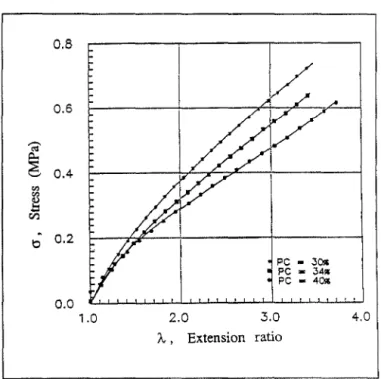
セ@ tl) セ@ 0.2 0.0 1.0 2.0 PC • 30ll PC • STセF@ PC • 40ll 3.0 ')... , Extension ratio 4.0Figure 1. Tensile test on unfilled PU elastomer type TA specimens for formulations having different
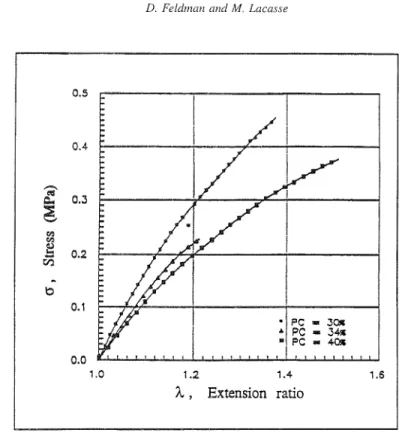
962 D. Feldman and M. Lacasse 0.5 0.4 0.1 • PC .. 3011 • PC Sセ@ • PC • セ@ 0.0 1.0 1.2 1.4 1.6 A. , Extension ratio
Figure 2. Tensile tests on unfilled PU elastomer type TB specimens for formulations having different
plasticizer contents (SR
=
1.062, BPR=
1.0).where v2 is the volume fraction of the polymer in the elastomer matrix. The strain
energy density is dependent on both the stress and strain at failure. There is very little difference in the values of Un due simply to the reduced stress at rupture brought about by the addition of plasticizer. This is offset by the increase in strain at break in the case of the formulation with 40% PC. Hence the trend is evidently one of reducing the modulus and stress at failure with a corresponding increase in PC. This phenomenon is clearly illustrated in Fig. 1.
It is worth noting however that the greatest strains at failure are achieved in those elastomers having the highest degree of plasticization and this a particularly useful trait in the preparation of filled elastomers since these elastomers will necessarily have lower failure strains than the unfilled ones.
An analysis of the data obtained reveals that there are no specific correlations which can be made between any of the mechanical properties of the elastomers and their related BPR's. Essentially the results indicate that the addition of castor oil, a component of the molecular sieve, to the elastomer formulation increases the strain at break. This effect can be attributed to the same phenomenon as that which occurs in the case of plasticizer. The data suggest also that an increase in SR decreases both the stress and strain at break.
Tensile tests on TB type specimens were used primarily to assess the adhesive strength of neat PU blends to a primed aluminum substrate. Some of these results are presented in Fig. 2. As we may observe from this figure the adhesive strength decreases with the amount of plasticizer.
Mechanical characteristics of sealants
Table 1.
Degree(%) of compression set of unfilled PU elastomers as a function of Baylith paste-polyol ratio, stoichiometric ratio and plasticizer content (PC)
Baylith paste-polyol ratio
0.588 0.740 1.0 PC SR SR SR % 1.0 1.06 1.1 1.0 1.06 1.1 1.0 1.06 1.1 30 3.4 2.7 3.6 1.8 0.8 0 0.9 0.4 1.5 34 1.9 3.2 3.3 2.7 3.4 3.3 3.9 2.5 3.0 40 2.6 2.5 3.5 3.6 2.9 2.0 3.5 2.7 5.4 SR: Stoichiometric ratio; PC: Platicizer content. 963
3.1.2. Compression testing. Results from tests used to determine the percentage of
compression set of the various elastomers are shown in Table 1. Based on these results, certain observations with respect to the performance of these elastomers in relation to their specific formulation can be made:
i) The degree of compression set for all unfilled elastomers is relatively moderate, on average 2.6%, and this is in accordance with what has been observed for similar elastomeric sealant formulations [12].
ii) The degree of set is not sensitive to changes in stoichiometry in the range of values used in this study (i.e. SR
=
1.02 to 1.1).iii) The Baylith paste-polyol ratio, which is indicative of the proportion of castor oil in the formulation, has a more significant effect in limiting the compression set at low plasticizer contents than at high plasticizer contents, at a given stoichiometric ratio.
iv) The addition of plasticizer increases the degree of set, with the exception of those elastomers containing the least amount of castor oil (i.e. having the smallest BPR).
H 0 H
I
III
... - R- 0- C- N-R.'-
N- C- 0- R- 0- C- N -RI-·· · IIj
II 0 H 0 H 0 HI
Iセ@
I
I ... - R -0- C- N- R- N- C- 0- R- 0 - C- N- R- · • • III
II 0 H 0964 D. Feldman and M. Lacasse
The strength of urethane elastomers is thought to be due to both primary (covalent) and secondary (intermolecular) bondings; the latter is considered to contribute significantly to the overall strength of the polymer matrix [13]. The number of possible secondary bonding sites is dependent on the presence of urethane groups, as shown below and this, in turn, is a function of the SR of the blend.
However, the relative increase in urethane groups in relation to the overall
macro-molecular structure remains small (e.g. 2.1 wt% urethane groups at an SR
=
1 vs.2.3 wt% at SR
=
1.06); consequently, this change is not considered significant enough to produce a corresponding change in the degree of set of these blends.The precise role of castor oil in limiting the degree of compression set is difficult to ascertain. Due to steric hindrances, it is not considered that the castor oil plays a significant, if any, role in the formation of crosslinks in this system. However, the fact that castor oil possesses polar groups does not preclude the possibility that secondary bonds may form provided conditions exist which are amenable to their formation. The formation of such bonds will affect reduction in the degree of compression set. Hence, at constant SR and PC, an increase in the BPR reduces the compression set by a factor of approximately two.
This effect is lost in those elastomer formulations containing greater quantities of plasticizer. The degree of recovery from the compressed state may be assumed to be primarily influenced by a balance between a recovery force and the restraining forces [13]. The recovery force is a function of the number of primary bonds, i.e. crosslinks a particular system possesses. The restraining force may be due to a number of factors including the formation of entanglements while in the compressed state. Entanglements may form, provided the internal viscosity of the system is reduced and this may be achieved by the addition of a suitable plasticizer. Consequently, there is a higher degree of set for more highly plasticized elastomers in comparison to those having a lower plasticizer content.
The effect of castor oil on the degree of compression set is opposite to that of the plasticizer; hence, based on the above observations, it can be expected that the least amount of set is found in blends having the greatest amount of castor oil and the least amount of plasticizer.
3.2. Filled polyurethane
3.2.1. Hardness. The addition of fillers to the elastomer formulation increases the
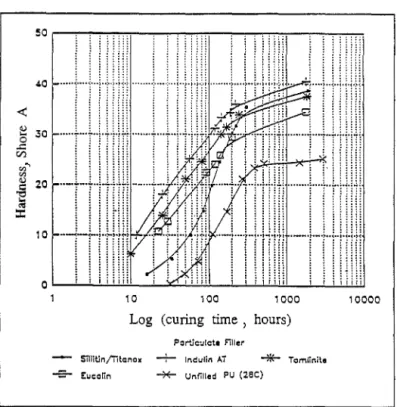
hardness at a given time in relation to the unfilled elastomer [ 1]. Furthermore, this effect is dependent on the quantity of filler in the formulation: the greater the filler loading, the greater the increase in hardness at a given time. Hence it may be argued that the filled specimens cure at a faster rate than the unfilled ones by virtue of the time required to achieve a given hardness reading. In fact the curing rate, as chmactcrized by the slope of the hardness-time curve, is seemingly the same as that of the unfilled formulations, indicating that the curing mode is essentially the same in both types of formulations and that the curing process (i.e. the formation of crosslinked structure) is unhindered by the addition of filler.
It may be shown however that the curing mode of elastomers formulated with the
Sillitin/Titanox based filler behaves slightly differently in relation to those formulated with the lignin based fillers. A comparative analysis is shown in Fig. 3 of the rela-tion between the curing mode of the different types of filler in relarela-tion to the unfilled
so 40
<
セ@ 30 0 ..c Cl)"'
..."'
セ@ 20-§
セ@ ::t 10 0Mechanical characteristics of sealants
iiiH
; : ; ; ; ;
10 100 1000
Log (curing time , hours)
STIIitin/iitcno:c Euccllin Pc:rJc:Jictl Filler Indulin Ai
""*-
Tomfinile"'*"
Unfilled PU (28C) 965 10000Figure 3. Curing kinetics of various formulations at 15% volume loading in relation to the base unfilled formulation numbered 28C; (SR = 1.062; BPR = 1.0; PC= 4.0%).
elastomer. The filled elastomers have a volume loading of 15%. Although the curing mode of the filled elastomers is essentially the same as that of the unfilled ones, the Sillitin/Titanox filled series has a prolonged rise in hardness in relation to the lignin based fillers. This is thought attributable to the finesse of the Sillitin/Titanox filler.
Since the hardness of the specimens is related to their modulus, the increase in hard-ness can be attributed to the same effects which contribute to the increase in modulus in elastomers with the addition of filler.
3.2.2. Tensile testing and packing characteristics. The results from tensile tests on
type TA specimens show that the strain energy to failure (U11 ), stress (ab) and strain
(cb) at break, and the modulus ratio (E / E0 ) all depend on the amount and type of filler
used in the base elastomer formulation.
In general, the phenomenon of reinforcement of an elastomer by the addition of filler is manifested by the increase in the elastic modulus and stress at break, and a decrease in the strain at break. The energy required to produce failure in the specimens should increase up to some optimum point after which further addition of filler is detrimental to the performance of the blend.
This is illustrated in Fig. 4, in which the addition of filler increases both the stress and strain at break, thus contributing to the improved performance of this elastomer series in relation to the lignin based formulations. In this same elastomer series, there is a steady increase in energy to failure up to a volumetric filler loading of 15%. The modulus ratio, which is simply the ratio of the modulus of the modified (filled) to the
966 1.0 0.6
..
セ@
セ@ 0.4 0.2 0.0 , .0D. Feldman and M. Lacasse
2.0 3.0
A. ,
Extension ratio • 150AT • 1SOEU • 150ST a 150TO 4.0Figure 4. Tensile characteristics of TA type PU based elastomer specimens having different filler types at 15% volumetric loading. § 2 ... ; ... ; ...
! ... ; ...
t"""""'"t"'""'""''""'セ@
1 a§ .
1.6 ···1···; ... ; ... ; ... セ@... .;. ... MセᄋMᄋᄋ@ 4 6 a Mセᄋᄋᄋᄋᄋᄋᄋᄋᄋᄋᄋᄋ@ ···;··· .. ····}··· 10 12 14 111Volune fraction of Filler (%)
セs・イゥ・ウ@ AT -=- Series TO Filler Series ..:;,... Sarles EU THEORY -if- Sarles ST
Theoretical curve frcm !lSI.
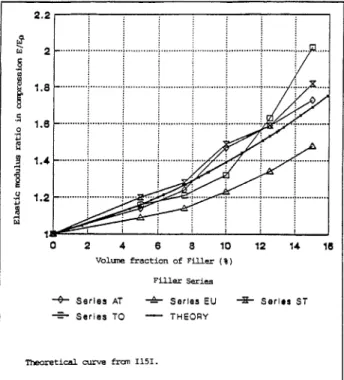
Figure 5. Elastic modulus ratio in compression for filled PU based elastomers as a function of volumetric loading for different filler types.
Mechanical characteristics of sealants 967
unmodified elastomer (E / E0 ), is presented in Fig. 5 as a function of the % volumetric
filler loading (¢f). The theory regarding reinforcement, as developed by Smallwood [14]
and extended by Guth [15], suggests that the modulus ratio is dependent on the filler loading according to the following relation:
E 2
- = 1
+
2.5· ¢f+
14.1· ¢f.Eo
It has been shown that the tensile properties of filled elastomers are dependent, not only on the quantity of filler incorporated into the elastomer, but also on the packing characteristics of the particles and on the interfacial bond between formulation compo-nents [15]. The following relationship given by Lewis and Nielsen [16-19], takes into account these more subtle effects.
E 1
+
セイᄁヲ@E0 1-f''lj;¢f'
セ@
=
KE - 1=
2.5 - 1=
1.5,f'
=
(Er/Eo- 1) Ef=
6.6GPa=
1l OOO(Ed eッKセI@ Eo 0.6MPa '
1/J = 1
+
c
セエュI@
¢f.Subscripts o and f refer to the continuous phase and filler, respectively.
The constant セ@ is a function of the Einstein coefficient, KE, which can be evaluated from measurements of the relative increase in absolute viscosity of a particulate filled liquid medium in relation to the volume fraction of filler added to the suspension. The value of KE represents the limiting value of the viscosity ratio (intrinsic viscosity) at zero filler volume. The value of [' is dependent of the filler-elastomer ratio and is in the order of 104 to 105 for most elastomer filled systems. Hence the value of [' is
close to unity for values ッヲセ@ less than or equal to 10 and consequently the reinforcing effect is mostly dependent on the value of the product 1j;¢f· The factor 'ljJ enables the use of a reduced concentration scale to take into account the existence of the maximum
packing fraction, ¢m, the volumetric fraction at which filler particles are the most closely
packed in a suspending medium. Clearly, for values of ¢m smaller than the theoretical values, the latter derived from a knowledge of the assumed packing configuration of ideal spherical filler particles, there is a significant increase in the reinforcing effect
at volume fractions approaching the value of ¢m. Hence an estimate of the maximum
packing fraction is useful for determining the extent of reinforcement which may be derived from a particular type of filler.
The maximum packing fraction may be estimated from the amount of liquid which must be added to a filler to convert it from a dry appearance to a wet appearing fluid mass. Using the method described in ASTM D281 we found for the mineral fillers used values for ¢m between 0.42 and 0.52 and for the different lignins the values ranged from 0.49 to 0.71.
3.2.3. Compression testing. The mechanical properties in compression were obtained
968 D. Feldman and M. Lacasse
Table 2.
Compression set of filled PU elastomers
Specimen series %set Specimen series %set
SOAT 8.6 SOST 0.5 75AT 9.9 75ST 13.3 IOOAT 7.7 JOOST 7 125AT 6.4 125ST 9.5 150AT 6.2 150ST 12.7 SOEU 8.2 SOTO 7.8 75EU 2.8 75TO 8.3 100EU 2.3 IOOTO 9.2 125EU 2.3 125TO 8.2 150EU 3.0 ISOTO 6.6
Number in columns I and 3 represent the percentage of lignin filler: i.e. 50 is 5.0%; 75 is 7.5%; 100 is 10%; 125 is 12.5%; ISO is 15%. AT= Indulin AT; EU = Eucalin; ST = Sillitin/Titanox filler; TO = Tom1inite.
of 50% of its original height. The increase in strain energy as well as in the modulus with increased filler is evident from the strength curves of all filler types. The relative increase in modulus of the filled elastomer formulations as a function of filler loading is given in Fig. 5. The data are plotted in relation to a theoretical curve developed by Guth [15].
The reduced modulus ratio of the Eucalin filler series at a given filler loading indicates that this type of filler does not reinforce to the same degree as Sillitin/Titanox, Tomlinite, or the Indulin AT series.
Based on the relationship developed by Nielsen [19], as presented above, the average particle size and particle size distribution determine the packing characteristics of the filler and hence the extent to which reinforcement can be achieved at specified filler loadings.
Results from tests to evaluate the compression set of filled elastomers (Table 2) indicate that no relation exists between the degree of compression set and the amount of loading. However, as a general rule, filled polymers have a greater degree of compression set than unfilled polymers [20]. For example, results obtained for filled elastomers have on average 2.5 times greater set than unfilled elastomer (e.g. 7% set vs. 2.7% set for unfilled elastomers). Eucalin filled elastomers are observed to have a lower average degree of compression set in comparison with the other elastomers (e.g. 3.7% set EU vs. 7.8%, 8.0%& 8.6% for AT, TO & ST) and it was also seen to interact the least with the polymer matrix [4]. Hence this filler least affects the compression set of the filled elastomer in comparison to the other fillers.
4. CONCLUSIONS
The elastomer content and the stress-strain characteristics of polyurethane- lignin poly-blends and polyurethane filled with mineral fillers were evaluated by the use of both tension and compression tests.
Mechanical characteristics of sealants 969
The addition of mineral fillers or different types of lignin increases the modulus of elasticity of the formulations investigated in this study. The increase in hardness is attributed to the same effects which contribute to the increase in modulus in elastomers with the filler addition.
The enhancement of mechanical properties is more evident for Sillitin- Titanox filled polyurethane in comparison with lignin filled polyurethane. The mineral filler demon-strated an increase in both stress and strain at failure. This particular phenomenon is attributed to finer particle size compared with the sizes of lignin used in this research.
Acknowledgement
The authors wish to thank the Natural Sciences and Engineering Research Council of Canada for financial support and Bayer Company Canada for some of the necessary materials. Thanks are also extended to Hlils Canada, Debro Chern Canada, NL Chern Canada and Hoffman Mineral, Germany for various ancillary products.
REFERENCES
1. D. Feldman and M. Lacasse, J. Appl. Polym. Sci. 35, 247 (1988).
2. D. Feldman and M. Lacasse, Mater. Res. Soc. Symp. Proc. 154, 265-270 (1989).
3. A. Natansohn, M. Lacasse, D. Banu and D. Feldman, J. Appl. Polym. Sci. 40, 899 (1990).
4. M. Lacasse and D. Feldman, J. Adhesion Sci. Techno!. 8, 473-484 (1994).
5. CAN2-19.0-M77 Methods for Testing Putty, Caulking and Sealing Compounds, Canadian Government Standards Board.
6. M. Lacasse, Sealant Polyblends with Lignin. M. Eng. Thesis, Concordia University, Montreal (1986). 7. Press eta!., Numerical Methods. Cambridge University Press, UK (1986).
8. M. A. Mandelsohn, F. W. Navish Jr and D. Kim, in: Advances in Urethane Science and Technology, Vol. 10, K. C. Frisch and D. Klempner (Eds), pp. 16-36. Technomic Pub!., Lancaster, PA (1987). 9. L. R. G. Treloar, The Physics of Rubber Elasticity, 3rd edn. Clarendon Press, Oxford (1975). 10. L. H. Sperling, Introduction to Physical Polymer Science. J. Wiley & Sons, New York (1986). 11. D. Dieterich, in: Polyurethane Handbook, G. Oertsl (Ed.), pp. 7-41. Hanser Verlag, Munich (1985). 12. H. R. Bylsma, I & EC Prod. Res. Devel. 3 (3), 204-209 (1964).
13. J. H. Saunder and K. C. Frisch, Polyurethanes, Vol. I, Chemistry, pp. 326-335. Interscience, New York (1963).
14. J. Smallwood, J. Phys. 40 (2), 253-258 (1944).
15. E. Guth, J. Appl. Phys. 16, 20 (1945).
16. L. E. Nielsen, J. Polym. Sci., Appl. Polym. Symp. 12, 249-265 (1969).
17. T. B. Lewis and L. E. Nielsen, J. Appl. Polym. Sci. 14, 1449 (1970).
18. L. E. Nielsen, J. Appl. Phys. 41, 4626 (1970).
19. L. E. Nielsen, Predicting the Properties of Mixtures, pp. 21-48. Marcel Dekker, New York (1980).
20. L. E. Nielsen, Mechanical Properties of Polymers & Composites, Vol. 2, pp. 379-452. Marcel Dekker,