Publisher’s version / Version de l'éditeur:
Canadian Geotechnical Journal, 21, 1, pp. 191-193, 1984-02
READ THESE TERMS AND CONDITIONS CAREFULLY BEFORE USING THIS WEBSITE. https://nrc-publications.canada.ca/eng/copyright
Vous avez des questions? Nous pouvons vous aider. Pour communiquer directement avec un auteur, consultez la première page de la revue dans laquelle son article a été publié afin de trouver ses coordonnées. Si vous n’arrivez pas à les repérer, communiquez avec nous à [email protected].
Questions? Contact the NRC Publications Archive team at
[email protected]. If you wish to email the authors directly, please see the first page of the publication for their contact information.
NRC Publications Archive
Archives des publications du CNRC
This publication could be one of several versions: author’s original, accepted manuscript or the publisher’s version. / La version de cette publication peut être l’une des suivantes : la version prépublication de l’auteur, la version acceptée du manuscrit ou la version de l’éditeur.
Access and use of this website and the material on it are subject to the Terms and Conditions set forth at
Empirical corrections to snow creep pressure equations
McClung, D. M.
https://publications-cnrc.canada.ca/fra/droits
L’accès à ce site Web et l’utilisation de son contenu sont assujettis aux conditions présentées dans le site LISEZ CES CONDITIONS ATTENTIVEMENT AVANT D’UTILISER CE SITE WEB.
NRC Publications Record / Notice d'Archives des publications de CNRC:
https://nrc-publications.canada.ca/eng/view/object/?id=3dac8a31-decc-4fcc-aae3-35af742545e7 https://publications-cnrc.canada.ca/fra/voir/objet/?id=3dac8a31-decc-4fcc-aae3-35af742545e7no.
1155
$
National Research Conseil nationalc . 2 Council Canada de recherches Canada
BLDG
'
EMPIRICAL CORRECTIONS TO SNOW CREEP
PRESSURE EQUATIONS
by D. M. McClung
Reprinted from
Canadian Geotechnical Journal
. Vol.2l,No.l,February1984 pp. 191-193 N W E
-
C l S T IBLDG. RESi
L I
SRARY,
84-
03-
27
B J B L I O T H ~ Q U E
Rech.
BBtim.
C N R C-
I C I S T DBR Paper No. 1 155Division of Building Research
This publication is being distributed by the Division of Building Research of the National Research Council of Canada. It should not be reproduced in whole or in part without permission of the original publisher. The Division would be glad to be of assistance in obtaining such permission.
Publications of the Division may be obtained by mailing the appropriate remittance (a Bank, Express, or Post Office Money Order, or a cheque, made payable to the Receiver General of Canada, credit NRC) to the National Research Council of Canada, Ottawa, KIA 0R6. Stamps are not acceptable.
A list of all publications of the Division is available and may be obtained from the Publications Section, Division of Building Research, National Research Council of Canada, Ottawa, KIA 0R6.
Empirical corrections to snow creep pressure equations
D. M. MCCLUNGDivision of Building Research, National Research Council of Canada, British Columbia Regional Station, 3904 West Fourth Avenue, Vancouver, B.C., Canada V6R IPS
Received April 2 1, 1983 Accepted October 13, 1983
A one-dimensional analytical model has been proposed for the average quasi-static snow creep pressure parallel to a slope at the centre of a long rigid structure. The model includes forces due to interruption of creep (internal deformation) and glide (slip of the snow cover over the ground). In reality, the problem is two-dimensional. By a series of two-dimensional finite element calculations, an empirical analytical correction has been found to improve the model. This yields a simple analytical model that provides results within 6% or less of the more complex two-dimensional problem.
Keywords: snow mechanics, creep, glide, snow pressure, snow-pack, finite element.
Un modtle analytique uni-dimensionnel a Ctt propost pour le calcul de la pression quasi-statique moyenne exercCe par un couvert de neige en fluage parallBle a une pente sur une structure rigide longue. Ce modble inclu les forces dues
a
I'intermption du fluage (dtfomation interne) et au glissement (glissement du couvert de neige sur le terrain). En rCalitC le probEme est bi-dimensionnel. Par une sCrie de calculs en ClCments finis a deux dimensions, une correction analytique empirique a CtC trouvCe pour arnkliorer le modMe. Ceci conduita
un modtle analytique simple qui donhe des rtsultats, semblables ?6% ou moins pres ia
ceux du problBme bi-dimensionnel plus complexe.Mots-clks: mCcanique des neiges, fluage, glissement, pression de neige, banc de neige, tltments finis.
[Traduit par la revue] Can. Geotech. 1. 21, 191-193 (1984)
Background
Haefeli (Bader et a1. 1939) provided the first formulation of the plane-strain snow pressure problem; it consists of calculation of the average pressure due to interruption of creep and glide processes at the centre of a long avalanche defence structure on a snow-covered slope. His model was later extended (Haefeli 1948), and although it was not derived from continuum mechanics, it constitutes essentially a one-dimensional treatment of the two-dimensional problem.
McClung (1982) gave a continuum mechanical one-dimensional model of the plane-strain problem, assuming the snow to deform as a linear, Newtonian viscous fluid with neglect of the static fluid pressure term. This model was shown by comparison with two-dimensional finite element results to be a more
accurate predictor for the linear problem than Haefeli's formulation. The continuum model has a tendency to underestimate the pressures at low slope angles (near 25") in comparison with finite element results. This was attributed to the two-dimensional character of the problem and an ad hoc empirical correction was proposed to improve the model prediction. Subsequent study with a more comprehensive set of finite element calculations has provided a much improved set of equations to replace the ad hoc empirical correction.
One-dimensional continuum model
The one-dimensional model for the average pressure, 15 (more precisely u is the average value of the maximum principal stress), across the face of a long rigid structure perpendicular to a snow-covered slope is given by
192 CAN. GEOTECH. I. VOL. 21. 1984
McClung (1982) as: 1 . 1
where v is the viscous analog of Poisson's ratio,
+
is the slope angle, p is depth-averaged snow density, g is acceleration due to gravity, and H is snow depth measured perpendicular to the ground surface. The parameter D is the stagnation depth for glide (McClung 1981) and L is a length scale derived from a creep stiffness equation. For the one-dimensional model, it was proposed that L / H = 112.Plane-strain finite element calculations presented by McClung (1982) showed that [ l ] is not completely accurate, particularly at slope angles near 25". In reality
L / H is a function of v and
+.
The representationfor
+
5 45" was proposed.0---0 ONE-D IMENS IONAL MODEL WITH
-
EMPIRICAL CORRECTIONS---
ONE-DIMENSIONAL MODEL WITHOUT EMPl RICAL CORRECTIONS0-4 HAEFELI'S MODEL
A
Proposed empirical correction and comparison with i
other predictions P"
By performing a comprehensive set of plane-strain finite element calculations (e.g. McClung 1982) for slope
O n '
1
d,,.,;'*- I1
angles in the range of interest for avalanche defense struc- .I
0
tures (25-55") it has been found that an accurate repre- 0.3
sentation for L / H is given by: o 0.1 0 . 2 0. 3 0 . 4
Equation [2] when used with [l] constitutes the proposed model.
For comparison, Haefeli's (1948) formulation of this problem is given by McClung (1982) in the present nota- tion:
+
l ( ~ )
2 1 - v cos*
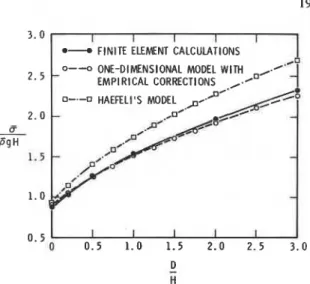
Figure 1 shows a comparison of 6 l p g H as a function of v from fmite element results with the one-dimensional model with empirical corrections ([I] and [2]) and Haefeli's eq. 131 for $ = 25" and D / H = 0.0. Also shown in Fig. I is the one-dimensiod m d e l without empirical cormtion for which L / N = 1 /2 in [I]. Figure 2 displays a similar comparison for+
= 55" andD/H
= 0.0. Figure 3 depicts the ratio 6 l p g H as a function of D / H for $ = 45" and v = 0.25. In this figure the one- dimensional model without empirical correction is notV
FIG. 1. The ratio 6/PgH versus v for 4 = 25' and D / H = 0.0.
shown because in this case it is almost identical to the model with empirical corrections.
A number of other examples have been studied in addi- tion to those presented in Figs. 1-3 and the maximum deviation of [ l ] and [2] from the two-dimensional finite element calculations found so far is 6% for parameters in the range 0 5 v 5 0.4,O 5 D / H 5 3, and 25" 5
+
5 55". These are the ranges of parameters of interest for the prediction of pressures at the centre of avalanche defence structures. It is felt, therefore, that the model provides prediction of creep pressures for the problem in which snow is modeled as a linear material with an accuracy better than the measurement accuracy of existing field measurements of the pressures (McClunget al. 1984).
Of further interest, the finite element results show that the zone of influence of the structure, termed by Haefeli the backpressure zone length, is given accurately by:
NOTES 193
0--0 ONE-DIMENSIONAL MODEL WlTH
EMPIRICAL CORRECTIONS
---
ONE-D IMENS I ONAL MODELWITHOUT EMPI RlCAL CORRECTIONS HAEFELI'S MODEL
0.1 0.2 0.3 0.4
FIG. 2. The ratio 6 / f i g H versus v for JI = 55" and D / H = 0.0.
with L/H expressed by [2]. Equation [4] follows logically from the theory given by McClung (1982) with L/H given by [2] rather than L/H = 1 /2 as used in the earlier one-dimensional model.
Concluding remarks
An analytical model has been presented that gives the average pressure for the plane-strain problem. This was shown by comparison with a two-dimensional finite element analysis. The main disadvantage of the model may be that the snow is modeled as a linear, Newtonian viscous fluid, which it certainly is not. The model can be extended to the simplest visco-plastic model by intro- ducing a time-dependent Poisson ratio. Recent field measurements from western Norway (Larsen and Mc- Clung 1982) show that average pressures are within the
3.0 I I I 1 I
0- FINITE ELEMNT CALCULATIONS
1
2.5 0 - 4 ONE-DIMNSIONAL MODEL WlTH EMPIRICAL CORRECTIONS
R.,.Od
o-.-o HAEFELI'S MODEL .pN.P
1.5
range predicted by the linear model extended for time dependence, which provides support for its use in engineering calculations. These measurements will be reported in detail, in a future publication (McClung et al. 1984).
Acknowledgement
This note is a contribution from the Division of Building Research of the National Research Council of Canada and is published with the approval of the Director of the Division.
BADER, H., HAEFELI, R., BUCHER, E., NEHERER, J., ECKEL,
O., THAMS, C., and NIGGLI, P. 1939. Der Schnee und seine Metamorphose, Beitrige zur Geologie der Schweiz. Geotech- nische Sene, Hydrologie, Lief. 3. (German, English trans- lation, U.S. Snow, Ice andPermafrost Establishment, Trans.
14, 1954.)
HAEFELI, R. 1948. Schnee, Lawinen, Firn und Gletscher. In
Ingenieur--Geologic. 2 Bd. Edited by L. Bendel. Springer- Verlag, Vienna, pp. 663-735.
LARSEN, J. O . , and MCCLUNG, D. M. 1982. Measurements of snow creep pressures on an avalanche defense structure. Paper presented at Second Symposium on Applied Glaciology, Hanover, NH, August 23-27, 1982.
MCCLUNG, D M. 1981. A physical theory of snow gliding.
Canadian Geotechnical Journal, 18(1), pp. 86-94.
1982. A one-dimensional analytical model for snow
creep pressures on rigid structures. Canadian Geotechnical Journal, 19(4), pp. 401-412.
MCCLUNG, D. M., LARSEN, J. O., and HANSEN, S. B. 1984.
Comparison of snow pressure measurements and theoretical predictions. Canadian Geotechnical Journal, in press.
![Figure 1 shows a comparison of 6 l p g H as a function of v from fmite element results with the one-dimensional model with empirical corrections ([I] and [2]) and Haefeli's eq](https://thumb-eu.123doks.com/thumbv2/123doknet/14313604.495712/5.781.435.737.90.633/figure-comparison-function-element-dimensional-empirical-corrections-haefeli.webp)