HAL Id: hal-03045921
https://hal.archives-ouvertes.fr/hal-03045921
Preprint submitted on 8 Dec 2020
HAL is a multi-disciplinary open access
archive for the deposit and dissemination of
sci-entific research documents, whether they are
pub-lished or not. The documents may come from
teaching and research institutions in France or
abroad, or from public or private research centers.
L’archive ouverte pluridisciplinaire HAL, est
destinée au dépôt et à la diffusion de documents
scientifiques de niveau recherche, publiés ou non,
émanant des établissements d’enseignement et de
recherche français ou étrangers, des laboratoires
publics ou privés.
Half-minimizers and Delaunay triangulations on closed
hyperbolic surfaces
Vincent Despré, Benedikt Kolbe, Monique Teillaud
To cite this version:
Vincent Despré, Benedikt Kolbe, Monique Teillaud. Half-minimizers and Delaunay triangulations on
closed hyperbolic surfaces. 2020. �hal-03045921�
Half-minimizers and Delaunay triangulations on closed
hyperbolic surfaces
Vincent Despr´
e
*Benedikt Kolbe
*Monique Teillaud
*§Abstract
Given a finite point cloud P in a Dirichlet fundamental domain F with respect to a fundamental group Γ of a closed hyperbolic surface S, we derive an explicit way to construct a set of copies of F that accounts for all points incident to points of P in the Delaunay triangulation of ΓP. We also compute precise bounds on the size of this set that only depend on the genus of S and are thus independent of the hyperbolic metric under consideration. The results in this paper lay the foundations for a practical algorithm to compute Delaunay triangulations on an arbitrary hyperbolic surface, akin to existing implementations for periodic sets of points in Euclidean space.
1
Introduction and motivation
1.1
Closed hyperbolic surfaces, covering spaces, and symmetry groups
The aim of this paper is to lay the foundations for a practical algorithm for the construction of Delaunay triangulations on arbitrary hyperbolic surfaces. We define a hyperbolic surface to be a closed orientable topological surface equipped with a hyperbolic metric of constant curvature −1. It is well-known that a hyperbolic surface S is covered universally by the hyperbolic plane H2, such that the projection map
π : H2 → S is a local isometry. Including flat tori, all surfaces of interest to us are isometric to the
compact quotient space X/Γ with induced metric from X, where Γ is a symmetry group of X, i.e. a discrete subgroup of the group of isometries of X. The space X is either E2, or H2, and we call the
surface Euclidean or hyperbolic, accordingly. In case X = H2, the symmetry group is also known as a
Non-Euclidean Crystallographic (NEC) group. That S is a hyperbolic surface implies that Γ contains only orientation preserving isometries and has no fixed points in X. The group Γ can be naturally identified with the fundamental group π1(S) of S (after choosing base points appropriately).
1.2
Hyperbolic surfaces in other sciences and nature
One of the motivations for this paper, and also the guiding example we use to illustrate our results and approach is the hyperbolic surface associated to the family of triply-periodic minimal surfaces (TPMS) that contains the gyroid, the primitive, and the diamond surface. A TPMS is a minimal surface in R3
that is moreover invariant under three linearly independent translations, i.e. a rank 3 lattice L3[43]. To
associate to a TPMS a closed surface, one considers the closed surface Sg of genus g embedded in the
3-torus T3 = R3/L
3, which corresponds to glueing the equivalent faces of a unit cell of the TPMS, i.e.
the smallest block out of which the TPMS can be reassembled through translations. It turns out that such a surface is always intrinsically hyperbolic [32]. The gyroid, the primitive, and the diamond TPMS are arguably the most prominent and simple [39] examples of TPMS and have received considerable attention in the mathematical, physical, chemical and biological as well as interdisciplinary literature, see, for example, [20, 25, 22, 23, 12]. More recently, TPMS have also found a role in the materials sciences
*Universit´e de Lorraine, CNRS, Inria, LORIA, F-54000 Nancy, France [email protected]
[email protected] §[email protected]
The authors were supported by grant ANR-17-CE40-0033 of the French National Research Agency ANR (project SoS) (https://members.loria.fr/Monique.Teillaud/collab/SoS/).
as a scaffold for crystallographic structures [15, 16], leading to both new mathematical formalisms [27, 26] and a database of such structures [1].
Figure 1 shows a region of H2 in the Poincar´e disk model and a portion of the diamond surface in
R3, illustrating how TPMS are covered by H2. Notice that the angles at which triangles meet are the same in R3as they are in H2, owing to the fact that the covering is conformal.
(a) Fundamental domain for the fundamental group of S3 in the Poincar´e disk model.
(b) A section of the D-surface in R3, together with its smallest asymmetric triangle patches. Figure 1: The covering of the diamond TPMS by H2.
Very recently, the edge flip algorithm for the computation of a Delaunay triangulation was shown to work for hyperbolic surface [13]. However, robust and efficient software to compute Delaunay triangu-lations on hyperbolic surfaces, and particularly TPMS, does not exist to date, as far as we know. This paper attempts to help fill this gap by establishing fundamental theoretical results in the hyperbolic case similar to those that have led to such software in the Euclidean setting.
1.3
Set-up and motivation
Given a finite point cloud P on a hyperbolic surface S = H2/Γ, P lifts to a locally finite1point cloud eP in
the covering space H2. The Delaunay triangulation DT e
P defined by eP in H
2 projects to a triangulation
DTP on S, which serves as a definition for the Delaunay triangulation of P on S [6, 11, 24]. We do not assume triangulations to be embedded simplicial complexes in this paper, in contrast to some previous work [6, 24]. In our setting, every finite point cloud on a hyperbolic surface has an associated locally finite Delaunay triangulation, see [9, Corollary 5.2], [13, Proposition 8].
Using the Poincar´e disk model of H2, where Euclidean circles correspond to hyperbolic circles, one
sees that the combinatorial structure of a Delaunay triangulation is equivalent to the Euclidean Delaunay triangulation defined by the same set of points in the unit disk. For algorithms to determine the Delaunay triangulation DTP, it is essential to limit oneself to a finite set of points ePf ⊂ eP that contains all the
information needed to construct the triangulation on S by projecting part of the triangulation of ePf
in H2. Our goal is to deduce bounds for the size of eP
f, for a practical algorithm to compute the
Delaunay triangulation on an arbitrary hyperbolic surface. Our results are the first of their kind for general hyperbolic surfaces, but Euclidean analogs exist [14], have received attention in the literature in different fields [8, 46, 18], and provide the foundation for the recent and, as far as we know, only implementations of algorithms that compute the Delaunay triangulation of general infinite, locally finite,
1A collection of points P in a topological space S is locally finite if every point s ∈ S admits a neighborhood U ssuch
periodic point sets in the Euclidean plane [35] (although solutions to special cases do exist). In [35], a set ePf like above is found for a periodic, infinite set of points eP ⊂ E2 with the help of bounds on
e
Pf that depend only on the structure of the group of translations that generates the periodicity of eP.
After having found ePf, classical algorithms for the construction of the Delaunay triangulation are used
to compute the triangulation DTPef of ePf in E2, which is then projected to the quotient torus. Note for
this that the edges of the convex hull of ePf, contained in DTPef, are the only edges of DTPef that are
not necessarily a part of DTPe.
Our focus is on generalizing the results of [35, 14] to the more complicated case of hyperbolic surfaces. The proofs in [14] that make possible the algorithms of [35] depend crucially on the Abelian nature of the symmetry groups involved. Since hyperbolic symmetry groups are inherently non-Abelian we need new tools to tackle the problem.
We picture the setup more concretely as follows. Recall that a tesselation or tiling is a countable collection of closed topological disks in a metric space that cover the whole space and whose interiors are disjoint. One can think of the projection map π : H2→ H2/Γ = S as giving rise to tilings of H2 by
copies of some fundamental domain for Γ. A fundamental domain V for the action of a symmetry group Γ is a connected subset V ⊂ X, equal to the closure VO of a connected set VO that intersects each orbit
in exactly one point, or, equivalently, such that the restriction of π to VOis a bijection from VOto S [31].
In DTPe, some points in eP ∩VO become adjacent to points inside a translate of VO under an element of
Γ. We will define a number, the combinatorial length of an edge, which relates to the number of copies of V an edge traverses. The objective of this paper is to find a bound, independent of the hyperbolic metric on S, on the combinatorial distance between any point in V and its neighbors in DTPe, given a reasonable choice for the tesselation.
We remark that even in the Euclidean case there cannot exist a bound as discussed in the previous paragraph for an arbitrary choice of fundamental domain, even if the Delaunay triangulation is defined by just one point on S. Intuitively speaking, this is because there is no bound on how stretched a fundamental domain can appear for an Abelian symmetry group of E2, necessarily isomorphic to Z2.
Assume for simplicity that the group is Z2 with its natural action on E2 by translations. For ever more
long and thin parallelograms that serve as a fundamental domain V, an edge in a Delaunay triangulation may traverse an unbounded number of copies of V. We illustrate the situation in Figure 2, which shows one edge ˜e, thick and in cyan, connecting ˜a to ˜b, of the Delaunay triangulation defined by Z2.˜a in two
different situations. The Figure shows ˜e in a portion of two different tilings of E2 by parallelograms
that serve as fundamental domains for Z2 with their boudnaries in green. Proposition 5 shows that a
similar situation occurs for hyperbolic surfaces. We note that in Euclidean spaces, the celebrated LLL algorithm [28] can be applied to eliminate such problems by finding well-behaved generators of lattices in polynomial time, but this does not work for NEC groups.
(a) Tiling of E2 by sheared parallelograms, invariant
under Z2. (b) Dirichlet domains in E 2
for the green marked points, for the action of the symmetry group Z2 on
E2.
Figure 2: Fundamental domains and the boundary edges, in green, of parts of their associated tesselations in E2. The thick cyan edge is an edge in the Delaunay triangulation defined by Z2.˜a, the set of red points.
Another way to resolve the issue for E2 is to choose for V a Dirichlet fundamental domain V ˜ x for
a point ˜x, which corresponds to the Voronoi cell of ˜x in the Voronoi diagram of Z2x, as in Figure 2b.˜
In fact, in this case, the shape of the Dirichlet fundamental domain Vx˜ does not depend on the point
˜
Figure 3: Dirichlet domain w.r.t. different base points. Images from [6, Figure 9]. VΓ T (˜x) = T (VT −1 ΓT ˜
x ) [3, Section 9.4], where we make explicit the dependence of a Dirichlet domain VΓ on
the symmetry group Γ, and T is any isometry. One readily sees that for a Delaunay triangulation defined by a single arbitrary point ˜y ∈ Vx˜, it is sufficient to use all copies of V˜xwith nonempty intersection with
Vx˜ to account for all vertices adjacent to ˜y. Indeed, choosing for ˜y the center of the unit square results
in the tiling by squares, shown in Figure 2b, with a choice of diagonals and any other choice of ˜y is a translated version. See [14] for a complete discussion of the case of Euclidean symmetry groups generated by translations.
The main result of this paper is that there is a bound on the number of domains one has to consider to account for all adjacent vertices of a point in a Dirichlet domain in a Delaunay triangulation, for closed hyperbolic surfaces S, depending only on the genus, when we restrict our choice of fundamental domain to Dirichlet fundamental domains; also we explicitly compute a bound. Note that it is far from clear that this works, a priori, because the shape, combinatorial structure, and group presentation a Dirichlet fundamental domain for Γ gives rise to depends on the chosen point in its construction in H2,
since NEC groups are non-Abelian, in contrast to the above situation in E2. See also Figure 3, which
depicts different Dirichlet domains for the same group.
We present a result valid for hyperbolic surfaces that presupposes a metric, but will remain valid for all hyperbolic metrics. Note that the diameter of a Dirichlet fundamental domain for a hyperbolic surfaces can become arbitrarily large, even when the genus is fixed, so there is no bound on the number of copies of Dirichlet fundamental domains an empty disk in a Delaunay triangulation intersects. Together with algorithms that compute a Dirichlet fundamental domain in H2 [44], this lays the foundation for
a practical algorithm to compute the Delaunay triangulation of a finite set of points on a hyperbolic surface, in the same way as [35].
A hallmark of our approach is that some of its techniques are actually valid in greater generality, for many Riemannian manifolds. In particular, our ideas and approach based on half-minimizers remain valid in a more general setting.
2
Dirichlet fundamental domains and Delaunay triangulations
For the remainder of this paper, S is a hyperbolic surface, with universal cover π : H2 → S, and
fundamental group Γ, as described in the introduction. To simplify the notation in the following, we denote objects in H2 with a tilde, and those on S = H2/Γ without, P will always denote a finite set of
points on the hyperbolic surface S, and eP its lifted point set to H2. We will again (implicitly) treat H2as a
subset of E2, which makes sense when making use of the Poincar´e disk model for the hyperbolic plane [4].
This is a conformal model for H2obtained by biconformally mapping H2to the interior of the unit disk
in E2such that the conformal mappings of the unit disk correspond exactly to the orientation preserving
isometries of H2. This model is well suited for the study of Delaunay triangulations in hyperbolic spaces, because in it, circles in H2 correspond to circles in E2.
We briefly recall the relevant definitions for our setup. For more details, see, for example, [7] for the Euclidean case, [11] or [6, 5] for Delaunay triangulations of hyperbolic spaces and [3] for Dirichlet domains. See [37] or [42] for a general introduction to hyperbolic geometry. Let X be a metric space
with distance function dX. We consider Voronoi diagrams where every cell is topologically a closed disk.
For a locally finite point set P ⊂ X and x ∈ P, we denote the Voronoi cell of x by VxP and the whole
Voronoi diagram by VP. In the cases X = E2, H2, the Voronoi diagram is a locally finite collection of
convex subsets of X [11, Lemma 5.2]. In particular, if a Voronoi cell is compact, then it only has a finite number of edges.
Definition 1([3]). For X = E2, H2, let Γ be an NEC group with no fixed points in X and ˜x ∈ X. The cell VΓ˜x
˜
x of ˜x in the Voronoi diagram of the orbit Γ˜x in X is called the (closed) Dirichlet fundamental
domain of ˜x, and is denoted as Vx˜for short.
The Dirichlet fundamental domain Vx˜ can also be defined equivalently as the sets
Vx˜= { y ∈ X | dX(x, y) ≤ dX(x, Γy) } = { y ∈ X | dX(x, y) ≤ dX(Γx, y) }
where the equality is true since Γ acts as isometries w.r.t. dX. In particular, we see that
˜
z ∈ V˜x ⇐⇒ ˜x ∈ Vz˜. (2.1)
Dirichlet domains and more generally Voronoi cells in H2 and E2 are bounded by geodesics, which
is why they are also known as Dirichlet and Voronoi polygons, respectively. A Dirichlet domain is a fundamental domain for Γ. Since S is compact, Vx˜is compact in H2 and therefore, as above, it has only
a finite number of edges and the tesselation ΓVx˜ associated to Vx˜, called the Dirichlet tesselation w.r.t.
˜
x, is a locally finite tesselation.
We now collect relevant definitions and results on Delaunay triangulations. A Delaunay triangulation DTPe of a locally finite point set eP ⊂ H2 is combinatorially a Euclidean Delaunay triangulation with vertex set eP, but with geodesic edges. Though we use the term triangulation, we consider that more than three cocircular points form a non-triangulated polygonal face. Such faces can always be triangulated in any way when needed. To preserve the duality between Voronoi diagrams and Delaunay triangulations, one removes edges that lead to triangles in DT
e
P with non-compact circumcircles, i.e. those not contained
in H2. We will see below that this technicality is not necessary for our purposes because all triangulations
we consider have compact circumcircles in H2.
The Delaunay triangulation of a finite point set P ⊂ S on a surface S is defined as the projection, to S, of the Delaunay triangulation in H2of the lifted point set eP := π−1(P), where eP is necessarily locally
finite.
A Delaunay edge in H2cannot have a hyperbolic length greater than 2 dia(S), where dia(M ) denotes
the diameter of the set M . Indeed, the circumcircle C of a triangle with such an edge has a diameter greater than 2 dia(S), which would cover all of S, since the length of a geodesic in H2and its projection
in S are equal [19, Proposition 2.109]. Therefore, there exists at least two points inside C that are equivalent under the action of Γ. In particular, each circumcircle of a cyclic polygon, i.e. a polygon with geodesic edges and concircular vertices in DTPe is compact [11, 13].
Proposition 2. ([13, Proposition 8],[9, Corollary 5.2]) The 1-skeleton of the Delaunay triangulation DTP onS is an embedded graph on S.
Definition 3. Let F ⊂ H2be a fundamental domain for Γ. The edges of F are identified pairwise under
the action of Γ. We fix one representative of each equivalence class of open edges of F under the action of Γ to obtain a set E of edges and also one representative of each vertex orbit to obtain a set V of vertices. An original fundamental domain FOassociated to F is a subset of F consisting of int(F) ∪ E ∪ V , where
int(M ) denotes the interior of a set M , such that E ∪ V is connected.
Let x ∈ FO and y ∈ H2. Consider the set {F1i}i of copies of F with F1i∩ F 6= ∅ and γ1i ∈ Γ such
that γi
1FO ⊂ F1i. We call N1 :=Siγ1iFO the first neighborhood layer of FO. If y ∈ N1 for some i and
y 6∈ FO, then y has combinatorial distance from x equal to 1. Repeating this process inductively, to find
the nth neighborhood layer Nn, we find all copies {Fni}iof F such that Fni∩ F j
n−16= ∅ for some i, j but
such that Fi
n is not contained in any mth neighborhood layer for m ≤ n − 1. We furthermore find group
elements γi
n such that γinFO ⊂ Fni. Then, if y ∈ Nn and y 6∈ Nm for m ≤ n − 1, y has combinatorial
distance to x equal to dC
FO(x, y) = n.
The combinatorial length of a geodesic segment designates the combinatorial distance between its endpoints. The (maximal) combinatorial length of a triangulation w.r.t. FO is dCFO = maxx∼ydCFO(x, y),
Remark 4. Original domains always exist, for any NEC-group, by [29, Theorem 4.1]. Assume that the tesselation induced by F and Γ features only vertices of degree 3, which is the generic case [3, Theorem 9.4.5]. Then the combinatorial distance between points is equal to the graph distance in the 1-skeleton of the dual tesselation, between the copies of the original domain FO that the points lie in.
Special cases of the above definition of original fundamental domains have been considered in the literature [8, 24]. Using an original fundamental domain FO, DTPe can be reconstructed by considering
e
P ∩FO and edges in DTPe that connect to these.
See Figure 4b for an illustration of the definition of neighborhood layers, which shows a blue colored fundamental domain surrounded by its red colored closed first neighborhood layer. The translations that induce opposite edge identifications of the hyperbolic octagon in the center generate a group ΓB, the
fundamental group of the Bolza surface [24].
(a) Translations that identify opposite edges generate a group ΓB, under which all vertices of the Dirichlet
fundamental domain are equivalent.
(b) The first neighboring layer built around a blue colored Dirichlet fundamental domain in the center.
Figure 4: Dirichlet fundamental domain and tesselation of an NEC group, along with the second neigh-borhood layer.
Since F is compact, the combinatorial length of a geodesic segment ˜e is finite if and only if ˜e crosses only a finite number of copies of the fundamental domain F. In particular, since a Dirichlet tesselation is locally finite, the combinatorial length of a triangulation with locally finite point set and finite vertex degrees, such as the Delaunay triangulation, is always finite.
For a proof of the following proposition, reminiscent of the situation in E2 described in the
introduc-tion 1 and which motivates the use of Dirichlet fundamental domains for our purposes, see Proposiintroduc-tion 25 in the appendix.
Proposition 5. Letn ∈ N. There is a fundamental domain for Γ in H2 such that there exists an edge
inDTPe the combinatorial length of which is greater than n.
3
Half-minimizers
This section is dedicated to introducing one of the central concepts in this paper.
Definition 6. A distance minimizer between two points on the surface S is a curve that has the minimum length out of all curves on S with the same endpoints.
We call a closed curve c based at a point x in a surface S a half-minimizer if the distance in S between x and any point on c is realized as the length of the shortest arc in c that connects these two points.
More generally, a curve c from x to y ∈ S is a half-minimizer if the distance from any point z ∈ c to x or y is realized by the length of a subarc of c that connects z to x or y.
We also call a curve ˜c in H2 a half-minimizer if it is the lift of a half-minimizer c in S.
Remark 7. A distance minimizer is necessarily a geodesic on S, but in general geodesics are not distance minimizers on S, since geodesics only locally minimize distances. Furthermore, a distance minimizer contains an arc minimizing the length of all curves that join any two points lying on it. A half-minimizer c between x and y on S necessarily has at least one distinguished point m ∈ c, such that the two distinct arcs between x and m, and y and m are distance minimizers. Indeed, observe that if cx
z is the subarc
of c realizing the distance of z ∈ c to x, then cx
z0 is contained in cxz for z0 ∈ cxz. Since a similar relation
holds for subarcs of c that realize the distance to y, c can be expressed as the union of subarcs of the form cx
mand cymfor some point m ∈ c. Moreover, if c is not a distance minimizer between x and y, then,
by Lemma 10 below, the point m is uniquely determined. We shall call m a half-point. If c is a closed half-minimizer, the half-point m coincides with the midpoint of c. A half-minimizer is smooth except that it may have a kink at m and, if closed, also at the base point, so it makes sense to call the two geodesic parts of a half-minimizer halves. See the violet curve from x1 to y1in Figure 5 for an example
of a non-closed half-minimizer and the blue curves for closed half-minimizers, where the curve based at x2 has two kinks, one at x2 and the other at m2. Note that the curve based at x4 has no kinks and
one can easily imagine the base point in this case to not be significant, as the curve is a half-minimizer based at all points lying on it. However, the closed geodesic based at x3 illustrates that there may be
half-minimizers that are smooth everywhere but do not allow the base point to be chosen freely, if, for example, the green curve between x0
3 and m03 depicts a distance minimizer.
The concept of closed half-minimizers has been studied before in the literature [2], in different contexts and using a more restrictive definition, under the name half-geodesic.
x
2m
2m
4x
4x
1m
1y
1x
03m
03m
3x
3Figure 5: Examples and counter-examples of half-minimizers.
Lemma 8. (Lemma 28 in appendix) Let Vx˜ be a Dirichlet domain. Then the geodesic segment g that˜
joins x to any ˜˜ y ∈ Vx˜ projects to a distance minimizer in S. Conversely, if g from x = π(˜x) to y is a
distance minimizer inS, then the lift ˜g of g based at ˜x satisfies ˜g ⊂ Vx˜.
As a consequence of Lemma 8, we see that two geodesics c1, c2in Vx˜, both incident to ˜x, give rise to
a half-minimizer c by concatenation.
Recall that two curves c1, c2 ⊂ H2 are Γ-equivariantly isotopic if and only if their projections are
isotopic in S = H2/Γ. The relevance of half-minimizers for Delaunay triangulations comes from the
following proposition.
Proposition 9. Letx ∈ e˜ P. Then any edge ˜e in DTPe based at x is Γ-equivariantly isotopic, with fixed˜ endpoints, to a curve ˜c that is a half-minimizer based at ˜x. The projection c of ˜c to S is simple and, if closed, nontrivial.
Before we present a proof, we discuss the situation. Note that it is possible in general that an edge ˜e in DTPe is not itself a half-minimizer. Figure 6 provides an example of this. The figure shows a Dirichlet
tesselation from a Voronoi diagram, constructed from the red points, which are all equivalent under the action of the group Γ generated by the translations that induce opposite edge identifications of the hyperbolic octagon in Figure 4a above. Since every vertex has degree 3, the dual tesselation DTPe is a triangulation and the geodesic edge ˜e shown in Figure 6b in cyan connecting the points ˜a and ˜b is an edge of DTPe, with a combinatorial length of 1. Moreover, ˜e intersects two edges in the Voronoi diagram in their interiors.
In general, if an edge ˜e0 in a Delaunay tesselation incident to ˜x and some copy of ˜x is a closed half-minimizer, then it follows straight from the definition of V˜xand Lemma 8 that the midpoint of ˜e0 must
be contained in Vx˜. Said in another way, such a half-minimizer intersects the interior of exactly two
Dirichlet domains. Therefore, the edge ˜e in DTPe cannot be a half-minimizer. On the other hand, the curve in blue in Figure 6b, connecting the points ˜a and ˜b, is a half-minimizer, isotopic to the cyan curve, by Proposition 9.
(a) The isotopy in the proof of Proposition 9 moves the edge ˜e over the shaded region to the curve ˜c.
(b) A generic Dirichlet fundamental domain and a geodesic, in cyan, connecting points ˜a and ˜b,
isotopic to the half-minimizer in blue. Figure 6: Dirichlet domains and tesselations for the fundamental group of the Bolza surface. With that, we turn to the proof of Proposition 9.
Proof. Consider the curve ˜c that connects the two vertices ˜x and ˜y of a triangular face ˜F in DTPeconsisting of the two geodesic segments from the center ωF˜ of the circumcircle CF˜ of ˜F to either endpoint. The
situation is illustrated in Figure 6a. The point ωF˜ lies in Vx˜ (by Lemma 26 in Appendix B). Together
with Lemma 8, this implies that ˜c is a half-minimizer based at either endpoint, with half-point ωF˜.
Consider the Dirichlet fundamental domain VωF˜, which contains ˜x and ˜y, by (2.1). Since VωF˜ is convex,
it also contains the geodesic edge ˜e in ˜F joining ˜x and ˜y. Now, ˜c and ˜e form a bigon B completely contained in VωF˜, so there is an isotopy inside every copy of VωF˜ from the copies of ˜e to ˜c, which fixes
points equivalent to ˜x and ˜y. Note also that B does not contain any points of eP by definition of DTPe and convexity of CF˜. Since VωF˜ contains only one representative of every point moved in the isotopy
and the tesselation of H2by copies of V
ωF˜ is Γ-invariant, one obtains a Γ-invariant isotopy of H 2.
That c, if closed, is nontrivial is clear, and simple follows from Proposition 2 for DTP and the fact
that c is isotopic to the projection of ˜e.
The situation illustrated in Figure 6 motivates the following definition. The Voronoi diagram dual to a Delaunay tesselation DT
e
P has edges joining the circumcenters of the polygons in DTPe. We call
an edge of either tesselation that intersects its dual edge a centered edge. This makes sense because the dual of the dual of DTPeis the same tesselation of H2as DT
e
centered if and only if its dual is. The concept of centered edges has been studied before [9], restricted to edges of a Voronoi diagram.
In the remainder of this section we study the number of intersections that two half-minimizers can have.
Lemma 10. (Lemma 29 in appendix) Two distinct distance minimizers that are not subarcs of one another onS cannot intersect each other more than once in their interior. Moreover, if an intersection occurs at an endpoint, then there cannot be an intersection in the interior.
Remark 11. Note that it is possible for two distance minimizers to intersect more than once, at end-points, as the existence of closed half-minimizer shows.
Lemma 12. (Lemma 30 in appendix) A half-minimizer can intersect a distance minimizer at most 2 times, or at least half of the half-minimizer is a subarc of the distance minimizer.
Lemma 13. (Lemma 31 in appendix) Two half-minimizers cannot intersect each other more than 4 times, as long as their halves are distinct.
We illustrate the machinery developed thus far in the context of Delaunay triangulations of the prim-itive, diamond, and gyroid triply-periodic minimal surface (TPMS) family discussed in the introduction. Let S3 denote the closed hyperbolic surface that gives rise to the gyroid TPMS family by lifting,
to R3, embeddings of S
3 into the three-torus T3. Consider the fundamental polygon D containing the
origin 0 and its tesselation in Figure 7a, under the symmetry group ΓS3 generated by the translations
that identify opposite edges of D. It is well-known that D is a fundamental domain for ΓS3 and that
H2→ H2/ΓS3 = S3corresponds to the universal (conformal) covering of S3 [38].
Lemma 14. (Lemma 32 in appendix) The dodecagon D depicted in Figure 1a is the Dirichlet fundamental domain V0⊂ H2 forΓS3.
It is straightforward to see that the boundary of D consists of 6 inequivalent edges and that all corners are equivalent, under ΓS3, since ΓS3 identifies opposite edges of D. Therefore, by Lemma 14 and
Lemma 8, the straight lines through the origin depicted in Figure 7c in blue also give rise to closed half-minimizers based at the origin. Moreover, by Lemma 8, one can combine any two of the line segments li from the origin to the corners, to obtain many more half-minimizers based at the origin. Denote the
set of these line segments by L and the set of all possible half-minimizers that can be formed from L by LH.
(a) Tesselation of H2 by Dirichlet dodecagons.
(b) The Dirichlet dodecagon along with lines, in blue, through the ori-gin, representing the invariant axes of hyperbolic translations.
(c) The Dirichlet dodecagon, in green, along with line segments that are distance minimizers emanating from the origin, in blue.
Figure 7: Half-minimizers in the Dirichlet dodecagon, corresponding to the Dirichlet fundamental domain of the genus 3 hyperbolic surface that gives rise to the gyroid TPMS family.
By Proposition 9 and Lemma 13, no Delaunay edge can project to a curve in S3 that is homotopic
the combinatorial length of Delaunay edges, we can count intersections with half-minimizers in LH. To
see if a geodesic segment ˜e emanating from D connecting two points of some eP is potentially a Delaunay edge, we assign to each line segment in L the numbers of intersections, in its interior, with ˜e. Then, the sum σ of any two of these values has to be less than five if the intersections are nontrivial, i.e. cannot be eliminated by homotopies. Note that the origin and corners of D can only be joint intersection points of the curves in L with ˜e, so can only add 1 each to each sum σ. When counting nontrivial intersections, it is well-known that geodesic representatives of two curves on a hyperbolic surface minimize the number of intersections these two curves can have in their homotopy classes (with fixed endpoints), see [17, Propositions 1.3 and 1.9] and [17, Section 1.2.7]. Observe that the blue curves in Figure 7c cut S3
into a set of topological disks {Di}i. Therefore, for every curve emanating from D, there is a maximal
combinatorial length it can attain before violating the restriction on the sum.
There is a maximal number of edges of a Dirichlet fundamental domain for the fundamental group of a surface of given genus [3, Theorem 10.5.1] and therefore also for the number of disks {Di}. Therefore,
with the above, it is clear that half-minimizers on hyperbolic surfaces lead to a bound on the combinatorial length of Delaunay edges, independent of the hyperbolic metric on the surface. To improve the results that the above method would generate, our strategy is to find as many distance minimizers within a given Dirichlet fundamental domain as possible.
Proposition 15. (Proposition 37 in appendix) Each centered edge of Vx˜ is a half-minimizer and each
non-centered edge a distance minimizer.
For the following, we recall an extended definition of convex to apply to regions on S.
Definition 16. We call a subset K ⊂ S convex if for every two points x, y ∈ K, there is a unique distance minimizer c ⊂ K with endpoints x and y.
Note that not all convex subsets of H2 project to convex subsets of S. Furthermore, a subset A of
S with the property that there is a unique geodesic in A that joins any two of its points is also not a convex set in S in general. In fact, the interior of every Dirichlet fundamental domain projected to S provides an example of such behavior.
Proposition 17. (Proposition 42 in appendix) A (closed) triangle in S with edges that are distance minimizers is convex.
Remark 18. The generalization of Proposition 17 to polygons with more edges does not hold. For a counter-example, consider a Dirichlet fundamental domain Vx˜ for some NEC group Γ with only one
vertex orbit and connect ˜x with two vertices incident to the same edge ˜e of V˜xby geodesics. By splitting
˜
e along its half-point, which exists by Proposition 15, we obtain a convex quadrilateral ˜Q in H2 with
edges that are distance minimizers w.r.t. eP = Γ˜x. However, as two of its vertices project to the same point on S = H2/Γ, by construction, so Q cannot be convex in S. It is easy to see that shifting Q around
a bit on S, one can also obtain examples of this type without equivalent vertices.
4
A bound on the combinatorial length of Delaunay edges
In this section, we prove the main results of this paper: bounds on the combinatorial length of Delaunay triangulations of point sets eP = π−1(P), where P is finite.
We start by summarizing the situation thus far. By Lemma 8, Proposition 15 and Proposition 17, every Dirichlet fundamental domain for Γ can be partitioned into a set of triangles each of whose projec-tion to S = H2/Γ is convex, as illustrated for a particular Dirichlet fundamental domain for the origin,
in Figure 8a. For other symmetry groups Γ or other Dirichlet domains, the situation may be slightly different as triangles incident to one edge of the Dirichlet polygon are not necessarily congruent. Fur-thermore, Figure 8a shows the worst possible case in terms of the number of triangles, because in case of the presence of non-centered edges, the triangle formed by the edge and the origin is already convex. By Lemma 10, the intersection of a distance minimizer on S and each triangle is necessarily connected. We first examine the recently considered, more restricted case [24, 6, 35], where the edges in the Delaunay triangulation are distance minimizers on S. The condition adopted in these works is that no two points in P that are connected by an edge in DTPe are further apart than a distance that is smaller
(a) Every blue arc in the Dirichlet domain projects to a distance minimizer.
(b) A distance minimizer that maximizes the combi-natorial distance illustrated for the Bolza surface. Figure 8: Distance minimizers in Dirichlet domains.
than half the length of the smallest noncontractible loop on S. This means that any path in S joining points x and y in P not homotopic to the edge e in DTPe joining these points is strictly longer than e. This implies that the edges in DTPe are distance minimizers.
Theorem 19. (Theorem 45 in appendix) LetΓ be the fundamental group of a closed hyperbolic surface S. Let V˜xbe a Dirichlet fundamental domain for Γ, with k edges and (Vx˜)O⊂ Vx˜ any original fundamental
domain. Let P be a finite set of points on S and DTPe the Delaunay triangulation of the lifted set of points eP ⊂ H2, with edges that are distance minimizers. Then the maximal combinatorial length of a
Delaunay edge is bounded by k/2.
A rigorous and detailed proof can be found in the appendix, Section C. Here, we merely present a sketch and explain the idea.
By the discussion before the statement of the theorem, a Dirichlet domain Vx˜ can be decomposed
into triangles { e∆j}2kj=1 as shown in Figure 8a. Since the projection of each of the triangles is convex in
S, the intersection of a distance minimizer e ⊂ S and each ∆j has to be connected. The edge e starts at
some point in Vx˜ and may exit it. We consider the part that lies in Vx˜ as the first geodesic segment ˜c1.
By using an appropriate element of γ ∈ Γ, one can map the first part of e that lies outside Vx˜ back into
Vx˜ to obtain another geodesic segment, which may again exit V˜x. Repeating this process of mapping
the beginning part of the geodesic segment that lies outside Vx˜ back into V˜x yields a collection {˜ci}ri=1
of pairwise disjoint geodesic arcs in Vx˜ that project to e, as illustrated in Figure 8b. To see what the
maximal possible combinatorial length is, we try to maximize it using a maximal collection of ˜ci that,
when added iteratively to the others in order, each increase the combinatorial length by the maximum possible value of 1. For this, ˜ci cannot join two neighboring edges of Vx˜. Therefore, each ˜ci has to
intersect at least 4 of the e∆j triangles. Thus, ignoring possible issues with the first and last geodesic
segments and the corners of Vx˜, the number r of arcs ˜ci, and therefore the combinatorial distance, is at
most 2k/4 = k/2.
Corollary 20. Let Vx˜be a Dirichlet fundamental domain for an NEC groupΓ = π1(S), with S a genus
g hyperbolic surface. Let DTPe be a Delaunay triangulation with edges that are distance minimizers, invariant underΓ. Then the maximal combinatorial length is bounded by 6g − 3.
Proof. The number of edges of a Dirichlet fundamental domain is bounded by 12g − 6 from above [3, Theorem 10.5.1]. Note also that the case of 12g − 6 edges corresponds to the generic situation where the Delaunay tesselation dual to VΓx is a triangulation. Theorem 19 completes the proof.
Corollary 21. Let Vx˜ be a Dirichlet fundamental domain, with k edges, for an NEC group Γ = π1(S).
Let DTPe be an arbitrary Delaunay triangulation, invariant underΓ. Then the maximal combinatorial length is bounded byk.
Proof. Since a Delaunay edge ˜e in H2 is Γ-equivariantly homotopic to a half-minimizer ˜e
H by
Proposi-tion 9, we will use Theorem 19 as follows. Given a starting point ˜a ∈ V˜xfor a curve, its homotopy class
on the surface is uniquely determined by which copy of the original fundamental domain (Vx˜)O contains
its endpoint ˜b. This is a consequence of the fact that the geodesic from ˜a and ˜b in H2 is unique and this
projects to a geodesic on the surface which is also unique in its homotopy class [17, Section 1.2.7]. This means that if ˜b lies in a copy of (V˜x)O outside of where the concatenation of two distance minimizers
can reach, then the geodesic between ˜a and ˜b cannot be homotopic to a half-minimizer.
Corollary 22. Let Vx˜be a Dirichlet fundamental domain for an NEC groupΓ = π1(S), with S a genus
g hyperbolic surface. Let DTPe be an arbitrary Delaunay triangulation, invariant under Γ. Then the maximal combinatorial distance is bounded by12g − 6.
Remark 23. For a Dirichlet tesselation of E2of the group Z2, with squares, Corollary 21 yields a bound
on the combinatorial length of 4, whereas the optimal bound is 2.
Together with the algorithm from [44] to compute a Dirichlet fundamental domain for hyperbolic symmetry groups, the results of this section lay the foundations for implementations of practical algo-rithms to construct the Delaunay triangulation DTP for a finite set of points on an arbitrary hyperbolic surface. We exhibited the first known bound for the set of points ePf in H2 one has to consider to
guarantee that there is at least one representative edge in DTPef for every edge in DTPe. To find ePf, it
suffices to take into account as many copies of a given Dirichlet fundamental domain as dictated by the bounds on the combinatorial length found in this section. Note that the bound of n on the combinatorial length of a Dirichlet domain of a genus g surface translates to a bound of order O((12g)n) for the number
of copies of a generic Dirichlet fundamental domain with 12g − 6 edges.
References
[1] Epinet. Accessed: 2020-10-23. URL: http://epinet.anu.edu.au.
[2] Ian M. Adelstein and Benjamin Schmidt. Characterizing round spheres using half-geodesics. Pro-ceedings of the National Academy of Sciences of the United States of America, 116(29):14501–14504, 2019. doi:10.1073/pnas.1907226116.
[3] A.F. Beardon. The Geometry of Discrete Groups. 3Island Press, 1983. [4] Marcel Berger. Geometry 2. Springer, 2009.
[5] Mikhail Bogdanov, Olivier Devillers, and Monique Teillaud. Hyperbolic Delaunay complexes and Voronoi diagrams made practical. Journal of Computation Geometry, 5:56–85, 2014. doi:10. 20382/jocg.v5i1a4.
[6] Mikhail Bogdanov, Monique Teillaud, and Gert Vegter. Delaunay Triangulations on Orientable Surfaces of Low Genus. In S´andor Fekete and Anna Lubiw, editors, 32nd International Symposium on Computational Geometry (SoCG 2016), volume 51 of Leibniz International Proceedings in In-formatics (LIPIcs), pages 20:1–20:17, Dagstuhl, Germany, 2016. Schloss Dagstuhl–Leibniz-Zentrum fuer Informatik. doi:10.4230/LIPIcs.SoCG.2016.20.
[7] Jean-Daniel Boissonnat and Mariette Yvinec. Algorithmic Geometry. Cambridge University Press, 1998. doi:10.1017/CBO9781139172998.
[8] Manuel Caroli and Monique Teillaud. Delaunay Triangulations of Closed Euclidean d-Orbifolds. Discrete & Computational Geometry, 55(4):827–853, jun 2016. URL: https://hal.inria.fr/ hal-01294409, doi:10.1007/s00454-016-9782-6.
[9] Jason DeBlois. The centered dual and the maximal injectivity radius of hyperbolic surfaces. Geom-etry and Topology, 19(2):953–1014, 2015. doi:10.2140/gt.2015.19.953.
[10] Jason DeBlois. The geometry of cyclic hyperbolic polygons. Rocky Mountain J. Math., 46(3):801– 862, 06 2016. doi:10.1216/RMJ-2016-46-3-801.
[11] Jason DeBlois. The Delaunay tessellation in hyperbolic space. Mathematical Proceedings of the Cambridge Philosophical Society, 164(1):15–46, 2018. doi:10.1017/S0305004116000827.
[12] Yuru Deng and Mark Mieczkowski. Three-dimensional periodic cubic membrane structure in the mitochondria of amoebae Chaos carolinensis. Protoplasma, 203:16–25, 1998. doi:10.1007/ BF01280583.
[13] Vincent Despr´e, Jean-Marc Schlenker, and Monique Teillaud. Flipping Geometric Triangulations on Hyperbolic Surfaces. In Sergio Cabello and Danny Z. Chen, editors, 36th International Symposium on Computational Geometry (SoCG 2020), volume 164 of Leibniz International Proceedings in In-formatics (LIPIcs), pages 35:1–35:16, Dagstuhl, Germany, 2020. Schloss Dagstuhl–Leibniz-Zentrum f¨ur Informatik. doi:10.4230/LIPIcs.SoCG.2020.35.
[14] Nikolai P. Dolbilin and Daniel H. Huson. Periodic Delone Tilings. In Periodica Mathematica Hungarica, volume 34, pages 57–64, 1997. doi:10.1023/A:1004272423695.
[15] Myfanwy E. Evans, Vanessa Robins, and Stephen T. Hyde. Periodic entanglement I: Networks from hyperbolic reticulations. Acta Crystallographica Section A: Foundations of Crystallography, 69(3):241–261, 2013. doi:10.1107/S0108767313001670.
[16] Myfanwy E. Evans, Vanessa Robins, and Stephen T. Hyde. Periodic entanglement II: Weavings from hyperbolic line patterns. Acta Crystallographica Section A: Foundations of Crystallography, 69(3):262–275, 2013. doi:10.1107/S0108767313001682.
[17] Benson Farb and Dan Margalit. A Primer on Mapping Class Groups (PMS-49). Princeton University Press, 2012. URL: http://www.jstor.org/stable/j.ctt7rkjw.
[18] Eric L. First, Chrysanthos E. Gounaris, James Wei, and Christodoulos A. Floudas. Computational characterization of zeolite porous networks: an automated approach. Phys. Chem. Chem. Phys., 13:17339–17358, 2011. doi:10.1039/C1CP21731C.
[19] Sylvestre Gallot, Dominique Hulin, and Jacques Lafontaine. Riemannian geometry. Springer, 3 edition, 2004.
[20] Karsten Große-Brauckmann and Meinhard Wohlgemuth. The gyroid is embedded and has constant mean curvature companions. Calculus of Variations and Partial Differential Equations, 1996. doi: 10.1007/BF01261761.
[21] Allen Hatcher. Algebraic Topology, volume 44. Cambridge University Press, 2002.
[22] S. T. Hyde, S. Ramsden, T. Di Matteo, and J. J. Longdell. Ab-initio construction of some crystalline 3D Euclidean networks. Solid State Sciences, 5(1):35–45, 2003. doi:10.1016/S1293-2558(02) 00079-1.
[23] Stephen T. Hyde, T. Landh, S. Lidin, B.W. Ninham, K. Larsson, and S. Andersson. The Language of Shape. Elsevier Science, 1996.
[24] Iordan Iordanov and Monique Teillaud. Implementing Delaunay Triangulations of the Bolza Surface. In 33rd International Symposium on Computational Geometry (SoCG 2017), pages 44:1 – 44:15, Brisbane, Australia, July 2017. doi:10.4230/LIPIcs.SoCG.2017.44.
[25] Jacob J K Kirkensgaard, Myfanwy E Evans, Liliana de Campo, and Stephen T Hyde. Hierarchical self-assembly of a striped gyroid formed by threaded chiral mesoscale networks. Proceedings of the National Academy of Sciences of the United States of America, 111(4):1271–6, 2014. doi: 10.1073/pnas.1316348111.
[26] Benedikt Kolbe and Myfanwy Evans. Enumerating isotopy classes of tilings guided by the symmetry of triply-periodic minimal surfaces. 2020. Under review.
[27] Benedikt Kolbe and Myfanwy Evans. Isotopic tiling theory for hyperbolic surfaces. Geometriae Dedicata, 2020. doi:10.1007/s10711-020-00554-2.
[28] A. K. Lenstra, H. W. Lenstra, and L. Lov´asz. Factoring polynomials with rational coefficients. Mathematische Annalen, 261(4):515–534, 1982. doi:10.1007/BF01457454.
[29] Z. Luˇci´c and E. Moln´ar. Fundamental domains for planar discontinuous groups and uniform tilings. Geometriae Dedicata, 40(2):125–143, Nov 1991. doi:10.1007/BF00145910.
[30] A. M. Macbeath. The classification of non-euclidean plane crystallographic groups. Canadian Journal of Mathematics, 19:1192–1205, 1967. doi:10.4153/CJM-1967-108-5.
[31] William S. Massey. A Basic Course in Algebraic Topology. Graduate Texts in Mathematics. Springer, 1991.
[32] William H. Meeks. The Theory of Triply Periodic Minimal Surfaces, 1990. doi:10.1512/iumj. 1990.39.39043.
[33] John Meier. Groups, Graphs and Trees: An Introduction to the Geometry of Infinite Groups. London Mathematical Society Student Texts. Cambridge University Press, 2008. doi:10.1017/ CBO9781139167505.
[34] Barrett O’Neill. Semi-Riemannian geometry : with applications to relativity. Academic Press, 1983. [35] Georg Osang, Mael Rouxel-Labb´e, and Monique Teillaud. Generalizing CGAL Periodic Delaunay Triangulations. In Fabrizio Grandoni, Grzegorz Herman, and Peter Sanders, editors, 28th Annual European Symposium on Algorithms (ESA 2020), volume 173 of Leibniz International Proceedings in Informatics (LIPIcs), pages 75:1–75:17, Dagstuhl, Germany, 2020. Schloss Dagstuhl–Leibniz-Zentrum f¨ur Informatik. Best paper award (Track B: Engineering and Applications). doi:10. 4230/LIPIcs.ESA.2020.75.
[36] S. J. Ramsden, V. Robins, and S. T. Hyde. Three-dimensional Euclidean nets from two-dimensional hyperbolic tilings: Kaleidoscopic examples. Acta Crystallographica Section A: Foundations of Crys-tallography, 65(2):81–108, 2009. doi:10.1107/S0108767308040592.
[37] J. Ratcliffe. Foundations of Hyperbolic Manifolds. Graduate Texts in Mathematics. Springer New York, 2006.
[38] J. -F Sadoc and J. Charvolin. Infinite periodic minimal surfaces and their crystallography in the hyperbolic plane. Acta Crystallographica Section A, 45(1):10–20, 1989. doi:10.1107/ S0108767388008438.
[39] G. E. Schr¨oder-Turk, A. Fogden, and S. T. Hyde. Bicontinuous geometries and molecular self-assembly: Comparison of local curvature and global packing variations in genus-three cu-bic, tetragonal and rhombohedral surfaces. European Physical Journal B, 54(4):509–524, 2006. doi:10.1140/epjb/e2007-00025-7.
[40] George Springer. Introduction to Riemann Surfaces. Addison-Wesley Publishing Company, Inc., 1957.
[41] A. Szczepa´nski. Geometry of Crystallographic Groups. Algebra and discrete mathematics. World Scientific, 2012.
[42] William Thurston. Geometry and Topology of Three-Manifolds. Princeton lecture notes, 1980. [43] Dierkes Ulrich, Stefan Hildebrandt, and Friedrich Sauvigny. Minimal Surfaces. Springer-Verlag
Berlin Heidelberg, 2 edition, 2010.
[44] John Voight. Computing fundamental domains for Fuchsian groups. Journal de Theorie des Nombres de Bordeaux, 21(2):467–489, 2009. doi:10.5802/jtnb.683.
[46] Qingyuan Yang, Dahuan Liu, Chongli Zhong, and Jian-Rong Li. Development of computational methodologies for metal–organic frameworks and their application in gas separations. Chemical Reviews, 113(10):8261–8323, 2013. PMID: 23826973. doi:10.1021/cr400005f.
A
Unbounded combinatorial distance
This section is dedicated to the proof of Proposition 25 below. We explain the necessary set-up. For NEC groups, Wilkie established a connection between tesselations with fundamental domains and group presentations [45], which lends itself well to applications and, in particular, motivates the kind of bounds we establish. Actually, Wilkie’s treatment is restricted to Dirichlet fundamental domains but the results apply to the general case because any isomorphism of symmetry groups is realized as a homeomorphism of H2[30, Theorem 3] and for every fundamental domain there is a combinatorially equivalent Dirichlet
fundamental domain of an isomorphic symmetry group [29, Theorem 3.3]. A Dirichlet domain V˜x for
an NEC group Γ induces the Dirichlet tesselation ΓVx˜, which induces a presentation of the group by
introducing a Wilkie generator for every edge of Vx˜. For ˜e an edge of Vx˜, the group element [˜e] corresponds
to traversing the edge ˜e to get to the neighboring copy of V˜xon the other side of ˜e. Each vertex of Vx˜
gives rise to a relation, corresponding to the sequence of edge traversals, counterclockwise, that lead back to the original Vx˜. By connecting two points ˜x1, ˜x2∈ Γ˜x if and only if the copies of V˜xcontaining
˜
x1, resp. ˜x2 share an edge, we obtain an embedding into H2 of the Cayley graph corresponding to
the presentation corresponding to the fundamental domain V˜x. Recall that a Cayley graph is a graph
representing a presentation of a group Γ with labeled edges corresponding to a set G of generators together with their inverses, and vertices corresponding to group elements [33]. Two elements a, b ∈ Γ are joined by an edge labelled g ∈ G if ag = b. One usually regards the edges labelled by inverse elements of G that connect the same two vertices as a single edge with two orientations, in which case the edge is considered as undirected. Notice that as abstract graphs, the Cayley graph and the 1-skeleton of the Delaunay tesselation are the same. By Proposition 2, the embedding of the Cayley graph can thus be assumed to feature geodesic edges.
Remark 24. One could hope to find restrictions for the number of edges of a Dirichlet fundamental domain for Γ, or the structure of the group presentation induced by the Wilkie generators, as opposed to taking any other fundamental domain, possibly simplifying our problem when restricting to Dirichlet fundamental domains. However, it turns out that there are no obstructions of this kind that limit the freedom of a Dirichlet fundamental domain for NEC groups [29, Theorem 3.3].
We will use use the notion of Dehn twists on S in the following, which are homeomorphisms defined up to isotopy of the surface it acts on [17, Chapter 3]. Each nontrivial closed curve α on a surface has an associated Dehn twist, defined by taking a regular neighborhood of α, which is topologically an annulus A. A Dehn twist around α is defined as the isotopy class of the homeomorphism of the surface that twists A by 2π, is supported in A and the identity on ∂A. Recently, a theory linking groups containing Dehn twists and isotopy classes of tilings of the underlying surface has been developed [27], containing ideas which we will use in the following.
Before presenting a general result that illustrates the difficulty of our problem, we first revisit the example from the introduction: The Euclidean torus T, with fundamental group Γ isomorphic to Z2,
acting on E2. After an affine transformation of E2, we can assume that Γ = Z2 [Theorem 2.1][41].
The Dehn twists of T generate a group isomorphic to SL(2, Z) [17, Theorem 2.5], so the idea from the introduction of shearing the square fundamental domain of Z2 with matrices in SL(2, Z) can be seen as
a consequence of this group having infinitely many elements.
Proposition 25. Letn ∈ N. There is a fundamental domain for Γ in H2such that there exists an edge
inDTPe the combinatorial length of which is greater than n.
Proof. By compactness of S, the number of isotopy classes of geodesic edges connecting two points on S that are shorter than a given constant is finite. Fix an edge ˜e of DTPe whose projection e to S is not closed, or, if closed, is nonseparating. To see that such an edge exists, observe that the only case where all edges are closed is the case where eP = Γ˜x. In this case, since DTPe is dual to VPe, DT
e
P represents
presentation of the fundamental group of S, given by the closed curves represented by edges in DTP.
By Hurewicz’ theorem [21, Theorem 2A.1], the curves in DTP are a basis of the homology group of S,
and therefore cannot all be separating, because separating curves are homologically trivial.
Given ˜e as above, we construct a fundamental domain V with one vertex orbit for Γ such that there is an edge ˜eV of V that is the only edge of V that intersects ˜e, and does so transversally, both in their interiors, as we now explain. By Proposition 2, e := π(˜e) is a simple curve on S, we can now choose a way to complete the curve e to obtain a simple nontrivial closed curve eC ⊂ S. Now, since eC is
nontrivial, we can find another simple closed nontrivial curve eV ⊂ S that intersects eC exactly once,
somewhere in the interior of e. By applying a homeomorphism f of S, we map eC∪ eV to the curves on
S shown in Figure 9a [17, Section 1.3.3] and consider the graph f (eV) ∪ v, with vertex v ∈ f (eV− eC).
Augmenting this graph by attaching 2g − 1, where g is the genus of S, closed curves e0
2, ..., e02g based
at v as illustrated in Figure 9b, we obtain a graph G0. Here, we understand all of the closed curves to
. . . f (eC) f (eV) f (e) v (a)
. . .
v
f (e
V)
e
02e
0 3e
0 4e
0 5e
0 6e
02g−1f (e)
f (e
C)
e
02g (b)Figure 9: The graph G0 in the proof of Proposition 25.
be disjoint except at v. Cutting open S along the graph G0 produces a disk, as G0 yields the standard
presentation of the fundamental group of a surface [21, p. 5]. Any graph ˆG such that S − ˆG is a disk gives rise to a fundamental domain of Γ [29, Theorem 5.1]. Therefore, G := f−1(G0) gives rise to the sought
for fundamental domain V ⊂ H2, with G ∩ e = e
V∩ e and therefore ˜e ∩ ∂V = ˜e ∩ ˜eV, for an appropriate lift
˜
eVof eV. Consider the Dehn twist t about eC, an infinite order element, which we can interpret as acting
on the space of fundamental domains for Γ [27]. Here, it suffices to note that t has a representative that is a homeomorphism that maps G to a similar graph and therefore gives rise to another fundamental domain. The Dehn twist t only changes the edges of G it intersects, so by construction, it leaves invariant all other edges but eV. The number of intersections of tM(eV) with eC, where tM = t ◦ t ◦ ... ◦ t (M -times),
is equal to M [17, Proposition 3.2]. Therefore, there is a representative in the isotopy class of tM(e V)
that intersects e M times, without forming any bigons which by [17, Proposition 1.7] and [17, Section 1.2.7] means that these intersections cannot be eliminated by using homotopies. Thus, the combinatorial length of the edge ˜e can be made arbitrarily large.
B
A collection of lemmata and remarks
Lemma 26. Let x ∈ e˜ P. Then for every triangle e∆ in DTPe with vertex x, the center ω˜ ∆e of the circumcircleC∆e of e∆ satisfies ω∆e ∈ VPe
˜ x.
Proof. Assume that ω∆eis contained in some other cell of the Voronoi diagram of eP. We have eP ∩ int(D∆e) = ∅, where D∆e denotes the disk bounded by C∆e. However, if ω∆e is contained in int(VPe
˜
y) for some ˜y 6= ˜x,
then dH2(ω e
∆, ˜y) < dH2(ω∆e, ˜x), i.e. ˜y ∈ int(D∆e), in contradiction to eP ∩ int(D∆e) = ∅.
Remark 27. In case eP = Γ˜x, Lemma 26 asserts that the circumcenter of a triangle with vertex ˜x is contained in the Dirichlet domain Vx˜, generalizing a similar statement for Euclidean symmetry groups
in the proof of Lemma 3.2 in [14].
Lemma 28. Let Vx˜ be a Dirichlet domain. Then the geodesic segment ˜g that joins ˜x to any ˜y ∈ Vx˜
projects to a distance minimizer inS. Conversely, if g from x = π(˜x) to y is a distance minimizer in S, then the liftg of g based at ˜˜ x satisfies ˜g ⊂ V˜x.
Proof. By definition, V˜xconsists of the points in H2 that are at least as close to ˜x as to any other point
in Γ˜x. Since V˜x is convex in H2, ˜g ⊂ Vx˜. If the statement of the lemma were not true, then there is a
simple geodesic g0 in S joining x = π(˜x) and y = π(˜y), which is shorter than g = π(˜g). Since geodesics connecting points are uniquely determined by their endpoints in their homotopy class in S [17, Section 1.2.7], g0 is not homotopic to g, so the lift ˜g0 of g0 based at ˜x is not equal to ˜g and therefore joins ˜x to
a point ˜y0 6= ˜y, possibly equivalent, under the action of Γ, to ˜y. Moreover, ˜g0 is shorter than ˜g because
π is a local isometry, a contradiction. For the converse statement, simply observe that if the endpoint ˜y of ˜g was not contained in Vx˜, then it is strictly closer to another point ˜x1∈ Γ˜x, which by the first part
of the proof contradicts the minimality of g.
Lemma 29. Two distinct distance minimizers that are not subarcs of one another onS cannot intersect each other more than once in their interior. Moreover, if an intersection occurs at an endpoint, then there cannot be an intersection in the interior.
Proof. Suppose there exist 2 distance minimizers c1and c2, connecting the points x1and y1, and x2and
y2, respectively. Assume further that c1and c2intersect each other at least 2 times in their interiors, at
points z and z0.
Note that the intersection of geodesics has to be transversal, meaning that their tangent vectors cannot be parallel at the point of intersection. This can be seen using a general argument concerning geodesics in Riemannian manifolds. If two geodesics g1, g2 intersected nontransversally at some point
p, then g1 = g2, after reparametrization. This is because geodesics are the solution of a second-order
differential equation, and these are uniquely determined by their initial values, i.e. the point p and their tangent vectors at p, so after rescaling the tangent vector if necessary, the geodesics agree [34, Chapter 3].
Since both c1and c2minimize distances along their paths, the portion of both c1and c2connecting z
to z0realize the distance between these points as geodesic arcs. Therefore, we can connect x1 to z along
c1, then connect z to z0 along c2, and z0 to y1along c1 to obtain a curve c3connecting x1 to y1with the
same length as c1. However, since the intersections of c1 and c2 are transversal, c3 is not a geodesic, as
it features kinks at z and z0. This implies, by the Hopf-Rinow theorem [34, Theorem 5.21], that we can further shorten the curve c3by applying a homotopy with fixed endpoints to find a curve connecting x1
and y1 homotopic to c3 with length shorter than c1, a contradiction.
The second statement of the lemma corresponds to the situation where either x1= z or y1= z0.
Lemma 30. A half-minimizer can intersect a distance minimizer at most2 times, or at least half of the half-minimizer is a subarc of the distance minimizer.
Proof. The only case that presents difficulty and is not immediate from Lemma 29 is the case where a distance minimizer c intersects a half-minimizer cH at both endpoints and at the half-point y of cH. Let
c join x to z, passing through y, and let (cH)1, (cH)2 be the two geodesic ‘halves’ of cH, connecting x
to y and y to z, respectively. Now, if (cH)1 intersected c at y nontransversally, then (cH)1 would be
included in c, similarly to the proof of Lemma 29 above. If we exclude such cases, then, similarly to the above proof of Lemma 29, we find a contradiction to the distance minimality of c by considering the geodesic in the homotopy class with fixed endpoints of the curve that follows first (cH)1to y and then c
from y to z.
Lemma 31. Two half-minimizers cannot intersect each other more than4 times, as long as their halves are distinct.
Proof. Since the two halves of a half-minimizer consist of distance minimizers by Remark 7, Lemma 30 implies the result.
Lemma 32. The dodecagon D depicted in Figure 1a is the Dirichlet fundamental domain V0⊂ H2 for
ΓS3.
Proof. First note that D is symmetric w.r.t. reflections across the axes through the origin shown in Figure 7b and that D is the result of glueing together 96 congruent hyperbolic triangles (with geodesic sides), each with angles π/6, π/2, and π/4, such that the triangles meet only along edges or at corners with equal angles [36, 38]. Moreover, the tesselation of H2 by these triangles is invariant under hyperbolic
geodesics. Therefore, the tesselation of H2 by copies of D is invariant under reflections across the
boundary of D, because the boundary is made up of geodesics that correspond to such a mirror axis. See Figure 1a for an illustration of the decomposition of D into such triangles. By symmetry, the lines connecting the origin 0 to the corners of D have the same length. Moreover, the lines li from 0 to the
midpoints of edges intersect the edges perpendicularly, by symmetry and the values of the angles of the triangles that decompose D. Since the edges of D are axes of reflection symmetries of the tesselation of H2by D, they correspond to perpendicular bisectors of 0 and points equivalent to 0. If some liwere not a
distance minimizer, then int(V0) would be strictly contained in D. This would imply that int(D) contains
points equivalent under the action of ΓS3, in contradiction to D being a fundamental domain.
Remark 33. As a further consequence of the symmetries of D used in the proof of Lemma 32, we see that the blue straight lines through the origin shown in Figure 7b correspond to closed geodesics on S3,
or, equivalently, show the intersections of D with the invariant axes of the translations corresponding to the side pairings that generate ΓS3.
We analyse the situation when Delaunay edges correspond to half-minimizers.
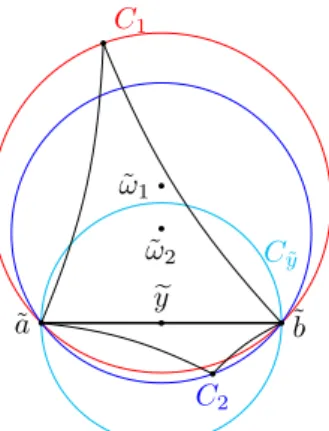
Lemma 34. An edgee of DT˜ Peis a half-minimizer joining its endpoints if the two circumcentersω1, ω2
of the circles C1, C2 of the two Delaunay polygons on both sides of ˜e lie on opposite sides of ˜e. The
circumcenters of circles containing the endpoints of ˜e lie on the perpendicular bisector of ˜e.
If either the center of C1 (or C2) lies on e, necessarily a diameter of C˜ 1 (or C2), e is still a half-˜
minimizer, but there may be multiple distance minimizers connecting a vertex of DTPe to the midpoint of ˜e.
Proof. Let ˜a and ˜b be the endpoints of ˜e, and ˜y its midpoint. After applying an isometry of H2we can
assume that ˜e lies on the real axis and that ˜y lies on the origin. Indeed, it is well-known that the group of conformal transformations of the unit disk acts transitively on triples on the boundary of the unit disk2 and therefore we can choose to map the geodesic in H2 containing ˜e to the real axis by mapping
its intersections with the boundary to the points 1 and −1 on the real axis. We obtain the desired situation by furthermore mapping one of the intersections of the perpendicular bisector of ˜a and ˜b with the boundary of the unit circle to the point i on the imaginary axis. The resulting situation is illustrated in Figure 10. By definition, the interiors of the two circles C1 and C2 do not contain a vertex of DTPe.
The fact that the figure depicts the situation accurately can be seen as follows. The hyperbolic distance from the origin of a point with Euclidean distance r from the origin is equal to arctanh(r) [40, Section 9 − 2, eq. (1)], which is a monotonous function in r. In particular, points that have a greater Euclidean distance from the origin in H2 also have a greater hyperbolic distance. Thus, as depicted in Figure 10a,
if we can show that the light blue circle Cy˜with center ˜y is contained in the union of the two closed disks
bounded by the circles C1 and C2, then ˜e is a half-minimizer based at either endpoint. We will do this
using Euclidean geometry. Consider the set, or pencil, C of circles containing the vertices ˜a and ˜b. The set C can also be described as the set of circles with center on the line through ˜y, perpendicular to ˜e. It is clear that if the Euclidean center of a circle Cu∈ C lies above ˜e, then Cu contains the upper half-disk
of Cy˜, bounded by ˜e. Similarly, a circle Cd∈ C with center below ˜e contains the lower half-disk of C˜y,
bounded by ˜e, so ˜e is a half-minimizer.
The last statement of the lemma is the limiting case where Cy˜equals C2.
Remark 35. Figure 10b illustrates the situation where the two circumcenters lie on the same side of ˜e. If DTPe is defined by Γ˜a, with ˜a ∈ Γ˜b, then, using the same set-up as in the proof of Lemma 34, one sees that the edge between ˜a and ˜b cannot be a half-minimizer.
Remark 36. It is worth discussing the differences between the concepts of centered edges and half-minimizers in the context of the tesselations defined by eP. First and foremost, there is the conceptual difference that half-minimizers are intrinsically defined on a surface without reference to a particular tiling or a point set. Furthermore, the property of being a half-minimizer is hereditary, since it follows straight from their definition that subarcs of half-minimizers inherit their length-minimizing properties and thus are half-minimizers as well. On the other hand, in the presence of a point set, by Lemma 34,
2This is also sometimes paraphrased as saying that there is only one triangle with only ideal vertices in H2, up to
C1 C2 ˜b e y ˜ a Cy˜ ˜ ω1 ˜ ω2
(a) The situation when the circle centers lie on both sides of the edge from ˜a and ˜b.
Cy˜ C1 C2 ˜b e y ˜ a ˜ ω1 ˜ ω2
(b) The situation when the circle centers lie on the same side of the edge from ˜a and ˜b. Figure 10: The two situations of Lemma 34.
a centered edge of a Delaunay tesselation is a half-minimizer. Moreover, by Proposition 37 below, the centered edges of Dirichlet domains are also minimizers. However, it is not true in general that half-minimizers give rise to centered edges, even for closed half-half-minimizers that are geodesics everywhere. For an example, recall the NEC group ΓB and Dirichlet fundamental domain from Figure 4a and consider
the line segments from the origin to the corners of the Dirichlet polygon in Figure 11(left), where the line segments are shown in blue. These are equivalent, under ΓB, to the edges shown in Figure 11(right).
By Lemma 28, analogous to the discussion of Figure 7 above, these line segments can be combined arbitrarily to yield closed half-minimizers. There are a total of four closed geodesics without kinks that one can produce on H2/Γ
B in this way, and none of these are edges of the Delaunay tesselation dual to
the shown Voronoi diagram. Moreover, it is impossible to make all of these part of a single Delaunay triangulation with the red points as vertices. Thus, there are half-minimizers that are closed geodesics based at a point that are not edges in a given Delaunay triangulation with that point as vertex set.
Figure 11: Closed geodesics on the Bolza surface, illustrated in a fundamental domain in H2, from line


![Figure 3: Dirichlet domain w.r.t. different base points. Images from [6, Figure 9].](https://thumb-eu.123doks.com/thumbv2/123doknet/14315542.496040/5.892.110.784.105.314/figure-dirichlet-domain-different-base-points-images-figure.webp)