Computer Science and Artificial Intelligence Laboratory
Technical Report
m a s s a c h u s e t t s i n s t i t u t e o f t e c h n o l o g y, c a m b r i d g e , m a 0 213 9 u s a — w w w. c s a i l . m i t . e d u
MIT-CSAIL-TR-2008-016
March 17, 2008
Cognitive Security for Personal Devices
Cognitive Security for Personal Devices
Rachel Greenstadt
Harvard University
[email protected]Jacob Beal
MIT
[email protected]Abstract
Humans should be able to think of computers as exten-sions of their body, as craftsmen do with their tools. Current security models, however, are too unlike those used in human minds—for example, computers authen-ticate users by challenging them to repeat a secret rather than by continually observing the many subtle cues of-fered by their appearance and behavior. We propose three lines of research that can be combined to pro-duce cognitive security on computers and other personal devices: imprinting and continuously deployed multi-modal biometrics, self-protection through virtualization and trusted computing, and adjustably autonomous se-curity.
1
Motivation and Overview
The best tools, in the hands of a skilled user, act as ex-tensions of the human body. A craftsman makes a ham-mer an extension of her arm, a driver makes a car an extension of his body. We treat personal computing de-vices this way as well, using them to extend our think-ing, communication, and acting capabilities even when we are not paying direct attention.
Trusting computers this way has its dangers. Unlike most tools or body parts, a single bad interaction (with a website or piece of code) can thoroughly compromise a machine, giving control over its data, resources, and operation to an adversary. The security community has largely responded to this state of affairs by erecting bar-riers between the user and the device—more passwords, icons, dialog boxes, and warnings to increase their vig-ilance. This vigilance comes at the expense of conve-nience and productivity and yet is still brittle.
We propose that computers should act more like hu-mans in their security decisions and characteristics. Hu-man minds have evolved cognitive security: rich and subtle mechanisms for handling trust and security in so-cial interactions. For example, when presented with au-thentication documents, human verifiers are trained to examine the humans as well as the documents them-selves. The personal interview, harnessing all our sub-tle cognitive security traits, is still the gold standard for determining malicious intentions in humans [15].
Currently, we suffer from cognitive dissonance from trying both to treat computers as an extension of
our-selves and to be constantly vigilant of the ways in which their security models are alien to those in our minds. If we can build machines that manage their security more like humans then we may be able to avoid some of the damage caused by this cognitive dissonance.
Our focus in this paper is on personal devices that serve one primary user, not servers or machines which are primarily shared resources. While such shared re-sources could also benefit from having better cognitive security properties, we have chosen to start with per-sonal devices because of the lesser complexity of hav-ing one master and because edge devices are where the primary security threats currently originate.
We propose advancing three lines of research that can be combined to achieve cognitive security for personal devices. First, imprinting and continuously deployed multi-modal biometrics, allowing a device to reliably recognize its owner. Second, self-protection through vir-tualization and trusted computing, allowing a device to protect itself while running untrusted applications. Fi-nally, adjustably autonomous security, allowing a device to make security decisions with user input for important judgement calls. Progress in these areas will help pro-duce devices that users can safely treat as extensions of themselves.
2
Differentiating Between Users
To serve its owner well, a device must be able to reliably differentiate between its owner and other users. Con-ventional methods for doing this are brittle, however, so we argue for two fundamental changes in how a device determines whether its user is its owner. First, rather than using a challenge/response protocol, we argue that a device should recognize its user through ongoing mea-surements of many streams of readily available biomet-rics. Second, we argue that no user should ever be al-lowed to set the identity of the owner; instead, a device should imprint on the first user it has a sufficiently rich interaction with, much like a baby bird imprints on the first sufficiently mother-like object it encounters. These two changes should allow a device to establish a durable privileged relationship with its owner.
2.1
Recognizing the Owner
How can Abacus, a device, tell that it is interacting with Alice, its owner? Conventional security designs gener-ally use a challenge/response strategy. Under this ap-proach, when Alice begins a session with Abacus, it challenges her to prove her identity, often using secret information such as a password. Once she has passed this challenge, however, Abacus never challenges her again that session, except perhaps after long periods of idleness. Although the challenge may be arbitrar-ily complex and difficult to fake—a password, biomet-rics, hardware keys, etc—the pragmatics of human us-age tend to erode this type of security:
• Challenges interrupt the natural use patterns of many personal devices, such as PDAs and phones. • Humans are bad at memorizing secrets: they
of-ten choose passwords that can be cracked by brute force or data-mining, and frequently reuse the same password on many different devices or services. • Remote device use (e.g. calling one’s answering
machine to check for messages) precludes the use of “physical” proofs like fingerprint scanning or hardware keys.
Worse yet, challenge/response authentication is funda-mentally vulnerable to theft. If you can duplicate the bits that Alice will be challenged to produce, then you can pretend to be her with impunity.
Humans do not normally recognize one another this way: in most everyday interactions, we recognize peo-ple by who they are and how they behave, rather than by the secrets that they know. The cues we use for recog-nition range from immediate and obvious, such as facial structure, voice, and gait, to subtle and slowly emerg-ing, such as fidgeting behavior and preferred topics of conversation. Nearly all, however, are based on streams of public information that are made available naturally throughout an interaction. Moreover, most users already view these sorts of biometrics as both acceptable and trustworthy[7], particularly for a personal device where privacy is not at stake.
2.1.1
Continuously Deployed Biometrics
We advocate a continuously deployed multi-modal ap-proach, in which many different low-fidelity streams of biometric information are combined to produce an ongo-ing positive recognition of a user. With an optimistic and ongoing recognition process, security can be stronger, because attackers must impersonate Alice well enough to satisfy many different cues throughout their interac-tion with Abacus, and also less intrusive, because Alice can gain privileges merely by interacting with Abacus.
There are potentially many cues available to help Aba-cus recognize Alice. To name a few:
• Camera: invariant facial structure, height, pos-ture, body shape, hair shape and color, complexion, glasses and eye color, tics and motion patterns • Microphone: voice tone, inflection, pattern of
speech and pauses
• Button Array (e.g. keyboard, phone keypad): typ-ing speed, pause patterns
• Pointing Device (e.g. mouse, PDA stylus): smooth-ness of arc, idle/wander patterns, speed of traverse, duration and frequency of clicks
• Accelerometer: walking speed, changes in posture • Use Patterns: music choice, favorite web
destina-tions, choice of words and phrasing, patterns of use and idleness, preferences for button vs. pointer in-put, preferred times of day
• Other Sensors: body temperature, fingerprints, con-ductivity
Alone, none of these cues is likely to even approach either the consistency or reliability of a strong password. As an aggregate, however, they may out-perform chal-lenge/response approaches.
Although many devices will have only a subset of these sensors, there are enough cues available that any large subset ought to provide enough information for a good recognition signal. For example, with 20 cues, each with an independent 20% error rate, a 2/3 vote has only a 1 in 500,000 chance of producing an incorrect decision.
The machine-learning subfield of ensemble learning[9] is explicitly focused on the problem of building strong classifiers from many weak classifiers, and has produced algorithms such as AdaBoost[4] that should be easily applicable to the problem of combining cues to provide good security while never denying Alice access to her own device. Existing work in multi-modal biometrics (e.g. [11], [3]) has already shown that machine learning can be used to fuse data sources and boost the efficacy of person recognition. In a continuously deployed multi-modal approach, we simply greatly multiply the number of sources and the time-frame over which they are considered.
Because cues are based on readily available informa-tion, the goal of a cue recognition system cannot be per-fect security. It will always be possible for a sufficiently determined attacker to study Alice thoroughly enough and invest enough time and effort in counterfeiting to fool Abacus. Rather, the goal of cue recognition is to make the cost of doing so high enough that an attacker will almost always prefer a different approach: even if the attacker knows how Abacus recognizes Alice, sus-taining an appropriate ensemble of cues is likely to be difficult.
2.1.2
Rich and Poor Cue Availability
When Alice and Abacus are physically co-located, the majority of cues are likely to be readily available. In a situation of this sort, the evidence that Abacus is inter-acting with Alice is likely to be overwhelming. As such, these periods of rich cue availability are ideal sources of training data, which Abacus can use to gradually adjust its model to reflect how Alice herself changes over time. If Alice is interacting with Abacus remotely, how-ever, most of the cues will not be available. If Alice called Abacus from an ordinary phone to get her mes-sages, for example, Abacus would have only her voice, tones produced by button presses, and her use patterns to judge her identity. When the interaction between Al-ice and Abacus is short and few cues are available, it may be advisable to also use a password or similar chal-lenge/response method.
2.2
Imprinting Abacus on Alice
Currently, devices are designed so that a sufficiently privileged user can easily change anything on the ma-chine, including how it recognizes Alice. The only way to avoid this is to have Abacus’ recognition of Alice be immutable.
There is a metaphorical similarity here to the psycho-logical notion of imprinting. Many animals go through critical periods where they rapidly learn to recognize a special stimulus. Imprinted relationships are extremely durable, often lasting a lifetime. Geese, for example, im-print on first suitable moving object they see shortly after hatching, and will ever after treat it as their parent[8].
Likewise, when Abacus has its first long and cue-rich encounter with Alice, we argue that it should imprint on her. During that first encounter, it should learn to rec-ognize Alice in as many different ways as possible, fix-ing her characteristics in a protected memory where not even Alice herself can modify it. Alice can thus trust that even a successful attack on Abacus will not compromise its relationship with her.
2.2.1
Loans and Sales
Imprinting need not make it any more difficult for Alice to loan out Abacus to her friends. If Abacus implements a reasonably fine-grained access control system, then it can adjust the privileges in real-time based on its ability to recognize its current user.
Transferring ownership, on the other hand, is a major shift, since only Abacus has access to its imprinting data. The new owner, Bob will not want an Abacus whose primary loyalty is to Alice rather than to him, so Aba-cus must re-imprint. Alice, meanwhile, will not want an Abacus that can re-imprint while carrying her private information. The only way out of this dilemma is for a
transfer of ownership to involve a “death and rebirth”— Abacus must reinitialize itself completely, destroying any data that Alice has on it, then imprint freshly on Bob. The difficulty of causing device death will likely depend on the type of device.
3
An Architecture for Machine Integrity
We envision Abacus as obedient to Alice’s interests in an autonomic sense. Just as Alice’s heart keeps beat-ing even when she’s sleepbeat-ing, or not paybeat-ing attention, or when she’s so emotionally distraught that she thinks it is broken, so too should Abacus require minimal action from Alice to work. Currently it is just too easy for ma-chines to be compromised for them to be trusted in this way.
Human security has some strong advantages over that of machines. Our human minds are basically inviolable; while it is easy to guess the gist of what someone is thinking or manipulate another person into doing what you want, it is impossible to actually read another per-son’s mind or control their will. In contrast, comput-ers are completely at the mercy of their uscomput-ers and appli-cation programming, making them vulnerable to attack and compromise by any rogue user, application, or re-mote exploit.
In humans, this security is effected by three features: (1) physical security in the form of the skull, the blood-brain barrier and limited access and inputs, (2) isolation of different regions of the brain and the ability of cer-tain regions to examine and reflect upon the activity and thoughts of other regions and (3) a complex cognitive security system that acts to protect our secrets and self-control and manage relationships with other humans. We cannot replicate this security entirely in Abacus, but we can seek to gain some of its properties strengthening integrity, isolation, and secure decision-making skills in machines.
The problem is actually harder for Abacus than for humans because Abacus must be capable of protecting its integrity from Alice while still obeying her wishes. Alice will want to run the dubious JavaScript applica-tion and Abacus has to let her, or else she will greatly resent the intrusion. The key is to recognize that it is a risky or untrusted program and find a way to run it safely while still isolating the Abacus core and protecting the integrity of it and other critical data and applications.
Building the kind of trustworthy agent devices we en-vision requires some architectural support. Develop-ments in trusted computing, virtualization, and instru-mentation provide a strong basis for the development of more sophisticated security models. While there may be other ways to provide the needed security, this combina-tion is already an active area of research (sHype, Xense, etc) [2].
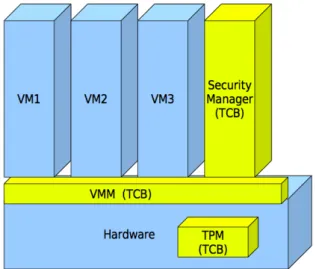
Such an architecture is illustrated in Figure 1. The trusted computing base—the software which must be vulnerability-free to protect the system—is shown in yellow. The core of the system is protected by a trusted platform module (TPM) that protects key material and ensures the integrity of the virtual machine monitor (VMM) above it. The security manager, verified by the VMM below it, runs in a virtual machine that manages the rest of the VMs. Abacus can spawn virtual machines to run untrusted code in isolation and uses instrumenta-tion to detect malicious acinstrumenta-tions on the part of this code. Without virtualization, trusted computing can attest to specific software configuration, but such systems are not easily changed and brittle; there is no way to run un-trustworthy code. Virtualization alone is not enough ei-ther. Without trusted hardware, there is no root of trust to build the system on: the VMM could be resting on top of a stealthy root kit like Blue Pill[12].
While such architectures have been limited to PCs, we also envision security managers running on other per-sonal devices, like phones and PDAs. Increasing num-bers of phones are running full-scale operating systems, and virtualization is becoming more and more efficient and lightweight. The continuing march of Moore’s law will also make more layered approaches to security more feasible long term.
3.1
Trusted Computing
Trusted computing refers to certain hardware additions to the platform, including a secure co-processor that al-lows for (1) secure storage and memory and (2) attesta-tion: the ability of running code to prove that it is run-ning in some specific environment [16]. One of the key benefits of using trusted computing is the isolation from attacks it provides. Key material can be stored securely and maintain security even in the event of software com-promise. Attestation by the secure core can be used to maintain the integrity of software executing on the ma-chine (for example a VMM) and bootstrap more com-plex security layers in software from there.
Trusted computing, as expressed in the initiatives of the Trusted Computing Group (TCG) [1] formerly known as TCPA, and the Microsoft Next Generation Se-cure Computing Base (NGSCB, formerly known as Pal-ladium) has been widely criticized for its potential to be used for unpopular DRM and ability to create software lock-in. However, most of these criticisms can be ad-dressed by allowing owner override of the trusted plat-form’s functions [14].
Trusted computing enables secure boot by allowing each level of the machine (from bios and firmware up through the operating system and applications) to be measured and then stored as a hash on the TPM. These measurements are checked before control is transferred
Figure 1: An illustration of the architecture for Abacus. The trusted computing base (TPM, VMM, and security manager) is shown in yellow. The rest of the hardware is untrusted, as are the other virtual machines for running applications.
to the next level and can be used to ensure that security-critical code is not maliciously altered [1]. Bootstrap-ping trust using a secure processor alone is quite brit-tle; any time the software or hardware configuration changes, the trust chain must be built anew. Virtualiza-tion provides a way to add addiVirtualiza-tional flexibility and iso-lation using software. This is what NGSCB was trying to do with the nexus “secure right side” and the “inse-cure left side” on Windows.
3.2
Virtualization
Virtualization is the process of representing hardware re-sources abstractly in software. In its most extreme incar-nation, emulation, all hardware is abstracted. There are also lightweight versions that only virtualize key system calls or drivers. While virtualization is most well-known for allowing multiple operating systems to run on the same machine, its security benefits are primarily gained by isolating pieces of software from each other. When the hardware (and some software) is abstracted, software running at different levels of trust can each be run on their own virtual machine. Different virtual machines are managed by a virtual machine monitor (VMM). If the VMM is secure (a large assumption but more plau-sible than operating system security) then each of these sets of software will execute in isolation, and a compro-mise in one VM will not affect the others or the VMM.
The basic architecture is illustrated in Figure 1. The hardware contains a trusted platform module, that can be accessed by a virtual machine monitor that manages a number of virtual machines. The security management
software will be run on a virtual machine on top of the VMM, so that the VMM can remain simpler and more likely to be bug-free. Nonetheless, the security man-ager will still be a part of the trusted computing base and need to be designed carefully, to avoid failures such as leaking biometric information about Alice or providing TPM owner override to an imposter. The security man-ager will have the ability to spawn virtual machines for the purpose of running applications on them and also for the purpose of testing the integrity of other applications and virtual machines. For instance, it is often possible to detect the presence of malicious code by running it in an instrumented virtual machine and taking note of suspicious actions [10]. In addition, root kits can often be detected by reconstructing the semantic view of the operating system from the virtual state in the VM in an-other VM and then comparing the outputs [6].
With good virtualization technology, it should be pos-sible for much everyday activity to be handled safely by confining untrustworthy code to isolated virtual ma-chines. It is important, however, that all these virtual machines have their I/O fused together to give Alice a seamless experience, rather than forcing her to navigate between them.
4
Adjustably Autonomous Security
If Alice understood what Abacus was being asked to do by the programs that she is running on it, she would usu-ally be able to make good judgments about what behav-iors are suspicious. For example, if Alice runs a program to send greeting cards to her friends, she would be happy to see it send those cards, upset if it tried to modify her browser, upset if it sent a list of her contacts or ads for Viagra to some random address, and might allow it to send its creator email with statistics on how many cards had been created.
Notice that these scenarios place us on the horns of a dilemma. On the one hand, these scenarios cannot be distinguished by what resources are involved, only by the semantic content of their usage, and we cannot ex-pect Abacus to differentiate between them without help from Alice. On the other hand, computers do so many things so rapidly that asking Alice for many judgment calls will quickly overwhelm her and annoy her into dis-abling security.
What we need is a way for Abacus to filter and sum-marize its behavior so that Alice is only asked to make a few relevant judgment calls. For Alice to be able to rely on Abacus’ judgment about what decisions need her input, Abacus needs to be able to judge how valu-able and private a piece of information is, know what Alice is expecting a program to do, know what types of program behavior are worthy of suspicion, and simulate Alice’s judgment so that it does not pester her when the
answer should be obvious. Although this is an unsolved problem, closely related problems are being studied in other domains, such as collaborative planning[13] and adjustable autonomy[5].
Any successful system will need to begin with a built-in knowledge base (contabuilt-inbuilt-ing facts like “money is valu-able” and “sending spam is bad”), which is then mod-ified as it interacts with Alice. Abacus will need a good model of how humans think about security so that it can infer Alice’s likely judgments about new situa-tions based on her reacsitua-tions to previous situasitua-tions. The same behavioral information used to recognize Alice might enrich this learning process as well—for exam-ple, guessing that information that causes stress in Alice is likely to be important to her.
Knowing what behaviors are suspicious is likely to be a harder problem and involve getting descriptions of pro-gram behaviors from some third party. Likely, Abacus will need some trust anchors that can provide machine-readable security advisories.
Finally, there needs to be careful user interface design that allows Abacus to give Alice information about the judgments that it is making, such that she can notice and react to them appropriately without interfering with her normal usage.
5
Conclusion
Cognitive security leads to better overall security be-cause of the better match between a personal device and its user. This can be achieved by combining three lines of research: trusted computing and virtualization to protect the integrity of the device, imprinting with continuously deployed multi-modal biometrics to allow the device to recognize its owner, and human-like se-curity models to enable responsible decision-making by the device. The greatest challenge is the last: human-like threat perception and response is a problem of poten-tially limitless complexity, and adversaries will exploit any systematic flaw in the design. Even a partial solu-tion, however, may be effective enough to fundamentally change the trust relationship between users and their de-vices.
6
Acknowledgments
This work has been partially funded by NSF Grant #6898853 and the Harvard Center for Research on Com-putation and Society. Thank you also to Stephen Mur-doch for information about the current state of trusted computing research.
References
[1] The trusted computing group. http://www.trustedcomputinggroup.org.
[2] S. Berger, R. Caceres, K. Goldman, R. Perez, R. Sailer, and L. van Doorn. vtpm: Virtualizing the trusted platform module. In 15th USENIX Security Symposium, July 2006.
[3] J. Bigun, J. Fierrez-Aguilar, J. Ortega-Garcia, and J. Gonzalez-Rodriguez. Combining biometric evi-dence for person authentication. In Advanced Stud-ies in Biometrics. Springer, 2005.
[4] Yoav Freund and Robert E. Schapire. A decision-theoretic generalization of on-line learning and an application to boosting. Journal of Computer and System Sciences, 55(1):119–139, 1997.
[5] Eric Horvitz. Principles of mixed-initiative user in-terfaces. In Conference on Human Factors in Com-puting Systems (CHI), 1999.
[6] X. Jiang, X. Wang, and D. Xu. Stealthy malware detection through vmm-based ”out-of-the-box” se-mantic view reconstruction. In ACM CCS, 2007. [7] L. Jones, A. Anton, and J. Earp. Towards
under-standing user perceptions of digital identity tech-nologies. In ACM Workshop on Privacy in the Electronic Society, 2007.
[8] Konrad Lorenz. Studies in animal and human be-havior. Harvard University Press, 1970.
[9] Robi Polikar. Ensemble based systems in deci-sion making. IEEE Circuits and Systems Maga-zine, 6(3):21–45, 2006.
[10] N. Provos, D. McNamee, P. Mavrommatis, K. Wang, and N. Modadugu. The ghost in the browser: Analysis of web-based malware. In USENIX Workshop on Hot Topics in Understand-ing Botnets, April 2007.
[11] Arun Ross and Anil Jain. Information fusion in biometrics. Pattern Recognition Letters, 24:2115– 2125, 2003.
[12] Joanna Rutkowska. Blue pill project. http://bluepillproject.org/.
[13] David Sarne and Barbara Grosz. Estimating infor-mation value in collaborative multi-agent planning systems. In AAMAS 2007, 2007.
[14] Seth Schoen. Eof - give tcpa an owner override. Linux Journal, December 2003.
[15] Andrew Simkin. Interrupting terror-ist travel: Strengthening the secu-rity of international travel documents. http://www.state.gov/r/pa/ei/othertstmy/84339.htm, May 2007.
[16] Sean W. Smith. Trusted Computing Platforms: De-sign and Applications. Springer, 2005.