Design for Implementation -
Redesigning a Planning Process in a
Multinational Company
by
Liron Azrielant
B.S. Mathematics and Physics, the Hebrew University of Jerusalem, Israel, 2007
Submitted to the MIT Sloan School of Management and the Electrical Engineering and Computer Science Division in Partial Fulfillment of the Requirements for the Degrees of
Master of Business Administration and
Master of Science in Electrical Engineering and Computer Science
In conjunction with the Leaders for Global Operations Program at the Massachusetts Institute of Technology
June 2011
C 2011 Massachusetts Institute of Technology. All rights reserved.
Signature of Author Certified by
ARCHIWES
' MASSACHUSETS INSITUTE OF TECHNOLOGYJUN 1 5
2011
LIBRARIES
May 6, 2011 Electrical Engineering and Computer Science, MIT Sloan School of ManagementDavid Simchi-Levi, Thesis Supervisor Professor, Civil and E r t nznn 1-i--An ncr nC+-ms
Certified by
eoy w eiscl, i nesis supervisor
Professor of !+,A Aa4 nicrivmwPnt Qrp1i-nap ATT Clran- Ca fln+' onement Accepted by
Leslie A. Kolodziejsiu, rrUoessor, tiectricai cngineeri y
aiiPukypuu---Cbair '->artment Copi ittee of Ggduate Students
Accepted by
Debbie Berechmin, Executive Director of MBA Program MIT Sloan School of Management
Design for Implementation -
Redesigning a New Planning Process in a
Multinational CPG company
by
Liron Azrielant
Submitted to the MIT Sloan School of Management and the Electrical Engineering and Computer Science Division on May 6, 2011 in Partial Fulfillment of the Requirements for the Degrees of Master of Business
Administration and Master of Science in Electrical Engineering and Computer Science
Abstract
As a consumer-packaged-goods company dealing with multiple suppliers, "Company X" (the company's real name has been disguised) has a clear need for an accurate raw material forecast. The current planning process has not managed to supply a forecast that will answer Company X's raw material procurement needs, and so a need for a new process has arisen. Process change initiatives are a task that every company frequently encounters, and creating the right setting for a successful change initiative is critical to determining whether the company will be able to drive the cost savings and remain competitive. This thesis outlines the process of redesigning the raw material planning process within the company's regional operations in several developing countries. The new process was designed in an attempt to balance creating a more accurate and more robust forecast with designing an implementable, well-accepted new process that will establish the settings for a successful change initiative.
In the process evaluation section, we examine the new procedure's potential accuracy improvement, as well as two unique management tools to evaluate the process' implementation potential and the trade-offs made in designing the process. We evaluate the impact of the finished goods forecast and production error on the overall material plan accuracy.
One common course of action companies typically take in order to decrease material plan variability is to reduce the number of finished goods SKU by aggregating similar SKUs. SKU reduction increases the forecast mean of the individual SKUs and thereby decreases the percent error of the forecast. One interesting conclusion this thesis outlines is that when the production error is not negligible, SKU
reduction will only help if the decreased finished goods forecast percent error is above a certain ratio (the square root of the forecast mean). This conclusion suggest that local optimizations of the sub-processes that generate the full material plan will not necessarily optimize the resulting material plan, and that material plan optimization should be done using a comprehensive approach, not as a set of sub-processes optimizations.
While these results, and the methodology for the design and assessment of new process was revealed during my work within company X, the material plan accuracy results are relevant for any material plan process improvement, and the change management methodology discussed is relevant for any company with a need for a smooth and successful implementation of a new process.
Thesis Supervisor: David Simchi-Levi
Title: Professor, Civil and Environmental Engineering and Engineering Systems Thesis Supervisor: Roy Welsch
Acknowledgments
I would like to thank the great people of Company Xfor providing the guidance
support and resources I needed throughout the internship. In particular,
Guillermo
Pinochet, Victor Valdebenito, Andres Alkoloumbri and Rodrigo Caliz offered their
unconditional support
-
without which this work would have not been possible.
I would also like to thank the Leaders for Global Operations programs staff, faculty
and students and my advisors, Roy Welsch and David Simchi-Levi for taking the
time to support and guide me through the writing of this thesis.
Finally, I would like to thank my parents, Ruth and Avraham Azrielant, and my
uncle Ofer Azrielantfor their constant support, inspiration, and great advice.
Table of Contents
A b stract ... 3 Acknowledgments ... 5 Table of Contents ... 7 List of Figures ... 10 1 Introduction...111.1 Com pany Overview ... 11
1.2 Thesis M otivation:...11
1.3 Problem Statem ent ... 14
1.4 Thesis Structure...14
2 The Planning Process ... 15
2.1 The General Planning Process... 15
2.1.1 The Planning Process by Region... 18
2.2 The Procurem ent Process ... 19
3 Designing a Planning Process ... 21
3.1 M apping the N eeds of the Procurement Team ... 21
3.2 D esired Process Output ... 23
3.3 Issues w ith the Historical Process ... 23
4 The N ew Process ... 28
5 Gap Analysis and Barriers for N ew Process Im plem entation ... 30
5.1 Im plem entation Barriers...30
5.2 Gap Analysis by Region...31
6 N ew Process Evaluation...33
6.1 Accuracy ... 33
6.1.1 First Six M onths ... ... 33
6.1.2 M onths -7 to 18 ... 40
6.1.3 Significance...41
6.2 Im plem entability and Sustainability ... 44
6.2.1 The Three Lens...45
6.2.2 The M atrix of Change ... 50
7 R e su lts ... 6 0 7.1 Accuracy Im provem ent ... 60
7.2 Im plem entation...60
8 Conclusions and Future Suggestions... 62
8.1 Recom m endations for Future Internships ... 64
9 Glossary ... 65
List of Figures
Figure 1 -Over Time Changes in the Material Plan for Raw Material R... 12
Figure 2. The Stages of the Planning Process at a Typical Mill... 15
Figure 3. 18-month Material Plan in a Certain Country - Only the First 6 months Contain Meaningful D ata ... 1 7 Figure 4. The Desired Process Output... 23
Figure 5. Differences between Actual Consumption and Documented Consumption for Material X...25
Figure 6. The Proposed Planning Process ... 28
Figure 7. Desired Output from S&OP... 28
Figure 8. Process Implementation Progress by Region, June 2010 ... 32
Figure 9-The absolute error as a function of forecasted quantity for certain finished good ... 34
Figure 10. ak2 values for each different k... 35
Figure 11. The absolute error as a function of forecasted quantity and the critical Fnk ratio...43
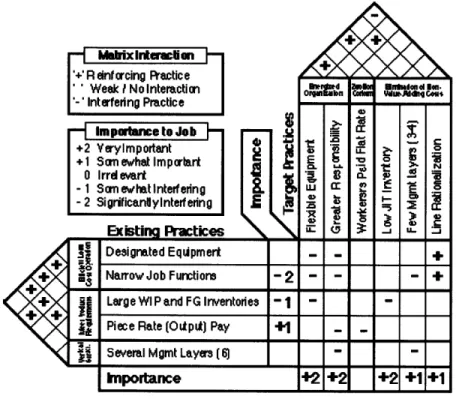
Figure 12. Sample Matrix of Change[8] ... 51
Figure 13. The critical practices in the existing practices and the new process in Company X...52
Figure 14. Triangular horizontal and vertical matrixes... 53
F igure 15. T ransition M atrix ... 54
Figure 16. Stakeholder Survey Presented in the MOC... 55
Figure 17. The Material Planning Process's Matrix of Change ... 56
1 Introduction
1.1 Company Overview
Company X is a large CPG enterprise with annual sales near of $20B and more than 50,000 employees. The company has operations in more than 130 countries and is a market leader in more than 80 countries. The company's regional division has operations in 21 countries, sales in 37 countries and over 18,000 employees. The regional division's headquarters is located in the US, and the culture within the headquarters is very similar to that of the developing countries. Even though the business language is English, much of the conversations are done in foreign languages. The regional division is divided into four sub-regions regions, and each sub-region has its own VP. In addition to the regional VPs there are three functional VPs - for supply chain, B2B business and human resources. The company's sites are
very much affected by the local culture and present distinguished cultures and business practices. Recently, the company launched several process improvement projects with the aim of cutting costs and increasing the system's response time. Those projects were highly successful, received significant support from the company's directors and achieved satisfactory results. The effort outlined in this thesis to improve the accuracy and visibility of the raw material plan and better support medium and long-term purchasing decisions, is one of those projects.
1.2 Thesis Motivation:
Company X's regional purchasing team has three major responsibilities: placing raw material orders as necessary, signing periodic long-term agreements with the company's suppliers, and developing new suppliers when additional capacity is necessary. Purchase orders are placed with a lead-time that ranges from 15 days to 3 months. Supplier agreements are generally negotiated once a year and have a horizon of
12 months. The supplier agreements include expected order quantity for the following year and an ordering quota that will entitle the company to a certain rebate. Those annual agreements are particularly important since most of Company X's suppliers use them to plan their manufacturing and capacity
requirements. Inaccurate agreements could cause supplier backorders and result in long-term raw material shortages for Company X. In cases where current suppliers do not have the required capacity to answer Company X's foreseen raw material needs, the purchasing team will either encourage the suppliers to invest in additional capacity or find new suppliers. Adding new capacity or developing new suppliers typically takes six to 24 months.
Throughout 2009 and 2010, Company X encountered significant differences between the estimated and actual consumption of raw materials in its region's mills. Those differences caused severe losses to the company in the form of lost rebates, purchases of raw materials at sub-optimal prices, excessive inventory and insufficient raw materials that even caused a production halt in several mills in 2009. Figure 1 shows an example for the volatility of the material plan regarding one material in two different regions.
Country 5 Country 4
Figre1.Ovr im Changes inteMtra-lnfrRwMtra
---
---Figure 1. Over Time Changes in the Material Plan for Raw Material R
Moreover, Company X is currently undergoing a transition from a regional to a global procurement system. Until recently, a regional procurement team verified and checked for consistency the purchase orders made by the local planning teams in the mills and renegotiated annual agreements as the
purchasing forecast changed. With the move to global procurement, the global procurement team will not
have the knowledge, the time or the resources to screen purchase orders for errors and minimize rebate losses by contract renegotiation. As a result, with the move to global procurement, an accurate and consistent raw material forecast is even more crucial for the company.
This thesis will focus on the design of a new process that will generate a better raw material plan. It will start with mapping the informational needs of Company X's regional procurement team and continue with the creation of an implementable process, which will answer those needs. The purpose of the thesis will be to review the design of a new planning process that will generate more accurate results, will achieve maximum stake-holder buy-in, and will be easy to implement uniformly throughout six relevant countries. The new process will standardize the work across the region and will attempt to improve the quality, validity and horizon of the information that is used by the regional and global procurement team.
1.3 Problem Statement
Due to the long lead times in the CPG industry, and Company X's suppliers' need to anticipate their raw material purchases, there is a clear need for an accurate and uniform raw material forecast that will supply a longer planning horizon. This thesis will review the process of defining the forecast horizon and
granularity required, and redesigning an implementable new process that will generate this new forecast. The thesis will review issues of evaluation of process accuracy, process design for implementation, and change management in a multinational company.
1.4 Thesis Structure
Chapter 1 provides background information for the host organization, outlines the motivation for the
thesis, and defines the problem the thesis aims to solve.
Chapter 2 provides an overview of the historic situation in the hosting company.
Chapter 3 describes the process of designing the new planning process, maps the needs of the buying
team, criticizes the old process, and reviews the constraints and considerations made in the design of the new process
Chapter 4 describes the new process proposed
Chapter 5 conducts gap analysis between the old and the new process
Chapter 6 evaluates the new process based on its anticipated accuracy and implementability, using both
engineering and management models.
Chapter 7 describes the results achieved by the new process in terms of improved accuracy as well as
process buy-in
Chapter 8 contains the conclusions of the analysis, as well as future recommendations and follow-up
2 The Planning Process
2.1 The General Planning Process
The planning process in each mill generates the production plan, production schedule, and the material plan.
Production Plan: high-level plan, dictates which finished goods will be manufactured in each
time period, typically has 2-6 month horizon
Production Schedule: shift-by-shift description of mill schedule, which machine will
manufacture which product at what time. Typically has 15-60 day horizon.
Material Plan: the materials that will be consumed according to the production plan, same
horizon as the production plan.
S&OP
Production Manufacuring Production
Co mationdule
TheRM onsmpton Creat the product The RM consumption acco ding to spec
Production Scheduler Inventories Spec Machines CE acities creates the schedule
FG Production Production Material
Create FG
forecast by SKU info to PurchaseOrders
"Ni Creates the BOM for
Intercompany each material BOM Orders
The planning process, outlined in figure 2, is a monthly process and has several stages:
1. S&OP - Sales and Operations. A team of sales staff, marketing staff, and planners generates a finished good forecast for the local region. The demand analyst creates a forecast baseline based on historical sales, which will be reviewed and adjusted by sales and marketing teams. Typically a brand-level forecast is created and later disaggregated to the stock-keeping unit
(SKU) level. This forecast is later divided and given to specific mills, based on the mill
capability and location using a DRP algorithm.
2. Intercompany Orders - Some regions also fulfill orders from other regions. The importing region creates a finished goods forecast though its own S&OP process and sends the imported orders to the exporting region.
3. Production Planning - The production planner takes the part of the forecast relevant to his mill, current and required inventory levels and machine capacity information, and plans the production for the next months.
4. Production Scheduling - The scheduler schedules the work plan for each machine according to the production plan, the machine capacity, and the available inventory of raw material. His schedule aims to minimize set-up costs and production costs, and maintain reasonable levels or raw material inventory.
5. Manufacturing - The products are manufactured in the mills according to the production schedule. Specs define the materials needed to produce each finished good. After each batch is manufactured, production confirmation updates the available raw material and finished goods inventories in the system.
6. Material Planning - The material planner takes the production plan and the different
products' bill of materials (BOM) and creates the material plan. The material plan is used to
make purchase orders for raw materials for the mill.
7. Product and Technology Development (P&TD)- whenever a new product is planned for,
the P&TD department is responsible for coordinating with marketing, and issuing the new BOM for the product
Long Term Raw Material Forecast
Recently, in an effort to extend the horizon of the material forecast, the purchasing team has asked each region to generate a long-term material forecast. This forecast has a horizon of 18 months, generated
solely by the material planner and predicts the future raw material needs of the mill. Even though not enough time has passed to measure the accuracy of the long-term material plan, it has proved to be inconsistent with financial forecasts, anticipated plant capacities, and sales and it did not account for new BOM of new products or changes in existing BOMs. In fact, as seen in Figure 3, many long-term material forecasts have been generated by copying the last month of the short-term forecast.
Figure 3. 18-month Material Plan in a Certain Country - Only the First 6 months Contain Meaningful Data - May-10 - Jun-10 Jul-10 Sep-10 - Nov-10 - May-10 - Jun-10 - Jul-10
Jan-10 May-10 Aug-10 Nov-10 Feb-11 Jun-11
Wmi
n
rI
I
i
2.1.1 The Planning Process by Region
The planning process is similar across the region. However, there are several differences between the regions that also affect the accuracy of the resulting material plan. The company has a dedicated system to input and calculate the production plan and the material plan, and a master data system that holds all the information of the forecasts, BOMs, and machine capacities. A region can only use the company's dedicated system to plan its production if the master data is updated for the materials and machines used in that region.
2.1.1.1 Sub-Region One
The planning process is done with a horizon of 6 months. The material planning process is done using Company X's internal information system.
2.1.1.2 Sub-Region Two
The planning is done with a two-month horizon. The material planning is done using Excel modules created by the local material planner and much of the production rates and BOM information on the
company's database is incorrect or obsolete. It is not currently possible to run accurate material planning
on the company's dedicated system.
2.1.1.3 Sub-Region Three
The finished goods forecast is generated in two levels, strategic and tactical. The tactical forecast has a
horizon of four months and is used for the planning process, which also has the horizon of four months.
The strategic forecast is generated in sub-brand granularity once a quarter. Material planning is done
using a locally created Excel module and the BOM and production rates information are not updated in
the company's internal master data.
The production plan has a 4-month horizon, but the material plan has a 12-month horizon. The finished goods forecast is generated using the company's internal system for the first four months but is
extrapolated using a spreadsheet for the remaining 8 months. The production plan is created from the first four months, and the material plan is generated by a locally created spreadsheet for the entire 12 months of the forecast.
2.2 The Procurement Process
Company X buys its products locally, regionally, and globally. Local procurement is done by each country's local team, and it is generally for raw materials that have a very short lead time -15 to 30 days.
Regional purchasing is done for all the regional division by a regional procurement team located in country one. The local buyer places the order in Company X's internal system and transfers it to the regional procurement team. The regional buyer chooses a supplier and places the order with it. Thereafter, the local buyer is responsible to track the order until it reaches the local mill. If any changes in future orders are required, or if there are delays in the order, the local buyer will discuss this with the regional purchaser. Global procurement is done similarly to regional.
In addition to placing purchase orders as necessary, the regional procurement team is responsible for negotiating future rates and order frequency and quantity with the regional suppliers. The procurement team is responsible for guaranteeing Company X a constant raw material supply at the best possible rates.
The regional buyers generally sign annual supplier agreements that include prices and anticipated orders. Those agreements define a rebate that Company X will be entitled to if its accumulated purchases during the year will reach a certain pre-defined quota.
Due to the volatility in material consumption, annual contracts tend to be re-negotiated throughout the year, as the anticipated orders from a supplier change significantly. Renegotiating contracts mitigates the
unclaimed rebates losses and incentivizes the suppliers to re-plan their production, preventing potential shortages. Despite that, in the past year, Company X experienced significant losses due to lost rebates and purchases of more expensive raw materials when the cheaper suppliers could not deliver the required
3
Designing a Planning Process
In order to address the needs of the regional procurement team of Company X, our team designed a new planning process. This chapter outlines the work done to design this process.
3.1 Mapping the Needs of the Procurement Team
Several interviews were conducted with 10 members of the procurement team to map and understand
their needs. The output of the new process was designed in an effort to best address those needs.
The regional procurement team has three main functions:
1. Placing periodic raw materials orders with a lead time of one to three months
2. Negotiating annual supplier agreements, defining quotas and rebates
3. Identifying the need to develop new suppliers or encourage existing suppliers to increase their
capacity when additional capacity is necessary
The raw material forecast is extremely important for all of the functions listed above. The short-term forecast is used to anticipate the raw materials need for each mill and to place periodic orders. When the short-term forecast changes within the lead time, the company incurs losses in the form of excessive inventory (overage), air freight, cross-sourcing or even a halt in production (underage).
For the other two functions, the purchasing team uses a long-term forecast. In the past, this forecast has been obtained from the long-term financial forecast, an estimate done by the buyers, or an estimate done
by the material planner.
Several interviews conducted with the procurement teams have generated the following conclusions
Short-term Forecast:
1. Even though the longest lead time for raw materials is three months, the next six months of
the material forecast is shared with the suppliers in order to foster better supplier relationships and guarantees material availability. This allows the suppliers to plan their manufacturing accordingly.
2. Since this forecast is generated for placing orders, the required granularity is SKU level
3. The first three months of the purchase orders are within the lead time, and therefore cannot be
modified. The last three months can tolerate certain variations, depending on the type of material and its individual lead time.
4. Orders for each raw material are made or modified about once a month, depending on the frequency of the Material Requirements Planning which changes from region to sub-region
Long-term Forecast:
1. This forecast is used to anticipate required future supplier capacity. Therefore, the required
granularity is defined by the suppliers' manufacturing processes. Every set of raw materials that is manufactured by the supplier using the same machines could be aggregated, and will be referred to as having the same "technology level".
2. When a need for new capacity arises, lead time to develop new suppliers is 1-2 years.
4. Since the historic forecasts have not been very accurate, Company X's suppliers do not typically rely on the purchasing forecast or the supplier agreements and do not always plan their capacity accordingly.
5. The better the long-term forecast, the easier it is for the buyers to maintain good supplier relationships, obtain better prices and guarantee supply.
3.2 Desired Process Output
With the above considerations in mind, and in an attempt to balance answering the needs of the procurement teams with implementability, our team has defined the following desired material plan for the process:
Months 1-6 Months 7-18
SKU level, One month rolling ,:fTechnology level, three months rolling '
Figure 4. The Desired Process Output
The first 6 months of the forecast will be generated at the SKU level, defining exactly which materials should be ordered, and the remaining 12 months will be aggregated to the technology level, and will be used for the suppliers' agreements and long-term capacity planning.
3.3 Issues with the Historical Process
The old process, described in Chapter 2, did not generate the required output as defined in 3.2 and had several additional issues hampering its accuracy.
Output Issues:
1. Only a short-term material forecast existed
3. Material forecast horizon inconsistent between the different sub-regions
4. Short-term material forecast was too volatile and inaccurate
Knowledge Sharing Issues:
1. Different planning horizon in every country
2. Low visibility of the material forecast - not all plans are stored in one unified system
3. Lack of consistency -different systems used to generate material plan - different spreadsheet
were created independently by each region. The company had a dedicated system to store and
adjust the plans but not all countries used it
4. Capacity, production rates and BOM information weren't consistent across regions, most
information was held locally and not uploaded to the company's master data base
5. The information leading to the material plan - the finished goods forecast, the BOMs, the
production plan and the plant capacity weren't visible throughout the organization
6. Historical material plans were not saved in system
Accuracy Issues
1. The Excel models that were created locally had calculation issues and human errors
2. BOM and production rates information was not accurate - when comparing the actual
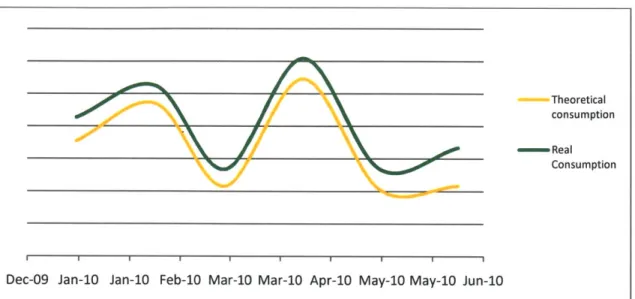
consumption with the theoretical one described by the BOMs, clear discrepancies where seen.
Theoretical consumption
Real
Consumption
I I I I I I I I I I
Dec-09 Jan-10 Jan-10 Feb-10 Mar-10 Mar-10 Apr-10 May-10 May-10 Jun-10
Figure 5. Differences between Actual Consumption and Documented Consumption for Material X
3. Finished goods forecast was not reviewed by marketing and planning team in all countries
Incentives Issues
1. Finished goods forecast KPIs only measured forecast accuracy for a one or two-month
horizon
2. Material plan was not stored and compared across time for accuracy, no KPIs or relevant incentives existed
3. Material planners had the incentive to inflate material plan in order to guarantee material
availability; they were not held accountable for overage
4. Marketing and sales people were measured mainly on sales, not profits, and therefore had a clear incentive to underestimate the forecast to make sure they reach their sales targets easily
3.4 Constraints and Considerations
When designing the new process, several external considerations had to be taken into account. The goal of the project was to design a process that would improve the resulting forecast, but would also be easy to implement and well-received by the local stakeholders. The main considerations that were taken into account were:
1. Simplicity - preferring simple processes over complicated ones increased local support for
the project, decreased the learning curve and allowed our team to support the process implementation with limited resources
2. Benchmarking - a preference for using sub-processes that were already practiced
successfully somewhere else in the region was beneficial for several reasons:
a. Existing knowledge sharing and training resources - the region practicing the
sub-process could train and support the other regions with implementation
b. Guaranteed implementability - processes that are already practiced in other regions
are less likely to run into unforeseen implementation problems
c. Easier buy-in - managers were more inclined to support the processes that were
benchmarked
3. Using local management input - all new process elements needed to be approved by the
local supply chain managers. For that, their input was taken during the design of the
process, and was used as much as possible.
4. Using procurement team input - each revision of the process was reviewed by the regional
purchasing team. Both the final output and the process leading to it had to be approved.
5. Minimal disruption - our team preferred processes that were as similar as possible to the
old process, or that were easy to transition to. This allowed minimal disruption to the
6. IT systems - the process had to use IT systems that were either already in place or could be implemented easily with limited time and resources
7. Sustainability - the new process must be easy to sustain and require minimal ongoing support after initial implementation.
4 The New Process
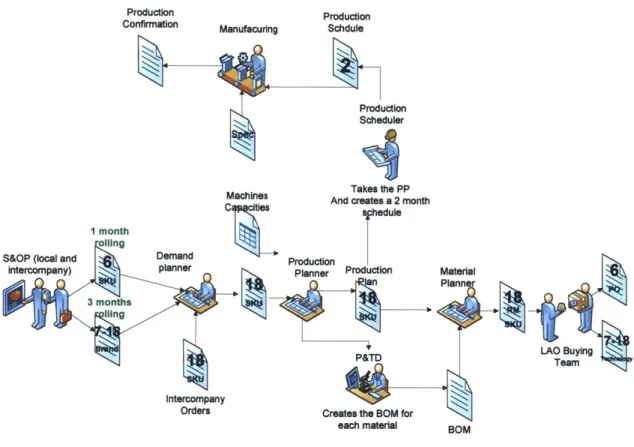
Considering the issues discussed in Chapter 3, our team designed the following process:
Production Schdule Production Scheduler
4
Takes the PP And creates a 2 monthI month
Material
Intercompany
Orders Creates the BOM for
each material BOM
Figure 6. The Proposed Planning Process
The new process will have the following stages:
1. S&OP: The S&OP process will generate the following input for the demand planner
e Planning forecast: 6 months horizon, SKU level, updated monthly
" Financial forecast: additional 12 months, sub-brand level, updated quarterly
Monhs1A
Figure 7. Desired Output from S&OP
Months 1-6 will be created according to the short term S&OP process. Production
Confirmation Manufacuring
Machines CPitle
The baseline for months 7-18 will be created by the demand planner. This baseline will be
reviewed quarterly by the marketing, finance, and planning teams of each country to assure
consistency with mill capacity, market trends and product pipeline.
2. Demand Planning: The demand planner will take the brand level forecast for months 7-18 and
disaggregate it based on SKU averages from months 1-6. He will then upload all 18 months of
SKU level forecast into the system.
3. Intercompany Orders: orders from all other regions will have the same 18 month horizon and SKU granularity and will be delivered to the demand planner
4. Production Planning: The production planner will create production orders for the next 18
months using the finished goods forecast. Only the first six months will be measured for
variability.
5. Production Scheduling: The production scheduler will schedule 2 months of production
planning and confirm raw material availability using the company's automated system.
6. Manufacturing: Product specs, production versions and production rates will be reviewed
periodically for consistency with the information on the company's database.
7. Material Planning: Material planner will run MRP for all 18-month horizons using the
company's automated system; he will only place orders as necessary, based on the lead time
8. Procurement: Regional buyers will use the short-term information to place orders and the
long-term information to negotiate agreements and develop new suppliers. They will update the system
with shipping information and whenever the arrival date for a shipment changes, they will update
5 Gap Analysis and Barriers for New Process Implementation
5.1 Implementation Barriers
The newly designed process differs from the old process in several key aspects and will require the company to complete several prerequisites before moving to the new process. With the old process, most of the planning was done in separate spreadsheets, which were created by the planners and did not connect to the company's information system. The move toward planning with the company's information system will require the following:
Data Cleansing: All BOMs, production rates and production versions saved in the company's master
data need to be reviewed and checked for consistency with the specs used for manufacturing. It is also necessary to make sure every product manufactured has a BOM stored in the master database and every machine has its production rates and capacities uploaded. Old BOMs of obsolete materials must be erased and old raw materials which are no longer in use must be removed from the system. Duplicate production versions need to be consolidated. The data stored in the master database must be reviewed periodically and checked for relevance and accuracy.
Cost Analysis: At Company X, cost information is calculated using the BOM and production rates values
that are stored in the company's master database. Changing the BOM and production rates values to match the specs used for production will change the calculated costs of the products. The cost analysis department must review these changes and agree to them. This change is especially challenging since the cost analysis department is not a part of the supply chain business unit.
New Product Development: Whenever new products are developed and orders for these products are
made, an internal system code needs to be issued to each new product. Current processes only allow
issuing a code for products for which the BOM is finalized, but new product development process only
finalizes the BOM four months before the product's launch date. In order for new products to be planned
for using the new process, a tentative BOM must be defined as soon as the product is planned for. Any
new product will be created with a tentative BOM, which will be finalized at least four months before the product's launch. Changes to the tentative BOM will cause changes in the material plan, but these changes are likely to be minor and within the allowed variability. In most cases, the tentative BOMs are the same as the finalized ones for the critical long lead time raw materials which are the main concern of this project.
IT Systems: The company's information system needs to be readjusted to support the new process. New
modules must be created, and new tools must be implemented.
5.2 Gap Analysis by Region
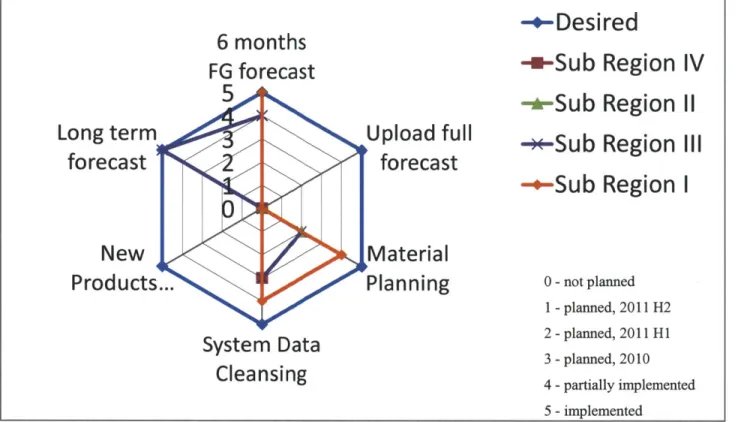
The major changes required for the new process implementation in each country were divided into six categories, and the progress of each country was evaluated across all categories:
Short-term Finished Goods Forecast: Establish six-month SKU-level forecast based on the S&OP
process
Long-term Forecast: Establish months 7-18 of the forecast in the brand--subbrand level
Upload Full Forecast: Disaggregate months 7-18 to SKU level based on the averages from months 1-6
and upload the full SKU level forecast of months 1-18 to the system
New Products Policy: Establish a new product development policy that will enable planning for new product using the new process
System Data Cleansing: Update and review all BOM, production rates and production versions in the
master data
6 months
FG forecast
5
A.
Long term
forecast
New
Products...
Upload full
forecast
Material
Planning
System Data
Cleansing
-- Desired
-a-Sub Region IV
-+-Sub Region II
-*-Sub Region III
-+-Sub
Region I
0
- not planned 1 -planned, 2011 H2 2 - planned, 2011 HI 3 - planned, 2010 4- partially implemented 5 -implementedFigure 8. Process Implementation Progress by Region, June 2010
As seen in the chart, limited process implementation started in CA&C and the Austral region, but most
6 New Process Evaluation
In this chapter, we will review and assess the new process using both engineering and management tools.
6.1 Accuracy
6.1.1
First Six Months
Define:
F, ... FN The production plan, based on the forecast, for finished goods 1 through N in month k
Bnrm, ..., Bnm The effective BOMs (considering production error) of material m for finished
goods 1 through N in month k
Mjk, ... Mj4 The forecast for raw material 1 through M mn--for month 4--k
For every material m and month k it holds that:
[1] Mm =
E_
Fk * B mIn first approximation, the error (estimated by the standard deviation) in the material forecast can be defined as:
[2] AMk = EN JAF * E[Bnkm] + E[Fnk] * ABnkm)
For the purposes of the accuracy evaluation, we will assume that the BOM inaccuracy ABnm is a random percentage of E [Bnkm], and is not correlated to the E[Fk]. Therefore, we will substitute ABkm with
V * Y, * E[Bnm] when Yn is a random variable with mean 0 and STD 1 and v is the effective BOM's
For the finished goods forecast, we will assume a constant variance u2 for each unit of finished goods
forecast (the units are defined arbitrarily, and the coefficient d2 which we will introduce later will
calibrate for the unit choice). Under that assumption, I will first show that AFk linearly depends on
E[ Fnk].
The total variance V[Fn] can be defined as:
Fn
V
[F]=
u
=
Fk *u
2n=1
And so, the total STD of demand will be JE[Fl] * u. This result also lies in some agreement with
observations from the mills, existing KPIs and interviews conducted with the planners and demand analysts. Figure 10 shows the ratio between the total demand and the demand variability for a typical product. I-0 In (U Foeatdqatt Fir -haboueerraafucinofoeatdqattfocetifiihdgo
We will substitute u2 with d2 * a2 where d2
is a coefficient that calibrates the units for VE[Fk], and ak is the monthly variability coefficient. Based on past observation and an estimate of the range of the forecast variability, d should be defined in the following way:
Vn such that E [Fnk] is at 10th percentile of the E[F k] distribution,
E[Fn] * d = E[Fk] - d E[Fn]
We have defined d in such a way that for every product that has a mean demand quantity that is at the
bottom 10 th percentile of the products' demand distribution, the MAPE of the demand for that product
will equal to exactly ak
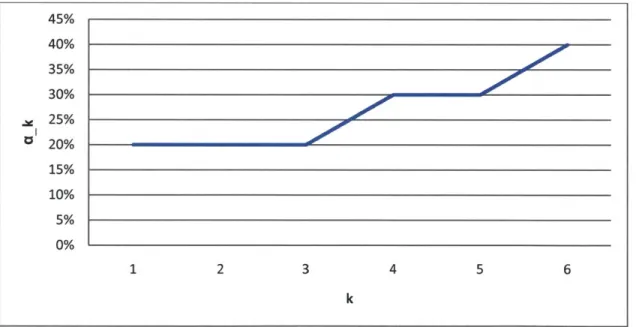
As for ak, in order to fit observed forecast values, we will define ak for every month k as following:
45% 40% 35% 30% 25% 20% 15% 10% 5% 0% 1 2 3 4 5 6 k
Figure 10. ak values for each different k
After six months, for k ;6, ak will remain constant at 50%.
[3] AM& =
Xi=
1 (adXnLE[F]E[Bnm] + vYnE [Bkm]E[Fk])
=ENd 1~
(xn_
,E[Fk]E[B'km]) + V :akd n1=1X E (Fk]E[k] vl=(YnE [Bnm] E[Fnk]
When X, and Yn are random variables with mean 0 and variance of 1. We will further assume that all
E[Fnk]and E[Bn'm] are independent for every k, m, n and so Xn and Yn will also be independent. This
assumption does not hold on reality, as the forecasts for the different months, the BOM errors, and the different products do depend on one another. However, past observations in the company suggest that the inherent random forecast and BOM error is significantly larger than the cross-months and cross-products correlations Therefore we can reasonably assume a lack of correlation without affecting the validity of our model.
Under these conditions, we look at equation [3] as two sums of many independent random variables with different variances. Applying random variables' algebra [3] we receive:
[4] E [AMm] = msak n1 E[Fn]E[Bnkm]) +myd i=(E[Fn]E[Bkm]) =0
And:
[5] V[IAMk] = 2 ((da kJ[Fnk]E[Bnkm]) + (vE[Fkl]E[Bfm])
According to the Central Limit Theorem and the Law of Large numbers [1][2] we know will behave
n
approximately like a normal distribution. Since n is finite, we can also assume that AMk behaves approximately like a normal distribution.
The new process aims to minimize the variance V[AMm] of the normal distribution AMk. Looking at equation [5] and assuming a constant total demand for finished goods, we identify three factors that affect the variability of the material plan:
1. The SKU's number - the fewer SKU's there are the smaller N is and the larger each E[Fk] becomes.
2. The BOM variability v.
3. The monthly forecast variability coefficient xk
6.1.1.1 Sensitivity analysis
We will now try to evaluate the material plan error's sensitivity to each of these factors:
SKU's number:
Given a constant total demand, we will look at the effect of x reduction in the number of SKU's. The
1
average forecast quantity per SKU will increase by -(1-X).For estimation purposes and ease of calculation, we will assume the SKU reduction was done by eliminating a portion x of the SKU's which has a
combined forecast quantity that equals to x of the total forecast. To maintain a constant total forecast quantity, each of the remaining SKU's will be increased by the same factor - . Under these assumptions, the new material forecast error will be modeled as:
N(1-x) 2
V[AMm'] = (1 EFl]E[Bnm] +
vE[F]E(Bm]
n=1
The effect of this decrease in SKU's number will change significantly depending on the individual sizes
of the Fn and Bnm. However, for estimation purposes, we will look at the case were all Fn and Bkfmare in
2
[6]
[Mk']= i(jdak (7-)E[F]E[Bn~] +((7-)
1E][k] N(1-x) (da ( E(]E[Bm])2 + VE[Fnk]E[Bkm]) = E[Fk]E[Bnkm]2N ((dack)2 +
vE[Fk])2
Whereas under the same assumptions, the variability for the material plan prior to the decrease in SKU's
will be
[7] V[AMm] = E[Fn]E[Bnm]2
N ((dak)2 + En[FThv
Looking at the two elements of equation [6] the first element depends on d and ak and the second
element depends on E[Fk] and v .If the monthly variability is more significant than the BOM error, the
different Fn are very small, then (dak)2
>>
E[F]v andV[AMmk']
=
E[Fk]E[B
m]2N ((dak)2
+
(
E[F]
~ E[Fn]E[Bm]
2N ((dak)2 + V E[Fk]))
=
V[AM ]
And the effect of reducing the SKU number on the material plan is negligible.
However, if the BOM error is larger than the monthly variability, E [F ] is significantly large, or (1 -x) is
small, then:
[8] V[AMmk'] = E[Fn]E[Bnkm]2N ((dak)2
+(U)
(VEFk])
(
)
E[Fn]E[Bm]2N
((dak)2+(vJE(F]=
)V[AM]
If either element of the equation is not negligible relative to the other, the material plan variability will
increase by some w such that 1 < o < .
This analysis was done using the assumption that the forecast mean is distributed equally across the different SKU's and that the SKU reduction will be done evenly across all SKU's. In reality a lower variance increase would be obtained by aggregating only SKU's with lower-than-average forecast
(E[F]) and lower-than-average material use (E[Bkm]). A higher increase in variability would be
obtained by aggregating SKU's with higher-than-average forecast and higher-than-average material use. This is due to the fact that the squaring affect on the forecast quantities will be stronger on large forecast quantities becoming larger than it would on increasing small forecast quantities.
BOM variability
Each decrease y in the BOM variability will have the following effect on the material plan:
[9] V[AMk] = (N=( dCkE[Fk]E[B km]) 2 + (vE[Fl]E [Bkm])2)
j=1 (da f[F4]E[Bkm])2 + (1- y)2(vE[Fk]E[Bkm])2
The more significant da kE[F]E[Bnkm] is over vE[Fnk]E[Bnkm] the less significant the contribution of the BOM accuracy change will be. For very small values of v and E[Fn], this contribution could be completely negligible. As v and Fn grow larger, the improvement dak E[Fk]E[Bnkm] will become more meaningful relative to vE[Fn]E[Bnkm] and the material plan improvement generated by will approach
(1-y).
The monthly variability coefficient
ak[10] V[AMk] = ZN=l ( k E[F]E[Bnkm]) + (VE[Fn]E[Bnkm] )) _
z)2 (dakVE[F]E[B m]) + (vE[Fkl]E[Bkm] )2)
Correspondingly to the BOM accuracy analysis, this result shows that more significant v and E[Fk]'s are relative to ak, the larger the effect of the change z will be to the material plan accuracy. For very small ak
and largeE [Fnk], the change in the material plan will be negligible, and for large ak and smaller v and
E [Fnk] the material plan improvement will approach z.
6.1.2
Months six--7 to
4241
For the long term forecast, the forecast is generated in the subbrand level, and then disaggregated to SKU level. For simplicity we will assume that the aggregation and disaggregation generates a forecast error such that the value of ak is 50% per SKU for all months 7-18. Before aggregating the forecast to the raw material technology level, the accuracy of the material forecast is modeled exactly like the material plan for the first 6 months:
AMm = 0.5 X E[F]E[Bm] + ] N[Bkm])
n=1 n=1
Aggregating according to technology level, we will sum AMk for all materials that have the same technology level. Therefore, the aggregated forecast will be:
>jJAMmk mET N 2 N
(I
(0.5d
E[Fnk]E[Bnkm]) +v
(YnE[Fkl]E[Bnkm])
mET n=1 n=1 N = (0.5d E[Fnk]E[Bkm] +v(YnE[Fnk]E[Bkm]) n=1,mETWhere T is the set of all m's within a certain technology level. Using random variable algebra, we receive:
E[ AMj =mxak E[F]E[Bnm] +myd (E[Fn]E[Bnkm])=0
mET n=1,mET n=1,mCT
And:
[11] V[EmET AMl] = =1,mET ((0.5dE[Fl]E[Bm] + (vE[Fn]E[Bkm])
Assuming a similar size forecasts for all materials in a certain technology group, the effect of aggregating the material forecast by technology level could be evaluated by:
v[ZmersuMk] 0.5|T|N((dFEFkE[Bnm +(vE[F,,]E[B-,m]
[12] V[AMmk] k )2=
ITI
v[ 0.5N((d E[F]E[Bnm +(vE[Fk]E[Bnm
Meaning that the variance Of
EmeT
AMk isITI
times larger than the variance of AMmk. Therefore, theSTD for
EmET
AMm will be 1TI larger than the STD of AMm. Therefore,EmeT
AMm has an MAPE thatis/TI times smaller than that of AMk. Better error reduction will be obtained by aggregating multiple materials with small material forecasts, and lower error reductions will result from aggregating small number of materials that have a large material forecast mean.
6.1.3
Significance
The analysis done in 6.1.1 and 6.1.2 has brought to light the following conclusions:
1. Under the stated assumptions, reducing the SKU number by x will increase the material plan
2. Decreasing the BOM variability v by y will decrease material plan variance by up to y. With best
results received when dak FF/ « vF k
3. Decreasing the monthly variability coefficient ak by z will decrease material plan variance by up
to z, With best results received when dakViE[F k]
>>
vE[Fnk].4. Aggregating different materials into one material group of size
ITI
will decrease material plan percent variability by a magnitude ofITI.
With best results received whenIT
I
is large and contains many materials that have a small forecast.Here, we will discuss the significance of each conclusion, and its effect on the business.
6.1.3.1 Reducing the SKU number by x will increase the material plan variance by up to
This conclusion lies in contradiction to common believe that the decreasing the number of SKUs will increase material plan accuracy. The rationale behind it is that for the material plan, all SKU level
forecasts are aggregated either way, and therefore adding another aggregation step before it has no affect on the material forecast variability resulting from the finished goods forecast variability, and has an adverse affect on the variability resulting from the BOM error, since the latter averages out in the second
aggregation step.
Company X had conducted several attempts to decrease the finished goods SKU's number, and
observations support that decreasing SKU's number decreases the per-SKU finished goods forecast. Such
initiatives could be valuable to other aspects of operations, such as financial forecast accuracy, or finished
goods inventory. However, no data exist on the effect of that SKU aggregation on the material plan. The
analysis done in 6.1 assumes that the forecast inaccuracy will grow as a function of
/
E[Fnk] and the MAPE will decrease as a function of 4E[F k], and shows that in that case, increasing E[Fnk] through SKUreduction will have a negative effect on the material plan accuracy. Therefore, only in cases where the
a positive effect on the material plan. It is possible to find some cases in which decreasing the number of SKU's will have a positive effect on the material plan. For example, on one KC site, the number of SKU's was so large and the different SKU's had so little differentiation that the demand analysts complained they could not generate an individual forecast for each of them individually. Under these
circumstances it is reasonable to believe that the forecast error will increase slower than 0
(J
[Fn]) as
VIE[Fn] is increased through the SKU aggregations. In that case, SKU aggregation would make sense and
have a positive effect on the material plan accuracy. Either way, the analysis suggest that optimization of the finished good forecast process individually will not necessary lead to material plan optimization. Therefore, SKU reduction should be evaluated carefully considering all factors involved, and that its overall affect, not just its affect on the per-SKU finished goods forecast, should be considered. One significant application for the company is to give close considerations to the incentives it applies to its demand planners, and to the demand planning process. In order to ensure to optimization of the entire process, SKU reduction should be regulated and limited, and only be done in coordination with the material planners.
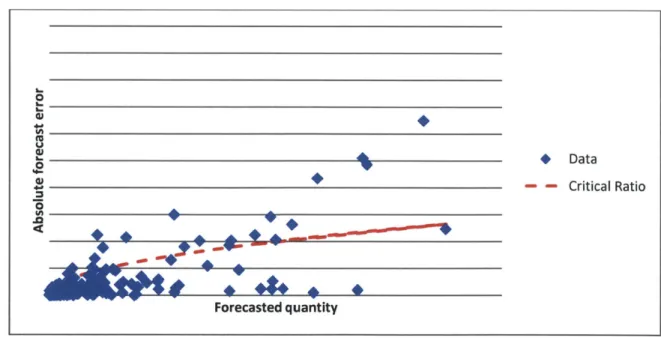
Figure 11. The absolute error as a function of forecasted quantity and the critical ratio
0
U
Data
0
6.1.3.2 Decreasing the BOM variability byy will decrease material plan variance by up toy.
The main conclusion from this part of the analysis is that best material plan improvement will result from
inspecting and improving the BOMs of the SKUs that have the largest forecast quantities, the largest
BOM errors, or both. This conclusion agrees with common sense, and basically guides the business to
deal with the low-hanging-fruit first when readjusting BOM values. At any time, the company has the
most to gain by fixing the most commonly used, or the most inaccurate BOMs.
6.1.3.3 Decreasing the monthly variability coefficient by z will decrease material plan
variance by up to z
Similarly to 6.1.3.2, this part of the analysis concludes that best material plan improvement will result from improving the monthly variability coefficients of the SKUs that have lower forecast quantities and largest monthly variability coefficient. This again, guides the business to deal with the low-hanging-fruit first, inspecting and improving the elements in the equation that causes the most uncertainty.
6.1.3.4 Aggregating different materials into one material group of size |T
I
will decrease
material plan percent variability by VJjiT.
The conclusion from this part of the analysis is that an effort should be made to create material groups
that are as large as possible, and to priorities grouping the materials that are ordered in small quantities. This conclusion is rather obvious, and lies in agreement with current efforts already done within the
company.
6.2 Implementability and Sustainability
Section 6.1 evaluated the material plan accuracy and how that accuracy will be affected by any
improvement in the parameters that the new process aims to modify. Since not enough time had passed, and the process had not yet been fully implemented it was hard to evaluate the effect the new process had on each of these variables and the final material forecast.
However, since one major objective of the internship was to create a process that will be easy to
implement and sustainable, I chose to focus on the evaluation of my process along those factors. For this analysis, I chose two tools: the Three Lens Analysis[9] and the Matrix of Change [8][7]. This evaluation
process aims to identify and evaluate the new process's strengths and weaknesses and the tradeoffs made in its design.
6.2.1 The Three Lens
6.2.1.1 Improvements Driven by the New Process:
6.2.1.1.1 Strategic DesignThe ultimate goal of the new process, as defined by this thesis, is to enable accurate purchasing of raw material, accurate supplier agreements, and guarantee long-term supply. The new process is strategically better in the following ways:
1. Alignment
Producing an end result that aligns with the strategy of the company
The first step in forming the new process was mapping the needs of the procurement team and defining its desired output. The new process is improving the alignment within the company in three ways:
a. Matching the short term material plan's horizon with short-term order schedule
b. Matching the granularity of the information with the purpose for which the information is
used
c. Matching the accuracy of the information to the accuracy needed by the procurement team.
Therefore, the new process introduced a great advance in customizing and targeting the information
generated to the needs of the people using this information.
Not all incentives within Company X stand in alignment with the needs of the procurement team. For example, the marketing team, under certain circumstances, might feel pressured to show a forecast that is as optimistic as possible, rather than as accurate as possible. The new process provides the following improvements to the alignment system:
a. Defining an accuracy objective for the material forecast
b. Tracking the accuracy of past material plans and comparing them to the new accuracy
c. Tracking the accuracy of the finished goods forecast for the entire planning horizon, rather than just 2-3 months.
Matching Resources with Tasks
The new process aims to assure that all tasks are performed by individuals who have the necessary resources to complete them. In the old process, the material planners were required to supply an 18-month raw material forecast when they only had the finished goods information for 4-6 months. They were also required to place material orders for products that are not yet in the system and had to guess which material they would require. The new process introduced the following resource-task improvements:
a. Providing the material planners 18 months of finished goods forecast and BOM information
b. Assigning tentative, un-finalized BOM to newly introduced products before planning for
them
c. Providing the demand analysts with strategic marketing information for creating the 18-month finished goods forecast
2. Linking Mechanisms
In order for the new process to work, the information needs to be readily available to all sides. One major improvement the new process introduces is the constant documentation and logging of the
forecast information in the company's system. This allows every planner and buyer to easily access not only the material plan, but all the information that was used to create it.
3. Strategic Grouping
Creating the 18-month material plan requires the involvement of material planners, production planners, demand analysts, marketers and sales people. The new process includes several small-scale
groupings to facilitate better information transfer between them:
a. The S&OP Process - This process, also discussed in a past LGO internship engages a
cross-functional team with the purpose of generating a well-balanced, reasonable and accurate finished goods 18-month forecast
b. Per-region Implementation Teams - Each country had a sub-team responsible for the implementation of the project, with a regional project manager responsible for coordinating all team members.
6.2.1.1.2 Political
A great strength of the new process is that it was done in collaboration with many major stakeholders and
much of their input has been taken into the design of the process. This not only made the process robust and well-thought-out but also increased the likelihood that the new process would achieve vast buy-in and would be easily adopted.
Moreover, most of the change initiatives were done within the planning team, which belongs to the same organization as the procurement team. This guaranteed that the interests of the teams that implement the changes would align with those that benefit from them.
The new process also minimized changes in the shift of within-region power. Even though applying a standard process might compromise the local teams' perceived autonomy within each country, almost all involved parties retained a similar level of involvement in the process. Therefore, within-region power struggles resulting from the process could be reduced to a minimum.
Being a regional division, the different partners in the project represent unique, individual cultures. While the countries do have several similarities, there are also vast differences and stereotypes that come into play when team members from different regions interact with one another. The major steps that were taken in order to facilitate a successful process, considering the cultural gap, were:
1. Flexibility in Process and in Implementation Plan - Whenever possible, our team allowed the regions to make small customizations in the process and drive the implementation on a different schedule
2. Visibility - Each company's progress was made visible to each of the other countries, encouraging competition and facilitating motivation
3. Similarity to Old Process and Small Implementation Steps - Since the company culture is focused on results, the process was broken down to small achievable steps, allowing the teams to show progress early on. Moreover, a process that is similar to the old process made the change much easier and faster.
6.2.1.2 Areas of Improvement and Tradeoffs:
6.2.1.2.1 Strategic DesignAlignment
Producing an end result that aligns with the strategy of the company
While the new process does target the needs of the buying team much better and is designed to achieve the business objective, one clear shortcoming of the process is that it does not provide the necessary horizon for well-planned supplier capacity planning. Developing a new supplier to be used
by the procurement team could take up to 2 years, and the new process only provides the procurement
team visibility to the next 18 months. The cross sourcing team also uses the long term financial forecast, that has a horizon of 18 month to five years, but this forecast in not necessarily as accurate as they need in order to plan for future suppliers' capacity. In that situation, our team chose to trade