HAL Id: halshs-01671758
https://halshs.archives-ouvertes.fr/halshs-01671758
Preprint submitted on 22 Dec 2017
HAL is a multi-disciplinary open access
archive for the deposit and dissemination of sci-entific research documents, whether they are pub-lished or not. The documents may come from teaching and research institutions in France or abroad, or from public or private research centers.
L’archive ouverte pluridisciplinaire HAL, est destinée au dépôt et à la diffusion de documents scientifiques de niveau recherche, publiés ou non, émanant des établissements d’enseignement et de recherche français ou étrangers, des laboratoires publics ou privés.
Notes on Sigwatch’s NGO campaign database
Pamina Koenig
To cite this version:
WORKING PAPER N° 2017 – 62
Notes on Sigwatch's NGO campaign database
Pamina Koenig
JEL Codes: F23, F61, L31
Keywords: NGOs campaigns, multinational firms, dataset, global value chains.
P
ARIS-
JOURDANS
CIENCESE
CONOMIQUES48, BD JOURDAN – E.N.S. – 75014 PARIS
TÉL. : 33(0) 1 80 52 16 00=
www.pse.ens.fr
CENTRE NATIONAL DE LA RECHERCHE SCIENTIFIQUE – ECOLE DES HAUTES ETUDES EN SCIENCES SOCIALES
ÉCOLE DES PONTS PARISTECH – ECOLE NORMALE SUPÉRIEURE
Notes on Sigwatch’s NGO campaign database
∗Pamina Koenig† December 22, 2017
Abstract
Activists monitoring global value chains are closely linked to international production and sales by companies. Academic research on international trade is however scarce in empirical work analyzing the behavior of these activists. The Sigwatch campaign database is a new and rich dataset listing campaigns launched by activists against multinational corporations. I provide explanatory notes on the raw data available for academics, and background information on the replication dataset for Hatte and Koenig (2017). Short descriptive statistics on campaigns are also presented.
JEL Codes: F23, F61, L31
Keywords: NGOs campaigns, multinational firms, dataset, global value chains.
1
Introduction
Sigwatch is a European consultancy tracking and analyzing activist campaigns. Their data is processed and distributed to businesses trying to anticipate the risk of being targeted. Indicators also provide information on the global trends in activism affecting each sector. Paris School of
Economics (PSE) manages Sigwatch’s data for academics1. We share two different versions of
the SIGWATCH campaign database used in the following paper: Hatte S. and P. Koenig, ”The Geography of NGO Activism against Multinational Corporations”, PSE Working Paper number 2017-17:
1. raw SIGWATCH yearly data files. 2. Replication data for the paper.
∗
Robert Blood and Sigwatch are greatly thanked for making the campaign data available to academics.
†
University of Rouen & Paris School of Economics, 48 boulevard Jourdan 75014 Paris. [email protected]
1
Access for academic purposes is granted subject to approval by Sigwatch. See https://www. parisschoolofeconomics.eu/en/research/data-production-and-diffusion/ngo-campaign-data/
2
Background information
Before detailing the variables in each dataset, let me briefly explain their common attributes: what is in the data and how was it collected.
2.1 Object
Sigwatch provides information about campaigns events. A campaign is defined by Sigwatch as a series of events over time, usually designed to achieve a specific objective of the NGO or coalition of NGOs. Campaigns can last weeks, months or even years. A campaign event is an action by the NGO which contains either a new target for pressure, or a new criticism or allegation, a report or significant public protest, or a new country. Campaign events are the campaign’s most significant moments, those that are likely to get media or political attention.
Examples of campaign events are shown online (http://www.sigwatch.com/). It happens often that NGOs jointly participate in campaigning actions against one or many multinational corporations. In this case, the recorded event may contain a combination of several firms, NGOs, or countries. Several firms may for example be criticized, as in large campaigns on labor
conditions and product content2. In the case NGOs formed a coalition on a given topic, the
event mentions all of them: in 2013 the UK NGOs “People and Planet”, “War on Want” and “Labour behind the Label” mobilized supporters to demand Footlocker stores to stop selling Adidas shoes, manufactured by the Indonesian PT Kizone. If the criticized action took place in several locations, the event refers to up to five countries.
The timeframe of a campaign, designed to challenge a company on a given topic, is hardly identifiable in the database. There is no variable indicating the beginning and the end of a confrontation on a specific topic. The data however provides the day on which the event was made public on the NGO’s website.
2.2 Data collection
For each country covered by the database, the pool of observations is built by identifying the country’s NGOs, and then collecting online data from activists’ websites regarding their campaigning activity. The data does not include repetition of known messages and arguments, and it does not originate in social media, blogs and tweets. New NGOs are added when they are discovered to be active. Researchers check and validate the online search in 18 different languages3.
2
An example of criticism towards several firms in a bundle: Henkel (Germany), Neste Oil (Finish producer of biodiesel), Nestle (Switzerland) and Unilever (UK), are denounced in September 2015 by Rainforest Rescue (a german NGO) to produce unhealthy levels of particules by burning rainforests.
3
English, Spanish, Dutch, Portuguese, French, German, Italian, Polish, Russian, Romanian, Serbian, Albanian, Swedish, Norwegian, Danish, Bulgarian, Chinese, and Japanese.
3
The year-specific files: YEAR data sigwatch.csv
When defining the variables for the academic dataset, we asked Sigwatch to slice each campaign event into as many observations as they are companies targeted in this specific event. In the raw data, one observation corresponds to a firm being targeted at a given date, by one or many NGOs, for harm done in one or many countries. For instance, when in 2015 the German Metro Group, the Swiss Migros, and the Austrian Interspar are being asked by Greenpeace Germany to switch to cleaner textile production, these are three lines of observations in our files. What is not reshaped in the yearly files are the NGOs and the countries in which the damageable action has taken place. This is why one observation may contain up to five NGOs and up to five locations for the damage. We now give further information on the variables contained in the yearly files.
3.1 Variables
All variables are raw and created by Sigwatch. None has been added. Definitions are by default from Sigwatch, unless information for academic use can be valuable (added by us in this case). • uid archive: code that identifies a campaign event, in which one or many firms have
been targeted.
• date: date that action was inputted into Sigwatch database. Year-month-day format. • company: name of targeted company. The target may be a parent, a subsidiary or a brand,
as coded in the next variable.
• company type: parent/subsidiary/brand.
• company parent: name of parent if company is a brand or a subsidiary.
• company parent country: country where parent firm is legally headquartered/listed. • sentiment: ‘tone’ of mention of corporate in activist communication, coded by Sigwatch
into one of the following: -2 (very negative), -1 (negative), 0 (neutral), +1 (positive), +2 (very positive). Positive numbers indicate that NGOs praised the firm, and negative numbers designate criticism towards the firm’s action.
• prominence: prominence of mention of corporate in the activist communication, coded by Sigwatch into one of the following : +4 (mentioned in headline), +3 (mentioned in first paragraph or opening text), +2 (mentioned elsewhere in communication, +1 (mentioned only in accompanying report or document, if there is one).
• issue code and issue name (1 to 3): three issue variables coded by Sigwatch from a selection of over 900, containing approximately 500 entries (issue1), 600 entries (issue2) and 200 entries (issue3). Entries are not hierarchical and some of them can be found in the three variables. They provide information on the cause of the campaign, but they do not identify if the action relates to the sales or to the manufacturing of a product: they are intended to classify the problem raised by the campaigners (Examples of keywords are: “GMOs in food”, “Coal, oil & gas and climate change”, “Herbicide environmental impact”).
• active country (1 to 6): name of country where NGO action is taking place (coded by Sigwatch). May be more than one.
• target country (1 to 6): country which the NGO is targeting. Can be the same as the active country. May be more than one.
• ngo code, ngo name (1 to 5): name of activist and code provided by Sigwatch.
• ngo power: Value reflecting geographical reach of activist group, on a scale running from local (lowest value) to global (highest value).
• ngo country code, ngo country: HQ country of activist group/branch.
• country corp, country corp code: country HQ of the targeted company and associated country code.
• corp industry sector code (1 to 3): identification for the activities described below, coded by Sigwatch. Does not correspond with existing industrial or goods classification. • corp industry sector (1 to 3): three sector variables of the company, coded by Sigwatch.
Variable 1 is disaggregated into 61 activities and filled in for all firms, variable 2 contains 62 activities and is missing for some firms, as for variable 3 (57 activities).
• isin corporate name official: official (listed) name for firm.
• isin corporate name cleaned: official (listed) name for firm with extraneous informa-tion, eg. Ltd, Inc, Plc removed.
• bloomberg ticker: Blomberg ticker identification for parent company if listed. • isin (1 to 3): ISIN for company or its parent if known.
• industry sector code (1 to 4): identification for the sector described below.
• industry sector (1 to 4): sector(s) variable specific to the campaign (Sigwatch coded). • report: news archive report (text, summary of campaign action, written by Sigwatch).
• link (1 to 5): link(s) to NGO source text.
4
Replication dataset
The paper by S. Hatte and P. Koenig uses the yearly files described above, merged with ad-ditional information regarding countries of NGOs, firms and damages, and estimates a triadic gravity equation on country-level campaigns.
Several clarifications are called for. With respect to the raw data contained in the yearly files, we reshape the data twice, along NGOs and along action countries. At the end of this process, an observation corresponds to a given firm that is the object of criticism on a given day by one NGO for damage done in one country. Note that in the paper, the word ‘campaign’ is used to address this quatuor NGO-firm-action-date. We then collapse these firm-level observations at the country-year level to obtain a triadic variable: the number of campaigns originating from each NGO country i, with destination countries j (country of firms) and k (countries where the damages have taken place, which we name the action country).
For further description of the variables in the replication dataset, please refer to the paper.
5
A short description of the data
5.1 Where do NGOs appear ?
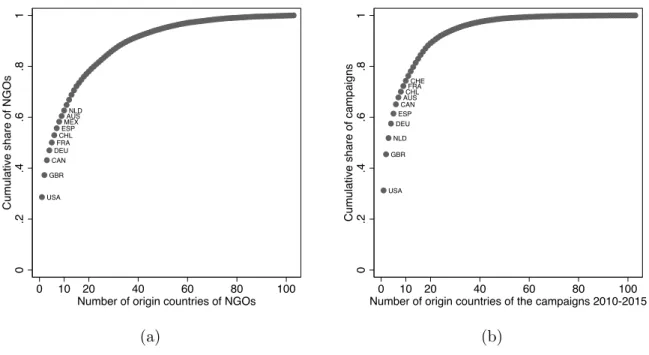
Activist campaigns originate from 103 different countries, whose share in world campaigns is displayed in Figure 1. A glance at the shape of both curves suggests a skewed distribution of campaigns. In panel (a), 4 countries account for 60% of observations. The USA and the United-Kingdom represent respectively 30.6% and 14% of the total number of communications. The Netherlands follows with 6%, and Germany with 5%. Note that some NGOs have an international architecture with branches in different countries. Although the campaign data differentiates reports according to the country of the NGO even for international NGOs (i.e. reports by Greenpeace originate from 46 different countries), the headquarter of the group may issue a large number of reports and thus attribute proportionately more campaigns to home countries of international NGOs. Countries whose count might be affected are Netherlands (Greenpeace International and Friends of the Earth International), Great-Britain (Amnesty International and Oxfam International), Germany (Transparency International) and Switzerland (WWF International). The NGOs that represent the largest share of their ‘home’ country’s reports are Greenpeace International, which accounts for 10.5% of Netherlands campaigns for
2010-2015, and WWF International, which represents 14.1% of Switzerland’s reports. The
other ones account for a smaller share of their home country’s number of campaigns (Amnesty International 2% o UK’s reports, Oxfam International 1.9%, Transparency International 1.2% and Friends of the Earth International 6%.). Together they account for 1.56% of all campaigns
in the database. The cumulative share of world campaigns is not affected by dropping the six international NGOs.
Table 1: Number of NGOs per country
Country NGOs Country NGOs Country NGOs Country NGOs
USA 962 JPN 28 MMR 8 MAR 2
GBR 291 PHL 27 NIC 8 VNM 2
CAN 196 IDN 27 DOM 7 LKA 2
DEU 130 ZAF 25 IRL 7 LBR 2
FRA 103 ECU 23 KHM 7 CMR 2
CHL 97 COL 23 HRV 6 DZA 2
ESP 92 CHN 20 KEN 6 EGY 2
MEX 86 GTM 19 MOZ 6 FJI 2
AUS 75 PRY 18 SVN 5 NPL 2
PER 73 NZL 17 SLE 4 GEO 1
NLD 73 BGR 15 MNG 4 NER 1
BRA 68 AUT 15 HUN 4 ZWE 1
ARG 66 MYS 13 MLT 4 UZB 1
ITA 59 HKG 13 GRL 4 VEN 1
CHE 54 TWN 12 UGA 4 TGO 1
SWE 43 PRT 12 PAL 4 ESH 1
RUS 42 GRC 12 ZAR 4 ISL 1
BEL 41 HND 11 LUX 4 ZMB 1
ROM 35 CRI 11 PNG 4 YUG 1
NOR 34 BOL 11 SGP 3 SEN 1
IND 34 URY 10 ISR 3 HTI 1
FIN 30 THA 10 PAK 3 SLB 1
UKR 29 SLV 9 BLR 3 NCL 1
DNK 29 KOR 9 BGD 3 ETH 1
NGA 29 PAN 9 LTU 2 CZE 1
POL 28 TUR 8 GHA 2
While the literature widely analyses the interaction of NGOs with firms taking as given the number of activists per country (Aldashev et al. (2015), Baron (2001), Baron and Diermeier (2007)), the stylized facts on the number of NGOs per country in the campaign data (Figure 1) evidently question the determinants of NGO emergence. Demand for campaigns certainly originates from preferences for ethical consumption. The relation between such preferences and income has been suggested in the NGO literature: Loureiro and Lotade (2005) emphasize that concerns for more information on goods’ production process and on their overall impact on the environment, are found in developing countries and are associated with a higher willingness to pay for such products. Krautheim and Verdier (2016) explicitely use ethic and environment-caring consumers in their model, where NGOs emerge in a Home country whose regulations are applicable and enforced, contrary to the Foreign country. These elements suggest that support for advocacy campaigns might be a luxury good, whose consumption increases more than proportionately with individuals’ income: Basu and Van (1998) model such a mechanism in the case of child labor and show that non-work is a luxury good in the household’s consumption. A simple and naive illustration of cross-country variation in demand for activism is given in Figure 2, which plots countries’ income per capita together with the intensity of advocacy campaigning in each country. The demand for activism is proxied respectively by each of the two
Figure 1: Cumulative share of world campaigns and world NGOs USA GBR CAN DEU FRACHL ESPMEX AUSNLD 0 .2 .4 .6 .8 1 C u mu la ti ve sh a re o f N G O s 0 10 20 40 60 80 100
Number of origin countries of NGOs
USA GBR NLD DEU ESP CANAUS CHLFRA CHE 0 .2 .4 .6 .8 1 C u mu la ti ve sh a re o f ca mp a ig n s 0 10 20 40 60 80 100
Number of origin countries of the campaigns 2010-2015
(a) (b)
elements brought forth in the above paragraph: income per capita (column a) and population (column b). The supply of activism is measured either by the number of non-profits campaigning between 2010 and 2015 (upper line), or by the number of campaigns from each source country (bottom line). The figure shows that the emergence of NGOs and their production of campaigns seem to be correlated to individual income more than to the number of individuals in a country. It appears that origin countries of campaigns are mainly rich countries, but not necessarily populated countries. These facts could corroborate a scenario in which NGOs need a certain level of income per capita in order to matter in the “consumption basket” of individuals. Below a given threshold, a larger population does not represent a large market for advocacy campaigns. A traditional way to tackle the relation between supply and local demand in the trade literature, is to estimate the so-called home-market effect (Krugman (1980)). An interesting parallel can be developed regarding the supply of activism. Whether the supply of a good reacts at all to the size of demand is a central and old question in the trade literature. Krugman (1980) has shown that a large domestic market for a good generates a more than proportional reaction of supply, leading the country to become an exporter of the good. The explanation rests on increasing-returns-to-scale in the industry of the good, which require producers to concentrate production in one location. Given the presence of trade frictions between countries, agglomeration occurs near the largest local demand, giving rise to the home-market effect. Head and Mayer (2004) review the empirical literature, and Costinot et al. (2016) provide recent evidence of a home-market effect in the pharmaceutical industry. An important challenge of estimating home-market effects relates to the measure of demand. In the case of activism, our
Figure 2: Is demand for campaigns increasing with income ? (a) (b) ALB ARG AUS AUT BEL BGD BGR BLR BOL BRA CAN CHE CHL CHN CMR COL CRI CZE DEU DNK DOM DZA ECU EGY ESP ETH FIN FJI FRA GBR GEO GHA GNB GRC GTM HKG HND HRV HTI HUN IDN IND IRL ISL ISR ITA JPN KEN KHM KOR LBR LKA LTU LUX MAR MEX MLT MNG MOZ MYS NER NGA NIC NLD NOR NPL NZL PAK PAN PER PHL PNG POL PRT PRY ROMRUS SEN SGP SLB SLE SLV SVN SWE TGO THA TUR TWN TZA UGA UKR URY USA UZB VEN VNM YEM ZAF ZAR ZMB ZWE coeff: .59 fit: .34 0 1 5 10 50 100 500 1000 N u mb e r o f a ct ive N G O s 500 5000 50000
Average GDP per capita 2010-2015
ALB ARG AUS AUT BEL BGD BGR BLR BOL BRA CAN CHE CHL CHN CMR COL CRI CZE DEU DNK DOM DZA ECU EGY ESP ETH FIN FJI FRA GBR GEO GHA GNB GRC GRL GTM HKG HND HRV HTI HUN IDN IND IRL ISL ISR ITA JPN KEN KHM KOR LBR LKA LTU LUX MAR MEX MLT MMR MNG MOZ MYS NCL NER NGA NIC NLD NOR NPL NZL PAK PAN PER PHL PNG POL PRT PRY ROM RUS SEN SGP SLB SLE SLV SVN SWE TGO THA TUR TWN TZA UGA UKR URY USA UZB VEN VNM YEM ZAF ZAR ZMB ZWE coeff: .378 fit: .162 0 1 5 10 50 100 500 1000 N u mb e r o f a ct ive N G O s 1 10 50 1000
Average population 2010-2015 [mio inhabitants]
ARG AUS AUT BEL BGD BGR BLR BOL BRA CAN CHE CHL CHN CMR COL CRI CZE DEU DNK DOM DZA ECU EGY ESP ETH FIN FJI FRA GBR GEO GHA GRC GTM HKG HND HRV HTI HUN IDN IND IRL ISL ISR ITA JPN KEN KHM KOR LBR LKA LTU LUX MAR MEX MLT MNG MOZ MYS NER NGA NIC NLD NOR NPL NZL PAK PAN PER PHL PNG POL PRT PRY ROM RUS SEN SGP SLB SLE SLV SVN SWE TGO THA TUR TWN UGA UKR URY USA UZB VEN VNM ZAF ZAR ZMB ZWE coeff: .923 fit: .387 0 1 5 10 50 100 500 2000 N u mb e r o f ca mp a ig n s fro m e a ch co u n try 500 5000 50000
Average GDP per capita 2010-2015
ARG AUS AUT BEL BGD BGR BLR BOL BRA CAN CHE CHL CHN CMR COL CRI CZE DEU DNK DOM DZA ECU EGY ESP ETH FIN FJI FRA GBR GEO GHA GRC GRL GTM HKG HND HRV HTI HUN IDN IND IRL ISL ISR ITA JPN KEN KHM KOR LBR LKA LTU LUX MAR MEX MLT MMR MNG MOZ MYS NCL NER NGA NIC NLD NOR NPL NZL PAK PAN PER PHL PNG POL PRT PRY ROM RUS SEN SGP SLB SLE SLV SVN SWE TGO THA TUR TWN UGA UKR URY USA UZB VEN VNM ZAF ZAR ZMB ZWE coeff: .512 fit: .141 0 1 5 10 50 100 500 2000 N u mb e r o f ca mp a ig n s o ri g in a ti n g i n . .. 1 10 50 1000
previous discussion has shown that demand probably contains two separate elements: the income level of the audience, and the number of potential donators. The fact that both have a different impact on the supply of activism certainly suggests that this is a case of a non-homothetic
demand4.
5.2 The concentration of campaigns
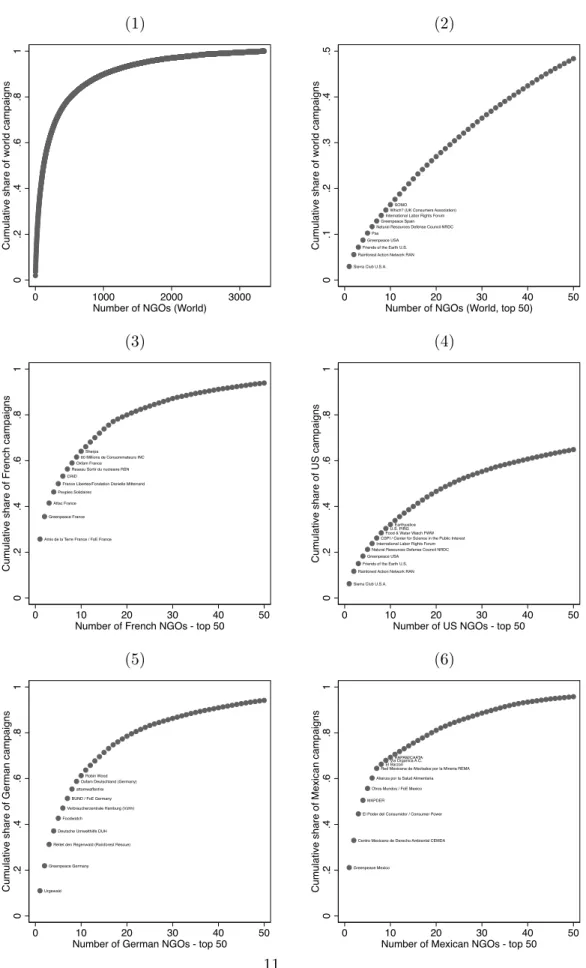
The bias of activists’ output is investigated in Figure 4 for the same four countries and for the world as a whole (two upper panels). The dotted curves plot the actual distribution of campaigns in each location, starting with the largest producer of campaigns. NGOs are ranked from left to right from the biggest to the smallest in terms of campaigns, on the horizontal axis. The vertical axis measures the cumulative contribution to the total number of campaigns. Among all world activists, we can compare the share of the first reporting NGO (1.9%) to its counterfactual share in the scenario where all the 3359 activists that appear at least once in 2010-2015 would report equally, hence 1/3359. The actual share of the first reporter is 65 times higher than the one of a uniform distribution. In a less extreme comparison, we compute a counterfactual in which the first NGO would publish a share of aggregate campaigns equal to 1/362 (the number of NGOs that remain during 5 or 6 years), hence 0.27%, whereas it actually publishes 2.9% of the campaigns, hence 7 times more.
The comparison with firm-level facts is interesting. A large literature has analyzed the shape of the distribution of firms’ output, employment or exports. Part of the litterature concludes at a log-normal distribution (Head et al. (2014)), others emphasize the Pareto characteristics of output distribution (Di Giovanni et al. (2011)). All agree on the existence of a skewed shape of the main performance variables. Mayer and Ottaviano (2008) show that the cumulative distribution of exports exhibits higher concentration than the one for employment. Freund and Pierola (2015) find for example that the average percentage of exports attributed to the first exporter across 32 countries accounts on average, across all countries, for 14% of aggregate international sales. Last, another strand of the literature investigates the granular characteristic of aggregate production, i.e. how large firms contribute to an important share of total output, and of its fluctuations (Gabaix (2011), di Giovanni et al. (2017)). The cumulative shares of total campaigns on the pooled data for 2010-2015 show that granularity is a plausible assumption regarding NGOs too.
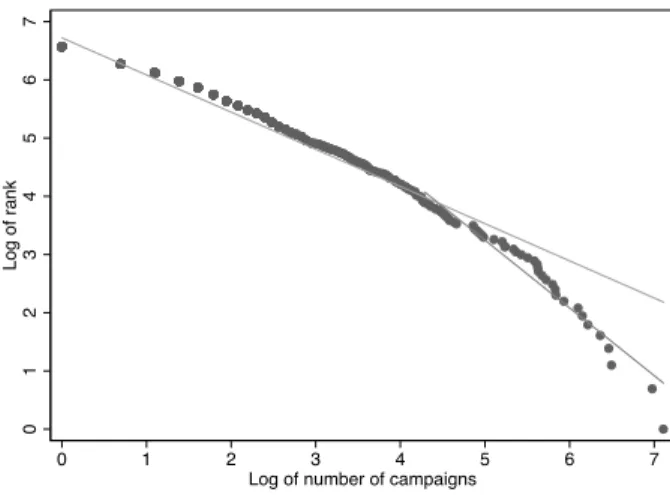
The graphical representation of distributions that has been often used to discriminate among the distributions is the log-rank-size scatter plot. Measuring firm size in the US, Axtell (2001) for example reports a linear relationship between the two variables and coefficients precisely estimated and close to 1, the former highlighting a power law distribution and the latter the specific Zipf law. We graph this relation for US NGOs’ campaigns and show the result in Figure
Figure 3: Number of outward campaigns, with home or foreign target 0 5,000 10,000 15,000 20,000 Top 15 SWE NOR MEX BEL CHE BRA FRA CHL AUS CAN ESP NLD DEU GBR USA Home Foreign 0 100 200 300 400 500 600 700 Rank 16 to 30 IDN PRT POL HKG NGA IND AUT FIN PER CHN ZAF ARG ITA RUS DNK Home Foreign 0 25 50 75 100 125 150 175 Rank 31 to 45 SLV KEN PAN URY MYS SGP CRI ECU UKR NZL PHL GTM JPN ROM COL Home Foreign
Numbers do not comprise campaigns by international NGOs
5. We keep one observation per activist, which is its total of reports published throughout the sample period. Producers of campaigns are ranked according to their number of publications, and we plot the log of their rank on the log of their output. Two regression lines are shown, one for the whole sample of US activists and one for the observations below rank 50 (on the right of the box). The steeper one corresponds to an estimated coefficient of -1.1 (0.039) and the one for the whole sample yields a coefficient equal to -0.63 (0.004) with respective R2 of 0.96 and 0.94. While characterizing the exact distribution of activists’ output would require further investigations, still the figure does not invalidate a power law as a potential distribution of campaigns, for the right tail at least.
5.3 Targeting abroad
Figure 3 displays, by country, the share of campaigns targeting home or foreign firms5. On
average, 35 % of a country’s campaigns are self-directed. Belgium reports 23% of its campaigns on domestic firms, Luxembourg 25%, Netherlands and South-Africa respectively 27% and 29%, whereas the US targets home firms in 67% of the cases, Japan 65 %, Brazil 62% and France 53%.
5
Alternatively we could compute the share of each NGO’s campaigns directed abroad: in this case NGOs targeting only abroad, even appearing a small number of times, would contribute to increase the share of foreign campaigns.
Figure 4: Cumulative share of campaigns by NGO, 2010-2015 (1) (2) 0 .2 .4 .6 .8 1 C u mu la ti ve sh a re o f w o rl d ca mp a ig n s 0 1000 2000 3000
Number of NGOs (World)
Sierra Club U.S.A. Rainforest Action Network RAN
Friends of the Earth U.S. Greenpeace USA
Pax
Natural Resources Defense Council NRDC Greenpeace Spain
International Labor Rights Forum Which? (UK Consumers Association)
SOMO 0 .1 .2 .3 .4 .5 C u mu la ti ve sh a re o f w o rl d ca mp a ig n s 0 10 20 30 40 50
Number of NGOs (World, top 50)
(3) (4)
Amis de la Terre France / FoE France Greenpeace France
Attac France Peuples Solidaires
France Libertes/Fondation Danielle Mitterrand CRID
Reseau Sortir du nucleaire RSN Oxfam France
60 Millions de Consommateurs INC Sherpa 0 .2 .4 .6 .8 1 C u mu la ti ve sh a re o f F re n ch ca mp a ig n s 0 10 20 30 40 50
Number of French NGOs - top 50
Sierra Club U.S.A. Rainforest Action Network RAN
Friends of the Earth U.S. Greenpeace USA
Natural Resources Defense Council NRDC International Labor Rights Forum
CSPI / Center for Science in the Public Interest Food & Water Watch FWWU.S. PIRG
Earthjustice 0 .2 .4 .6 .8 1 C u mu la ti ve sh a re o f U S ca mp a ig n s 0 10 20 30 40 50
Number of US NGOs - top 50
(5) (6)
Urgewald Greenpeace Germany
Rettet den Regenwald (Rainforest Rescue) Deutsche Umwelthilfe DUH
Foodwatch
Verbraucherzentrale Hamburg (Vzhh) BUND / FoE Germany
attomwaffenfrei Oxfam Deutschland (Germany)
Robin Wood 0 .2 .4 .6 .8 1 C u mu la ti ve sh a re o f G e rma n ca mp a ig n s Greenpeace Mexico
Centro Mexicano de Derecho Ambiental CEMDA El Poder del Consumidor / Consumer Power
MAPDER Otros Mundos / FoE Mexico
Alianza por la Salud Alimentaria Red Mexicana de Afectados por la Mineria REMAEl Barzon
Via Organica A.C.RAPAM/CAATA
0 .2 .4 .6 .8 1 C u mu la ti ve sh a re o f Me xi ca n ca mp a ig n s
Figure 5: Log rank and log size of US NGOs’ campaigns 0 1 2 3 4 5 6 7 L o g o f ra n k 0 1 2 3 4 5 6 7
Log of number of campaigns
References
Aldashev, G., M. Limardi, and T. Verdier (2015). Watchdogs of the invisible hand: Ngo moni-toring and industry equilibrium. Journal of Development Economics 116, 28–42.
Axtell, R. L. (2001). Zipf distribution of us firm sizes. Science 293 (5536), 1818–1820.
Baron, D. P. (2001). Private politics, corporate social responsibility, and integrated strategy. Journal of Economics & Management Strategy 10 (1), 7–45.
Baron, D. P. and D. Diermeier (2007). Strategic activism and nonmarket strategy. Journal of Economics & Management Strategy 16 (3), 599–634.
Basu, K. and P. H. Van (1998). The economics of child labor. American economic review , 412–427.
Costinot, A., D. Donaldson, M. Kyle, and H. Williams (2016). The more we die, the more we sell? a simple test of the home-market effect. Technical report, National Bureau of Economic Research.
di Giovanni, J., A. A. Levchenko, and I. Mejean (2017). Large firms and international business cycle comovement.
Di Giovanni, J., A. A. Levchenko, and R. Ranciere (2011). Power laws in firm size and openness to trade: Measurement and implications. Journal of International Economics 85 (1), 42–52. Freund, C. and M. D. Pierola (2015). Export superstars. Review of Economics and
Statis-tics 97 (5), 1023–1032.
Hatte, S. and P. Koenig (2017). The geography of ngo activism against multinational corpora-tions. PSE Working Paper .
Head, K. and T. Mayer (2004). The empirics of agglomeration and trade. Handbook of regional and urban economics 4, 2609–2669.
Head, K., T. Mayer, and M. Thoenig (2014). Welfare and trade without pareto. The American Economic Review 104 (5), 310–316.
Krautheim, S. and T. Verdier (2016). Offshoring with endogenous ngo activism. Journal of International Economics 101, 22–41.
Krugman, P. (1980). Scale economies, product differentiation, and the pattern of trade. The American Economic Review 70 (5), 950–959.
Loureiro, M. L. and J. Lotade (2005). Do fair trade and eco-labels in coffee wake up the consumer conscience? Ecological economics 53 (1), 129–138.
Matsuyama, K. (2015). The home market effect and patterns of trade between rich and poor countries. Unpublished Manuscript .
Mayer, T. and G. I. Ottaviano (2008). The happy few: the internationalisation of european firms. Intereconomics 43 (3), 135–148.