HAL Id: hal-03095965
https://hal.archives-ouvertes.fr/hal-03095965
Submitted on 4 Jan 2021
HAL is a multi-disciplinary open access
archive for the deposit and dissemination of
sci-entific research documents, whether they are
pub-lished or not. The documents may come from
teaching and research institutions in France or
abroad, or from public or private research centers.
L’archive ouverte pluridisciplinaire HAL, est
destinée au dépôt et à la diffusion de documents
scientifiques de niveau recherche, publiés ou non,
émanant des établissements d’enseignement et de
recherche français ou étrangers, des laboratoires
publics ou privés.
Gene Expression Changes and Community Turnover
Differentially Shape the Global Ocean
Metatranscriptome
Guillem Salazar, Lucas Paoli, Adriana Alberti, Jaime Huerta-Cepas,
Hans-Joachim Ruscheweyh, Miguelangel Cuenca, Christopher M. Field, Luis
P. Coelho, Corinne Cruaud, Stefan Engelen, et al.
To cite this version:
Guillem Salazar, Lucas Paoli, Adriana Alberti, Jaime Huerta-Cepas, Hans-Joachim Ruscheweyh, et al..
Gene Expression Changes and Community Turnover Differentially Shape the Global Ocean
Metatran-scriptome. Cell, Elsevier, 2019, 179 (5), pp.1068-1083.e21. �10.1016/j.cell.2019.10.014�. �hal-03095965�
Gene
expression
changes
and
community
turnover
differentially shape the global ocean metatranscriptome
Guillem Salazar1,33, Lucas Paoli1,33, Adriana Alberti2,3, Jaime Huerta-Cepas4, Hans-Joachim Ruscheweyh1, Miguelangel Cuenca1, Christopher M. Field1, Luis P. Coelho5,6, Corinne Cruaud3,7, Stefan Engelen3,7, Ann C. Gregory8, Karine Labadie3,7, Claudie Marec9,10, Eric Pelletier2,3, Marta Royo-Llonch11, Simon Roux8, Pablo Sánchez11, Hideya Uehara12,13, Ahmed A. Zayed8, Georg Zeller14, Margaux Carmichael3,15, Céline Dimier3,16,17, Joannie Ferland3,18, Stefanie Kandels14, Marc Picheral3,16, Sergey Pisarev19, Julie Poulain2,3, Tara Oceans Coordinators, Silvia G. Acinas11, Marcel Babin18, Peer Bork14,20,21, Chris Bowler3,17, Colomban de Vargas3,22, Lionel Guidi3,15,23, Pascal Hingamp3,24, Daniele Iudicone25, Lee Karp-Boss26, Eric Karsenti17,27, Hiroyuki Ogata12, Stephane Pesant28,29, Sabrina Speich30, Matthew B. Sullivan8,31,32, Patrick Wincker2,3 & Shinichi Sunagawa1,34
1Department of Biology; Institute of Microbiology and Swiss Institute of Bioinformatics, ETH Zurich; Zurich, 8093; Switzerland 2Génomique Métabolique, Genoscope, Institut de biologie François Jacob, Commissariat à l'Energie Atomique (CEA), CNRS,
Université Evry, Université Paris-Saclay, Evry, France.
3Research Federation for the study of Global Ocean Systems Ecology and Evolution, FR2022/GOSEE, 3 rue Michel-Ange,
75016 Paris, France
4Centro de Biotecnología y Genómica de Plantas; Universidad Politécnica de Madrid (UPM) and Instituto Nacional de
Investigación y Tecnología Agraria y Alimentaria (INIA); 28223 Madrid, Spain
5Institute of Science and Technology for Brain-Inspired Intelligence, Fudan University, Shanghai 200433, China
6Key Laboratory of Computational Neuroscience and Brain-Inspired Intelligence (Fudan University), Ministry of Education,
China
7Genoscope, Institut de biologie François-Jacob, Commissariat à l'Energie Atomique (CEA), Université Paris-Saclay, Evry,
France.
8Department of Microbiology, The Ohio State University; Columbus, Ohio 43210; USA 9Département de biologie; Université Laval; Québec, QC, G1V 0A6; Canada
10Laboratoire d’Oceanographie Physique et Spatiale, UMR 6523, CNRS - IFREMER - IRD -UBO, Plouzané, France 11Department of Marine Biology and Oceanography; Institut de Ciències del Mar (CSIC); Barcelona, 08003; Spain 12Institute for Chemical Research; Kyoto Univerisity; Gokasho, Uji 611-0011; Japan
13Hewlett-Packard Japan, Ltd. 2-2-1; Ojima, Koto-ku, Tokyo, 136-8711; Japan
14Structural and Computational Biology; European Molecular Biology Laboratory; Heidelberg, 69117; Germany
15Sorbonne Université & CNRS, UMR 7144 (AD2M), ECOMAP, Station Biologique de Roscoff, Place Georges Teissier, 29680
Roscoff, France
16Sorbonne Université, CNRS, Laboratoire d’Océanographie de Villefanche, LOV, F-06230 Villefranche-sur-mer, France 17Institut de Biologie de l'ENS (IBENS), Département de biologie, École normale supérieure, CNRS, INSERM, Université PSL,
75005 Paris, France
18Takuvik Joint International Laboratory, CNRS-Université Laval, Québec, QC, G1V 0A6; Canada 19Shirshov Institute of Oceanology, Russian Academy of Sciences; Moscow, 117997; Russia 20Max Delbrück Centre for Molecular Medicine; Berlin,13125; Germany
21Department of Bioinformatics, Biocenter; University of Würzburg; Würzburg, 97074; Germany
22Sorbonne Université & CNRS, UMR 7144 (AD2M), ECOMAP, Station Biologique de Roscoff, Place Georges Teissier, 29680
Roscoff, France
23Department of Oceanography; University of Hawaii; Honolulu, Hawaii, 96822; USA 24Aix Marseille Univ, Université de Toulon, CNRS, IRD, MIO, Marseille, France. 25Stazione Zoologica Anton Dohrn; Naples,80121; Italy
26School of Marine Sciences; University of Maine; Orono, Maine, 04469; USA
27Directors’ Research European Molecular Biology Laboratory; Heidelberg, 69117; Germany 28MARUM, Center for Marine Environmental Sciences; University of Bremen; Bremen; Germany
29PANGAEA, Data Publisher for Earth and Environmental Science; University of Bremen; Bremen; Germany 30Laboratoire de Physique des Océans; UBO-IUEM; Plouzané, 29820; France
231Department of Civil, Environmental and Geodetic Engineering; The Ohio State University; Columbus, OH, 43214; USA 32Center for RNA Biology; The Ohio State University; Columbus, Ohio, 43214; USA
33Contributed equally
34Correspondence: [email protected]
Lead Contact: Shinichi Sunagawa ([email protected])
Summary
Ocean microbial communities strongly influence the biogeochemistry, food webs, and climate of our planet. Despite recent advances in understanding their taxonomic and genomic compositions, little is Manuscript
known about how their transcriptomes vary globally. Here, we present a dataset of 187 metatranscriptomes and 370 metagenomes from 126 globally distributed sampling stations, and establish a resource of 47 million genes to study community-level transcriptomes across depth layers, and from pole-to-pole. We examine gene expression changes and community turnover as the underlying mechanisms shaping community transcriptomes along these axes of environmental variation, and show how their individual contributions differ for multiple biogeochemically relevant processes. Furthermore, we find the relative contribution of gene expression changes to be significantly lower in polar than in non-polar waters, and hypothesize that in polar regions, alterations in community activity in response to ocean warming will be driven more strongly by changes in organismal composition than by gene regulatory mechanisms.
Keywords
Tara Oceans, global ocean microbiome, metatranscriptome, metagenome, microbial ecology, gene expression change, community turnover, biogeochemistry, eco-systems biology
Introduction
Microorganisms perform ecological functions, and drive biogeochemical cycles that transform matter and energy on a global scale (Falkowski et al., 2008). Recent advances in sequencing technology and the analysis of DNA extracted from environmental samples (metagenomics) have made it possible to systematically characterize the taxonomic and genomic composition of microbial communities in diverse biomes (Fierer et al., 2012; Human Microbiome Project Consortium, 2012; Sunagawa et al., 2015). In the ocean, such biodiversity surveys have been conducted on local (Karl and Church, 2014; Venter et al., 2004), as well as regional and global scales (Biller et al., 2018; Kent et al., 2016; Rusch et al., 2007; Sunagawa et al., 2015). These and similar efforts (Duarte, 2015; Kopf et al., 2015; Tully et al., 2018), have provided valuable baseline data that reveal the biodiversity of ocean microbial taxa, the repertoire of genes and genomes in the ocean, and the ecological factors that structure ocean microbial communities.
Despite the rich information that can be obtained about the gene-encoded functional potential in an environment, metagenomics alone cannot predict which, and in what amount, specific functions contribute to the molecular activity of microbial communities in situ, as genes may be variably expressed or not expressed at all. In contrast, metatranscriptomics enables the analysis of the pool of transcripts from genes that are actually expressed in an environmental sample (Helbling et al., 2012; Moran et al., 2013; Poretsky et al., 2005) and therefore provides a more accurate depiction of ecologically relevant processes that are occurring, e.g., in response to diurnal or other variations in environmental conditions (Ottesen et al., 2014; Poretsky et al., 2009). In addition, the integration of metagenomic and metatranscriptomic data to quantify levels of gene expression, that is, the relative amount of expressed transcripts per gene, has revealed a number of important insights. For example, the ecological importance of photosynthesis, carbon fixation and ammonium uptake has been highlighted in Prochlorococcus, which is abundant in oligotrophic waters of the tropical and subtropical ocean, as genes encoding these functions were among the most highly expressed genes in their genomes (Frias-Lopez et al., 2008). Picocyanobacteria in general, have been found to contribute more to the community pool of transcripts than expected by abundances inferred from metagenomics, whereas the opposite has been shown for some heterotrophic bacteria, including those from the highly abundant SAR11 clade (Dupont et al., 2015; Frias-Lopez et al., 2008; Shi et al., 2011).
In contrast to studying differences between gene and transcript abundances within samples, understanding why a pool of community transcripts (metatranscriptome) changes from one sample to another has received much less attention. Notably, changes in metatranscriptomes can result from alterations in the relative abundance of organisms and their associated genes (community turnover) and/or by changes in the expression of genes encoded among the community members (Satinsky et al., 2014) (Figure S1). For microbial communities in the Amazon River Plume it has been shown, for
example, that higher transcript levels for some functions (e.g., acquisition of phosphorous) could be explained by increased gene abundances in free-living communities whereas for other functions (e.g., sulfur cycling, vitamin biosynthesis, and aromatic compound degradation) higher transcript levels were attributed to increased gene expression levels in particle-attached communities (Satinsky et al., 2014). However, global-scale biogeographic patterns of community turnover versus gene expression-driven changes in metatranscriptomes, and the ecological determinants of the relative contribution driving these two mechanisms, have not yet been studied for marine or any other environmental microbial communities.
Here, in order to better understand the basis of metatranscriptomic differences across environmental gradients (e.g., latitude and depth) in the ocean, we leveraged efforts from the Tara Oceans (2009-2013) expeditions (Karsenti et al., 2011) and analyzed an environmentally contextualized dataset (Pesant et al., 2015) of metatranscriptomes and metagenomes, which includes a circumpolar representation of the climate change-impacted Arctic Ocean (Hoegh-Guldberg and Bruno, 2010; Overland et al., 2018). To capture the abundances of genes and transcripts from ocean microbial communities at the species level, we established a reference catalog of non-redundant protein-coding sequences (hereafter, genes). Using this integrated information, we determined for a number of biogeochemical processes involved in photosynthesis, as well as in the cycling of carbon, nitrogen, and sulfur, varying contributions of community turnover and gene expression changes to metatranscriptome differences across latitude and depth. We further compared, as a function of temperature, the relative contributions of these mechanisms, and hypothesize how they will differ between polar and non-polar regions in response to ocean warming.
Results and Discussion
A new meta-omics resource for global ocean microbiome research
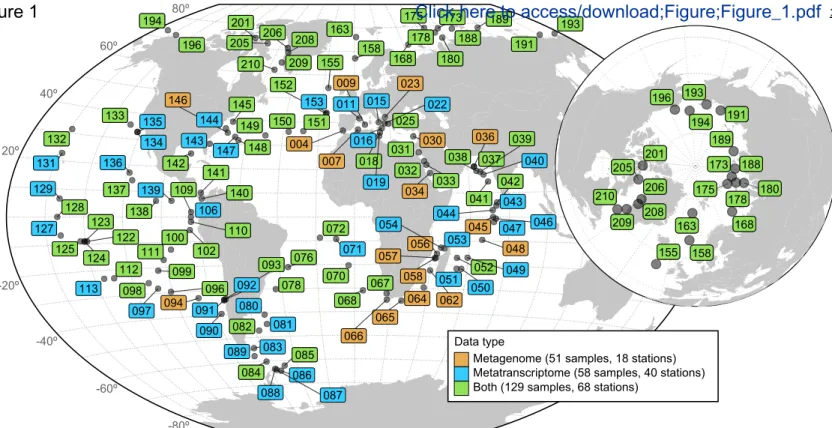
The dataset for this study consists of metatranscriptomic (n = 187) and metagenomic (n = 370) samples collected at 126 globally distributed sampling stations across a latitudinal range of 142° (Figure 1, Table S1). The samples originate from the light-penetrated, epipelagic waters from the surface (SRF), deep chlorophyll maximum (DCM), and mixed water layer, and dark waters from the mesopelagic (MES) layer, from 5 m to 1,000 m in depth (median depths of 5 m, 50 m and 550 m for SRF, DCM, and MES respectively). The 187 prokaryote-enriched metatranscriptomic libraries were generated and sequenced to an average depth of 28 Gbp per sample (Table S1), after protocol optimization for low-input RNA samples (Alberti et al., 2014; STAR Methods). These data were analyzed in conjunction with a set of 131 virus-, 59 giant virus-, and 180 prokaryote-enriched metagenomes (Table S1), which include prior sequencing efforts of Tara Oceans (Sunagawa et al., 2015), virus-enriched metagenomes from polar (n = 44) and non-polar (n = 42) regions (Gregory et al., 2019; Roux et al., 2016) (see STAR Methods for definitions), and 41 prokaryote-enriched metagenomes from the Arctic Ocean (new to this study).
We aimed to capture whole community-level variations in community turnover and gene expression changes, and to place these data into the context of geographic and environmental gradients at a global scale. Notably, the applicability of this approach critically depends on the evolutionary distances between the organisms present in the environment and those represented in genomic sequence databases (Nayfach et al., 2016). Ideally, genome sequences would be available for all organisms that comprise the communities of interest, thus facilitating the integration of gene abundance and gene expression data to assess whole-community compositions. Such analyses appear to be within reach for the human gut microbiome, for which appropriate genomic resources have recently become available (Almeida et al., 2019; Nayfach et al., 2019; Pasolli et al., 2019). However, for ocean microbiome samples, less than 10% of metatranscriptomic, and less than 5% of metagenomic data, can currently be resolved at the species-level using available marine genomic sequence databases (Figure 2A).
To overcome this limitation, we generated an updated version of the Ocean Microbial Reference Gene Catalog (OM-RGC.v2; http://www.ocean-microbiome.org; (Sunagawa et al., 2015)) based on 370 metagenomes with extended geographic coverage, particularly for the Arctic Ocean (Figure 1). Among the 47 million non-redundant genes, 24.5% were reconstructed, although partially detected elsewhere (Figure 2), in the Arctic Ocean samples alone, highlighting the added value of sampling genomically underexplored environments. Using this reference, nearly 70% of the genes could be taxonomically annotated, and 61% showed homology to known (i.e., existing) orthologous groups (OGs) in the database used for gene functional annotation (eggNOG version 4.5, (Huerta-Cepas et al., 2015) STAR Methods). We further grouped the remaining 39% of the genes in the OM-RGC.v2 that represent unknown genes (i.e., genes of unknown function without detectable homology to known sequences), into ~250,000 gene clusters (GCs) based on shared sequence similarity (Figure 2C, STAR Methods). We identified significant differences when comparing transcript abundances between depth layers (for 5,439 GCs) or between polar and non-polar regions (for 31,339 GCs), or correlations with environmental parameters (for 21,648 GCs) (Figure S2). These findings suggest ecologically relevant yet unknown functions of these genes in response to environmental variation. A benchmarked analysis of conserved co-expression as a method for identifying functionally related genes (Stuart et al., 2003) suggests that some of the GCs are likely to represent unidentified players in signal transduction, transcriptional regulation, and energy production/conversion (Figure S3, Table S2).
In contrast to existing ocean genomic reference databases, we found the OM-RGC.v2 to capture the majority of gene-encoding metagenomic and metatranscriptomic data (70% and 51%, respectively; Figure 2A) used in this study, making it a suitable resource to address our aim of analyzing whole-community metatranscriptomic compositions. All gene sequences can be queried online for their abundance, expression, and geographic distribution (Villar et al., 2018), and they are linked to contextual environmental parameters (Pesant et al., 2015) facilitating additional gene-centric explorations in the future.
Variation of meta-omic compositions across latitude and depth
Having established resources to quantify whole-community taxonomic, genomic and transcriptomic compositions, we next sought to identify patterns and drivers of compositional structure across major axes of environmental variation in the ocean biome at a global scale. Numerous studies have revealed that microbial communities are vertically stratified in the ocean, with a striking boundary between epipelagic and mesopelagic zones (DeLong et al., 2006; Giovannoni and Stingl, 2005; Sunagawa et al., 2015). Polar and non-polar communities have also been shown to separate into distinct groups with different species-level taxonomic compositions (Ghiglione et al., 2012; Gregory et al., 2019). Critically, however, the shared gene content between different strains of the same species may be as low as 40%, as has been shown, for example, in Escherichia coli (Mira et al., 2010). Furthermore, gene functional redundancy in microbial communities (i.e., when the same gene functions are encoded by different taxa) may help to maintain important community functions in cases of biodiversity loss (Bell et al., 2005). Thus, it is difficult to predict whether gene functional compositions and gene expression-regulated transcriptomic repertoires would follow the same patterns of taxonomic composition changes.
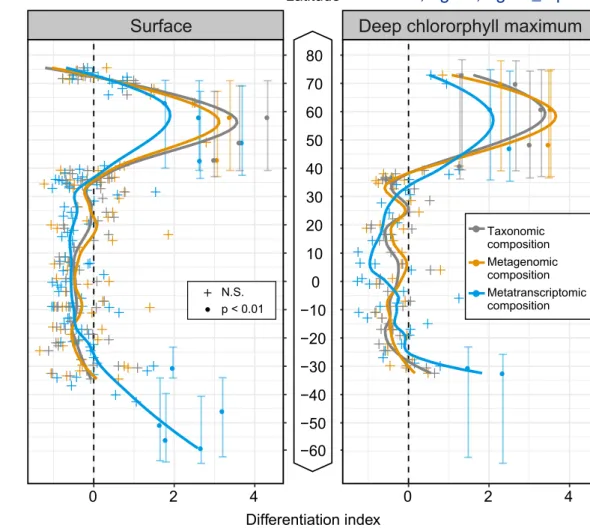
To address this question, we first aimed to locate the boundaries of differentiation (Ludwig and Cornelius, 1987) in epipelagic waters (SRF and DCM) along the latitudinal gradient for different community-compositional measures derived from the prokaryote-enriched metatranscriptomes and metagenomes (STAR Methods). From the equator northwards, no significant differentiation was identified in epipelagic waters until a latitude of 40°N. At this point, the degree of differentiation increased significantly for all community-compositional measures and peaked at around 60°N. A similar trend was also observed for the southern hemisphere (Figure 3) and is consistent with the taxonomic compositional differences observed between polar and non-polar waters for bacterial (Ghiglione et al., 2012; Gregory et al., 2019) and viral communities (Ghiglione et al., 2012; Gregory et
al., 2019). We further found that the differentiation is reflected by significant enrichments of operational taxonomic units (OTUs) from the order Flavobacteriales (e.g., Formosa, Polaribacter, NS5, NS7 and NS9 marine groups), the class Gammaproteobacteria (OM182 clade and Piscirickettsiaceae), and eukaryotes (e.g., Phaeocystis), as well as by depletions of Prochlorococcus spp., members of the Rhodospirillaceae family, and members of the SAR11 and SAR406 clades toward higher latitudes (Figure S4). Here, the congruent patterns observed for both metagenomic and metatranscriptomic differentiation, measured as changes in the relative abundance of gene copies at the level of OGs, indicate that on a global scale, organismal composition largely shapes the composition of gene functional content and also dominates over gene regulatory variations in shaping community-level transcriptomic compositions across ecological boundaries.
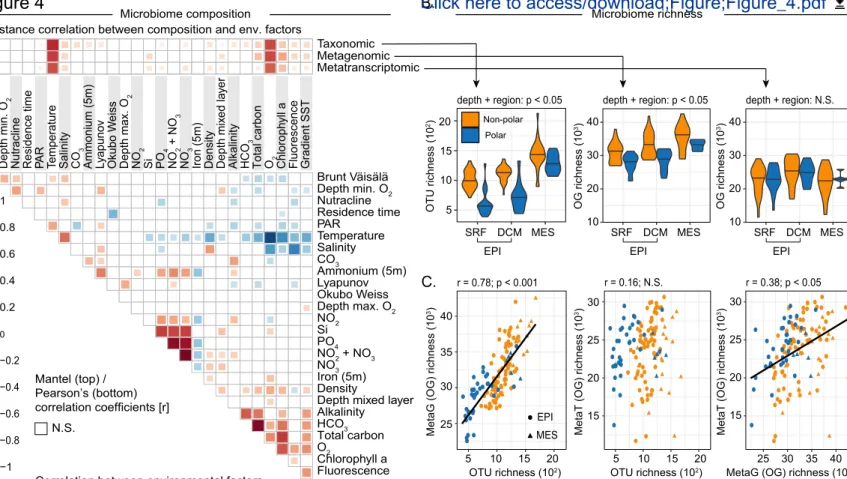
Indeed, we found that all community-compositional measures were highly correlated (Figure S5), and their variability in the epipelagic ocean was, among a set of 27 environmental parameters, best explained by seawater temperature (Figure 4A). This result complements earlier reports of temperature as an important factor driving the taxonomic composition of ocean microbial communities (e.g. Fuhrman et al., 2006), which was corroborated by a later analysis of a globally distributed set of samples that accounted for geographic effects and disentangled temperature from other environmental parameters to confirm that it acts as a key driver of taxonomic and gene functional compositions in epipelagic, non-polar open ocean waters (Sunagawa et al., 2015). In fact, the identification of an ecological boundary starting at 40ºN and peaking at 60°N coincides with a steep temperature decrease between the North Atlantic and Arctic waters that were sampled (Figure S6), and relates to additional oceanographic features. At ~40ºN/S, the 15ºC annual-mean isotherm effectively delineates the permanently stratified ocean from the subpolar and polar regions (Behrenfeld et al., 2006), while winter mixing in the North Atlantic is the strongest (deepest mixed layer depth) at ~60ºN (Montégut and de Boyer Montégut, 2004). The ecological boundary we describe here for microbial community compositions could thus be due to physico-chemical changes driven by the variability in the vertical mixing of oceanic water masses, which is linked to differences in sea surface temperature.
We next quantified metatranscriptomic richness (i.e., the unique number of OGs detected by cDNA sequencing), as a proxy for the diversity of transcribed gene functions, and compared this to taxonomic and metagenomic richness (i.e., the unique number of detected operational taxonomic units (OTUs) and OGs, respectively, detected by DNA sequencing). As measures of diversity, the latter two provide information about the stability (McCann, 2000), functionality (Cardinale et al., 2006) and possibly productivity (Tilman, 1995; Vallina et al., 2014) of ecological communities. In addition, we sought to quantify the fraction of the gene-encoded functional potential in a given community that is actually transcribed at a given time by comparing metatranscriptomic and metagenomic richness. Taxonomic and metagenomic richness were highly correlated, without showing signs of saturation, supporting the previous observation that functional redundancy in the marine ecosystem is rather low (Fierer et al., 2013; Galand et al., 2018), and both were found to be significantly lower in polar than in non-polar communities at all tested depth layers (Figure 4B). These data are congruent with studies suggesting a decrease in the taxonomic diversity of communities with increasing latitude (Fuhrman et al., 2008; Gregory et al., 2019; Ibarbalz et al., 2019 submitted; Sul et al., 2013) and an associated decrease in gene functional diversity, although other studies have also proposed alternative patterns of latitudinal diversity gradients (Ghiglione et al., 2012; Ladau et al., 2013; Raes et al., 2018). In contrast, metatranscriptomic richness was not correlated with taxonomic richness and only poorly correlated with metagenomic richness, and no significant difference was found between polar and non-polar microbiomes or between any depth layers (Figure 4B). This unexpected disparity between metagenomic and metatranscriptomic richness patterns suggests that the non-transcribed proportion of a given metagenome is higher in mesopelagic waters and non-polar regions relative to epipelagic waters and polar regions. This could be due to a higher proportion of dormant or dead, and passively sinking, microbes in the mesopelagic compared to the epipelagic ocean. Alternatively, these observations may reflect the prevalence of genome streamlining in surface ocean waters (Swan et al.,
2013), where per genome, the number of genes is expected to be lower (Mende et al., 2017). The proportion of transcribed genes is thus expected to be higher, than in mesopelagic waters. Future studies will be required to determine whether the apparent saturation of simultaneously transcribed gene functions, despite increasing numbers of encoded gene functions, is a feature that is also common in microbial communities from other biomes.
Differential abundance and expression of biogeochemical cycling genes
The pool of microbial community transcripts may vary along environmental gradients as a function of community turnover and/or changes in gene expression (Figures S1, S7; STAR Methods). To disentangle the individual contributions of these mechanisms across environmental gradients for genes that are involved in ecologically relevant processes, we integrated 122 prokaryote-enriched, matched metatranscriptomes and metagenomes, and quantified the differential abundances and expression levels for a set of biogeochemical marker genes, across depth layers and between polar and non-polar waters (Figure 5).
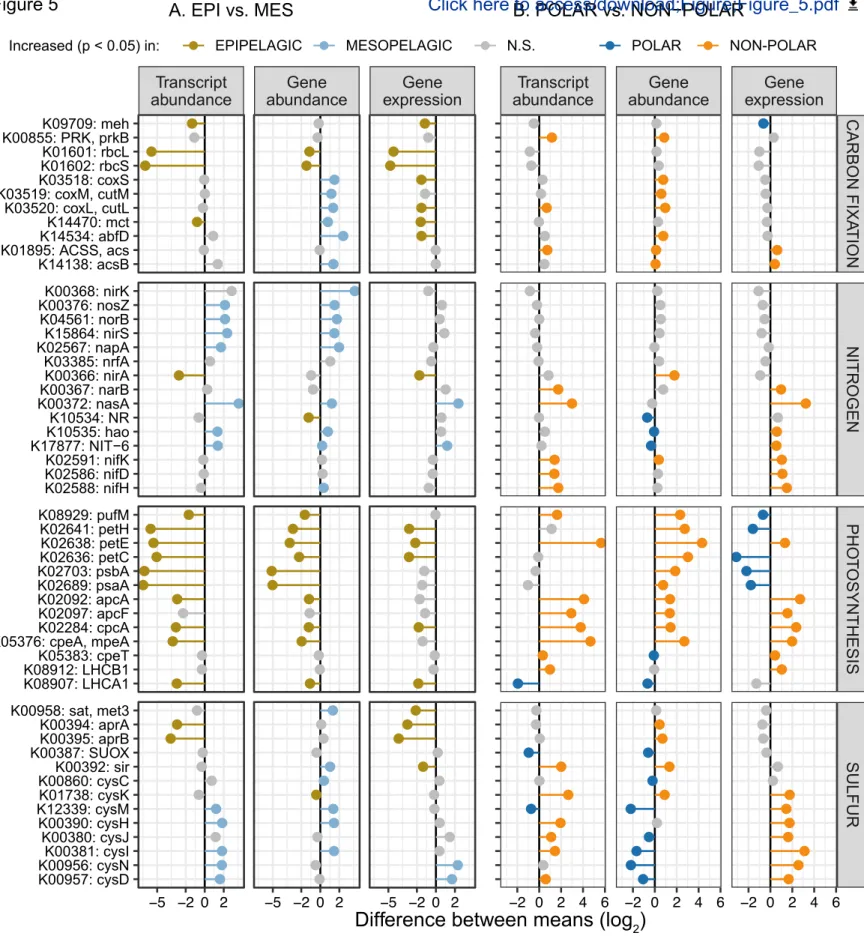
As a first step, we sought to validate both data quality and our analytical approach by testing whether patterns for genes involved in well-studied processes, including carbon fixation, photosynthesis, and nitrogen cycling, could be observed. As expected, we found that the most differentially abundant transcripts between epipelagic and mesopelagic layers included those from the photosynthesis marker genes, psaA and psbA, and genes encoding the subunits of RuBisCO (rbcL and rbcS), the key enzyme required for carbon fixation (Figure 5A). Moreover, we observed that abundances of the rbcL and rbcS transcripts were highly correlated with those of psaA and psbB, which is consistent with the expectation that carbon fixation is primarily driven by photoautotrophs rather than chemoautotrophs (Raven, 2009; Shively et al., 1998; Swan et al., 2011). This is further supported by the observation of low RuBisCO gene expression levels in mesopelagic waters, despite the presence of chemoautotrophs (Figure S8). In addition to psbA, the abundances of other photosynthetic marker genes, including markers for the photosynthetic reaction center (petC, petE, and petH) and the cyanobacteria-specific antenna proteins (apcA, apcF, cpcA, cpeA and cpeT) were lower in polar than in non-polar waters (Figure 5B). This result likely reflects the depletion of cyanobacteria in colder environments (Marchant et al., 1987) (Figure S4), and an underrepresentation of eukaryotic phototrophs in the prokaryote-enriched samples we analyzed here.
With respect to nitrogen cycling, we detected both gene and transcript abundances for denitrification marker genes (napA, nirS, norB, and nosZ) to be enriched in mesopelagic versus epipelagic waters (Figure 5A). As expected for this predominantly anaerobic process (Zehr and Ward, 2002), transcript abundances were particularly high in oxygen-depleted waters, although interestingly, similar transcript levels were also observed in some well-oxygenated Arctic water samples (Figure S9). Transcripts of nitrogen fixation marker genes (nifK, nifH and nifD) were more abundant in non-polar than in polar regions, with the highest abundances detected in waters between 20º and 35º (absolute latitude) with low nitrate and nitrite concentrations (Figure S10). These data generally agree with the long-standing expectations that nitrogen fixation activity is higher under conditions of nitrogen limitation and is primarily driven by cyanobacteria in tropical and subtropical regions (Dixon and Kahn, 2004; Stal, 2009). However, more recent studies have provided additional evidence for an extended geographic and depth range (Blais et al., 2012; Harding et al., 2018; Moisander et al., 2017) and for a wider taxonomic breadth of nitrogen fixing organisms including non-cyanobacterial heterotrophic diazotrophs (Bombar et al., 2016; Delmont et al., 2018). Given these findings, we further investigated the biogeography of the nifH gene in more detail and determined which organisms not only encode this gene, but also express it. Specifically, we analyzed the distribution of nifH gene and transcript abundances among 24 nifH-encoding ‘species’ that were detected in the 122 matched metagenomes and metatranscriptomes. From this analysis, we found that a number of Gamma- and Deltaproteobacteria, for which genomes have recently been reconstructed (Delmont et al., 2018), were not only abundant, but also among the top contributors to the nifH transcript pool in the studied samples (Figure 6). Additionally, for the first time, to our knowledge, we detected nifH gene
expression in mesopelagic Arctic waters, and reconstructed the nif operon-containing genome of its carrier (Table S3, STAR Methods), a candidate heterotrophic Deltaproteobacterium,or a member of the Myxococcota phylum according to a recent proposal for a standardized bacterial taxonomy (Parks et al., 2018), that awaits further characterization.
In spite of the potential biases inherent to our approach that are related to the collection of spatially discrete data over a period of more than three years and to the sampling process itself (e.g., unaccounted effect of seasonality or potential changes in transcript abundances during the sampling process), we were able to corroborate expected patterns of metabolic processes using metatranscriptomic data at global scale. In addition to validating our methods, we demonstrated how our community-centric approach for analyzing metatranscriptomes can be used in conjunction with metagenomic data, and furthermore, bridge to new genome-resolved insights. Building on the robustness of our analysis, we next focused on disentangling the mechanisms that underpin the differences in community transcriptomes across depth and latitude. Notably, we observed cases in which transcript abundance changes could be mainly attributed either to differences in gene abundance or gene expression, or a combination of these mechanisms. As described above, the enrichment of transcripts from denitrification marker genes in mesopelagic versus epipelagic waters are mainly driven by changes in gene abundance (Figure 5A). In this case, gene abundance changes, due to environmental filtering of organismal community composition in response to higher nitrate and nitrite concentrations in mesopelagic waters, dominate the observed community transcriptomic differences. Conversely, a higher transcript abundance of marker genes for anaerobic dissimilatory sulfate reduction (aprA and aprB) in epipelagic waters is driven by an increased expression of these genes, despite no significant differences in the abundance of these genes between depth layers (Figure 5A). A taxonomic breakdown shows that 39% and 59% of aprA and aprB genes were encoded by Proteobacteria and only 2% of each gene could be assigned to taxa containing known sulfate reducers (Archaea, Firmicutes, Nitrospirae, and Deltaproteobacteria) (Muyzer and Stams, 2008). These results suggest that the significance of alternative uses for aprA and aprB in oxic waters, namely to detoxify cells by catalyzing the oxidation of sulfite accumulated in the cytoplasm, as described for clades such as SAR11 and SAR116 (Meyer and Kuever, 2007; Smith et al., 2016), may be of global relevance.
A more complex scenario for observing differences in transcript pools is exemplified by a number of marker genes for assimilatory sulfate reduction (cysD, cysH, cysI, cysJ, and cysN), for which the observed differences across the latitudinal gradient (i.e., higher transcript abundances in non-polar versus polar regions) result from a combination of community turnover and gene expression changes. In this case, the increased transcript abundance in non-polar waters results from higher expression levels, despite a lower abundance of genes. Interestingly, we found the transcript abundance of these marker genes to be anticorrelated with that of dmdA (Figure S11), the key gene for the demethylation of dimethylsulfoniopropionate (DMSP) (Howard et al., 2006), which results in incorporation of carbon and sulfur into bacterial biomass (Kiene et al., 1999). Based on these data, we hypothesize that the global-scale expression of the assimilatory sulfate reduction pathway may be downregulated in response to the availability of DMSP, which is used by prokaryotes as an alternative source for sulfur assimilation (Kiene et al., 2000). Notably, if turnover and differential gene expression are both operative, relying on gene abundance alone may lead to false predictions including of patterns that would suggest the opposite of what is manifested at the transcript level (e.g., non-photosynthetic carbon pathways with higher epipelagic expression levels, but higher mesopelagic gene abundances of mct and abfD).
Turnover dominates over gene expression differences in polar water communities
In light of global climate change, a better understanding of how ocean microbial communities will respond to ongoing changes is urgently needed (Cavicchioli et al., 2019; Overland et al., 2018). In particular, the Arctic region has experienced some of the highest ocean surface water temperature anomalies recorded to date (Hoegh-Guldberg and Bruno, 2010). Ocean warming models (scenario
RCP 8.5, business as usual) predict that mean surface water temperatures will increase by 2 to 5°C in the Arctic by the end of the century (Alexander et al., 2018), highlighting a critical need to better understand how these changes will impact microbial communities in this region. Given that these projections focus on surface temperature changes and due to their major contribution to biogeochemical cycles (Field 1998), we sought to assess the response of epipelagic communities to environmental variation, as reflected by measurable differences in their metatranscriptomic composition, and subsequently to use these spatially discrete data to hypothesize on future projections.
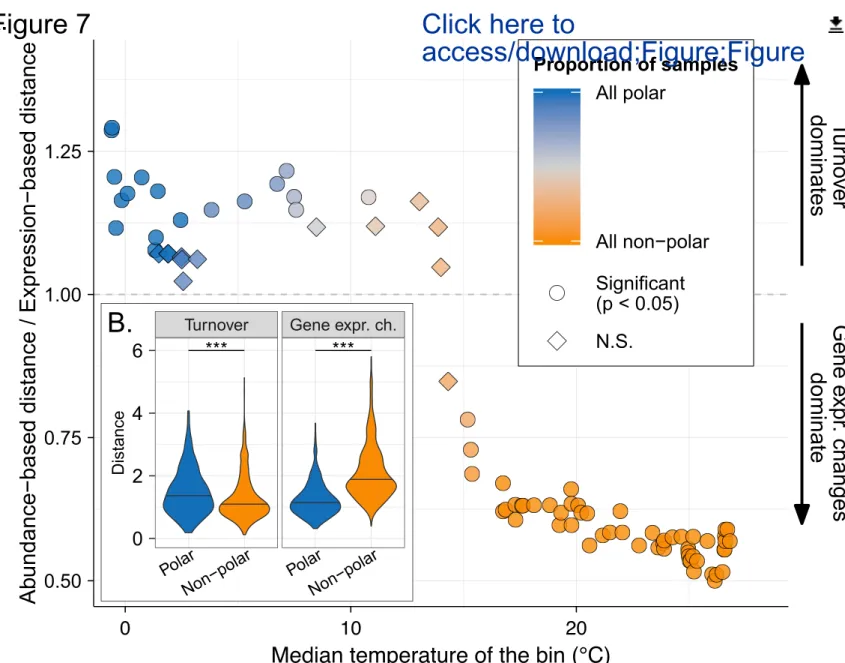
Specifically, we aimed to disentangle (Figure S7, STAR methods) whether differences in microbial community transcriptomes are impacted more strongly by community turnover and/or by gene expression changes along the temperature gradient at their sampling locations. To this end, we divided all samples into groups of 15 samples (bins) using a sliding window along the temperature gradient, so that each group reflected the range of ocean warming expected before the end of the century (median temperature difference within each bin: 1.6°C; Figure S12A). We then quantified the different mechanisms of metatranscriptome changes within each bin (Figure 7; STAR Methods), and found that in warmer epipelagic waters, the relative contribution of community turnover to metatranscriptomic compositional dissimilarities is significantly lower than that of gene expression changes. In contrast, the effect of community turnover in colder (predominantly Arctic) waters is higher or in the same range as gene expression changes (Figure 7A). Overall, community turnover was found to be significantly higher in polar communities than in non-polar communities (p<0.001), whereas gene expression changes displayed the opposite pattern (p<0.001) (Figure 7B). Interestingly, the shift in the relative contributions of the different mechanisms of metatranscriptome changes occurs at ~15ºC, and therefore coincides with the ecological boundary previously identified, which, as such, not only delineates communities differing in their composition, but also in the mechanism shaping their transcript pool. We further found that the effect of temperature was greater than that of other environmental variables, such as nitrate/nitrite concentrations and salinity (Figure S12), suggesting a higher acclimatory capacity of microbial communities in warm than in cold epipelagic waters in response to temperature variations.
Finally, by extrapolating our results from spatially discrete data to potential consequences of climate change (Blois et al., 2013), we hypothesize that the relative impact of organismal composition changes on microbial community transcriptomes will be greater in polar than in non-polar waters. This extrapolation, however, needs to be interpreted within the limitations of the data analysed here, namely that it cannot account for the evolutionary adaptation of microbial communities to gradual changes with time. As such, further studies resolving long-term temporal dynamics of metatranscriptome changes are required to improve our understanding of the contributions of community turnover and gene expression changes in the context of environmental changes. Notwithstanding, the present results provide a first global-scale evaluation of the mechanisms underpinning the changes in community transcriptomes as well as a framework for future work. Conclusions
Large-scale oceanographic sampling expeditions, such as the World Ocean Circulation Experiment (WOCE) or GEOTRACES (Anderson et al., 2014; Koltermann et al., 2011; Woods, 1985) have been extremely valuable in building our understanding of the ocean circulation, and the distribution of major nutrients and elements including trace metals, as well as their contribution to the climate system. However, our geochemical and physical knowledge of the ocean remains incomplete without incorporating the processes that regulate biogeochemical cycles at planetary scale (Falkowski et al., 2008). Analyzing the repertoire of genes and transcripts from environmental samples can inform us about the potential and activity of microbial communities that drive these cycles at global scale, and thus help us to understand the intertwined processes that shape the physico-chemical state of the ocean through biological activity.
In this study, we describe global biogeographical patterns of microbial community transcriptome compositions and demonstrate how changes in these compositions can be attributed to community turnover and/or gene expression changes as the underlying mechanisms. Assessing the mechanisms that underlie such compositional differences, as demonstrated here, can help us to determine whether changes in the molecular activities of microbial communities are regulated by gene expression changes or by a turnover of organisms containing genomic modifications that arose over evolutionary time. In addition, an improved understanding of the ecological factors that drive community compositional and diversity changes can help us to better predict how ocean microbial communities will respond to environmental changes. For example, the consistent identification of temperature as a major explanatory factor for global-scale community-level differences in genomic (Sunagawa et al., 2015) and transcriptomic (this study) composition, as well as taxonomic diversity (Gregory et al., 2019; Ibarbalz et al., 2019 submitted), has wide-ranging implications, in particular for the Arctic Ocean, given the current projections of disproportionately high warming rates in this region (Alexander et al., 2018; IPCC, 2014).
Notably, the analyses of this study were enabled by a systematic, highly contextualized, pan-oceanic set of metagenomic and metatranscriptomic data that, along with the OM-RGC.v2, complements other large-scale datasets that have been developed for eukaryotes (Carradec et al., 2018; Ibarbalz et al., 2019 submitted), prokaryotes (Biller et al., 2018) , and viruses (Gregory et al., 2019). Together, these will pave the way for an eco-systems level understanding of ocean plankton diversity, function, and activity across boundaries of organismal size ranges. To reach this goal, it will be important to integrate temporal meta-omics data, ideally from global observations, to account for seasonal variations and other concomitant environmental changes, such as increased stratification, acidification, nutrient availability and deoxygenation of the oceans (Bopp et al., 2013; Schmittner et al., 2008). Such concerted efforts are required to further refine gene-to-ecosystem models (Coles et al., 2017; Garza et al., 2018; Guidi et al., 2016) and to inform environmental and climate policies (Le Quéré et al., 2018), which must consider not only how microorganisms are impacted by but also how they may affect anthropogenic climate change (Cavicchioli et al., 2019).
Acknowledgements
Tara Oceans (which includes both the Tara Oceans and Tara Oceans Polar Circle expeditions) would not exist without the leadership of the Tara Expeditions Foundation and the continuous support of 23 institutes (http://oceans.taraexpeditions.org). We further thank the commitment of the following sponsors: CNRS (in particular Groupement de Recherche GDR3280 and the Research Federation for the study of Global Ocean Systems Ecology and Evolution, FR2022/Tara Oceans-GOSEE), European Molecular Biology Laboratory (EMBL), Genoscope/CEA, The French Ministry of Research, and the French Government ‘Investissements d’Avenir’ programmes OCEANOMICS (ANR-11-BTBR-0008), FRANCE GENOMIQUE (ANR-10-INBS-09-08), MEMO LIFE (ANR-10-LABX-54), and PSL* Research University (ANR-11-IDEX-0001-02), Gordon and Betty Moore Foundation (award #3790), the US National Science Foundation (awards OCE#1536989 and OCE#1829831) to MBS, the European Union’s Horizon 2020 research and innovation programme under grant agreement No 686070, as well as the Ohio Supercomputer, and the EMBL and ETH Zürich HPC facilities for computational support. Funding for the collection and processing of the TARA data set was provided by NASA Ocean Biology and Biogeochemistry program under grants NNX11AQ14G, NNX09AU43G, NNX13AE58G and NNX15AC08G to the University of Maine and Canada Excellence Research Chair on Remote sensing of Canada’s new Arctic frontier Canada foundation for innovation. Funding for the collection and processing of TARA environmental data was provided by NASA Ocean Biology and Biogeochemistry program under grants NNX11AQ14G, NNX09AU43G, NNX13AE58G and NNX15AC08G to the University of Maine. SGA thanks the Spanish Ministry of Economy and Competitiveness (CTM2017-87736-R). SS is supported by the ETH and the Helmut Horten Foundation, and funding from the Swiss National Foundation grant (205321_184955). We also thank the support and commitment of Agnès b. and Etienne Bourgois, the Prince Albert II de Monaco Foundation, the Veolia Foundation,
Region Bretagne, Lorient Agglomeration, Serge Ferrari, Worldcourier, and KAUST. The global sampling effort was enabled by countless scientists and crew who sampled aboard the Tara from 2009-2013, and we thank MERCATOR-CORIOLIS and ACRI-ST for providing daily satellite data during the expeditions. We are also grateful to the countries who graciously granted sampling permissions. The authors declare that all data reported herein are fully and freely available from the date of publication, with no restrictions, and that all of the analyses, publications, and ownership of data are free from legal entanglement or restriction by the various nations whose waters the Tara Oceans expeditions sampled in. This article is contribution number 94 of Tara Oceans.
List of the Tara Ocean Coordinators
Silvia G. Acinas, Marcel Babin, Peer Bork, Emmanuel Boss, Chris Bowler, Guy Cochrane, Colomban de Vargas, Michael Follows, Gabriel Gorsky, Nigel Grimsley, Lionel Guidi, Pascal Hingamp, Daniele Iudicone, Olivier Jaillon, Stefanie Kandels-Lewis, Lee Karp-Boss, Eric Karsenti, Fabrice Not, Hiroyuki Ogata, Stéphane Pesant, Nicole Poulton, Jeroen Raes, Christian Sardet, Sabrina Speich, Lars Stemmann, Matthew B. Sullivan, Shinichi Sunagawa, Patrick Wincker
Author Contributions
Conceptualization
G.S., S.S., Tara Oceans coordinators
Ideas; formulation or evolution of overarching research goals and aims
Methodology A.A., G.S., L.P., S.S. Development or design of methodology; creation of models
Software G.S., H.J.R., H.U., J.H.C., M.C.V., P.H., S.S.
Programming, software development; designing computer programs; implementation of the
computer code and supporting algorithms; testing of existing code components
Validation G.S., L.P., H.J.R.
Verification, whether as a part of the activity or separate, of the overall replication/ reproducibility of results/experiments and other research outputs
Formal Analysis G.S., H.U., L.P., M.C.V., P.H.
Application of statistical, mathematical, computational, or other formal techniques to analyze or synthesize study data
Investigation
A.A., A.C.G., A.Z., C.B., C.C., C.D., C.F., C.M., C.V., E.K., E.P., G.S., H.J.R., H.U., H.O., J.F., J.H.C., J.P., K.L., L.K.B., L.P., L.P.C., M.B., M.B.S., M.C., M.C.V., M.P., M.R-L.., P.B., P.H., P.W., S.E., S.G.A., S.K., S.Pi., S.Pe., S.R., S.S., Tara Oceans coordinators
Conducting a research and investigation process, specifically performing the experiments, or data/evidence collection
Resources Tara Oceans coordinators
Provision of study materials, reagents, materials, patients, laboratory samples, animals,
instrumentation, computing resources, or other analysis tools
Data Curation A.A., G.S., H.J.R., L.P., P.H., H.O., H.U., S.Pe.
Management activities to annotate (produce metadata), scrub data and maintain research data (including software code, where it is necessary for interpreting the data itself) for initial use and later reuse
Writing – Original
Draft G.S., L.P., S.S.
Preparation, creation and/or presentation of the published work, specifically writing the initial draft (including substantive translation)
Writing – Review & Editing C.B., C.F., D.I., M.B.S., P.B., P.H., S.G.A., A.G., A.Z., G.Z., L.P.C., L.K.B., P.W., S.R., S.Sp.
Preparation, creation and/or presentation of the published work by those from the original research group, specifically critical review, commentary or revision – including pre- or postpublication stages
Visualization C.F., G.S., L.P., S.S.
Preparation, creation and/or presentation of the published work, specifically visualization/ data presentation
Supervision S.S.
Oversight and leadership responsibility for the research activity planning and execution, including mentorship external to the core team
Project
Administration Tara Oceans coordinators
Management and coordination responsibility for the research activity planning and execution
Funding Acquisition
Tara Oceans coordinators Tara Oceans Polar Circle coordinators: M.B., C.B.
and L.K.B. Acquisition of the financial support for the project leading to this publication Declaration of interests
Figure titles and legends
Figure 1: Geographic coverage of the meta-omics dataset analyzed in this study. Geographic distribution of
the sampling stations of the Tara Oceans (2009-2013) expeditions (Pesant et al., 2015). Several size-fractionated samples were collected from different depth layers at each station for a total of 557 samples (370 metagenomes and 187 metatranscriptomes). Stations numbered 155 and above represent the Tara Oceans Polar Circle campaign undertaken between June and October 2013. Colors indicate the type of samples collected for the prokaryote-enriched fractions at each station: metagenome only (orange, 18 stations); metatranscriptome only (blue, 40 stations); metagenome and metatranscriptome for at least one of the depth layers (green, 68 stations).
Figure 2: Gene detection rates and annotation of the OM-RGC.v2. (A) Percentage of reads from 180
prokaryote-enriched metagenomes (orange) and 187 prokaryote-enriched metatranscriptomes (blue) aligned with a 95% identity cutoff to: the MarRef database v3, updated 2019/01/19 (Klemetsen et al., 2018), a collection of metagenome-assembled genomes (MAGs) reconstructed from Tara Oceans samples (Delmont et al., 2018), and the OM-RGC.v2 (this study). To fairly compare the alignments to the MarRef database or MAGs and the catalog, we corrected for the gene coding density in prokaryotic genomes (STAR Methods). (B) The accumulation of OM-RGC.v2 genes detected in 180 prokaryote-enriched samples. The dashed line separates the prokaryote-enriched non-Arctic metagenomes [n = 139; (Sunagawa et al., 2015)] from the Arctic metagenomes (n = 41). The increase in slope reflects an increase in the rate of detection of new genes in the Arctic Ocean. The non-prokaryote-enriched metagenomes (n = 190) and the metatranscriptomes (n = 187) are excluded from this analysis. (C) The taxonomic annotation of genes at the domain level (and viruses; LUCA: last universal common ancestor) and the breakdown of gene functional annotations into ~9k KEGG and ~76k eggNOG orthologous groups (KOs and OGs, respectively). The remaining fraction of unannotated genes was used to generate de novo gene clusters (GCs) for further functional characterization of the catalog.
Figure 3: Latitudinal partitioning of global ocean microbiome compositions. The schematic on the left
illustrates the underlying concept of the split moving-window analysis of ecological differentiation (Ludwig and Cornelius, 1987). It consists of a comparison of the pairwise distances between communities on opposite sides of a putative boundary with the pairwise distances between communities on the same side. A high differentiation value captures an increase in the distance between the two sides of the boundary compared with the distances within each side. The analysis was conducted with a window width of 10 samples and shows an ecological boundary centered around 60°N based on the taxonomic composition (grey, relative abundance of OTUs), metagenomic composition (orange, per-cell abundance of genes), and metatranscriptomic composition (blue, relative per-cell abundance of transcripts) of prokaryote-enriched samples from surface (SRF) and deep chlorophyll maximum (DCM) waters (both belonging to the epipelagic layer). A similar pattern is evident for the southern hemisphere; however, the limited number of samples precluded detection of an ecological boundary. Significance was determined using 99% confidence intervals computed with 10,000 random permutations of the latitude values. Vertical lines represent the window of the latitudinal range of significant values. The insufficient number of samples and latitudinal coverage prevented us to perform this analysis for the mesopelagic layer.
Figure 4: Patterns and drivers of global ocean microbiome compositions across depth layers, and between polar and non-polar regions. (A) Taxonomic, metagenomic, and metatranscriptomic composition of
epipelagic samples (based on mitags, and the normalized abundances of eggNOG-derived OGs from metagenomic and metatranscriptomic data, respectively) were related to each of 27 environmental factors using partial (geographic distance-corrected) Mantel tests with 10,000 permutations and Bonferroni correction. Pairwise comparisons of environmental factors are shown below, with a color gradient denoting Spearman’s correlation coefficients. Temperature is the best explanatory variable for all of the profiles in the epipelagic ocean (taxonomic profile: Pearson’s r = 0.75; metagenomic profile: Pearson’s r = 0.69; metatranscriptomic profile: Pearson’s r = 0.64; all p < 0.05), followed by oxygen concentration, which is highly correlated to temperature (Pearson’s r = -0.72). A more detailed description of the variables is available in Table S1. (B) Compositional richness of polar and non-polar microbiomes across three depth layers. Taxonomic and functional metagenomic richness (numbers of OTUs and OGs, respectively) increases with depth, although the richness is consistently lower in polar samples than in non-polar samples (two-way ANOVA: p < 0.05 for depth layers and polar/non-polar, for both taxonomic and metagenomic functional richness). By contrast, there was no significant difference in functional metatranscriptomic richness (number of OGs), either across depths or between polar and non-polar samples (two-way ANOVA: p > 0.05 for depth layers and polar/non-polar). (C) Correlations among species richness (number of OTUs), functional metagenomic (metaG) richness and metatranscriptomic (metaT) richness (number of OGs). Data were rarefied before richness computation (STAR Methods). Pearson’s correlation was used for all comparisons (OTU-metaG; r = 0.78, p < 0.001; OTU-metaT: r = 0.16, p = 0.06; metaG-metaT: r = 0.39, p < 0.05). The solid line corresponds to the best linear fit. N.S.: not significant (p > 0.05).
Figure 5: Differences in gene abundance and expression determine differential transcript abundances of metabolic marker genes across depth layers, and between polar and non-polar regions. Differences in the
abundance of genes and transcripts, and the gene expression level of metabolic marker genes (KOs) were determined (A) between epipelagic and mesopelagic layers and (B) between polar and non-polar regions. The data points show the differences in the mean transcript abundances, mean gene abundances, and mean gene expression (i.e., transcript abundance normalized by gene abundance) of KOs. Differences were computed using log2-transformed values (STAR Methods) and tested for significance by Mann-Whitney tests. Differences were considered significant if p-values after Holm correction were smaller than 0.05. Only epipelagic samples were used for the data shown in (B).
Figure 6: Relative gene and transcript abundance of 24 nitrogenase genes (nifH) representing nifH-encoding ‘species’.
Relative gene (orange) and transcript (light blue) abundance distributions of the 24 nifH genes from the OM-RGC.v2 that were detected in 122 matched metagenomes and metatranscriptomes (A) are shown and broken down by latitude (B) and by depth (C) of the sample origin. Genes (IDs in the bottom panel) were annotated using a nifH-specific database (see STAR Methods). Colors denote phylum-level taxonomic annotations, naming corresponds to finer grain taxonomy or database-specific identifiers (D), and stars indicate genes that were previously identified in MAGs of heterotrophic bacterial diazotrophs (HBDs; Delmont et al., 2018). The genome containing a nifH gene for which transcripts were detected in the mesopelagic layer in the Arctic (OM−RGC.v2.019519152, bold) was reconstructed (see STAR Methods and Table S3). Horizontal dashed lines denote the latitude and depth that were used to define polar and non-polar (B), and epipelagic and mesopelagic waters (C), respectively.
Figure 7: Relative contributions of community turnover and gene expression changes to variations in metatranscriptome composition. Determination of the relative contributions of community turnover and gene
expression changes to variations in the metatranscriptome composition requires the decomposition of metatranscriptomic distances between communities (STAR Methods and Figure S7). Specifically, the relative contribution is determined as the ratio of the gene abundance-based distance (community turnover) and the gene expression-based distance (gene expression changes) between two metatranscriptomes. (A) The relationship of the ratio with temperature was analysed by dividing the epipelagic samples into groups (bins) of 15 samples each using a sliding window along the temperature gradient. For each bin, we report the median ratio (among all the pairwise comparisons within each bin) as a function of the median temperature of the samples present in the bin. The significance is determined by a Wilcoxon test comparing the within-bin distribution of the ratios to 1 (in which case the relative contributions of community turnover and gene expression changes are the same).The Holm correction was used to adjust for multiple testing. The ratio was considered to be significantly different from 1 if p < 0.05. (B) The inner panel represents the difference, for community turnover and gene expression changes, between polar and non-polar regions. The distributions capture the distances of each component for all pairwise comparisons of polar and non-polar epipelagic samples. Significance was tested by the Wilcoxon test; *** p < 0.001.
Supplementary information
Supplementary Table 1: Sample information
Information for all samples included in the present work: sample identifiers and information on their inclusion in the different steps of the analysis, summaries of sequencing and sequence processing and associated environmental data for each sample.
Supplementary Table 2: Pairs of GCs/OGs linked through co-expression
Includes GCs-GCs and GCs-OGs pairs with co-expression Pearson’s r greater than 0.86 (which corresponds to a false-positive rate below 5%;STAR Methods). In total, 17,516 GCs are linked either to another GC (16,706) or to an OG (810).
Supplementary Table 3: Functional annotation of the putative nitrogen-fixing metagenome-assembled genome
Start and end position, orientation and functional annotation of the open reading frames (ORF) detected in the metagenome-assembled genome (MAG). COG, EC, Pfam and KO annotation is provided for each ORF (see STAR Methods). The nif-operon (containing genes annotated as nifD, nifK and nifH) corresponds to the ORFs
topc.bin.586_00486 to 00488. MAG contig and gene sequences are available at http://doi.org/10.5281/zenodo.3352181
Supplementary Table 4: List of biogeochemical cycling marker KOs
List of KOs used as functional markers for microbial metabolisms with biogeochemical relevance.
Figure S1: Transcript abundance profile as a function of community composition and gene expression
Cartoon exemplifying how an initial community with a given expression profile may result insimilar transcript abundance profiles through two different mechanisms: (i) changes in the community composition (upper arrow), represented by three different species (green, red, and blue), or (ii) changes in gene expression (lower arrow), represented by two different genes (purple and orange, with low and high expression levels, respectively).
Figure S2: Prevalence and statistical associations to the environment of OGs and GCs
Gene abundance-based prevalence vs. transcript abundance-based prevalence (i.e., number of samples in which detected) for (A) eggNOG-based orthologous groups (OGs) and (B) de novo gene clusters (GCs) based on the 122 paired metagenomes and metatranscriptomes. Prevalence distributions are shown in the side and upper panels. The numbers of OGs and GCs with significant associations of transcript abundances to depth layers (C) and polar/non-polar regions and (D) to environmental variables are shown. Associations were detected as statistically significant differences in transcript abundance by Wilcoxon tests for depth layers and polar/non-polar regions (p < 0.05, after Holm correction for multiple comparisons) and as significant Pearson correlations for environmental variables (|r| > 0.6 and p < 0.05, after Holm correction for multiple comparisons). In both cases only the OGs and GCs with a transcript abundance-based prevalence higher than 10% were considered in order to avoid spurious associations.
Figure S3: Rationale for the use of co-expression data to associate groups with unknown functions to known functional groups.
Evaluation of model performance for the link between OGs based on co-variation analysis. (A) Receiver operating characteristic (ROC) curves for all models. Variation in (B) false positive rate and (C) sensitivity with increasing Pearson correlation values used as a cut-off for classification (rmin). The rmin is a value to be optimized corresponding to the minimum Pearson r that provides sufficient predictive power (false positive rate < 5%). A total of nine models are represented, which used co-abundance, co-transcription, and co-expression for the prediction of shared KEGG reactions, modules and pathways, respectively, between pairs of OGs (see details in STAR Methods).
Figure S4: Differential abundance of the dominant OTUs along the latitudinal gradient.
Latitudinal niche value (i.e., the abundance-weighted mean absolute latitude) for the 60 most abundant OTUs in the epipelagic subset of samples. Latitudinal niche values significantly higher and lower than the value expected from a random distribution of abundances (represented by the horizontal bold lines; see STAR Methods) are color coded. The dot size is proportional to the mean relative abundance of each OTU.
Figure S5: Correlations between the taxonomic, metagenomic and metatranscriptomic composition.
All pairwise correlations between the Euclidean distance of the (log2-transformed) taxonomic, metagenomic, and metatranscriptomic profiles were computed for 122 samples for which all three profiles were available. The correlation strength and significance were assessed using Mantel tests with 10,000 permutations.
Figure S6: Latitudinal distribution of seawater temperature in the epipelagic.
Seawater temperature (°C) measurements (n = 528) at the surface (SRF) and the deep chlorophyll maximum (DCM) along the Tara Oceans course in relation to (A) raw latitude values and (B) bins of the absolute latitude. Data are available at https://doi.pangaea.de/10.1594/PANGAEA.875576.
Mathematical basis for (A and B) the within-sample decomposition of metatranscriptomes (transcript copies / cell) into abundance (gene copies / cell) and expression (transcript copies / gene copy) components, and for (C) the between-sample decomposition of the Euclidean distance between metatranscriptomes (transcript abundance differences) into the abundance component (gene abundance differences), the expression component (expression differences), and an interaction term (abundance - expression covariation). See details in STAR Methods.
Figure S8: Gene and transcript abundance of RuBisCO subunits and PSI and PSII marker genes.
Distribution of whole-community (log2-transformed) (A) gene and (B) transcript abundances of the RuBisCO subunits (rbcS and rbcL) and the marker genes for photosystem I (psaA) and II (psbA) in the epipelagic and mesopelagic depth layers. Pairwise correlations based on the (C) gene and (D) transcript abundances of the four genes are shown below. All comparisons, except the ones denoted with N.S. in (A) and (B) were significant (p < 0.05 using Wilcoxon test and Holm correction for multiple comparisons). All Pearson correlations in (B) and (C) were significant (p < 0.05).
Figure S9: Transcript abundance of denitrification marker genes along the oxygen gradient.
The log2-transformed transcript abundances of nirS, norZ, nosB, and napA in relation to the oxygen concentration at the sampling location, showing a high transcript abundance in samples taken from anoxic waters (<100 µM) and interestingly, from oxygenated waters at stations 206, 208, and 210. The depth layer (EPI or MES) and polar/non-polar nature of the sample are coded as the symbol type and color, respectively. The dot size is proportional to the concentration of NO2 and NO3 (µM) when available.
Figure S10: Expression and transcript abundance of the nifH, nifD and nifK genes in relation to nitrate and nitrite concentration.
Gene expression and transcript abundance of the nifH, nifD, and nifK genes in relation to the total nitrate plus nitrite concentration (µM), showing a fast decay of gene expression and transcript abundance with increased in nitrate/nitrite concentrations from 0 to 0.2 µM at absolute latitudes between 20° and 35°. Solid lines correspond to the result of local regression.
Figure S11: Correlation between assimilatory sulfate reduction marker genes and the dmdA gene.
Transcript abundance and expression of the genes involved in the assimilatory sulfate reduction pathway in relation to the transcript abundance of the dmdA gene involved in the dimethylsulfoniopropionate (DMSP) demethylation pathway. Pearson correlation was used to test for significance of the correlation. Pearson r values and significance are shown on the plot. Log2-transformed data were used in all cases. The correlation with the transcript abundance was significant for all genes and was especially high (-0.73) for cysD and cysN, the genes encoding the initial step of the pathway (i.e. the reduction of sulfate).
Figure S12: Temperature dominates over other environmental variables in structuring the relative contribution of community turnover and gene expression changes to metatranscriptomic differences between epipelagic communities.
Panel (A) mirrors the data in Figure 7A, so that it represents the groups of 15 samples (bins) along the temperature gradient on the x-axis. The y-axis, however, captures the distribution of the temperature differences within each bin. Notably, the distributions of these differences are highly similar in polar and non-polar waters. This indicates that the higher relative contribution of turnover in polar waters and gene expression changes in non-polar waters occurs for a similar range of temperature differences. (B) The distribution of the interaction component (see equation 1 in STAR Methods) for all the polar-to-polar and non-polar-to-non-polar comparisons across the bins are not significantly different from each other (Wilcoxon test), which indicates that the absolute values of turnover and gene expression changes are comparable between polar and non-polar communities (Figure 7B). Panel (C) is based on Figure 7A and serves as an explanatory schematic for panel (D). To evaluate the influence of an environmental parameter on the relative contribution of community turnover and gene expression changes, a similar analysis to the one in Figure 7A was performed. A score was attributed to each parameter as the sum of the deviation of each bin from 1 (where the effect of both mechanisms is identical). The deviation of each individual bin is visualized as a grey line. The results are summarized in panel (D) for the environmental parameters that were tested. The vertical lines indicate the distribution of this score for 100 random binnings (solid line denotes the median value and dashed lines represent the 95% interval of the distribution). As a result, we identify that daylength, temperature and chlorophyll concentrations have significant effects on the relative contributions. We further investigated these parameters, by assessing the distribution of environmental variation for polar and non-polar regions across the bins [panels (E), (G), and (I)], and the relationship between the relative contributions (of community turnover and gene expression changes) and the variation in the environmental parameter across the whole (unbinned) dataset [panels (F), (H), and (J)]. The left-side [(E), (G), and (I)] aims at answering whether the difference in regimes that are observed between polar and non-polar regions may simply be due to a different range of environmental variation. The distributions display little differences in the case of temperature, while they are strongly contrasted for daylength and chlorophyll concentrations. Furthermore, (F), (H), and (J) provide a direct estimation of the relationship of the relative contributions of community turnover and gene expression changes with the environmental distance. Based on linear models, temperature differences capture most of the variance, both in polar and non-polar regions. In contrast, daylength and chlorophyll concentrations show a weaker or no trend, especially in polar regions (despite a wide range of variation). Overall, this confirms that among the parameters tested, temperature is the best explanatory variable for the difference in the relative contribution of community turnover and gene expression changes observed between polar and non-polar epipelagic communities.
STAR Methods
Key resources table
Reagent or Resource Source Identifier(s)
Sequencing Reagents and Kits Ribo-Zero Magnetic Kit for
Bacteria Epicentre
MRZB12424 RNA Clean and Concentrator-5
kit ZymoResearch
R1013 SMARTer Stranded RNA-Seq
Kit Clontech
634839
NEBNext Sample Reagent Set New England Biolabs E6000
Ampure XP Beckmann Coulter A63882
Platinum Pfx DNA polymerase Invitrogen 11708039
SeqAmp DNA polymerase Clontech 638509
Agilent 2100 Bioanalyzer Agilent Technologies, USA G2939BA
qPCR MxPro, Agilent Technologies, USA Mx3005P
Contact for reagent and resource sharing
Further information and requests for resources and reagents should be directed to and will be fulfilled by the Lead Contact, Shinichi Sunagawa ([email protected]).
Method details
Sample and environmental data collection
Genetic and environmental data were collected at 126 sampling stations across all major oceanic provinces during the Tara Oceans expedition (2009 - 2013). Stations with absolute latitude above 60° were generally considered to be polar. Additionally, station 155 (at 54.5°N) was considered a polar station based on a manual evaluation of associated environmental data. The sampling was conducted within the mesopelagic layer (MES, 200-1000 m) and within the epipelagic layer at the sea surface (SRF, 5-10 m) and the deep chlorophyll maximum (DCM, 20-200 m) layer, with the exception of nine epipelagic samples that could not be classified as either SRF or DCM (MIX, 25-200 m). The sampling strategy and methodology are described in detail elsewhere (Pesant et al., 2015). Information about the samples used in this study is provided in Table S1. Environmental data measured or inferred at the depth of sampling are published at the PANGAEA database (https://doi.pangaea.de/10.1594/PANGAEA.875582). Additional information used throughout the manuscript is available at http://www.ocean-microbiome.org.