HAL Id: hal-01723846
https://hal.inria.fr/hal-01723846
Submitted on 5 Mar 2018
HAL is a multi-disciplinary open access
archive for the deposit and dissemination of
sci-entific research documents, whether they are
pub-lished or not. The documents may come from
teaching and research institutions in France or
abroad, or from public or private research centers.
L’archive ouverte pluridisciplinaire HAL, est
destinée au dépôt et à la diffusion de documents
scientifiques de niveau recherche, publiés ou non,
émanant des établissements d’enseignement et de
recherche français ou étrangers, des laboratoires
publics ou privés.
Abib Alimi, Alexandra Petiet, Mathieu Santin, Anne-Charlotte Philippe,
Stéphane Lehéricy, Rachid Deriche, Demian Wassermann
To cite this version:
Abib Alimi, Alexandra Petiet, Mathieu Santin, Anne-Charlotte Philippe, Stéphane Lehéricy, et al..
Towards the assessment of myelination using time-dependent diffusion MRI indices. ISMRM 2018
- International Society for Magnetic Resonance in Medicine, Jun 2018, Paris, France. pp.1-4.
�hal-01723846�
Towards the assessment of myelination using time-dependent diffusion MRI indices.
Abib O. Y. Alimi , Alexandra Petiet , Mathieu Santin , Anne-Charlotte Philippe , Stephane Lehericy , Rachid Deriche , and Demian Wassermann
Université Côte d'Azur, Inria, Valbonne, France, Institut du Cerveau et de la Moelle épinière – ICM, Centre de NeuroImagerie de Recherche – CENIR, Paris, France, Sorbonne Universités, UPMC Univ Paris 06, Inserm U1127, CNRS UMR 7225, Paris, France, Inria, CEA, Université Paris-Saclay, Paris, France
Synopsis
We study the sensitivity of time-dependent diffusion MRI indices or qτ-indices to demyelination in the mouse brain. For this, we acquire in vivo four-dimentional diffusion-weighted images -varying over gradient strength, direction and diffusion time- and estimate the qτ-indices from the corpus callosum. First order Taylor approximation of each index gives fitting coefficients α and β whose variance we investigate. Results indicate that, cuprizone intoxication affects mainly index coefficient β by introducing inequality of variances between the two mice groups, most significantly in the splenium and that MSD increases and RTOP decreases over diffusion time τ.
Introduction
Time-dependent diffusion is increasingly becoming popular among the diffusion MRI (dMRI) community . We propose, for the very first time to our knowledge, to explore the potential of the time-dependent diffusion microstructure indices (q -indices) as accurate biomarkers in order to understand and efficiently treat myelin-related pathologies, in vivo and non invasively. Here, as a preliminary study, we use the cuprizone mouse model to investigate the sensitivity of the q -indices to demyelination in the corpus callosum. We acquire in vivo time-varying diffusion-weighted images using the sparse four-dimensional diffusion signal represented in terms of functional basis , taking into consideration both the tree-dimensional q-space and diffusion time .
Methods
In this study, we consider the time-dependent dMRI indices . These microstructure indices correspond to the three-dimensional q-space scalar indices evaluated over diffusion time . That is, the time-dependent Return-To-Origin Probability (RTOP), Return-To-Axis Probability (RTAP), Return-To-Plane Probability (RTPP) and Mean Squared Displacement (MSD). These are referred to as q -indices and are estimated using the sparse four-dimensional diffusion signal representation. For illustration, we focus on MSD and RTOP in this preliminary study.
Index coefficients approximation: To compare the q -indices from the corpus callosum regions of the two mice groups, each index is formulated as a function of time : . Then, in the logarithmic scale illustrated in Fig. 2, the first order Taylor approximation of fits a linear function of , to . For each q -index, the coefficients and are estimated by a least square approach then the exponent of the linear line is taken
Given an index, and respectively correspond to the slope and intercept of the linear system that best fits the index in the log scale.
In vivo acquisitions: We acquire in vivo diffusion images of the brains of controls and cuprizone-treated mice on a Tesla Bruker scanner. We use the q -dMRI acquisition scheme defined in q space so as to account for both three-dimensional q-space and diffusion time , but with drastically less q -samples using the relaxed probabilistic model for down-sampling purpose. The data consist of voxels of size mm for a total of diffusion-weighted images from each mouse.
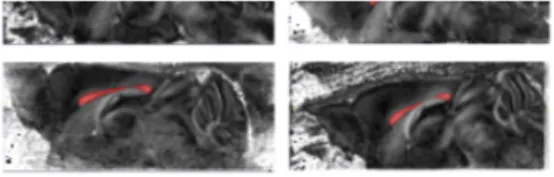
Data preparation: We use FSL’s eddy to correct the data from eddy currents and motion artifacts. We then manually create a mask from the fractional anisotropy (FA) map, as pictured in Fig. 1, to segment the corpus
callosum and separate three regions of interest: genu, body and splenium.
Results and discussion
Fig. 2 indicates that, at short diffusion , time-dependent q -indices are approximated by the first order Taylor in the logarithmic scale. To assess cuprizone effects on q -indices, our analysis focuses on the derived
1 2 2 2 2,3 1 1,4 1 2 3 4 1, 2, 3, 4
τ
5, 6τ
4τ
4 7,8τ
τ
τ
τ index(τ)
log (index(τ))
log τ α log τ + log β log (index(τ))
τ
α
log β
index(τ) ≃ exp(α log τ + log β + Ω(log τ)) = β Ω(log τ) (1)
τ
αα
log β
11.7
τ
4τ
τ
τ
980 × 160 × 5
0.1 × 0.1 × 0.5
3515
variances of estimated from MSD and RTOP. In Fig. 3, for both q -indices, difference of variances is significant in the splenium of the corpus callosum. It is the same in the body for MSD but no significant inhomogeneity is observed elsewhere. Fig. 4 supports this trend by showing large variances of between mice groups, more specifically in the splenium, considering both q -indices. Overall, coefficients of indices determined from the splenium are the most impacted as expected because this region is the most readily affected by cuprizone . Moreover, MSD increases and RTOP decreases over time, see Fig. 2. Indeed as diffusion increases, spins have more time to diffuse, traveling longer distances and reducing their chance to return at the origin .
Conclusion
This abstract presents our preliminary results of the potential of time-dependent dMRI q -indices as in vivo biomakers for myeline-related pathologies through the cuprizone mouse model. We focused on the cuprizone effects on the variance of coefficient derived from time-dependent MSD and RTOP indices. First order Taylor approximation of each q -index gives fitting coefficients and whose physical or physiological meanings are still unknown, however they can be used to quantify the changes caused by cuprizone-induced demyelination.
Acknowledgements
This work was partly supported by ANR “MOSIFAH” under ANR-13-MONU-0 0 09-01, the ERC under the European Union’s Horizon2020 research and innovation program (ERC Advanced Grant agreement no 694665: CoBCoM), MAXIMS grant funded by ICM’s The BigBrain Theory Program and ANR-10-IAIHU-06.
References
1. Bihan, Denis Le. "Molecular diffusion, tissue microdynamics and microstructure." NMR in Biomedicine 8.7 (1995): 375-386.
2. Novikov, Dmitry S., et al. "Revealing mesoscopic structural universality with diffusion." Proceedings of the National Academy of Sciences 111.14 (2014): 5088-5093. 3. Fieremans, Els, et al. "In vivo observation and biophysical interpretation of time-dependent diffusion in human white matter." NeuroImage 129 (2016): 414-427. 4. Fick, Rutger HJ, et al. "Non-parametric graphnet-regularized representation of dMRI in space and time." Medical Image Analysis 43 (2018): 37-53.
5. Praet, Jelle, et al. "Cellular and molecular neuropathology of the cuprizone mouse model: clinical relevance for multiple sclerosis." Neuroscience & Biobehavioral Reviews 47 (2014): 485-505. 6. Jelescu, Ileana O., et al. "In vivo quantification of demyelination and recovery using compartment-specific diffusion MRI metrics validated by electron microscopy." Neuroimage 132 (2016): 104-114. 7. Özarslan, Evren, et al. "Mean apparent propagator (MAP) MRI: a novel diffusion imaging method for mapping tissue microstructure." NeuroImage 78 (2013): 16-32.
8. Fick, Rutger HJ, et al. "MAPL: Tissue microstructure estimation using Laplacian-regularized MAP-MRI and its application to HCP data." NeuroImage 134 (2016): 365-385.
9. Filipiak, Patryk, et al. "Spatio-Temporal dMRI Acquisition Design: Reducing the Number of q Samples Through a Relaxed Probabilistic Model." MICCAI 2017 Workshop on Computational Diffusion MRI (CDMRI 2017). 2017.
10. Steelman, Andrew J., Jeffrey P. Thompson, and Jianrong Li. "Demyelination and remyelination in anatomically distinct regions of the corpus callosum following cuprizone intoxication." Neuroscience research 72.1 (2012): 32-42.
β
τ
β
τ
β
10τ
7τ
β
τ
α
β
τ
Figures
Figure 1. Illustrations of segmentation of the corpus callosum, colored in red from the FA map, of mice brains selected from the control group (top) and the cuprizone-treated group (bottom), respectively.
Figure 2. Mean and standard deviation of MSD and RTOP estimated from the genu, the body and the splenium of the corpus callosum. In each region, the qτ-index is fitted in the logarithmic scale by a linear function (dashed line) of log(τ) derived from the first order Taylor approximation.